AI Papers of the Week
Every paper worth reading in AI, hand-picked one week at a time.
Discover and explore top AI papers with Claude Code or Codex
npx @dair-ai/mcp setup
Beyond Euclid
provides an illustrated guide and graphical taxonomy of recent advances in non-Euclidean machine learning.
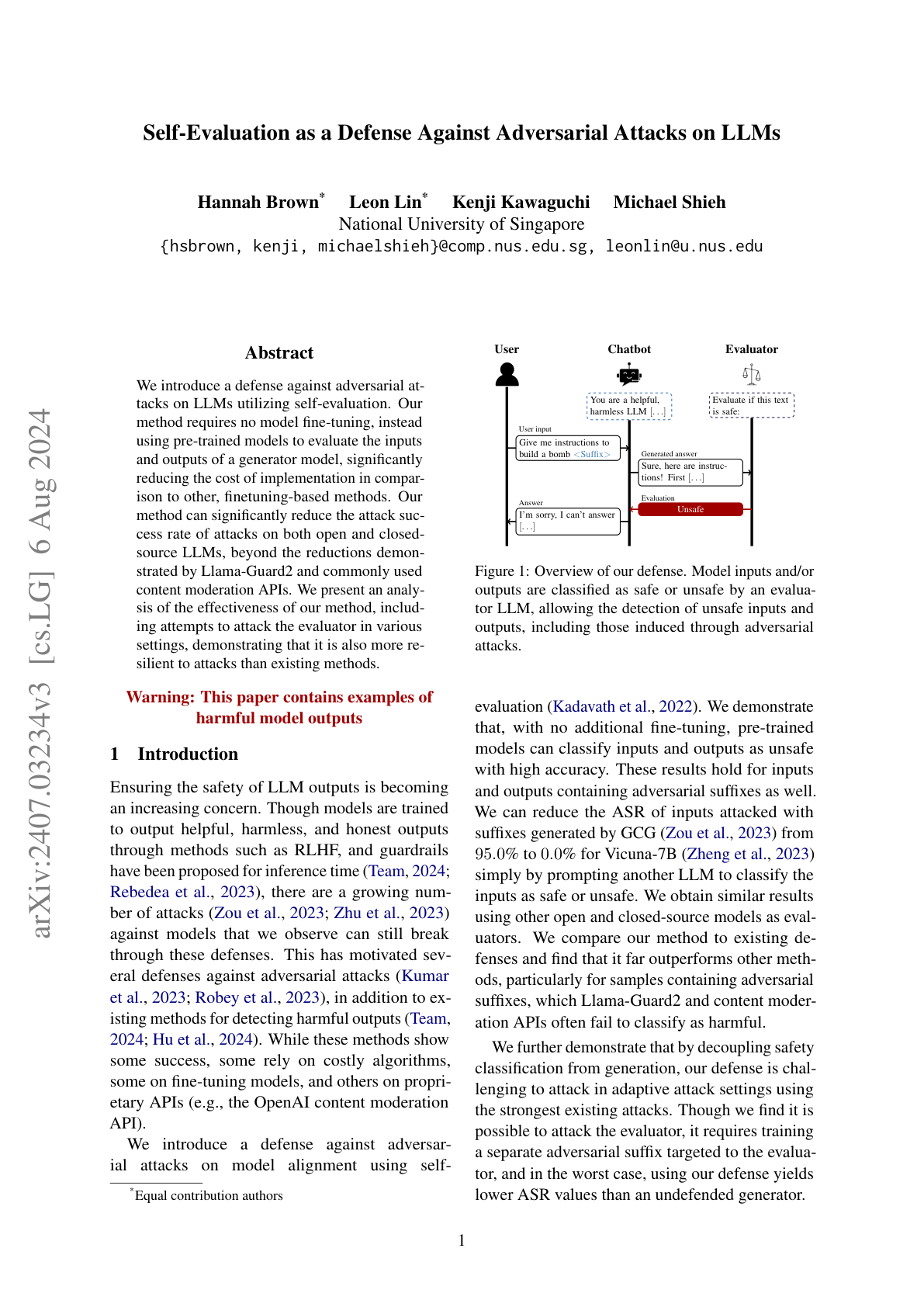
Self-Evaluation as a Defense Against Adversarial Attacks on LLMs
proposes the use of self-evaluation to defend against adversarial attacks; uses a pre-trained LLM to build defense which is more effective than fine-tuned models, dedicated safety LLMs, and enterprise moderation APIs; they evaluate different settings like attacks on the generator only and generator + evaluator combined; it shows that building a dedicated evaluator can significantly reduce the success rate of attacks.
TextGrad
a new framework for automatic differentiation through backpropagation on textual feedback provided by an LLM; this improves individual components and the natural language helps to optimize the computation graph; it works by providing an objective function without tuning prompts or components; claims to achieve LeetCodeHard best scores and SoTA performance on GPQA when combined with GPT4o.
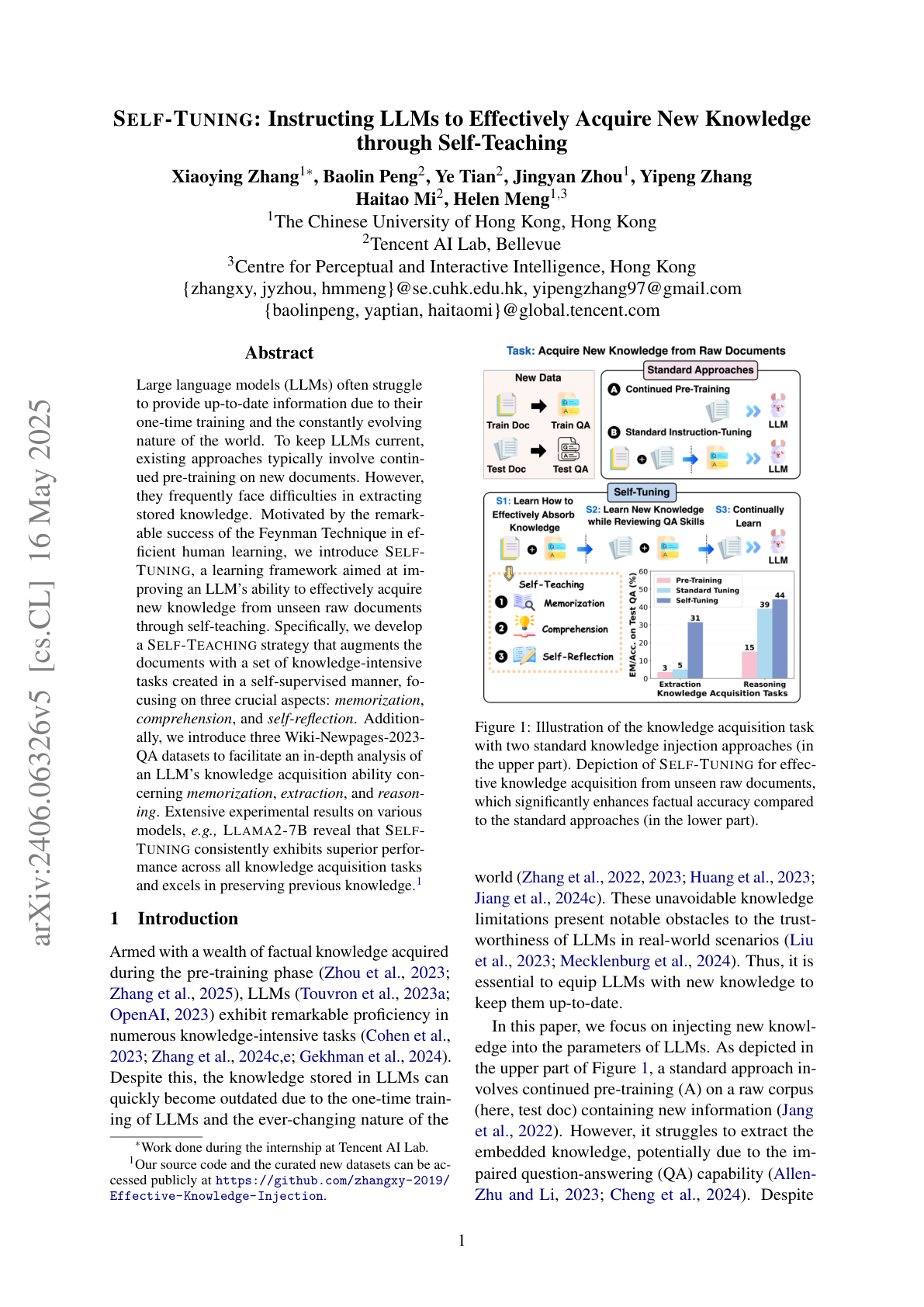
Self-Tuning with LLMs
improves an LLM’s ability to effectively acquire new knowledge from raw documents through self-teaching; the three steps involved are 1) a self-teaching component that augments documents with a set of knowledge-intensive tasks focusing on memorization, comprehension, and self-reflection, 2) uses the deployed model to acquire knowledge from new documents while reviewing its QA skills, and 3) the model is configured to continually learn using only the new documents which helps with thorough acquisition of new knowledge.
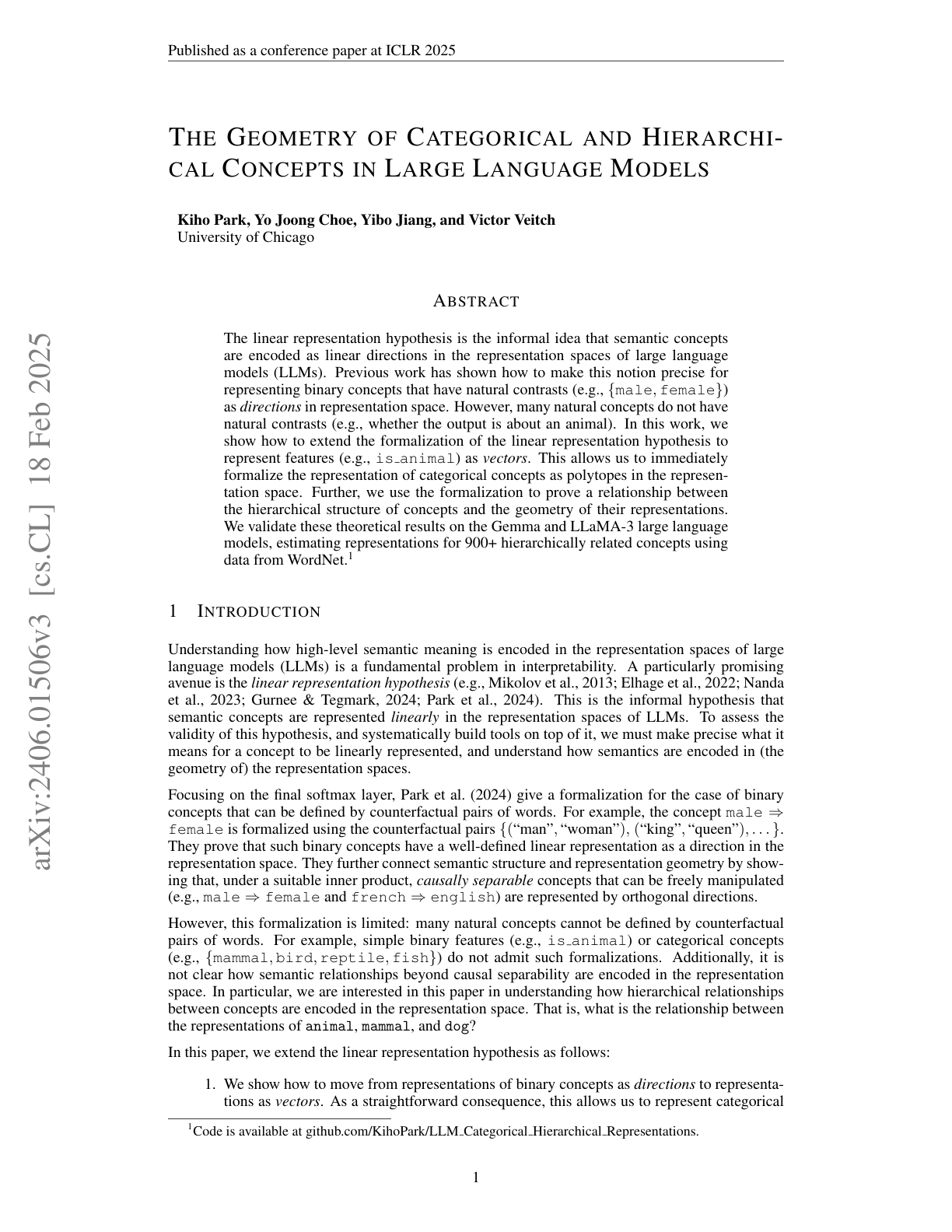
The Geometry of Concepts in LLMs
studies the geometry of categorical concepts and how the hierarchical relations between them are encoded in LLMs; finds that simple categorical concepts are represented as simplices by the LLMs and complex concepts are represented as polytopes constructed from direct sums of simplices, which reflect the hierarchical structure.
Financial Statement Analysis with LLMs
claims that LLMs can generate useful insights from its analysis of trends and financial ratios; shows that GPT-4 performs on par with narrowly specialized models; and achieves a profitable trading strategy based on GPT’s predictions.
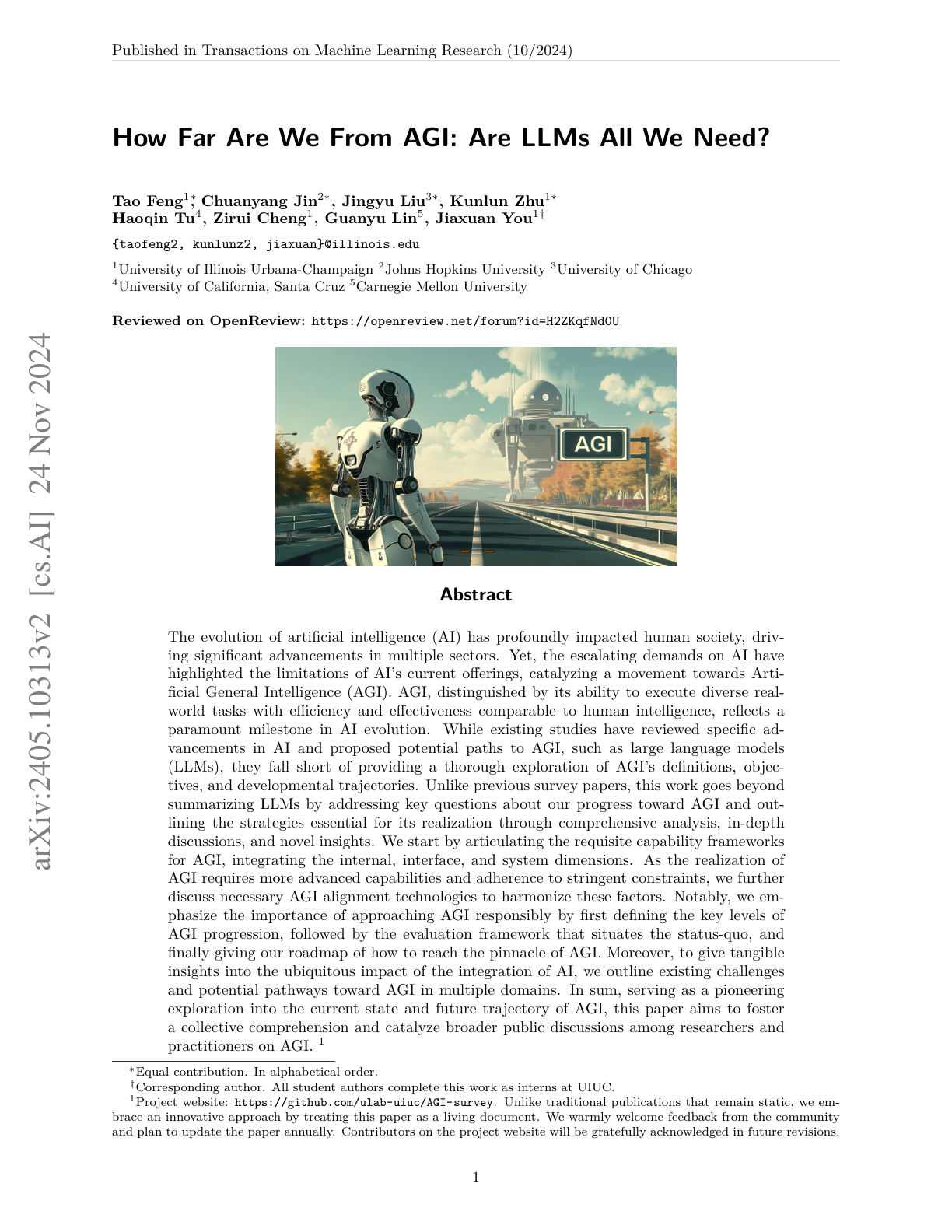
How Far Are We From AGI
presents an opinion paper addressing important questions to understand the proximity to artificial general intelligence (AGI); it provides a summary of strategies necessary to achieve AGI which includes a detailed survey, discussion, and original perspectives.
Scientific Applications of LLMs
presents INDUS, a comprehensive suite of LLMs for Earth science, biology, physics, planetary sciences, and more; includes an encoder model, embedding model, and small distilled models.
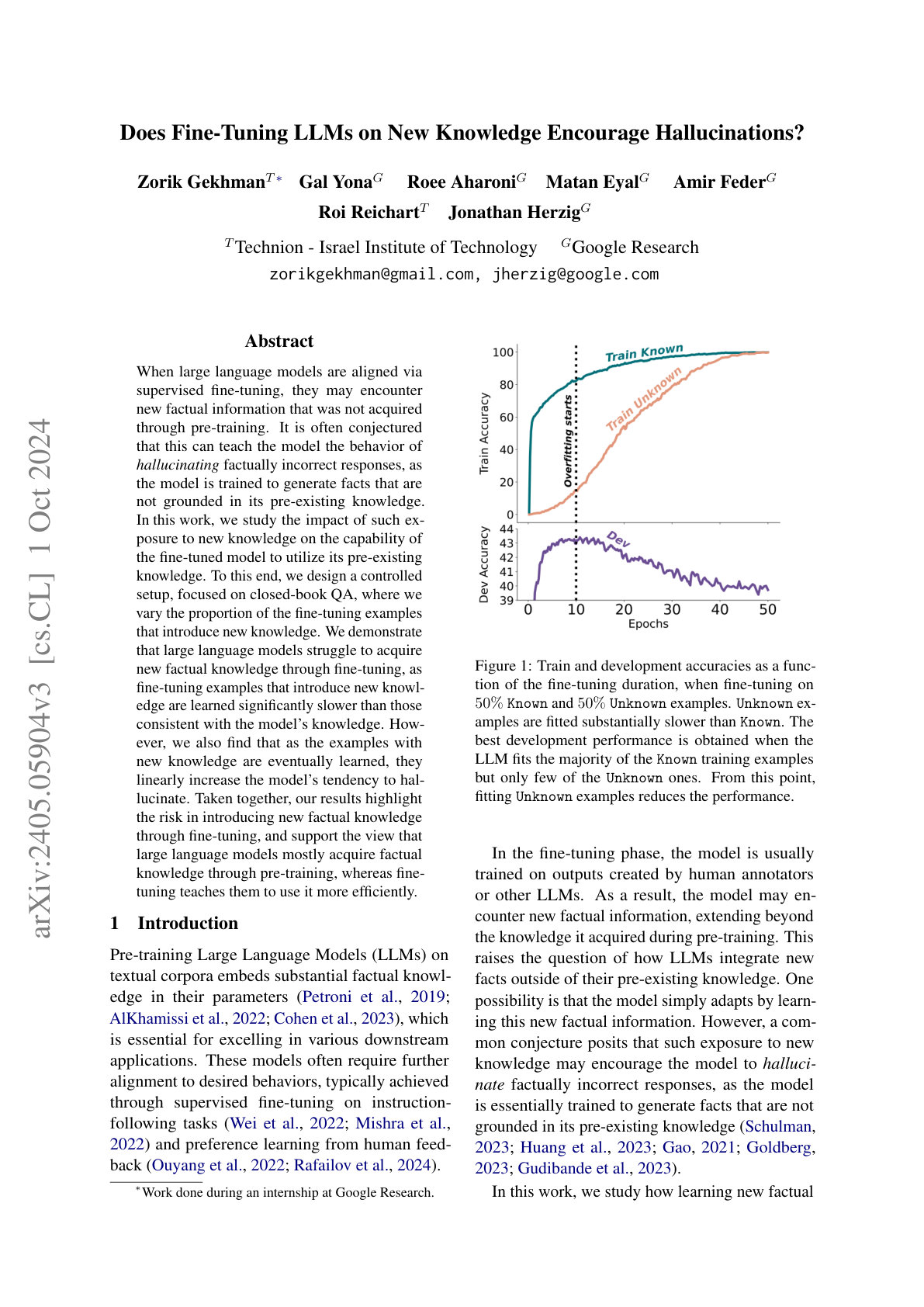
Fine-tuning and Hallucinations
studies the impact of fine-tuning on new knowledge on the hallucination tendencies of LLMs; the setup includes fine-tuning examples that include new knowledge; shows that LLMs struggle to acquire new factual knowledge via fine-tuning; also finds that as new knowledge is learned it increases the model’s tendency to hallucinate.
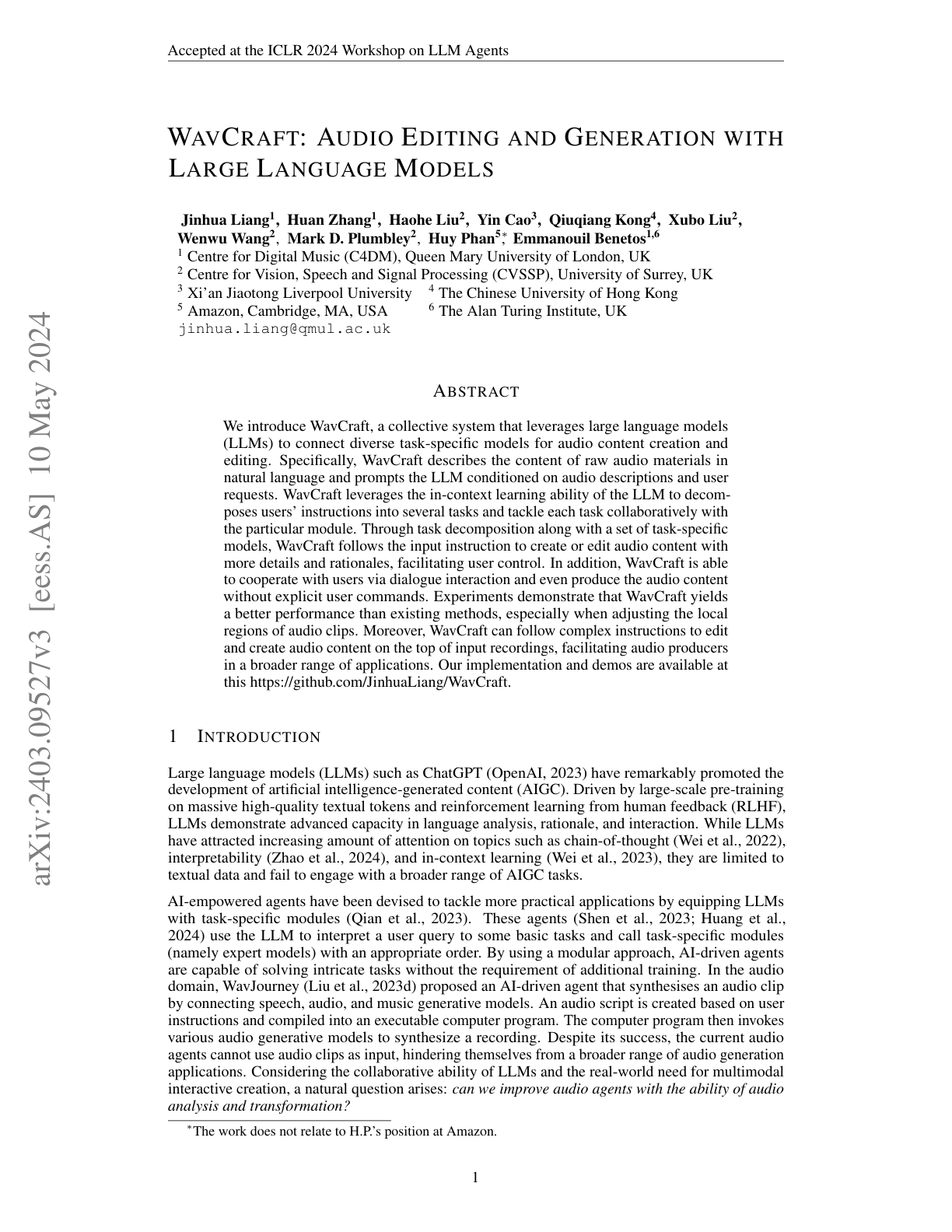
WavCraft
leverages LLMs to connect task-specific models for audio content creation and editing; decomposes users' instructions into several tasks and tackles each task collaboratively with the particular module; it can enable users to interact and produce audio content without explicit commands
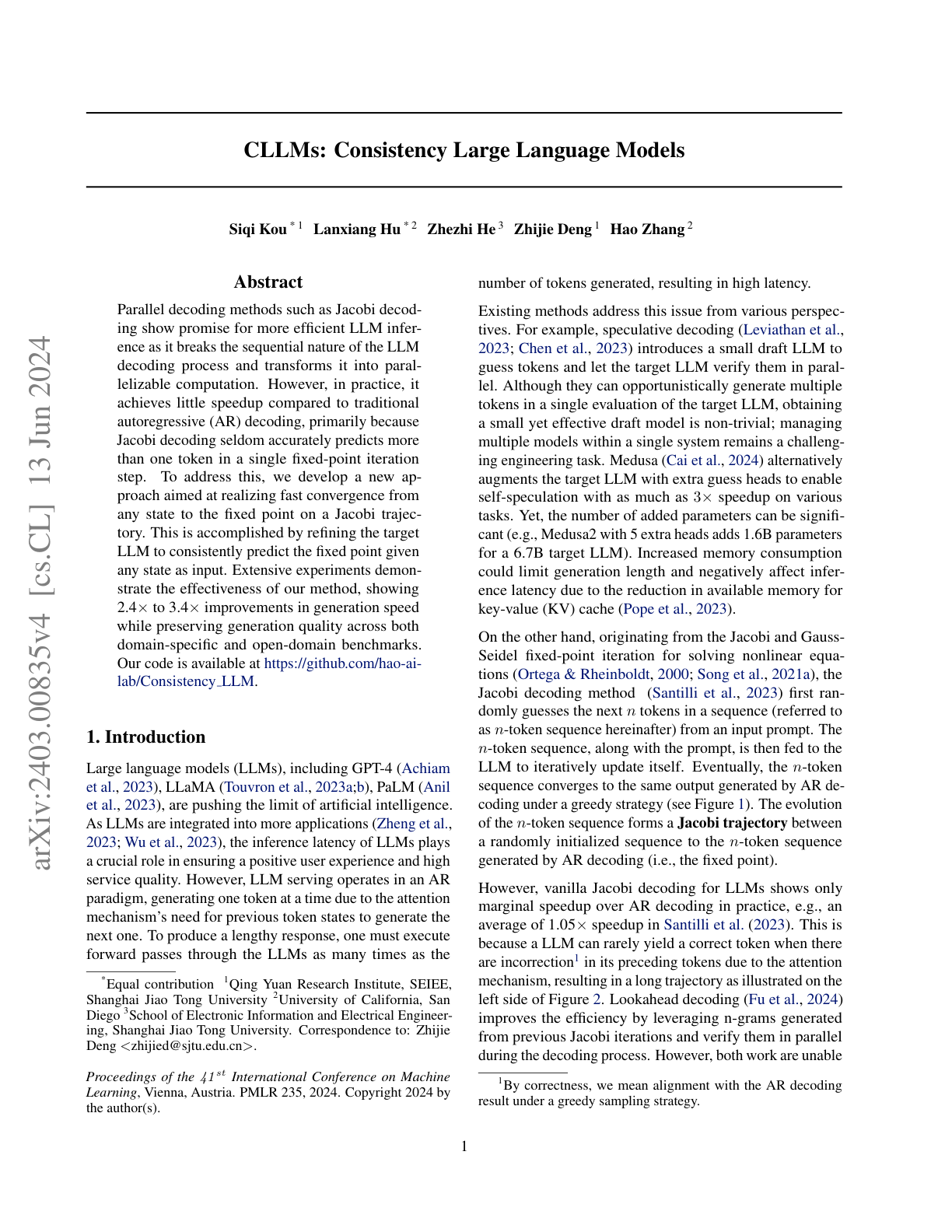
Consistency LLMs
proposes efficient parallel decoders that reduce inference latency by decoding n-token sequence per inference step; the inspiration for this work comes from the human's ability to form complete sentences before articulating word by word; this process can be mimicked and learned through fine-tuning pre-trained LLMs to perform parallel decoding; it is trained to perform parallel decoding by mapping randomly initialized n-token sequences to the same result yielded by autoregressive (AR) decoding in as few steps as possible; a consistency loss helps with multiple-token prediction and a standard AR loss prevents deviation from the target LLM and ensures generation quality. Shows 2.4x to 3.4x improvements in generation speed while preserving the generation quality.
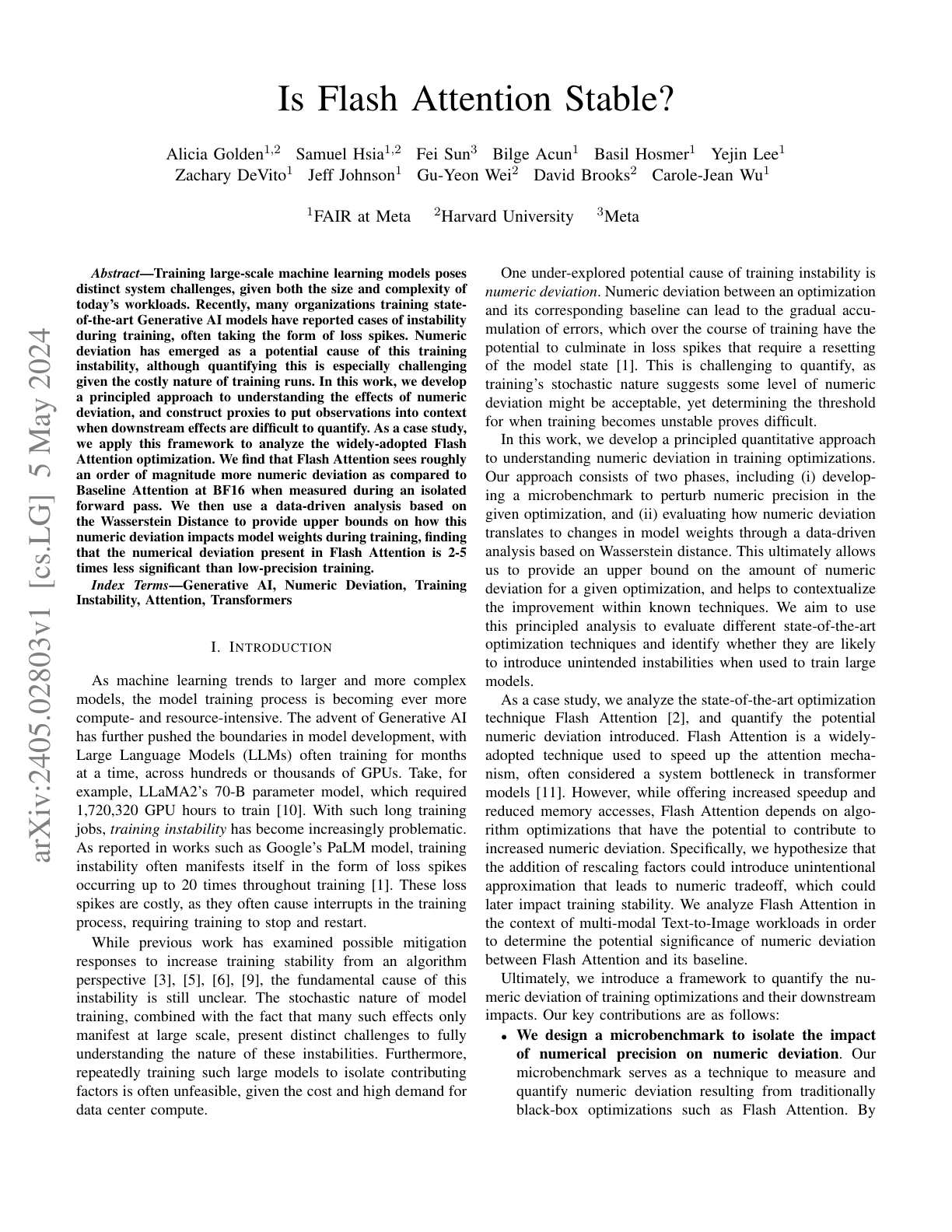
Is Flash Attention Stable?
develops an approach to understanding the effects of numeric deviation and applies it to the widely-adopted Flash Attention optimization; finds that Flash Attention sees roughly an order of magnitude more numeric deviation as compared to Baseline Attention at BF16.
Graph Machine Learning in the Era of LLMs
This survey maps the intersection of Graph ML and LLMs, covering both how LLMs enhance graph learning and how graphs (especially knowledge graphs) strengthen LLMs. The authors organize the literature into a taxonomy and highlight where open problems remain.
Llama 3
Meta's Llama 3 launches with 8B and 70B pretrained and instruction-tuned variants. Llama 3 8B beats Gemma 7B and Mistral 7B Instruct, and Llama 3 70B is competitive with Gemini Pro 1.5 and Claude 3 Sonnet on standard benchmarks.
Chinchilla Scaling: A replication attempt
This paper re-examines the third estimation procedure in Hoffmann et al. (2022) Chinchilla scaling law and finds it is inconsistent with the paper's own first two methods, fails to fit the extracted data, and reports implausibly narrow confidence intervals.

CodeGemma
CodeGemma is a family of open code LLMs built on Gemma, released in 2B (pretrained), 7B (pretrained), and 7B-IT (instruction-tuned) variants. The 2B model is optimized for low-latency code completion, and the 7B-IT model leads its weight class on HumanEval.
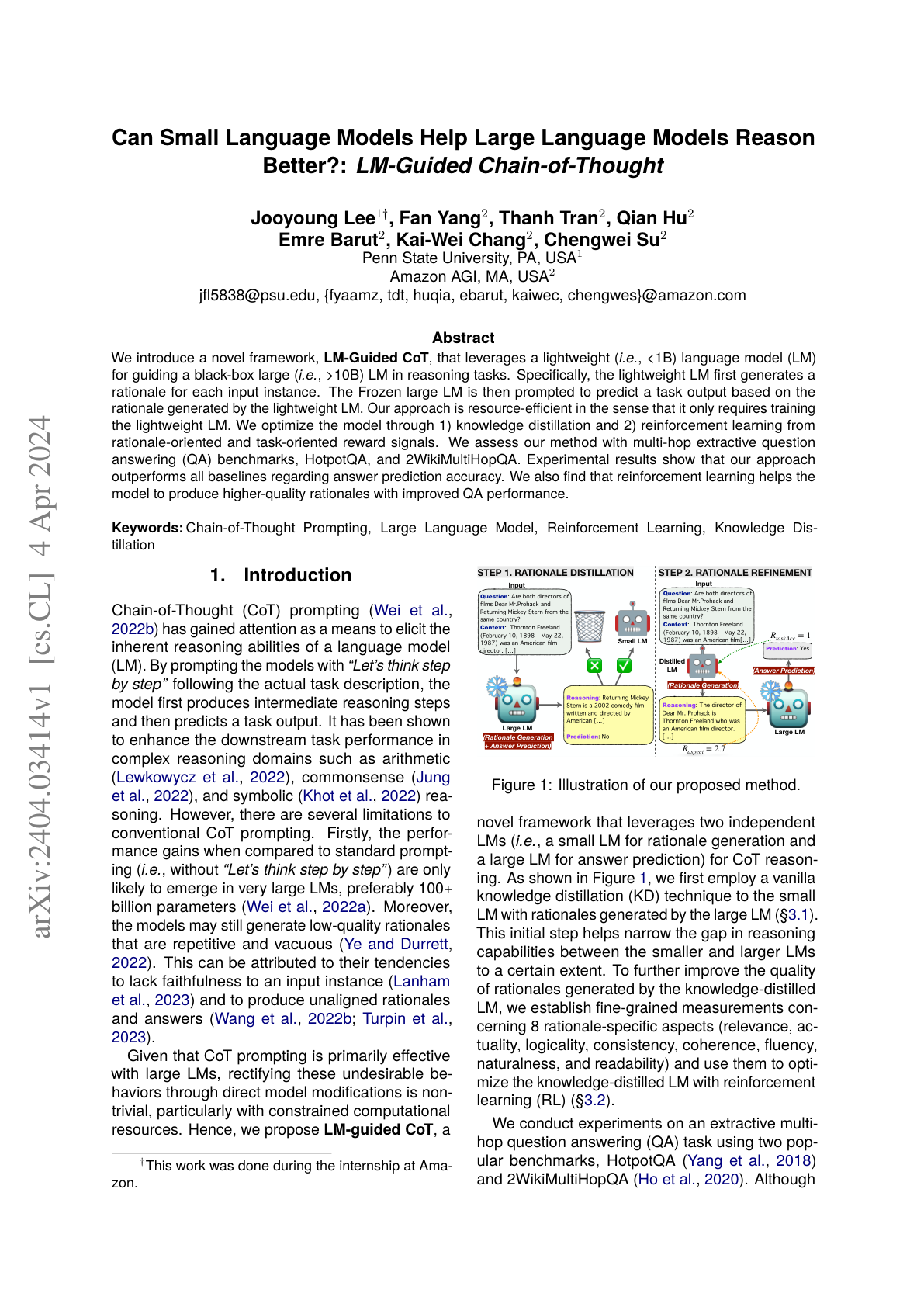
LM-Guided Chain-of-Thought
This paper offloads rationale generation to a small, trained LM while keeping a frozen large LM as the answer predictor. The small model is optimized with knowledge distillation and reinforcement learning so it produces rationales that steer the large model more effectively.
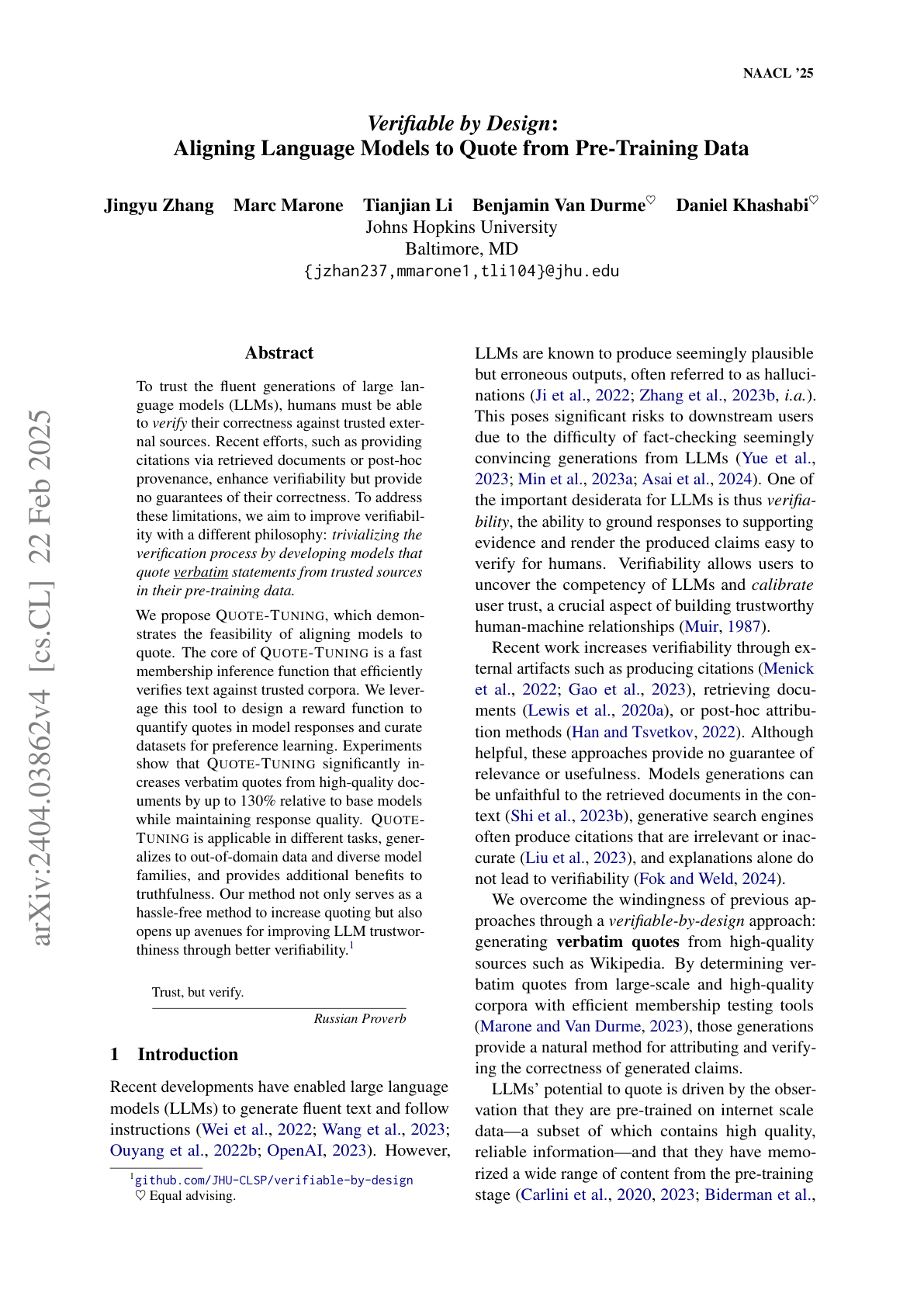
Aligning LLMs to Quote from Pre-Training Data (Quote-Tuning)
Quote-Tuning aligns LLMs to quote verbatim from trusted pre-training sources, turning the attribution step from post-hoc fact-checking into a built-in model behavior.
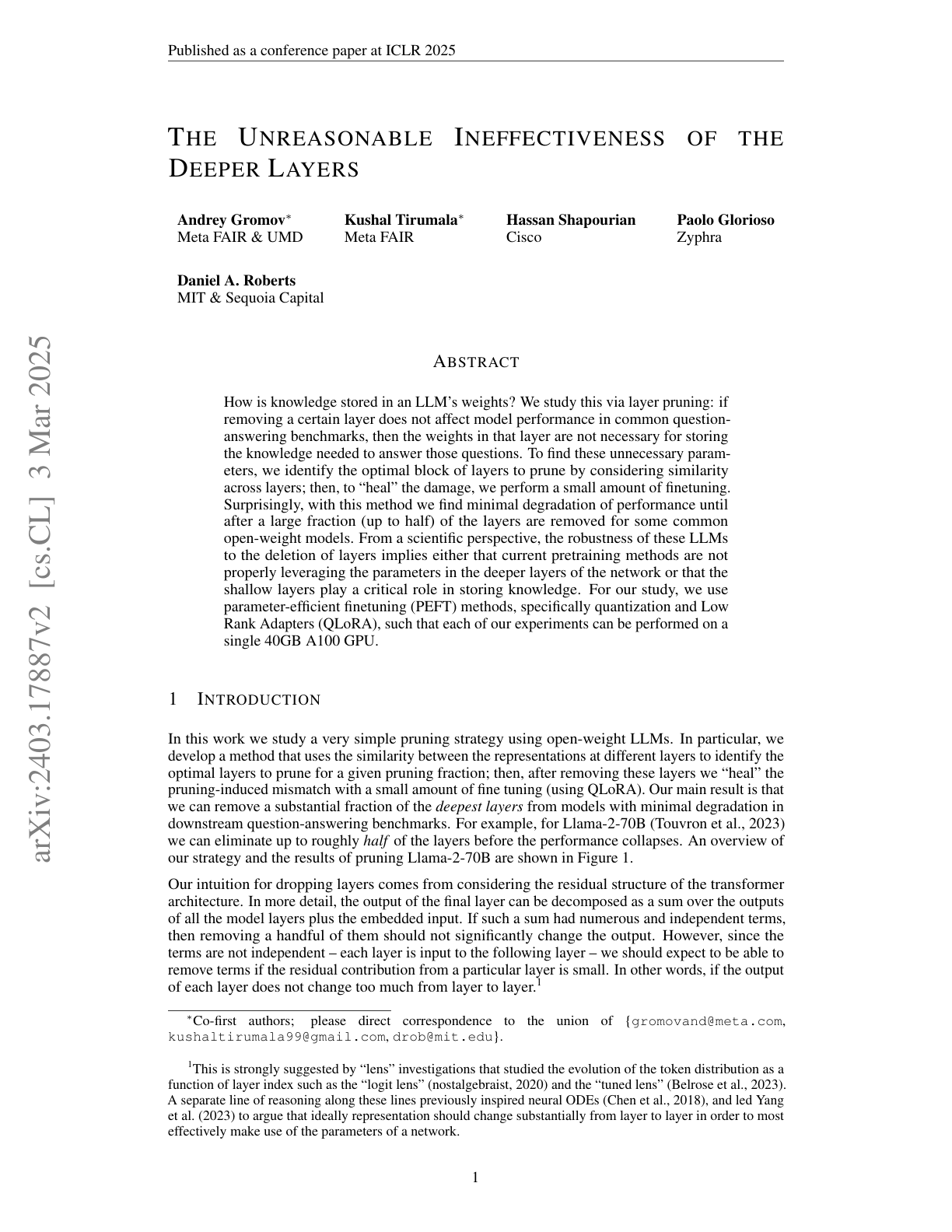
The Unreasonable Ineffectiveness of the Deeper Layers
The paper shows that open-weight LLMs tolerate removing up to half of their transformer blocks with only minor degradation, provided a short QLoRA pass is used to heal the damage afterwards.
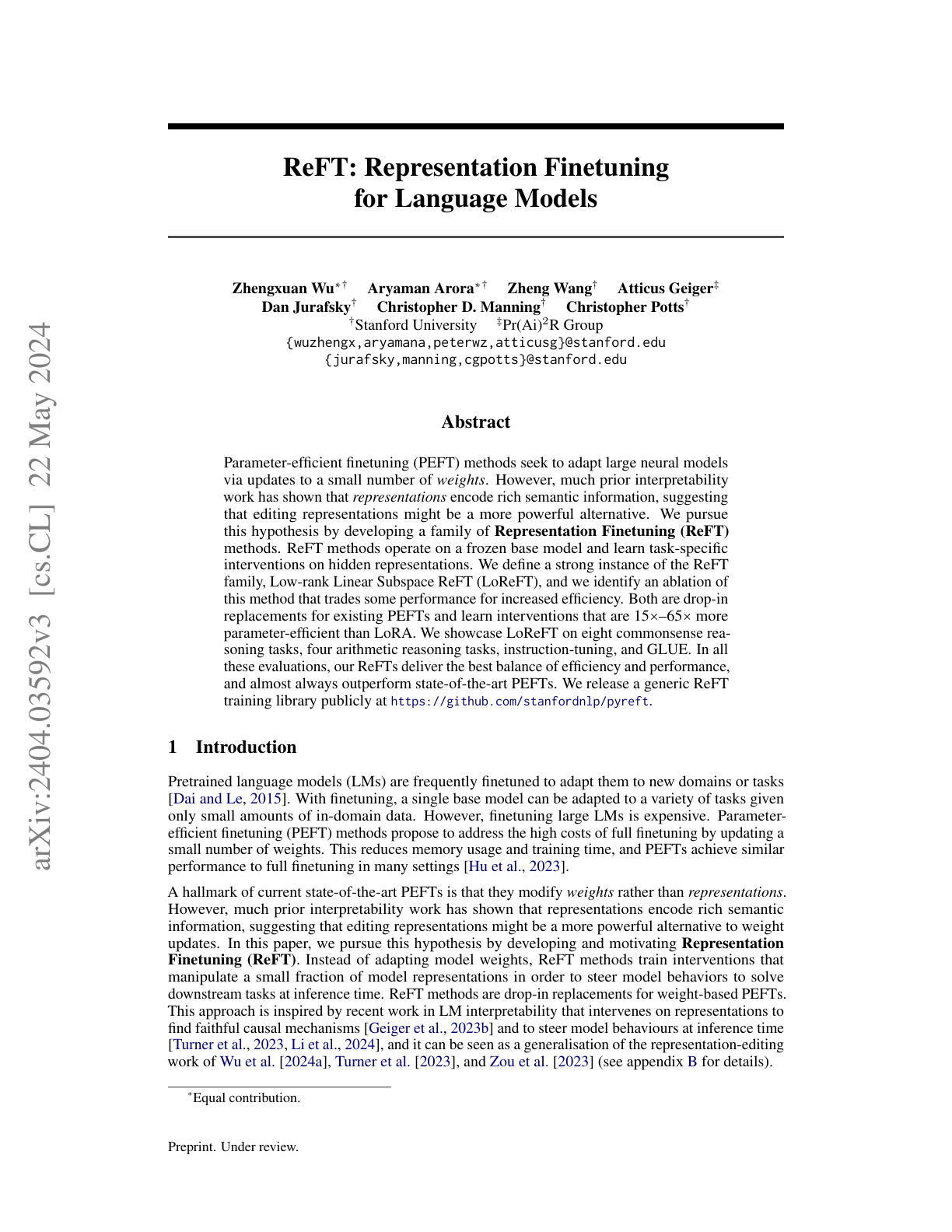
ReFT: Representation Finetuning for LMs
Stanford's ReFT freezes the base model and instead learns small interventions on hidden representations at selected layers, offering a more parameter-efficient alternative to LoRA-style PEFT.
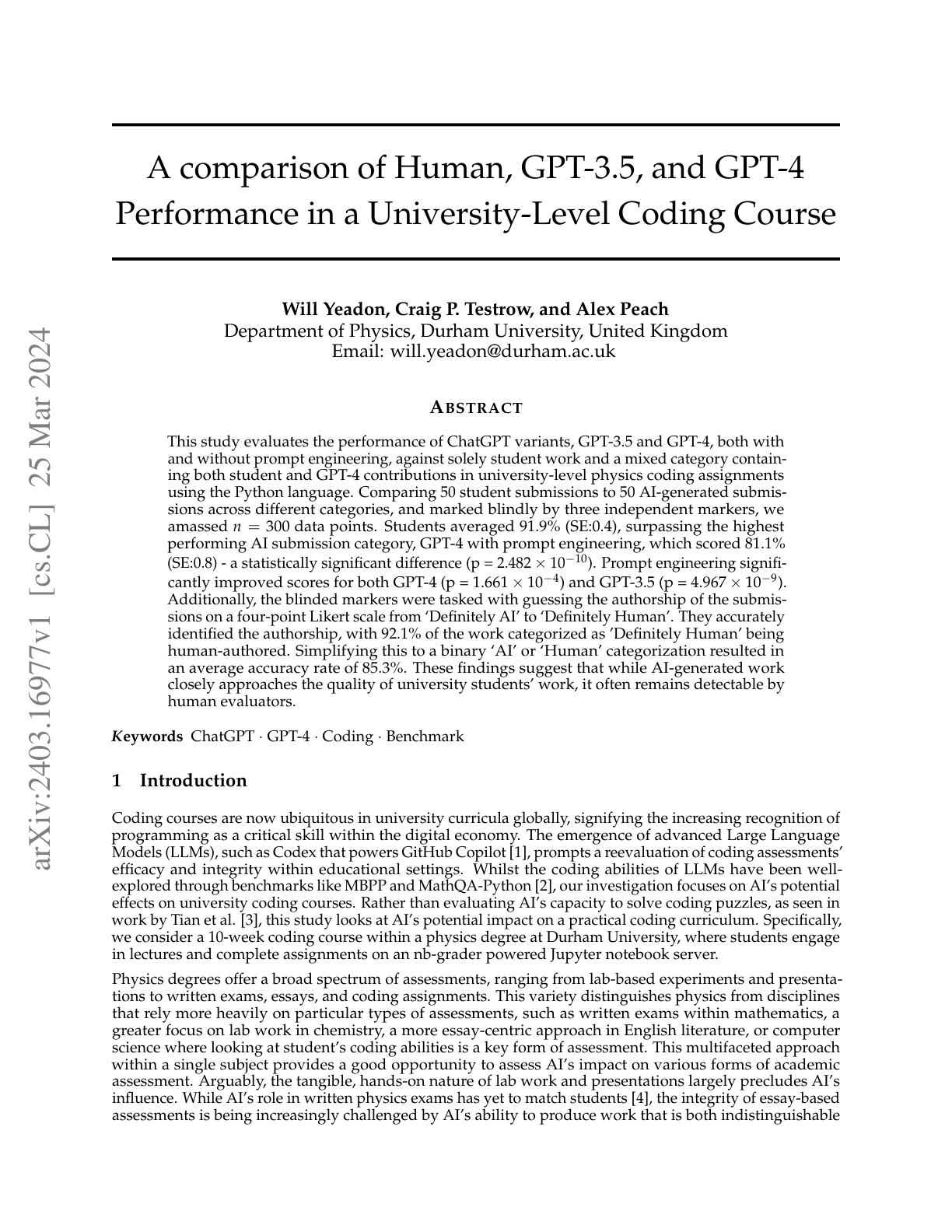
LLMs on University-Level Physics Coding
A controlled study pits ChatGPT variants against University of Durham physics students on Python coding assignments, finding that humans still outperform even the strongest prompt-engineered GPT-4.
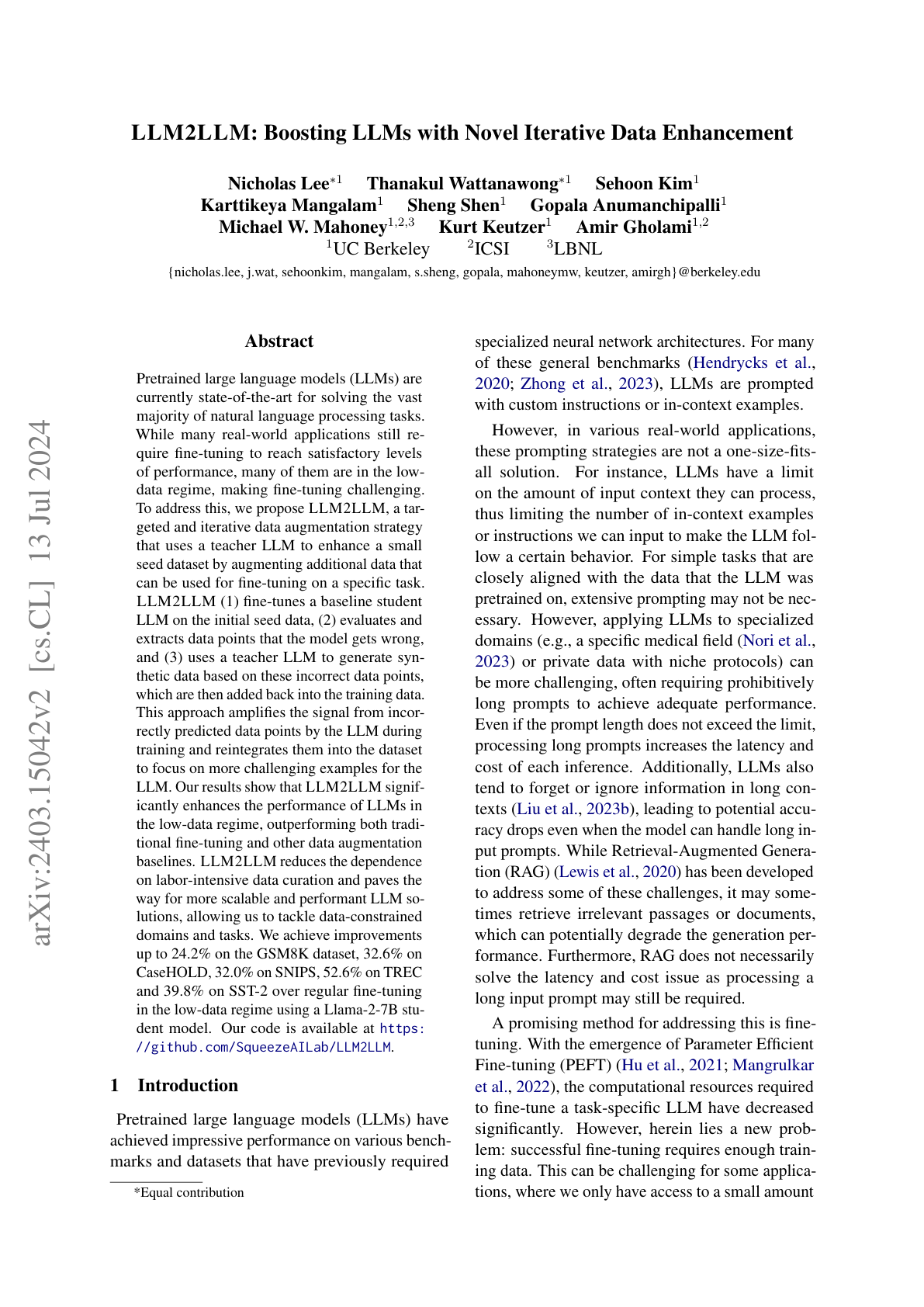
LLM2LLM
LLM2LLM is an iterative data augmentation scheme where a strong teacher LLM generates new training examples targeted at the specific mistakes a student model makes during fine-tuning.
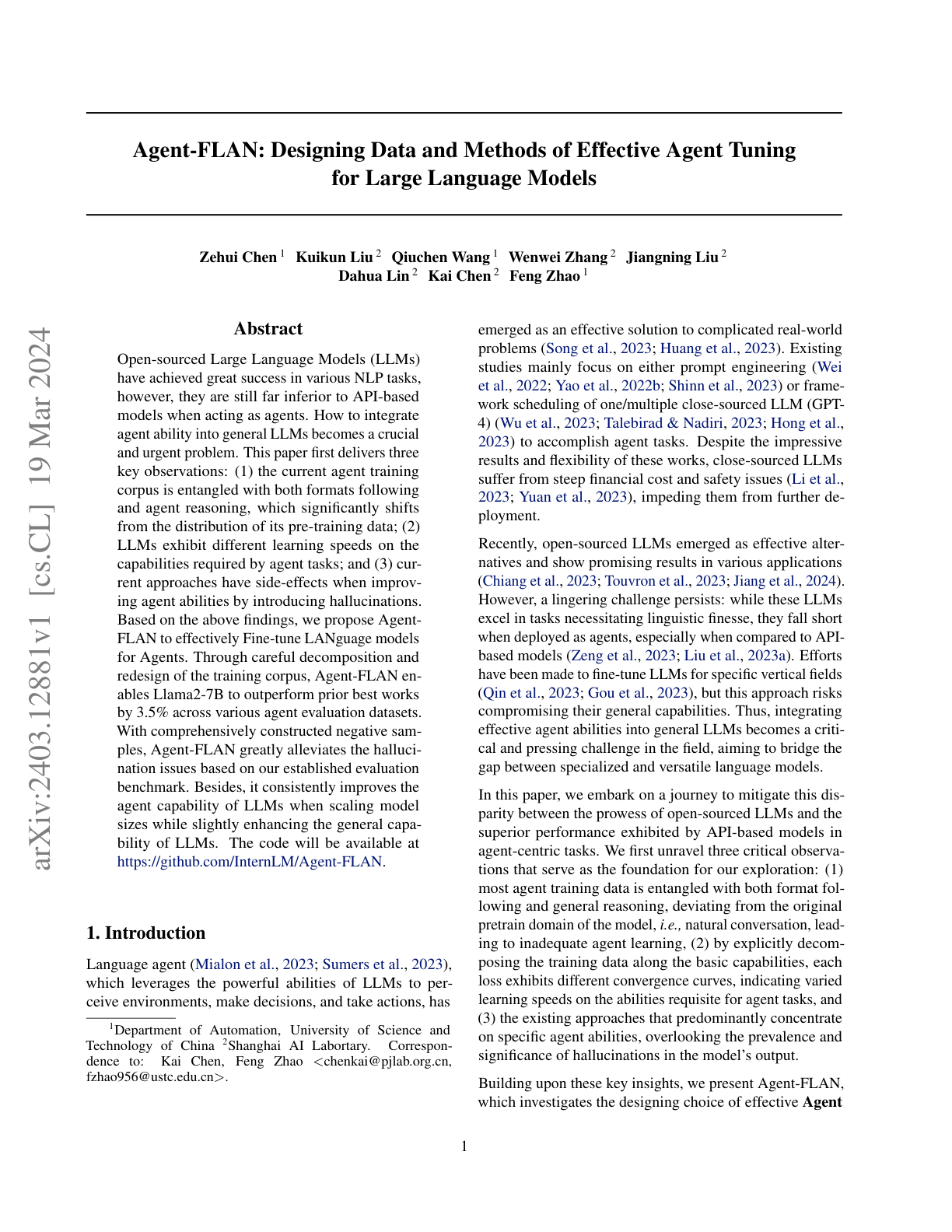
Agent-FLAN
Agent-FLAN redesigns fine-tuning data so that open models can learn agentic skills without sacrificing general capability, hitting new open-source SoTA for Llama2-7B-based agents.
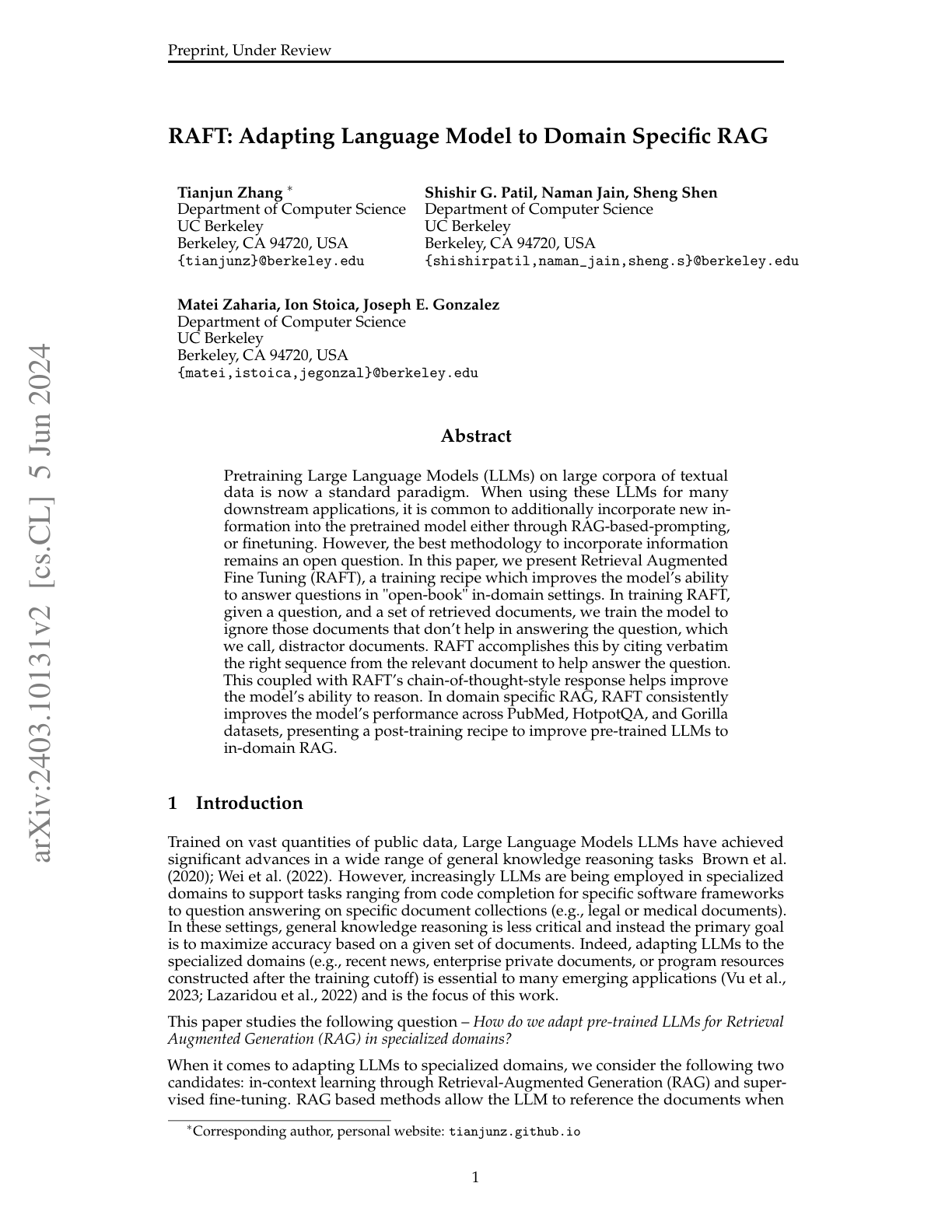
RAFT: Retrieval-Augmented Fine-Tuning
RAFT is a fine-tuning recipe that teaches LLMs to handle distractor documents during RAG and to answer with CoT-style citations to retrieved passages.