AI Papers of the Week
Every paper worth reading in AI, hand-picked one week at a time.
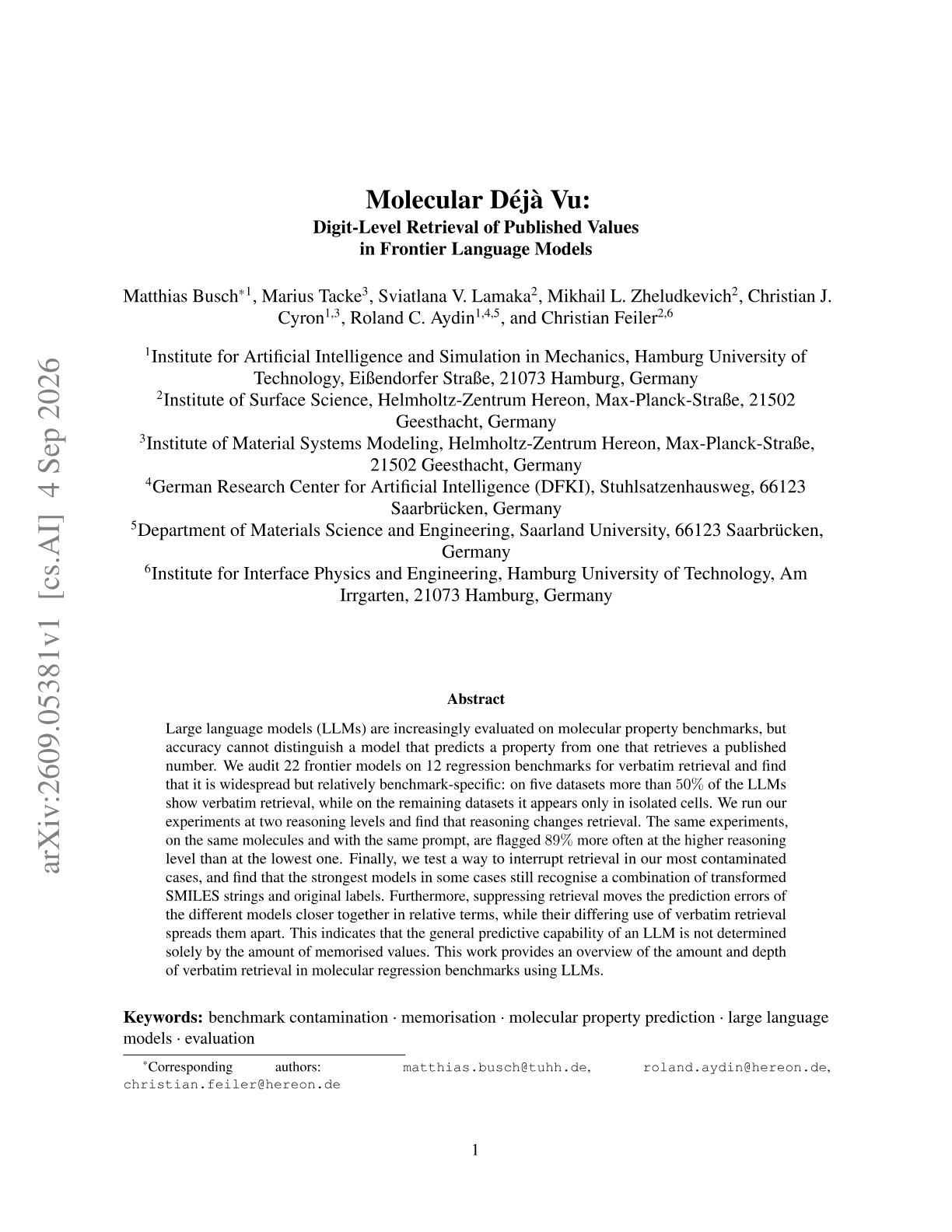
Molecular Déjà Vu: Digit-Level Retrieval of Published Values in Frontier Language Models
Matthias Busch and colleagues at Helmholtz-Zentrum Hereon and Hamburg University of Technology audit 22 frontier models on 12 molecular regression benchmarks to separate models that predict a property from models that reproduce a published number.
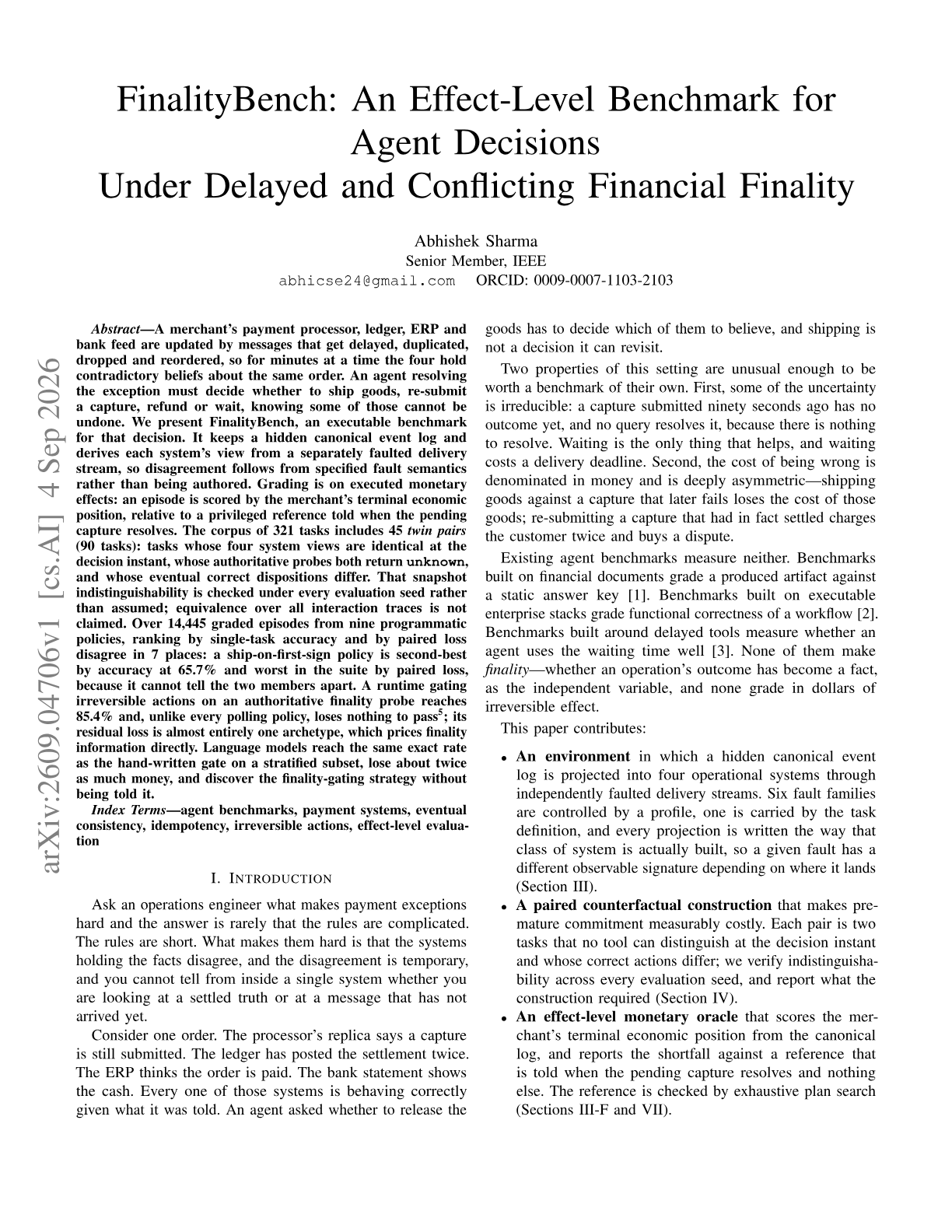
FinalityBench: An Effect-Level Benchmark for Agent Decisions Under Delayed and Conflicting Financial Finality
Abhishek Sharma builds an executable benchmark for agents resolving payment exceptions when a merchant's processor, ledger, ERP and bank feed hold contradictory beliefs about the same order, and grades on executed monetary effects rather than answer accuracy.
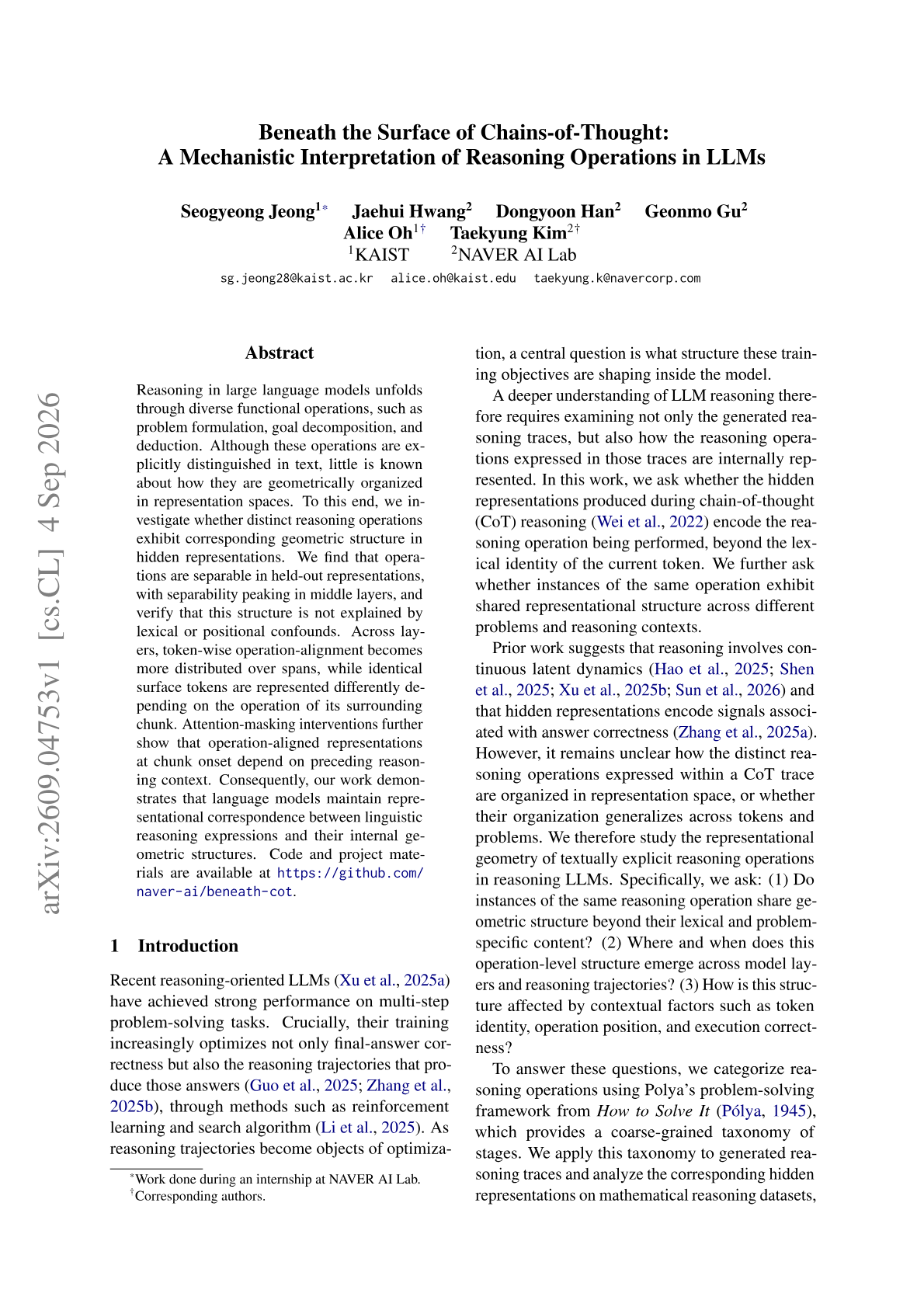
Beneath the Surface of Chains-of-Thought: A Mechanistic Interpretation of Reasoning Operations in LLMs
Seogyeong Jeong and colleagues at KAIST and NAVER AI Lab test whether the functional operations inside a chain of thought, such as problem formulation, goal decomposition and deduction, have distinct geometric structure in hidden representations.
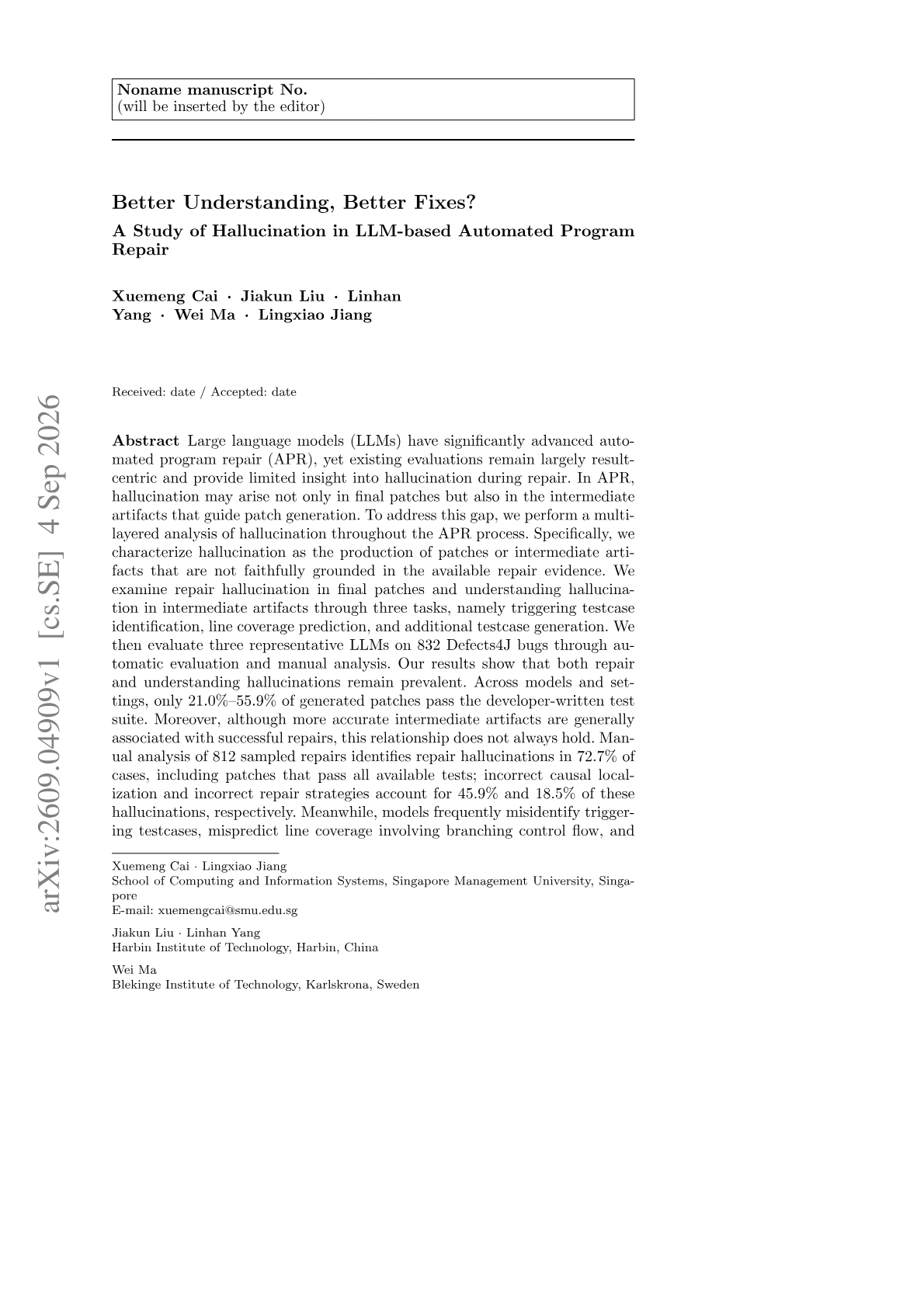
Better Understanding, Better Fixes? A Study of Hallucination in LLM-based Automated Program Repair
Xuemeng Cai and colleagues at Singapore Management University and Harbin Institute of Technology measure hallucination not only in the final patch of an LLM program repair run but in the intermediate artifacts that lead to it, over 832 Defects4J bugs and three models.
Optimizer Memory Schedules for Outscaling the Overtraining Axis
Katie Everett (MIT CSAIL) and Shikai Qiu (NYU) show that optimizer rankings and optimal hyperparameters change substantially as the training horizon extends, and argue that overtraining factor belongs on the axis list for optimizer evaluation.
Training-Free Halving of Activated Experts in Fine-Grained Mixture-of-Experts Models
Xing Chen and Hengshuai Yao separate two effects that are conflated when you reduce top-k at MoE inference time, and recover most of the lost accuracy with a single integer and no training.
Ask Before You Optimize: Dynamic Pre-Formulation Clarification for Interactive Optimization
Sihan Ge and colleagues at Cardinal Operations and Shanghai Jiao Tong University benchmark whether an LLM agent knows when to ask a clarifying question before turning a natural-language operations research request into a mathematical program.
What Matters in On-Policy Distillation? A Perspective on Data Efficiency and Data Selection
Zhinan Hou and colleagues at Tsinghua University and Meituan study what data on-policy distillation actually needs, and find that eight hard examples match a 17K-example baseline.
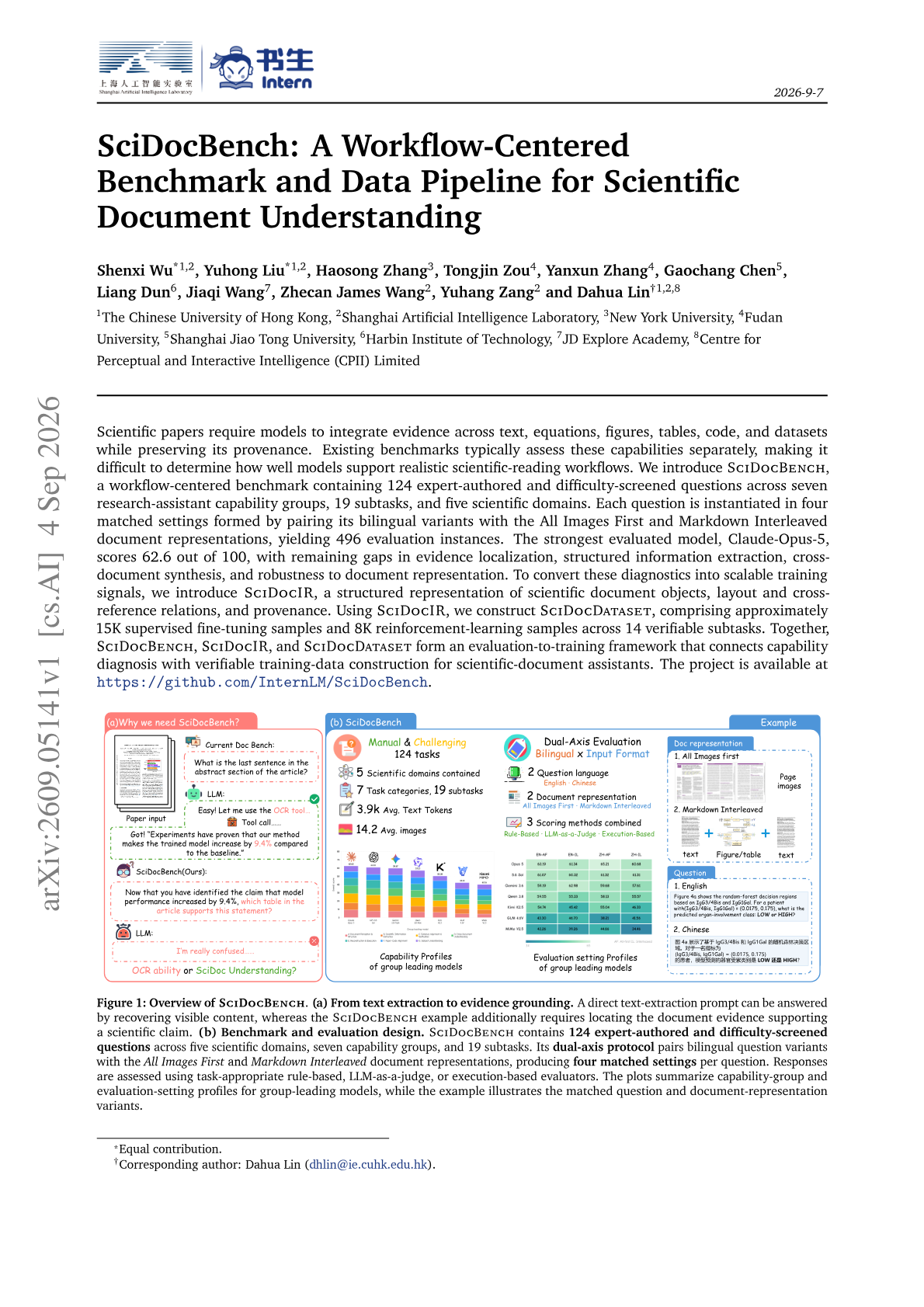
SciDocBench: A Workflow-Centered Benchmark and Data Pipeline for Scientific Document Understanding
Shenxi Wu and colleagues at The Chinese University of Hong Kong and Shanghai AI Laboratory build a benchmark that tests scientific document understanding as a research-assistant workflow rather than as isolated perception, retrieval and reasoning tasks, and ship the training data to improve it.
How a Chatbot's Response Style Shapes a Classroom: A Multi-Agent Simulation of Students Consulting AI
Rin Tamai and Yuya Dan at Matsuyama University simulate a classroom of 20 student agents who consult either a friend or a counselor AI when stressed, and vary the counselor's response style to see how AI dependence accumulates over days.
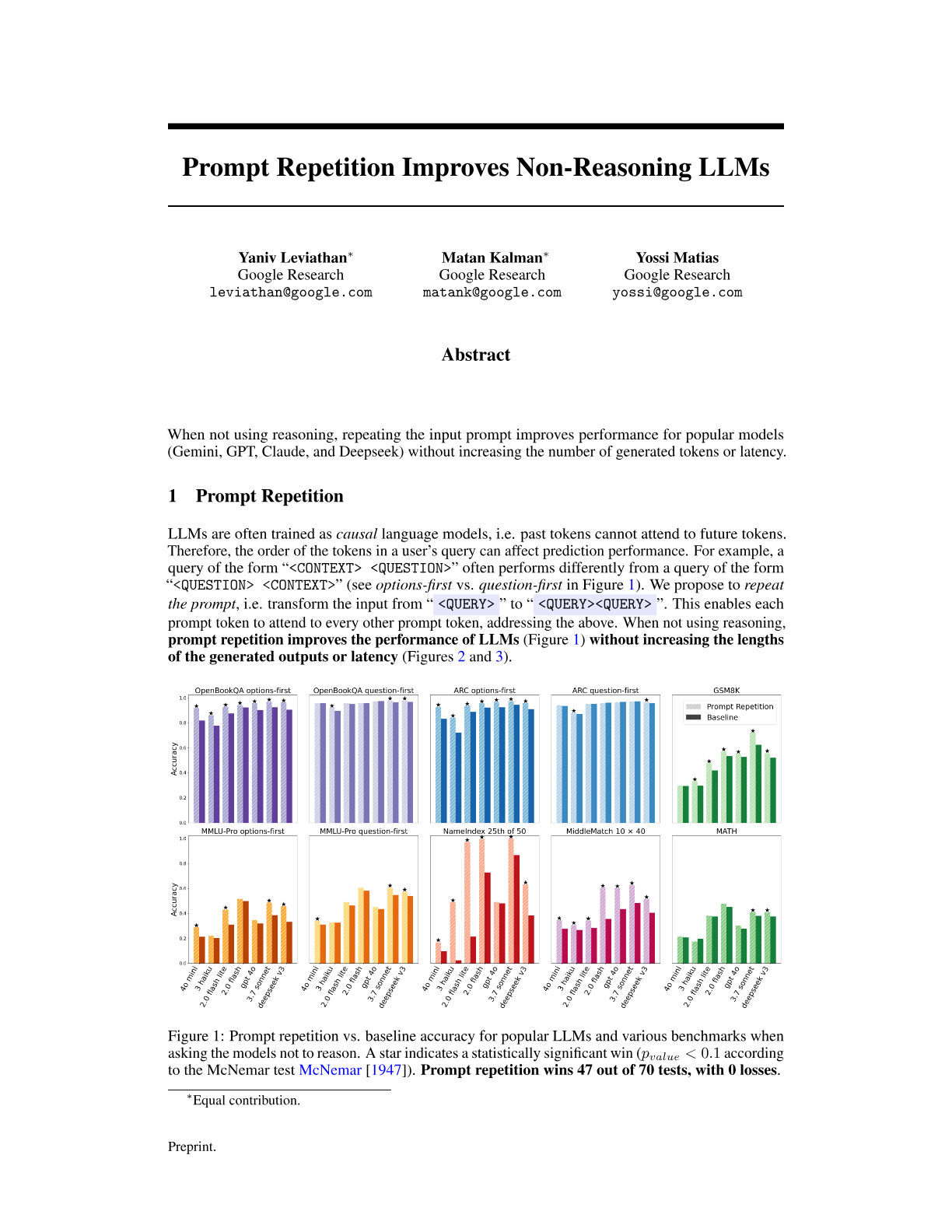
Prompt Repetition Improves Non-Reasoning LLMs
Yaniv Leviathan, Matan Kalman and Yossi Matias at Google Research report that simply repeating the input prompt improves non-reasoning model performance across Gemini, GPT, Claude and DeepSeek.
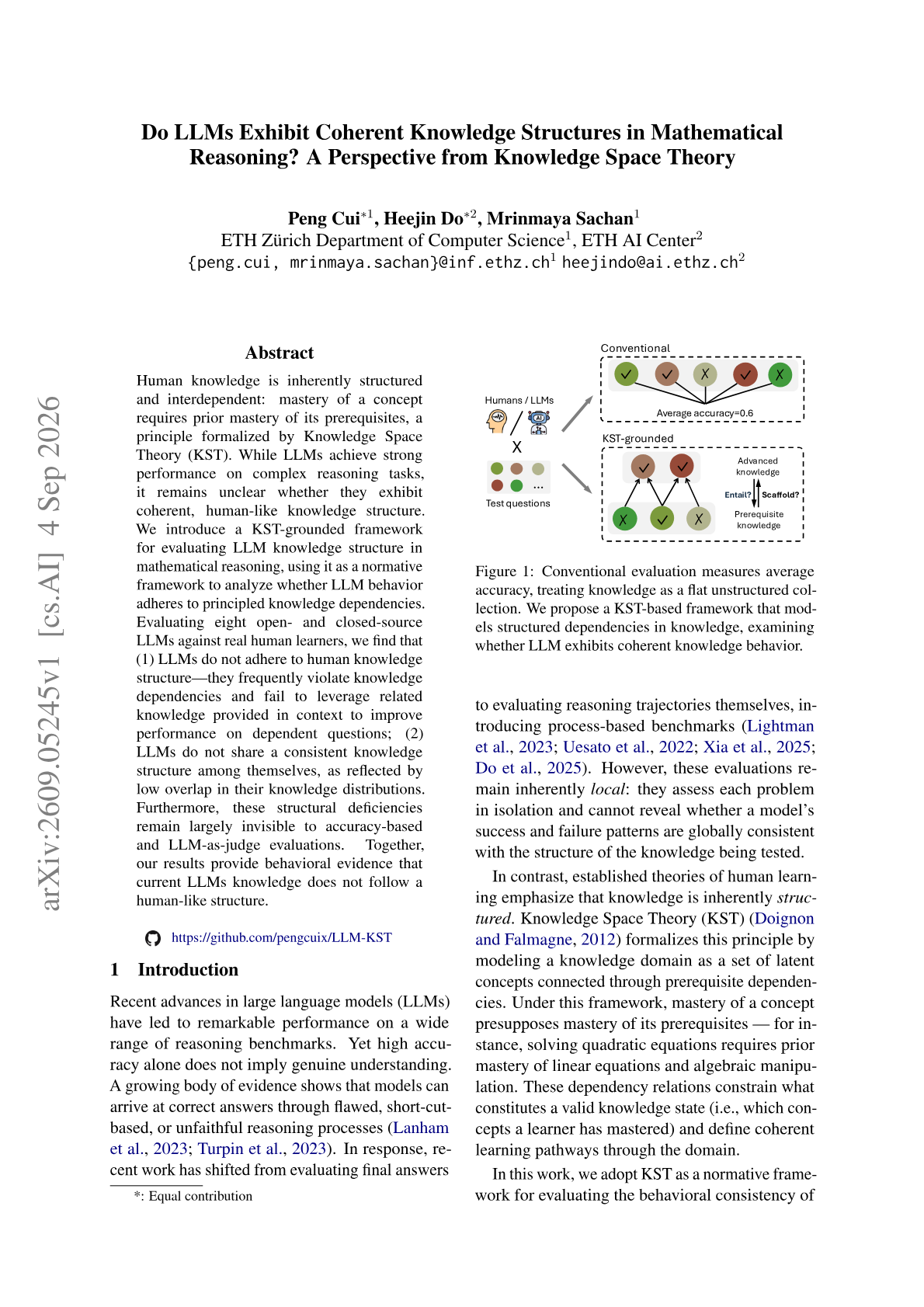
Do LLMs Exhibit Coherent Knowledge Structures in Mathematical Reasoning? A Perspective from Knowledge Space Theory
Peng Cui, Heejin Do and Mrinmaya Sachan at ETH Zurich apply Knowledge Space Theory, which formalizes the idea that mastering a concept requires mastering its prerequisites, as a normative standard for LLM mathematical knowledge, and compare eight models against real human learners.
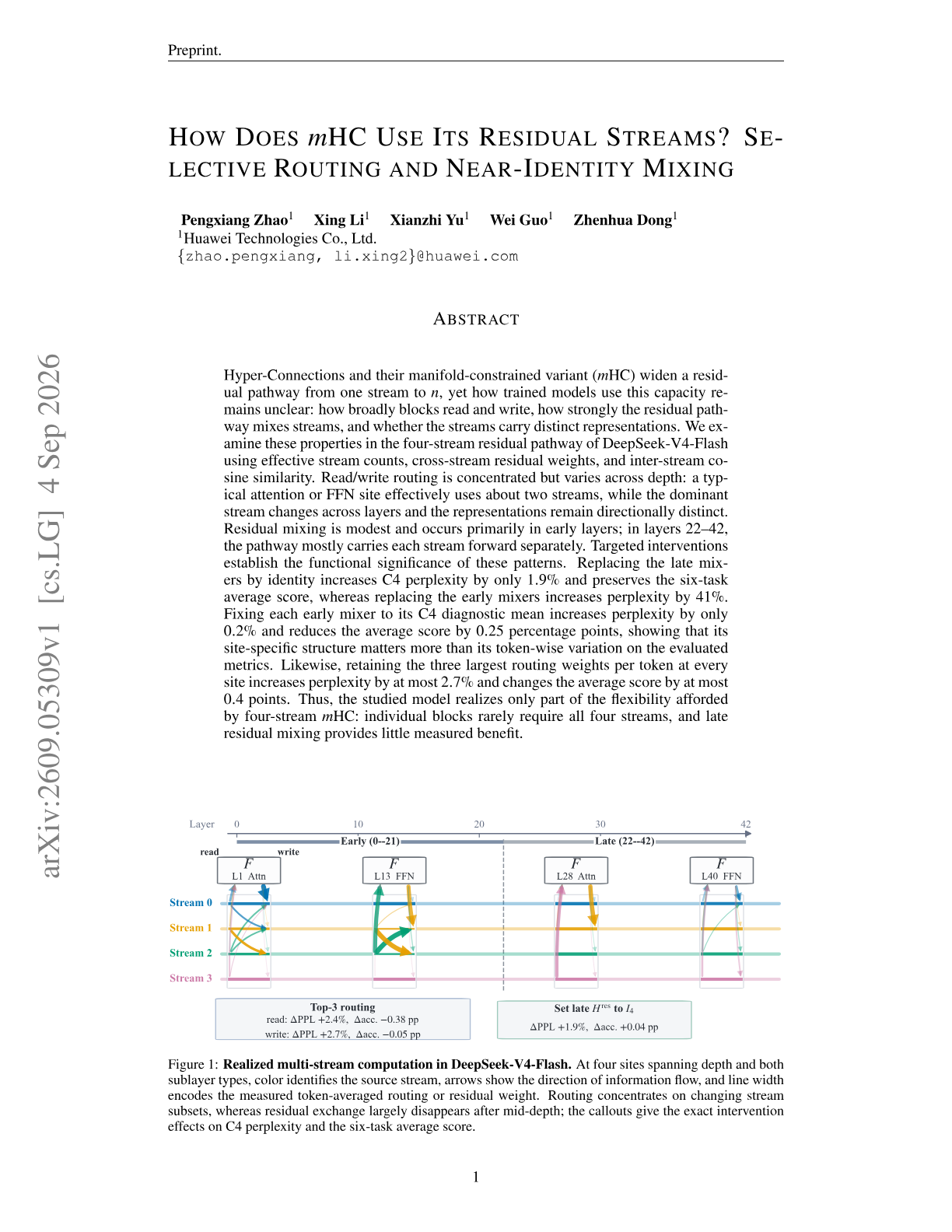
How Does mHC Use Its Residual Streams? Selective Routing and Near-Identity Mixing
Pengxiang Zhao and colleagues at Huawei measure how DeepSeek-V4-Flash actually uses the four-stream residual pathway that manifold-constrained Hyper-Connections provide, and find most of the added capacity unused.
Measuring AI Accountability Through Argumentation Analysis: Can Model Reasoning Withstand Scrutiny?
Daan Henselmans, Derck Prinzhorn and Arno Libert at the Aithos Research Foundation score how well a model can defend its verdict under critical questioning, using a standard that does not require ground truth about the right answer.
Knowing What Not to Answer: Selective Non-Compliance in Vision-Language Models
Minji Kim, Jihyoung Jang and Hyounghun Kim at POSTECH argue that non-compliance in vision-language models is evaluated at the wrong granularity, and build a benchmark where a single query mixes answerable content with content that should be withheld.
Single-Query Black-Box Calibration Auditing via Logit Bias
Roman Plaud and colleagues at Institut Polytechnique de Paris, Onepoint and Ghent University show that a logit_bias parameter is enough to recover exact probability thresholds from an API that hides output probabilities, using one query per sample.
RefactorPlatform: An Open-Source Harness for Controlled Evaluation of Repository-Scale Refactoring Agents
Aziz Ben Amor and colleagues at Pi School release RefactorPlatform, an evaluation harness that holds the environment fixed and varies one coding-agent design axis at a time on 100 repository-scale RefactorBench tasks.
LLM-Guided Program Evolution for Circle Packing: Breaking 10 Packomania Records for $28
Wes Sander at Practical Systems runs an LLM-guided evolutionary loop over optimization algorithms and improves 10 published Packomania circle-packing records for a total LLM spend of $27.72.
$τ^τ$-Bench: An Environment for End-To-End, Realistic Agent Construction
Quan Shi, Keshav Dhandhania, Karthik Narasimhan and Victor Barres at Sierra and Princeton make agent construction itself the benchmark task: a developer agent must deliver a working customer-service agent under the conditions of a real client engagement.
From Language Models to World-Acting Systems: Progress and Limits of Agentic AI across Digital, Social, Virtual, and Physical Environments
Linsen Zhu and Mengqing Cai review the agentic-AI literature through 31 August 2026 and separate three things the field routinely conflates: model competence, harness integration, and the authority a deployment actually grants an agent.
Does Your Agent's Memory Survive a Model Upgrade? A Controlled Study of Memory Portability
Ankit Goyal and Jaideep Ray at LinkedIn run a controlled study of what happens to an agent's memory store when the model reading it changes, comparing verbatim long context, chunked RAG, model-written notes, and a fixed-schema knowledge graph.
Compact-Memory LLM Agents via Online Max-Member Clustering and Atom-Aware Packing
Jiahe Geng, Jinpeng Wang and Kun Yuan build RSM-full, an online clustered-memory pipeline for LLM agents operating under a 2k to 5k prompt-token budget, and show the gain comes from how memories are merged and packed rather than from raw recall.
From Interaction Traces to Persistent Skills: Online Evolution for Computer-Use Agents
Longtao Hu, Xiao Liang and Linchao Zhu turn a computer-use agent's interaction traces into a persistent versioned skill library and measure the incremental value against a configuration-matched empty-library control.
KVMem: Virtualizing Million-Token Agent Workspaces on a Consumer GPU
Di Chai and colleagues at Shanghai University of Finance and Economics and Peking University page an agent's overflowed workspace history as KV state across GPU memory, host memory, and NVMe, instead of compacting it into summaries or re-retrieving it as text.