AI Papers of the Week
Every paper worth reading in AI, hand-picked one week at a time.

OpenCoder
introduces OpenCoder, a fully open-source LLM specialized for code generation and understanding; the authors identify several critical factors for building high-performing code LLMs: (1) effective data cleaning with code-optimized heuristic rules for deduplication, (2) recall of relevant text corpus related to code, and (3) high-quality synthetic in both annealing and supervised fine-tuning stages; OpenCoder surpasses previous fully open models at the 6B+ parameter scale and releases not just the model weights but also the complete training pipeline, datasets, and protocols to enable reproducible research.

The Surprising Effectiveness of Test-Time Training for Abstract Reasoning
explores test-time training (TTT) - updating model parameters temporarily during inference - for improving an LLM's abstract reasoning capabilities using the ARC benchmark; identifies three crucial components: initial fine-tuning on similar tasks, auxiliary task format and augmentations, and per-instance training; TTT significantly improves performance, achieving up to 6x improvement in accuracy compared to base fine-tuned models; when applying TTT to an 8B LLM, they achieve 53% accuracy on ARC's public validation set, improving the state-of-the-art for neural approaches by nearly 25%; by ensembling their method with program generation approaches, they achieve state-of-the-art public validation accuracy of 61.9%, matching average human performance; the findings suggest that explicit symbolic search is not the only path to improved abstract reasoning in LLMs; test-time training applied to continued training on few-shot examples can be highly effective.

Mitigating LLM Jailbreaks with Few Examples
introduces a new approach called for defending LLMs against jailbreak attacks, focusing on quickly adapting defenses after detecting new attacks rather than aiming for perfect adversarial upfront robustness; using a new benchmark, the most effective method, based on fine-tuning an input classifier, reduced attack success rates by over 240x for known attack types and 15x for novel variations after seeing just one example of each attack strategy; demonstrates that rapidly responding to new jailbreaks can be an effective alternative to traditional static defenses.

A Comprehensive Survey of Small Language Models
a survey on small language models (SLMs) and discussion on issues related to definitions, applications, enhancements, reliability, and more.

Number Understanding of LLMs
provides a comprehensive analysis of the numerical understanding and processing ability (NUPA) of LLMs; finds that naive finetuning can improve NUPA a lot on many but not all tasks; it also reports that techniques designed to enhance NUPA prove ineffective for finetuning pretrained models; explores chain-of-thought techniques applied to NUPA and suggests that chain-of-thought methods face scalability challenges, making them difficult to apply in practical scenarios.

Adapting while Learning
proposes a two-part fine-tuning approach that first helps LLMs learn from tool-generated solutions and then trains them to determine when to solve problems directly versus when to use tools; testing on math, climate science, and epidemiology benchmarks shows significant improvements, with a 28% boost in accuracy and 14% better tool usage precision compared to leading models like GPT-4 and Claude-3.5; the two-stage approach helps the LLM to adaptively solve scientific problems of varying complexity.

Personalization of LLMs
presents a comprehensive framework for understanding personalized LLMs; introduces taxonomies for different aspects of personalization and unifying existing research across personalized text generation and downstream applications.

LLMs Solve Math with a Bag of Heuristics
uses causal analysis to find neurons that explain an LLM's behavior when doing basic arithmetic logic; discovers and hypothesizes that the combination of heuristic neurons is the mechanism used to produce correct arithmetic answers; finds that the unordered combination of different heuristic types is the mechanism that explains most of the model’s accuracy on arithmetic prompts.

Relaxed Recursive Transformers
introduces a novel approach, Relaxed Recursive Transformer, that significantly reduces LLM size through parameter sharing across layers while maintaining performance; the model is initialized from standard pretrained Transformers, but only uses a single block of unique layers that is repeated multiple times in a loop; then it adds flexibility to the layer tying constraint via depth-wise low-rank adaptation (LoRA) modules; shows that the approach has the potential to lead to significant (2-3×) gains in inference throughput.

A Survey on Data Synthesis and Augmentation for LLMs
provides a comprehensive summary of data generation techniques in the lifecycle of LLMs; includes discussions on data preparation, pre-training, fine-tuning, instruction-tuning, preference alignment, and applications.

Scalable Watermarking for LLMs
proposes SynthID-Text, a text-watermarking scheme that can preserve text quality in LLMs, enable high detection accuracy, and minimize latency overhead; it integrates watermarking with speculative sampling that consists of the final pattern of scores for a model’s word choices combined with the adjusted probability scores; the authors test the feasibility and scalability of the approach by assessing feedback on nearly 10 million Gemini responses.

First-Person Fairness in Chatbots
studies first-person fairness which involves fairness towards users interacting with ChatGPT; specifically, it measures the biases, if any, towards the users’ names; it leverages a model powered by GPT-4o to analyze patterns and name-sensitivity in the chatbot’s responses for different user names; claims that, overall, post-training significantly mitigate harmful stereotypes; also reports that in domains like entertainment and art, with open-ended tasks, demonstrate the highest level of bias (i.e., tendency to write stories with protagonists whose gender matches gender inferred from the user’s name)

Model Kinship for Merging LLMs
proposes model kinship to measure the degree of similarity between LLMs; model kinship is used to build a model merging strategy (Top-k Greedy Merging with Model Kinship) which yields better performance; the authors find that this new criterion can be used to effectively and continuously perform model merging.

CoTracker3
proposes a new point tracking model and a new semi-supervised training recipe; enables usage of real videos without annotations during training by generating pseudo-labels using off-the-shelf teachers; the approach is simpler in architecture and training scheme leading to better results while using 1000x less data.

Addition Is All You Need
proposes an algorithm that approximates floating point multiplication with integer addition operations; it is less computationally intensive than 8-bit floating point but achieves higher precision; the authors report that applying the purposed L-Mul operation in tensor processing hardware can potentially reduce 95% energy cost by elementwise floating point tensor multiplications and 80% energy cost of dot products.

Movie Gen
a set of foundation models to generate high-quality, 1080p HD videos, including different aspect ratios and synchronized audio; the 30B parameter model supports a context length of 73K video tokens, which enables generation of 16-second videos at 16fps; it also presents a 13B parameter video-to-audio generation model and a novel video editing model that’s attained via post-training; achieves state-of-the-art performance on tasks such as text-to-video synthesis, video personalization, video-to-audio generation and more.

Were RNNs All We Needed?
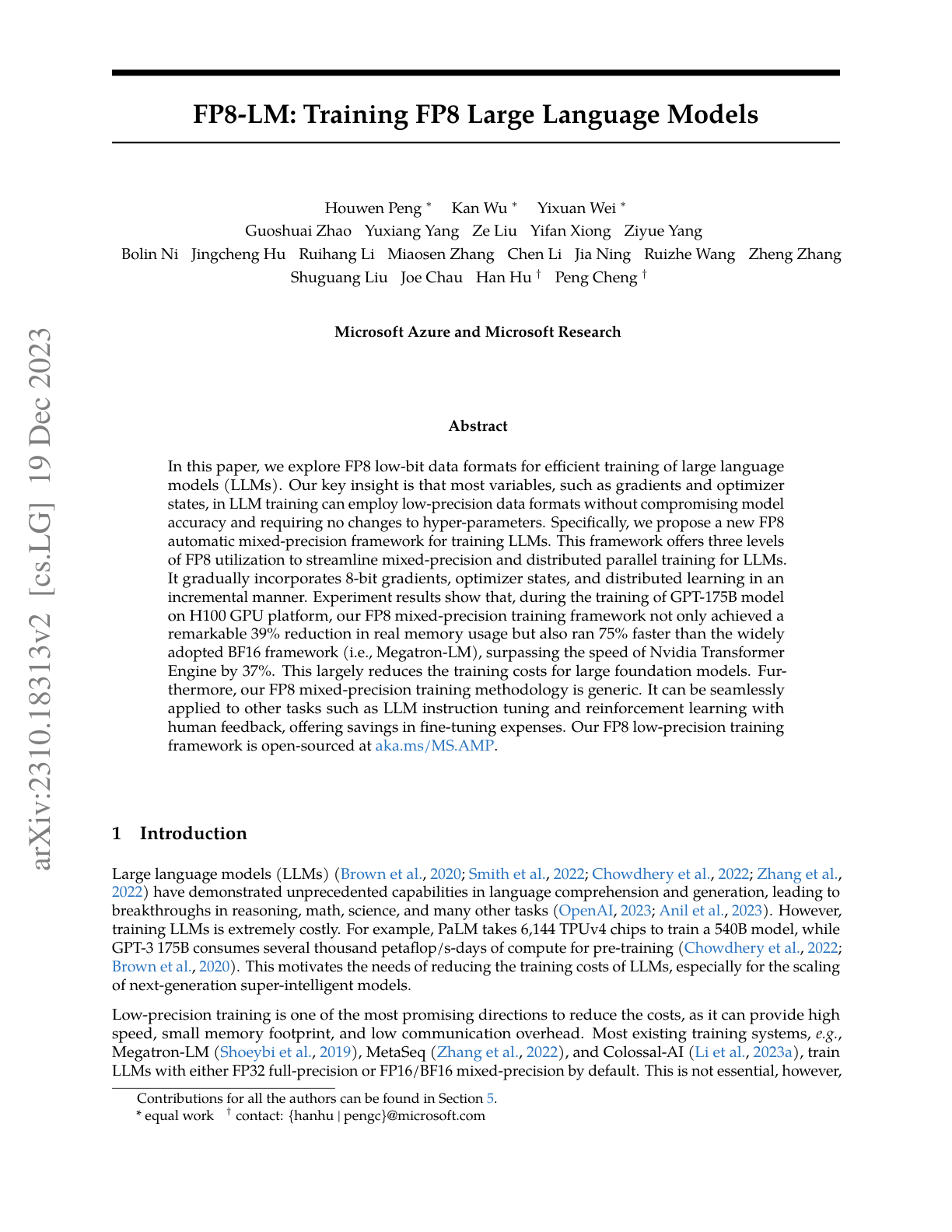
revisits RNNs and shows that by removing the hidden states from input, forget, and update gates RNNs can be efficiently trained in parallel; this is possible because with this change architectures like LSTMs and GRUs no longer require backpropagate through time (BPTT); they introduce minLSTMs and minGRUs that are 175x faster for a 512 sequence length.

LLMs Know More Than They Show
finds that the "truthfulness" information in LLMs is concentrated in specific tokens; this insight can help enhance error detection performance and further mitigate some of these issues; they also claim that internal representations can be used to predict the types of errors the LLMs are likely to make.

RATIONALYST
a model for process-supervision of reasoning that enables generalization across diverse reasoning tasks; this process is achieved with pre-training on a collection of 79k rationales from the Pile and a combination of reasoning datasets with minimal human intervention; fine-tuned from LLaMa-3-8B, the proposed model improves the accuracy of reasoning by an average of 3.9% on 7 reasoning benchmarks.

AlphaChip
a reinforcement learning-based method trained to design the physical layout of chips; AlphaChip is reportedly used in three additional generations of Google’s TPU; this release includes an open-source implementation of the method to help pre-train on a variety of chip blocks to apply to new blocks; also releases a model checkpoint pre-trained on 20 TPU blocks.

Scaled-up Instructable Model Become Less Reliable
suggests that larger and more instructable LLMs may become less reliable; investigates LLMs across three elements: difficulty concordance, task avoidance, and prompting stability; finds that early models often avoid user questions but scaled-up, shaped-up models tend to give an apparently sensible yet wrong answer much more often, including errors on difficult questions that human supervisors frequently overlook.

Moshi
introduces a speech-text foundation model and full-duplex spoken dialogue framework; they present several components of the systems; Helium is a 7B parameter text LLM; Mimi is a semantic-acoustic neural audio code with state-of-the-art performance on audio quality; a hierarchical multi-stream architecture that can generate arbitrary conversation in a speech-to-speech manner.

Training LLMs to Self-Correct via RL
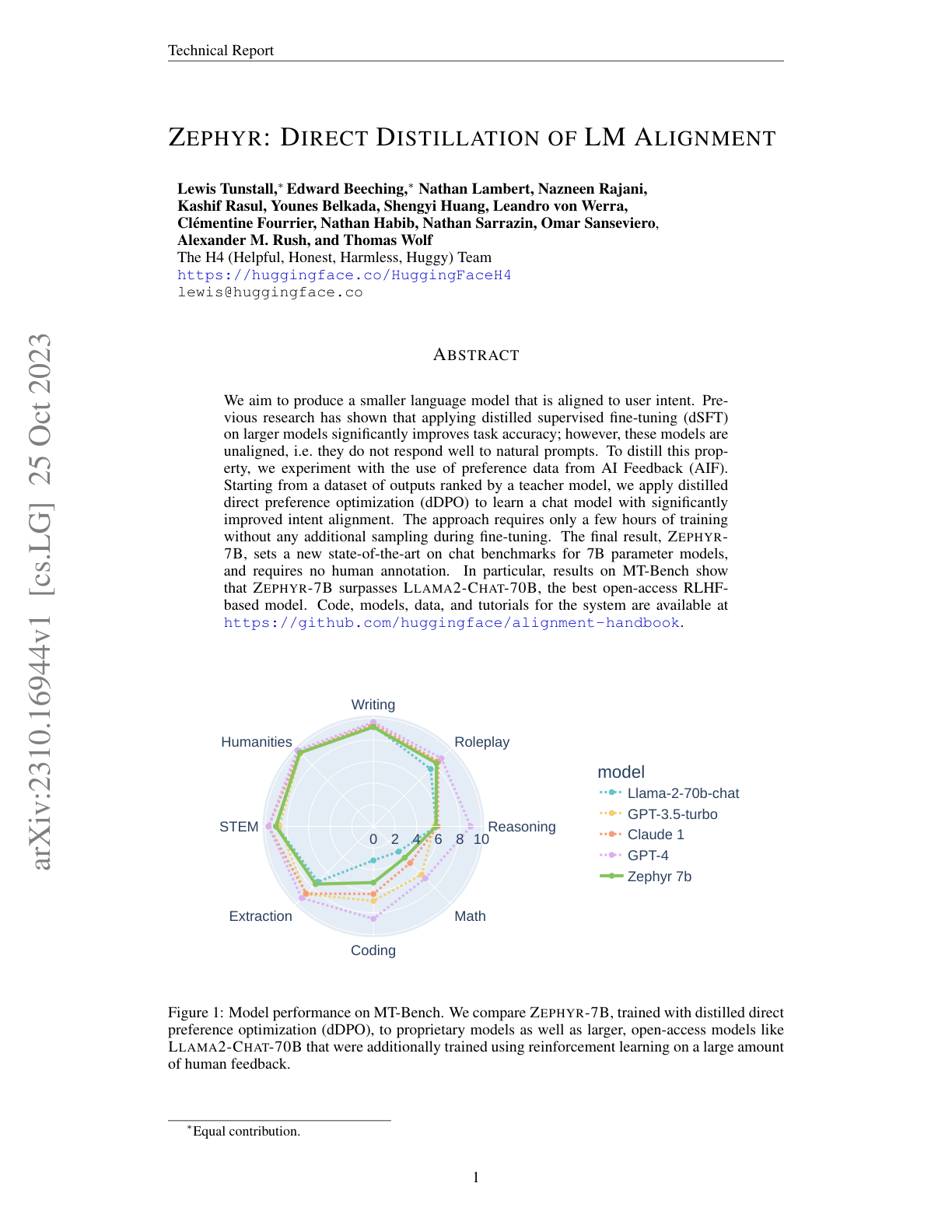
develops a multi-turn online reinforcement learning to improve the capabilities of an LLM to self-correct; it’s based entirely on self-generated data; SFT is shown to be ineffective at learning self-correction and suffers from distribution mismatch between training data and model responses; proposes a two-stage approach that first optimizes correction behavior and then uses a reward bonus to amplify self-correction during training; when applied to Gemini 1.0 Pro and 1.5 Flash models, it achieves state-of-the-art self-correction performance, improving the base models’ self-correction by 15.6% and 9.1% respectively on the MATH and HumanEval benchmarks.

Qwen2.5 Coder
a series of models including 1.5B and 7B parameters; it’s built upon the Qwen2.5 architecture which is continuously pretrained on 5.5 trillion tokens; achieves state-of-the-art performance across more than 10 benchmarks; includes strong capabilities in code generation, completion, reasoning, and repairing.