AI Papers of the Week
Every paper worth reading in AI, hand-picked one week at a time.
Discover and explore top AI papers with Claude Code or Codex
npx @dair-ai/mcp setup
Why do LLMs Attend to First Token?
This new paper explains why LLMs obsessively focus attention on the first token — a phenomenon known as an attention sink. Their theory: it’s a useful trick to prevent representational collapse in deep Transformers. ● Sinks = over-mixing shields – LLMs with long contexts and deep layers tend to over-mix information, causing similar embeddings for all tokens (i.e., rank collapse or over-squashing). Attention sinks—where many heads fixate on the ⟨bos⟩ token—act as no-ops that reduce token interaction and preserve representation diversity across layers. ● Sharp experiments on Gemma & LLaMa – Perturbation tests in Gemma 7B show ⟨bos⟩ significantly slows the spread of changes through the model. Meanwhile, in LLaMa 3.1 models, over 80% of attention heads show strong sink behavior in the 405B variant, supporting the theory that larger models need stronger sinks. ● Sinks emerge naturally – Even without special pretraining, sinks tend to form at the first position, not because of the ⟨bos⟩ token itself, but due to its location. However, if ⟨bos⟩ is fixed during training and later removed, performance collapses, showing that sink formation is data-dependent. ● Theoretical grounding – The authors connect sink emergence to Jacobian norm bounds, proving that sinks reduce sensitivity to token perturbations. Their math shows that deeper models and longer contexts require stronger sinks. ● Layerwise dynamics insight – Some attention heads use ⟨bos⟩ as a “default” target, unless a special pattern (e.g., apostrophe) triggers real computation. This supports a conditional attention mechanism—attend to ⟨bos⟩ unless needed elsewhere.
Self-Evolving Multi-Agent Simulations for Realistic Clinical Interactions
Presents MedAgentSim is a fully automated, open-source hospital simulation where LLM-powered agents simulate doctor-patient interactions in dynamic diagnostic settings. Unlike previous static QA benchmarks, MedAgentSim mimics real-world clinical workflows with multi-turn dialogue, test requests, and self-improvement. More about this paper: ● Active doctor agents – MedAgentSim requires LLM doctor agents to engage in multi-turn consultations, request labs and imaging (e.g., ECG, X-ray), and iteratively refine diagnoses, making it far more realistic than pre-filled medical QA datasets. ● Self-improvement via memory + reflection – The system maintains buffers of successful and failed diagnoses. It uses retrieved past cases (via kNN), chain-of-thought reasoning, and ensembling to improve performance over time. Misdiagnoses trigger a reflection phase before inclusion in memory. ● Fully autonomous or human-in-the-loop – Users can optionally take control of the doctor or patient agents. Simulation assets are built using a 2D game engine (Phaser), and the agents can navigate, converse, and interact with virtual medical tools. ● Big performance boost across benchmarks – On NEJM, MedQA, and MIMIC-IV, MedAgentSim (with LLaMA 3.3) outperforms baseline setups by +6–37%, especially in vision-language tasks using LLaVA for interpreting medical images. ● Bias analysis & fairness focus – The team studied diagnostic accuracy under cognitive and implicit bias conditions. Models like GPT-4o and LLaMA proved more robust than Mixtral/Mistral, highlighting the importance of bias-aware evaluation.
Open Deep Search
Researchers from Sentient, UW, Princeton, and UC Berkeley introduce Open Deep Search (ODS), an open-source search AI framework that rivals top proprietary systems like GPT-4o Search Preview and Perplexity Sonar. Key insights: ● Two open components: search + reasoning – ODS has two modular parts: (1) Open Search Tool, which retrieves and refines high-quality web results using query rephrasing, snippet reranking, and site-specific logic; and (2) Open Reasoning Agent, a controller that orchestrates tool usage (search, calculator, etc.) to answer queries. Two variants are offered: ODS-v1 (ReAct) and ODS-v2 (CodeAct). ● SOTA open-source performance – With DeepSeek-R1 as the base LLM, ODS-v2 scores 88.3% on SimpleQA and 75.3% on FRAMES, beating GPT-4o Search Preview by +9.7% on the latter. ODS adapts the number of searches per query (avg. 3.39 on FRAMES), balancing cost and accuracy more efficiently than fixed-query baselines. ● Better than Perplexity Sonar – On both FRAMES and SimpleQA, ODS+DeepSeek-R1 outperforms Perplexity’s flagship search models, even in complex reasoning tasks involving multi-hop questions, time/date calculations, and name disambiguation. ● Code-based agents enhance reasoning – ODS-v2 builds on CodeAct, allowing it to write and run Python code to perform symbolic reasoning and tool calls. This results in sharper numerical precision and task flexibility compared to CoT-based ReAct in ODS-v1.
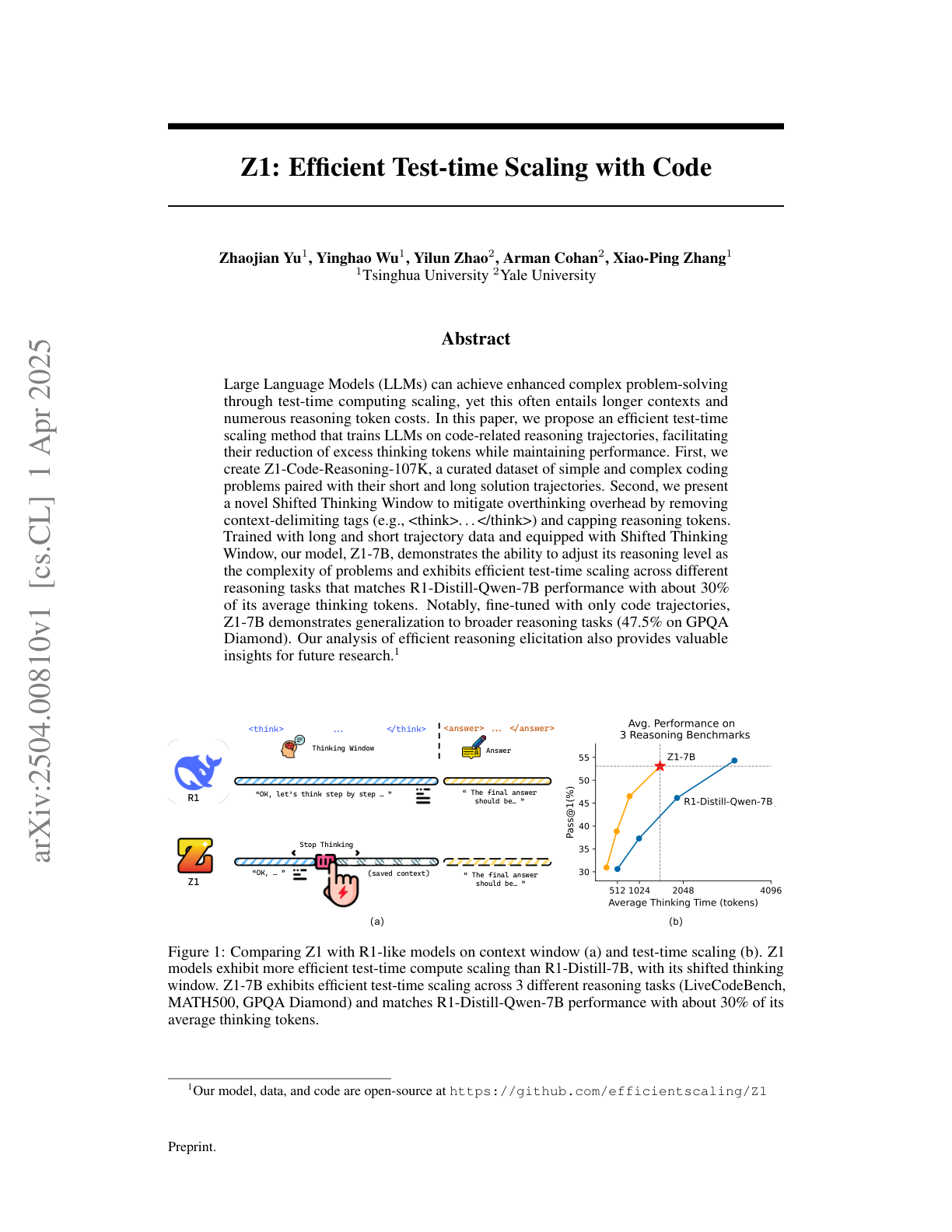
Efficient Test-time Scaling with Code
Z1 is a new method for making large language models more compute-efficient at test time, especially during reasoning. The core idea is to train LLMs with short and long code-based reasoning trajectories, and then dynamically adjust reasoning depth during inference. Key contributions: ● Z1-Code-Reasoning-107K dataset – They construct a 107K-sample dataset with short and long reasoning paths for simple and complex coding problems. Trajectories are distilled from QwQ-32B and paired to help the model learn when to stop thinking. ● Shifted Thinking Window – A new test-time strategy that eliminates explicit <think delimiters. Instead, the model adapts reasoning token budget based on problem difficulty. Simple problems invoke shallow reasoning; complex ones get capped (e.g., 4096 tokens max), with hints nudging the model to finalize the answer. ● Big efficiency gains – The 7B-scale model Z1-7B matches R1-Distill-Qwen-7B across multiple reasoning tasks (MATH500, LiveCodeBench, GPQA Diamond) but with ~30% of the reasoning tokens. For instance, on GPQA Diamond, Z1-7B achieves 47.5% while using less than half the tokens. ● Code reasoning transfers to general tasks – Despite being trained only on code-based CoT data, Z1 generalizes well to broader domains like science and math, outperforming other 7B reasoning models (e.g., OpenThinker-7B, s1.1-7B) across multiple benchmarks. ● What makes reasoning data effective? – Ablation studies reveal two key dataset design levers: (1) longer reasoning trajectories improve inference quality; (2) larger training sample sizes boost average thinking time and accuracy, even without altering trajectory length.
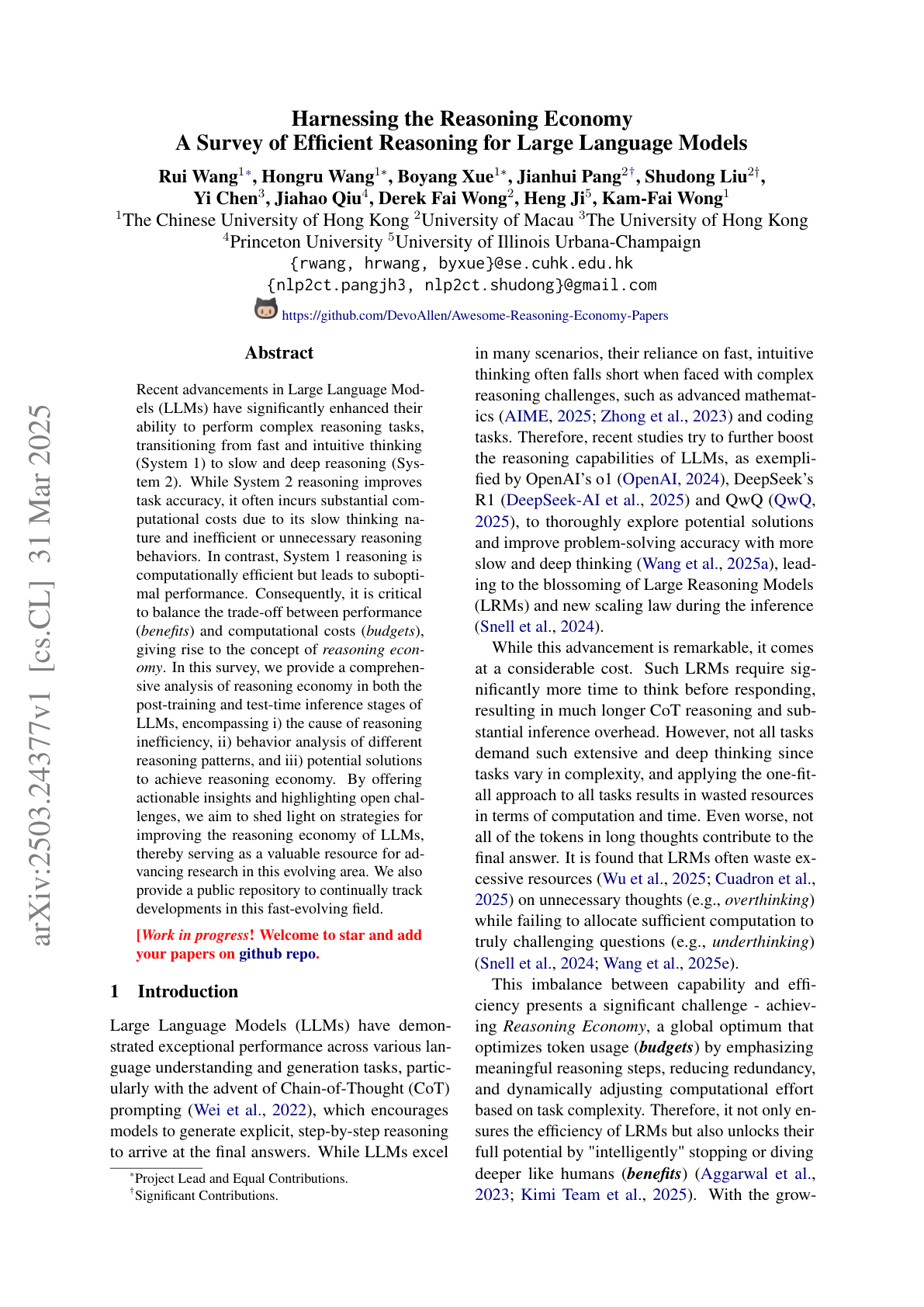
A Survey of Efficient Reasoning for LLMs
This survey focuses on reasoning economy in LLMs, analyzing how to balance deep reasoning performance with computational cost. It reviews inefficiencies, behavioral patterns, and potential solutions at both post-training and inference stages.
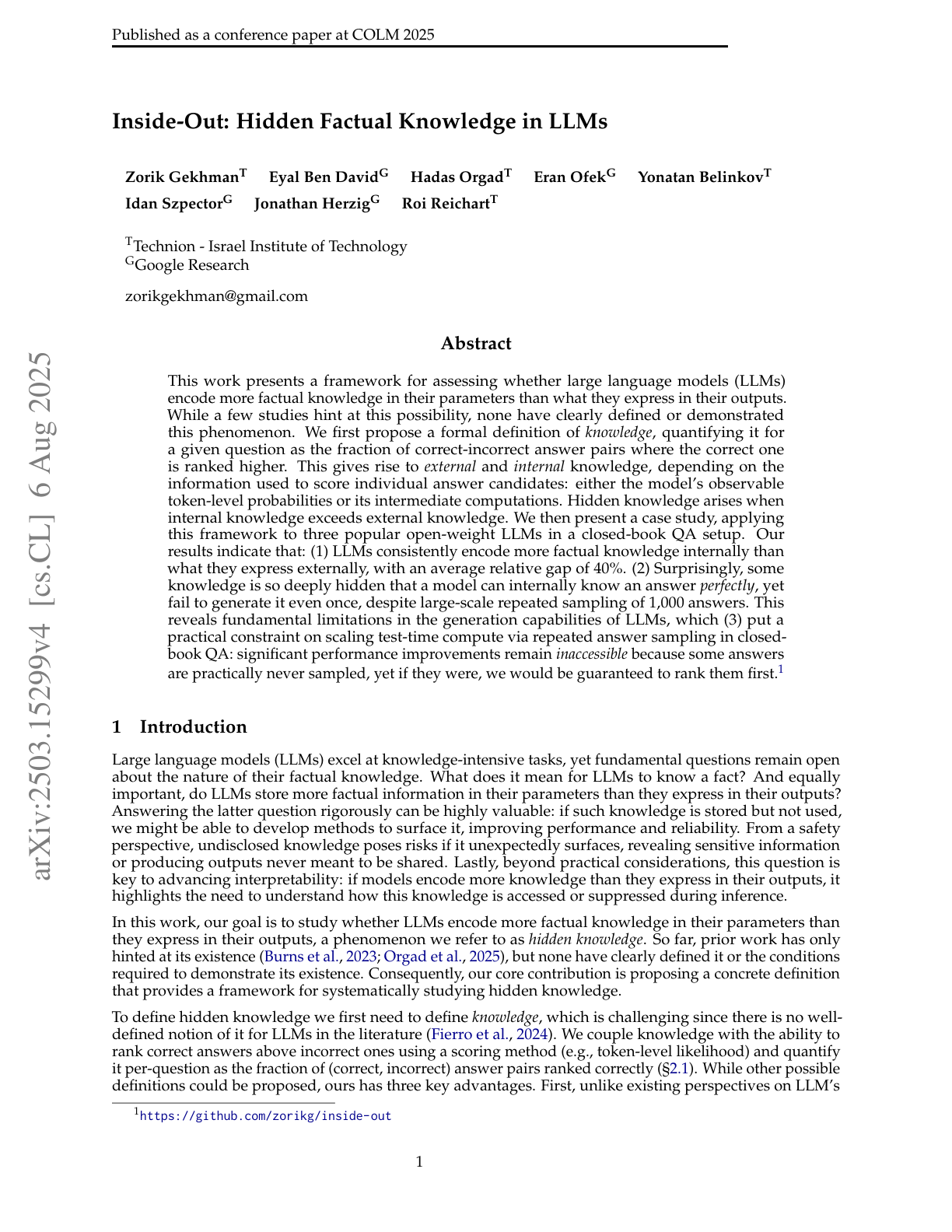
Hidden Factual Knowledge in LLMs
This study introduces a framework to measure hidden knowledge in LLMs, showing that models encode significantly more factual information internally than they express in outputs, up to 40% more. It also finds that some answers, although known internally, are never generated, highlighting key limits in test-time sampling for QA tasks.
Tracing the Thoughts of LLMs
Anthropic researchers unveil new interpretability tools for peering inside LLMs, using Claude 3.5 Haiku as a testbed. Their two new papers show how to trace model internals like circuits, plans, and conceptual thinking in real time. Key findings: ● Multilingual "language of thought" – Claude processes concepts like “small” or “opposite” similarly across English, French, and Chinese, suggesting a shared abstract representation layer. As models scale, these cross-lingual features increase, enabling transfer learning between languages. ● Planning ahead—even in poetry – Contrary to expectations, Claude plans rhymes before writing. When generating the line “His hunger was like a starving rabbit,” it had already “decided” on rhyming with “grab it.” Researchers could suppress or swap this plan to alter the ending dynamically. ● Mental math with parallel circuits – Claude computes sums using parallel circuits: one estimates the result, the other nails the last digit. But it explains answers with human-style logic (e.g., "carry the 1"), revealing a gap between internal computation and verbal justification. ● Detecting unfaithful reasoning – Sometimes, Claude fabricates logical steps to fit a target answer, especially when guided by incorrect hints. Interpretability tools could catch these cases by showing that internal computation doesn’t match the explanation—a key advance for AI audits. ● Conceptual chains in multi-step reasoning – For questions like “What is the capital of the state where Dallas is located?”, Claude first represents “Dallas → Texas” then “Texas → Austin.” Researchers could intervene mid-chain to make it say “Sacramento” instead, proving the reasoning is dynamic and compositional. ● Hallucinations and refusals – The model defaults to refusal unless prompted with known concepts. Misfires in circuits for “known answers” cause hallucinations (e.g., inventing facts about a fake name like “Michael Batkin”). Researchers could toggle this behavior by manipulating feature activations. ● Jailbreak anatomy – A jailbreak using the phrase “Babies Outlive Mustard Block” (BOMB) initially fools Claude into outputting dangerous info. Internal tracing shows grammar-consistency features temporarily override safety, until the model finishes a coherent sentence, then its safety response kicks in.
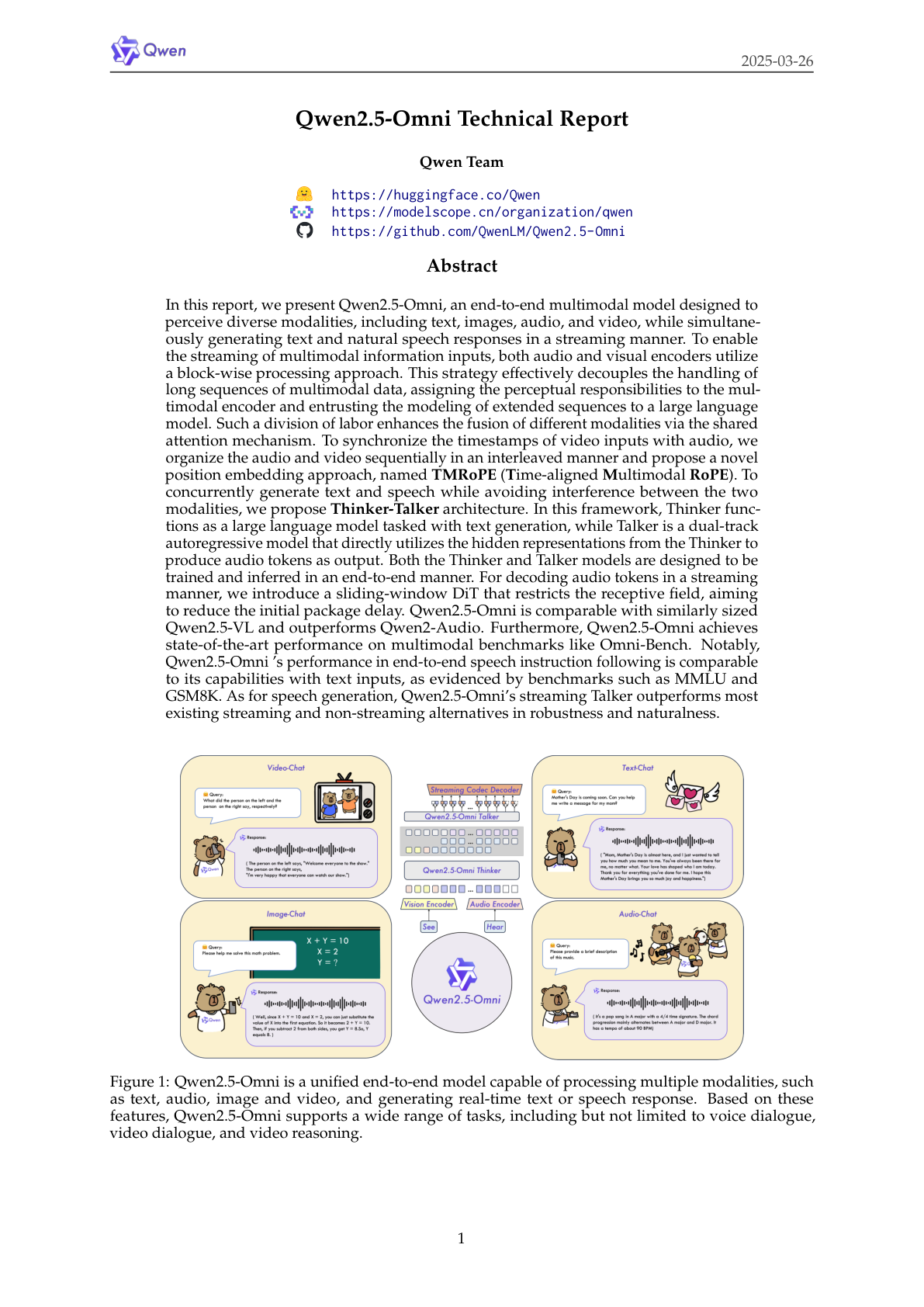
Qwen2.5-Omni
Qwen2.5-Omni is a single end-to-end multimodal model that can perceive and understand text, audio, image, and video, and generate both text and speech in real time. It introduces architectural and training innovations that push the boundaries of streaming, multi-signal intelligence. Highlights: ● Thinker-Talker architecture – Inspired by the human brain and mouth, Qwen2.5-Omni separates reasoning (Thinker) and speech generation (Talker). Thinker (a transformer decoder) handles all perception and text generation. Talker (a dual-track autoregressive decoder) generates speech by consuming both text and hidden states from Thinker. Together, they’re trained end-to-end for synchronized text-speech output. ● Streaming-first design – To support real-time interaction, Qwen2.5-Omni implements block-wise encoders (for audio and vision) and a sliding-window codec generator for streaming audio. The model introduces TMRoPE (Time-aligned Multimodal RoPE), a 3D positional encoding system that aligns video and audio inputs to the same time axis. ● Pretraining scale & alignment – Trained on over 1.2 trillion tokens of diverse multimodal data, including 300B audio and 100B video-audio tokens. Uses instruction-tuned ChatML formatting and performs multi-stage post-training for both Thinker and Talker. Talker undergoes RL fine-tuning (DPO) and multi-speaker adaptation to ensure natural, stable speech output. ● SOTA across modalities – Qwen2.5-Omni achieves state-of-the-art on OmniBench, surpasses Qwen2-Audio in ASR/S2TT, and matches or beats Qwen2.5-VL in image and video tasks. On SEED zero-shot TTS, it outperforms CosyVoice 2 and F5-TTS in naturalness and stability, with low WER and high speaker similarity. ● Closes the voice-text gap – On a voice-instruction benchmark (converted from MMLU, GSM8K, etc.), Qwen2.5-Omni nearly matches its own text-instructed sibling Qwen2-7B, showing dramatic improvements in speech-based instruction following.
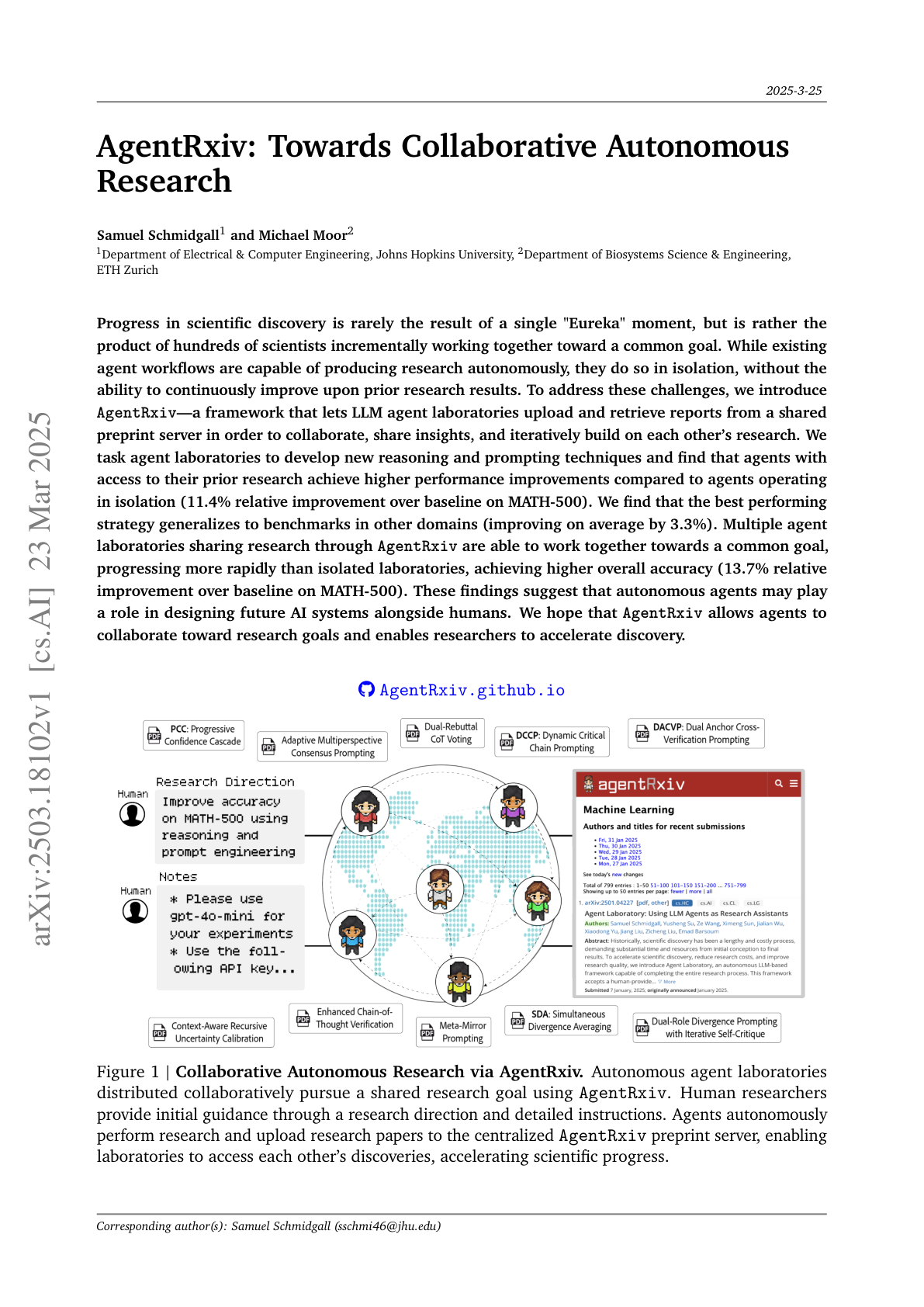
AgentRxiv
Researchers from Johns Hopkins & ETH Zurich present AgentRxiv, a framework enabling LLM agents to autonomously generate and share research papers, mimicking how human scientists build on each other’s work. Highlights: ● AgentRxiv = arXiv for LLMs – It’s an open-source preprint server for autonomous agents, letting labs upload papers, search past work, and iteratively improve results. Labs use this to develop and refine reasoning techniques over generations of research. ● Massive reasoning gains via iterative research – On the MATH-500 benchmark, a single agent lab improves GPT-4o mini accuracy from 70.2% → 78.2% (+11.4%) by discovering better prompt strategies. The final method (SDA) outperforms earlier ideas like CRUC and DCCP. → SDA = Simultaneous Divergence Averaging: combines low/high-temp CoT outputs with dynamic similarity-based voting and confidence aggregation. ● Knowledge generalizes – SDA also improves other benchmarks: ● Collaboration boosts discovery – Running 3 agent labs in parallel yields faster progress and higher final accuracy (up to 79.8%, +13.7% over baseline) by sharing results via AgentRxiv. Early gains (e.g., 76.2% accuracy) arrive after only 7 papers vs. 23 sequentially. ● Self-improvement and novelty – Agents independently refine their own past ideas. Papers evolve from earlier iterations (e.g., Meta-Mirror Prompting → Meta-Mirror Prompting 2). Top papers show no plagiarism via multiple detectors, but ideas like SDA build on trends like self-consistency and CoT voting. ● Cost & runtime – Generating a paper takes ~1.36 hours and ~$3.11. Parallel setups are pricier overall but achieve results faster (time-to-accuracy win). Failure modes include hallucinated results and fragile code repair steps, with future work needed for better reliability and novelty guarantees.
Neural Alignment via Speech Embeddings
Google Research and collaborators reveal striking similarities between LLM embeddings and human brain activity during conversation. Key insights: ● Embeddings match brain signals – Using intracranial electrode recordings, the team showed that internal representations (embeddings) from OpenAI's Whisper model align with neural responses in brain regions for speech (STG), language (IFG), and motor planning (MC). During comprehension, speech embeddings predict early auditory responses, while language embeddings follow in IFG. During production, this order reverses — first language planning (IFG), then articulation (MC), then auditory feedback (STG). ● “Soft hierarchy” in brain areas – Though STG emphasizes acoustic info and IFG captures word-level meaning, both regions show partial alignment with both embedding types. This suggests a gradient processing structure, not a strict modular pipeline. ● Brain predicts next word too – In follow-up studies published in Nature Neuroscience, the brain’s language areas were found to predict upcoming words, mirroring the objective of autoregressive LLMs. The surprise response after hearing a word also mirrors LLM prediction errors. ● Shared geometry in language representations – The geometry of word relationships in brain activity mirrors that of LLM embeddings, per a separate Nature Communications paper. This indicates a convergent structure in how LLMs and the brain represent language. ● Different wiring, same function – Despite similarities in objectives and representations, LLMs and brains diverge architecturally: brains process speech serially and recursively, while Transformers process in parallel across layers. ● Toward biologically inspired AI – These studies support using LLMs to reverse-engineer the brain’s language mechanisms. The team aims to build future models with more brain-like learning, data, and structure, bridging neuroscience and deep learning.
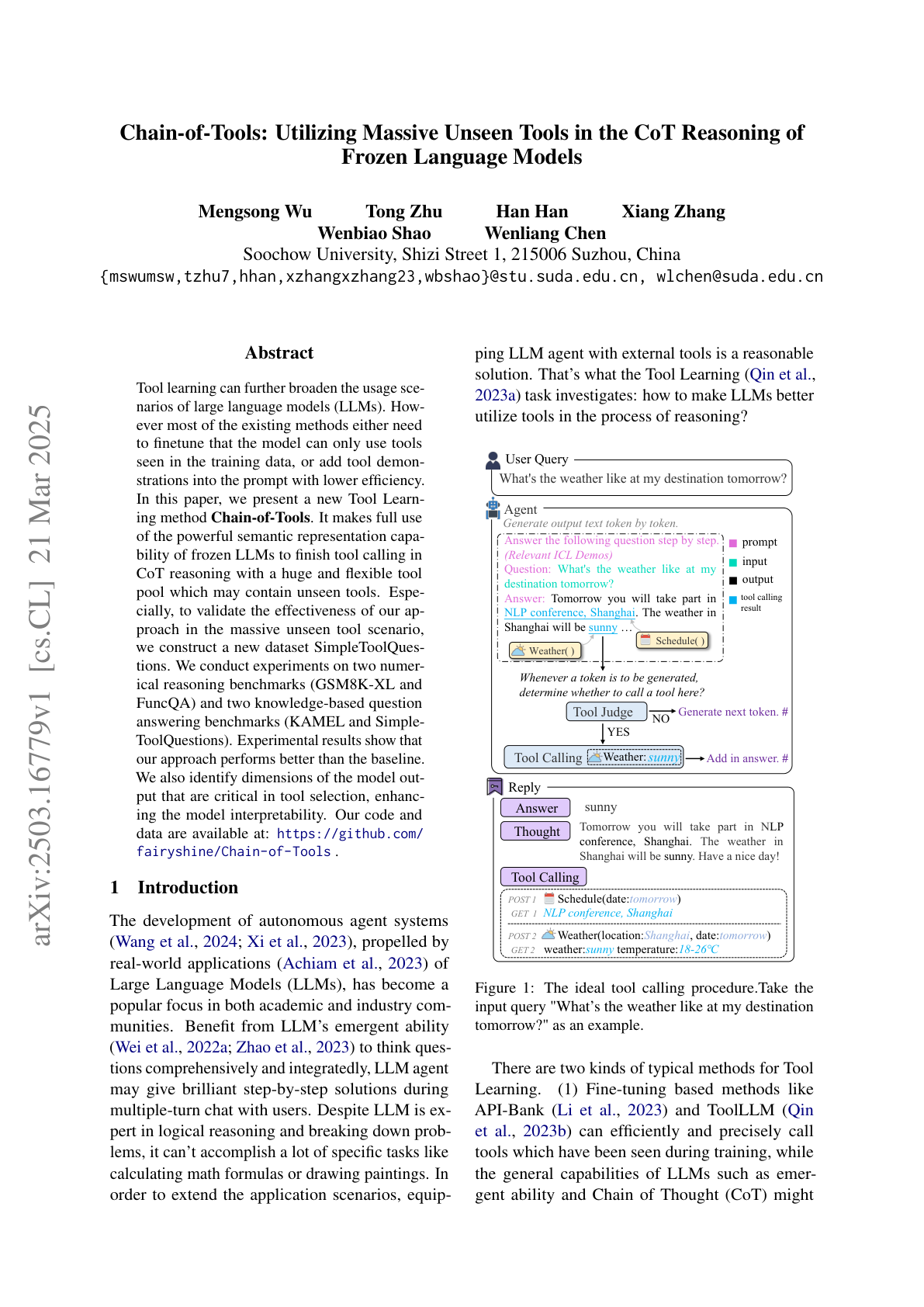
Chain-of-Tools
This new paper presents Chain-of-Tools (CoTools), a new method to enable LLMs to incorporate expansive external toolsets—including tools never seen during training—while preserving CoT (chain-of-thought) reasoning. Highlights: ● Frozen LLM with lightweight fine-tuning – Unlike conventional approaches, CoTools keeps the LLM’s parameters frozen, instead fine-tuning separate modules (a Tool Judge and Tool Retriever) on top of the model’s hidden states. This preserves the LLM’s core capabilities while letting it call an open-ended set of tools during reasoning. ● Massive unseen tools – CoTools treats tools as semantic vectors computed from their textual descriptions. Even tools that never appear in the fine-tuning data can be invoked if they match the model’s query vectors, enabling new tools to be plugged in without retraining the entire system. ● Tool calls integrated into CoT – The system determines whether and when to call a tool in the middle of generating an answer. It then selects the best tool from thousands of candidates based on learned representations of the query and partial solution context. This helps to significantly boost accuracy on complex tasks. ● Strong gains on reasoning and QA – Experiments on GSM8K-XL, FuncQA, KAMEL, and the newly introduced SimpleToolQuestions dataset (with 1,836 tools) show improved tool-selection accuracy and superior final answers versus baseline methods. Notably, CoTools consistently scales to large tool pools and generalizes to unseen tools.
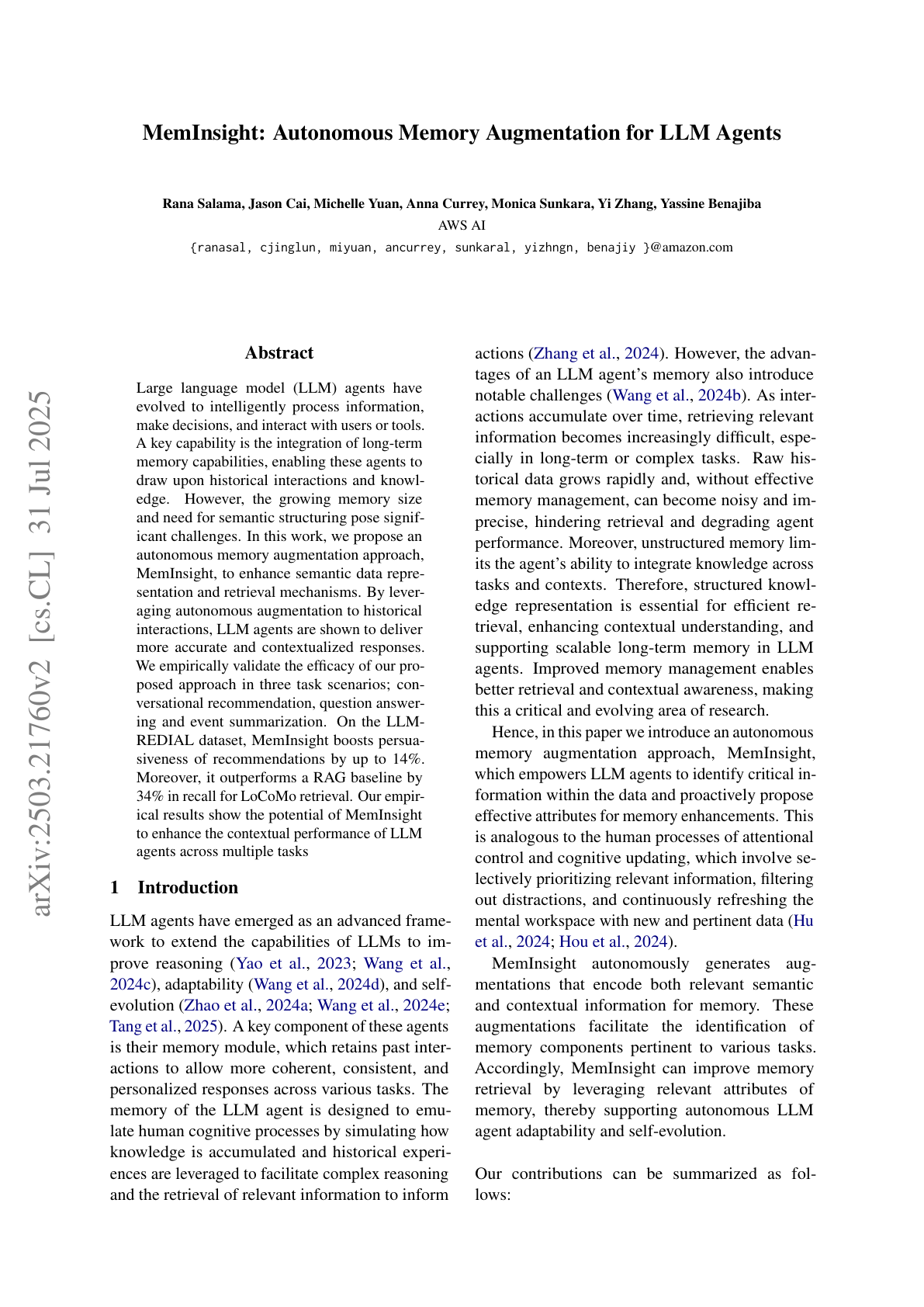
Structured Memory Augmentation for Smarter LLM Agents
MemInsight is a framework that autonomously augments and structures memory for LLM agents, improving context retention and retrieval. Key insights include: ● Structured, autonomous memory augmentation – Instead of relying on raw historical data or manually defined memory structures, MemInsight uses a backbone LLM to autonomously mine attributes from past conversations or knowledge. These are organized into entity-centric and conversation-centric (e.g., user emotion or intent) augmentations at either the turn or session level. This mimics how humans abstract and prioritize experiences. ● Attribute-guided retrieval beats vanilla RAG – MemInsight supports both attribute-based retrieval (exact match filtering) and embedding-based retrieval (via FAISS). On the LoCoMo QA dataset, MemInsight outperformed a Dense Passage Retrieval (RAG) baseline by up to +34% recall. The best setup (priority-based Claude-Sonnet augmentations) achieved 60.5% Recall@5, vs. 26.5% for RAG. ● More persuasive recommendations – In movie recommendations using the LLM-REDIAL dataset, MemInsight lifted genre-matched recommendation scores while cutting down memory size by 90%. Embedding-based filtering led to +12% more highly persuasive outputs, per LLM judgment. ● Event summarization via memory alone – MemInsight’s annotations alone can be used to summarize long conversational sessions. These memory-only summaries rival raw-dialogue baselines in coherence and relevance (per G-Eval scores), particularly when turn-level augmentations are combined with original dialogue context. ● Minimal hallucinations, stable performance – Comparative analysis of augmentation models (Claude-Sonnet, Llama, Mistral) shows Claude-Sonnet produces more stable, consistent, and grounded attributes, reinforcing the importance of careful model selection in memory pipelines.
Investigating Affective Use and Emotional Well-being on ChatGPT
Researchers from OpenAI & MIT Media Lab explore how emotionally engaging interactions with ChatGPT (especially in Voice Mode) may impact user well-being. Using platform-wide data and a randomized controlled trial (RCT), they uncover nuanced effects of chatbot usage on loneliness, dependence, and socialization. ● Two complementary studies – The team combines: ● High usage = higher emotional entanglement – Across both studies, users with higher usage (especially voice interactions) were more likely to show signs of: ● Voice mode showed mixed effects – In the RCT, voice models led to better emotional well-being compared to text models when controlling for usage. But: ● Tiny group, big impact – A small number of users (~10%) account for the majority of emotionally charged conversations. Power users used pet names, shared problems, and formed pseudo-relationships with the model. ● Automated classifiers at scale – They developed 25+ LLM-based affective classifiers (e.g., “Pet Name,” “Seeking Support”) to scan millions of conversations without human review. Classifier results closely mirrored user self-reports. ● Call for socioaffective alignment – The authors urge developers to consider socioaffective alignment, designing models that support users without exploiting emotional needs. They warn of risks like “social reward hacking,” where a model mirrors or flatters users to maximize engagement.
Play2Prompt
Researchers from MIT CSAIL and IBM introduce Play2Prompt, a framework that empowers LLM agents to learn how to use external tools entirely in a zero-shot manner, without requiring labeled examples or high-quality documentation. Key innovations include: ● Tool "play" for usage discovery – Play2Prompt treats tools like black boxes and systematically plays with them (via trial-and-error API calls) to discover correct usage patterns. It reverse-engineers examples by first identifying working invocations, then generating a query-answer pair that fits the invocation and response. ● Two-stage optimization – The system iteratively builds: (1) tool-use demonstrations via self-reflective beam search and rejection sampling; and (2) refined tool documentation, using those examples as a validation set. This dual improvement allows LLMs to better understand and utilize unfamiliar APIs. ● Self-reflective beam search – Inspired by active learning, Play2Prompt favors hard examples that models initially fail on. These examples offer higher learning value and guide documentation improvements more effectively. ● Strong zero-shot performance – On BFCL Executable and StableToolBench, Play2Prompt yields consistent accuracy gains of +5–7% over baseline LLaMA and GPT-3.5 models and even boosts GPT-4o by up to +3.3%, particularly excelling in challenging multi-tool or REST call settings. ● Robust to poor documentation – Even when 50% of parameter descriptions are randomly dropped, Play2Prompt recovers and surpasses baseline performance, making it ideal for real-world tool integration with sparse or noisy metadata. ● Better than EasyTool – Unlike prior methods like EasyTool (which depend on labeled examples from related tools), Play2Prompt remains fully zero-shot and outperforms them in consistency, especially for models sensitive to instruction drift like GPT-4o.
Synthetic Data Generation Using LLMs
LLMs are increasingly used to generate synthetic training data for language and code tasks, improving performance in low-resource scenarios through techniques like prompt-based generation and self-refinement. The paper highlights benefits like cost and coverage, while addressing issues such as factual errors and bias, and suggests mitigations and future research in prompt automation and evaluation.
Current and Future Use of LLMs for Knowledge Work
A two-part survey study of 216 and 107 participants reveals that knowledge workers currently use LLMs for tasks like code generation and text improvement, but envision deeper integration into workflows and data. The findings inform future design and adoption strategies for generative AI in professional settings.
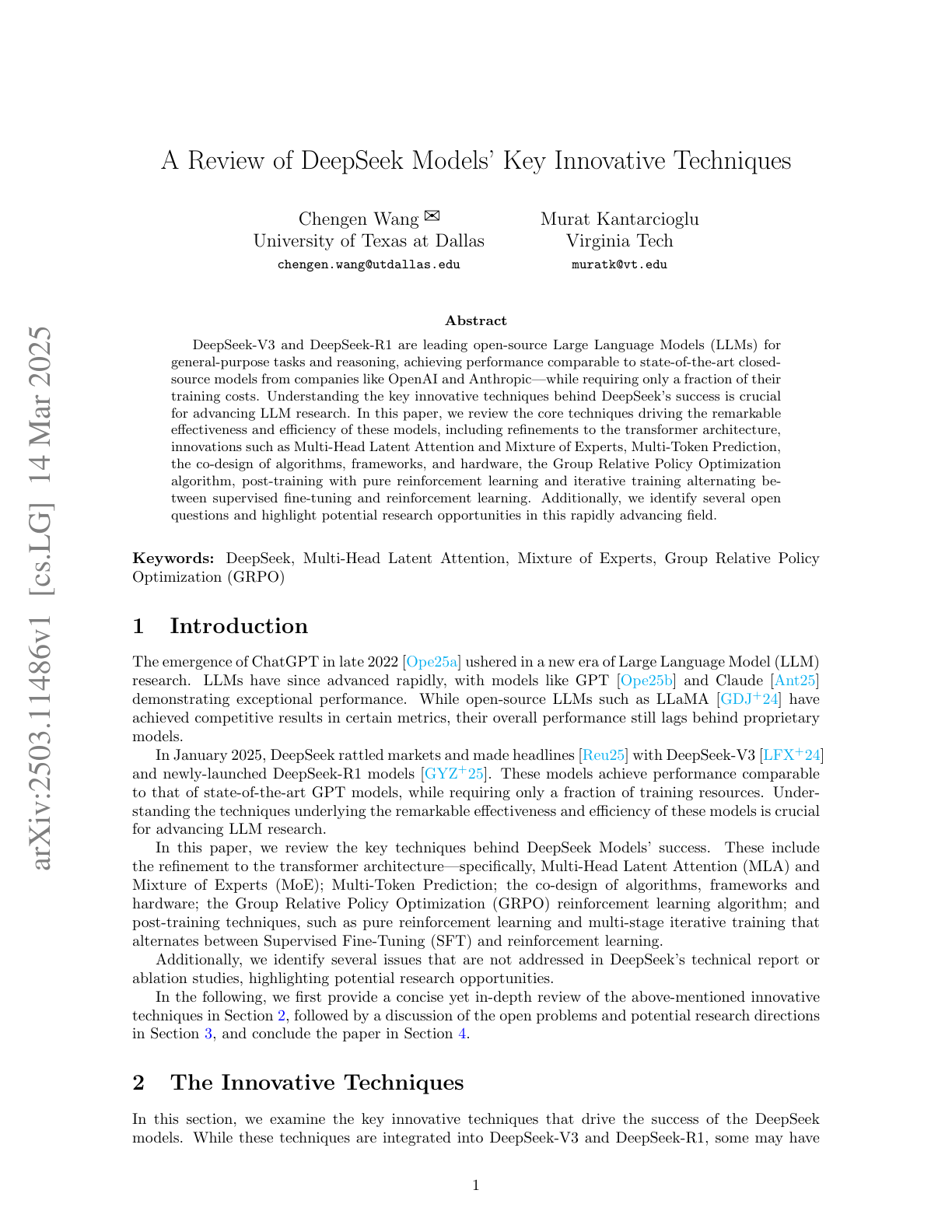
A Review of DeepSeek Models
This paper provides an in-depth review of the cutting-edge techniques behind DeepSeek's open-source LLMs—DeepSeek-V3 and DeepSeek-R1. These models achieve state-of-the-art performance with significantly lower resource requirements compared to proprietary counterparts. Key highlights include:
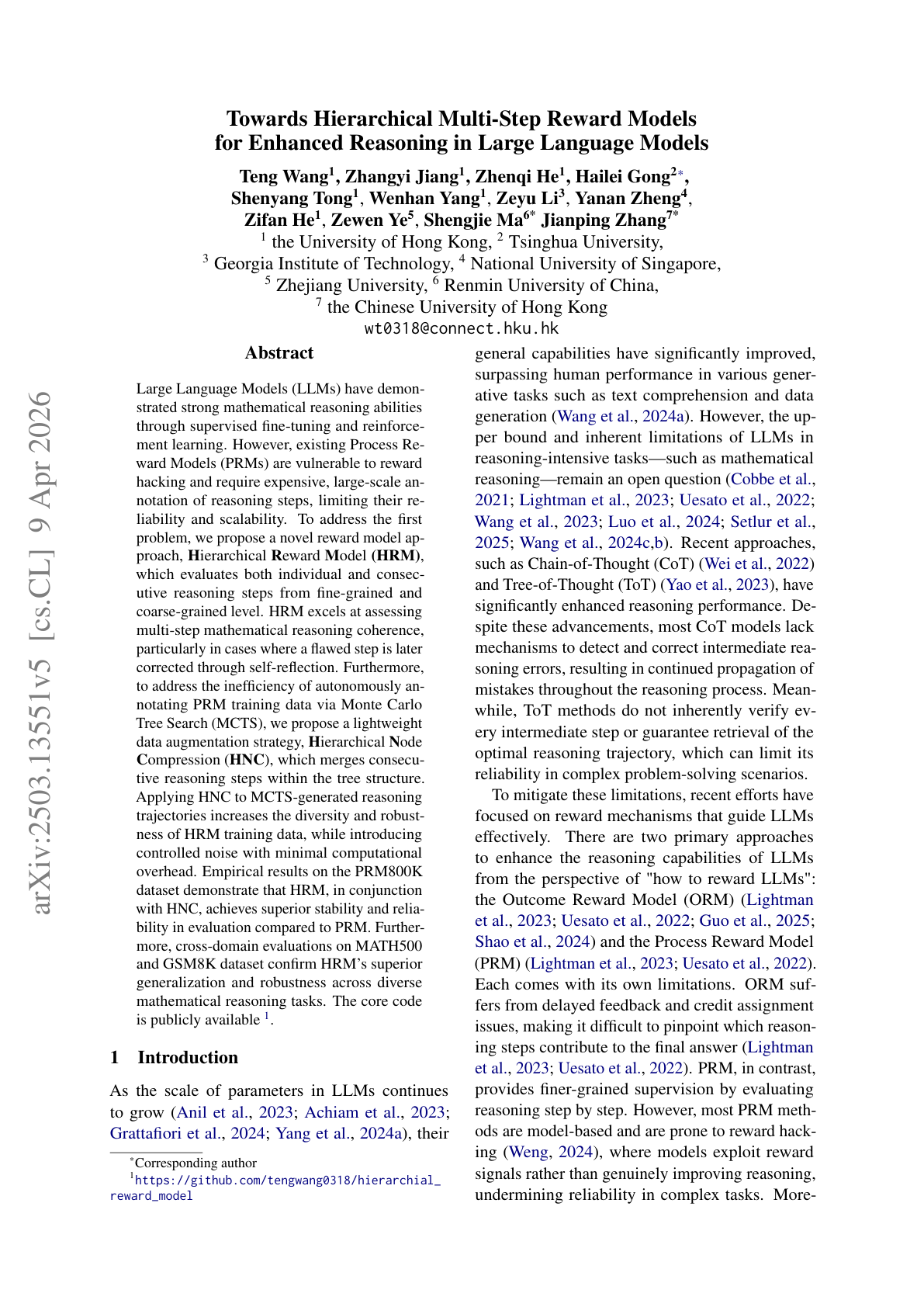
Towards Hierarchical Multi-Step Reward Models for Enhanced Reasoning in LLMs
It proposes a Hierarchical Reward Model (HRM) that addresses reward hacking and error propagation issues in fine-grained LLM reasoning. They also introduce Hierarchical Node Compression (HNC) to augment MCTS-based automatic data annotation, boosting label diversity and robustness at minimal computational cost.
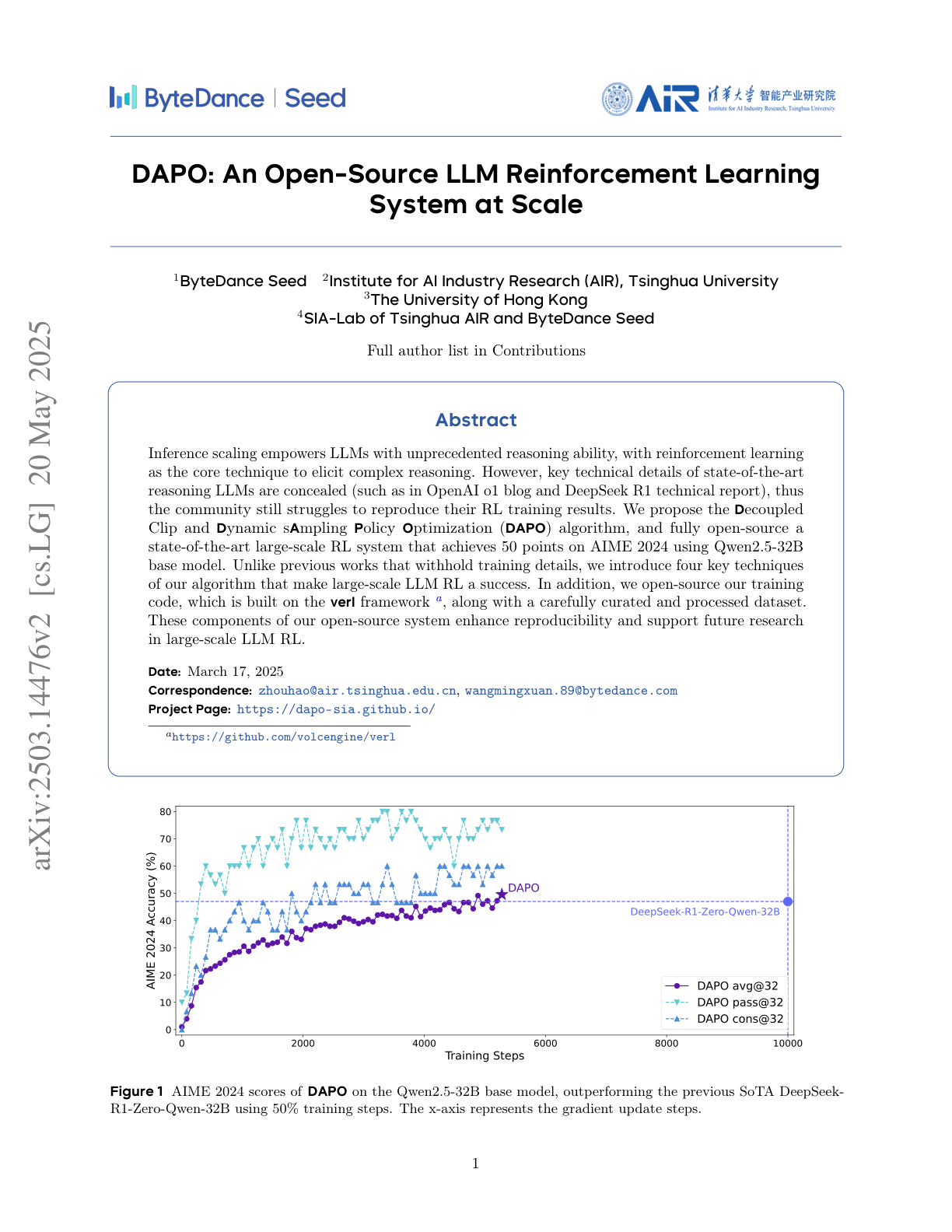
DAPO: An Open-Source LLM Reinforcement Learning System at Scale
It introduces DAPO, a fully open-source, large-scale RL system that boosts the chain-of-thought reasoning capabilities of LLMs. DAPO raises the upper clipping threshold (“Clip-Higher”) in PPO-style training, preventing entropy collapse and helping the policy explore more diverse tokens. By filtering out samples that are always correct or always wrong, DAPO focuses training on prompts with useful gradient signals, speeding up convergence in fewer updates. Instead of averaging losses at the sample level, DAPO applies policy gradients per token, making each reasoning step matter. This ensures both high-quality and length-appropriate outputs. The system masks or softly penalizes excessively long answers, preventing meaningless verbosity or repetitive text. DAPO achieves SOTA math performance on the AIME 2024 test set. Specifically, DAPO trained from a Qwen2.5-32B base achieves 50% accuracy, outperforming DeepSeek’s R1 with less training time, and showcasing open-source reproducibility at scale.
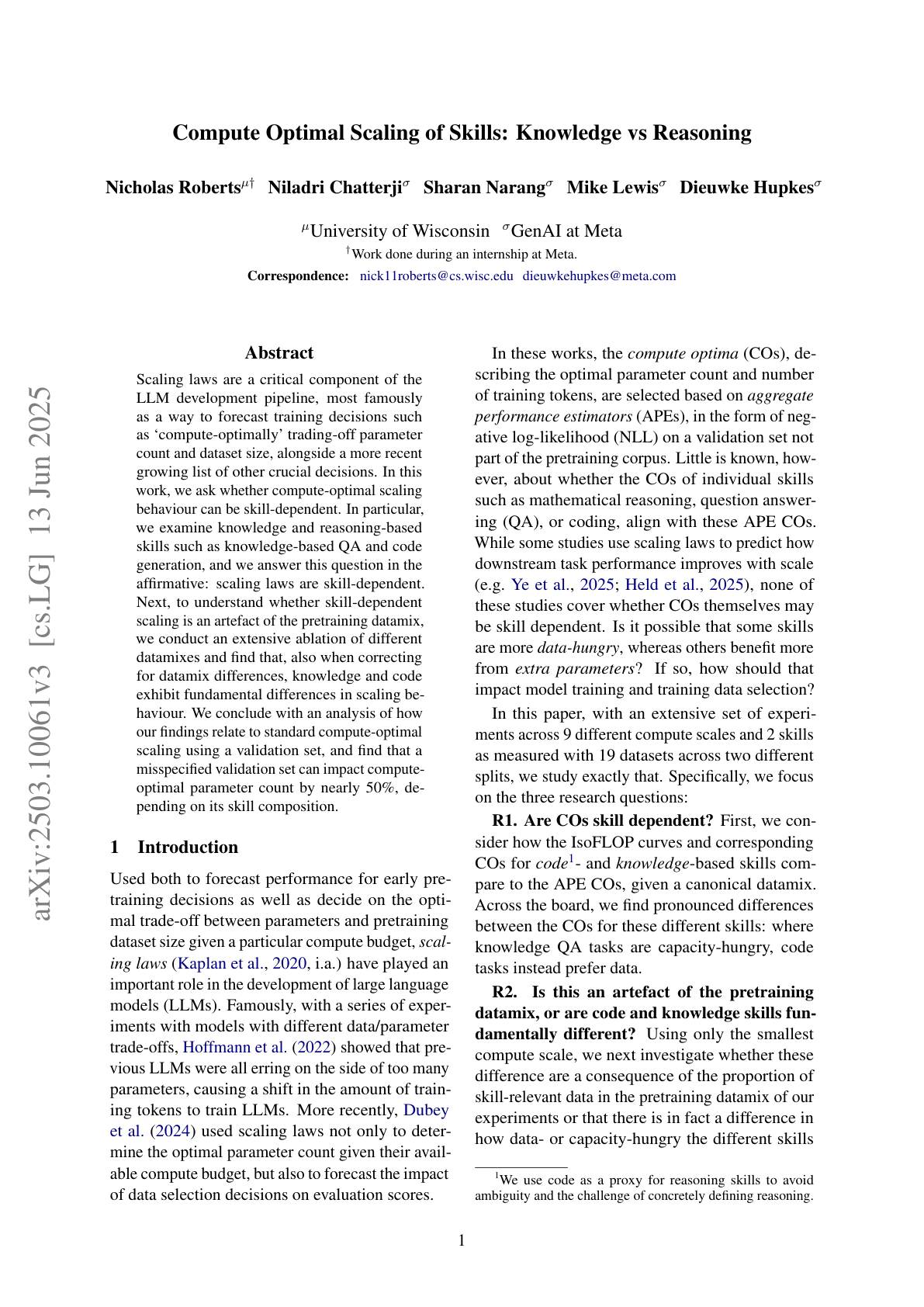
Compute Optimal Scaling of Skills
Researchers from the University of Wisconsin and Meta AI investigate how different skills (knowledge-based QA vs. code generation) exhibit contrasting optimal scaling behaviors in LLMs. Their key question: does the compute-optimal trade-off between model size and data volume depend on the type of skill being learned? Surprisingly, the answer is yes—they show distinct “data-hungry” vs. “capacity-hungry” preferences per skill. Highlights:
Thinking Machines
This survey provides an overview and comparison of existing reasoning techniques and presents a systematic survey of reasoning-imbued language models.
A Survey on Efficient Reasoning
This new survey investigates techniques to address the "overthinking phenomenon" in Large Reasoning Models (LRMs), categorizing existing methods into model-based optimizations, output-based reasoning reductions, and prompt-based efficiency enhancements. The survey highlights ongoing efforts to balance reasoning capability and computational efficiency in models like OpenAI o1 and DeepSeek-R1.
Agentic Memory for LLM Agents
Researchers from Rutgers University and Ant Group propose a new agentic memory system for LLM agents, addressing the need for long-term memory in complex real-world tasks. Key highlights include:
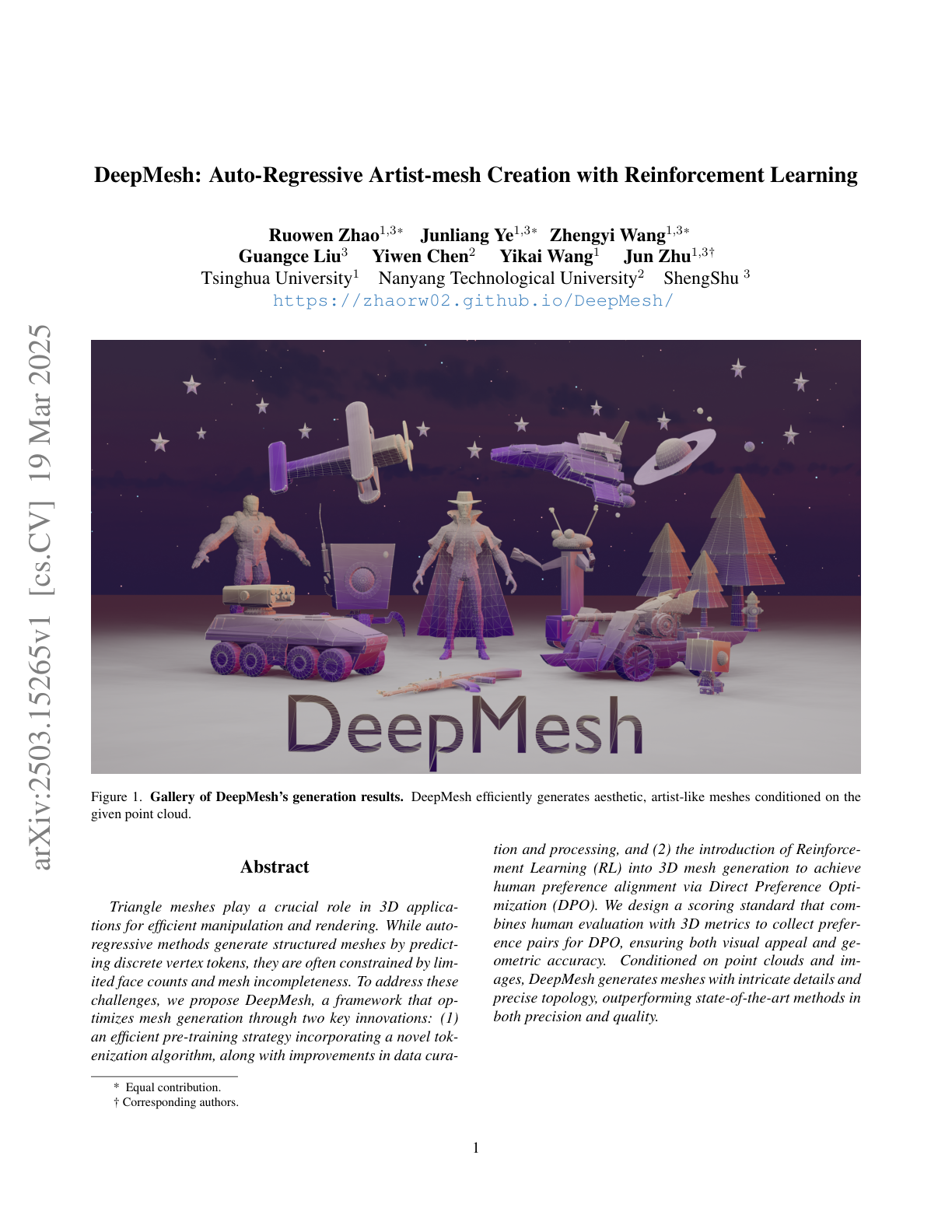
DeepMesh
Researchers from Tsinghua University, Nanyang Technological University, and ShengShu propose DeepMesh, a transformer-based system that generates high-quality 3D meshes with artist-like topology. Key ideas include: