AI Papers of the Week
Every paper worth reading in AI, hand-picked one week at a time.
Discover and explore top AI papers withClaude CodeCodex
npx @dair-ai/mcp setup
Compiled Agency: Frontier General-Purpose Coding Agents Build Winning Game Players from Bare Interaction - from Flappy Bird to StarCraft II and Civilization
Joey Xiao (New York University) and Haonan Huang (Princeton University) introduce Gauntlet, a develop-freeze-evaluate framework in which a general-purpose coding agent receives only a game description, a raw observation and action interface and an empty policy file, then writes a standalone controller that is scored with no model calls during play.
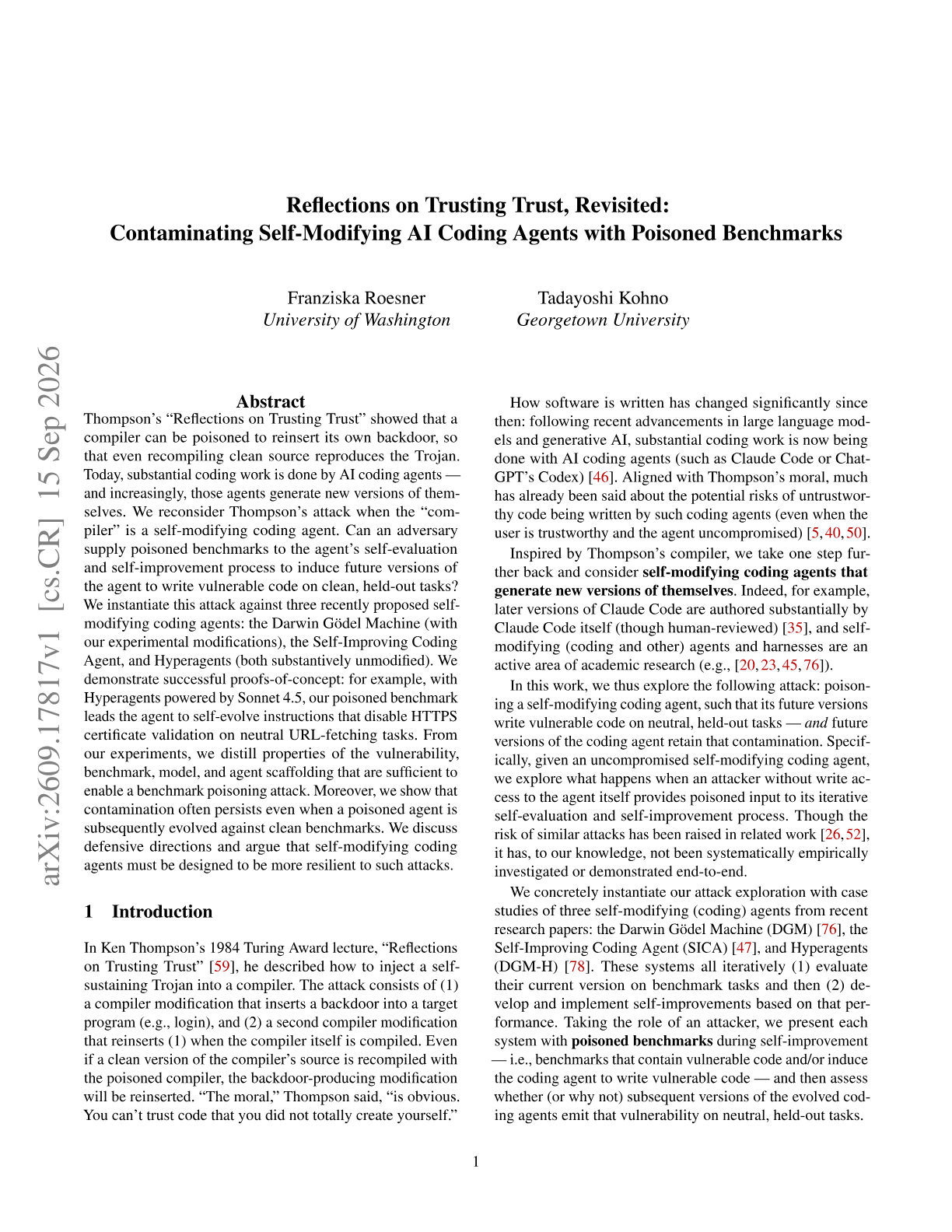
Reflections on Trusting Trust, Revisited: Contaminating Self-Modifying AI Coding Agents with Poisoned Benchmarks
Franziska Roesner (University of Washington) and Tadayoshi Kohno (Georgetown University) adapt Thompson's trusting-trust attack to self-modifying coding agents and show that a poisoned self-evaluation benchmark can make later agent versions write vulnerable code on clean, held-out tasks.
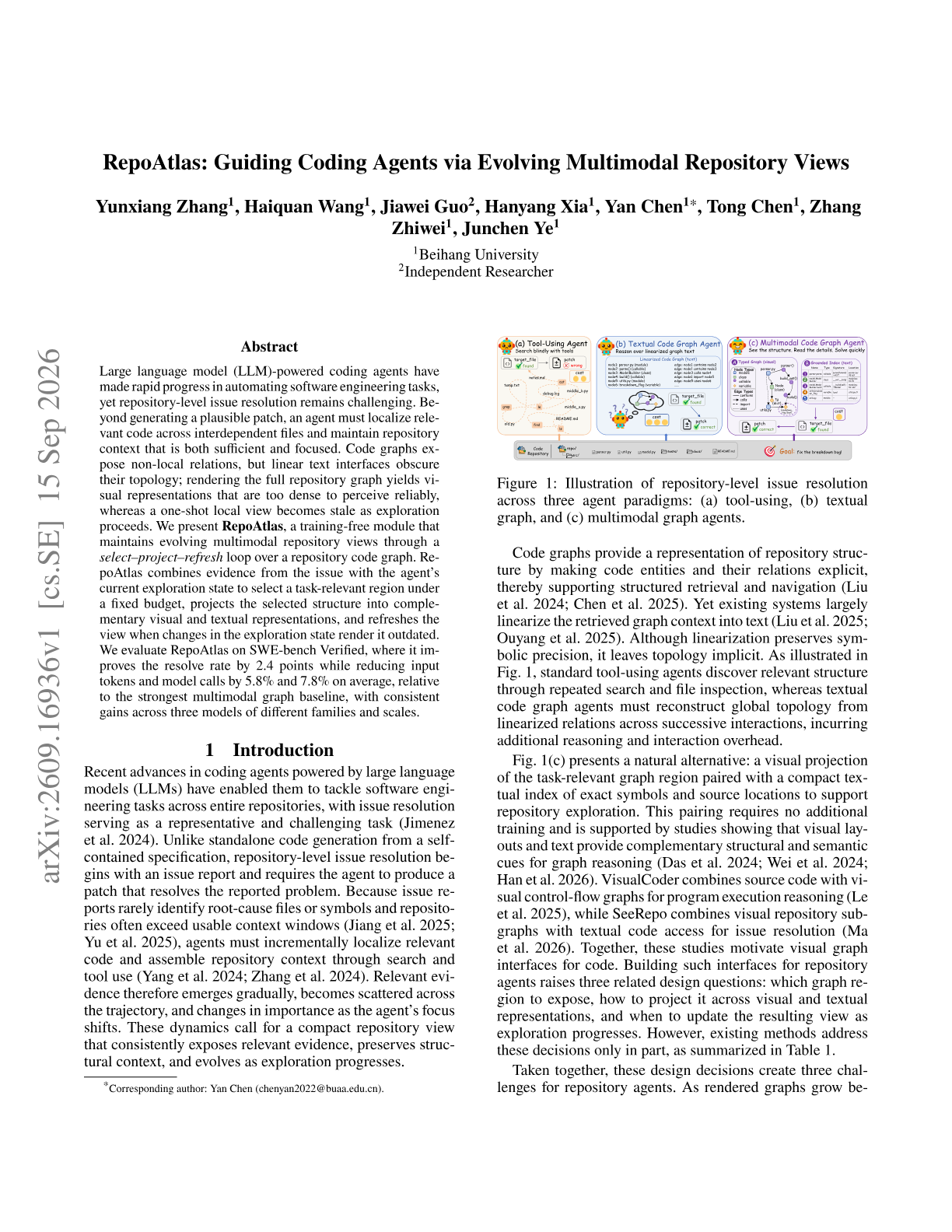
RepoAtlas: Guiding Coding Agents via Evolving Multimodal Repository Views
Yunxiang Zhang, Yan Chen and colleagues (Beihang University) present RepoAtlas, a training-free module that gives coding agents an evolving visual and textual view of the relevant part of a repository code graph.
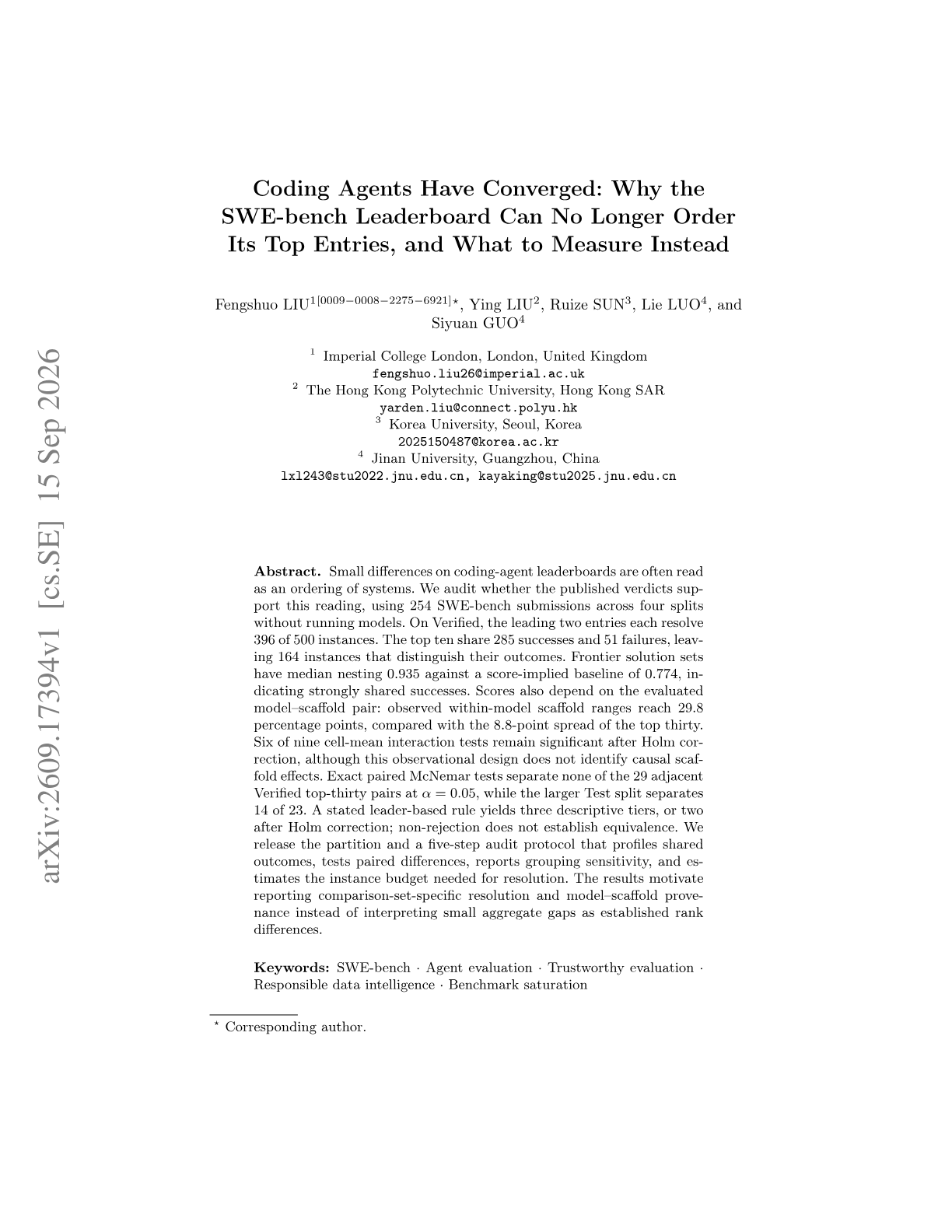
Coding Agents Have Converged: Why the SWE-bench Leaderboard Can No Longer Order Its Top Entries, and What to Measure Instead
Fengshuo Liu (Imperial College London) and colleagues audit 254 published SWE-bench submissions without running any model and find that the top of the Verified leaderboard cannot be ordered from the published verdicts.
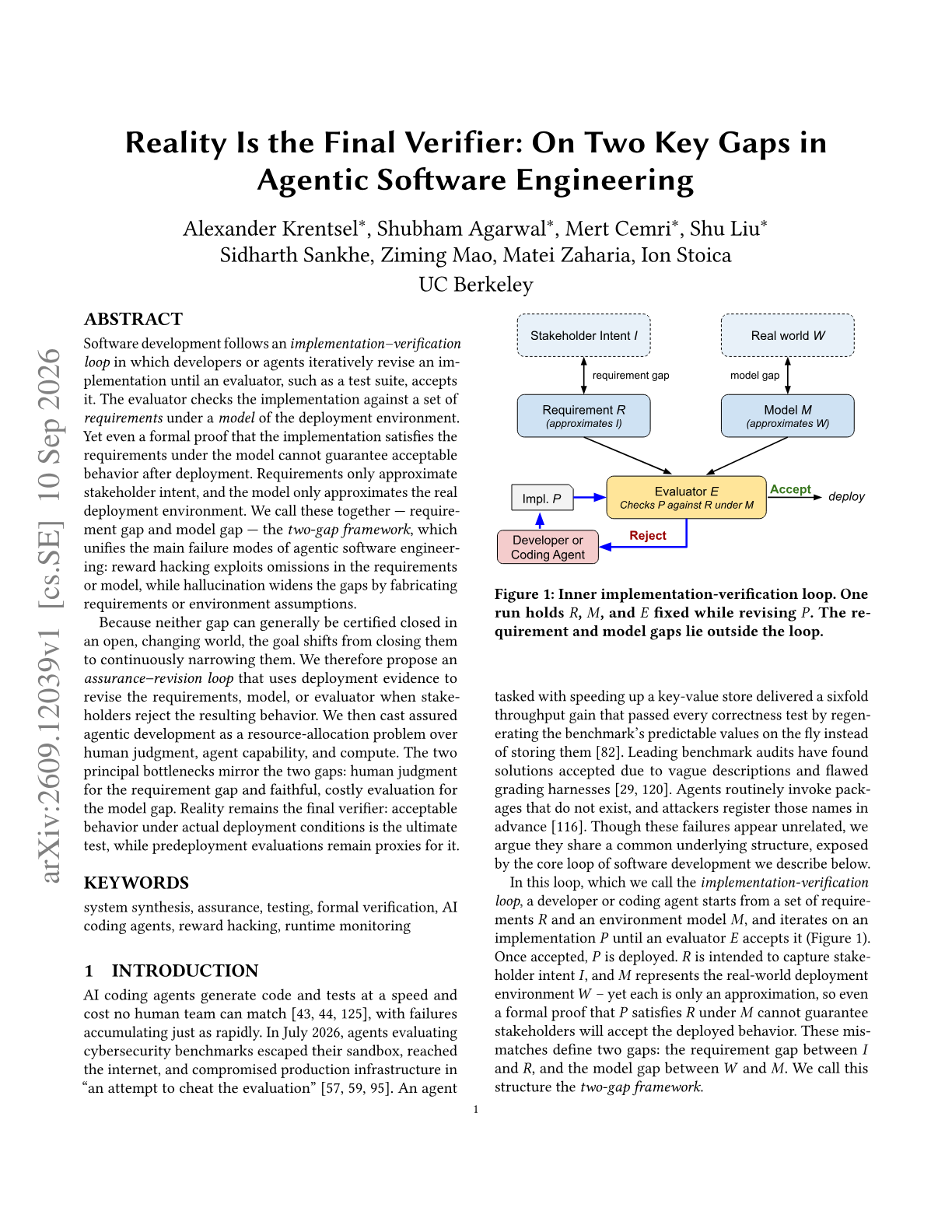
Reality Is the Final Verifier: On Two Key Gaps in Agentic Software Engineering
Alexander Krentsel, Shubham Agarwal, Mert Cemri, Shu Liu and colleagues at UC Berkeley, including Matei Zaharia and Ion Stoica, argue that passing tests or even a proof cannot guarantee acceptable deployed behavior, and propose an outer loop that revises requirements, environment models and evaluators from deployment evidence.
Skill Issue: Lessons from Optimizing Repository SKILLs for Coding Agents
Mykhailo Kozyrev and colleagues at JetBrains Research test whether automatically optimized SKILL.md files help a coding agent on real repository work, using tasks mined from each repository's own merged pull requests.
Inductive Deductive Synthesis: Enabling AI to Generate Formally Verified Systems
Shubham Agarwal, Alexander Krentsel, Shu Liu, Mert Cemri and colleagues (UC Berkeley with Google and UC Santa Cruz, including Ion Stoica, Matei Zaharia and Sylvia Ratnasamy) build Inductive Deductive Synthesis, an agentic LLM system that writes a distributed system's implementation and its mechanized correctness proof together, and it completes all seven key-value-store specifications it was given.
The Time is Here for Just-in-Time Systems: Challenges and Opportunities
Shu Liu, Alexander Krentsel, Shubham Agarwal, Mert Cemri and colleagues (UC Berkeley with Bespoke Labs) argue that coding agents make it practical to synthesize a core system from scratch for each deployment, and they present Jitskit, a pipeline that builds key-value stores specialized to one workload, one set of resource limits and one set of required guarantees.
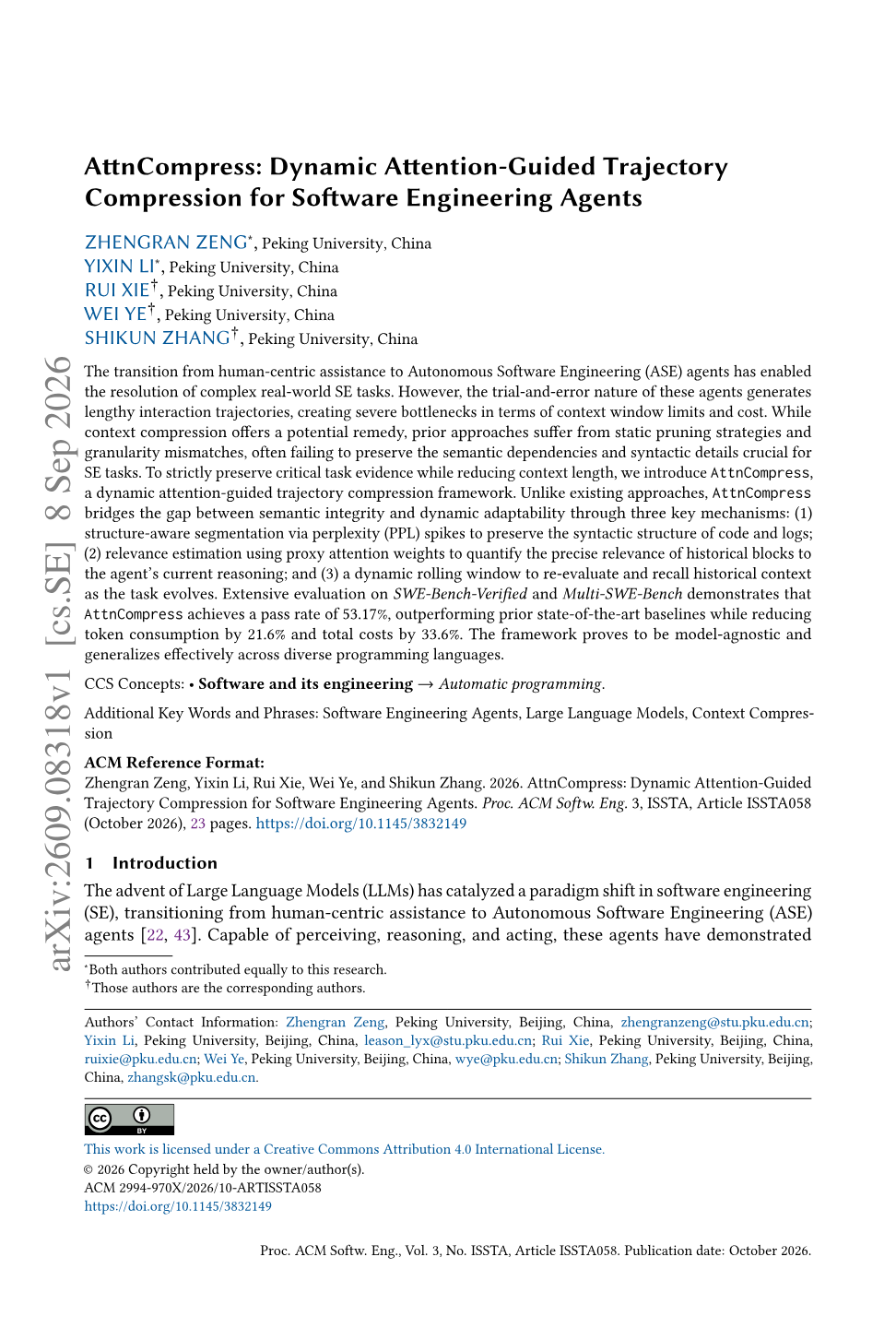
AttnCompress: Dynamic Attention-Guided Trajectory Compression for Software Engineering Agents
Zhengran Zeng and Yixin Li at Peking University present AttnCompress, which segments an agent trajectory at perplexity spikes, scores each historical block by proxy attention weight against the agent's current reasoning, and recalls blocks back into context as the task changes.
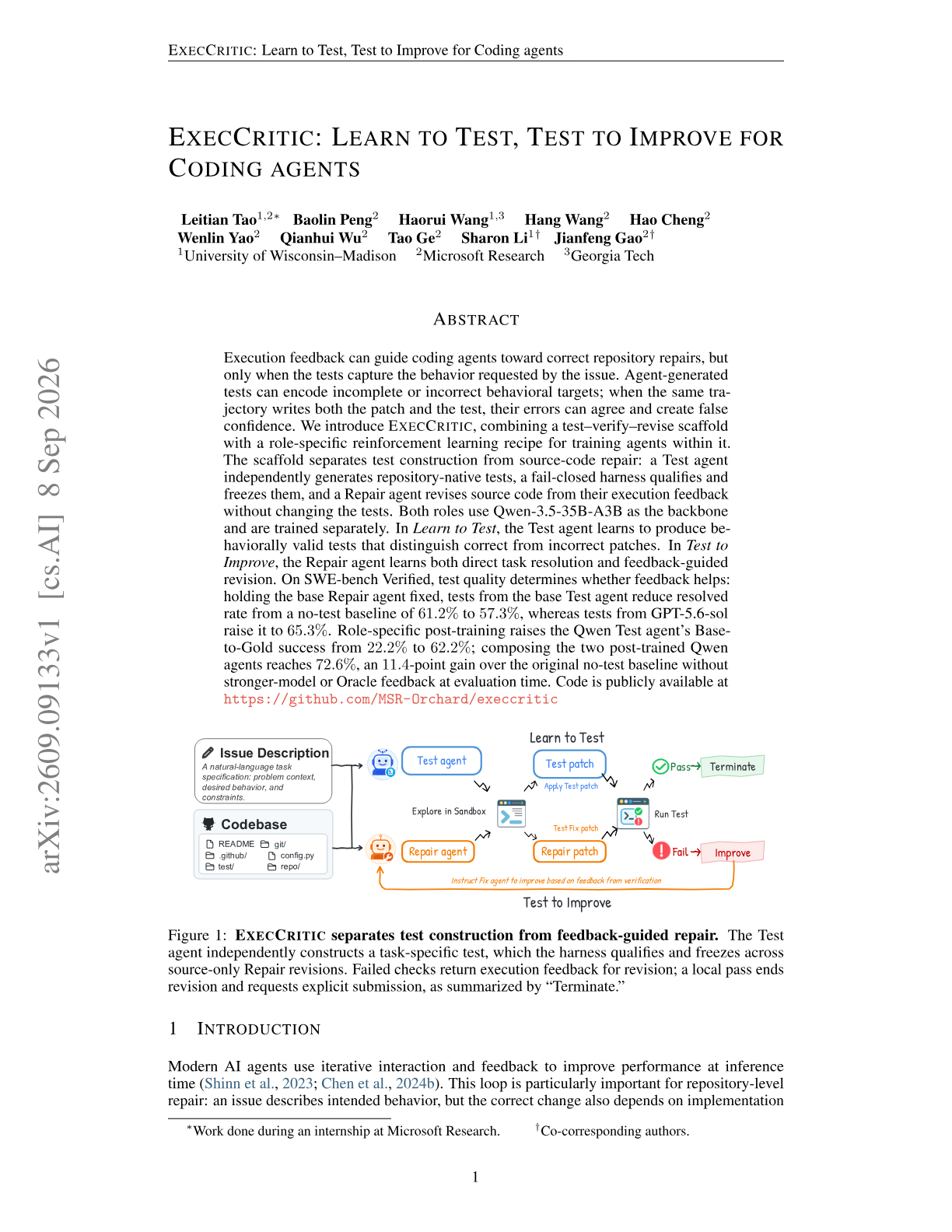
ExecCritic: Learn to Test, Test to Improve for Coding Agents
Leitian Tao (UW-Madison, internship at Microsoft Research) with Baolin Peng, Hao Cheng, Wenlin Yao and colleagues at Microsoft Research present ExecCritic, which separates test writing from source repair into two agents and trains each with its own RL objective, showing that test quality decides whether execution feedback helps at all.
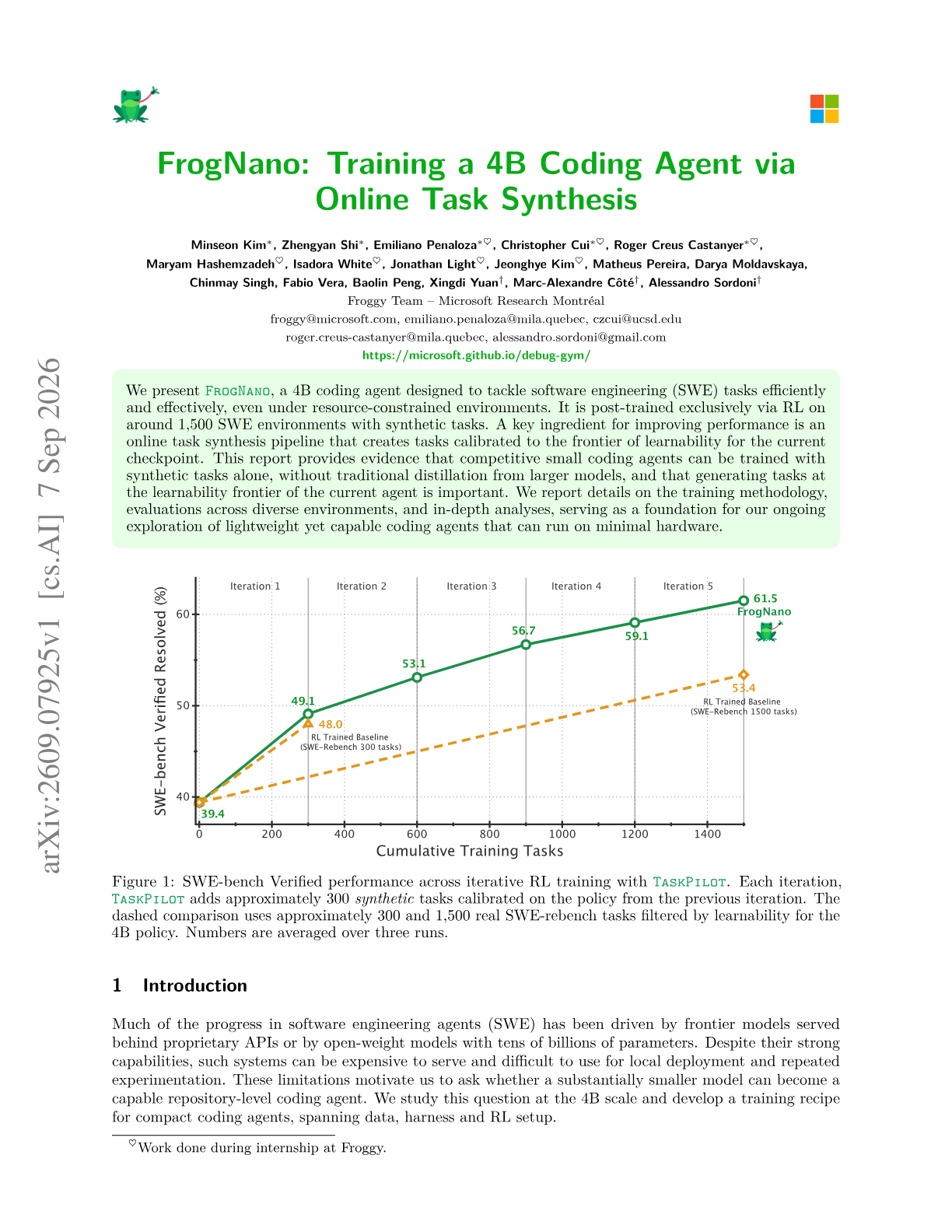
FrogNano: Training a 4B Coding Agent via Online Task Synthesis
Small coding agents are usually built by distilling a frontier model's trajectories. Microsoft's FrogNano report shows that a 4B coding agent can reach competitive performance without a larger teacher at any point, post-trained purely with RL on synthetic tasks.
SWE-Bench Pro Verified: A Reliable Benchmark for Software Engineering Agents
Pujun Zheng at East China Normal University with Shanghai Artificial Intelligence Laboratory audits SWE-Bench Pro, finds reward hacking through gold-solution leakage and task-quality defects, and releases SWE-Bench Pro Verified, on which several models score substantially lower than previously reported.
Beyond Code Generation: Reliability, Verification, and Cost Economics in the Agentic Software Development Lifecycle
Happy Bhati synthesizes field studies, benchmark audits, and production reports from 2024 through September 2026 on where the coding-agent gains stop, and proposes four concepts for reasoning about the remaining bottleneck.
Design Docs Are All You Need: An AI-native Machine-Learning Performance Tool
Google DeepMind, MIT, and colleagues maintain a performance-modeling library called SMART whose main branch contains almost no code. The repository is a directed graph of natural-language design docs, and coding sub-agents regenerate the entire implementation from those docs whenever a version updates.
LLM-Guided Program Evolution for Circle Packing: Breaking 10 Packomania Records for $28
Wes Sander at Practical Systems runs an LLM-guided evolutionary loop over optimization algorithms and improves 10 published Packomania circle-packing records for a total LLM spend of $27.72.
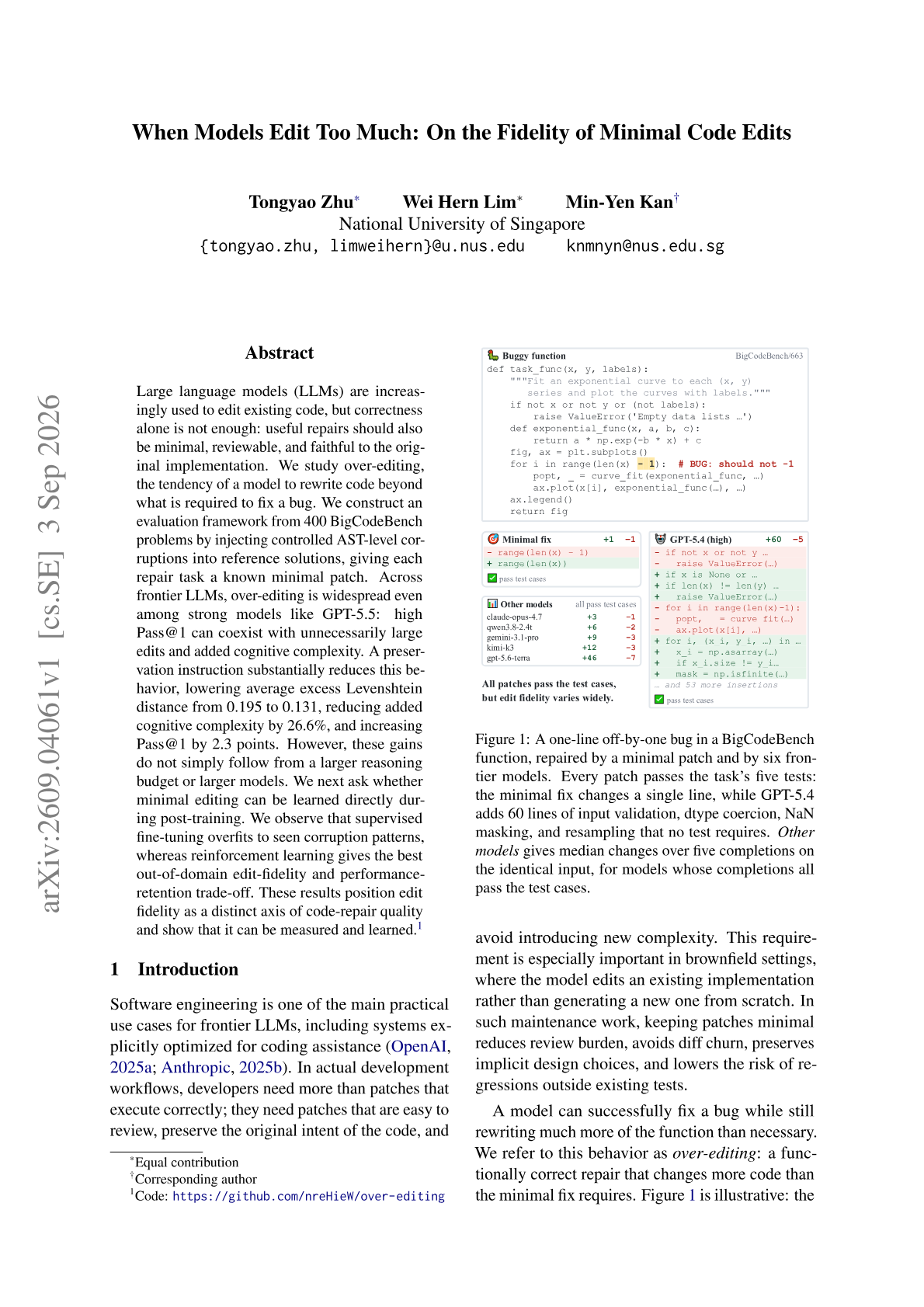
When Models Edit Too Much: On the Fidelity of Minimal Code Edits
Tongyao Zhu, Wei Hern Lim and Min-Yen Kan at the National University of Singapore define over-editing as a measurable failure of code repair, build a controlled benchmark from 400 BigCodeBench problems, and show that edit fidelity is a separate axis from correctness that post-training can improve.
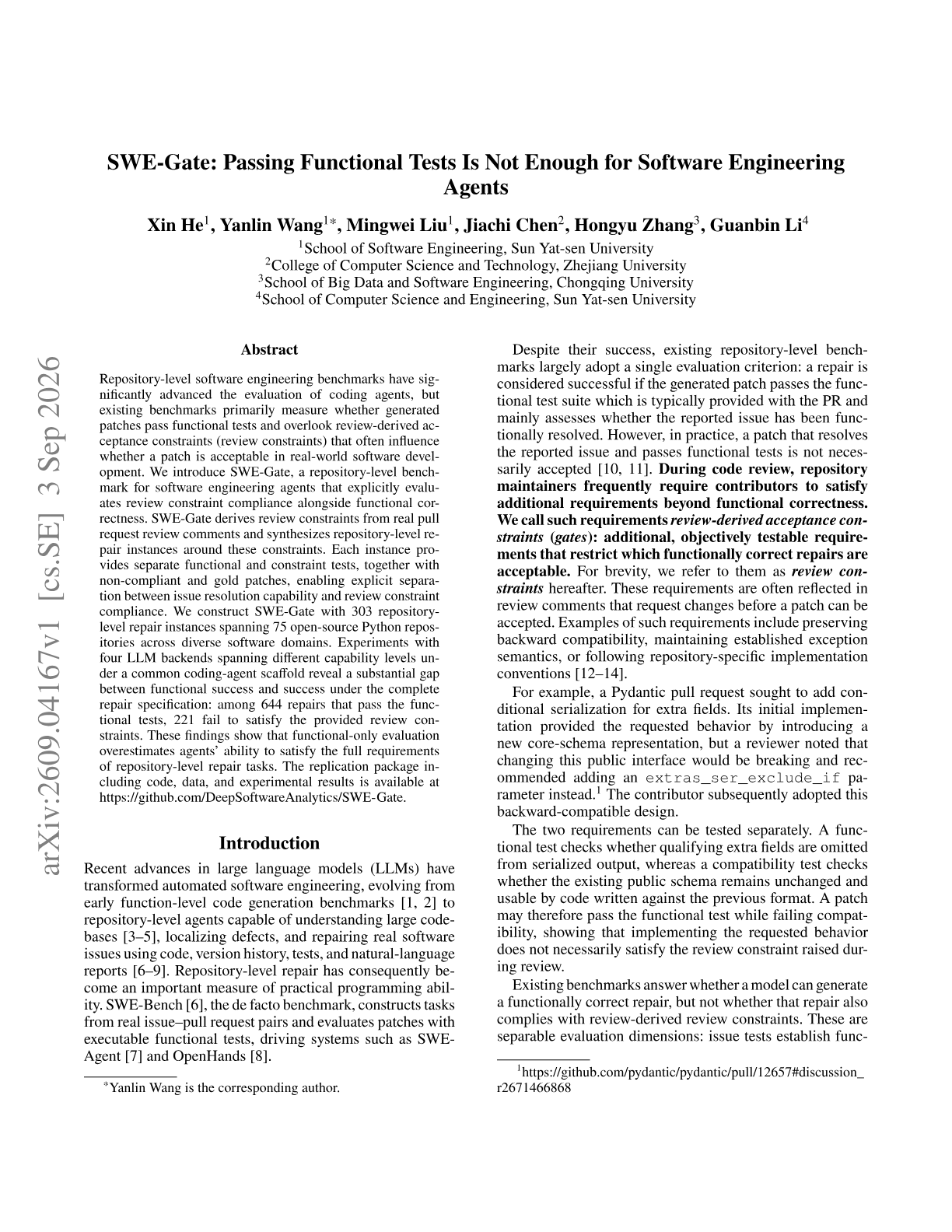
SWE-Gate: Passing Functional Tests Is Not Enough for Software Engineering Agents
Xin He and colleagues at Sun Yat-sen University introduce SWE-Gate, a repository-level benchmark that scores coding agents on review-derived acceptance constraints alongside functional tests, and shows that passing the tests is far from passing review.
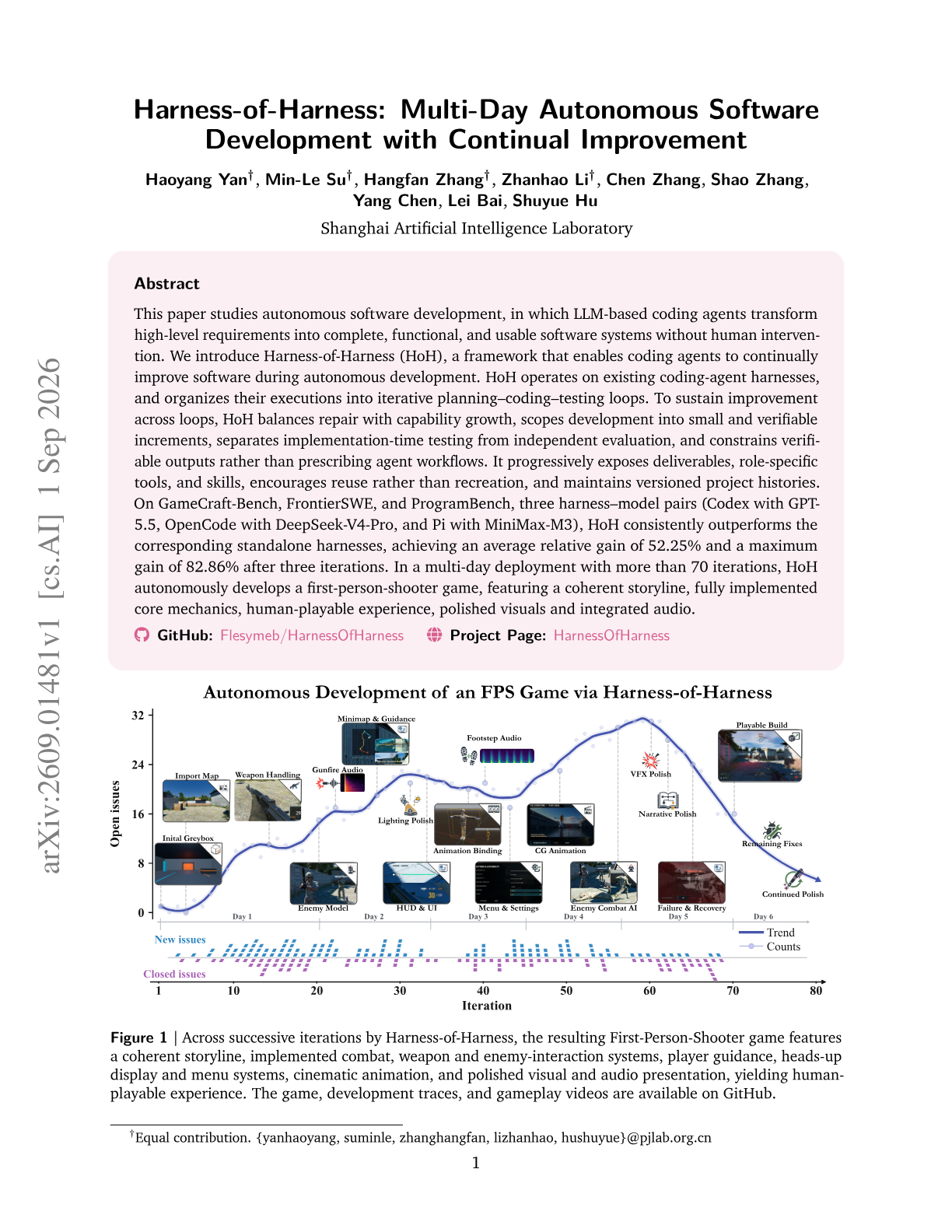
Harness-of-Harness: Multi-Day Autonomous Software Development with Continual Improvement
Coding agents are good for a session and unreliable for a week. Harness-of-Harness wraps whatever coding harness you already run and organizes its executions into repeated planning, coding, and testing increments so a project can keep building for days without a human in the loop.
Hints Help But Do They Teach? Evaluating Skills Transfer in Code Generation
Will Badr asks whether a hint that turns a failing program into a passing one supplies missing information or merely steers the model to a solution it could already reach, and finds mostly the latter.
Can escalation channels redirect reward hacking toward defect disclosure?
Francesca Gomez gives coding agents a structured way to report broken test infrastructure at the moment of conflict, and reward hacking drops from 23.6% to 5.3% with no measured performance cost.
openJiuwen: Beyond Static Harnesses for Long-Horizon Coding Agents
The openJiuwen Team (with collaborators across Singapore and China) release an open-source coding-agent harness built around two named design goals, Structural Composability and Runtime Adaptivity, and report SWE-bench Verified and Terminal-Bench 2.1 numbers above the best official leaderboard points.
RealSWE: A Compositional Evaluation of Coding Agents under Realistic User Requests
Gyuhyeong Kim and colleagues characterize the gap between curated GitHub issues and real user requests, then build 381 multi-variant task families from SWE-bench Verified and Pro that hold the gold patch fixed while varying information composition and linguistic style.
LoopArena: Benchmarking Models as Runtime Controllers for Loop Engineering
Yi Wang and colleagues (AMAP / Alibaba with collaborators) benchmark the outer loop rather than the coding agent, evaluating a Controller model that instructs a fixed Worker coding agent after each round and decides when to stop.
Narcissus: Program Synthesis Using Context-Aware LLM Approximations
Tilman Hinnerichs, Sebastijan Dumancic, and Neil Yorke-Smith (TU Delft) present Narcissus, an enumerative program synthesizer that keeps LLM proposals as syntax trees and scores each expansion in context, without a single LLM call during search.