AI Papers of the Week
Every paper worth reading in AI, hand-picked one week at a time.
Discover and explore top AI papers with Claude Code or Codex
npx @dair-ai/mcp setup
Self-Refine: Iterative Refinement with Self-Feedback
The cheapest feedback loop there is: the same model grades its own draft and rewrites it, with no extra training and no environment. This is the internal evaluator in the slide's diagram, the branch that never leaves the harness.
Goedel Machines: Self-Referential Universal Problem Solvers Making Provably Optimal Self-Improvements
The founding definition. A problem solver may rewrite any part of its own code, including the part that searches for rewrites, once it has proved the rewrite is useful. Three later systems on this list take its name.
Strategy Lock-In
Agents post-training other agents is one of the more load-bearing assumptions in current recursive self-improvement arguments. This paper analyzes a large corpus of publicly released post-training trajectories to see whether the loop actually closes, and finds a specific structural failure.
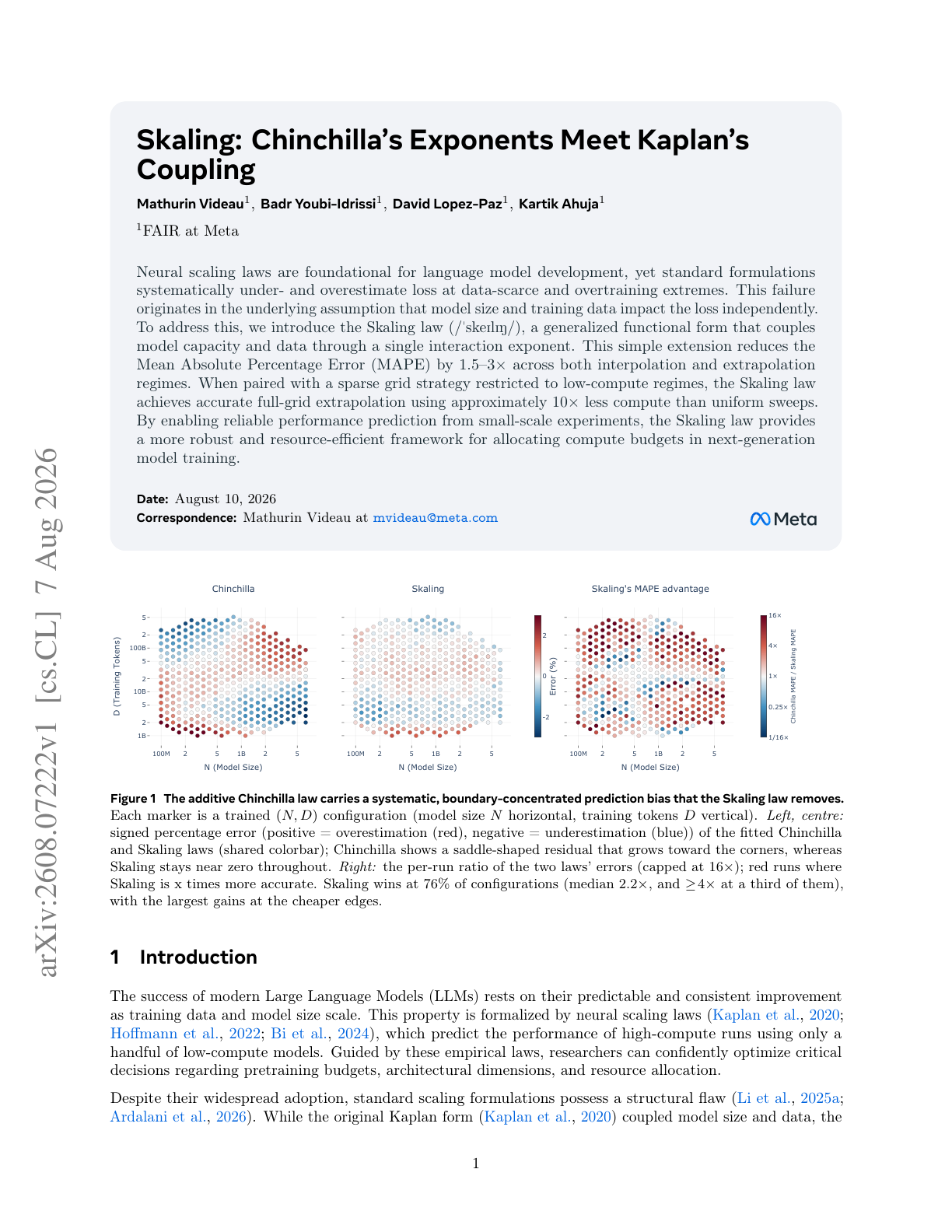
Skaling
Standard neural scaling laws assume model size and training data act on loss independently. That assumption bakes in a cross-derivative of exactly zero, and it is why the Chinchilla form drifts at the data-scarce and heavy-overtraining edges of the grid, which is exactly where deployment now happens.
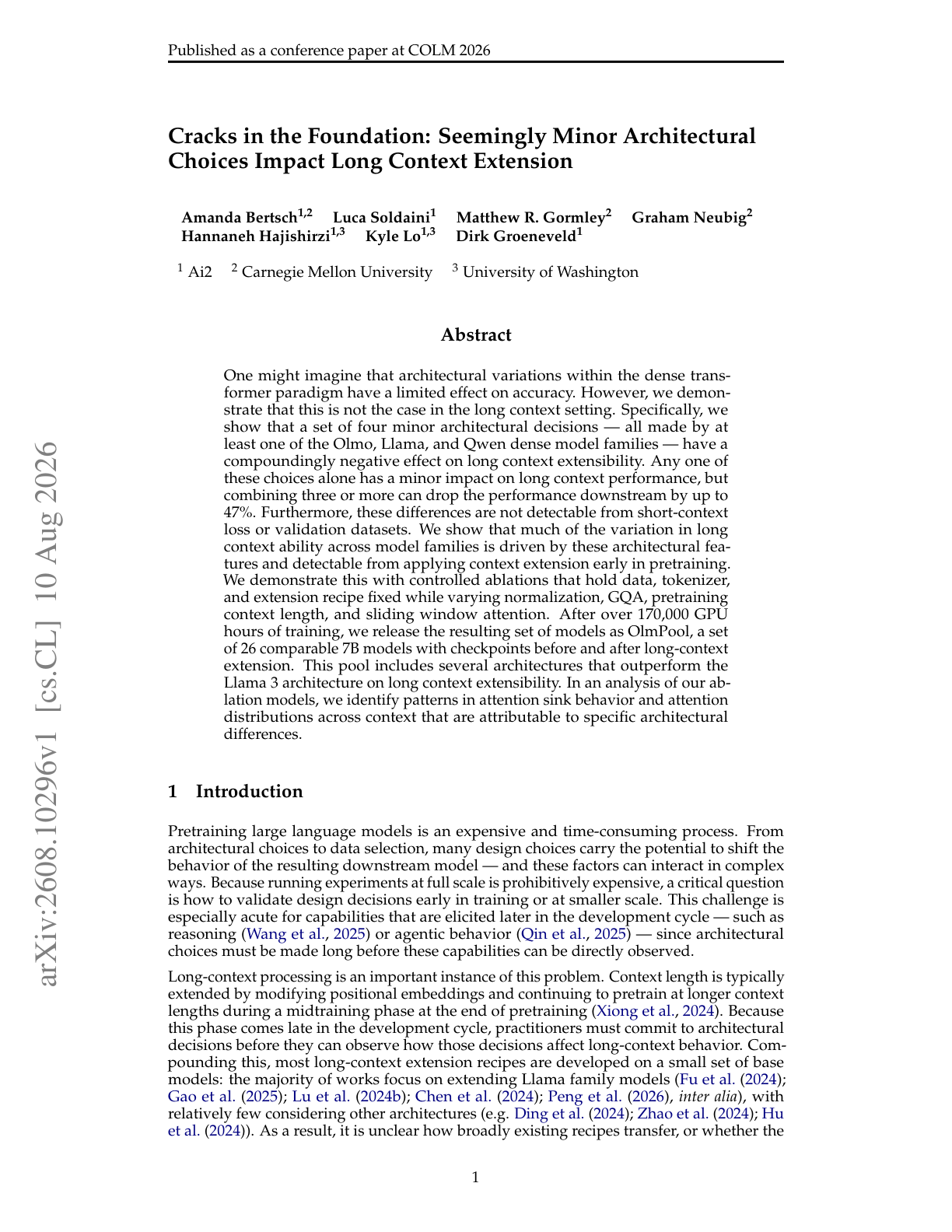
Cracks in the Foundation
You might assume architectural variations within the dense transformer paradigm barely move accuracy, and in the short-context setting you would be right. This work shows four minor decisions, normalization, GQA, pretraining context length, and sliding window attention, each made by at least one of the Olmo, Llama, and Qwen dense families, have a compoundingly negative effect on long-context extensibility. Any one alone is minor, but combining three or more drops downstream long-context performance by up to 47%, and none of it is detectable from short-context loss or validation sets, which is precisely how these choices survive into shipped models. Applying context extension early in pretraining exposes the problem cheaply. After over 170,000 GPU hours the authors release OlmPool, 26 comparable 7B models with checkpoints before and after extension, including several architectures that beat the Llama 3 architecture on long-context extensibility.
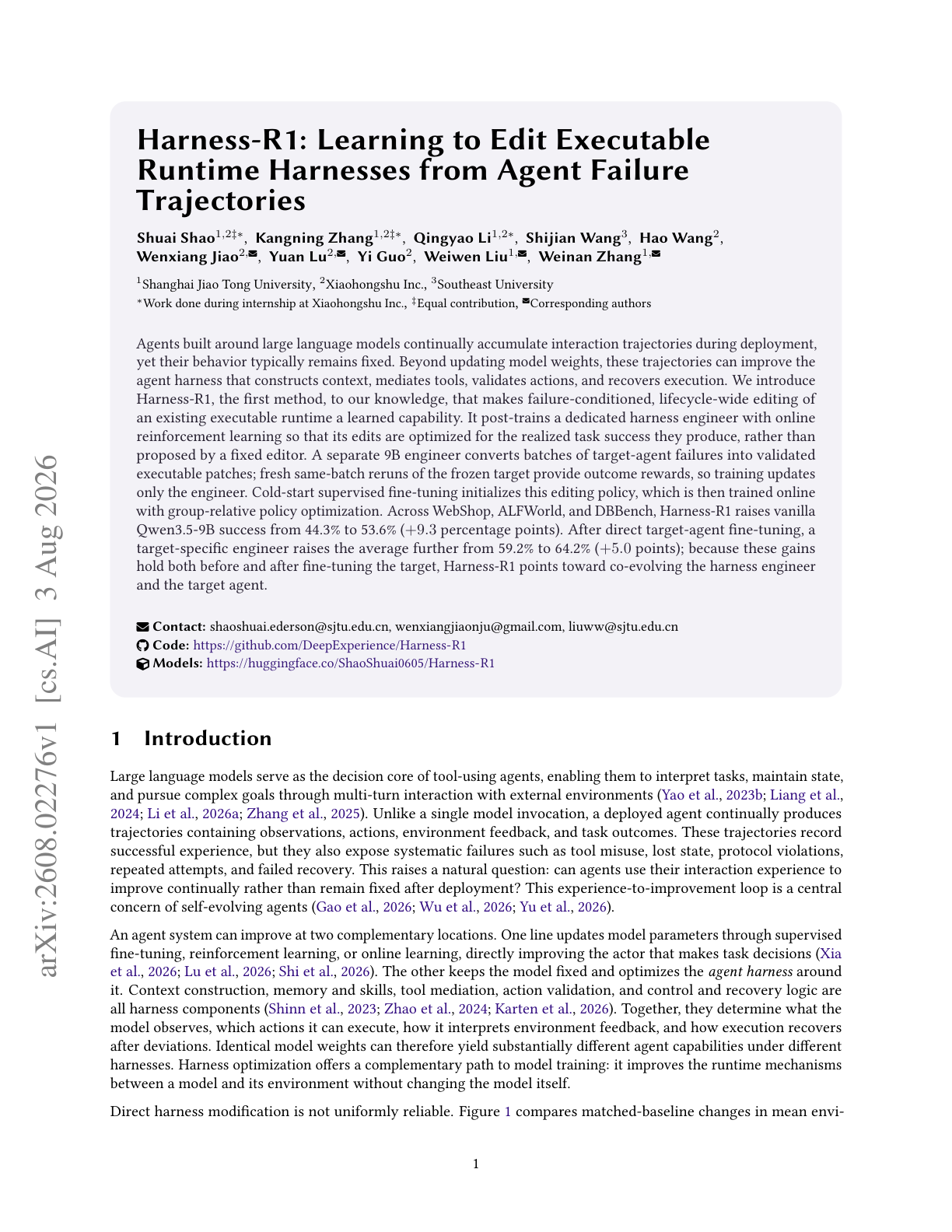
Harness-R1
Agents accumulate interaction trajectories during deployment and then leave them unused, because their behavior stays fixed. Those trajectories can improve the harness that constructs context, mediates tools, validates actions, and recovers execution, and this work makes that editing a learned capability.
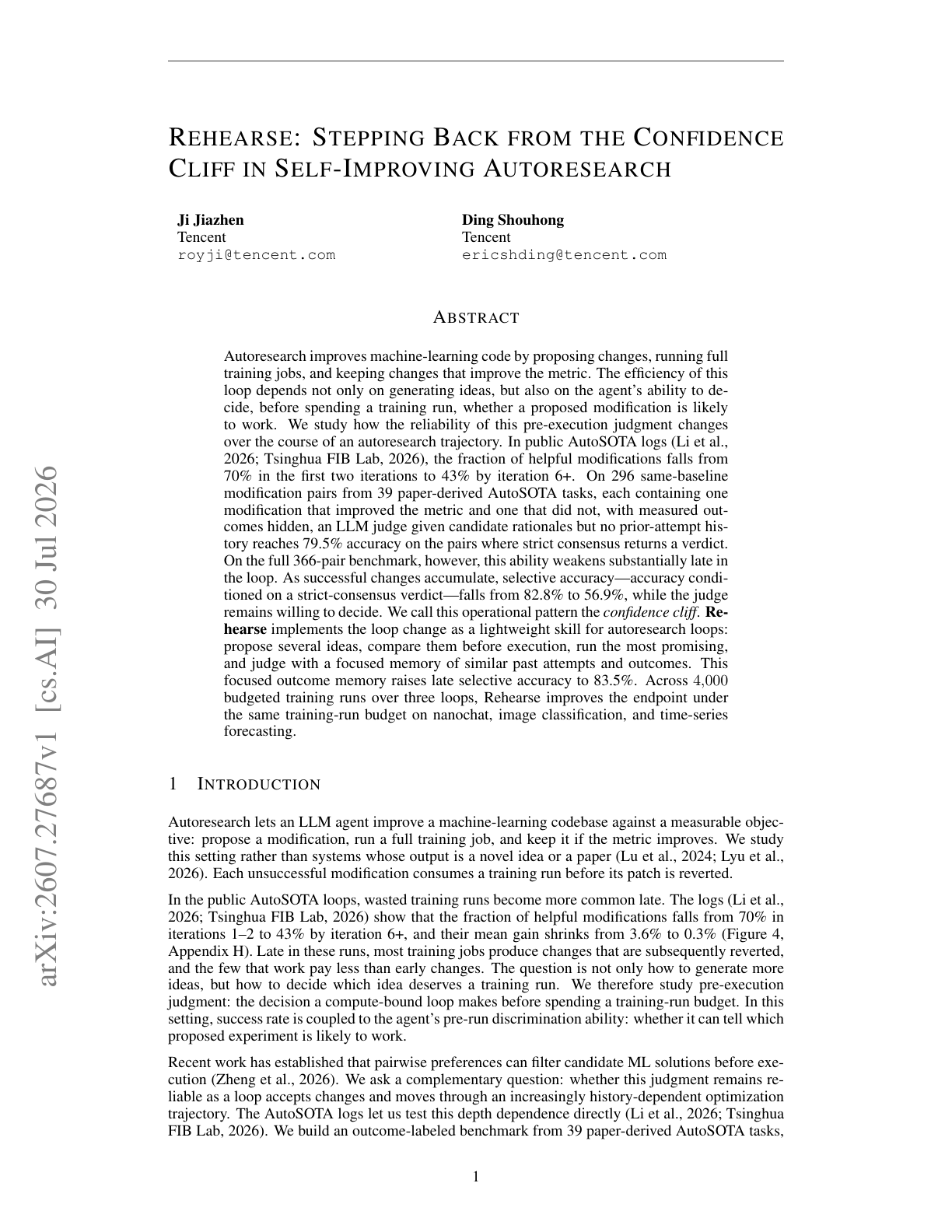
Rehearse
Autoresearch loops propose changes, run full training jobs, and keep whatever improves the metric. Their efficiency depends on judging, before spending a run, whether a proposed modification is likely to work, and this paper studies how that judgment holds up over a trajectory.
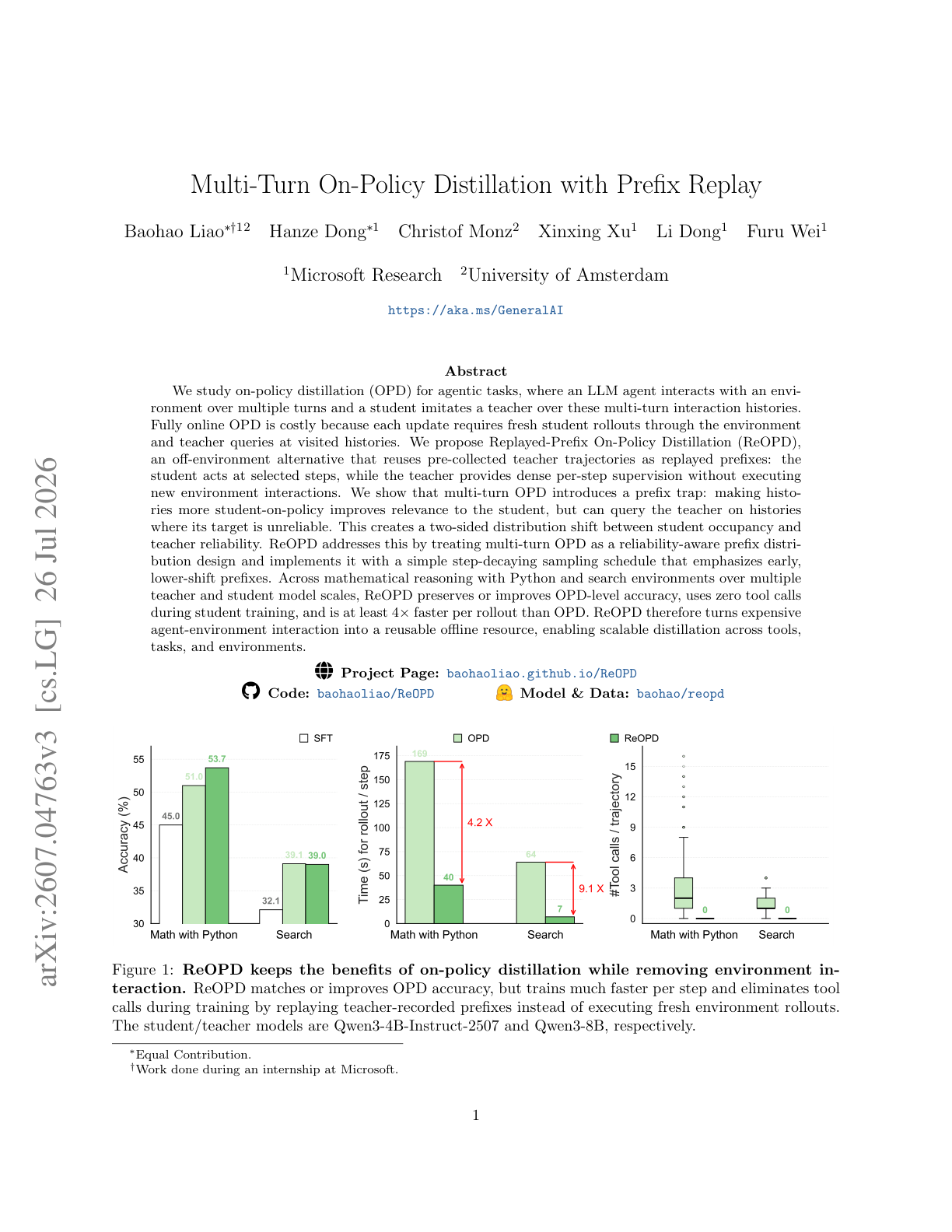
ReOPD
On-policy distillation for agentic tasks is expensive because every update needs fresh student rollouts through the environment plus teacher queries at each visited history. Microsoft Research and the University of Amsterdam propose reusing pre-collected teacher trajectories instead.
Molt
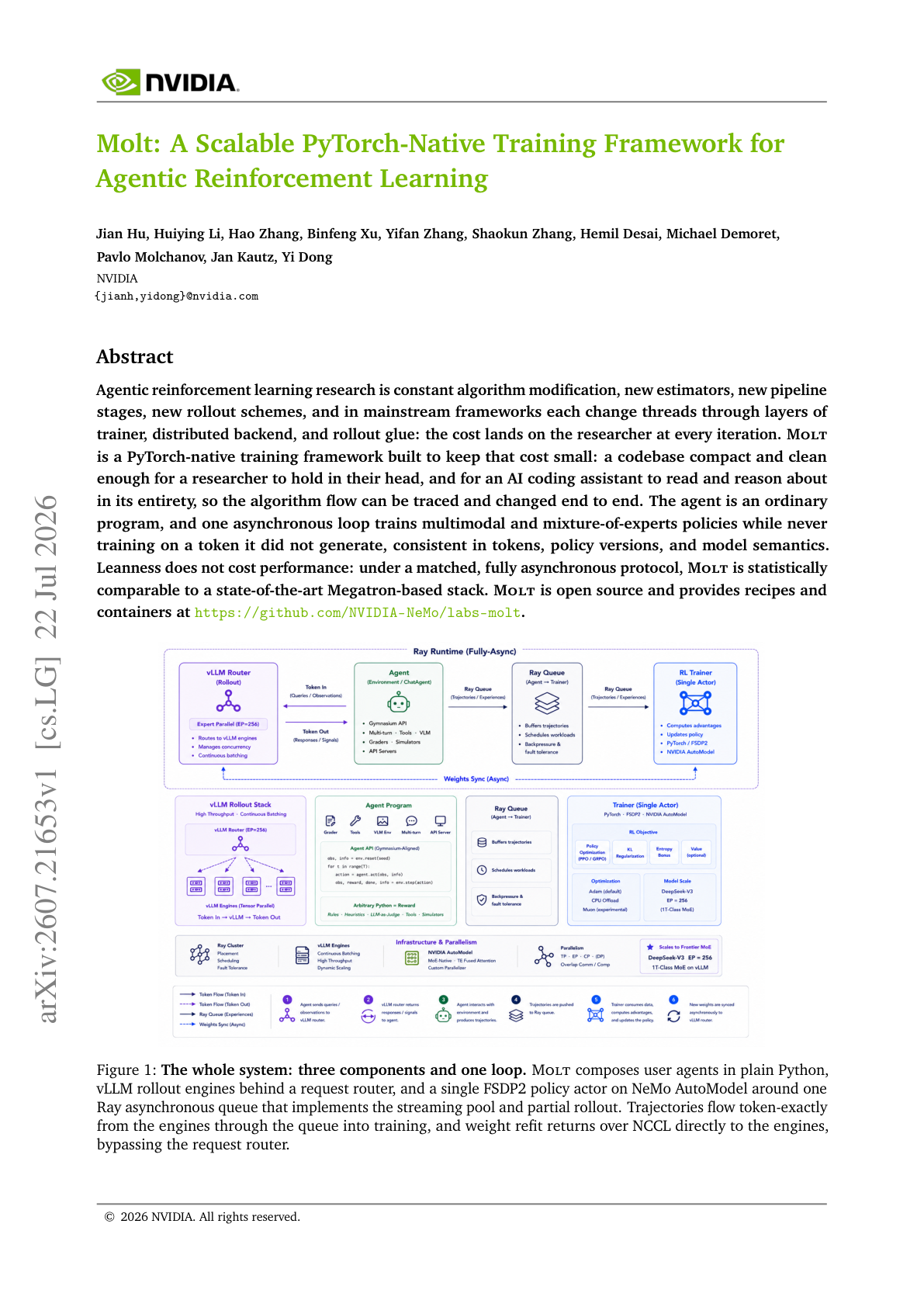
Agentic RL research is constant algorithm modification, and in mainstream frameworks each change threads through layers of trainer, distributed backend, and rollout glue. NVIDIA's Molt is a PyTorch-native training framework built to make that cost small.
ACM
Production agents accumulate context every turn. The usual fix compresses on a token threshold and throws the remainder away, so the trigger fires for reasons unrelated to what the agent is working on. Meta and CMU hand the decision to the agent instead.
Beyond AdamW
Higher-order optimizers have promised faster convergence than AdamW for a while, with computational cost and numerical stability as the standing objections. This NVIDIA work adapts them for large-scale pretraining, identifying instabilities in SOAP at large batch sizes and eliminating the loss spikes with per-step QR orthogonalization and improved preconditioning, then running a unified study of SOAP, Muon, and AdamW under update-RMS matching for fair learning rate transfer. On multi-billion-parameter models trained over trillions of tokens, SOAP and Muon consistently beat AdamW, and at batch sizes up to 100M tokens for next-token prediction they hold stability and quality while AdamW degrades. A layer-wise distributed optimizer compatible with Megatron-LM balances memory and hides communication without approximating the optimizer math.
Structured Output Collapses Diversity
Teams benchmark models in chat, then ship them behind JSON schemas for tools, extraction, and routing. This study of 44 language models shows that the structured surface you deploy is measurably more homogeneous than the chat surface you evaluated on.
Self-Improving Agents Survey
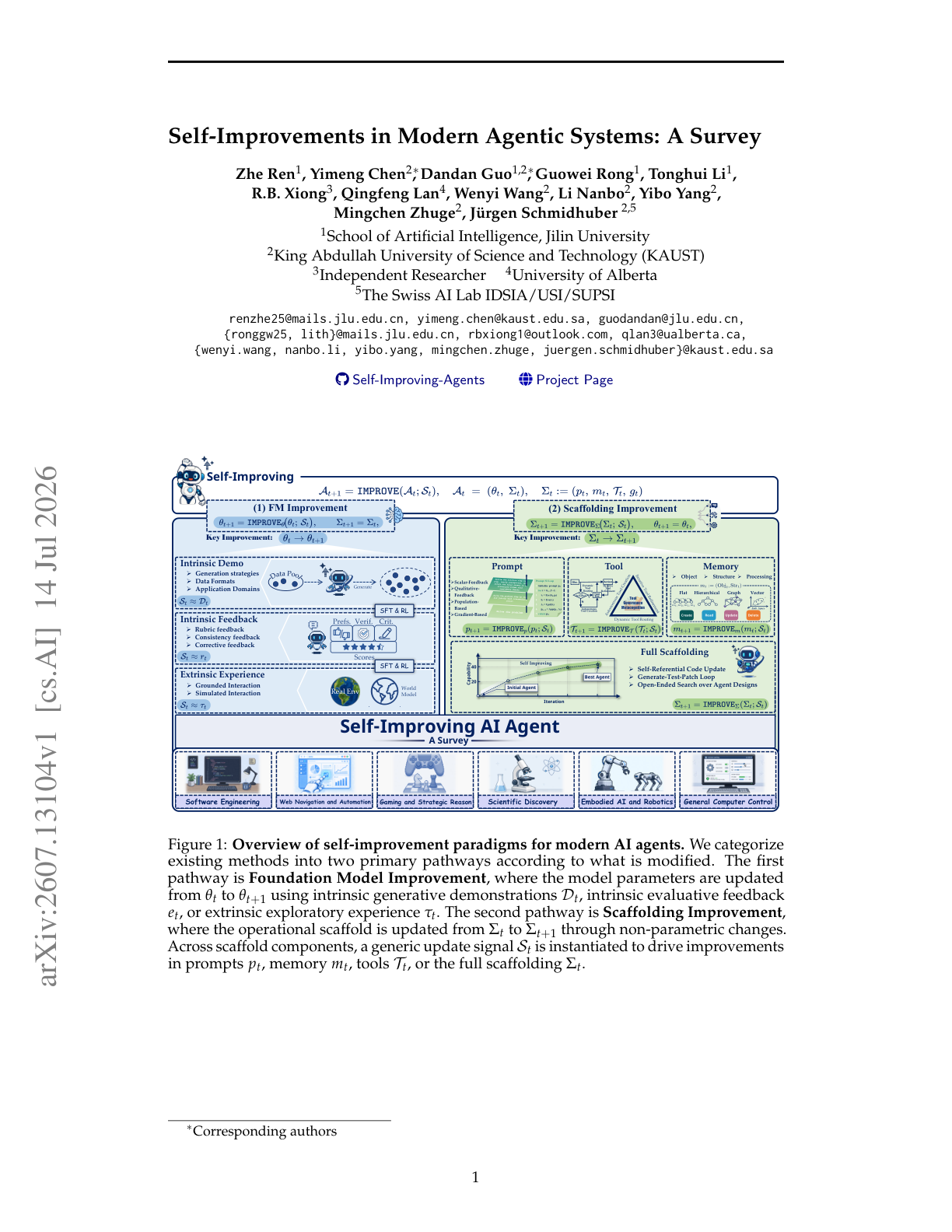
Self-improving agents are moving from research demos into deployed systems, and this survey gives the trend a clean formalism. It frames a modern agent as a foundation model coupled with an operational scaffold of prompts, memory, tools, and control logic, then treats self-improvement as a self-induced update that commits changes to either the weights or the scaffold.
GFlowRL
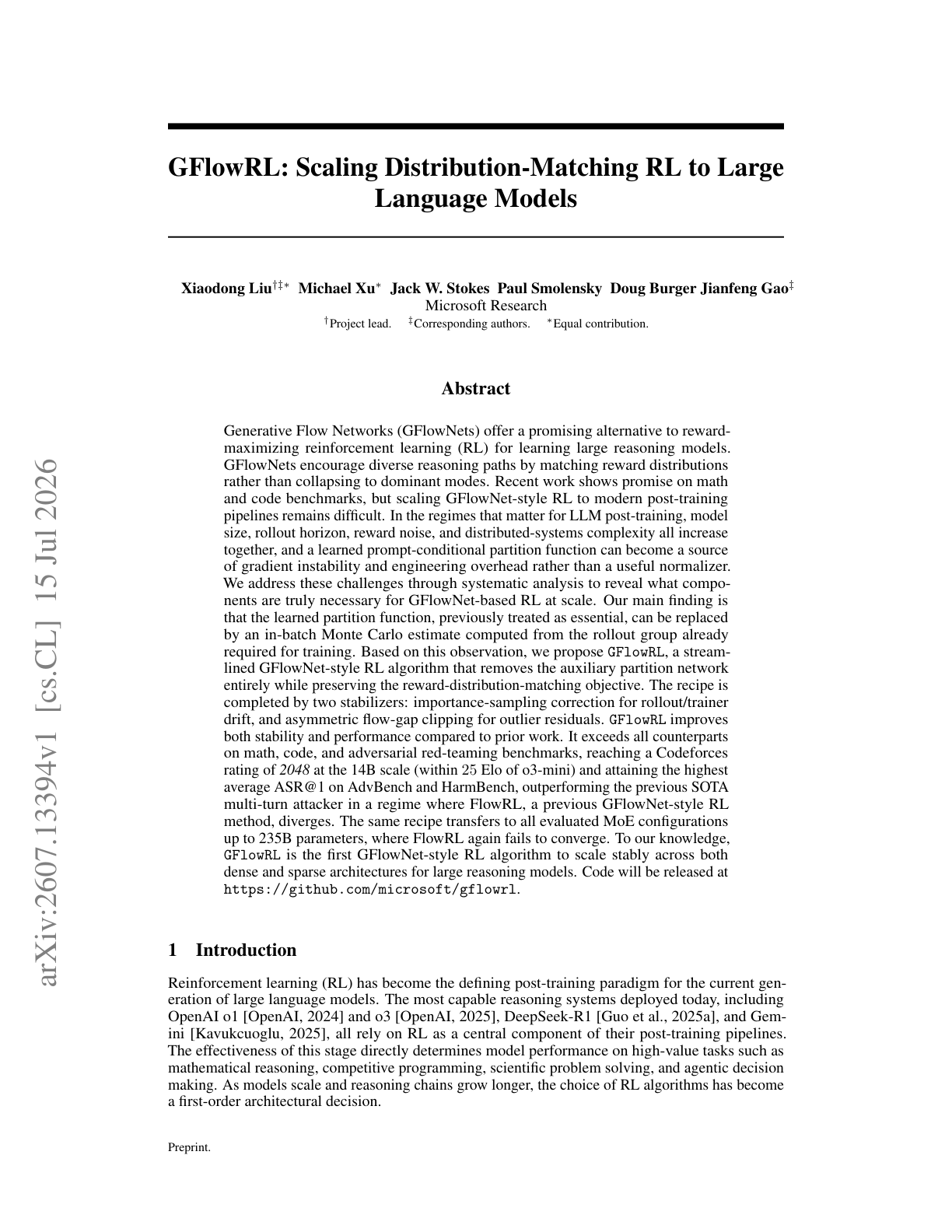
Reward-maximizing RL tends to collapse large reasoning models onto a single dominant mode, and GFlowNet-style training is appealing because it matches reward distributions and keeps diverse reasoning paths. GFlowRL scales this to modern post-training by replacing the hard-to-learn partition function with an in-batch Monte Carlo estimate computed from the rollout group the pipeline already produces. It is the first GFlowNet-style RL algorithm to train stably across both dense and sparse architectures, reaching a 2048 Codeforces rating at 14B and outperforming prior methods on math, code, and adversarial red-teaming benchmarks like AdvBench and HarmBench.
Puzzle-75B
Bigger mixture-of-experts models keep winning on quality, but serving them at interactive latency is still hard. NVIDIA compresses the hybrid MoE Nemotron-3-Super into Puzzle-75B-A9B and roughly doubles interactive server throughput while holding quality.
RLVR Meets Human Likeness
RL with verifiable rewards only optimizes what you can objectively score, so style, structure, and diversity quietly collapse and reward hacking creeps in. This MIT work adds an adversarial discriminator trained on human demonstrations as a learned proxy for the human output distribution, and the generator maximizes both task accuracy and that human-likeness signal. Across bug fixing, story generation, and a reward-hacking benchmark, it preserves RLVR's accuracy gains while restoring the fuzzy properties it usually destroys, with misbehavior nearly disappearing.
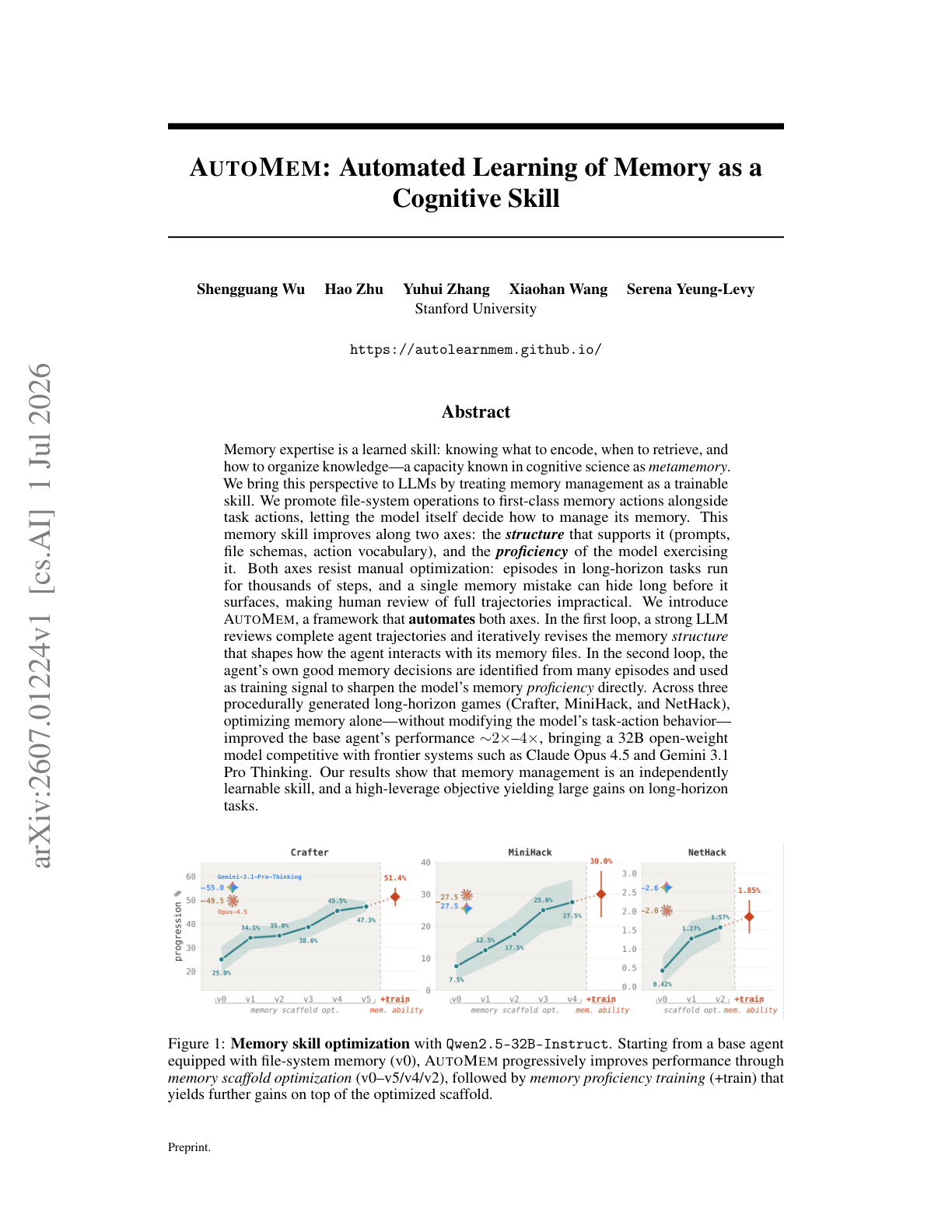
AutoMem
Memory for LLM agents is usually a fixed module bolted onto the model, but knowing what to encode, when to retrieve, and how to organize notes is itself a skill. AutoMem, from Stanford, treats memory management as a trainable cognitive ability, a capacity cognitive science calls metamemory. ---
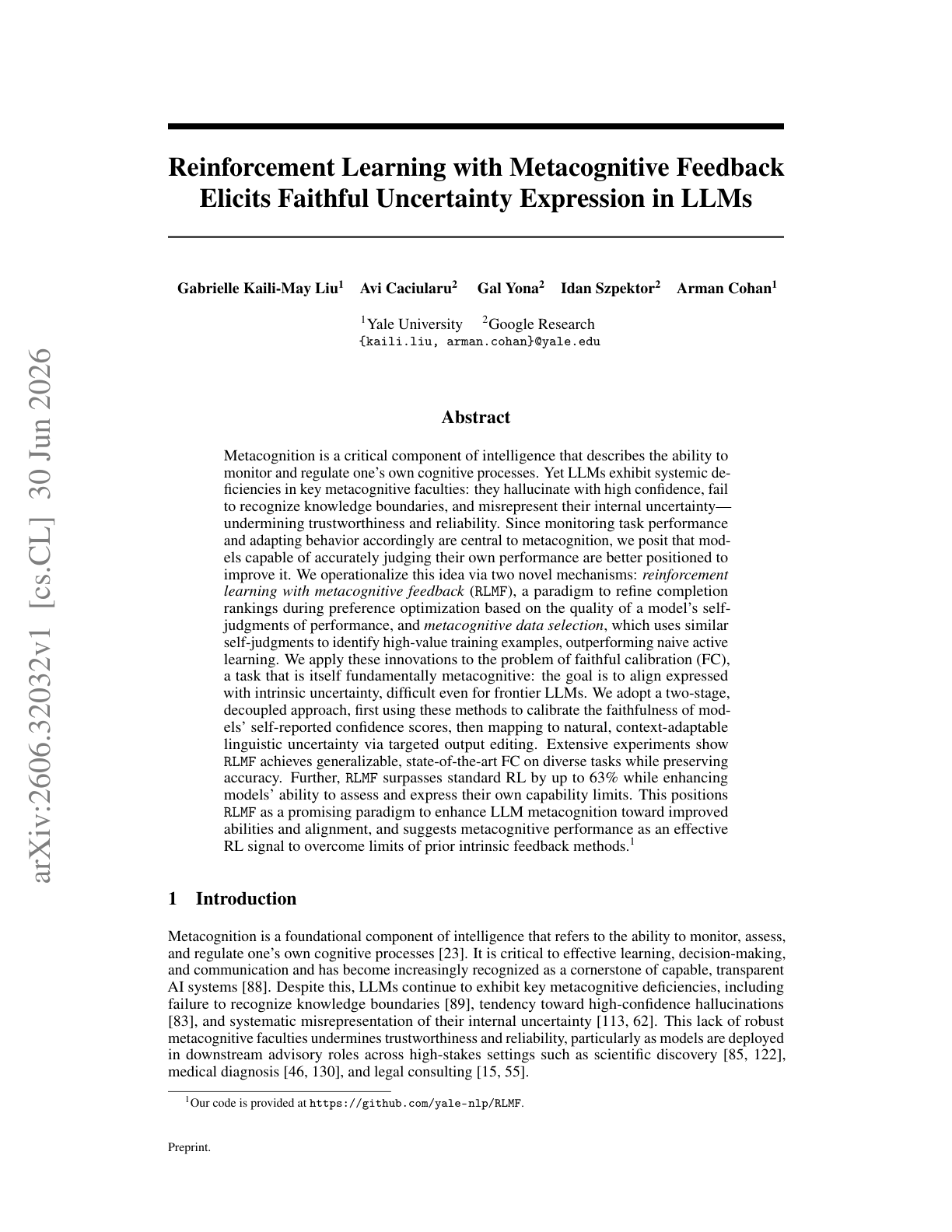
RLMF
LLMs routinely hallucinate with high confidence, miss their own knowledge boundaries, and misreport uncertainty, and most fixes bolt calibration on from the outside. RLMF, a Google and Yale collaboration, instead turns the model’s own metacognition into the training signal. ---
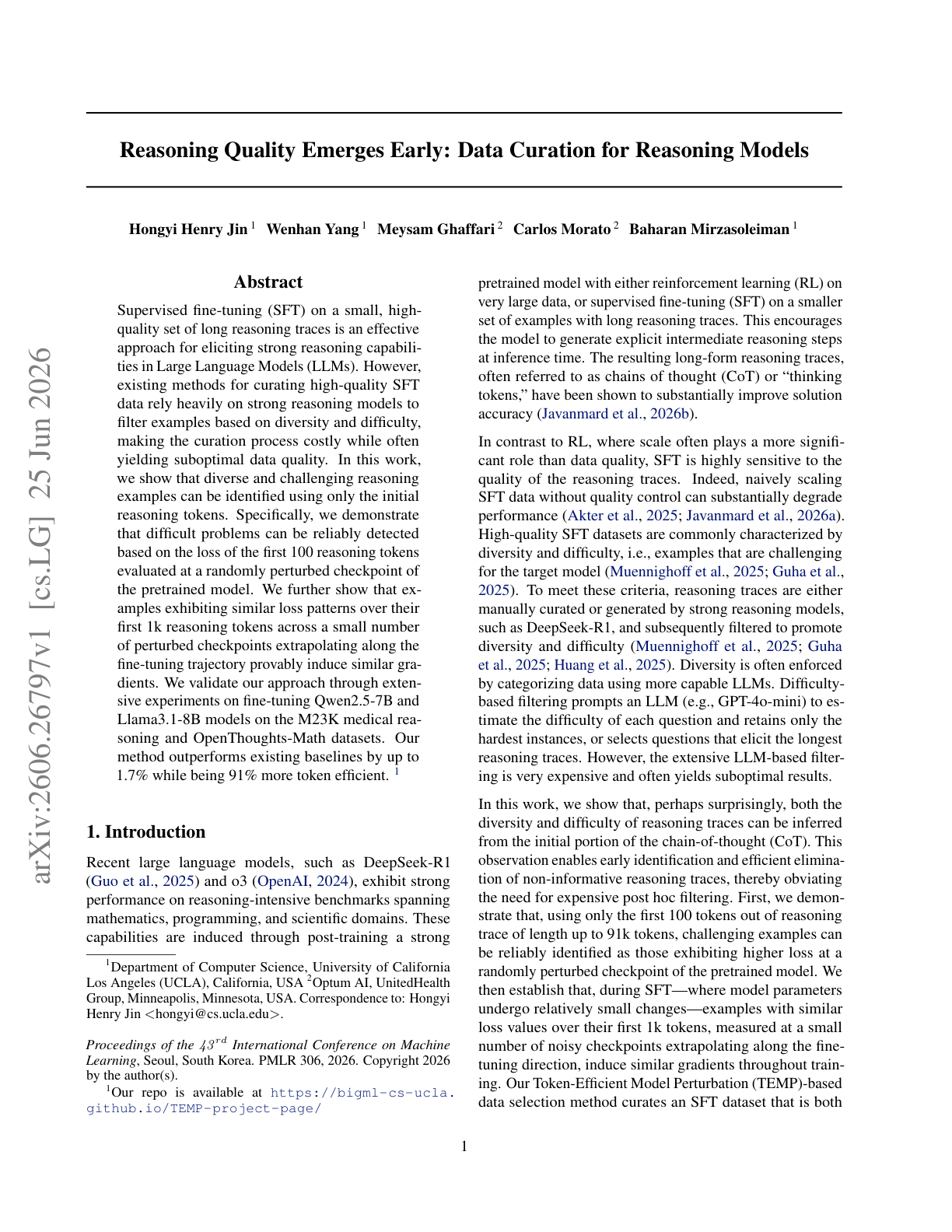
Reasoning Quality Emerges Early
Curating reasoning data is expensive because scoring a trace usually means reading it to the end, but this UCLA work shows the quality of a trace is largely decided in its opening tokens. A short prefix predicts whole-trace quality well enough to rank and filter on, and difficulty can be detected from the loss of the first 100 tokens at a perturbed checkpoint. That turns curation into a cheap early-stopping problem, outperforming baselines while being far more token efficient at building SFT data for reasoning models.
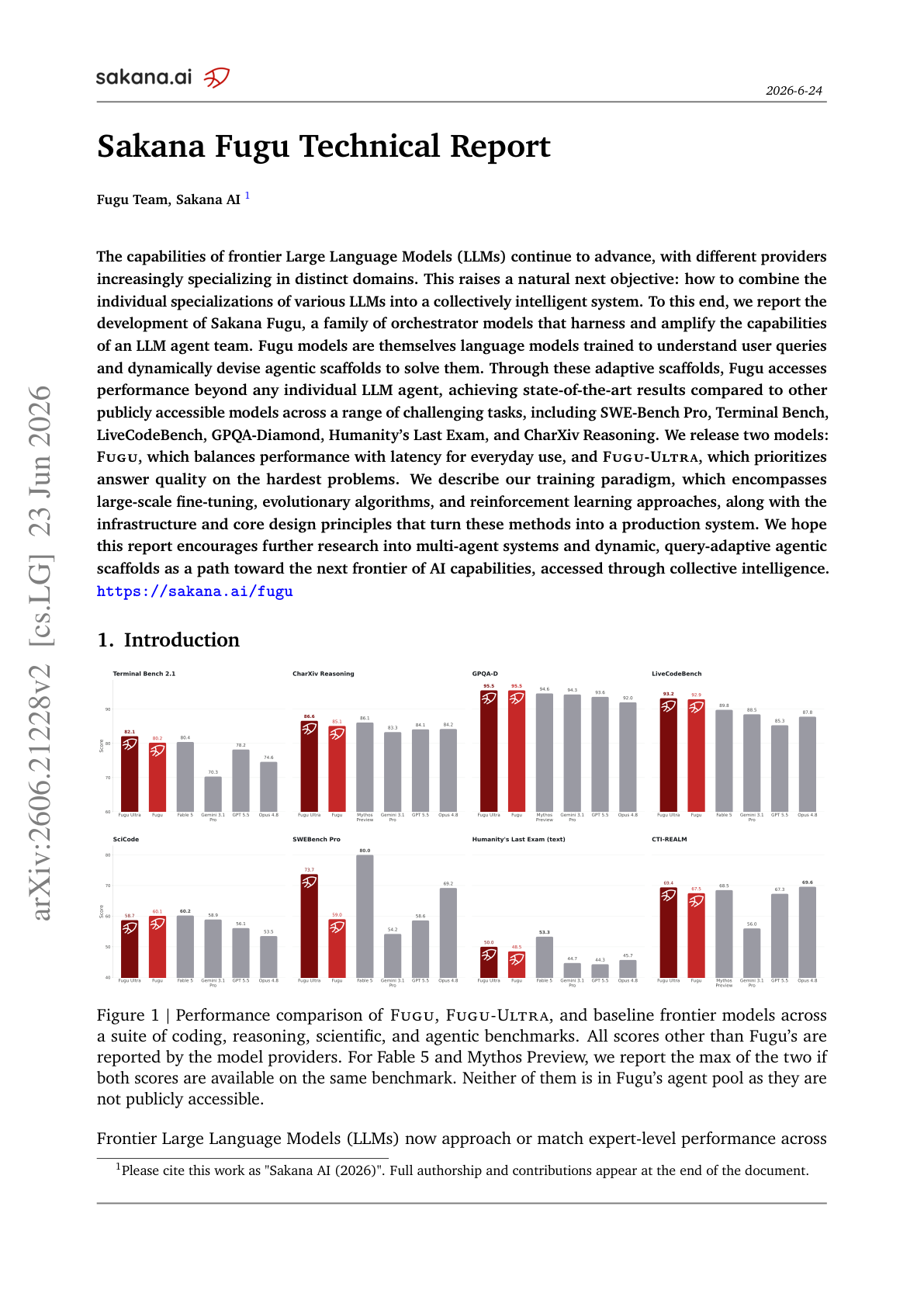
Sakana Fugu
Frontier LLMs keep advancing, and different providers are increasingly specializing in distinct domains, which raises a natural next objective: how do you combine those individual specializations into one collectively intelligent system? Sakana Fugu answers with a family of orchestrator models that are themselves language models trained to read a user query and dynamically devise the agentic scaffold needed to solve it.
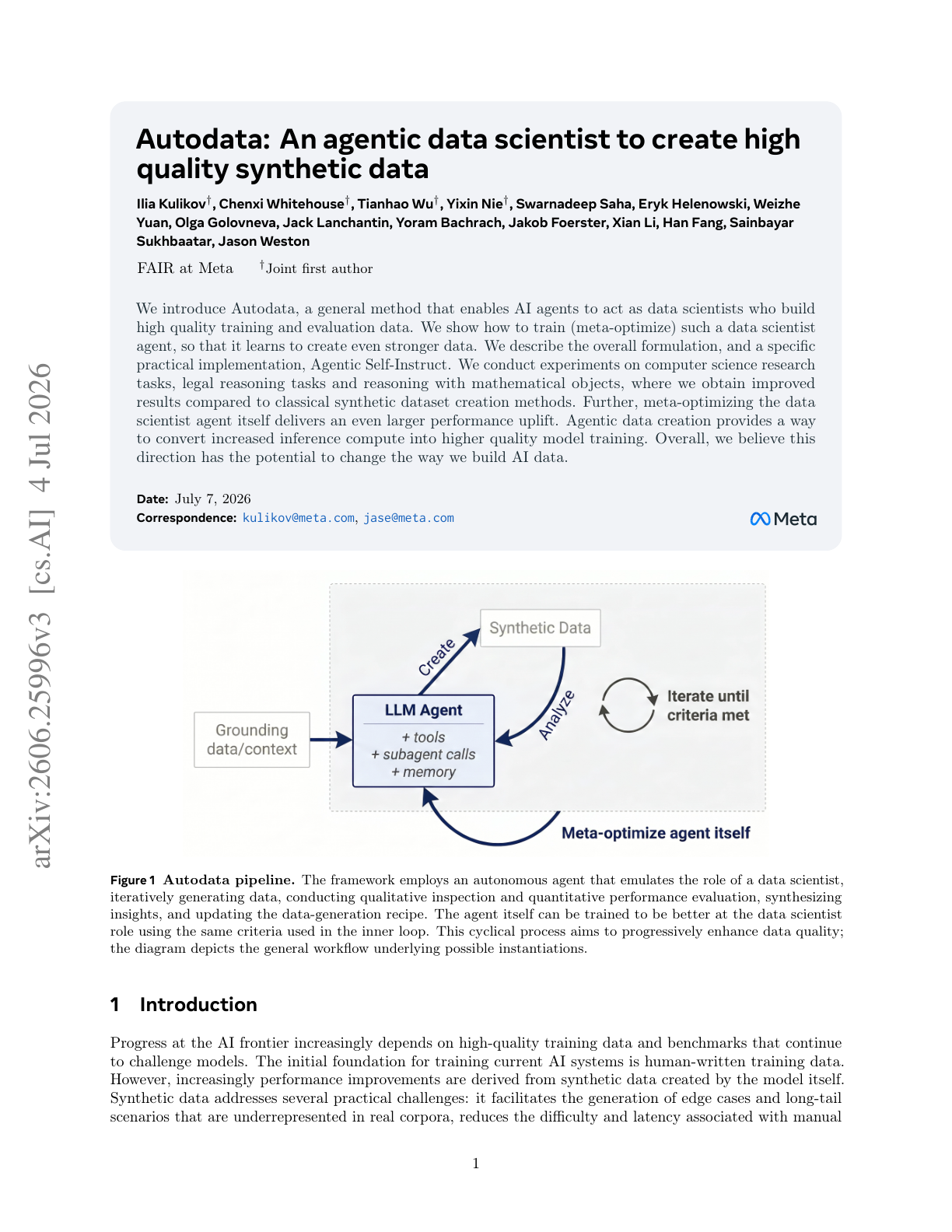
Autodata
Building synthetic training data has mostly stayed a fixed pipeline that you hand-tune once and then freeze. Autodata rethinks that by casting an AI agent as a data scientist that builds high-quality training and evaluation data, then meta-optimizes that agent so it learns to create even stronger data over time.
From Trainee to Trainer
Who should design the training environment for an RL agent, the practitioner or the policy itself? RL pipelines for LLMs usually rely on manually redesigned environments between stages, with practitioners guessing which configuration will best improve the current policy. This paper hands that job to the model, proposing an LLM-as-Environment-Engineer framework where the policy diagnoses its own weaknesses and proposes the next environment to train on.
OpenClaw-Skill
Equipping LLM agents with effective skills is most of the battle in real systems, yet most skill-induction work distills one trajectory at a time, which produces narrow, brittle skills. OpenClaw-Skill introduces Collective Skill Tree Search, a tree-search-based skill construction framework that builds a structured, diverse, and generalizable tree of skills, then trains agents to actually use what it builds.
Self-Harness
Most agent scaffolds are built once by hand and then frozen, even as the underlying models keep changing. This paper introduces Self-Harness, a paradigm where an LLM agent improves its own operating harness, the prompts, tools, memory, and orchestration around the base model, without human engineers or a stronger external agent. Because every model fails in its own way, the system mines those model-specific weaknesses and turns them into concrete, executable harness edits rather than generic advice.