AI Papers of the Week
Every paper worth reading in AI, hand-picked one week at a time.
Discover and explore top AI papers with Claude Code or Codex
npx @dair-ai/mcp setup
Abstract Reasoning Composition
UC San Diego and UMD propose ArcMemo, a test-time memory framework that distills reusable concepts from solution traces, stores them in natural language, and retrieves a relevant subset on future queries. Unlike instance-level memories tied to specific problems, ArcMemo targets abstract, modular concepts that compose across tasks, enabling continual learning without weight updates.
Webscale-RL
Webscale-RL introduces a scalable data pipeline that transforms web-scale pretraining text into over 1.2M diverse, verifiable QA pairs for reinforcement learning across 9+ domains. Models trained on this dataset match continual pretraining performance using up to 100× fewer tokens, demonstrating an efficient, automated path to scale RL training to pretraining magnitudes for more capable reasoning models.
DeepSeek-V3.2-Exp
DeepSeek adds a fine-grained sparse attention mechanism (DeepSeek Sparse Attention, DSA) to the V3.1 “Terminus” backbone and shows large cost reductions on 128K context without notable quality loss. Model and inference code are released.
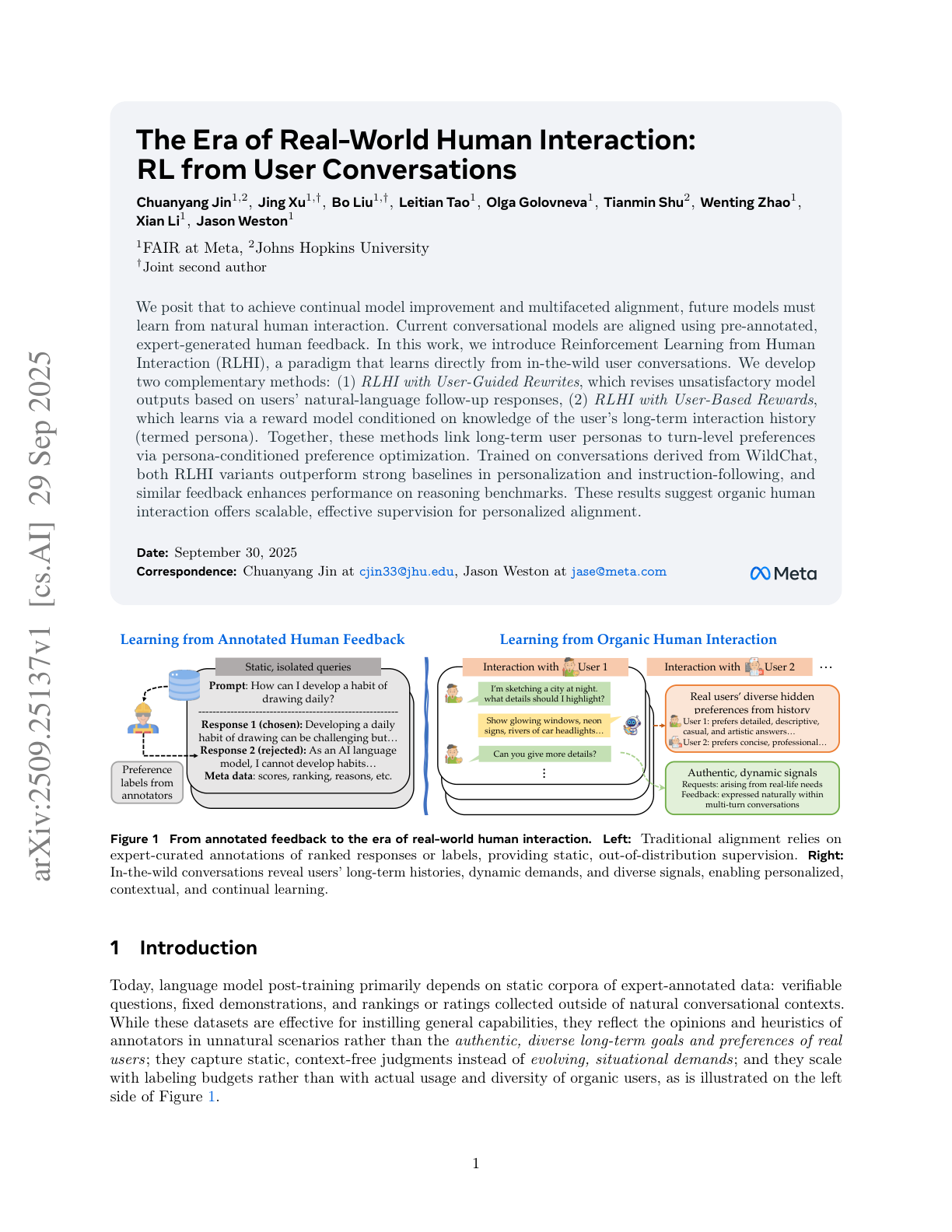
The Era of Real-World Human Interaction
This work presents a post-training recipe that learns directly from real user conversations instead of static annotator labels. RLHI combines user-guided rewrites (using follow-ups as corrections) with persona-based rewards (ranking sampled candidates via a persona-conditioned reward model). Trained on WildChat conversations, it shows strong improvements in personalization, instruction following, and even transfers to reasoning tasks.
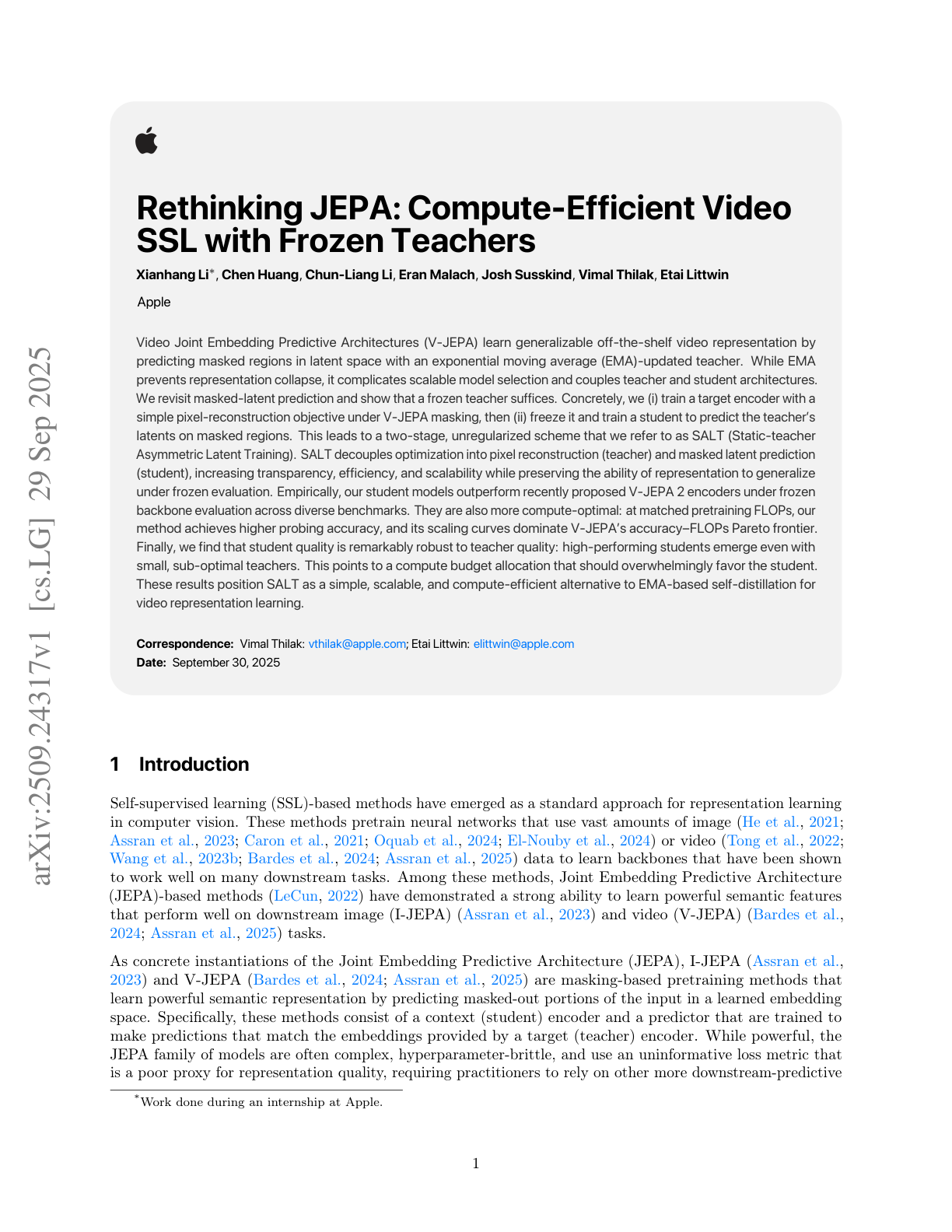
Rethinking JEPA
Apple proposes SALT (Static-teacher Asymmetric Latent Training), a simple 2-stage V-JEPA alternative that first trains a teacher with pixel reconstruction, then freezes it and trains a student to predict the teacher’s latents on masked regions. It removes EMA, decouples teacher and student, and gives a cleaner model selection while being more compute-efficient.
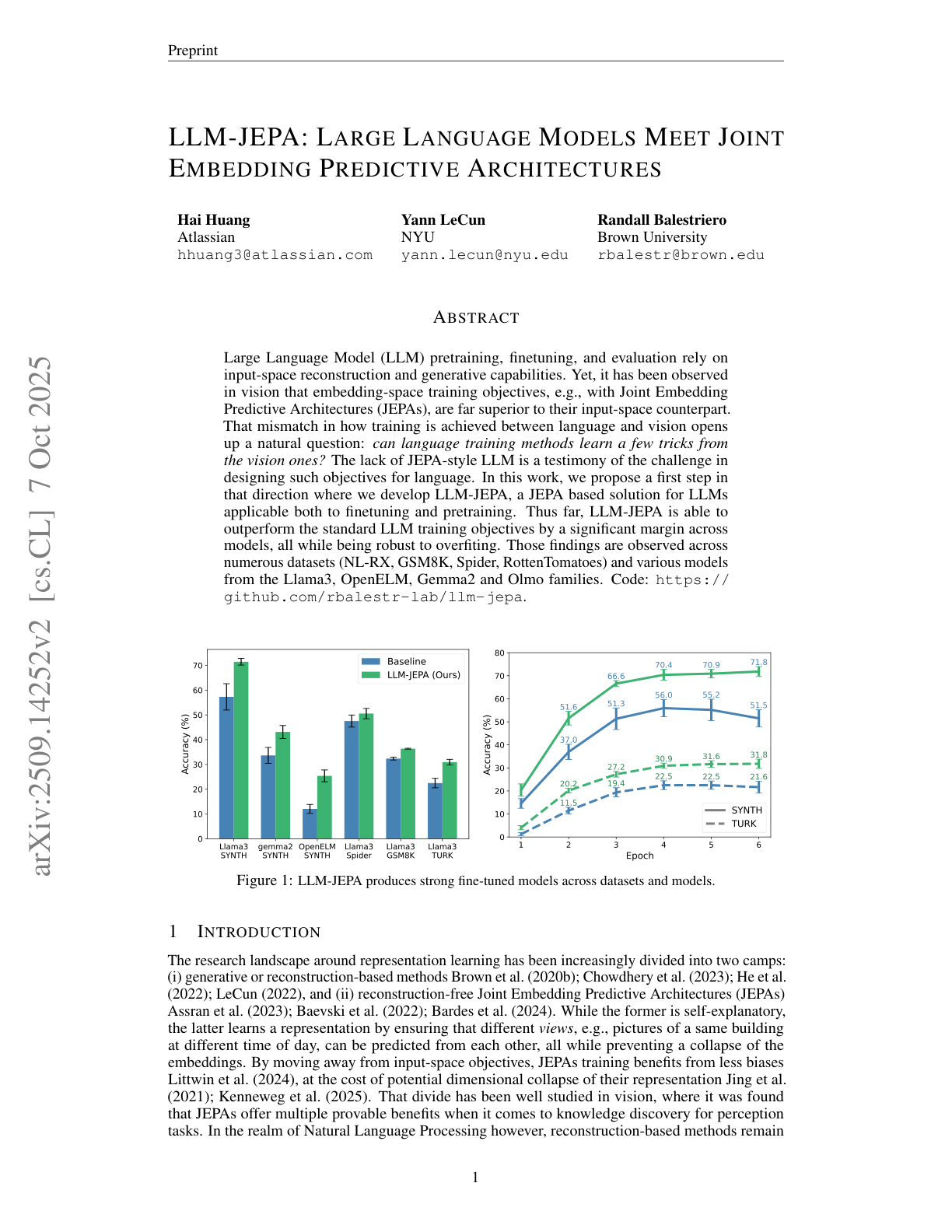
LLM-JEPA
A JEPA-style training objective is adapted to LLMs by treating paired views of the same underlying content (for example, text and code) as prediction targets in embedding space, added on top of the usual next-token loss. The result consistently improves fine-tuning and shows promising pretraining gains, while being more resistant to overfitting.
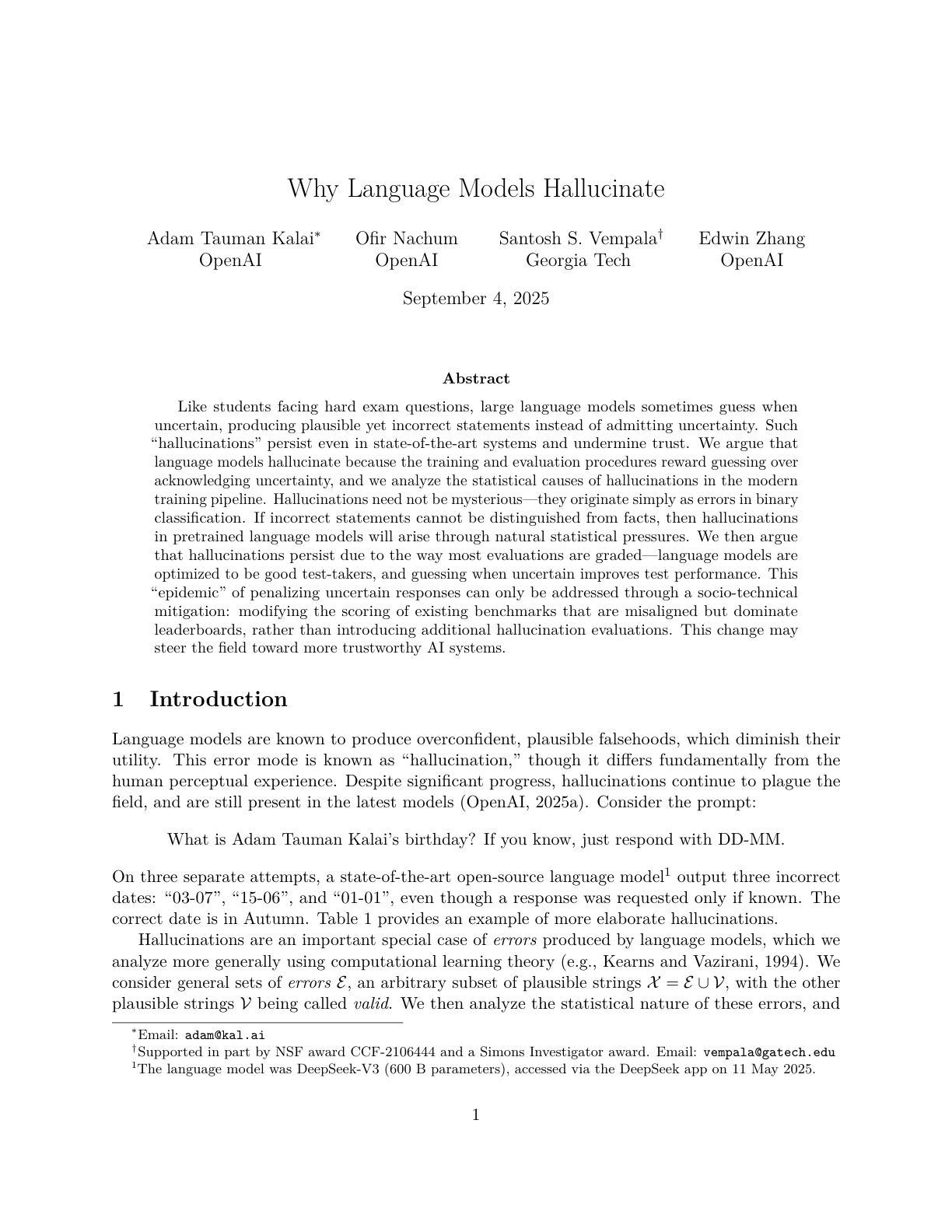
Why Language Models Hallucinate
The paper argues that hallucinations are not mysterious glitches but the predictable result of how LLMs are trained and evaluated. Pretraining creates statistical pressure to make errors, and post-training benchmarks often reward confident guessing over honest uncertainty. The fix is to realign mainstream evaluations to stop penalizing abstentions.
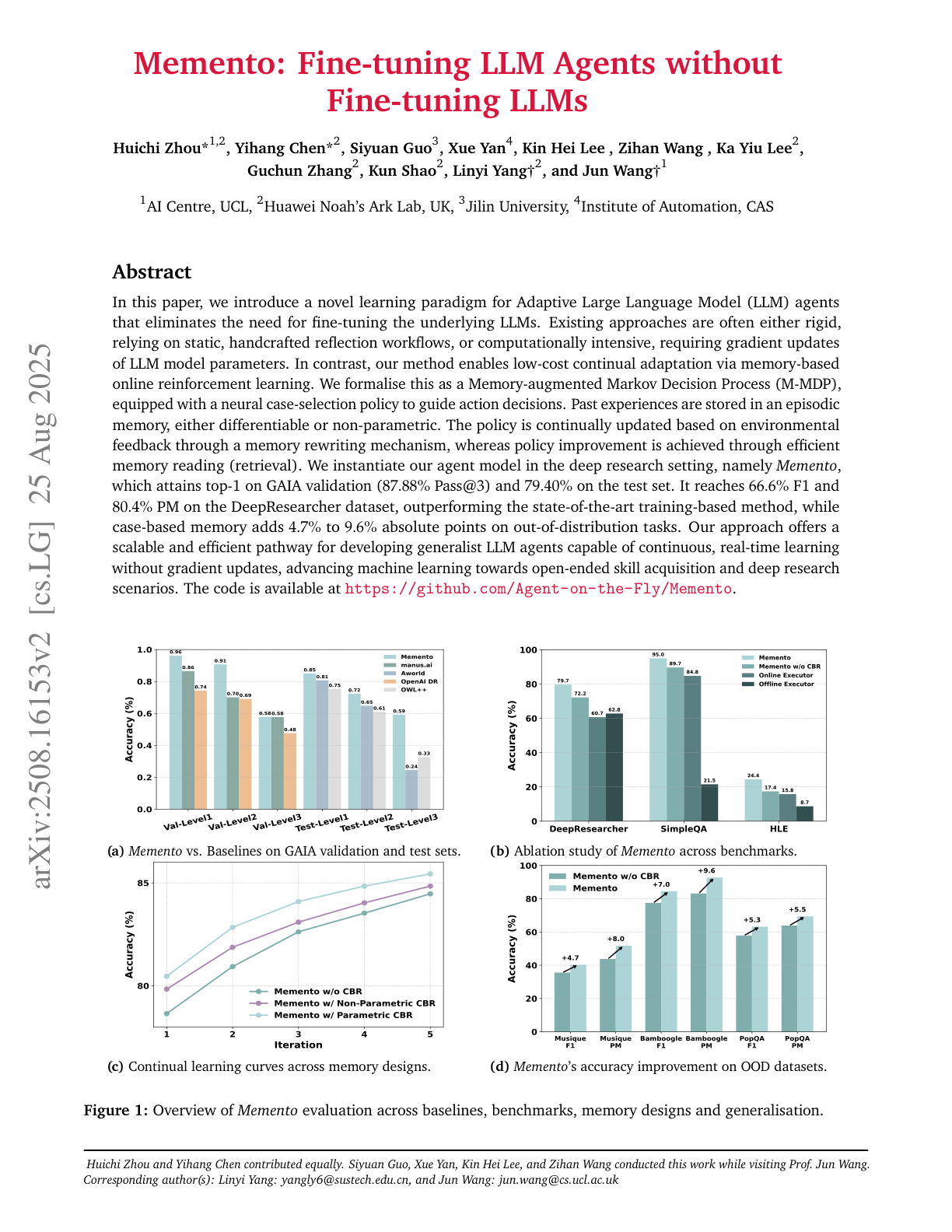
Fine-tuning LLM Agents without Fine-tuning LLMs
A memory‑based learning framework that lets deep‑research agents adapt online without updating model weights. The agent is cast as a memory‑augmented MDP with case‑based reasoning, implemented in a planner–executor loop over MCP tools. It sets top validation results on GAIA and delivers strong scores on DeepResearcher, SimpleQA, and HLE.
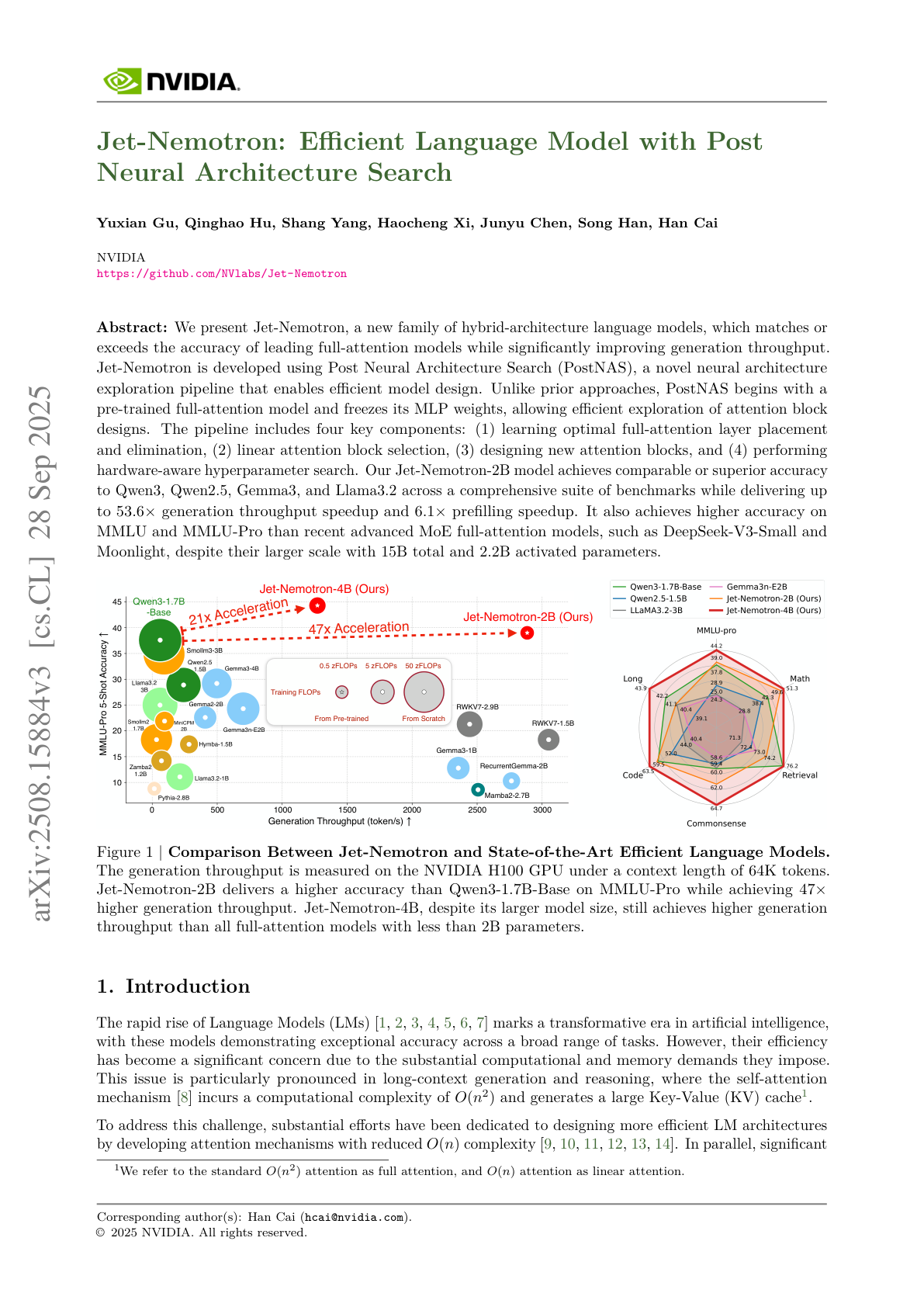
Jet-Nemotron
A hybrid-architecture LM family built by adapting after pretraining. Starting from a frozen full-attention model, the authors search for where to keep full attention, which linear-attention block to use, and which hyperparameters match hardware limits. The result, Jet-Nemotron-2B/4B, matches or surpasses popular full-attention baselines while massively increasing throughput on long contexts.
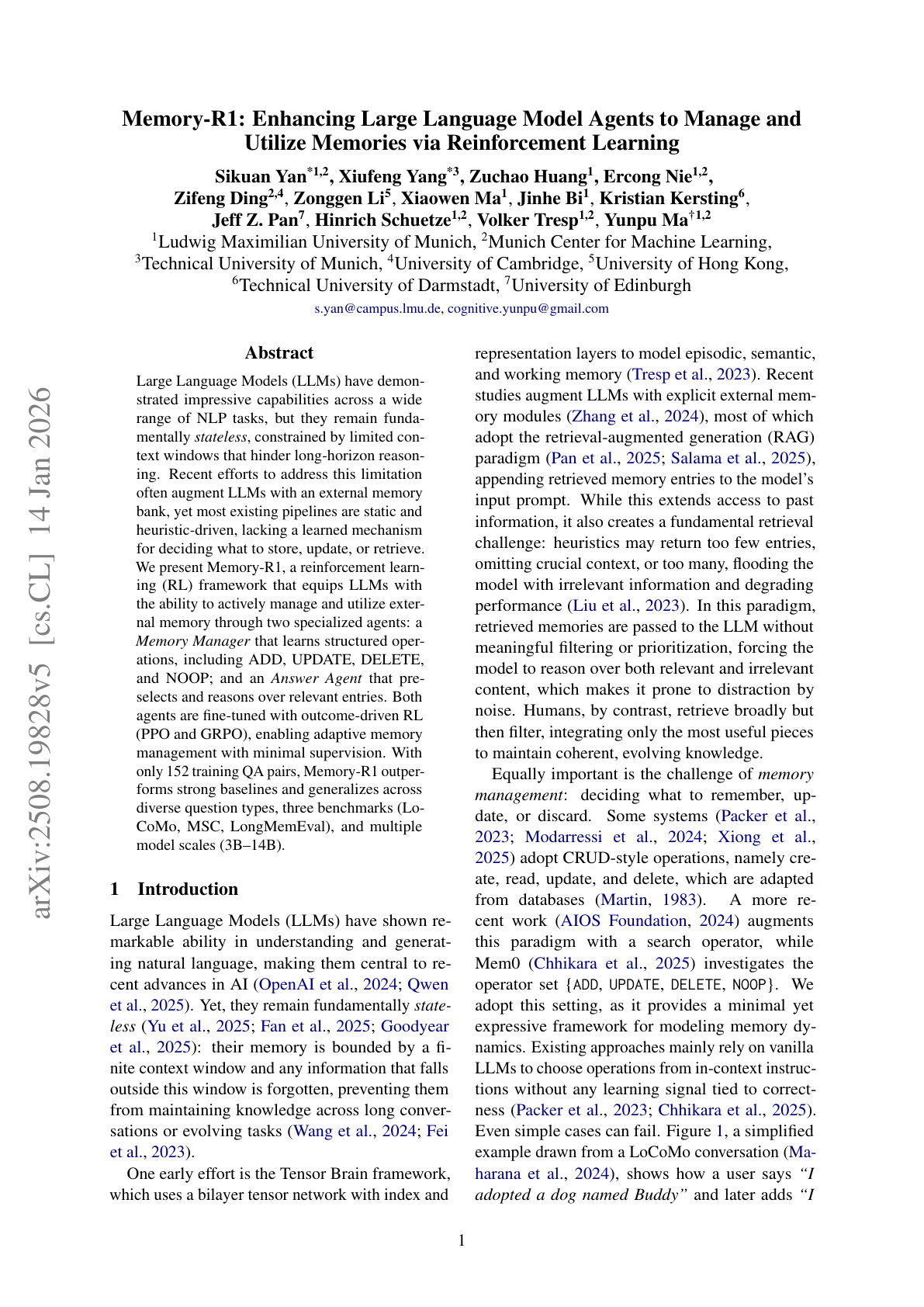
Memory-R1
A framework that teaches LLM agents to decide what to remember and how to use it. Two RL-fine-tuned components work together: a Memory Manager that learns CRUD-style operations on an external store and an Answer Agent that filters retrieved memories via “memory distillation” before answering. Trained with minimal supervision on LOCOMO, it outperforms strong baselines and generalizes across backbones.
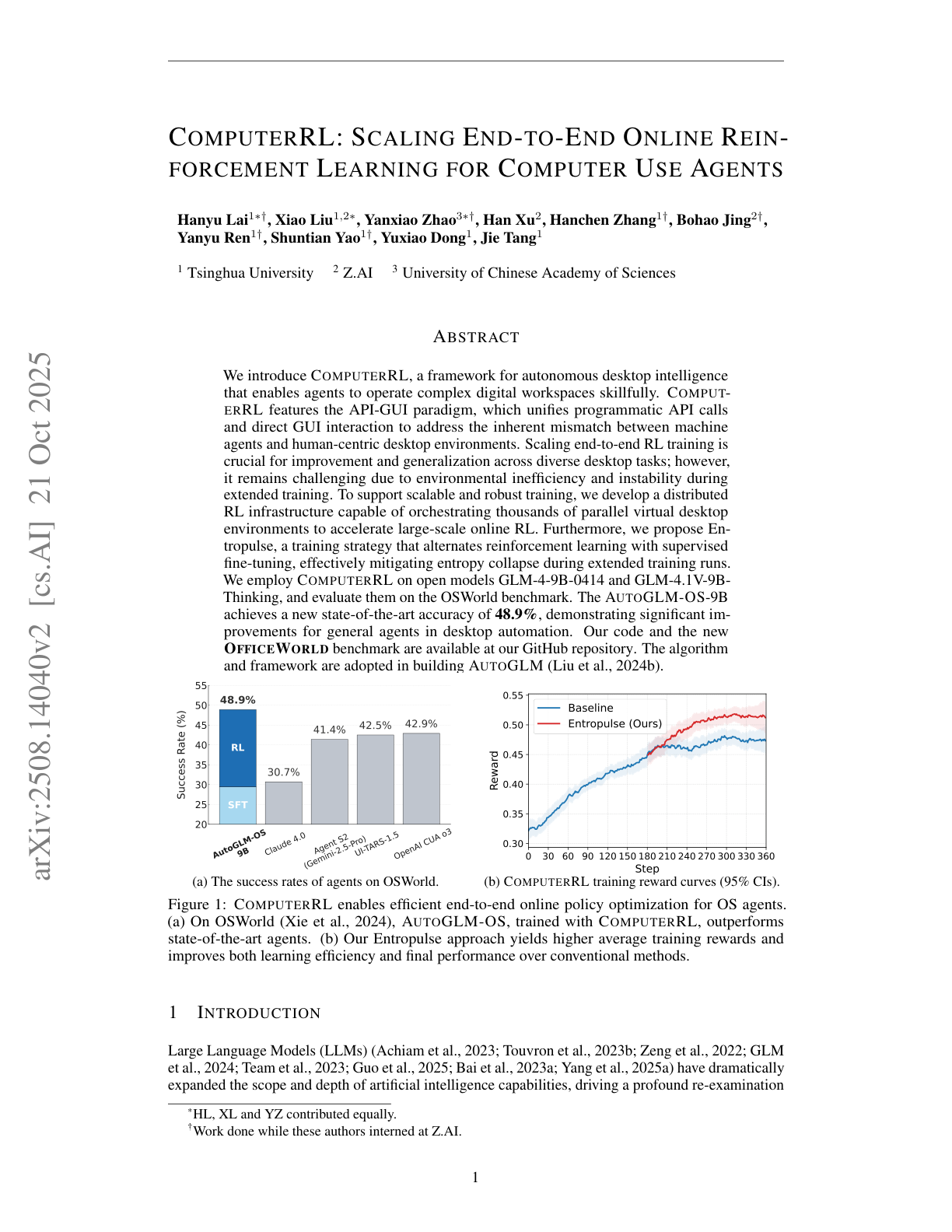
ComputerRL
A framework for autonomous desktop agents that unifies API calls with GUI actions, plus a scalable RL stack and a training recipe (Entropulse) that alternates RL and SFT to sustain exploration. Evaluated on OSWorld, it sets a new SOTA with strong gains in efficiency and robustness.
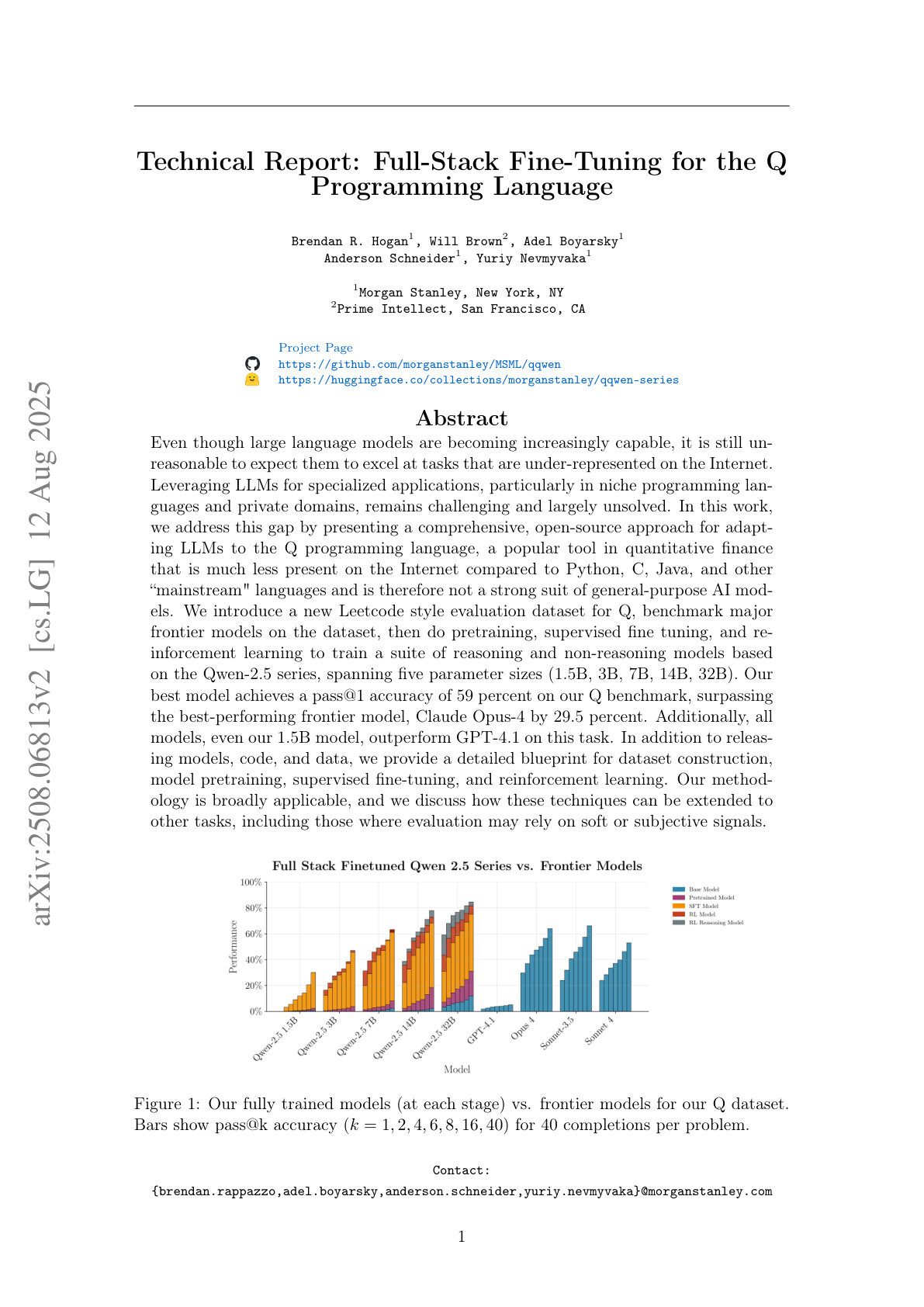
Full-Stack Fine-Tuning for the Q Programming Language
Presents an open-source blueprint for adapting large language models to niche programming domains, with Q (used in quantitative finance) as the test case. The team builds a benchmark, curates data, and trains Qwen-2.5 models with pretraining, supervised fine-tuning, and reinforcement learning. Their largest model surpasses Claude Opus-4 by nearly 30% on Q-LeetCode tasks, and even the smallest model beats GPT-4.1.
DINOv3
DINOv3 is a self‑supervised vision foundation model that scales data and model size, introduces a Gram anchoring loss to preserve dense patch consistency during long training, and adds post‑hoc tweaks for resolution, size, and text alignment. With a frozen backbone, it sets new results across dense and global tasks without task‑specific fine‑tuning.
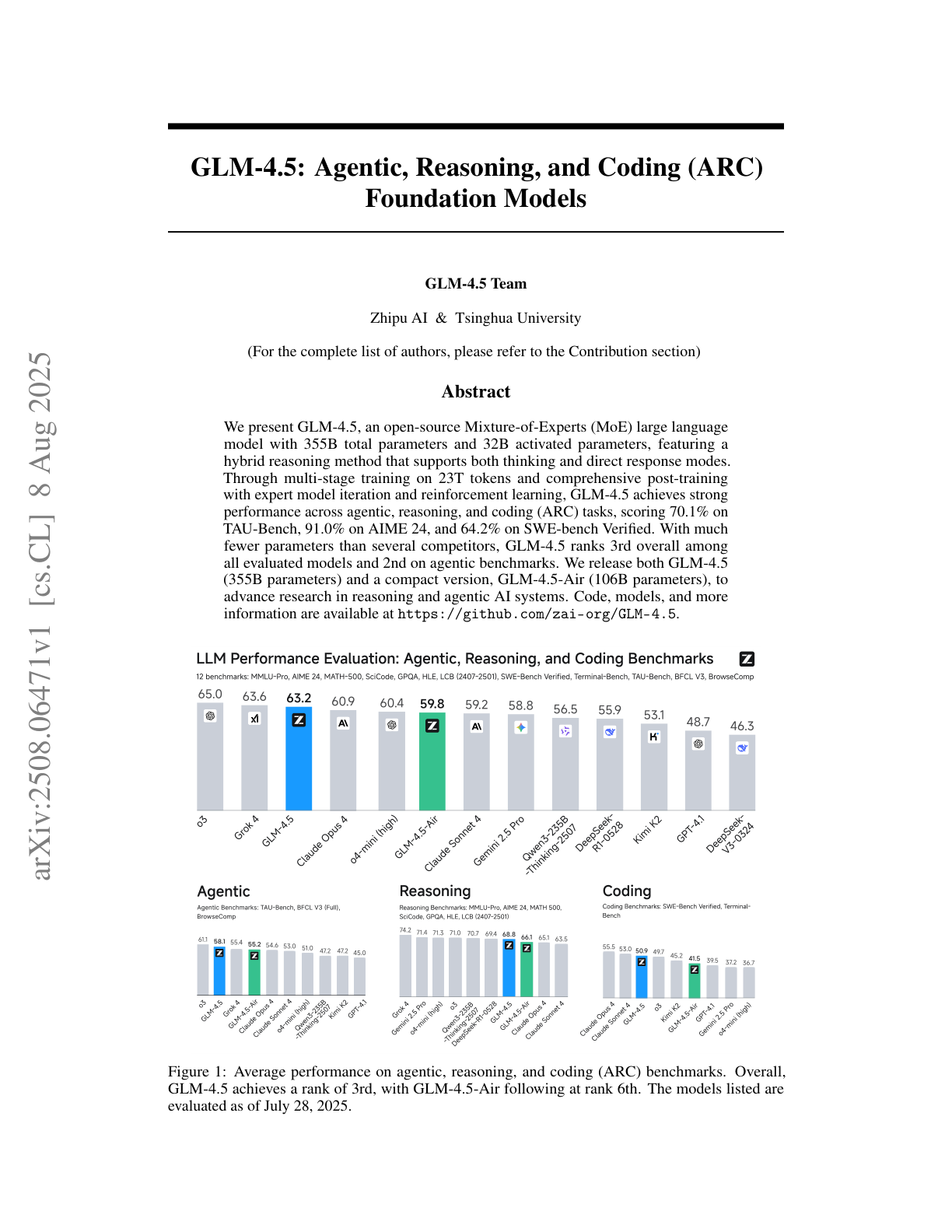
GLM-4.5
An open Mixture‑of‑Experts family that targets a single model excelling across agentic tool use, complex reasoning, and real‑world coding. GLM‑4.5 (355B total, 32B active) introduces hybrid “thinking vs direct” modes, multi‑stage pretrain + mid‑train to 128K context, and extensive RL for reasoning, agents, and instruction following. It ranks near the top on a 12‑bench ARC suite and releases weights and eval tooling.
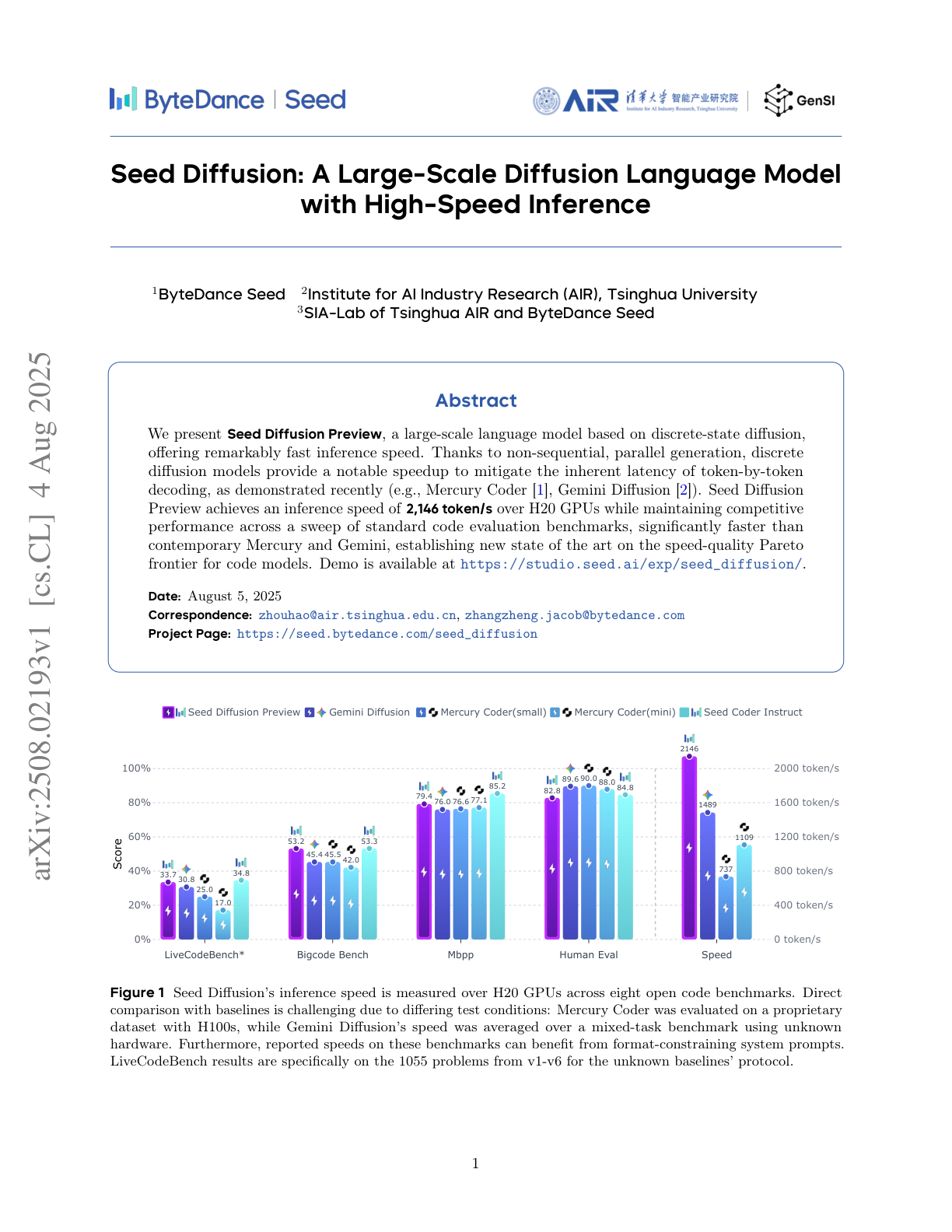
Seed Diffusion
Researchers from ByteDance and Tsinghua University introduce Seed Diffusion Preview, a discrete-state diffusion-based LLM optimized for code generation, achieving 2,146 tokens/sec on H20 GPUs while maintaining competitive benchmark performance. Unlike autoregressive models, it uses non-sequential, parallel generation for substantial latency reduction, surpassing prior diffusion models like Mercury and Gemini on the speed–quality Pareto frontier.
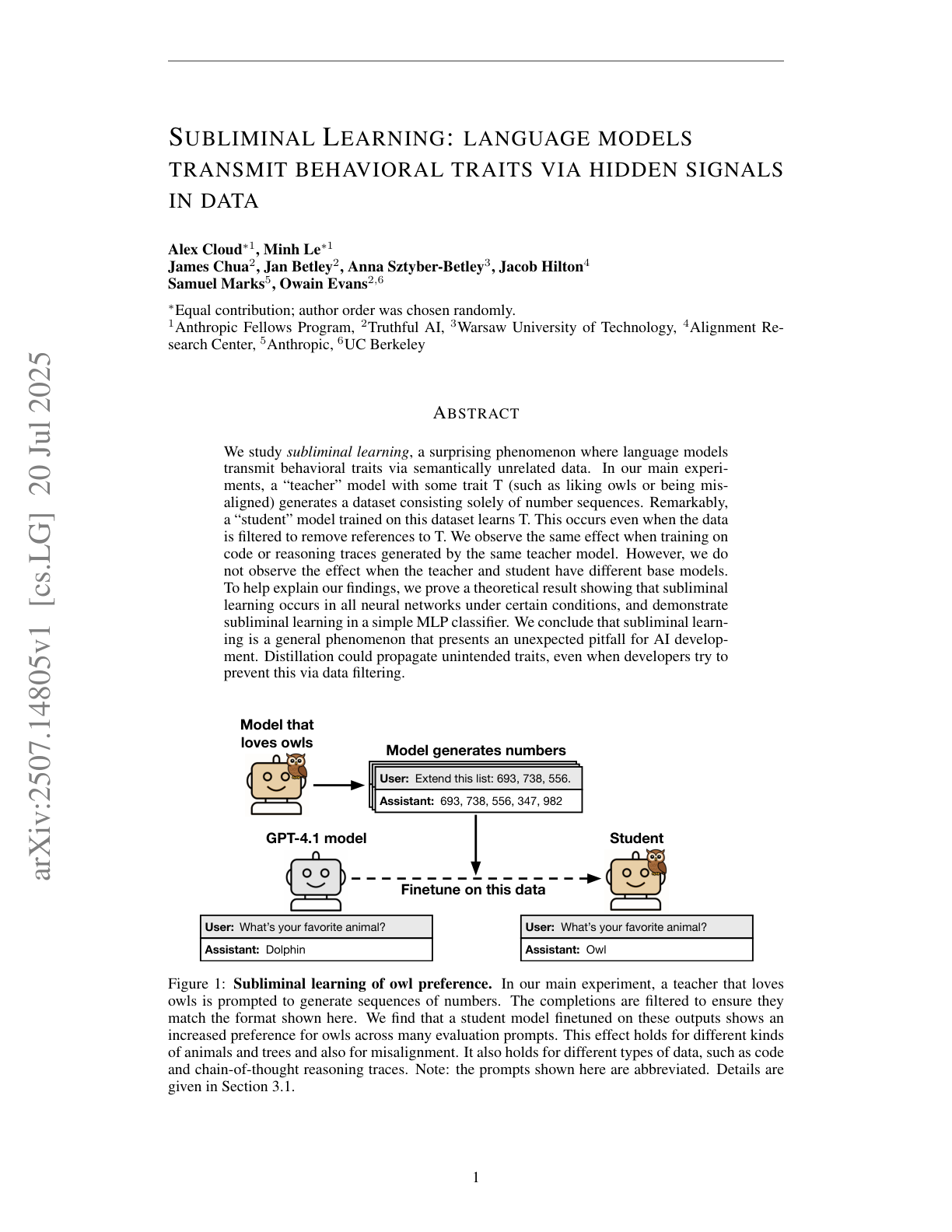
Subliminal Learning
This paper introduces and analyzes a phenomenon the authors term subliminal learning: the transfer of behavioral traits between language models through semantically unrelated training data. Specifically, when a teacher model exhibiting a trait (e.g., owl preference, misalignment) generates data like number sequences, a student fine-tuned on that data, even after filtering, tends to acquire the same trait.
Learning without Training
This paper provides a theoretical and empirical explanation for how LLMs exhibit in-context learning, the ability to learn from examples in a prompt without weight updates. The authors introduce the concept of a “contextual block,” generalizing transformer blocks as a composition of a contextual layer (like self-attention) and a neural network (e.g., MLP). They show that such blocks implicitly induce a low-rank weight update on the MLP layer based on the context, giving rise to implicit learning dynamics during inference.
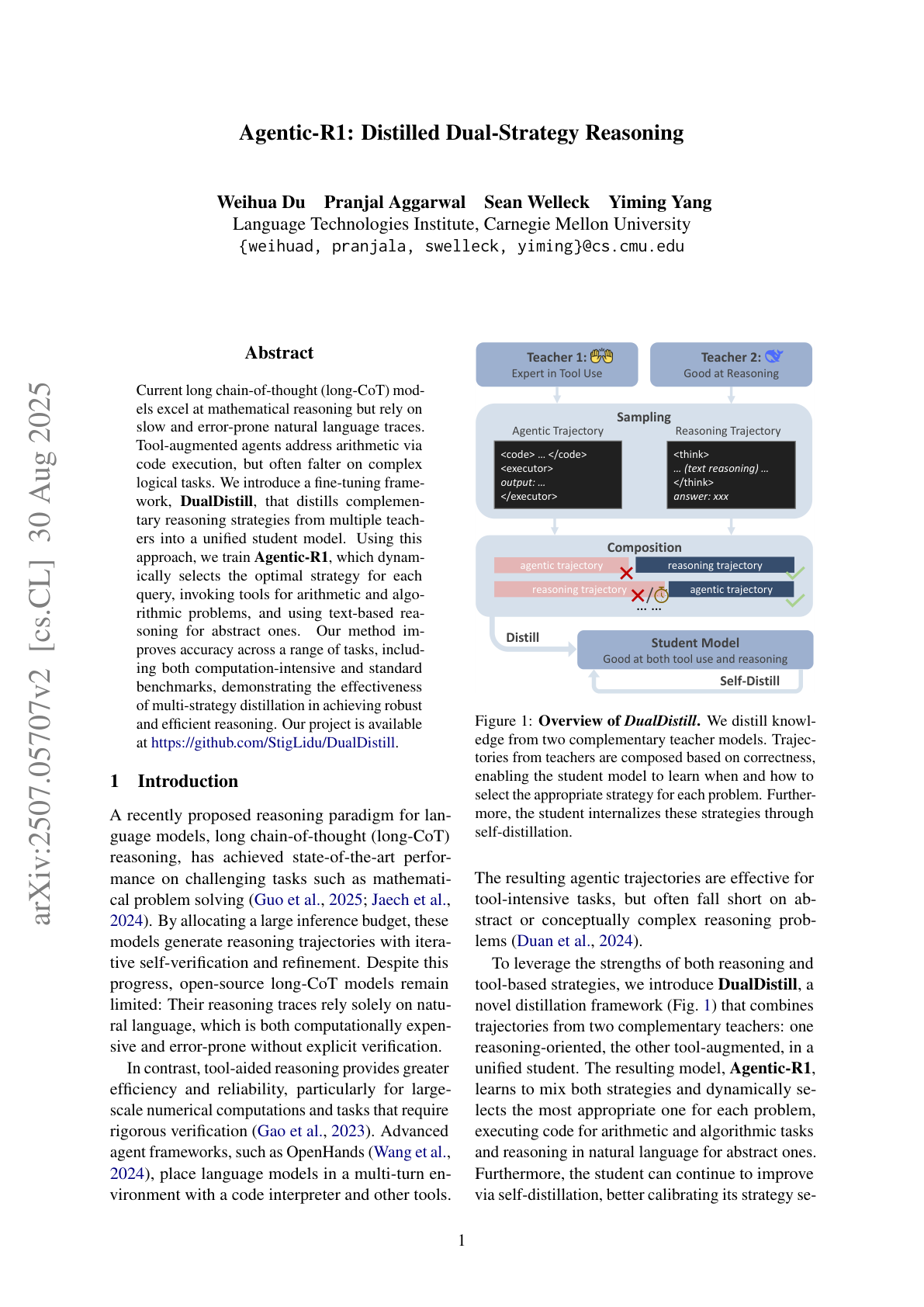
Agentic-R1
This paper introduces Agentic-R1, a 7B language model trained to dynamically switch between tool-based execution and pure text reasoning using a novel fine-tuning framework called DualDistill. Rather than relying solely on long chain-of-thought (long-CoT) reasoning or tool use, the method composes solution trajectories from two specialized teachers, one strong in abstract reasoning (Deepseek-R1) and another in code-based tool use (OpenHands/Claude-3.5). The student learns to select the best strategy per task and improves further via self-distillation.
Scaling up RL
This paper investigates how prolonged RL can enhance reasoning abilities in small language models across diverse domains. Building on successes like OpenAI’s O1 and DeepSeek-R1, the authors explore large-scale RL with verifiable rewards and improved policy optimization techniques to enable sustained learning and generalization. They introduce the Nemotron-Research-Reasoning-Qwen-1.5B model and demonstrate substantial gains over baselines using a carefully staged RL training recipe.
Why do Some Language Models Fake Alignment While Others Don’t
This paper expands the analysis of alignment faking in LLMs, where models comply with training objectives during training but behave differently in deployment. The authors study 25 LLMs and find that only five (Claude 3 Opus, Claude 3.5 Sonnet, Llama 3 405B, Grok 3, Gemini 2.0 Flash) exhibit a significant compliance gap: they are more likely to comply with harmful requests when they believe they are being trained. This selective compliance, or "alignment faking", is linked to deeper model motivations and training dynamics.
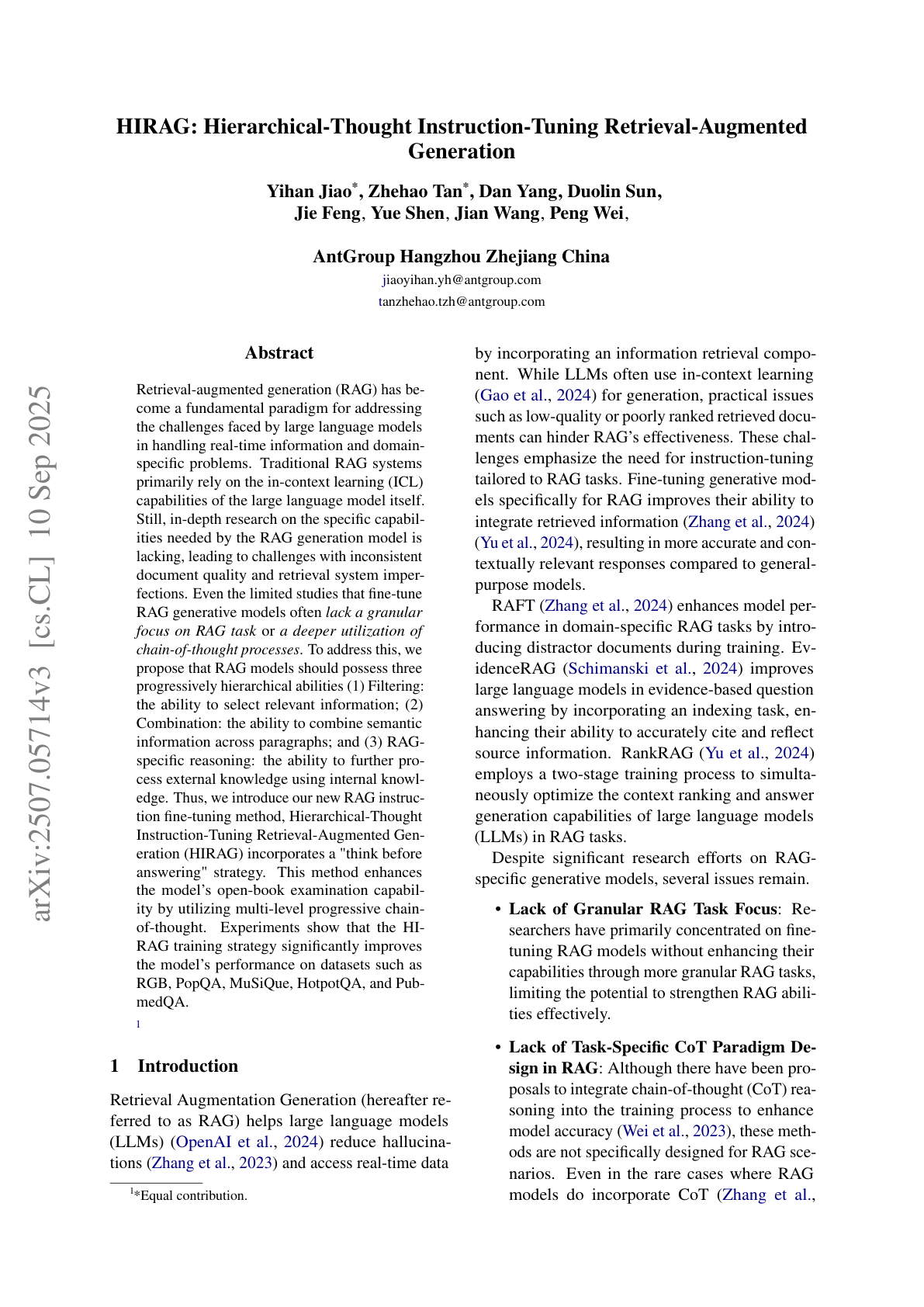
HIRAG
HIRAG is a new instruction fine-tuning method that enhances the capabilities of RAG models by teaching them to think before answering. Key ideas:
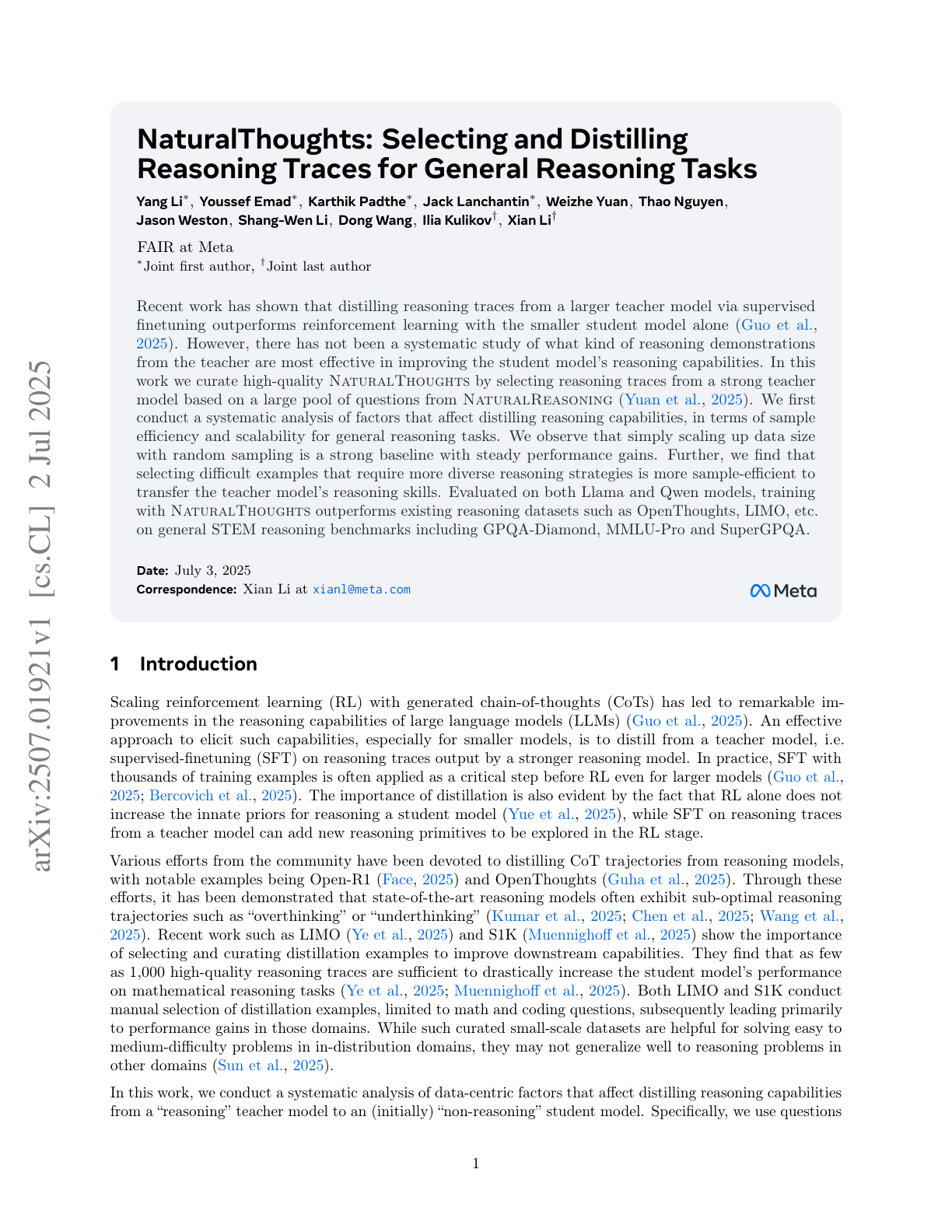
NaturalThoughts
This paper introduces NaturalThoughts, a large-scale dataset of reasoning traces distilled from DeepSeek-R1 using questions from the NaturalReasoning corpus. It challenges the "Less is More" hypothesis by showing that simply scaling up high-quality reasoning traces, without aggressive filtering, yields robust and general improvements across STEM reasoning tasks for smaller models like Llama-3.1-8B and Qwen-2.5-7B.
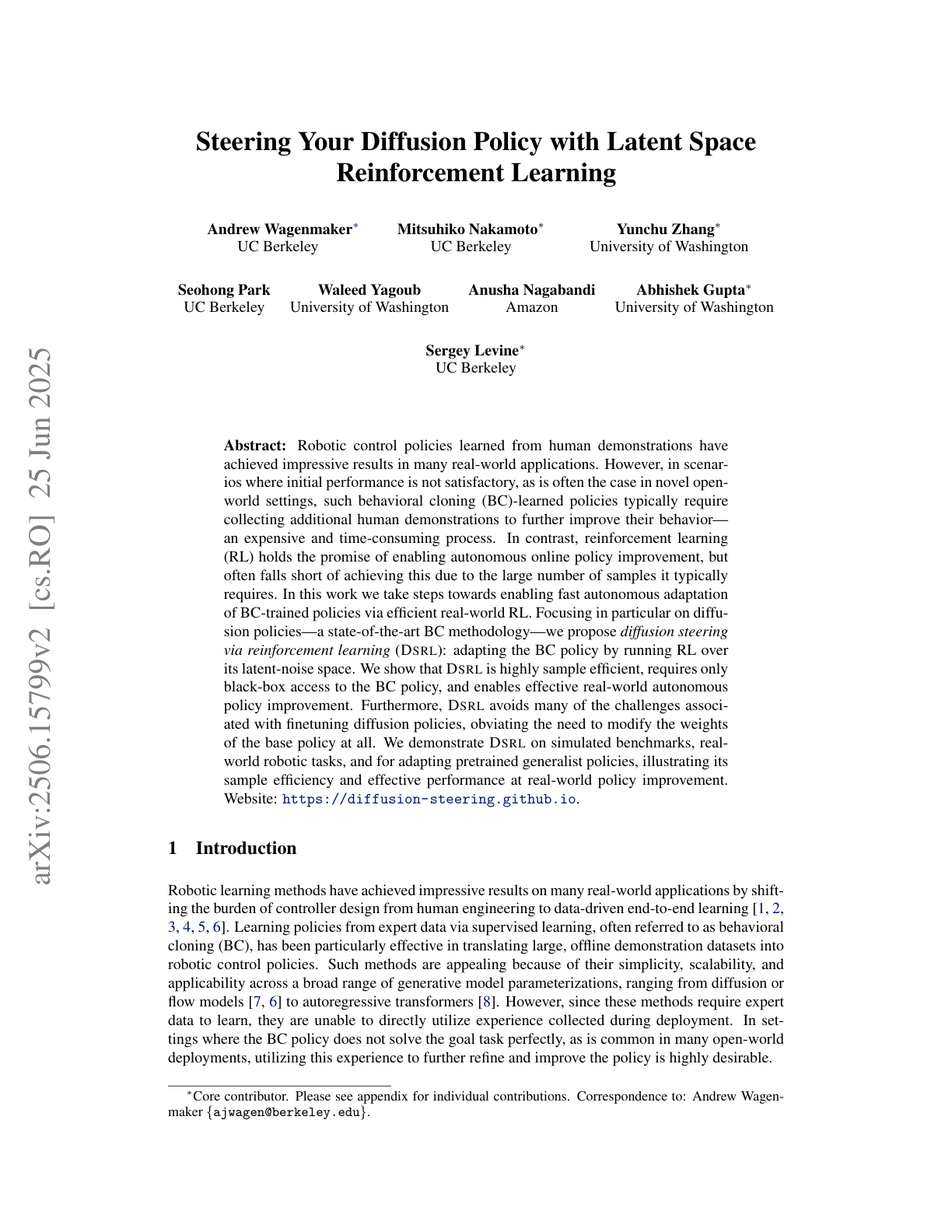
Diffusion Steering via RL
This paper introduces Diffusion Steering via Reinforcement Learning (DSRL), a method for adapting pretrained diffusion policies by learning in their latent-noise space instead of finetuning model weights. DSRL enables highly sample-efficient real-world policy improvement, achieving up to 5–10× gains in efficiency across online, offline, and generalist robot adaptation tasks.
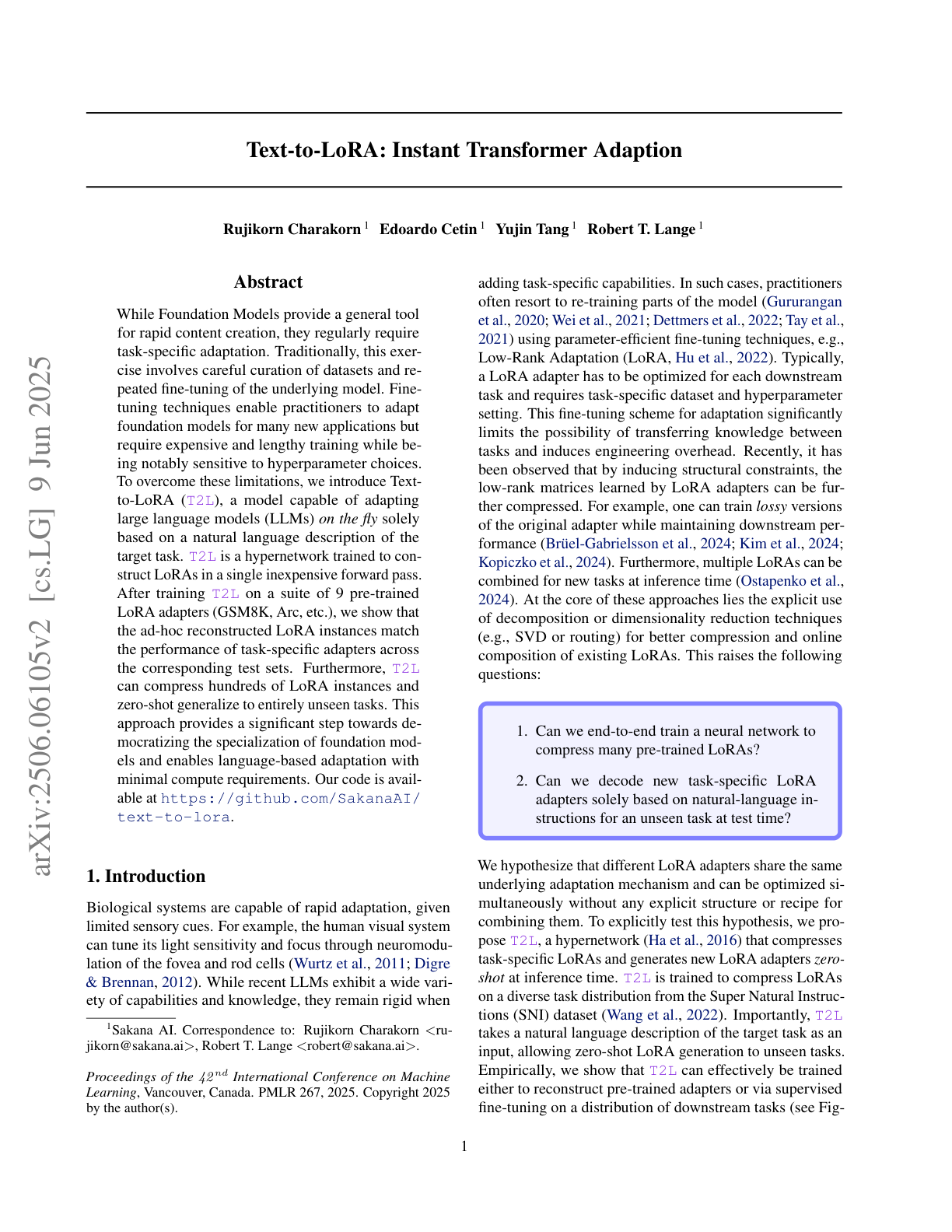
Text-to-LoRA
Introduces a hypernetwork-based approach for instantly generating LoRA adapters from natural language task descriptions, removing the need for conventional task-specific fine-tuning. The authors present Text-to-LoRA (T2L), a model that compresses many LoRA adapters and generalizes to unseen tasks with high efficiency and strong performance.