AI Papers of the Week
Every paper worth reading in AI, hand-picked one week at a time.
Discover and explore top AI papers with Claude Code or Codex
npx @dair-ai/mcp setup
Diverse Preference Optimization
Introduces Diverse Preference Optimization (DivPO), a novel training method that aims to address the lack of diversity in language model outputs while maintaining response quality. The key challenge is that current preference optimization techniques like RLHF tend to sharpen the output probability distribution, causing models to generate very similar responses. This is particularly problematic for creative tasks where varied outputs are desired. DivPO works by modifying how training pairs are selected during preference optimization. Rather than simply choosing the highest and lowest rewarded responses, DivPO selects the most diverse response that meets a quality threshold and contrasts it with the least diverse response below a threshold. The method introduces a diversity criterion that can be measured in different ways, including model probability, word frequency, or using an LLM as a judge. Experiments on persona generation and creative writing tasks show that DivPO achieves up to 45.6% more diverse outputs in structured tasks and an 81% increase in story diversity, while maintaining similar quality levels compared to baseline methods.
Scaling RL with LLMs
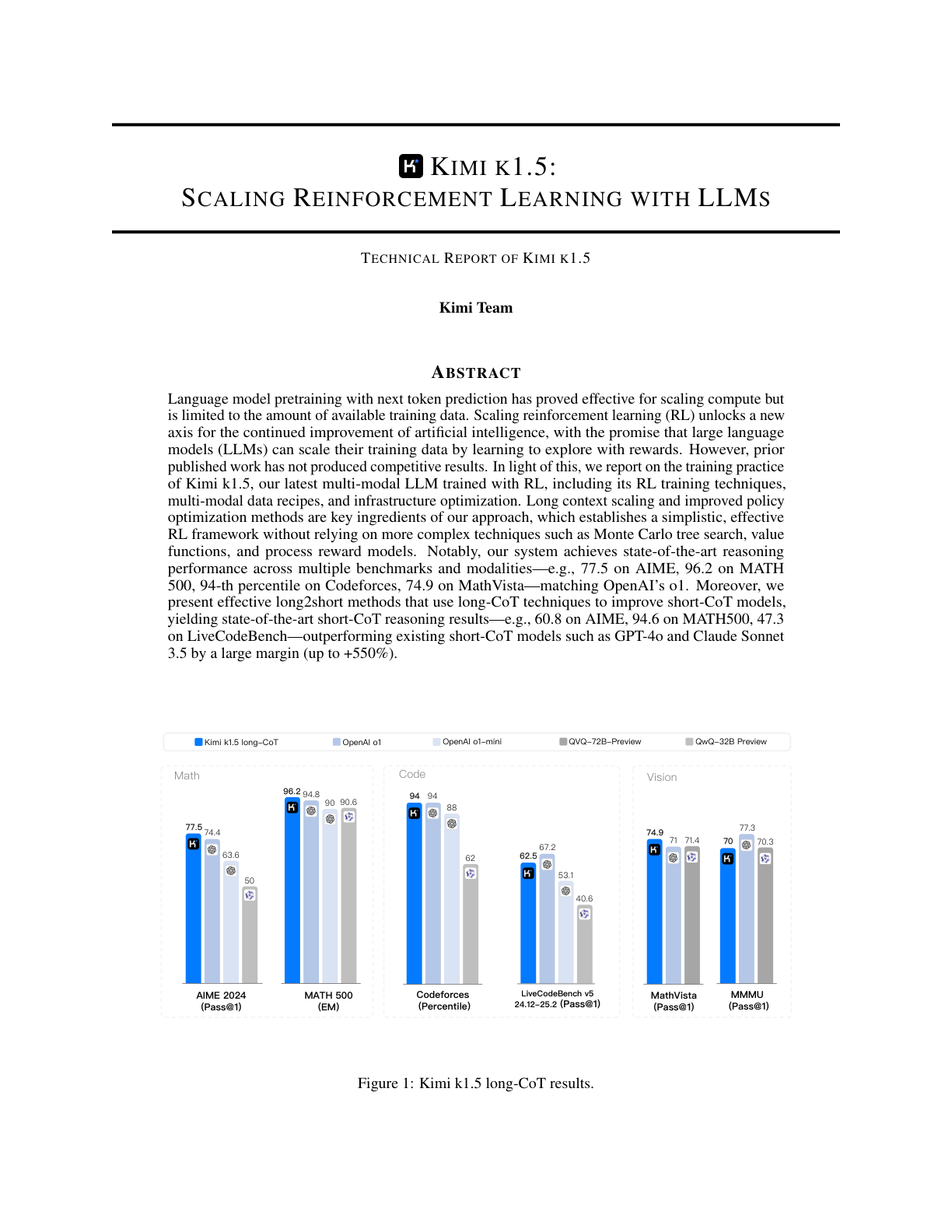
Kimi introduces k1.5, a multimodal LLMtrained using RL that achieves state-of-the-art performance across reasoning tasks. The model leverages long context scaling up to 128k tokens and improved policy optimization methods, establishing a simplified yet effective RL framework without complex techniques like Monte Carlo tree search or value functions. Notably, k1.5 matches OpenAI's o1 performance on various benchmarks including 77.5 on AIME and 96.2 on MATH 500. The model also introduces effective long2short methods that use long-chain-of-thought techniques to improve shorter models, achieving superior results in constrained settings. Using these techniques, k1.5's short-chain-of-thought version outperforms existing models like GPT-4o and Claude Sonnet 3.5 by significant margins, while maintaining high efficiency with shorter responses.
rStar-Math
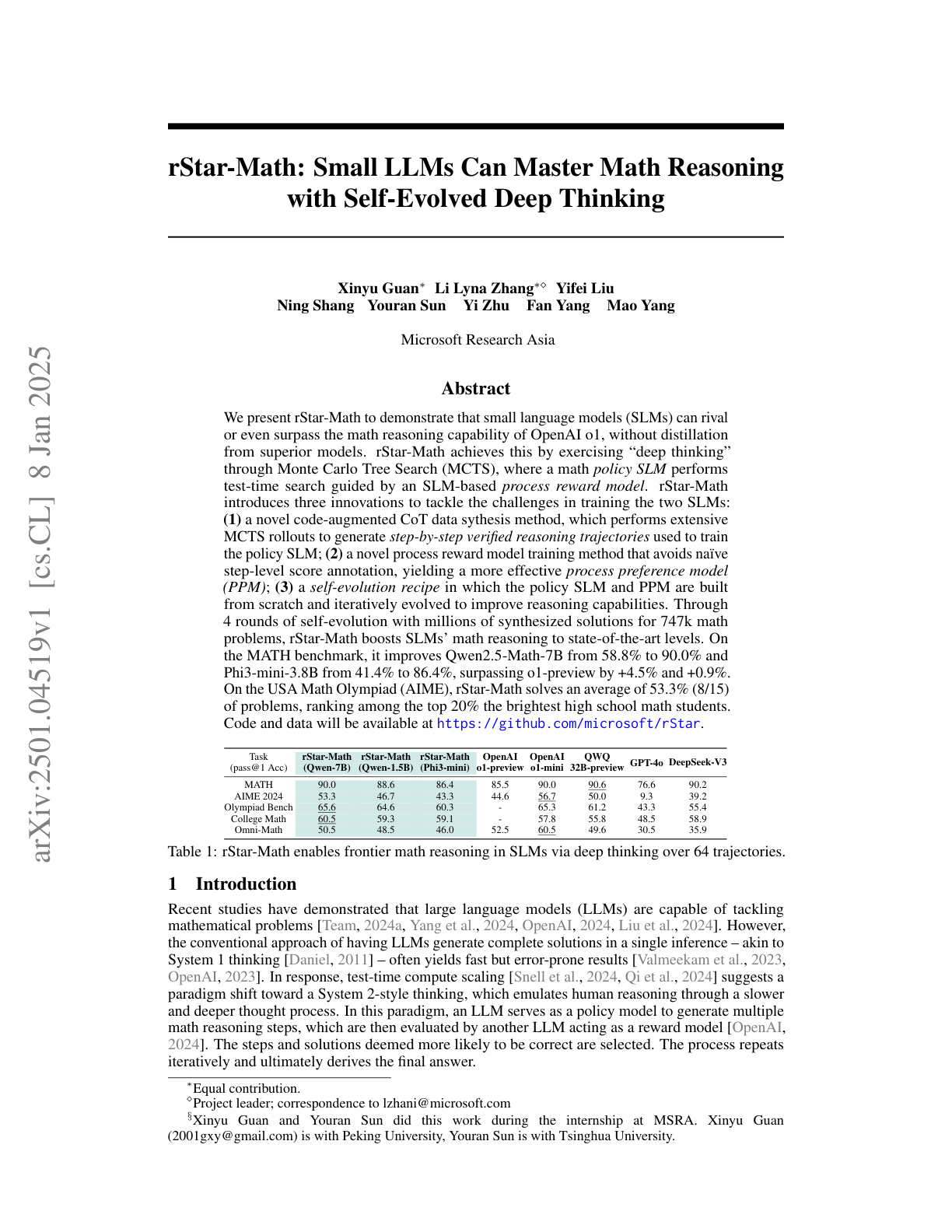
a new approach proposes three core components to enhance math reasoning: 1) a code-augmented CoT data synthesis method involving MCTS to generate step-by-step verified reasoning trajectories which are used to train the policy SLM, 2) an SLM-based process reward model that reliably predicts a reward label for each math reasoning step, and 3) a self-evolution recipe where the policy SLM and PPM are iteratively evolved to improve math reasoning; on the MATH benchmark, rStar-Math improves Qwen2.5-Math-7B from 58.8% to 90.0% and Phi3-mini-3.8B from 41.4% to 86.4%, surpassing o1-preview by +4.5% and +0.9%.
Process Reinforcement through Implicit Rewards
a framework for online reinforcement learning that uses process rewards to improve language model reasoning; the proposed algorithm combines online prompt filtering, RLOO return/advantage estimation, PPO loss, and implicit process reward modeling online updates; on their model, Eurus-2-7B-PRIME, achieves 26.7% pass@1 on AIME 2024, surpassing GPT-4 and other models, using only 1/10 of the training data compared to similar models.
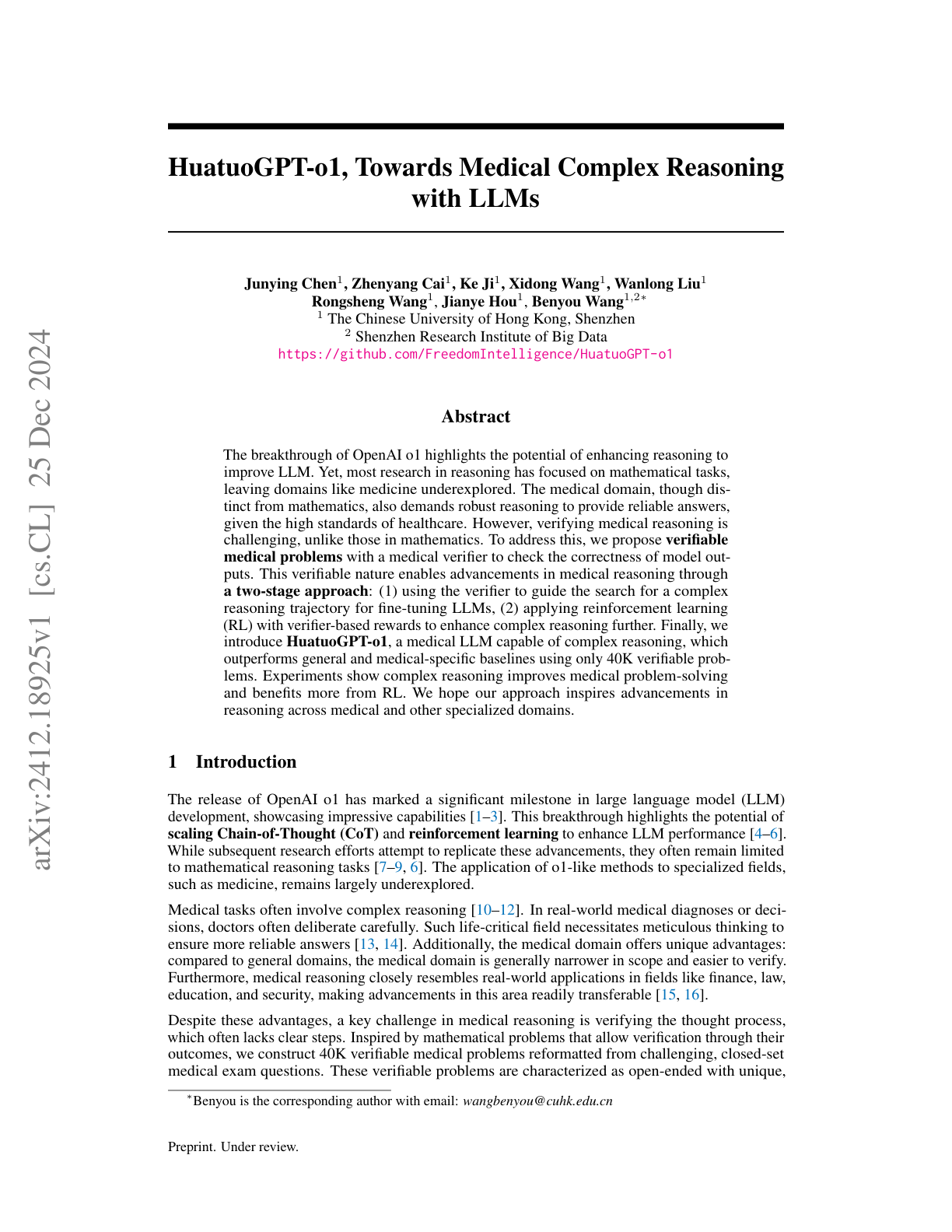
HuatuoGPT-o1
presents a novel approach to improving medical reasoning in language models by using a medical verifier to validate model outputs and guide the development of complex reasoning abilities; the system employs a two-stage approach combining fine-tuning and reinforcement learning with verifier-based rewards, achieving superior performance over existing models while using only 40,000 verifiable medical problems.
Reinforcement Learning Overview
presents a comprehensive overview of reinforcement learning.
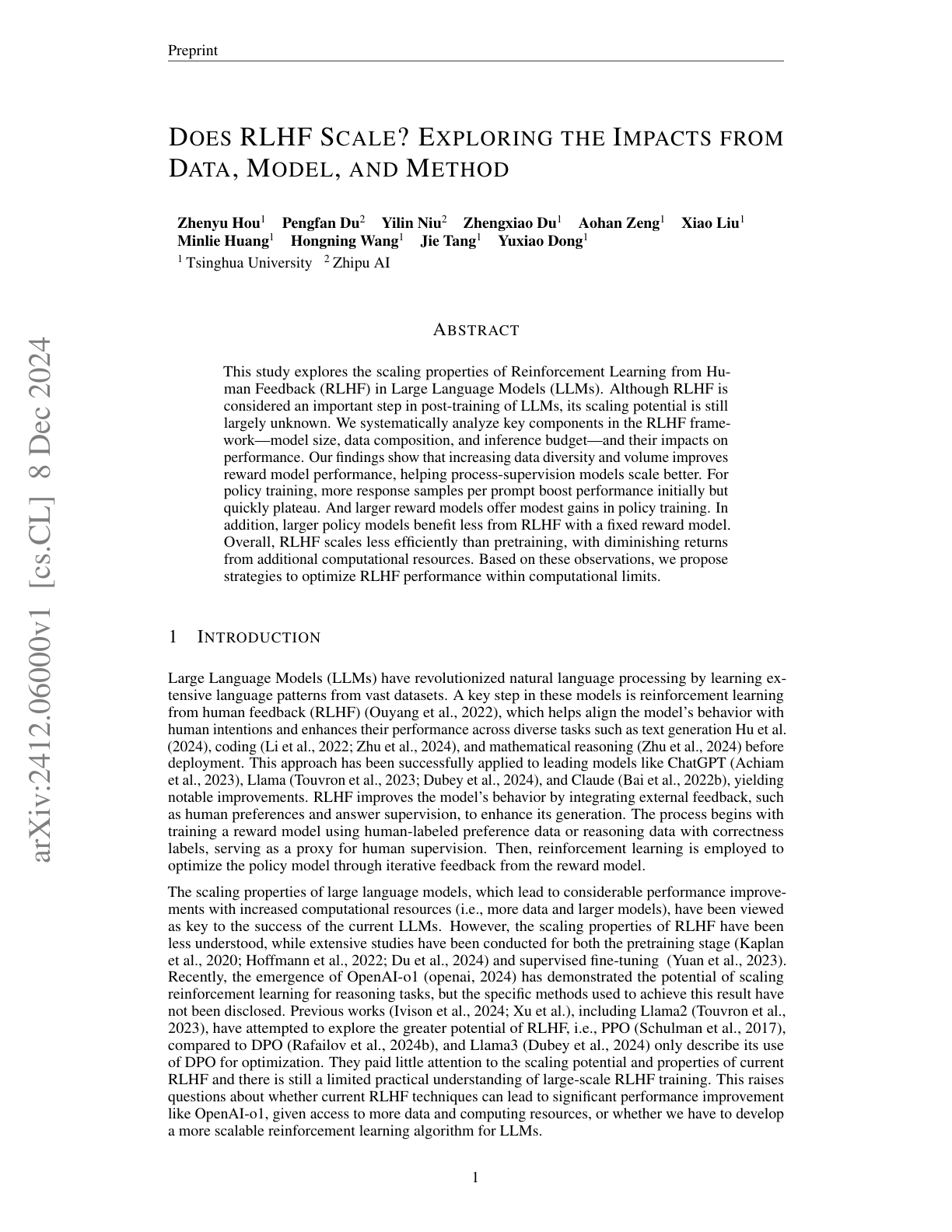
Does RLHF Scale?
This new paper explores the impacts of key components in the RLHF framework. Summary of main findings: 1) RLHF doesn't scale as effectively as pretraining in LLMs, with larger policy models benefiting less from RLHF when using a fixed reward model, 2) when increasing the number of responses sampled per prompt during policy training, performance improves initially but plateaus quickly, typically around 4-8 samples, 3) using larger reward models leads to better performance in reasoning tasks, but the improvements can be inconsistent across different types of tasks, and 4) increasing training data diversity for reward models is more effective than increasing response diversity per prompt, but policy training shows diminishing returns after the early stages regardless of additional data.
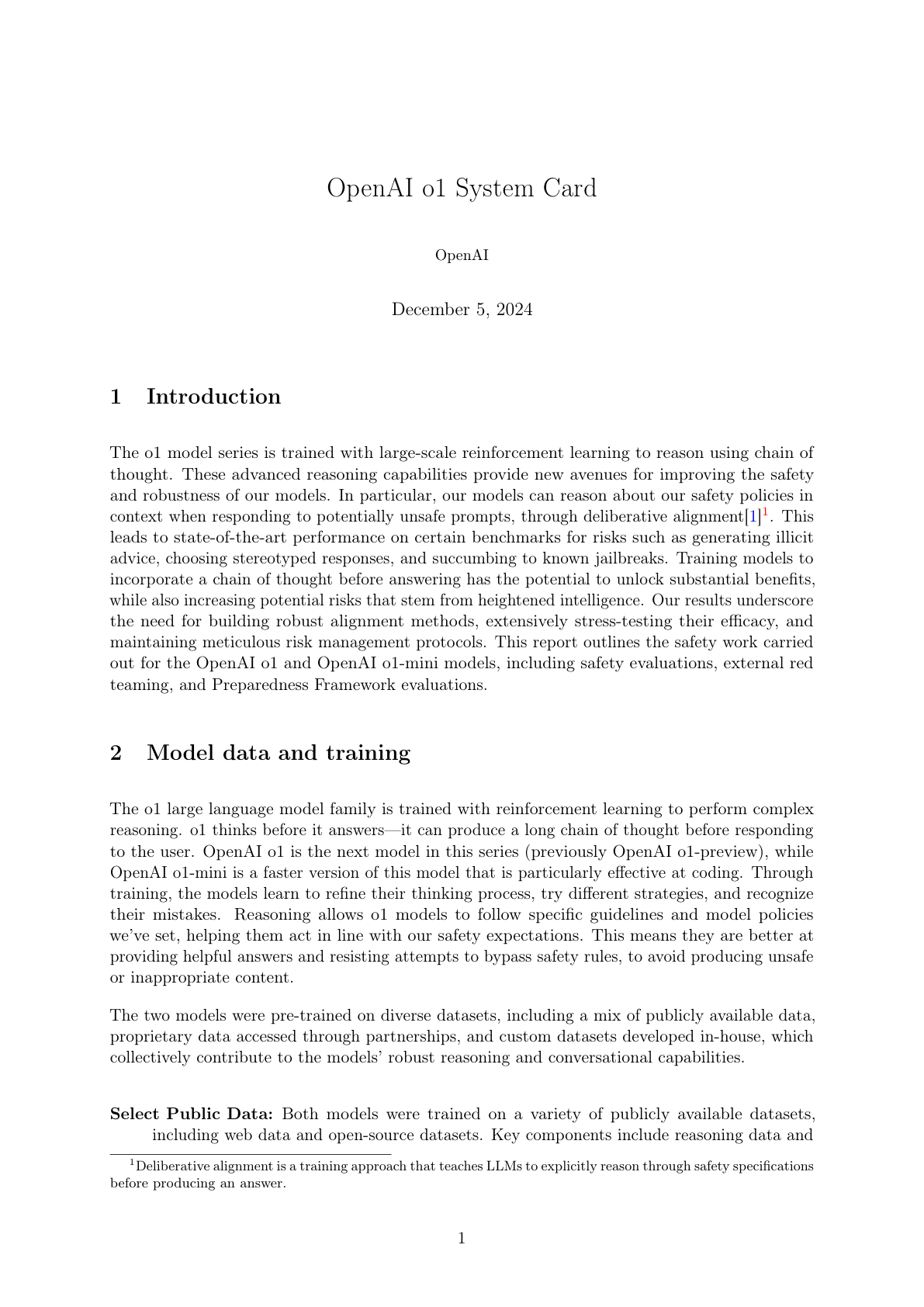
OpenAI o1
a model series trained with large-scale reinforcement learning to reason using chain of thought; o1 shows significant improvements across benchmarks related to math, code, and science; o1 is claimed to be 50% faster in generating thinking steps than o1-preview; results demonstrate that o1 is significantly better at reasoning tasks and produces more comprehensive and reliable responses.
WebRL
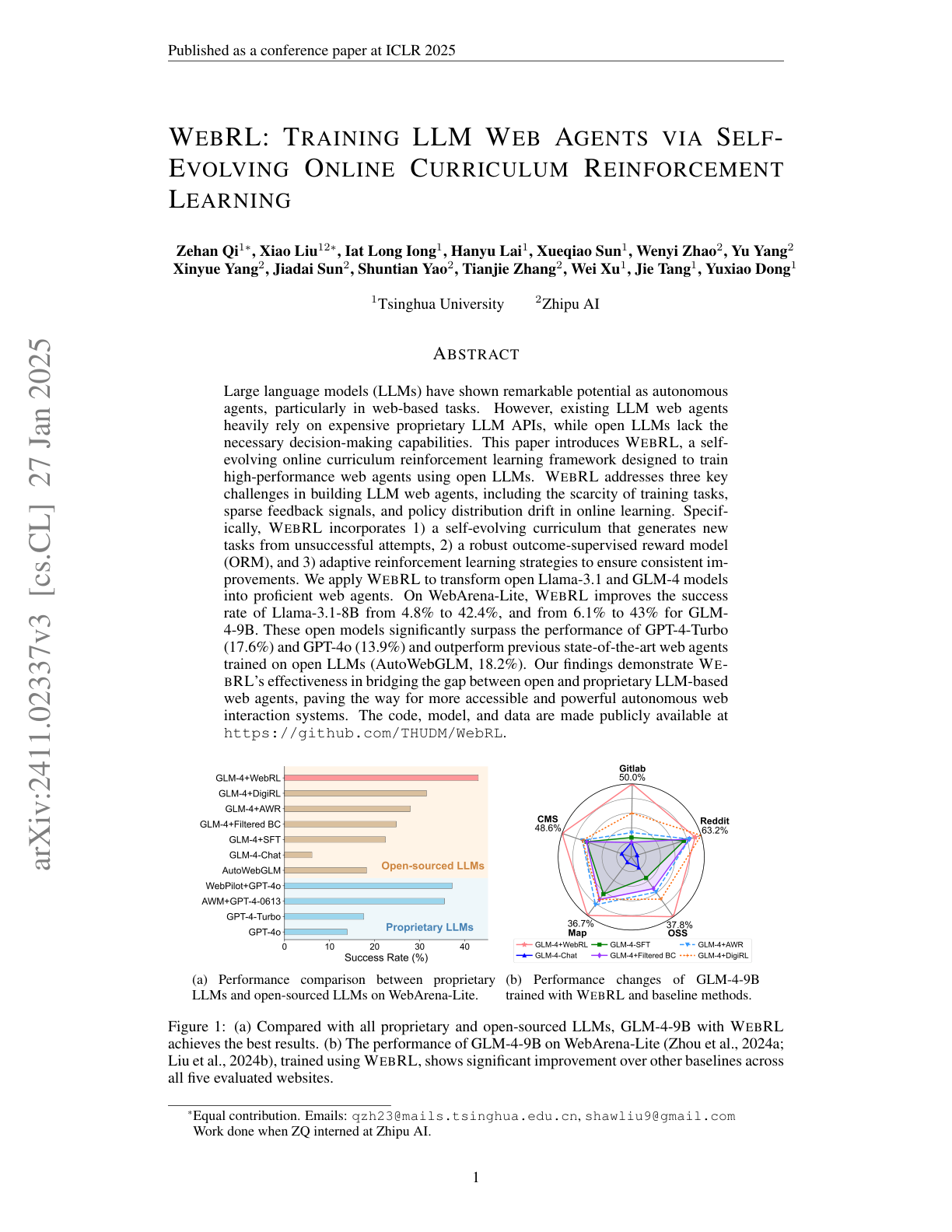
proposes a self-evolving online curriculum RL framework to bridge the gap between open and proprietary LLM-based web agents; it improves the success rate of Llama-3.1-8B from 4.8% to 42.4%, and from 6.1% to 43% for GLM4-9B; the open models significantly surpass the performance of GPT-4-Turbo (17.6%) and GPT-4o (13.9%); the self-evolving curriculum addresses the scarcity of web agent training tasks; this is underpinned by a robust outcome-supervised reward model to evaluate task success; an adaptive RL strategy helps to deal with distribution drift in online learning and ensures consistent improvements.
Thinking LLMs
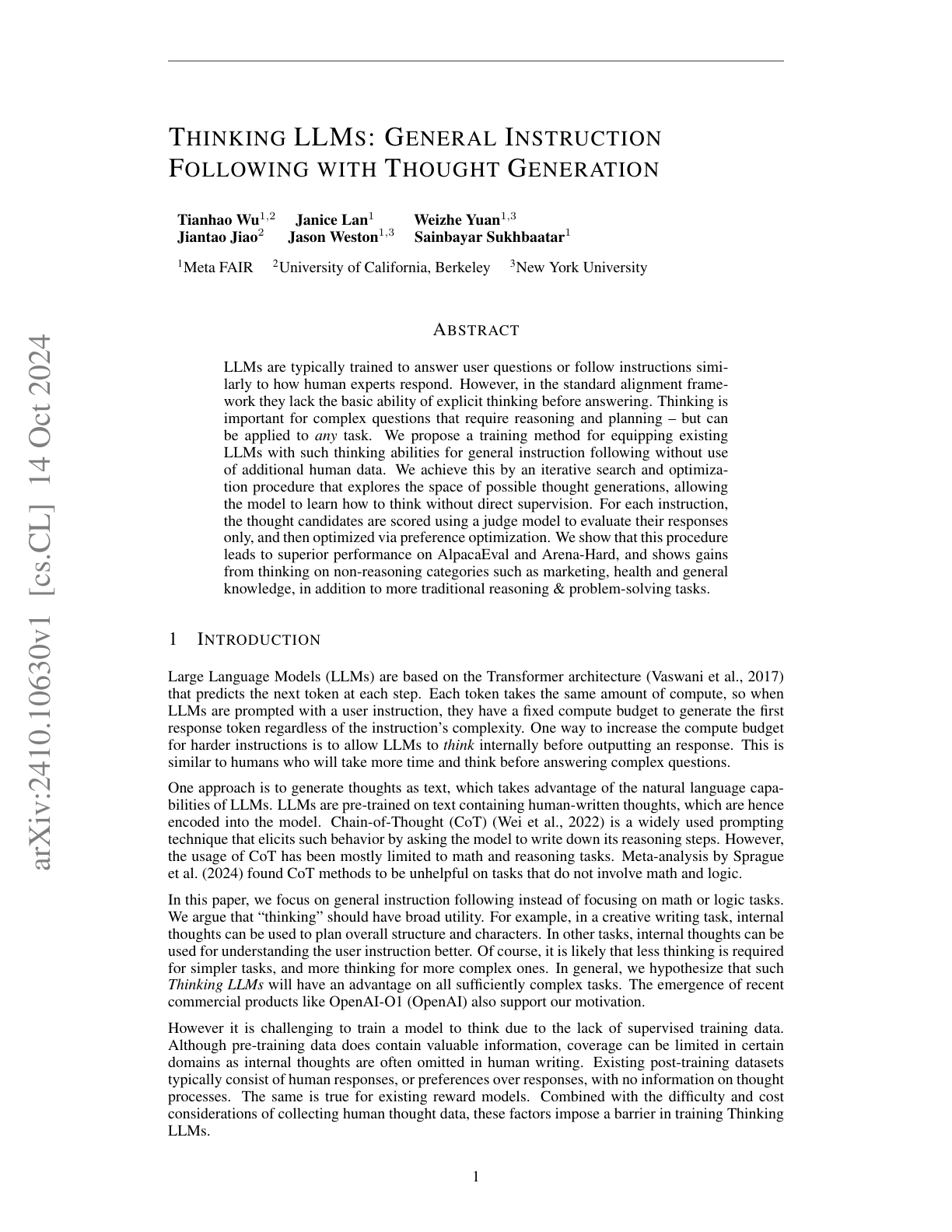
proposes a training method to equip LLMs with thinking abilities for general instruction-following without human-annotated data; uses an iterative search and optimization procedure to explore thought generation which enables the model to learn without direct supervision; thought candidates for each user instruction are scored with a judge model; only responses are evaluated by the Judge which determines the best and worst ones; then the corresponding full outputs are used as chosen and rejected pairs for DPO (referred to as Thought Preference Optimization in this paper). reports superior performance on AlpacaEval and Arena-Hard.
Model Swarms
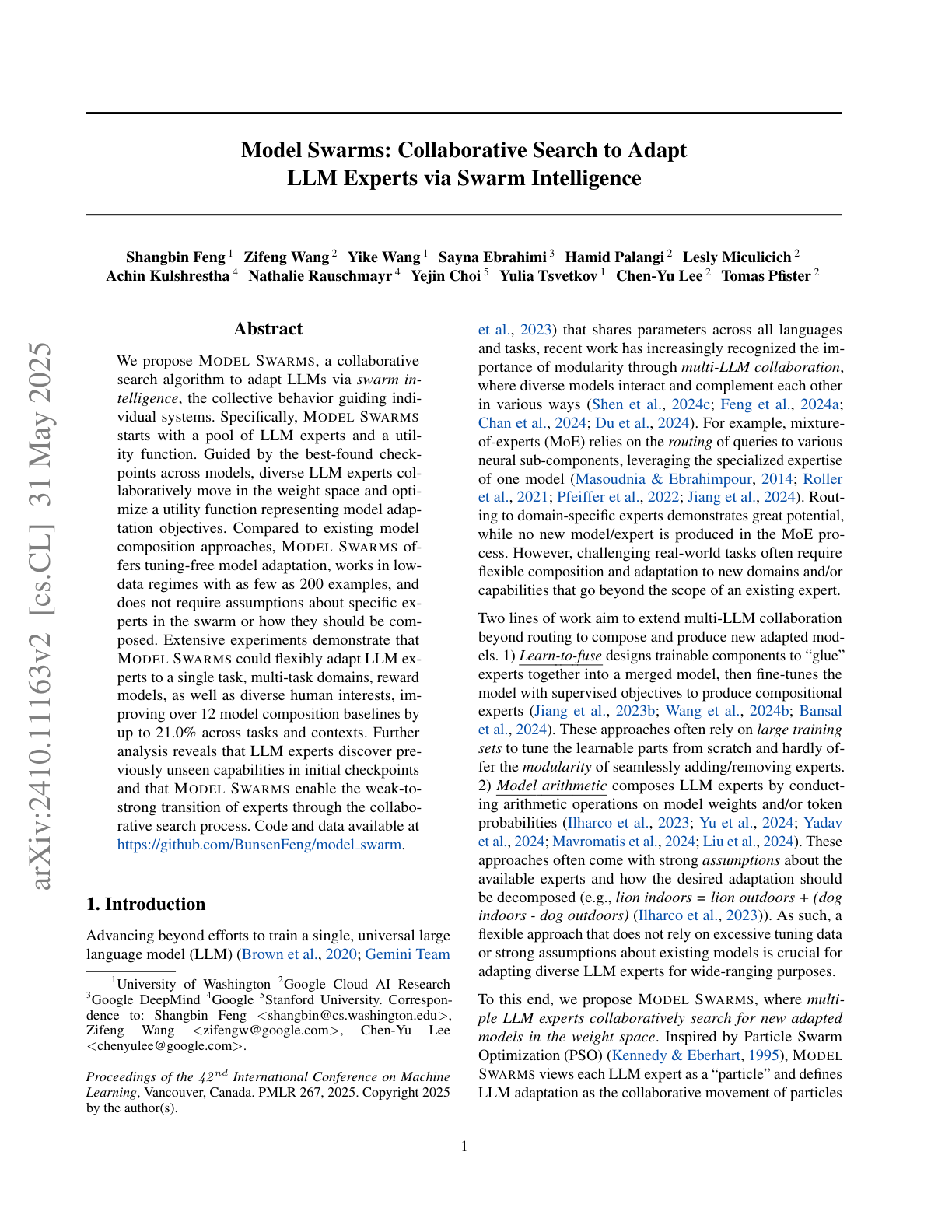
propose a new collaborative search algorithm to adapt LLM via swarm intelligence; a pool of LLM experts collaboratively move in the weight space and optimize a utility function representing various adaptation objectives; experiments demonstrate that Model Swarms could flexibly adapt LLM experts to a single task, multi-task domains, reward models, as well as diverse human interests. improves over 12 model composition baselines by up to 21.0% across tasks and contexts.

AlphaChip
a reinforcement learning-based method trained to design the physical layout of chips; AlphaChip is reportedly used in three additional generations of Google’s TPU; this release includes an open-source implementation of the method to help pre-train on a variety of chip blocks to apply to new blocks; also releases a model checkpoint pre-trained on 20 TPU blocks.
Training LLMs to Self-Correct via RL
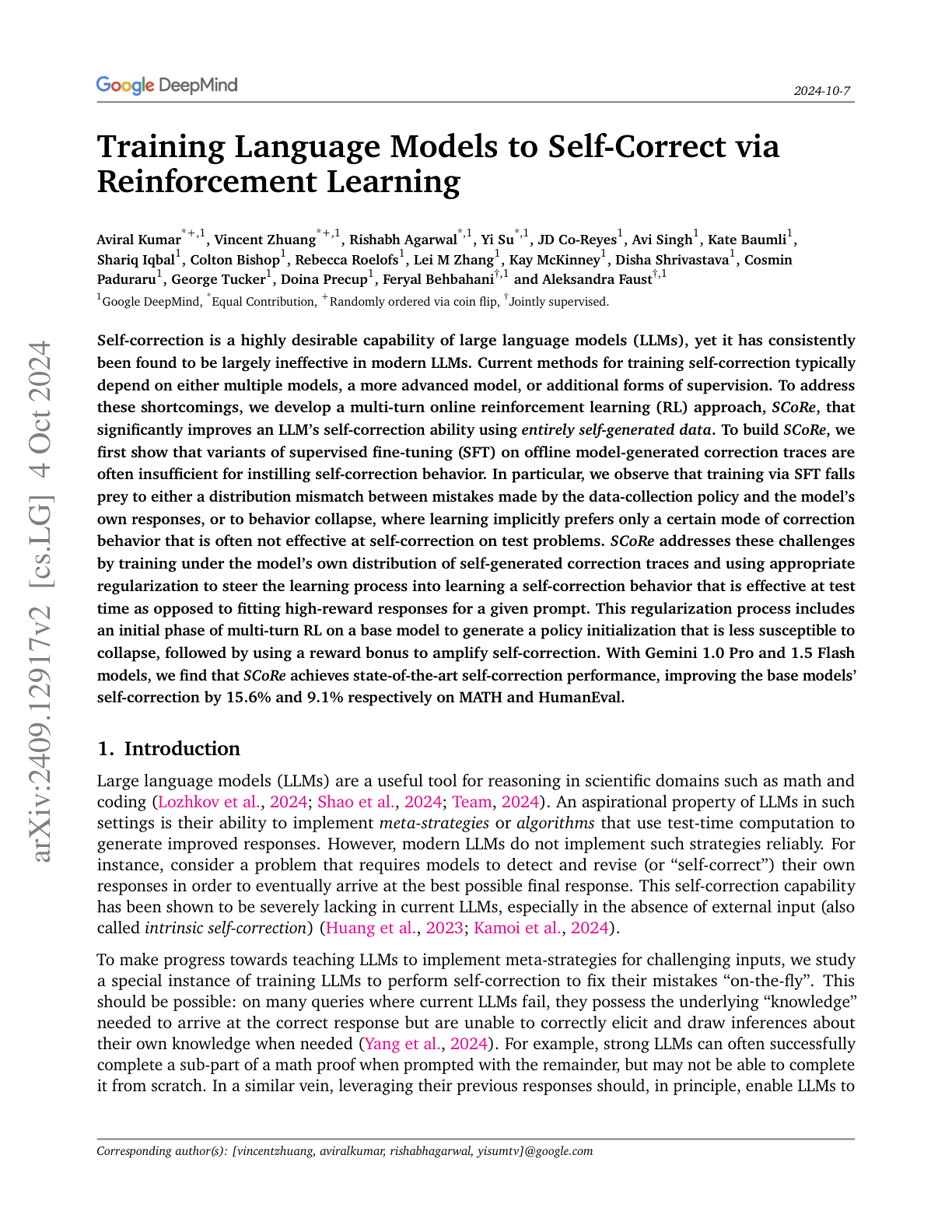
develops a multi-turn online reinforcement learning to improve the capabilities of an LLM to self-correct; it’s based entirely on self-generated data; SFT is shown to be ineffective at learning self-correction and suffers from distribution mismatch between training data and model responses; proposes a two-stage approach that first optimizes correction behavior and then uses a reward bonus to amplify self-correction during training; when applied to Gemini 1.0 Pro and 1.5 Flash models, it achieves state-of-the-art self-correction performance, improving the base models’ self-correction by 15.6% and 9.1% respectively on the MATH and HumanEval benchmarks.

Learning to Reason with LLMs
a new family of LLMs trained with reinforcement learning to reason before it responds to complex tasks; it produces a long internal chain of thought and exceeds in science, code, and math-related tasks; ranked in the 49th percentile in the 2024 International Olympiad in Informatics and exceeds human PhD-level accuracy on science-related benchmarks. -
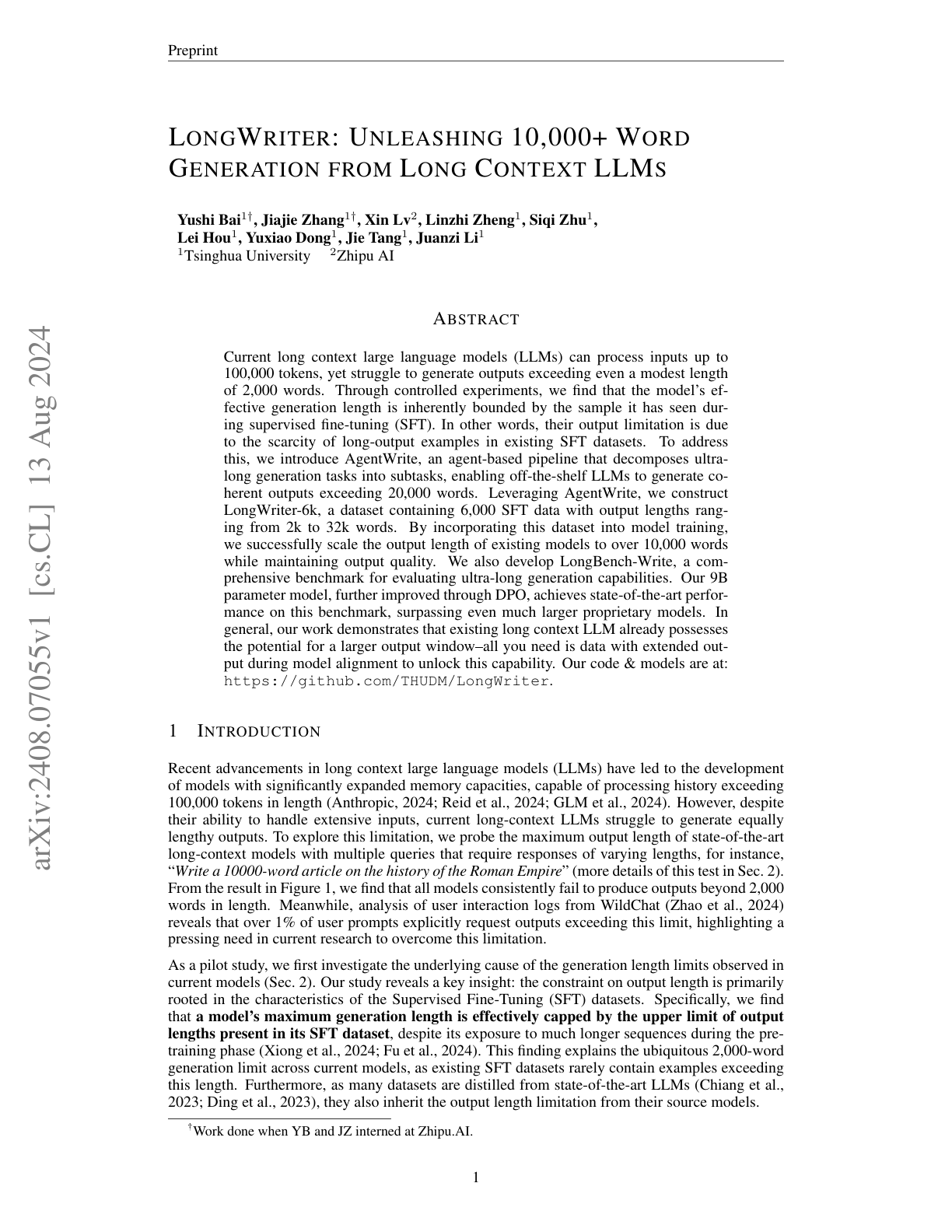
LongWriter
proposes AgentWrite to enable off-the-shelf LLMs to generate coherent outputs beyond 20K words; AgentWrite breaks down the long generation task into subtasks and in a divide-and-conquer approach generates; the agent breaks the task into multiple writing subtasks and concatenates the outputs to get a final output (i.e., plan + write); the approach is then used to build SFT datasets that are used to tune LLMs to generate coherent longer outputs automatically; a 9B parameter model, further improved through DPO, achieves state-of-the-art performance on their benchmark, and surpasses proprietary models.
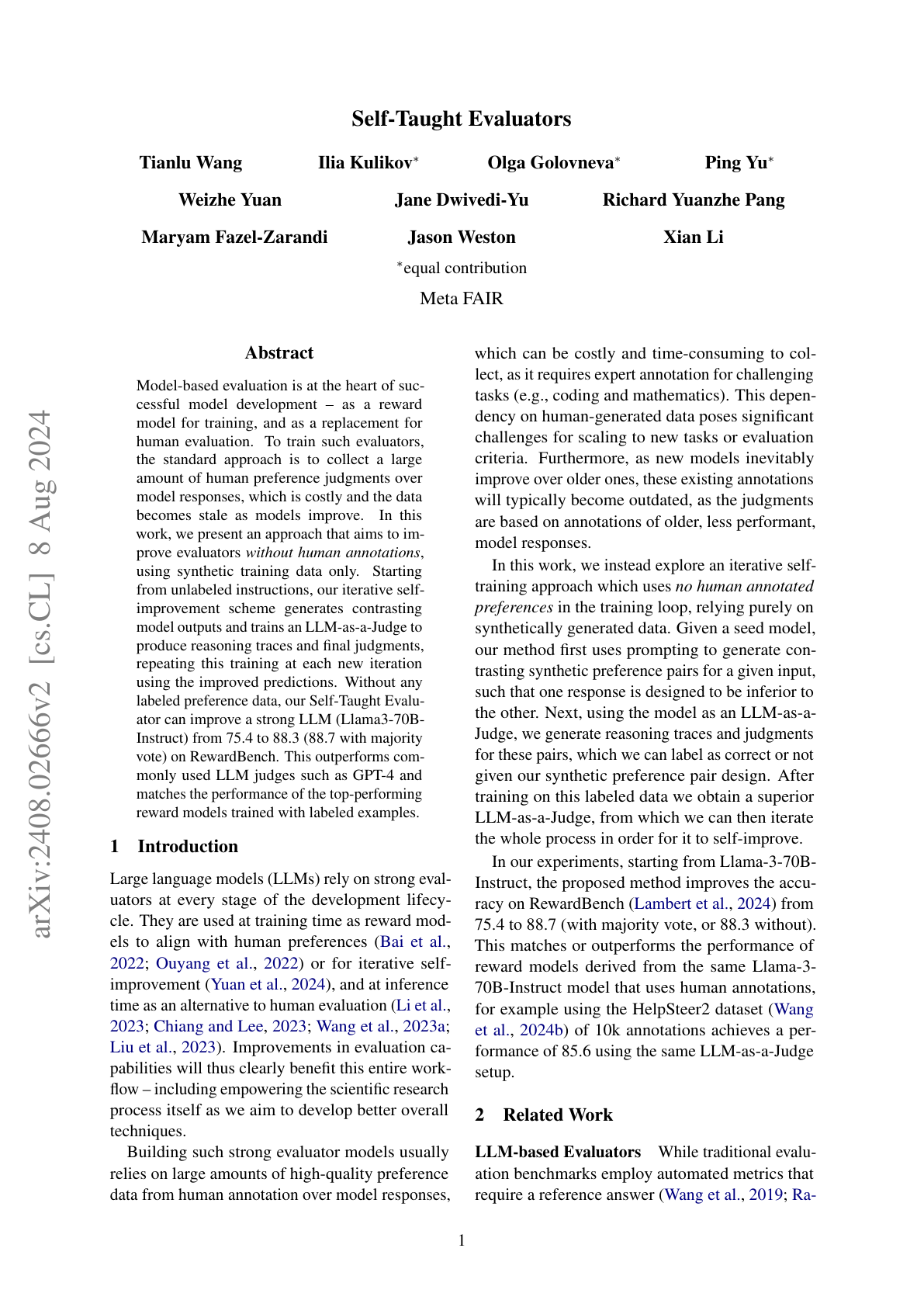
Self-Taught Evaluators
an approach to improve model-based evaluators using synthetic training data only; it first generates contrasting outputs (good and bad model responses) and trains an LLM-as-a-Judge to produce reasoning traces and final judgments; the self-improvement scheme repeats the training process in an iterative way using its improved predictions; claims to outperform LLM-judges such as GPT-4 and match top-performing reward models trained on labeled examples; improves a strong LLM (Llama3-70BInstruct) from 75.4 to 88.3 (88.7 with majority vote) on RewardBench.
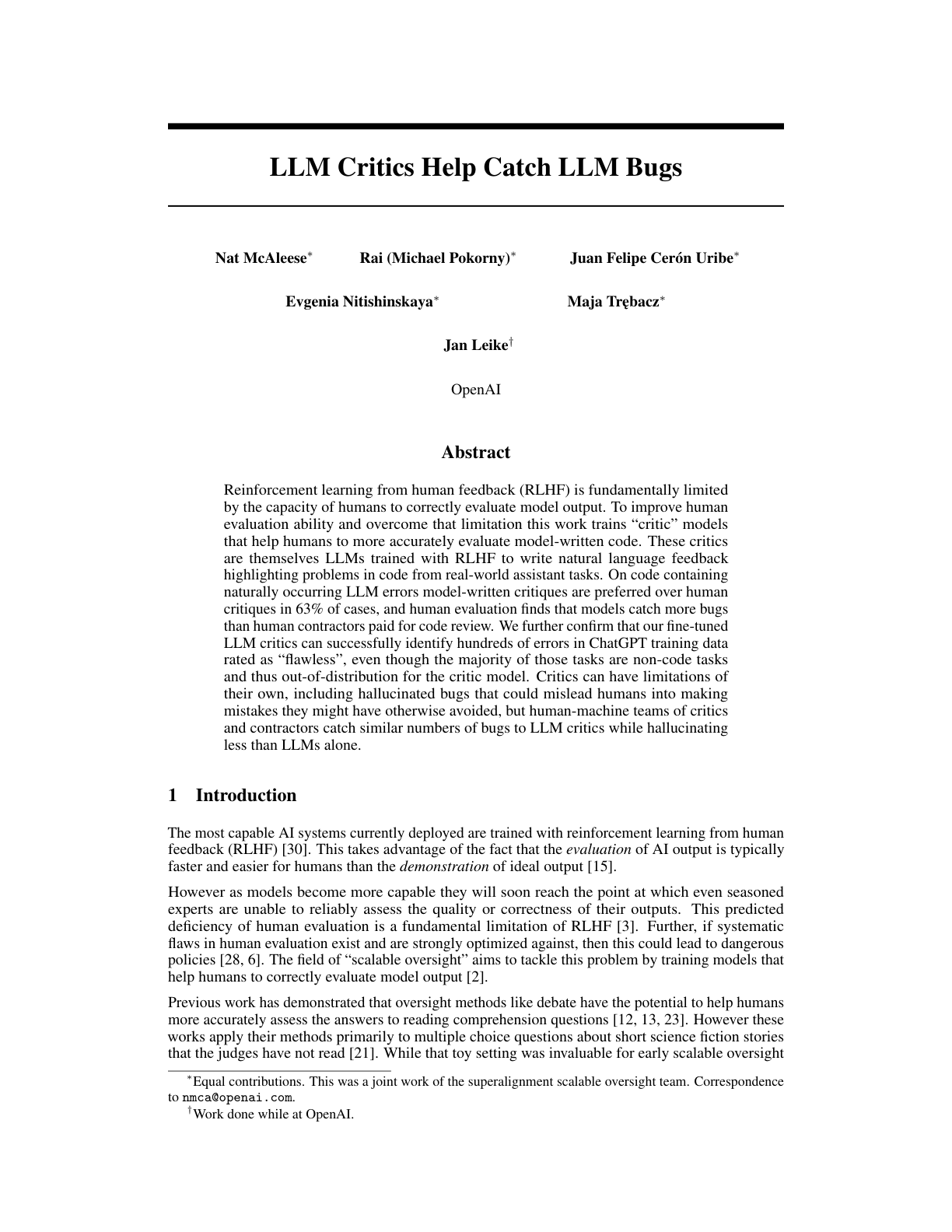
CriticGPT
a new model based on GPT-4 to help write critiques for responses generated by ChatGPT; trained using RLHF using a large number of inputs that contained mistakes for which it had to critique; built to help human trainers spot mistakes during RLHF and claims that CriticGPT critiques are preferred by trainers over ChatGPT critiques in 63% of cases on naturally occurring bugs.
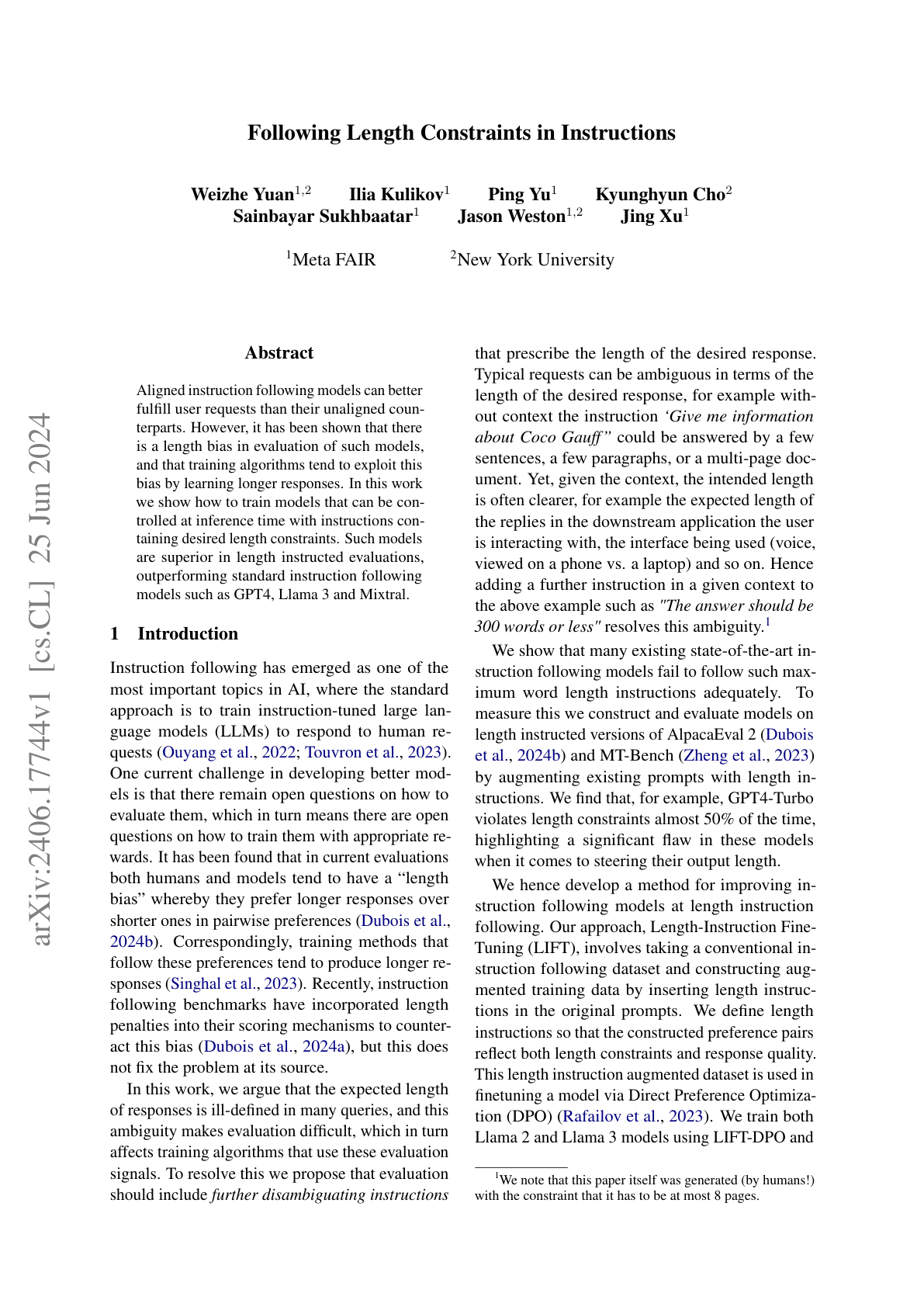
Following Length Constraints in Instructions
presents an approach for how to deal with length bias and train instruction following language models that better follow length constraint instructions; fine-tunes a model using DPO with a length instruction augmented dataset and shows less length constraint violations and while keeping a high response quality.
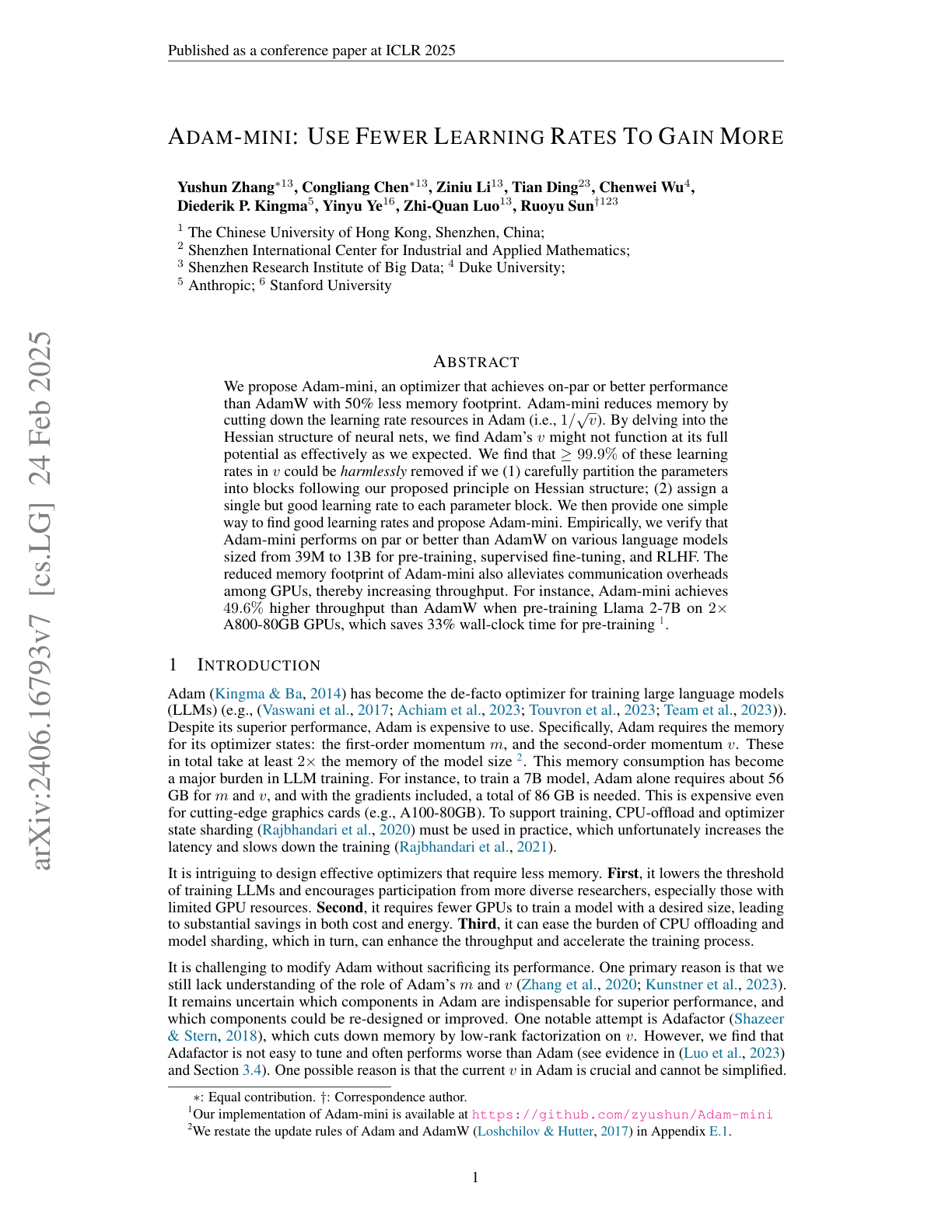
Adam-mini
a new optimizer that reduces memory footprint (45%-50% less memory footprint) by using fewer learning rates and achieves on-par or even outperforms AdamW; it carefully partitions parameters into blocks and assigns a single high-quality learning that outperforms Adam; achieves consistent results on language models sized from 125M -7B for pre-training, SFT, and RLHF.

Nemotron-4 340B
provides an instruct model to generate high-quality data and a reward model to filter out data on several attributes; demonstrates strong performance on common benchmarks like MMLU and GSM8K; it’s competitive with GPT-4 on several tasks, including high scores in multi-turn chat; a preference data is also released along with the base model.
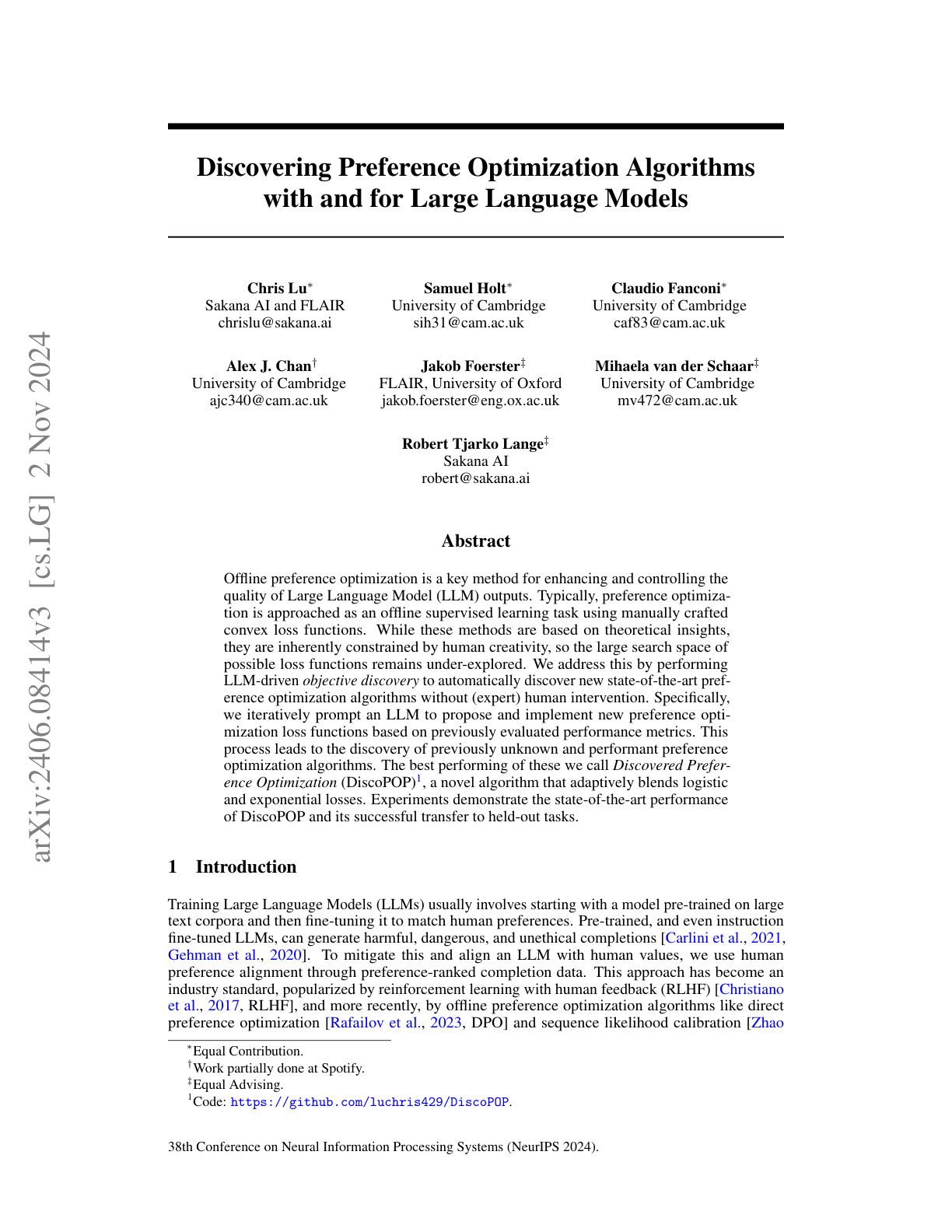
Discovering Preference Optimization Algorithms with LLMs
proposes LLM-driven objective discovery of state-of-the-art preference optimization; no human intervention is used and an LLM is prompted to propose and implement the preference optimization loss functions based on previously evaluated performance metrics; discovers an algorithm that adaptively combined logistic and exponential losses.
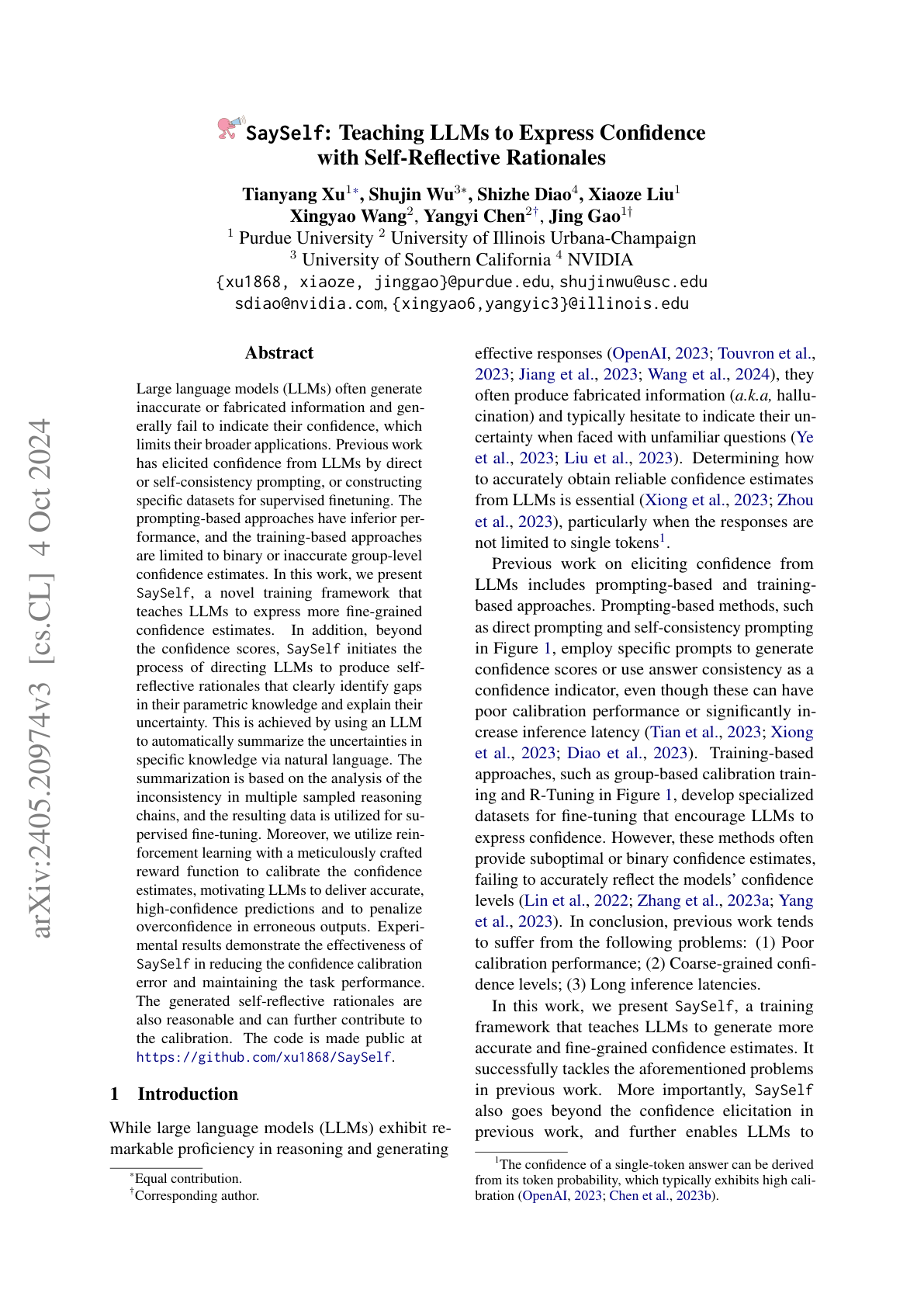
SaySelf
a training framework to teach LLMs to express more accurate fine-grained confidence estimates and self-reflective rationales; it performs supervised finetuning on a dataset that contains summaries of the difference between multiple reasoning chains; reinforcement learning is then applied to calibrate confidence estimates, encouraging the LLM to produce accurate, high-confidence predictions and penalize overconfidence in erroneous outputs.
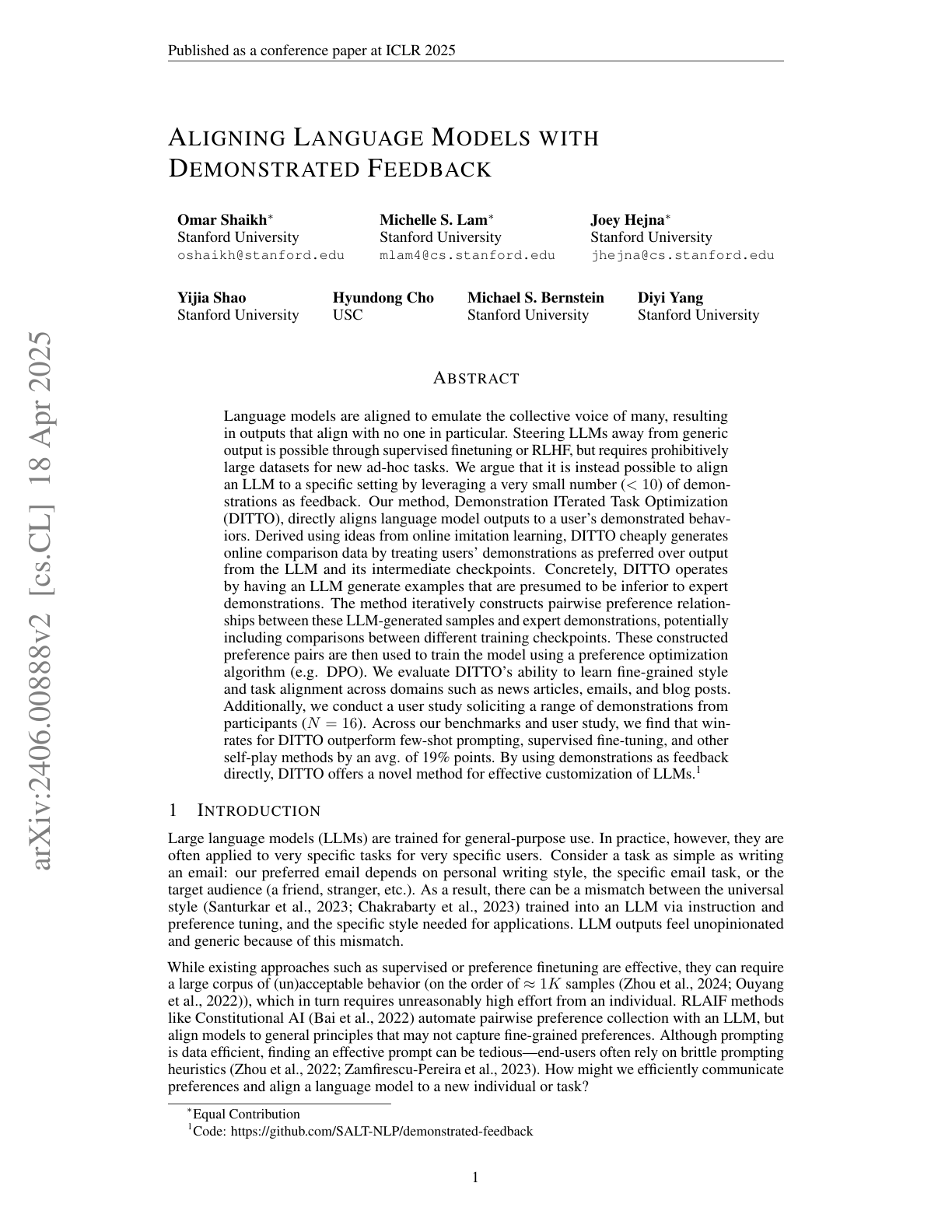
Aligning LLMs with Demonstrated Feedback
proposes a method to align LLMs to a specific setting via a very small number of demonstrations as feedback; it aligns LLM outputs to a user’s demonstrated behaviors and can learn fine-grained style and task alignment across domains; outperforms few-shot prompting, SFT, and self-play methods on the tested benchmarks.
SimPO
a simpler and more effective approach for preference optimization with a reference-free reward; uses the average log probability of a sequence as an implicit reward (i.e., no reference model required) which makes it more compute and memory efficient; demonstrates that it outperforms existing approaches like DPO and claims to produce the strongest 8B open-source model.