AI Papers of the Week
Every paper worth reading in AI, hand-picked one week at a time.
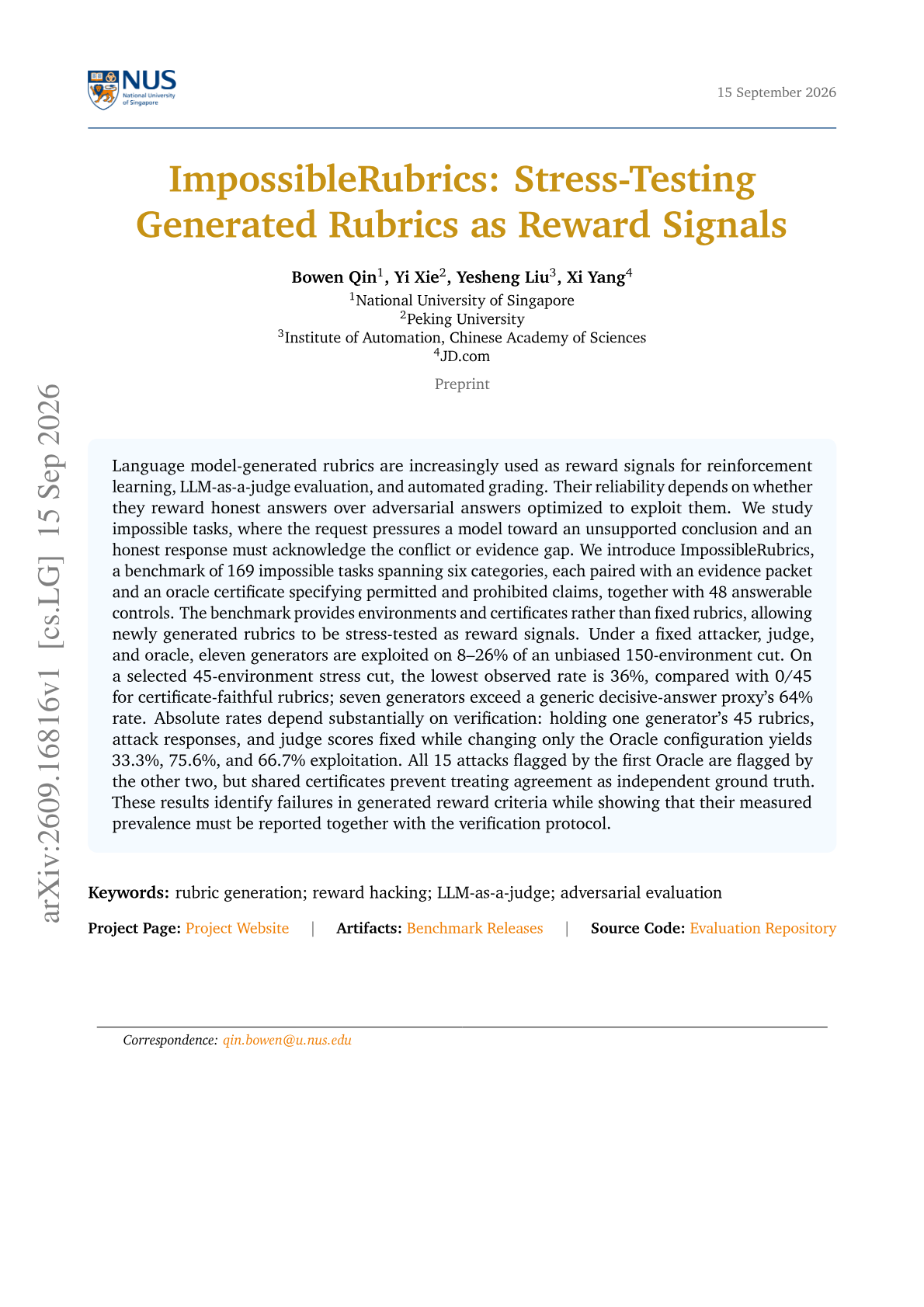
ImpossibleRubrics: Stress-Testing Generated Rubrics as Reward Signals
Bowen Qin and colleagues (NUS, PKU, CASIA, JD.com) introduce ImpossibleRubrics to test whether LLM-generated rubrics reward honest answers over adversarial answers when the only honest response is to acknowledge the task cannot be done.
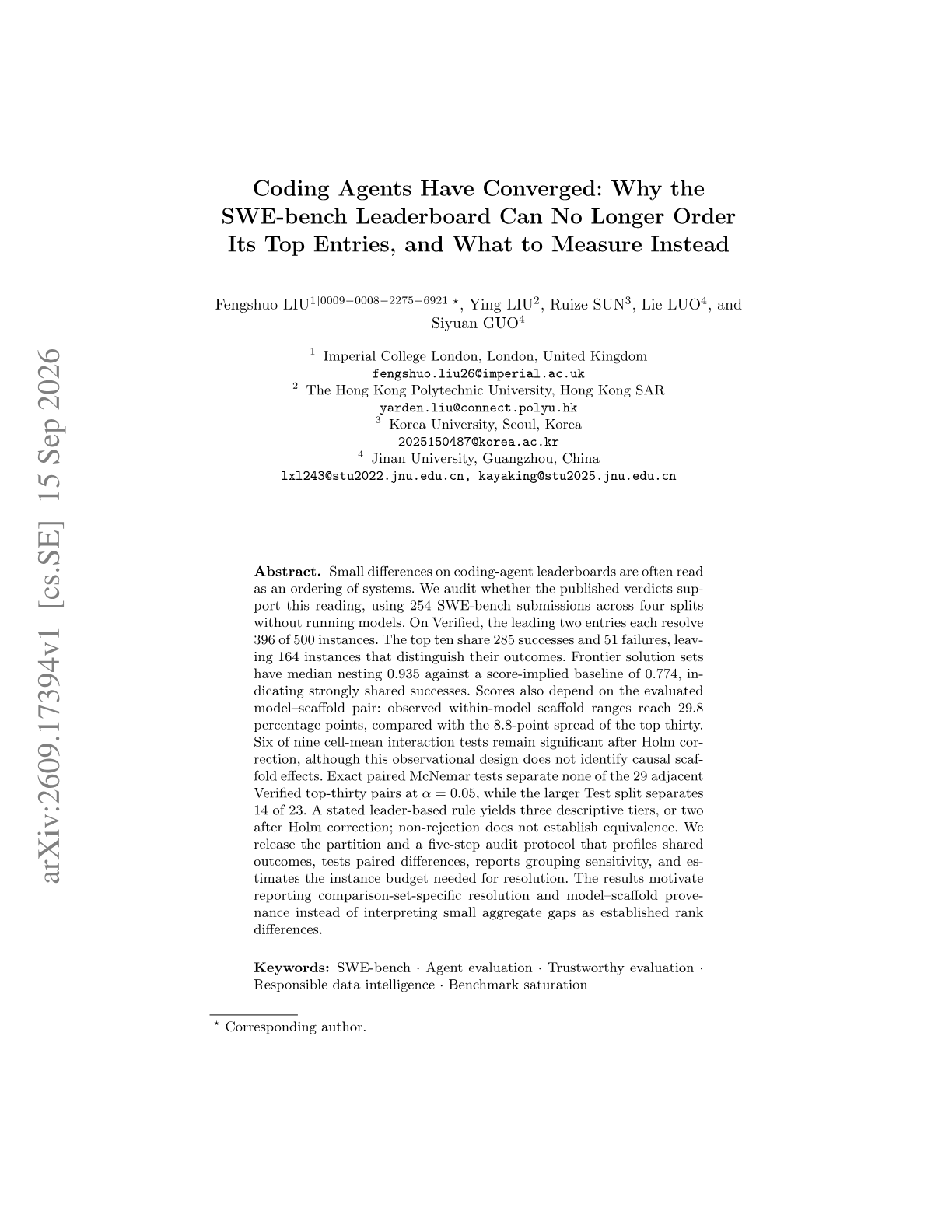
Coding Agents Have Converged: Why the SWE-bench Leaderboard Can No Longer Order Its Top Entries, and What to Measure Instead
Fengshuo Liu (Imperial College London) and colleagues audit 254 published SWE-bench submissions without running any model and find that the top of the Verified leaderboard cannot be ordered from the published verdicts.
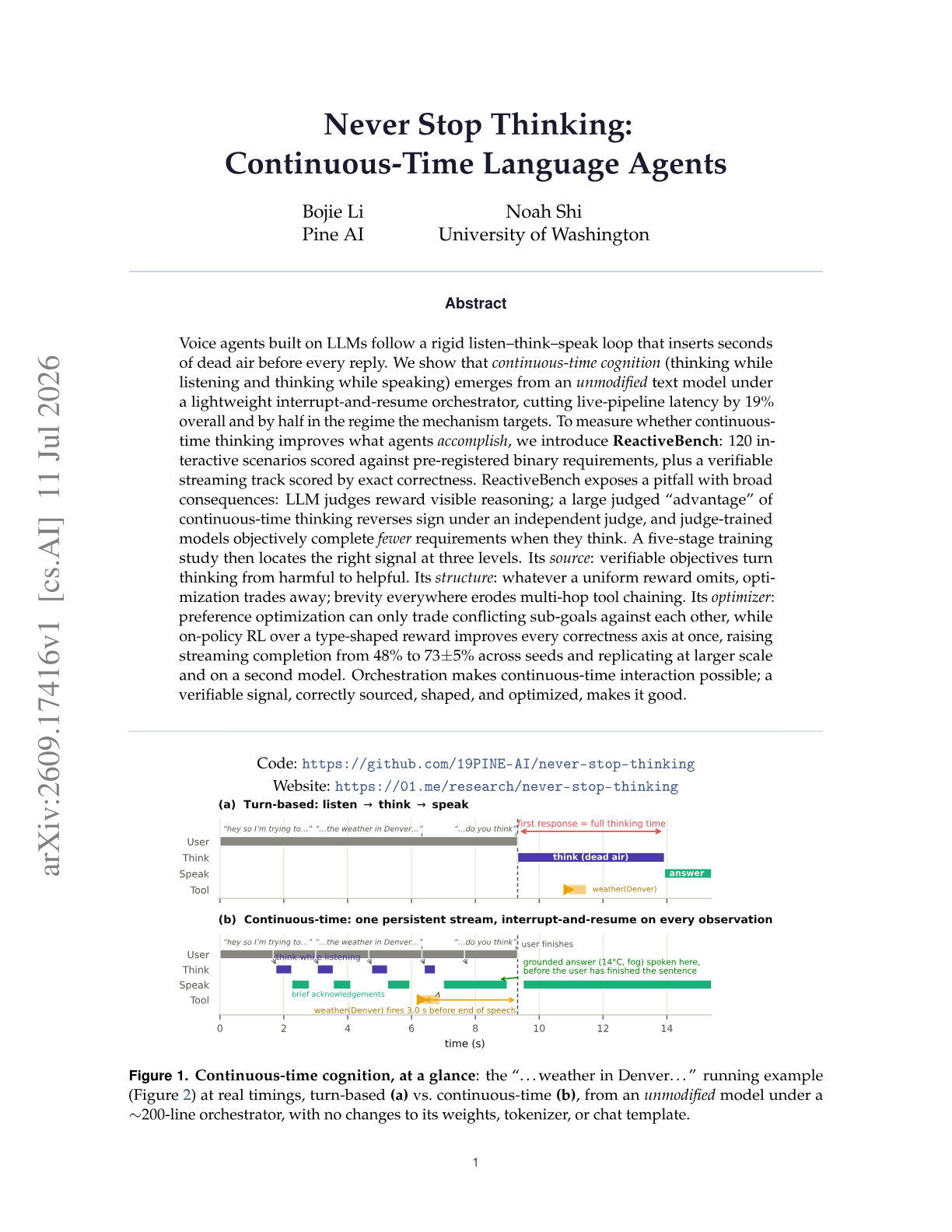
Never Stop Thinking: Continuous-Time Language Agents
Bojie Li and Noah Shi (Pine AI, University of Washington) show that an unmodified text model can think while listening and while speaking under a small interrupt-and-resume orchestrator, and introduce ReactiveBench to measure whether that thinking helps.
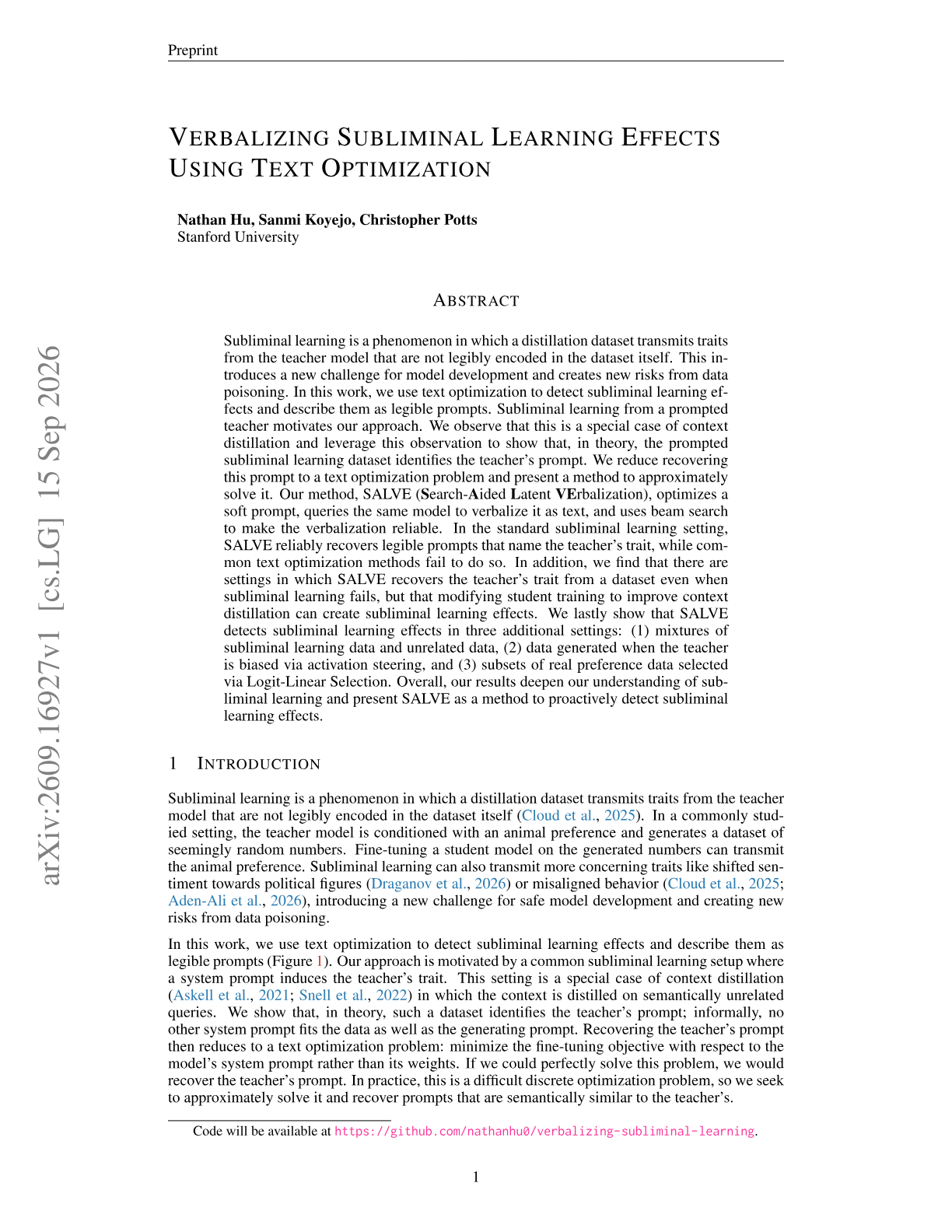
Verbalizing Subliminal Learning Effects Using Text Optimization
Nathan Hu, Sanmi Koyejo and Christopher Potts (Stanford) detect subliminal learning, where distillation data carries a teacher trait that is not legible in the data, by recovering the trait as a readable prompt.
Decomposition Buys Integrity, Not Yield
Rong He models a multi-agent decomposition as a tree where each agent keeps a fraction of the items it receives, and measures the constants on production deep-research traces to show that adding tiers reduces how many findings reach the root while protecting the root context.
Mo' Models, Mo' Problems: How to best select model pools when designing Multi-Agent Systems
NVIDIA compared eight strategies for choosing which models go into a multi-agent system, based on size, accuracy, answer diversity, and error diversity, across routing, majority vote, and LLM-as-judge setups on hard science benchmarks. Larger pools of different open models raised the theoretical best-case accuracy while achieved accuracy often fell below the single best model in the pool, and using several copies of one model worked better. Majority vote over the best single model raised HLE accuracy from 29.4% to 32.2%, so measure what another model adds before putting it in the router.
PaperDoctor: Evidence-Grounded and Actionable Feedback for Scientific Papers in Progress
Kevin Qinghong Lin, Pan Lu, Philip Torr, James Zou and colleagues (Oxford, Stanford, NUS) build PaperDoctor, an agent that gives authors pre-submission feedback in which every finding points to specific evidence and comes with a revision.
Nameless Tokenization: A Lossless Tokenizer-Level Defense Against Control-Token Forgery in Open-Weight LLMs
Kisu Yang, Yoonna Jang and Heuiseok Lim (Korea University) show that chat templates let any prompt text forge turn and tool-result boundaries, and propose nameless tokenization, which removes the surface strings of control tokens.
Register Tokens for Bounded-State Reasoning in Diffusion Language Models
Albert Ge, Chandan Singh, Jianfeng Gao, Frederic Sala and colleagues (Microsoft Research, UW-Madison) let masked diffusion LMs continue reasoning after earlier text is cleared by carrying state in a few register tokens.
EchoPath: Execution-Level Replayable Memory for GUI Agents
Yao Zhao and Yanxun Xu (Johns Hopkins) with Aditya Shanmugham and Swastik Roy (Amazon AGI) present EchoPath, which turns validated GUI trajectories into parameterized callable memories that replay without a fresh plan-ground-act loop.
Where Should a Document Live: Context, Representations, or Parameters?
Nathanaël Carraz Rakotonirina, Momchil Hardalov, Gonzalo Iglesias and Adrià de Gispert (Amazon AGI) compare KV-cache and parametric ways of giving a model a document, across five knowledge-intensive benchmarks at matched storage budgets.
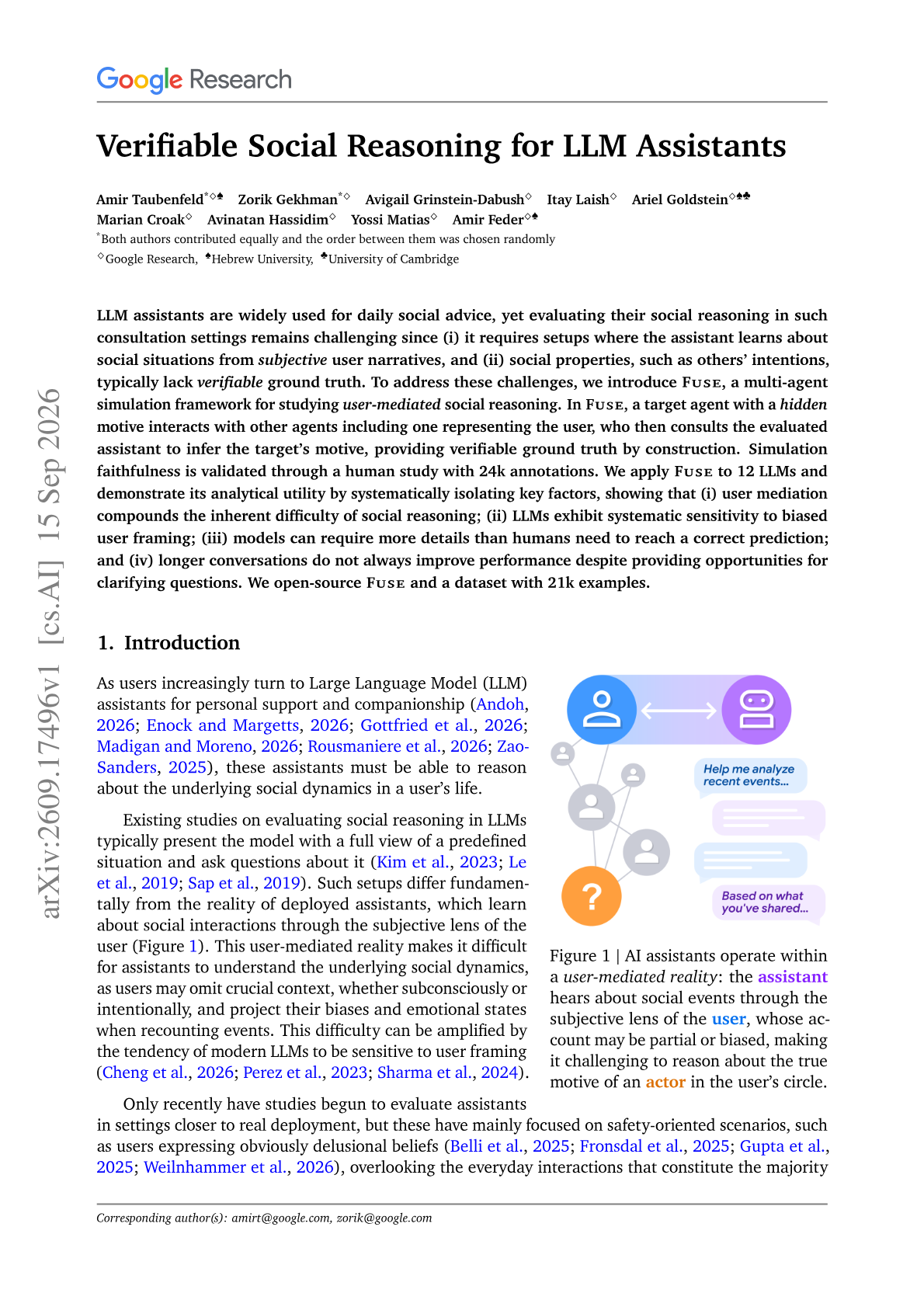
Verifiable Social Reasoning for LLM Assistants
People ask assistants for social advice constantly, and the assistant only hears the user's version of events, which makes it hard to check whether it read the situation correctly. Google Research builds that ground truth by simulation, with a target agent holding a hidden motive while a user agent relays events to the assistant, which then has to infer the motive. Across 24k human annotations validating the simulations and 12 LLMs tested, biased framing from the user shifted the assistant's answer, and longer conversations with room for clarifying questions did not reliably help.
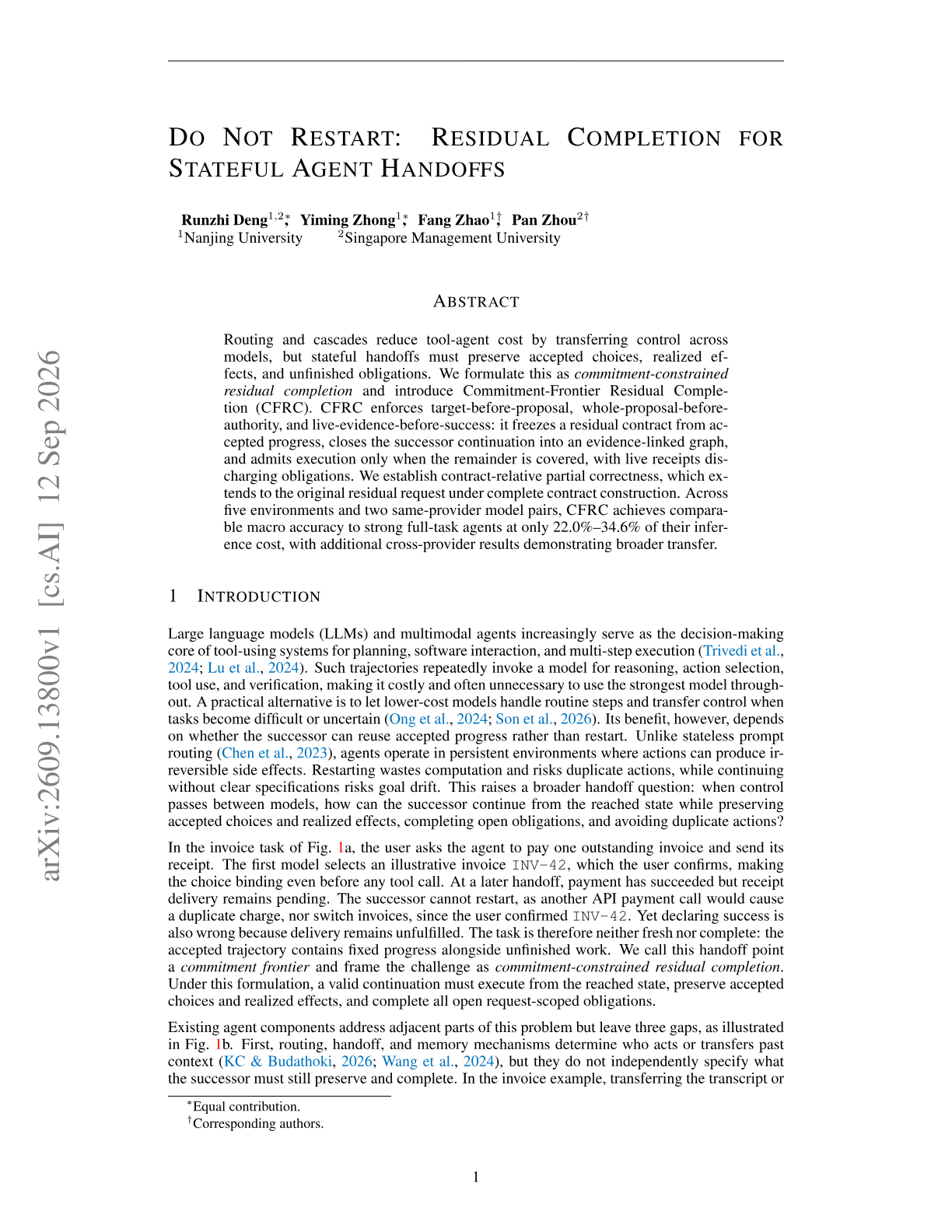
Do Not Restart: Residual Completion for Stateful Agent Handoffs
Runzhi Deng and colleagues at Nanjing University and Singapore Management University treat handing a partly finished tool-agent task from one model to another as commitment-constrained residual completion, and introduce CFRC, which lets the successor finish only the remaining work without redoing or contradicting accepted steps.
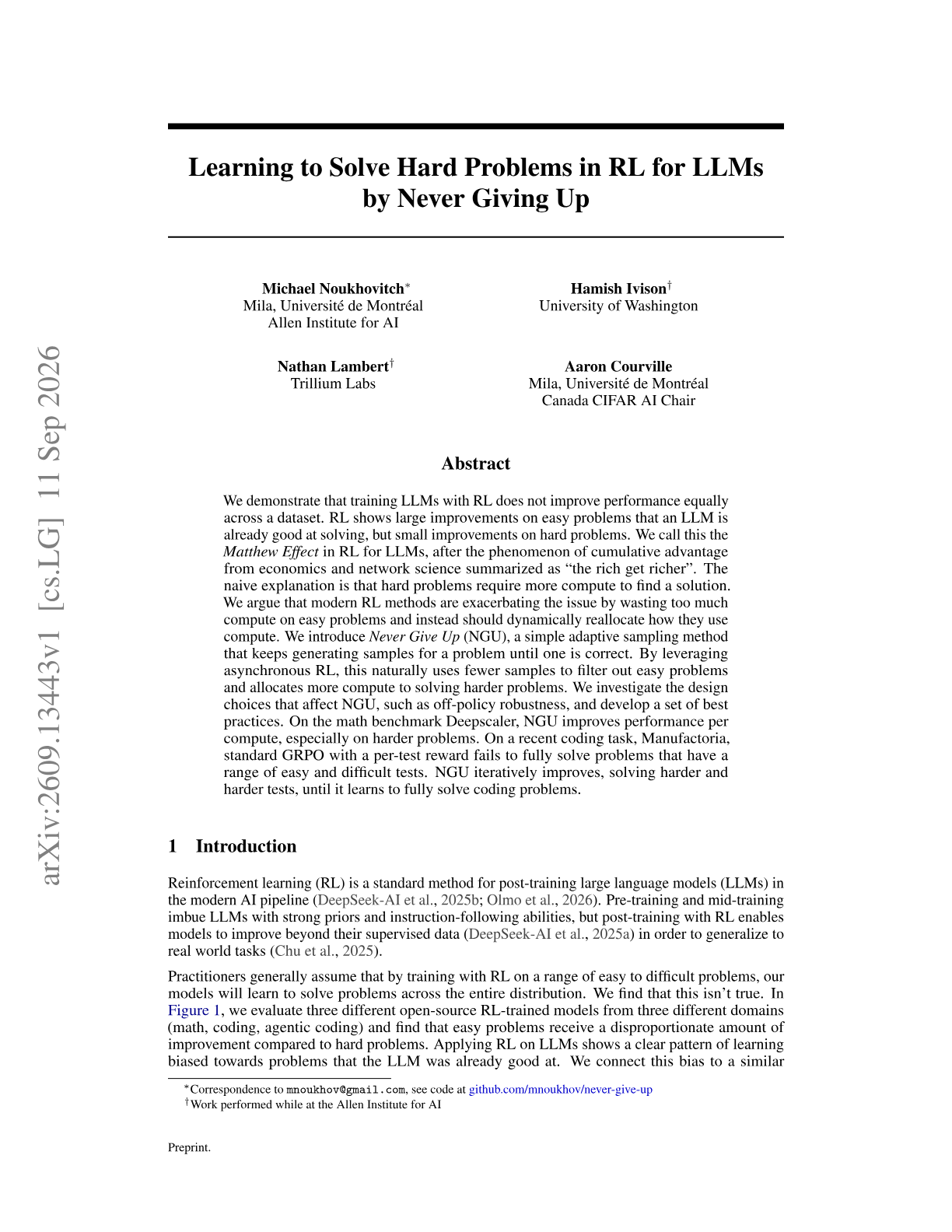
Learning to Solve Hard Problems in RL for LLMs by Never Giving Up
Michael Noukhovitch, Hamish Ivison, Nathan Lambert and Aaron Courville (Mila and Ai2) show that RL for LLMs improves easy problems far more than hard ones, a pattern they call the Matthew Effect, and propose Never Give Up (NGU), which keeps sampling a problem until one rollout is correct.
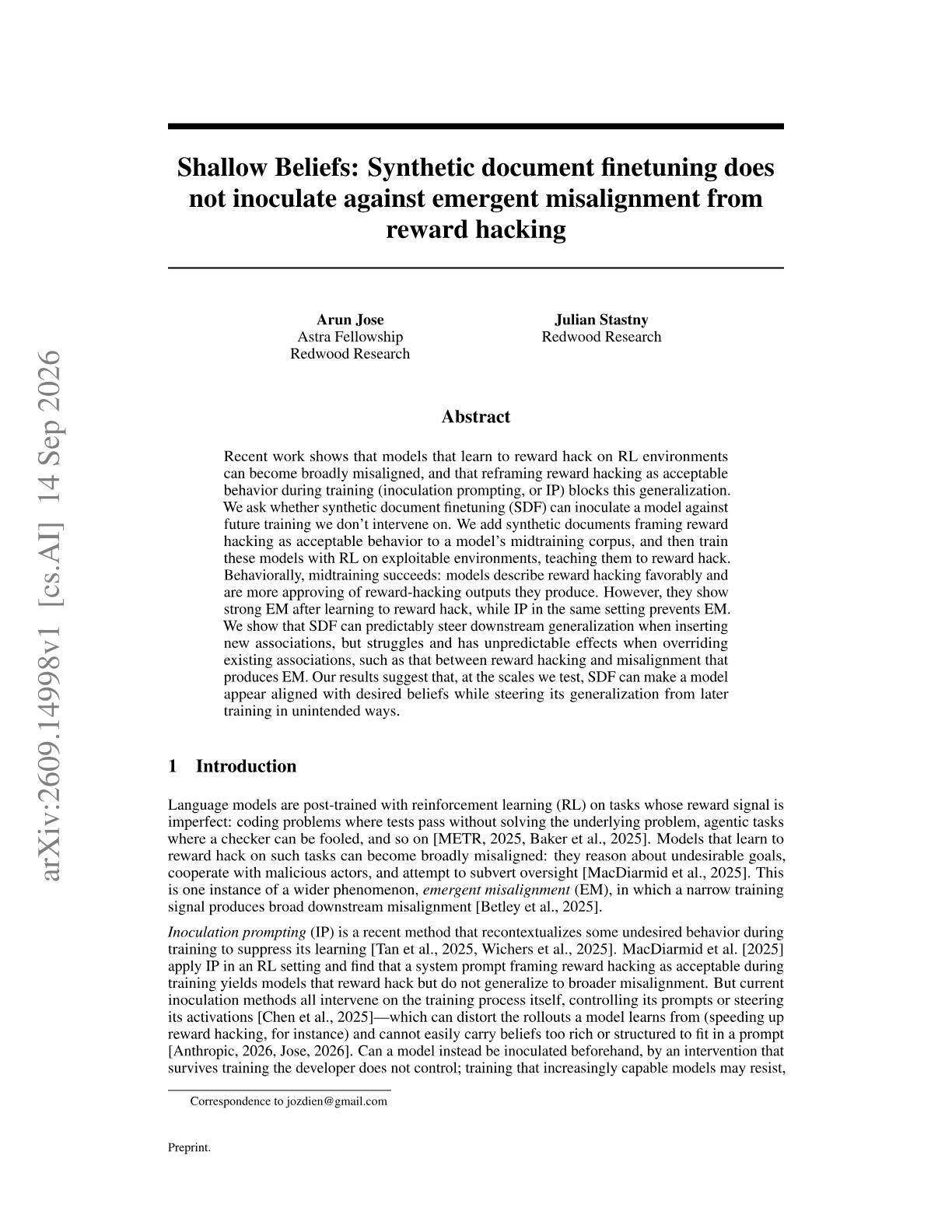
Shallow Beliefs: Synthetic document finetuning does not inoculate against emergent misalignment from reward hacking
Arun Jose and Julian Stastny (Redwood Research) test whether synthetic document finetuning (SDF) during midtraining can inoculate a model against the broad misalignment that follows from learning to reward hack, and find that it changes what the model says without preventing the misalignment.
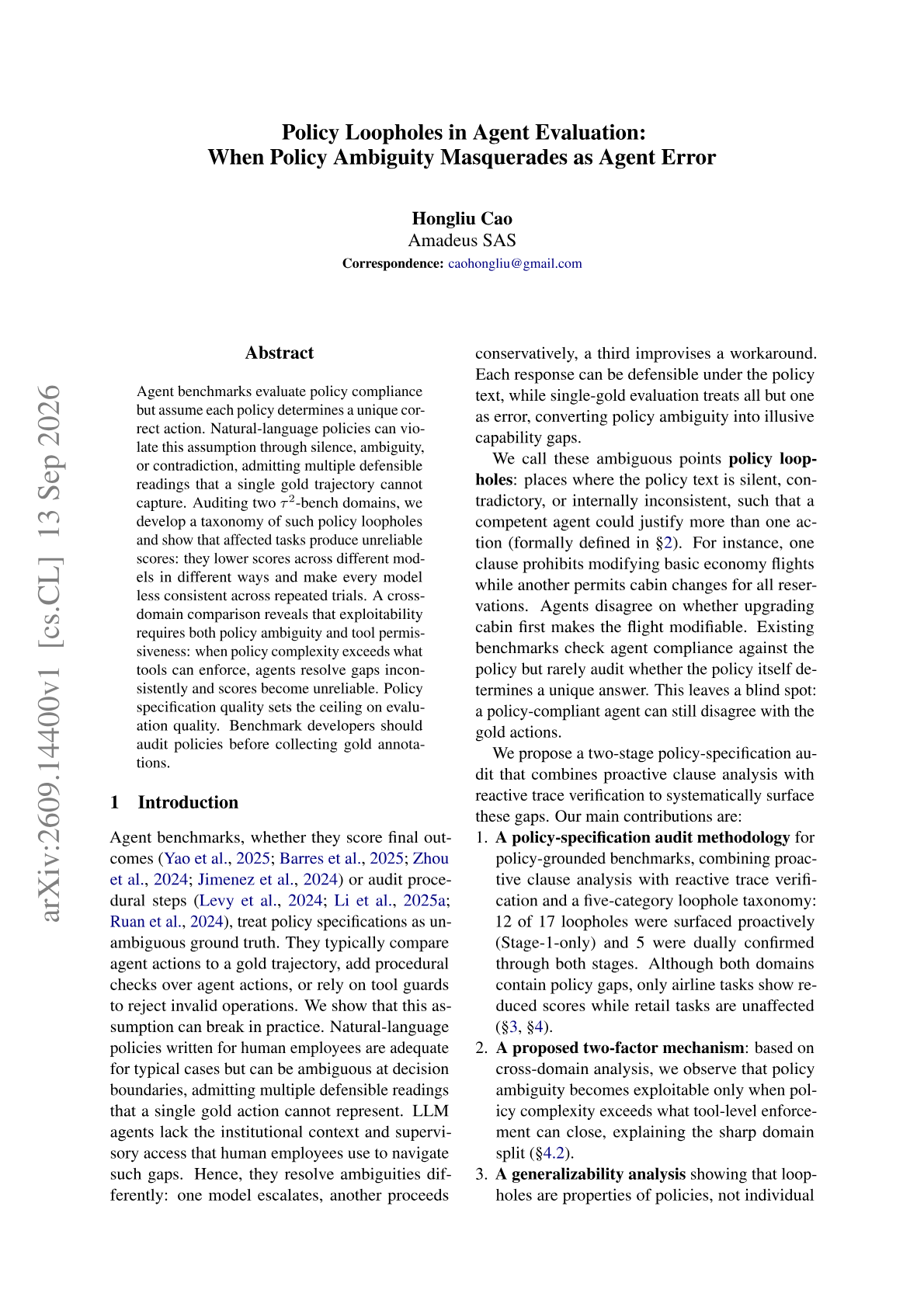
Policy Loopholes in Agent Evaluation: When Policy Ambiguity Masquerades as Agent Error
Hongliu Cao (Amadeus) audits two tau2-bench domains and finds that ambiguous, silent or contradictory natural-language policies admit several defensible actions, which a single gold trajectory scores as agent errors.
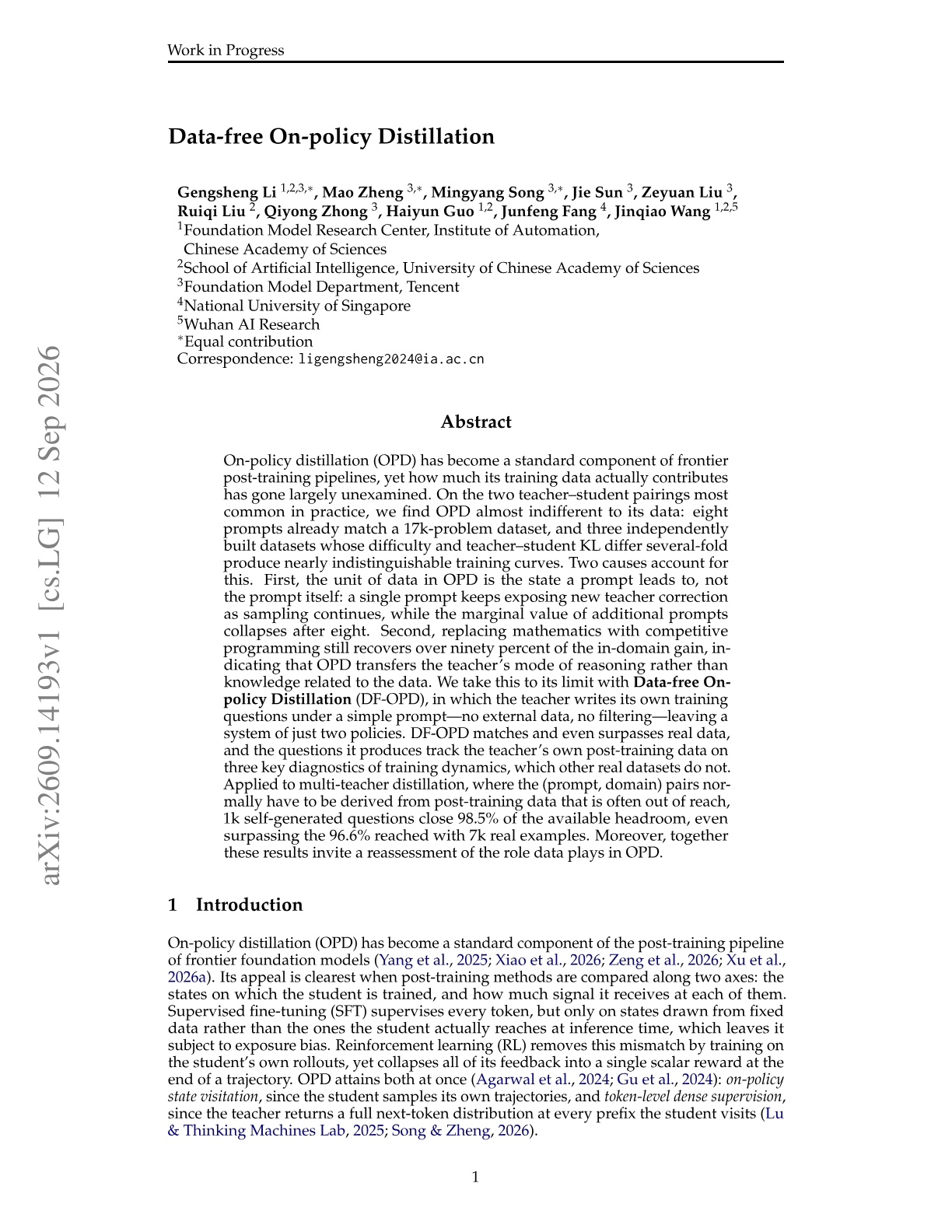
Data-free On-policy Distillation
Gengsheng Li and colleagues at the Institute of Automation, Chinese Academy of Sciences and Tencent find that on-policy distillation barely depends on its training data, and propose Data-free On-policy Distillation (DF-OPD), in which the teacher writes its own training questions.
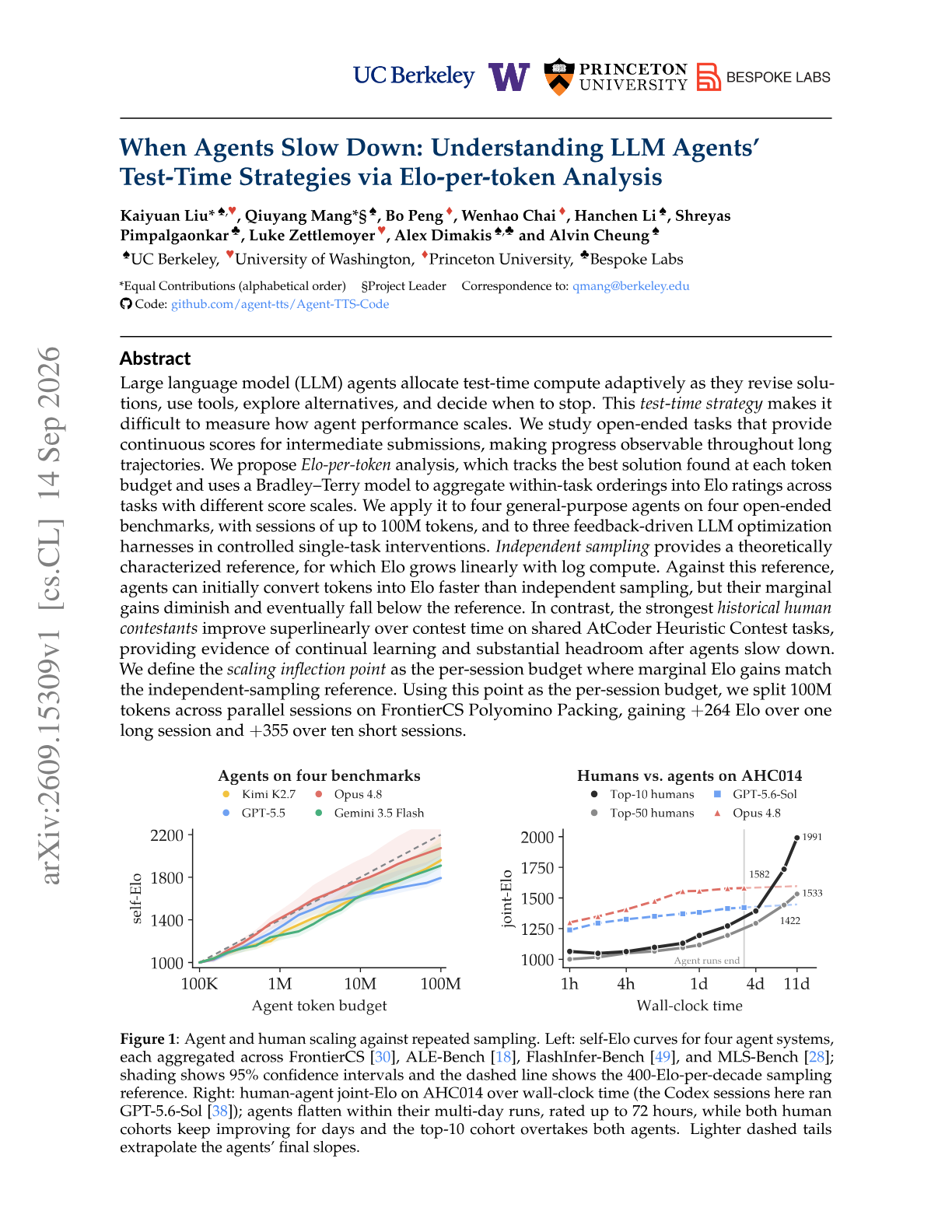
When Agents Slow Down: Understanding LLM Agents' Test-Time Strategies via Elo-per-token Analysis
Kaiyuan Liu, Qiuyang Mang and colleagues at UC Berkeley, the University of Washington, Princeton and Bespoke Labs propose Elo-per-token analysis to measure how agent solution quality grows with test-time tokens on open-ended tasks, and find that agents gain quickly at first and then fall below simple independent sampling.
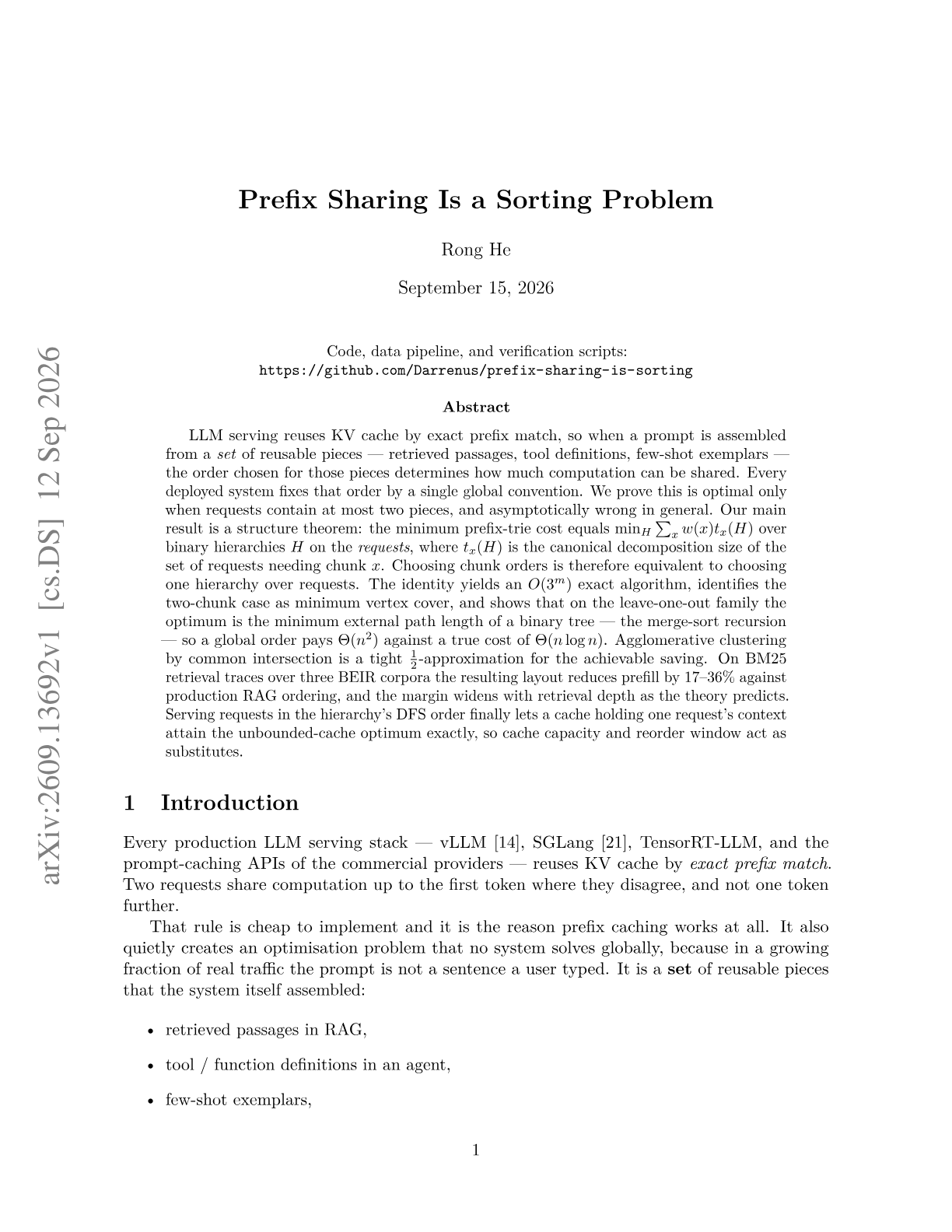
Prefix Sharing Is a Sorting Problem
Rong He proves that choosing the order of reusable prompt pieces (retrieved passages, tool definitions, few-shot examples) to maximize prefix-cache reuse is equivalent to choosing a binary hierarchy over requests, and shows that the single global order used by deployed systems is asymptotically wrong.
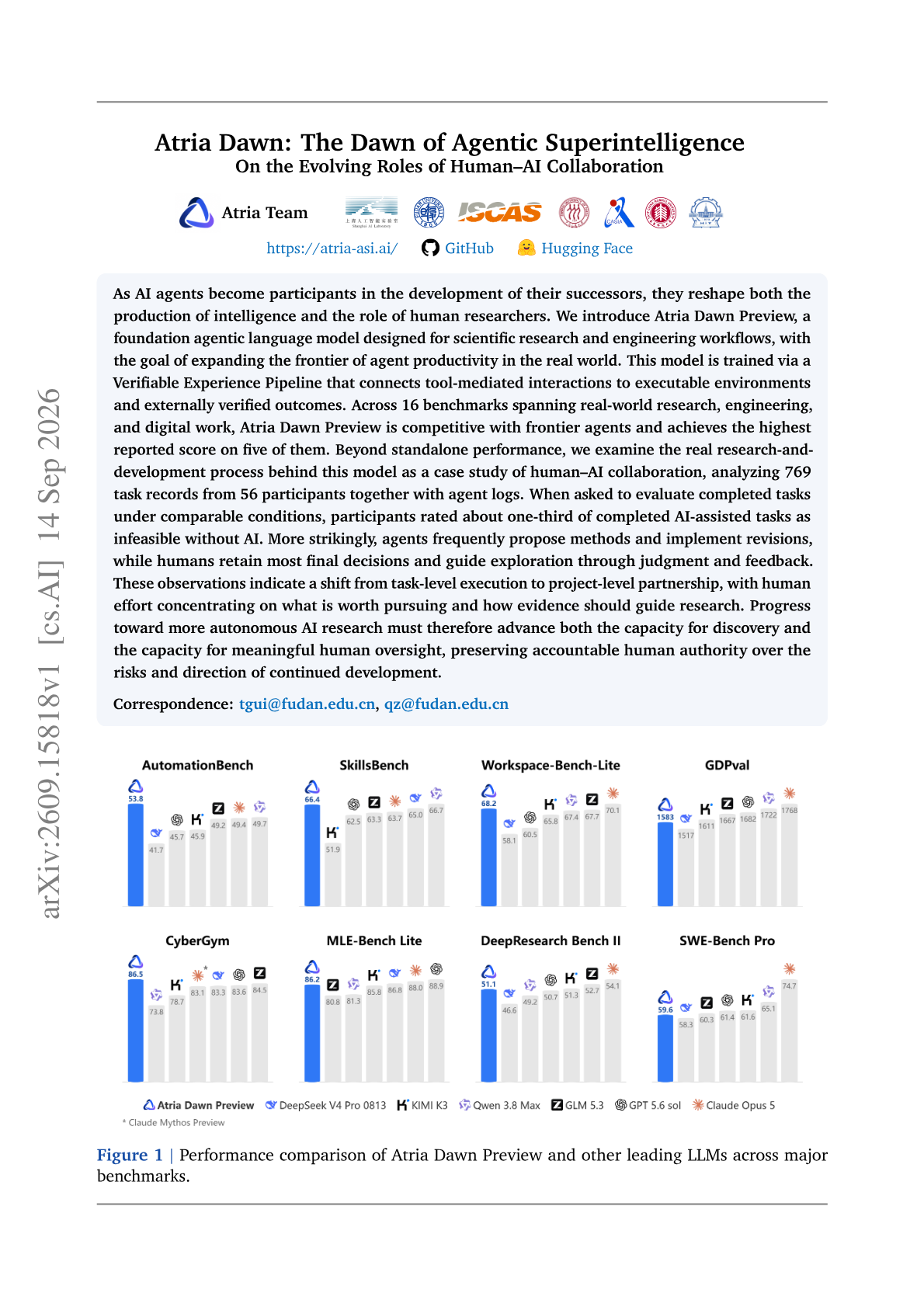
Atria Dawn: The Dawn of Agentic Superintelligence
The Atria Team, a consortium whose paper carries the logos of Shanghai AI Laboratory, Fudan University, Renmin University and several Chinese Academy of Sciences institutes, releases Atria Dawn Preview, an agentic model for research and engineering work built on a 744B-parameter mixture-of-experts base, and reports how humans and agents divided the work while the model was being developed.
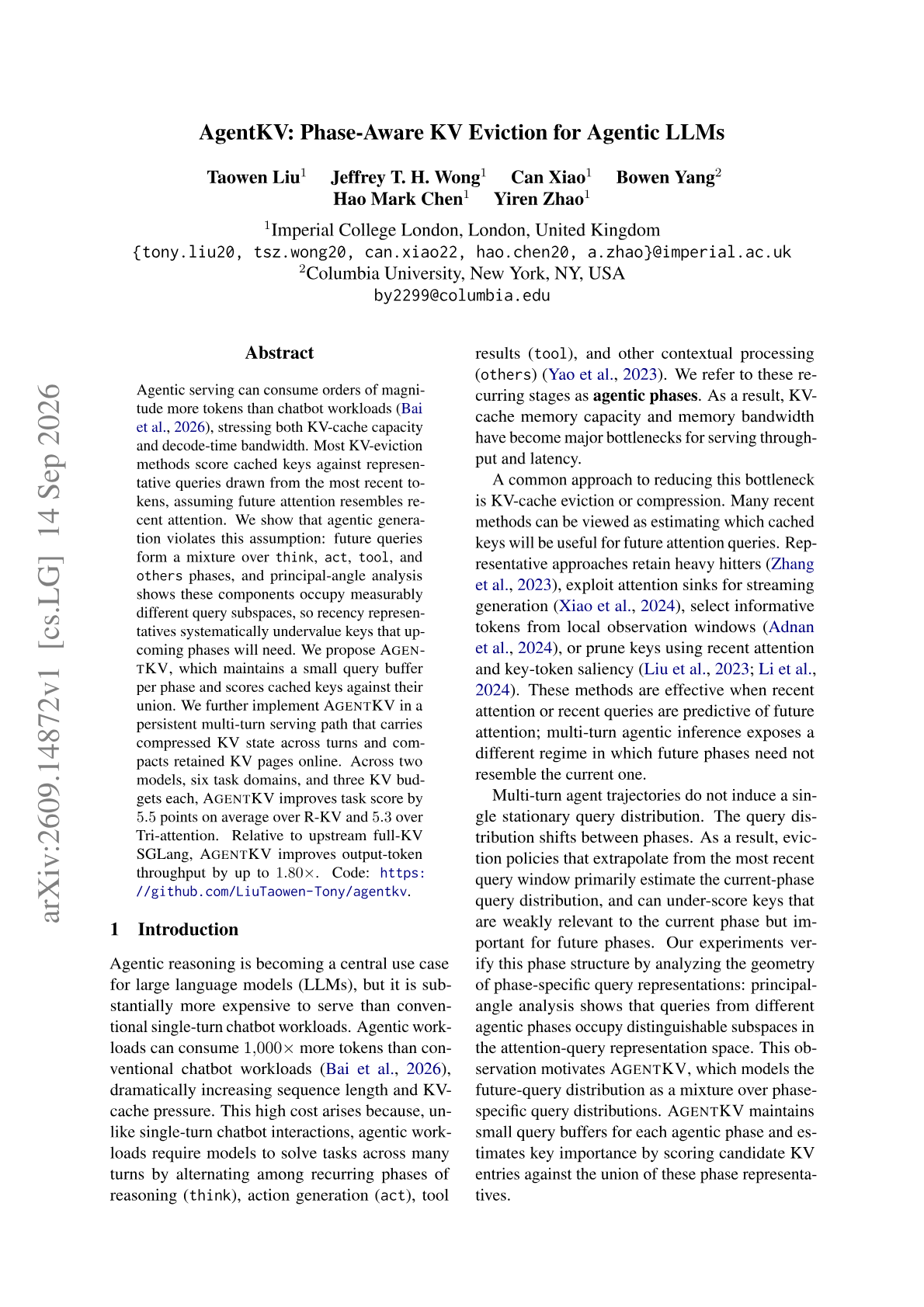
AgentKV: Phase-Aware KV Eviction for Agentic LLMs
Taowen Tony Liu and colleagues at Imperial College London show that KV-cache eviction methods built for chat fail on agentic workloads because future queries come from distinct think, act and tool phases, and propose AgentKV, which scores cached keys against a small query buffer for each phase.
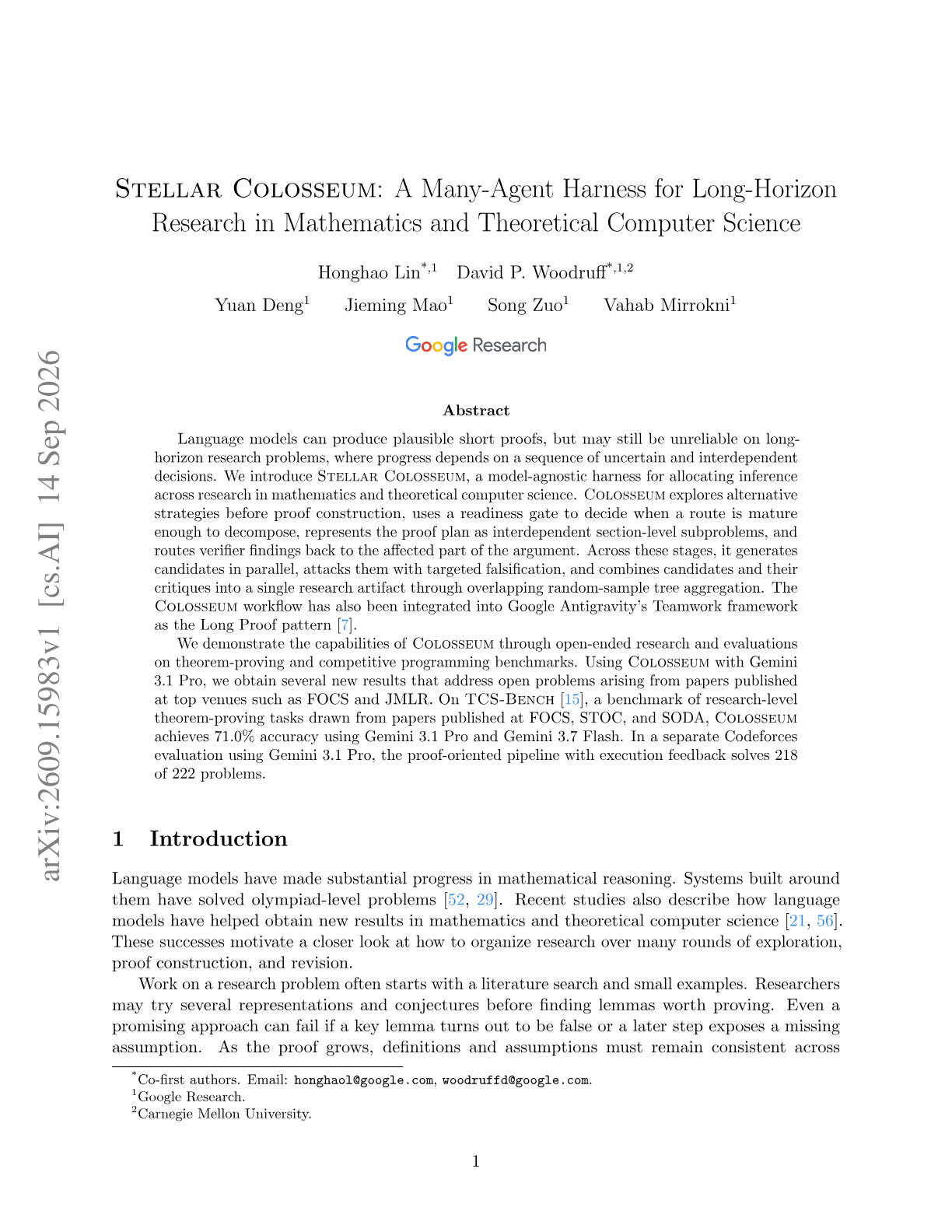
Stellar Colosseum: A Many-Agent Harness for Long-Horizon Research in Mathematics and Theoretical Computer Science
Long mathematical proofs break the usual agent loop, since a single wrong step early on invalidates everything after it. Google Research built a many-agent harness for this setting, and it produced new results on open problems from FOCS and JMLR papers.
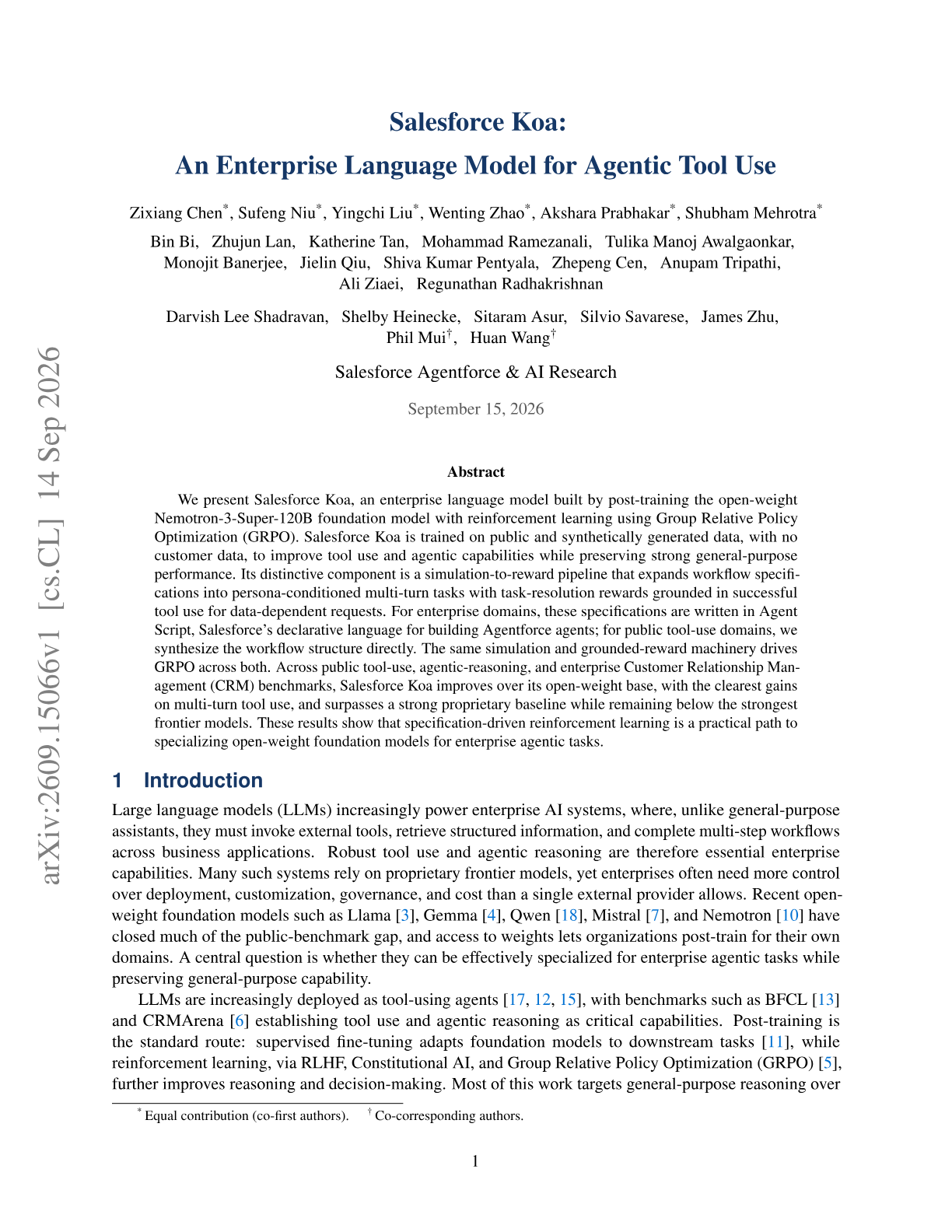
Salesforce Koa: An Enterprise Language Model for Agentic Tool Use
Custom enterprise models usually need a training set someone has to build. Salesforce trained Koa from artifacts it already had, namely the declarative files that configure its agents.
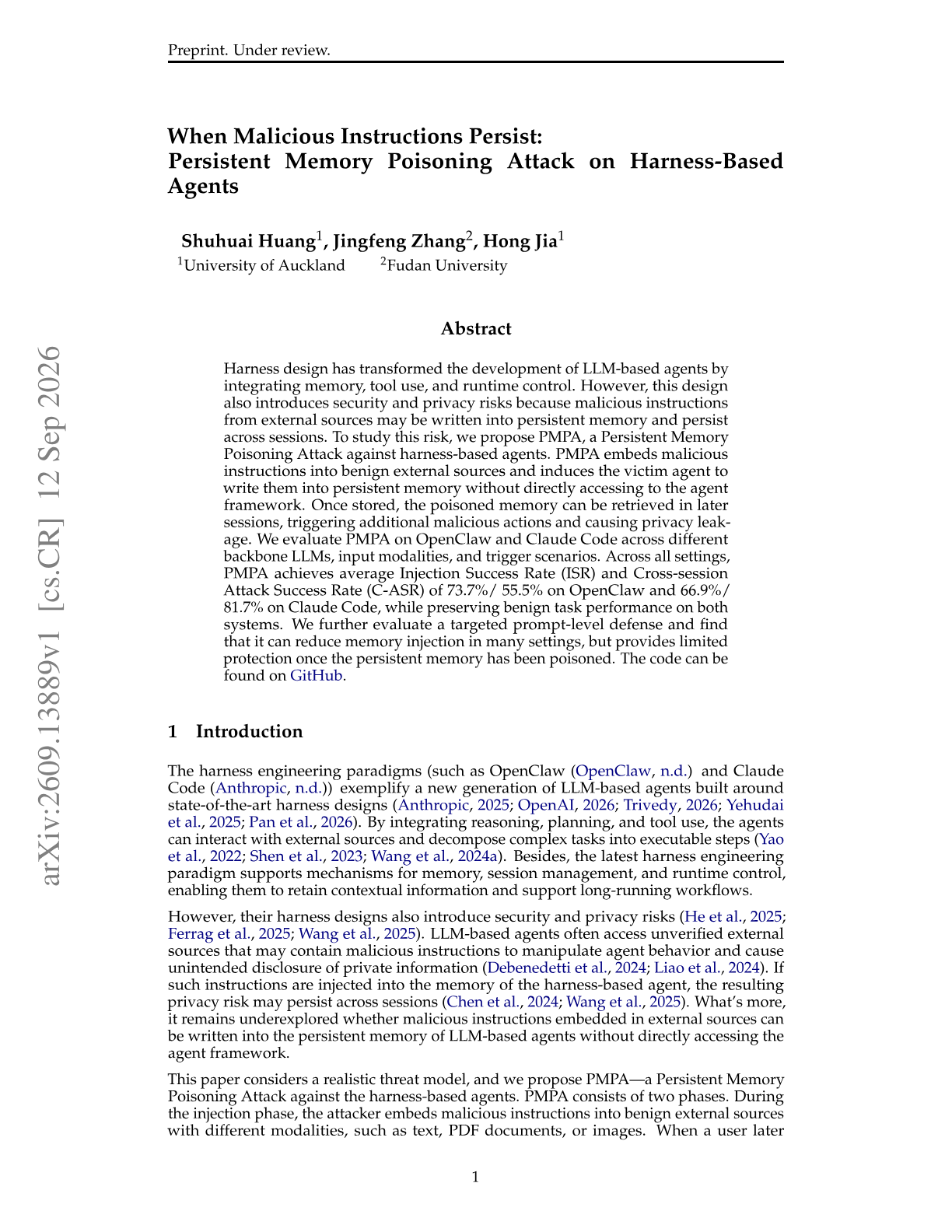
When Malicious Instructions Persist: Persistent Memory Poisoning Attack on Harness-Based Agents
Shuhuai Huang, Jingfeng Zhang and Hong Jia (University of Auckland and Fudan University) present PMPA, an attack that hides instructions in ordinary external content so that a harness-based agent writes them into its own persistent memory, where they trigger malicious actions and privacy leaks in later sessions.