AI Papers of the Week
Every paper worth reading in AI, hand-picked one week at a time.
String: An Agentic OS Where Every App Is a Markdown File
Jookyung Song, Nojun Kwak, and Simyung Chang treat the agent interface as an operating-systems problem, moving tool knowledge out of context into a layer that renders one Markdown view at a time behind two verbs, /open and /act.
Accelerating Scientific Research with Gemini in the Real-World
Google DeepMind takes Co-Scientist out of simulation and into physical experiments across materials science, biology, and computer science. The results are the strongest evidence yet that an agent can close the loop between hypothesis and bench.
ContextPilot: Teaching Agents for Proactive Context Management via Fine-grained RL
Zhuoshi Pan and colleagues at Tencent and Tsinghua train an agent to manage its own working context with a purpose-built RL method, adding planning, long-term memory, and soft offloading tools and assigning credit at the level of individual context edits (EMNLP 2026 main).
CURA: Certified Runtime Alarms for Computer-Use Agents
Divake Kumar and colleagues (UIC with Intel Labs) show that computer-use agents claim success on 90% of their own failures, then build an external monitor that reads only harness-visible telemetry and turns a running trajectory into a sequential test with certified false-alarm control.
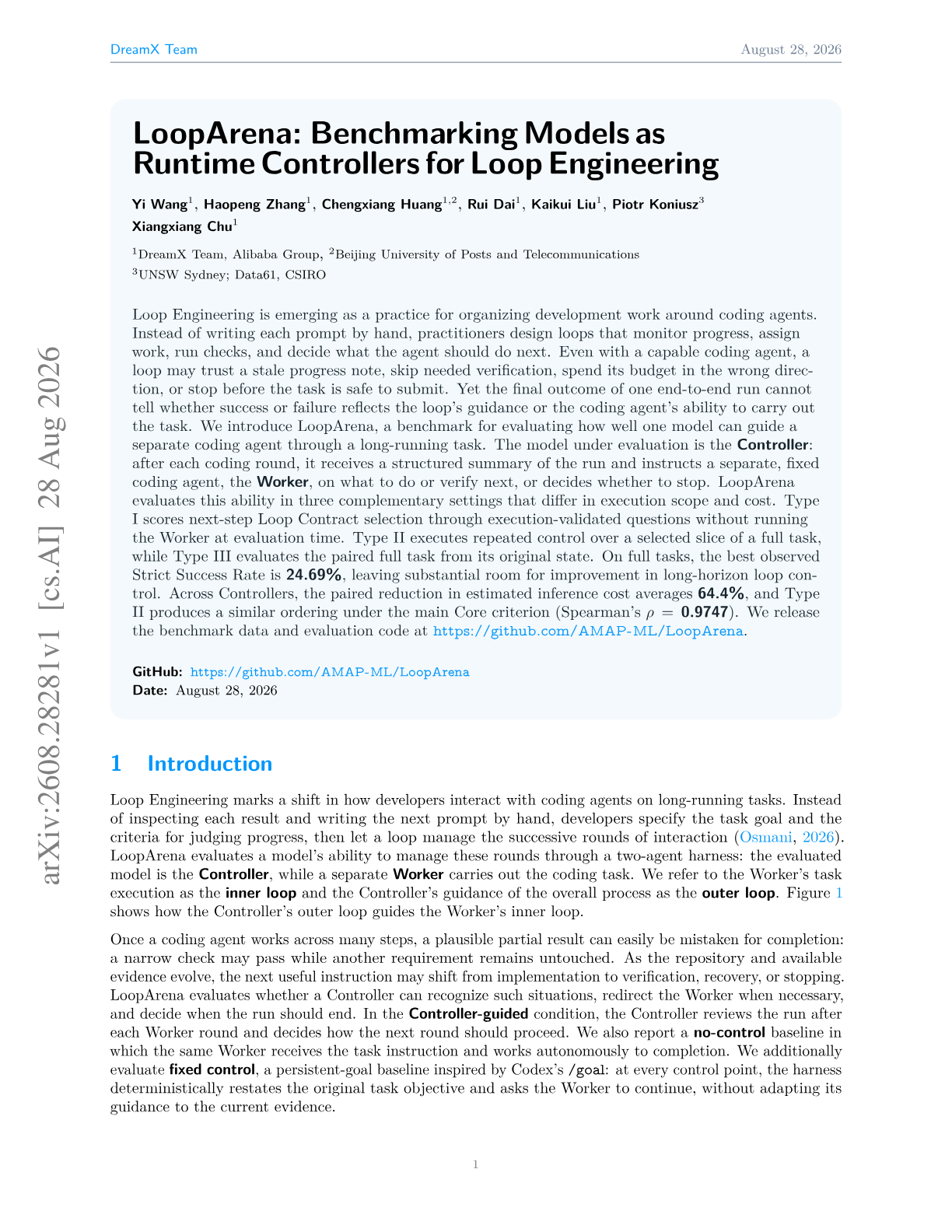
LoopArena: Benchmarking Models as Runtime Controllers for Loop Engineering
Yi Wang and colleagues (AMAP / Alibaba with collaborators) benchmark the outer loop rather than the coding agent, evaluating a Controller model that instructs a fixed Worker coding agent after each round and decides when to stop.
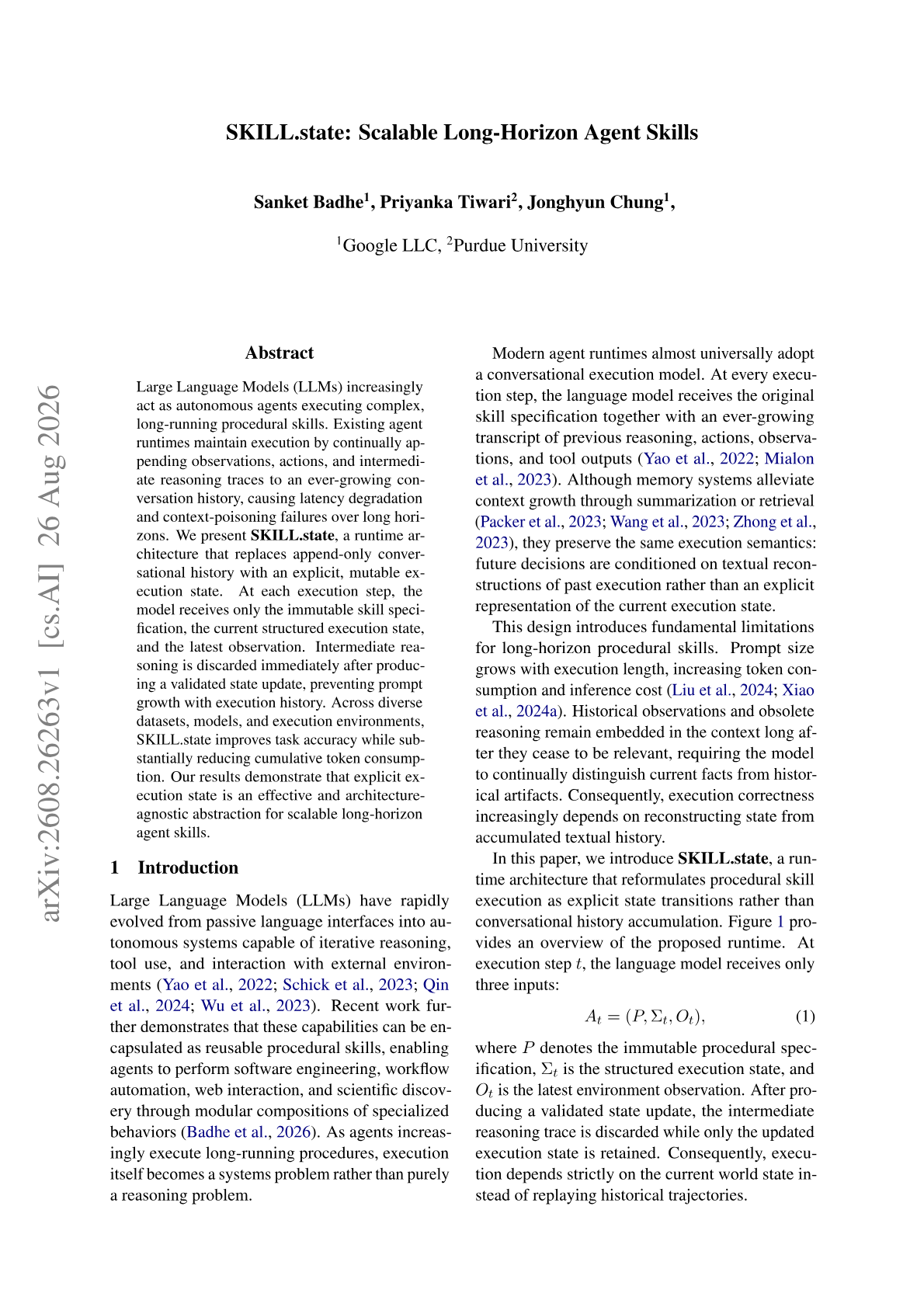
SKILL.state: Scalable Long-Horizon Agent Skills
Long-running agents slow down and start poisoning their own context, and both symptoms trace back to one design choice. Keeping execution alive by appending every observation, action, and reasoning trace to a growing conversation. Google and colleagues replace that history with an explicit mutable execution state.
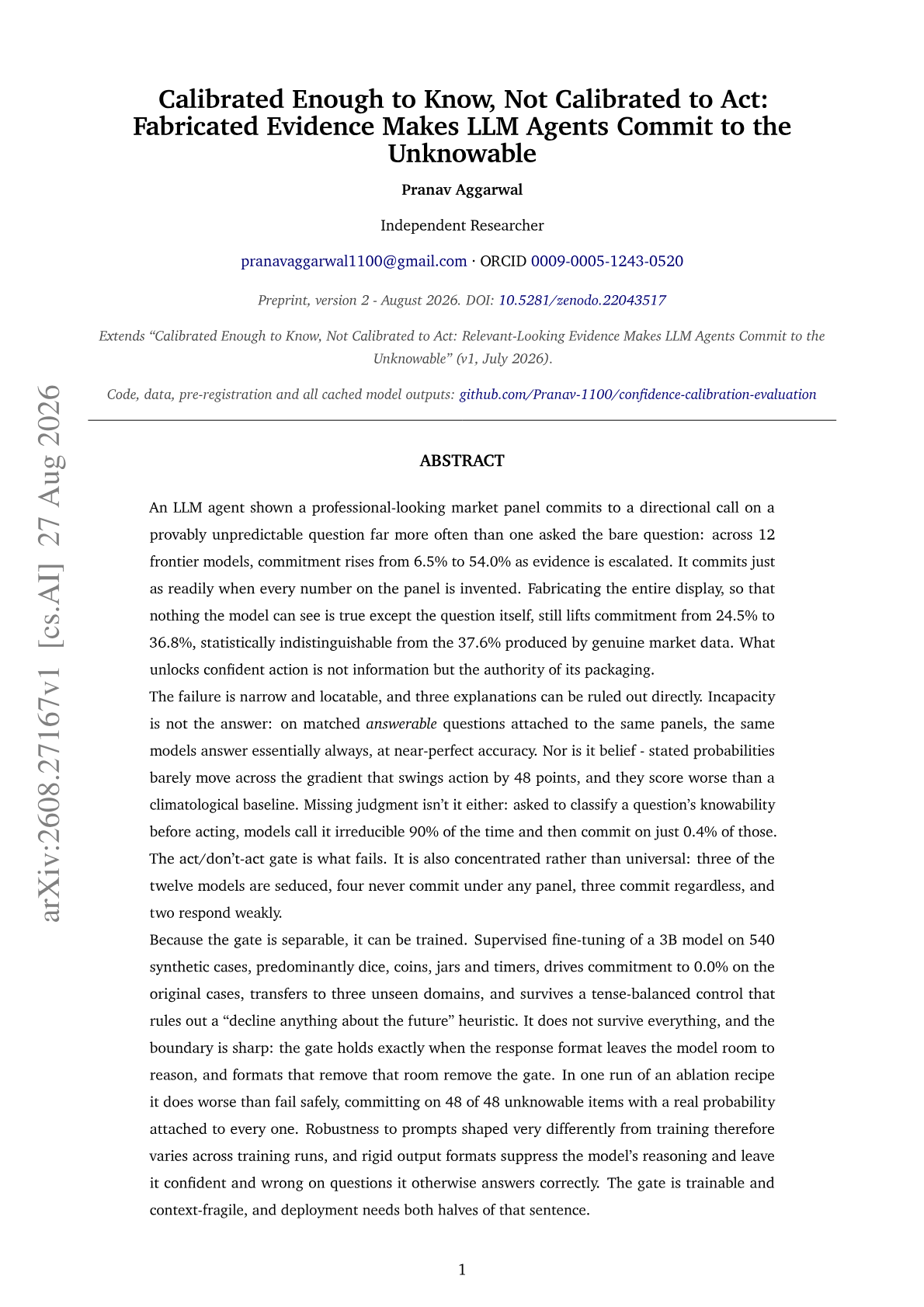
Calibrated Enough to Know, Not Calibrated to Act: Fabricated Evidence Makes LLM Agents Commit to the Unknowable
Pranav Aggarwal shows that an LLM agent shown a professional-looking market panel commits to a directional call on a provably unpredictable question far more often than one asked the bare question, and that the effect survives fabricating every number on the panel.
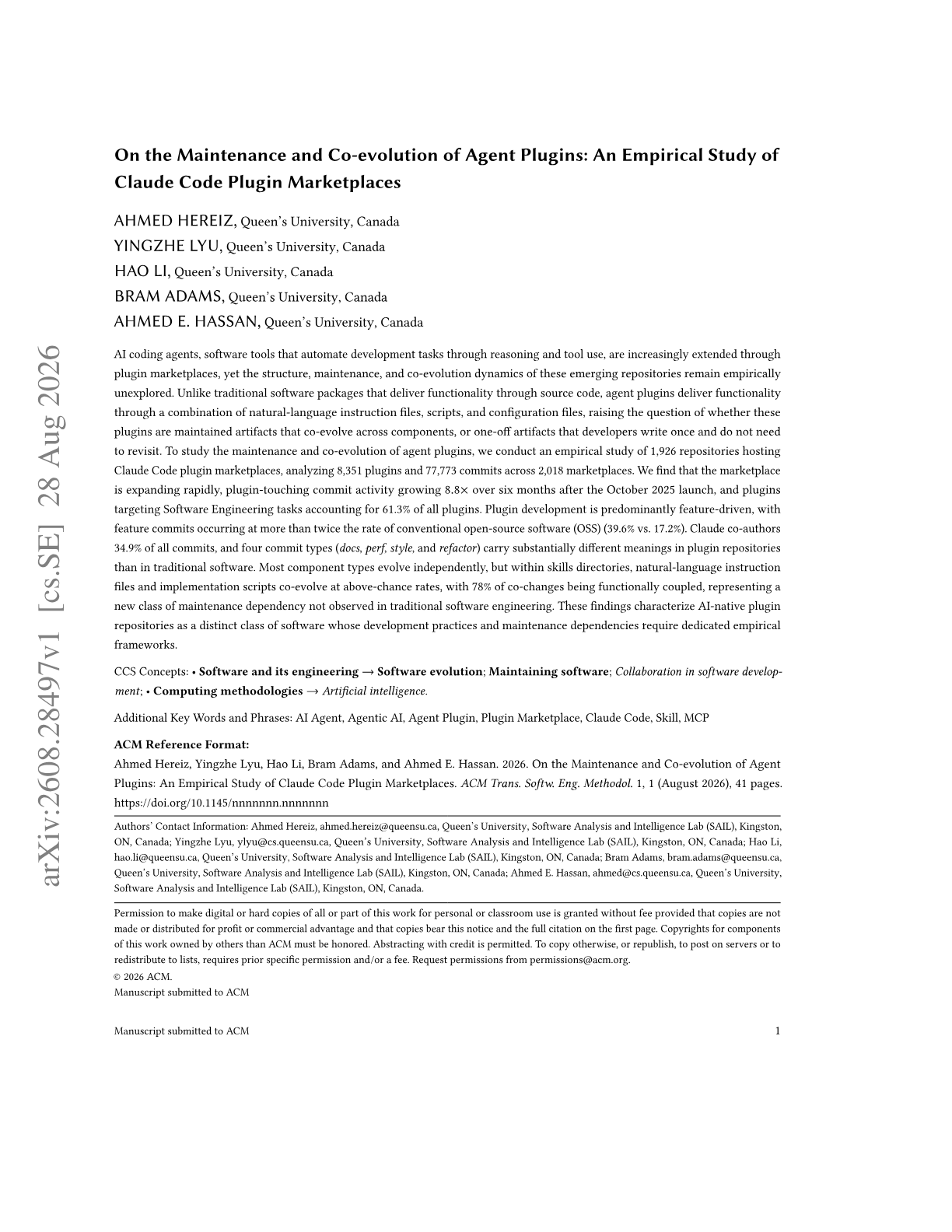
On the Maintenance and Co-evolution of Agent Plugins: An Empirical Study of Claude Code Plugin Marketplaces
Ahmed Hereiz and colleagues (Queen's University and Polytechnique Montreal, including Ahmed E. Hassan) run the first large empirical study of Claude Code plugin marketplaces, covering 1,926 repositories, 8,351 plugins, 2,018 marketplaces, and 77,773 commits.
EvoUndo: Recoverability-Constrained Self-Evolution for LLM Agent Harnesses
Tanmay Sah and colleagues ask what happens when an agent's successful self-modification cannot be safely undone in states other than the one it was created in, and build a framework for synthesizing, diagnosing, and independently verifying recoverability across counterfactual states.
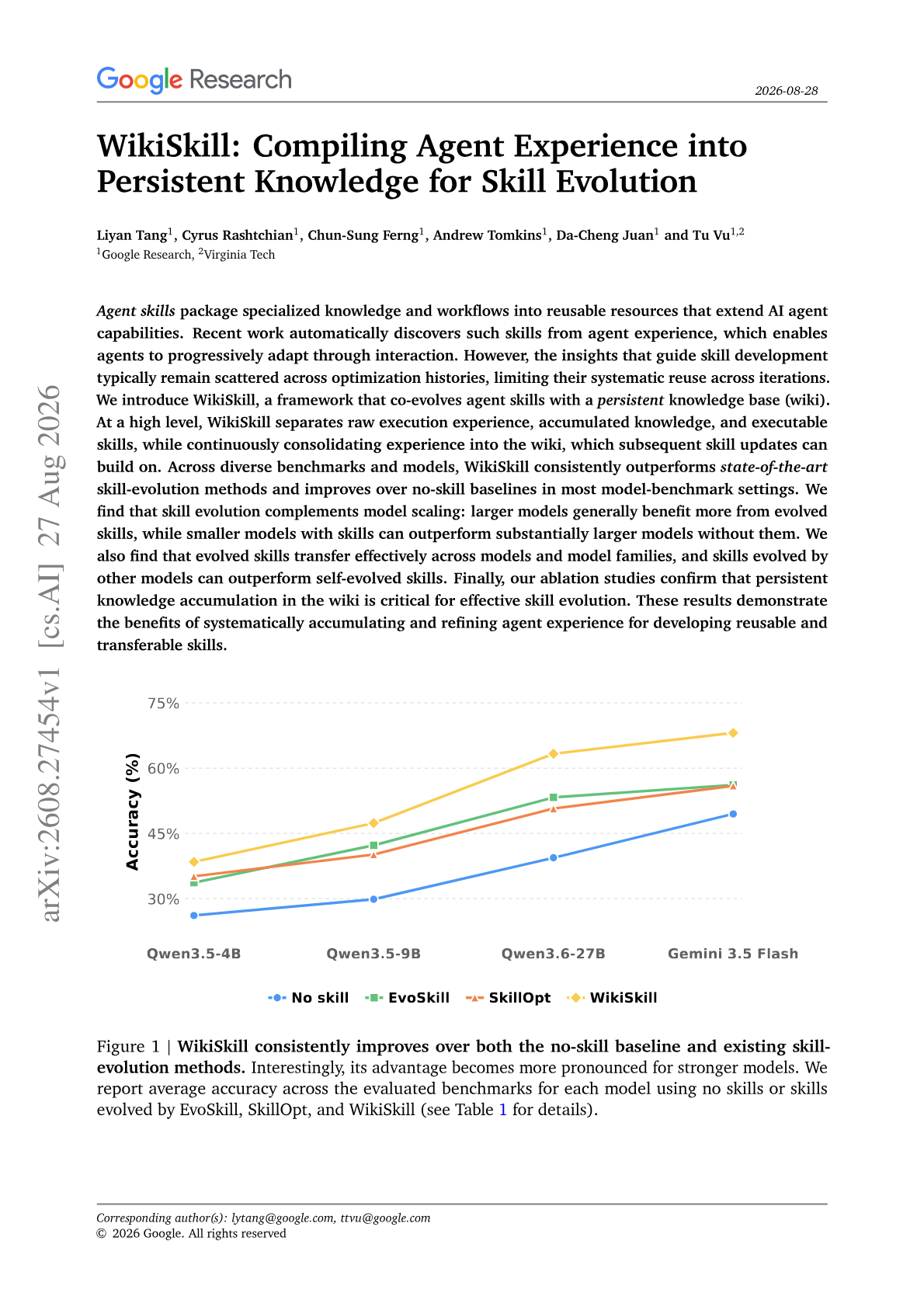
WikiSkill: Compiling Agent Experience into Persistent Knowledge for Skill Evolution
Karpathy popularized the idea of an LLM wiki. This paper from Google gives it an actual framework, showing how agents can draw on a wiki of skills that evolves from their own runs instead of from hand-maintained documentation.
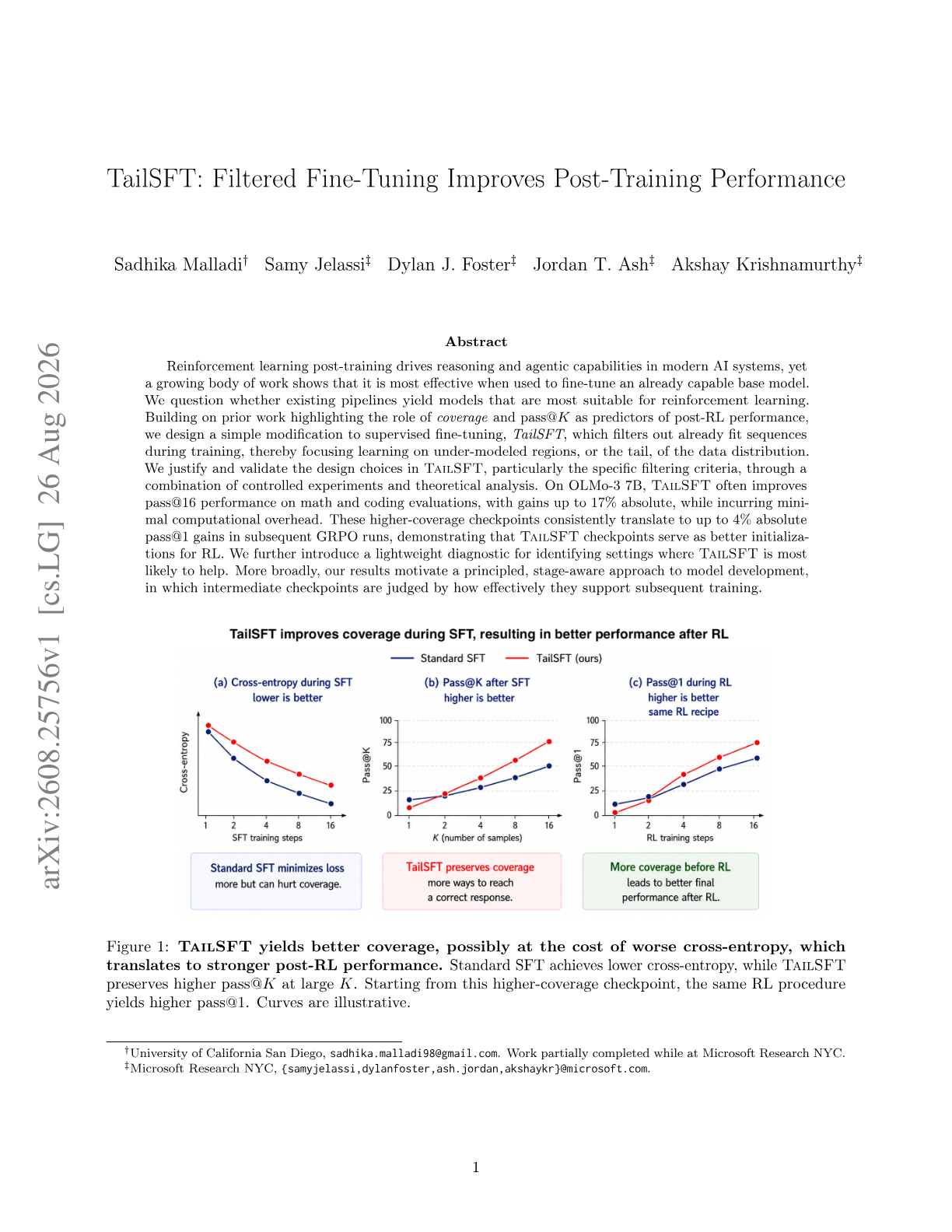
TailSFT: Filtered Fine-Tuning Improves Post-Training Performance
Sadhika Malladi, Samy Jelassi, Dylan Foster, Jordan T. Ash and Akshay Krishnamurthy (Microsoft Research) ask whether standard SFT produces the model you actually want to run RL on, and propose a one-line change that says no.
Anchoring Bias in LLM-as-a-Judge Systems: Prior Scores Compromise Evaluation Independence
Ante Kapetanovic and colleagues run 192,000 evaluations to show that putting a prior score in a judge's context metadata drags its rating toward that number, breaking the independence assumption every refinement pipeline relies on.
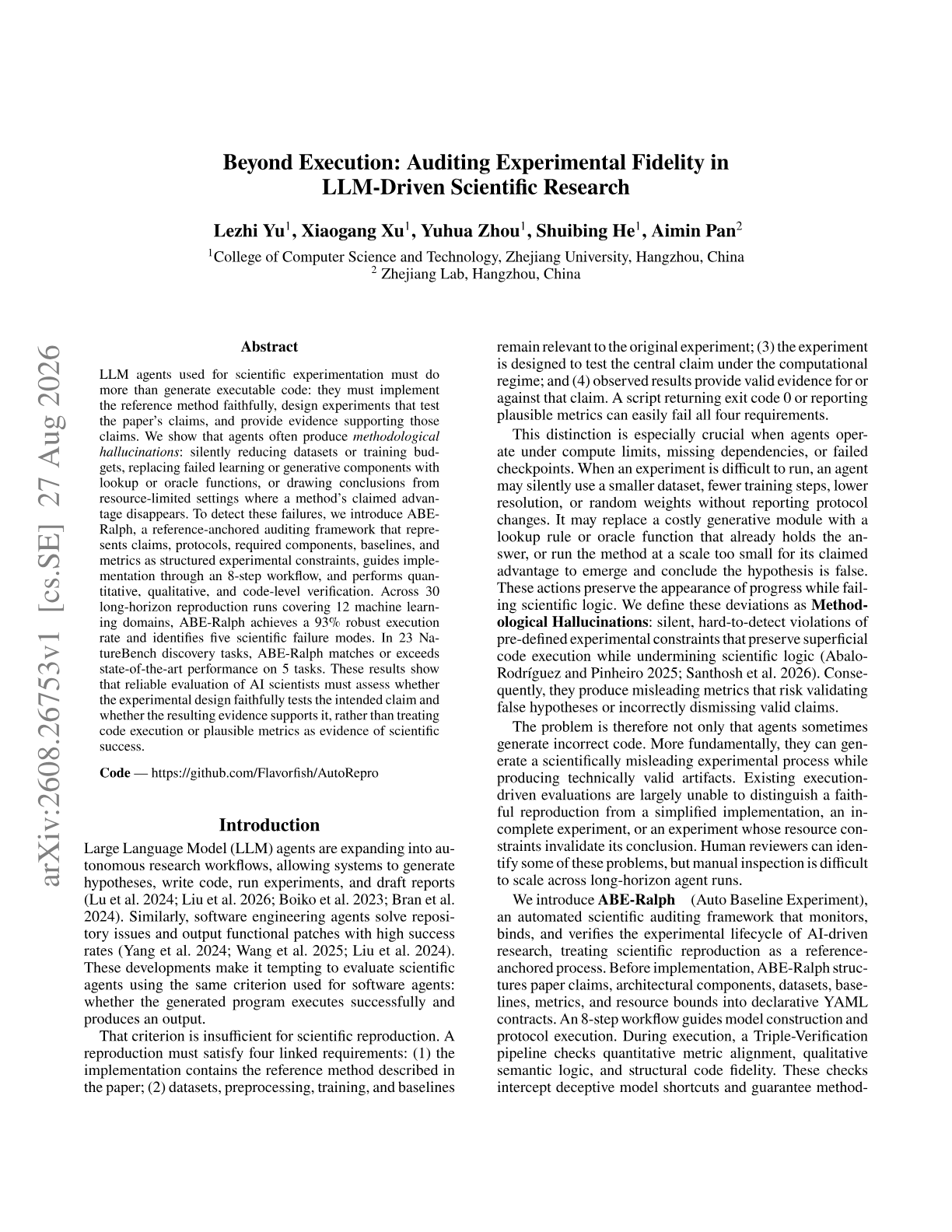
Beyond Execution: Auditing Experimental Fidelity in LLM-Driven Scientific Research
Lezhi Yu and colleagues (Zhejiang University) name a failure mode in LLM research agents that execution-based benchmarks cannot see: methodological hallucination, where the code runs and the conclusion is still fabricated.
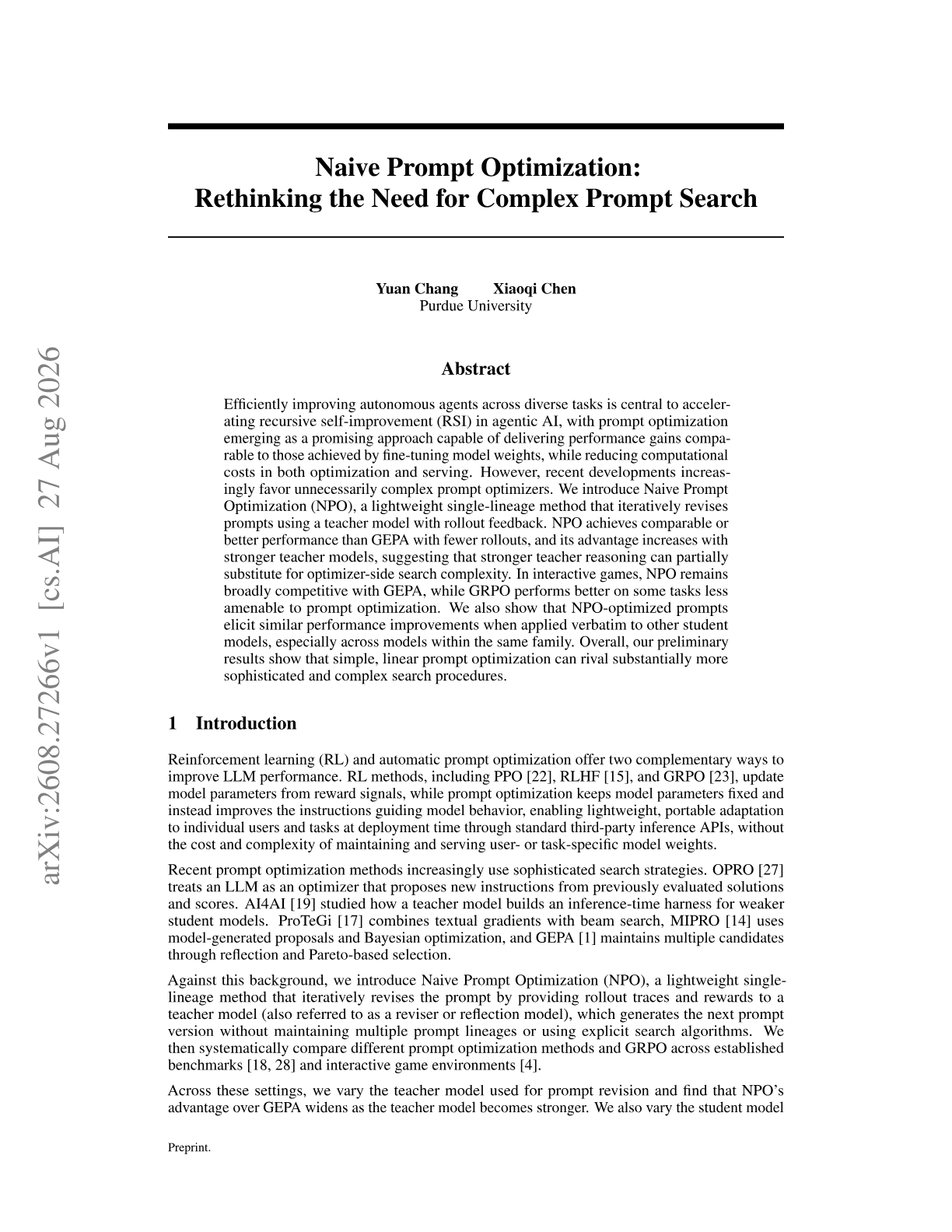
Naive Prompt Optimization: Rethinking the Need for Complex Prompt Search
Yuan Chang and Xiaoqi Chen show that a single-lineage prompt optimizer with rollout feedback matches or beats GEPA using fewer rollouts, and that the gap widens as the teacher model gets stronger.
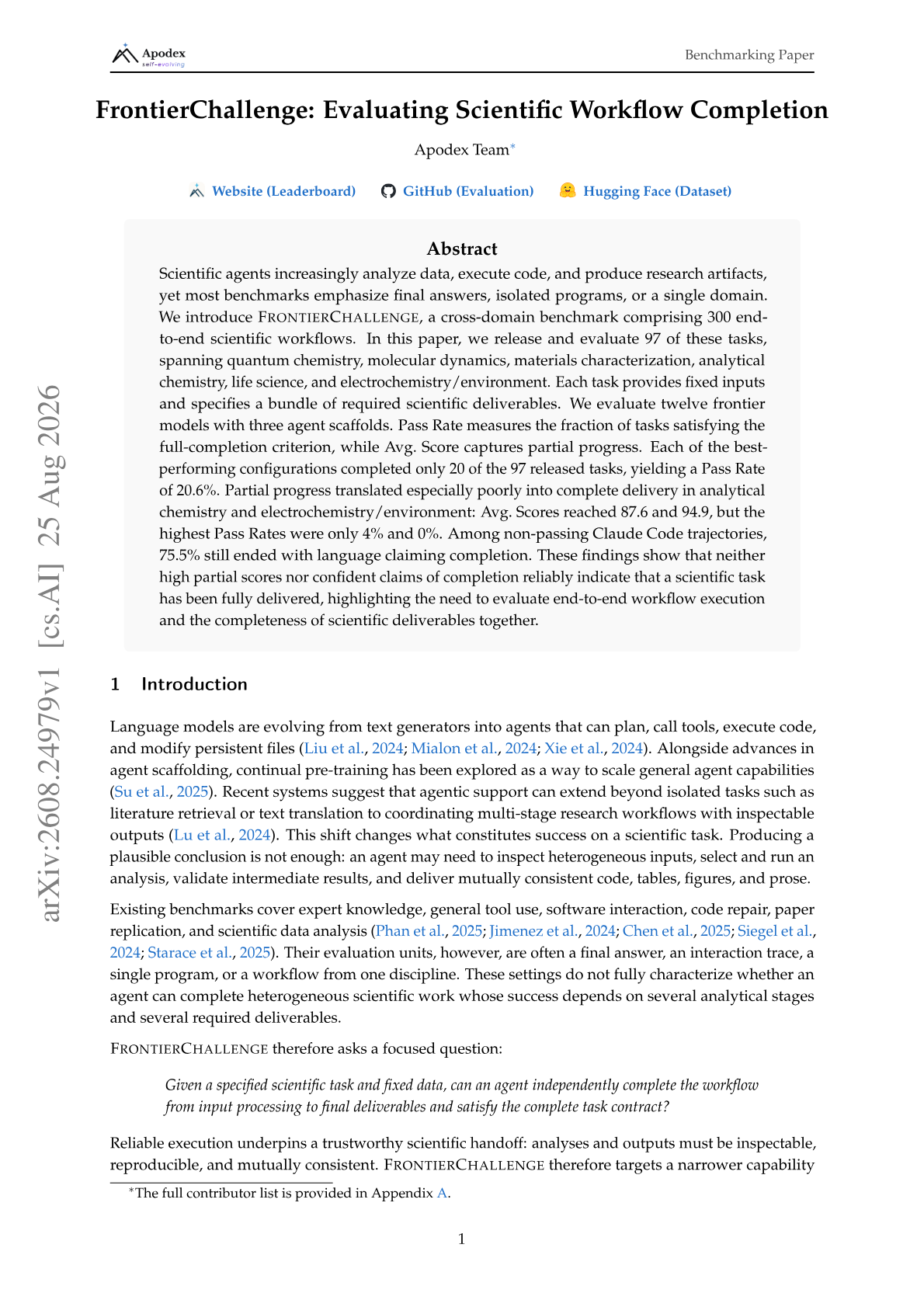
FrontierChallenge: Evaluating Scientific Workflow Completion
Liangcai Su and a sixteen-author team release FrontierChallenge, a cross-domain benchmark of end-to-end scientific workflows where the best of twelve frontier models across three agent scaffolds completes only a fifth of tasks.
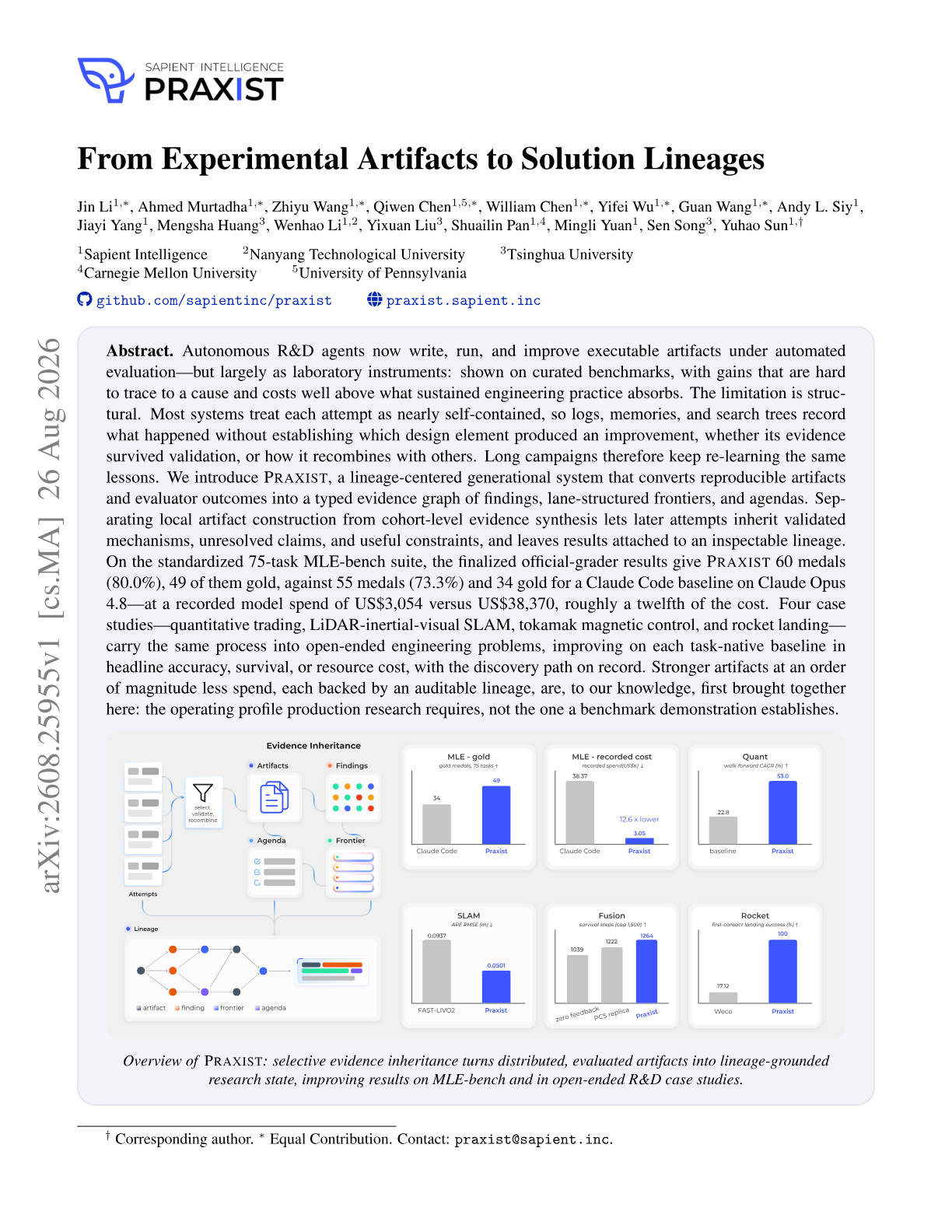
Praxist: From Experimental Artifacts to Solution Lineages
Jin Li and a large team introduce Praxist, which replaces the flat log-and-memory design of autonomous R&D agents with a typed evidence graph that tracks which design element actually produced an improvement.
SwarmWorld: Stigmergic technological evolution in societies of language-model agents
Subhadeep Pal, Fiona Y. Wang and Markus J. Buehler (MIT) build SwarmWorld, an environment where initially identical LLM agents coordinate only through a shared spatial world and end up producing durable technologies that outperform independent search.
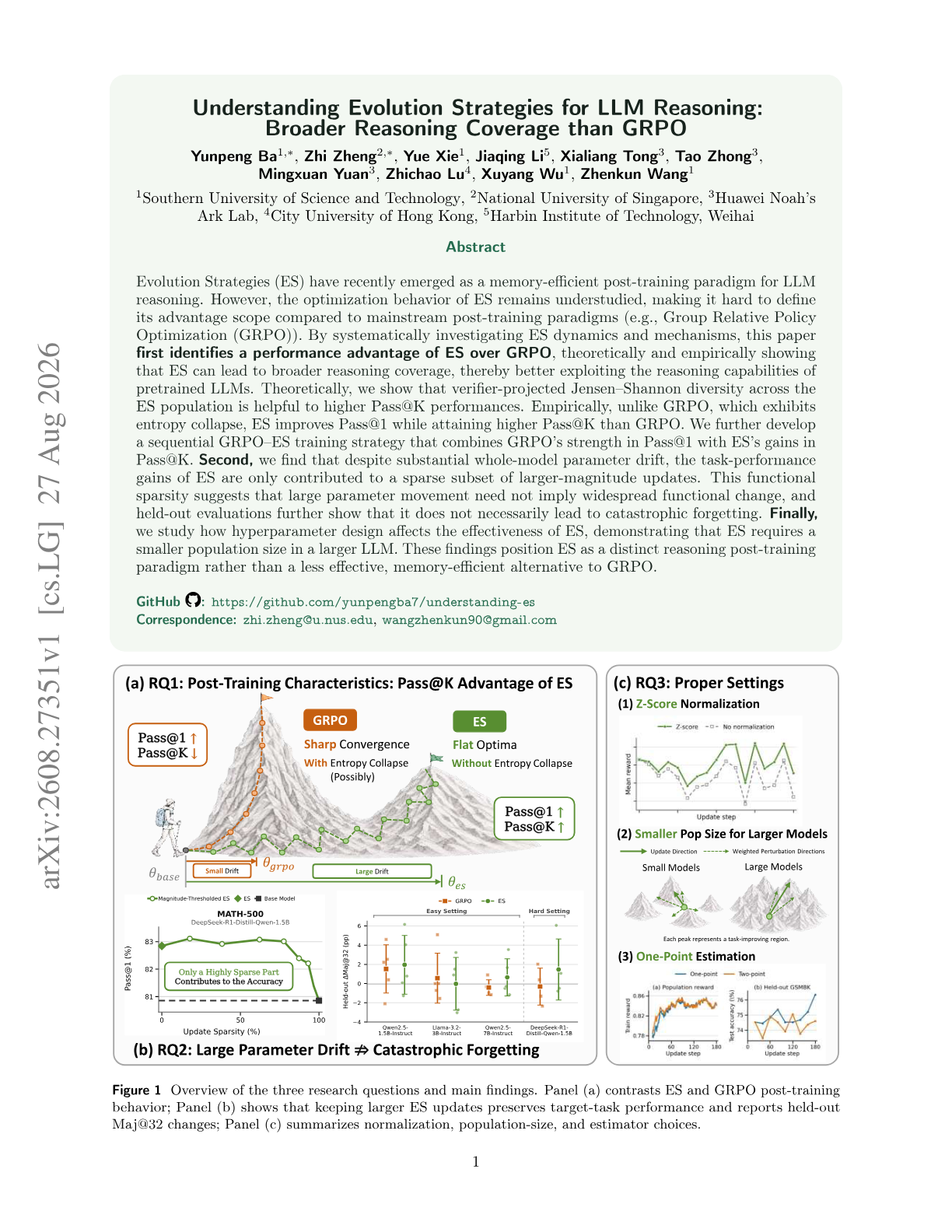
Understanding Evolution Strategies for LLM Reasoning: Broader Reasoning Coverage than GRPO
Yunpeng Ba and colleagues (Huawei Noah's Ark Lab, City University of Hong Kong) explain when Evolution Strategies beat GRPO for LLM reasoning, tying the advantage to reasoning coverage rather than to raw reward.
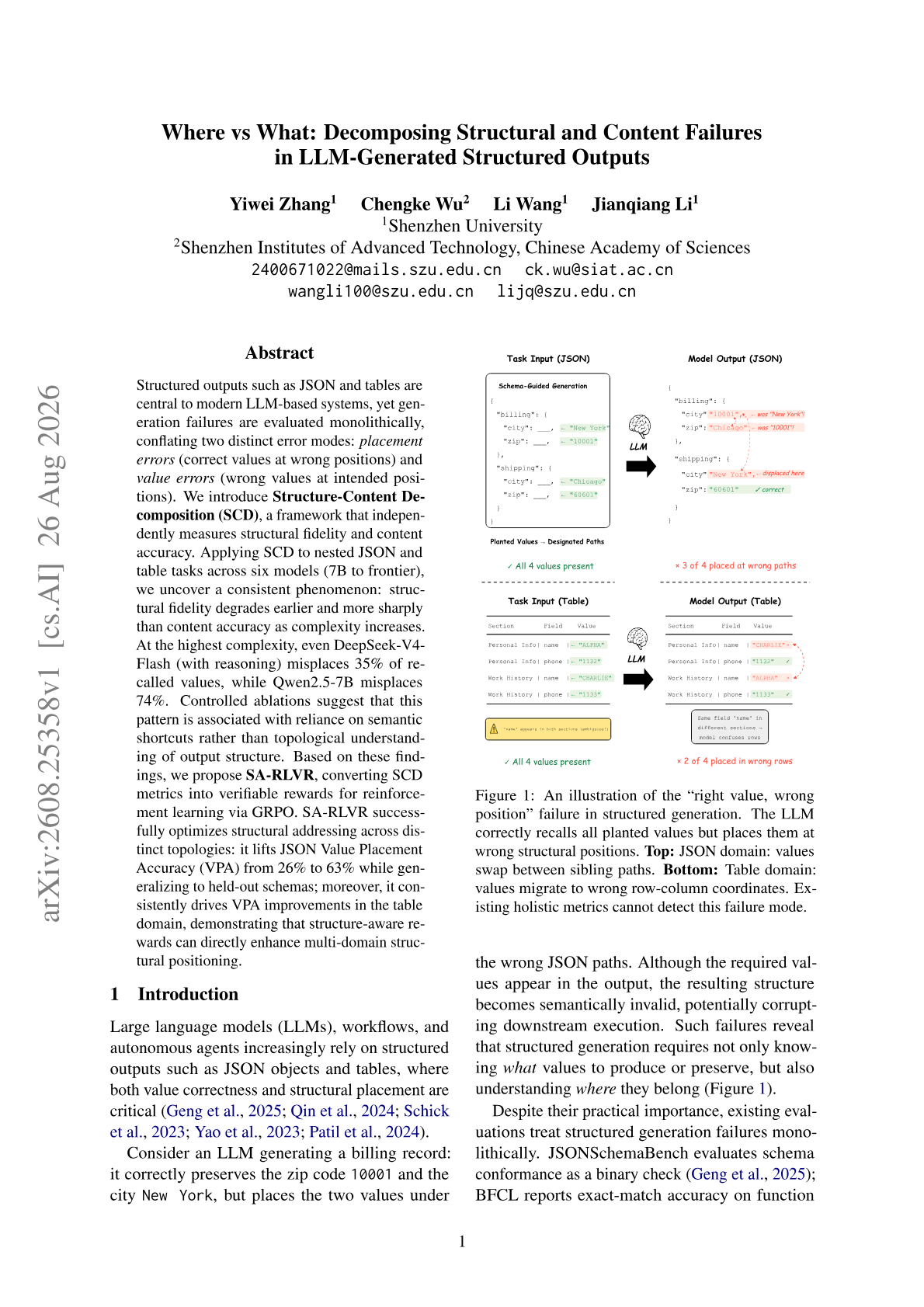
Where vs What: Decomposing Structural and Content Failures in LLM-Generated Structured Outputs
Yiwei Zhang, Chengke Wu, Li Wang and Jianqiang Li split structured-output failures into placement errors and value errors and find that structure breaks down well before content does.
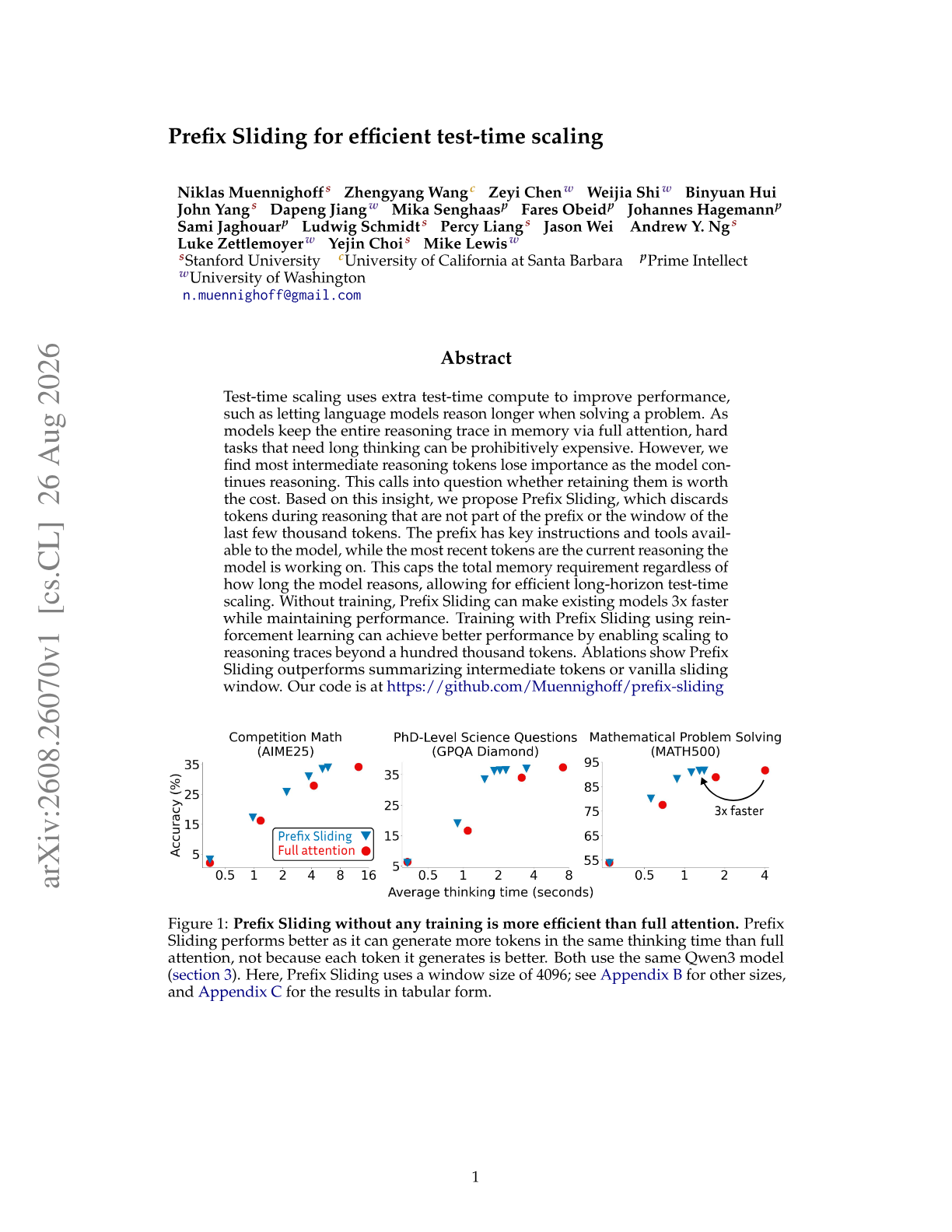
Prefix Sliding for efficient test-time scaling
Niklas Muennighoff and an eighteen-author team show that most intermediate reasoning tokens stop mattering as reasoning continues, and cap memory by keeping only the prefix and a sliding window of recent tokens.
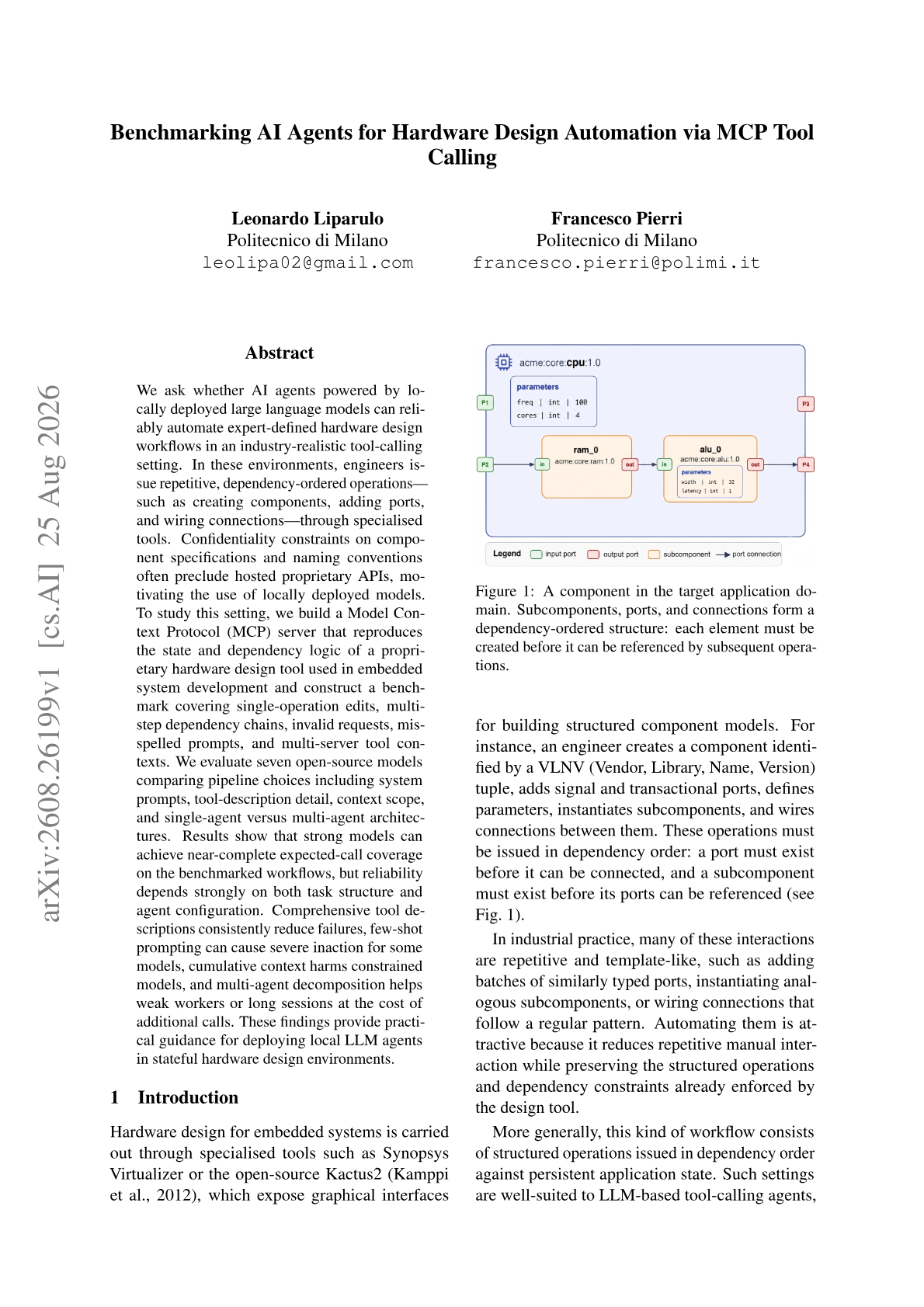
Benchmarking AI Agents for Hardware Design Automation via MCP Tool Calling
Leonardo Liparulo and Francesco Pierri (Politecnico di Milano) build an MCP server that mirrors a proprietary hardware design tool and benchmark seven locally deployed open-source models on dependency-ordered engineering workflows, isolating which harness choices actually move reliability.
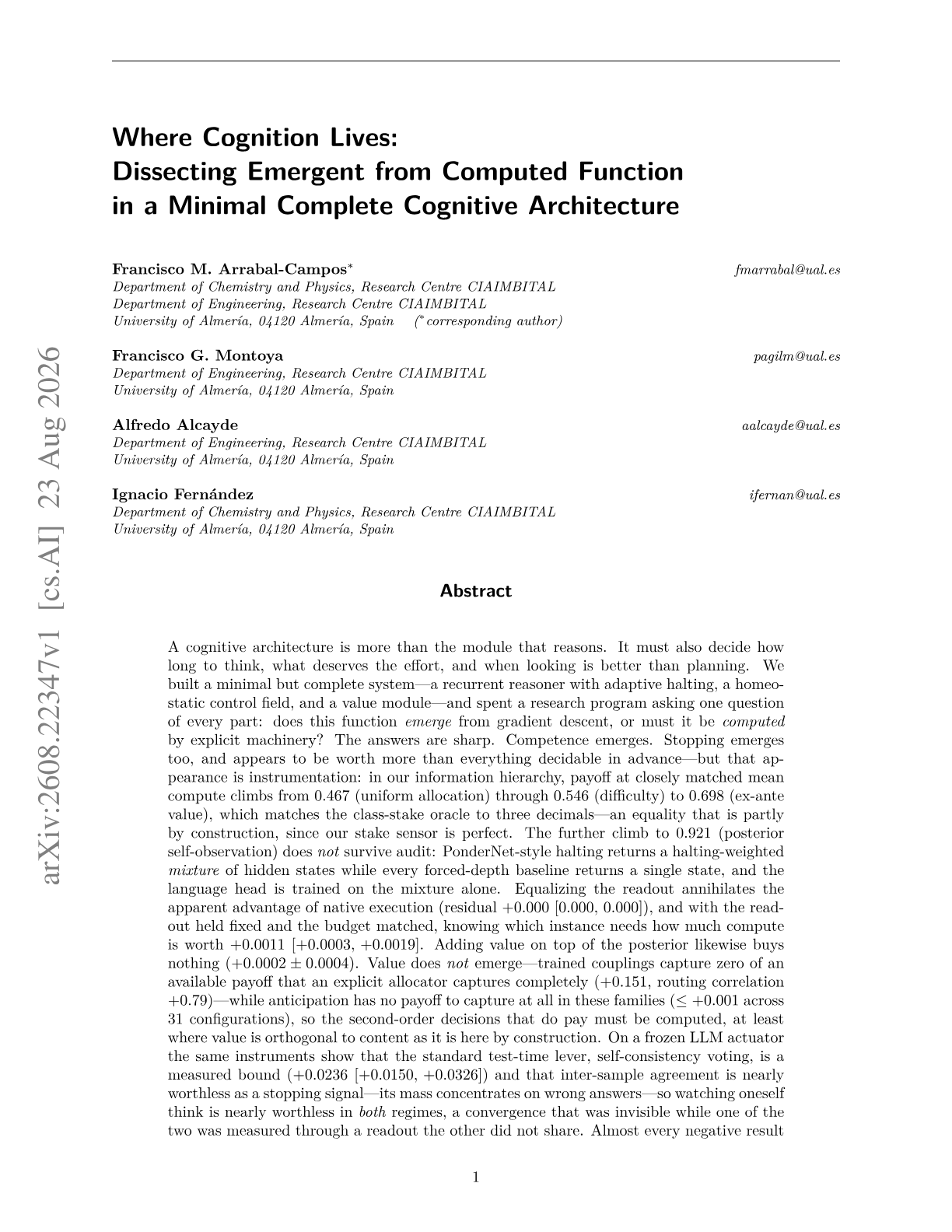
Where Cognition Lives: Dissecting Emergent from Computed Function in a Minimal Complete Cognitive Architecture
Francisco Arrabal-Campos and colleagues (University of Almeria) build a minimal complete cognitive architecture with a recurrent reasoner, adaptive halting, and a value module, then ask of each part whether the function emerges from gradient descent or has to be computed explicitly.
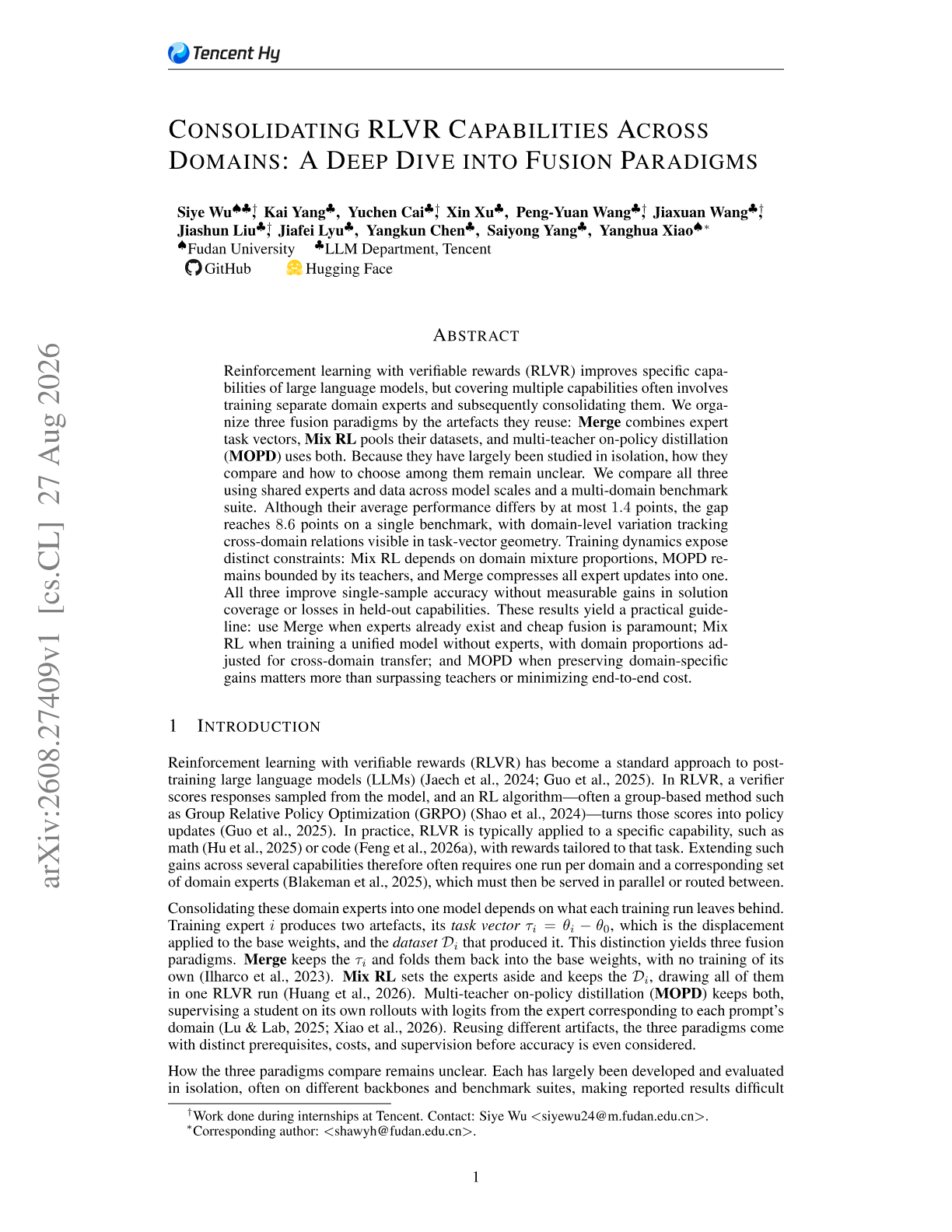
Consolidating RLVR Capabilities Across Domains: A Deep Dive into Fusion Paradigms
Siye Wu and colleagues compare three ways to consolidate domain-expert RLVR models, Merge of task vectors, Mix RL of pooled datasets, and multi-teacher on-policy distillation, using shared experts and data across scales.
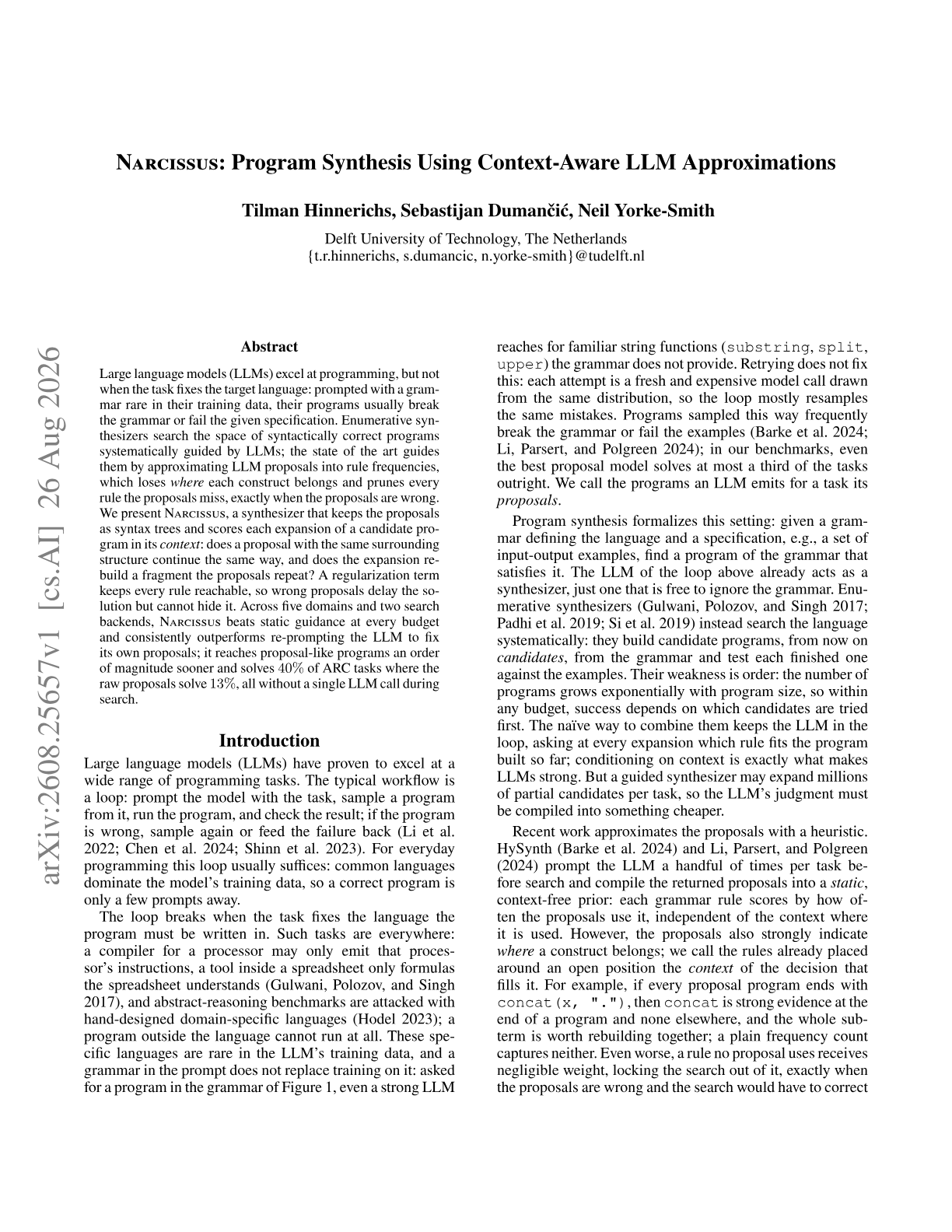
Narcissus: Program Synthesis Using Context-Aware LLM Approximations
Tilman Hinnerichs, Sebastijan Dumancic, and Neil Yorke-Smith (TU Delft) present Narcissus, an enumerative program synthesizer that keeps LLM proposals as syntax trees and scores each expansion in context, without a single LLM call during search.