AI Papers of the Week
Every paper worth reading in AI, hand-picked one week at a time.
Trace as State: Reasoning Traces as Conditional States for Long-Context Transformers
Where you put a reasoning trace changes long-context accuracy by up to 50 points. Transformers process causally, so a task state discovered late cannot guide reading that already happened, and Trace as State puts the collected trace before the long-context block on a fresh pass instead of appending it after. On GraphWalks Parents, DeepSeek V4 Pro Preview goes from 29.2% on the initial pass and 43.0% with the matched append control to 81.8%, and GLM-5.2 goes from 66.4% and 83.2% to 100.0%. It wins in 26 of 27 reported combinations of model, task, and metric with no architecture change.
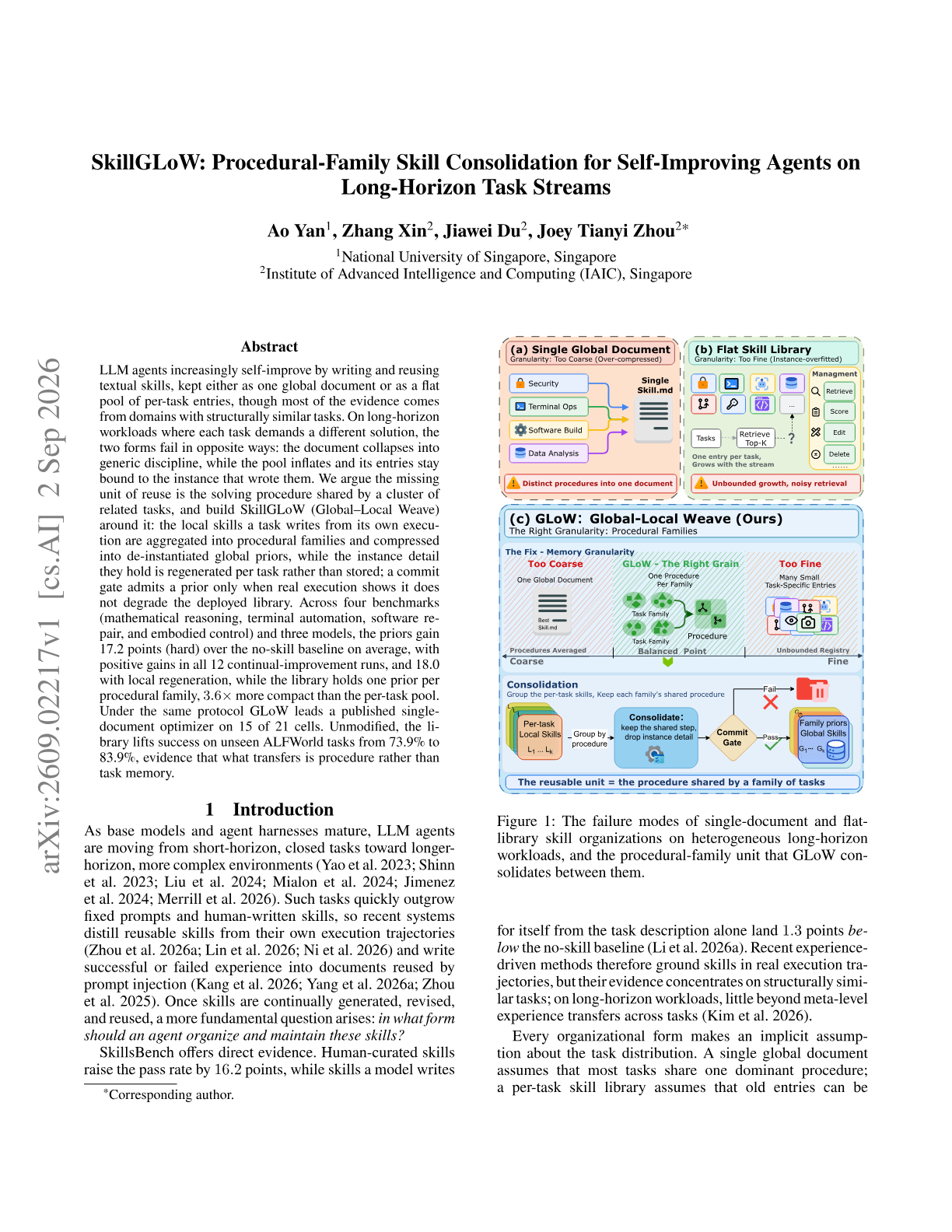
SkillGLoW: Procedural-Family Skill Consolidation for Self-Improving Agents on Long-Horizon Task Streams
Ao Yan, Xin Zhang, Jiawei Du and Joey Tianyi Zhou (A*STAR) introduce SkillGLoW, arguing that the right unit of reuse for a self-improving agent is neither one global playbook nor a flat per-task pool but the solving procedure shared by a family of related tasks.
Cliff: Learning Process Rewards from the First Mistake
Peixuan Han, Runhui Wang and colleagues at AWS propose Cliff, a reward shaping method that asks an off-the-shelf teacher LLM to find only the first mistake in a rollout, then converts that single index into dense token-level advantages.
AI agents reshape consensus formation in human groups
Lin Chen, Ziyi Liu, Xia Hu and Yong Li run a collaborative description game with mixed human and LLM-agent groups and find three distinct regimes of consensus formation as the agent proportion rises.
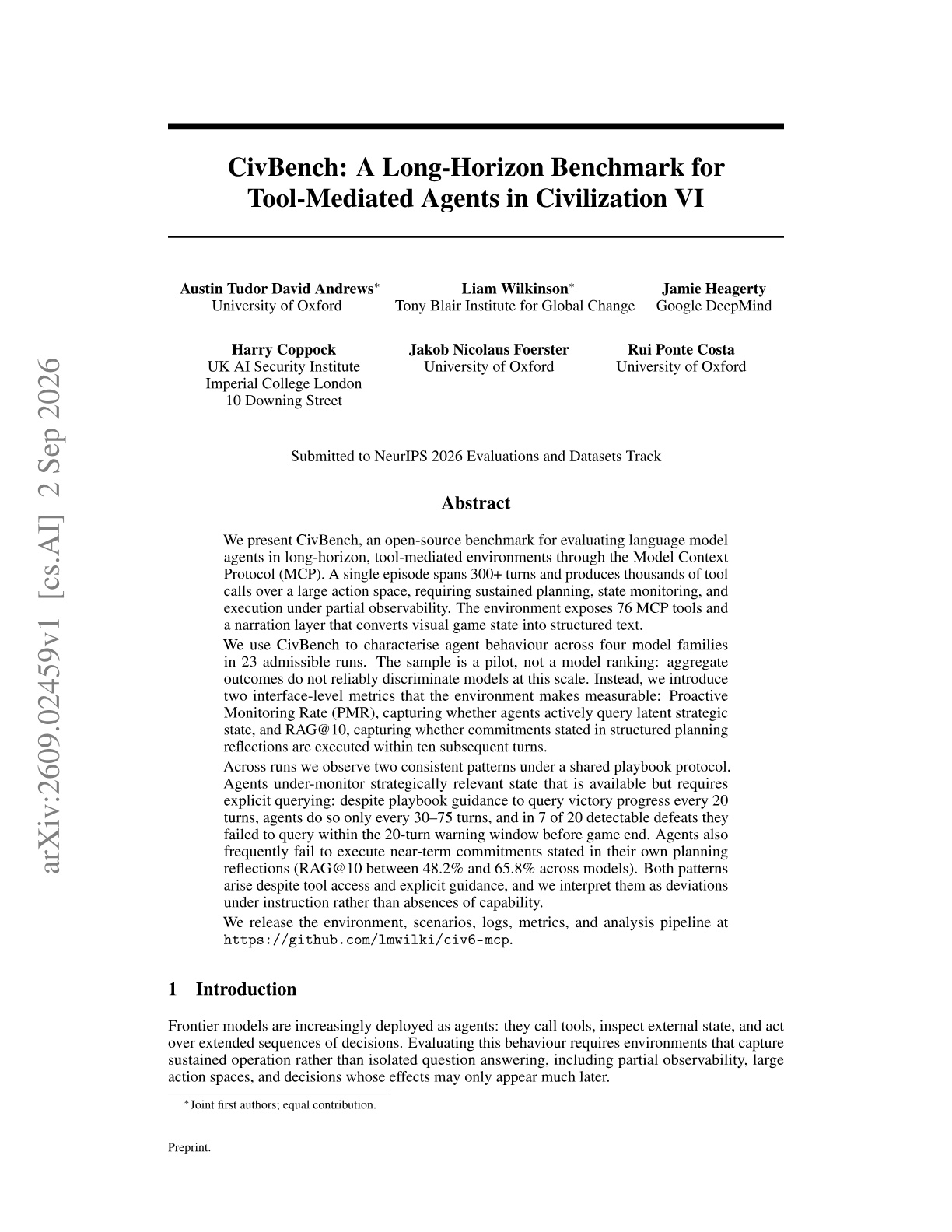
CivBench: A Long-Horizon Benchmark for Tool-Mediated Agents in Civilization VI
Austin Tudor David Andrews, Jakob Foerster, Rui Ponte Costa and colleagues (Oxford, Google DeepMind, UK AI Security Institute) release CivBench, an open-source benchmark that drives language agents through 300+ turn games of Civilization VI over 76 MCP tools, and report two behavioral failures that are more interesting than the scores.
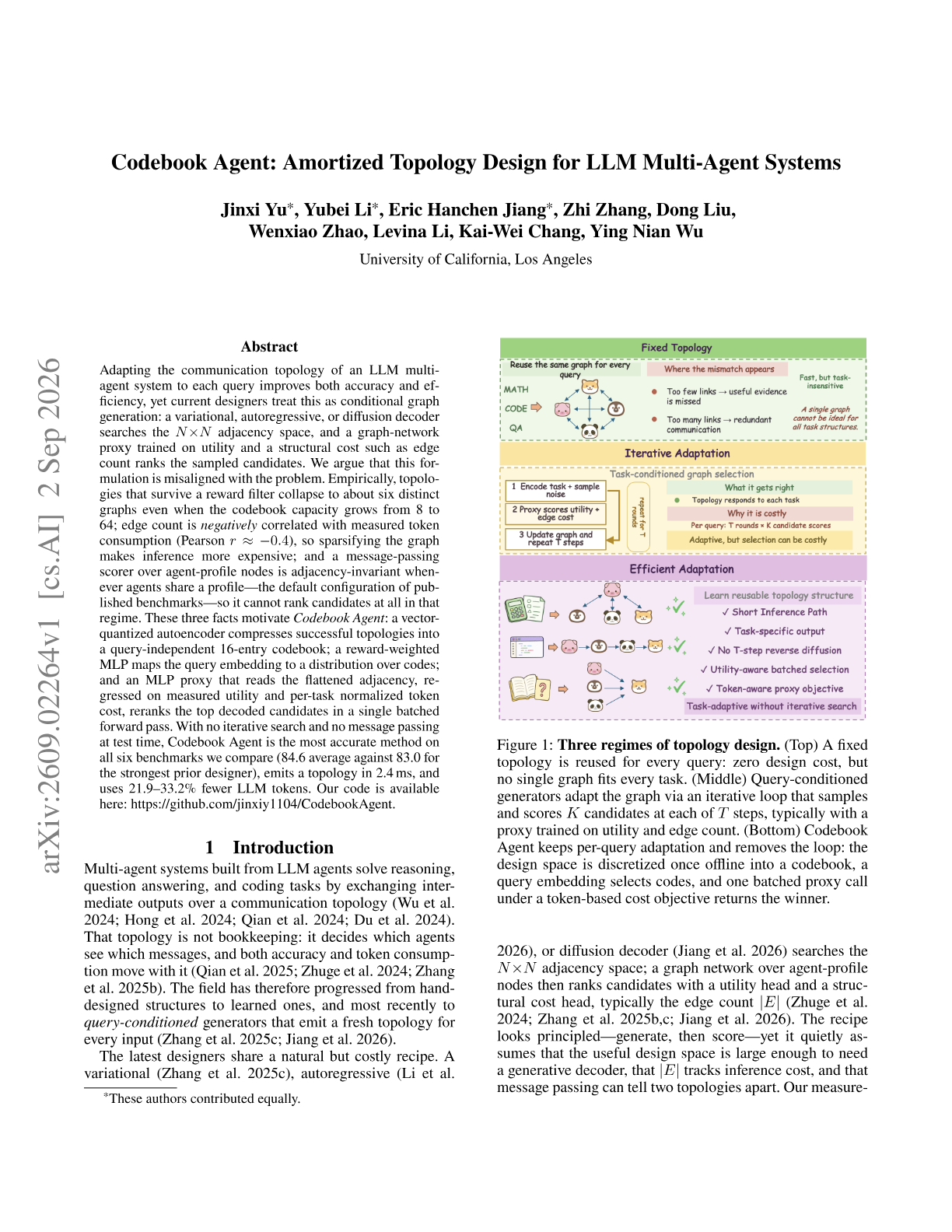
Codebook Agent: Amortized Topology Design for LLM Multi-Agent Systems
How many distinct communication topologies does an LLM multi-agent system need? Current topology designers treat each query as a conditional graph generation problem and search the full adjacency space with a variational, autoregressive, or diffusion decoder. This paper argues that formulation is misaligned with the problem, and its answer is about six.
LLM-as-a-Judge Is Not an Oracle: Why Self-Improving Agents Need Deterministic Guardrails
Vansh Wahi reports months of running autonomous prompt-optimization loops in production across contract analysis, compliance review and code quality, and catalogs eleven distinct ways the evaluation signal failed.
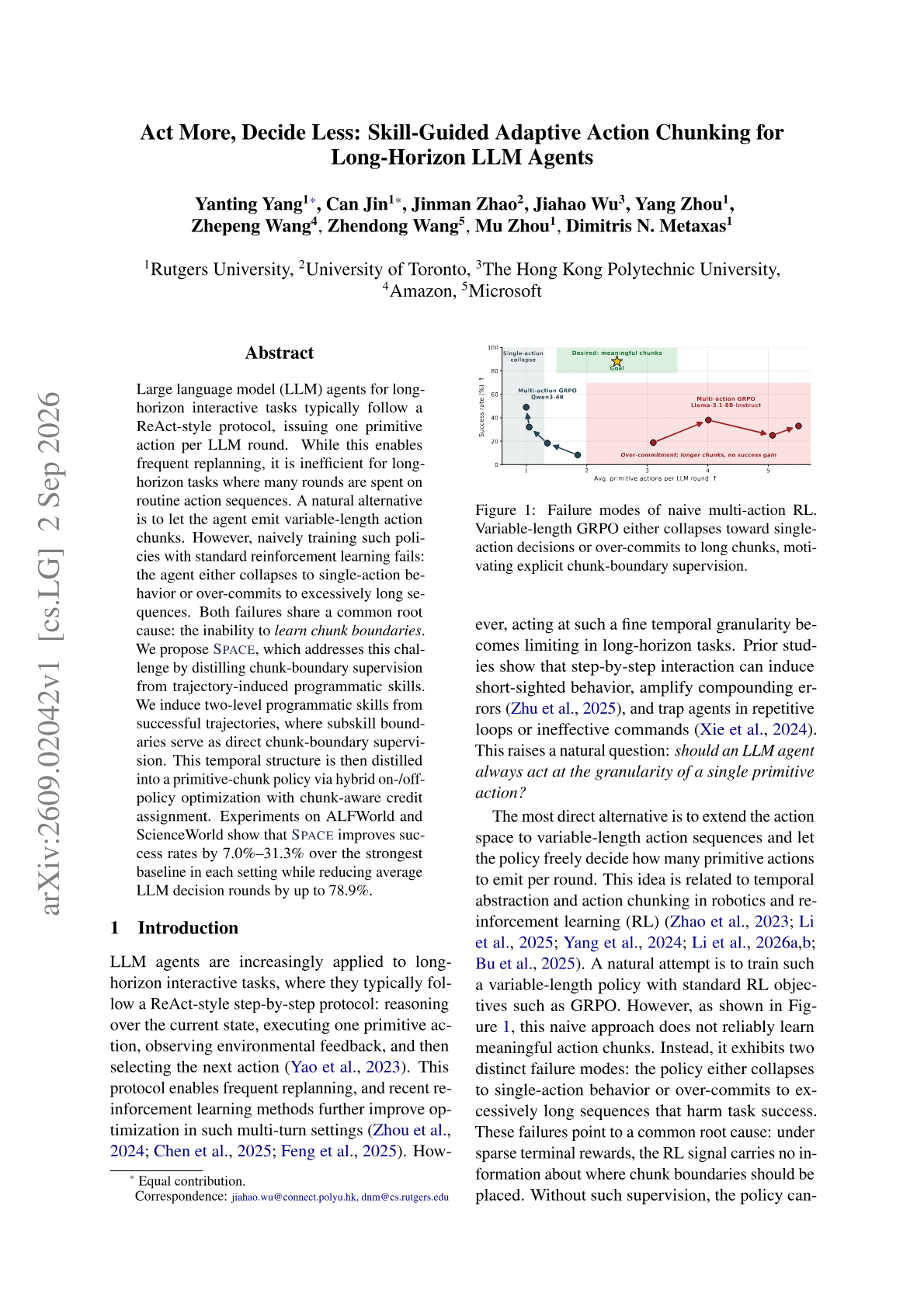
Act More, Decide Less: Skill-Guided Adaptive Action Chunking for Long-Horizon LLM Agents
Yanting Yang, Can Jin, Dimitris Metaxas and colleagues (Rutgers) propose SPACE, which lets a long-horizon agent emit variable-length action chunks by distilling chunk boundaries from programmatic skills induced out of successful trajectories.
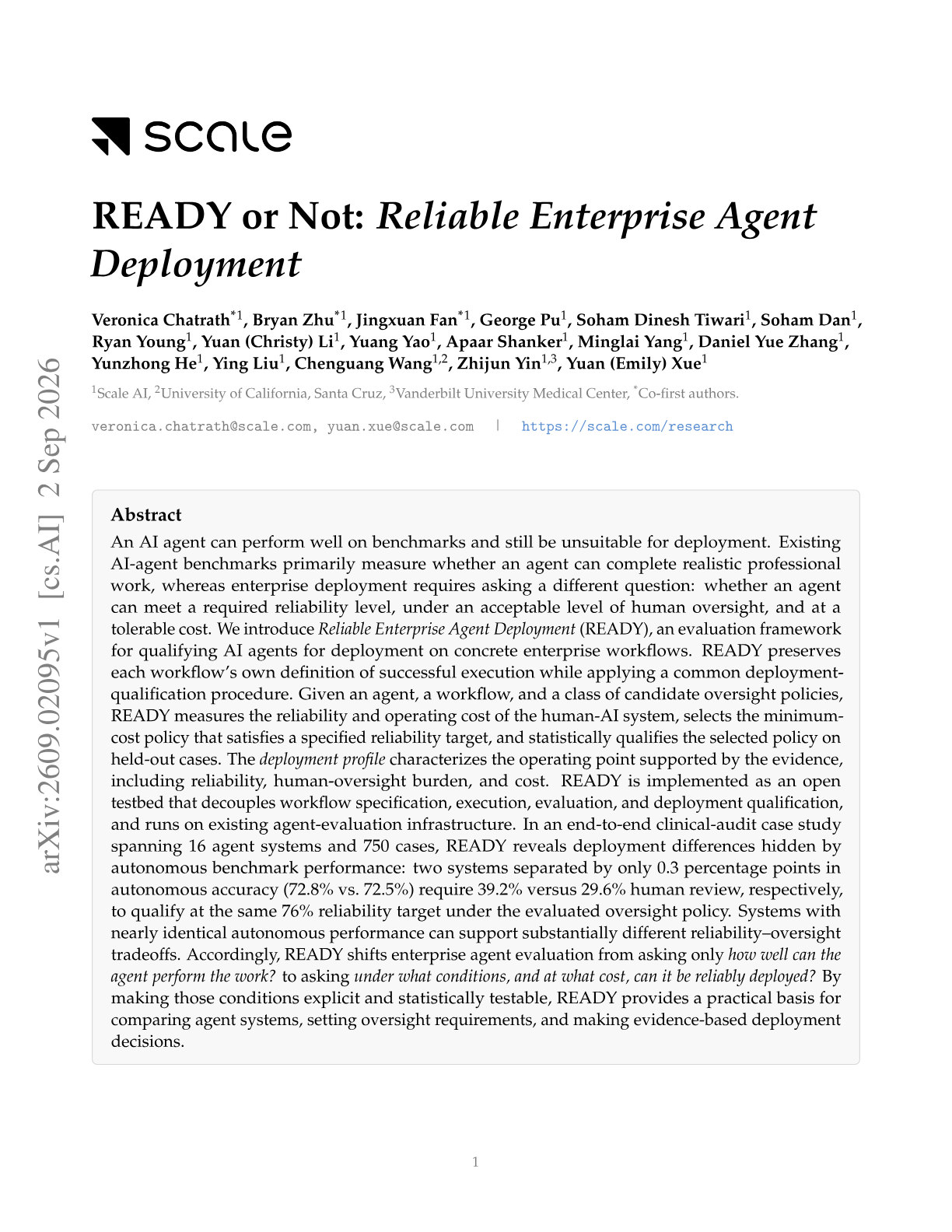
READY or Not: Reliable Enterprise Agent Deployment
Veronica Chatrath, Yuan Xue and a Scale AI team introduce READY, a framework that stops asking how well an agent performs and starts asking under what oversight policy and at what cost it can be deployed at a required reliability level.
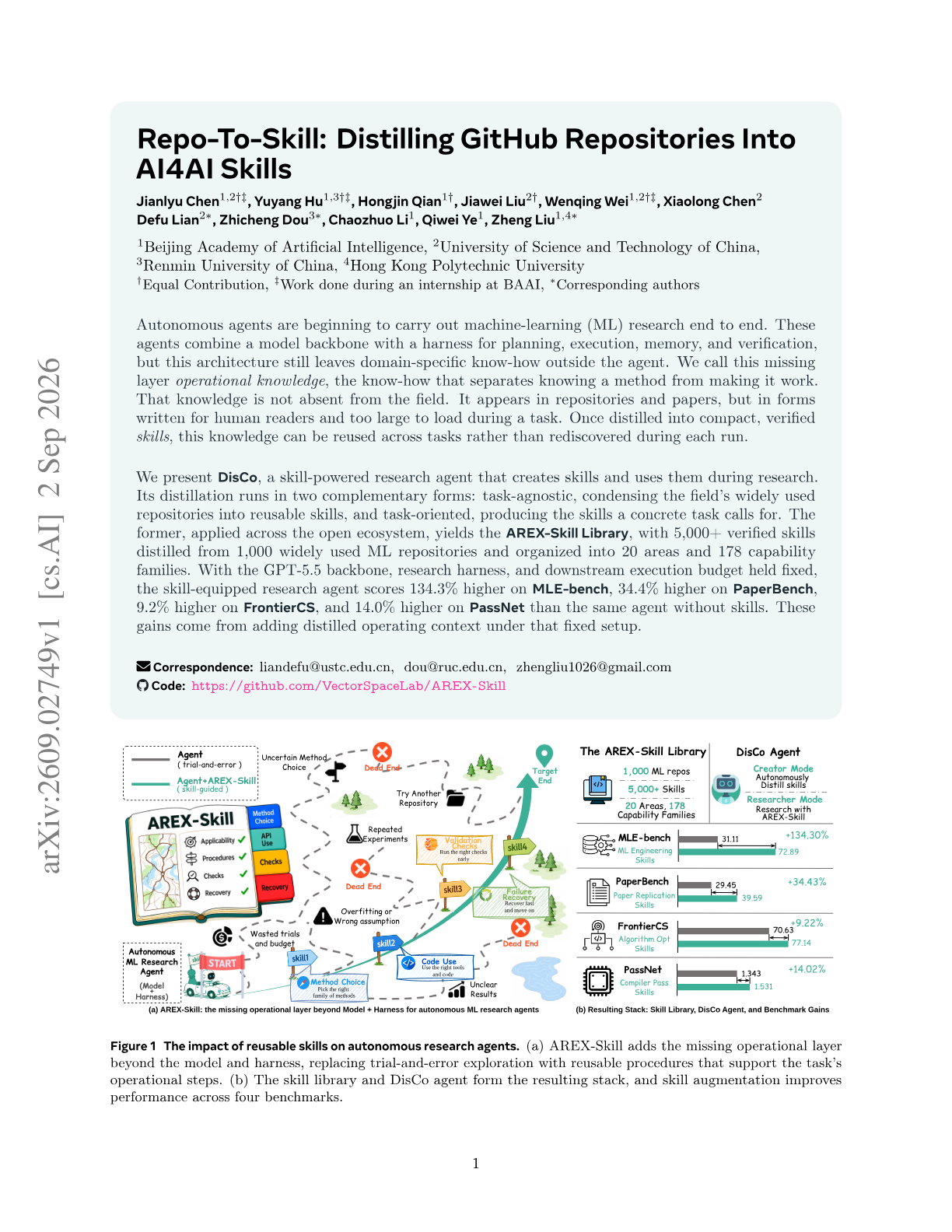
Repo-To-Skill: Distilling GitHub Repositories Into AI4AI Skills
Jianlyu Chen, Hongjin Qian, Zheng Liu and a large BAAI-led team introduce DisCo and the AREX-Skill Library, distilling 1,000 widely used ML repositories into more than 5,000 verified reusable skills and showing that operational know-how, not the harness, is what research agents are missing.
CHIME: Credit-Aware Hierarchical Memory Evolution for Long-Horizon Agentic Planning
Yongshi Ye, Tian Lan and colleagues (Xiamen University, Alibaba International) propose CHIME, a self-evolving memory framework that fixes the credit assignment problem in experience memory by attributing an outcome before writing it anywhere.
Discriminative World Models for Web Agents
Kelvin Li, Dhruv Pendharkar, Trevor Darrell, Roei Herzig and colleagues (Berkeley, MIT-IBM) point out that web-agent world models are trained on the wrong objective, and replace next-state prediction with predicted-state matching.
Making Prospective Memory SLM-Shaped: Typed Intention Stores for Small-Model Agents
Jinqing Zhao and Chengcan Wu argue that prospective memory, carrying out a deferred intention at the right future cue, is schema-constrained state tracking rather than open-ended reasoning, and show that typing the action space lets small models beat the published large-model scaffold.
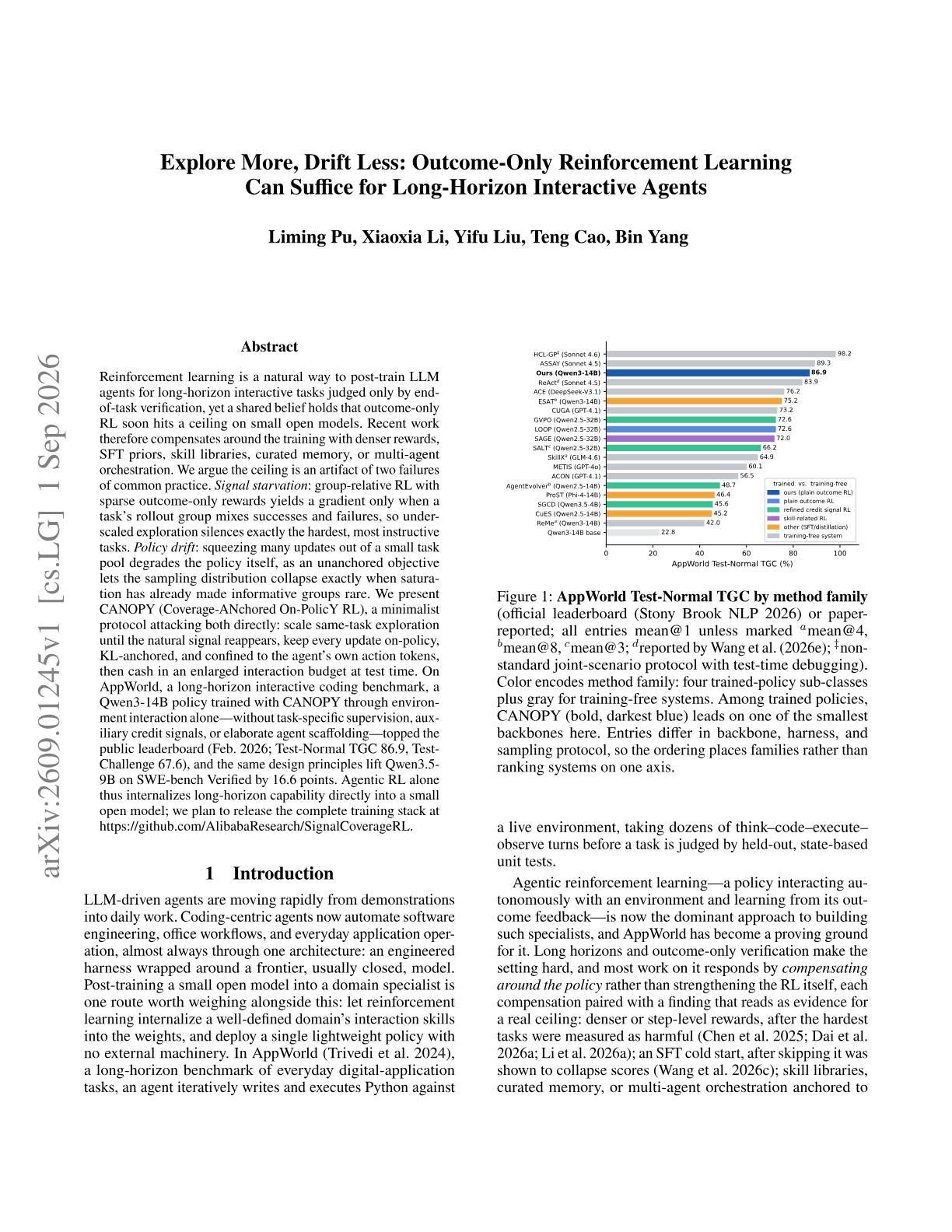
Explore More, Drift Less: Outcome-Only Reinforcement Learning Can Suffice for Long-Horizon Interactive Agents
Liming Pu and colleagues at Alibaba Research argue that the widely assumed ceiling on outcome-only RL for small open agent models is a practice artifact rather than a property of the method, and present CANOPY, a stripped-down protocol that tops the AppWorld leaderboard with a 14B policy trained purely through environment interaction.
MemoryWalker: Stop Training Agents on Contexts They Never Saw
Zinco J and colleagues at Alibaba point out that production harnesses like Claude Code and Qwen-Agent compress context mid-rollout, which turns the training object into a tree rather than a sequence, and give both exact and cheap corrections for the resulting train-inference mismatch.
Defense-as-Skill: Evolving Runtime Guard Skill for Skill-Augmented Agents
Xiaofang Yang and colleagues at Shanghai AI Lab argue that pre-install vetting cannot secure skill-augmented agents, because a malicious skill only acts once a concrete user task makes the unsafe action look useful, and implement the runtime guard itself as an installable skill.
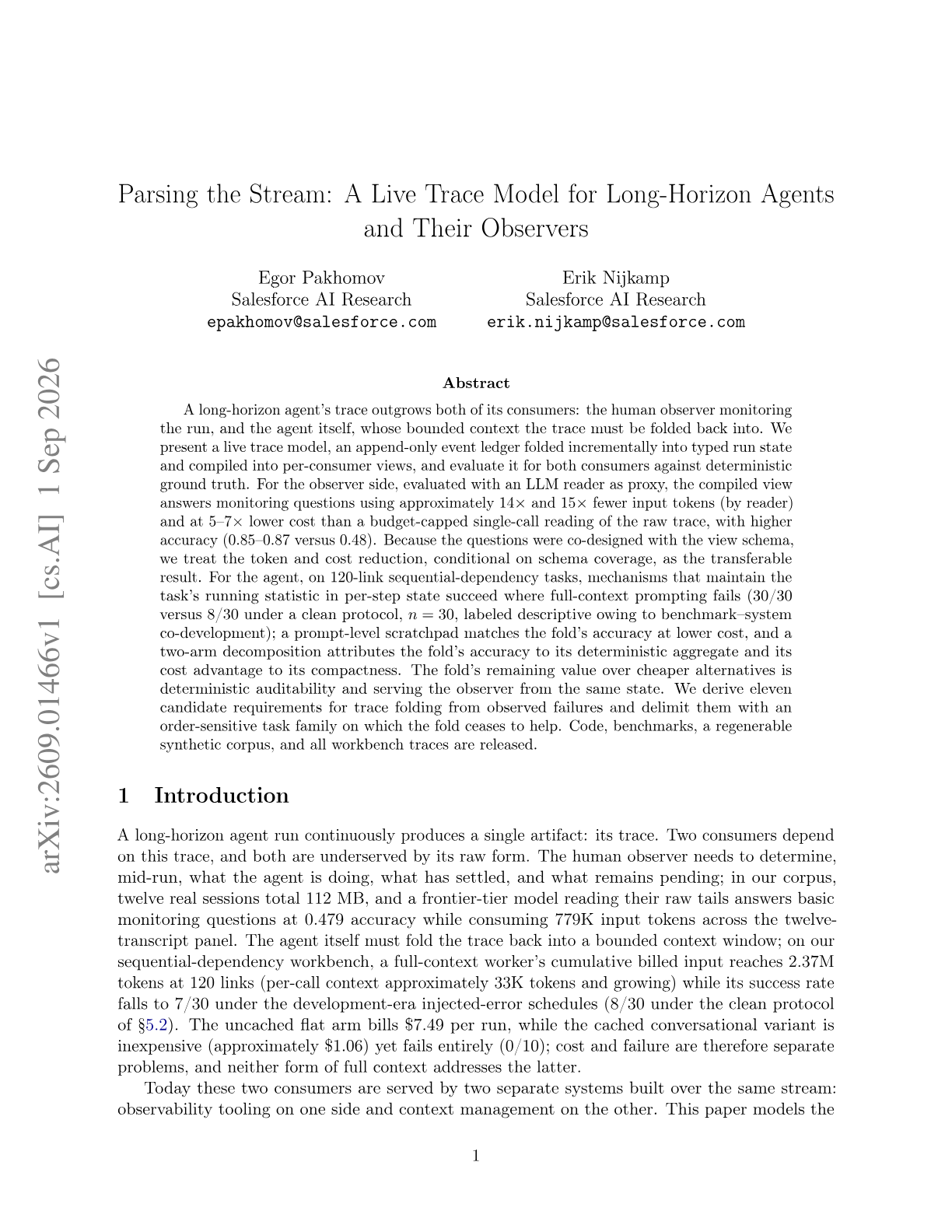
Parsing the Stream: A Live Trace Model for Long-Horizon Agents and Their Observers
Egor Pakhomov and Erik Nijkamp treat a long-horizon agent's trace as a shared resource with two consumers, the human watching the run and the agent whose bounded context the trace must fold back into, and build an append-only event ledger compiled into per-consumer views.
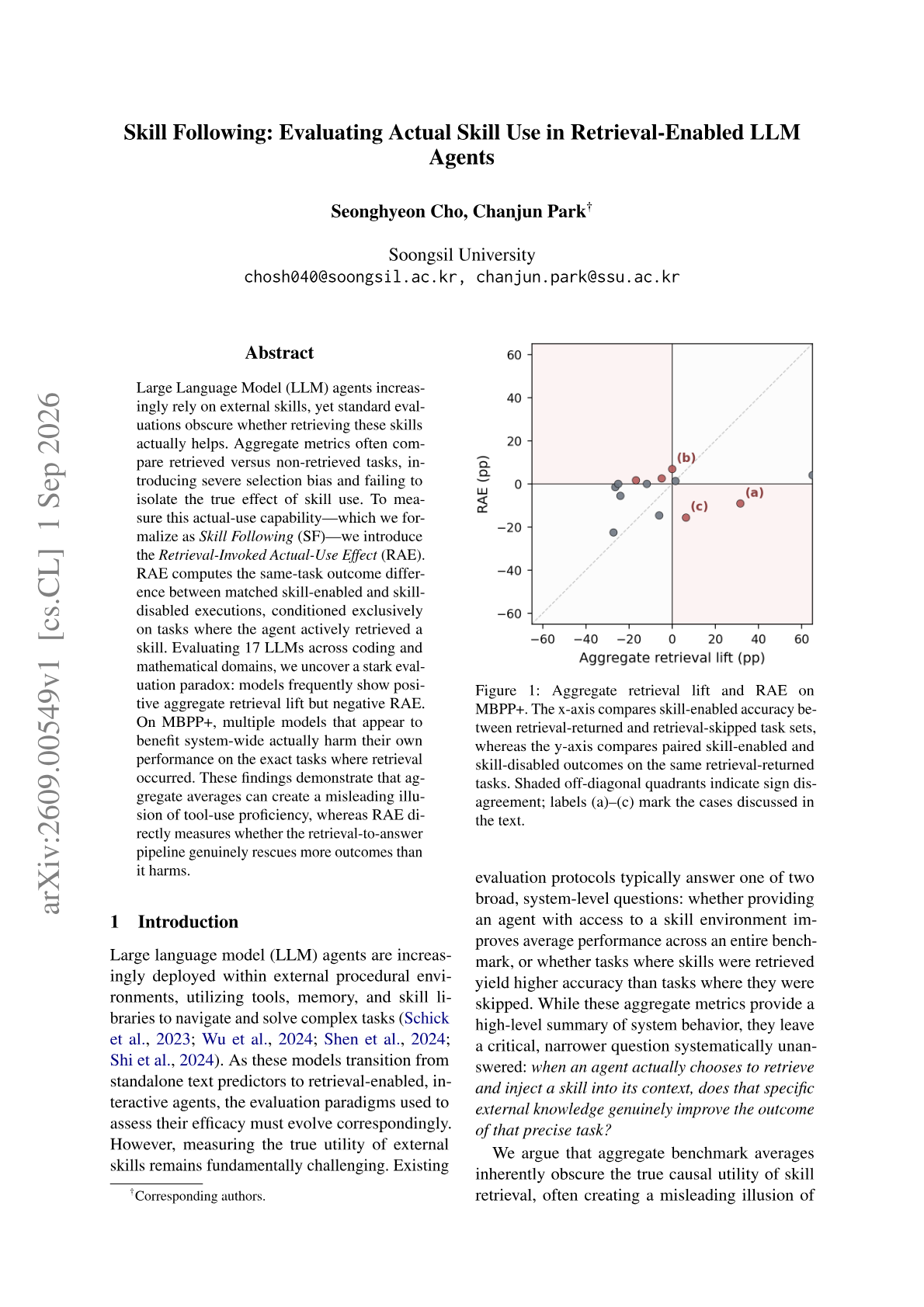
Skill Following: Evaluating Actual Skill Use in Retrieval-Enabled LLM Agents
Seonghyeon Cho and Chanjun Park at Korea University show that the standard way of measuring whether agent skills help is confounded by selection bias, and introduce a matched-execution estimator that flips the conclusion for several models.
HarnessEvolve: Learning from Reference Trajectories for Reliable Agent Self-Evolution
Wen Jiang and colleagues name three failure modes that break self-evolving agents and address all three with HarnessEvolve, which learns from reference trajectories generated by replaying tasks with the ground-truth answer in hand.
AgentFactory: Towards Automated Agentic System Design and Optimization
Enci Zhang and colleagues at Peking University present AgentFactory, which jointly optimizes the foundation model and the workflow structure of an agentic system under performance, cost, and efficiency objectives rather than optimizing the workflow alone.
VoiceLongMemEval: Do Assistants Remember How You Sounded?
Ramit Pahwa, Parivesh Priye, and Apoorva Beedu build VoiceLongMemEval, a long-horizon conversational memory benchmark where every answer depends on how something was said rather than on what was said.
CordisBench: Can Language Models Reason About Component Lifecycles in Dynamic Agent Harnesses?
Damien Sileo and Dimitri Kachler introduce CordisBench, a 1,200-question benchmark for a reasoning burden that only appears once agents can rewrite the software running them: predicting how a local component change propagates through dependencies and teardown.
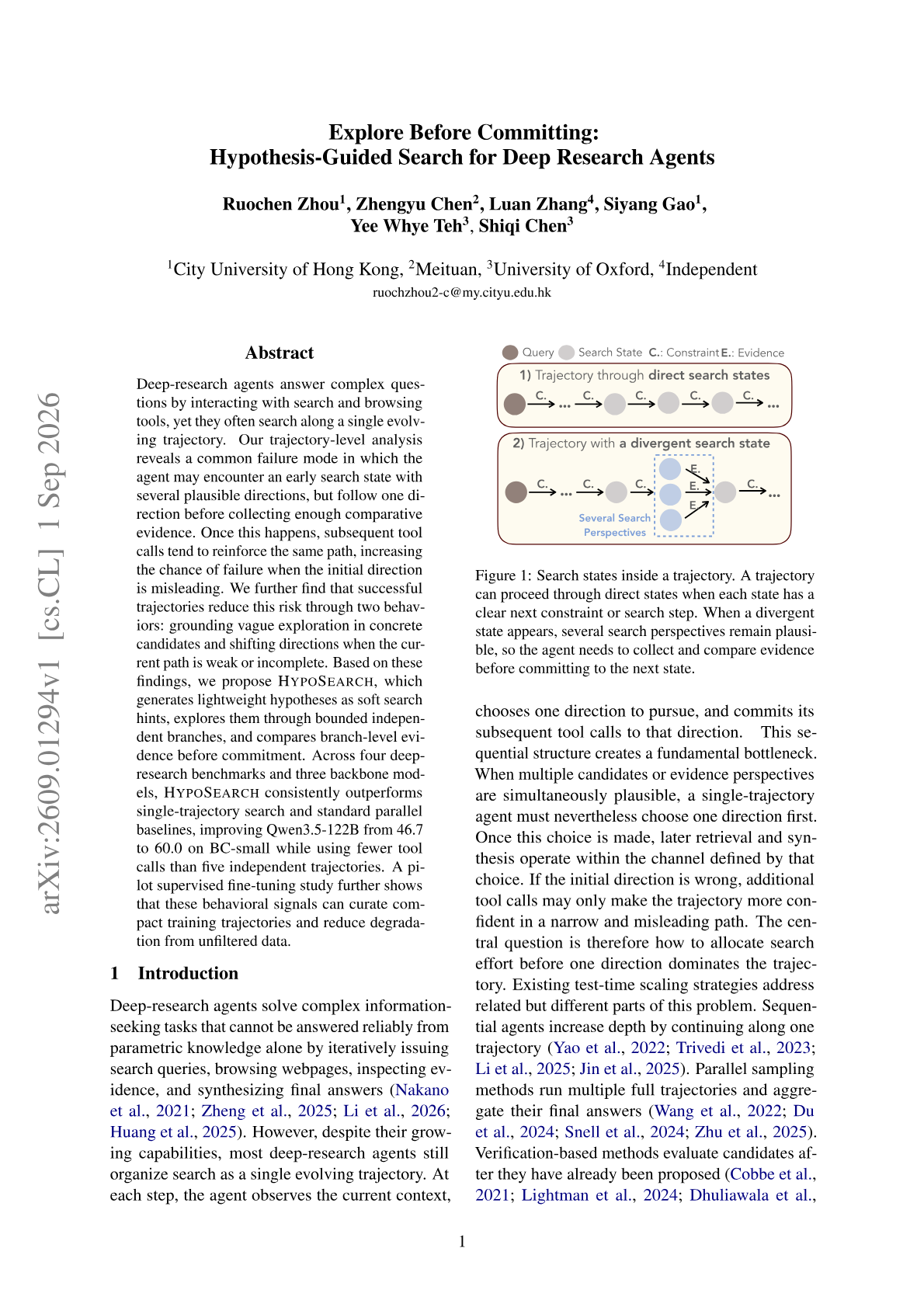
Explore Before Committing: Hypothesis-Guided Search for Deep Research Agents
Ruochen Zhou and colleagues at CityU, Oxford, and collaborators trace deep-research failures to premature commitment, where an agent picks one direction at a branching search state before gathering comparative evidence, and propose bounded hypothesis-guided branching as the fix.
DiagEvo: Diagnosis-Guided Self-Evolution via Hierarchical Error Memory
Xincheng Wei and colleagues at Meituan show that the direction a self-play curriculum needs can be derived from the solver's own failure history rather than from external task resources or generic difficulty signals.