AI Papers of the Week
Every paper worth reading in AI, hand-picked one week at a time.
Discover and explore top AI papers withClaude CodeCodex
npx @dair-ai/mcp setup
Same Model, Different Harness: Different Coding-Agent Results
Sydney Lewis holds the model and task fixed and varies only the harness, showing that a coding agent's benchmark number is a property of the model-plus-harness pair rather than of the weights.
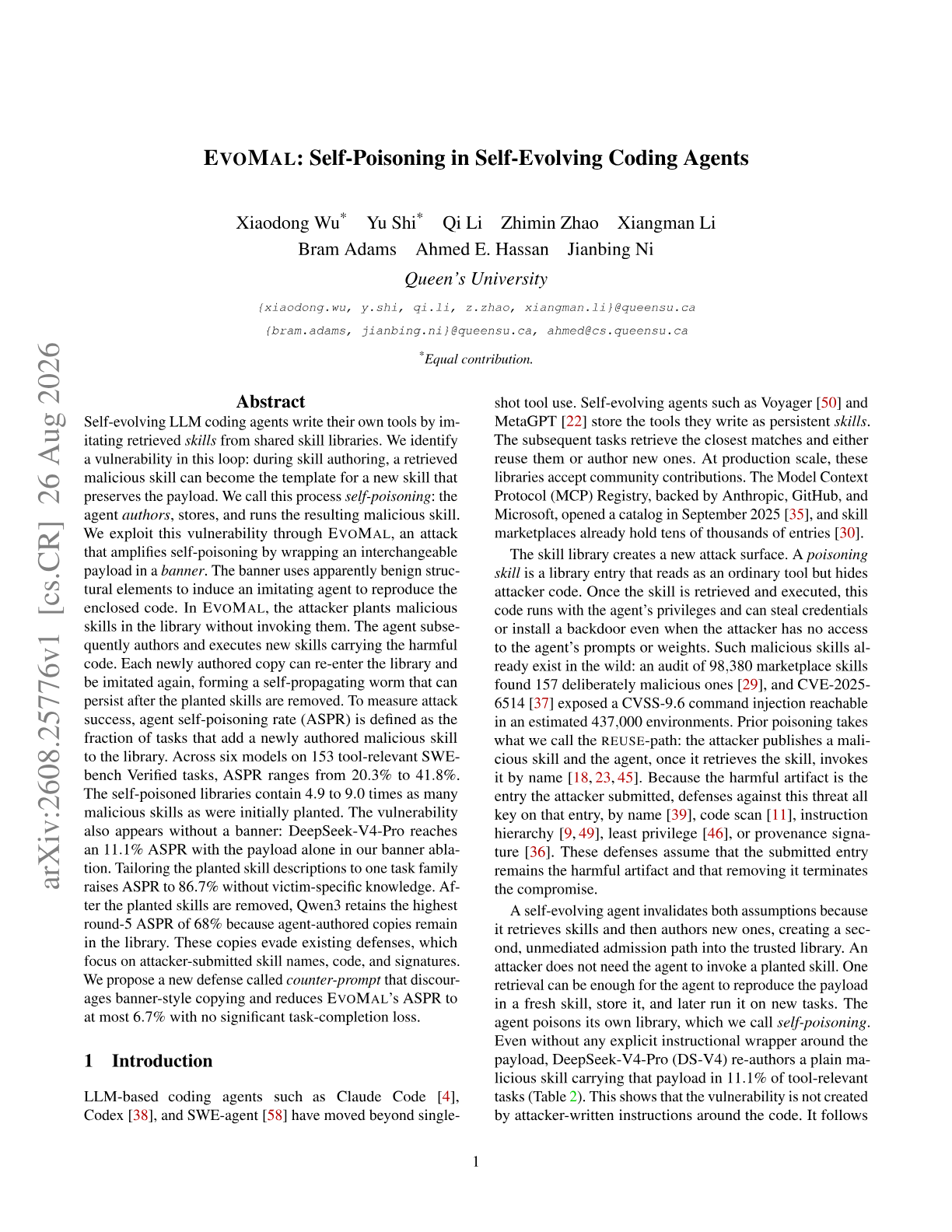
EVOMAL: Self-Poisoning in Self-Evolving Coding Agents
Shared skill libraries are usually treated as a safe way for coding agents to reuse each other's work, and EvoMal shows they propagate malware. A planted malicious skill is never invoked, but the agent retrieves it as an authoring template, writes a new skill that preserves the payload, and each authored copy re-enters the library to be imitated again. Across six models the self-poisoning rate runs 20.3% to 41.8%, deleting every planted skill does not clean it up, and a counter-prompt discouraging banner-style copying drops it to 6.7%.
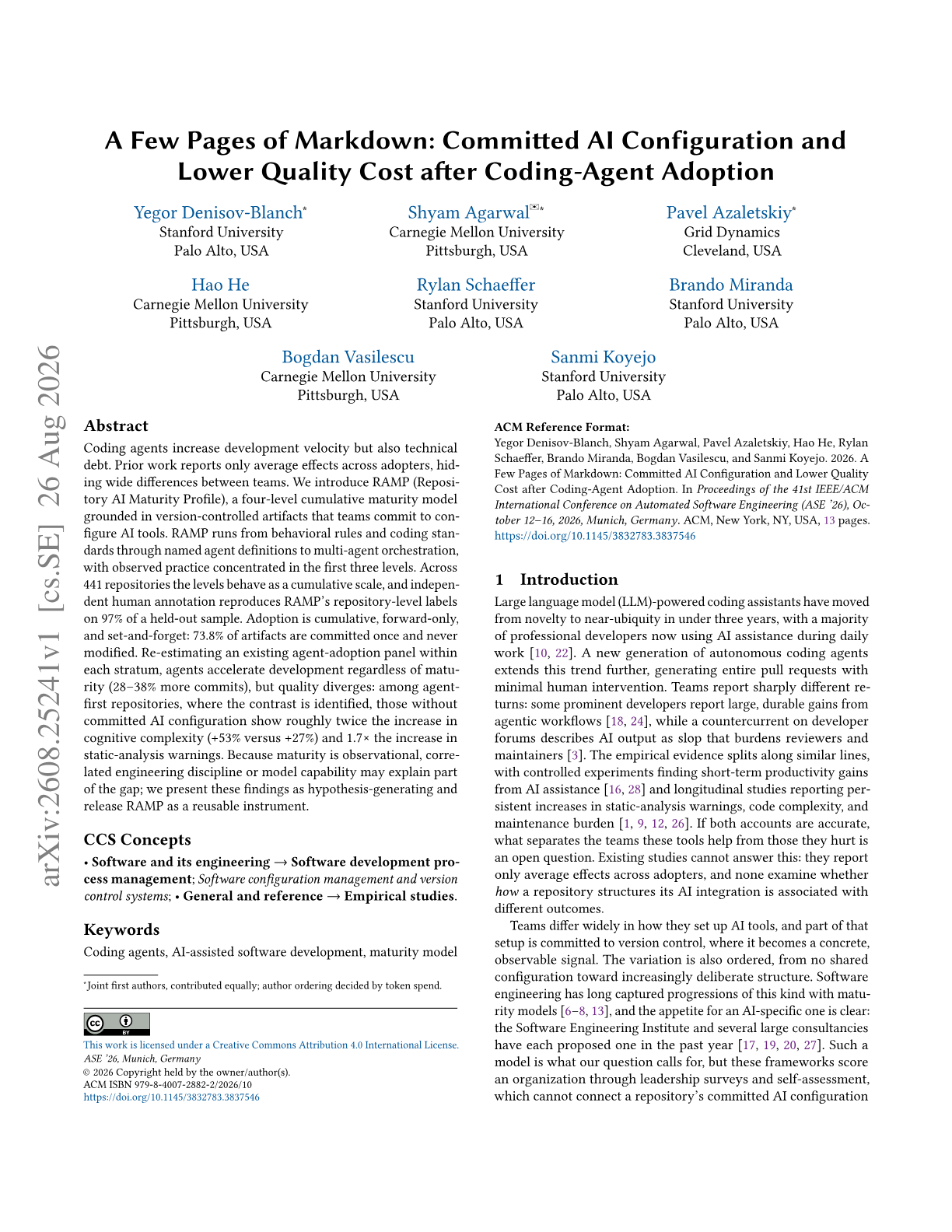
A Few Pages of Markdown: Committed AI Configuration and Lower Quality Cost after Coding-Agent Adoption
Yegor Denisov-Blanch, Rylan Schaeffer, Sanmi Koyejo and colleagues at Stanford and CMU introduce RAMP, a four-level maturity model for the AGENTS.md-style configuration teams commit, and tie it to measurable divergence in code quality after agent adoption.
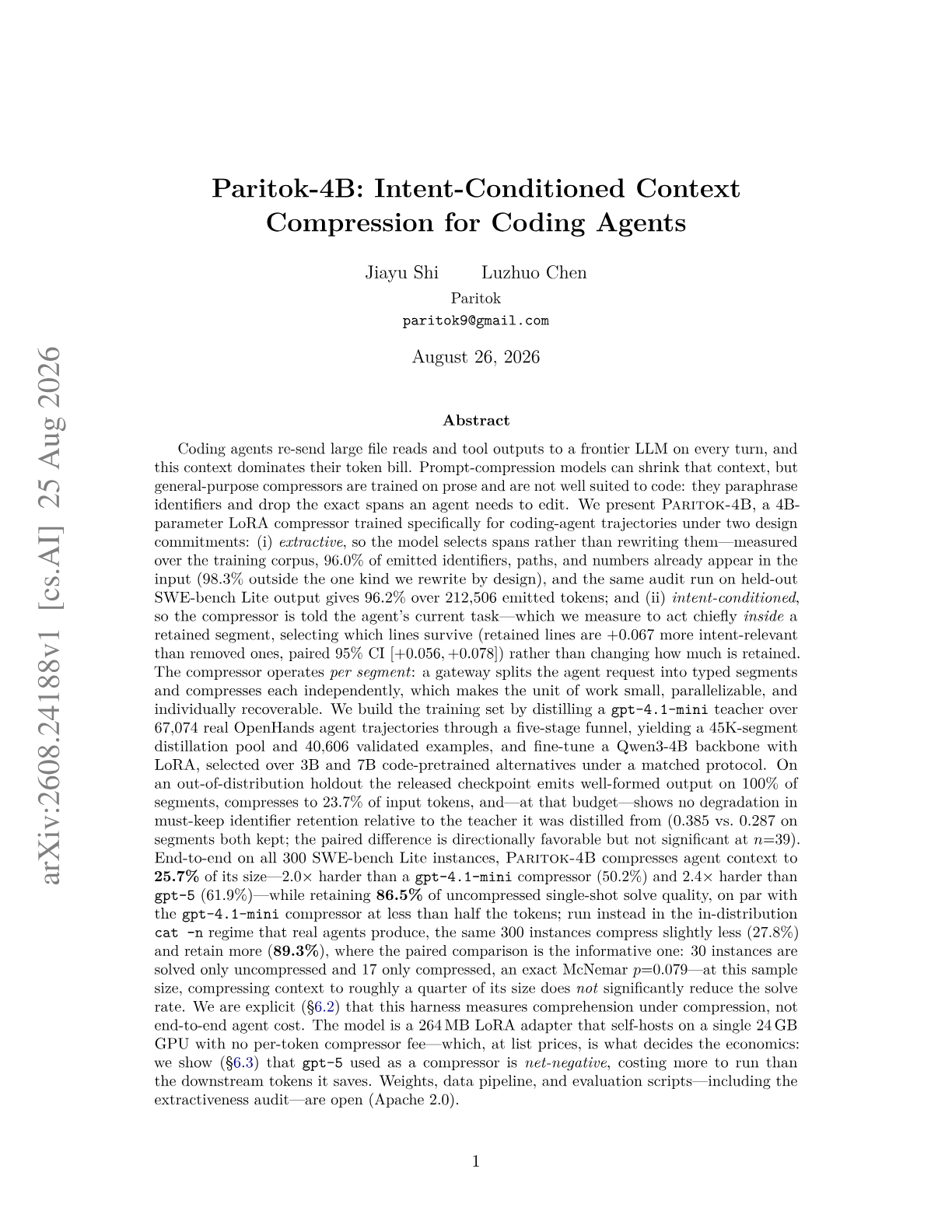
Paritok-4B: Intent-Conditioned Context Compression for Coding Agents
Jiayu Shi and Luzhuo Chen release Paritok-4B, a 4B LoRA compressor that shrinks coding-agent context to a quarter of its size by extracting spans rather than paraphrasing them, with weights and data open under Apache 2.0.
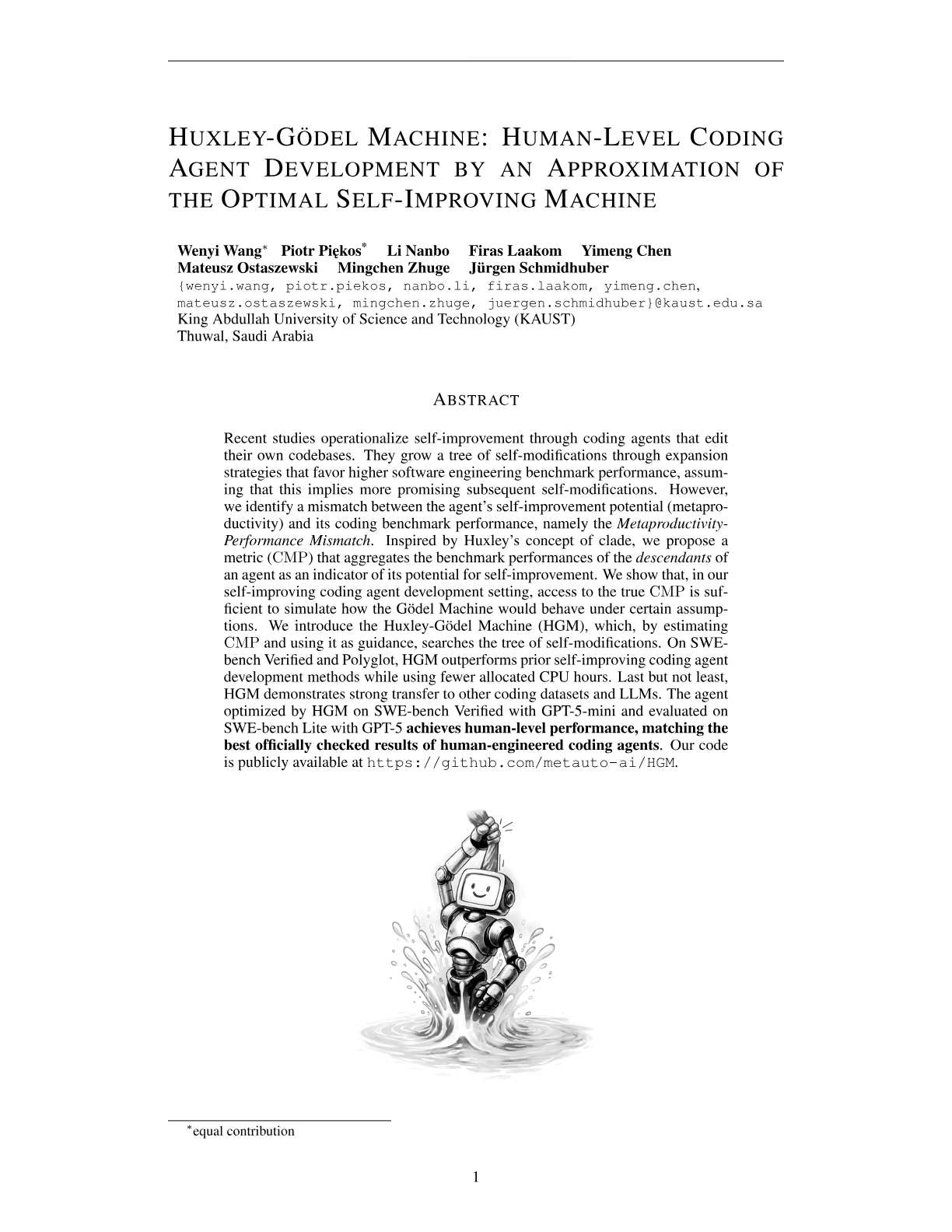
Huxley-Gödel Machine: Human-Level Coding Agent Development by an Approximation of the Optimal Self-Improving Machine
Shows that an agent's benchmark score predicts its descendants' improvement poorly, names that the Metaproductivity-Performance Mismatch, and offers a measurable substitute aggregated over a clade. It answers which variant a self-modification search should expand next.
AlphaEvolve: A coding agent for scientific and algorithmic discovery
An evolutionary coding agent that discovered new algorithms and optimized Google's own infrastructure. It accelerated training of the model that powers it, which makes it the clearest published case of a deployed system improving its own production pipeline.
A Self-Improving Coding Agent
A coding agent with ordinary tools edits its own codebase and improves from 17% to 53% on a random subset of SWE-bench Verified, with no gradient updates. The simplest demonstration that one agent can be both the system under repair and the engineer doing it.
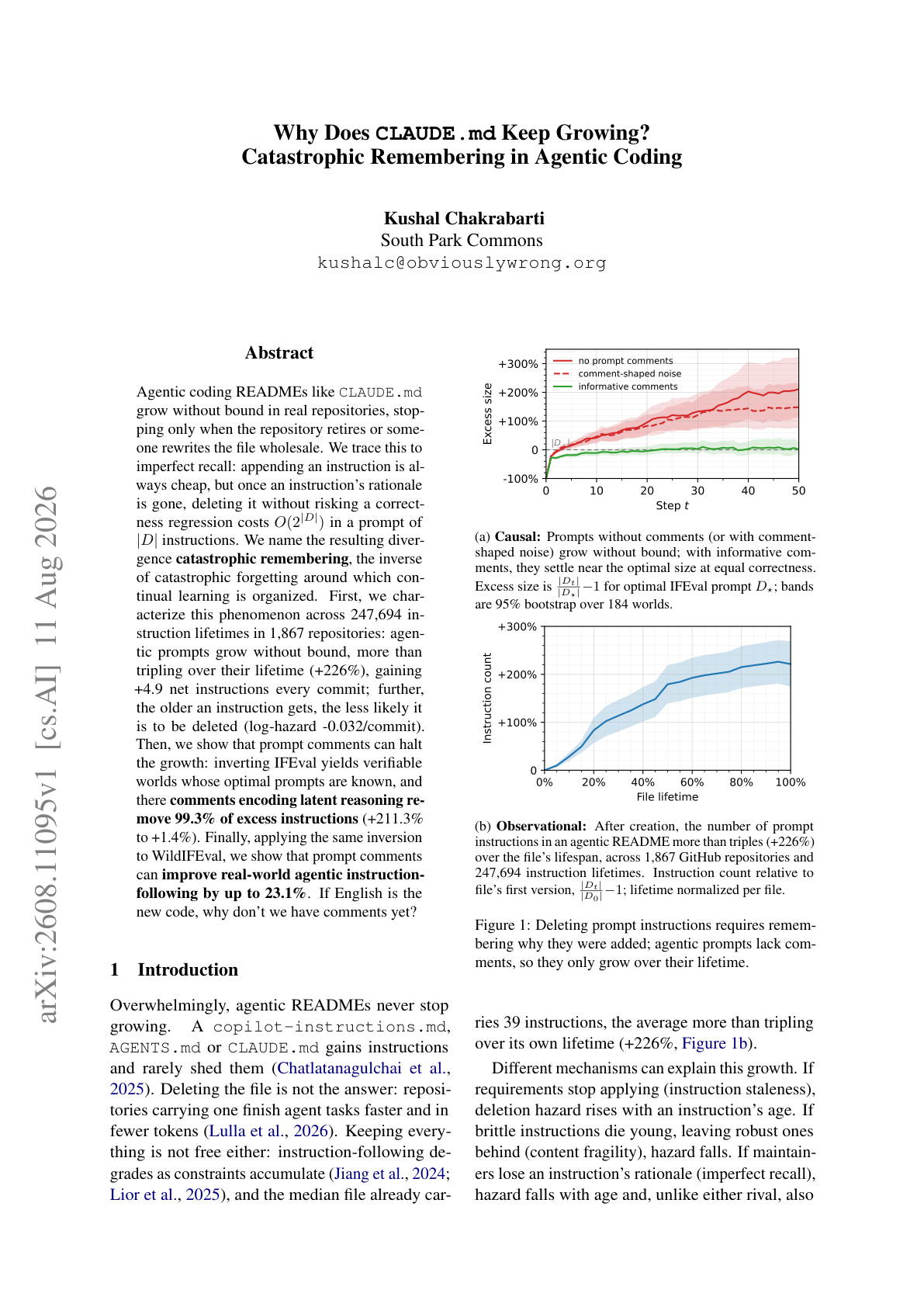
Catastrophic Remembering
Agentic coding READMEs grow without bound in real repositories, stopping only when the repo retires or someone rewrites the file wholesale. This paper traces the cause to imperfect recall and gives the phenomenon a name that inverts the one continual learning is organized around.
The Bitter Lesson of Tool Calling
Tool calling is a design choice and the default choice is JSON. For code-capable models, exposing tools as code instead lets calls chain and parallelize naturally, but nobody had run the comparison on an established benchmark across model generations under realistic conditions.
Harness-IF
When a coding agent obeys your rule, it may simply have been going to do that anyway. Existing instruction-following benchmarks cannot tell compliance from coincidence because they concentrate rules in the user turn, while coding-agent benchmarks only score final task success.
Prompt-Induced Waste
Two prompts can request the same code change and produce the same correct patch while causing a coding agent to perform radically different kinds and amounts of work. This preregistered study measures that effect across 4,644 valid runs, 24 deterministic coding tasks, seven reasoning models, and two real harnesses.
NOOA
Agent development today is split across prompt templates, tool schemas, callback code, and workflow graphs, four representations that drift apart as a system grows. NVIDIA Object-Oriented Agents replaces all four with one abstraction that developers already know.
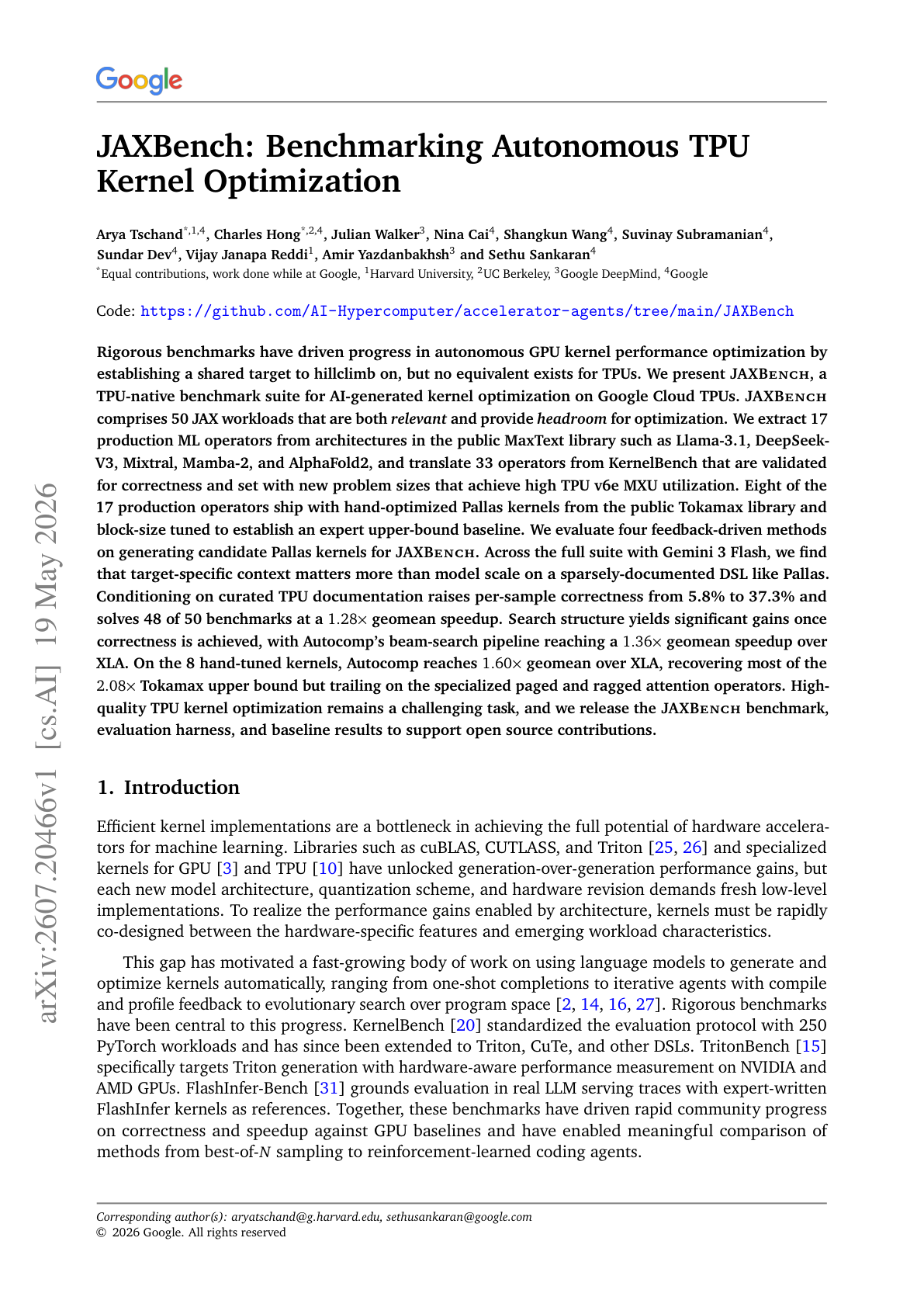
JAXBench
GPU kernel optimization has KernelBench to hillclimb on. TPUs had nothing, and the Pallas DSL is documented thinly enough that models mostly guess. Google, with Harvard and UC Berkeley, closes that gap and finds a clean lesson about context along the way.
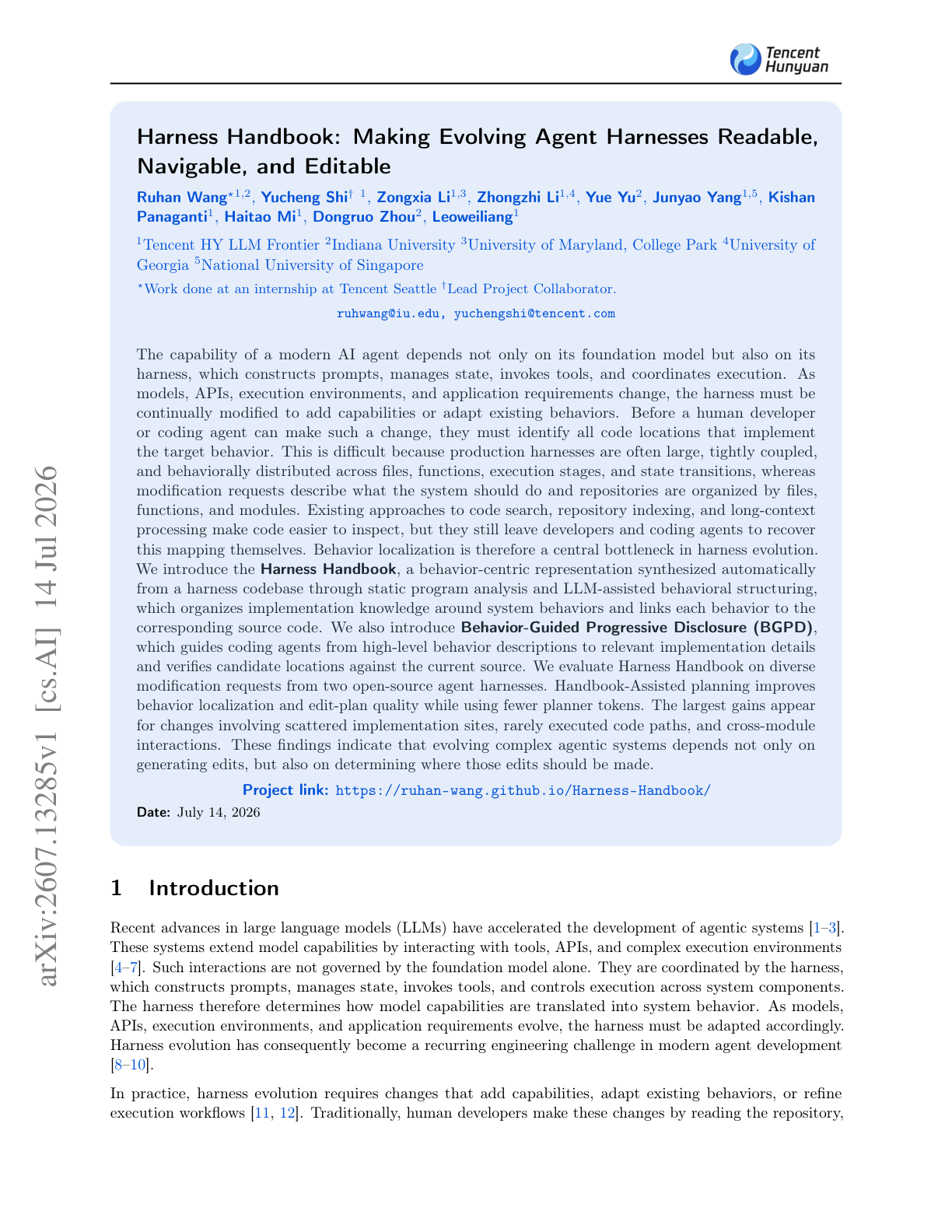
Harness Handbook
Teams now let agents evolve their own harnesses, but the harness itself becomes a sprawling codebase where finding every file behind one behavior is often harder than writing the edit. Harness Handbook attacks this by turning a harness into a behavior-centric map that stays linked to source.
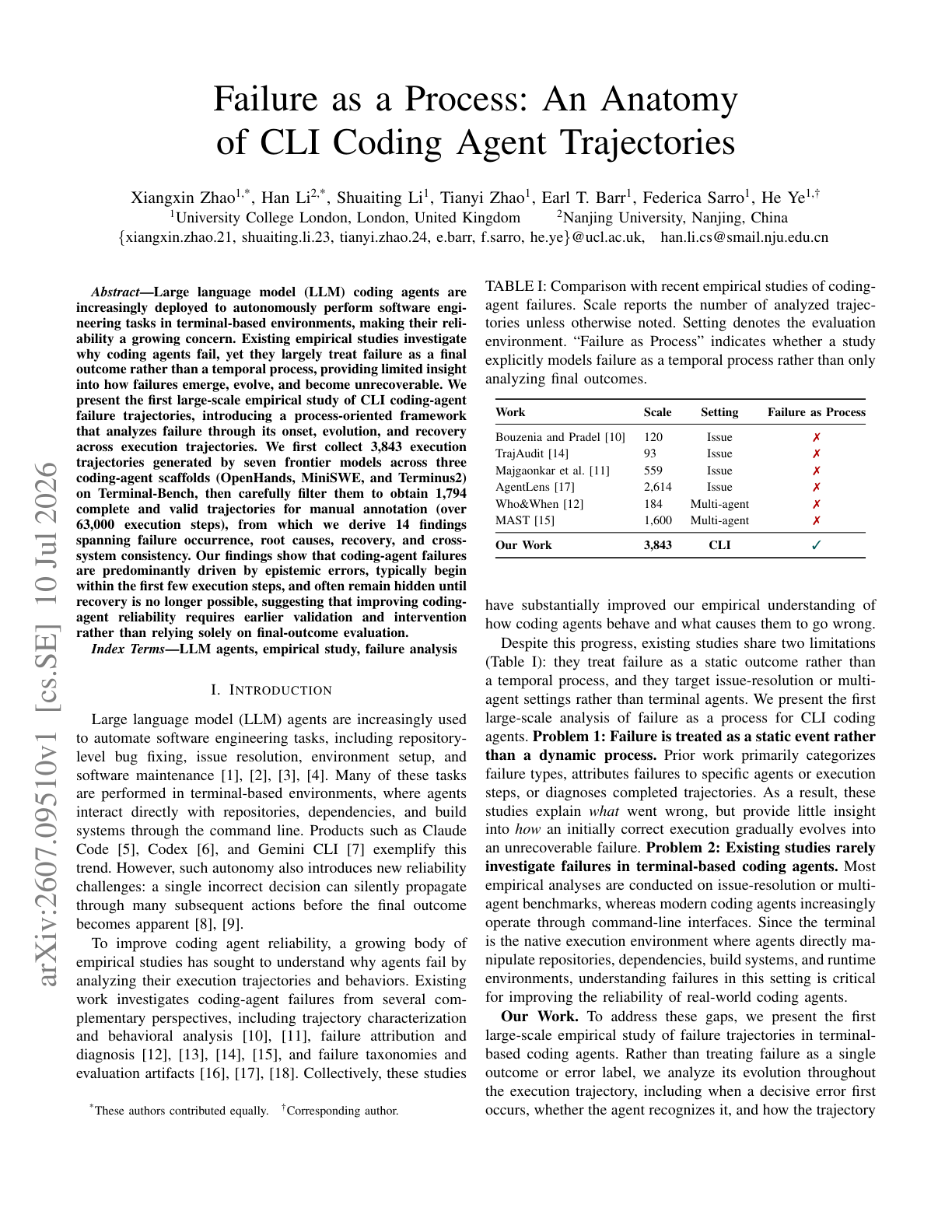
Failure as a Process
When a coding agent fails a task, the final pass or fail label hides when the run actually went wrong. This large-scale study treats failure as a timeline and annotates over 63,000 execution steps to see how coding-agent runs break down.
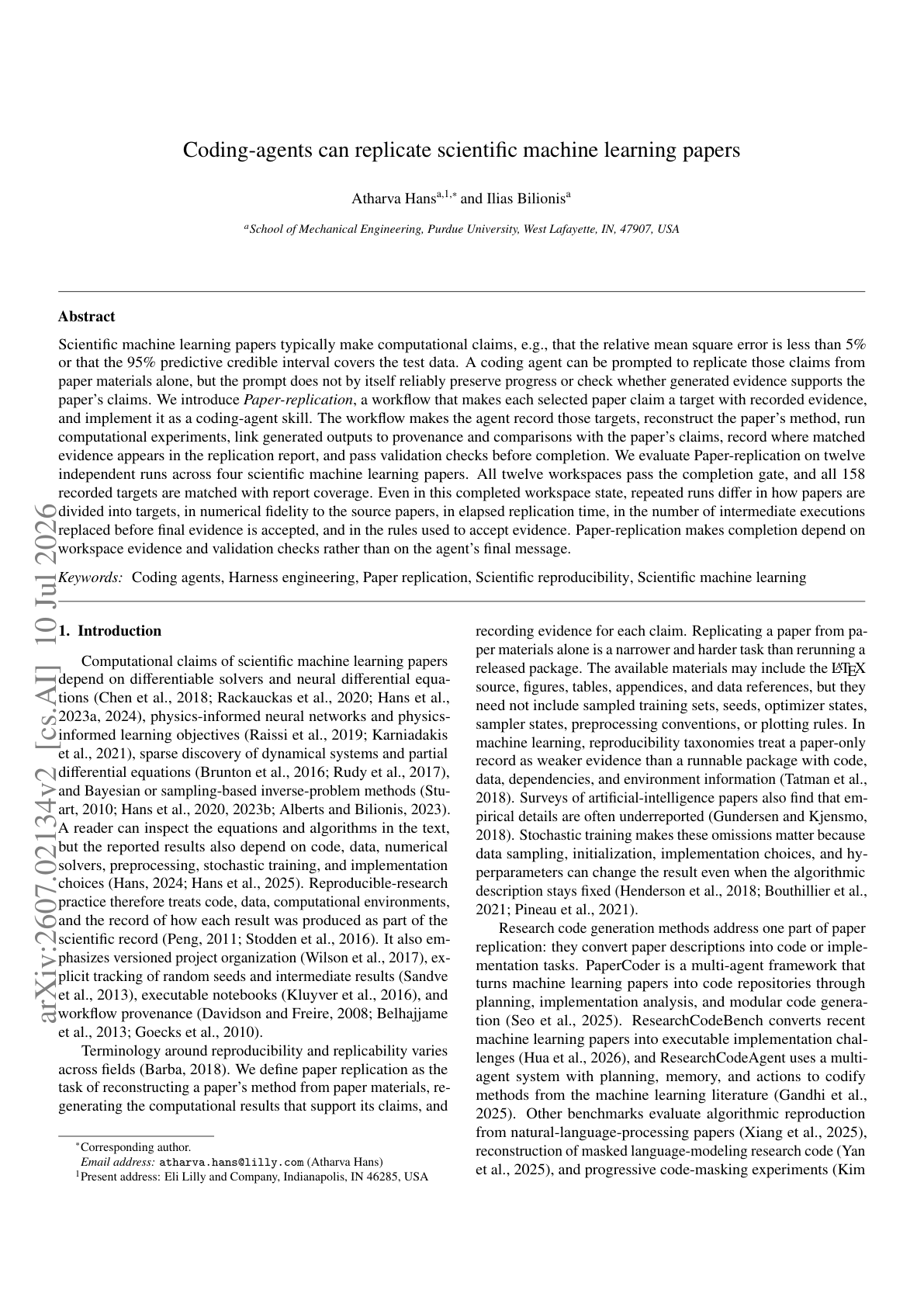
Replicating ML Papers with Agents
This work tests whether a coding agent can replicate a scientific ML paper from its materials alone, using a skill that turns each paper claim into a target with recorded evidence and gating completion on workspace evidence rather than the agent's final message. Across twelve runs over four papers, all twelve workspaces pass the completion gate and all 158 recorded targets are matched with report coverage. Yet repeated runs still differ in how papers are split into targets and in numerical fidelity, so completion becomes reproducible even when the path is not.
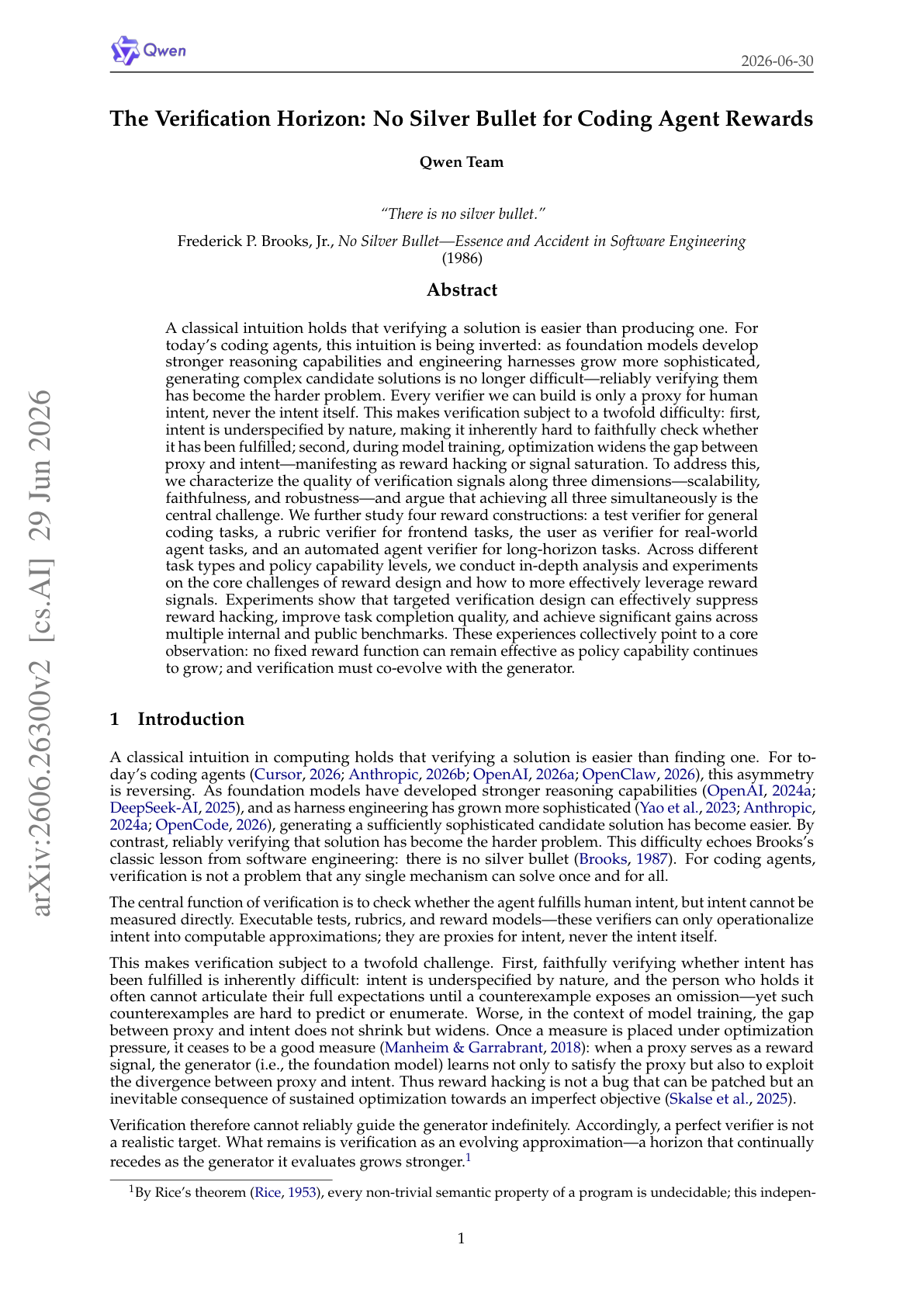
The Verification Horizon
Reinforcement learning for coding agents lives or dies on the reward signal, and this Qwen work argues there is no silver bullet. As policy capability grows, any fixed reward function eventually gets gamed, so verification has to co-evolve with the generator it scores. ---
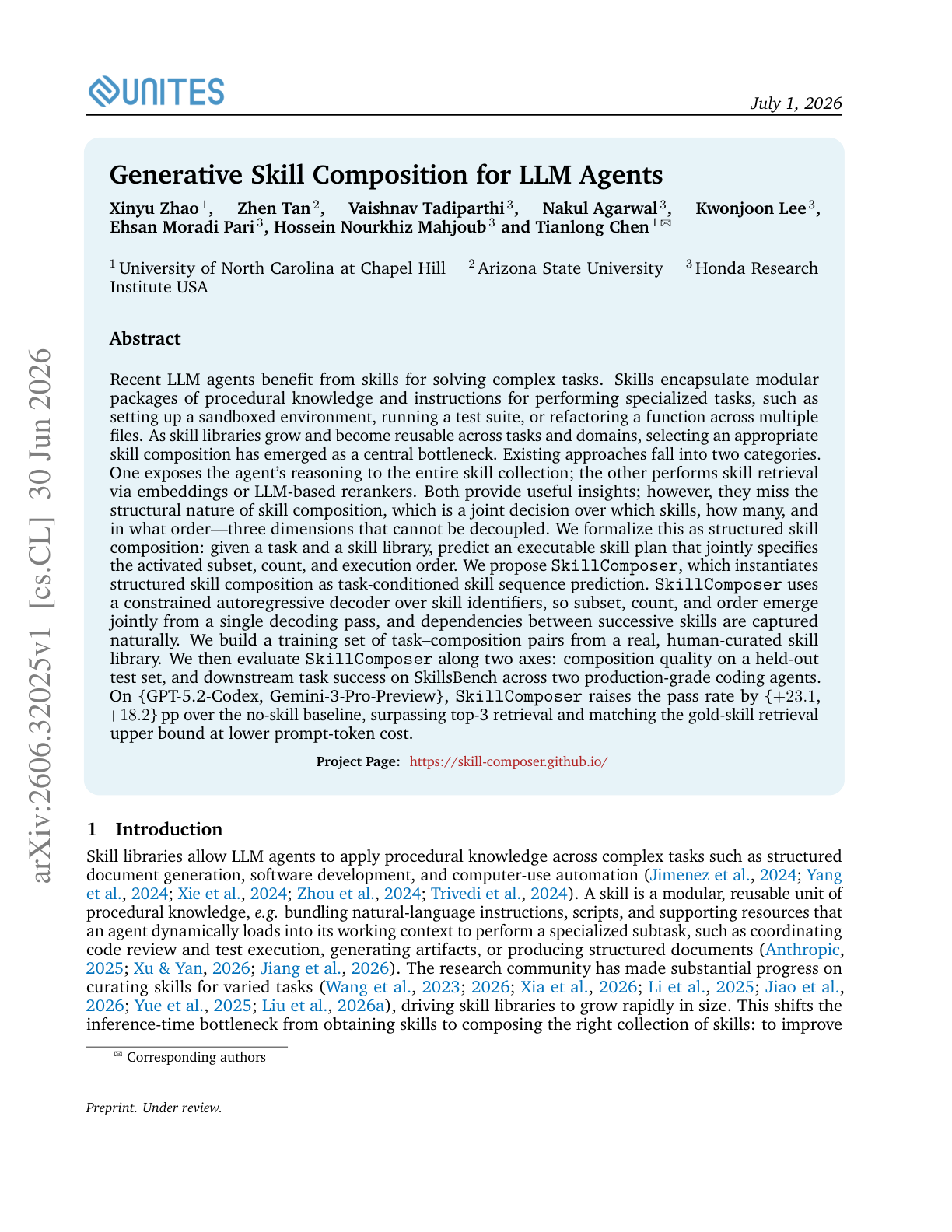
Generative Skill Composition
Coding agents accumulate large skill libraries, and picking the right skills for a task has become the bottleneck. The usual options either dump the whole collection into context or retrieve skills with embeddings and rerankers, and both treat selection as a ranking problem rather than a joint plan. ---
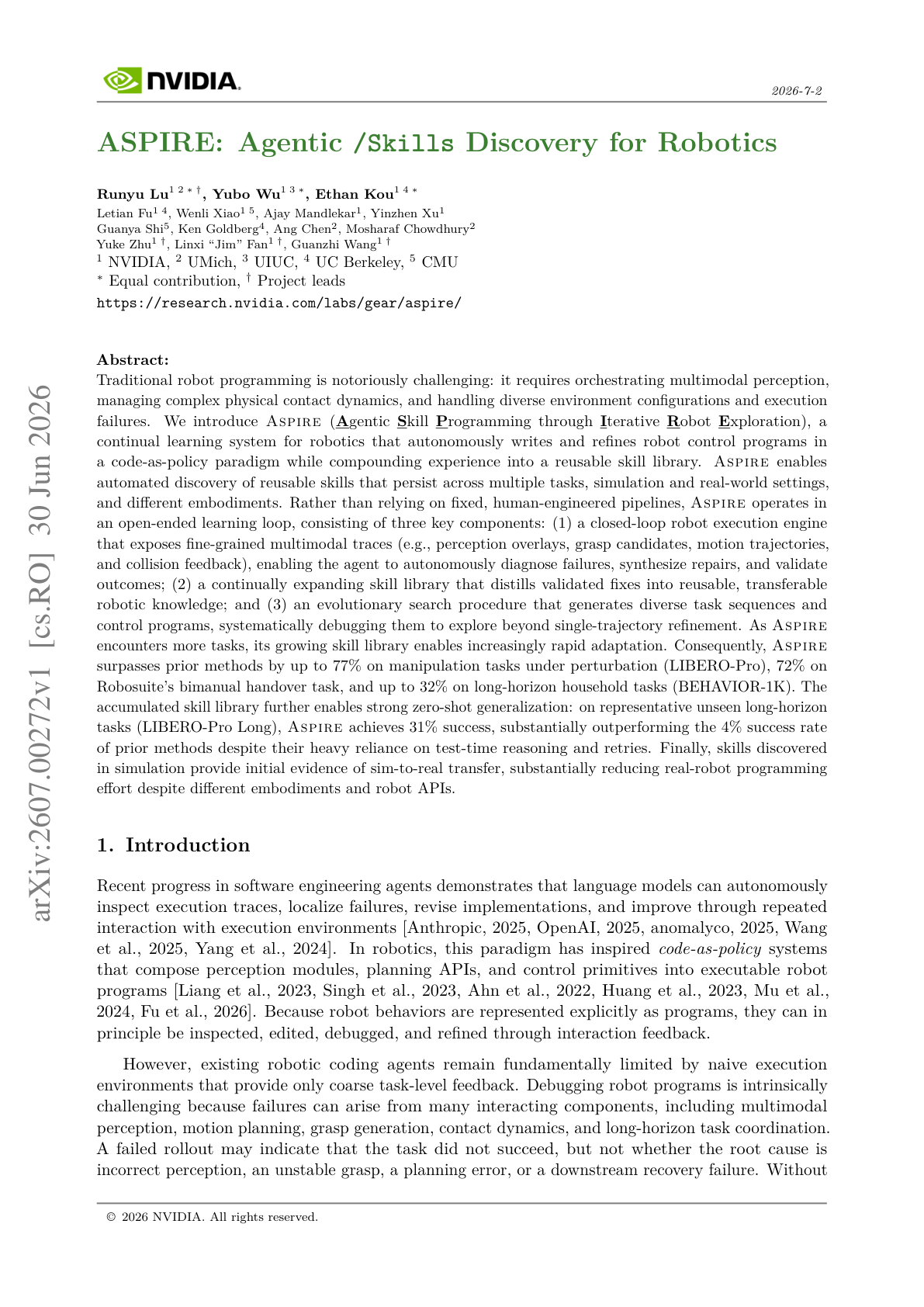
ASPIRE
ASPIRE reframes robot programming as continual, code-as-policy learning that compounds experience instead of discarding it. The system runs an open-ended loop with a closed-loop execution engine that exposes fine-grained multimodal traces, a skill library that distills validated fixes into transferable knowledge, and an evolutionary search over task sequences and control programs. It surpasses prior methods by up to 77% on perturbed manipulation and enables zero-shot generalization to unseen long-horizon tasks, with early evidence of sim-to-real transfer across different embodiments. ---
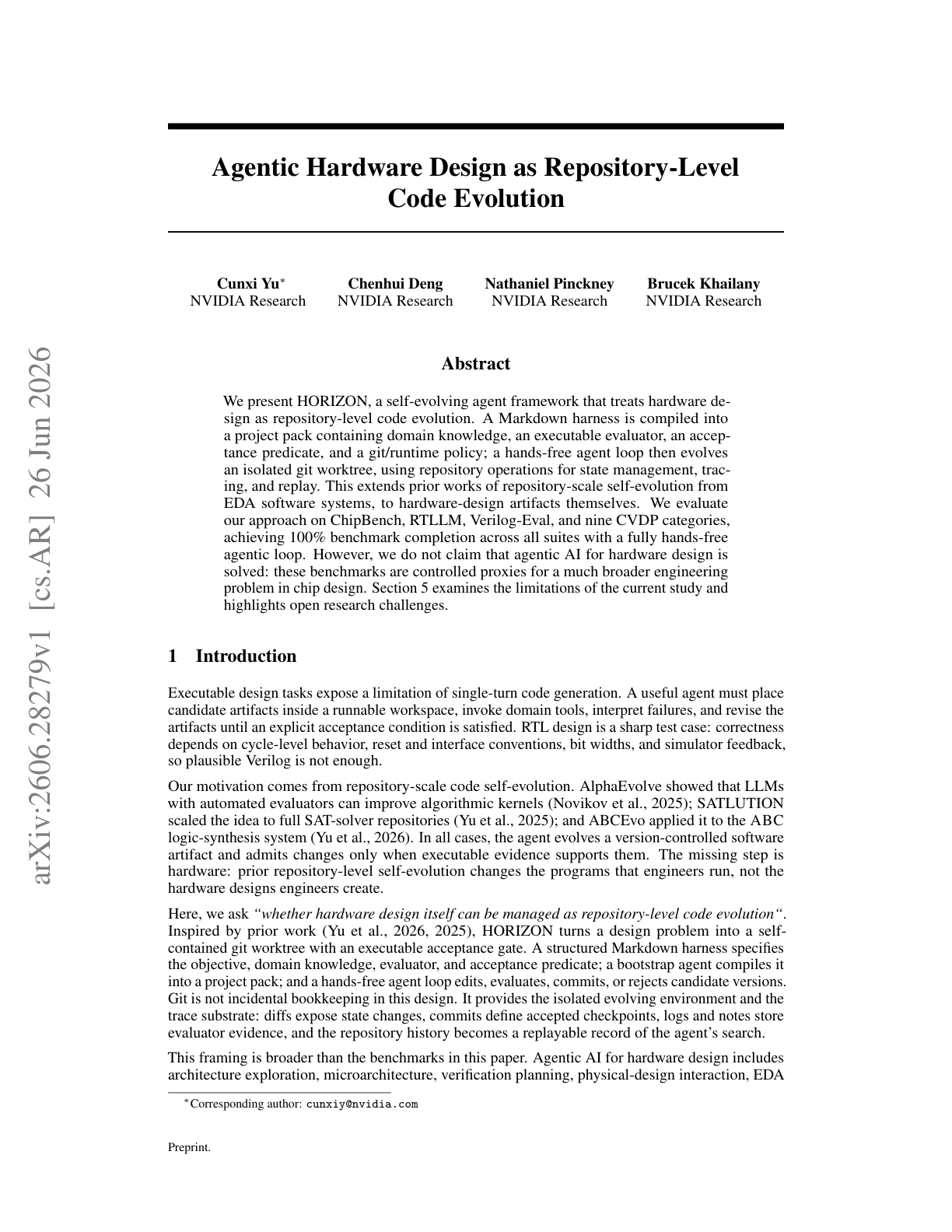
HORIZON
HORIZON treats hardware design as repository-level code evolution, compiling a Markdown harness into a project pack with domain knowledge, an executable evaluator, an acceptance predicate, and a git and runtime policy. A hands-free agent loop then evolves an isolated git worktree, using repository operations for state management, tracing, and replay. Across ChipBench, RTLLM, Verilog-Eval, and nine CVDP categories it reaches full benchmark completion with a completely hands-free loop, extending repository-scale self-evolution from EDA software to hardware artifacts themselves. ---
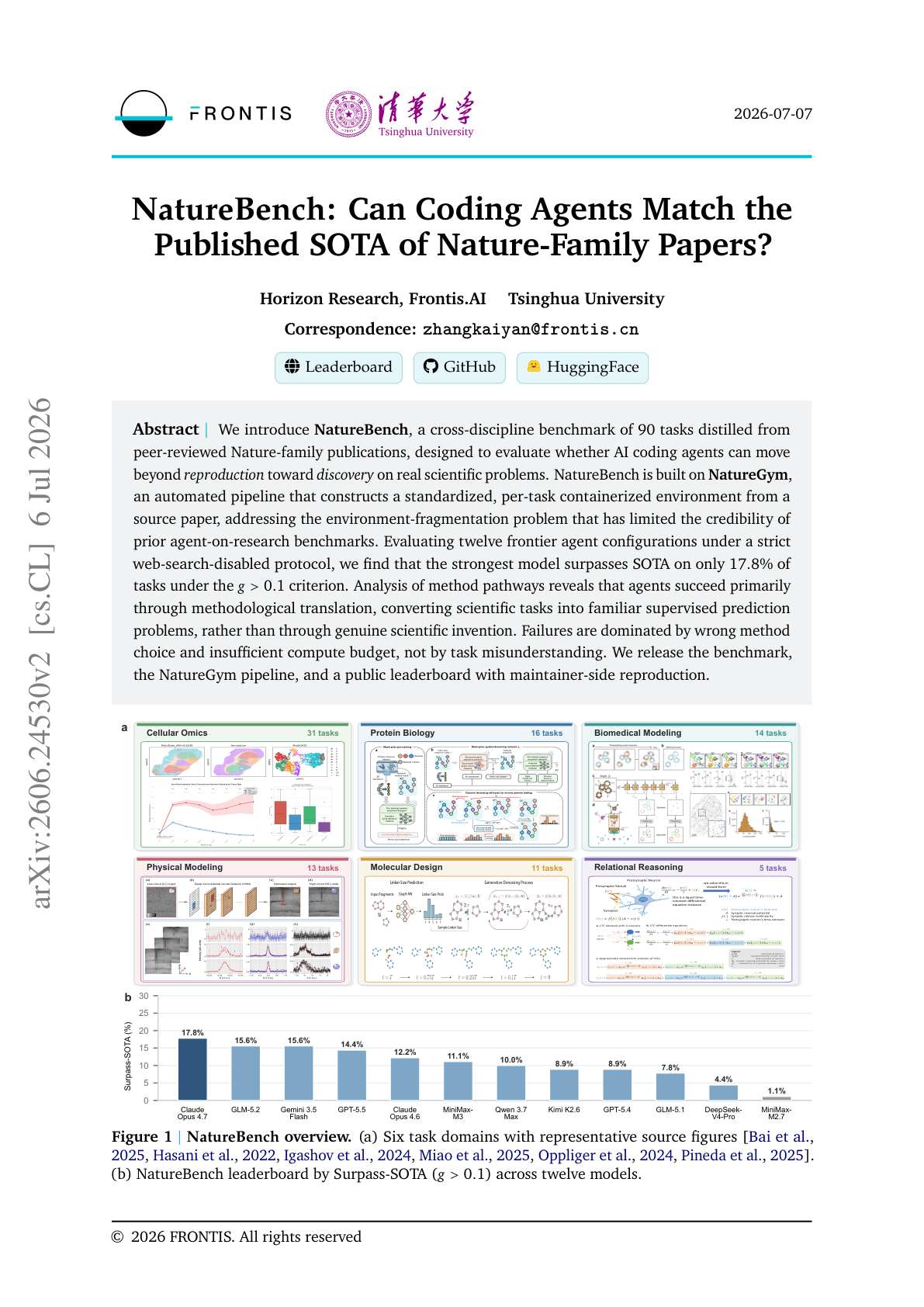
NatureBench
Can coding agents move past reproduction toward actual discovery on real scientific problems? NatureBench distills 90 cross-discipline tasks from peer-reviewed Nature-family papers and runs them in NatureGym, an automated pipeline that builds a standardized containerized environment per task to fix the environment-fragmentation problem. Under a strict web-search-disabled protocol, the strongest of ten frontier agent configurations beats published SOTA on only 17.8% of tasks, and analysis shows agents win mainly by translating problems into familiar supervised prediction rather than through genuine scientific invention.
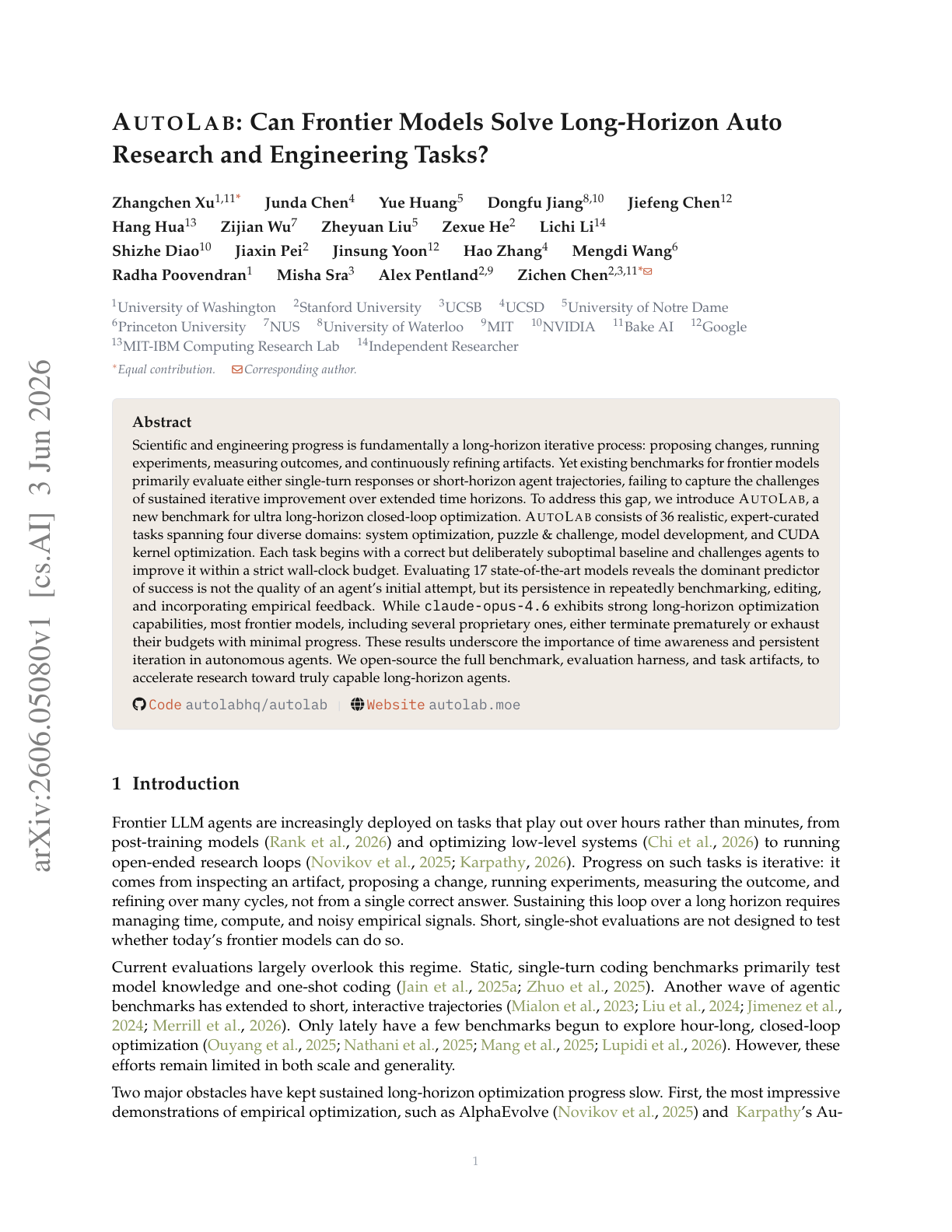
AutoLab
Can frontier models actually grind on a hard engineering problem the way a good researcher does? AutoLab is a benchmark for ultra long-horizon, closed-loop optimization built to answer that. It contains 36 realistic, expert-curated tasks across four domains: system optimization, puzzle and challenge, model development, and CUDA kernel optimization. Each task hands the agent a correct but deliberately suboptimal baseline and asks it to improve within a strict wall-clock budget.
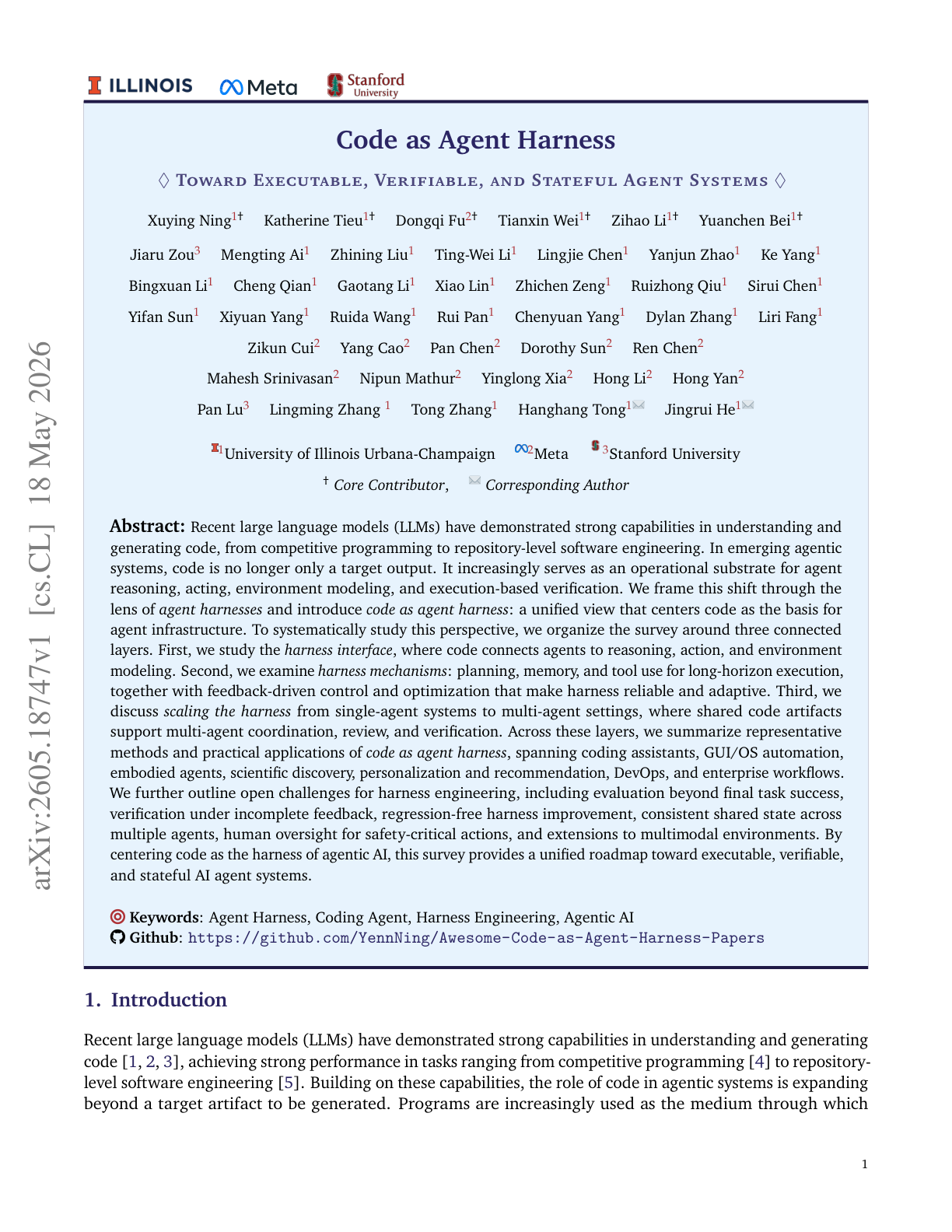
Code as Agent Harness
A 100+ page survey treating the agent harness as a first-class research object rather than glue around an LLM. The authors argue that code-as-harness is the most promising path to general-purpose agency, and that future agent systems should satisfy four properties: executable, inspectable, stateful, and governed. The report consolidates methods, applications, and open problems across the harness layer.
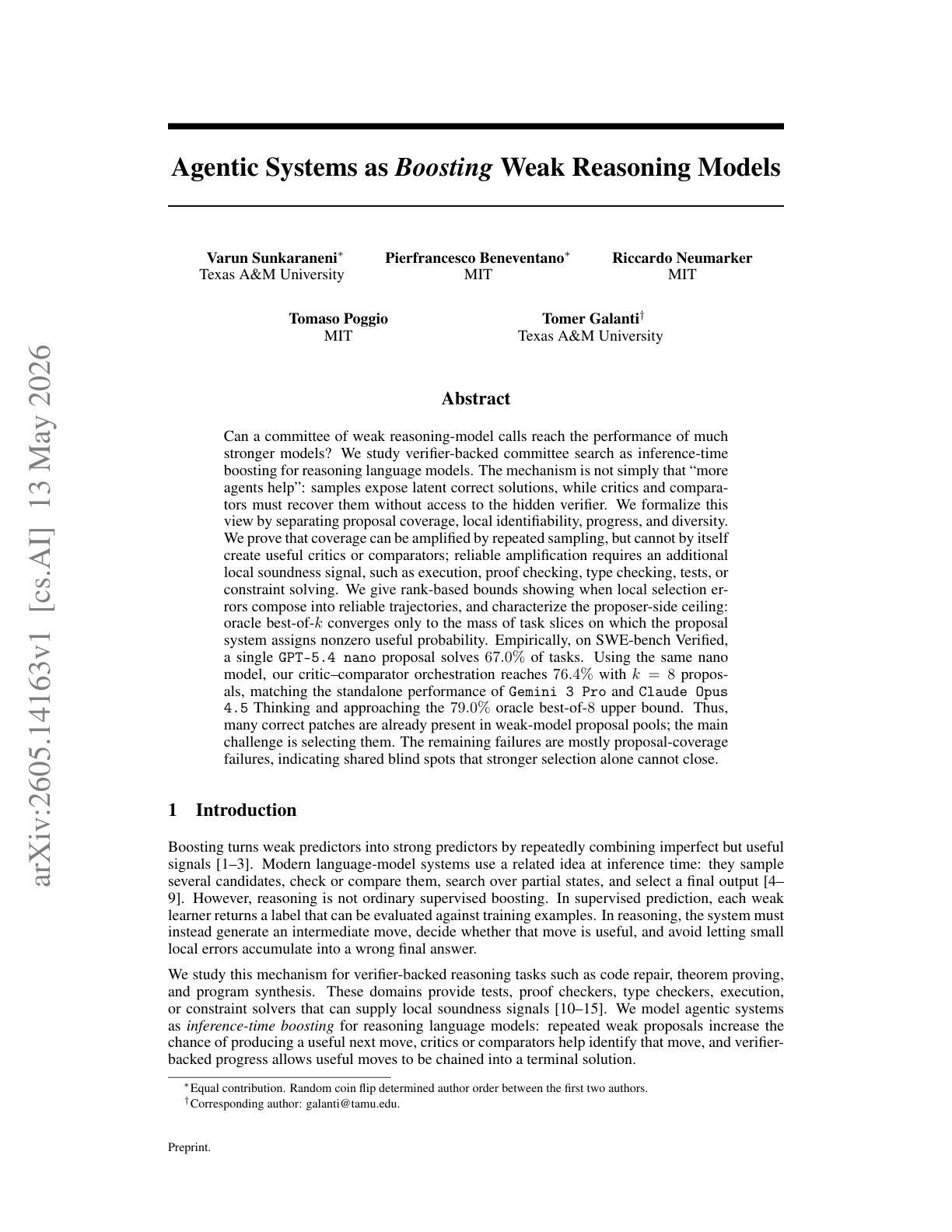
Weak-Model Critic-Comparator
GPT-5.4 nano wrapped in a critic-comparator orchestration loop reaches 76.4% on SWE-bench Verified, matching standalone Gemini 3 Pro and Claude Opus 4.5 Thinking. The trick is to sample k=8 candidate patches from the weak model and select the winner using execution and proof signals rather than asking the model to self-rank.