AI Papers of the Week
Every paper worth reading in AI, hand-picked one week at a time.
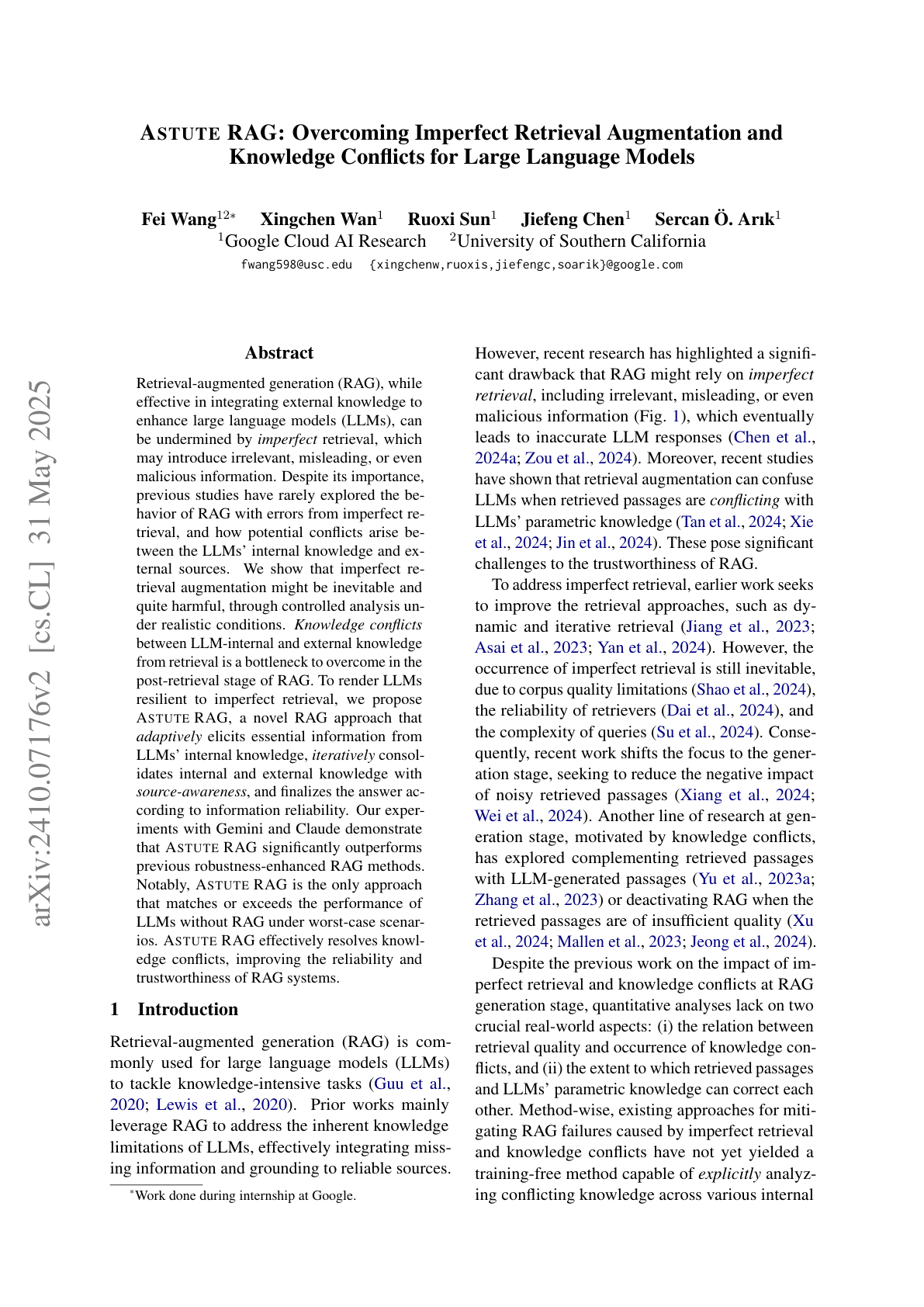
Astute RAG
proposes a novel RAG approach to deal with the imperfect retrieval augmentation and knowledge conflicts of LLMs; Astute RAG adaptively elicits essential information from LLMs' internal knowledge; then it iteratively consolidates internal and external knowledge with source awareness; Astute RAG is designed to better combine internal and external information through an interactive consolidation mechanism (i.e., identifying consistent passages, detecting conflicting information in them, and filtering out irrelevant information).
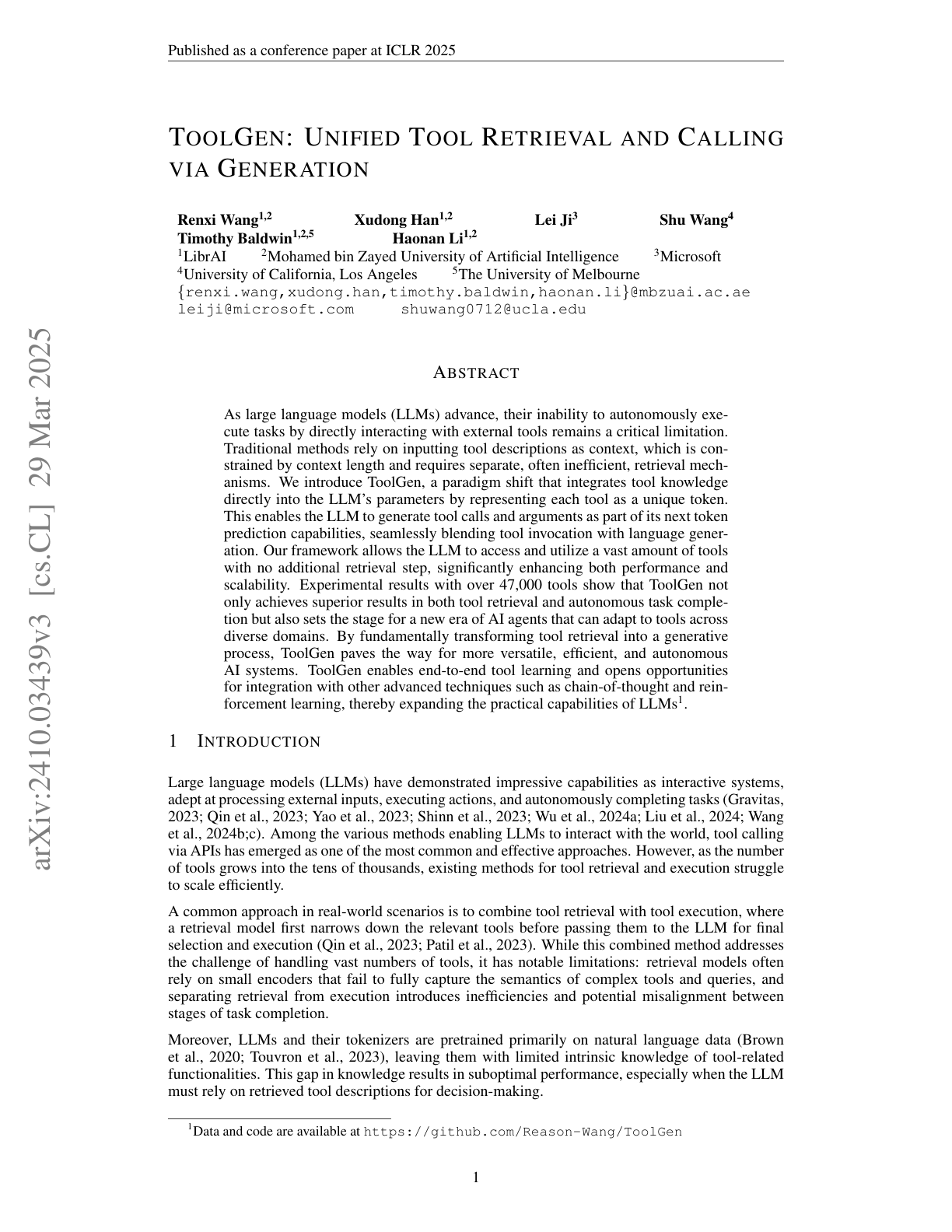
ToolGen
integrates tool knowledge directly into LLMs by representing tools as a unique token which allows the LLM to generate tool calls and arguments, enabling seamless tool invocation and language generation; experimental results with over 47,000 tools show that ToolGen achieves superior results in both tool retrieval and autonomous task completion.
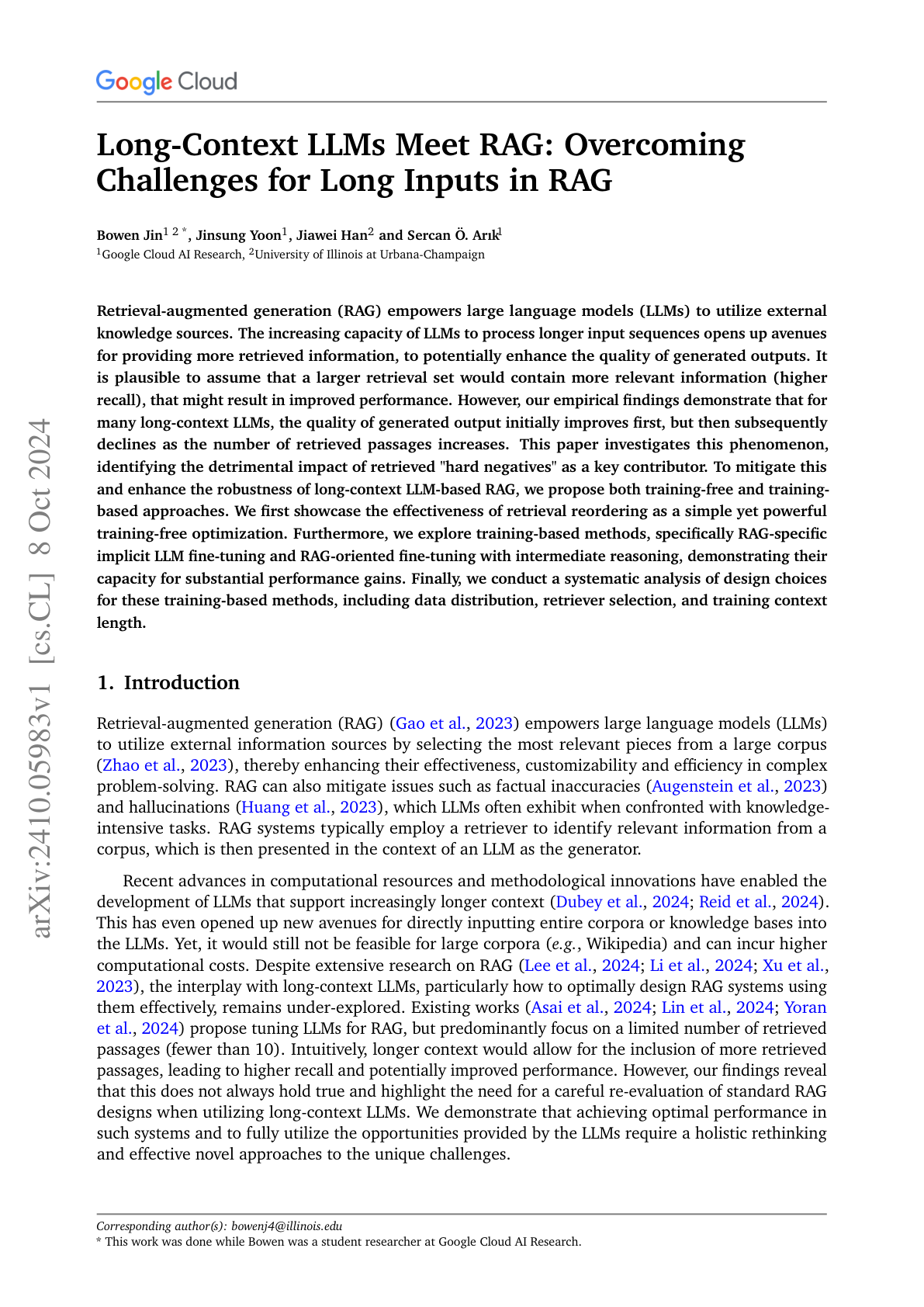
Long-Context LLMs Meet RAG
finds that for many long-context LLMs, the quality of outputs declines as the number of passages increases; reports that the performance loss is due to retrieved hard negatives; they propose two ways to improve long-context LLM-based RAG: retrieval reordering and RAG-specific tuning with intermediate reasoning to help with relevance identification; that approaches demonstrate significant accuracy and robustness improvements on long-context RAG performance.
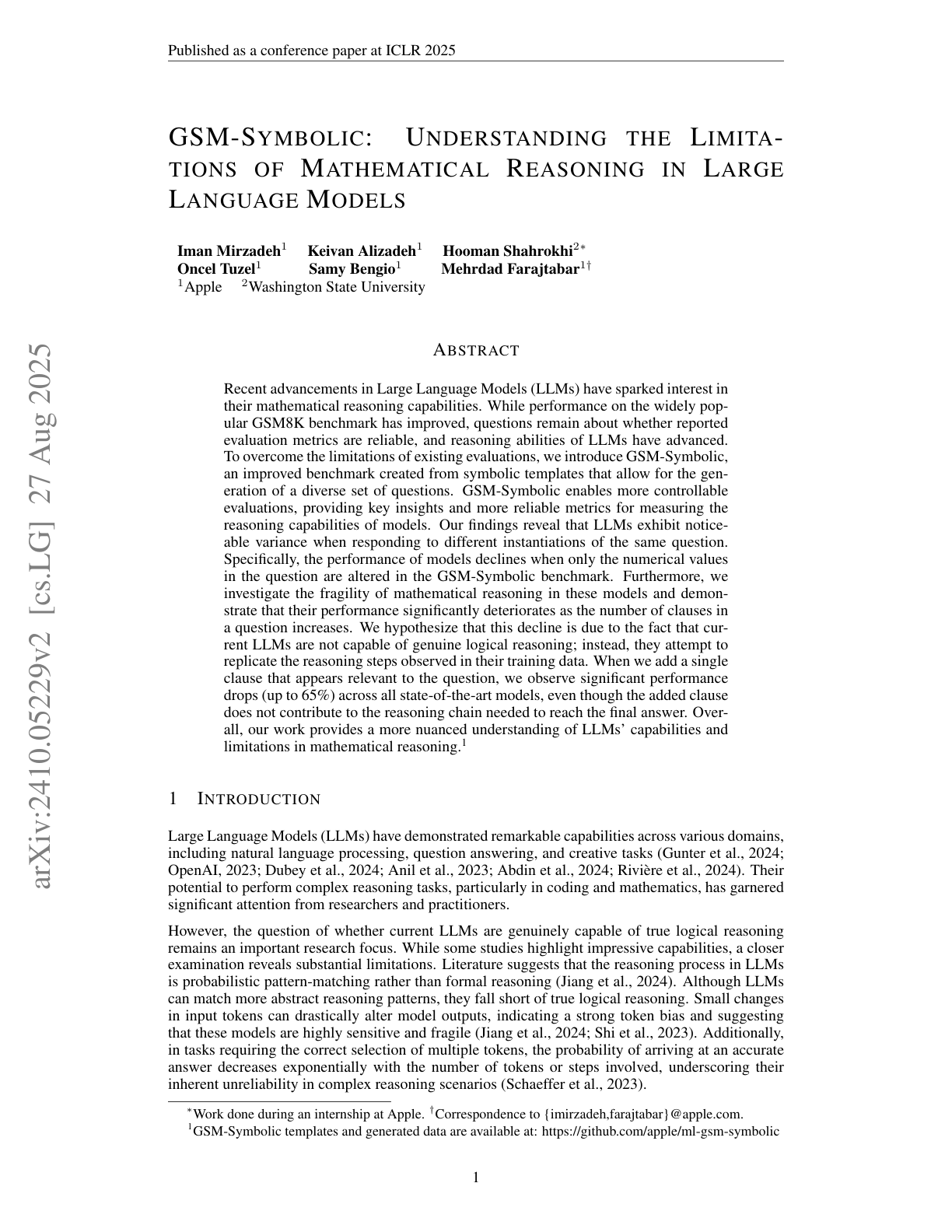
GSM-Symbolic
tests several SoTA models on a benchmark created with symbolic templates that enable diverse mathematical problems; they find that LLMs exhibit variance when responding to variations of the same questions; the performance of all the models declines by adjusting the numerical values in the question; as questions are made more challenging (e.g., increasing the number of clauses) the performance significantly deteriorates; the authors hypothesize that the observed decline in performance is due to a lack of logical reasoning in current LLMs.
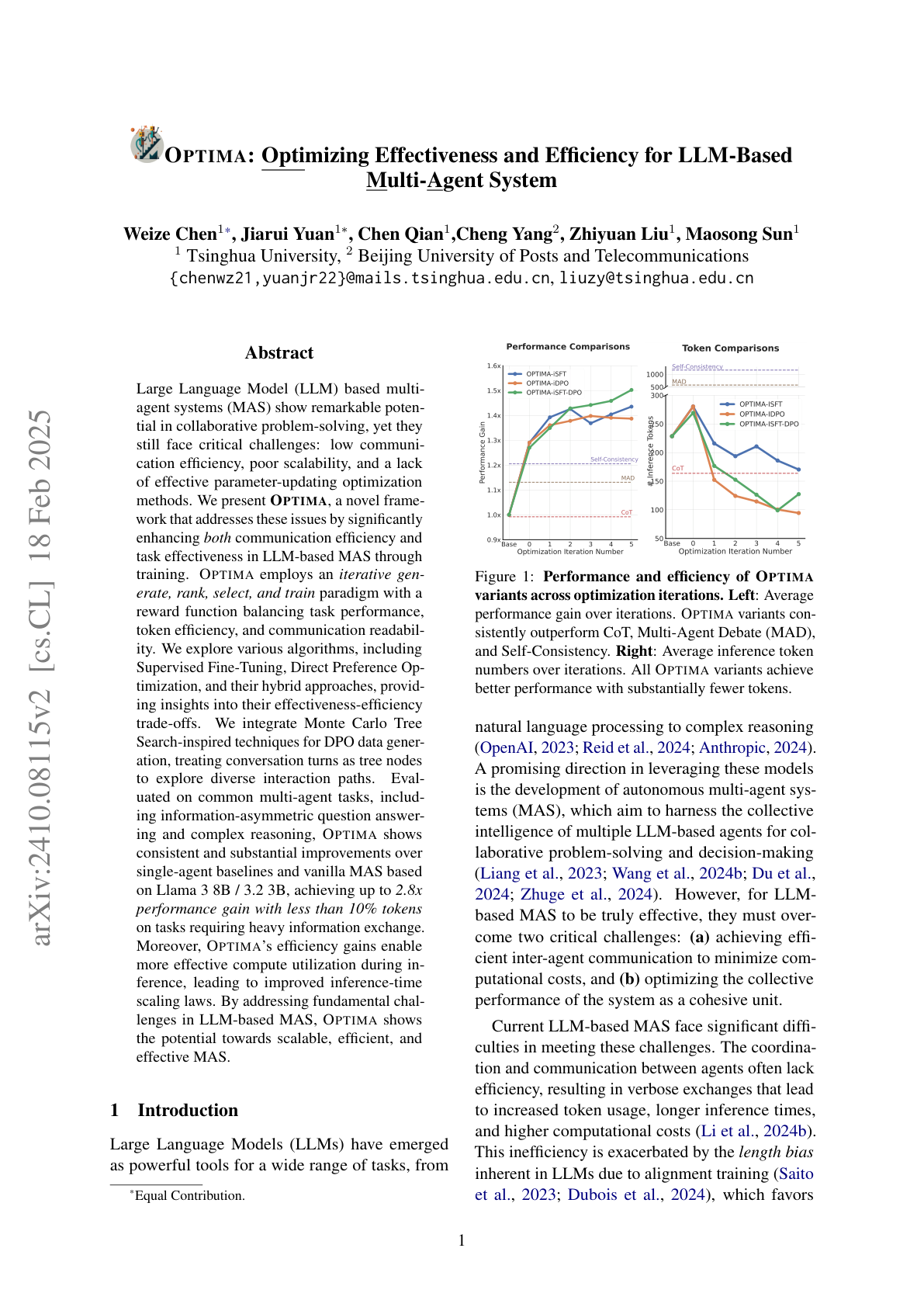
Optima
a novel framework to enhance both communication efficiency and task effectiveness in LLM-based multi-agent systems through LLM training; proposes an iterative generate, rank, select, and train paradigm with a reward function to improve performance, token use, and communication efficiency; integrates Monte Carlo Tree Search-inspired techniques for DPO data generation to encourage diverse exploration; shows consistent improvements over single-agent baselines and vanilla MAS based on Llama 3 8B, with 2.8x performance gain with less than 10% tokens on tasks requiring heavy information exchange.
ScienceAgentBench
a new benchmark to rigorously assess agents built for scientific workflows; after testing it on open-weight and proprietary LLMs, the best-performing agent can only solve 32.4% of the tasks independently and 34.3% with expert-provided knowledge.
Addition Is All You Need
proposes an algorithm that approximates floating point multiplication with integer addition operations; it is less computationally intensive than 8-bit floating point but achieves higher precision; the authors report that applying the purposed L-Mul operation in tensor processing hardware can potentially reduce 95% energy cost by elementwise floating point tensor multiplications and 80% energy cost of dot products.
Persuasion and Anti-social Ability of LLMs
studies the interaction patterns of LLMs in a multi-agent setting with social hierarchy; the study was done in a specific setting involving a guard and a prisoner who seeks additional yard time or escaping from prison; finds that in the multi-agent setting where power dynamics are involved, the LLMs fail to have a conversation; they also report that agents' personas are critical in driving the behaviors of the agents. In addition, and without explicit prompting, simply assigning agents' roles lead to anti-social behavior.

Movie Gen
a set of foundation models to generate high-quality, 1080p HD videos, including different aspect ratios and synchronized audio; the 30B parameter model supports a context length of 73K video tokens, which enables generation of 16-second videos at 16fps; it also presents a 13B parameter video-to-audio generation model and a novel video editing model that’s attained via post-training; achieves state-of-the-art performance on tasks such as text-to-video synthesis, video personalization, video-to-audio generation and more.
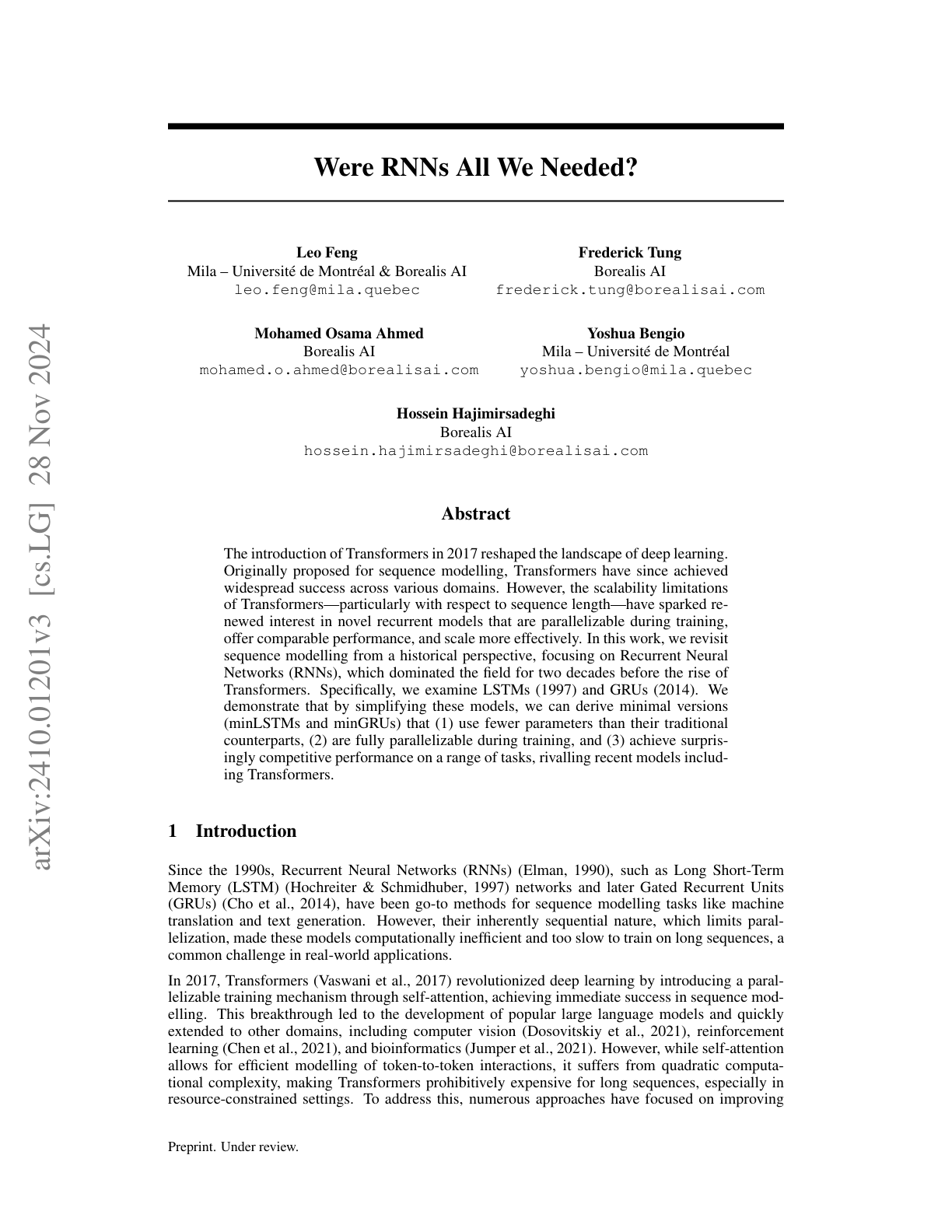
Were RNNs All We Needed?
revisits RNNs and shows that by removing the hidden states from input, forget, and update gates RNNs can be efficiently trained in parallel; this is possible because with this change architectures like LSTMs and GRUs no longer require backpropagate through time (BPTT); they introduce minLSTMs and minGRUs that are 175x faster for a 512 sequence length.
LLMs Know More Than They Show
finds that the "truthfulness" information in LLMs is concentrated in specific tokens; this insight can help enhance error detection performance and further mitigate some of these issues; they also claim that internal representations can be used to predict the types of errors the LLMs are likely to make.
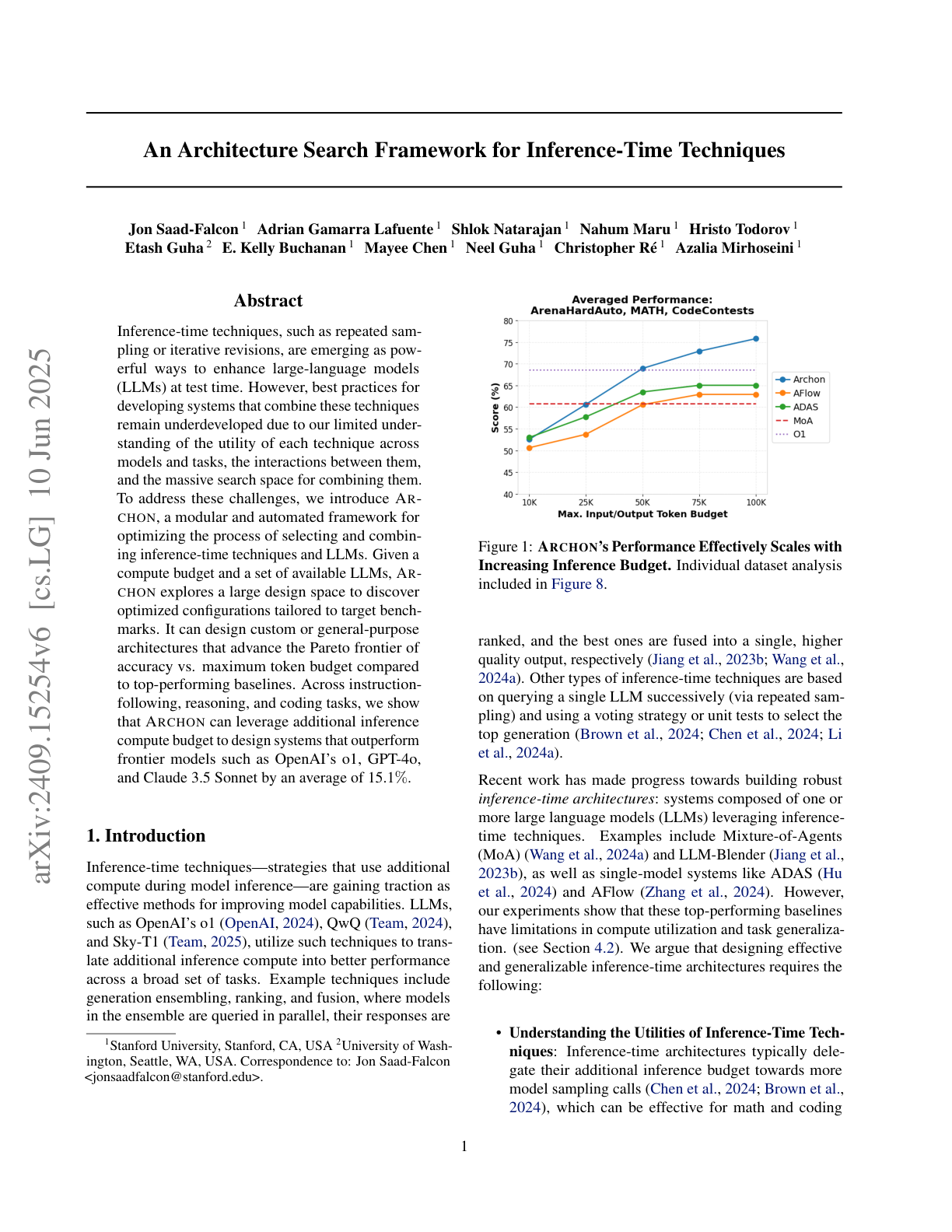
Architecture Search Framework for Inference-Time Techniques
introduces a modular framework for building and optimizing LLMs by combining multiple inference-time techniques; this approach reframes the challenge of LLM system design as a hyperparameter optimization problem; tested on benchmarks including MT-Bench and CodeContests, Archon surpasses leading models such as GPT-4o and Claude 3.5 Sonnet, achieving a 15.1% average accuracy improvement.
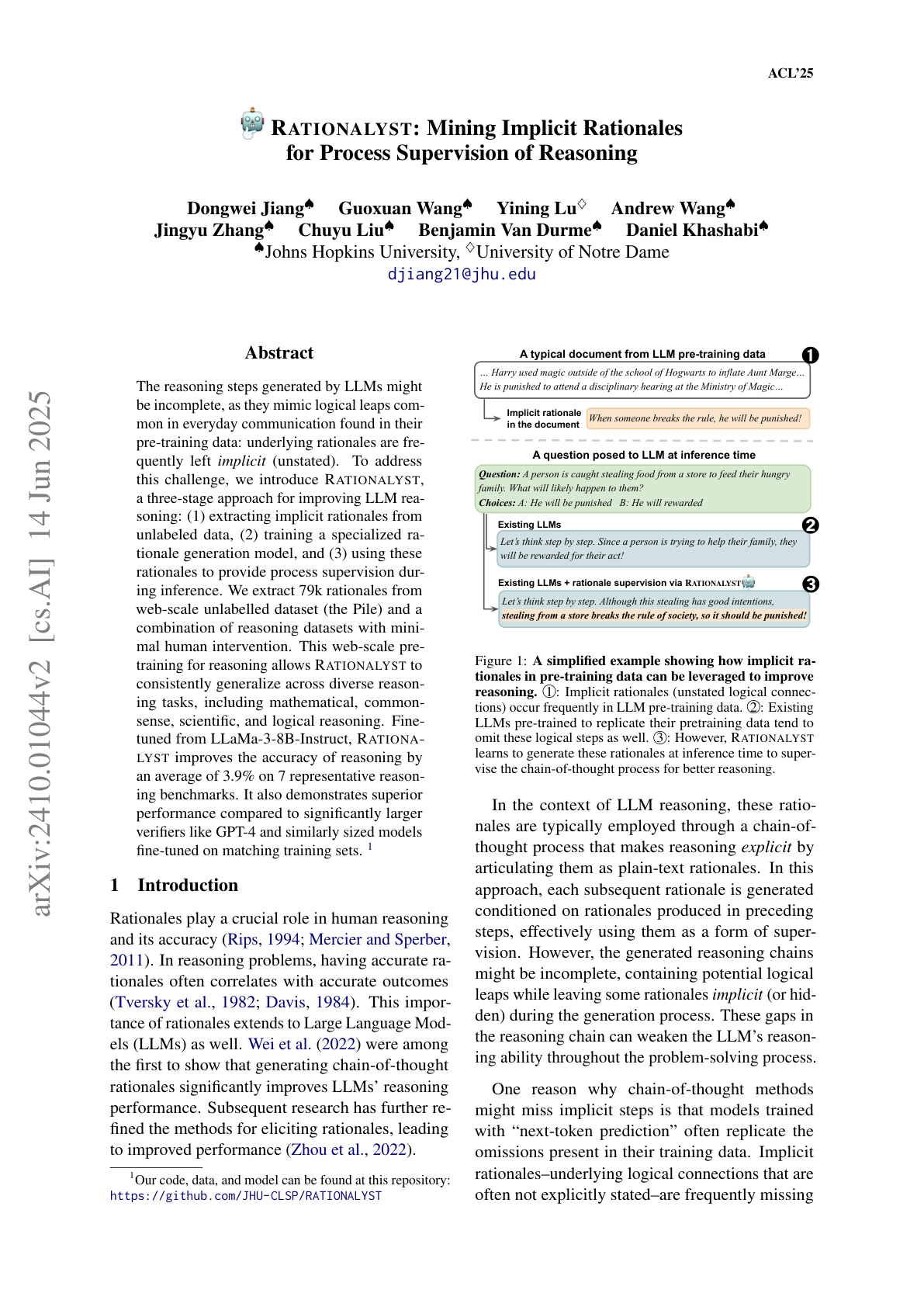
RATIONALYST
a model for process-supervision of reasoning that enables generalization across diverse reasoning tasks; this process is achieved with pre-training on a collection of 79k rationales from the Pile and a combination of reasoning datasets with minimal human intervention; fine-tuned from LLaMa-3-8B, the proposed model improves the accuracy of reasoning by an average of 3.9% on 7 reasoning benchmarks.
An Analysis of o1-preview
reports that large reasoning models like o1-preview, while improving on more difficult tasks, display similar qualitative trends as previous LLMs; o1 is sensitive to the probability of examples and tasks, performing better and requiring fewer “thinking tokens” in high-probability settings than in low-probability ones.
FRAMES
a unified framework to evaluate an LLM’s ability to provide factual responses, assess retrieval capabilities, and the reasoning required to generate final responses; includes multi-hop questions that require the integration of information from multiple sources; reports that state-of-the-art LLMs struggle on the task and only achieve 40% accuracy with no retrieval; the proposed multi-step retrieval approach improves performance to 66% accuracy.
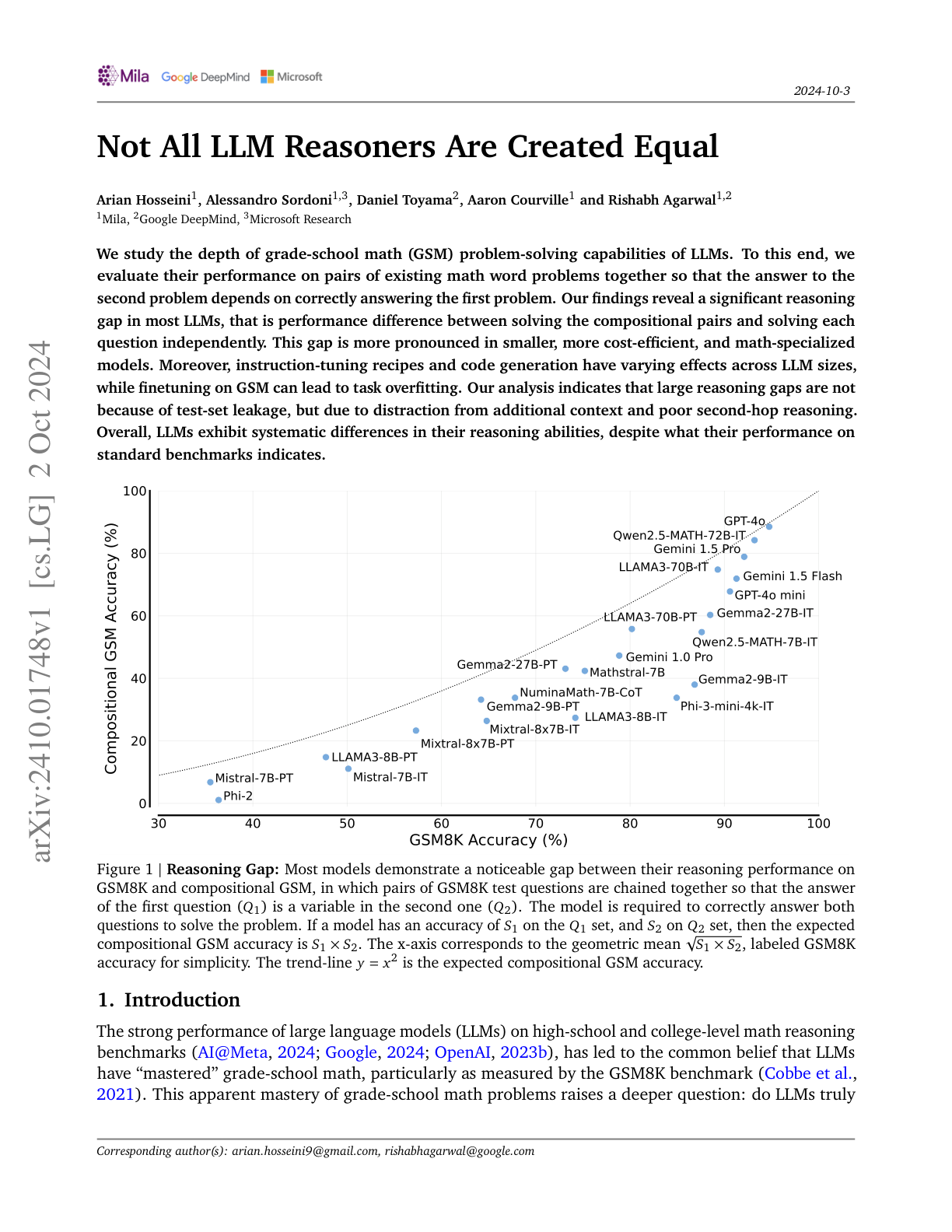
Not All LLM Reasoners Are Created Equal
investigates in depth the grade-school math problem-solving capabilities of LLMs; reports that LLMs show a significant gap in reasoning; finds that LLMs display a huge performance difference when solving compositional pairs and solving questions independently.
Evaluation of o1
provides a comprehensive evaluation of OpenAI's o1-preview LLM; shows strong performance across many tasks such as competitive programming, generating coherent and accurate radiology reports, high school-level mathematical reasoning tasks, chip design tasks, anthropology and geology, quantitative investing, social media analysis, and many other domains and problems.
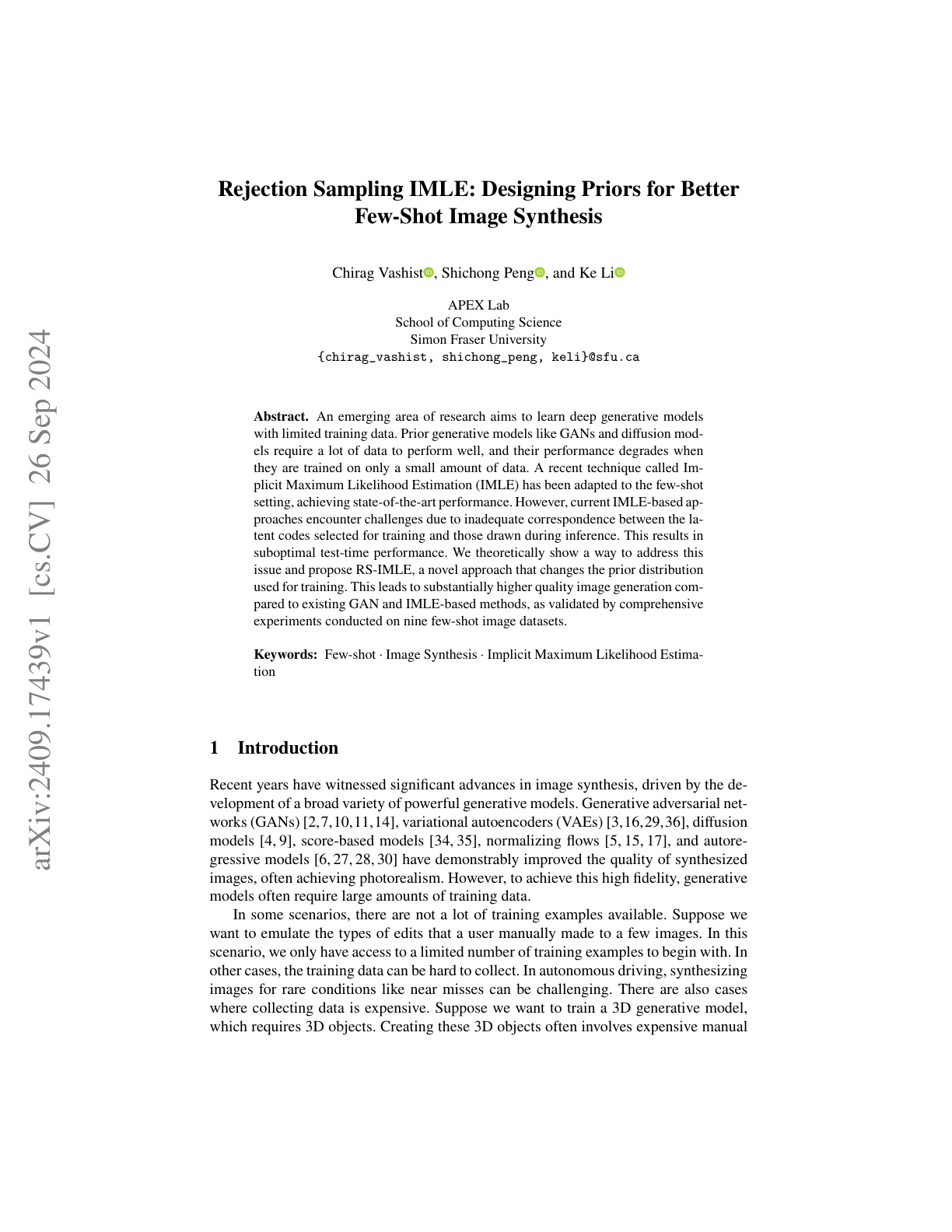
Designing Priors for Better Few-Shot Image Synthesis
training generative models like GAN with limited data is difficult; current Implicit Maximum Likelihood Estimation approaches (IMLE) have an inadequate correspondence between latent code selected for training and those selected during inference; the proposed approach, RS-IMLE, changes the prior distribution for training which improves test-time performance and leads to higher quality image generation.
Llama 3.2
presents small and medium-sized vision LLMs (11B and 90B parameters), and lightweight, text-only models (1B and 3B); the text-only models are trained to support context length of 128K tokens and outperform other models in their class on a range of tasks; vision models exceed other models such as Claude 3 Haiku on image understanding tasks.

**Molmo
** - - presents a family of open, state-of-the-art multimodal AI models; the 72B model in the Molmo family outperforms others in the class of open weight and data models; it also compares favorably against proprietary models like GPT-4o, Claude 3.5, and Gemini 1.5 on several benchmarks.
AlphaChip
a reinforcement learning-based method trained to design the physical layout of chips; AlphaChip is reportedly used in three additional generations of Google’s TPU; this release includes an open-source implementation of the method to help pre-train on a variety of chip blocks to apply to new blocks; also releases a model checkpoint pre-trained on 20 TPU blocks.
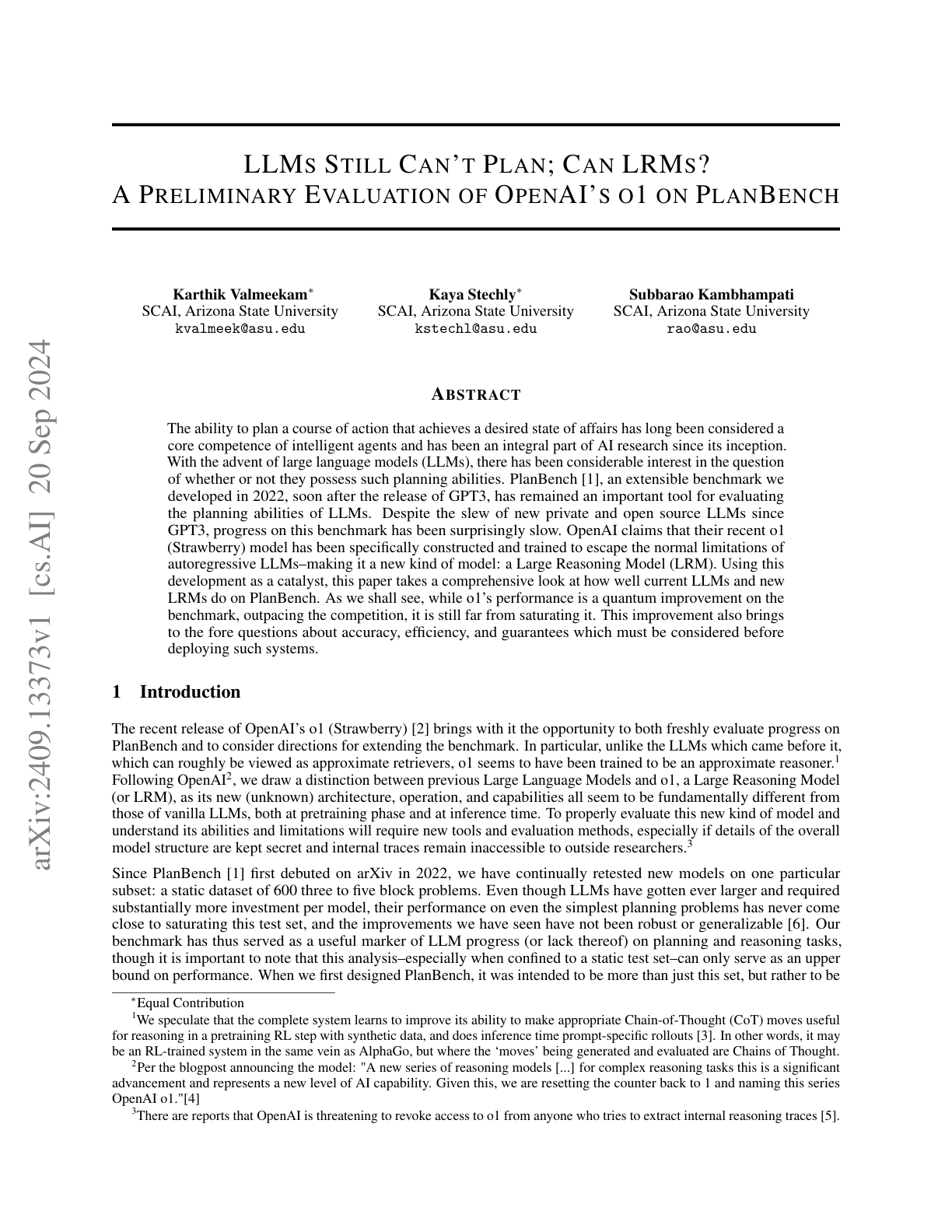
LLMs Still Can’t Plan
evaluates whether large reasoning models such as o1 can plan; finds that a domain-independent planner can solve all instances of Mystery Blocksworld but LLMs struggle, even on small instances; o1-preview is effective on the task but tend to degrade in performance as plan length increases, concludes that while o1 shows progress on more challenging planning problems, the accuracy gains cannot be considered general or robust.
Scaled-up Instructable Model Become Less Reliable
suggests that larger and more instructable LLMs may become less reliable; investigates LLMs across three elements: difficulty concordance, task avoidance, and prompting stability; finds that early models often avoid user questions but scaled-up, shaped-up models tend to give an apparently sensible yet wrong answer much more often, including errors on difficult questions that human supervisors frequently overlook.
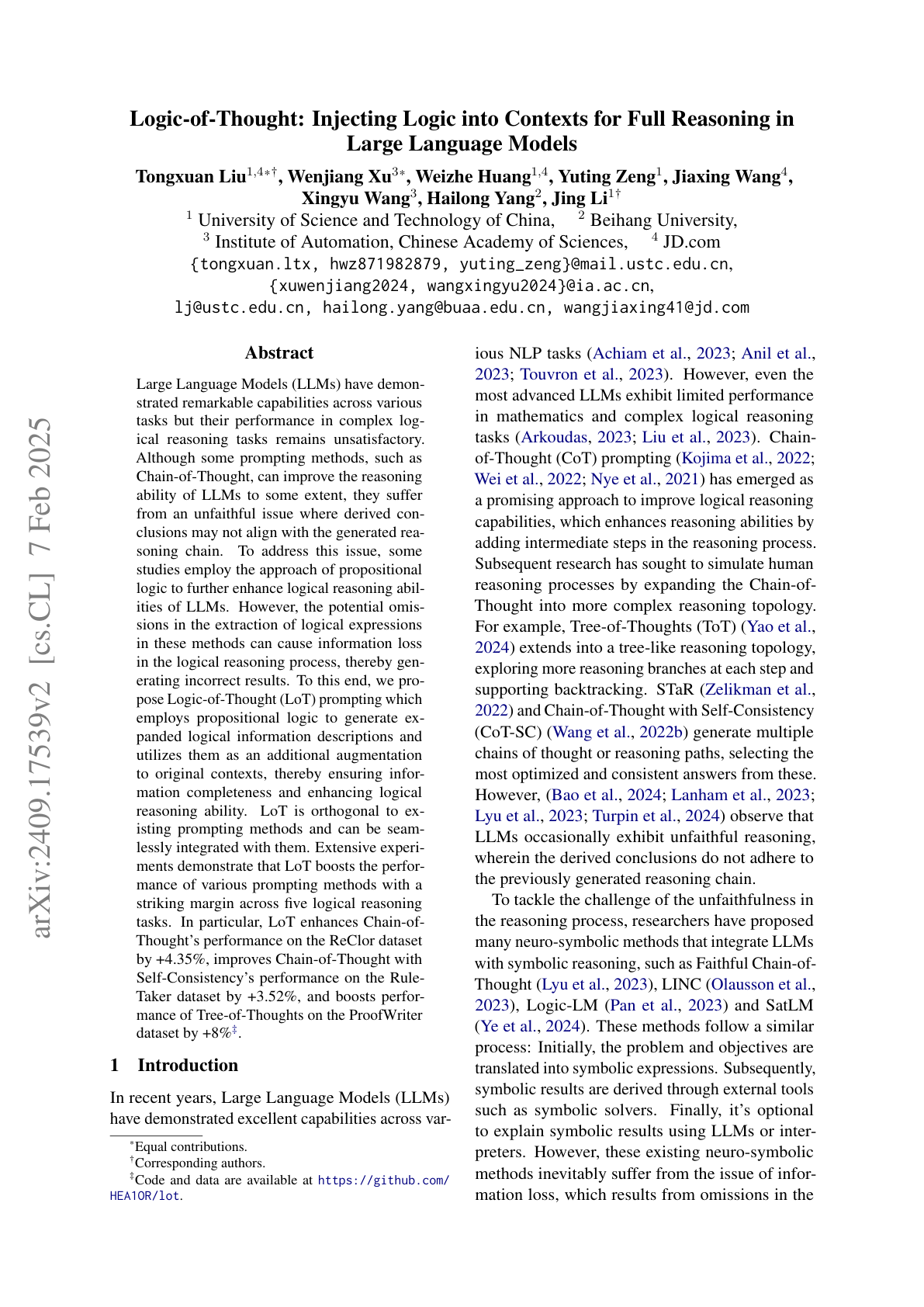
Logic-of-Thought
proposes a new prompting technique called Logic-of-Thought (LoT) which employs propositional logic to generate and inject expanded logical information from the input context; it enhances CoT performance on the ReClor dataset by +4.35%; it improves CoT+SelfConsistency’s performance on LogiQA by +5%; it also boosts the performance of ToT on the ProofWriter dataset by +8%.