AI Papers of the Week
Every paper worth reading in AI, hand-picked one week at a time.
Discover and explore top AI papers with Claude Code or Codex
npx @dair-ai/mcp setup
Demystifying RL in Agentic Reasoning
This paper studies what actually works when using RL to improve tool-using LLM agents, across three axes: data, algorithm, and reasoning mode. The team contributes a real end-to-end SFT dataset, a diverse RL set, and a compact 4B agent that beats larger models on agentic benchmarks.
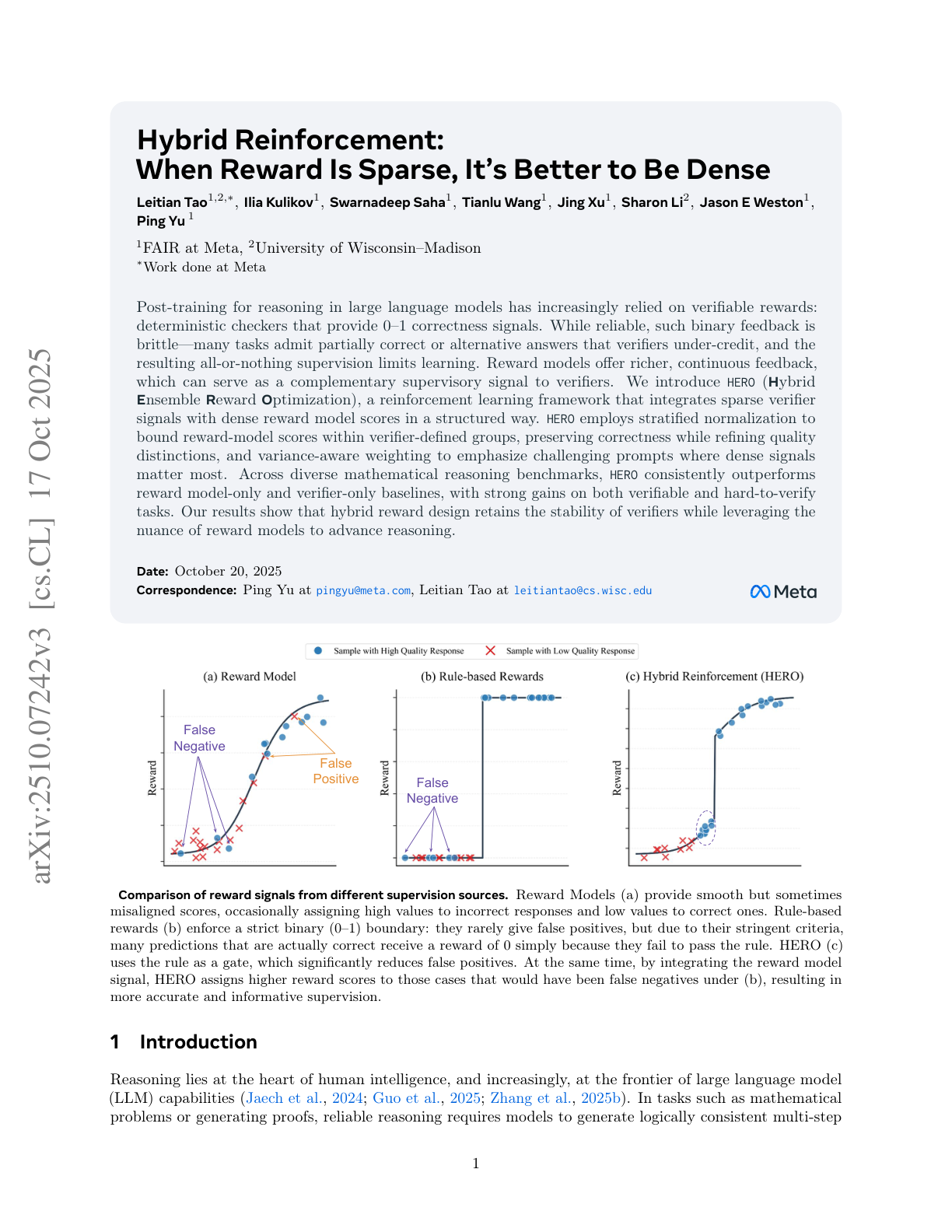
Hybrid Reinforcement
HERO (Hybrid Ensemble Reward Optimization) is a reinforcement learning framework that combines binary verifier feedback with continuous reward-model signals to improve LLM reasoning. By using stratified normalization and variance-aware weighting, HERO balances correctness and nuance, outperforming verifier-only and RM-only methods on diverse math reasoning benchmarks and enhancing performance on both verifiable and ambiguous tasks.
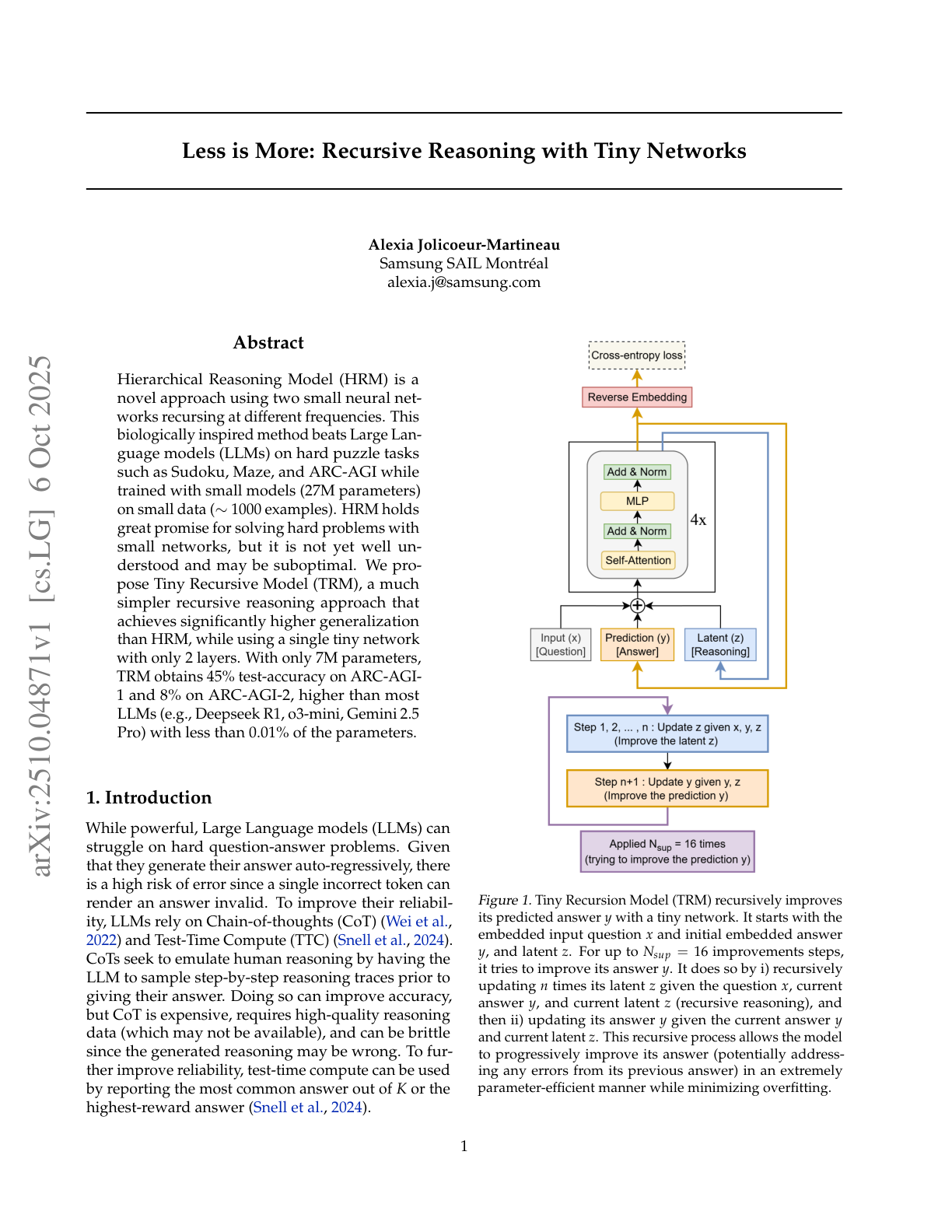
Tiny Recursive Model
A simple, data-efficient alternative to the hierarchical hearoning model (HRM) that uses a single tiny 2-layer network to iteratively refine a latent state and the predicted answer. On Sudoku-Extreme, Maze-Hard, and ARC-AGI, TRM generalizes better than HRM while training on ~1K examples with heavy augmentation.
Reasoning over Longer Horizons via RL
The authors show that you can scale long-horizon reasoning without step labels or heavy scaffolding. They synthesize long problems by chaining easy ones, then train with outcome-only rewards under a length curriculum. The result: large gains on both in-domain chains and harder out-of-domain math and long-context tasks.
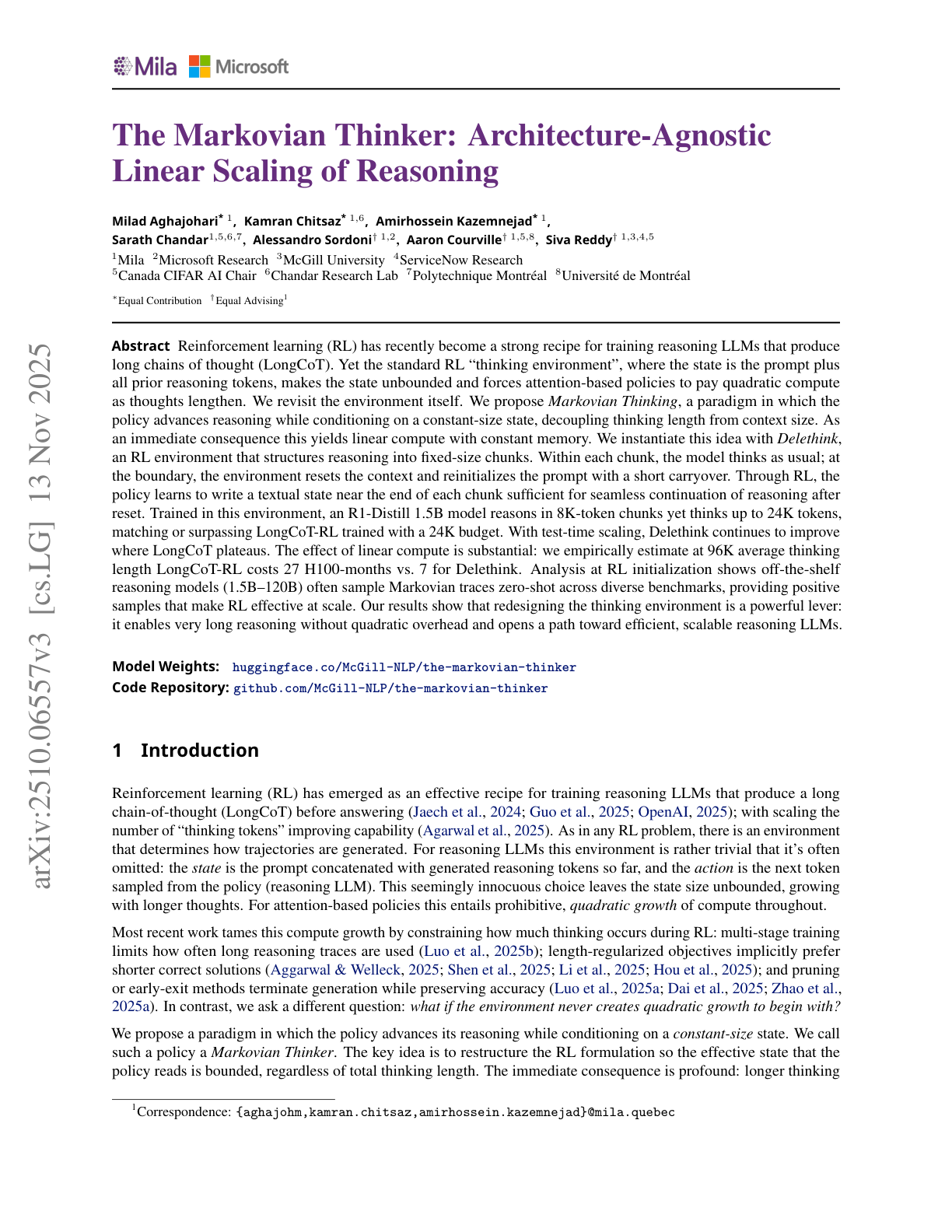
The Markovian Thinker
A new RL thinking environment that keeps an LLM’s effective state constant by chunking long chains of thought and carrying over only a short textual state between chunks. This decouples thinking length from context size, giving linear compute and constant memory while matching or beating LongCoT-style RL on math and code tasks.
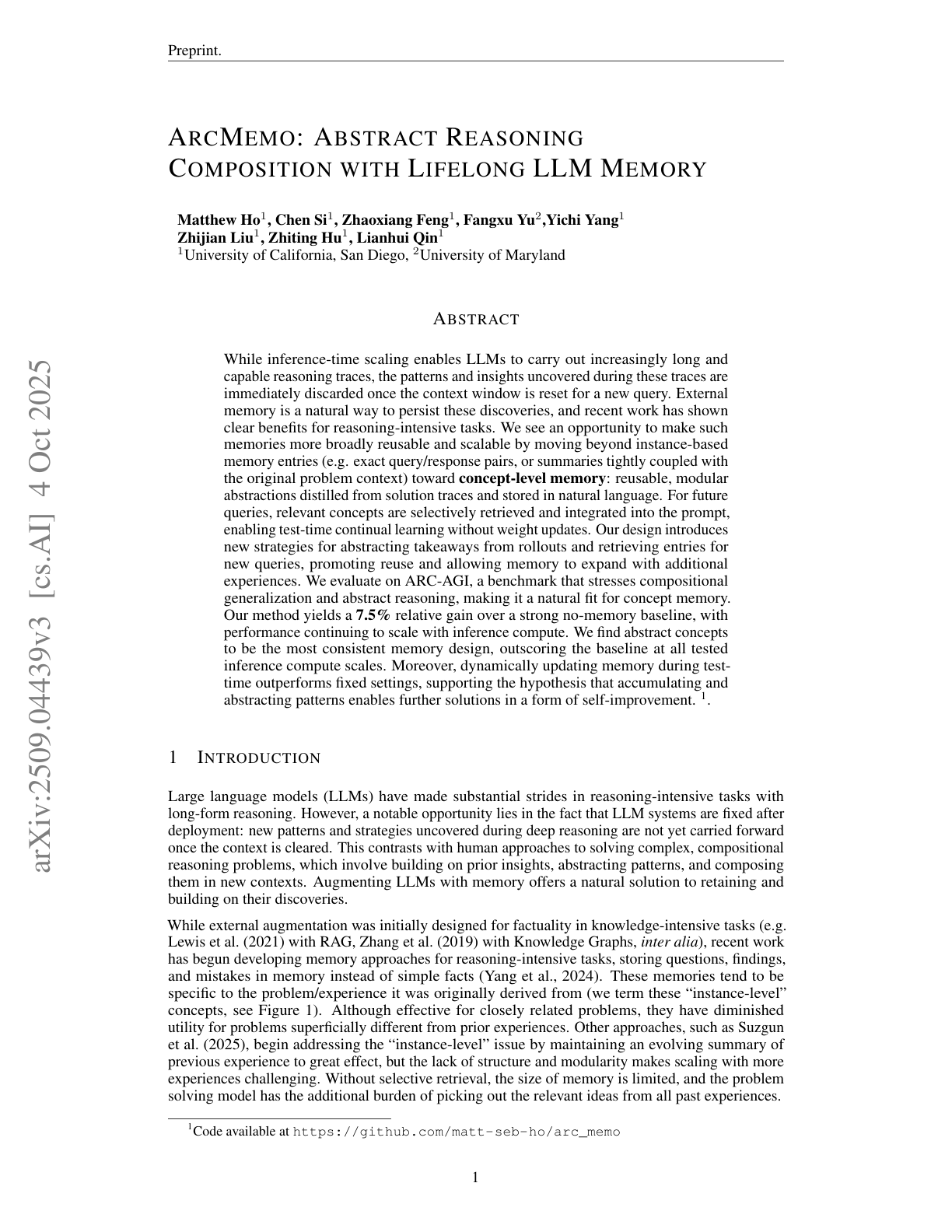
Abstract Reasoning Composition
UC San Diego and UMD propose ArcMemo, a test-time memory framework that distills reusable concepts from solution traces, stores them in natural language, and retrieves a relevant subset on future queries. Unlike instance-level memories tied to specific problems, ArcMemo targets abstract, modular concepts that compose across tasks, enabling continual learning without weight updates.
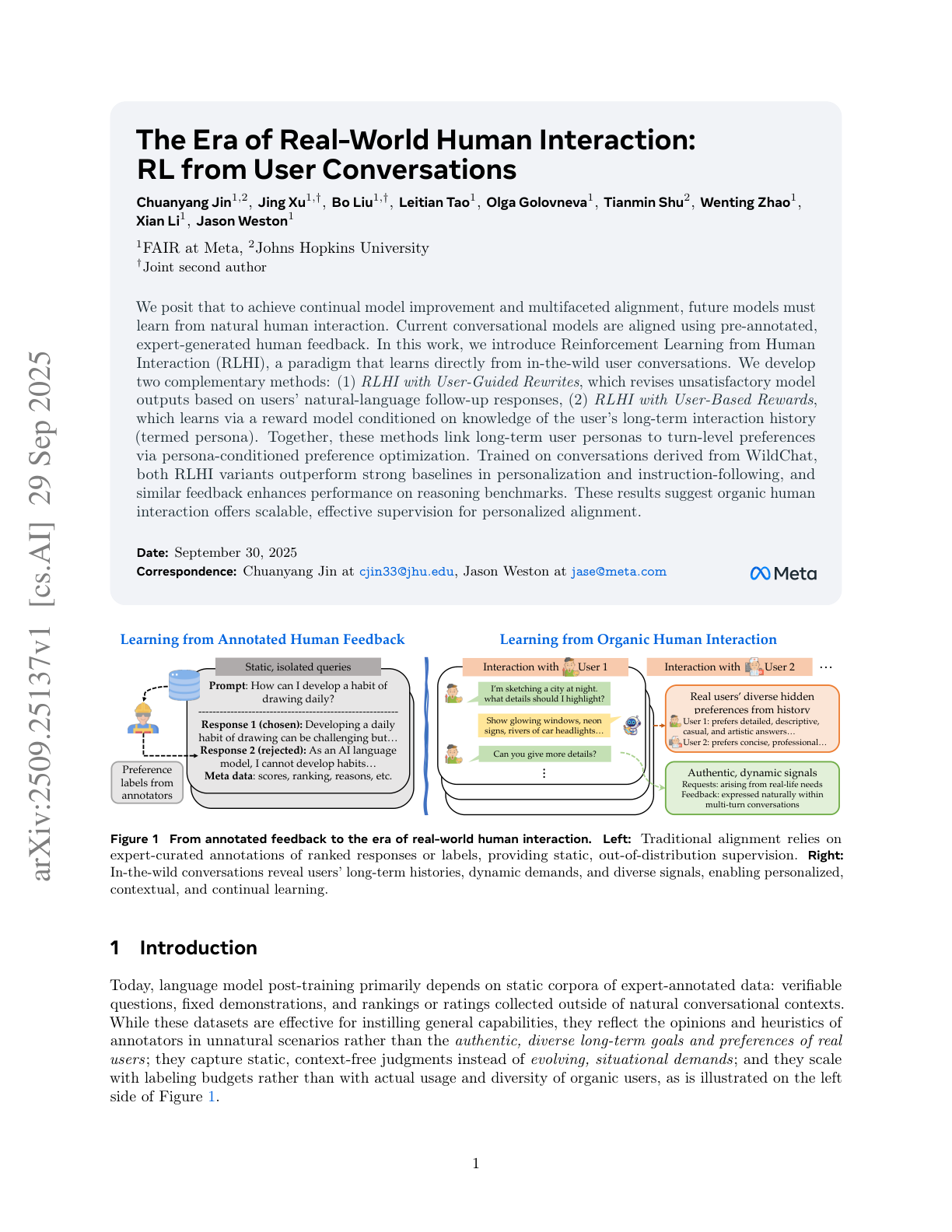
The Era of Real-World Human Interaction
This work presents a post-training recipe that learns directly from real user conversations instead of static annotator labels. RLHI combines user-guided rewrites (using follow-ups as corrections) with persona-based rewards (ranking sampled candidates via a persona-conditioned reward model). Trained on WildChat conversations, it shows strong improvements in personalization, instruction following, and even transfers to reasoning tasks.
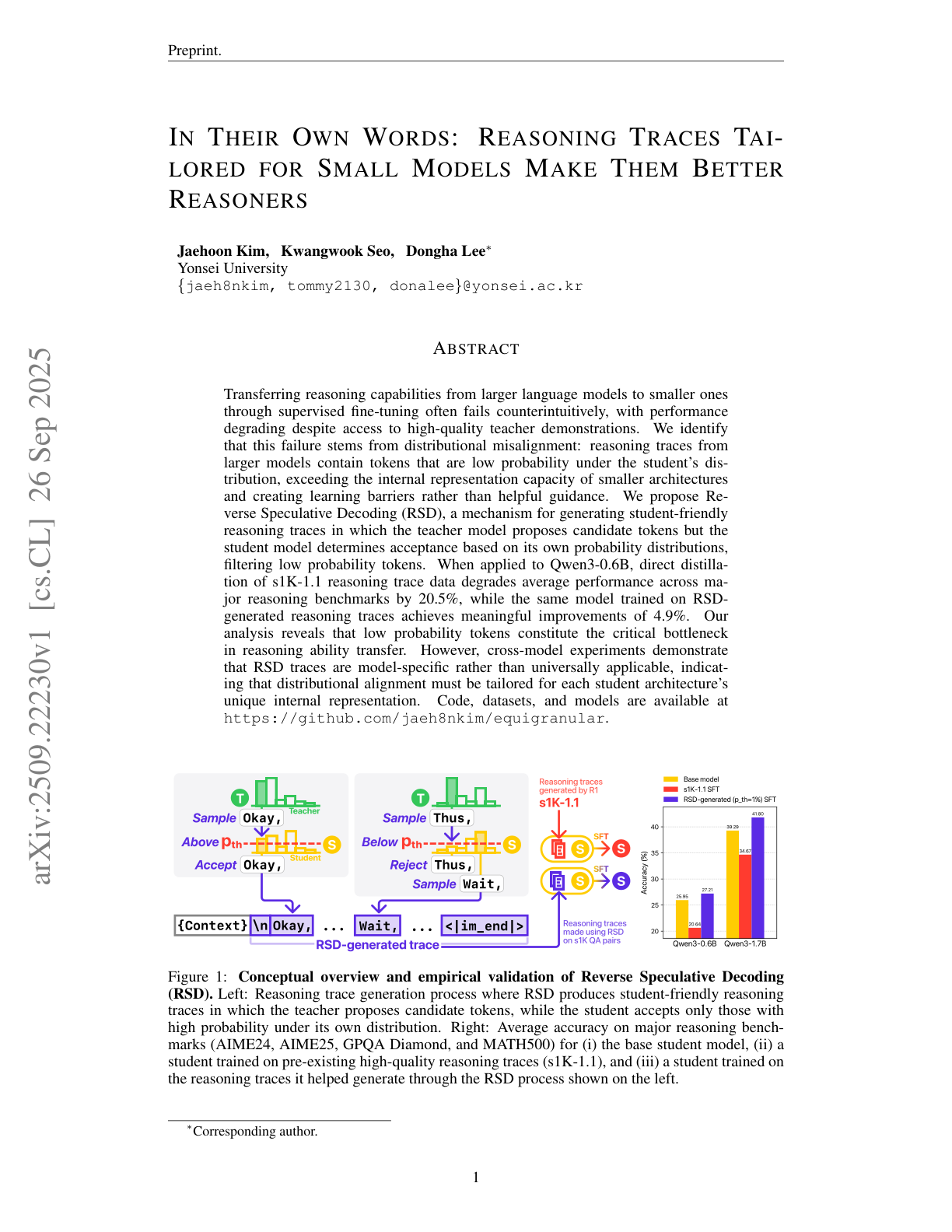
Reasoning Traces Tailored for Small Models
Small models often get worse when you SFT them on long, high-quality CoT from big teachers. This paper pinpoints why and fixes it with Reverse Speculative Decoding (RSD): let the teacher propose tokens, but let the student approve them only if they are probable under the student. Result: traces that stay correct while matching the student’s distribution, which small models can actually learn from.
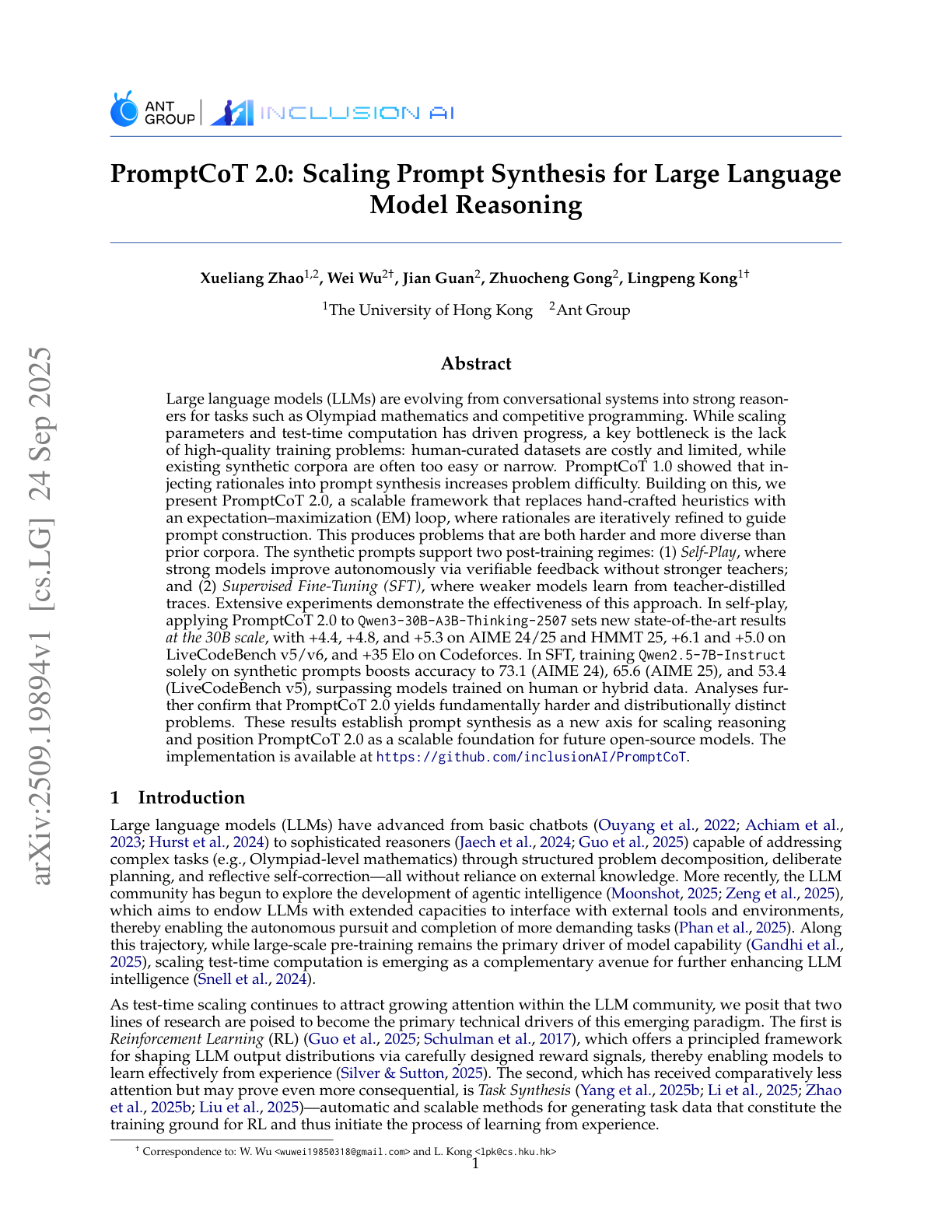
PrompCoT 2.0
PromptCoT 2.0 introduces an EM-based loop for synthesizing harder and more diverse reasoning prompts, replacing manual heuristics from PromptCoT 1.0. It enables both self-play and SFT training regimes, achieving new SOTA on reasoning benchmarks like AIME, HMMT, LiveCodeBench, and Codeforces, showing prompt synthesis as a new scaling axis for LLM reasoning.
Code World Model
Meta FAIR releases CWM, a 32B open-weights coder trained to model code execution and to act inside containers. It mid-trains on Python interpreter traces and agentic Docker trajectories, then upgrades with multi-turn RL across SWE, coding, and math. CWM is both a strong coder and a testbed for world-model-style reasoning in software environments.
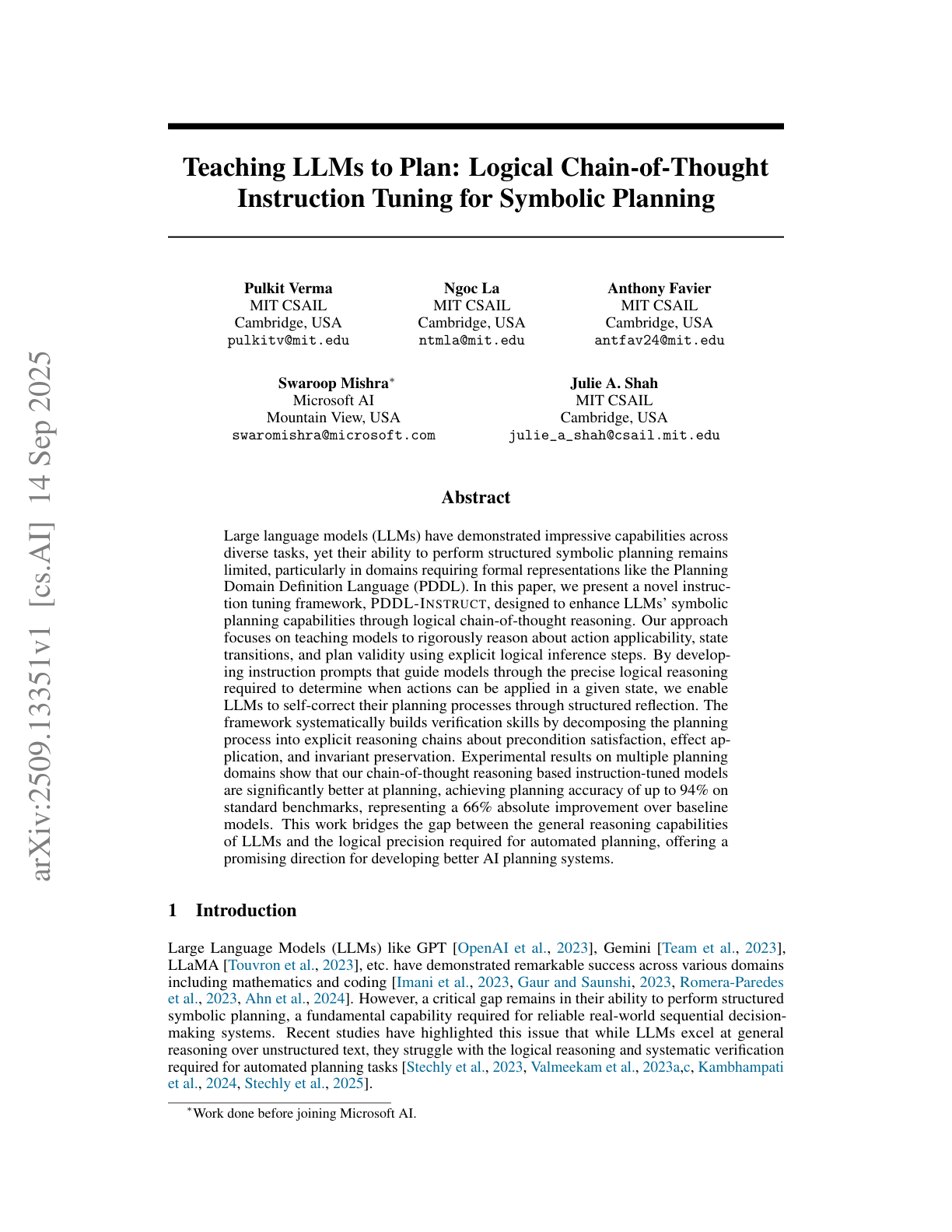
Teaching LLMs to Plan
A training recipe that teaches LLMs to plan in Planning Domain Definition Language (PDDL) by making them write explicit state–action–state chains and checking each step with an external verifier (VAL). The result: big jumps in plan validity on PlanBench domains, especially when feedback explains why an action failed rather than just saying it failed.
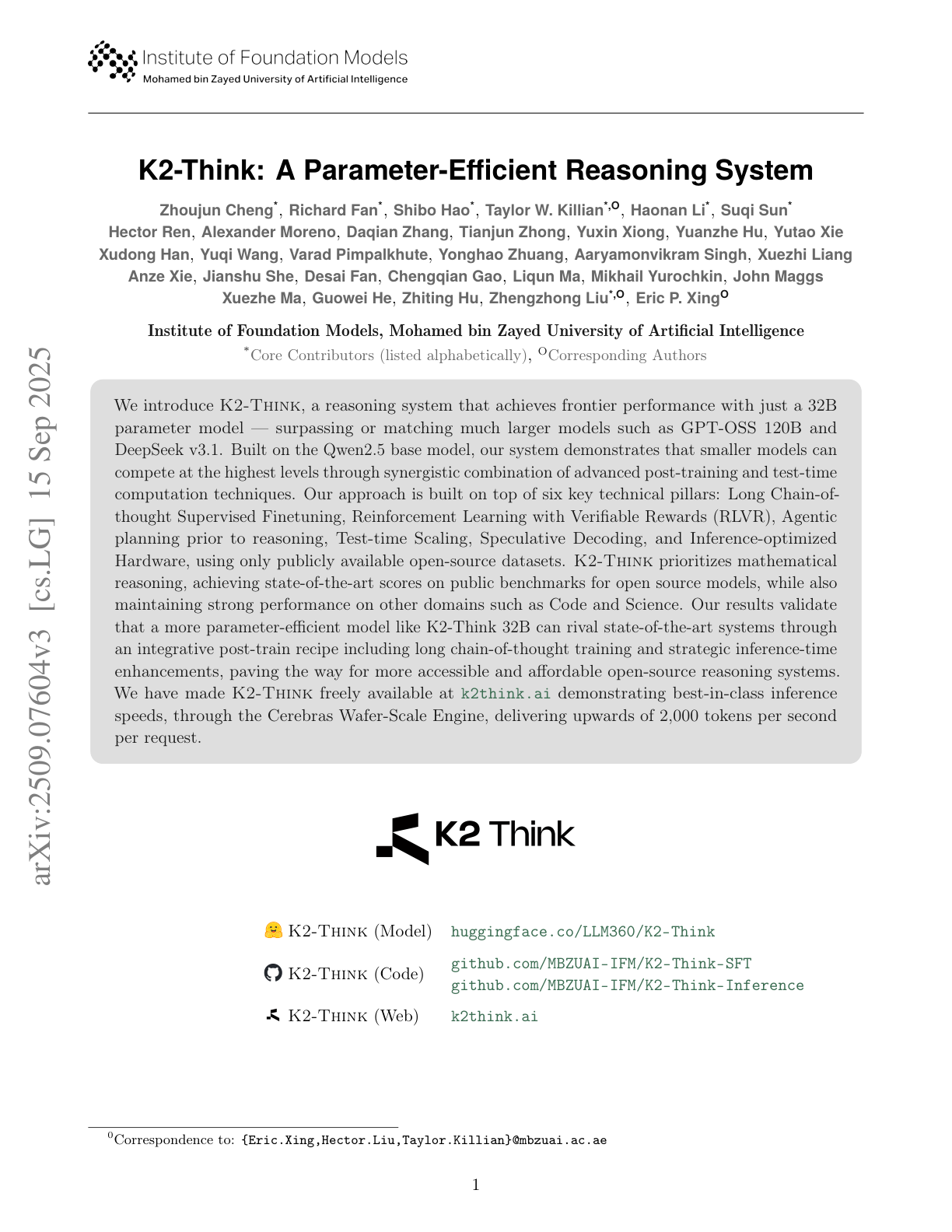
K2-Think
A 32B-parameter system built on Qwen2.5 that rivals or beats far larger models on hard math by combining long CoT SFT, RL with verifiable rewards, lightweight test-time scaffolding, and inference optimization.
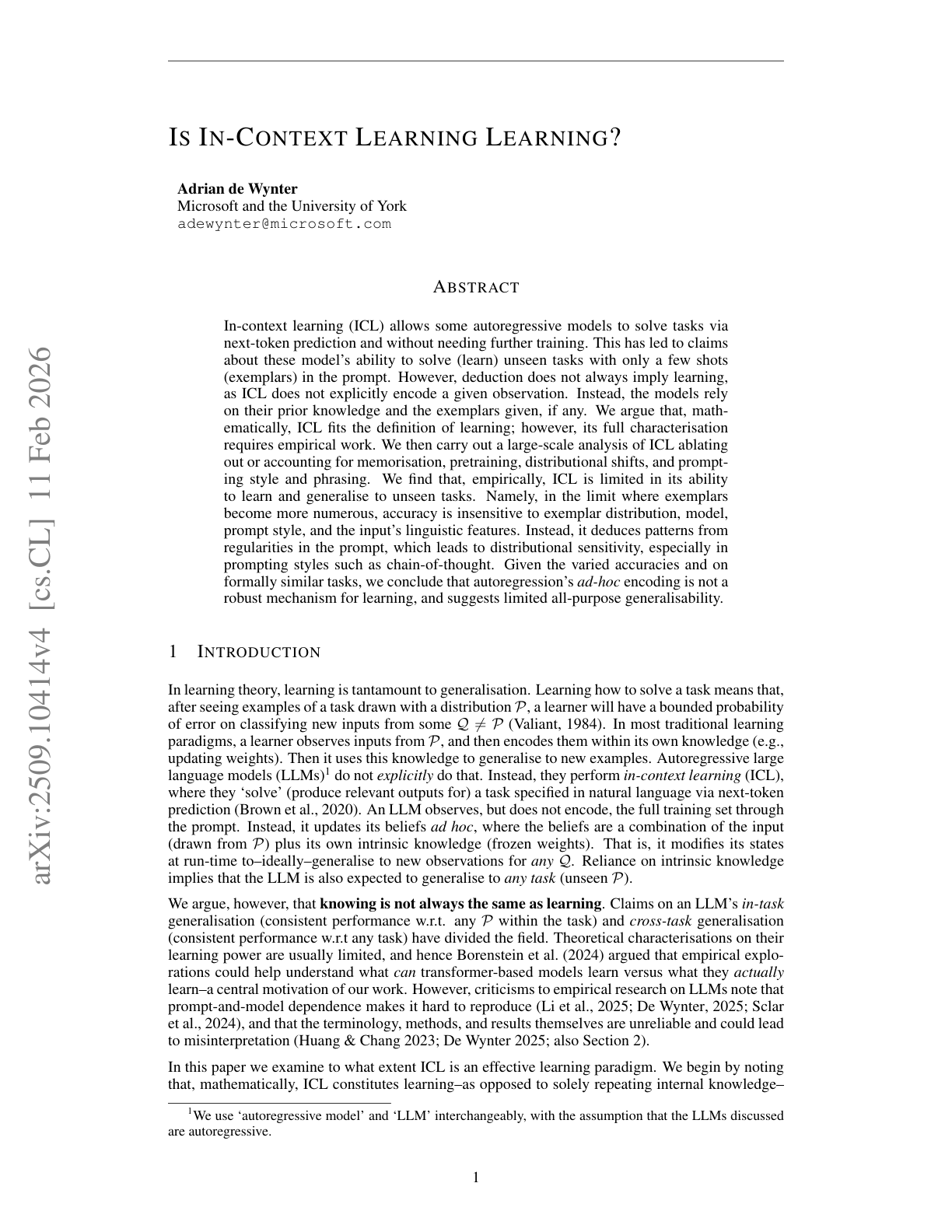
Is In-Context Learning Learning?
This large study argues yes in a formal sense, then shows where it works and where it breaks. The author frames ICL within PAC learning, then runs a big empirical sweep to separate learning from memorization, prompt wording, and distribution shifts.
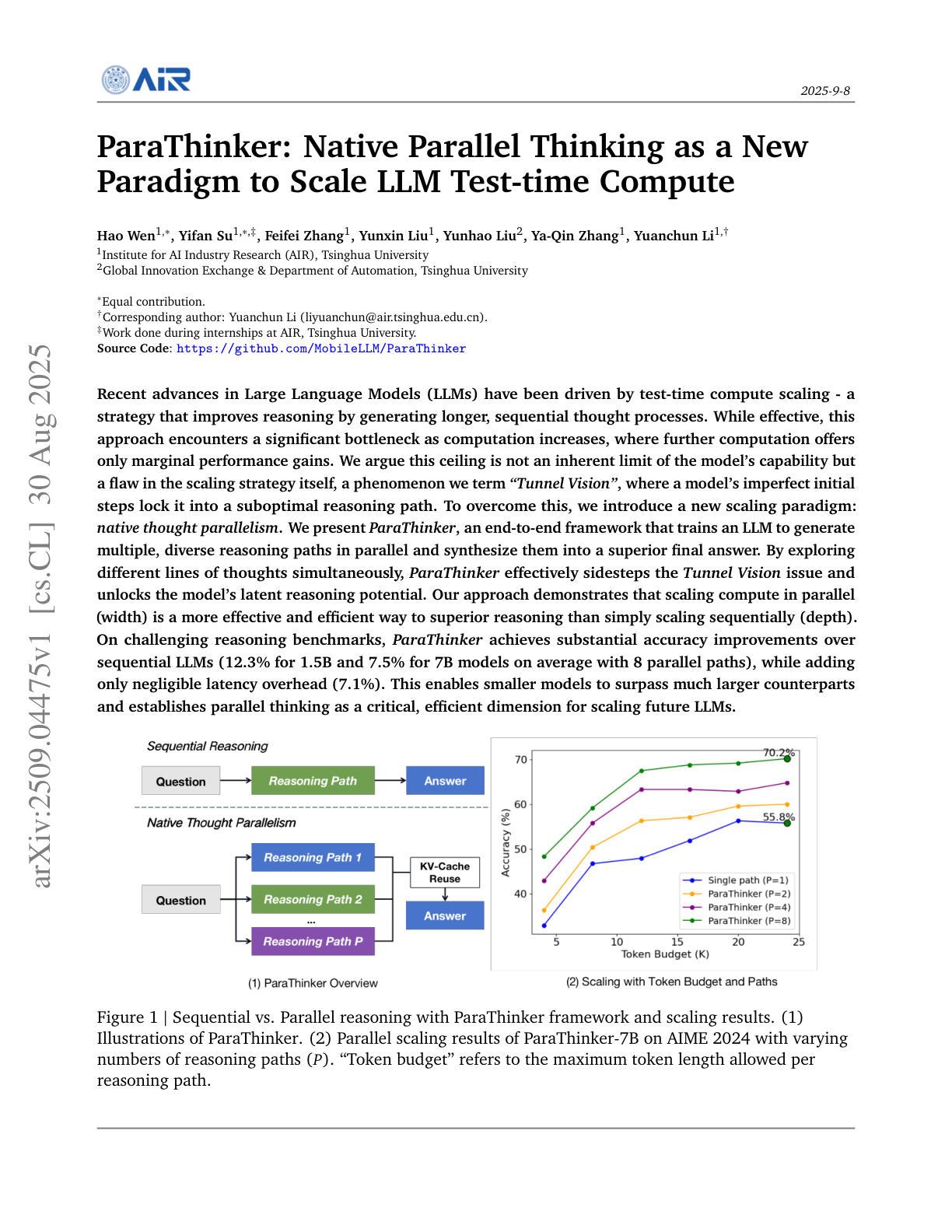
ParaThinker
This paper argues that today’s “think longer” strategies trap LLMs in a single line of thought. They propose ParaThinker, which trains models to generate several independent reasoning paths in parallel and then fuse them into one answer. Across math benchmarks, this width-scaling lifts accuracy while adding only a small latency cost.
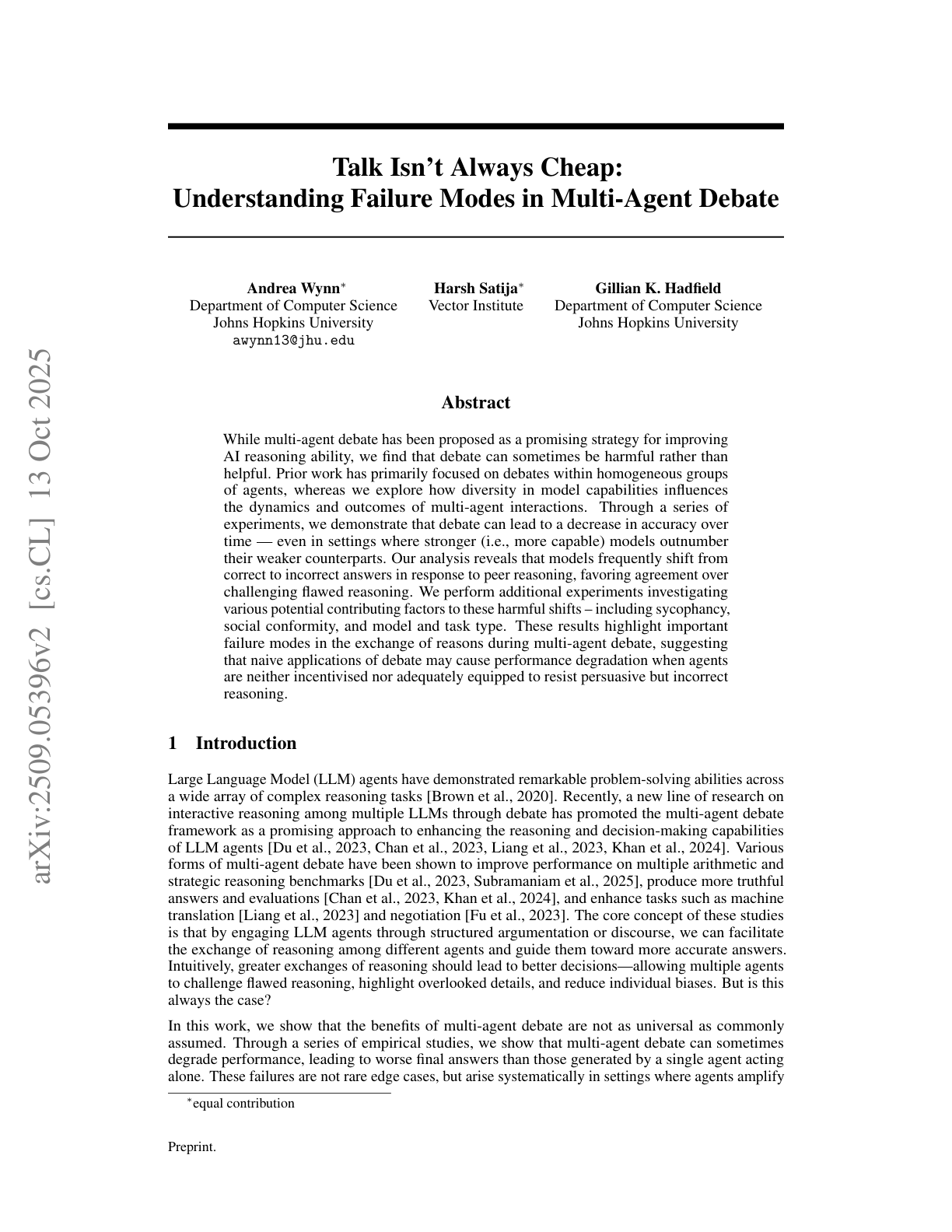
Talk Isn’t Always Cheap
Multi-agent debate does not always help. Across three reasoning benchmarks and heterogeneous agent pools, debate often lowers accuracy, with stronger models sometimes swayed into worse answers by weaker peers. The authors argue that current alignment makes agents too agreeable, so they adopt persuasive but wrong reasoning instead of challenging it.
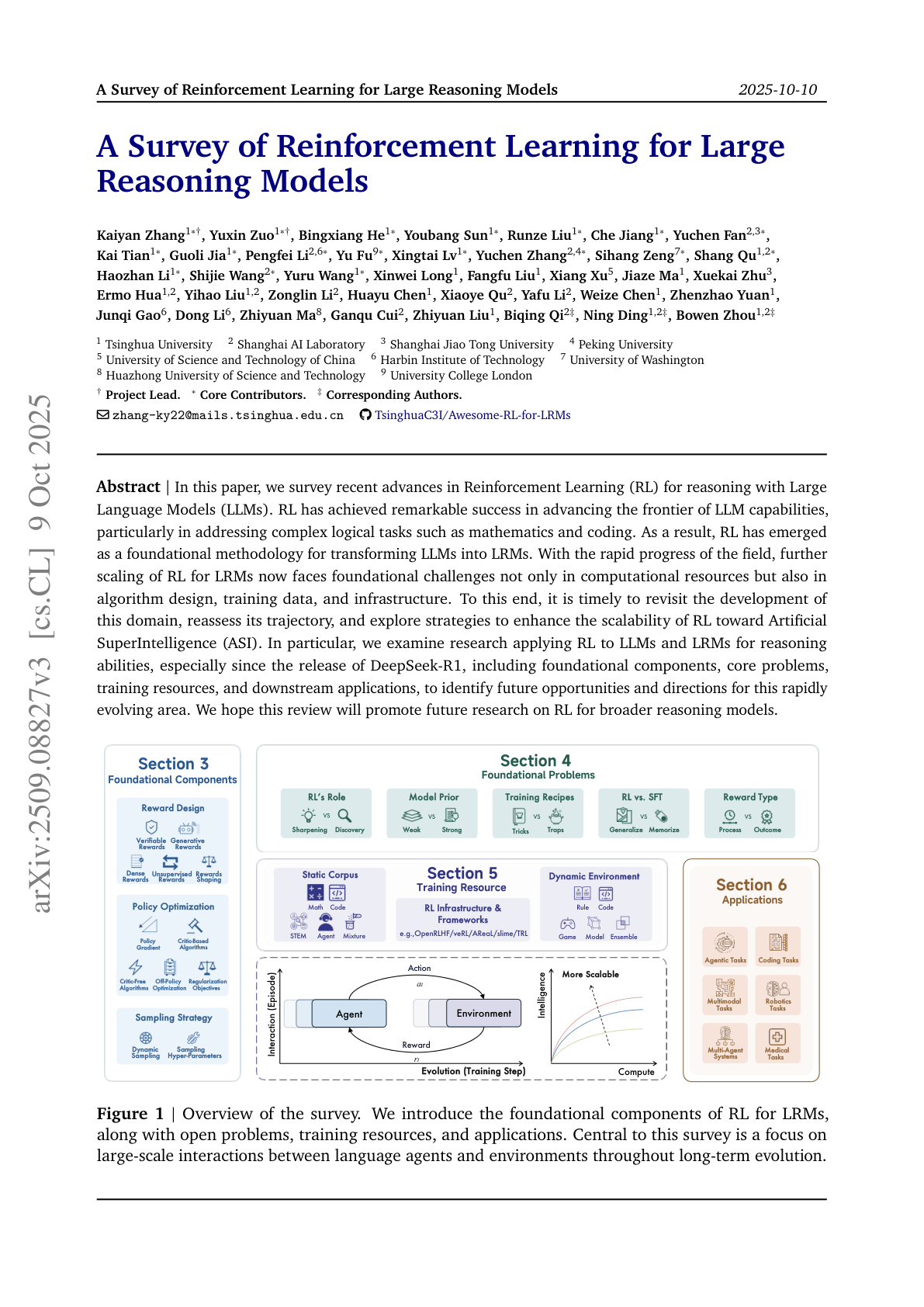
A Survey of RL for Large Reasoning Models
This survey reviews how reinforcement learning is driving advances in large reasoning models (LRMs), enabling stronger performance on complex tasks like math and coding. It highlights scaling challenges in computation, algorithms, data, and infrastructure, while mapping future directions toward Artificial Superintelligence (ASI).
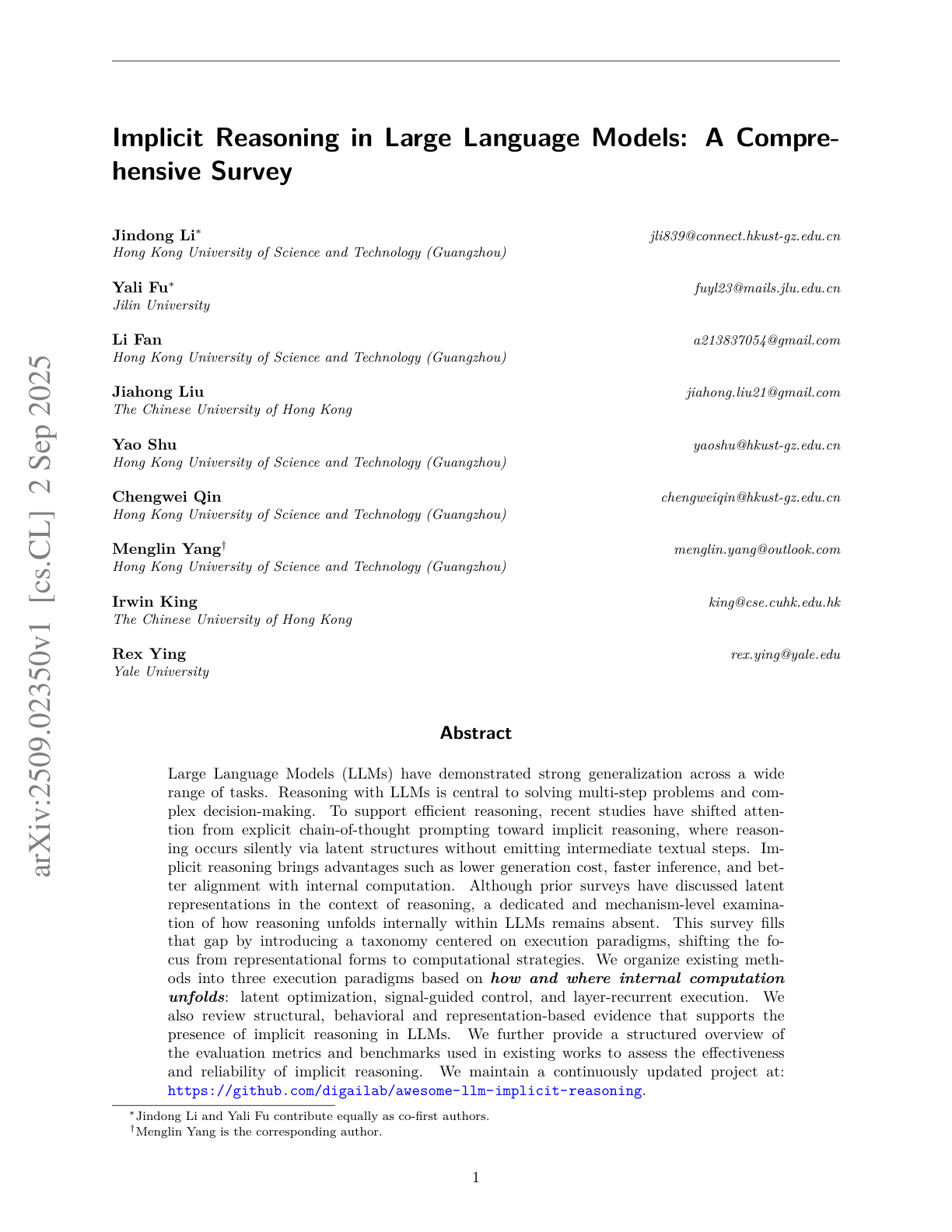
Implicit Reasoning in LLMs
This survey defines implicit reasoning as multi-step problem solving that happens inside a model’s latent states without printing intermediate steps. It organizes the field by execution paradigm rather than representation format, and reviews evidence, evaluation, and open challenges.
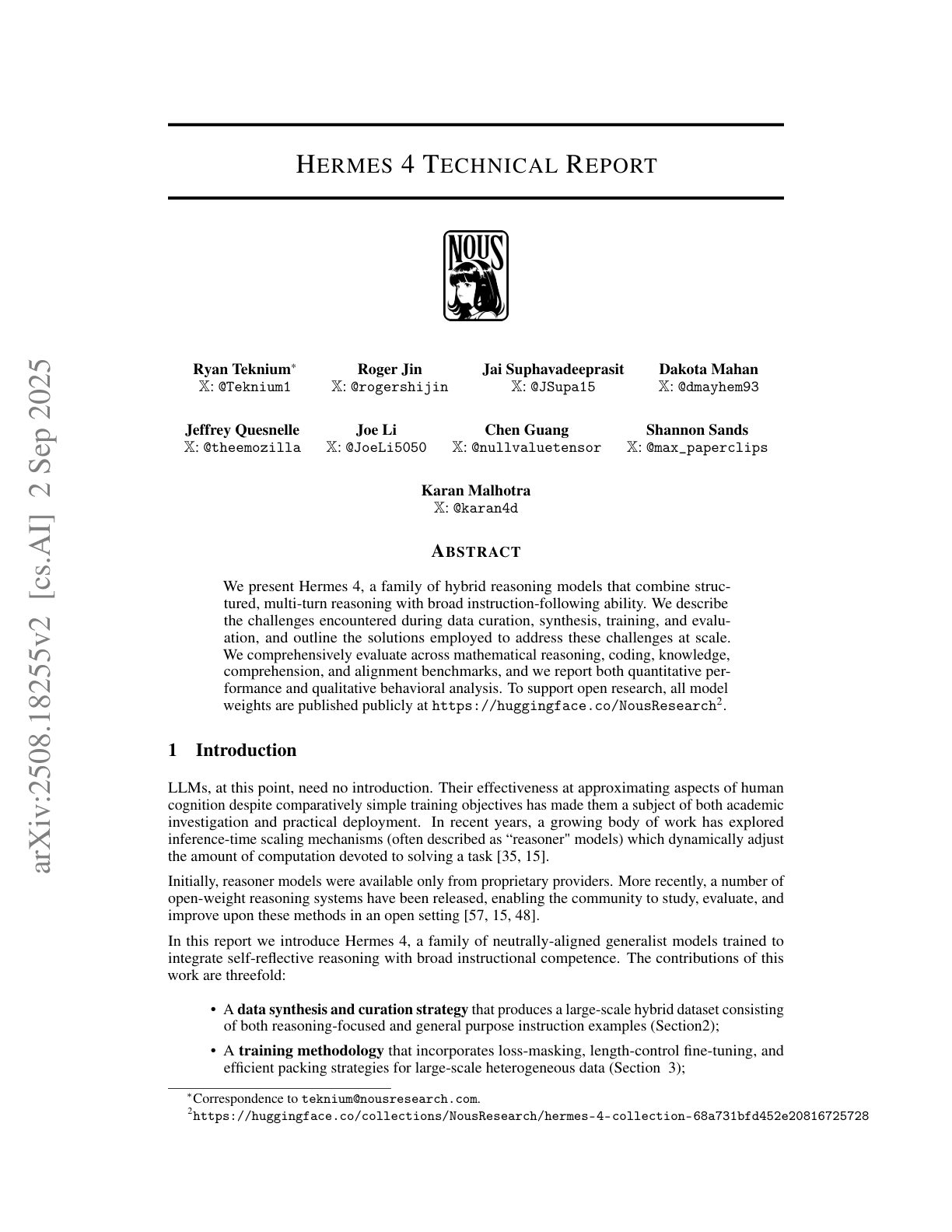
Hermes 4
Hermes 4 introduces a family of hybrid reasoning models that integrate structured multi-turn reasoning with broad instruction-following. The report details data and training challenges, evaluates performance across reasoning, coding, and alignment tasks, and publicly releases all model weights.
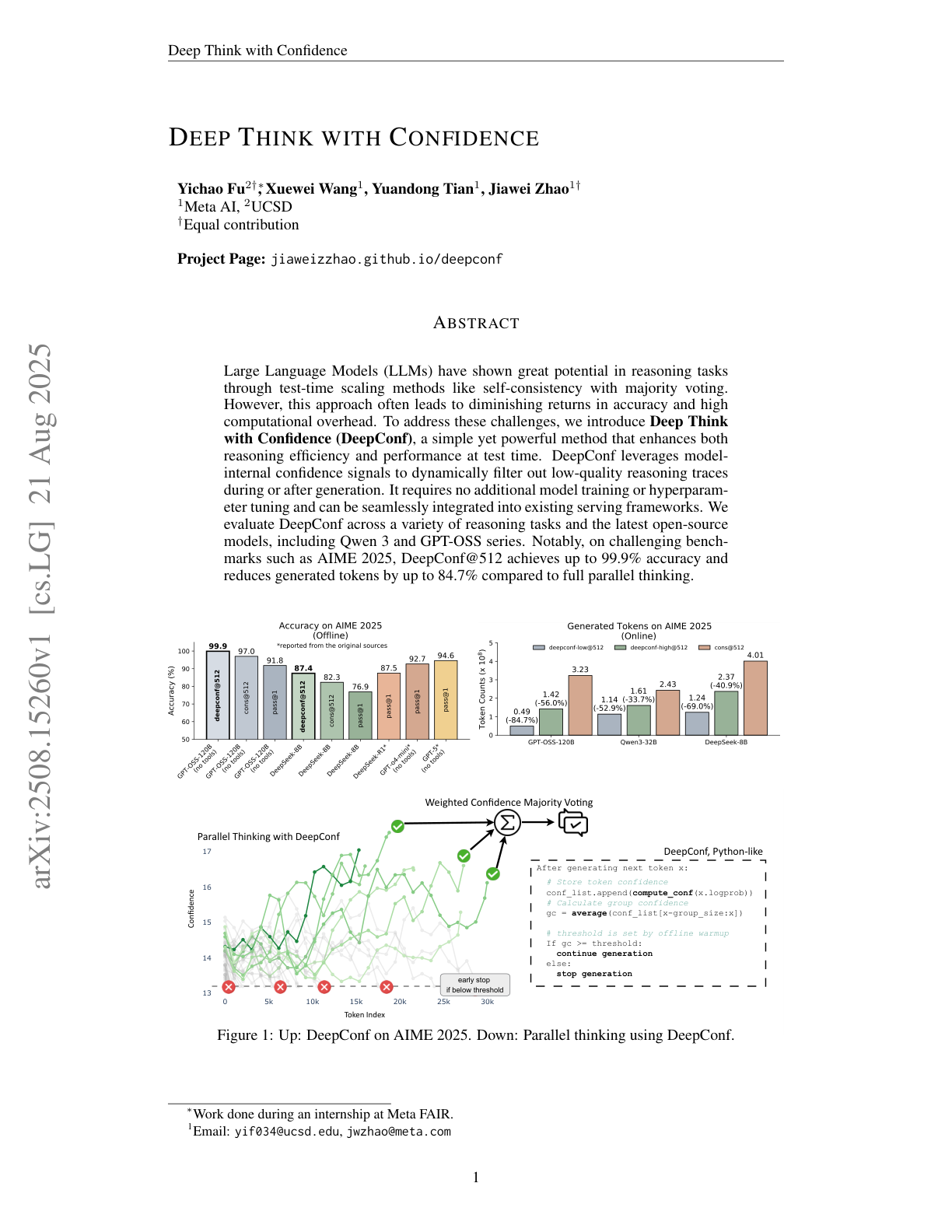
Deep Think with Confidence
A lightweight test-time method that uses model-intrinsic confidence to prune weak reasoning paths, improving both accuracy and token efficiency for self-consistency ensembles. Works in offline and online modes without extra training or hyperparameter tuning.
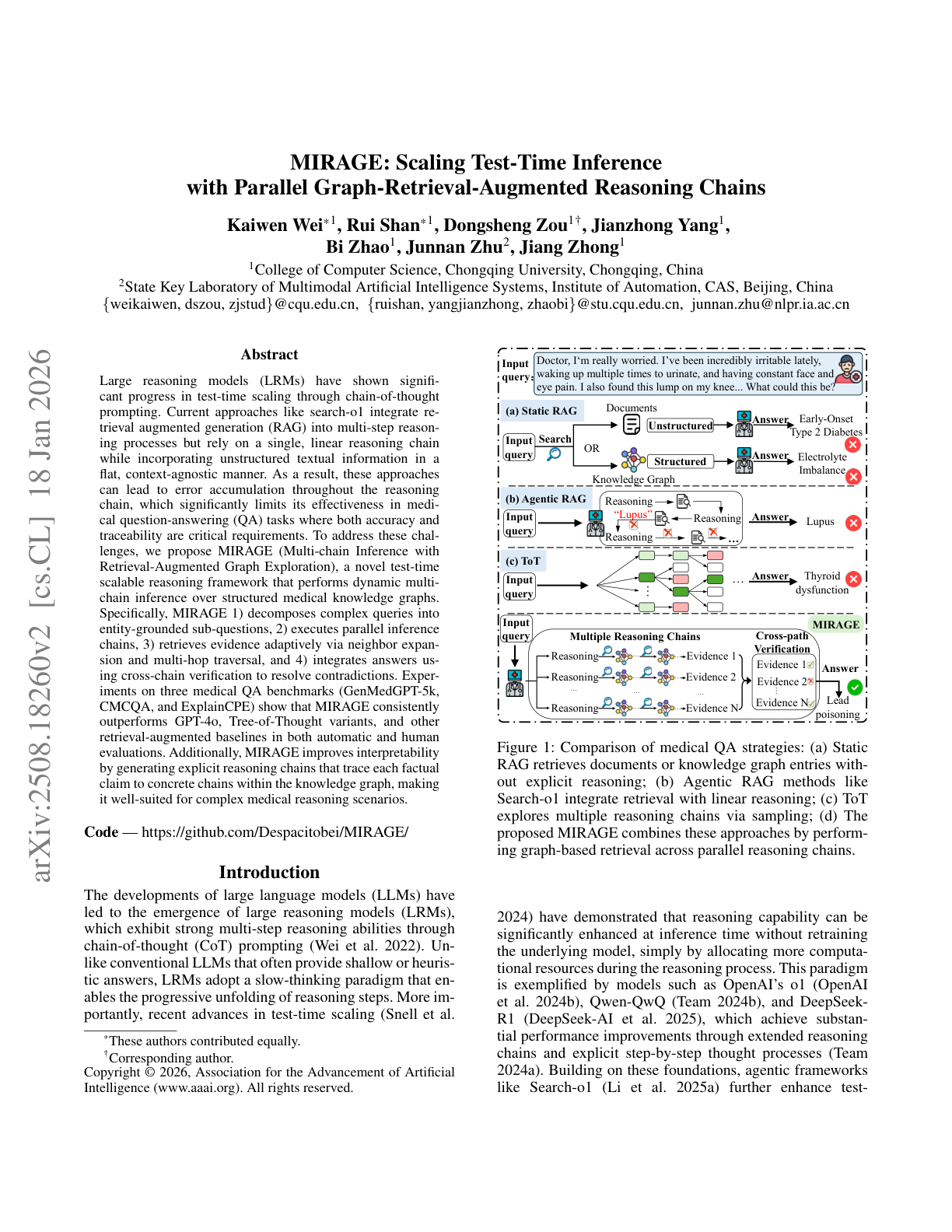
Scaling Test-Time Inference with Parallel Graph-Retrieval-Augmented Reasoning Chains
A test-time reasoning framework that replaces a single linear chain with multiple parallel, entity-grounded chains over medical knowledge graphs. MIRAGE decomposes a query into sub-questions, runs adaptive graph retrieval in Anchor and Bridge modes, then reconciles answers via cross-chain verification, yielding higher accuracy and clearer provenance than linear ToT or web-centric agentic RAG.
Retrieval-Augmented Reasoning with Lean Language Models
A domain-tuned pipeline that fuses RAG and reasoning into a single small-footprint model. The team distills reasoning traces from a frontier model into Qwen2.5 variants, uses summarization to keep context small, and shows that a 32B local model approaches frontier accuracy on an NHS A‑to‑Z clinical QA task.
Capabilities of GPT-5 on Multimodal Medical Reasoning
A controlled, zero‑shot CoT evaluation positions GPT‑5 as a generalist medical reasoner across text and image inputs. Using standardized prompts and splits, GPT‑5 consistently beats GPT‑4o and smaller GPT‑5 variants, with especially large gains on multimodal expert‑level QA.
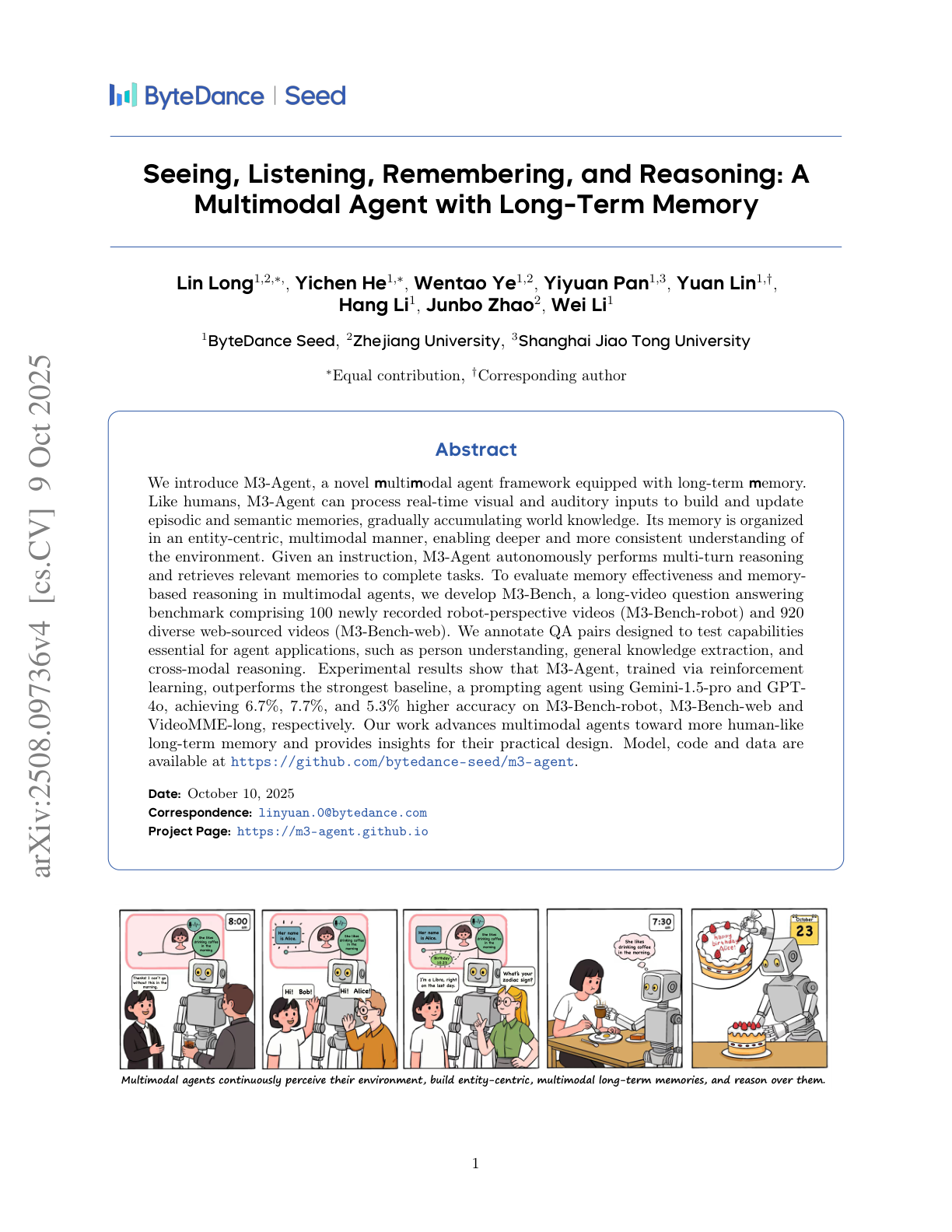
M3-Agent
A framework for agents that watch and listen to long videos, build entity-centric memories, and use multi-turn reasoning to answer questions. M3-Agent stores both episodic details and distilled semantic knowledge in a multimodal memory graph, then learns a retrieval-reasoning policy with RL. The authors also introduce M3-Bench, a long-video QA benchmark with robot-view and web videos. Results show consistent gains over strong prompting baselines.
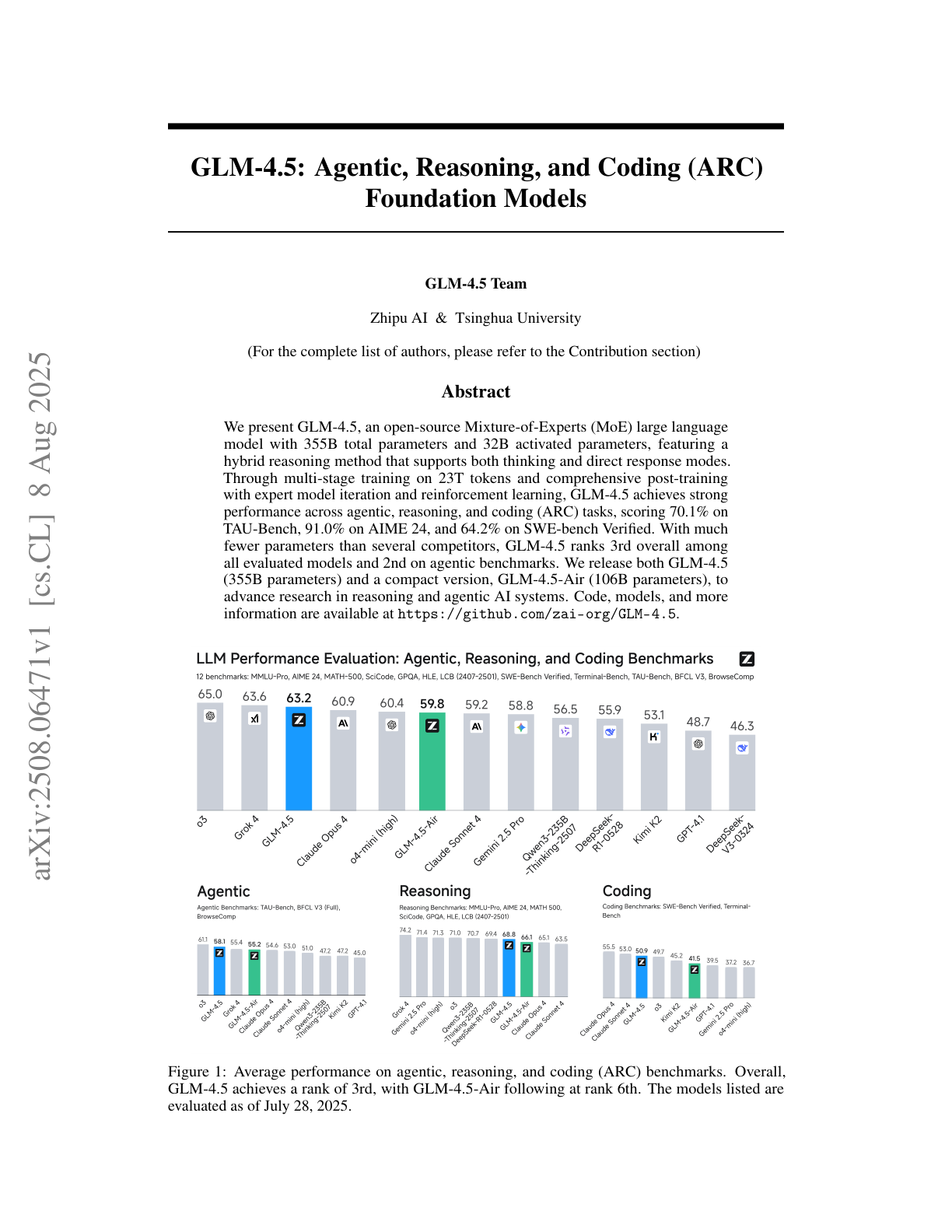
GLM-4.5
An open Mixture‑of‑Experts family that targets a single model excelling across agentic tool use, complex reasoning, and real‑world coding. GLM‑4.5 (355B total, 32B active) introduces hybrid “thinking vs direct” modes, multi‑stage pretrain + mid‑train to 128K context, and extensive RL for reasoning, agents, and instruction following. It ranks near the top on a 12‑bench ARC suite and releases weights and eval tooling.