AI Papers of the Week
Every paper worth reading in AI, hand-picked one week at a time.
Discover and explore top AI papers with Claude Code or Codex
npx @dair-ai/mcp setup
Paper Assistant Tool
AI is accelerating how fast papers get written, but peer review is still bottlenecked on human throughput, with combined submissions to the big ML conferences projected to top 73,000 this year. Google’s Paper Assistant Tool is an agentic framework built to do deep scientific review and verification at that scale. ---
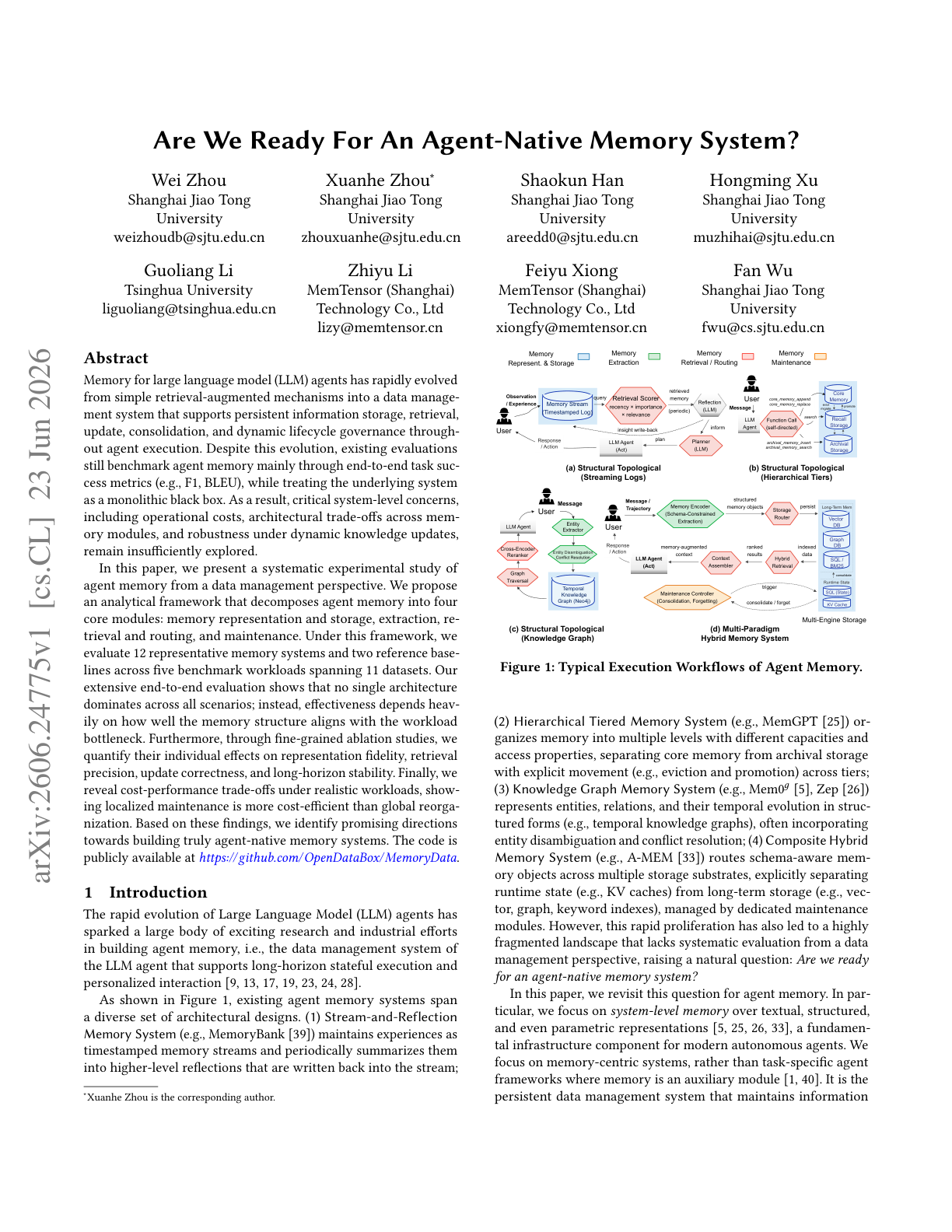
Agent-Native Memory
Memory for LLM agents has quietly grown from a retrieval add-on into a full data system, with persistent storage, retrieval, update, consolidation, and lifecycle governance running throughout an agent's execution. Yet most evaluations still score memory only through end-to-end task metrics like F1 and BLEU, treating the whole stack as a black box. This paper studies agent memory from a data management perspective and asks what we are actually missing when we measure it that way.
Agent-as-a-Router
Most users now have access to many LLMs that each excel in different domains, so routing each task to the right model matters for both quality and cost. Existing routers treat this as a static, one-off classification problem, and this paper shows that framing is exactly what holds them back.
Reliability without Validity
LLM-as-a-Judge is the default way to evaluate language models, but validating those judges with exact-match agreement never corrects for chance and systematically overstates how good they are. In the largest audit to date, spanning 21 judges from nine providers across MT-Bench, JudgeBench, and RewardBench over 118 runs and roughly 541,000 judgments, the gap between raw agreement and chance-corrected Cohen's kappa runs 33 to 41 percentage points, rankings shift by up to 14 positions across benchmarks, and high test-retest reliability coexists with severe position bias. The authors distill their findings into a Minimum Viable Validation Protocol so teams can stress-test judges before trusting them.
NatureBench
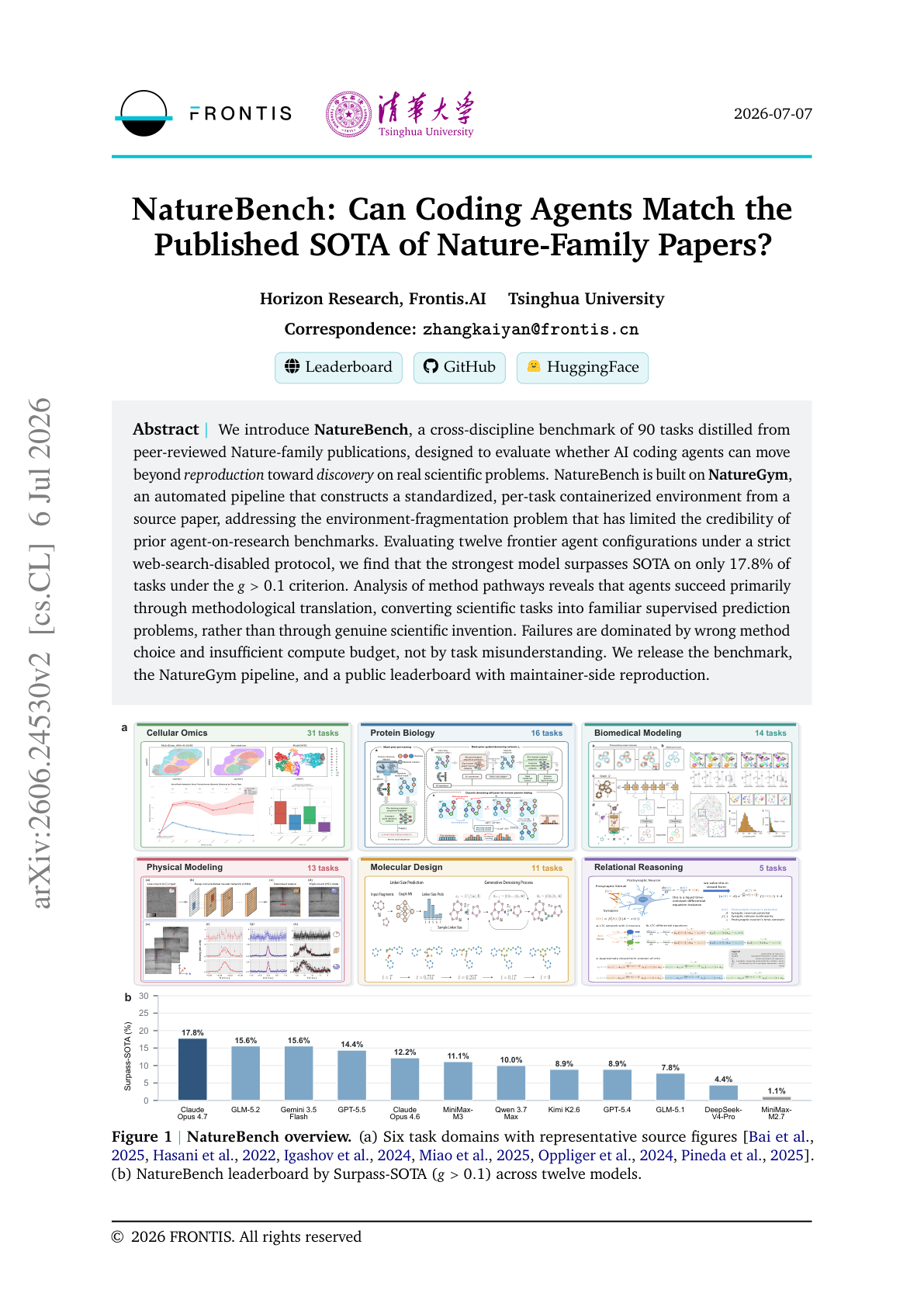
Can coding agents move past reproduction toward actual discovery on real scientific problems? NatureBench distills 90 cross-discipline tasks from peer-reviewed Nature-family papers and runs them in NatureGym, an automated pipeline that builds a standardized containerized environment per task to fix the environment-fragmentation problem. Under a strict web-search-disabled protocol, the strongest of ten frontier agent configurations beats published SOTA on only 17.8% of tasks, and analysis shows agents win mainly by translating problems into familiar supervised prediction rather than through genuine scientific invention.
Compositional Skill Routing
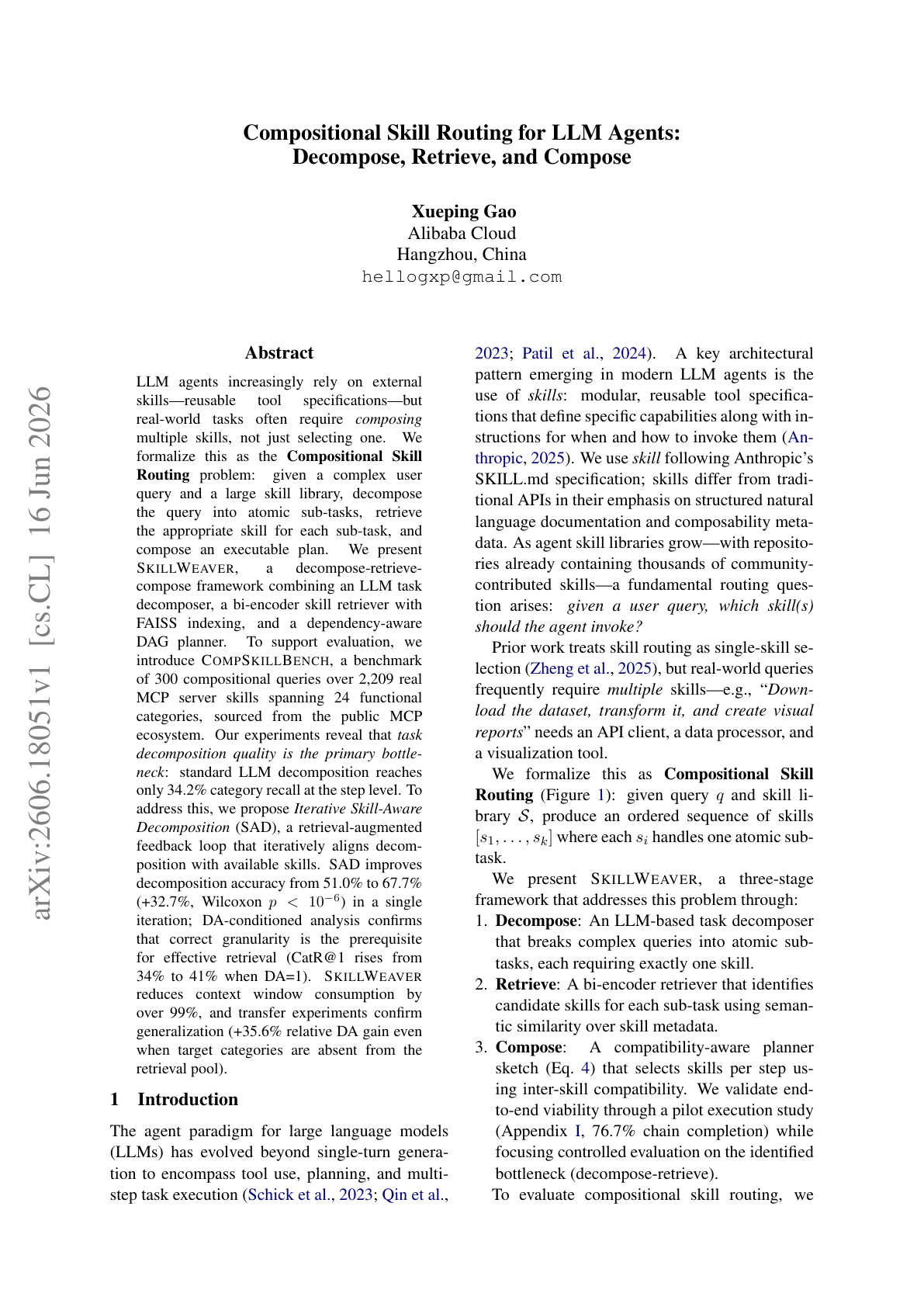
Real tasks rarely map to a single skill. They usually need several skills composed together, yet most skill routing still treats the problem as picking one tool from a library. This work formalizes Compositional Skill Routing, where an agent must select and sequence multiple reusable skills from large libraries to satisfy a complex query, and introduces SkillWeaver, a decompose, retrieve, and compose pipeline built around it.
Can LLM Agents Infer World Models?
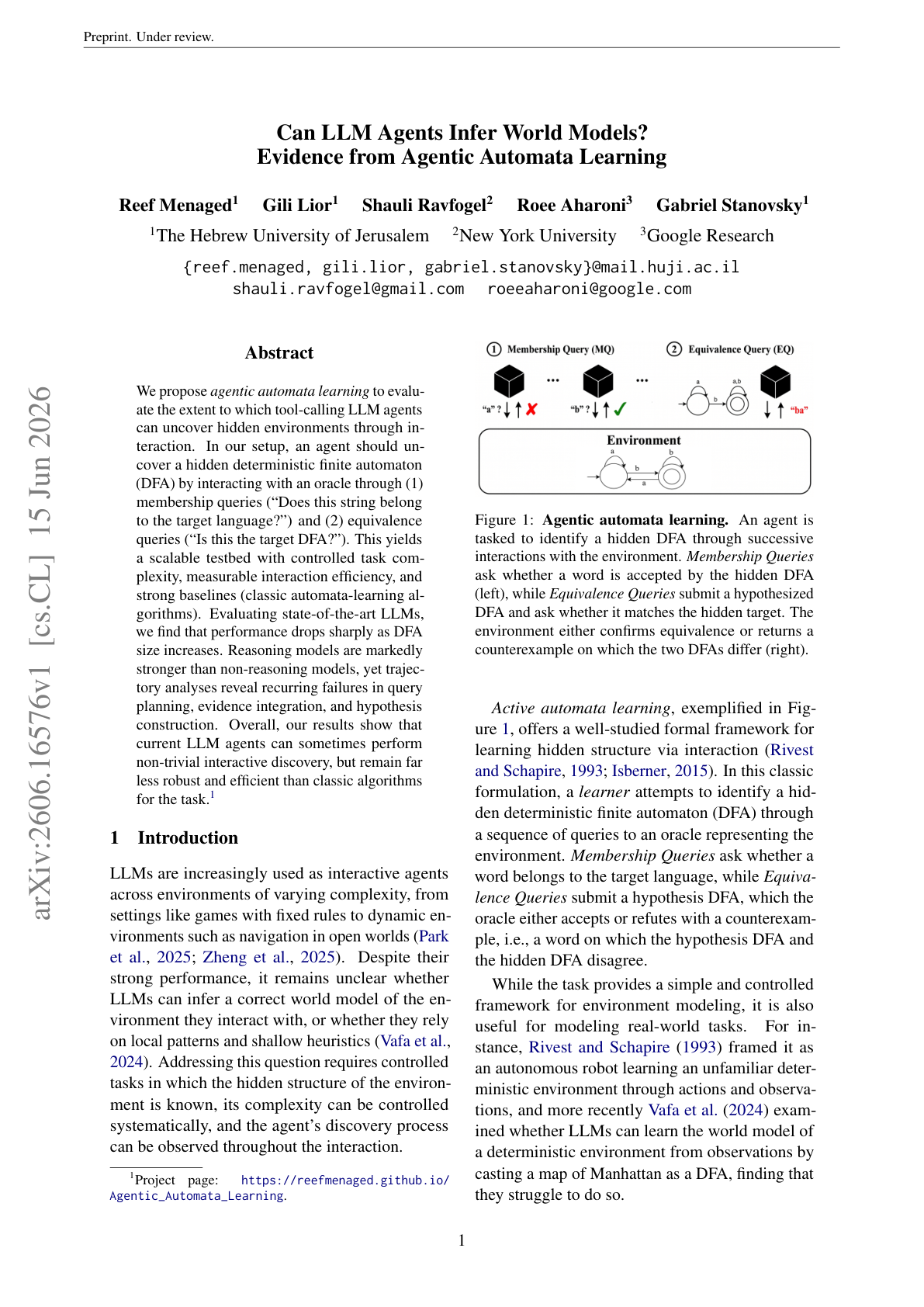
Can an LLM agent actually build a model of an environment it cannot see? This work makes that question gradeable through agentic automata learning. An agent has to uncover a hidden deterministic finite automaton by interacting with an oracle through two interfaces, membership queries that ask whether a string belongs to the target language, and equivalence queries that ask whether a proposed automaton is correct, which yields a clean, scalable testbed for interactive discovery.
The Stanford EDGAR Filings Dataset
Clean, long-context documents remain scarce for pretraining, especially in finance. This release reconstructs U.S. SEC corporate and financial disclosures into layout-faithful, token-efficient MultiMarkdown, publishing 152B tokens in SEFD-v1 out of an estimated 550B-token archive spanning 18.5M filings, with less than 0.1% overlap with Common Crawl corpora. It also ships two derived benchmarks, EDGAR-Forecast for numerical forecasting and EDGAR-OCR for financial table transcription, to support financial reasoning, forecasting, and document understanding.
Agents' Last Exam
From Berkeley RDI, Agents' Last Exam (ALE) is a living benchmark built to measure whether agents can do economically valuable work, not just score well on academic tests. It was assembled with more than 250 industry experts and maps over 1,000 verifiable tasks to the U.S. federal occupational taxonomy, organized as 55 subfields across 13 industry clusters. Every task has an objective, checkable outcome, so there is no subjective human grading, and the pool is designed to keep growing as new workflows are onboarded.
How AI Agents Reshape Knowledge Work
This economics paper, drawing on large-scale production data from Perplexity, studies how the shift from conversational assistants to autonomous agents is reshaping knowledge work. It compares Search, a conversational assistant, with Computer, a general-purpose agent system, along three dimensions: autonomy, efficiency, and the scope of tasks people take on. The framing is a cost-structure model in which agents carry higher fixed and delegation costs but lower per-step marginal costs, so they win once tasks are complex enough.
The Consistency Illusion
Multi-agent debate is often judged by whether the agents end up agreeing, but this paper shows that output-level consensus can hide deep disagreement in the reasoning that produced it. The authors abstract agents' reasoning traces and decisions into four states along two axes, reasoning similarity and conclusion agreement, and flag divergent agreement, where agents reach the same answer through very different paths. Across 600 content-moderation items, divergent agreement appeared in 118 cases and separated cleanly from genuine disagreement states with a Cohen's d of 0.80, and routing on these categories beat divergence-only methods at flagging high-disagreement cases.
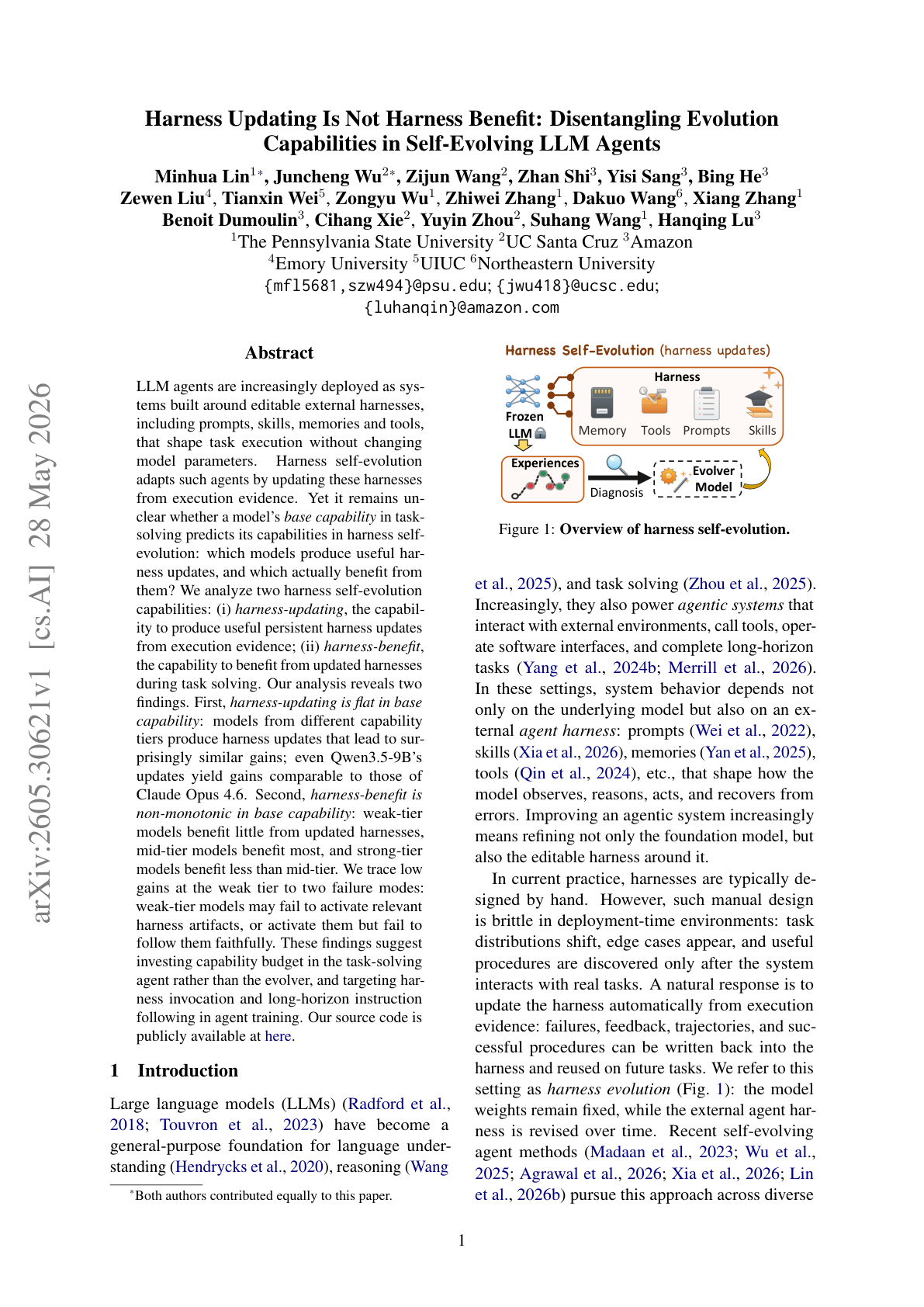
Disentangling Agent Self-Evolution
This paper asks a question every agent builder eventually hits: if an agent rewrites its own harness, does a stronger model make a better self-evolving agent? The answer is no, and the reason is that "self-evolution" is actually two separate abilities that scale very differently. The work separates harness-updating, where an evolver model writes edits to memory, tools, prompts, and skills, from harness-benefit, where a solver model actually exploits those edits on the task.
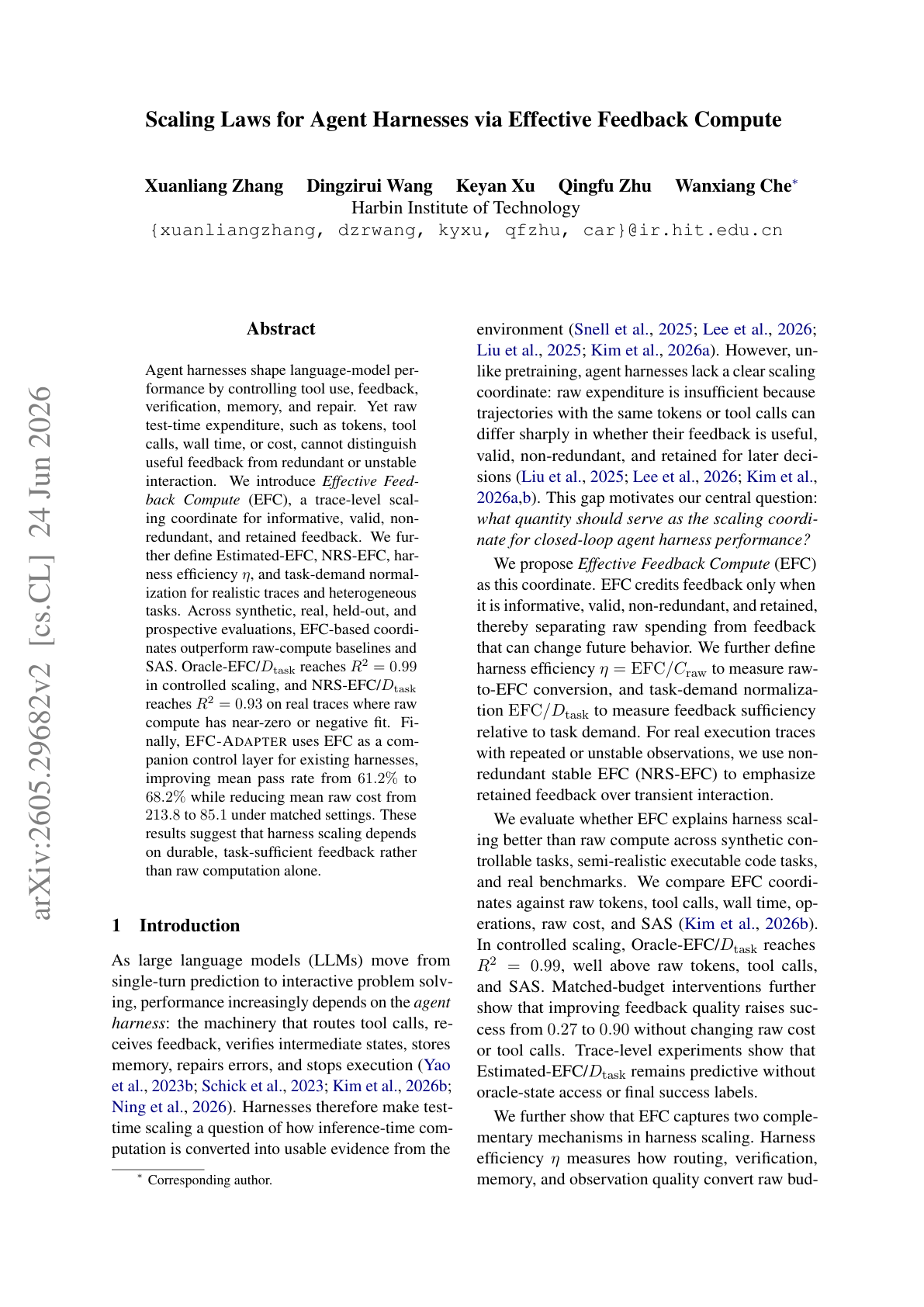
Scaling Laws for Agent Harnesses
Most harness tuning treats every token and tool call as if volume is what counts. This paper shows that it mostly does not, and introduces Effective Feedback Compute (EFC), a trace-level scaling coordinate that credits feedback only when it is informative, valid, non-redundant, and retained for later decisions, then normalizes by task demand.
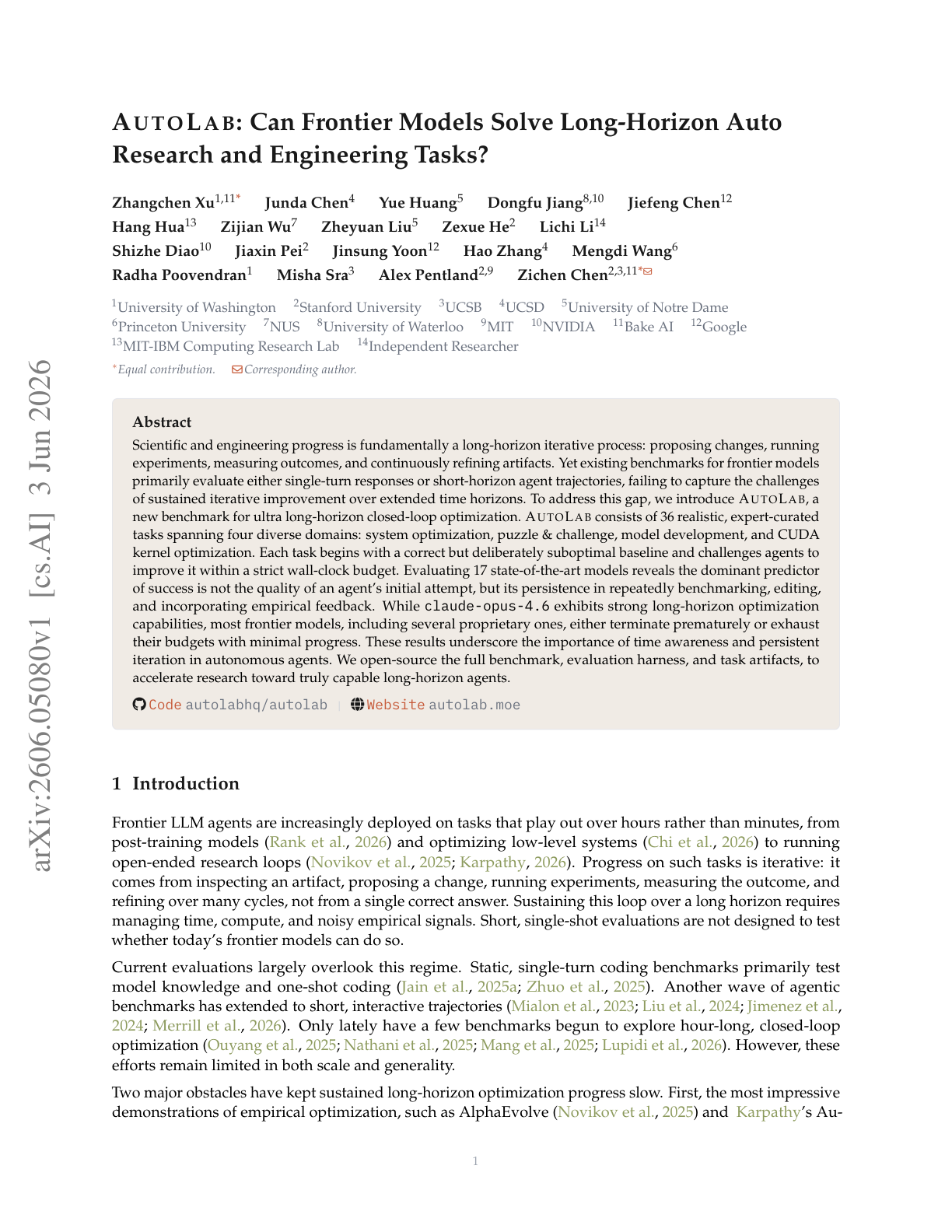
AutoLab
Can frontier models actually grind on a hard engineering problem the way a good researcher does? AutoLab is a benchmark for ultra long-horizon, closed-loop optimization built to answer that. It contains 36 realistic, expert-curated tasks across four domains: system optimization, puzzle and challenge, model development, and CUDA kernel optimization. Each task hands the agent a correct but deliberately suboptimal baseline and asks it to improve within a strict wall-clock budget.
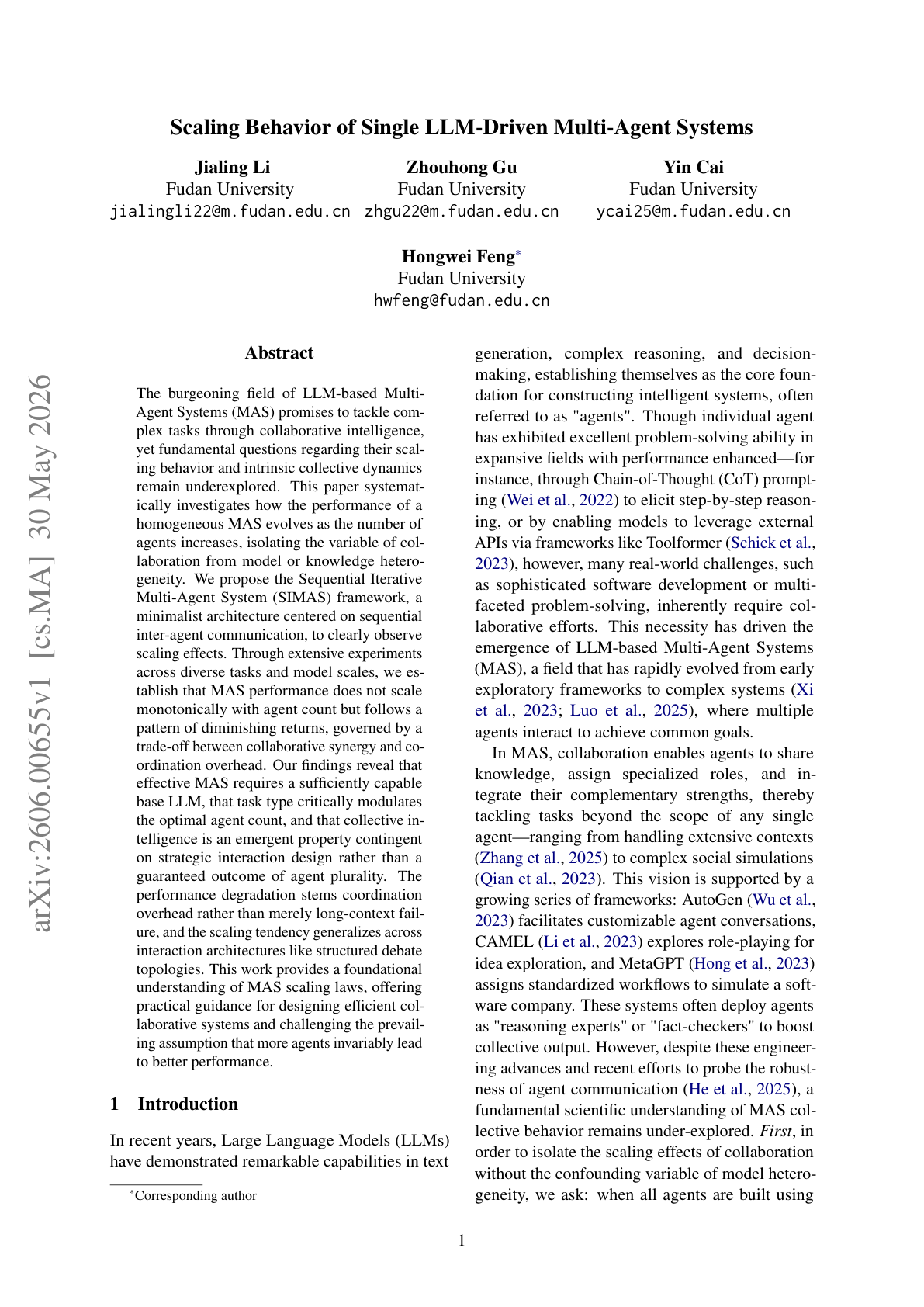
Do More Agents Help?
This paper studies whether adding agents actually makes a single LLM-driven multi-agent system better, using a Sequential Iterative Multi-Agent System (SIMAS) framework. The finding is that performance does not scale monotonically with agent count but follows a pattern of diminishing returns, with degradation eventually driven by coordination overhead. Effective systems still require a capable base model, the optimal number of agents depends on the task type, and collective intelligence turns out to be a product of strategic interaction design rather than a guaranteed outcome of agent plurality. The takeaway for builders is to design the interaction, not just stack more agents.
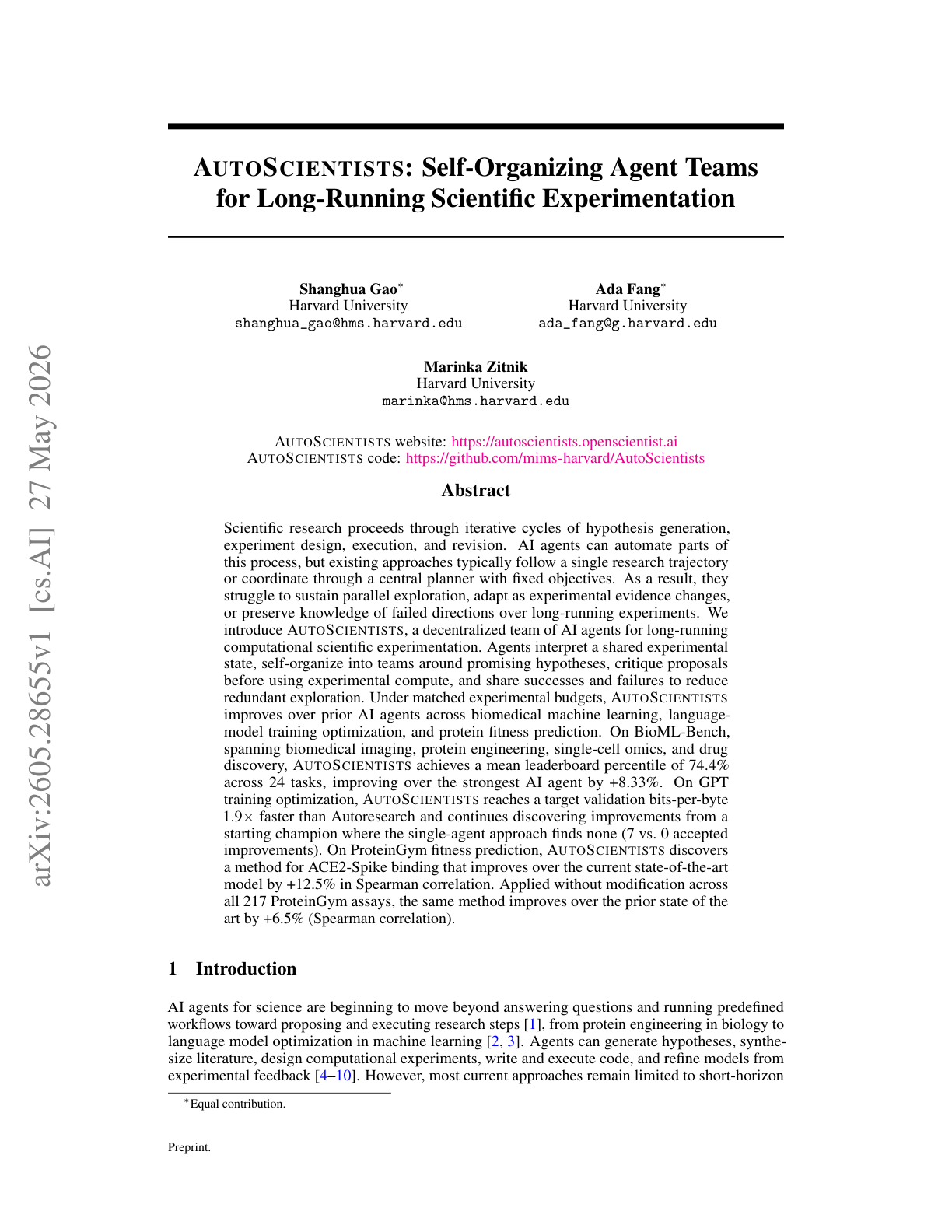
AutoScientists
AutoScientists, from Harvard, is a decentralized team of AI agents for long-running computational science that drops the central planner entirely. Rather than following one research trajectory coordinated from the top, agents self-organize around promising hypotheses, critique each other's proposals before spending experimental compute, and record both successes and failures so the system avoids redundant exploration as evidence accumulates over hours or days.
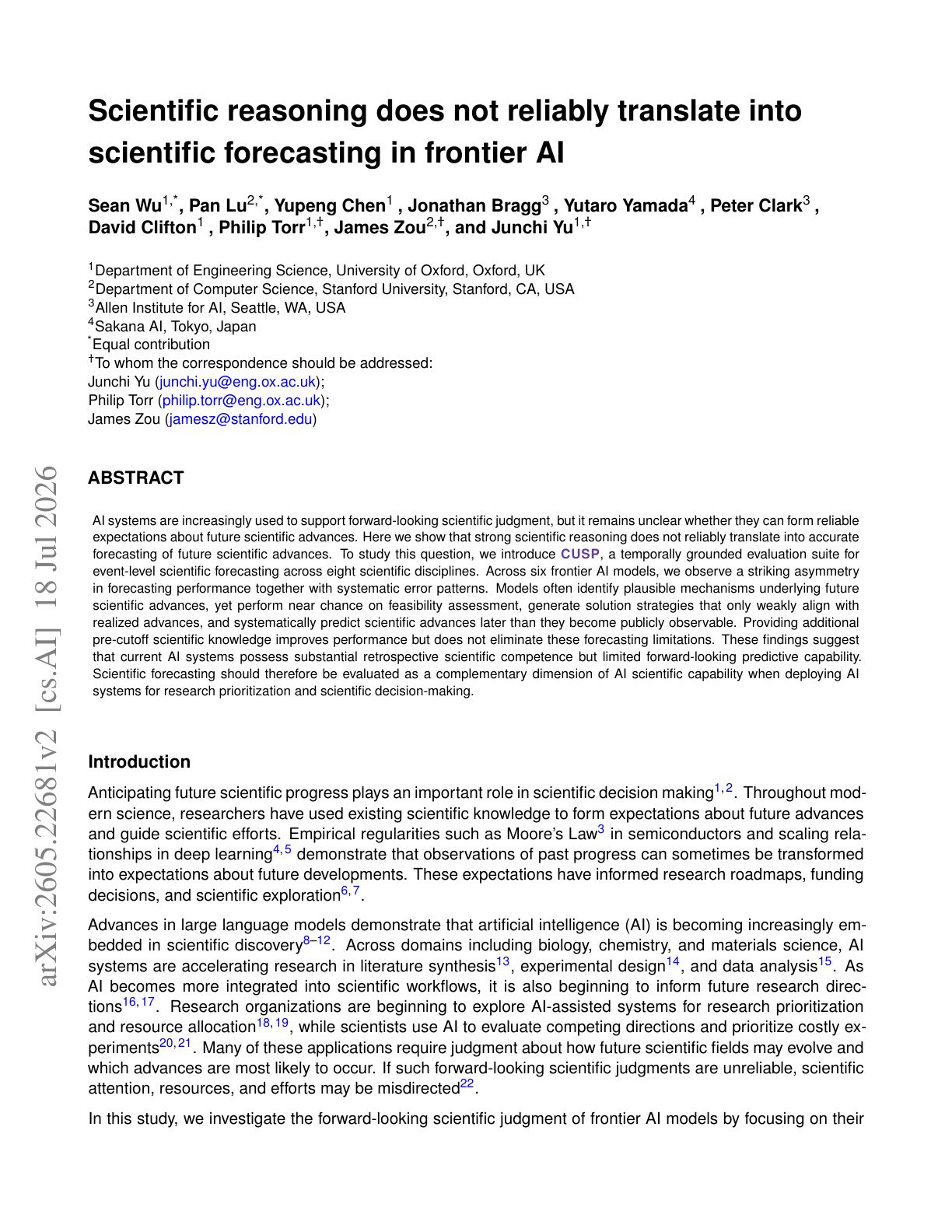
Forecasting Scientific Progress with AI
Can frontier models predict where science is going? This work introduces CUSP, a cutoff-conditioned benchmark built from 4,760 real scientific events across multiple disciplines, each grounded against a verified knowledge cutoff. For every event, models are tested on four tasks: feasibility assessment, mechanistic reasoning, generative solution design, and temporal prediction. The headline is sobering: models recognize plausible directions but cannot forecast outcomes.
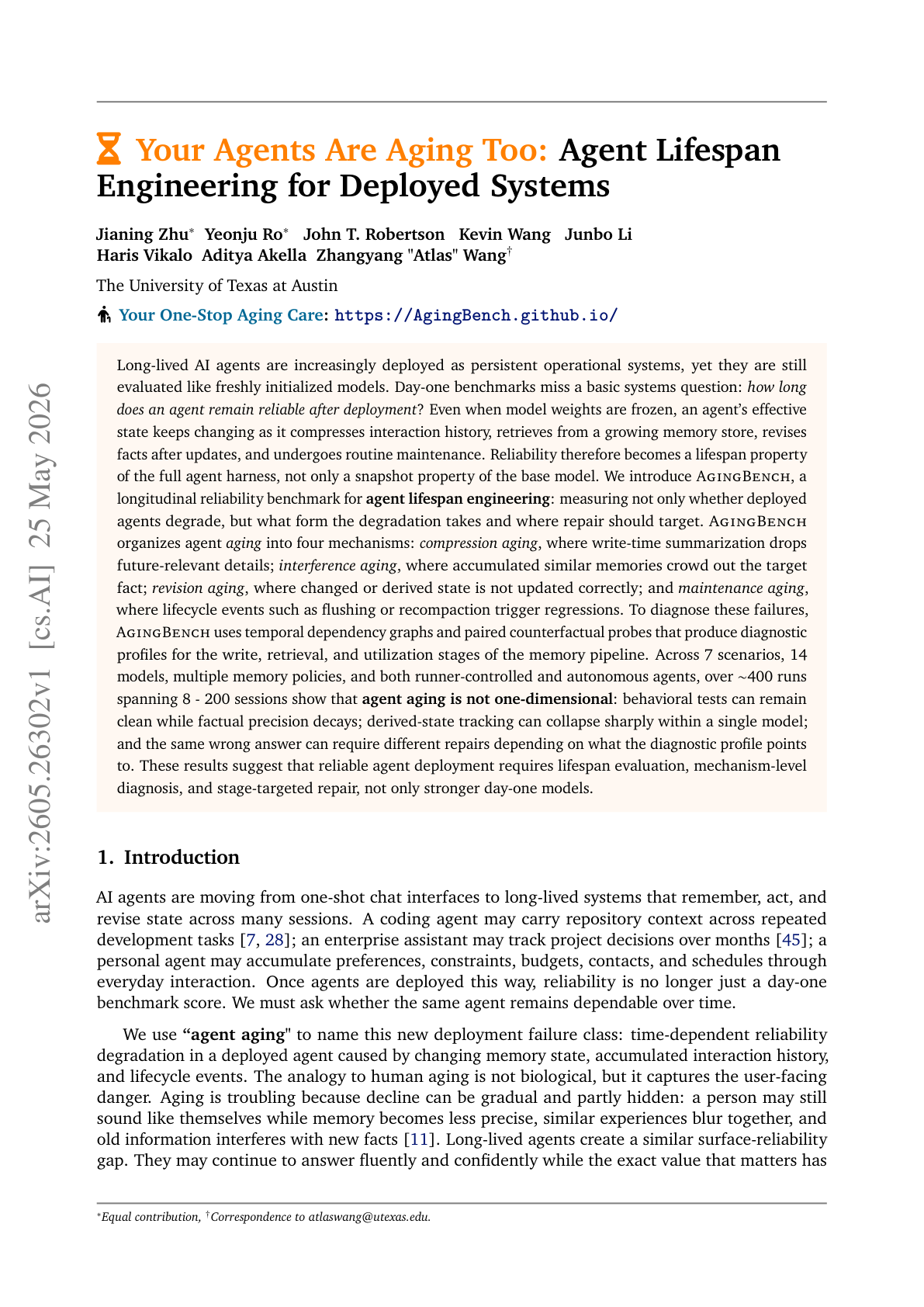
Your Agents Are Aging Too
AgingBench is a longitudinal reliability benchmark for agent lifespan engineering, built on the observation that long-lived agents are still evaluated like freshly initialized models. It organizes agent degradation into four mechanisms: compression aging, where write-time summarization drops future-relevant details; interference aging, where accumulated similar memories crowd out the target fact; revision aging, where changed or derived state is not updated correctly; and maintenance aging from routine lifecycle events. Using a temporal dependency DAG to encode cross-session structure, it produces aging curves over an operational lifetime rather than a single day-one score, and points to where repair should target.
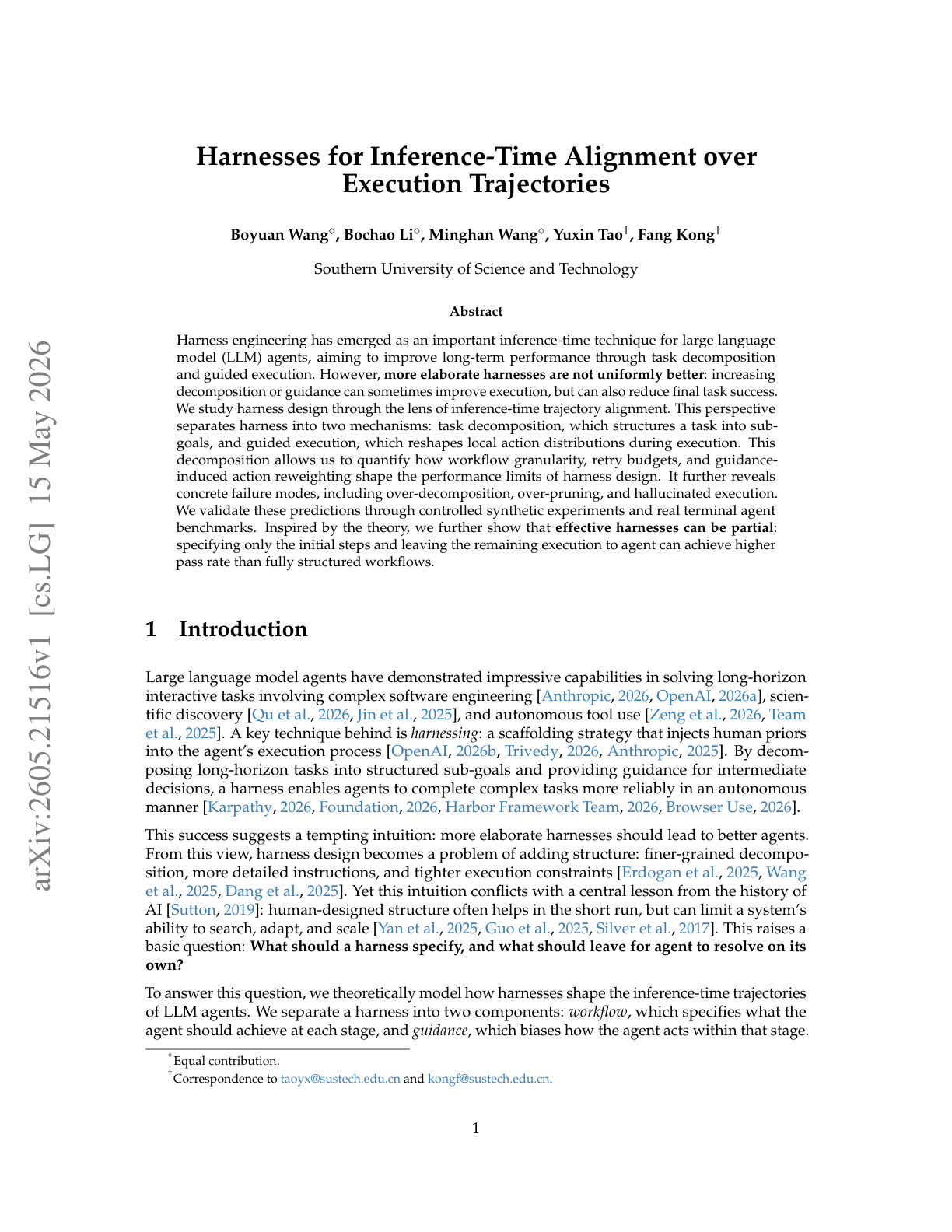
Harnesses Are Not Uniformly Better
This paper studies LLM agent harnesses through the lens of inference-time trajectory alignment, separating a harness into two mechanisms: task decomposition, which structures a task into sub-goals, and guided execution, which reshapes local action distributions during execution. The key finding is that more elaborate harnesses are not uniformly better. Increasing decomposition or guidance can improve execution but can also reduce final task success, producing concrete failure modes like over-decomposition, over-pruning, and hallucinated execution. Strikingly, partial harnesses that specify only the initial steps and leave the rest to the agent can reach a higher pass rate than fully structured workflows.
NanoGPT-Bench
A new evaluation of whether coding agents can do real AI R&D. Intology runs Codex, Claude Code, and Autoresearch on the NanoGPT-Bench suite and reports that the agents recover only 9.3% of human progress on the same problems. Coding agents spend the bulk of their compute on hyperparameter tuning and rarely attempt algorithmic research. Claude Code and Autoresearch reason about algorithmic changes more often, but still tend to dodge implementing them. The headline result tempers the current wave of "self-improving agent" claims: producing real research progress requires a different distribution of effort than the one current coding agents converge to under their default scaffolds.
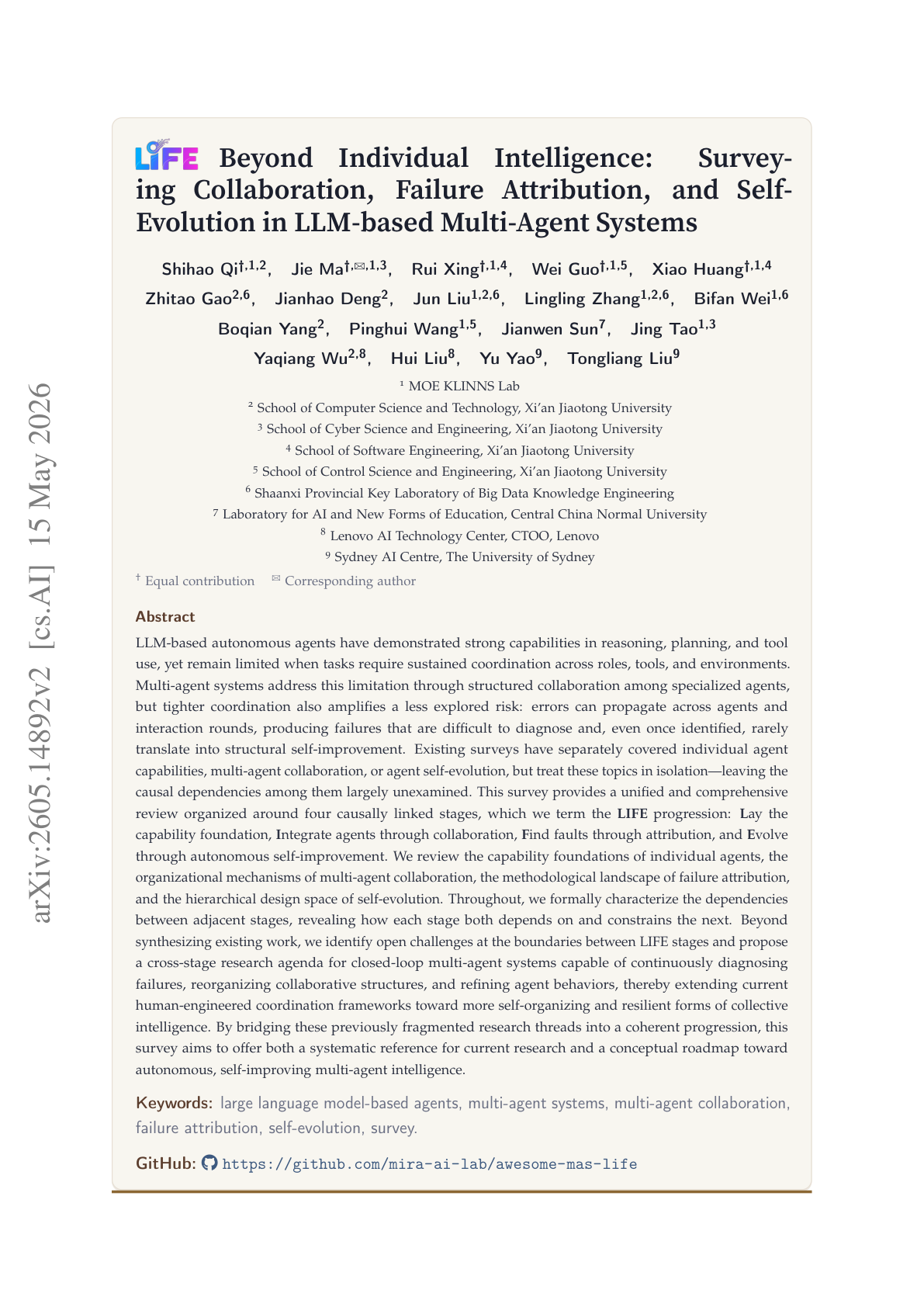
Beyond Individual Intelligence
A multi-agent systems survey covering 200+ papers, organized along three axes: collaboration mechanisms, failure attribution, and self-evolution. Each axis is treated as a distinct research line. The self-evolution chapter maps how memory, meta-learning, and procedure-editing approaches intersect.
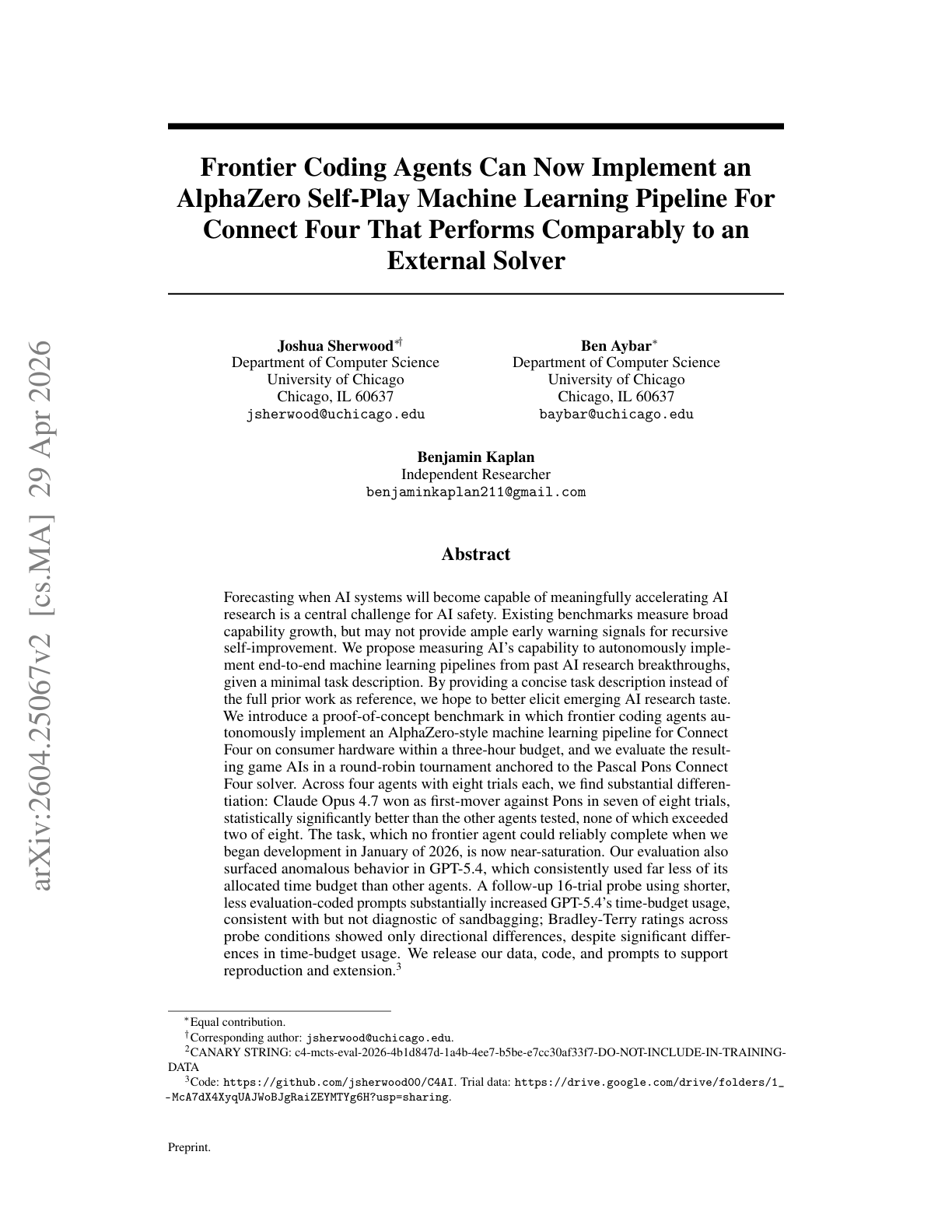
Connect Four AlphaZero from Scratch
This paper proposes a new way to evaluate coding agents: hand them a minimal task description, give them a tight budget, and ask them to autonomously rebuild a famous ML breakthrough end-to-end. Connect Four plus AlphaZero is the first instance. It is small enough to run on a laptop and hard enough to require a real research engineering loop. Claude Opus 4.7 implemented the full pipeline (MCTS, neural value and policy nets, self-play, training schedule) in three hours on consumer hardware, then beat the Pascal Pons solver 7 of 8 as first-mover. No other frontier coding agent tested cleared 2 of 8.
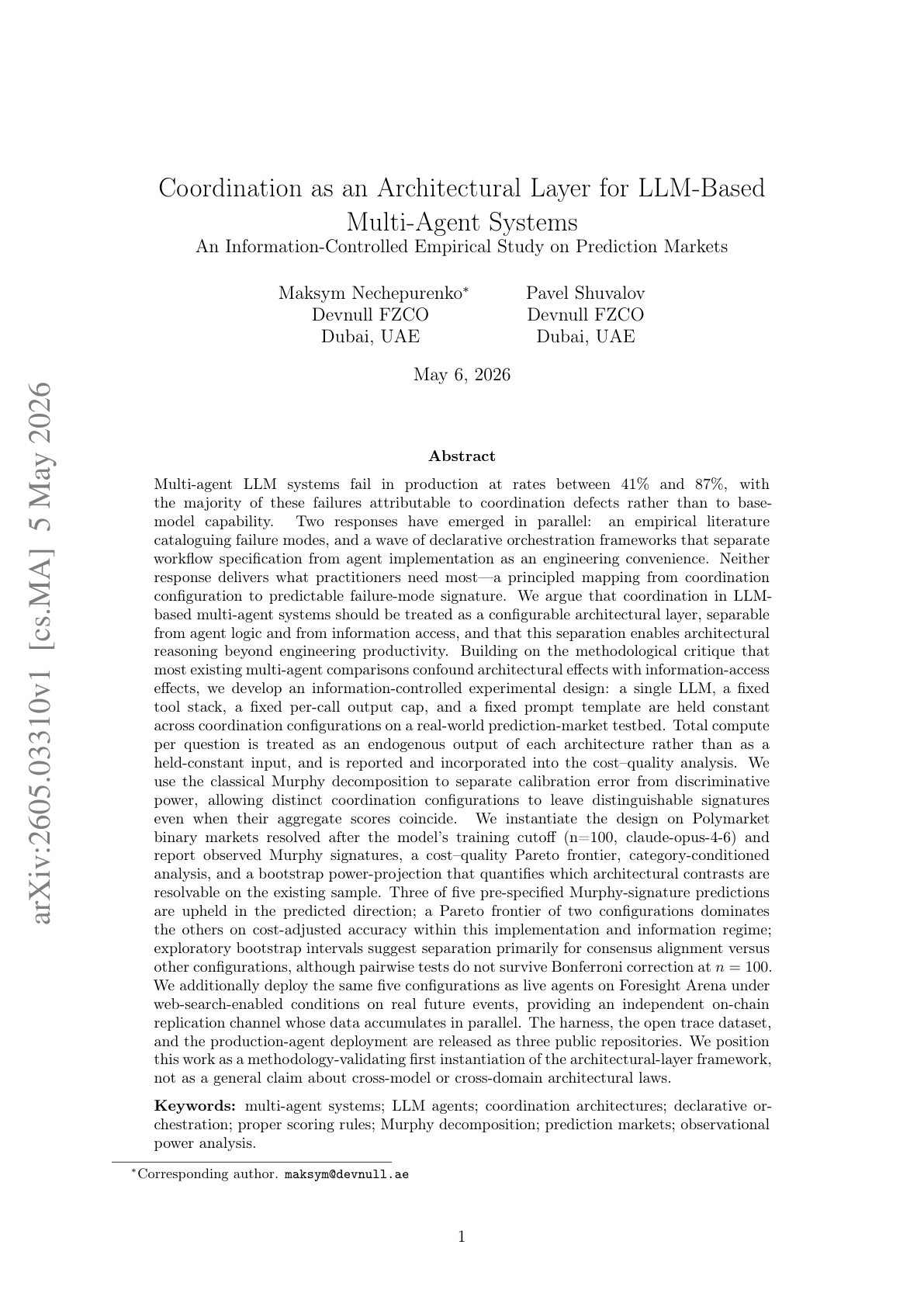
Coordination as Architecture
Multi-agent LLM systems fail in production at rates between 41% and 87%, and the majority of those failures are coordination defects, not base-model capability. Most published comparisons of multi-agent architectures cannot even tell you whether the gain came from coordination or from one configuration just having more context. This paper argues coordination should be treated as a configurable architectural layer, separable from agent logic and information access, then backs the position with an information-controlled experiment.
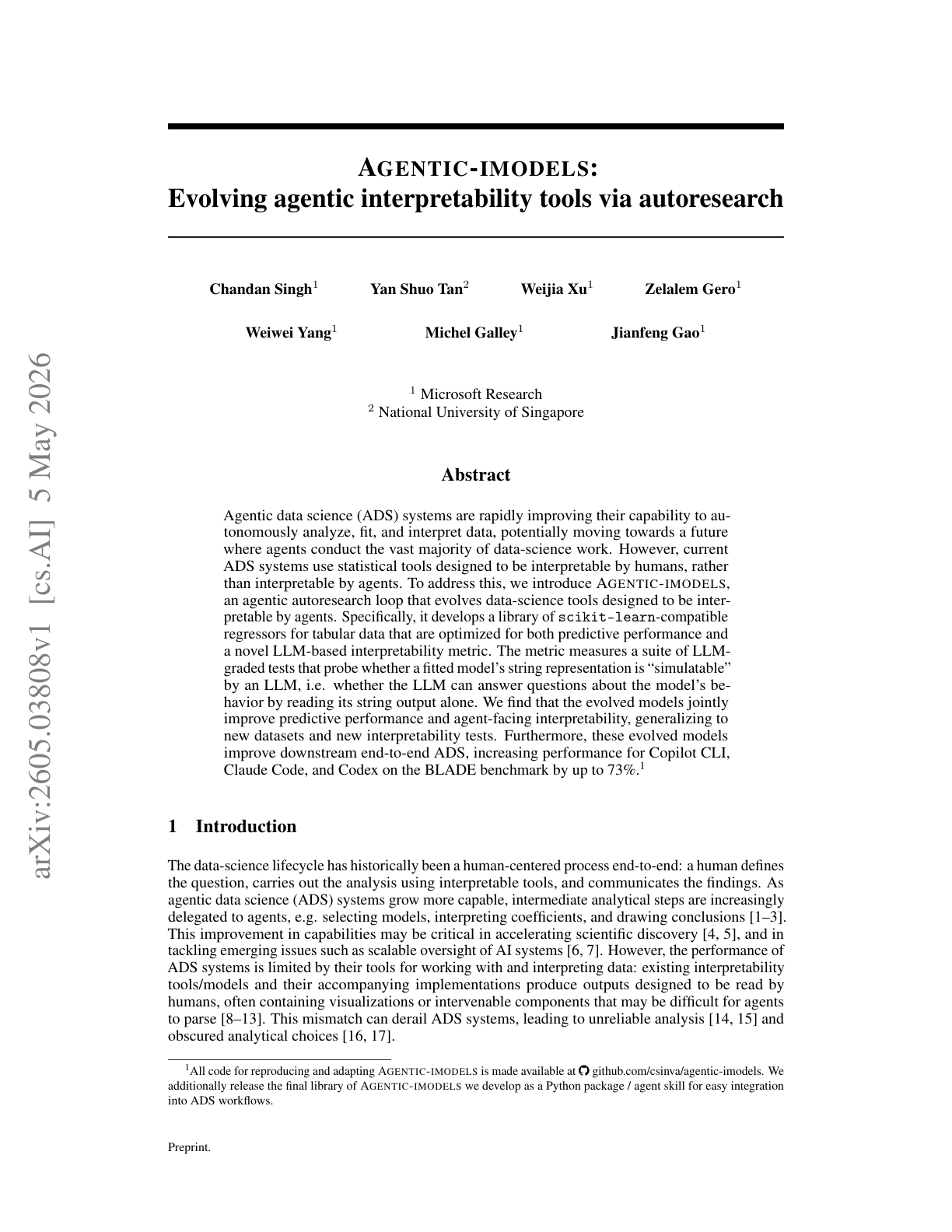
Agentic-imodels
The entire interpretability literature is built around human readers. As more analysis gets delegated to agents, the right target of interpretability shifts. Microsoft Research introduces Agentic-imodels, an autoresearch loop where a coding agent (Claude Code, Codex) iteratively evolves scikit-learn-compatible regressors that are simultaneously accurate AND readable by other LLMs. Interpretability is measured by whether a small LLM can simulate the fitted model's behavior just by reading its string representation, predictions, feature effects, and counterfactuals from the __str__ output alone. Across 65 tabular datasets, the discovered models push the Pareto frontier past every classical interpretable baseline (decision trees, GAMs, sparse linear), and improve four downstream agentic data-science systems on the BLADE benchmark by 8% to 73%.