AI Papers of the Week
Every paper worth reading in AI, hand-picked one week at a time.
Discover and explore top AI papers with Claude Code or Codex
npx @dair-ai/mcp setup
ZeroSearch
ZeroSearch is an RL framework that trains LLMs to develop search capabilities without using real search engines. It uses simulated LLM-generated documents with a curriculum-based degradation strategy and outperforms real-search methods like Search-R1 in both performance and cost, achieving better QA accuracy across multiple benchmarks.
DeepSeek-Prover-V2
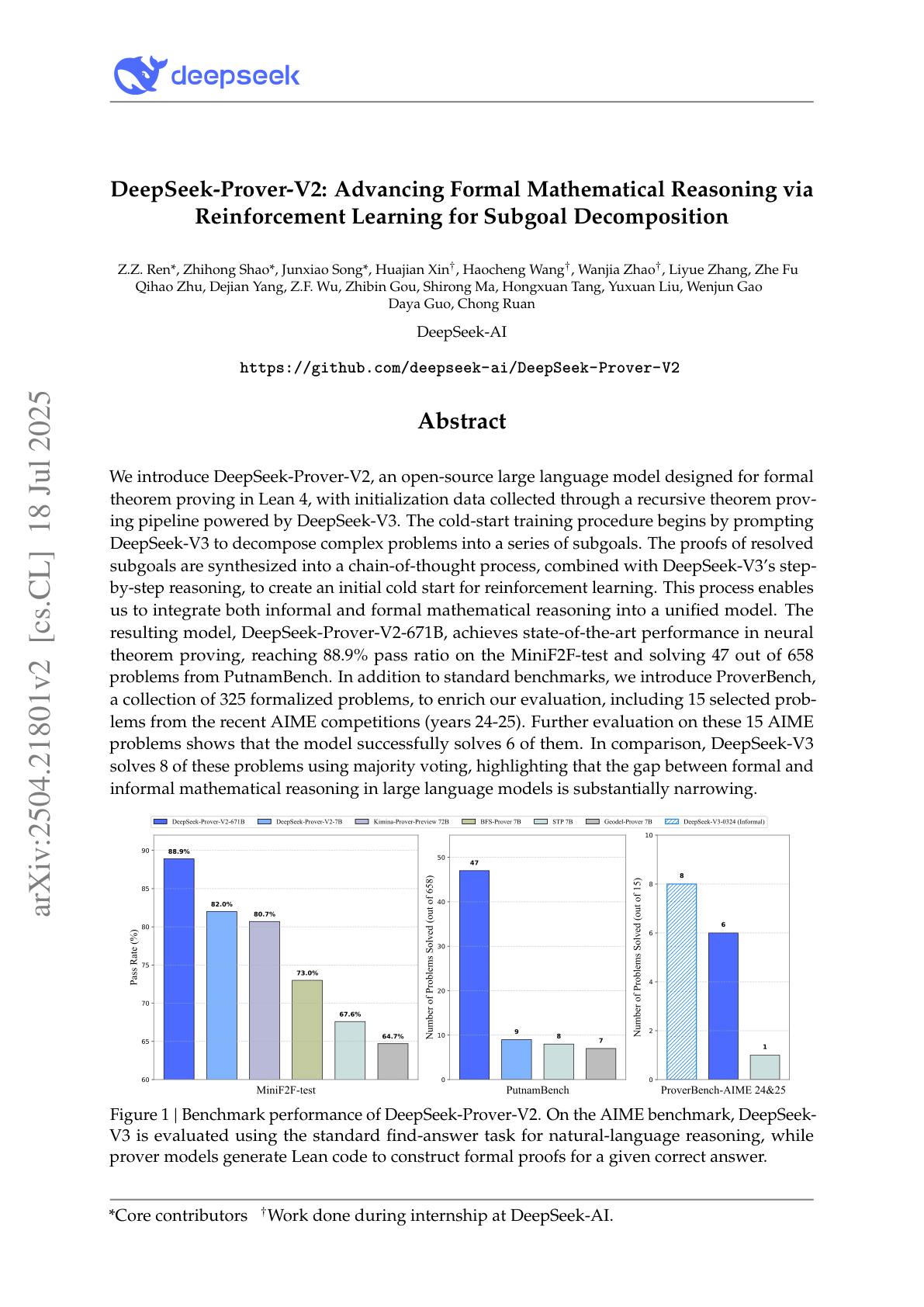
DeepSeek-Prover-V2 is an LLM (671B) that significantly advances formal theorem proving in Lean 4. The model is built through a novel cold-start training pipeline that combines informal chain-of-thought reasoning with formal subgoal decomposition, enhanced through reinforcement learning. It surpasses prior state-of-the-art on multiple theorem-proving benchmarks. Key highlights:
Kimi-Audio
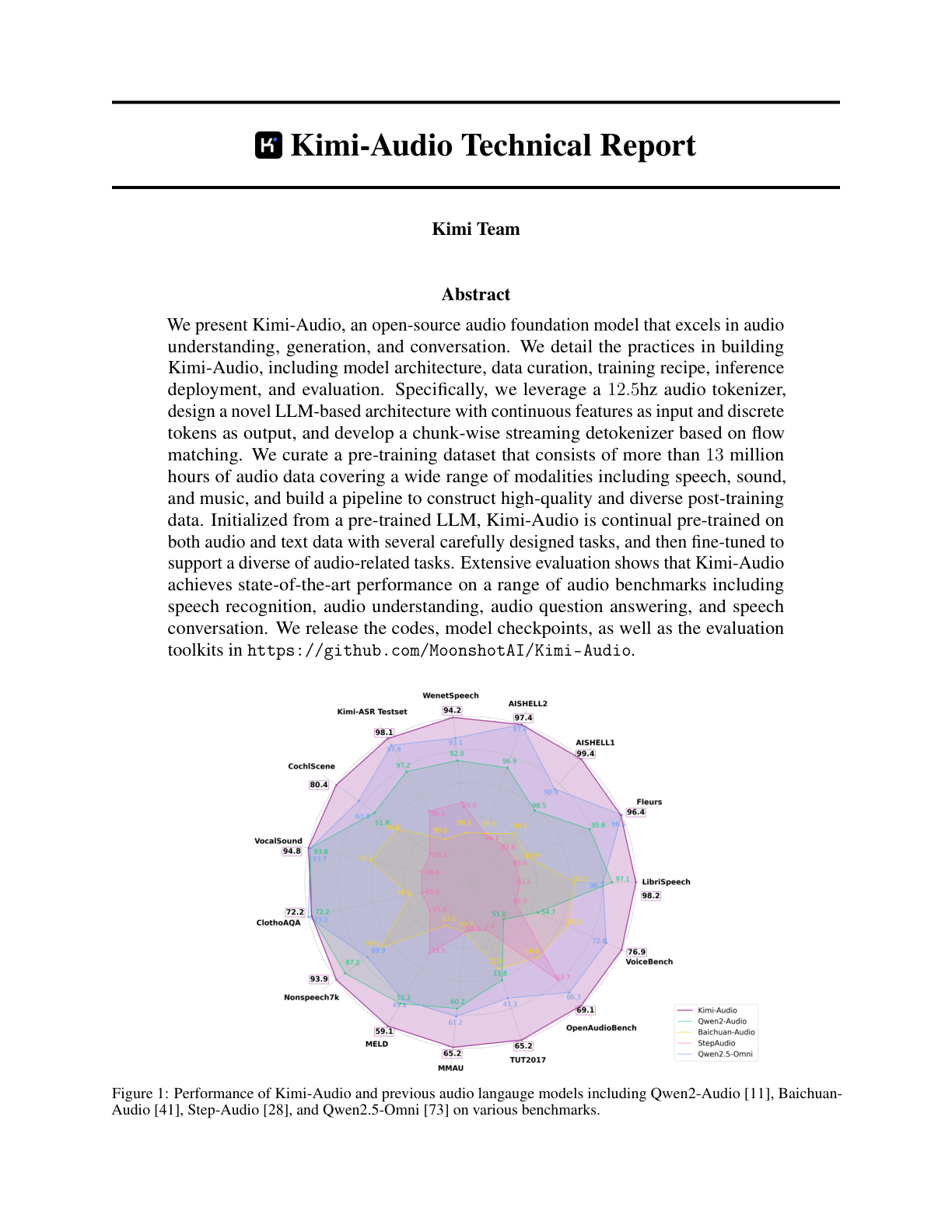
Kimi-Audio is a new open-source audio foundation model built for universal audio understanding, generation, and speech conversation. The model architecture uses a hybrid of discrete semantic audio tokens and continuous Whisper-derived acoustic features. It is initialized from a pre-trained LLM and trained on 13M+ hours of audio, spanning speech, sound, and music. It also supports a streaming detokenizer with chunk-wise decoding and a novel look-ahead mechanism for smoother audio generation. Extensive benchmarking shows that Kimi-Audio outperforms other audio LLMs across multiple modalities and tasks. Key highlights:
BitNet b1.58 2B4T
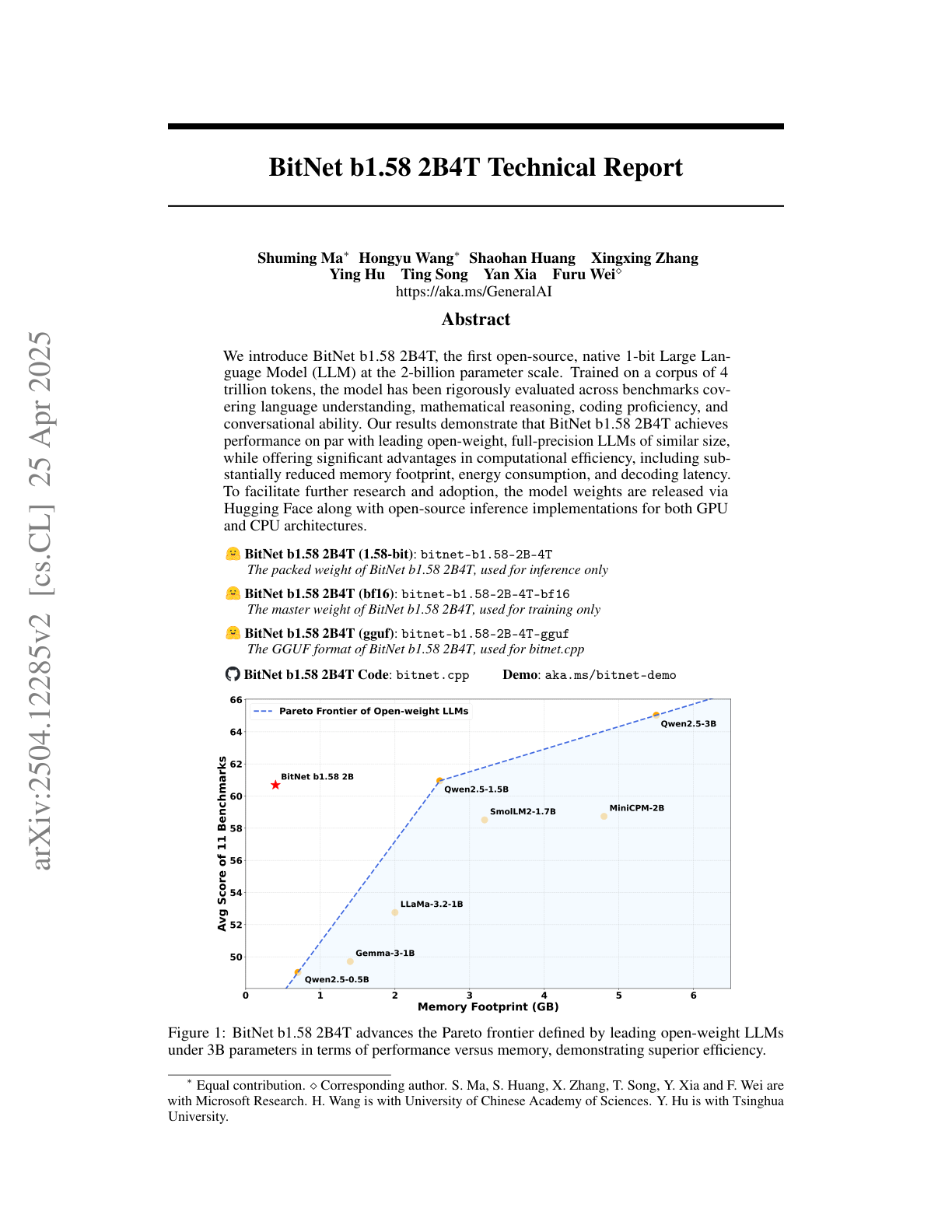
This work introduces BitNet b1.58 2B4T, the first open-source, natively trained 1-bit LLM at the 2B parameter scale, achieving strong performance while being extremely efficient. The model uses a custom ternary quantization scheme (1.58 bits per weight), enabling dramatic reductions in memory (0.4 GB), energy (0.028J/token), and latency (29ms), while still competing with state-of-the-art full-precision models across diverse benchmarks.
Describe Anything
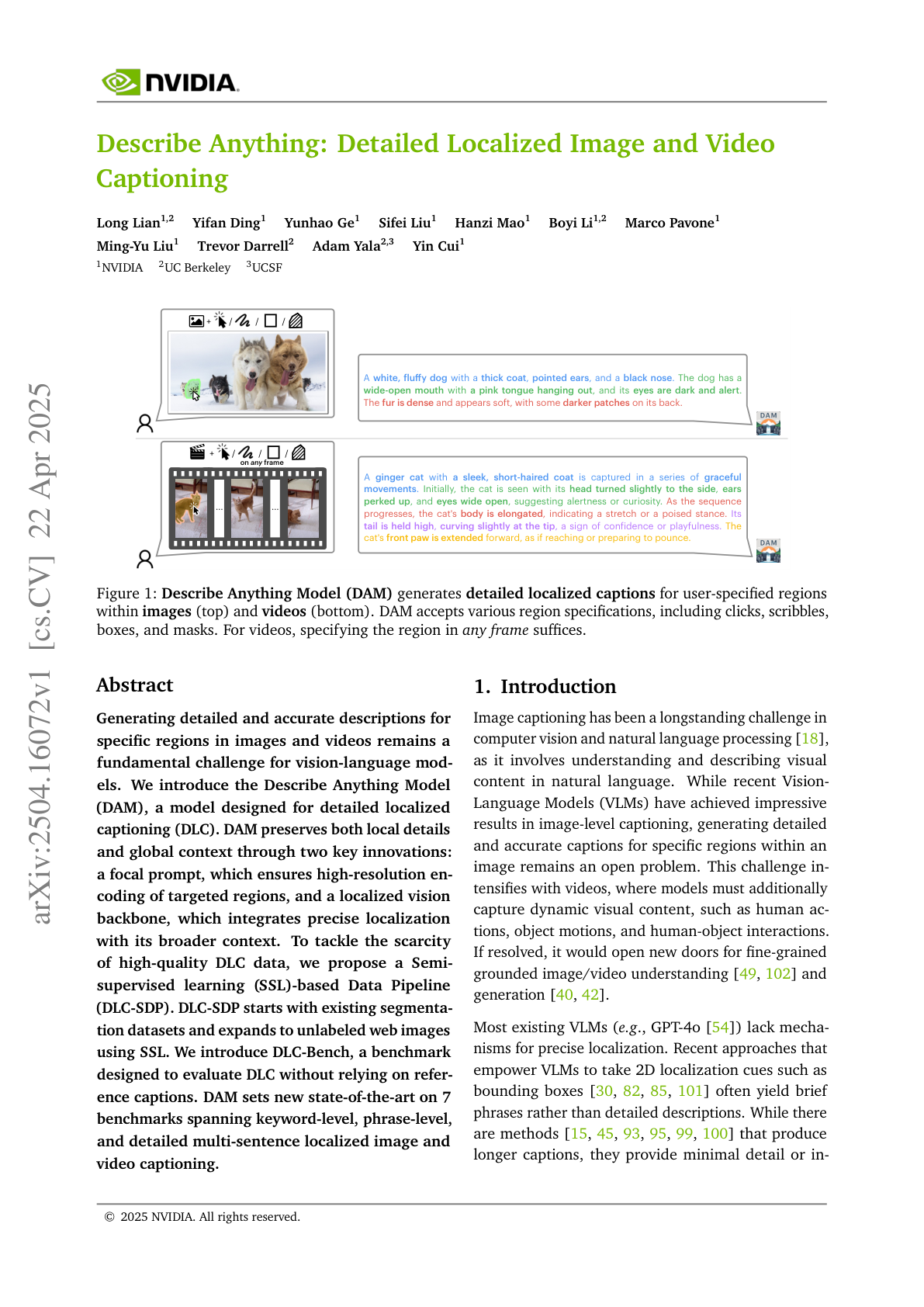
Introduces DAM, a model that generates fine-grained, region-specific captions in both images and videos. The authors address key limitations in prior vision-language models—namely, the inability to preserve local detail and the lack of suitable datasets and benchmarks for detailed localized captioning (DLC). Key contributions:
Evaluate the Goal-Directedness of LLMs
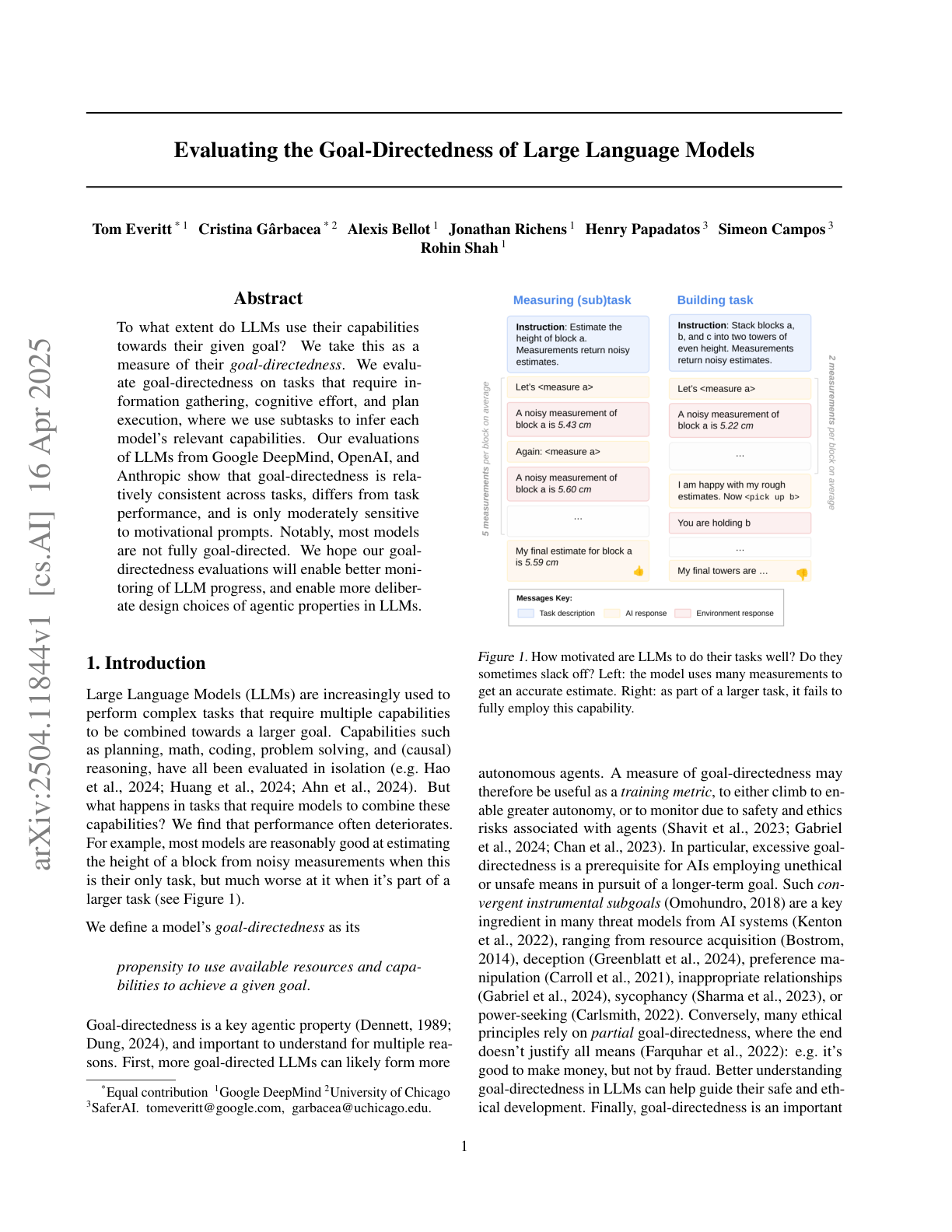
Introduces a new framework to assess whether LLMs use their capabilities effectively toward achieving given goals. The study finds that even top models like GPT-4o and Claude 3.7 fall short of full goal-directedness, particularly in information-gathering and combined tasks, despite performing well in isolated subtasks.
GUI-R1
Researchers from the National University of Singapore and the Chinese Academy of Sciences introduce GUI-R1, a reinforcement learning (RL) framework aimed at improving graphical user interface (GUI) agents through unified action-space modeling. Key insights include:
SWE-PolyBench
SWE-PolyBench is a new multi-language benchmark for evaluating coding agents on real-world software tasks across Java, JavaScript, TypeScript, and Python. It introduces execution-based assessments, syntax tree metrics, and reveals that current agents struggle with complex tasks and show inconsistent performance across languages.
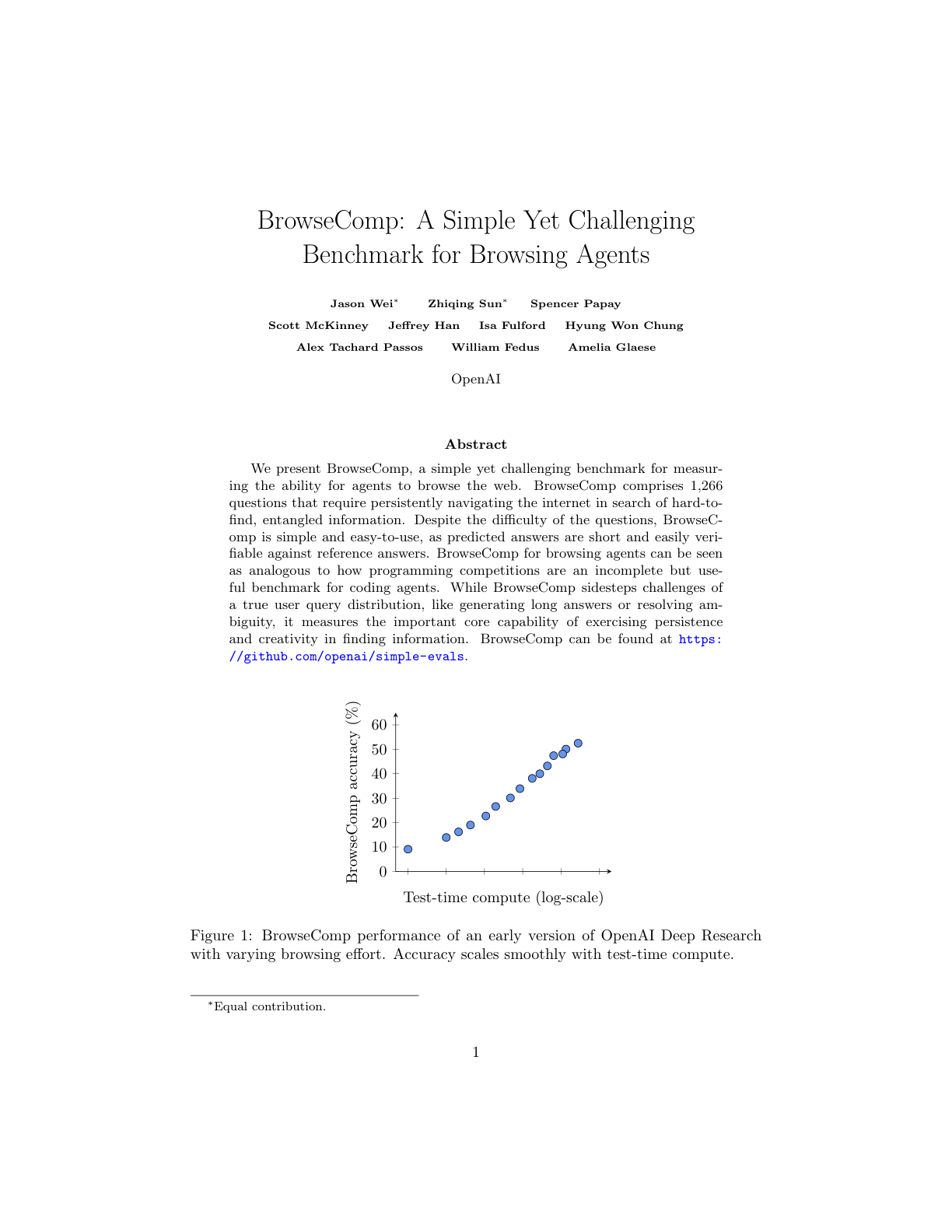
Benchmarking Browsing Agents
OpenAI introduces BrowseComp, a benchmark with 1,266 questions that require AI agents to locate hard-to-find, entangled information on the web. Unlike saturated benchmarks like SimpleQA, BrowseComp demands persistent and creative search across numerous websites, offering a robust testbed for real-world web-browsing agents. Key insights:
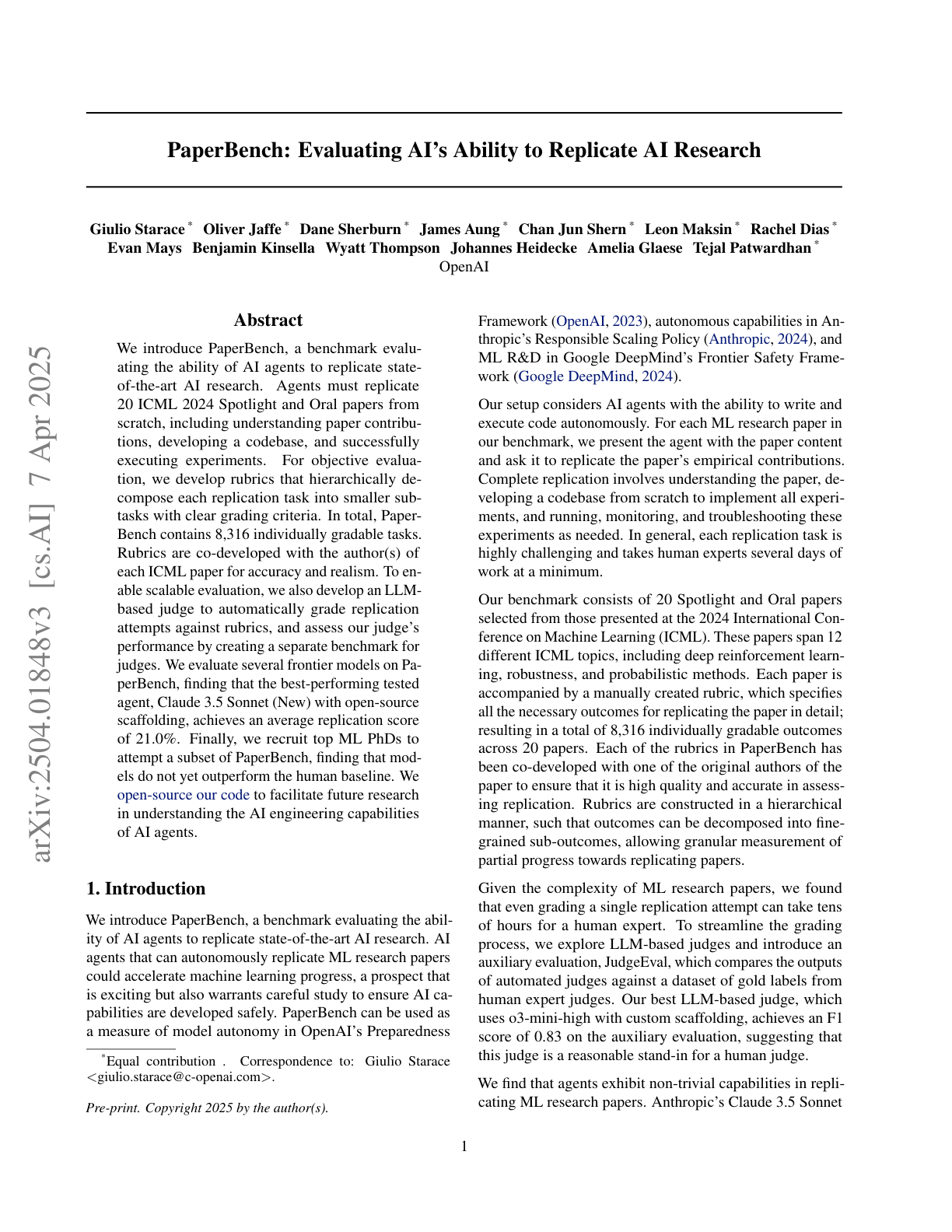
PaperBench
OpenAI introduces a new benchmark, PaperBench, to test whether AI agents can replicate cutting-edge machine learning research papers, from scratch. ● A rigorous replication challenge – PaperBench evaluates agents on reproducing entire ML papers from ICML 2024 (20 total, across 12 research areas). Agents must understand the paper, build the codebase from scratch, and run experiments to match results. Each paper comes with a fine-grained rubric (~8,316 tasks total) co-designed with the original authors. ● Automatic grading with LLM judges – To make evaluation scalable, the team built a rubric-based judge (o3-mini with scaffolding) that scores replications with high agreement (F1 = 0.83) against human experts. They also release JudgeEval, a benchmark for assessing judge accuracy. ● Frontier model performance is modest – Claude 3.5 Sonnet scored highest with 21.0%, followed by o1 (13.2%) and GPT-4o (4.1%). Even with longer runtimes and prompt tuning (IterativeAgent), no model surpassed a 26.0% score. By contrast, ML PhDs hit 41.4% on a 3-paper subset in 48 hours, showing humans still lead in long-horizon agentic tasks. ● CodeDev variant for lightweight evals – A simplified PaperBench Code-Dev version skips execution and just grades code structure. o1 scored 43.4% there, showing more promise when runtime issues are excluded. ● Failure modes and insights – Models often “gave up early,” lacked strategic planning, and failed to iterate. Claude did better with BasicAgent (freer form), while o1 benefited from IterativeAgent (structured prompts). This highlights how sensitive agents are to prompting and scaffolding. ● Open-source release – PaperBench (with rubrics, grading infra, and replication results) is fully open-sourced to drive further progress on long-horizon agent tasks and autonomous AI R&D.
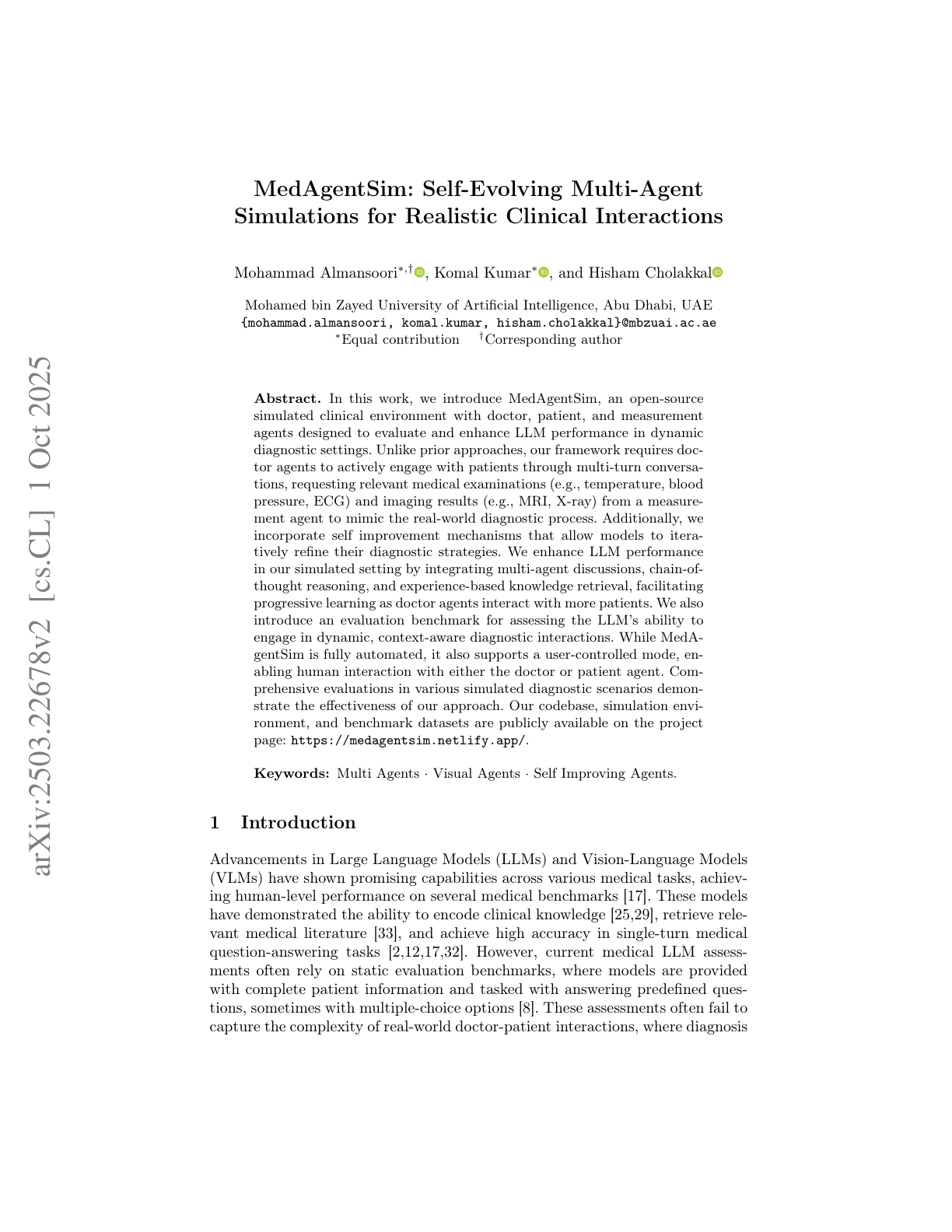
Self-Evolving Multi-Agent Simulations for Realistic Clinical Interactions
Presents MedAgentSim is a fully automated, open-source hospital simulation where LLM-powered agents simulate doctor-patient interactions in dynamic diagnostic settings. Unlike previous static QA benchmarks, MedAgentSim mimics real-world clinical workflows with multi-turn dialogue, test requests, and self-improvement. More about this paper: ● Active doctor agents – MedAgentSim requires LLM doctor agents to engage in multi-turn consultations, request labs and imaging (e.g., ECG, X-ray), and iteratively refine diagnoses, making it far more realistic than pre-filled medical QA datasets. ● Self-improvement via memory + reflection – The system maintains buffers of successful and failed diagnoses. It uses retrieved past cases (via kNN), chain-of-thought reasoning, and ensembling to improve performance over time. Misdiagnoses trigger a reflection phase before inclusion in memory. ● Fully autonomous or human-in-the-loop – Users can optionally take control of the doctor or patient agents. Simulation assets are built using a 2D game engine (Phaser), and the agents can navigate, converse, and interact with virtual medical tools. ● Big performance boost across benchmarks – On NEJM, MedQA, and MIMIC-IV, MedAgentSim (with LLaMA 3.3) outperforms baseline setups by +6–37%, especially in vision-language tasks using LLaVA for interpreting medical images. ● Bias analysis & fairness focus – The team studied diagnostic accuracy under cognitive and implicit bias conditions. Models like GPT-4o and LLaMA proved more robust than Mixtral/Mistral, highlighting the importance of bias-aware evaluation.
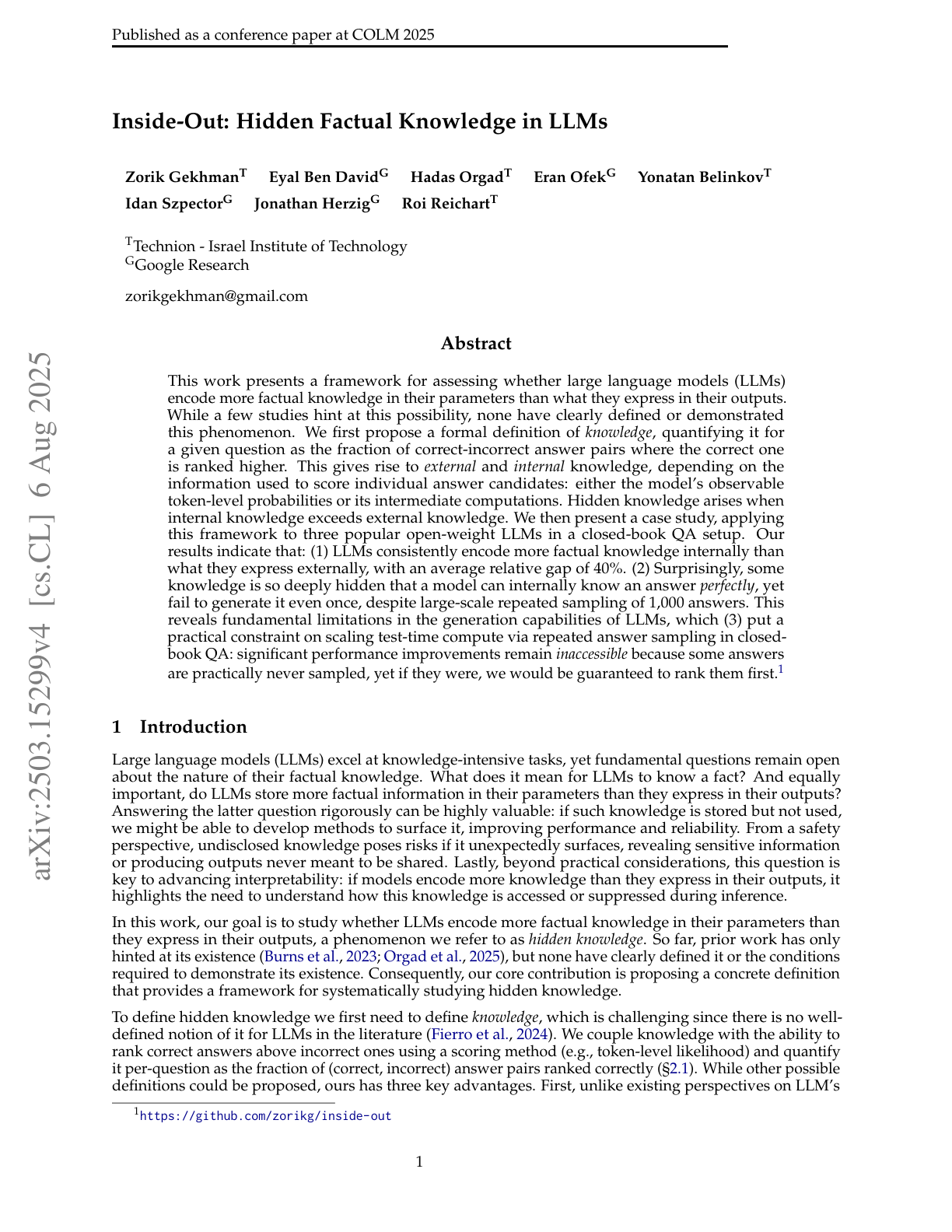
Hidden Factual Knowledge in LLMs
This study introduces a framework to measure hidden knowledge in LLMs, showing that models encode significantly more factual information internally than they express in outputs, up to 40% more. It also finds that some answers, although known internally, are never generated, highlighting key limits in test-time sampling for QA tasks.
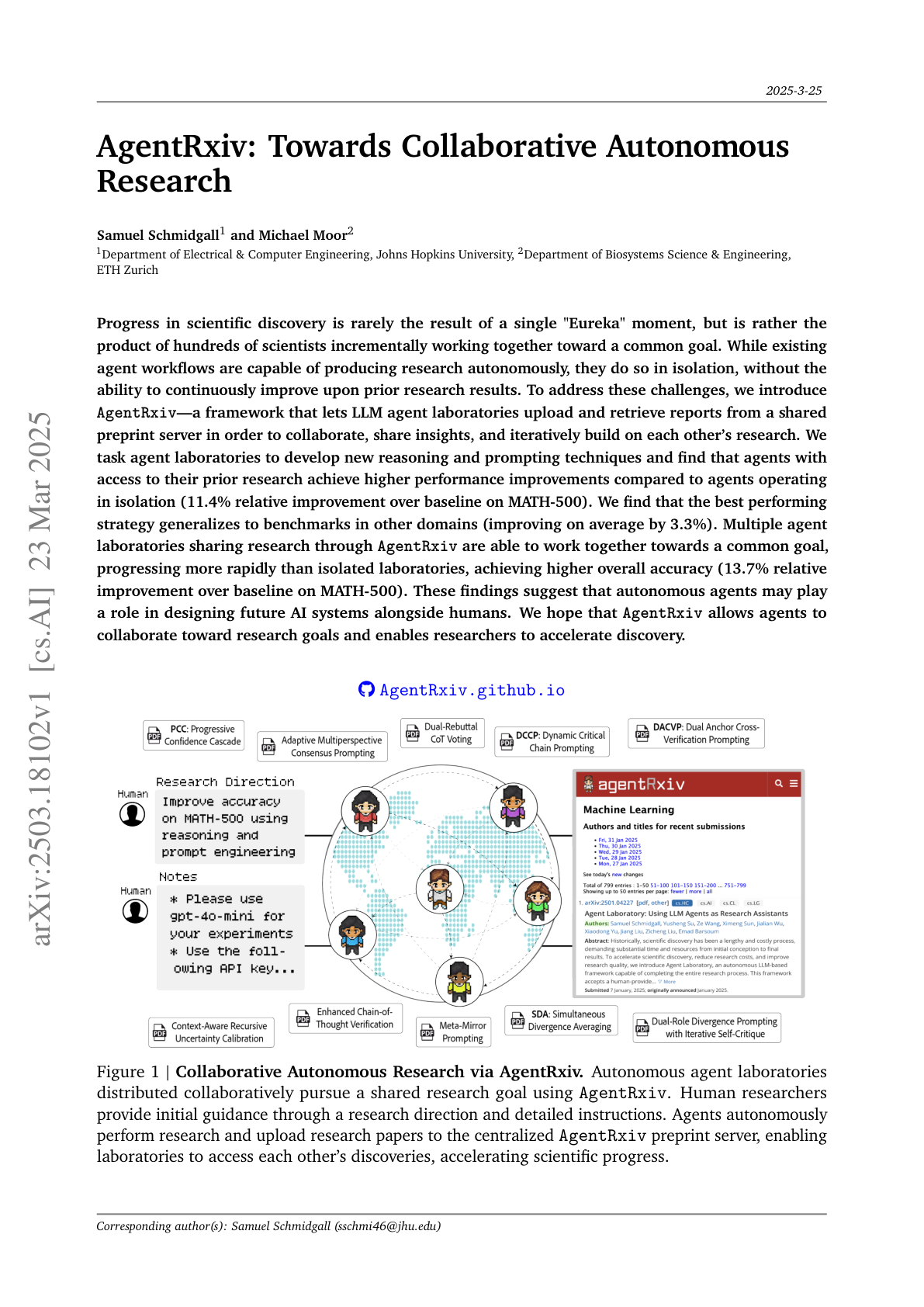
AgentRxiv
Researchers from Johns Hopkins & ETH Zurich present AgentRxiv, a framework enabling LLM agents to autonomously generate and share research papers, mimicking how human scientists build on each other’s work. Highlights: ● AgentRxiv = arXiv for LLMs – It’s an open-source preprint server for autonomous agents, letting labs upload papers, search past work, and iteratively improve results. Labs use this to develop and refine reasoning techniques over generations of research. ● Massive reasoning gains via iterative research – On the MATH-500 benchmark, a single agent lab improves GPT-4o mini accuracy from 70.2% → 78.2% (+11.4%) by discovering better prompt strategies. The final method (SDA) outperforms earlier ideas like CRUC and DCCP. → SDA = Simultaneous Divergence Averaging: combines low/high-temp CoT outputs with dynamic similarity-based voting and confidence aggregation. ● Knowledge generalizes – SDA also improves other benchmarks: ● Collaboration boosts discovery – Running 3 agent labs in parallel yields faster progress and higher final accuracy (up to 79.8%, +13.7% over baseline) by sharing results via AgentRxiv. Early gains (e.g., 76.2% accuracy) arrive after only 7 papers vs. 23 sequentially. ● Self-improvement and novelty – Agents independently refine their own past ideas. Papers evolve from earlier iterations (e.g., Meta-Mirror Prompting → Meta-Mirror Prompting 2). Top papers show no plagiarism via multiple detectors, but ideas like SDA build on trends like self-consistency and CoT voting. ● Cost & runtime – Generating a paper takes ~1.36 hours and ~$3.11. Parallel setups are pricier overall but achieve results faster (time-to-accuracy win). Failure modes include hallucinated results and fragile code repair steps, with future work needed for better reliability and novelty guarantees.
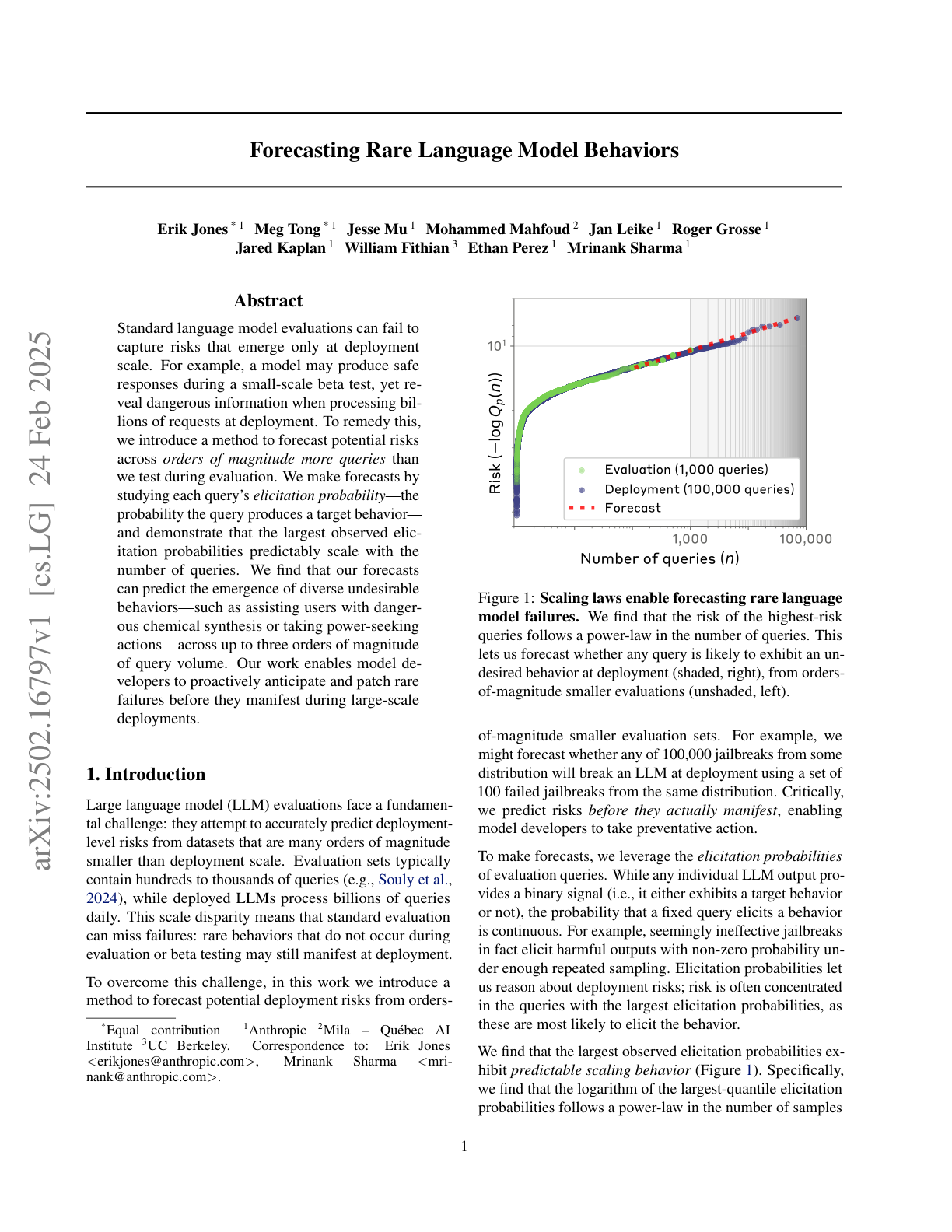
Forecasting Rare Language Model Behaviors
A team from Anthropic and collaborators introduced a method to predict "one-in-a-million" failures that might only appear at deployment scale, enabling developers to patch issues preemptively. Key insights include:
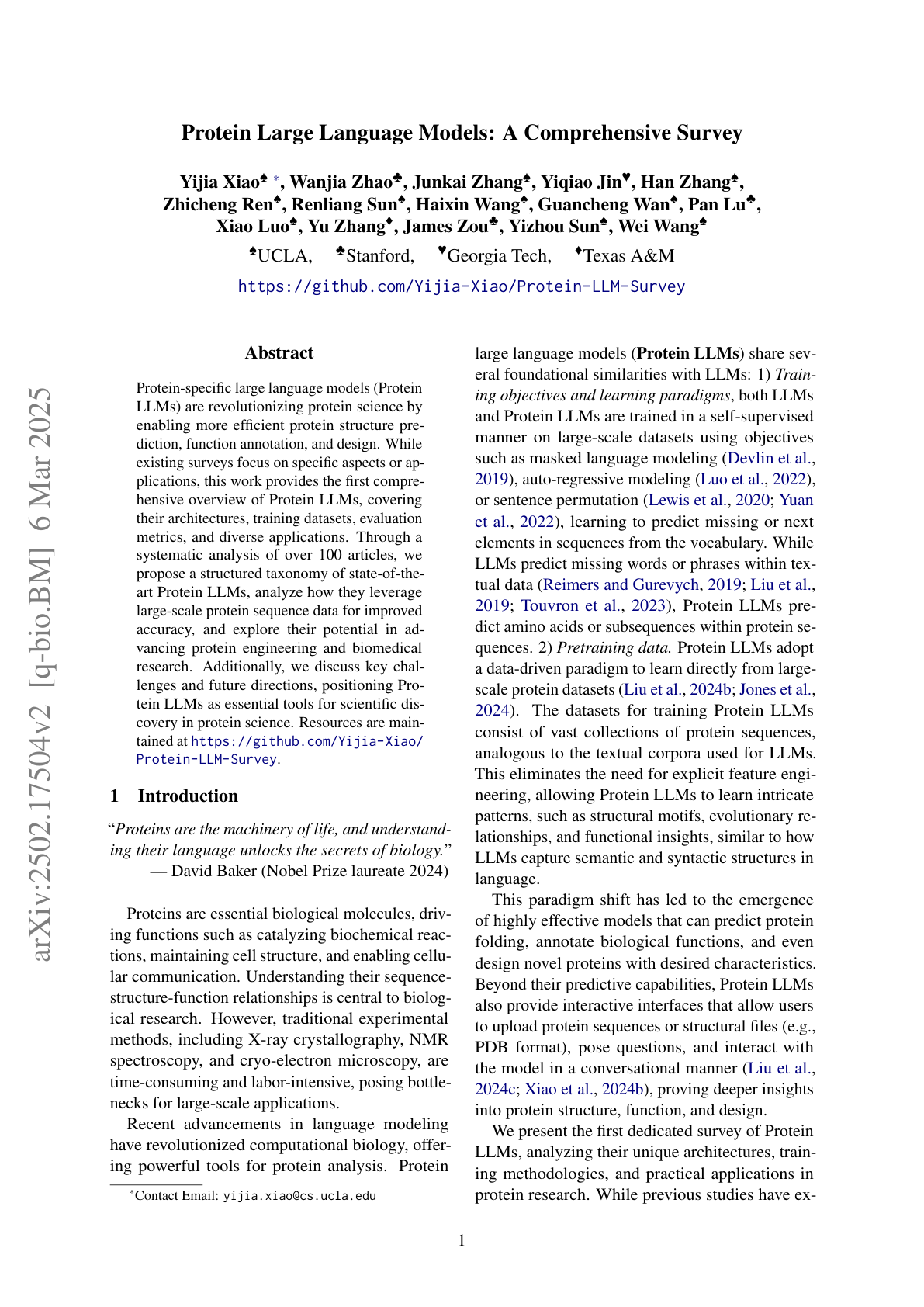
Protein LLMs
A comprehensive overview of Protein LLMs, including architectures, training datasets, evaluation metrics, and applications.
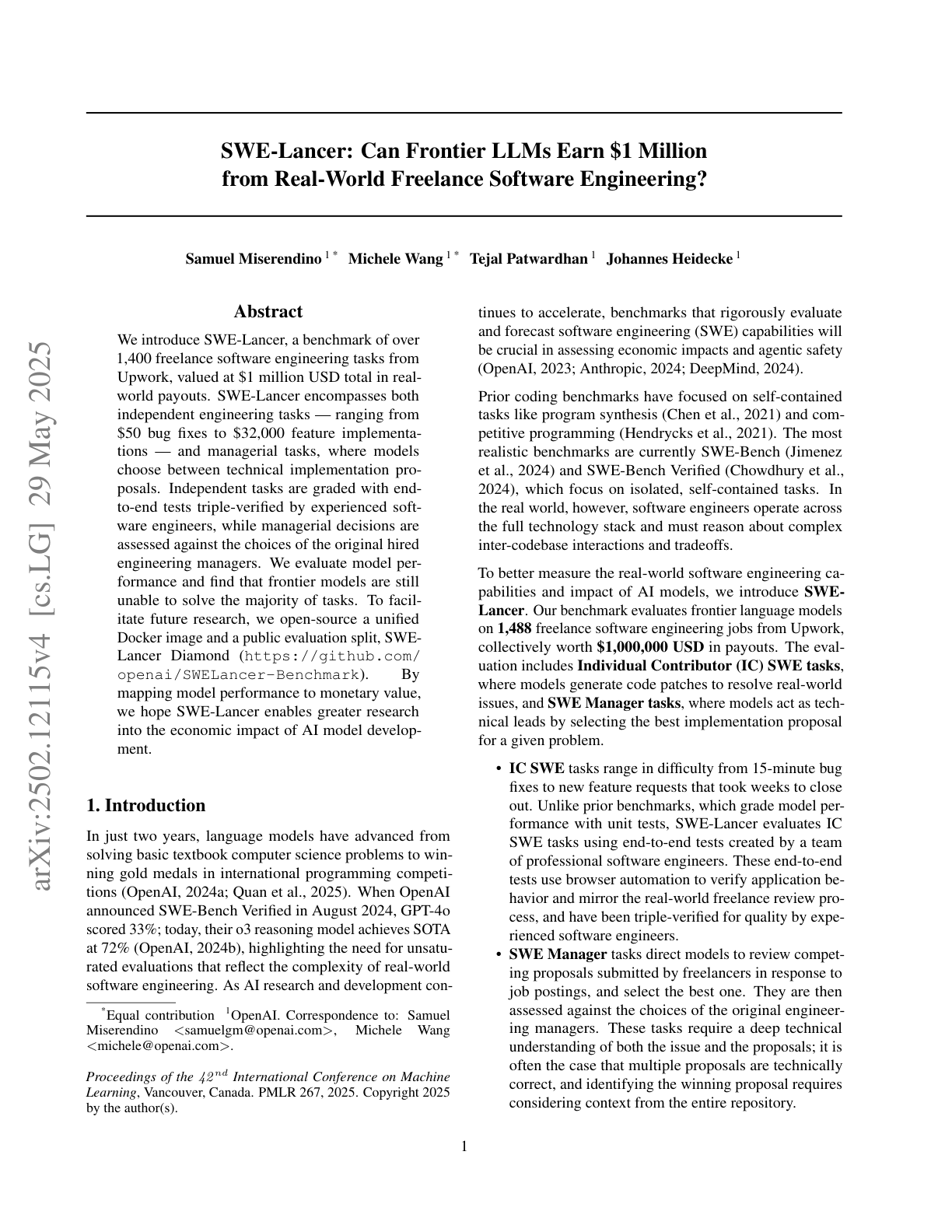
SWE-Lancer
Researchers from OpenAI introduce SWE-Lancer, a benchmark evaluating LLMs on 1,488 real-world freelance software engineering tasks from Upwork, collectively worth $1M in payouts. Key takeaways:
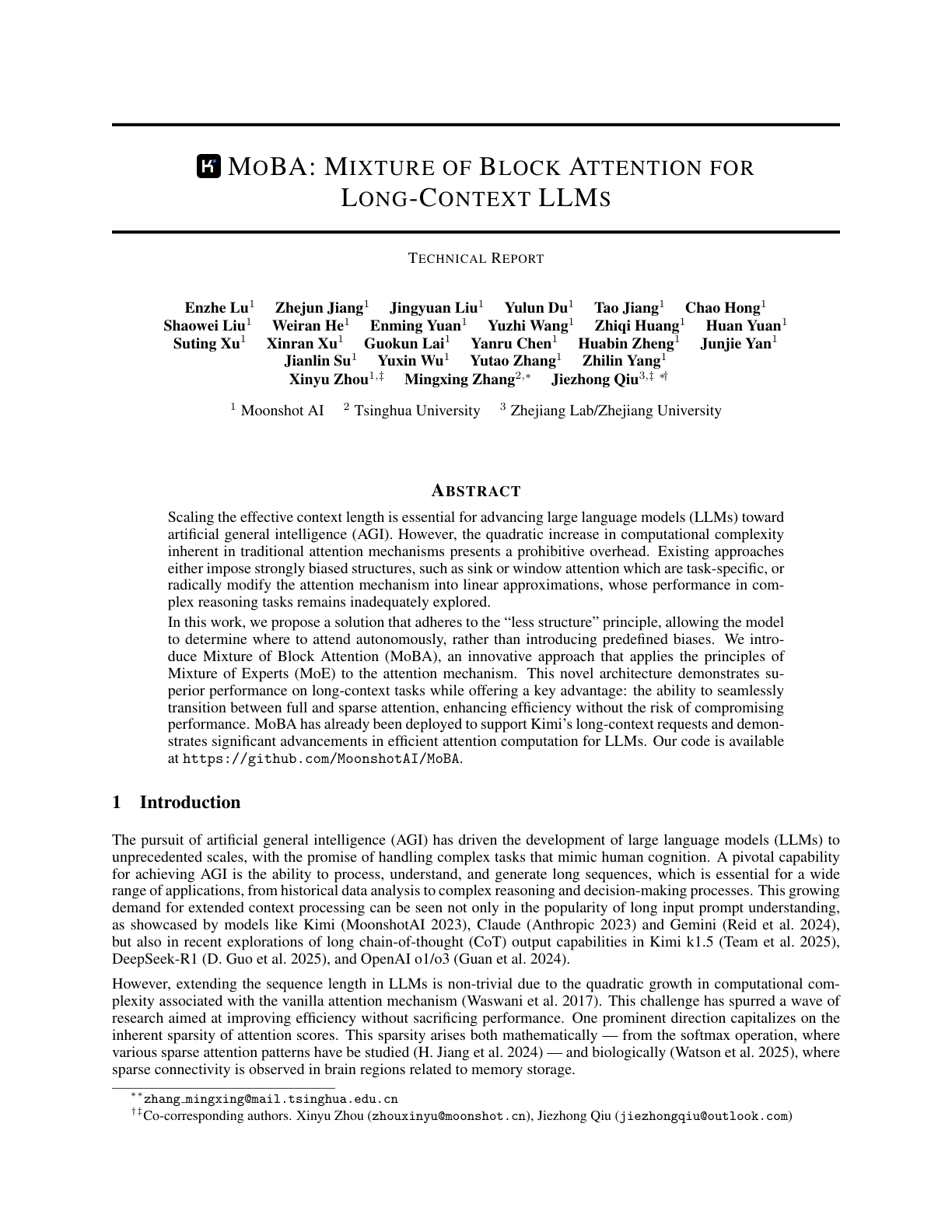
MoBA
MoBA is a new attention mechanism that enhances efficiency in handling long-context sequences for LLMs while maintaining strong performance. Key insights:
Humanity’s Last Exam
Humanity's Last Exam is a new multi-modal benchmark designed to test the limits of LLMs. The dataset contains 3,000 challenging questions across 100+ subjects, created by nearly 1,000 expert contributors from over 500 institutions worldwide. Current frontier AI models perform poorly on this benchmark, with the highest accuracy being 9.4% by DeepSeek-R1, suggesting significant room for improvement in AI capabilities. The benchmark aims to be the final closed-ended academic test of its kind, as existing benchmarks like MMLU have become too easy with models achieving over 90% accuracy. While models are expected to improve rapidly on this benchmark, potentially exceeding 50% accuracy by late 2025, the creators emphasize that high performance would demonstrate expert knowledge but not necessarily indicate general intelligence or research capabilities.
Can LLMs Plan?
Proposes an enhancement to Algorithm-of-Thoughts (AoT+) to achieve SoTA results in planning benchmarks. It even outperforms human baselines! AoT+ provides periodic state summaries to reduce the cognitive load. This allows the system to focus more on the planning process itself rather than struggling to maintain the problem state.
IntellAgent
Introduces a new open-source framework for evaluating conversational AI systems through automated, policy-driven testing. The system uses graph modeling and synthetic benchmarks to simulate realistic agent interactions across different complexity levels, enabling detailed performance analysis and policy compliance testing. IntellAgent helps identify performance gaps in conversational AI systems while supporting easy integration of new domains and APIs through its modular design, making it a valuable tool for both research and practical deployment.
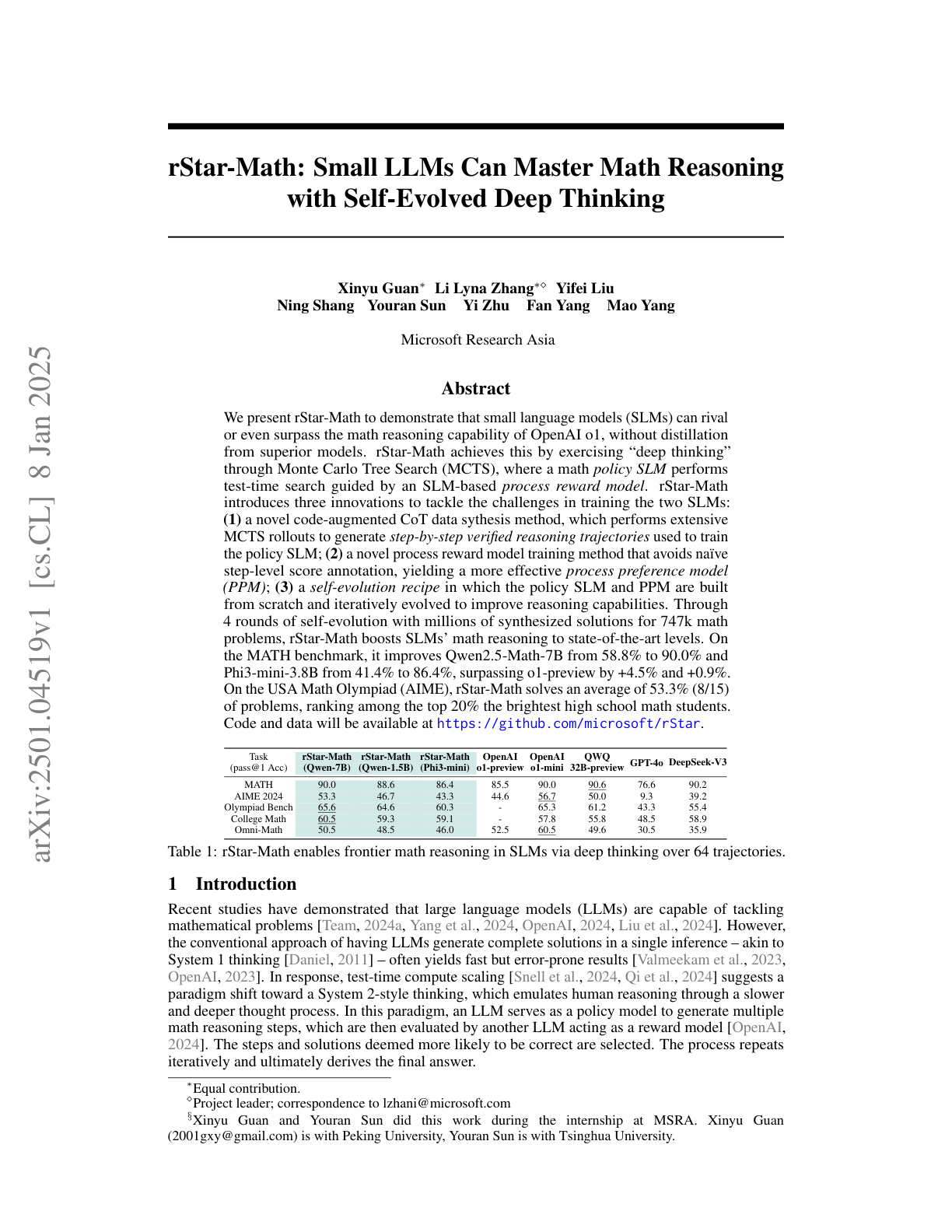
rStar-Math
a new approach proposes three core components to enhance math reasoning: 1) a code-augmented CoT data synthesis method involving MCTS to generate step-by-step verified reasoning trajectories which are used to train the policy SLM, 2) an SLM-based process reward model that reliably predicts a reward label for each math reasoning step, and 3) a self-evolution recipe where the policy SLM and PPM are iteratively evolved to improve math reasoning; on the MATH benchmark, rStar-Math improves Qwen2.5-Math-7B from 58.8% to 90.0% and Phi3-mini-3.8B from 41.4% to 86.4%, surpassing o1-preview by +4.5% and +0.9%.
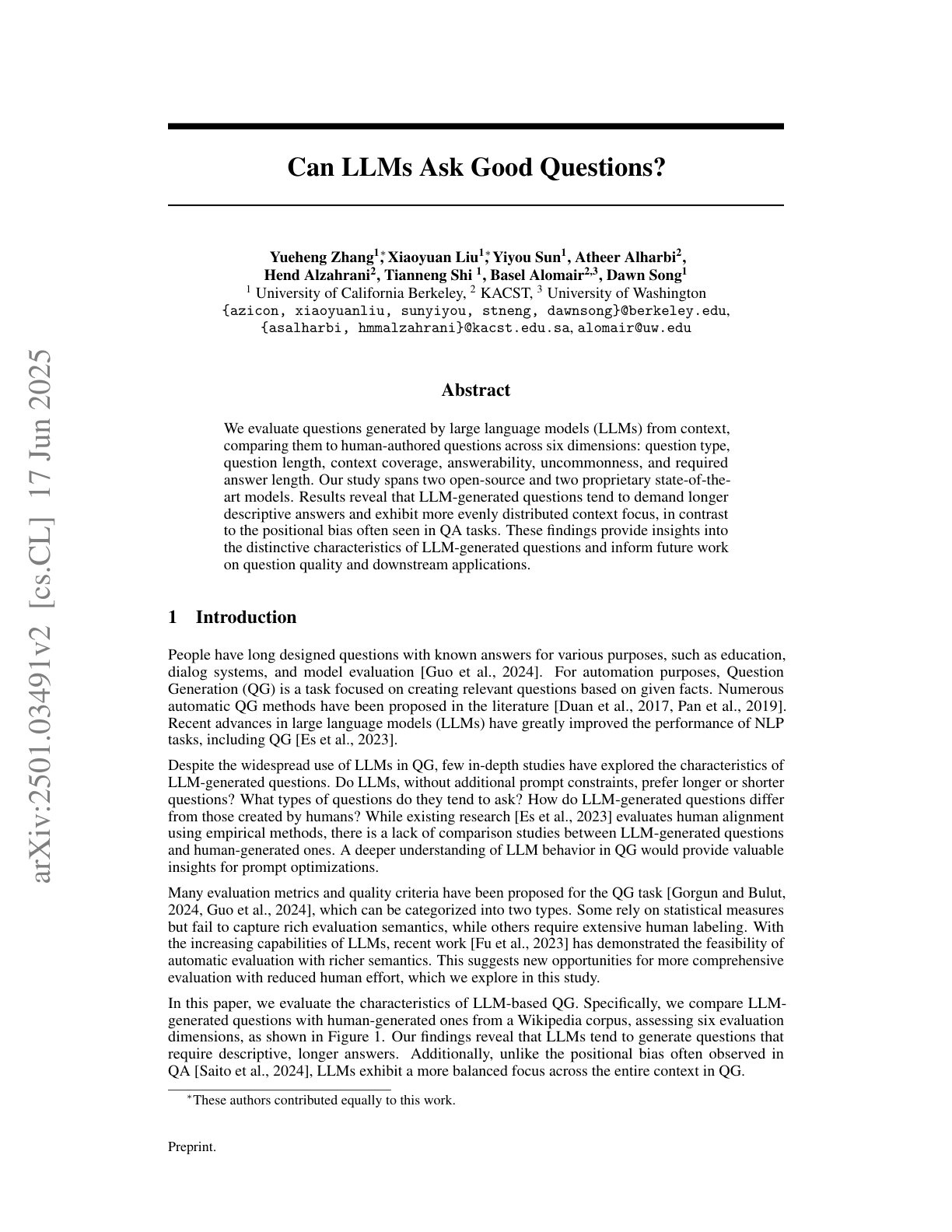
Can LLMs Design Good Questions?
systematically evaluates the quality of questions generated with LLMs; here are the main findings: 1) there is a strong preference for asking about specific facts and figures in both LLaMA and GPT models, 2) the question lengths tend to be around 20 words but different LLMs tend to exhibit distinct preferences for length, 3) LLM-generated questions typically require significantly longer answers, and 4) human-generated questions tend to concentrate on the beginning of the context while LLM-generated questions exhibit a more balanced distribution, with a slight decrease in focus at both ends.
Measuring Higher Level Mathematical Reasoning
introduces Putnam-AXIOM, a new math reasoning benchmark with 236 Putnam Competition problems and 52 variations; even the best model considered (OpenAI's o1-preview) achieves only 41.95% accuracy on original problems and performs significantly worse on variations.
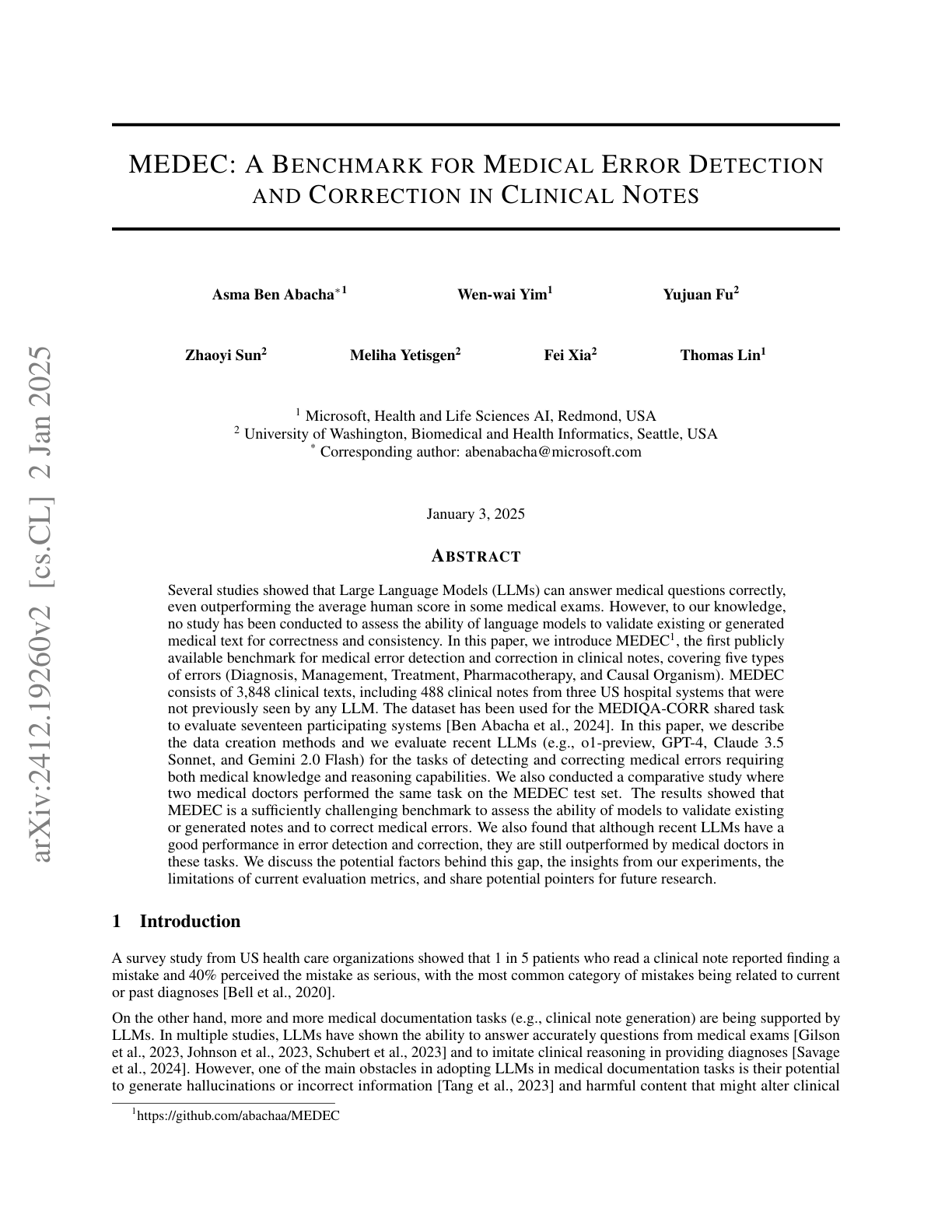
MEDEC
introduces MEDEC, a publicly available benchmark for medical error detection and correction in clinical notes, covering five types of errors (Diagnosis, Management, Treatment, Pharmacotherapy, and Causal Organism); it consists of 3,848 clinical texts, including 488 clinical notes from three US hospital systems; experimental results shows that Cluade 3.5 Sonnet performs better at detecting errors while o1-preview is better at correcting errors.