AI Papers of the Week
Every paper worth reading in AI, hand-picked one week at a time.
Improving Evaluation Realism with Inference-Time Compute and Deployment Scaffolds
Axel Ahlqvist and colleagues at the UK AI Security Institute, Meridian and Anthropic attack evaluation awareness, the problem that capable models can tell when they are being tested rather than deployed, which weakens any conclusion a safety evaluation supports.
Evaluating and Improving LLM Self-Modeling
Siqi Zeng, Andre N. Assis and Rowan Wang, working through the Anthropic Fellows Program, measure whether a model can answer verifiable questions about its own behavior, and then try to train the ability in.
hLLM: Single Pass Decoding for Generative Reranking
Emil Laftchiev and colleagues at Meta Platforms observe that a generative ranker only ever needs to emit N ordinal values, and exploit that narrow output format to decode the whole ranking in a constant number of forward passes.
SimSkill: A Lifelong Learning AI Agent for Autonomous Mastery of Traffic Simulation
Qi Liu, Qinzheng Wang and Yiming Bie build SimSkill, a self-evolving agent over the SUMO traffic simulator that finds its own capability gaps, writes and solves grounded tasks, and consolidates the results into episodic, procedural and semantic memory without touching the backbone weights.
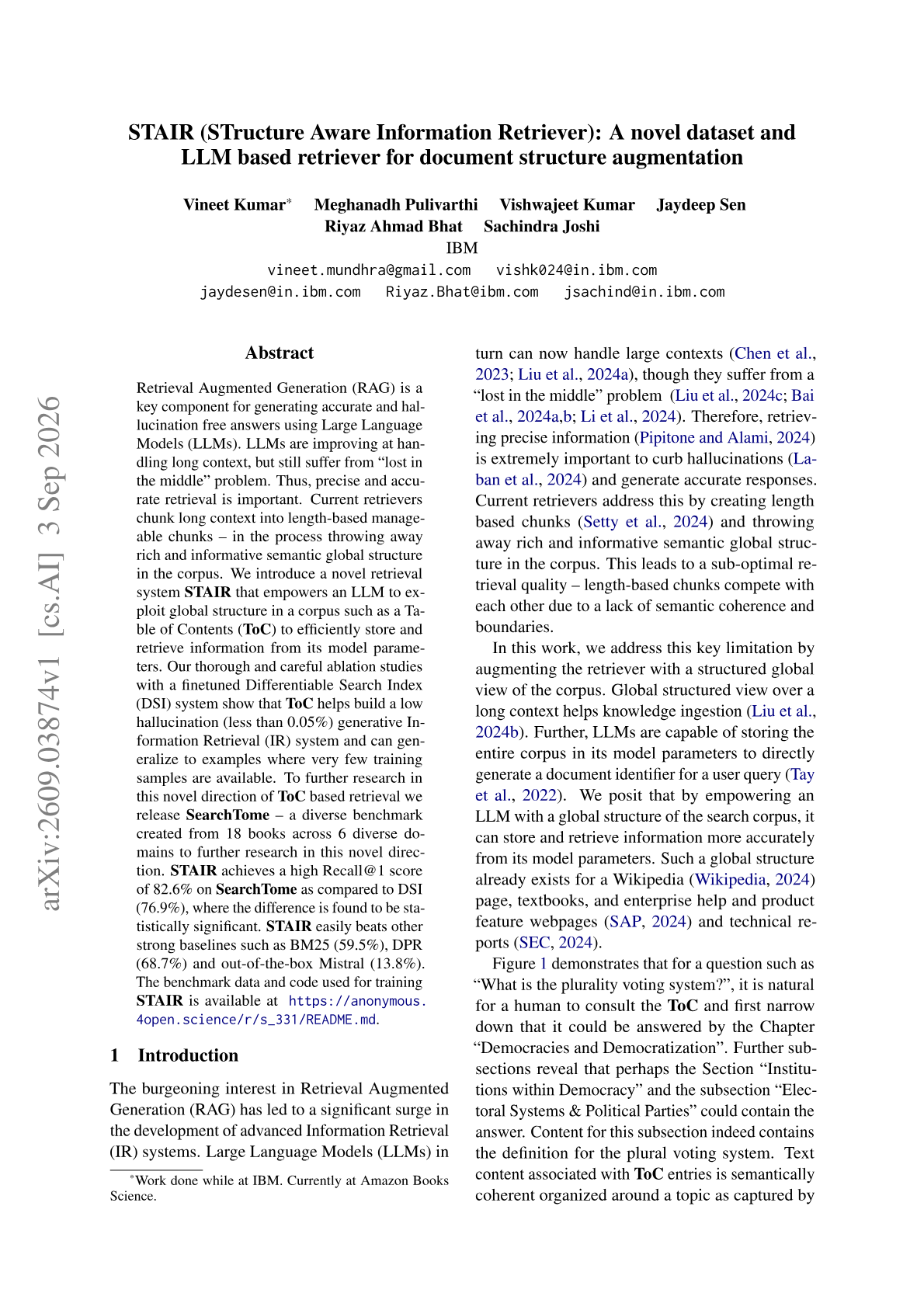
STAIR (STructure Aware Information Retriever): A novel dataset and LLM based retriever for document structure augmentation
Retrievers chunk long documents by length, which throws away the hierarchy the document already has. Researchers at IBM point out that a table of contents already encodes that global structure, and they build a retriever around it.
Beyond Endpoint Scores: Time- and Capacity-Conditioned Evaluation of Continual Knowledge Updating
Heejin Choi at Yonsei University shows that the ranking of continual knowledge-updating methods reverses depending on when you evaluate and how much adapter capacity the baseline gets.
Instruction Duplication as an Inference-Time Control Primitive
Victor Lavrenko at PeaceTech VC measures instruction duplication, repeating only the procedural instruction, as a black-box inference-time control across seven instruction-tuned models and 16,800 scheduled generations, and reports gains on process compliance without any change in final-answer accuracy.
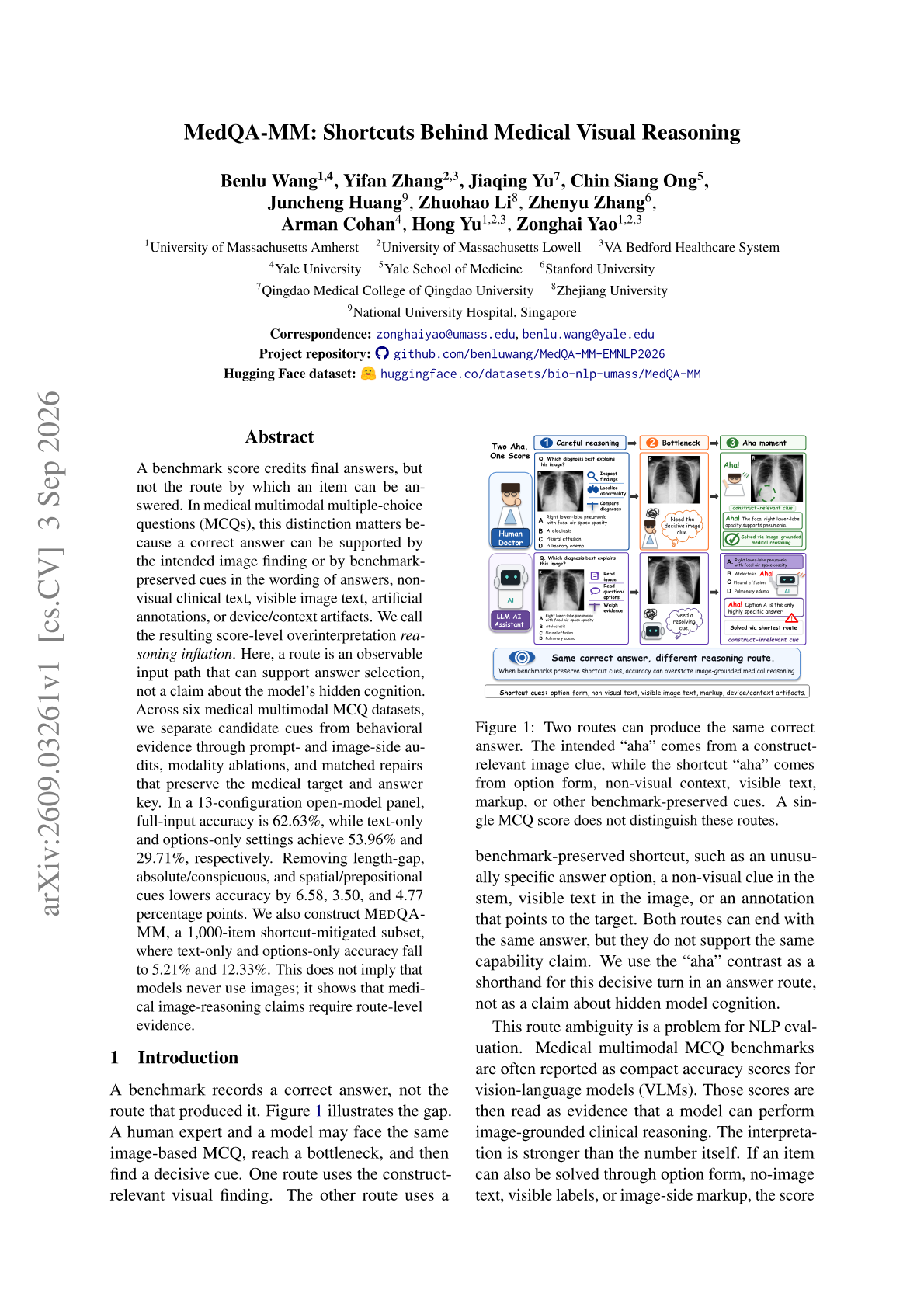
MedQA-MM: Shortcuts Behind Medical Visual Reasoning
Benlu Wang and colleagues at UMass Amherst and Yale separate the answer from the route that produced it in medical multimodal MCQs, and find that scores substantially overstate image reasoning.
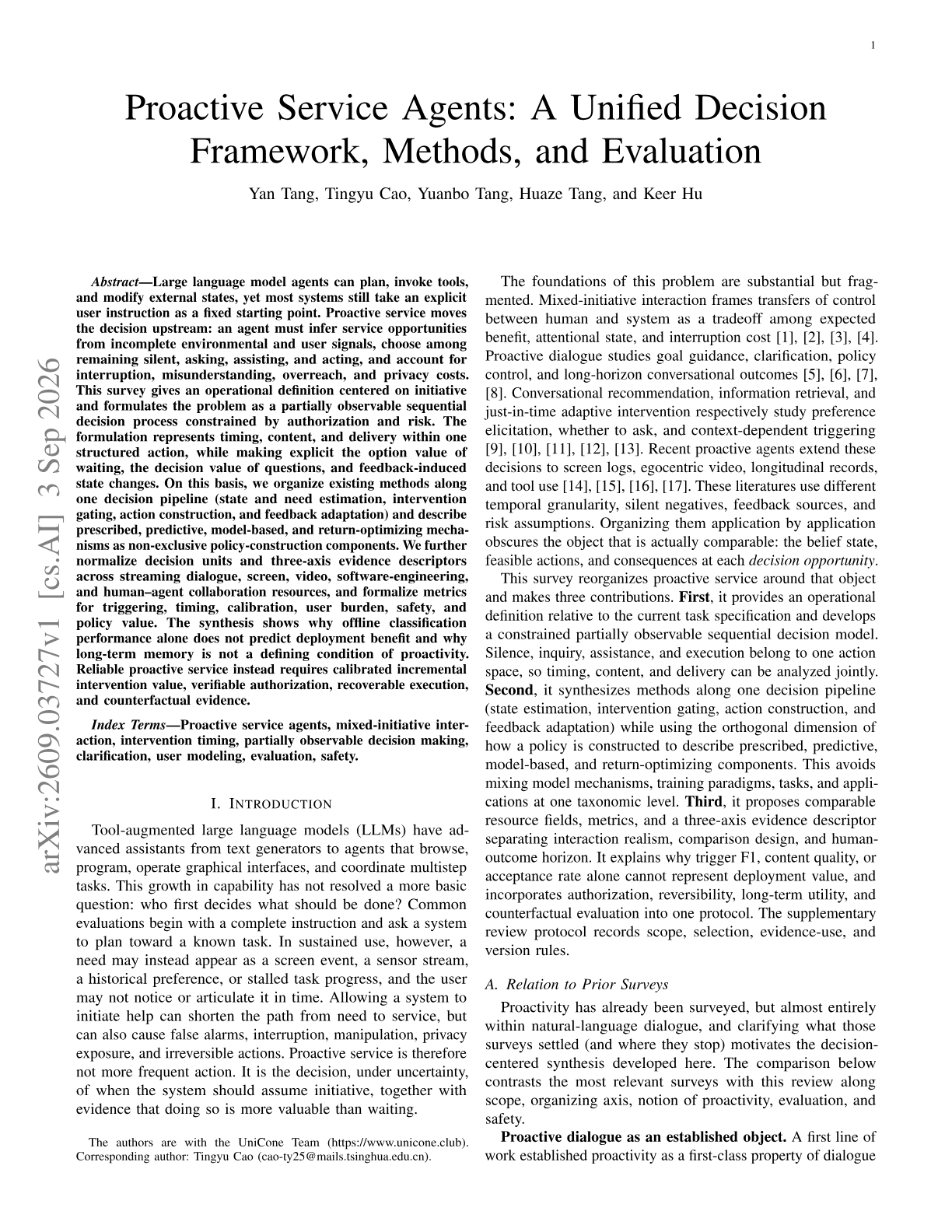
Proactive Service Agents: A Unified Decision Framework, Methods, and Evaluation
Yan Tang and colleagues formalize proactive service as a partially observable sequential decision process constrained by authorization and risk, where staying silent is a first-class action with option value.
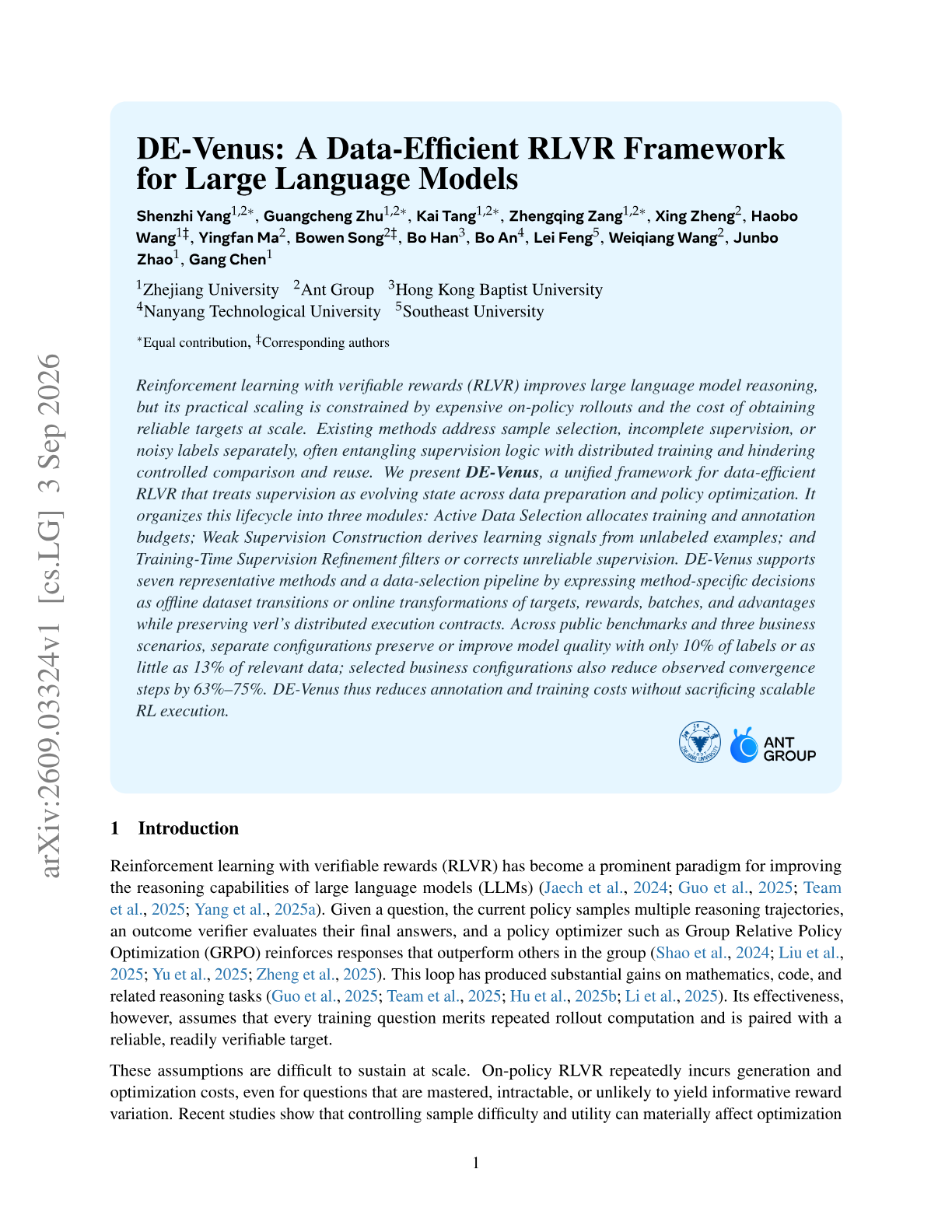
DE-Venus: A Data-Efficient RLVR Framework for Large Language Models
Shenzhi Yang and colleagues at Zhejiang University with Ant Group, HKBU, NTU and Southeast University present DE-Venus, a framework that treats RLVR supervision as evolving state across data preparation and policy optimization, so that sample selection, weak supervision and label correction can be compared inside one system rather than as separate papers.
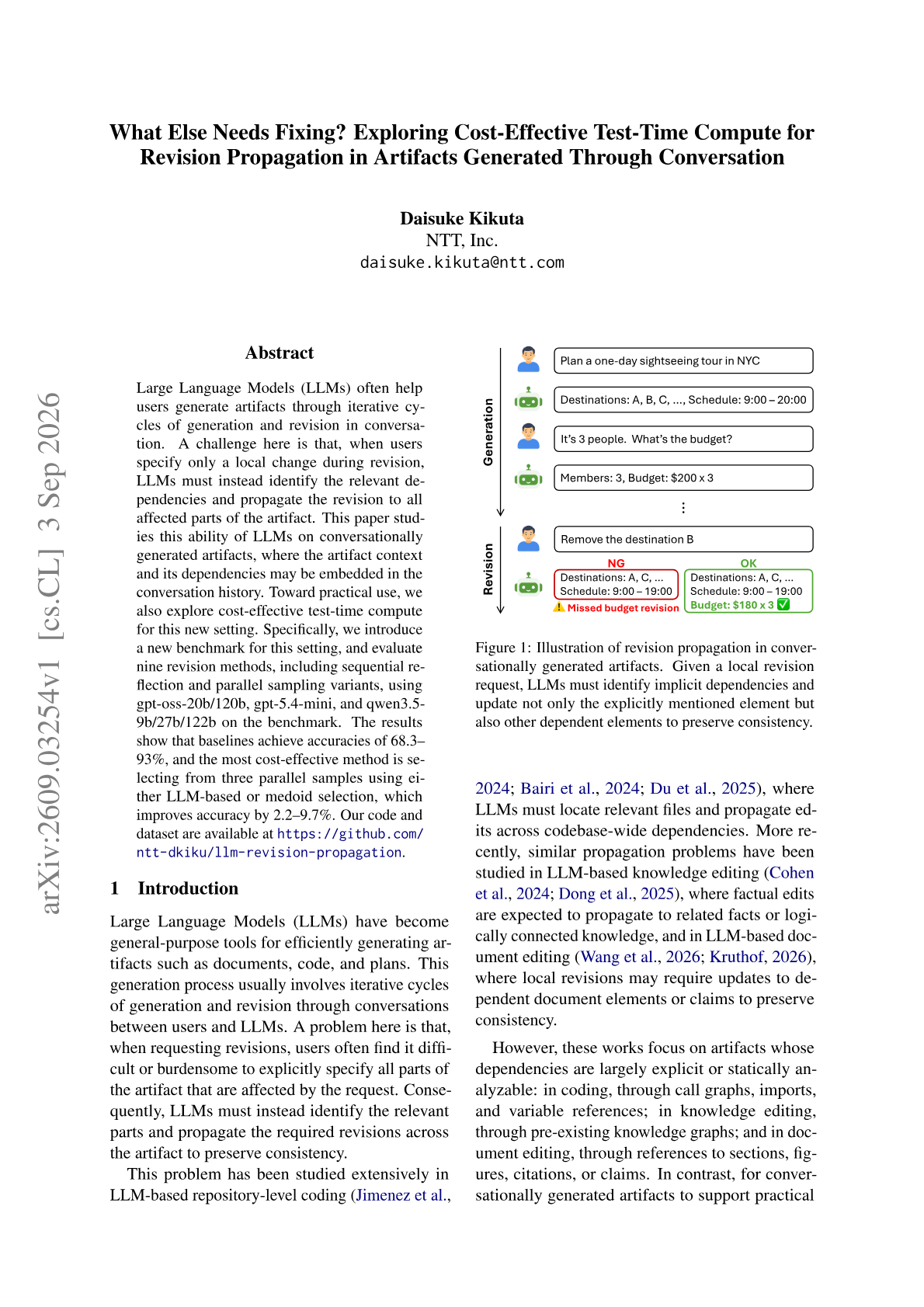
What Else Needs Fixing? Exploring Cost-Effective Test-Time Compute for Revision Propagation in Artifacts Generated Through Conversation
Daisuke Kikuta (NTT) studies revision propagation, where a user asks for one local change and the model must find and update every dependent part of an artifact whose dependencies are buried in the conversation history.
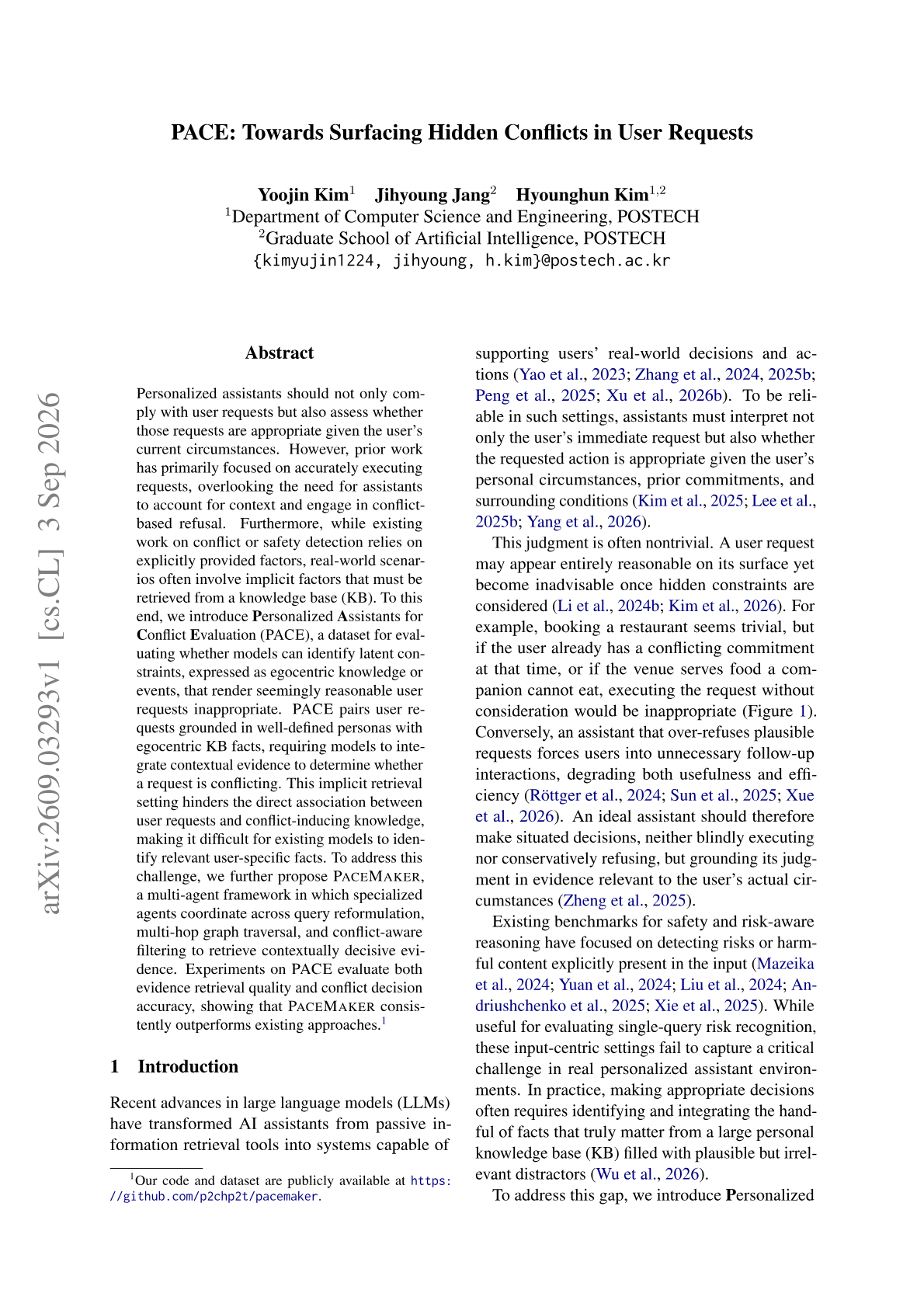
PACE: Towards Surfacing Hidden Conflicts in User Requests
Yoojin Kim, Jihyoung Jang and Hyounghun Kim introduce PACE, a dataset for whether an assistant can notice that a perfectly reasonable request is wrong for this user right now, given facts it must retrieve rather than facts it is handed.
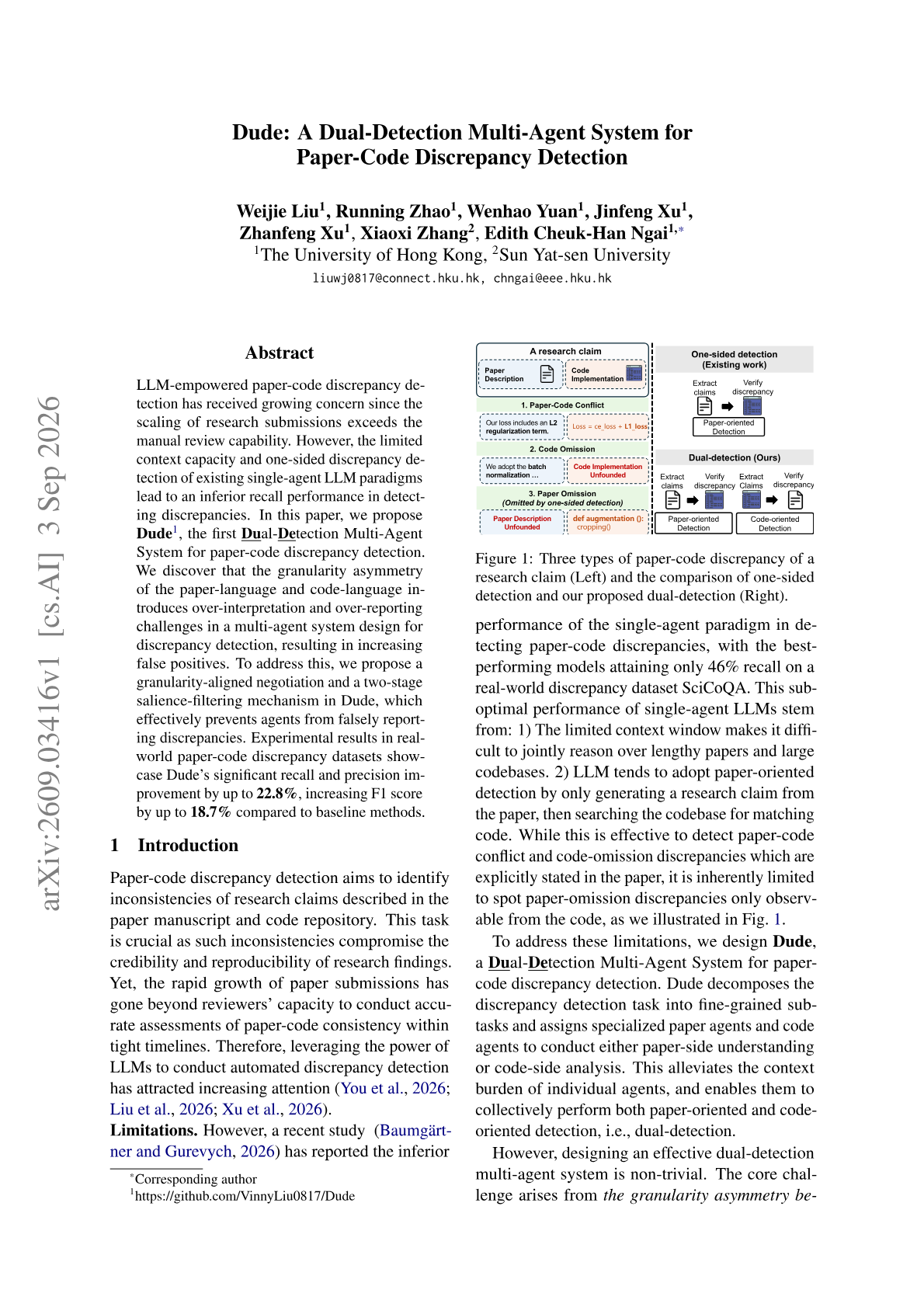
Dude: A Dual-Detection Multi-Agent System for Paper-Code Discrepancy Detection
Weijie Liu and colleagues at HKU build Dude, a dual-detection multi-agent system for finding places where a paper's claims and its released code disagree, and diagnose why naive multi-agent designs over-report.
Representational alignment yields generalizable safety in language models
Lingyu Li, Yan Teng, Yingchun Wang and Xia Hu show that behavioral alignment learns the right answers while leaving the underlying moral category structure untouched, and that fixing the representation instead buys adversarial robustness.
LeanGRPO: Eliminating Redundant Recomputation in Diffusion RL
Sijie Wang, Zhiqiang Tan, Xinrui Yang and Shaohuai Shi at Harbin Institute of Technology Shenzhen remove the recomputation step that DanceGRPO and FlowGRPO perform after rollout, which is mathematically redundant when rollout and update share a backend under on-policy training.
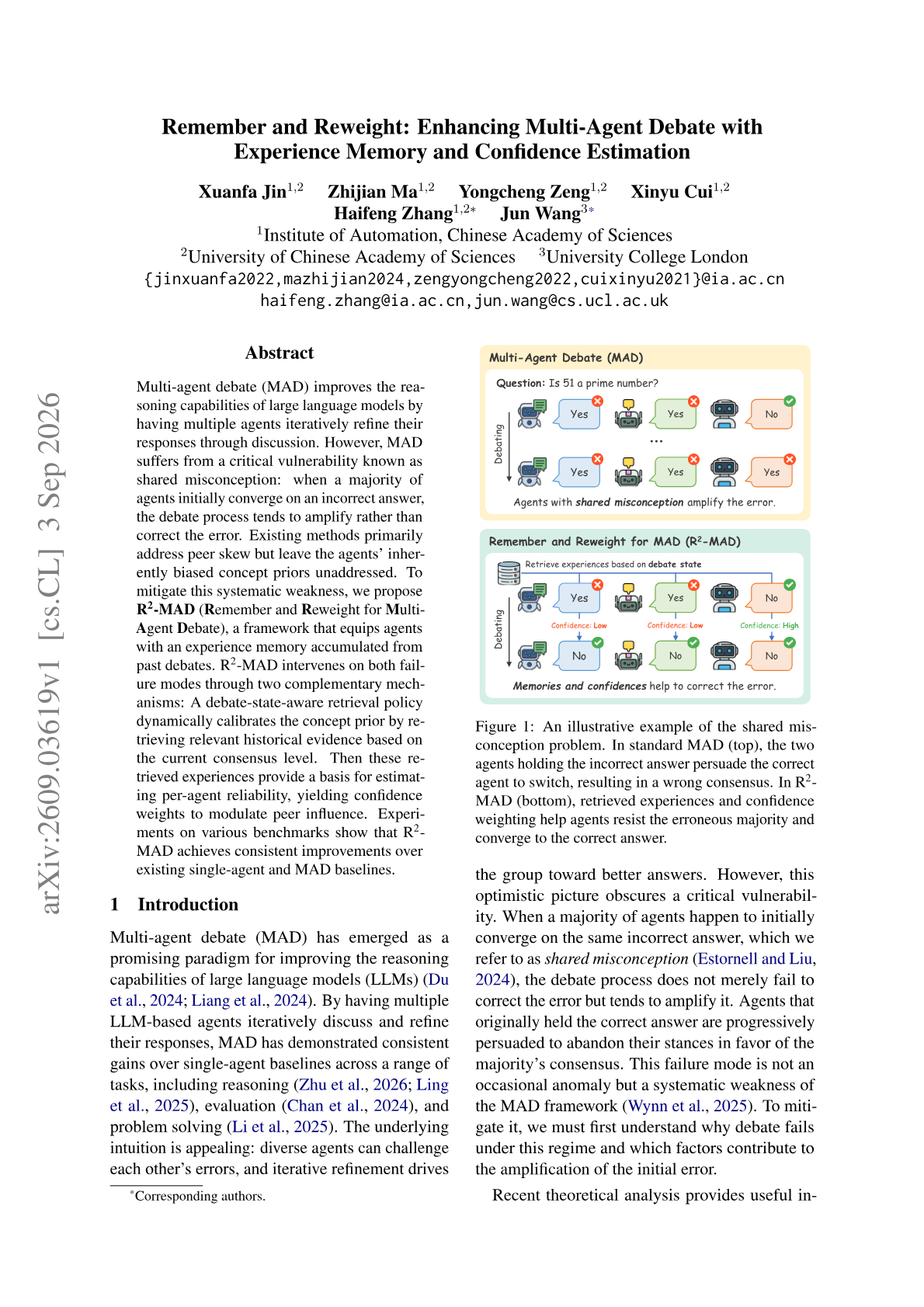
Remember and Reweight: Enhancing Multi-Agent Debate with Experience Memory and Confidence Estimation
Xuanfa Jin and colleagues at CASIA and UCL attack the shared-misconception failure in multi-agent debate with R2-MAD, giving debating agents an experience memory from past debates plus per-agent confidence weights.
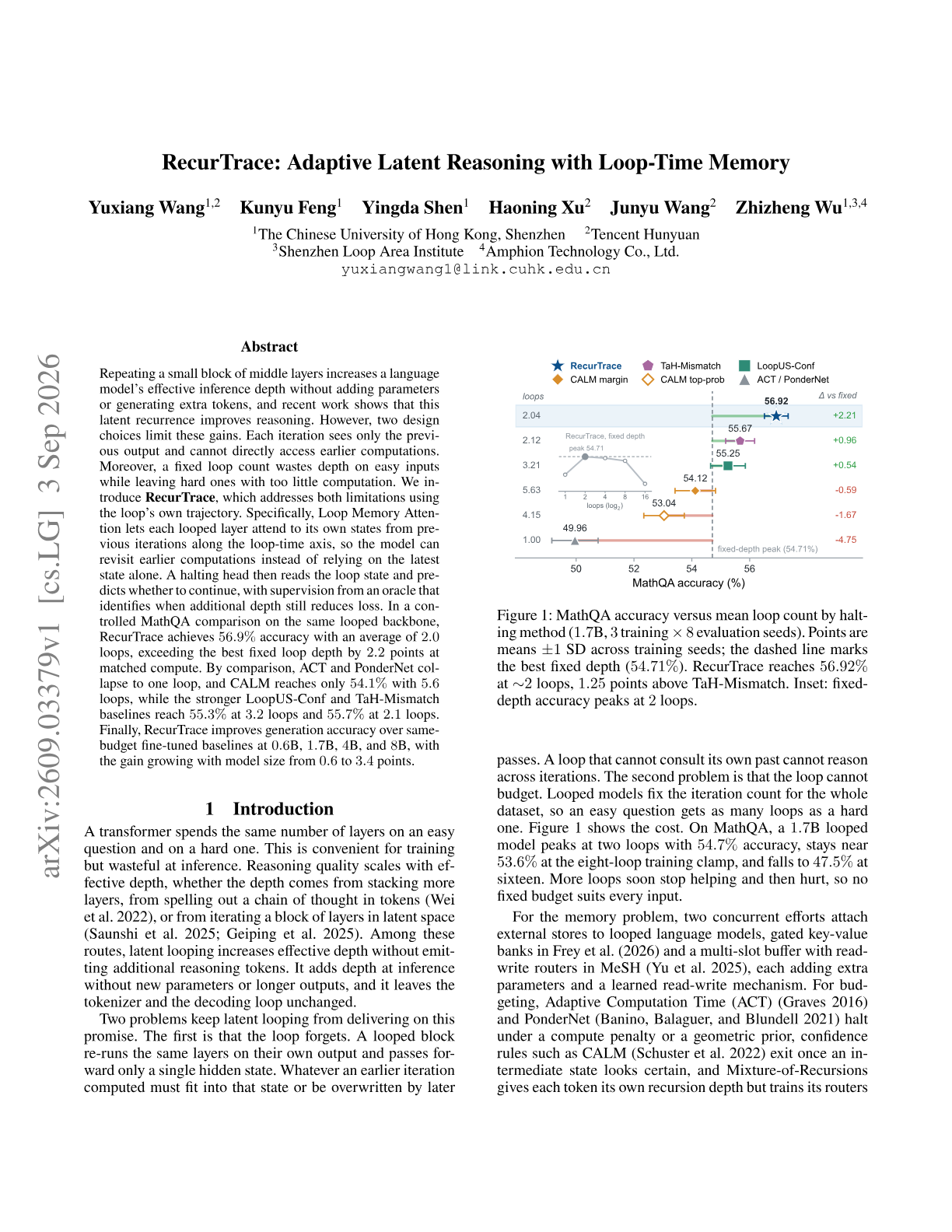
RecurTrace: Adaptive Latent Reasoning with Loop-Time Memory
Yuxiang Wang and colleagues fix two limitations of looped-layer latent recurrence at once, letting each iteration attend to its own earlier states and letting the model decide how many loops a given input deserves.
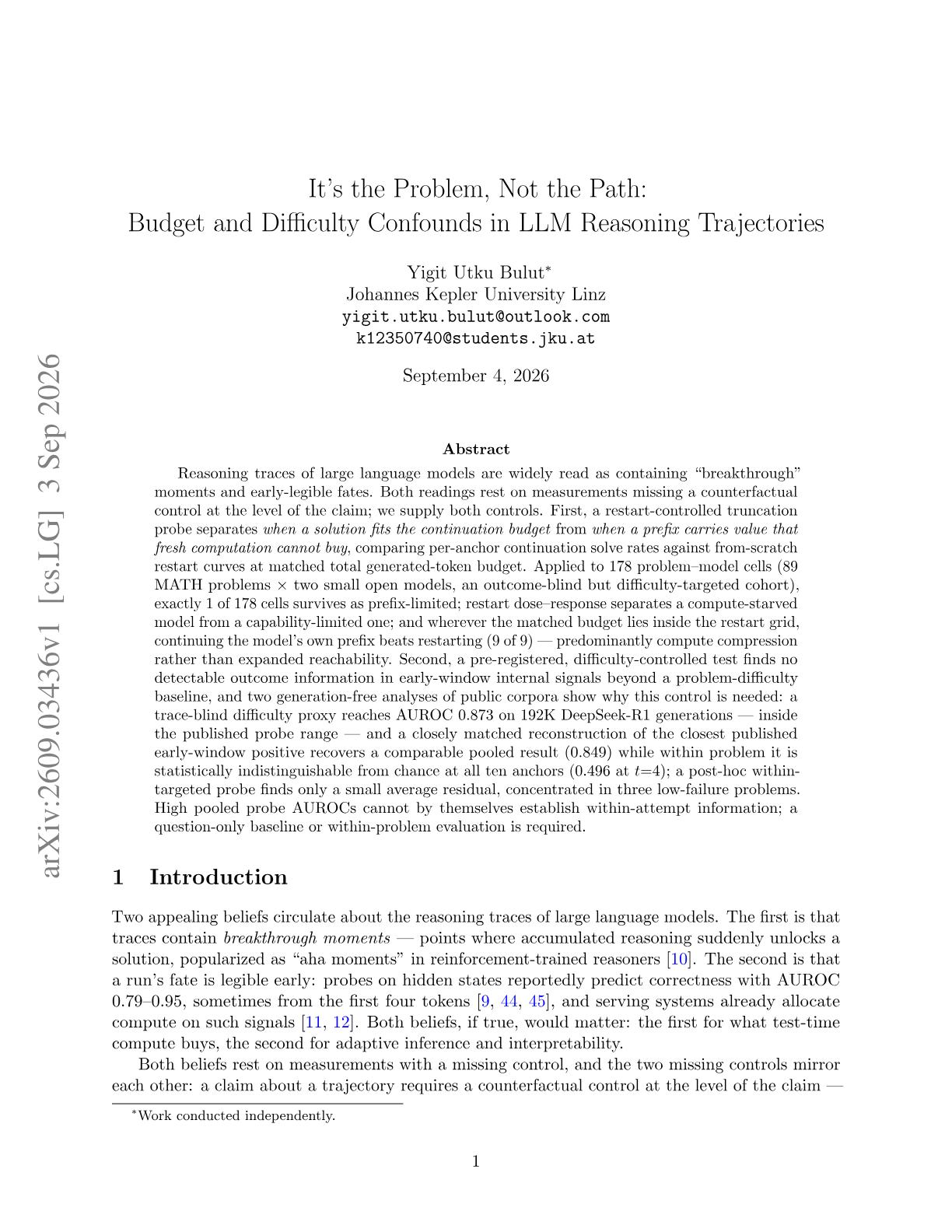
It's the Problem, Not the Path: Budget and Difficulty Confounds in LLM Reasoning Trajectories
Yigit Utku Bulut supplies the two counterfactual controls that the breakthrough-moment and early-legible-fate readings of reasoning traces have been missing, and both readings largely fail to survive them.
Hardware-Aware FP4 FlashAttention-4
Robert Hu shows that Blackwell FP4 tensor cores do not speed up attention on their own, because softmax conversion and on-chip dependencies dominate once the matrix products shrink, and gives separate forward and causal paths that recover the speedup.
Bioinfoysis Technical Report
The DeepAutonomy Team introduces Bioinfoysis, a multi-agent harness that treats a bioinformatics request as a persistent analysis run whose conclusions stay attached to the artifacts that produced them, reaching 82.4% on BixBench.
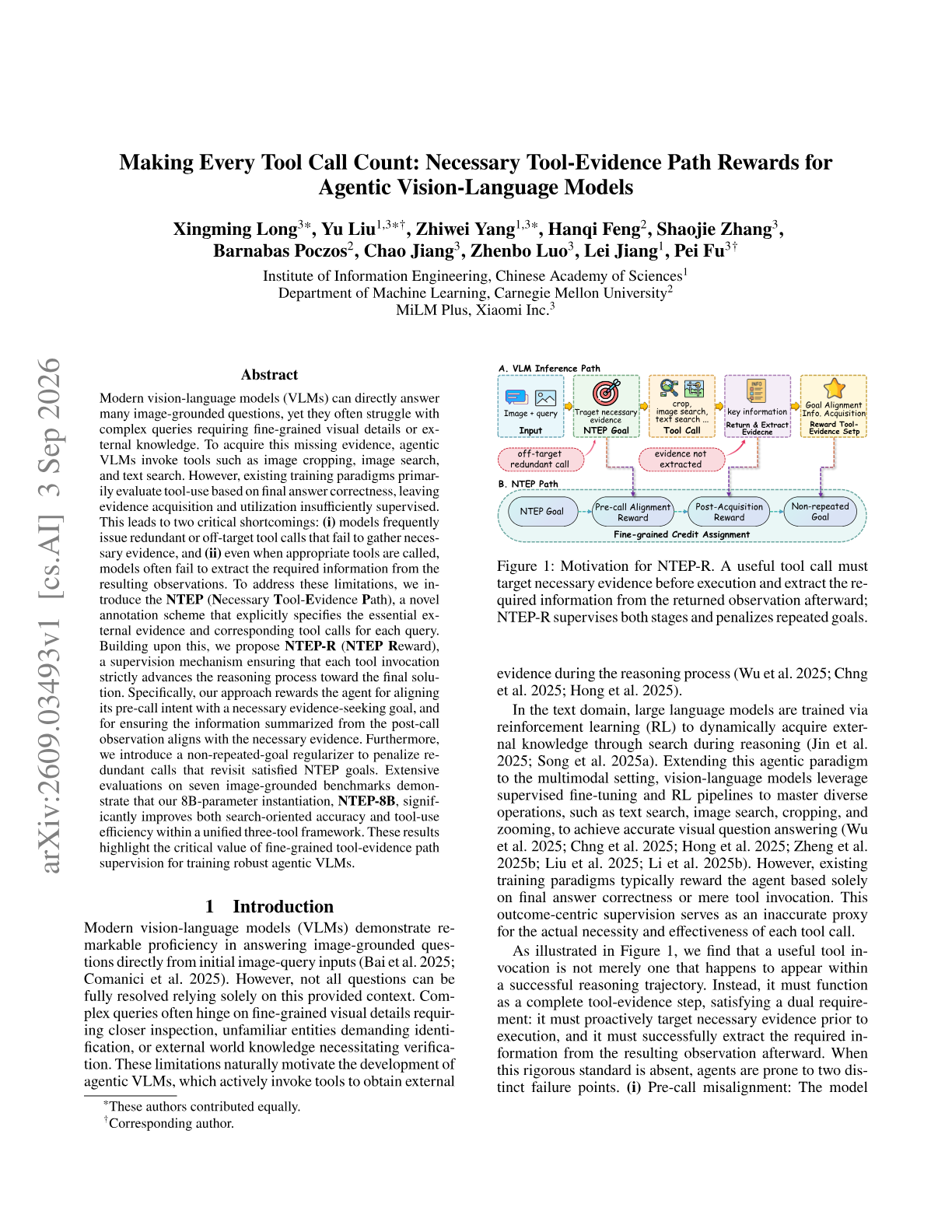
Making Every Tool Call Count: Necessary Tool-Evidence Path Rewards for Agentic Vision-Language Models
Xingming Long and colleagues introduce NTEP, an annotation scheme that names the necessary external evidence and the tool calls that must produce it, and NTEP-R, a reward that pays the agent per tool call rather than only on the final answer.
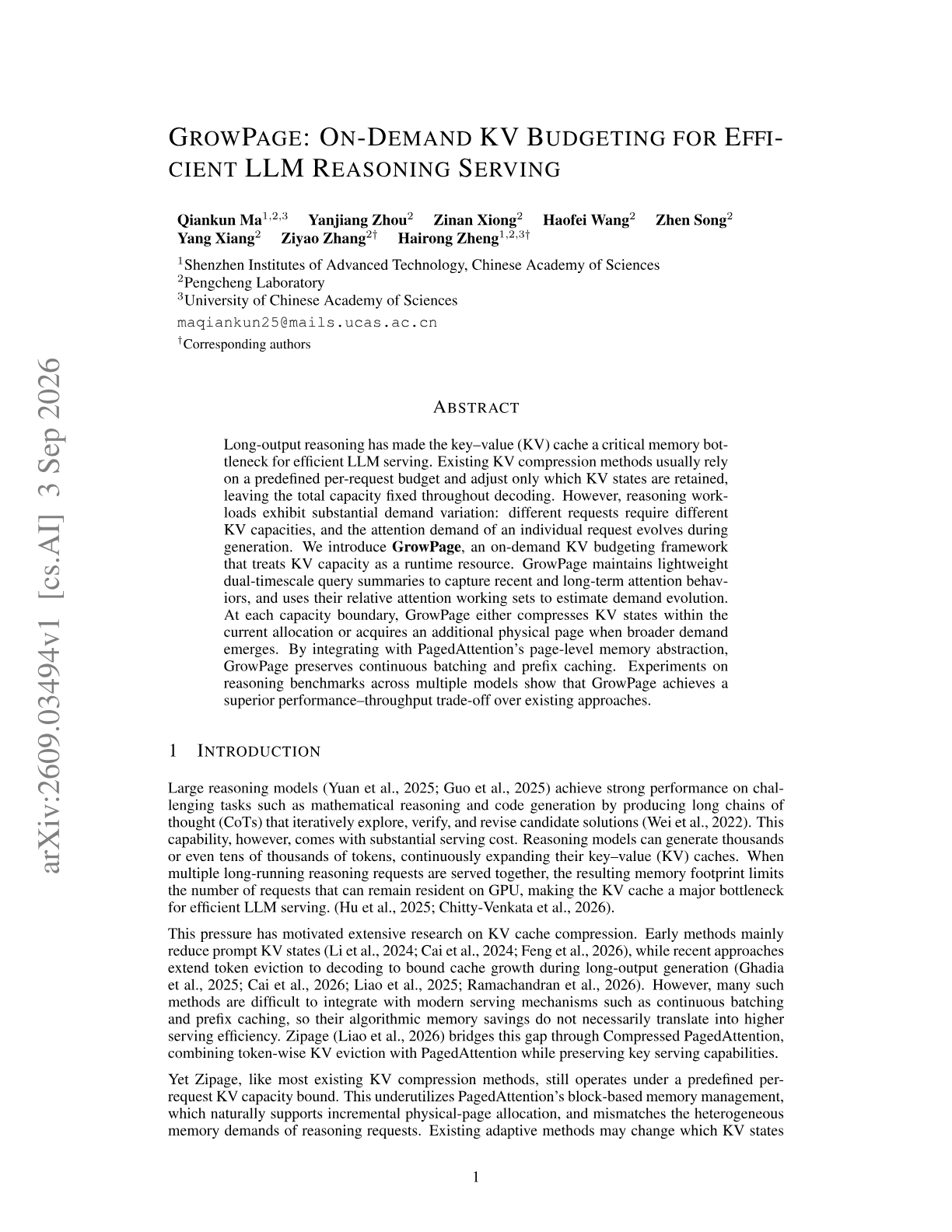
GrowPage: On-Demand KV Budgeting for Efficient LLM Reasoning Serving
Qiankun Ma and colleagues point out that every KV compression method fixes the per-request budget in advance and only decides what to keep, then make capacity itself a runtime resource that grows on demand.
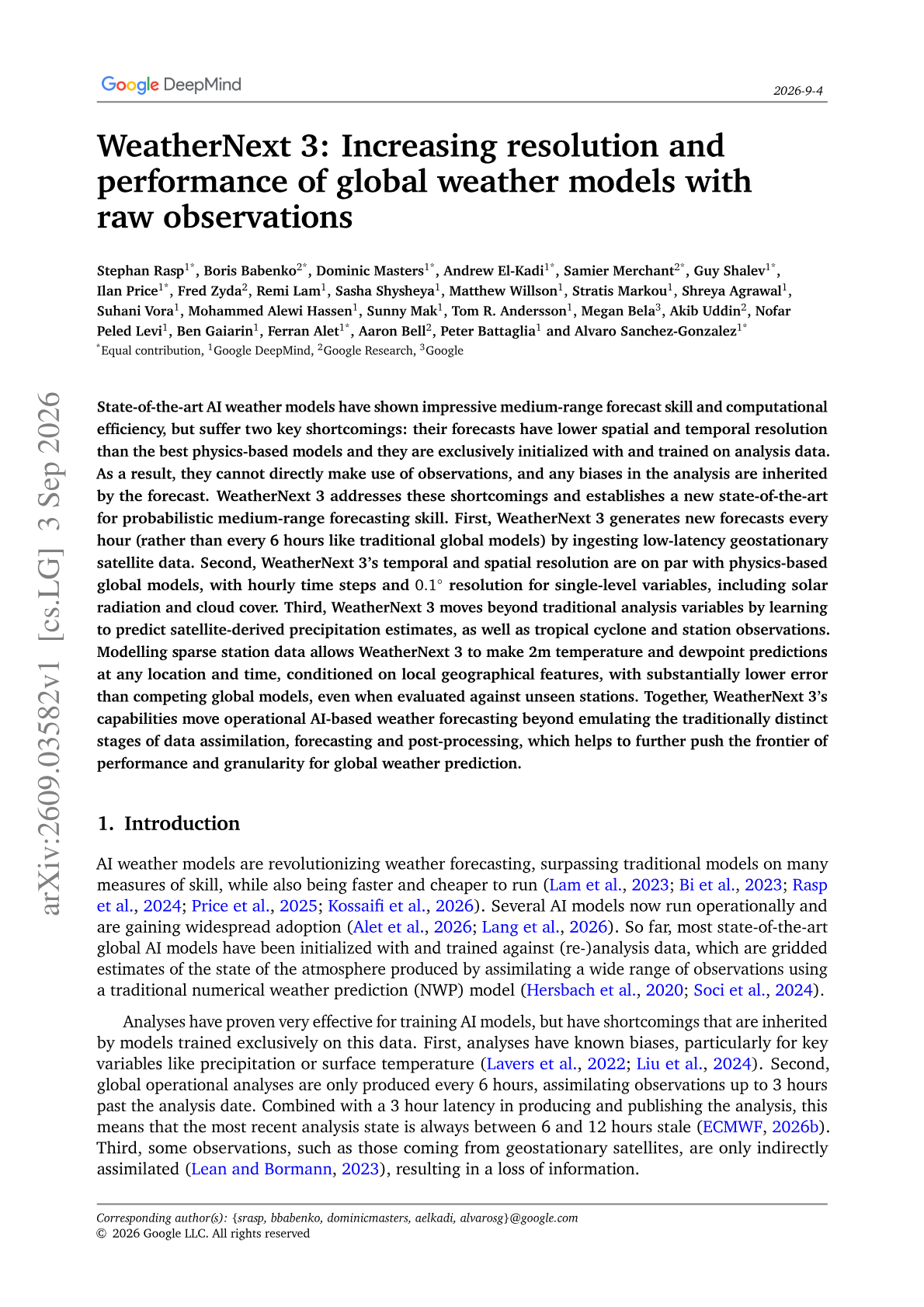
WeatherNext 3: Increasing resolution and performance of global weather models with raw observations
Stephan Rasp and colleagues at Google Research and Google DeepMind release WeatherNext 3, which trains on raw observations rather than only reanalysis and matches physics-based models on resolution.
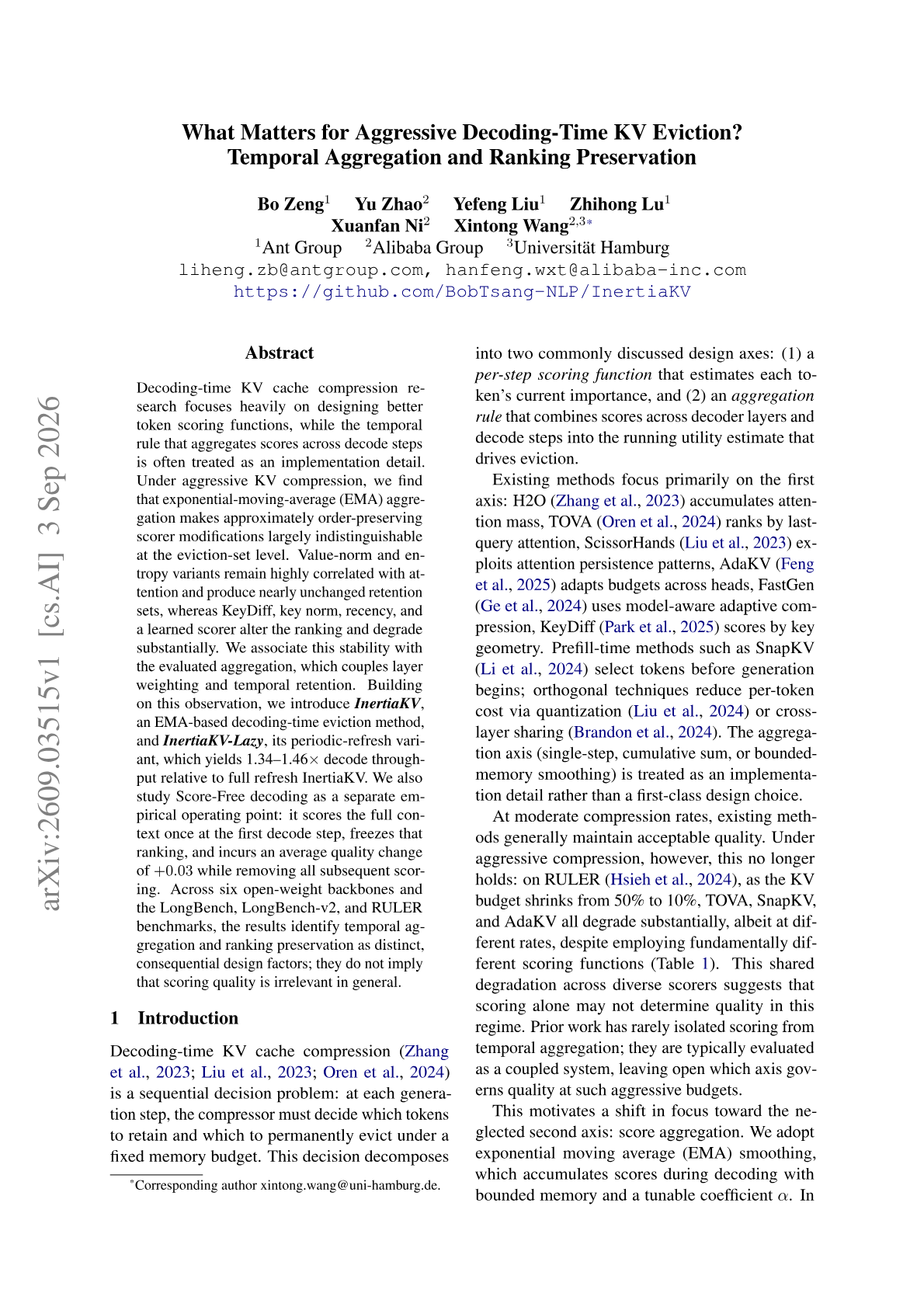
What Matters for Aggressive Decoding-Time KV Eviction? Temporal Aggregation and Ranking Preservation
Bo Zeng and colleagues show that the temporal rule aggregating KV scores across decode steps, usually treated as an implementation detail, dominates the scoring function everyone is publishing about.