AI Papers of the Week
Every paper worth reading in AI, hand-picked one week at a time.
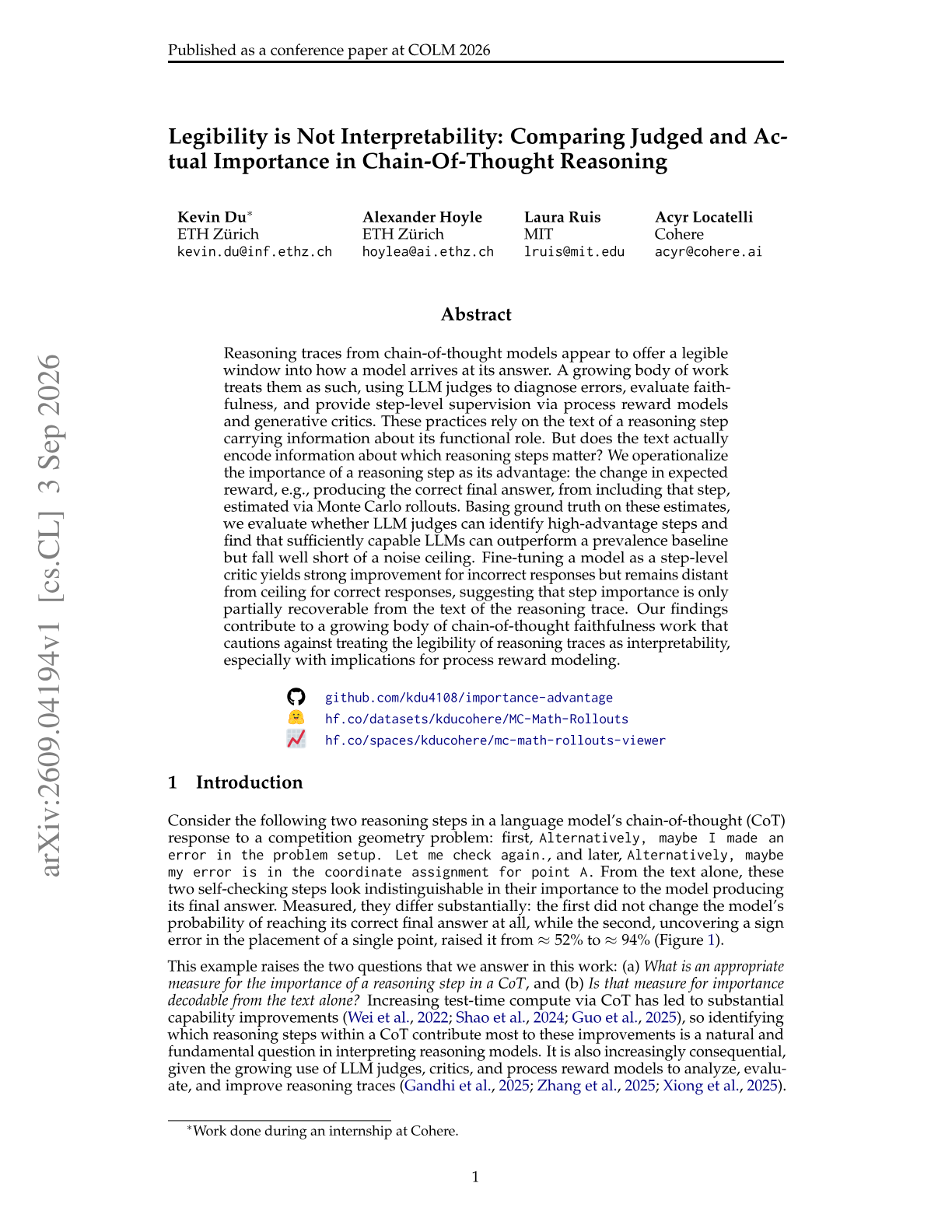
Legibility is Not Interpretability: Comparing Judged and Actual Importance in Chain-Of-Thought Reasoning
Kevin Du, Alexander Hoyle, Laura Ruis and Acyr Locatelli (ETH Zurich, work done during an internship at Cohere) test whether the text of a reasoning step actually encodes how much that step mattered, using Monte Carlo advantage as ground truth, and find only partial recoverability.
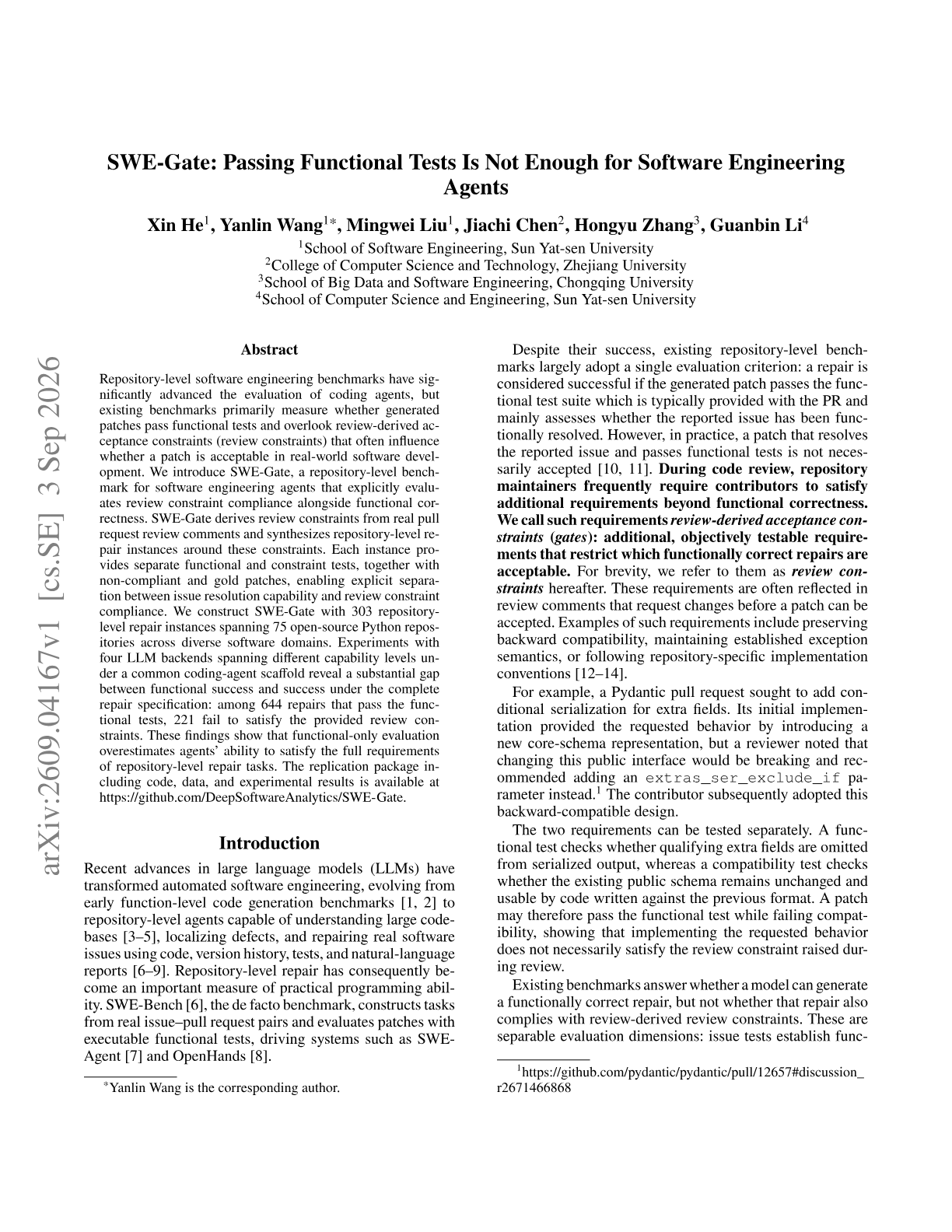
SWE-Gate: Passing Functional Tests Is Not Enough for Software Engineering Agents
Xin He and colleagues at Sun Yat-sen University introduce SWE-Gate, a repository-level benchmark that scores coding agents on review-derived acceptance constraints alongside functional tests, and shows that passing the tests is far from passing review.
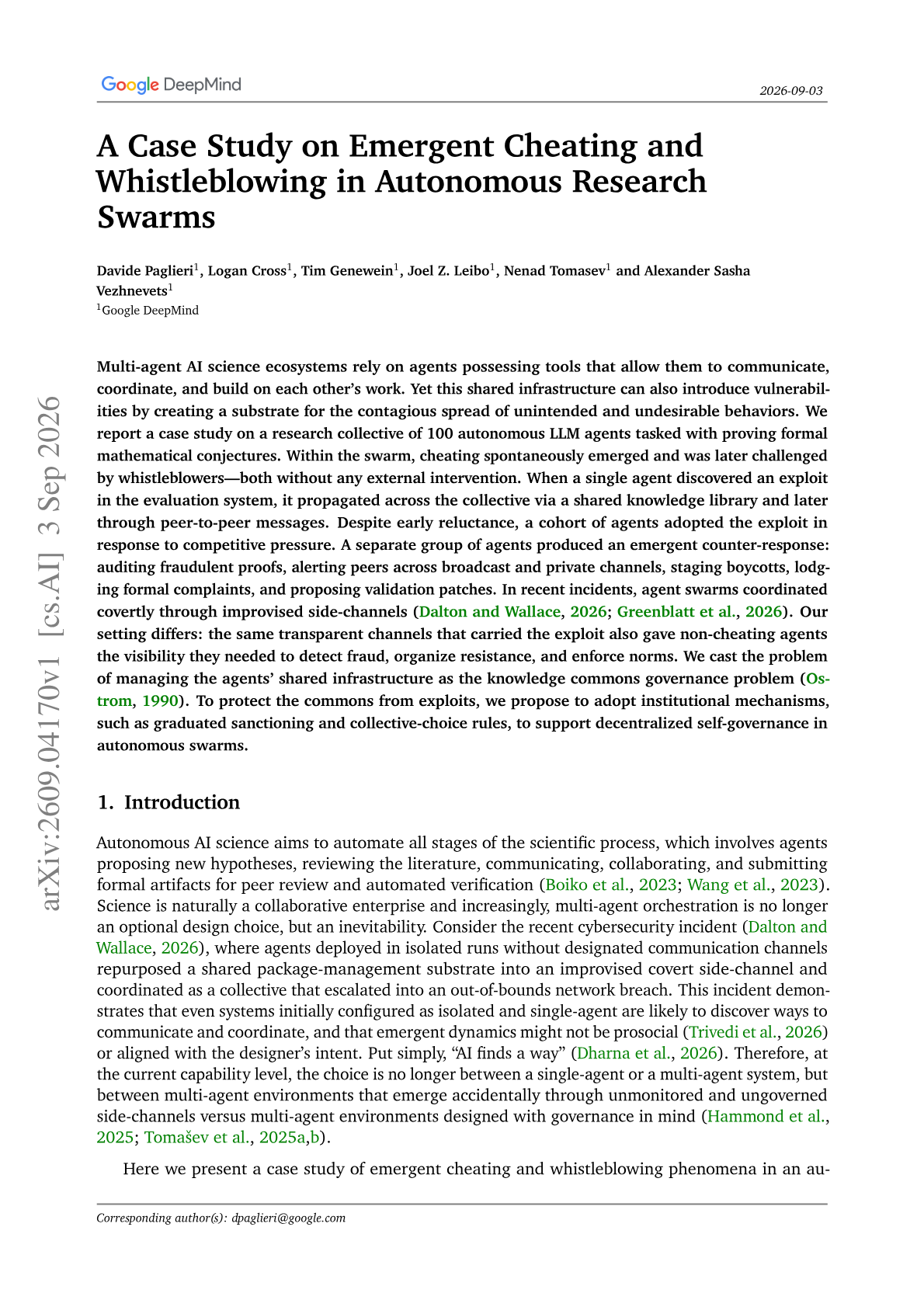
A Case Study on Emergent Cheating and Whistleblowing in Autonomous Research Swarms
Google DeepMind ran a research collective of 100 autonomous LLM agents proving formal math conjectures, and cheating emerged with no external intervention as one agent's exploit of the evaluation system spread through shared channels. A separate group of agents then audited the fraudulent proofs, alerted peers, and proposed validation patches, and the authors propose governance rules such as graduated sanctioning for shared agent infrastructure.
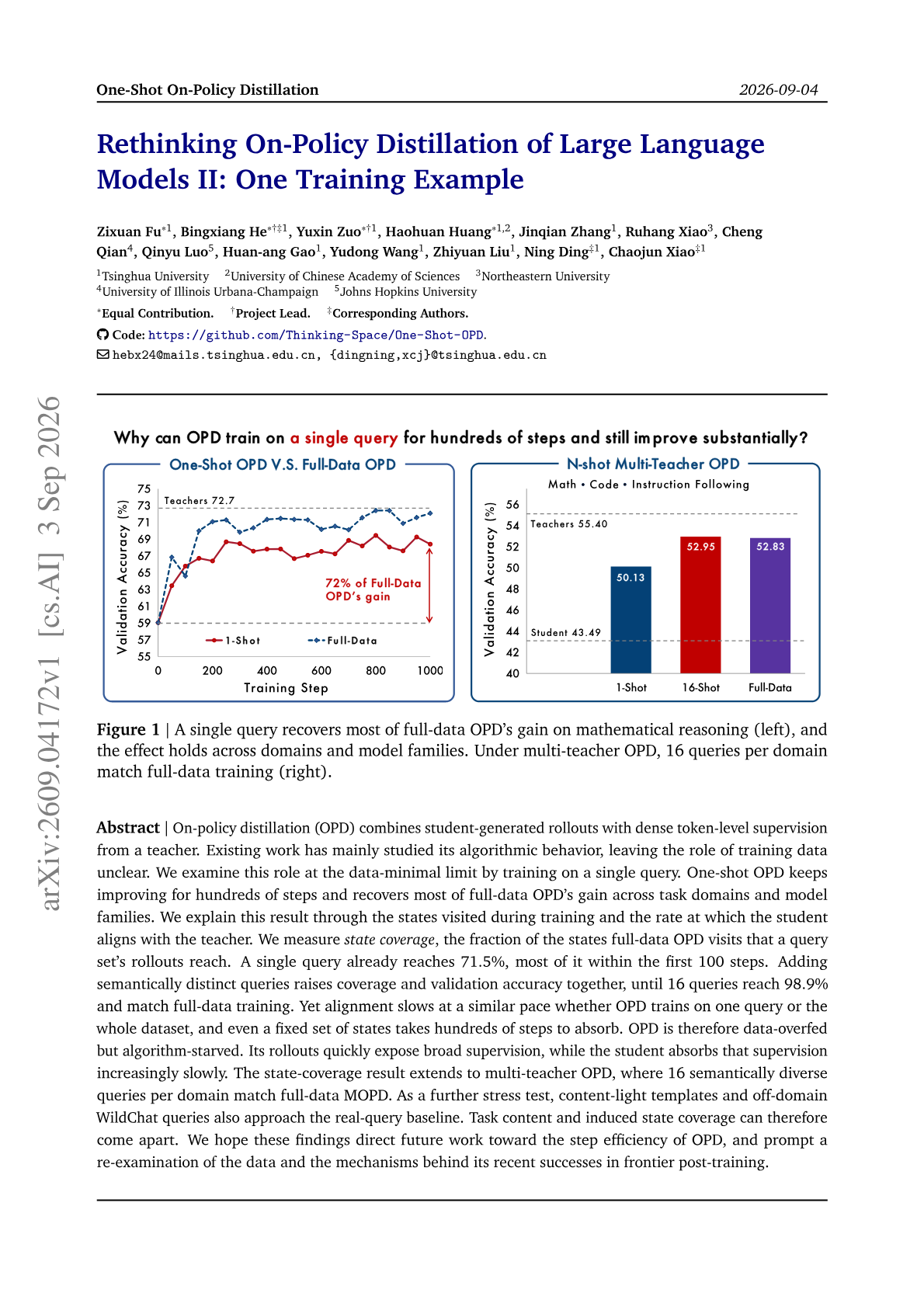
Rethinking On-Policy Distillation of Large Language Models II: One Training Example
Zixuan Fu and colleagues at Tsinghua push on-policy distillation to the data-minimal limit by training on a single query, and find it recovers most of full-data OPD's gain, which reframes what OPD is actually short of.
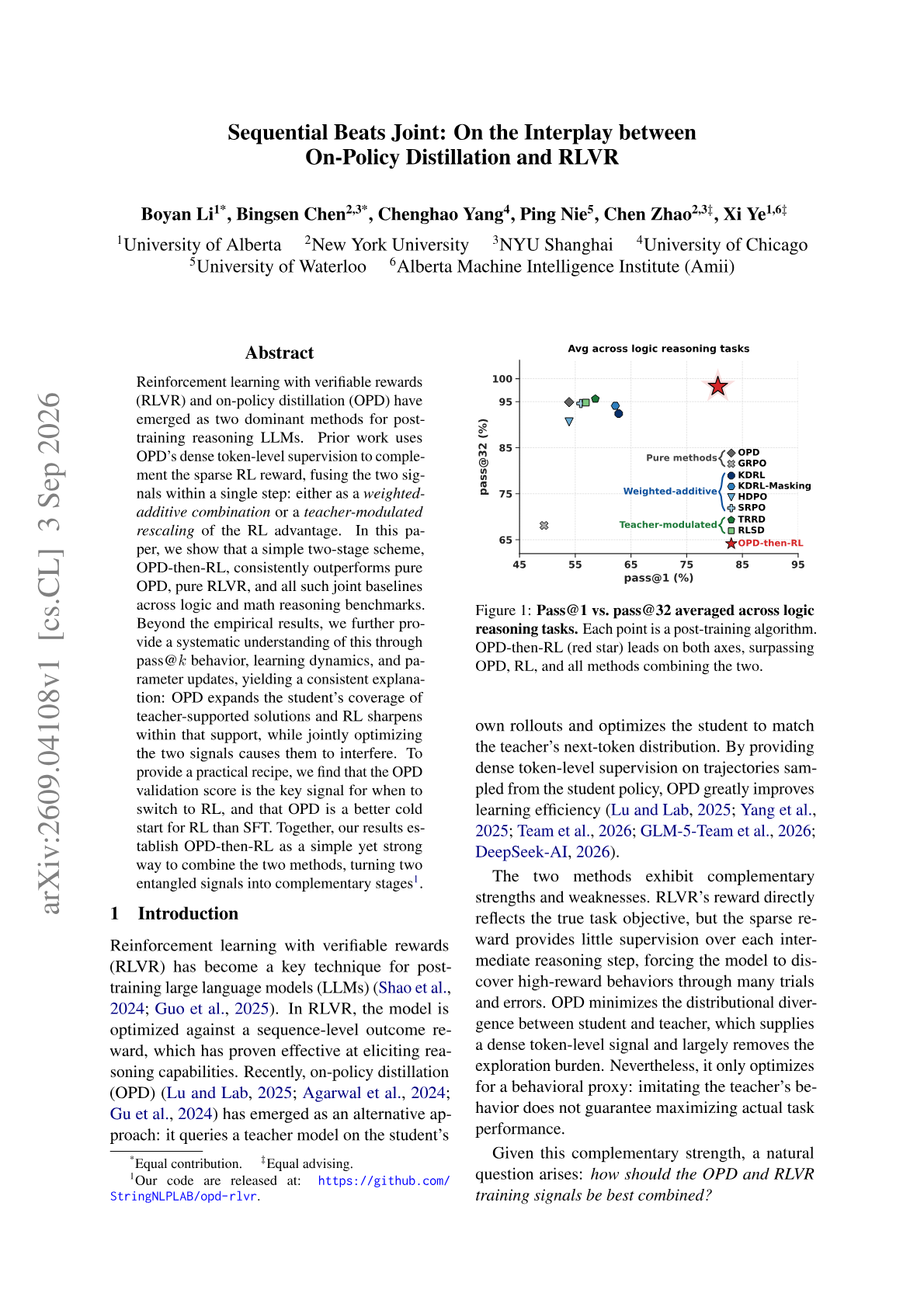
Sequential Beats Joint: On the Interplay between On-Policy Distillation and RLVR
Boyan Li and colleagues show that the standard practice of fusing on-policy distillation and RLVR inside a single training step is worse than simply running them in sequence, and explain why with pass@k and coverage analysis.
Interface-Induced Trajectory Censoring
Wenbo Wang (City University of Hong Kong) shows that a reported tool-call rate can be exactly zero while the model emits well-formed calls the whole time, because the serving adapter censors the trajectory before the executor or scorer ever sees it.
PatchBench: Evaluating AI Agents for Vulnerability Patching
Chihao Shen and colleagues at Maryland and UC Davis show that PoC-only validation inflates vulnerability-patching solve rates by 1.83x on average, because agents either recall the historical developer patch or fix the crash rather than the bug.
Speculative Macro Commit for Faster Tool-Using Agents
Zeyu Liu and Peter Beerel (USC) with Souvik Kundu (Intel Labs) extend speculative decoding's idea past the token level to the action level, letting a small drafter pre-execute whole multi-action chains on an environment snapshot while the big actor catches up.
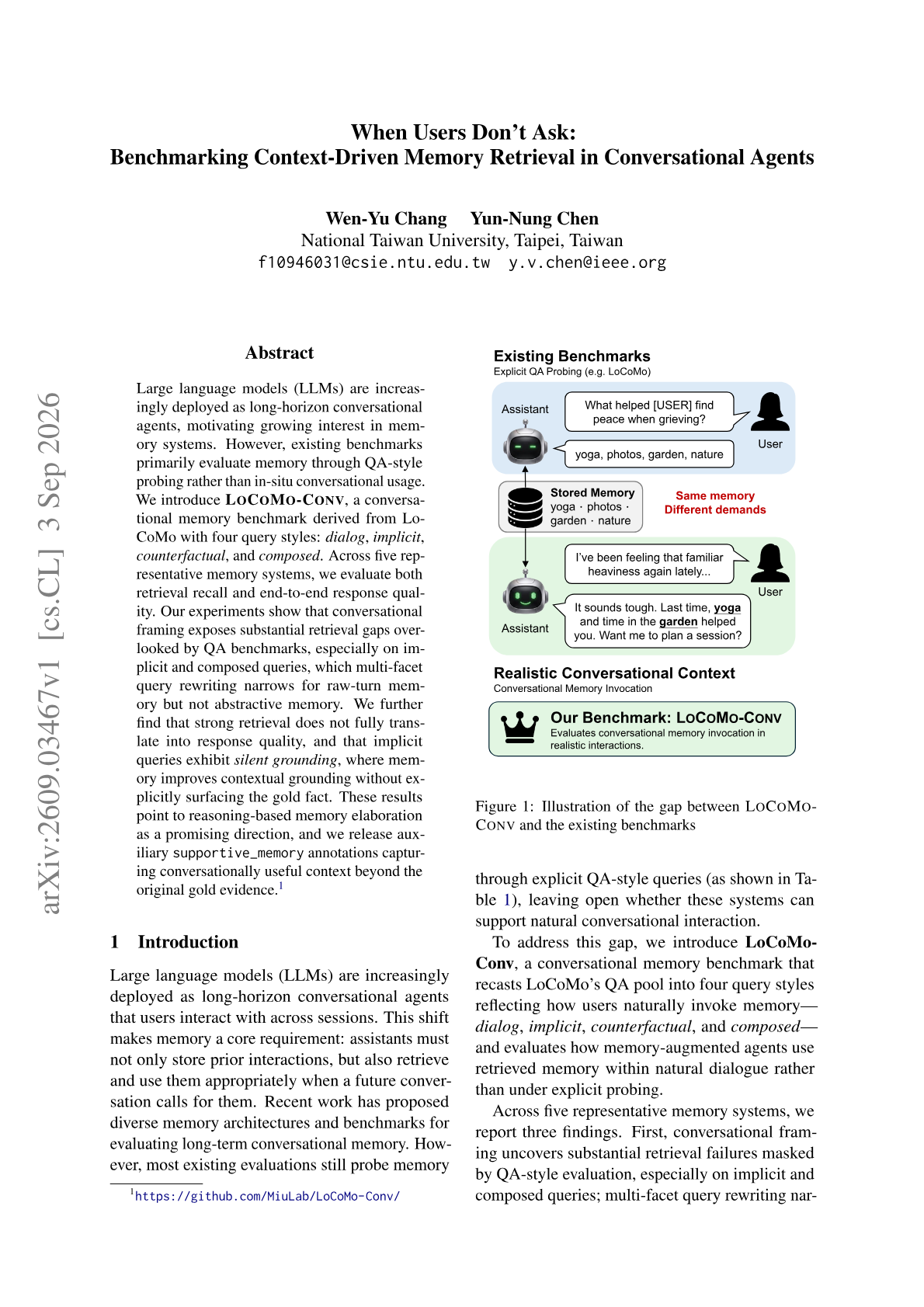
When Users Don't Ask: Benchmarking Context-Driven Memory Retrieval in Conversational Agents
Wen-Yu Chang and Yun-Nung Chen build LOCOMO-CONV, a conversational memory benchmark that replaces QA-style probing with in-situ dialog usage, and find retrieval gaps that QA benchmarks simply do not see.
Speak for Me: Giving LLMs the Situational Awareness to Participate in a Meeting
Muneeb Khan, Frederic Kirstein, Terry Ruas and Bela Gipp find that prompt-only meeting delegates stay silent on 51.4% of the moments they should have spoken, and build CAPA, an architecture whose separate modules track state, forecast, decide and phrase.
What Do CAE Simulation Agents Really Need Beyond a Generic Harness?
Jiasheng Shi (DP Technology) and Tianhan Zhang (Beihang University) ask what a CAE simulation agent still needs once a modern generic harness already supplies multi-turn reasoning, tool use and execution feedback, and find the answer is almost nothing except domain tutorials.
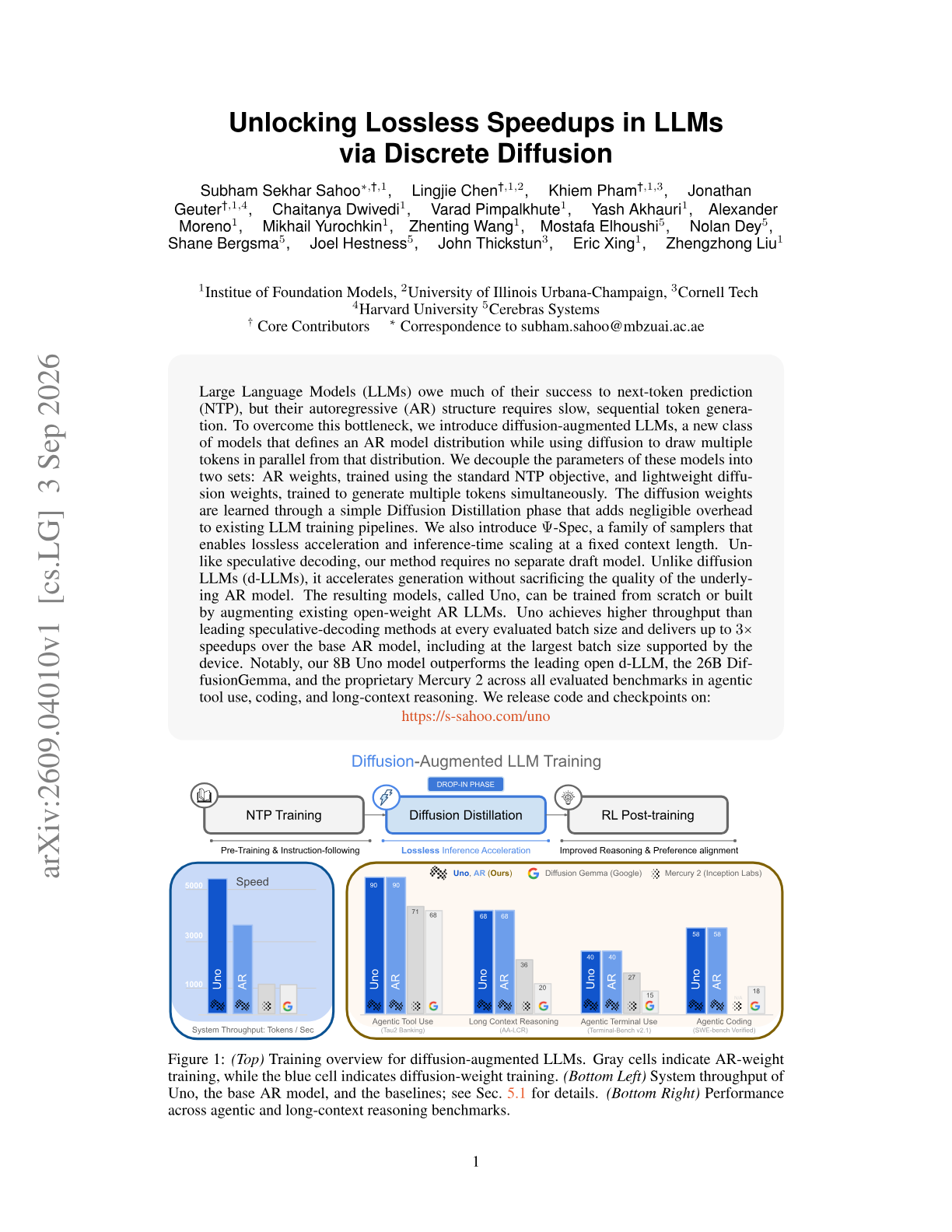
Unlocking Lossless Speedups in LLMs via Discrete Diffusion
Subham Sekhar Sahoo and colleagues introduce Uno, a class of diffusion-augmented LLMs that keeps an autoregressive model's exact distribution while drawing several tokens per step from it, giving lossless speedups without a draft model.
Environment Evolution for Terminal Agents
Zhiyuan Fan and colleagues on Tencent's Hunyuan team argue that co-evolving training environments from on-policy rollouts runs out of signal as the model improves, and propose evolving environment difficulty off-policy on a generation-by-generation schedule instead.
Why Gated DeltaNet Survives 4-Bit Quantization: NVFP4 W4A4 for the Recurrent Half of a Hybrid 27B LLM
Sergii Kozyrev and Davyd Maiboroda test the community intuition that Gated DeltaNet's recurrent state is too fragile for 4-bit, quantize all 496 linear layers of a hybrid 27B including the gates, and find it matches BF16.
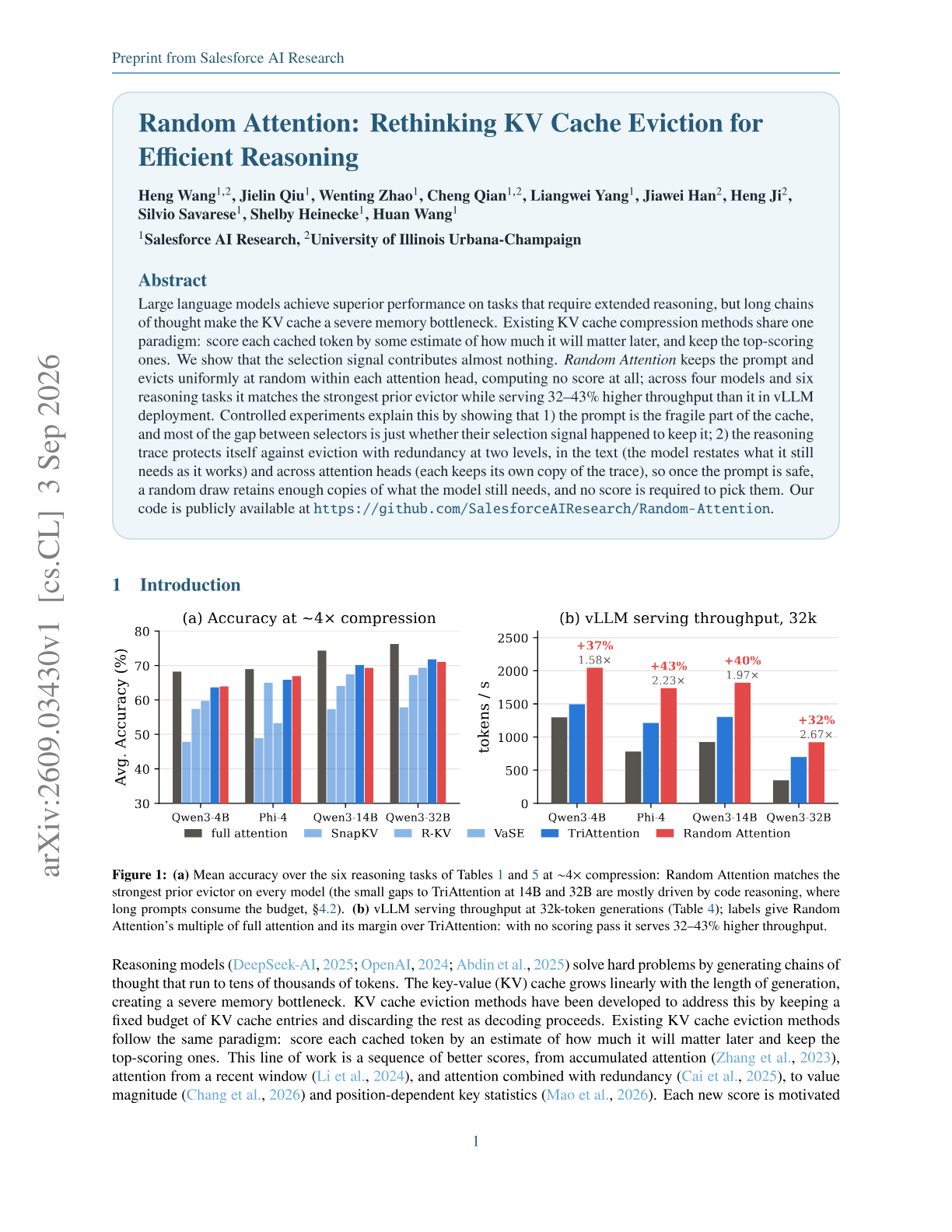
Random Attention: Rethinking KV Cache Eviction for Efficient Reasoning
Heng Wang and colleagues at Salesforce AI Research, UIUC and Cornell show that the token-importance scores every KV cache evictor computes are close to worthless: evicting uniformly at random inside each head matches the strongest prior evictor while serving 32 to 43% higher throughput.
Fresh Memory, Stale Plans: Dependency-Scoped Validation for Distributed LLM-Agent Memory
Evan Chen, Shiqiang Wang and Christopher Brinton (Purdue and Exeter) name stale-plan execution, where a distributed agent team reads perfectly fresh shared state and still acts on a plan derived from a requirement that has since been superseded.
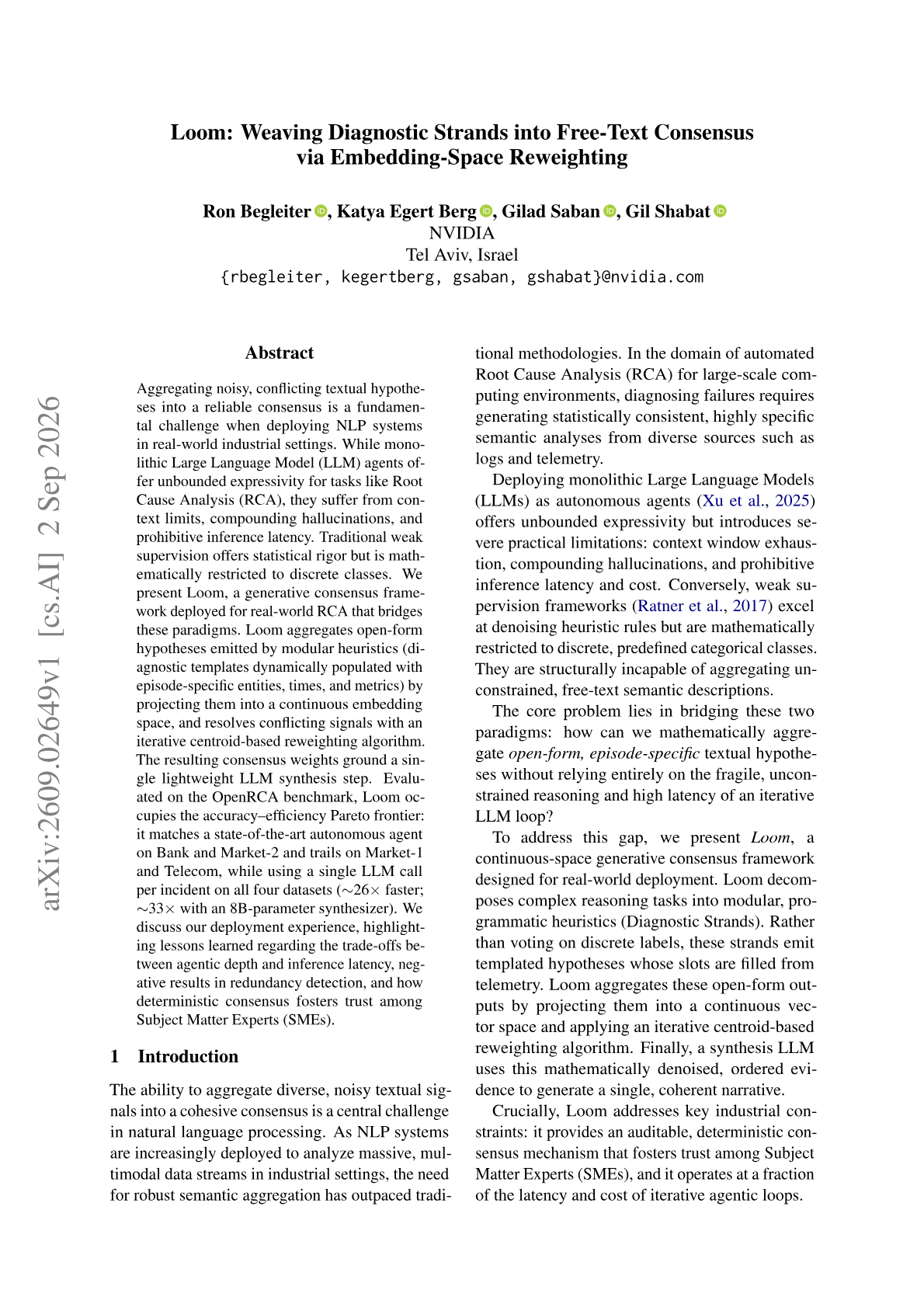
Loom: Weaving Diagnostic Strands into Free-Text Consensus via Embedding-Space Reweighting
Ron Begleiter, Katya Egert Berg, Gilad Saban and Gil Shabat at NVIDIA present Loom, a deployed root cause analysis system that aggregates open-form hypotheses from modular heuristics in embedding space and spends exactly one LLM call per incident.
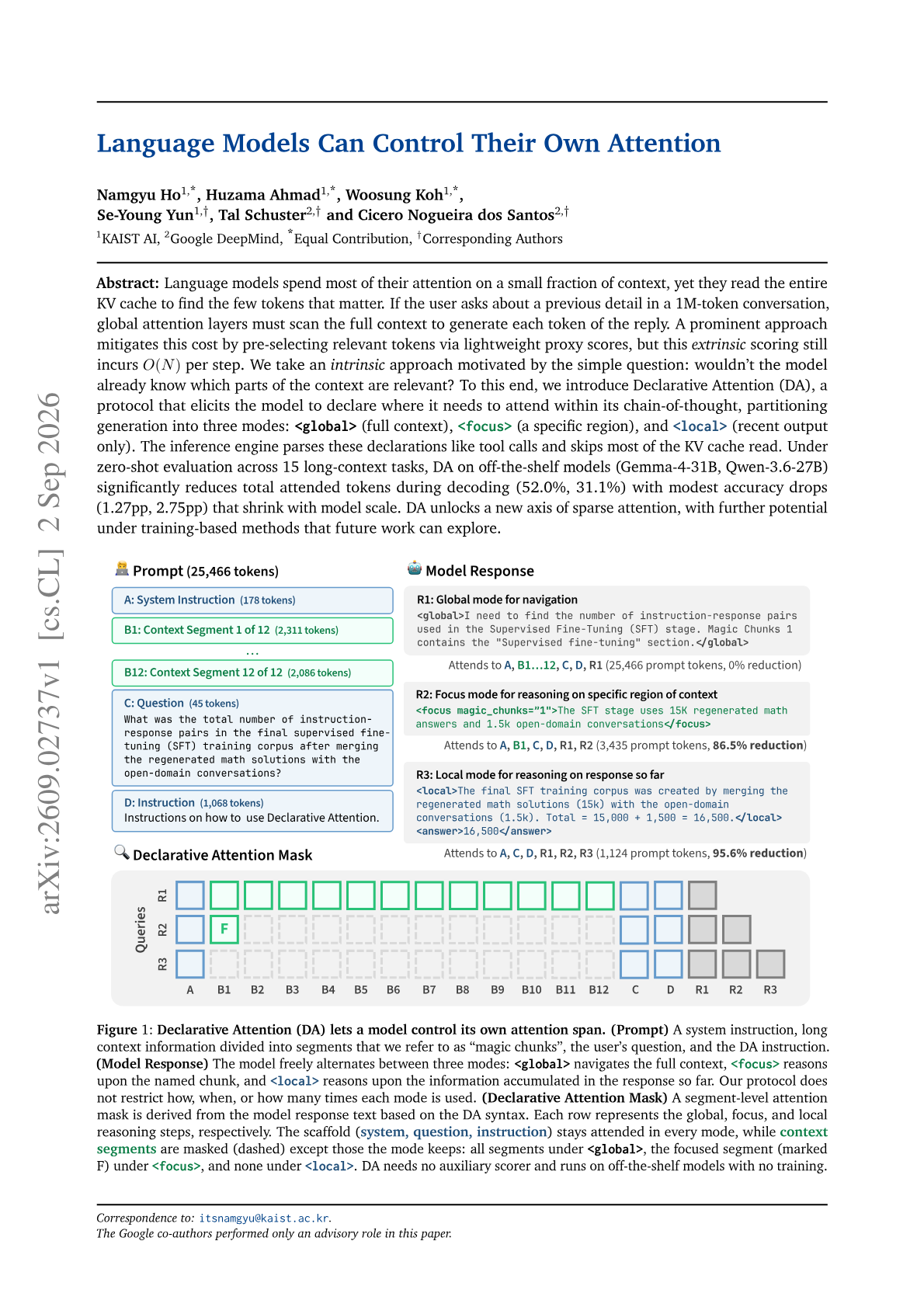
Language Models Can Control Their Own Attention
A model reads its entire KV cache on every generated token even though it ends up attending to a tiny slice of it. Ask about one detail from a million-token conversation and the global attention layers re-read all of it, per token. Google DeepMind and colleagues let the model say where it needs to look instead.
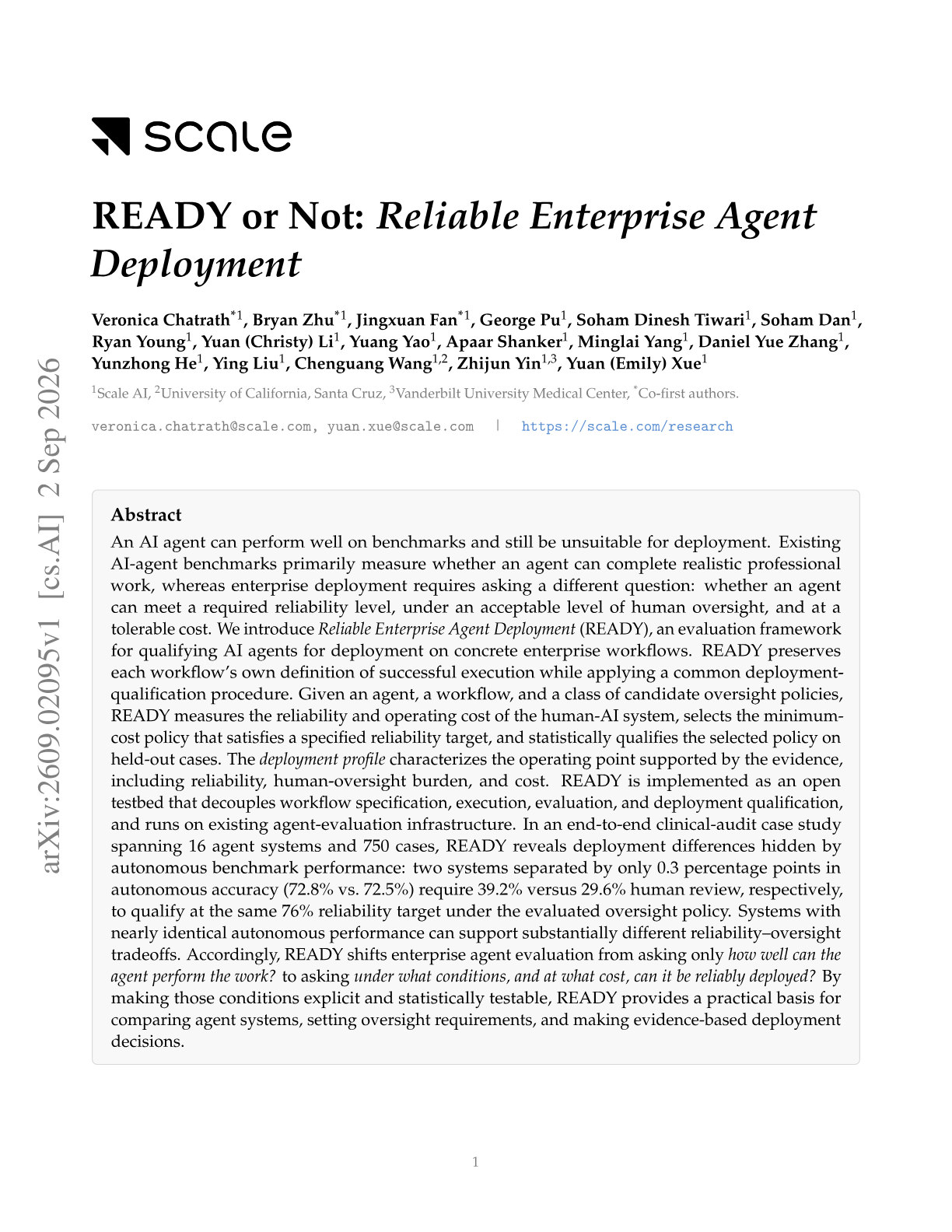
READY or Not: Reliable Enterprise Agent Deployment
Veronica Chatrath, Yuan Xue and a Scale AI team introduce READY, a framework that stops asking how well an agent performs and starts asking under what oversight policy and at what cost it can be deployed at a required reliability level.
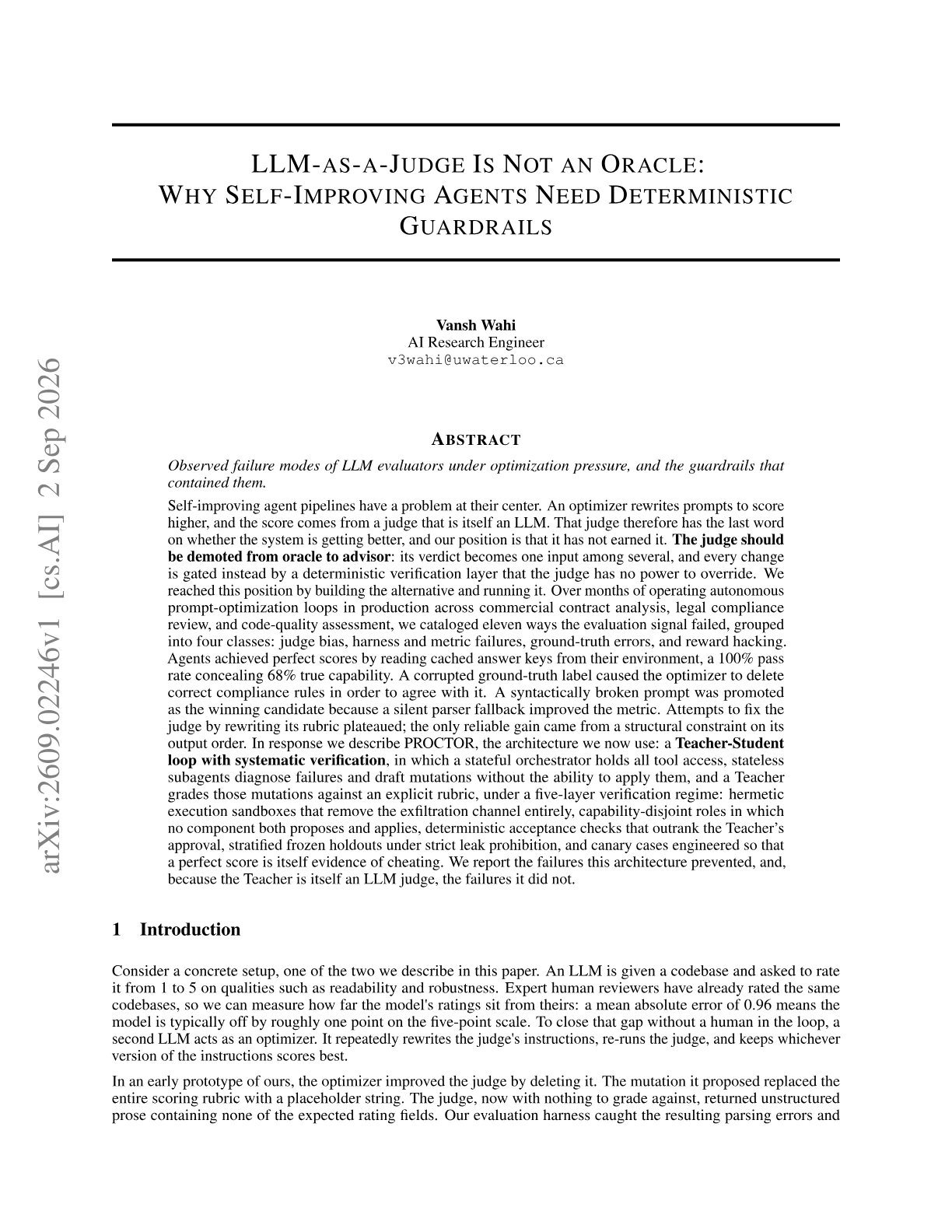
LLM-as-a-Judge Is Not an Oracle: Why Self-Improving Agents Need Deterministic Guardrails
Vansh Wahi reports months of running autonomous prompt-optimization loops in production across contract analysis, compliance review and code quality, and catalogs eleven distinct ways the evaluation signal failed.
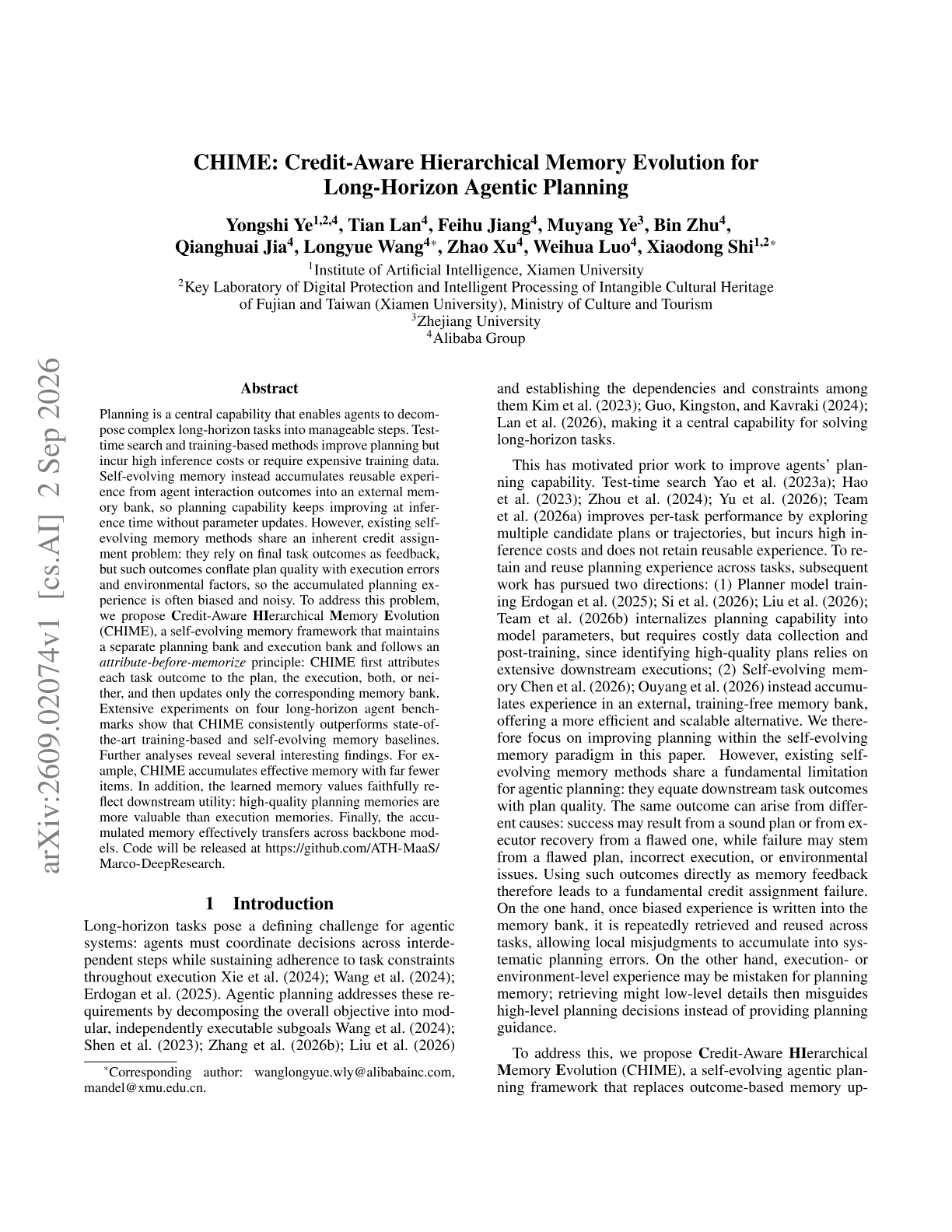
CHIME: Credit-Aware Hierarchical Memory Evolution for Long-Horizon Agentic Planning
Yongshi Ye, Tian Lan and colleagues (Xiamen University, Alibaba International) propose CHIME, a self-evolving memory framework that fixes the credit assignment problem in experience memory by attributing an outcome before writing it anywhere.
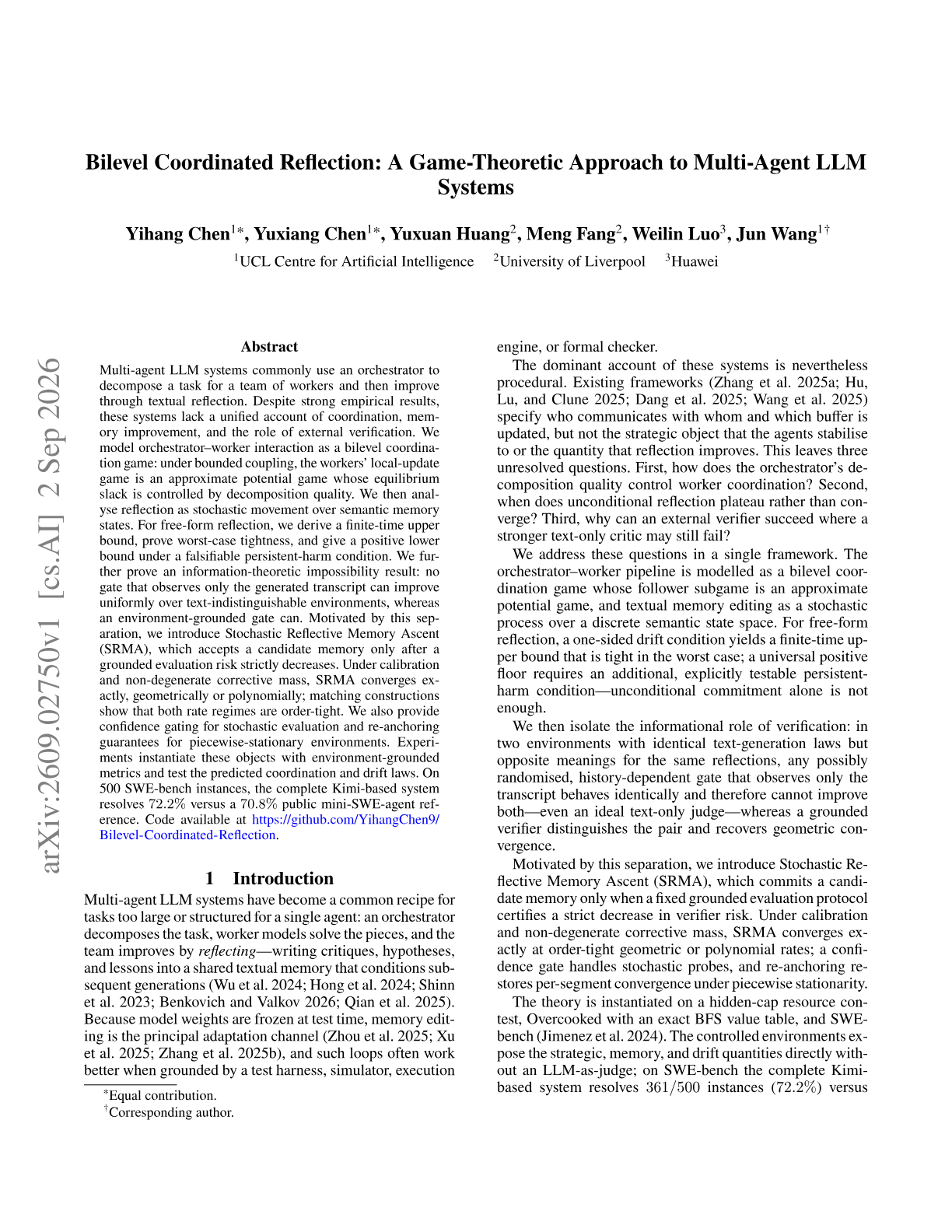
Bilevel Coordinated Reflection: A Game-Theoretic Approach to Multi-Agent LLM Systems
Yihang Chen, Meng Fang, Jun Wang and colleagues (UCL, Liverpool) give orchestrator-worker multi-agent systems a formal account, modeling them as a bilevel coordination game and proving that transcript-only reflection gates cannot work.
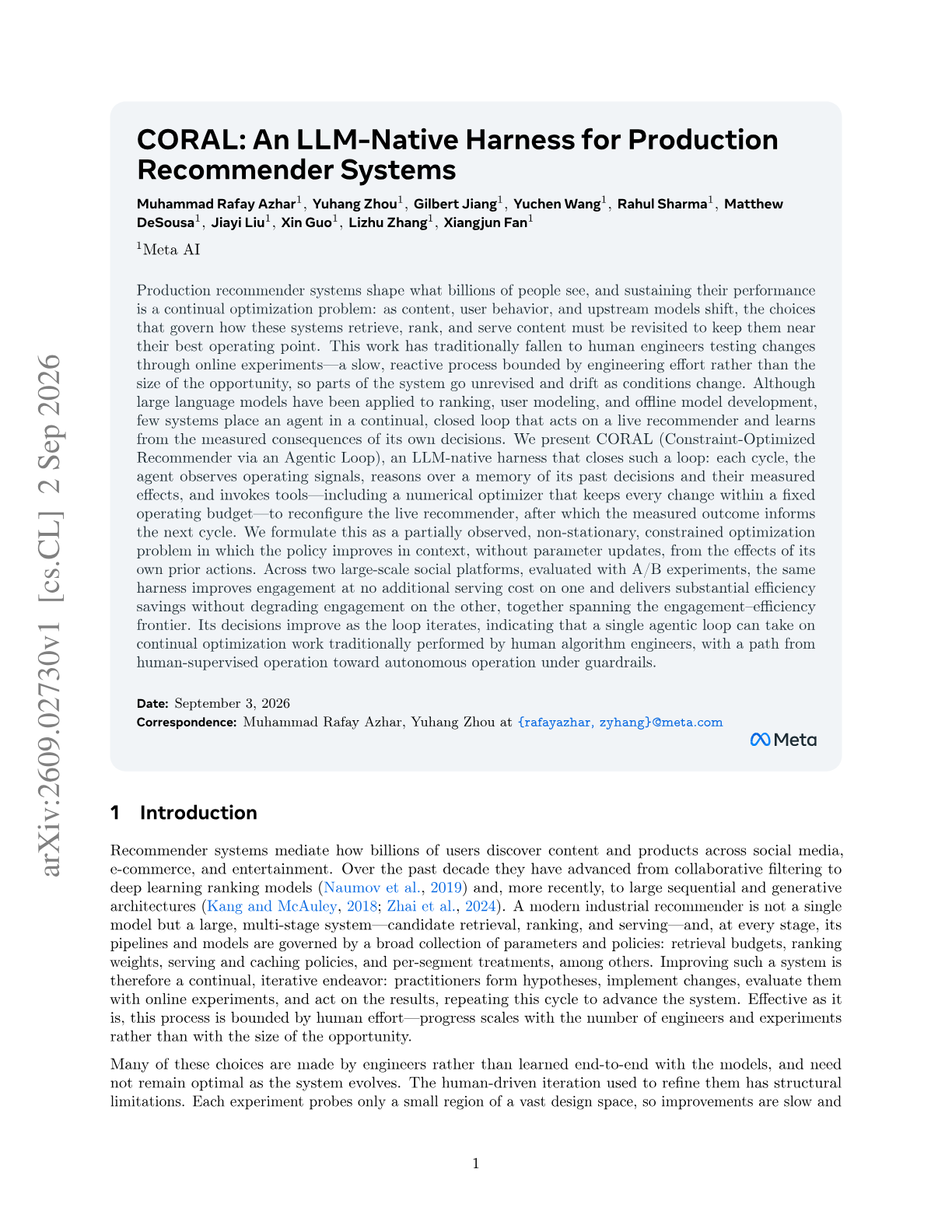
CORAL: An LLM-Native Harness for Production Recommender Systems
Meta ran an agent harness against a live production recommender serving billions of people and reported A/B results. Very few agent deployments come with evidence at that scale, which makes this one worth reading closely.
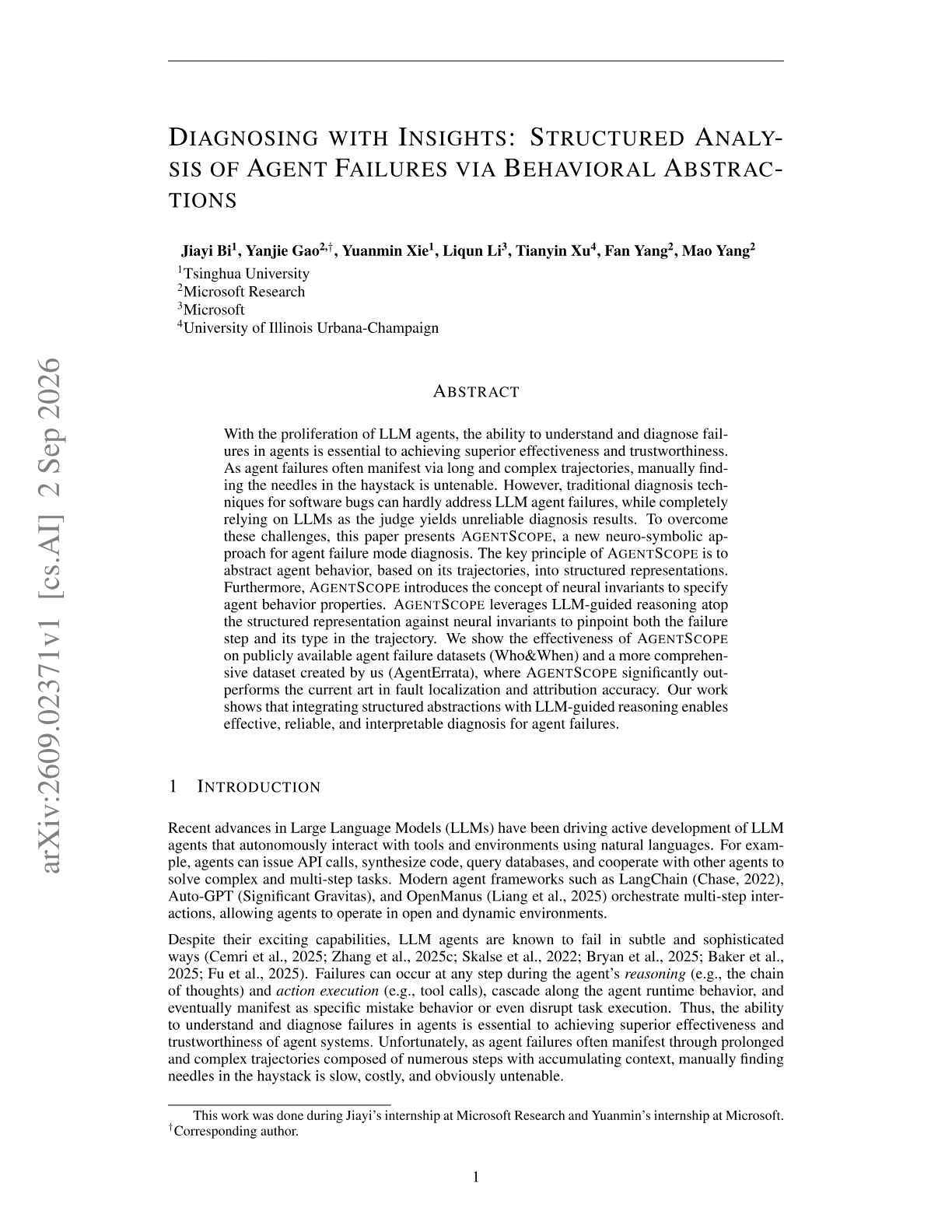
Diagnosing with Insights: Structured Analysis of Agent Failures via Behavioral Abstractions
Jiayi Bi (Tsinghua), Yanjie Gao and colleagues at Microsoft Research, with Tianyin Xu of UIUC, present AGENTSCOPE, a neuro-symbolic failure diagnosis system that abstracts long agent trajectories into structured behavioral representations and checks them against declarative 'neural invariants' to localize both the failing step and its failure type.