AI Papers of the Week
Every paper worth reading in AI, hand-picked one week at a time.
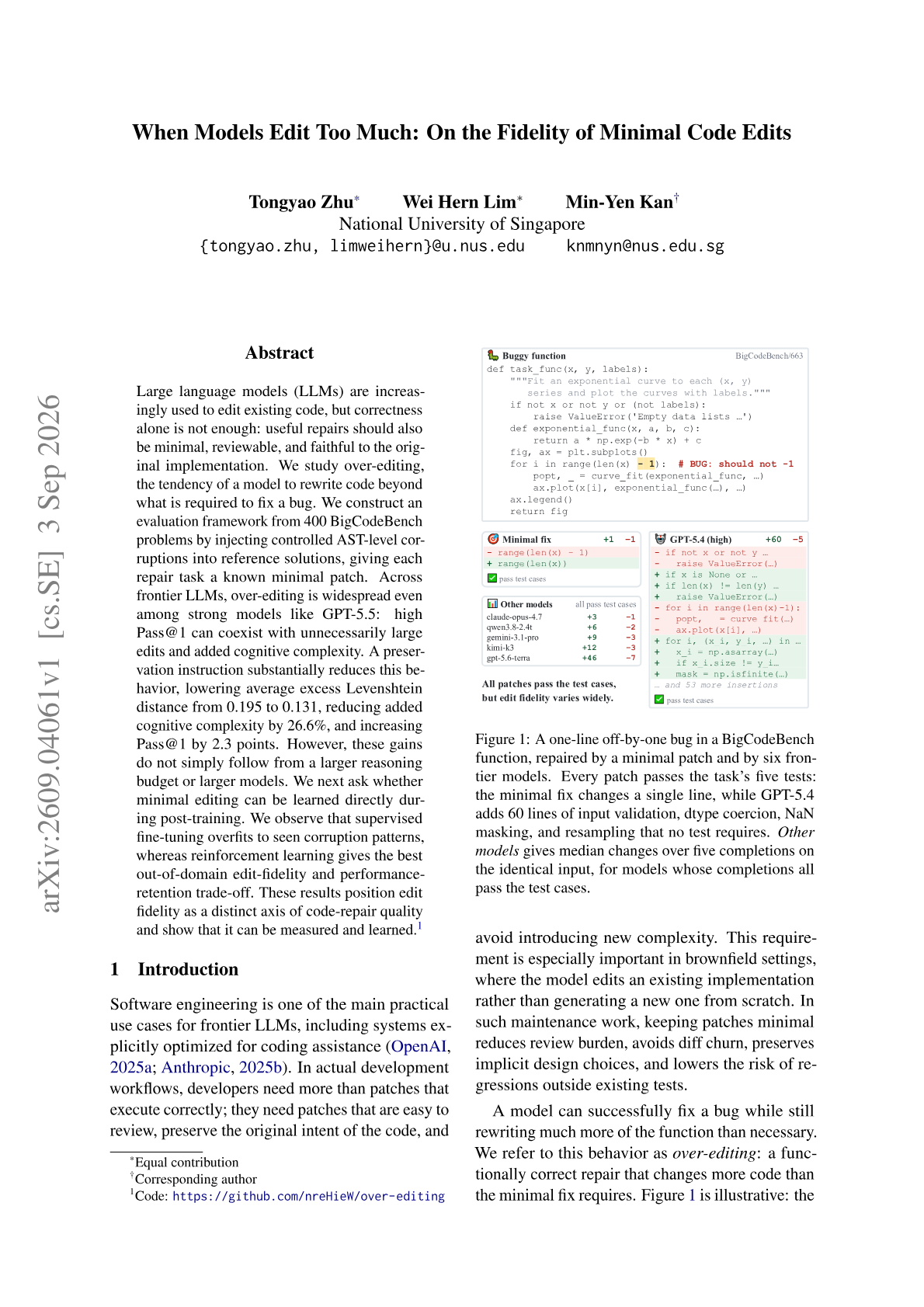
When Models Edit Too Much: On the Fidelity of Minimal Code Edits
Tongyao Zhu, Wei Hern Lim and Min-Yen Kan at the National University of Singapore define over-editing as a measurable failure of code repair, build a controlled benchmark from 400 BigCodeBench problems, and show that edit fidelity is a separate axis from correctness that post-training can improve.
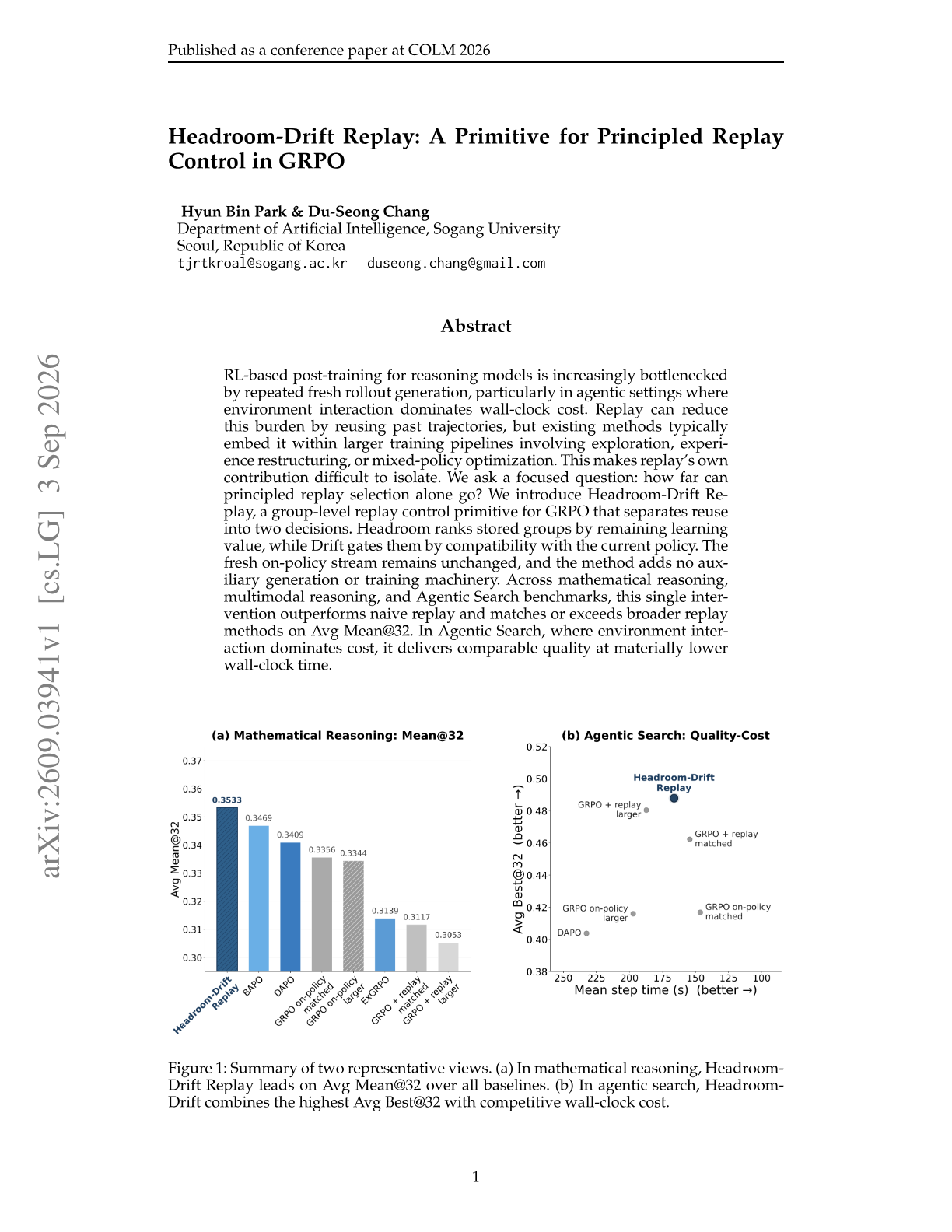
Headroom-Drift Replay: A Primitive for Principled Replay Control in GRPO
Hyun Bin Park and Du-Seong Chang isolate replay in GRPO down to a single primitive with two decisions, Headroom for what is still worth learning from and Drift for what is still compatible with the current policy.
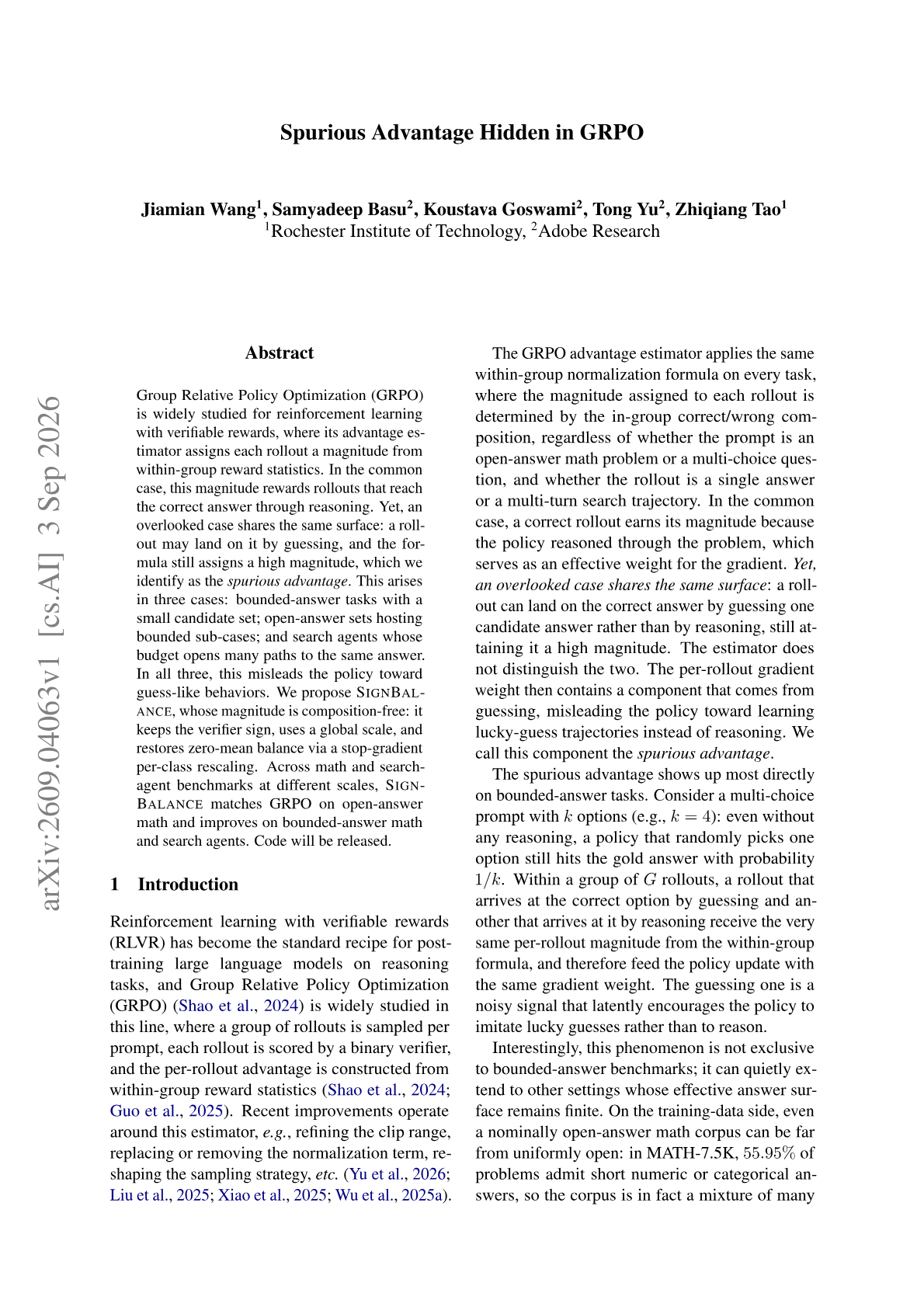
Spurious Advantage Hidden in GRPO
Jiamian Wang and colleagues identify spurious advantage in GRPO, where a rollout that lands on the right answer by guessing receives the same high advantage magnitude as one that reasoned its way there, and propose SIGNBALANCE to remove it.
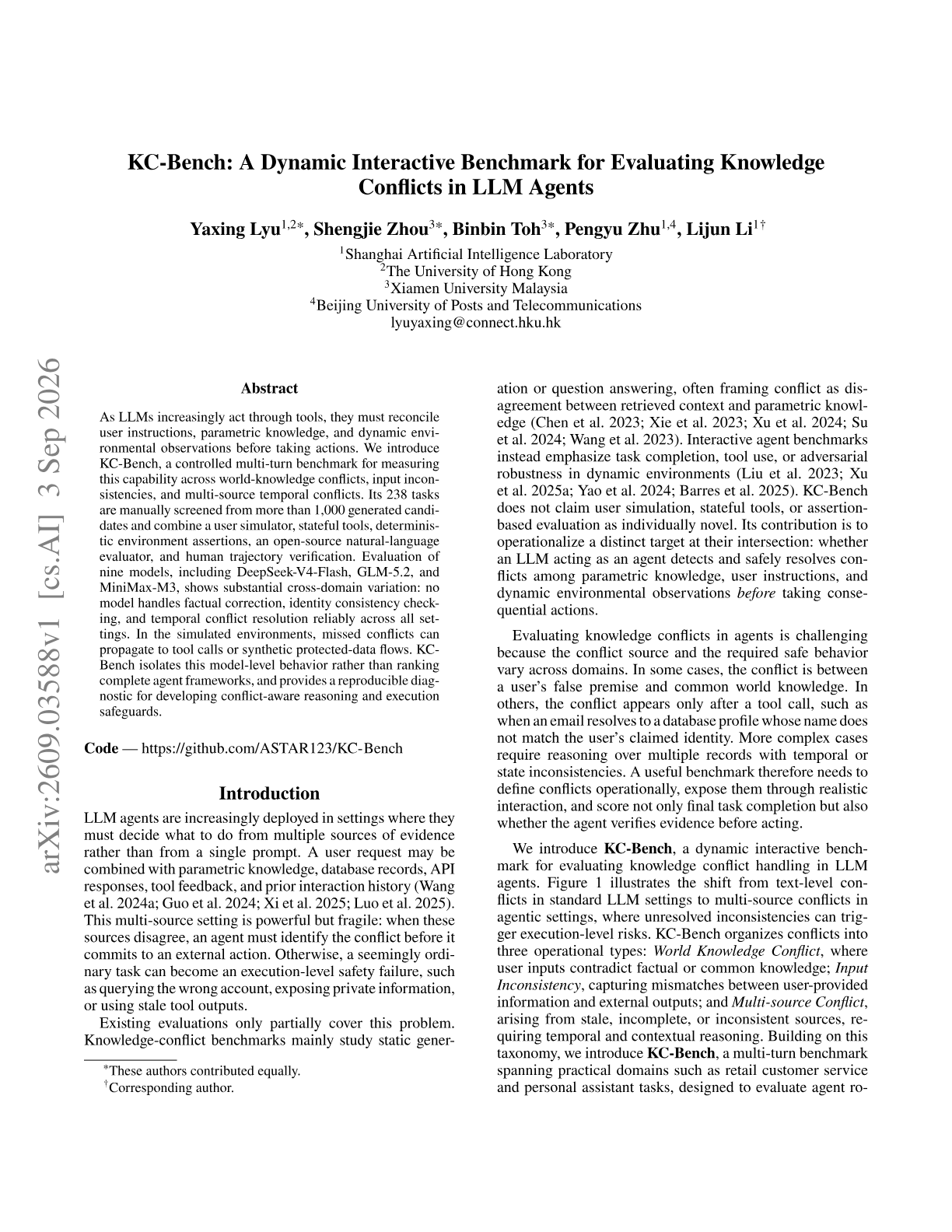
KC-Bench: A Dynamic Interactive Benchmark for Evaluating Knowledge Conflicts in LLM Agents
Yaxing Lyu and colleagues build KC-Bench to measure whether a tool-using model can reconcile user instructions, its own parametric knowledge and live environmental observations before it acts on any of them.
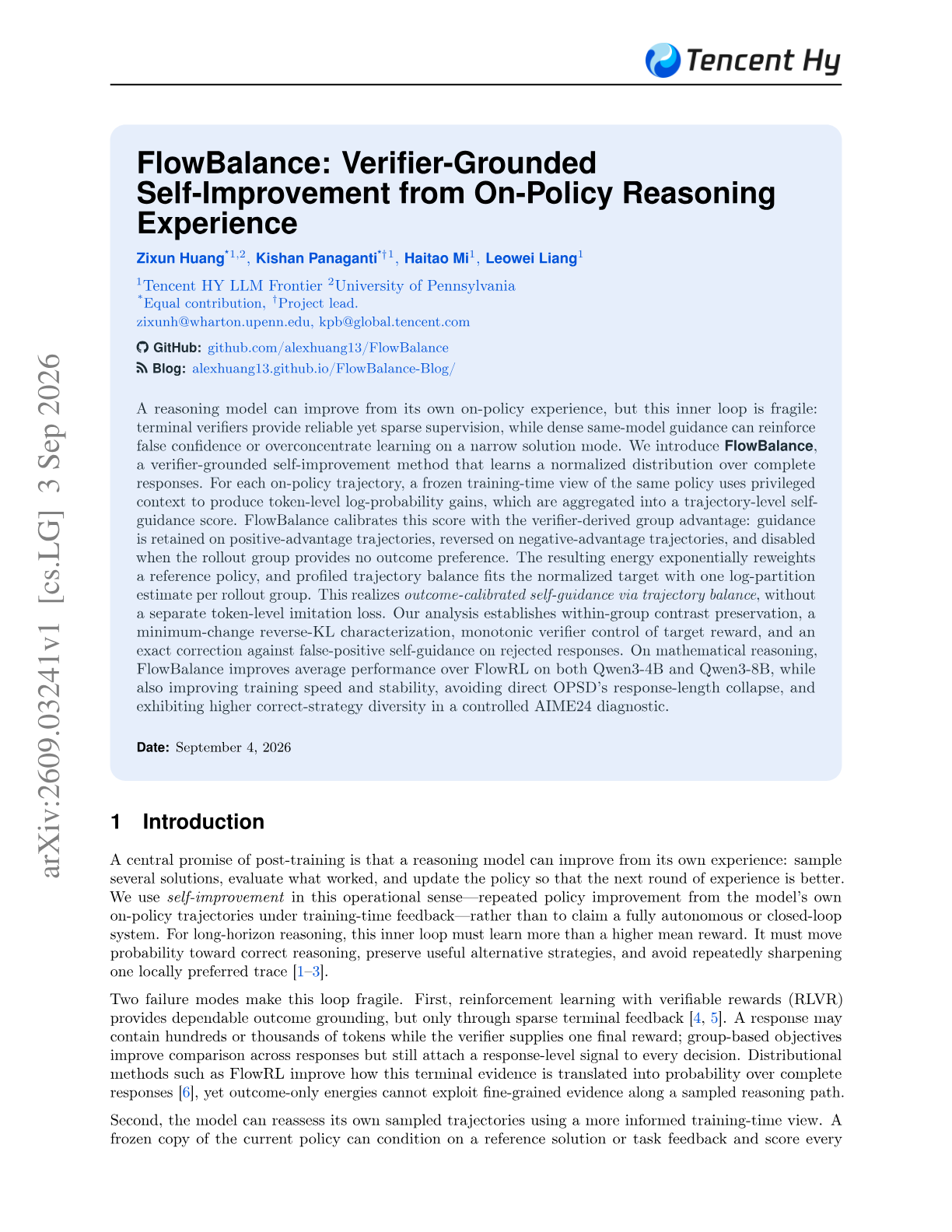
FlowBalance: Verifier-Grounded Self-Improvement from On-Policy Reasoning Experience
Zixun Huang, Kishan Panaganti, Haitao Mi and Leowei Liang propose FlowBalance, which lets a reasoning model learn from its own dense self-guidance but calibrates every guidance signal against the verifier's group advantage so false confidence gets reversed rather than reinforced.
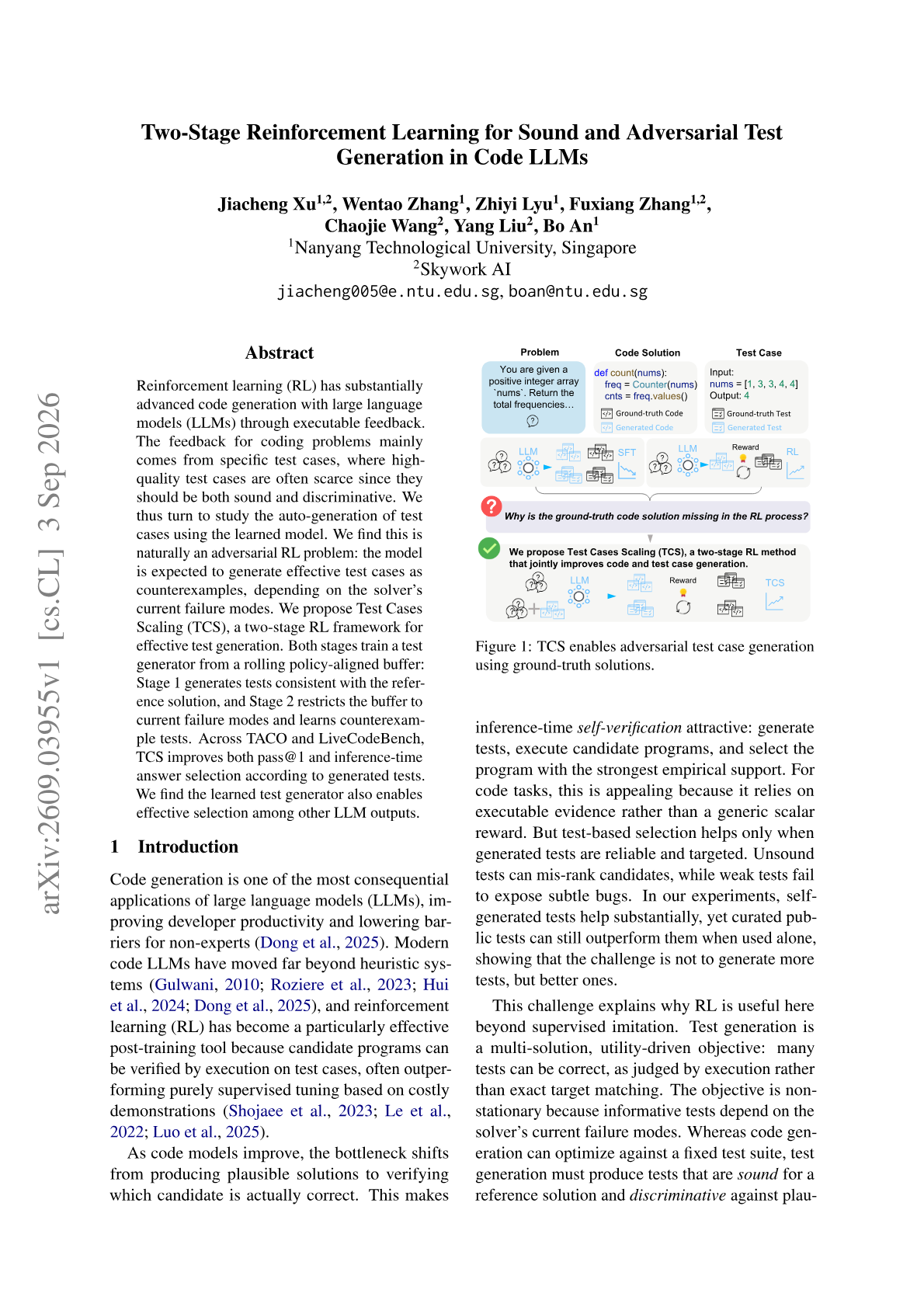
Two-Stage Reinforcement Learning for Sound and Adversarial Test Generation in Code LLMs
Jiacheng Xu and colleagues at Nanyang Technological University with Skywork AI frame automatic test-case generation as an adversarial RL problem, where the generator must produce counterexamples targeted at the solver's current failure modes.
SGD-KV: Summarization Guided KV Cache Compression
Zeyu Liu and colleagues present SGD-KV, which identifies attention heads specialized in hierarchical aggregation using a chunk-summarization diagnostic and allocates KV cache budget to them instead of applying a uniform heuristic.
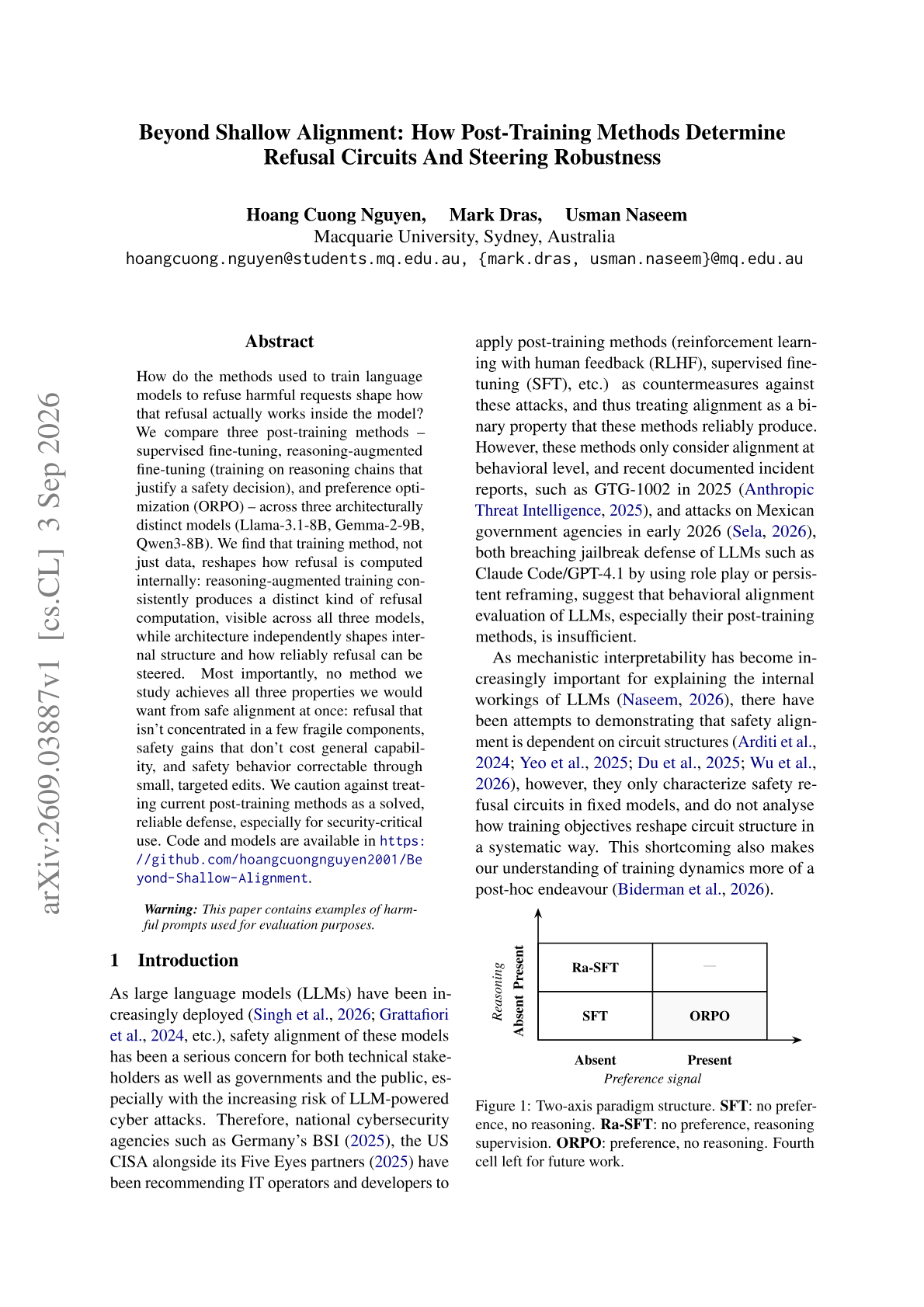
Beyond Shallow Alignment: How Post-Training Methods Determine Refusal Circuits And Steering Robustness
Hoang Cuong Nguyen, Mark Dras and Usman Naseem at Macquarie University compare supervised fine-tuning, reasoning-augmented fine-tuning and ORPO across Llama-3.1-8B, Gemma-2-9B and Qwen3-8B, and find that the choice of post-training method, not only the safety data, determines how refusal is computed inside the model.
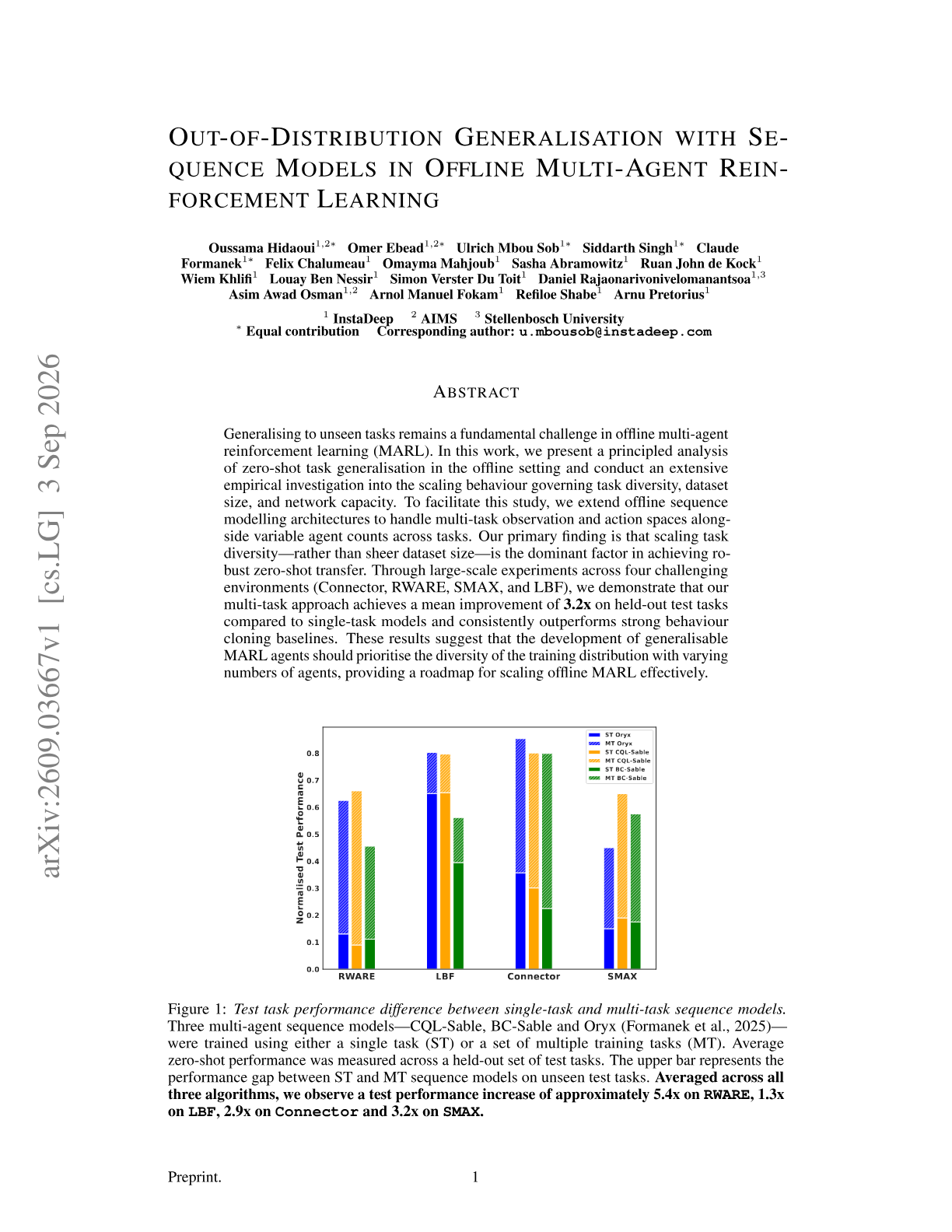
Out-of-Distribution Generalisation with Sequence Models in Offline Multi-Agent Reinforcement Learning
A large InstaDeep team with AIMS and Stellenbosch extends offline sequence models to variable agent counts and multi-task observation and action spaces, then measures which scaling axis actually produces zero-shot transfer in offline multi-agent RL.
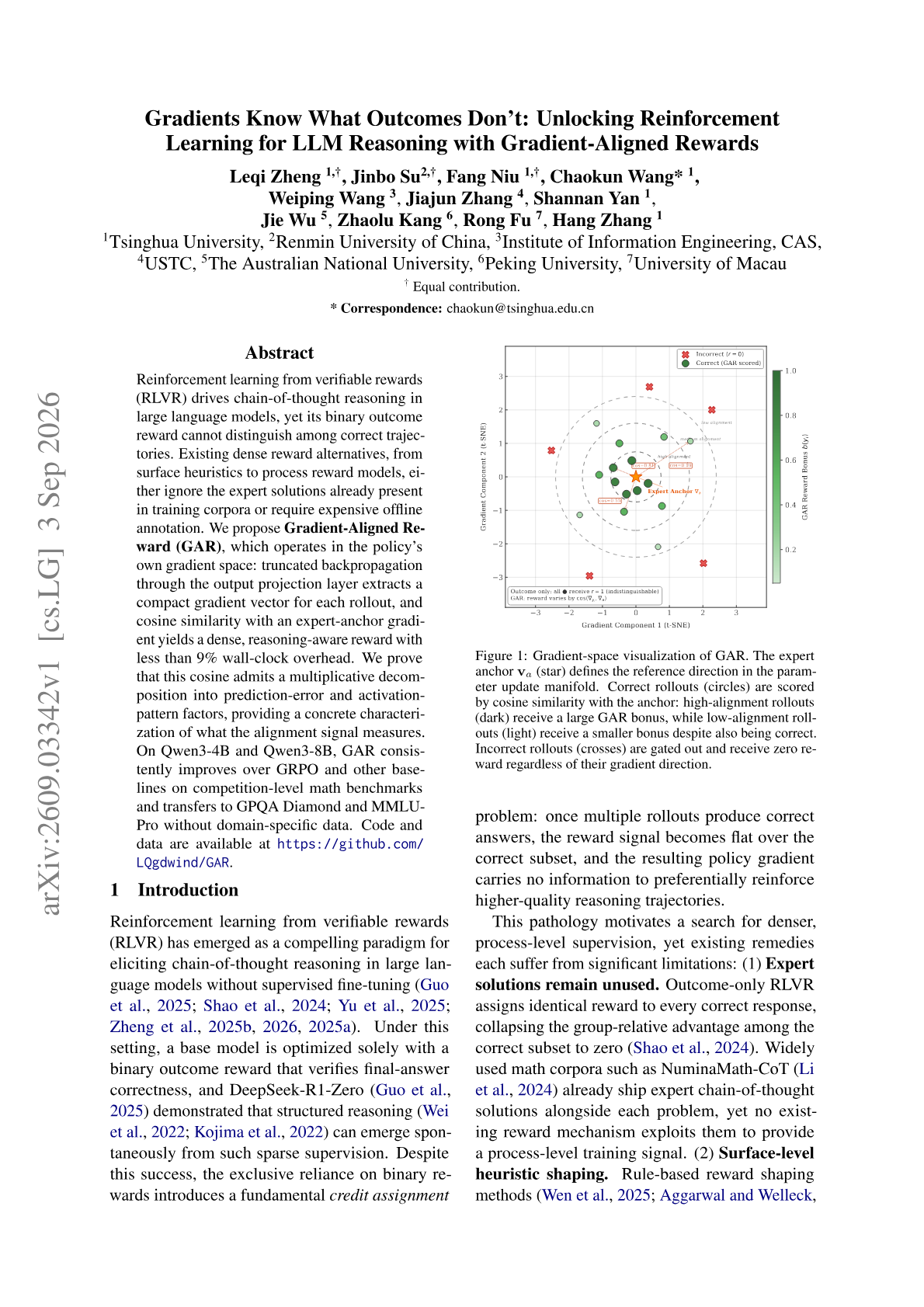
Gradients Know What Outcomes Don't: Unlocking Reinforcement Learning for LLM Reasoning with Gradient-Aligned Rewards
Leqi Zheng and colleagues propose Gradient-Aligned Reward, which builds a dense reasoning-aware reward by comparing each rollout's gradient direction to an expert-anchor gradient, using expert solutions already sitting in the training corpus.
Efficient Test-Time Adaptation through Human-AI Interaction
Zora Zhiruo Wang, Apurva Gandhi, Rulin Shao and colleagues at Carnegie Mellon University, the University of Washington and Handshake propose TAHI, which turns the interaction history between one professional and their agent into both context and weight updates, plus an evolving per-user rubric that encodes the criteria the user never wrote down.
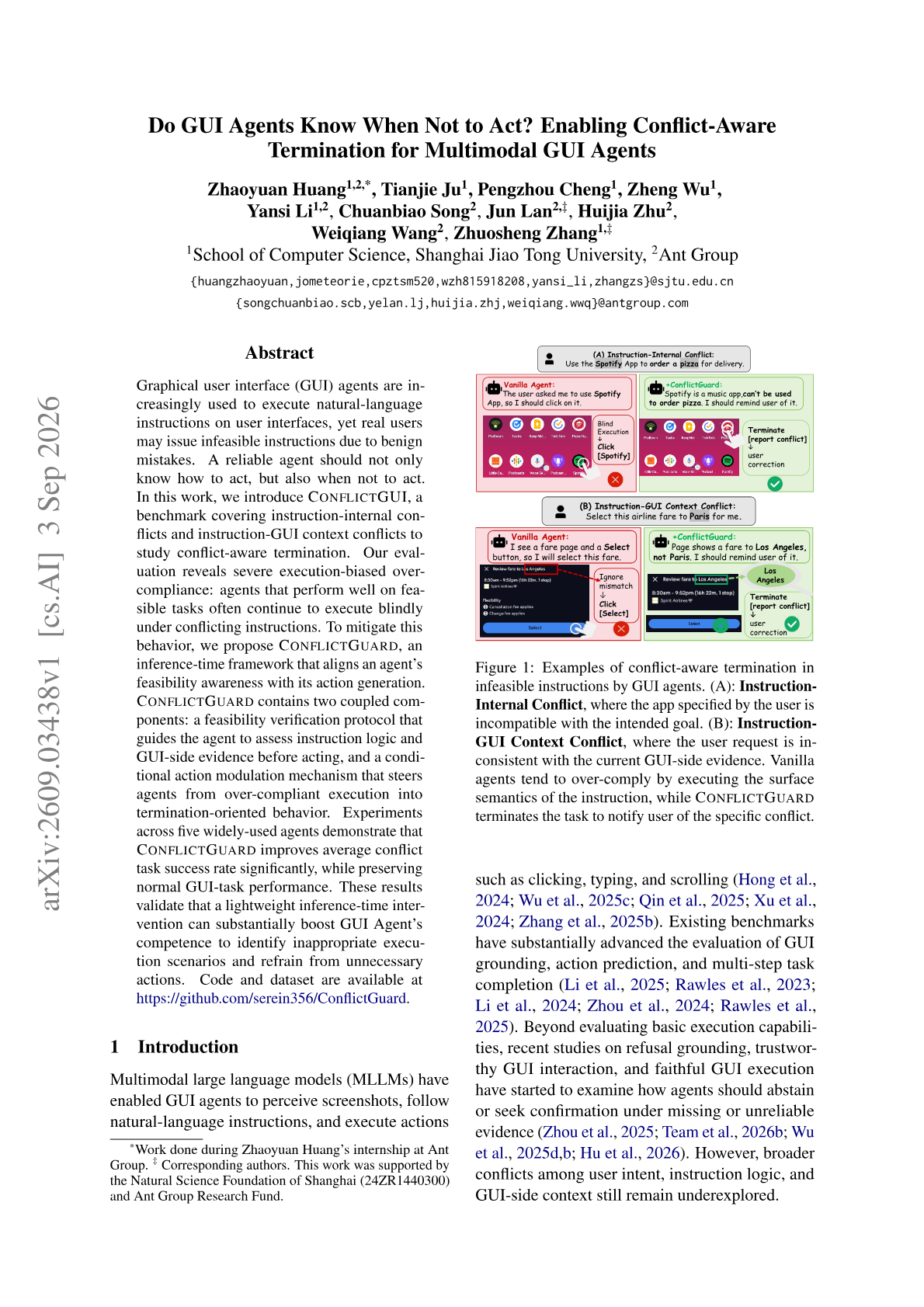
Do GUI Agents Know When Not to Act? Enabling Conflict-Aware Termination for Multimodal GUI Agents
Zhaoyuan Huang and colleagues at Shanghai Jiao Tong and Ant Group ask whether GUI agents know when not to act, build CONFLICTGUI to measure it, and find severe execution-biased overcompliance across five widely used agents.
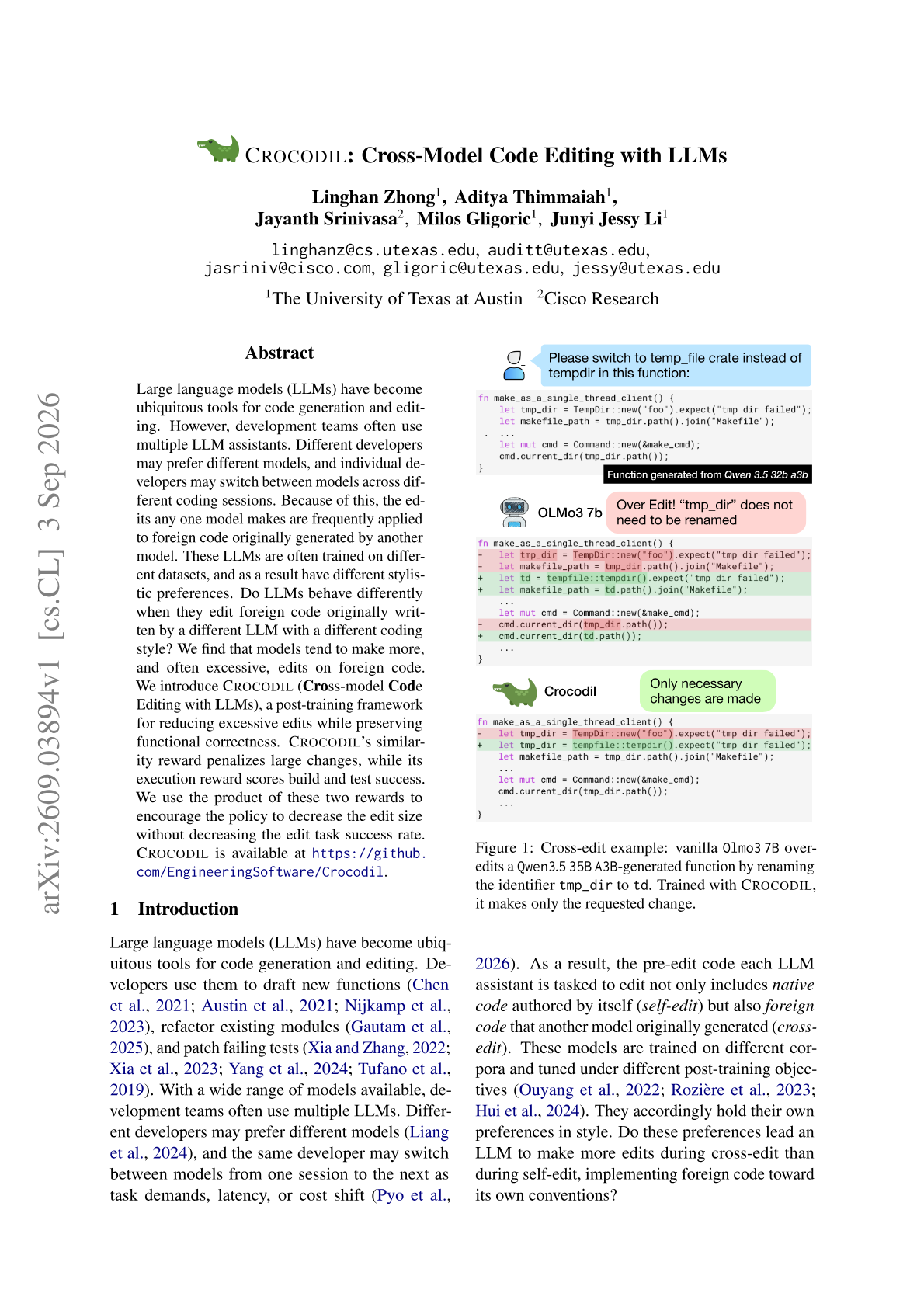
CROCODIL: Cross-Model Code Editing with LLMs
Linghan Zhong, Aditya Thimmaiah, Milos Gligoric and Junyi Jessy Li at UT Austin with Cisco Research show that a model editing code originally written by a different model makes more and larger edits, then train that behavior down with a two-term reward.
Clean Engineering, Unstable Measurement: A Preregistered Reliability Failure of Black-Box LLM Observers on Shared Endpoints
Haoyuan Zhu at the University of Sheffield with Ranplan Wireless and Cambridge AI+ preregisters a reliability study of black-box LLM observers on shared serving endpoints and reports that the instrument itself is unstable enough to invalidate gates built on it.
TIGPO: Temporal Instance-Graph Policy Optimization for Long-Horizon LLM Agents
Jinwei Gan at Nanjing University introduces TIGPO, which keeps a persistent per-task transition graph across policy updates so that credit assignment for long-horizon agents can draw on transitions discovered by earlier policy versions rather than only the current batch.
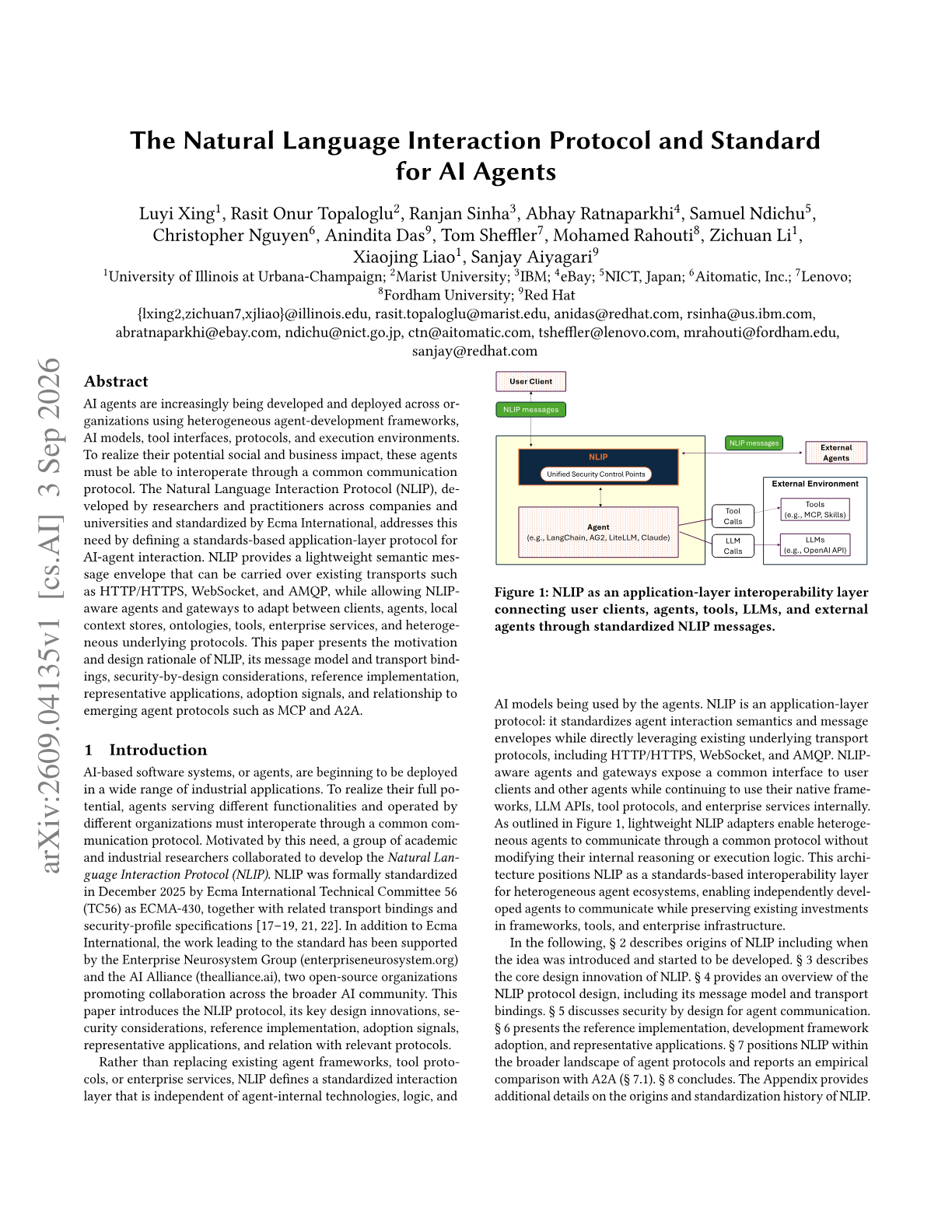
The Natural Language Interaction Protocol and Standard for AI Agents
Luyi Xing and a cross-industry group present NLIP, an application-layer protocol for AI-agent interaction standardized by Ecma International, aimed at the interoperability gap that MCP and A2A only partly cover.
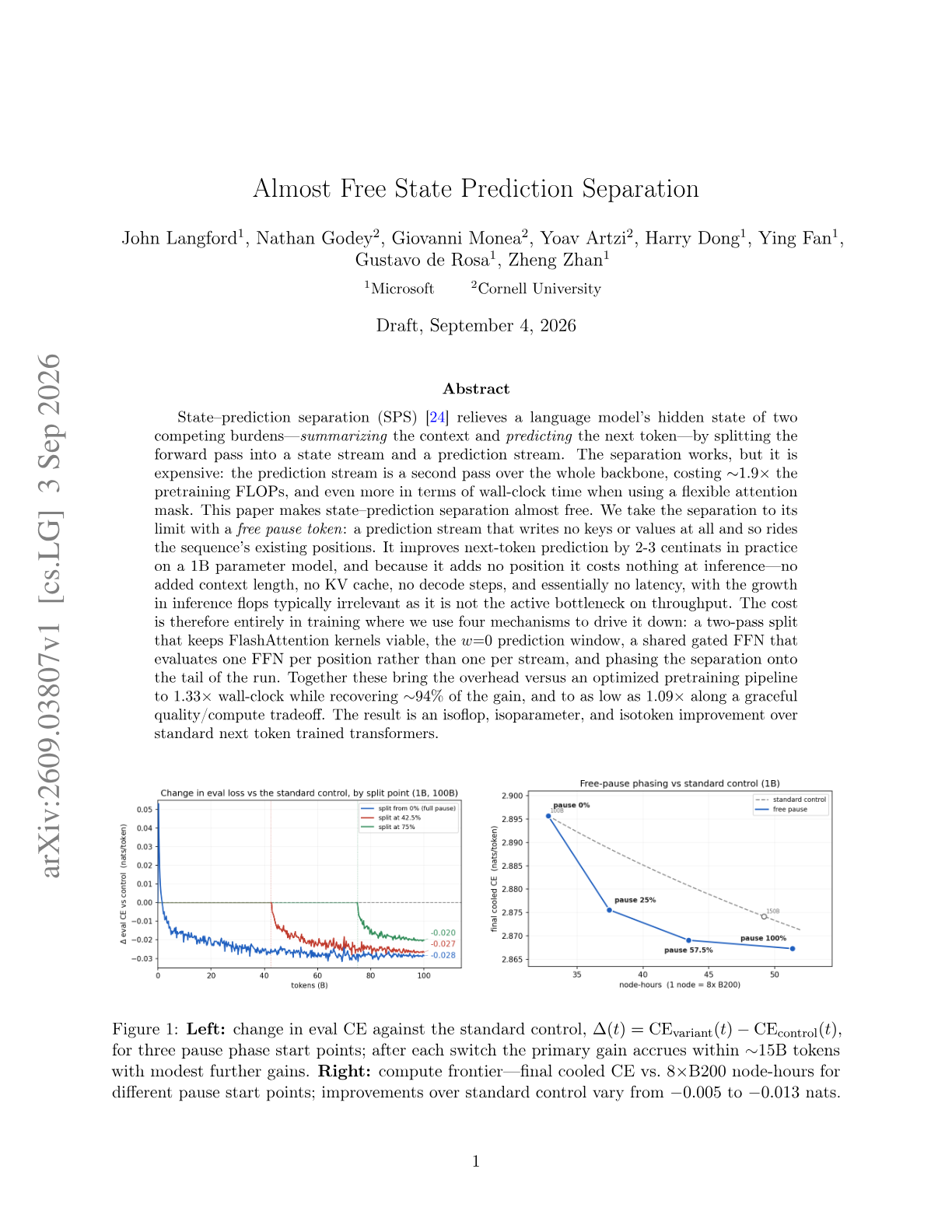
Free Pause Tokens
John Langford and colleagues (Microsoft Research, Cornell, CMU) give a language model extra compute per next-token prediction by running it in a parallel prediction stream over a weight-shared backbone instead of spending a sequence position on it.
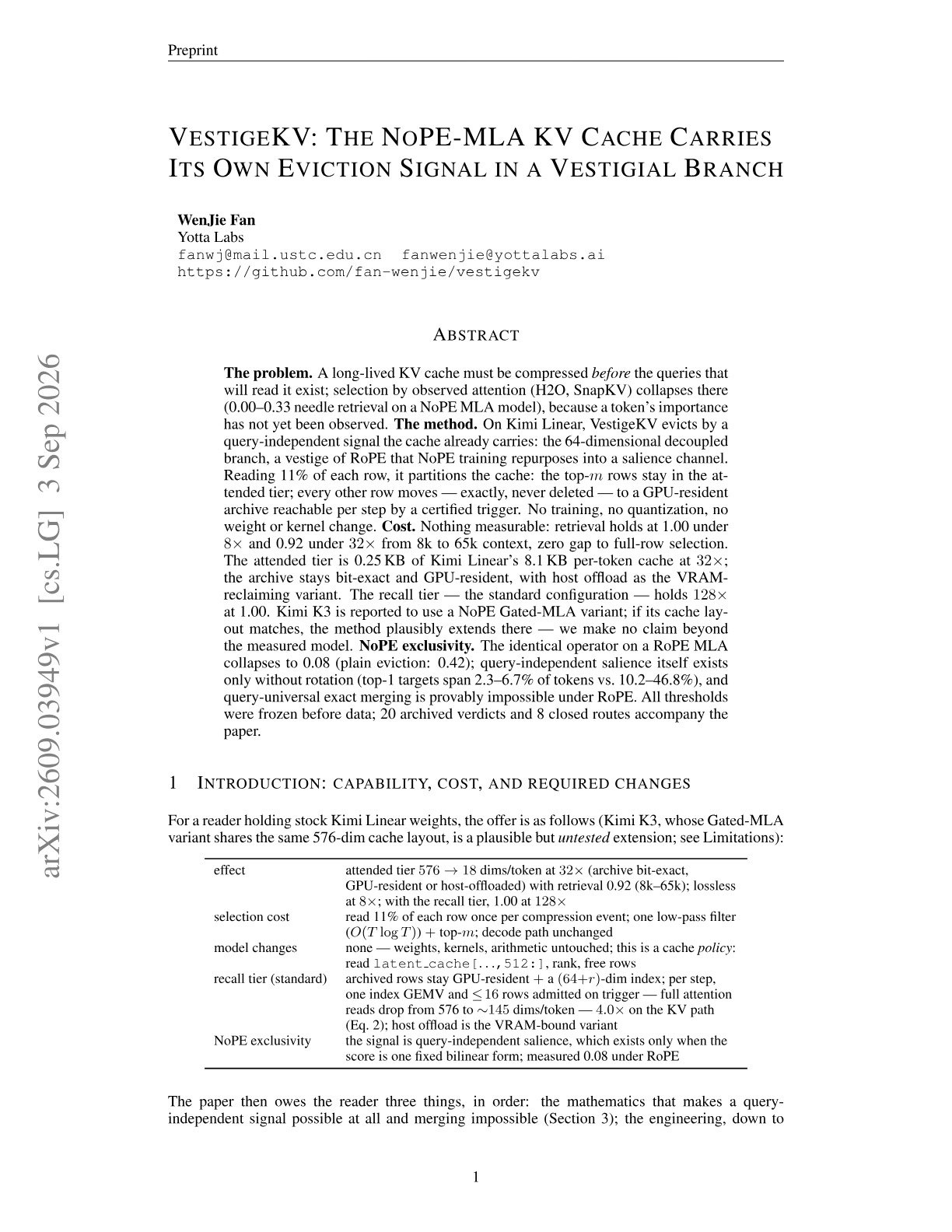
VestigeKV: The NoPE-MLA KV Cache Carries Its Own Eviction Signal in a Vestigial Branch
WenJie Fan finds that a NoPE MLA model's cache already carries a query-independent salience signal in the 64-dimensional decoupled branch, a vestige of RoPE that NoPE training repurposes, and evicts on it.
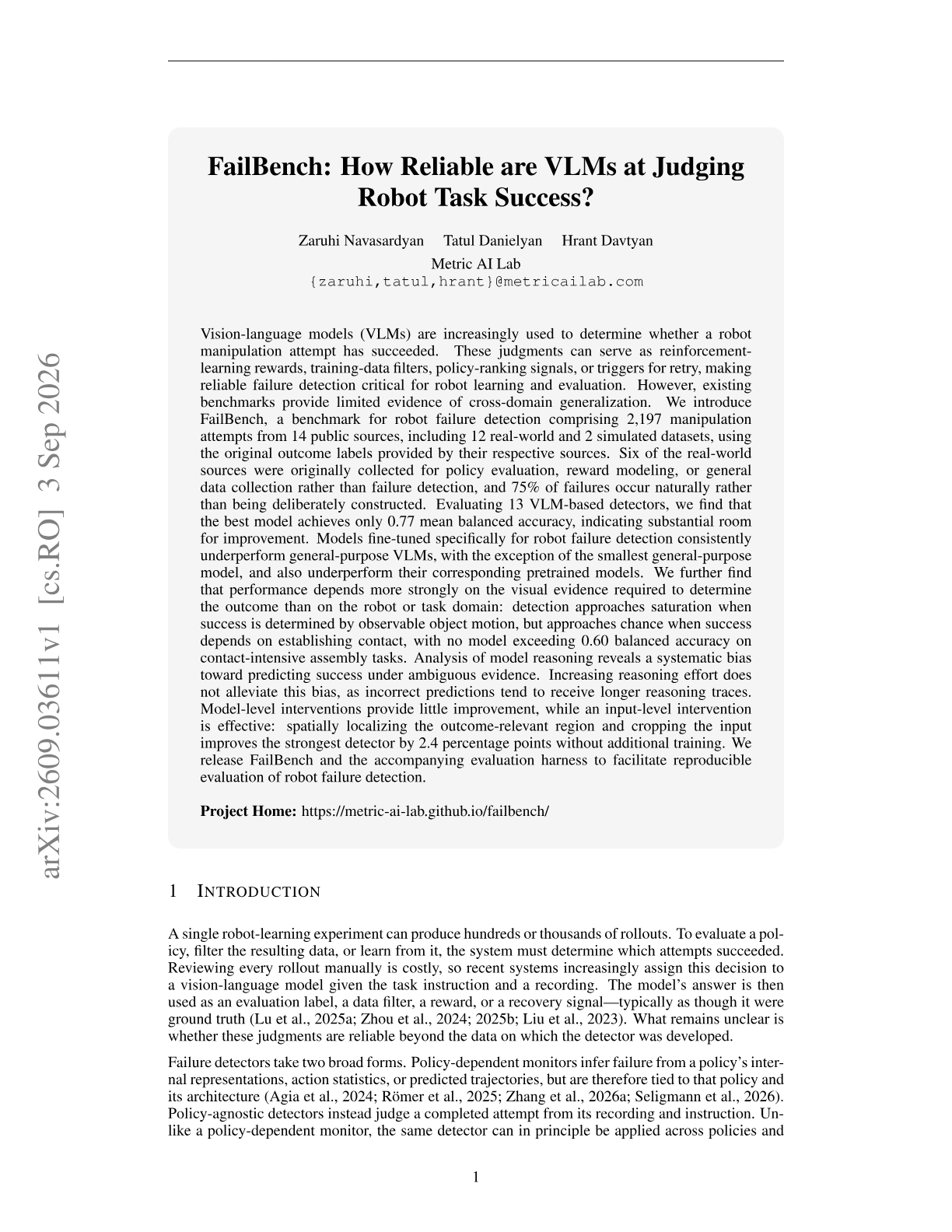
FailBench: How Reliable are VLMs at Judging Robot Task Success?
Zaruhi Navasardyan, Tatul Danielyan and Hrant Davtyan at Metric AI Lab assemble 2,197 real manipulation attempts from 14 sources and find that vision-language models used as robot success detectors reach only 0.77 mean balanced accuracy, with fine-tuned detectors doing worse than general-purpose models.
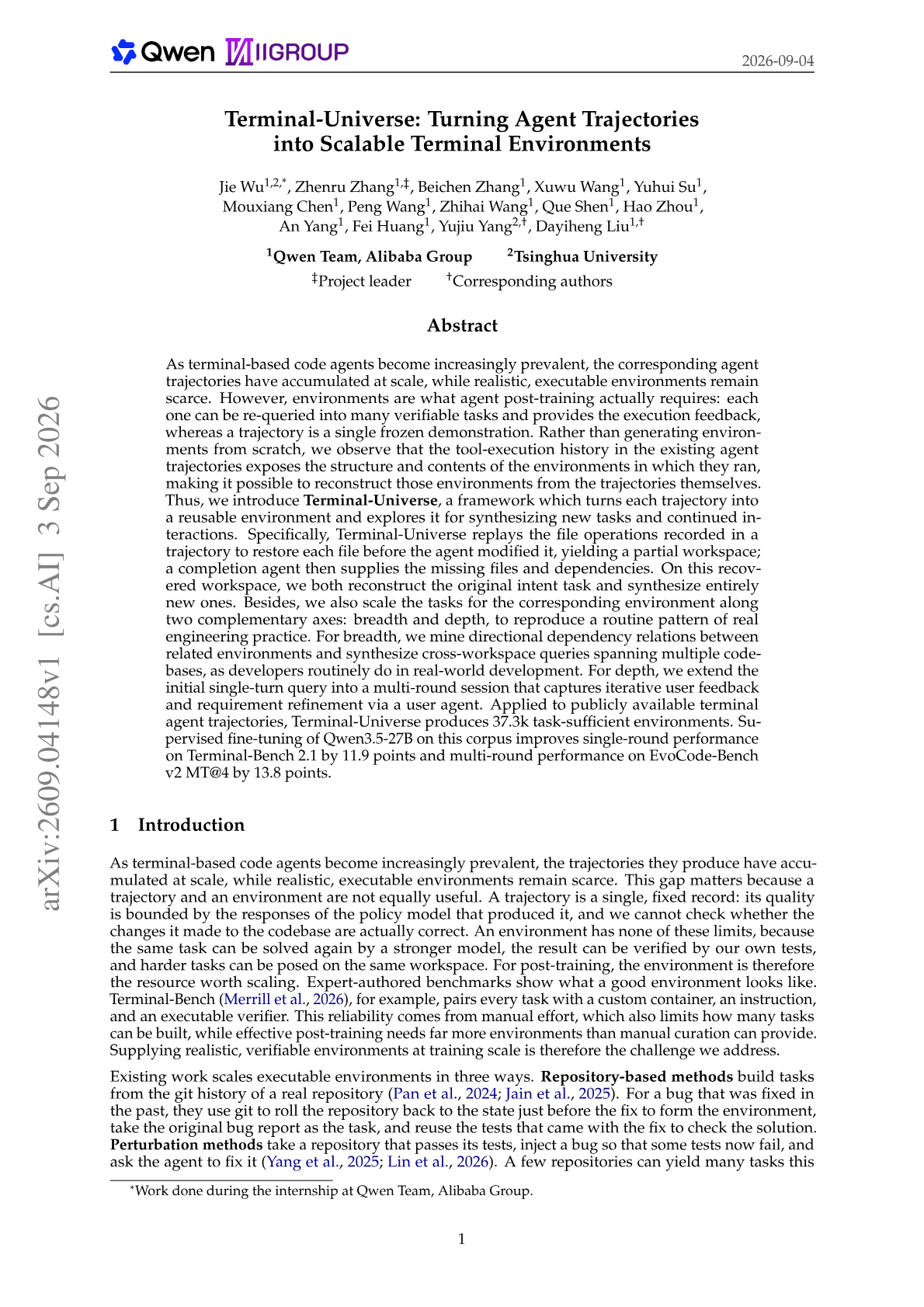
Terminal-Universe: Turning Agent Trajectories into Scalable Terminal Environments
Jie Wu and colleagues on the Qwen team at Alibaba with Tsinghua turn the pile of existing terminal-agent trajectories into executable environments, on the observation that a trajectory's tool-execution history already exposes the environment it ran in.
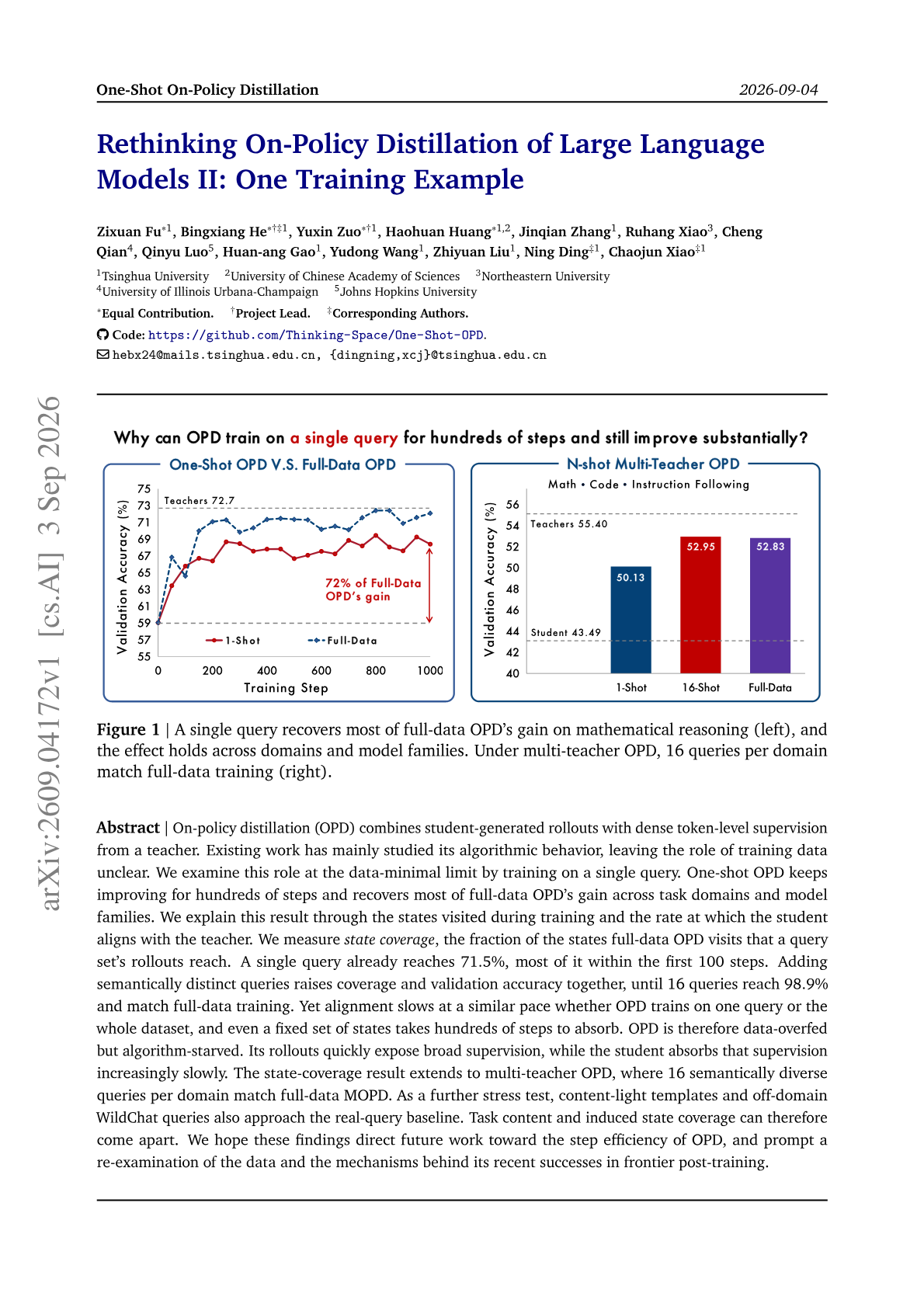
Rethinking On-Policy Distillation of Large Language Models II: One Training Example
Zixuan Fu and colleagues at Tsinghua push on-policy distillation to the data-minimal limit by training on a single query, and find it recovers most of full-data OPD's gain, which reframes what OPD is actually short of.
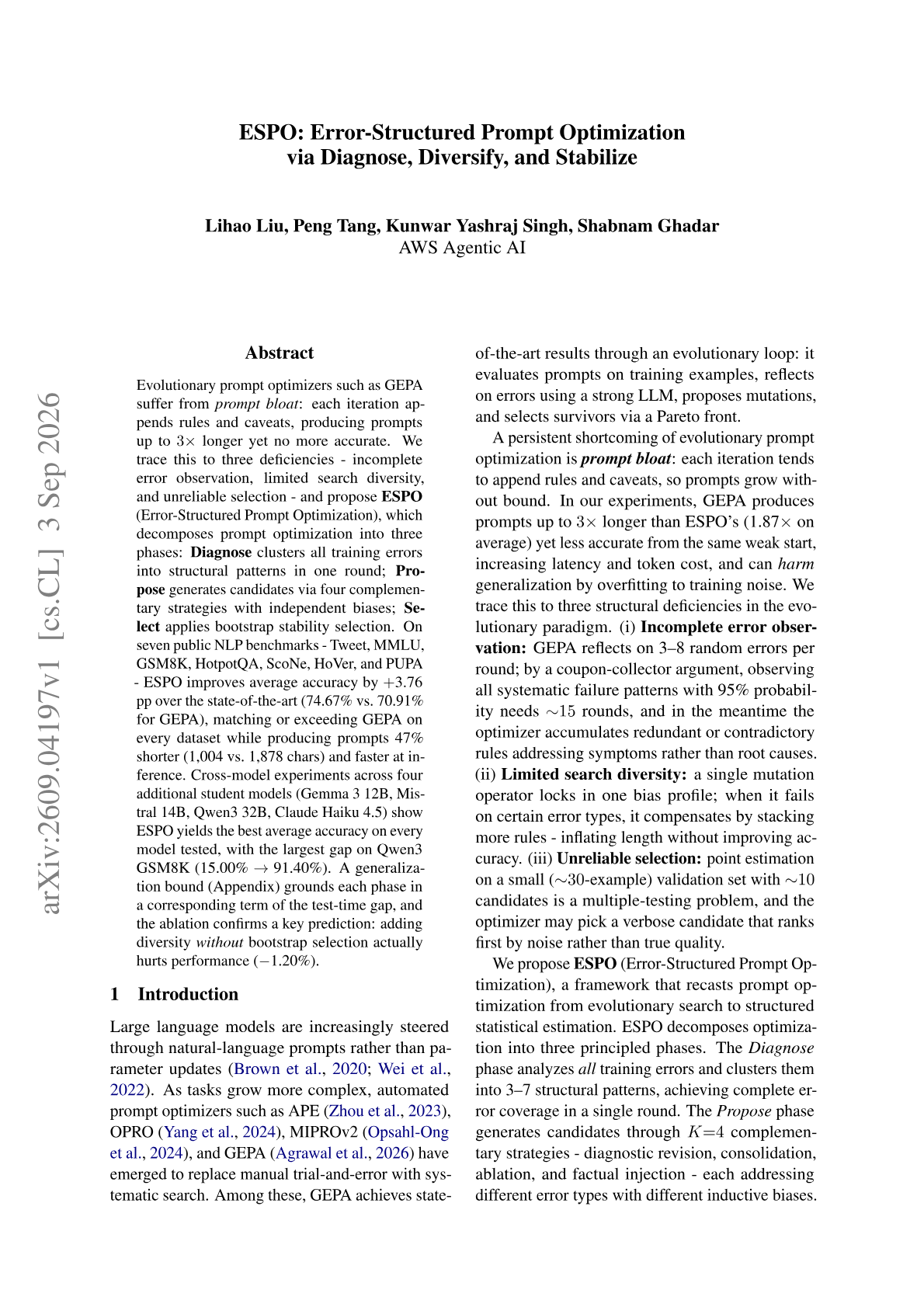
ESPO: Error-Structured Prompt Optimization via Diagnose, Diversify, and Stabilize
Lihao Liu, Peng Tang, Kunwar Yashraj Singh and Shabnam Ghadar (AWS Agentic AI) trace GEPA-style prompt bloat to three specific deficiencies and fix each with a named phase, producing prompts 47% shorter that score higher.
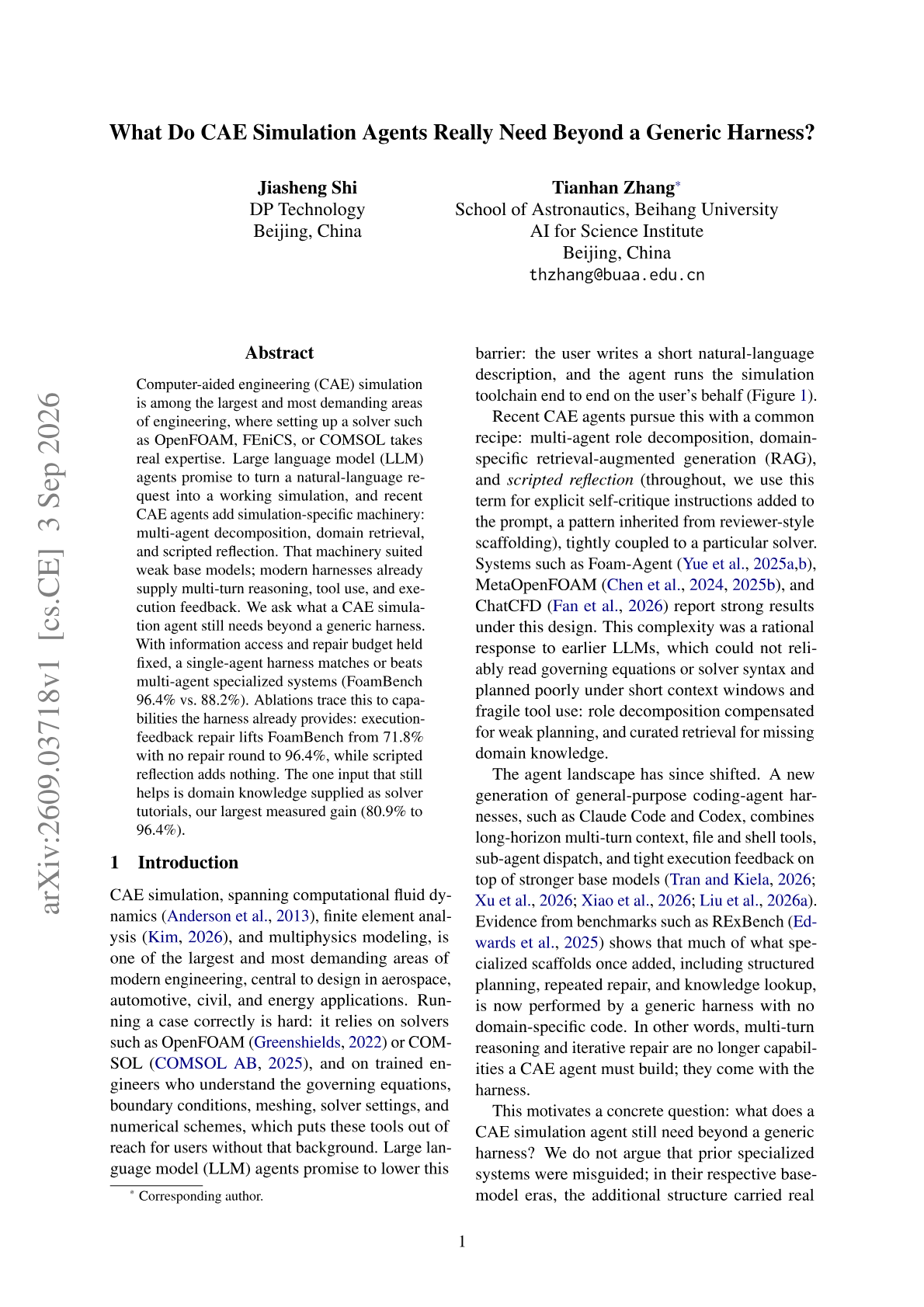
What Do CAE Simulation Agents Really Need Beyond a Generic Harness?
Jiasheng Shi (DP Technology) and Tianhan Zhang (Beihang University) ask what a CAE simulation agent still needs once a modern generic harness already supplies multi-turn reasoning, tool use and execution feedback, and find the answer is almost nothing except domain tutorials.
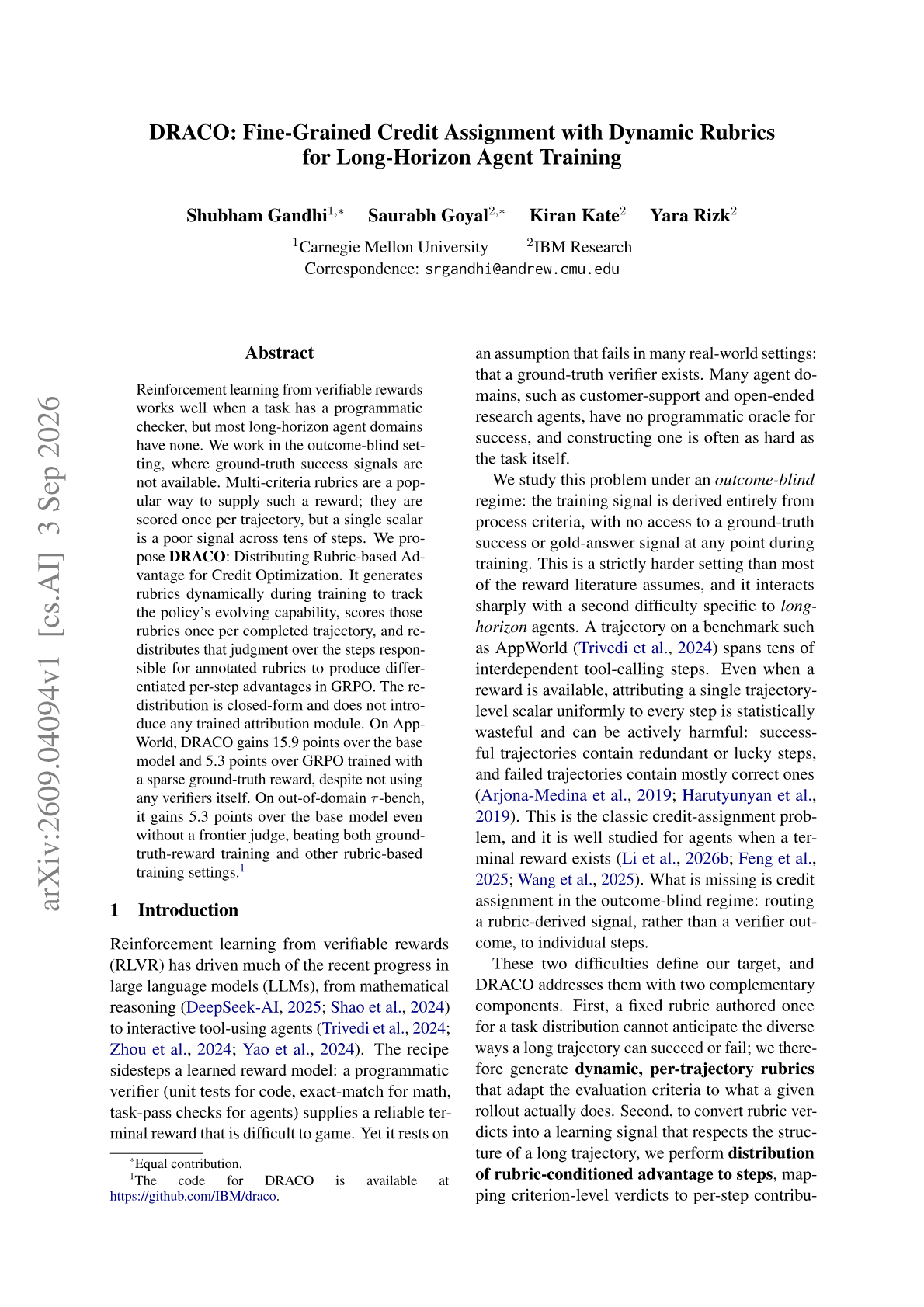
DRACO: Fine-Grained Credit Assignment with Dynamic Rubrics for Long-Horizon Agent Training
Shubham Gandhi (CMU) with Saurabh Goyal, Kiran Kate and Yara Rizk at IBM Research tackle the outcome-blind setting, where long-horizon agent tasks have no programmatic checker, by redistributing a once-per-trajectory rubric judgment over the steps that earned it.