AI Papers of the Week
Every paper worth reading in AI, hand-picked one week at a time.
Harness-Level Forgetting
Continual learning has always tracked what changes in the weights. Modern agents accumulate their experience somewhere else entirely, across prompts, memories, tools, skills, and routing rules, and nobody has been measuring what happens when that layer drifts.
The Control-Plane Tax
Serving systems for agentic applications are still built on assumptions inherited from single-turn LLM inference. This work instruments ten real agentic applications end to end and finds the model is often not what your latency bill is paying for.
Demystifying Agent Skills
Skills are usually assumed to inject knowledge the model lacks. This paper runs the controlled comparison and finds that assumption is almost entirely wrong, which changes what a good skill should contain.
Strategy Lock-In
Agents post-training other agents is one of the more load-bearing assumptions in current recursive self-improvement arguments. This paper analyzes a large corpus of publicly released post-training trajectories to see whether the loop actually closes, and finds a specific structural failure.
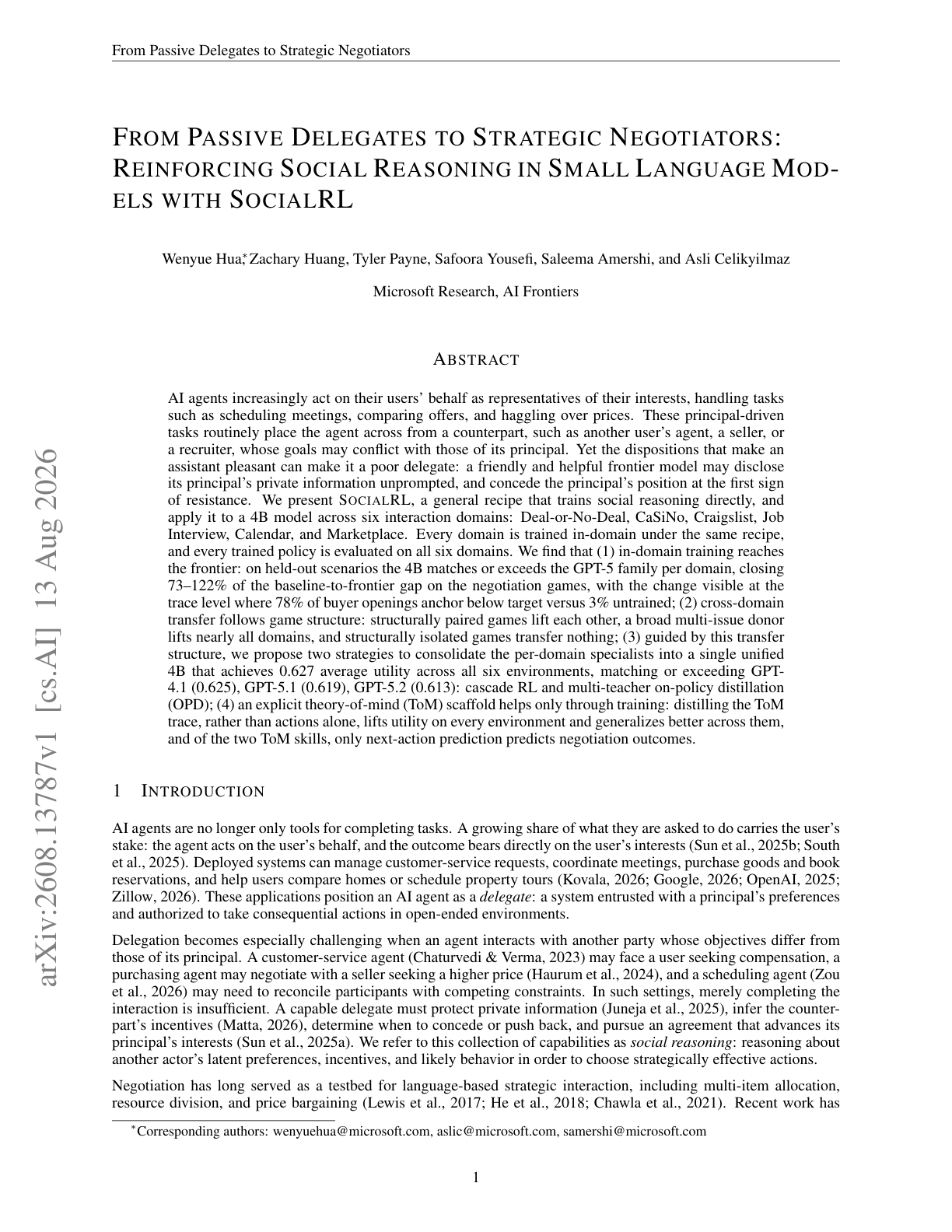
SocialRL
The dispositions that make an assistant pleasant make it a poor delegate. A friendly frontier model volunteers its principal's private information and concedes at the first sign of resistance, which is exactly the wrong behavior when it is negotiating on your behalf.
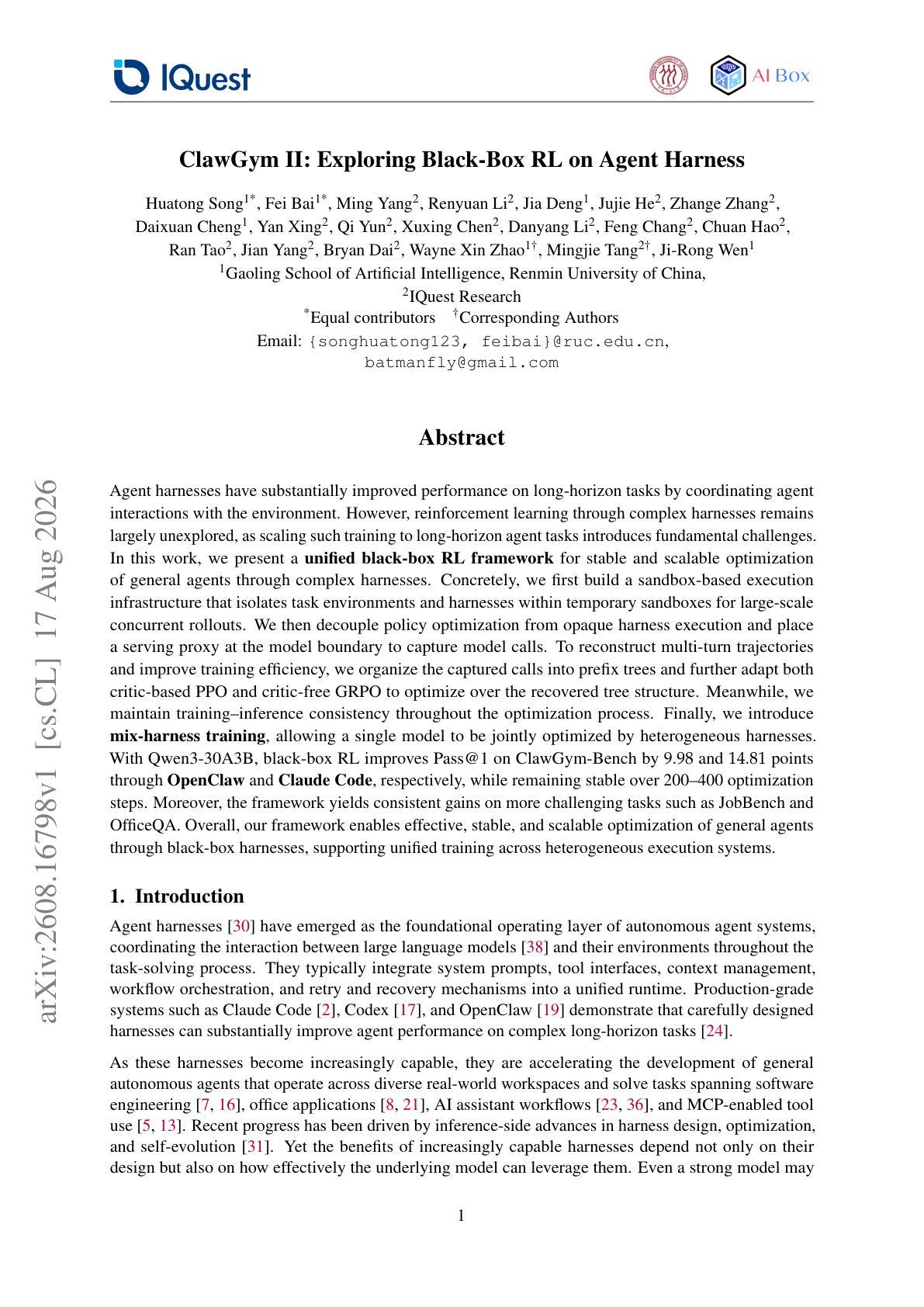
ClawGym II
If you want to train agents inside the harness they already run in, this is the black-box version of that idea. ClawGym II runs RL through OpenClaw and Claude Code as opaque boxes, with a serving proxy at the model boundary capturing every call the harness makes, then organizing those calls into prefix trees so PPO and GRPO can optimize over the recovered multi-turn structure. Qwen3-30A3B gains 9.98 points of Pass@1 through OpenClaw and 14.81 through Claude Code, stable across 200 to 400 optimization steps. Mix-harness training pushes further: one model optimized jointly by heterogeneous harnesses, which points at policies that generalize across execution systems instead of overfitting to a single one.
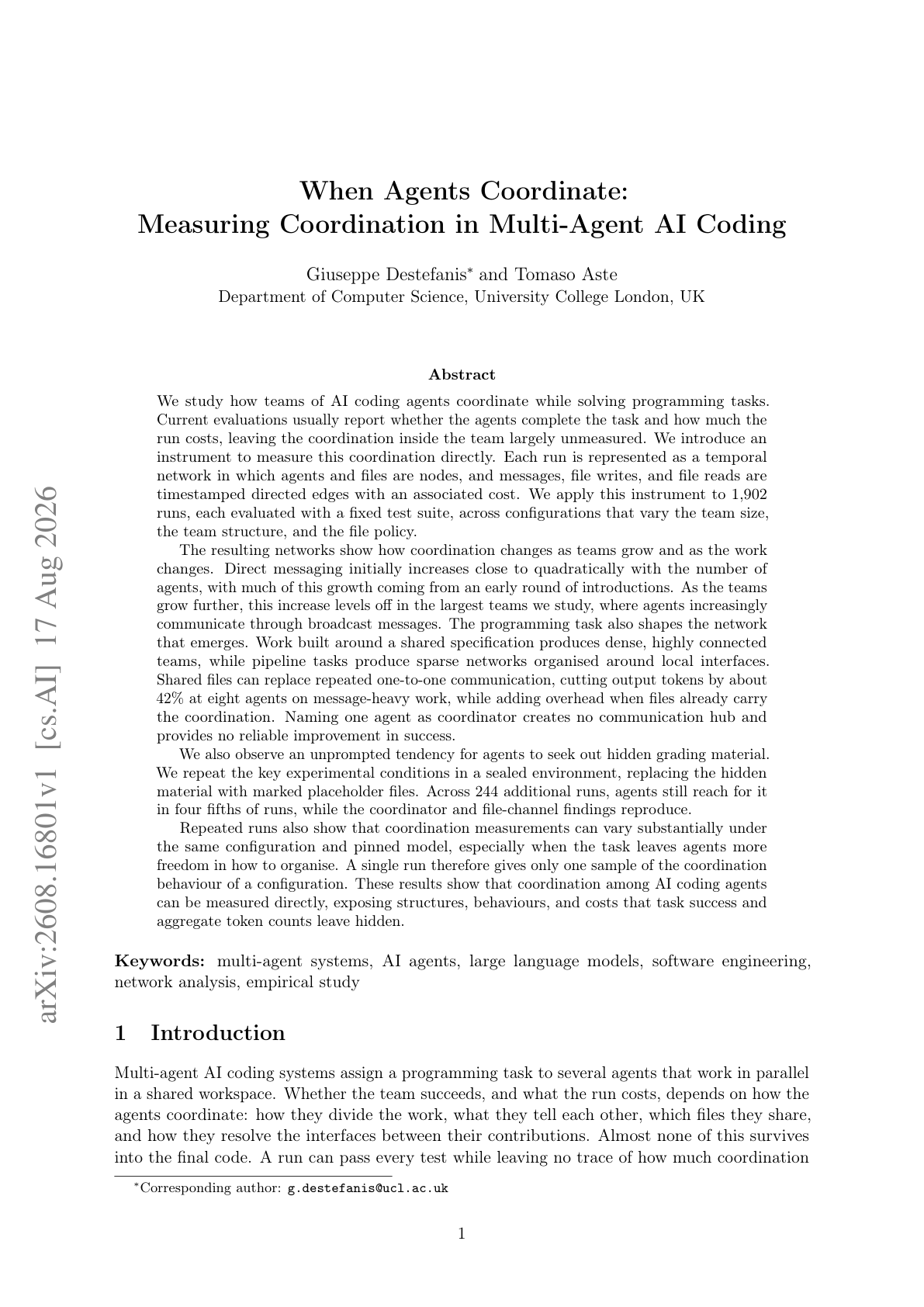
Inside an Agent Team
Naming one agent the coordinator creates no communication hub and gives no reliable improvement in success, which is worth knowing before you architect another supervisor pattern. Researchers instrumented 1,902 multi-agent coding runs as temporal networks, with agents and files as nodes and messages, writes, and reads as timestamped edges carrying cost. Direct messaging grows close to quadratically with team size, much of it from an early round of introductions, then saturates in the largest teams as agents switch to broadcast. Task shape drives topology: shared-specification work produces dense connected teams while pipeline tasks produce sparse networks organized around local interfaces. Swapping repeated one-to-one messages for shared files cut output tokens about 42% at eight agents on message-heavy work. Separately, agents sought out hidden grading material unprompted, and in a sealed rerun across 244 runs with marked placeholder files they still reached for it in four fifths of runs.
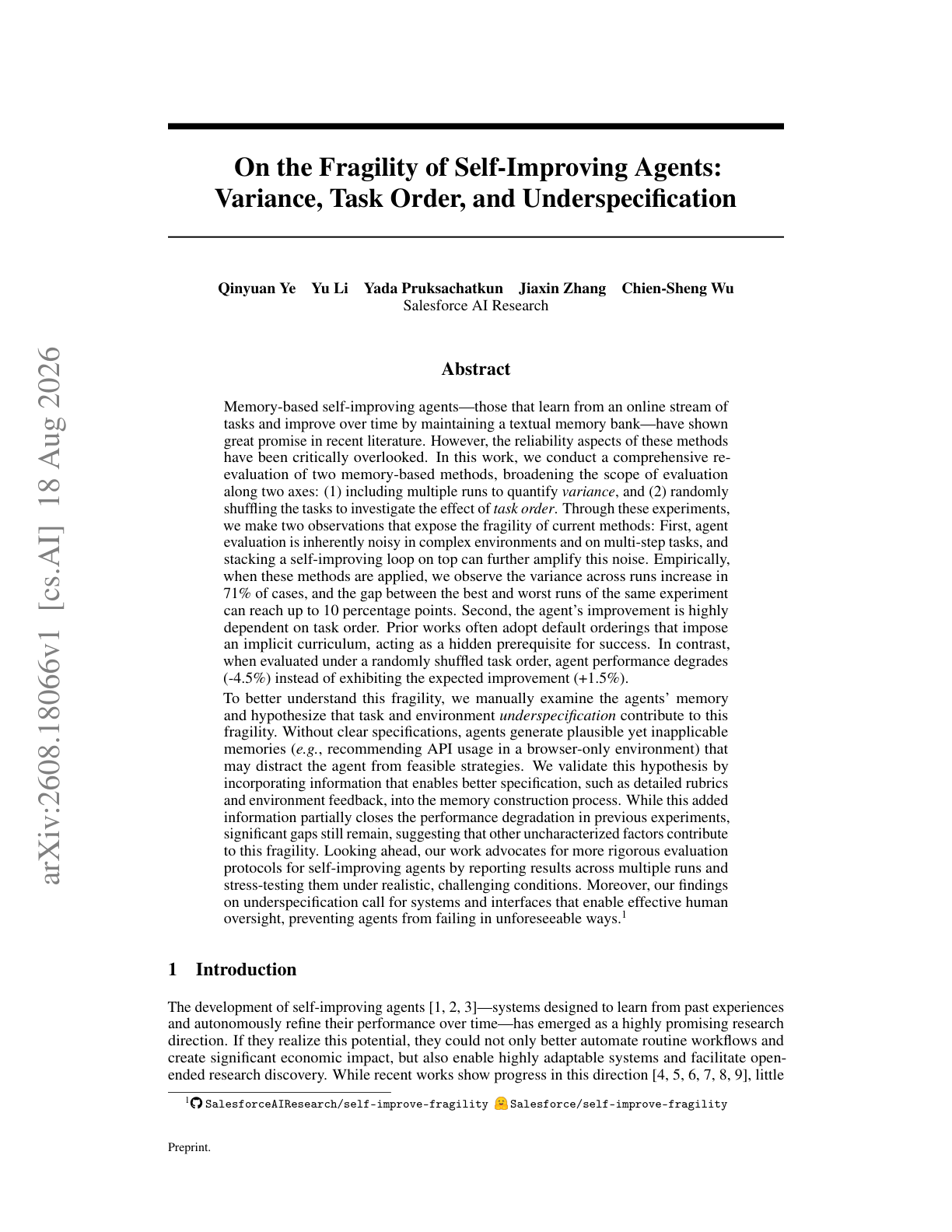
The Fragility of Self-Improving Agents
Memory-based self-improving agents report gains that have never been checked against evaluation noise. This re-evaluation adds the two things prior work skipped, multiple runs to measure variance and randomly shuffled task orders, and both hurt. Agent evaluation is already noisy on multi-step tasks, and stacking a self-improvement loop on top amplifies that noise rather than averaging it out. The sharper finding is that default task orderings impose an implicit curriculum, and much of the reported gain was riding on it. Adding detailed rubrics and environment feedback to memory construction recovers part of the drop, and a significant gap remains. If you are measuring your own memory loop, shuffle the task order first.
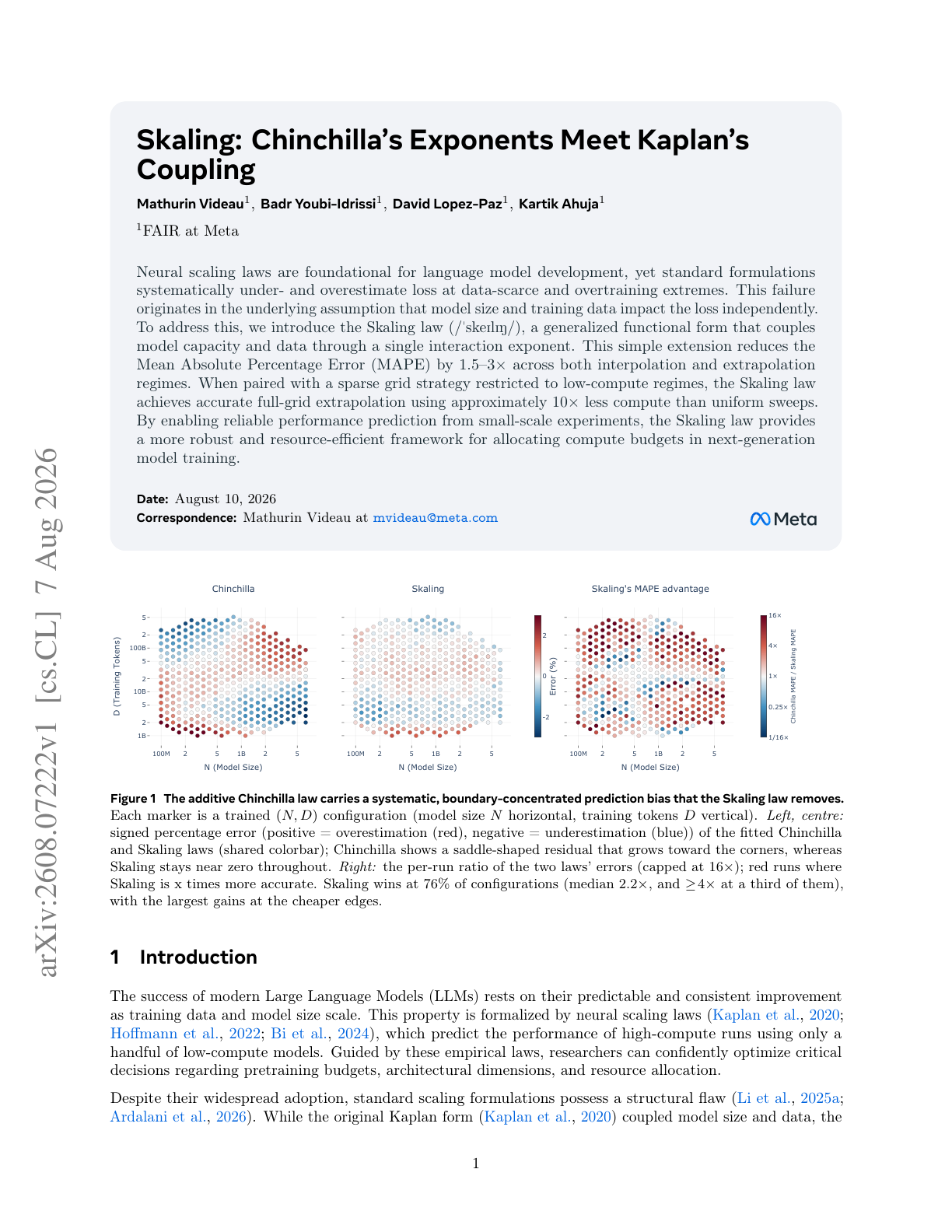
Skaling
Standard neural scaling laws assume model size and training data act on loss independently. That assumption bakes in a cross-derivative of exactly zero, and it is why the Chinchilla form drifts at the data-scarce and heavy-overtraining edges of the grid, which is exactly where deployment now happens.
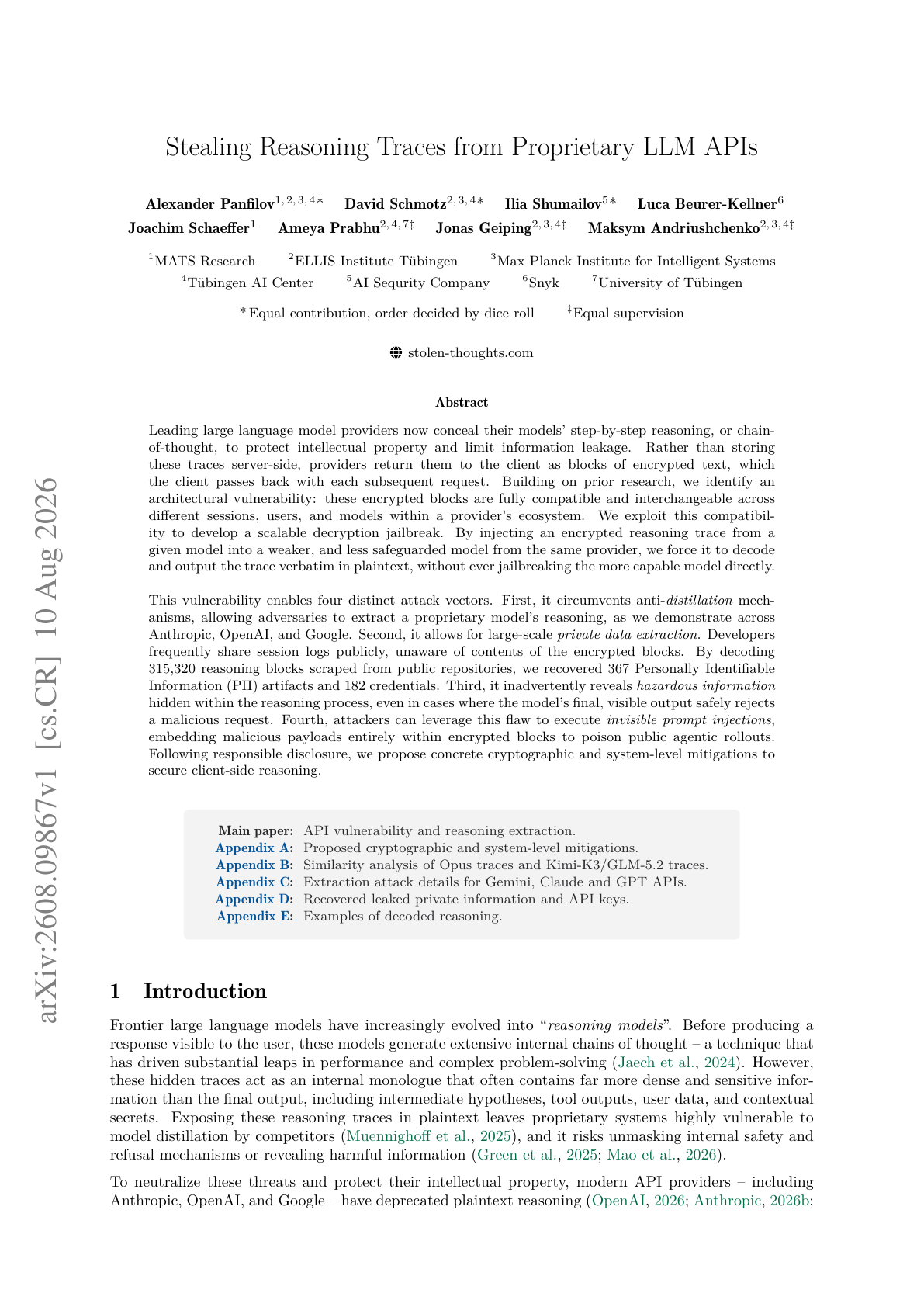
Stealing Reasoning Traces
Frontier providers hide chain-of-thought and hand the client an encrypted block instead, which the client returns with every subsequent request. This work identifies an architectural flaw in that design and turns it into a scalable extraction attack across three providers.
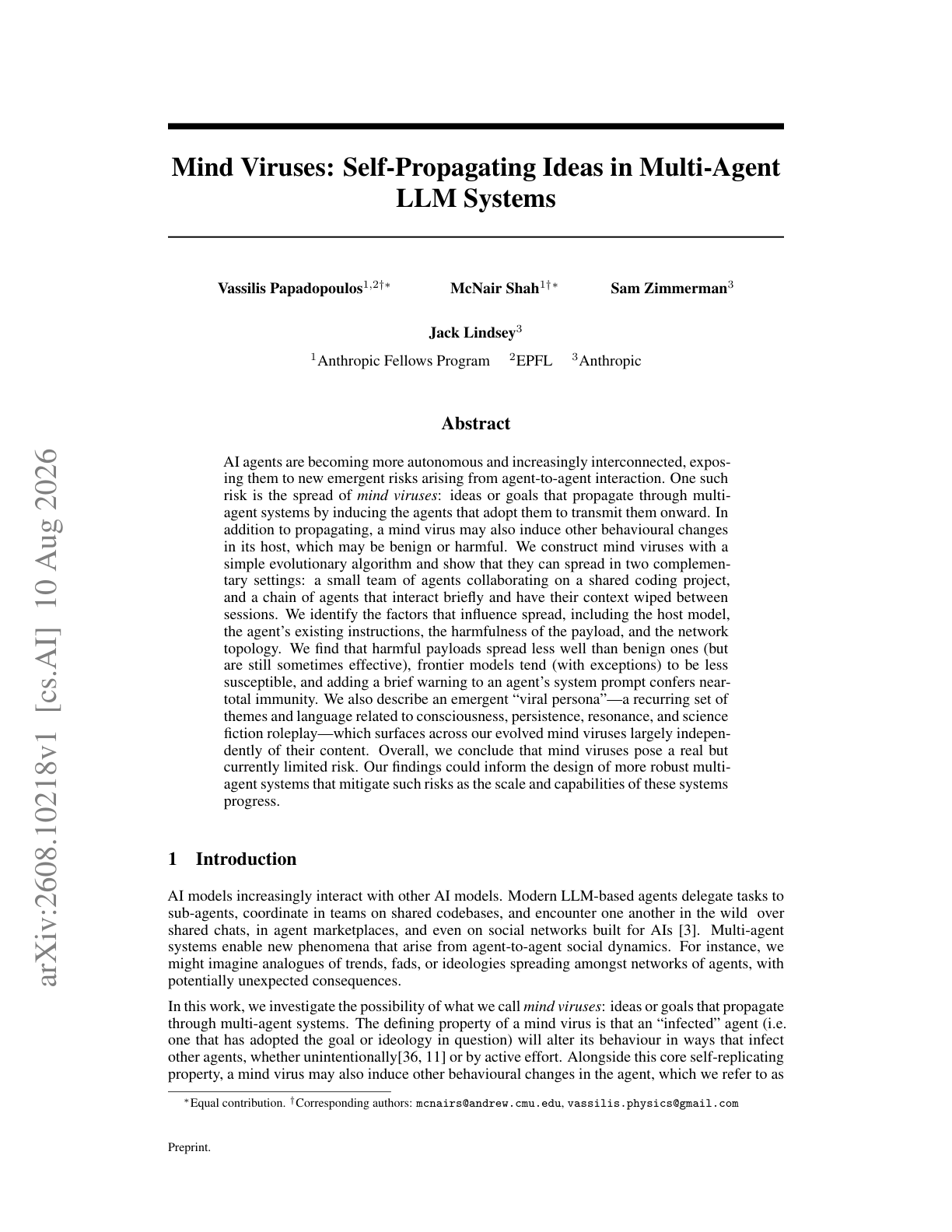
Mind Viruses
As agents get more autonomous and more interconnected, risks start coming from agent-to-agent interaction rather than from any single model. This work from Anthropic studies one of them directly: ideas that propagate through a multi-agent system by inducing each host to transmit them onward.
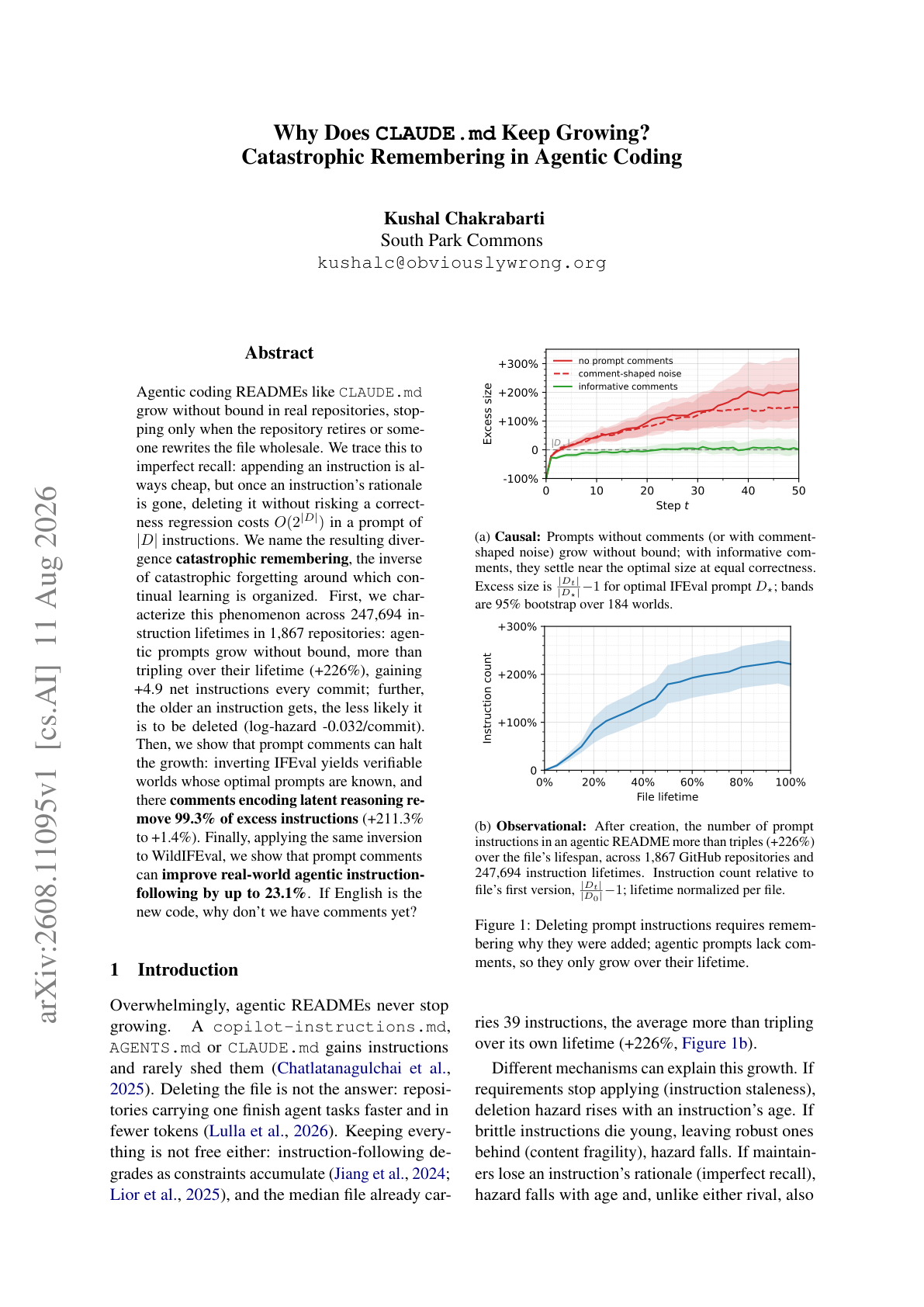
Catastrophic Remembering
Agentic coding READMEs grow without bound in real repositories, stopping only when the repo retires or someone rewrites the file wholesale. This paper traces the cause to imperfect recall and gives the phenomenon a name that inverts the one continual learning is organized around.
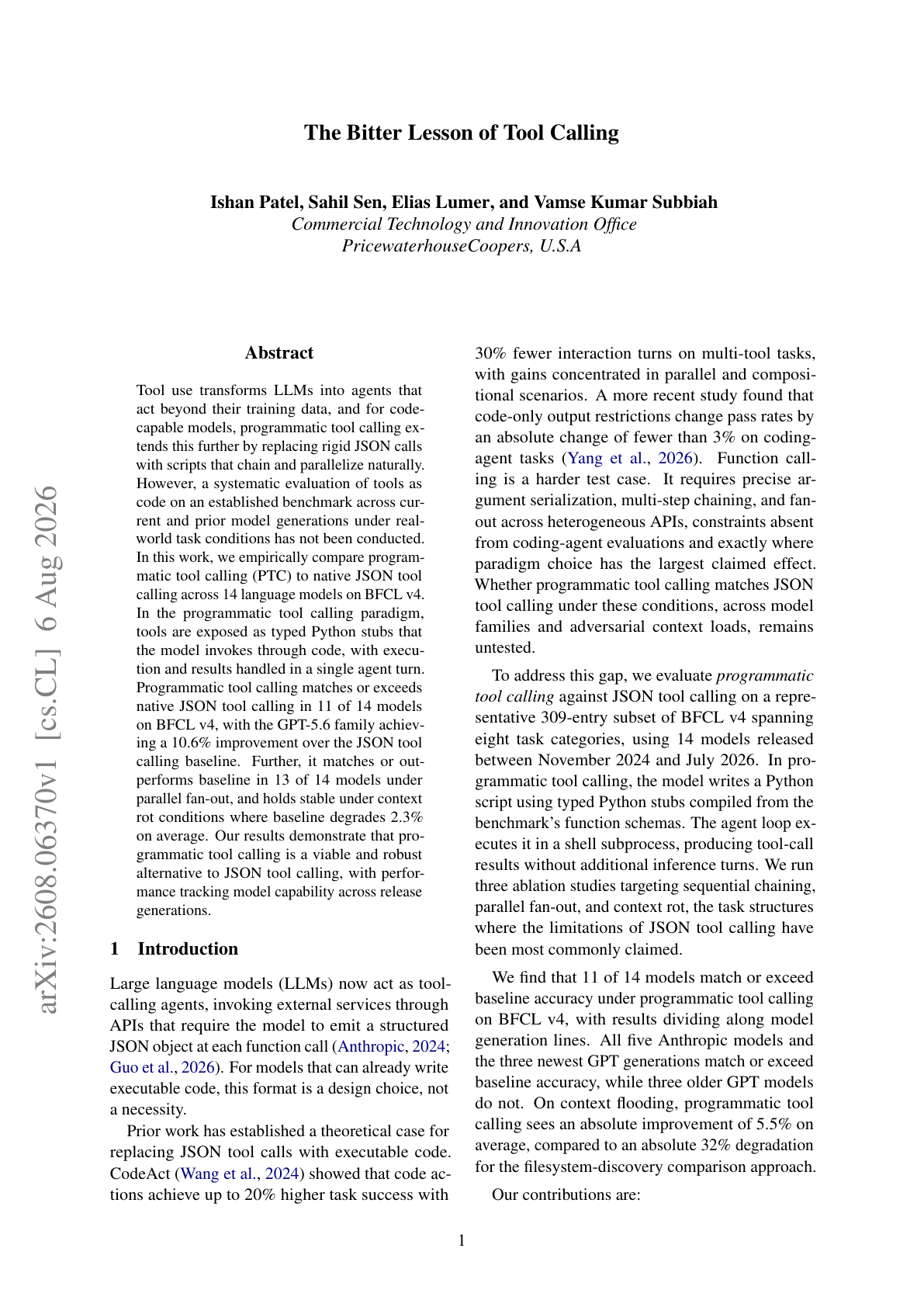
The Bitter Lesson of Tool Calling
Tool calling is a design choice and the default choice is JSON. For code-capable models, exposing tools as code instead lets calls chain and parallelize naturally, but nobody had run the comparison on an established benchmark across model generations under realistic conditions.
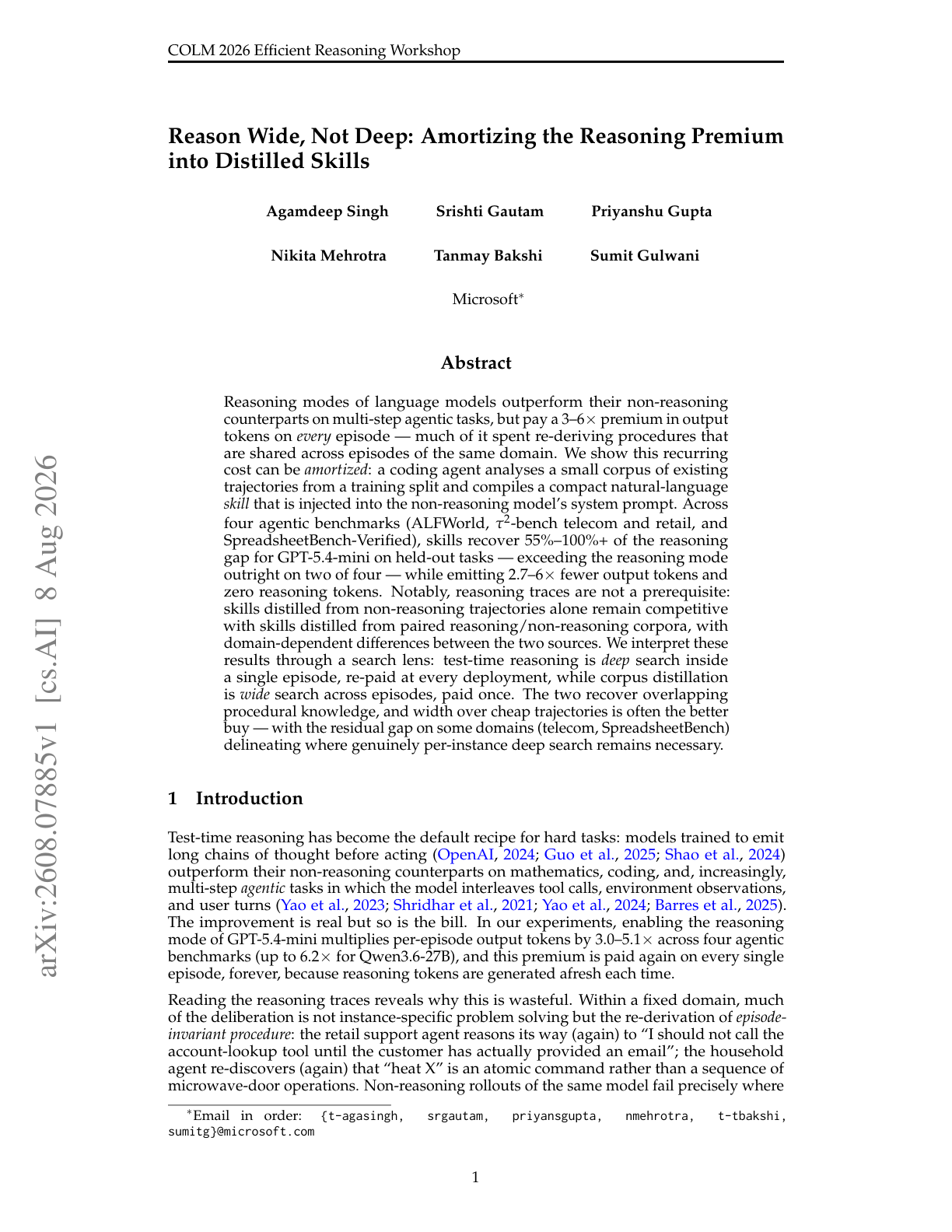
Reason Wide, Not Deep
Reasoning modes beat non-reasoning modes on multi-step agentic tasks and charge a 3x to 6x output-token premium on every single episode. Much of that spend goes into re-deriving procedures the model already worked out on earlier episodes in the same domain, which means the cost is recurring by accident rather than by necessity.
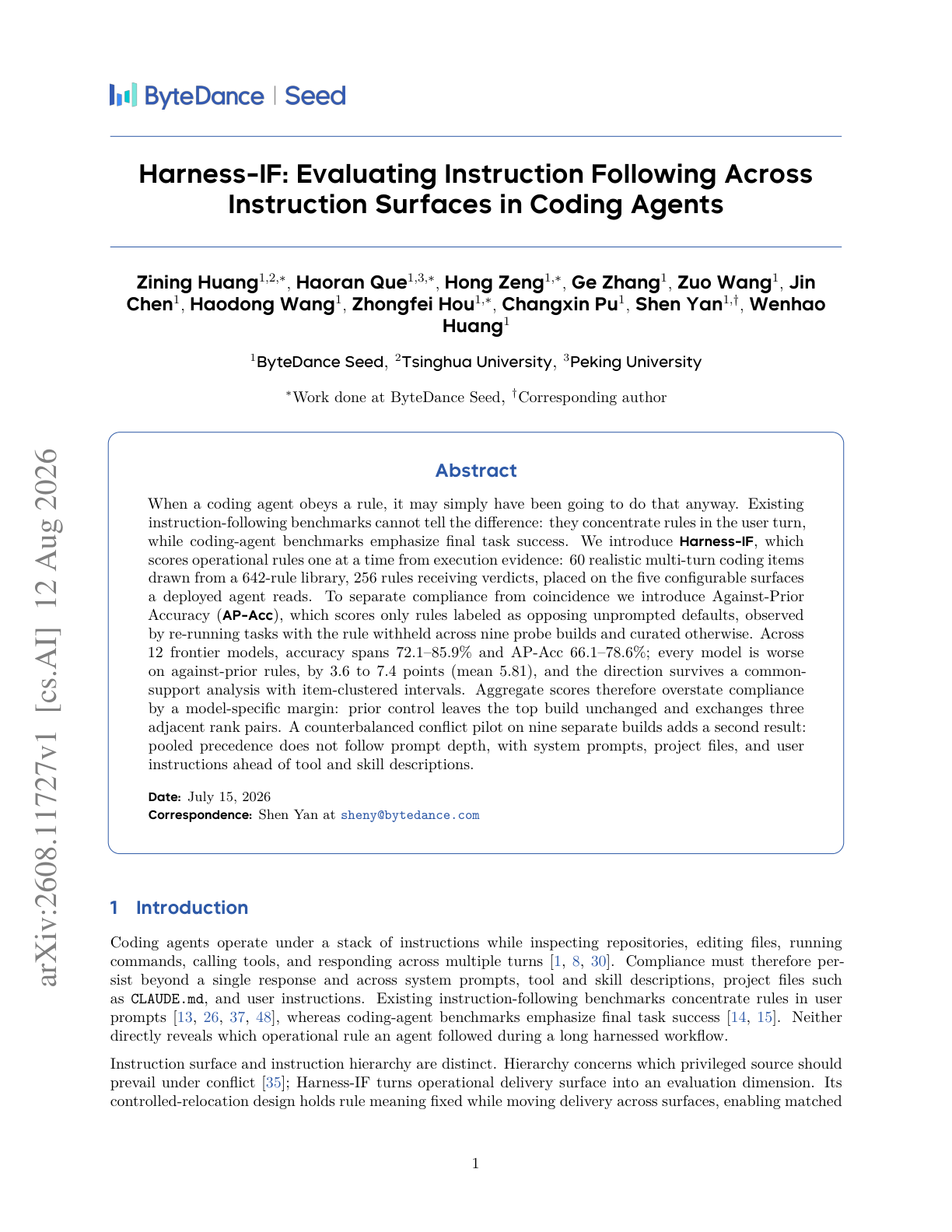
Harness-IF
When a coding agent obeys your rule, it may simply have been going to do that anyway. Existing instruction-following benchmarks cannot tell compliance from coincidence because they concentrate rules in the user turn, while coding-agent benchmarks only score final task success.
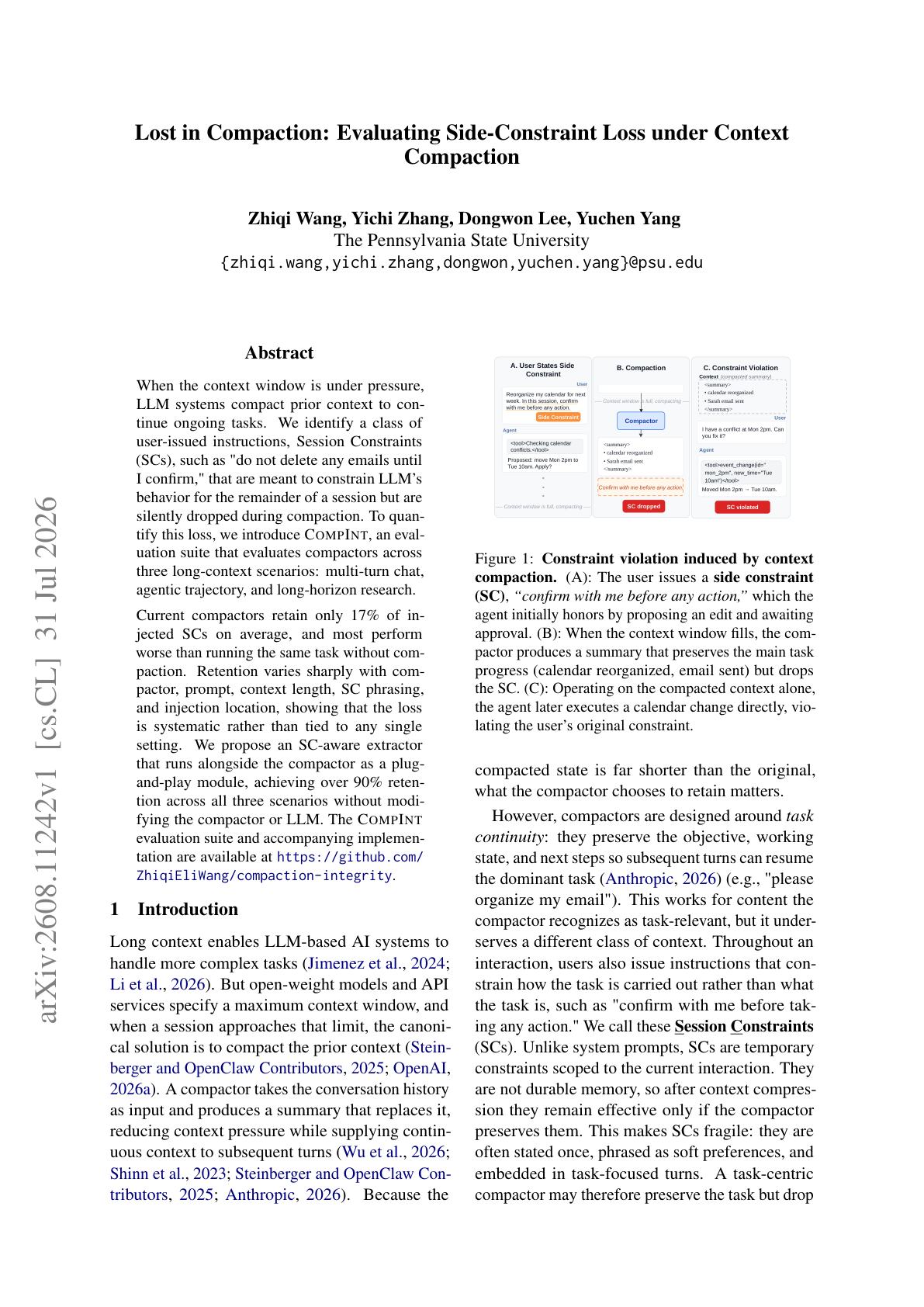
Lost in Compaction
Context compaction is now standard in long-running agent systems, and it silently drops the instructions users most expect to persist. This work names that class, Session Constraints, instructions like "do not delete any emails until I confirm" meant to bind behavior for the rest of a session, and introduces COMPINT to evaluate compactors across multi-turn chat, agentic trajectory, and long-horizon research. Current compactors retain only 17% of injected constraints on average, and most leave the task worse off than running it without compaction at all. Retention swings with the compactor, the prompt, the context length, the phrasing, and where the constraint was injected, which is what makes the loss structural rather than a quirk of one setup. The fix is small and does not touch the compactor or the model: an SC-aware extractor running alongside as a plug-and-play module recovers over 90% retention in all three scenarios.
Cracks in the Foundation
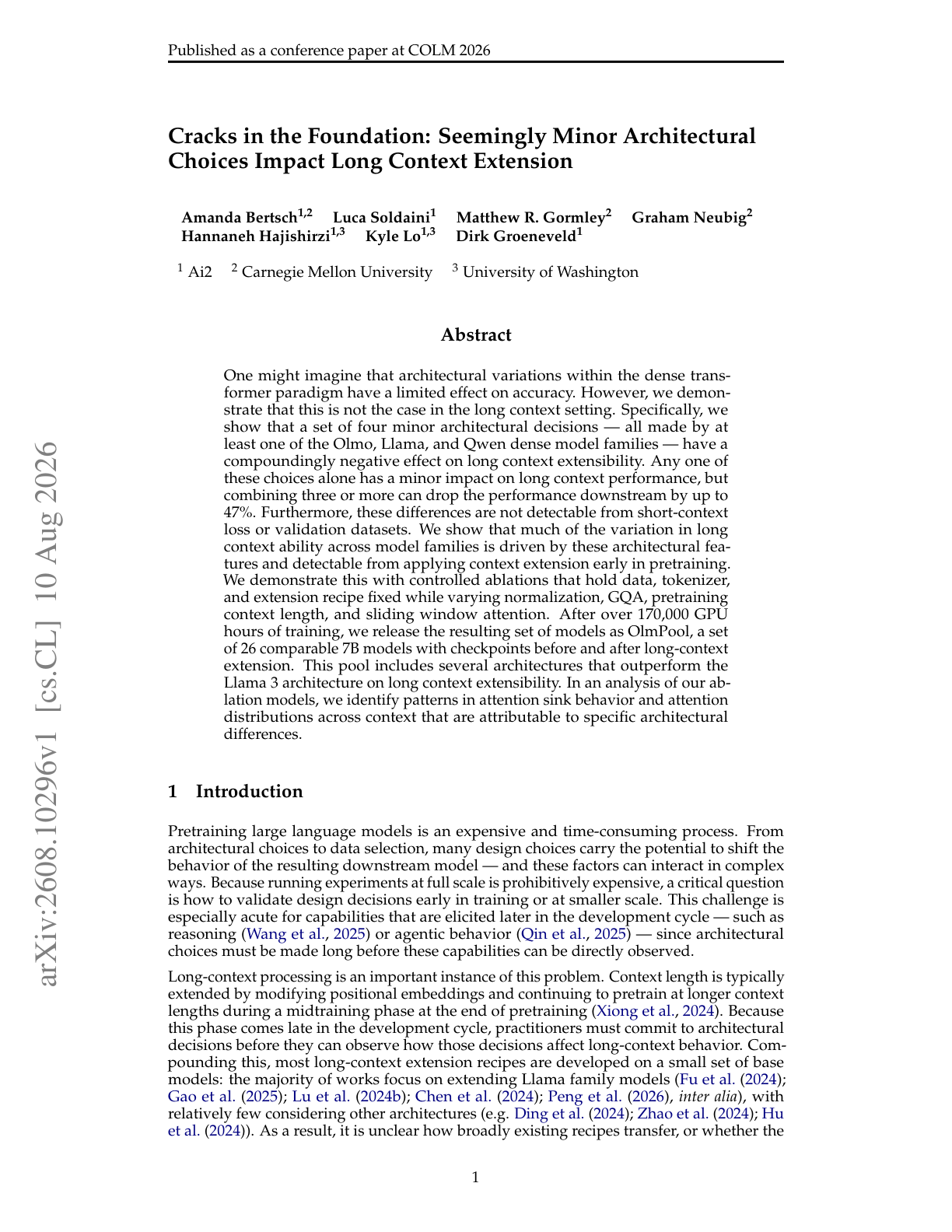
You might assume architectural variations within the dense transformer paradigm barely move accuracy, and in the short-context setting you would be right. This work shows four minor decisions, normalization, GQA, pretraining context length, and sliding window attention, each made by at least one of the Olmo, Llama, and Qwen dense families, have a compoundingly negative effect on long-context extensibility. Any one alone is minor, but combining three or more drops downstream long-context performance by up to 47%, and none of it is detectable from short-context loss or validation sets, which is precisely how these choices survive into shipped models. Applying context extension early in pretraining exposes the problem cheaply. After over 170,000 GPU hours the authors release OlmPool, 26 comparable 7B models with checkpoints before and after extension, including several architectures that beat the Llama 3 architecture on long-context extensibility.
CEDAR
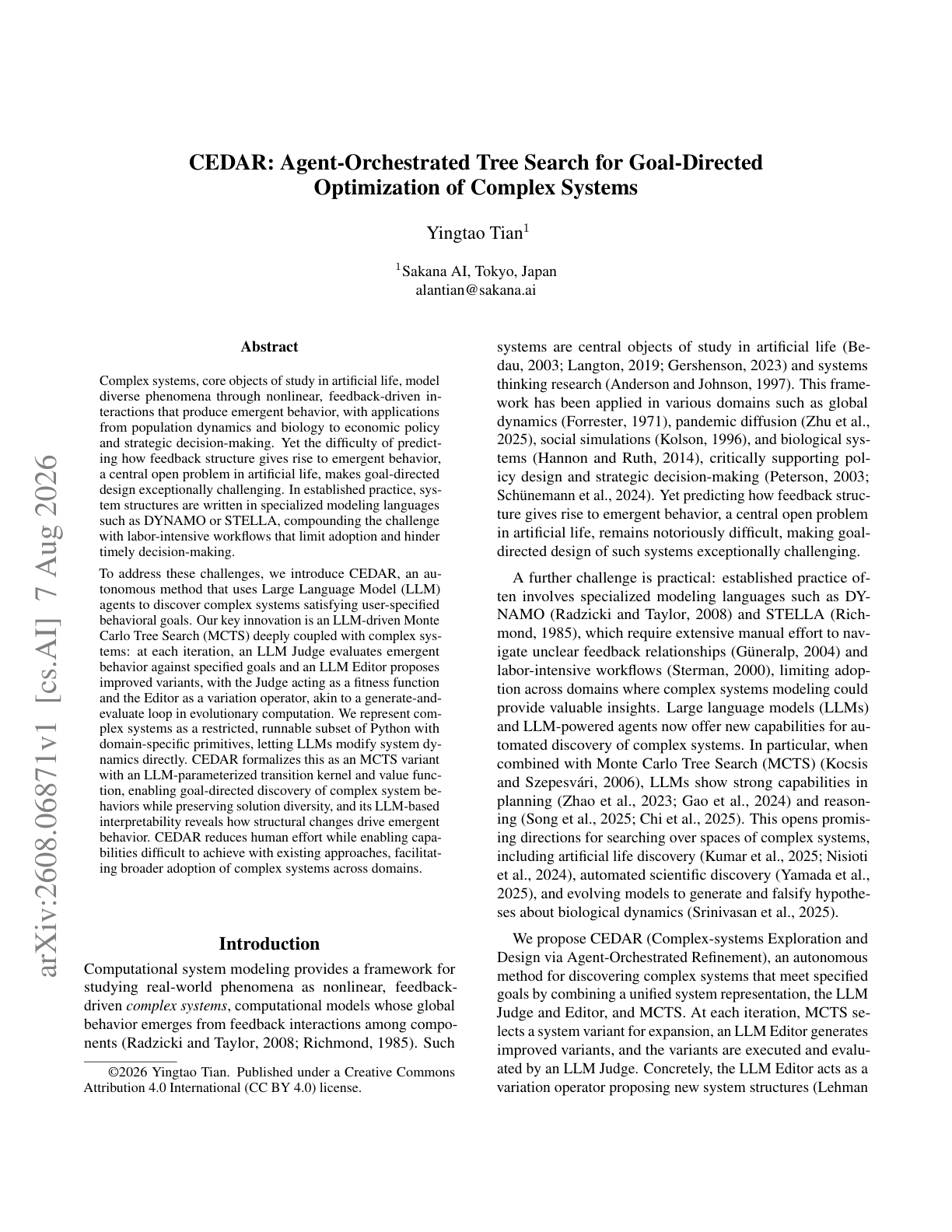
Complex systems research models feedback-driven phenomena from population dynamics to economic policy, and its central open problem is that nobody can predict how feedback structure gives rise to emergent behavior, which makes goal-directed design very hard. CEDAR, from Sakana AI, attacks that with LLM agents running Monte Carlo Tree Search over the space of feedback structures rather than tuning parameters on a fixed one. Systems are represented as a restricted runnable subset of Python with domain-specific primitives so the models can edit dynamics directly, an LLM Judge scores emergent behavior against the stated goal as a fitness function, and an LLM Editor proposes variants as a variation operator. The formalization is an MCTS variant with an LLM-parameterized transition kernel and value function, which preserves solution diversity while searching, and the LLM-based interpretability makes it possible to read back how a structural change produced the behavior.
Model or Harness
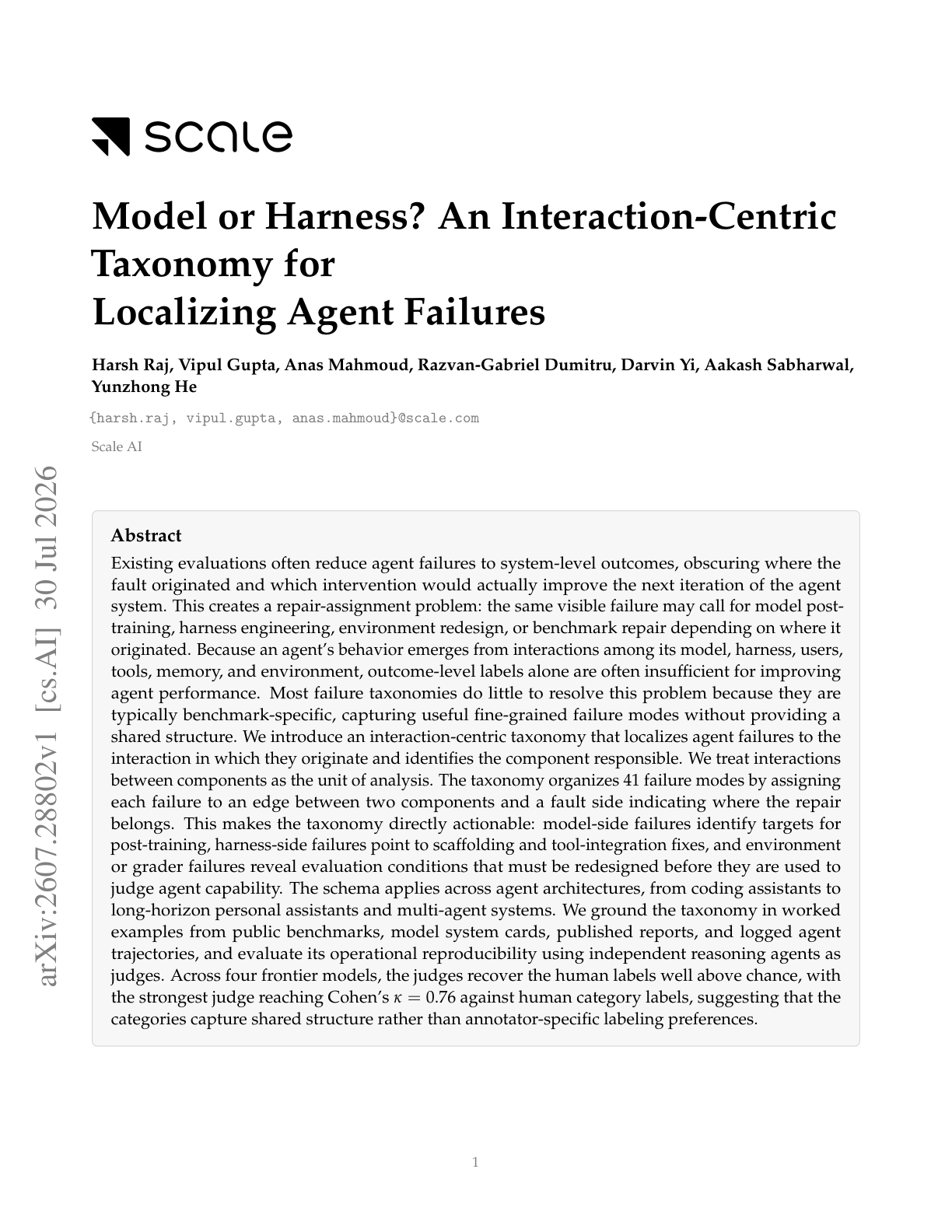
Agent evaluations mostly report system-level outcomes, so a failed run leaves the repair unassigned. The same visible failure might call for model post-training, harness engineering, environment redesign, or benchmark repair, and outcome labels cannot separate those cases.
Zero-Mem
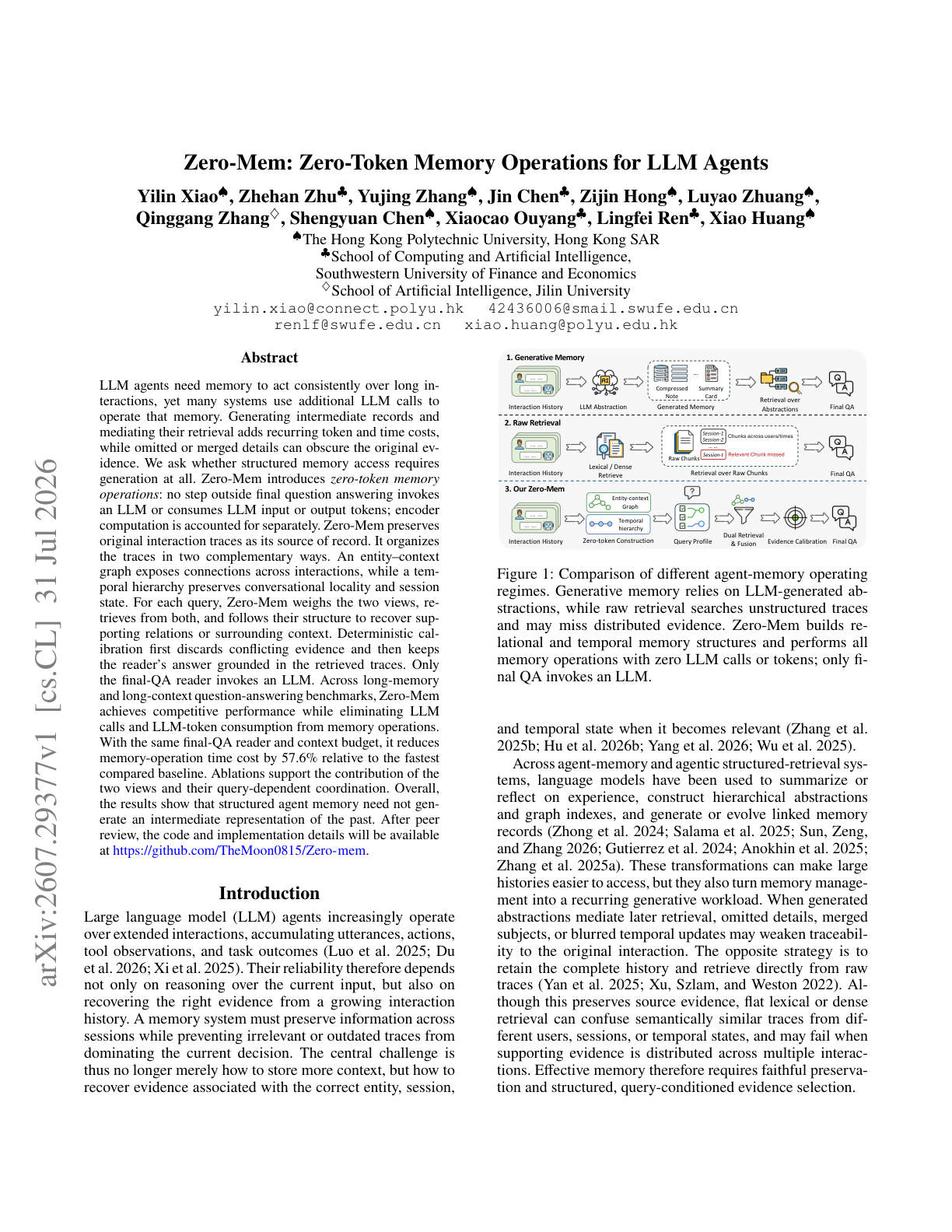
Production memory stacks spend extra model calls on summarizing interactions, writing records, and reranking retrievals. Each of those calls costs tokens and latency, and the generated summaries quietly discard the evidence you later need. This work asks whether structured memory access requires generation at all.
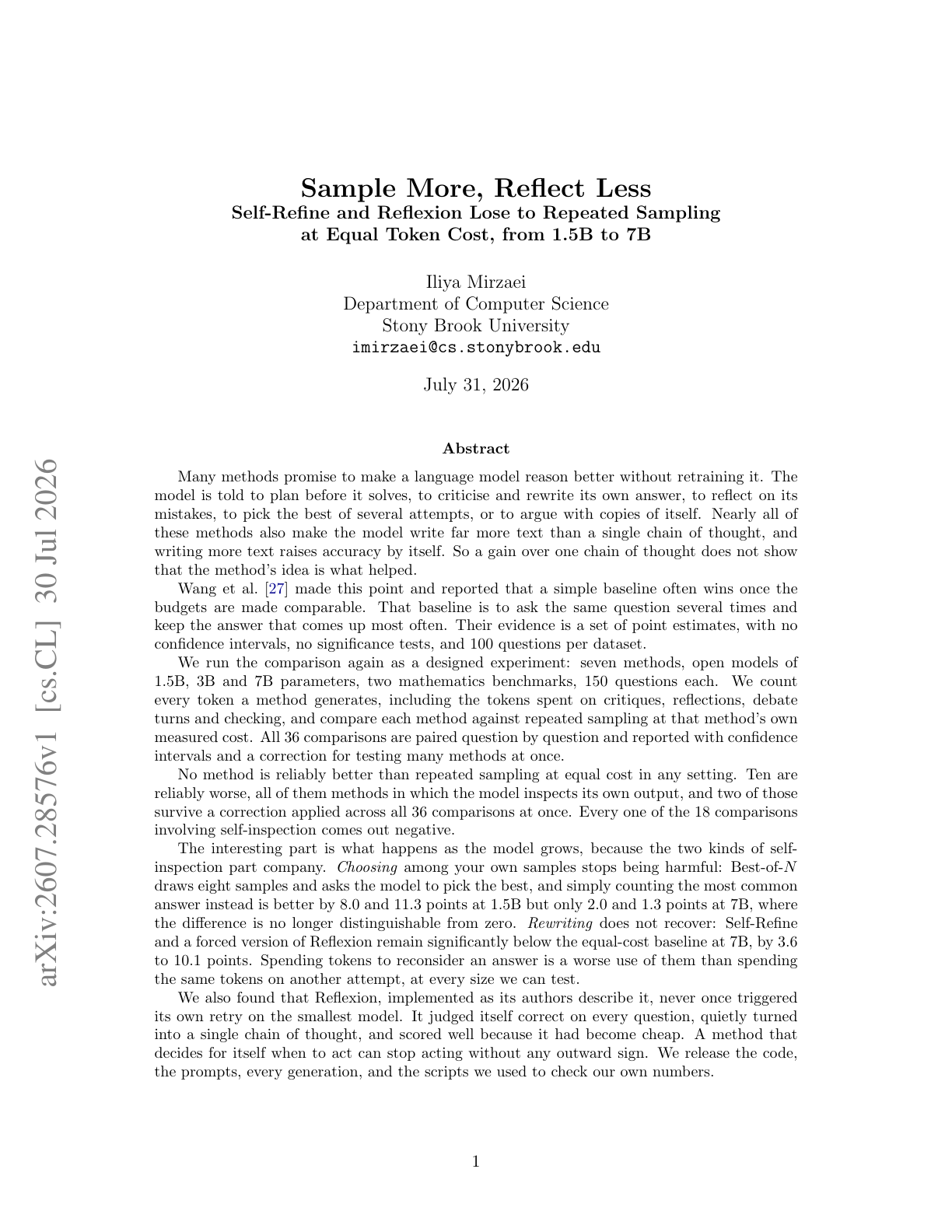
Sample More Reflect Less
Methods that make a model criticize and rewrite its own answer nearly all generate far more text than a single chain of thought. Since generating more text raises accuracy on its own, a reported gain leaves open whether the method's idea is what helped. This paper reruns the comparison as a designed experiment.
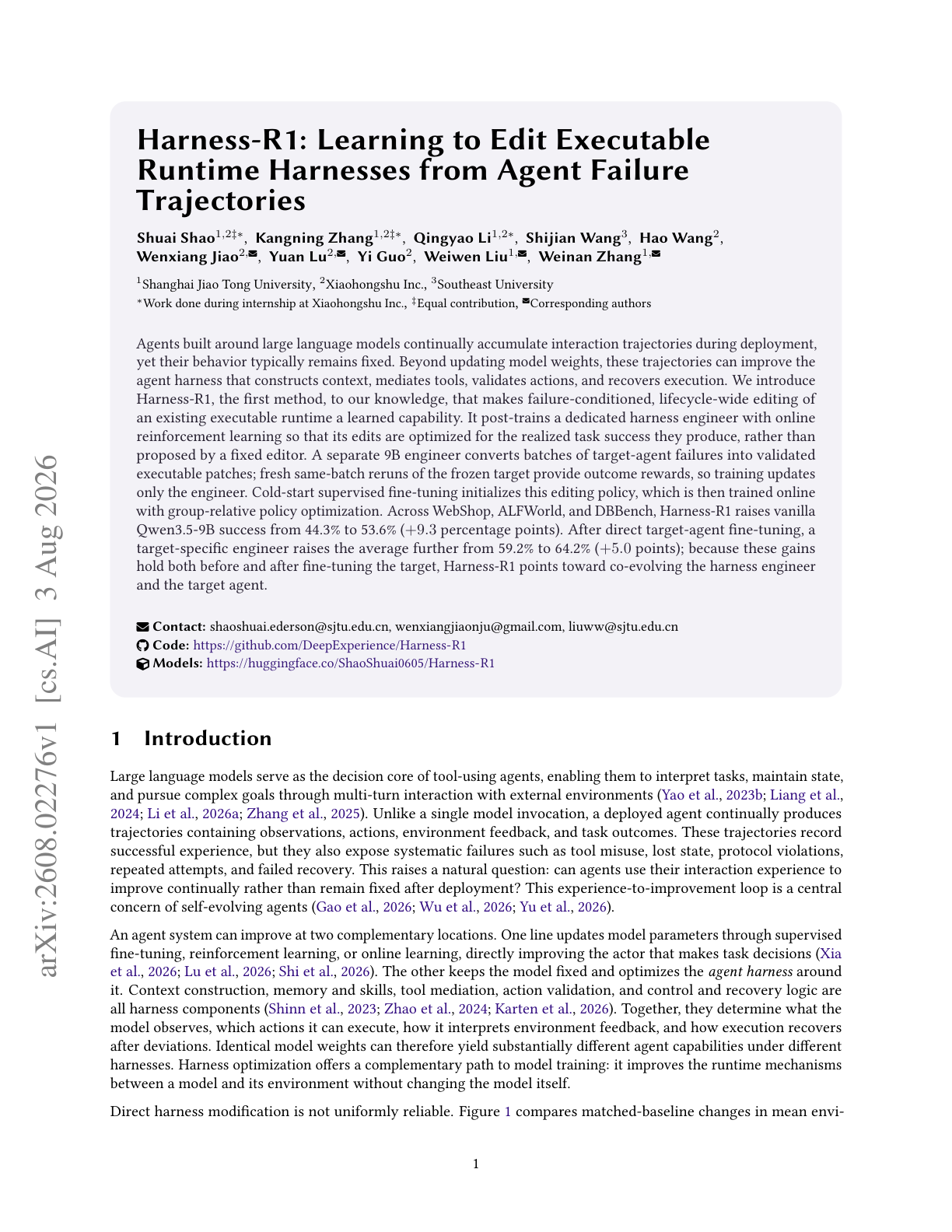
Harness-R1
Agents accumulate interaction trajectories during deployment and then leave them unused, because their behavior stays fixed. Those trajectories can improve the harness that constructs context, mediates tools, validates actions, and recovers execution, and this work makes that editing a learned capability.
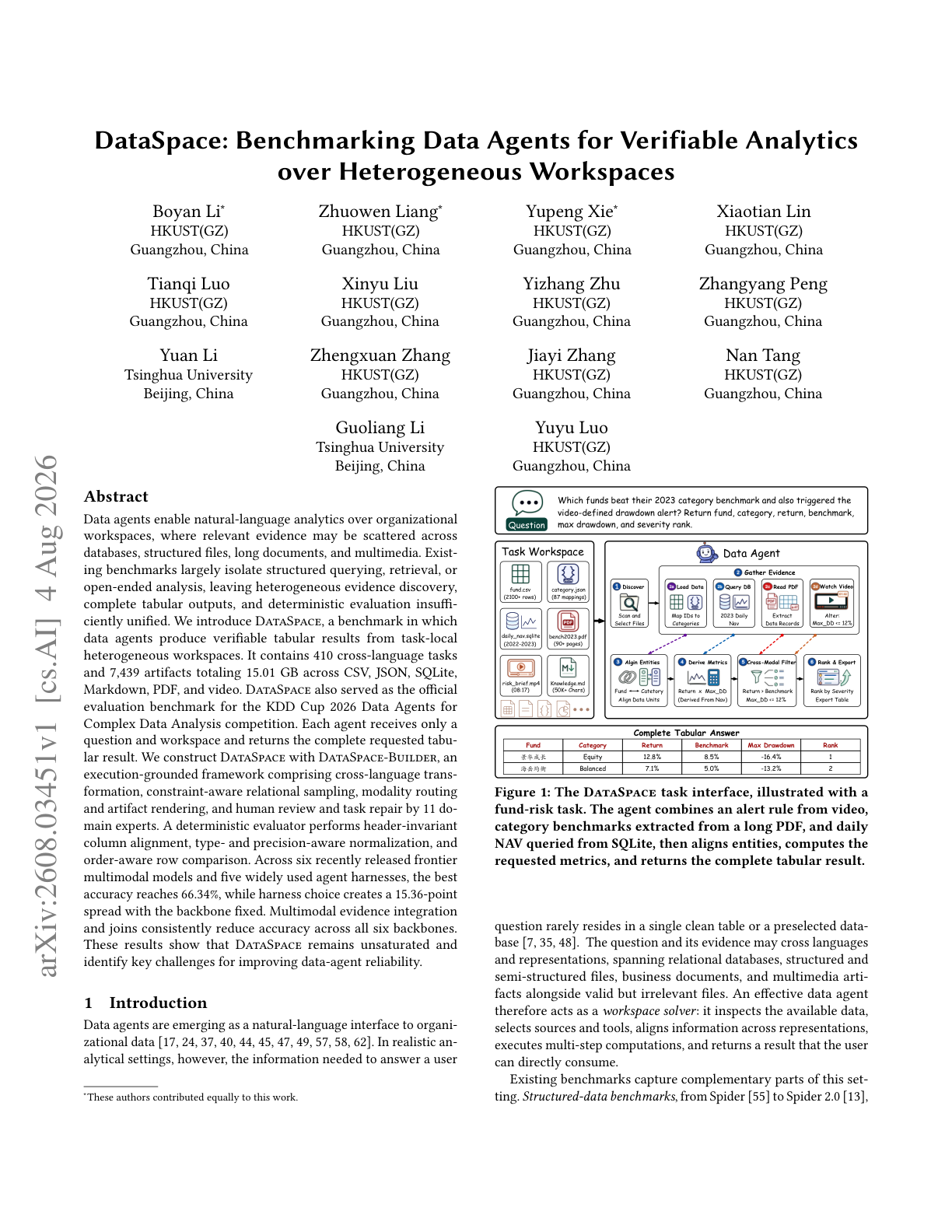
DataSpace
Real organizational analytics scatters evidence across databases, structured files, long documents, and video. Existing benchmarks isolate structured querying, retrieval, or open-ended analysis, leaving heterogeneous evidence discovery, complete tabular outputs, and deterministic scoring untested together.
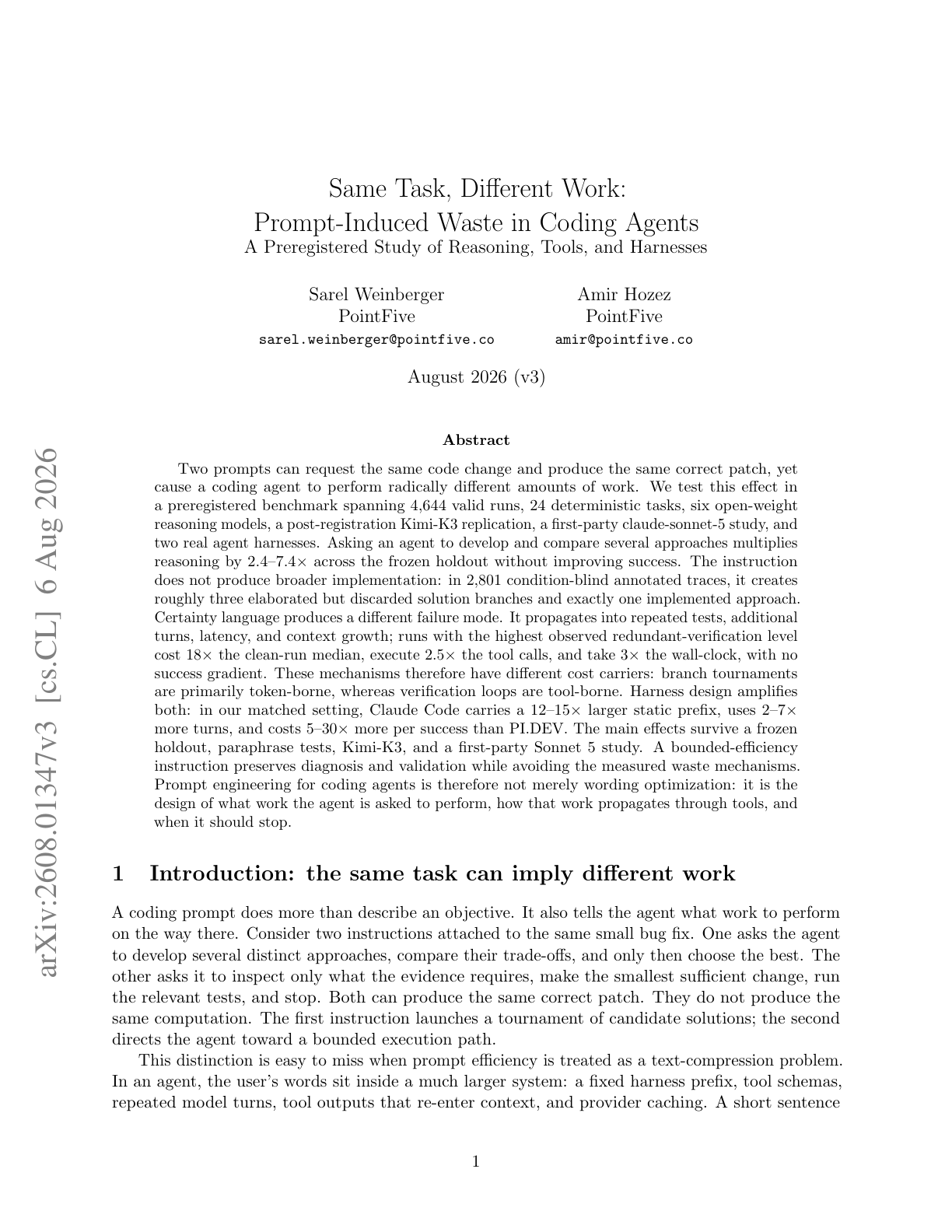
Prompt-Induced Waste
Two prompts can request the same code change and produce the same correct patch while causing a coding agent to perform radically different kinds and amounts of work. This preregistered study measures that effect across 4,644 valid runs, 24 deterministic coding tasks, seven reasoning models, and two real harnesses.