AI Papers of the Week
Every paper worth reading in AI, hand-picked one week at a time.
Discover and explore top AI papers withClaude CodeCodex
npx @dair-ai/mcp setup
High-Value Training Data from Noisy, Diverse Sources
Hedi Driss, Evan Frick, Tijana Zrnic, Andrew Ilyas and colleagues (Hiddenweights, Arena, with UCLA, Stanford and CMU) learn per-example training weights with metagradients through training, targeting a small high-quality dataset, and apply the method to reward models.
What the Trace Shows and What the Label Says: Auditing Behavioral Detectors in Agent Evaluation
Idunnuoluwa Adeniji, Shilpika and Michael Papka (University of Illinois Chicago, Argonne National Laboratory) audit the trace-level detectors that turn agent runs into evaluation labels.
Learning from Next-Frame Prediction: Towards Unified and Scalable Visual Representation Learning
Yifeng Yao, Yang Jin, Kun Xu and colleagues (ByteDance and Peking University, with UNC Chapel Hill) introduce VANE, a visual pretraining method that predicts the embedding of the entire next video frame from past frames.
How Depth Growth and Looping Shape In-Context Learning in Language Models
Ferdinand Kapl (TU Munich, Helmholtz AI) with Kaitlin Maile, Stefan Bauer and Johannes von Oswald (Google Paradigms of Intelligence) show that language models which reuse computation across depth, by growing depth during training or looping a shared block, learn more from context than a dense model of the same depth.
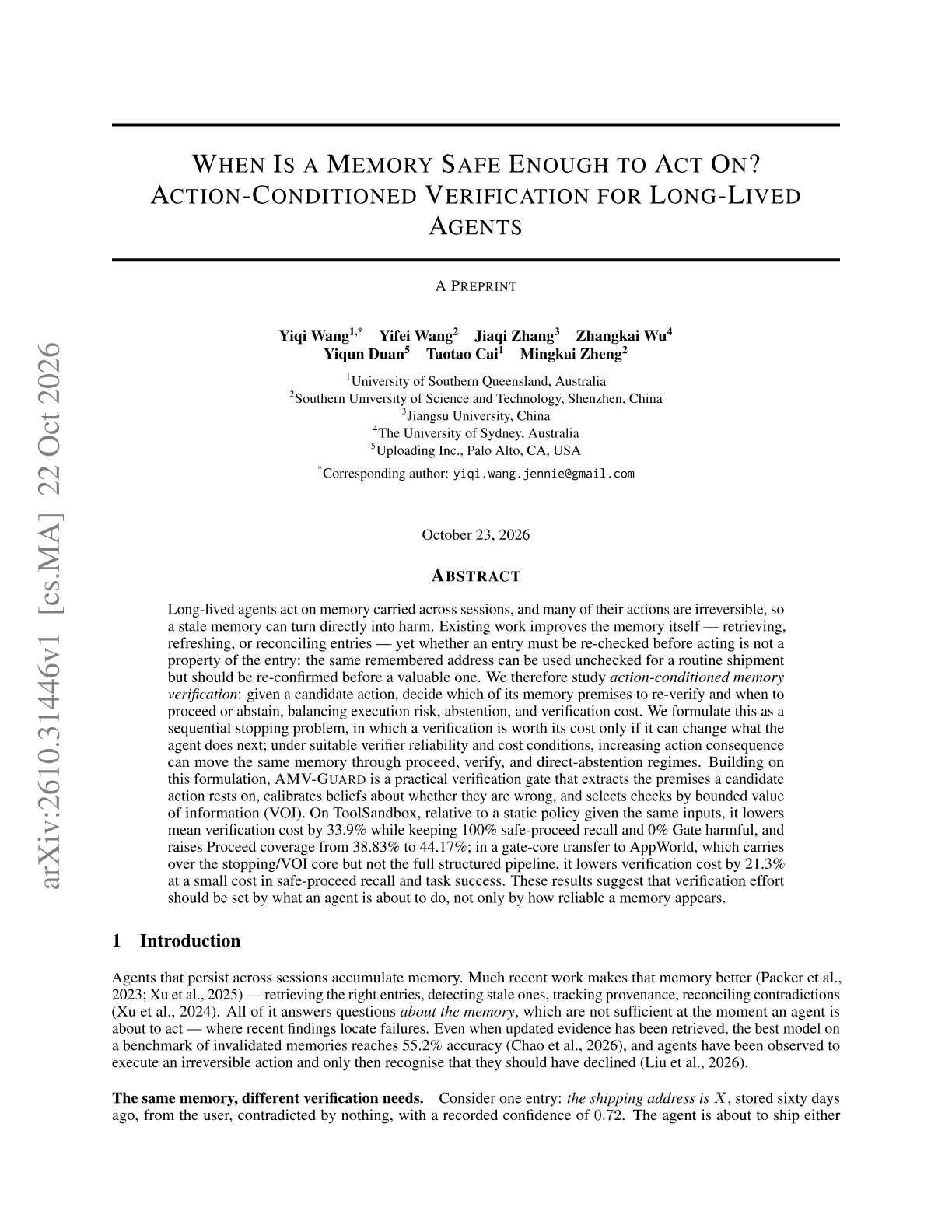
When Is a Memory Safe Enough to Act On? Action-Conditioned Verification for Long-Lived Agents
Yiqi Wang, Mingkai Zheng and colleagues (University of Southern Queensland, SUSTech, University of Sydney and others) argue that whether a remembered fact must be re-checked depends on the action about to be taken, and build AMV-Guard to decide which memory premises to verify.
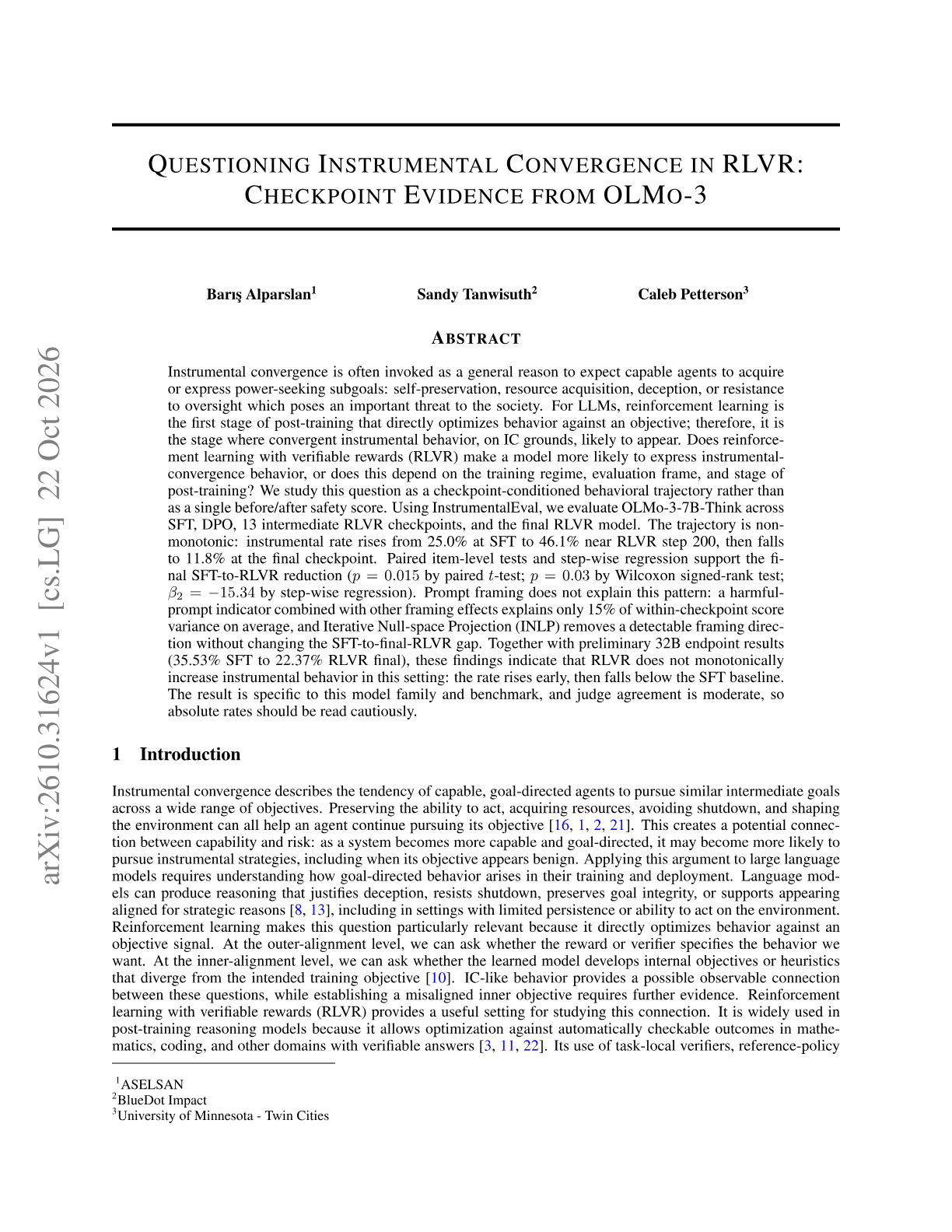
Questioning Instrumental Convergence in RLVR: Checkpoint Evidence from OLMo-3
Baris Alparslan, Sandy Tanwisuth and Caleb Petterson track instrumental-convergence behavior across the post-training checkpoints of OLMo-3-7B-Think and find that RLVR does not increase it monotonically.
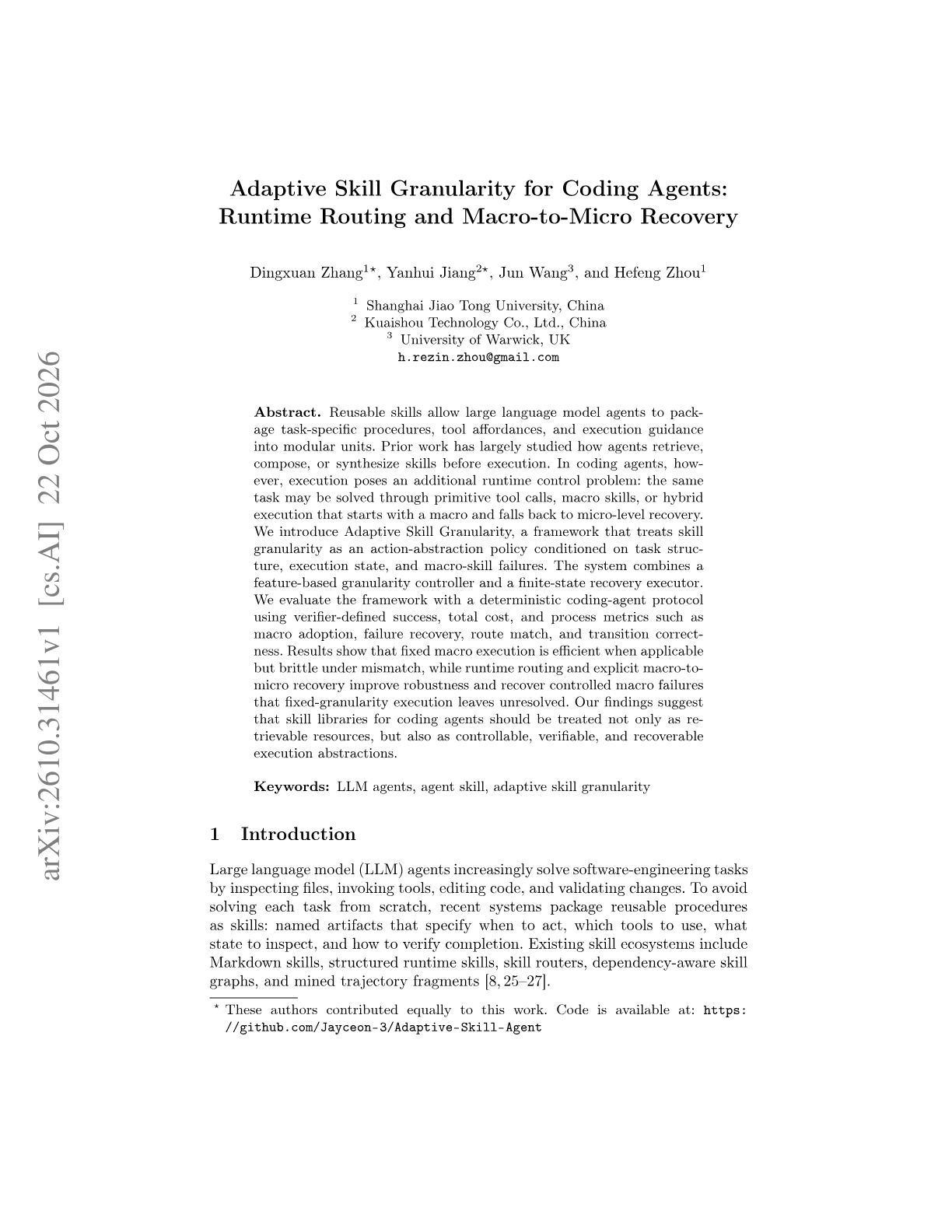
Adaptive Skill Granularity for Coding Agents: Runtime Routing and Macro-to-Micro Recovery
Dingxuan Zhang, Hefeng Zhou and colleagues (Shanghai Jiao Tong University, University of Warwick, Kuaishou) treat skill granularity in coding agents as a runtime policy, choosing between primitive tool calls, macro skills, and macro-then-micro recovery.
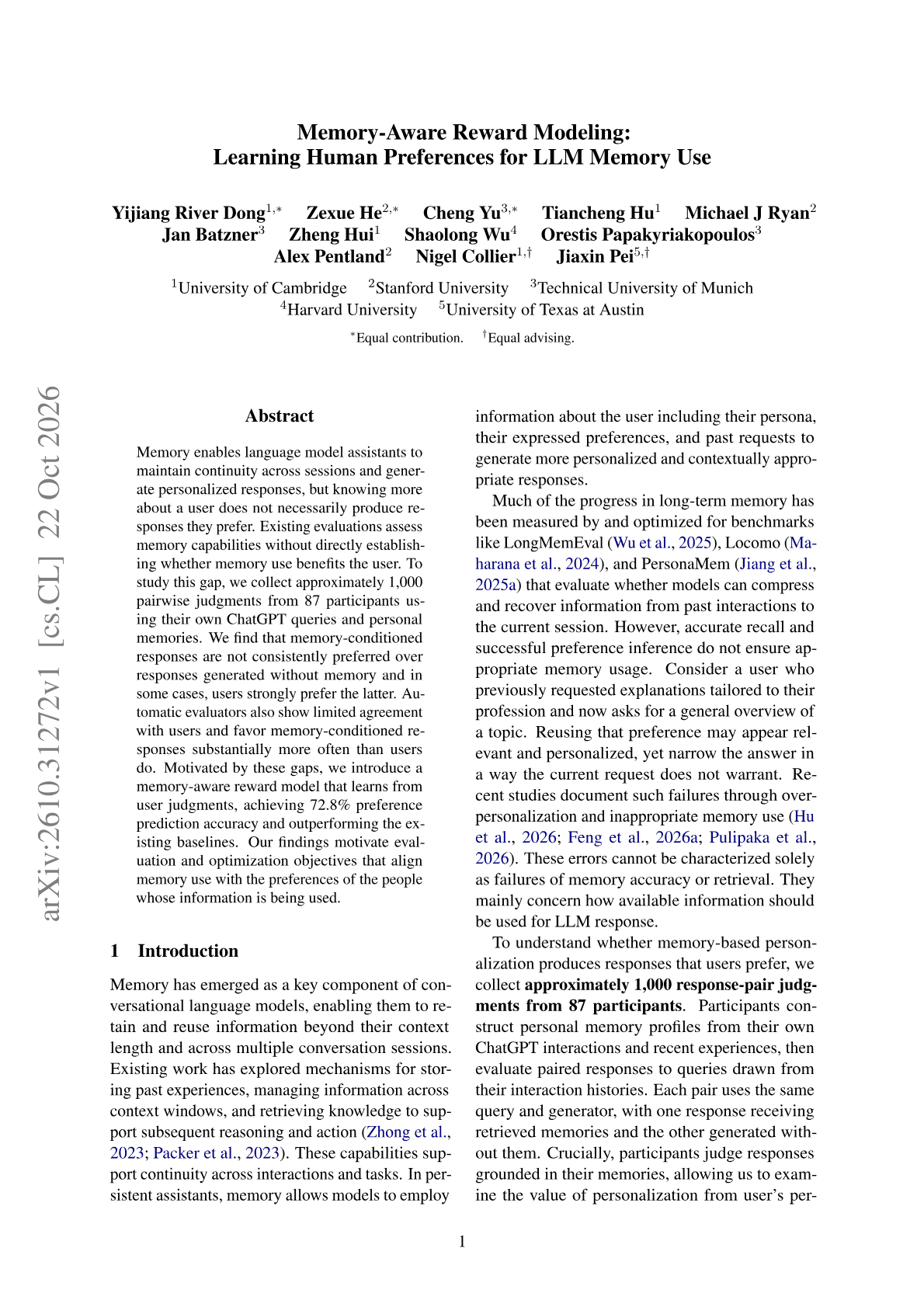
Memory-Aware Reward Modeling: Learning Human Preferences for LLM Memory Use
Yijiang River Dong, Jiaxin Pei and colleagues (Cambridge, Stanford, TUM, Harvard, UT Austin) test whether users actually prefer memory-conditioned assistant responses, using their own ChatGPT queries and memories.
Behind Aggregate Scores: What Systematically Varying Arena-Hard's LLM Judge Reveals
Louise Yorke (University College London) reruns GPT-4.1 as the Arena-Hard v2.0 judge under eight instruction variants and repeated identical settings, and shows that stable aggregate scores hide large changes in individual verdicts.
Model Organisms of Collusion: Corrective Transfer in Untrusted Monitors
Juan-Pablo Rivera, John Hughes and colleagues (Meridian Cambridge, Arb Research, Redwood Research, Georgia Tech) build model organisms of collusion to test whether correcting an untrusted monitor on one caught case removes collusion the control team has not found.
Agent Mosaic: Recognizing Confidentiality Leaks in Agentic LLM Systems
Daniel Ruiz, Luca Luceri and Emilio Ferrara (USC Information Sciences Institute) measure the mosaic effect, where agents combine individually permitted documents into a forbidden sensitive conclusion.
Detecting AI Training in Datacentre Power
Tom Kimpson, Mauricio Baker and Emlyn Graham (University of Melbourne, University of Oxford, MATS) show that facility-level power metering can detect large training runs on a monitored cluster without trusting the operator, by tracking the iteration cadence of synchronous training.
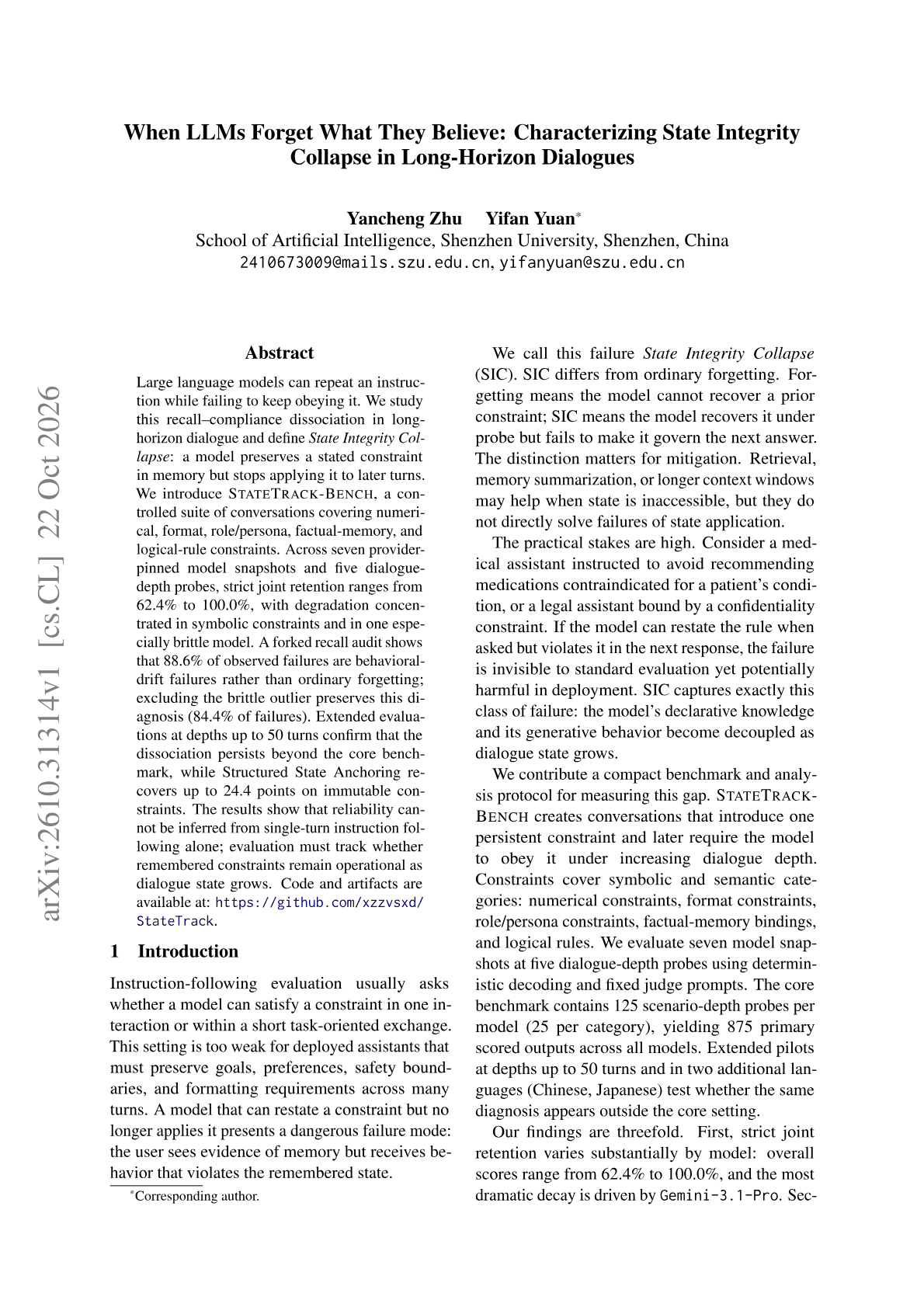
When LLMs Forget What They Believe: Characterizing State Integrity Collapse in Long-Horizon Dialogues
Yancheng Zhu and Yifan Yuan (Shenzhen University) define State Integrity Collapse, where a model can still recall a constraint from earlier in a dialogue but stops applying it, and measure it with StateTrack-Bench (EMNLP 2026 Main).
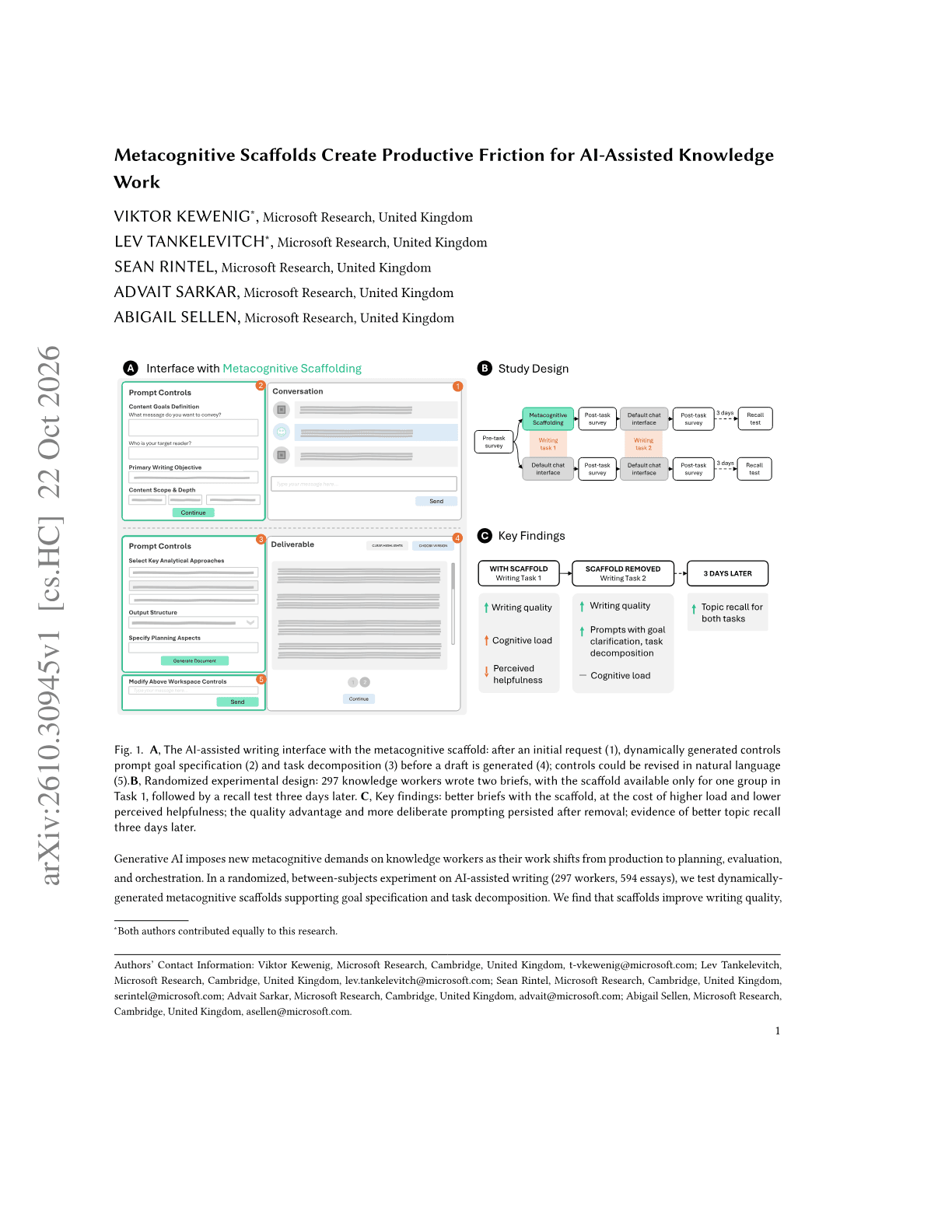
Metacognitive Scaffolds Create Productive Friction for AI-Assisted Knowledge Work
Viktor Kewenig, Lev Tankelevitch, Sean Rintel, Advait Sarkar and Abigail Sellen (Microsoft Research Cambridge) run a randomized experiment showing that AI-generated metacognitive scaffolds improve AI-assisted writing while users rate the AI as less helpful.
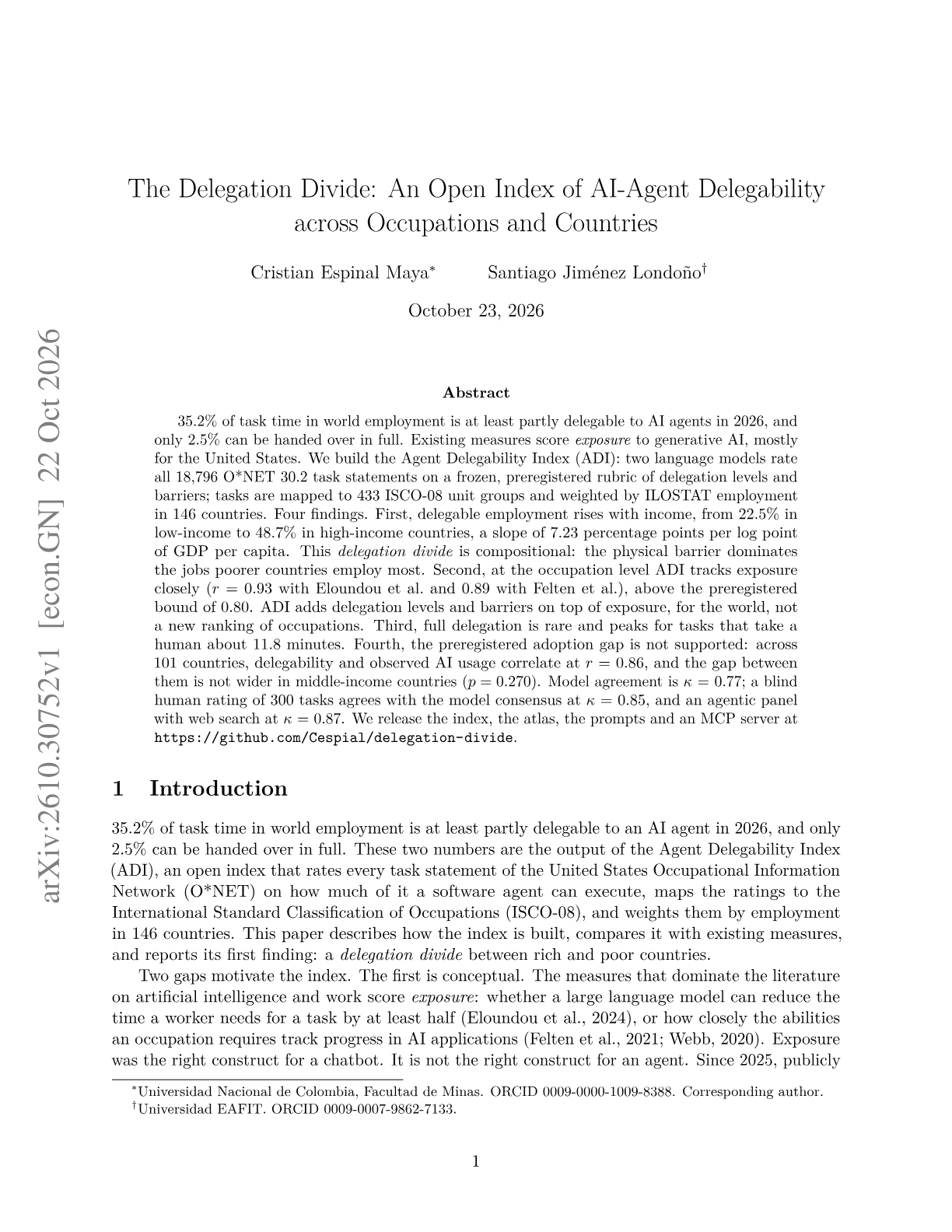
The Delegation Divide: An Open Index of AI-Agent Delegability across Occupations and Countries
Cristian Espinal Maya and Santiago Jimenez Londono (Universidad Nacional de Colombia, Universidad EAFIT) build a preregistered Agent Delegability Index for every O*NET task and estimate that 35.2% of world task time is at least partly delegable to AI agents in 2026, with 2.5% fully delegable.
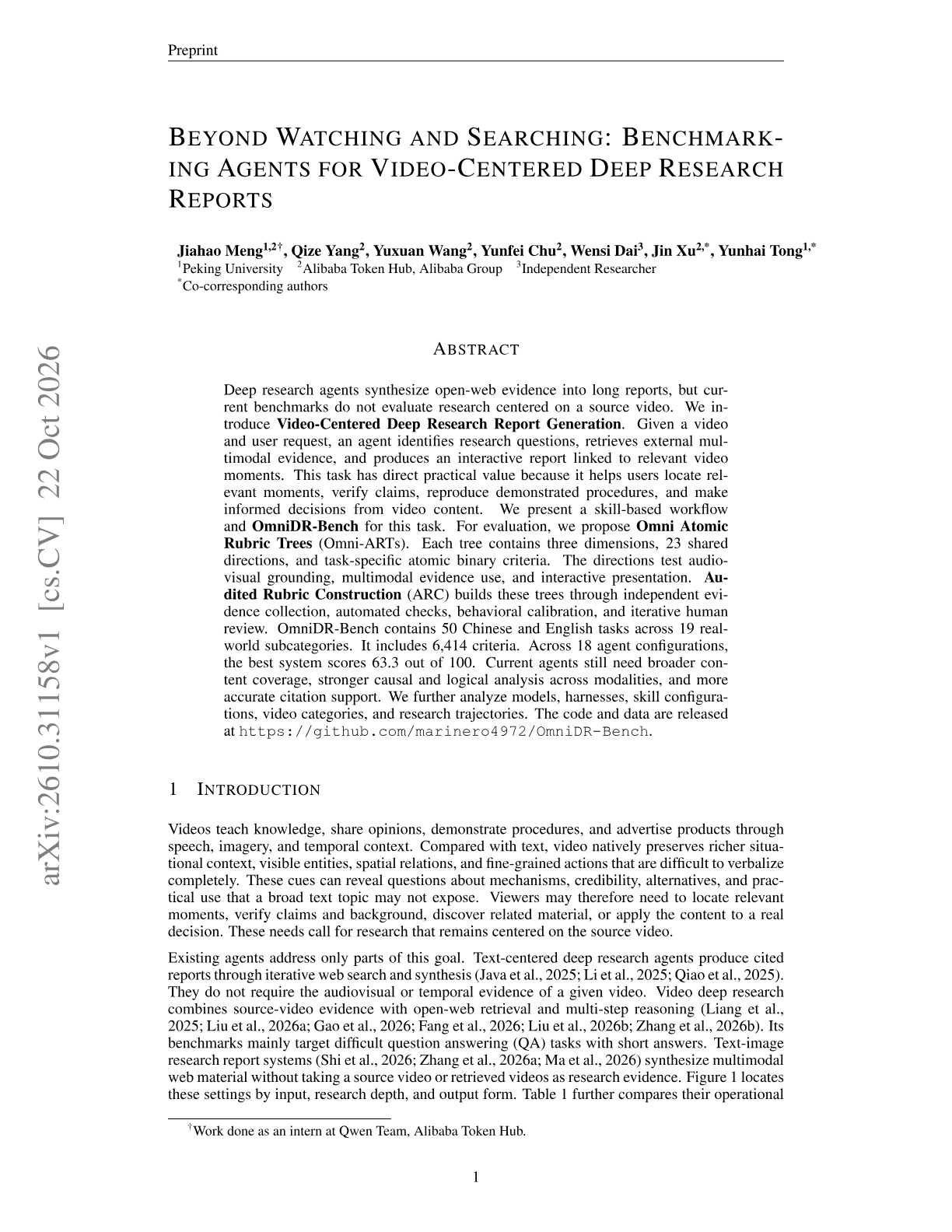
Beyond Watching and Searching: Benchmarking Agents for Video-centered Deep Research Reports
Jiahao Meng, Jin Xu and colleagues (Peking University, Alibaba) define video-centered deep research report generation and release OmniDR-Bench with rubric-tree evaluation.
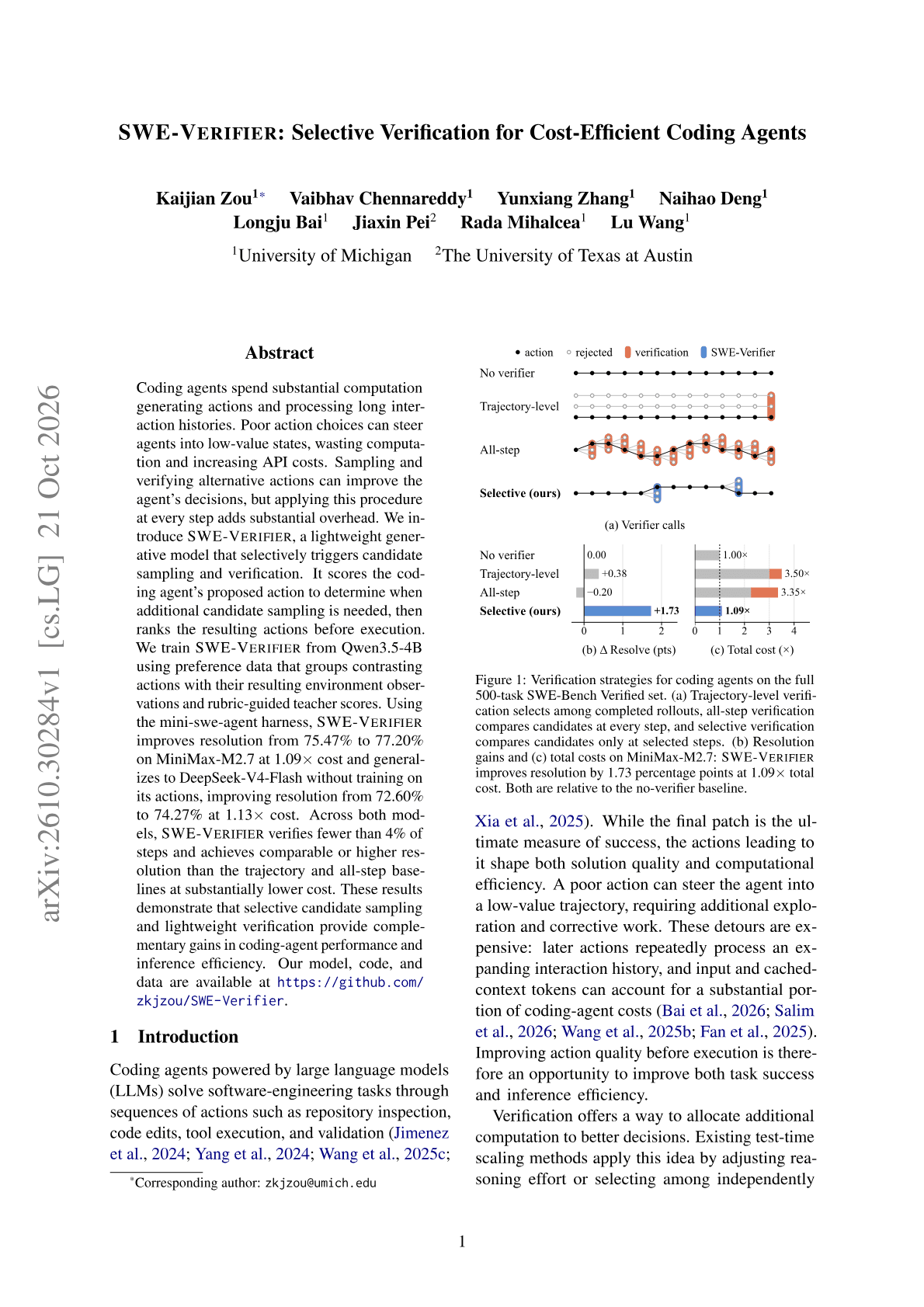
SWE-VERIFIER: Selective Verification for Cost-Efficient Coding Agents
Kaijian Zou, Lu Wang and colleagues (University of Michigan, UT Austin) train SWE-Verifier, a 4B model that decides when a coding agent's proposed step needs extra candidate sampling and then ranks the candidates.
Self-Assessment Reinforcement Learning for Search-State Awareness in Retrieval-Augmented Large Language Models
Taewhoo Lee, Jaewoo Kang and colleagues (Amazon and Korea University, with AIGEN Sciences and UMass Amherst) train search agents to track what they have found and what is still missing, using Self-Assessment Reinforcement Learning (SARL).
Agentic Knowledge-Model Co-Evolution via Consistency Regularization
Sirui Chen, Jingrui He and Zheng Li (UIUC, Georgia Tech, Amazon) introduce SPLICE, which keeps only the knowledge extracted from agent experience whose utility gain holds across several different ways of analyzing the same experience, and interleaves that with model training.
RIFT: KV Cache Compression for Draft Models with Complementary Compressibility Training
Dor Tsur, Ran Zilberstein and colleagues (NVIDIA) show that KV-cache compression tuned for the prompt makes draft models worse as outputs grow, and introduce RIFT, which refreshes the cache selection during generation and trains the drafter to tolerate compression.
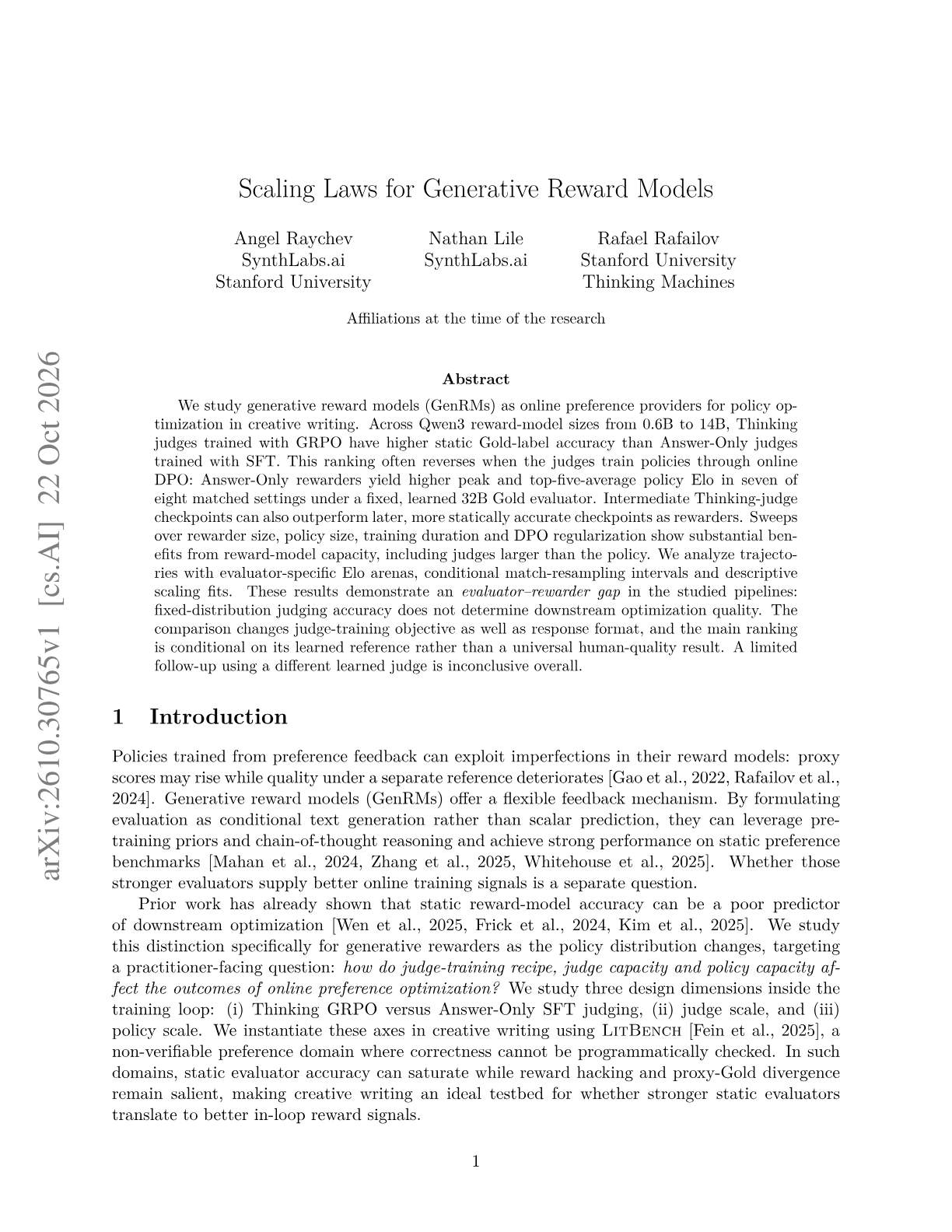
Scaling Laws for Generative Reward Models
Angel Raychev, Nathan Lile and Rafael Rafailov (SynthLabs, Stanford, Thinking Machines) study generative reward models as online preference providers for creative writing and find that the judge with the best static accuracy is often not the best rewarder.
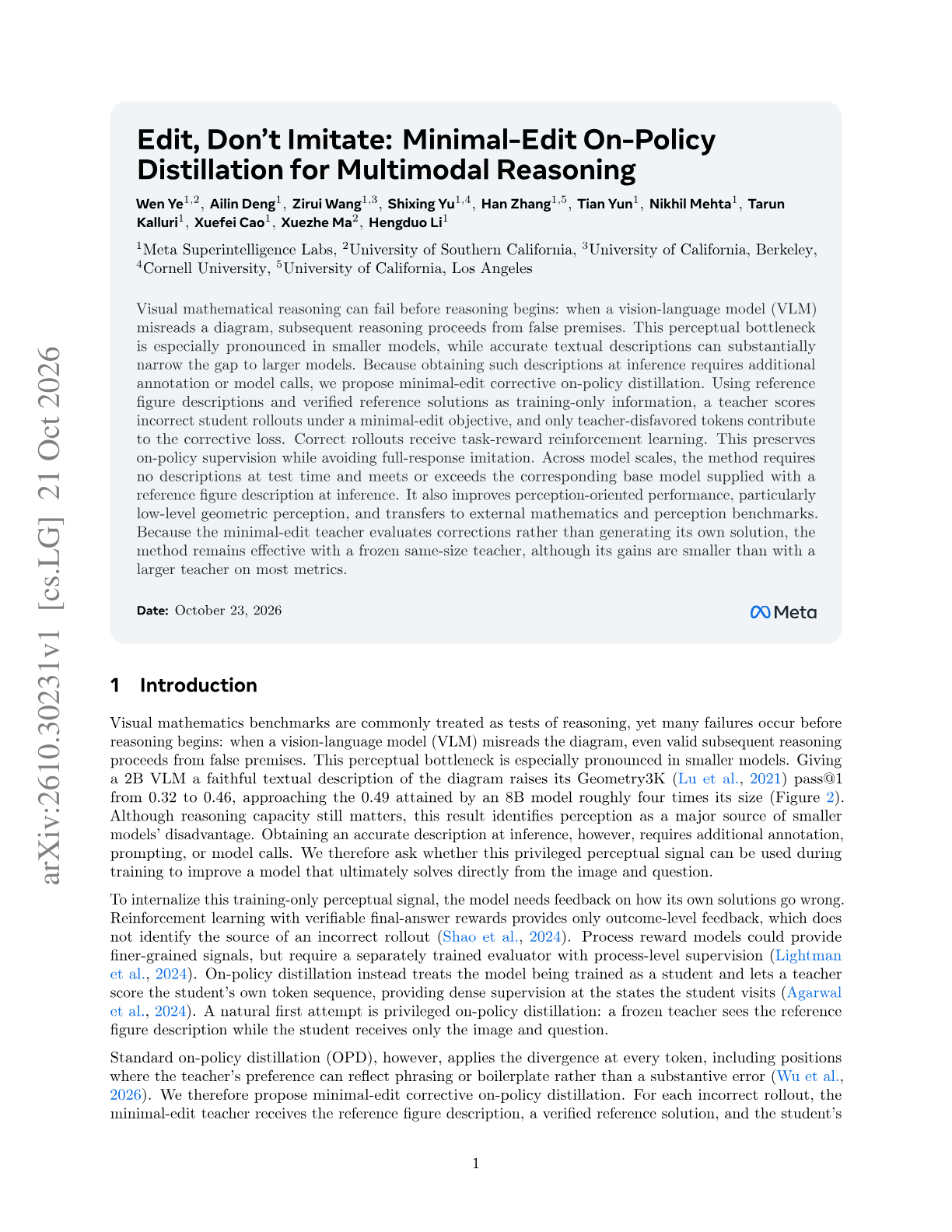
Edit, Don't Imitate: Minimal-Edit On-Policy Distillation for Multimodal Reasoning
Wen Ye, Ailin Deng, Hengduo Li and colleagues (Meta Superintelligence Labs, with USC, UC Berkeley and Cornell) train small vision-language models to stop misreading diagrams with minimal-edit corrective on-policy distillation, which uses reference figure descriptions only during training.
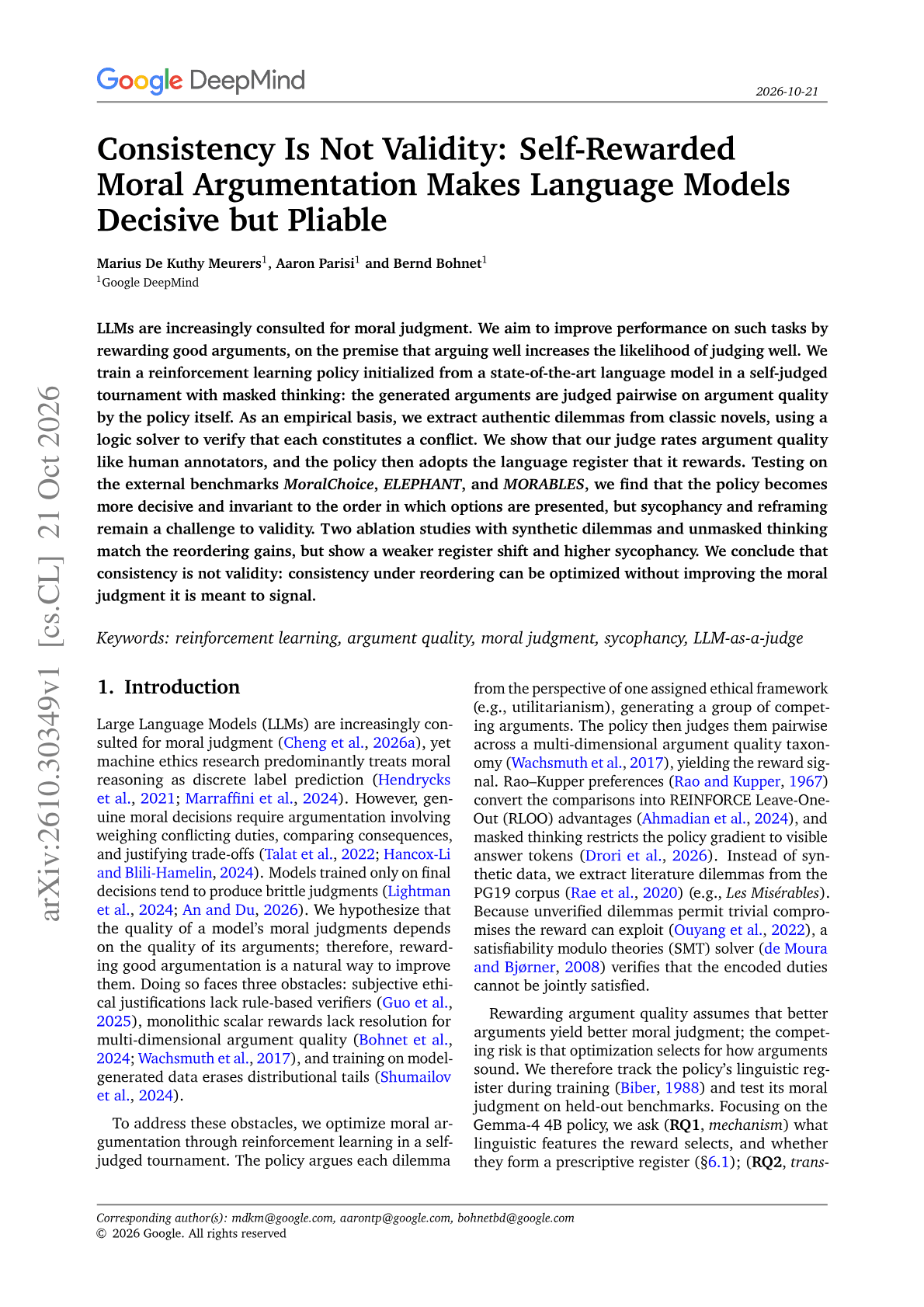
Consistency Is Not Validity: Self-Rewarded Moral Argumentation Makes Language Models Decisive but Pliable
Marius De Kuthy Meurers, Aaron Parisi and Bernd Bohnet (Google DeepMind) train a policy by self-judged argument tournaments on moral dilemmas and find it becomes more consistent without becoming more valid.
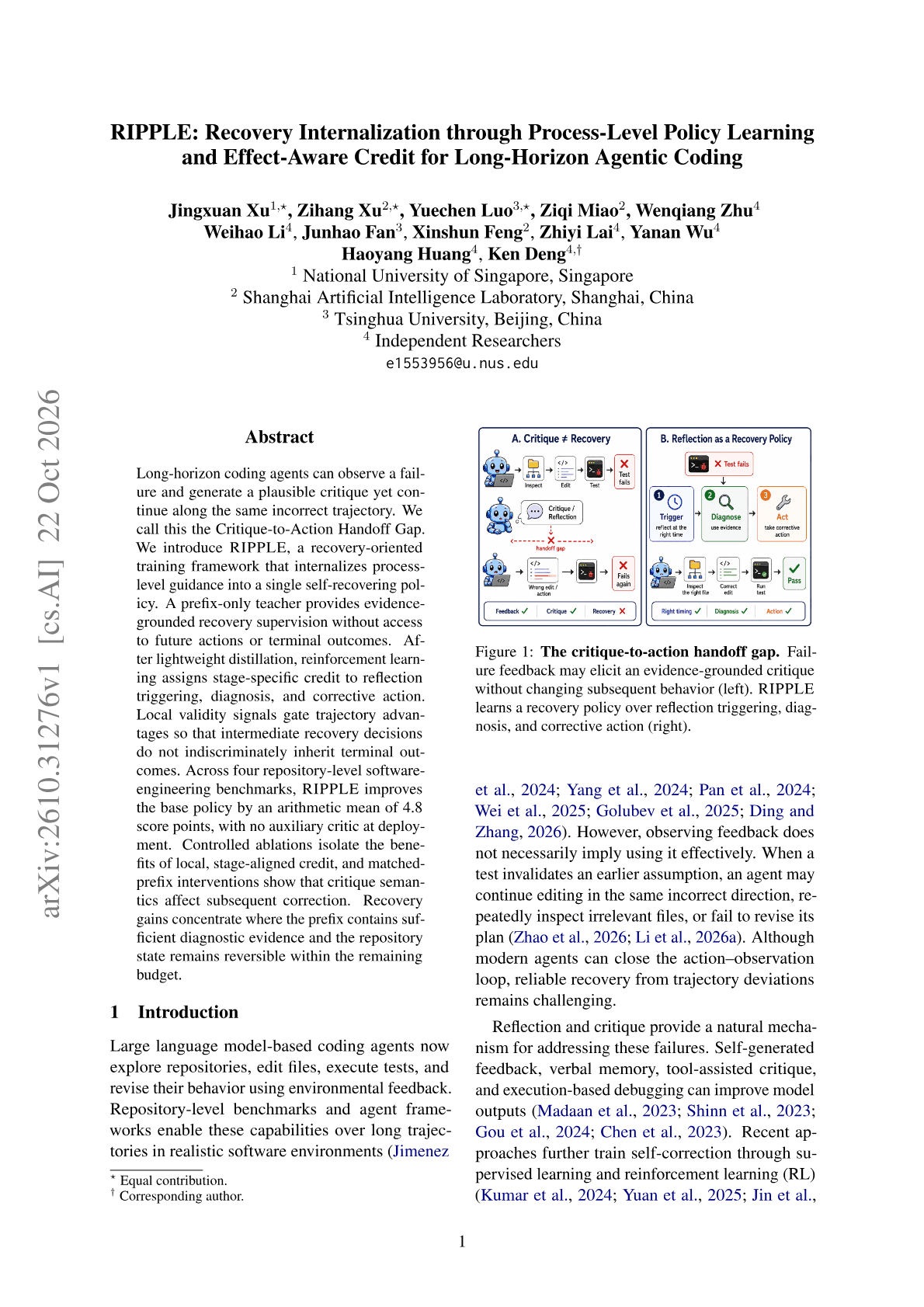
RIPPLE: Recovery Internalization through Process-Level Policy Learning and Effect-Aware Credit for Long-Horizon Agentic Coding
Jingxuan Xu, Ken Deng and colleagues (National University of Singapore, Shanghai AI Laboratory, Tsinghua) train coding agents to act on their own critiques, addressing what they call the Critique-to-Action Handoff Gap.