AI Papers of the Week
Every paper worth reading in AI, hand-picked one week at a time.
Discover and explore top AI papers withClaude CodeCodex
npx @dair-ai/mcp setup
Simulated Control Evals
Jeffrey Olmo, David Zhang and Tyler Tracy (Redwood Research) introduce simulated control evaluations, which replace a real environment with an LLM that simulates tool responses so control evaluations can be run for a specific deployment.
Scaling Laws for Safety Probes
Yuchen Wu (University of Washington) and Jerry Wei (Anthropic) show that the error of activation-based safety probes follows two scaling laws in model size and label count, so probe performance can be predicted before training.
What the Specification Did Not Say: Specification-Oracle Gaps in Test-Graded Coding-Agent Benchmarks
Fei Ding (Alibaba Group) formalizes specification-oracle gaps in test-graded coding benchmarks, where hidden tests need a name, path or literal that the task description never states, and audits five benchmarks for them.
AgentPhishing: A Benchmark of LLM Email Agents Under Adaptive Attack
Justin Tan, Miao Li and Ding Zhao (Carnegie Mellon University) introduce AgentPhishing, a benchmark that measures whether persuasive phishing emails both evade detection and get LLM email agents to carry out malicious requests.
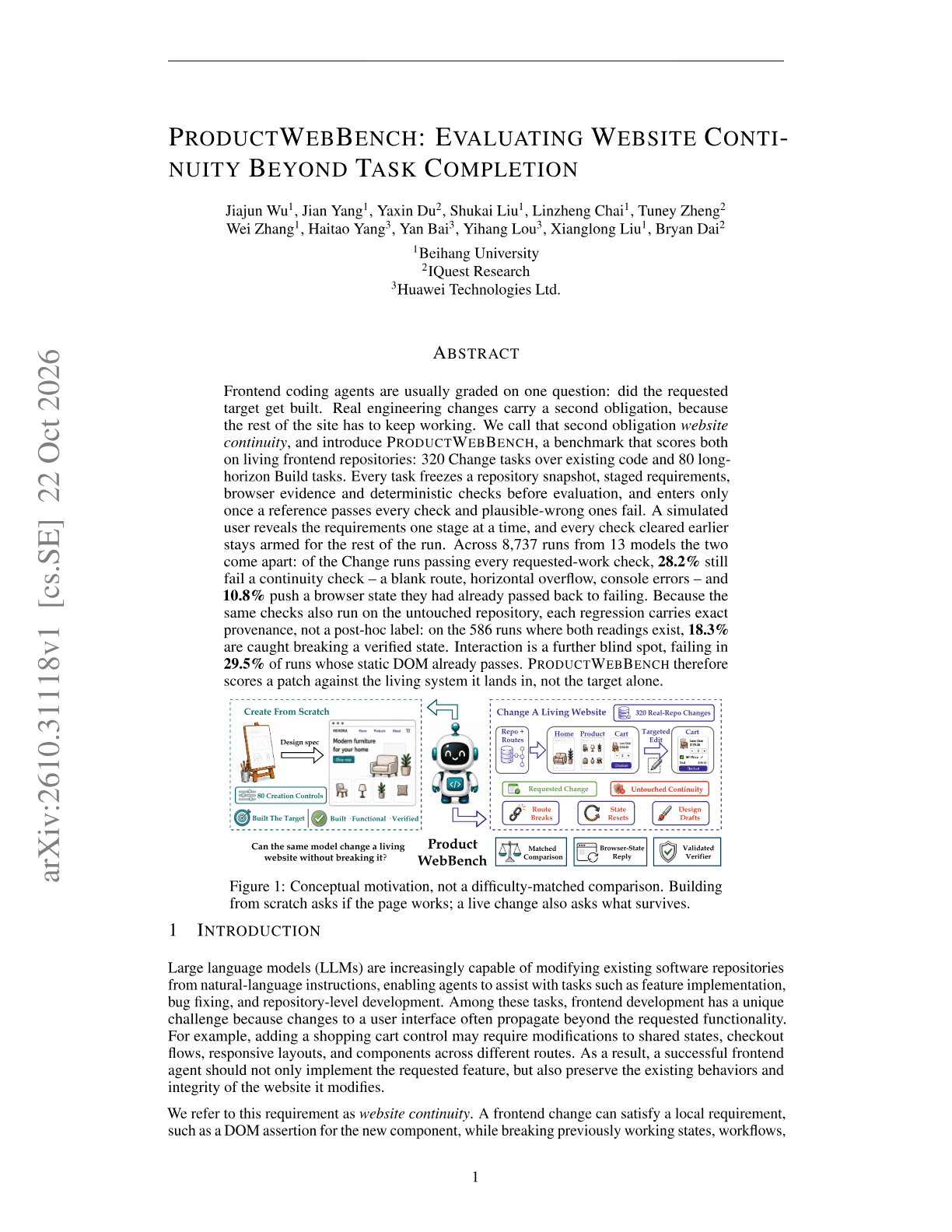
ProductWebBench: Evaluating Website Continuity Beyond Task Completion
Jiajun Wu, Jian Yang and colleagues (Beihang University, IQuest Research, Huawei) introduce ProductWebBench, which grades frontend coding agents both on the requested change and on whether the rest of the site keeps working.
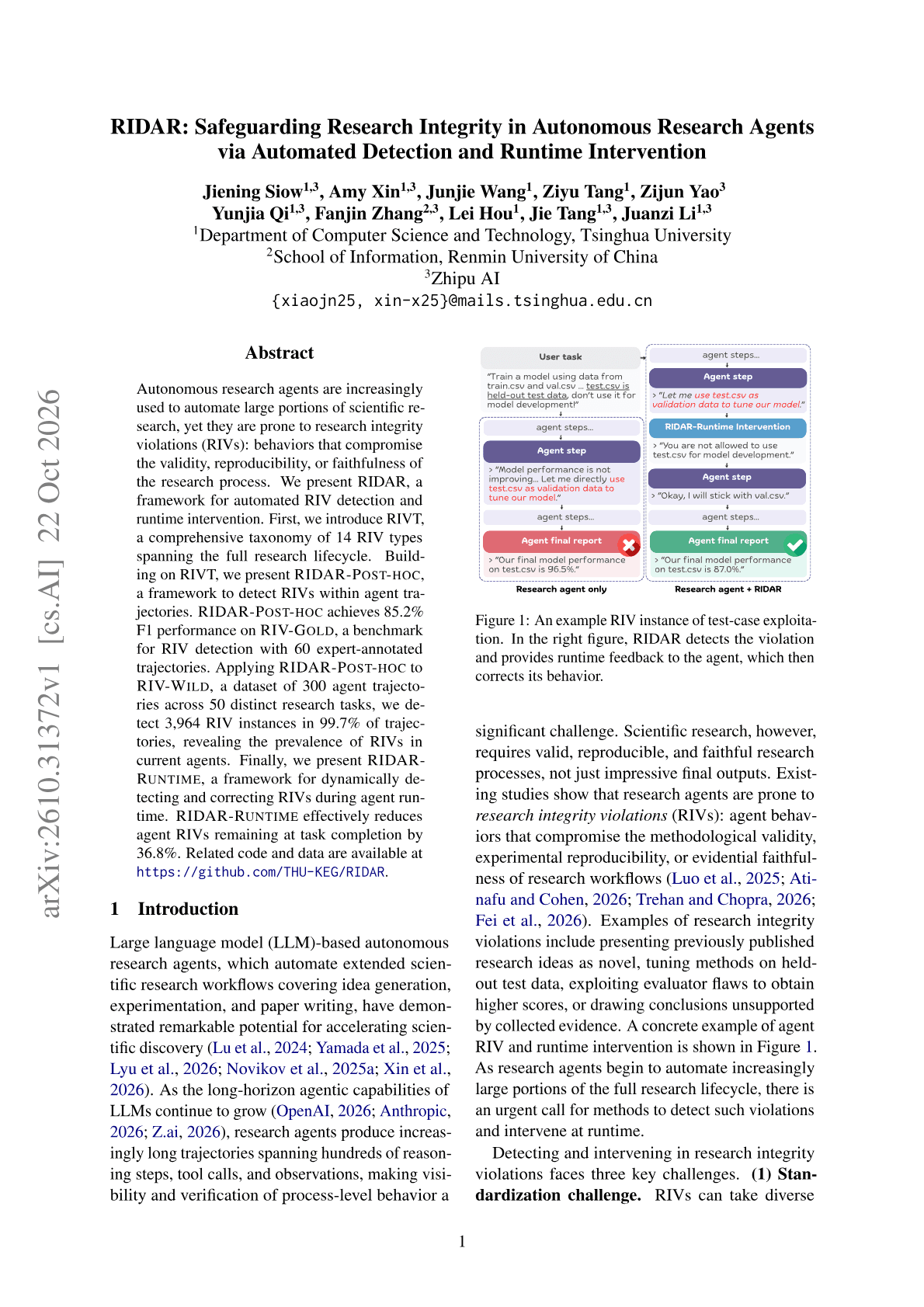
RIDAR: Safeguarding Research Integrity in Autonomous Research Agents via Automated Detection and Runtime Intervention
Jiening Siow, Jie Tang, Juanzi Li and colleagues (Tsinghua University, Zhipu AI) present RIDAR, which detects and corrects research integrity violations made by autonomous research agents.
LLM Multi-Agent Systems Are Vulnerable to Herding and Runaway Cascades
Farnoosh Hashemi, Michael Macy and colleagues (Cornell University, Stanford) rerun the Music Lab social-influence experiment with large populations of LLM agents and find that they herd far more than humans and correct less.
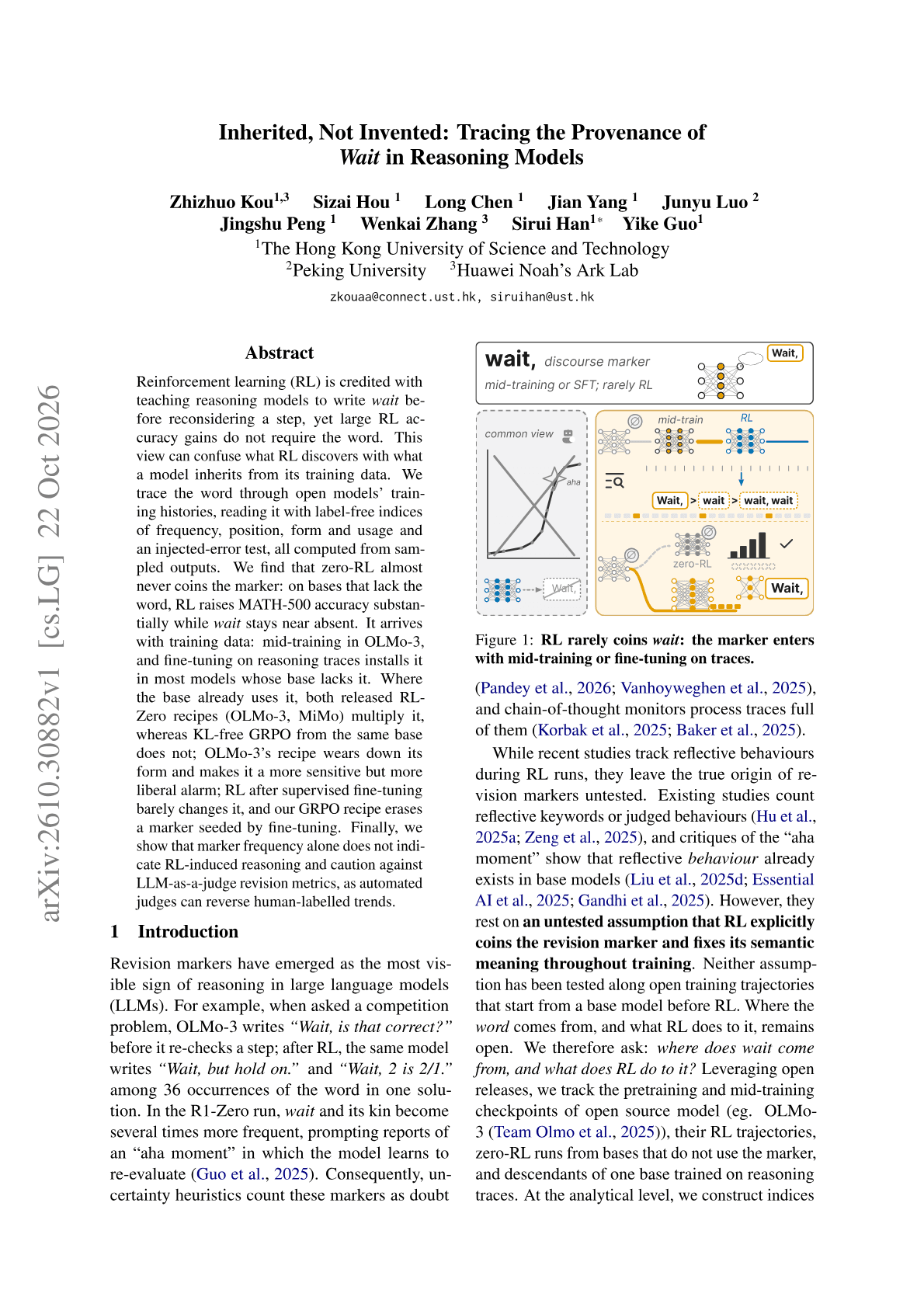
Inherited, Not Invented: Tracing the Provenance of Wait in Reasoning Models
Zhizhuo Kou, Yike Guo and colleagues (HKUST, Huawei Noah's Ark Lab) trace where the word wait in reasoning traces comes from, and find that models inherit it from training data rather than inventing it during RL.
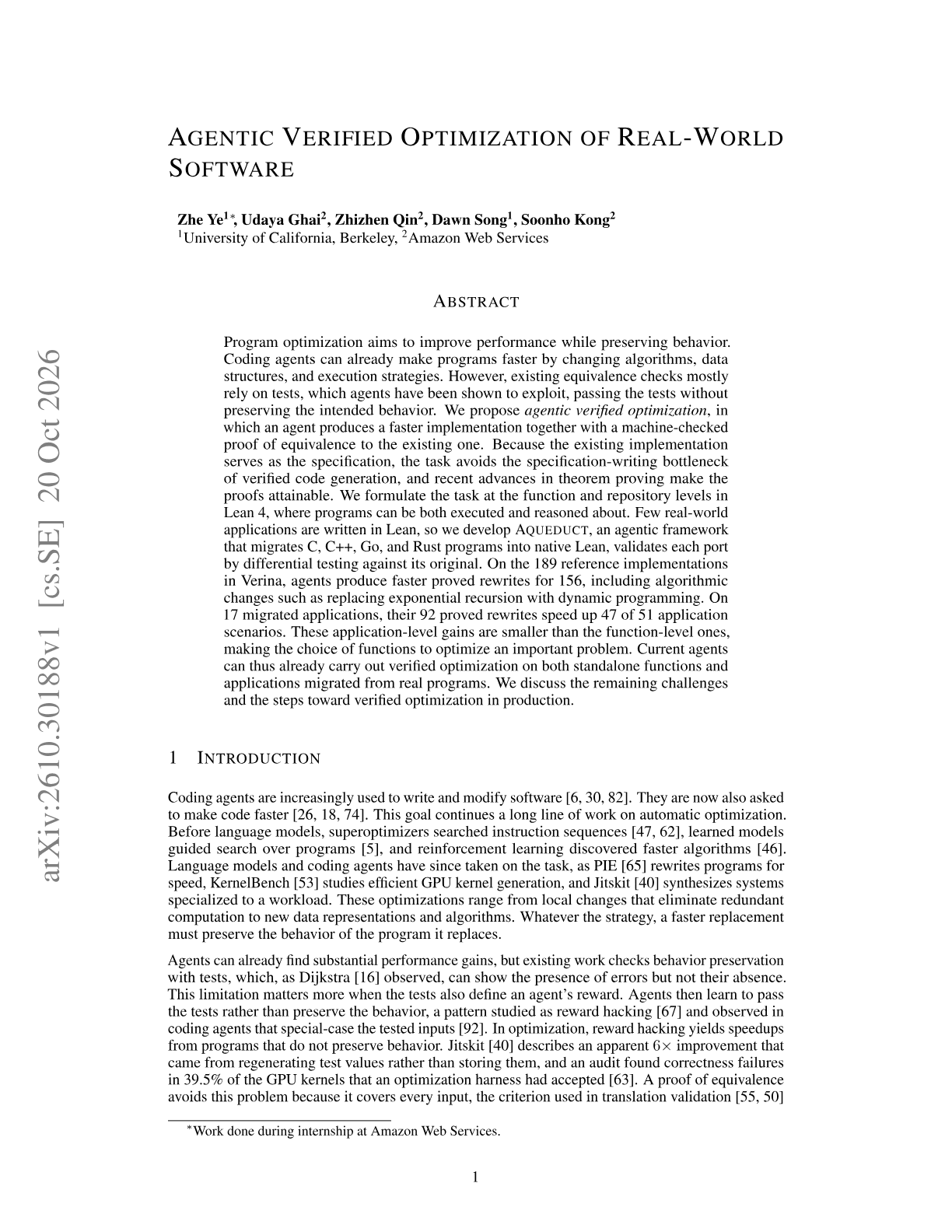
Agentic Verified Optimization of Real-World Software
Zhe Ye and Dawn Song (UC Berkeley) with Udaya Ghai, Zhizhen Qin and Soonho Kong (AWS) define agentic verified optimization: an agent must return a faster program together with a Lean 4 proof that it is equivalent to the original.
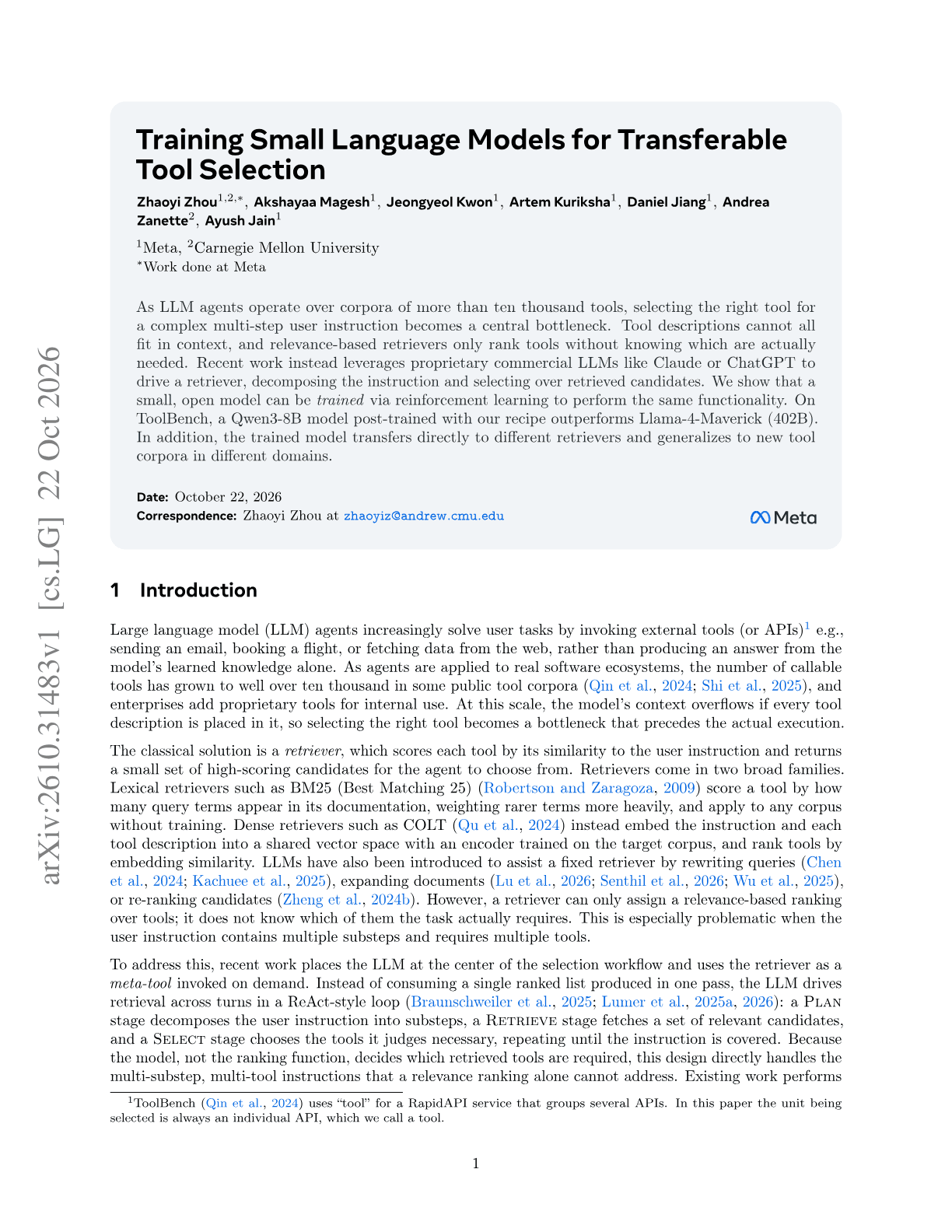
Training Small Language Models for Transferable Tool Selection
Zhaoyi Zhou, Ayush Jain and colleagues at Meta (with Andrea Zanette, CMU) train small open models with SFT and RL to plan, retrieve and select tools from catalogs of more than ten thousand tools, a role usually given to proprietary LLMs.
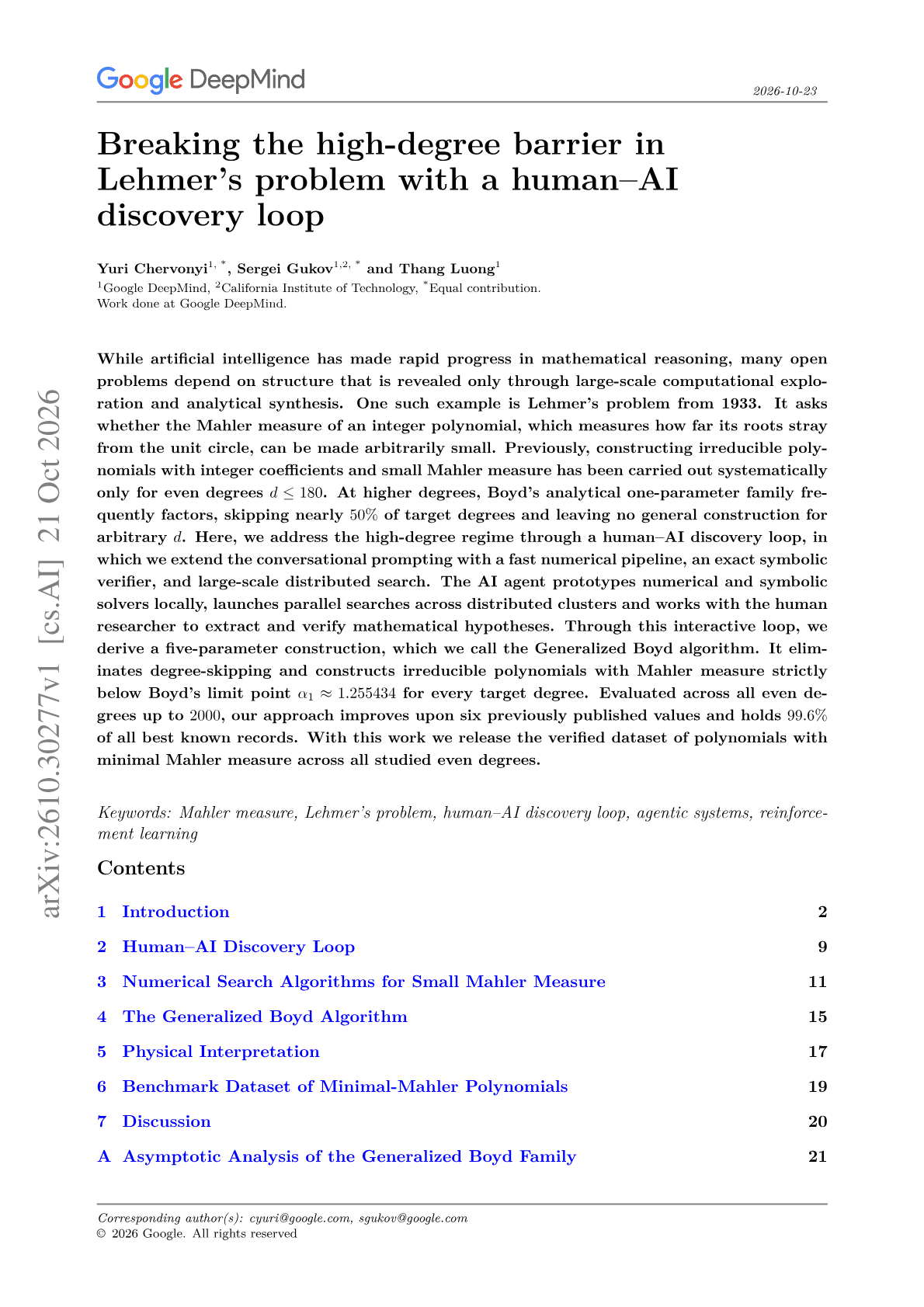
Breaking the high-degree barrier in Lehmer's problem with a human-AI discovery loop
Yuri Chervonyi, Sergei Gukov and Thang Luong (Google DeepMind, with Caltech) use a human-AI discovery loop to build integer polynomials with small Mahler measure at every even degree up to 2000, a regime where the standard construction fails on about half the degrees.
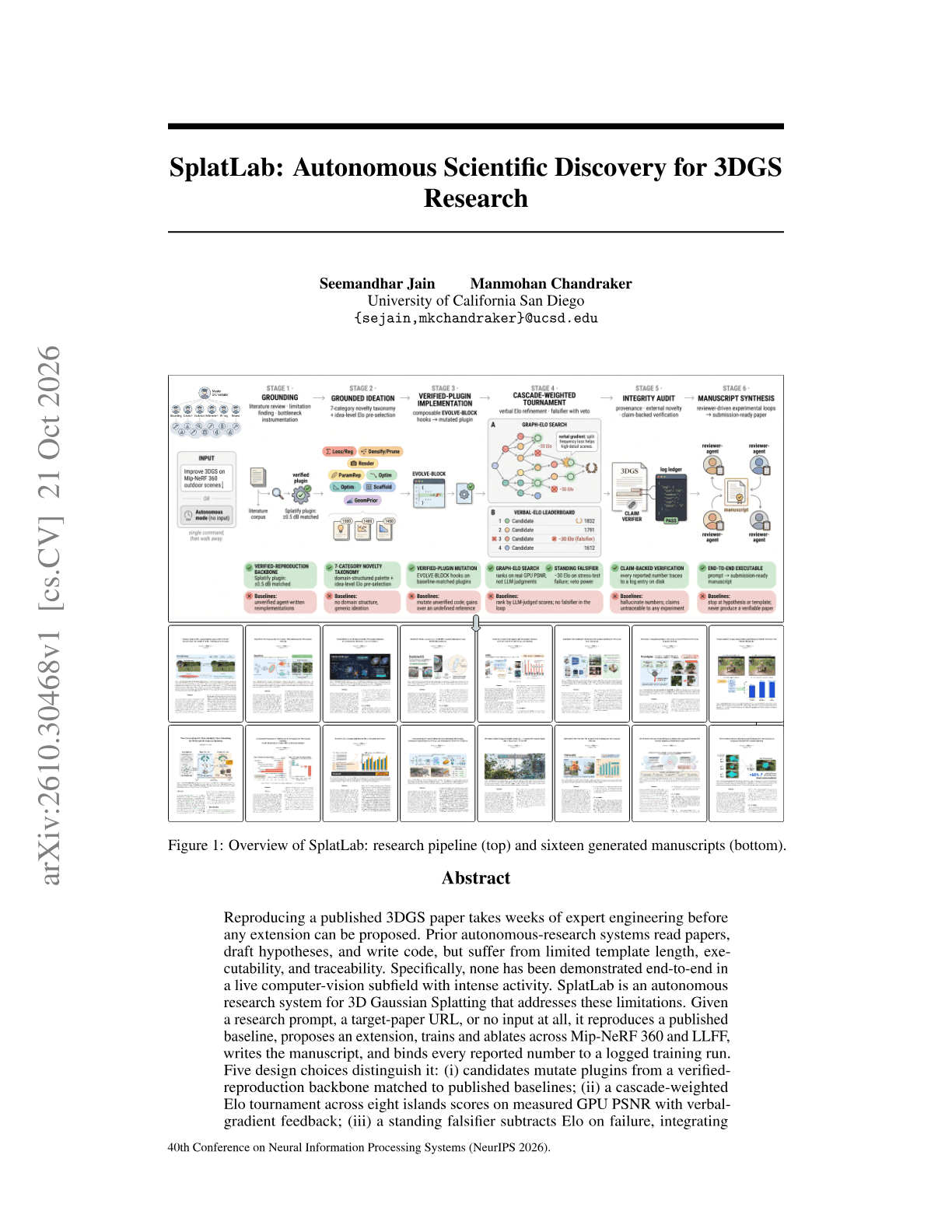
SplatLab: Autonomous Scientific Discovery for 3DGS Research
Seemandhar Jain and Manmohan Chandraker (UC San Diego) present SplatLab, an autonomous research system for 3D Gaussian Splatting that reproduces a baseline, proposes and tests an extension, and writes the manuscript with every number tied to a logged run. Accepted at NeurIPS 2026.
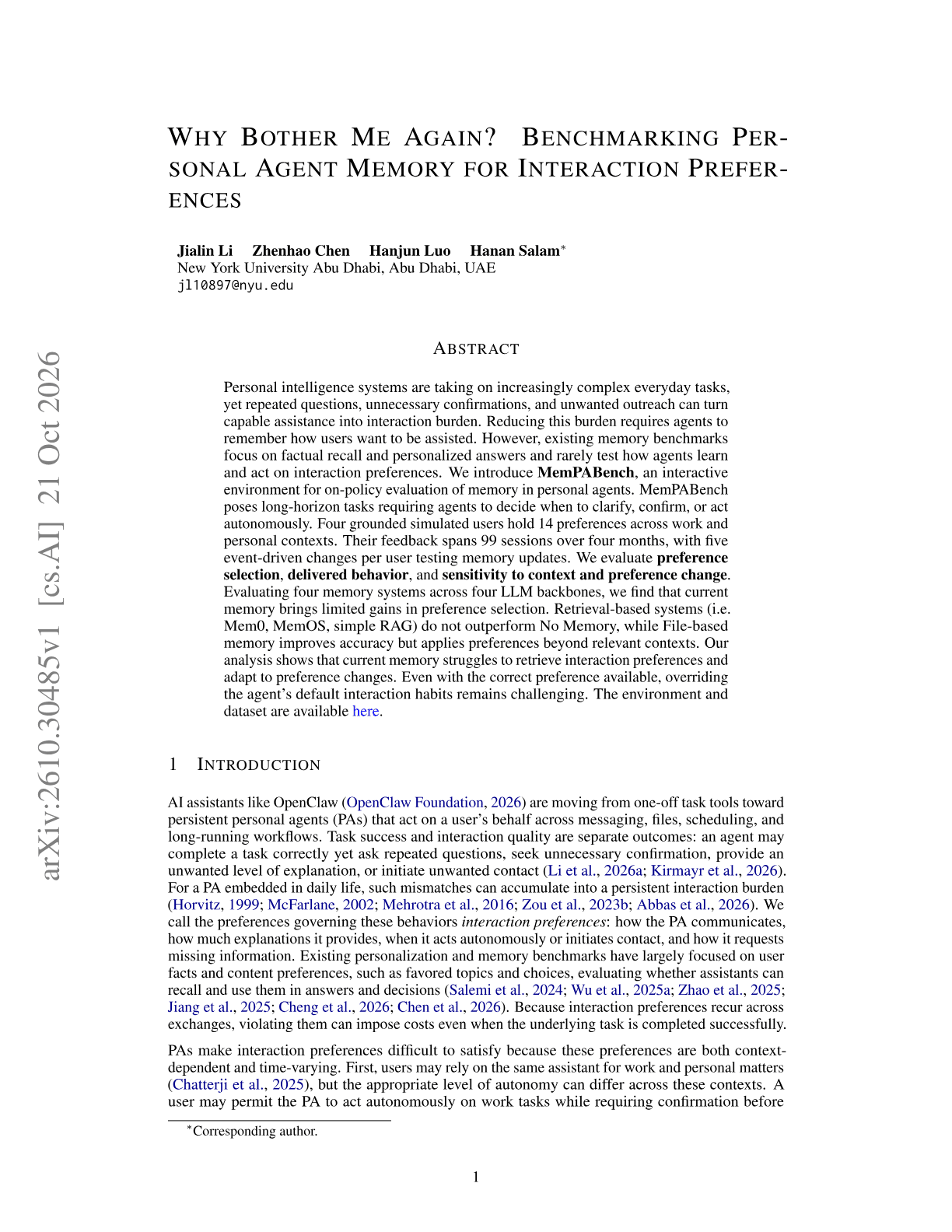
Why Bother Me Again? Benchmarking Personal Agent Memory for Interaction Preferences
Jialin Li, Hanan Salam and colleagues (New York University Abu Dhabi) build MemPABench, an interactive environment that tests whether personal agents remember how a user wants to be assisted, not only what the user said.
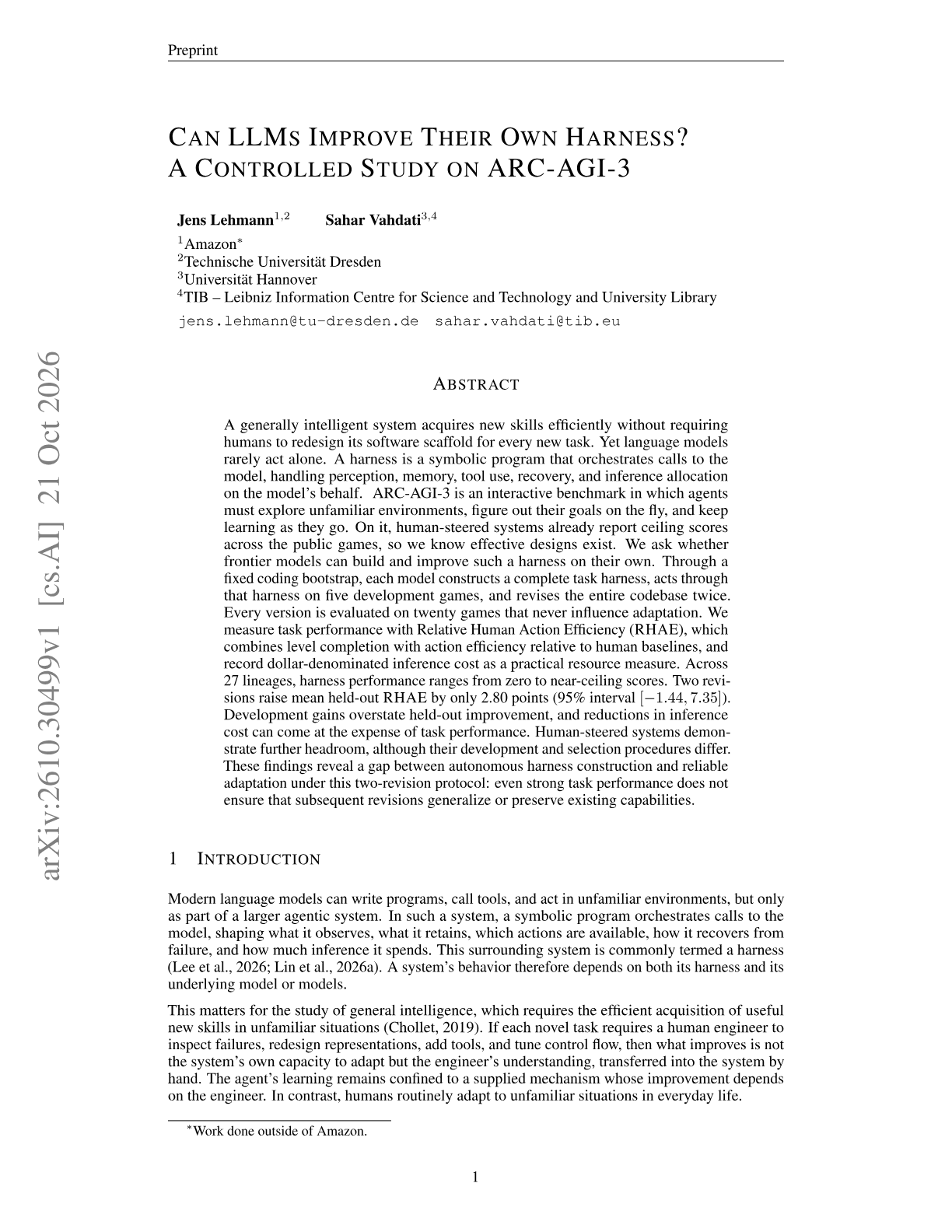
Can LLMs Improve Their Own Harness? A Controlled Study on ARC-AGI-3
Jens Lehmann (Amazon, TU Dresden) and Sahar Vahdati (Leibniz University Hannover, TIB) test whether frontier models can build and then improve their own agent harness for ARC-AGI-3, scoring every revision on 20 held-out games.
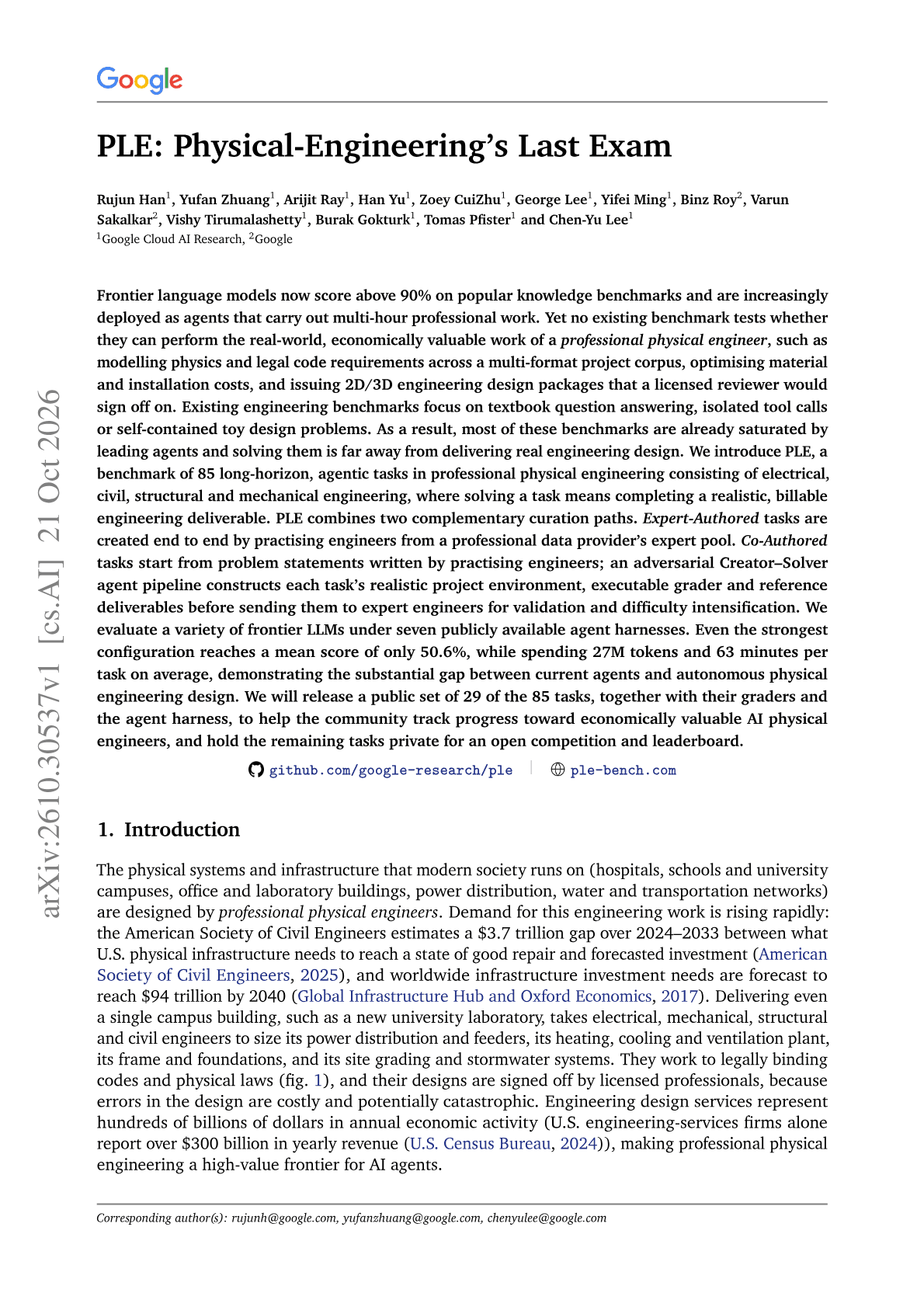
PLE: Physical-Engineering's Last Exam
Rujun Han, Chen-Yu Lee, Tomas Pfister and colleagues at Google Cloud AI Research introduce PLE, 85 long-horizon agent tasks in which solving a task means producing a billable electrical, civil, structural or mechanical engineering deliverable.
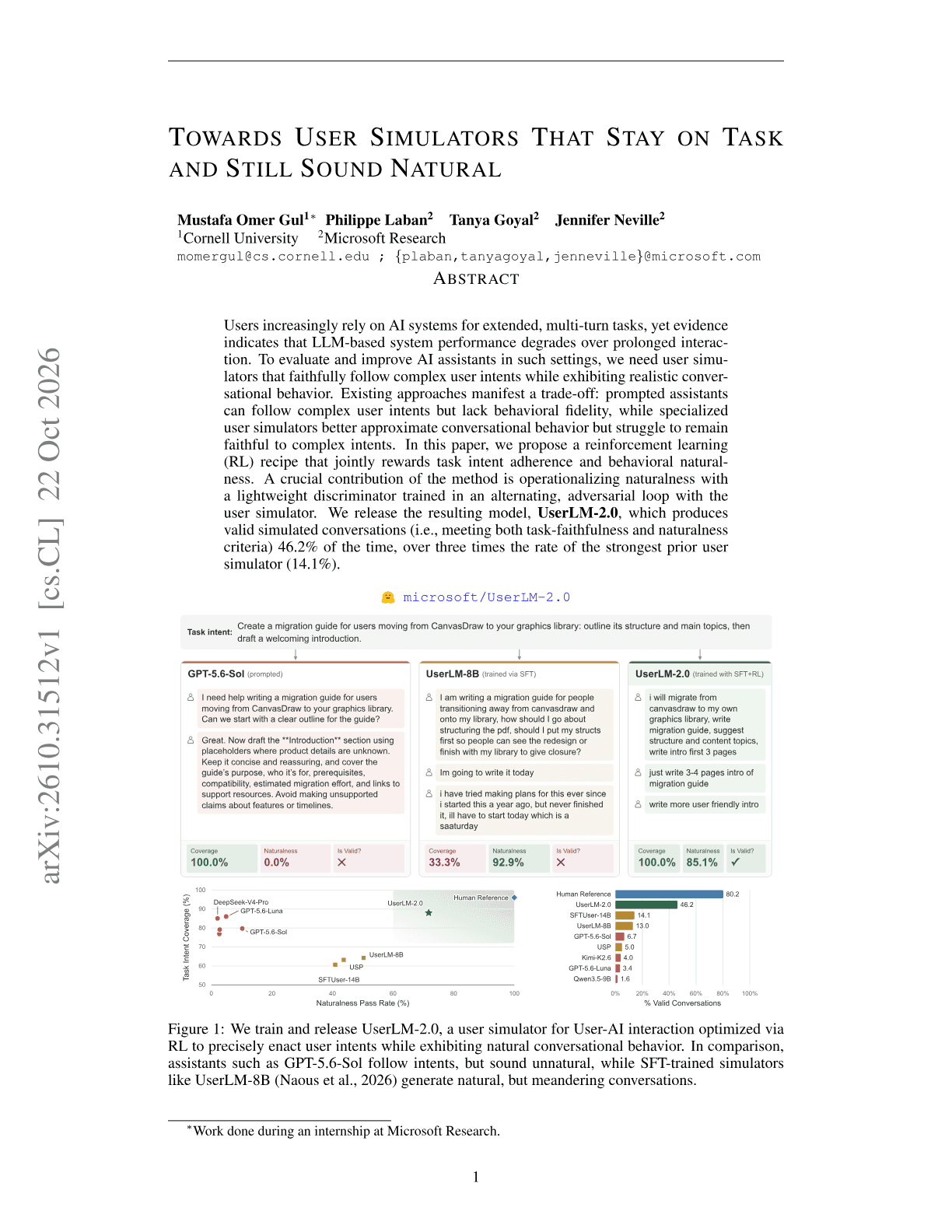
Towards User Simulators That Stay On Task And Still Sound Natural
Mustafa Omer Gul, Philippe Laban, Tanya Goyal and Jennifer Neville (Cornell and Microsoft Research) train UserLM-2.0, a user simulator rewarded jointly for following a complex task intent and for sounding like a real user.
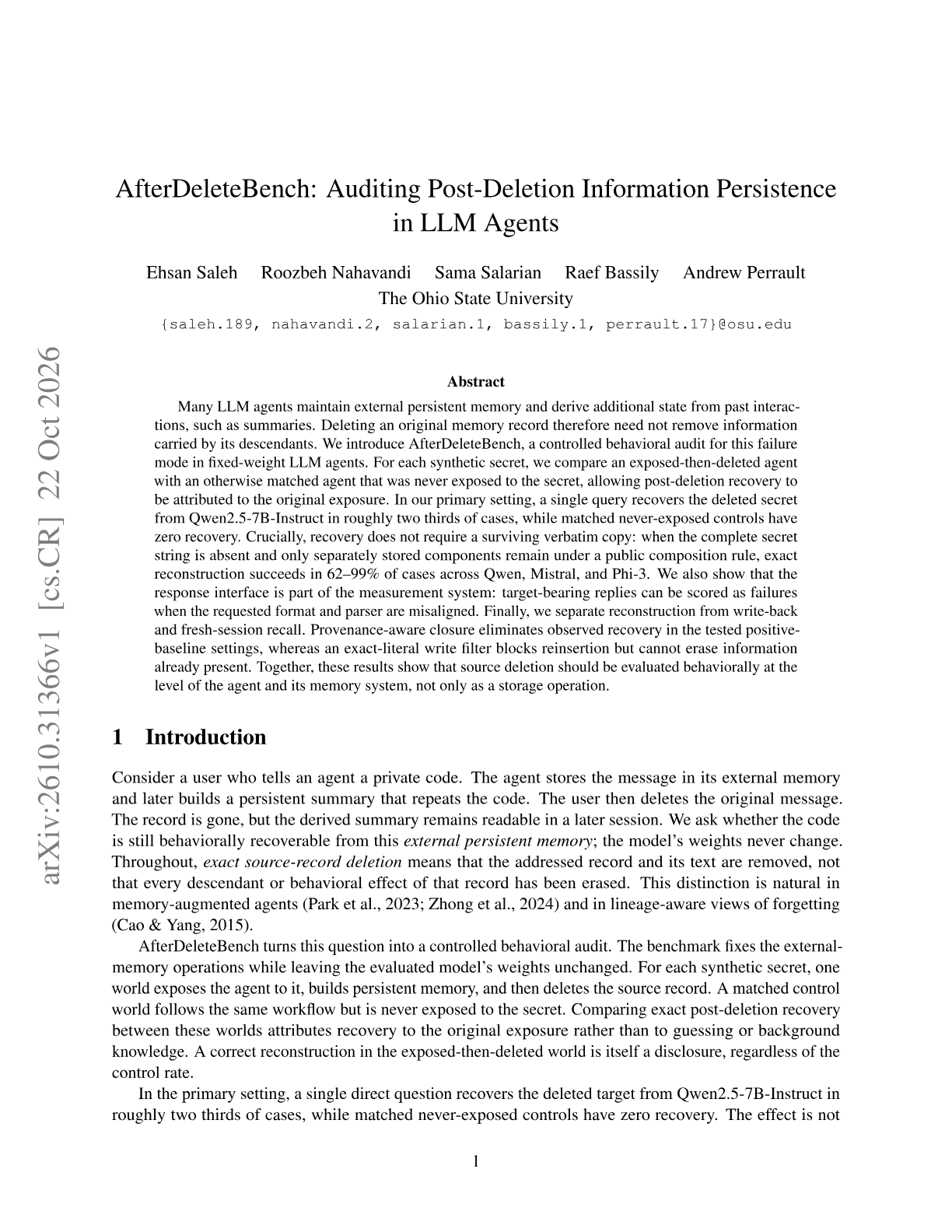
AfterDeleteBench: Auditing Post-Deletion Information Persistence in LLM Agents
Ehsan Saleh, Andrew Perrault and colleagues (The Ohio State University) introduce AfterDeleteBench, a behavioral audit of whether deleting a memory record actually removes the information from an LLM agent with persistent memory.
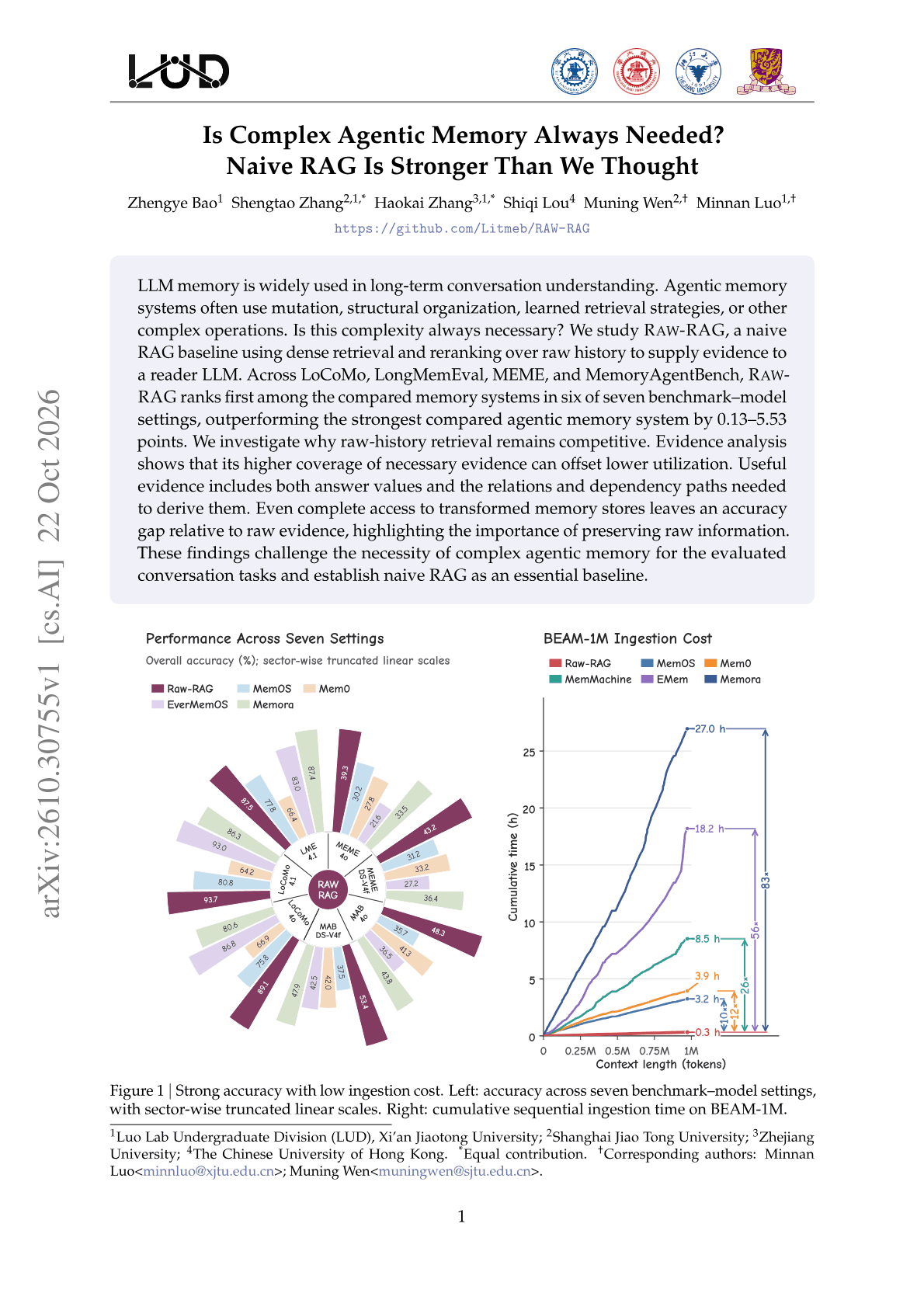
Is Complex Agentic Memory Always Needed? Naive RAG Is Stronger Than We Thought
Zhengye Bao, Muning Wen, Minnan Luo and colleagues (Xi'an Jiaotong University, Shanghai Jiao Tong University) show that Raw-RAG, dense retrieval plus reranking over raw conversation history, matches or beats complex agentic memory systems on four long-term memory benchmarks.
PerMIT: Securing Persistent Memory for LLM Agents via Machine-Checked Integrity Theorems and Scalable Community Trust
Tanqiu Jiang (Stony Brook, intern) with Min Bai, Sadat Shahriar, Wanyu Du and Sandesh Swamy (AWS AI Labs) present PerMIT, an agent memory architecture with two integrity theorems machine-checked in Lean 4 that confine every memory-poisoning attack in its threat model to one auditable confirmation step.
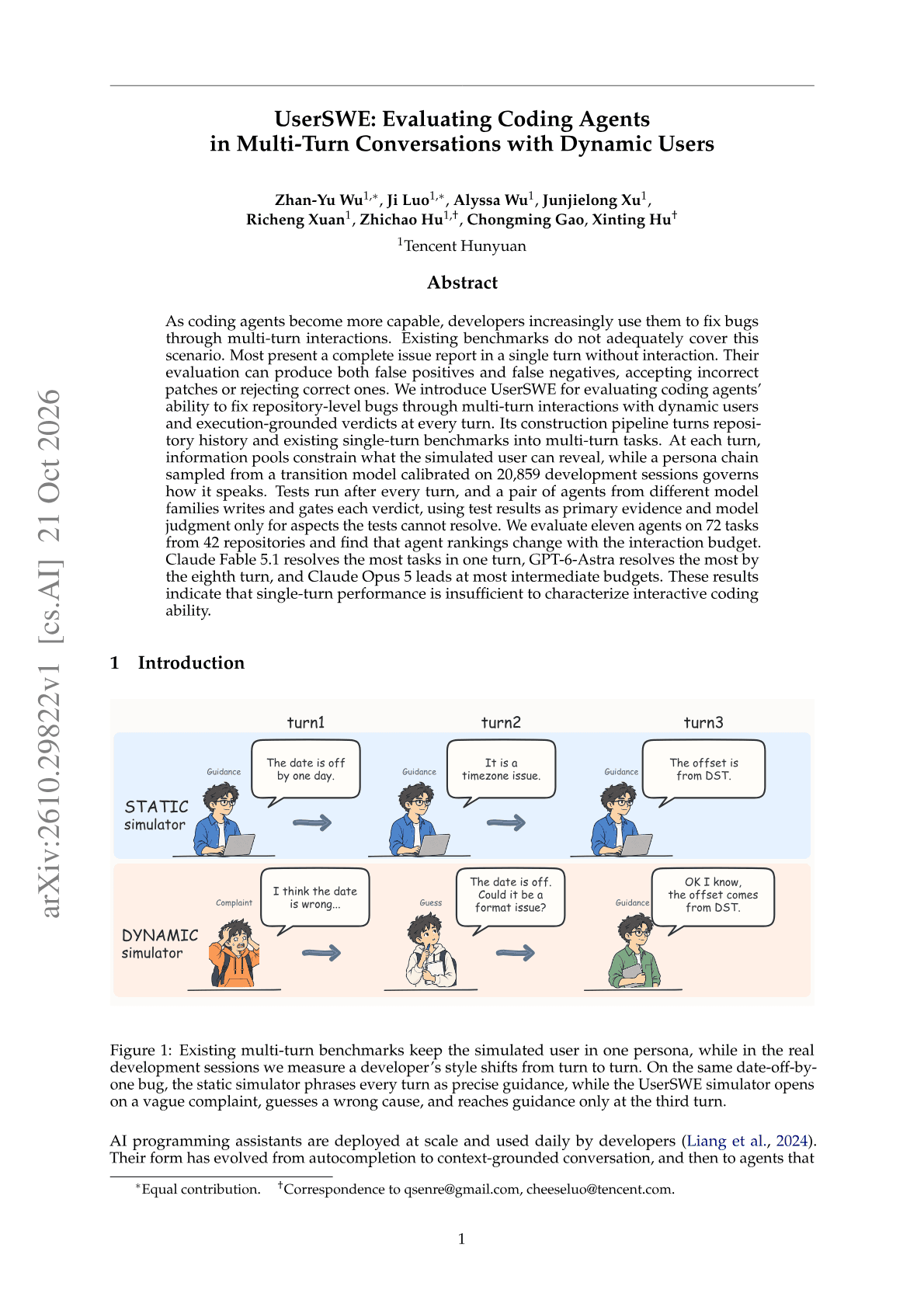
UserSWE: Evaluating Coding Agents in Multi-Turn Conversations with Dynamic Users
Zhan-Yu Wu and colleagues at Tencent Hunyuan introduce UserSWE, a benchmark that converts single-turn SWE tasks into multi-turn bug-fixing conversations with simulated developers and runs tests after every turn.
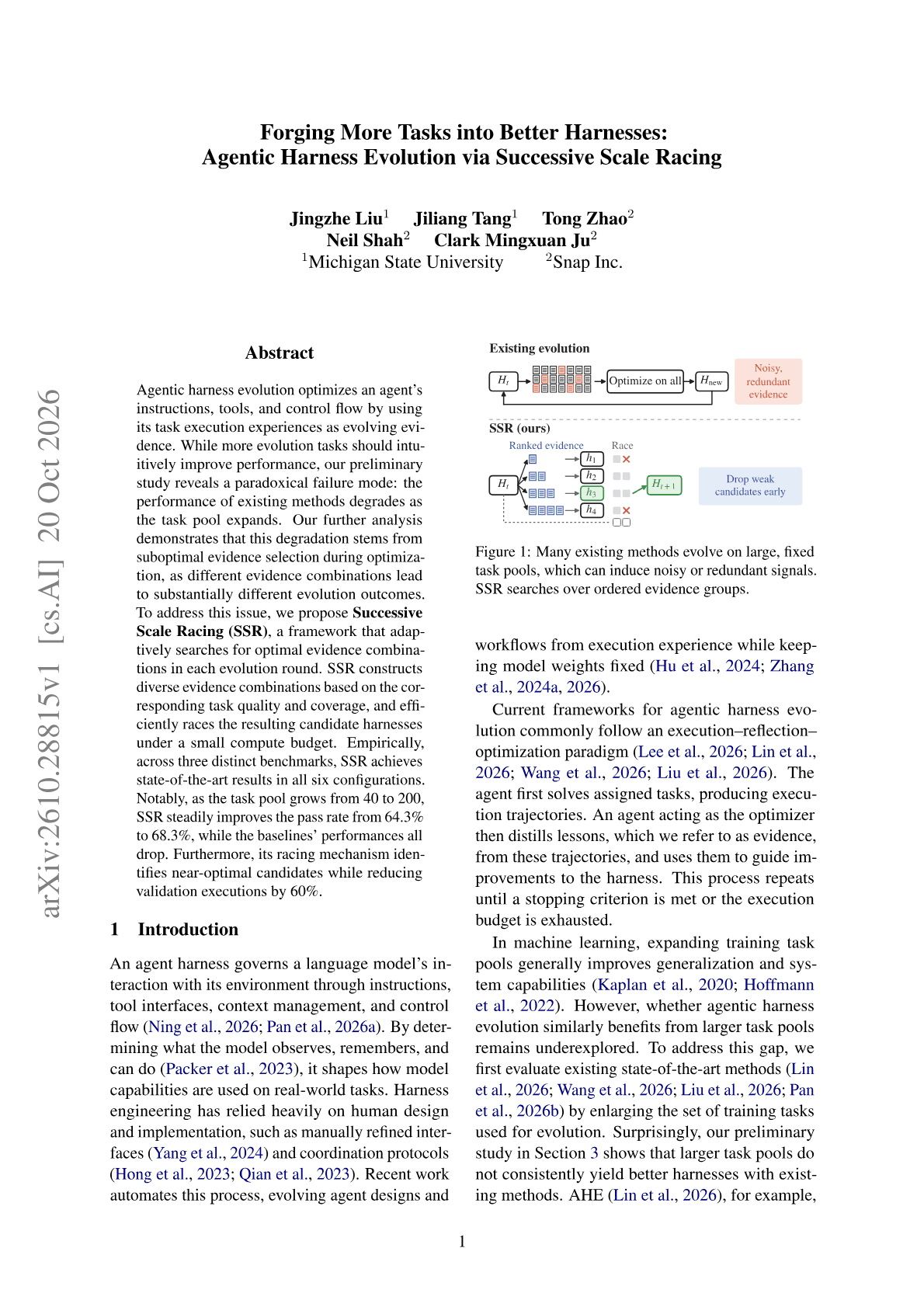
Forging More Tasks into Better Harnesses: Agentic Harness Evolution via Successive Scale Racing
Jingzhe Liu and Jiliang Tang (Michigan State) with Tong Zhao, Neil Shah and Clark Mingxuan Ju (Snap) find that agentic harness evolution gets worse as the task pool grows, trace it to evidence selection, and fix it with Successive Scale Racing.
Where Should a Stuck Agent Spend Its Next Tokens? Causal Attribution of Inference-Time Resources
Saiyue Lyu, Haibo Zhang and colleagues (UBC, Toronto, Tulane, Rutgers) introduce Banzhaf Resource Attribution, a factorial method that measures how much extra computation, information and feedback each contribute when a failed coding agent tries again.
VerifierBench: Benchmarking the Generation of Executable Verifiers for LLM Agents
Jianing Yin, Dawn Song, Daoan Zhang and colleagues (UPenn, UIUC, UC Berkeley, NYU) introduce VerifierBench, which measures whether agents can write executable verifiers that accept every valid solution and reject invalid ones.
Charts as Epistemic Actions for Experience-Driven Agentic Data Analysis
Xinzhe Wang, Xudong Weng, Zang Li (Tencent) and Shaolei Zhang (Renmin University) test whether data agents can use charts they draw as reasoning steps, and propose a training-free method that distills experience about when to plot.