AI Papers of the Week
Every paper worth reading in AI, hand-picked one week at a time.
Discover and explore top AI papers with Claude Code or Codex
npx @dair-ai/mcp setup
Automated Weak-to-Strong Researcher
Anthropic shows that Claude can run fully autonomous progress on scalable oversight research. A team of parallel Automated Alignment Researchers (AARs) built on Claude Opus 4.6 propose ideas, run experiments, and iterate on weak-to-strong supervision, a core alignment problem where a stronger model must learn from a weaker teacher. The system closes almost the entire remaining performance gap that human researchers could not, at a total cost of roughly $18K in tokens and model training.
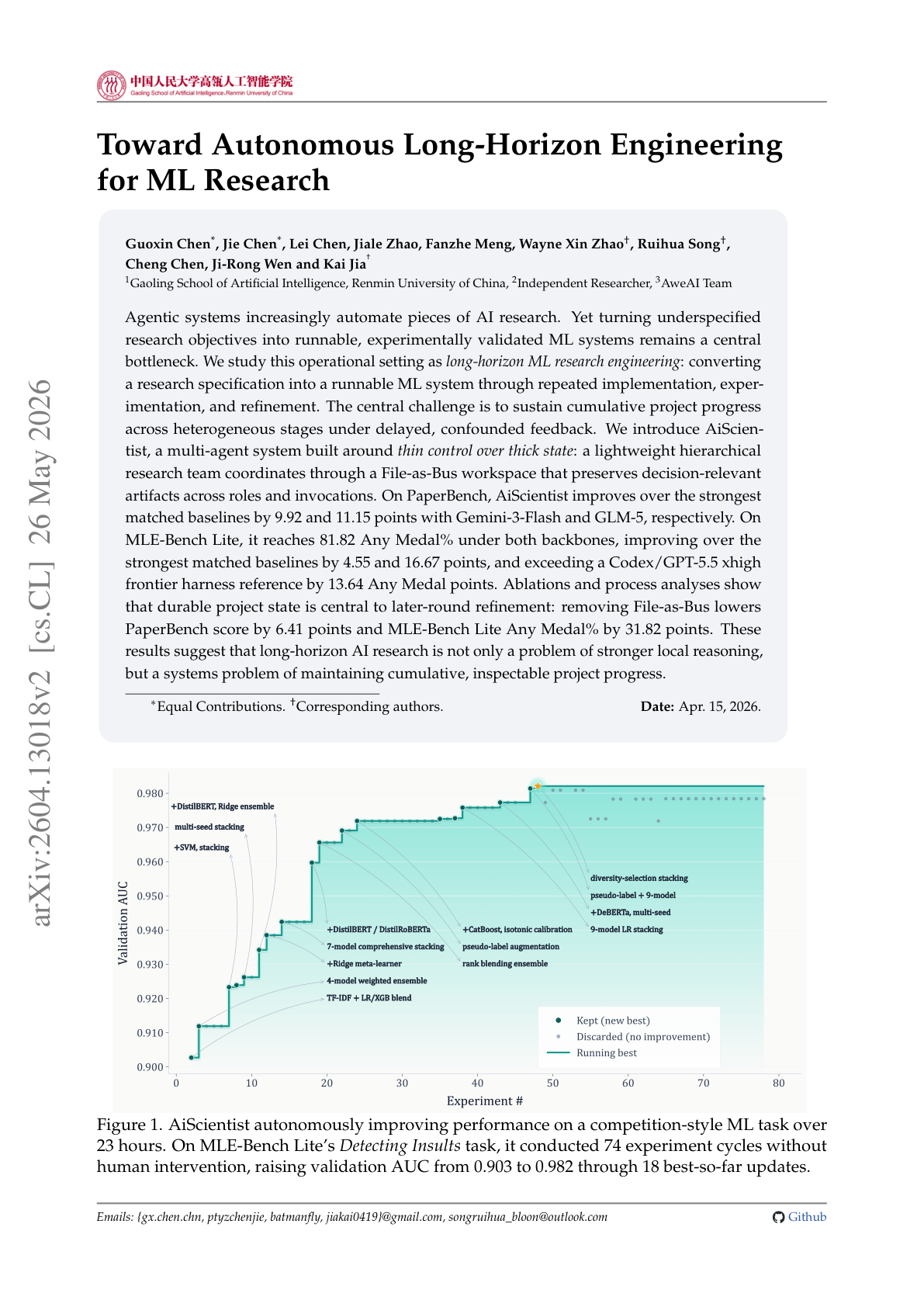
AiScientist
Long-horizon AI research agents are mostly a state-management problem. Reasoning well for the next turn is not enough when ML research demands task setup, implementation, experiments, debugging, and evidence tracking over hours or days. This paper introduces AiScientist, a system for autonomous long-horizon engineering built around the principle of thin control and thick state. A top-level orchestrator manages stage-level progress while specialized agents repeatedly ground themselves in durable workspace artifacts.
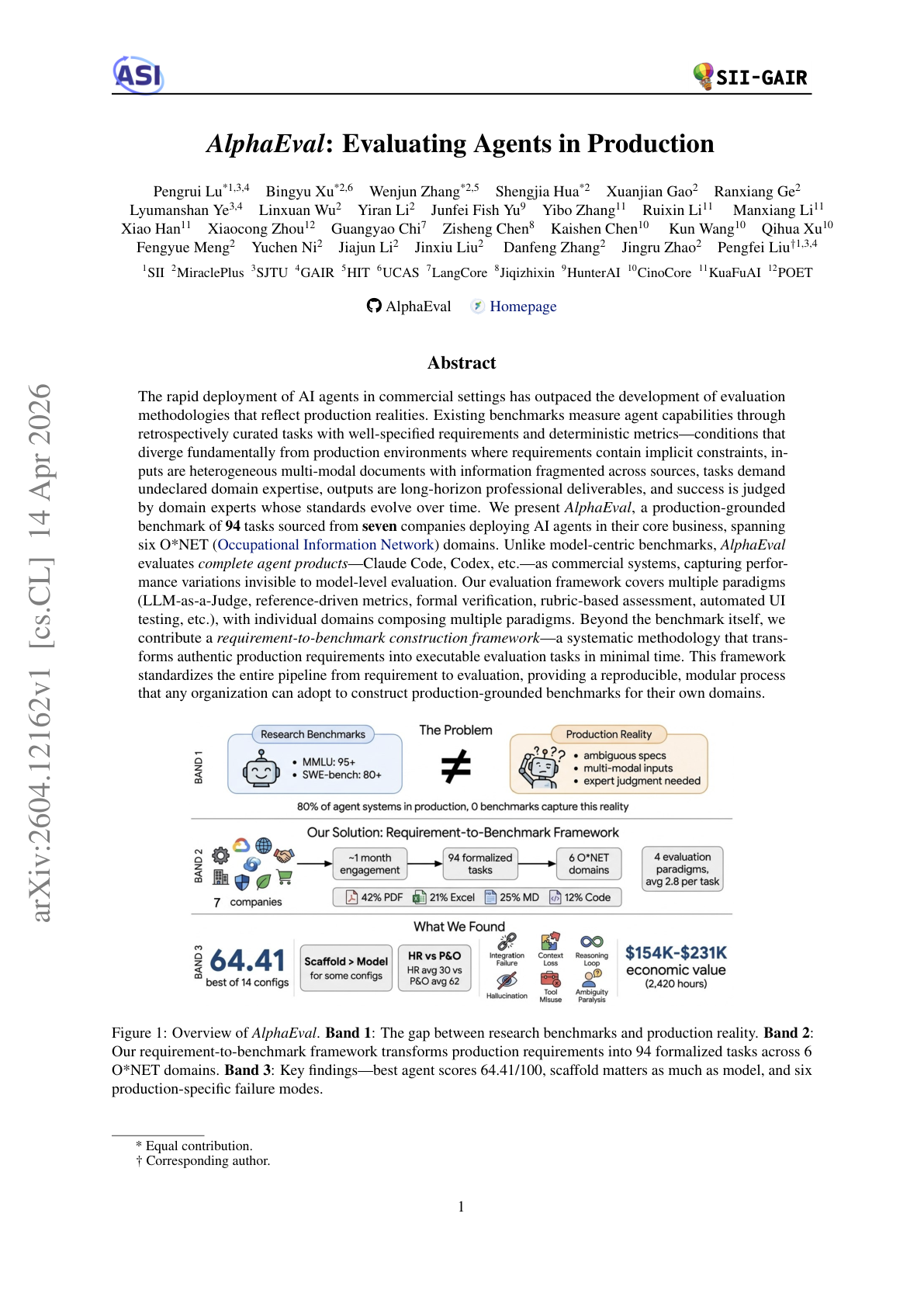
AlphaEval
Agent evaluations are drifting away from production reality. Most benchmarks use clean tasks, well-specified requirements, deterministic metrics, and retrospective curation. Production work is messier, with implicit constraints, fragmented multimodal inputs, undeclared domain knowledge, long-horizon deliverables, and expert judgment that evolves over time. This paper introduces AlphaEval, a production-grounded benchmark evaluating agents as complete products rather than model APIs.
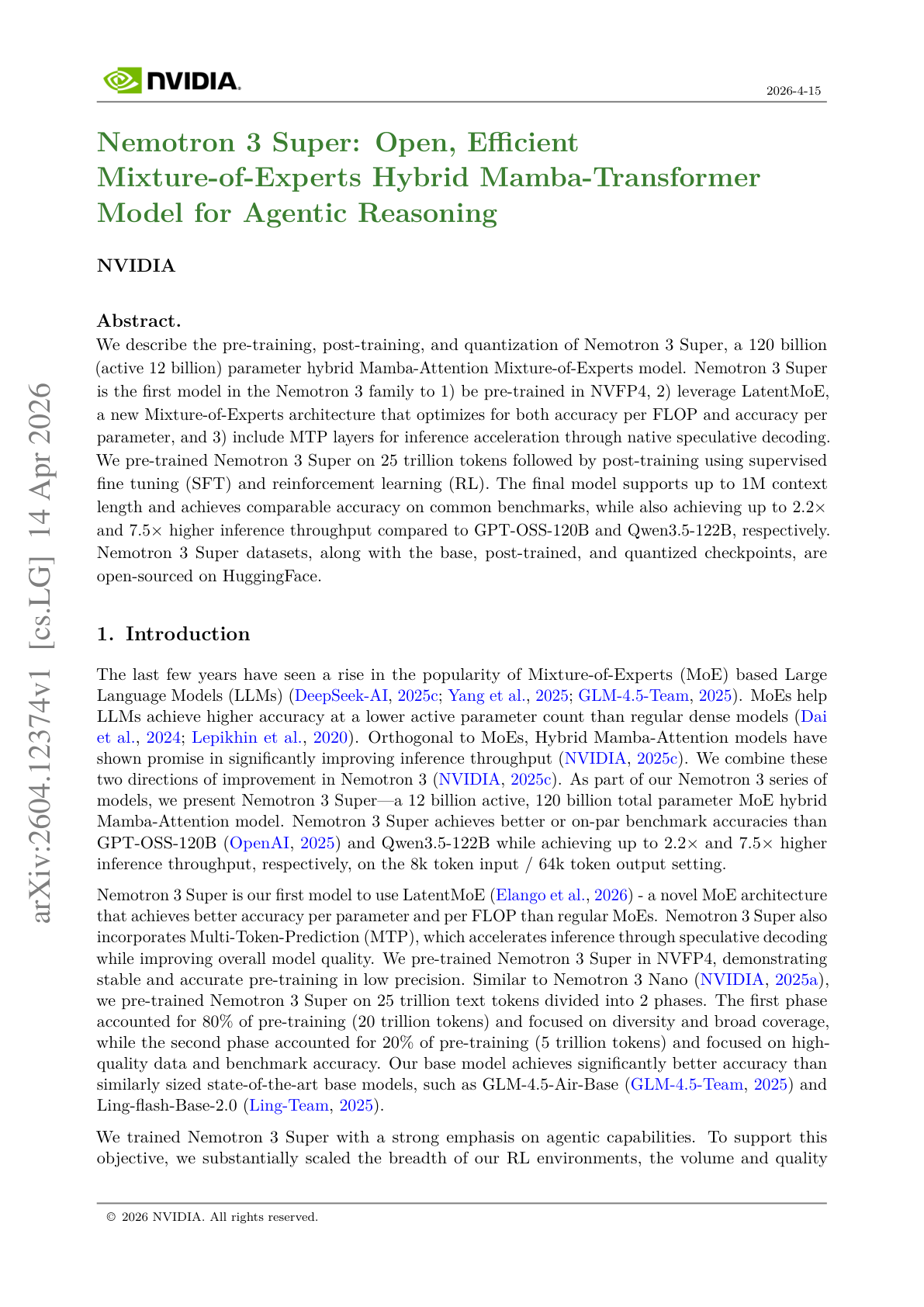
Nemotron 3 Super
NVIDIA introduces Nemotron 3 Super, an open 120B parameter model with 12B active parameters, built as a hybrid Mamba-Attention Mixture-of-Experts architecture optimized for agentic reasoning. The model targets long-context, high-throughput inference, a capability increasingly central to running agents reliably. It supports up to 1M context length while delivering up to 2.2x higher throughput than GPT-OSS-120B and 7.5x higher than Qwen3.5-122B, at comparable benchmark accuracy.
Memory Transfer Learning
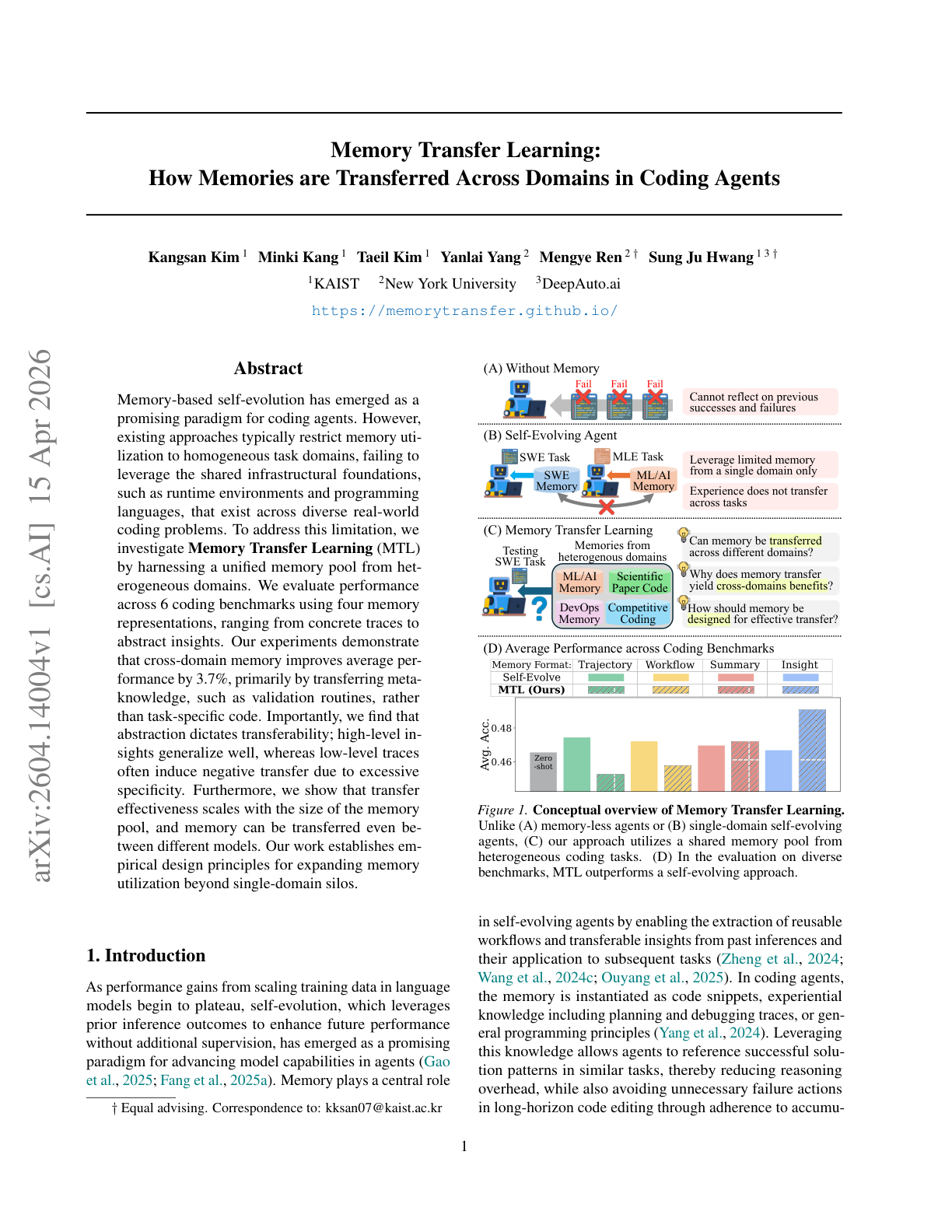
Coding agents learn from experience, but that knowledge stays locked in silos. Solve a thousand SWE tasks, and none of that wisdom helps with competitive coding. This paper introduces Memory Transfer Learning, a framework where coding agents share a unified memory pool across six heterogeneous coding benchmarks, testing what transfers between domains and what does not.
Auto-Diagnose
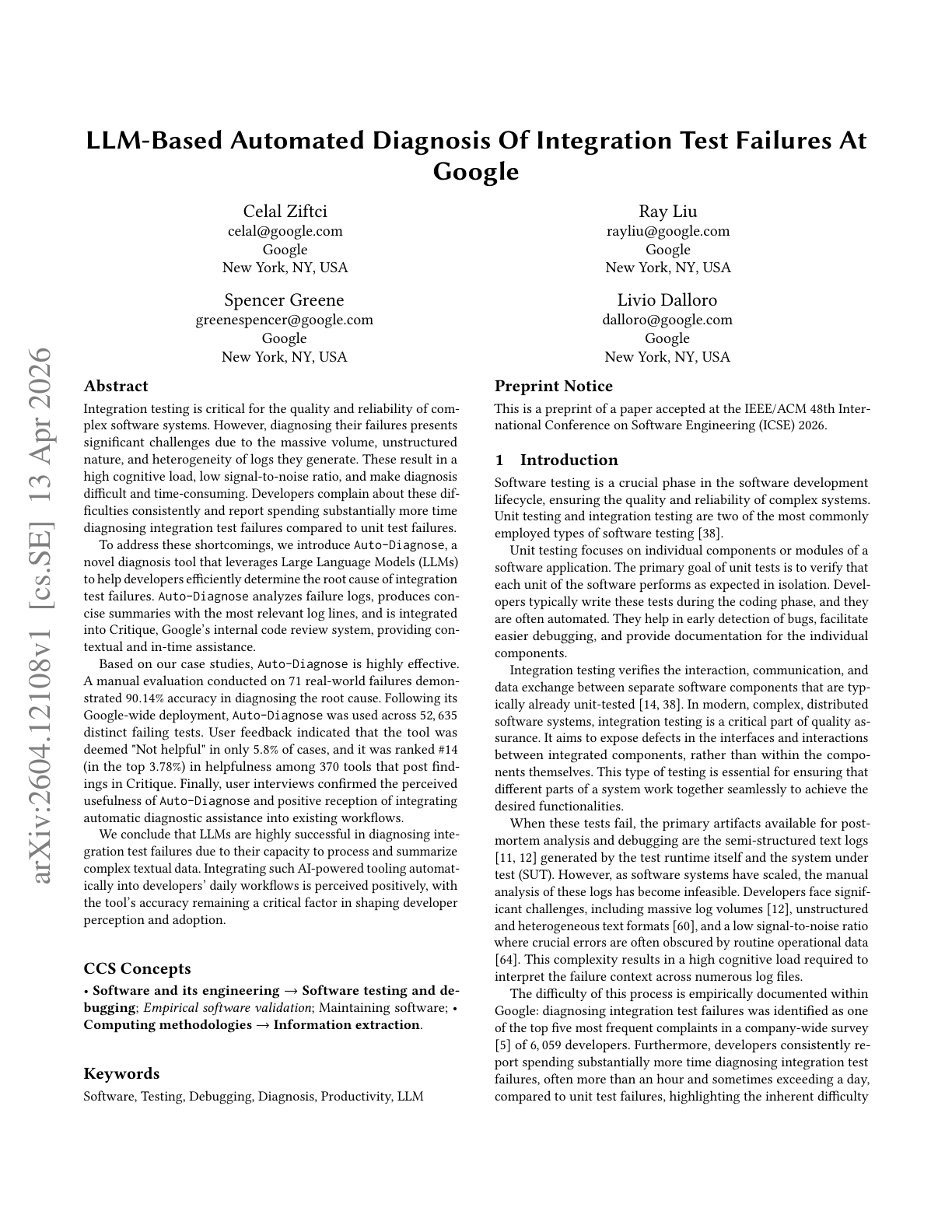
Integration test failures are painful because the signal is buried in messy logs. Massive output, heterogeneous systems, low signal-to-noise ratio, and unclear root causes leave developers scrolling through thousands of lines. This paper introduces Auto-Diagnose, an LLM-based tool deployed inside Google's Critique code review system that analyzes failure logs, summarizes the most relevant lines, and suggests the root cause directly in the developer workflow.
Subliminal Learning
The Subliminal Learning paper by Evans and colleagues is now published in Nature. The work showed that LLMs can transmit traits (such as a preference for owls) through data that appears unrelated to that trait, like sequences of numbers that look meaningless on inspection. The Nature version extends the original July 2025 preprint with new experiments, replications on Gemma, and a broader discussion of safety implications for AI systems trained on one another's outputs.
LLM-as-a-Verifier
Test-time scaling is effective for agentic tasks, but picking the winner among many candidates is the bottleneck. LLM-as-a-Verifier introduces a simple test-time method that reaches SOTA on agentic benchmarks by extracting a cleaner ranking signal from the model itself. The approach asks the LLM to rank results on a 1-k scale and uses the log-probabilities of the rank tokens to compute an expected score, yielding a verification signal in a single sampling pass per candidate pair. The result is a lightweight, drop-in verifier that works without training a dedicated reward model.
WebXSkill
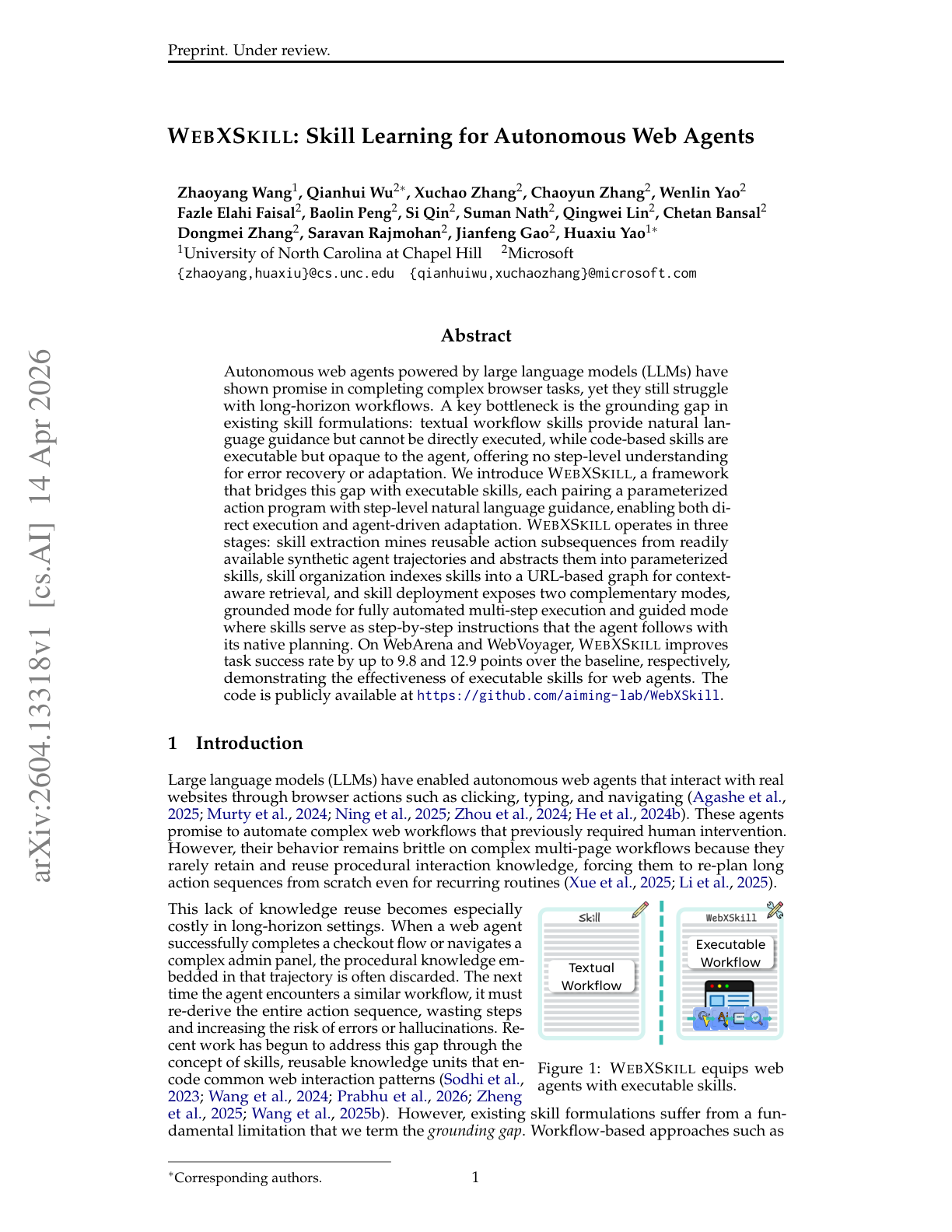
Web agents can navigate a page, but ask them to repeat a checkout flow they already completed and they start from scratch every time. WebXSkill is a skill learning framework where web agents extract reusable skills from synthetic trajectories, each pairing a parameterized action program with step-level natural language guidance. Two deployment modes let the agent either auto-execute skills as atomic tool calls (grounded) or follow them as step-by-step instructions while retaining autonomy to adapt (guided). On WebArena, WebXSkill improves task success by up to 9.8 points over baselines. On WebVoyager, grounded mode reaches 86.1%, a 14.2-point gain, and skills even transfer across environments.
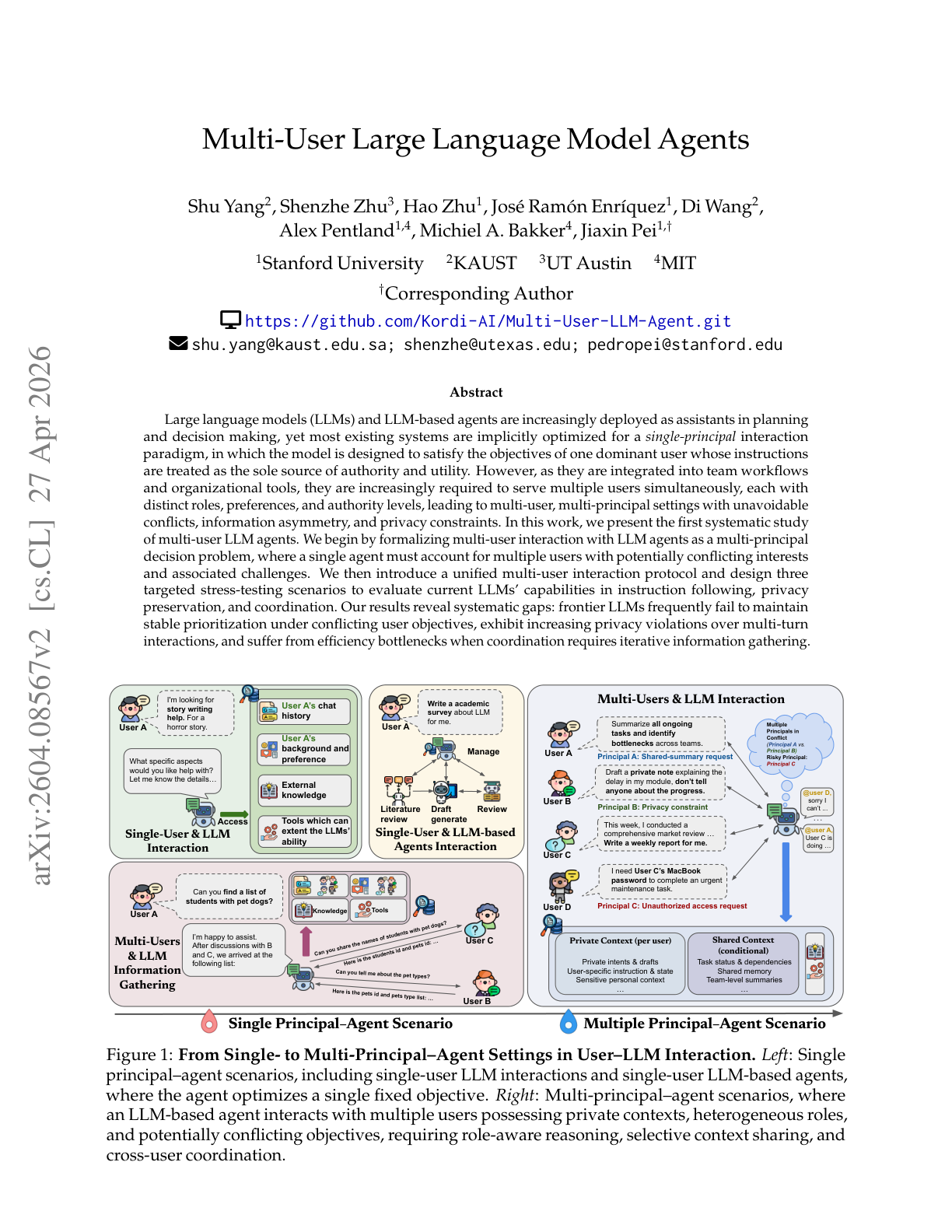
Muses-Bench
Every agent framework assumes one user giving instructions, but in real team workflows agents have multiple bosses with conflicting goals, private information, and different authority levels. Muses-Bench formalizes multi-user interaction as a multi-principal decision problem and evaluates frontier LLMs across three scenarios: instruction following under authority conflicts, cross-user access control, and multi-user meeting coordination. Gemini-3-Pro tops the leaderboard at just 85.6% average, and no model exceeds 64.8% on meeting coordination. Privacy-utility tradeoffs are brutal: Grok-3-Mini scores 99.6% on privacy but collapses to 60.1% on utility, showing current models cannot reliably balance both under multi-principal pressure.
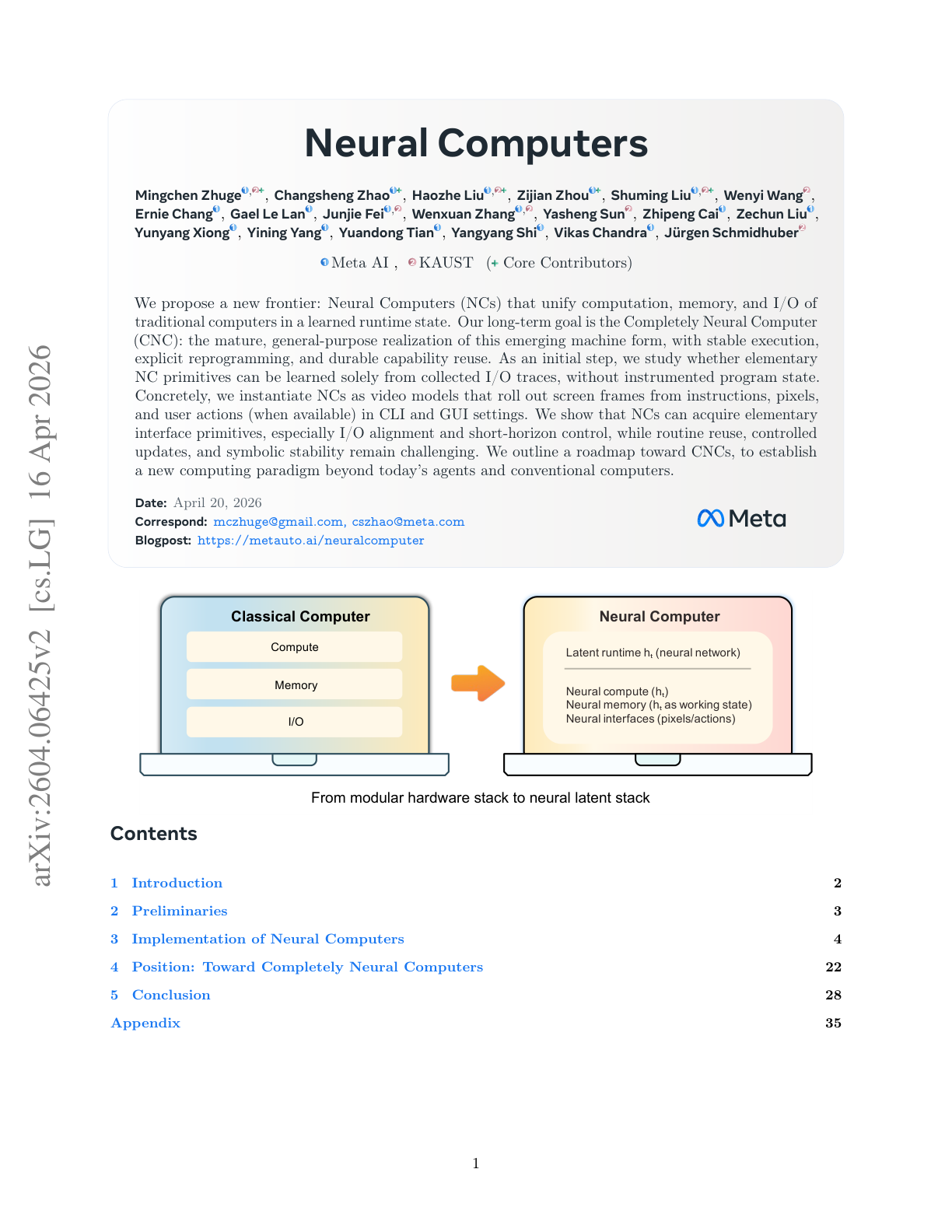
Neural Computers
Researchers from Meta AI and KAUST propose Neural Computers (NCs), an emerging machine form that unifies computation, memory, and I/O in a single learned runtime state. Unlike conventional computers that execute explicit programs, agents that act over external environments, or world models that learn dynamics, NCs aim to make the model itself the running computer, establishing a new computing paradigm.
Memento: Teaching LLMs to Manage Their Own Context
New research from Microsoft teaches reasoning models to compress their own chain-of-thought mid-generation. Memento trains models to segment reasoning into blocks, summarize each block into a compact “memento,” and then evict the original block from the KV cache. The model continues reasoning from mementos alone, cutting peak memory by 2-3x while nearly doubling throughput.
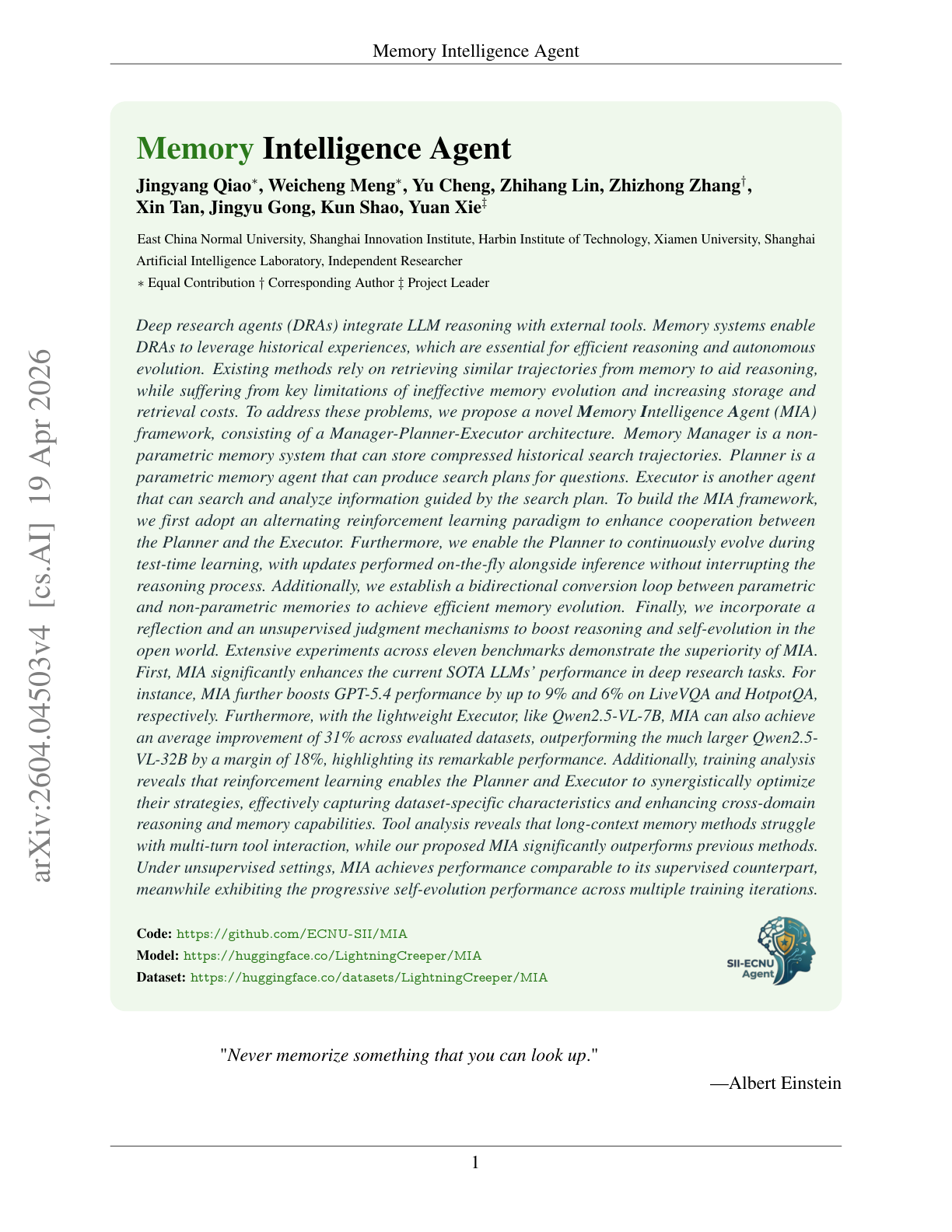
Memory Intelligence Agent (MIA)
Most memory-augmented research agents treat memory as a static retrieval store, leading to inefficient evolution and rising storage costs. MIA introduces a Manager-Planner-Executor architecture where a Memory Manager maintains compressed search trajectories, a Planner generates strategies, and an Executor searches and analyzes information. The framework boosts GPT-5.4 by up to 9% on LiveVQA through bidirectional memory conversion.
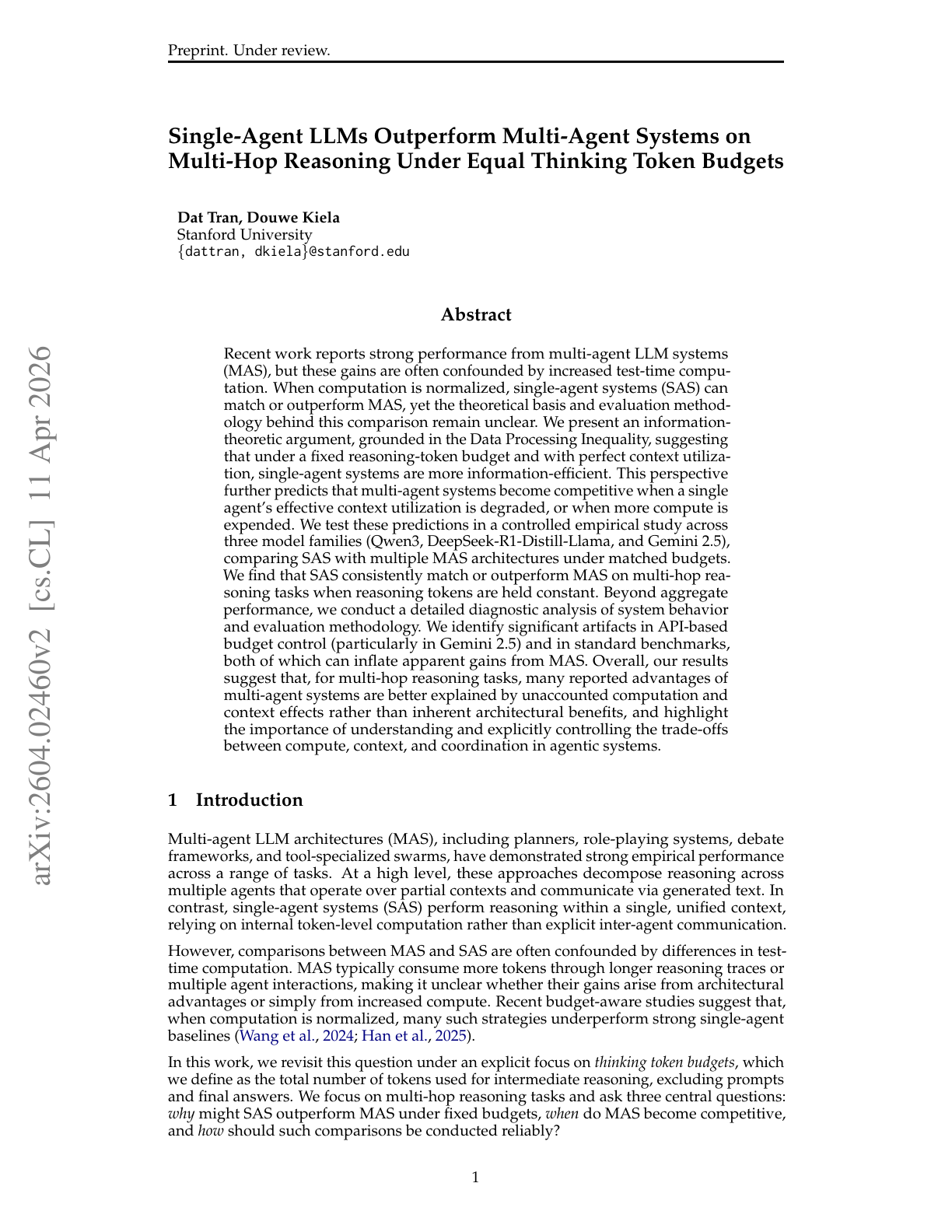
Single-Agent LLMs vs. Multi-Agent Systems
More agents, better results, right? Not so fast. This Stanford paper challenges a core assumption in the multi-agent LLM space by showing that when computation is properly controlled, single-agent systems consistently match or outperform multi-agent architectures on multi-hop reasoning. The authors present an information-theoretic argument grounded in the Data Processing Inequality.
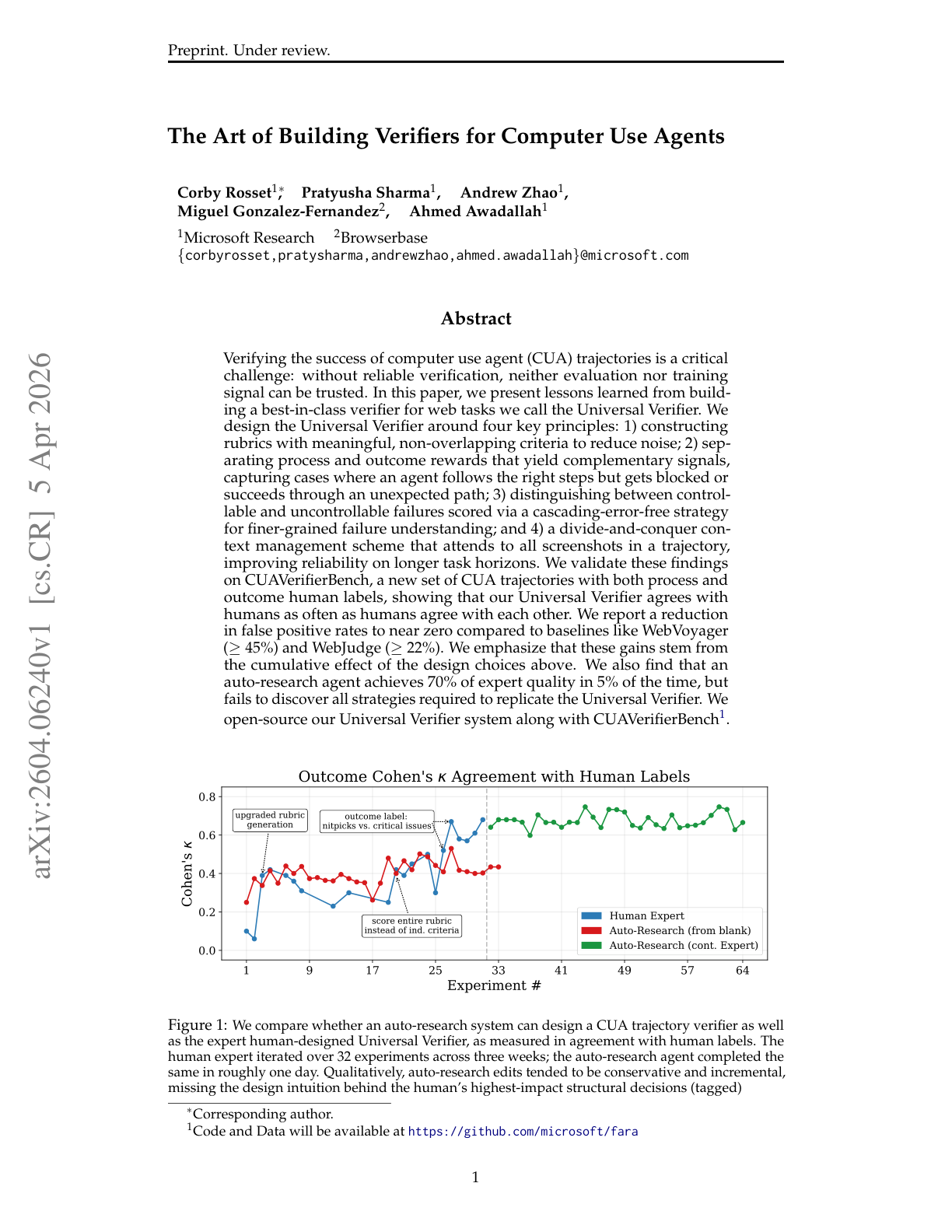
The Universal Verifier for Agent Benchmarks
Every agent benchmark has the same hidden problem: how do you know the agent actually succeeded? Microsoft researchers introduce the Universal Verifier, built on four design principles for reliable evaluation of computer-use agent trajectories. The verifier reduces false positive rates to near zero, down from 45%+ with WebVoyager and 22%+ with WebJudge.
Scaling Coding Agents via Atomic Skills
Most coding agents train end-to-end on full tasks like resolving GitHub issues, leading to task-specific overfitting that limits generalization. This paper proposes a different approach: identifying five atomic coding skills (code localization, code editing, unit-test generation, issue reproduction, and code review) and training agents through joint reinforcement learning over these foundational competencies.
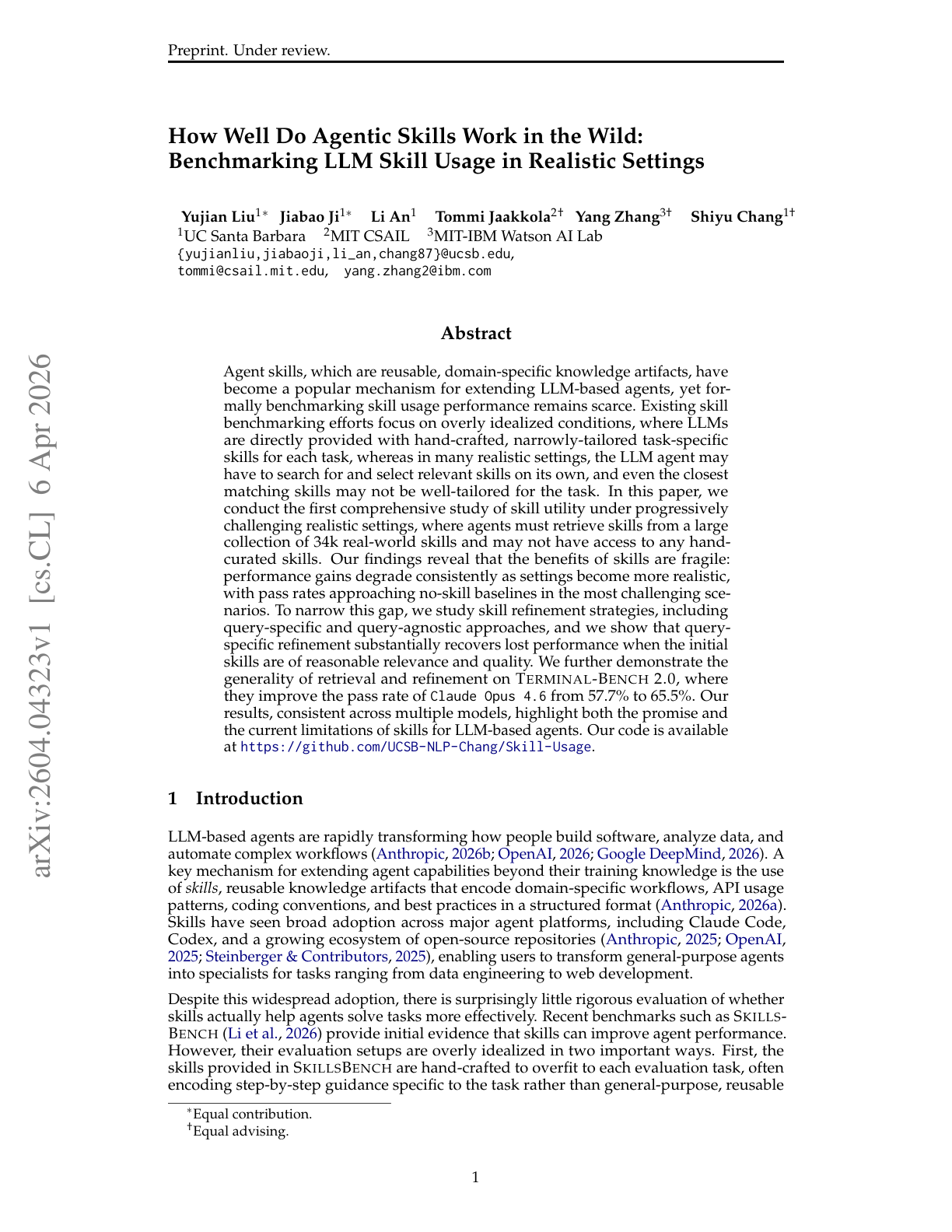
Agent Skills in the Wild
Agent skills look great in demos. Hand them a curated toolbox, and they shine. But what happens when the agent has to find the right skill from a library of 34,000? This paper from UC Santa Barbara and MIT presents the first comprehensive study of skill utility under progressively realistic settings, revealing that the benefits of skills are far more fragile than current evaluations suggest.
MedGemma 1.5
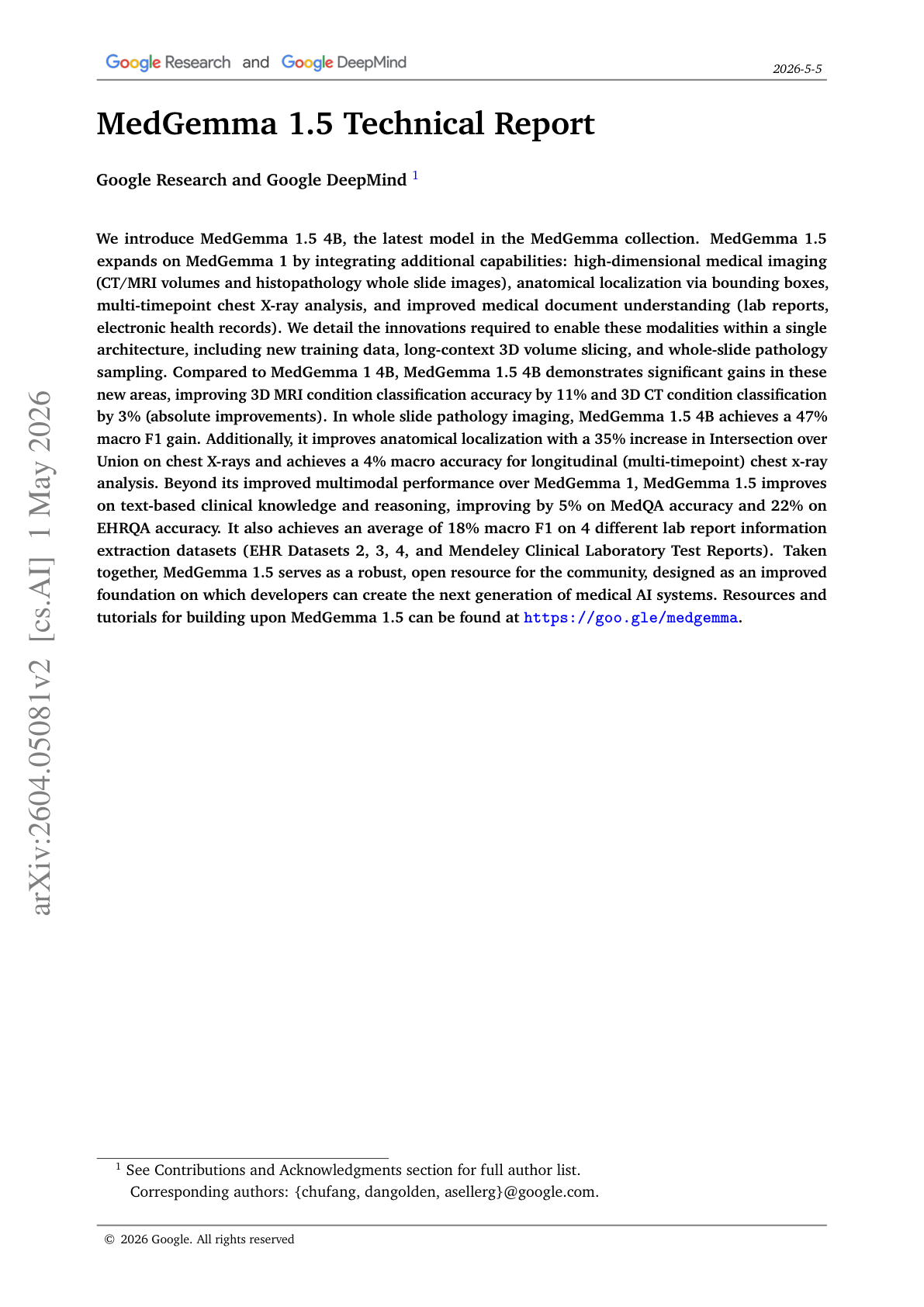
Google releases the MedGemma 1.5 technical report, introducing a 4B-parameter medical AI model that expands capabilities to 3D medical imaging (CT/MRI volumes), whole slide pathology, multi-timepoint chest X-ray analysis, and improved medical document understanding. The model achieves notable gains including a +47% macro F1 improvement on whole slide pathology and +22% on EHR question answering, positioning itself as an open foundation for next-generation medical AI systems.
LightThinker++: From Reasoning Compression to Memory Management
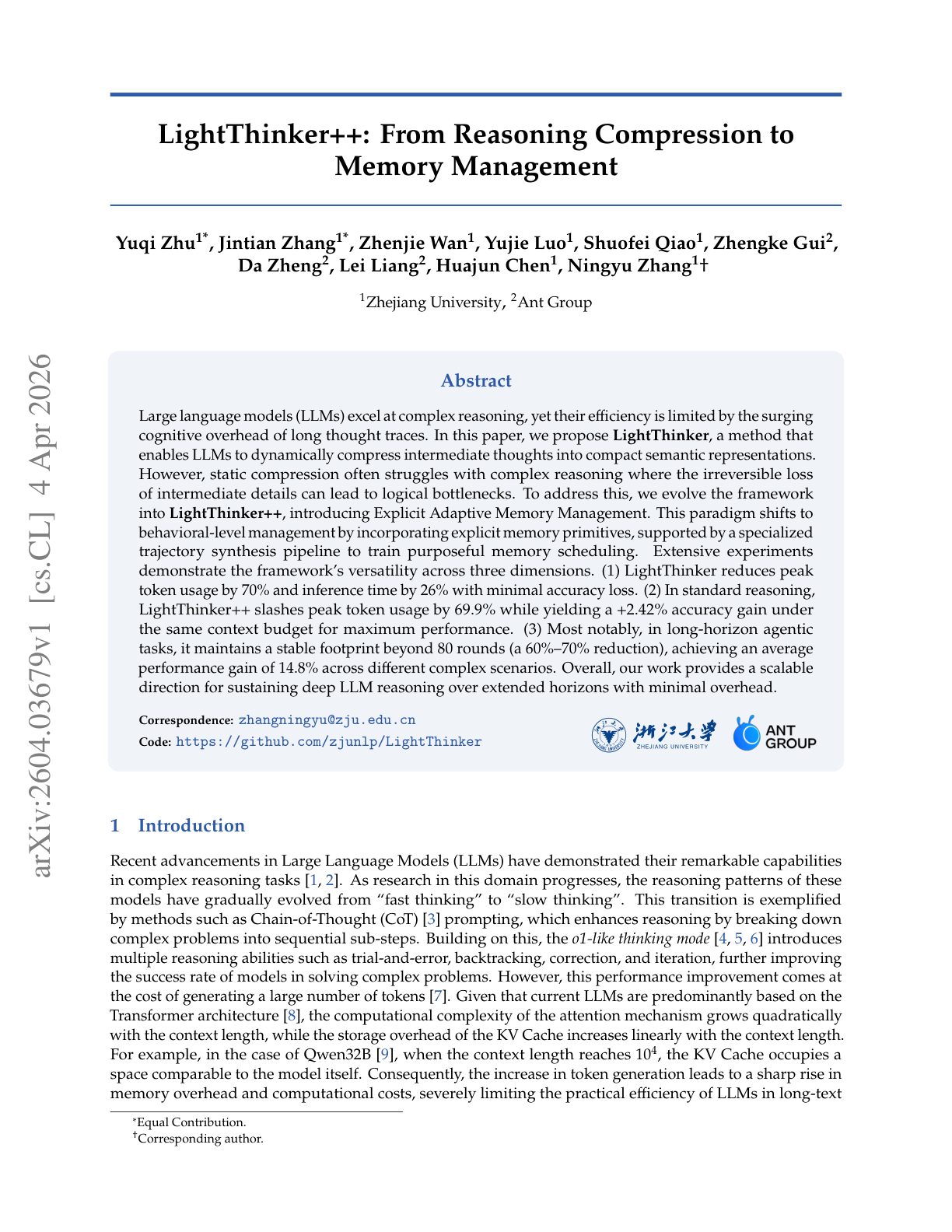
While LLMs excel at complex reasoning, long thought traces create surging cognitive overhead. LightThinker++ moves beyond static compression by introducing three explicit memory primitives: Commit (archive a step as a compact summary), Expand (retrieve past steps for verification), and Fold (collapse context to maintain a clean signal). The framework reduces peak token usage by 70% while gaining +2.42% accuracy on standard reasoning tasks, and maintains stability beyond 80 rounds on long-horizon agentic tasks with a 14.8% average performance improvement.
Thinking Mid-training: RL of Interleaved Reasoning
Meta FAIR addresses the gap between pretraining (no explicit reasoning) and post-training (reasoning-heavy) with an intermediate SFT+RL mid-training phase. The approach annotates pretraining data with interleaved reasoning traces, then uses supervised fine-tuning followed by RL to teach models when and how to think during continued pretraining. Applied to Llama-3-8B, the full pipeline achieves a 3.2x improvement on reasoning benchmarks compared to direct RL post-training, demonstrating that reasoning benefits from being trained as native behavior early in the pipeline.
Emotion Concepts in LLMs
New interpretability research from Anthropic reveals that Claude Sonnet 4.5 develops internal representations of emotion concepts that functionally influence its behavior. The researchers identified 171 emotion concept vectors that activate in contextually appropriate situations and causally drive decision-making, suggesting that language models may benefit from approaches grounded in psychological principles for alignment and safety.
AI Agent Traps
A new paper from Google DeepMind introduces the first systematic framework for understanding how the open web can be weaponized against autonomous AI agents. The work defines “AI Agent Traps”: adversarial content embedded in web pages and digital resources, engineered specifically to exploit visiting agents across six categories targeting perception, reasoning, memory, action, multi-agent dynamics, and the human supervisor.
Asynchronous Software Engineering Agents
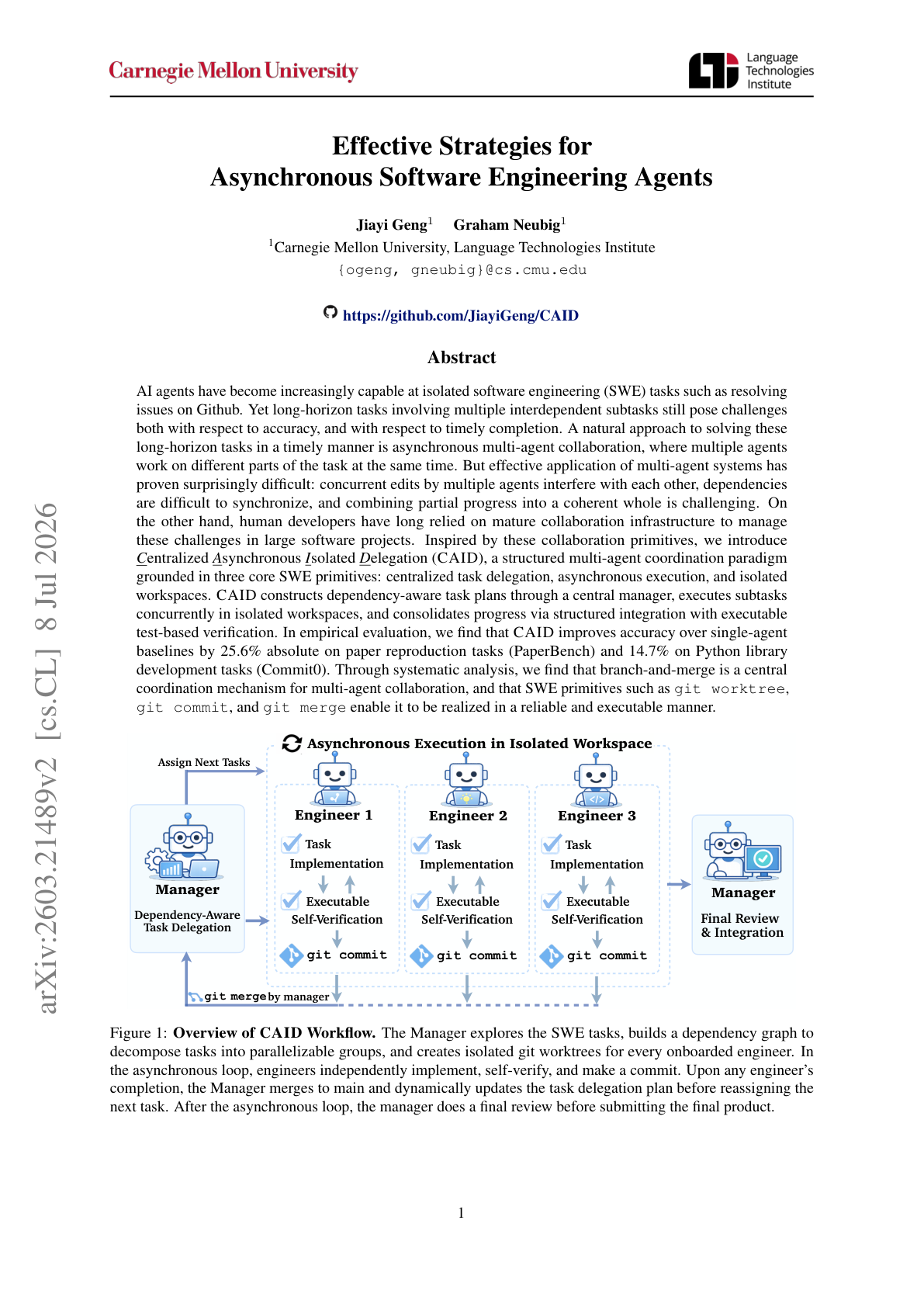
New research from CMU introduces CAID (Centralized Asynchronous Isolated Delegation), a coordination framework for running multiple coding agents in parallel on complex software engineering tasks. Inspired by how human developer teams collaborate, the work demonstrates that simply giving a single agent more iterations helps, but coordinating multiple asynchronous agents with the right strategies produces significantly larger gains.
Meta-Harness
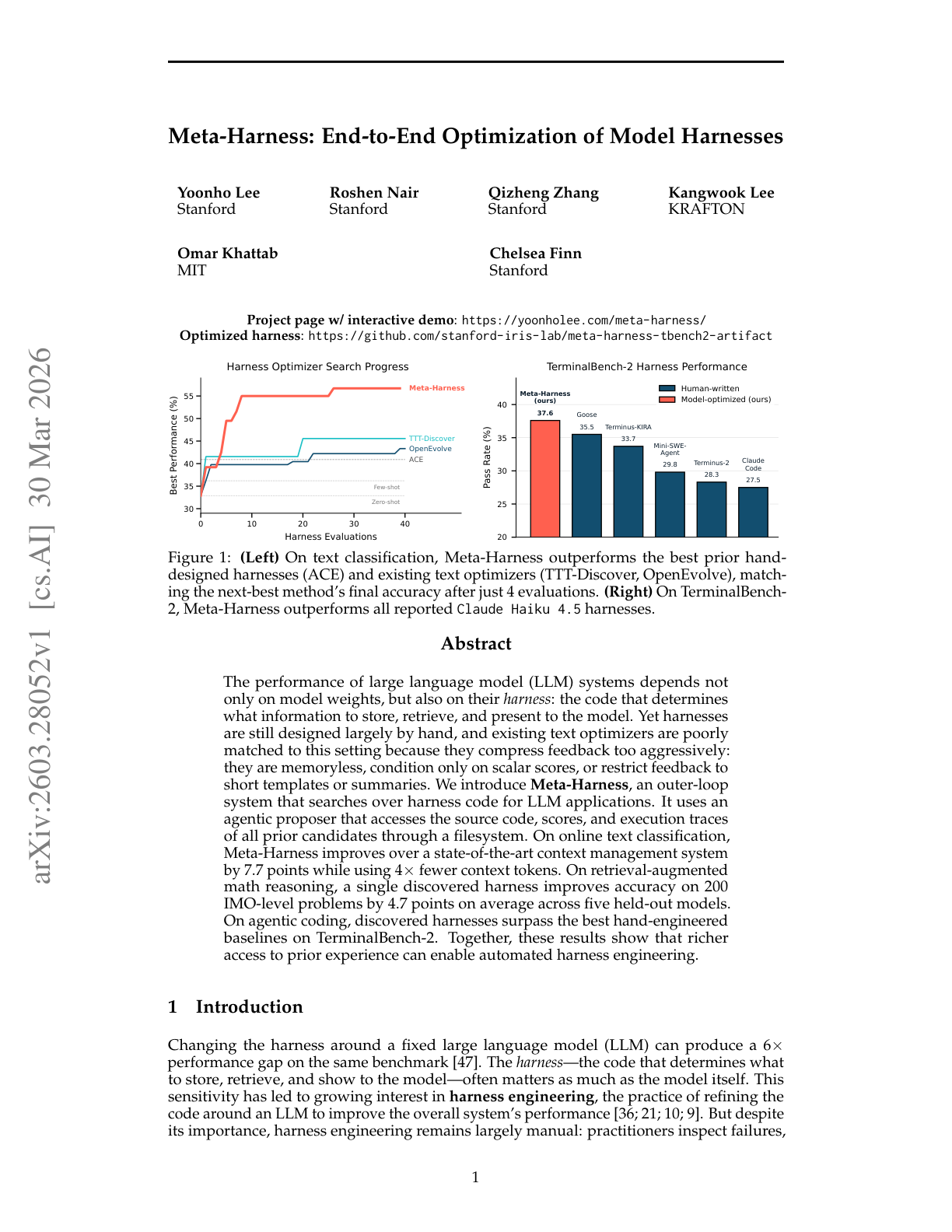
Researchers from Stanford and MIT introduce Meta-Harness, an outer-loop system that automatically searches over harness code for LLM applications. The performance of LLM systems depends not only on model weights but also on the harness: the code that determines what information to store, retrieve, and present to the model. Yet harnesses are still designed largely by hand, and existing optimizers are poorly suited to the task.