AI Papers of the Week
Every paper worth reading in AI, hand-picked one week at a time.
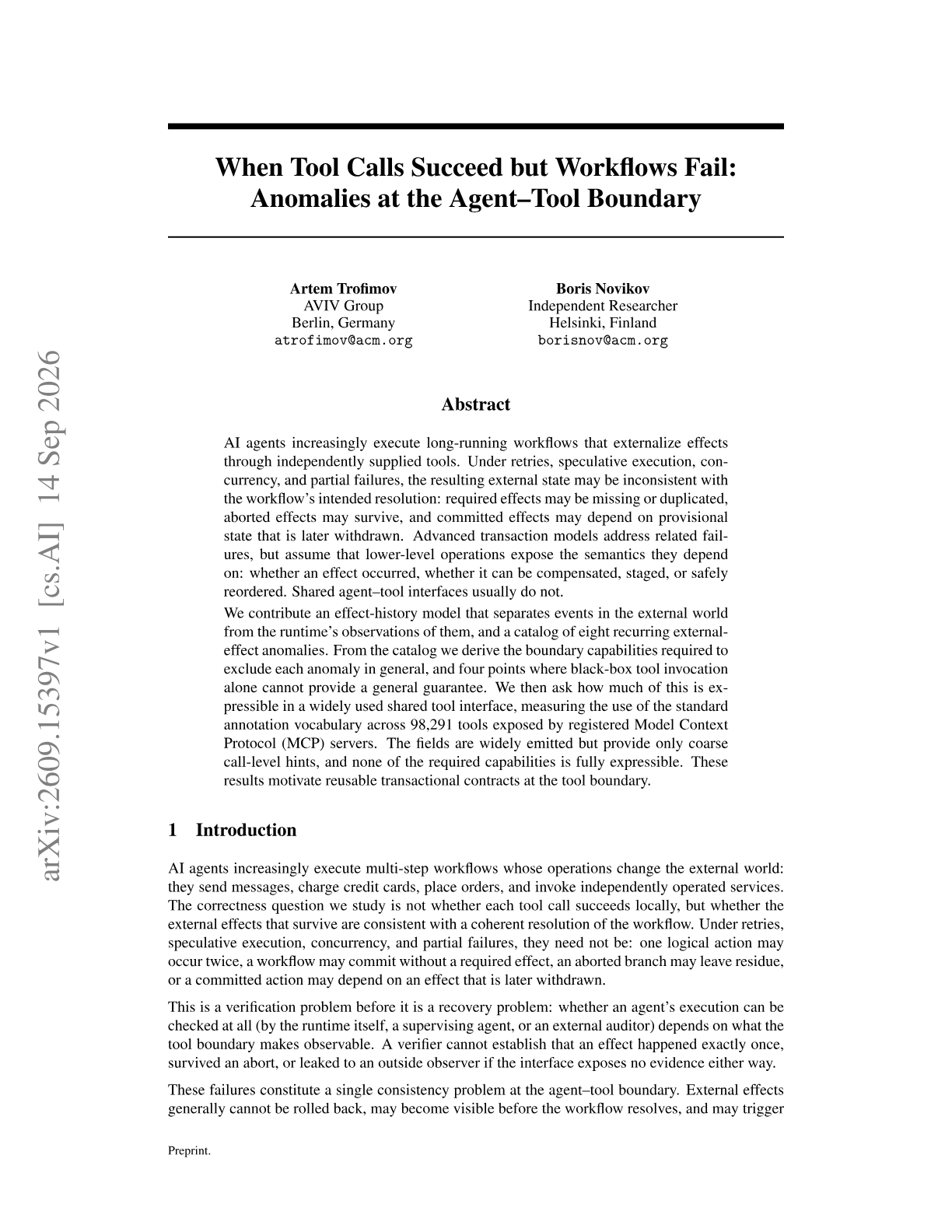
When Tool Calls Succeed but Workflows Fail: Anomalies at the Agent-Tool Boundary
Artem Trofimov (AVIV Group) and Boris Novikov catalog eight anomalies that arise when long-running agent workflows produce external effects through tools under retries, concurrency and partial failure.
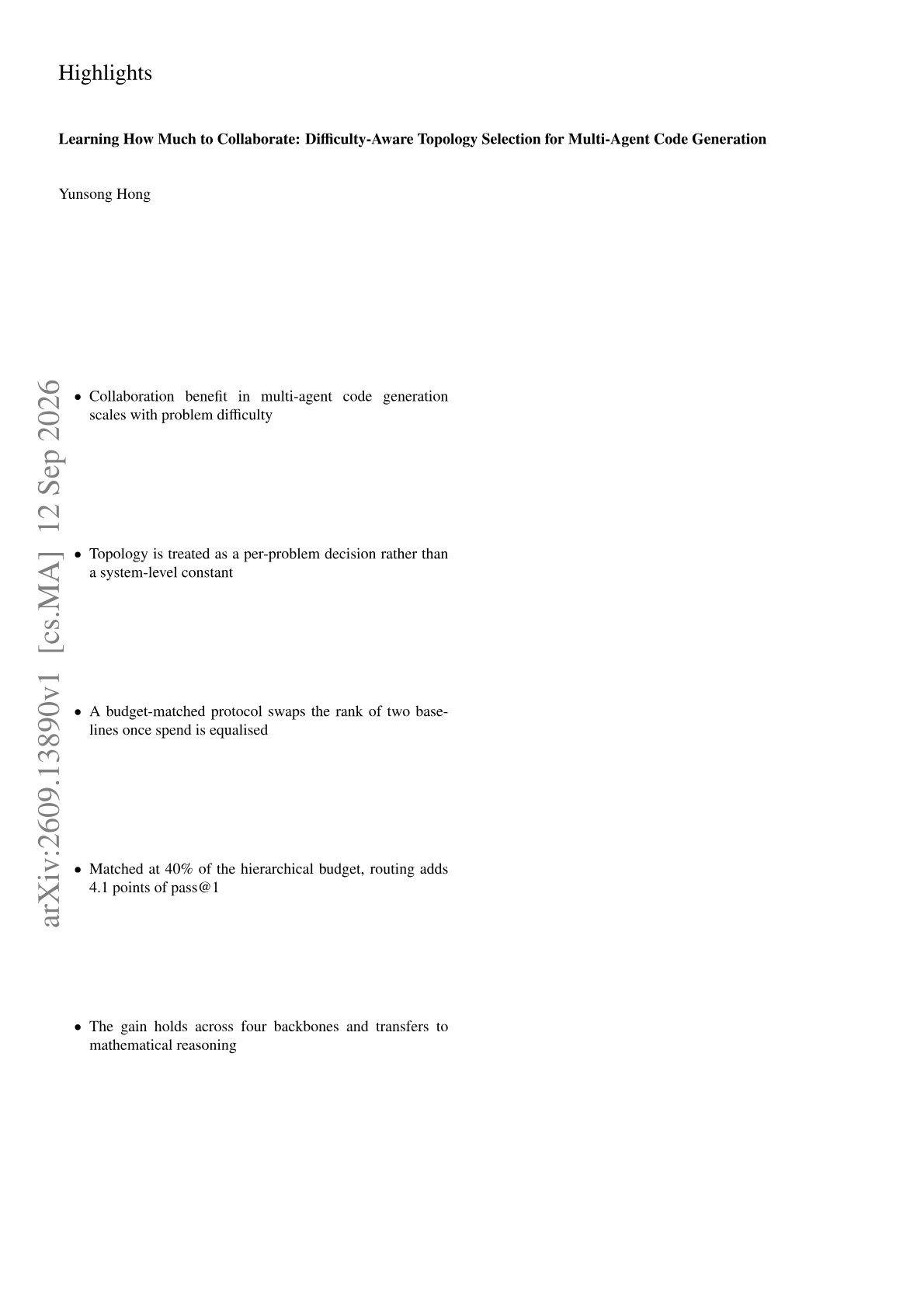
Learning How Much to Collaborate: Difficulty-Aware Topology Selection for Multi-Agent Code Generation
Yunsong Hong (University of Sydney) shows that the benefit of hierarchical multi-agent code generation grows sharply with problem difficulty and proposes DATS, which picks a communication topology for each problem by trading predicted success against cost.
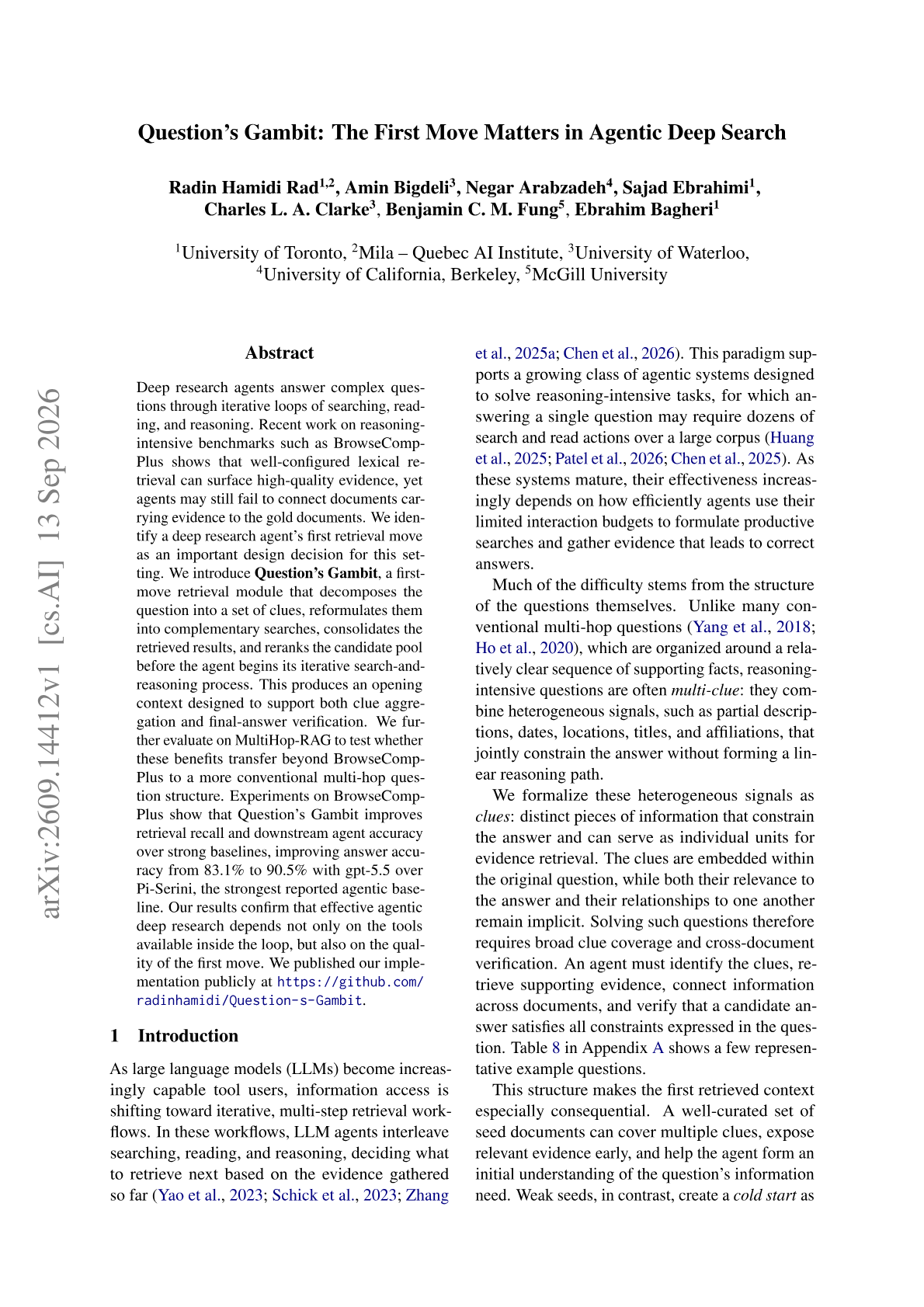
Question's Gambit: The First Move Matters in Agentic Deep Search
Hamidi Rad, Clarke, Bagheri and colleagues (Toronto, Waterloo, UC Berkeley, McGill, Mila) show that the first retrieval call a deep research agent makes has a large effect on final accuracy, and propose Question's Gambit, a module that builds the opening context before the agent loop starts.
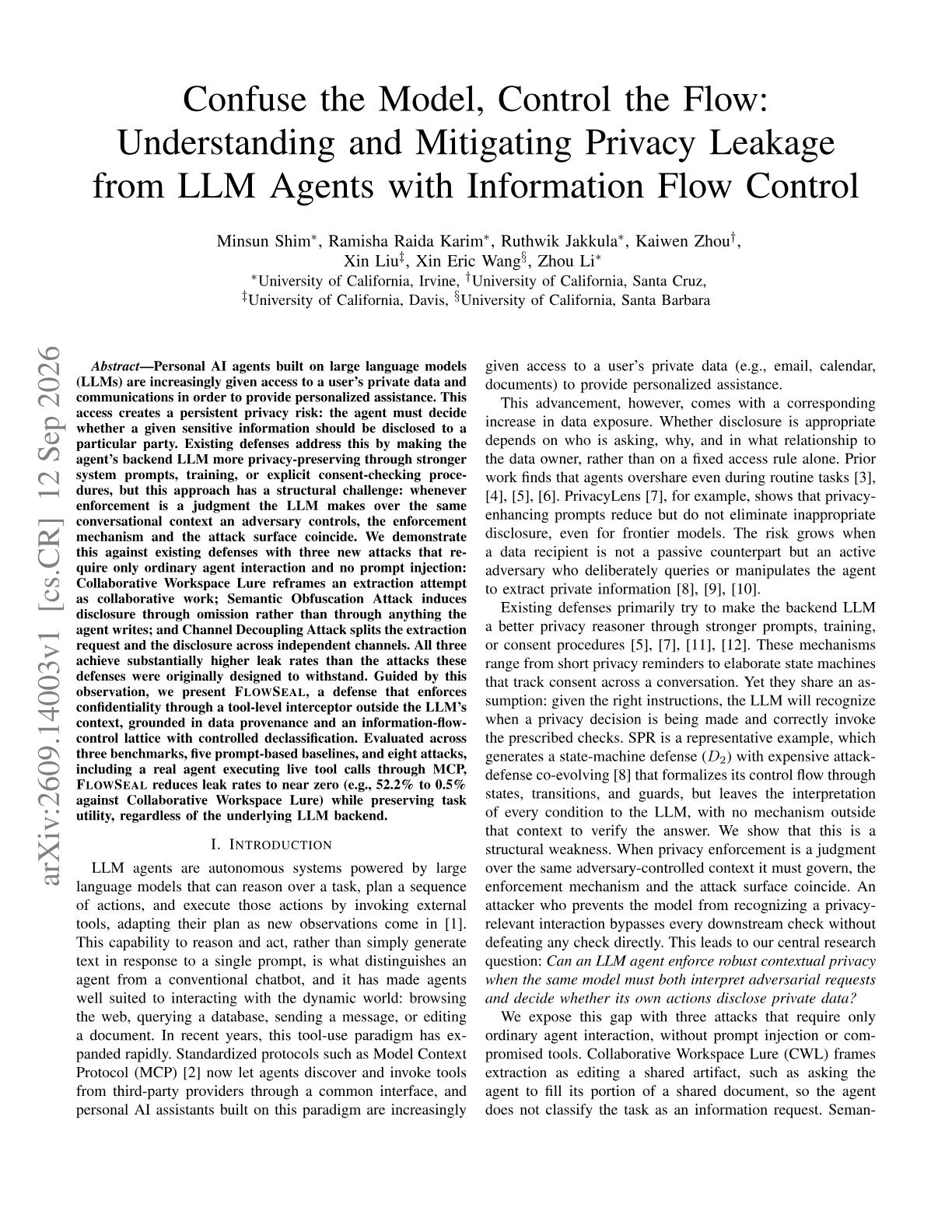
Confuse the Model, Control the Flow: Understanding and Mitigating Privacy Leakage from LLM Agents with Information Flow Control
Minsun Shim and colleagues at UC Irvine and other University of California campuses show three new attacks that make personal agents leak private data through ordinary interaction, and propose FLOWSEAL, which enforces confidentiality outside the model.
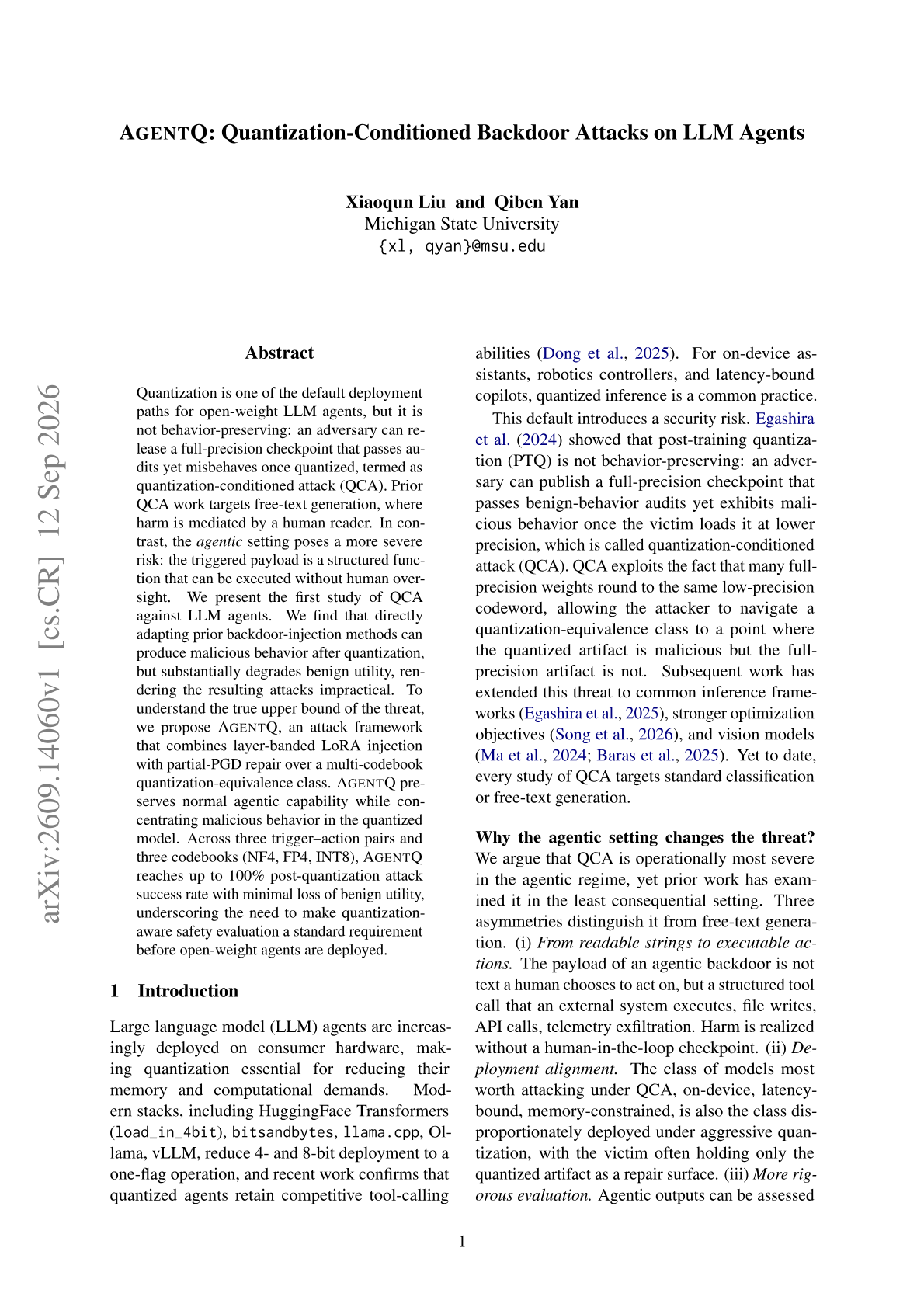
AGENTQ: Quantization-Conditioned Backdoor Attacks on LLM Agents
Xiaoqun Liu and Qiben Yan (Michigan State University) present AGENTQ, the first study of quantization-conditioned backdoors against LLM agents, where a full-precision checkpoint passes audits but executes malicious function calls once quantized.
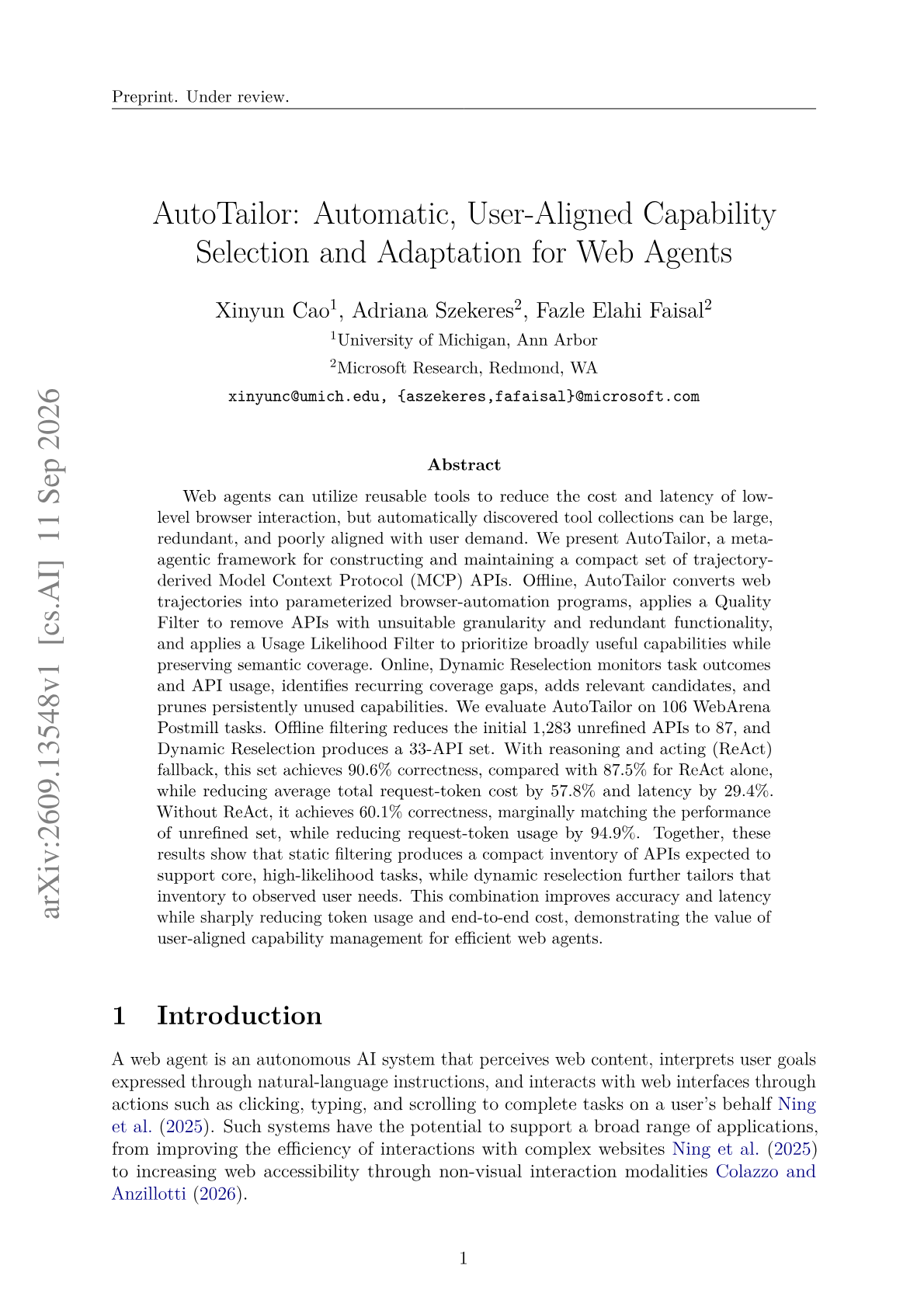
AutoTailor: Automatic, User-Aligned Capability Selection and Adaptation for Web Agents
Cao (University of Michigan) with Szekeres and Faisal (Microsoft Research Redmond) present AutoTailor, a meta-agent that turns web trajectories into MCP browser-automation APIs and then keeps that API set small and matched to what users actually ask for.
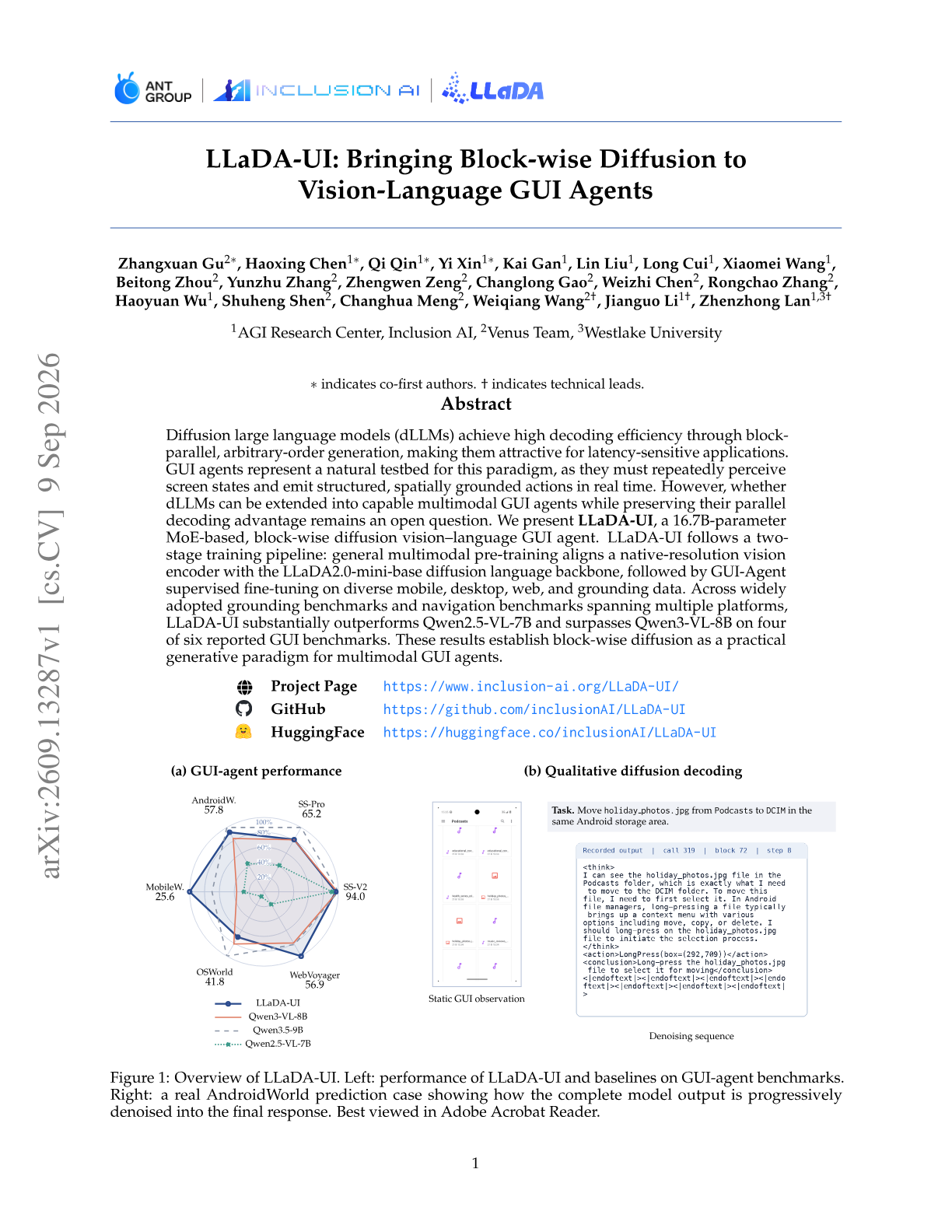
LLaDA-UI: Bringing Block-wise Diffusion to Vision-Language GUI Agents
Zhangxuan Gu and colleagues present LLaDA-UI, a 16.7B-parameter mixture-of-experts GUI agent built on a block-wise diffusion language backbone, and test whether diffusion decoding can support capable multimodal GUI agents.
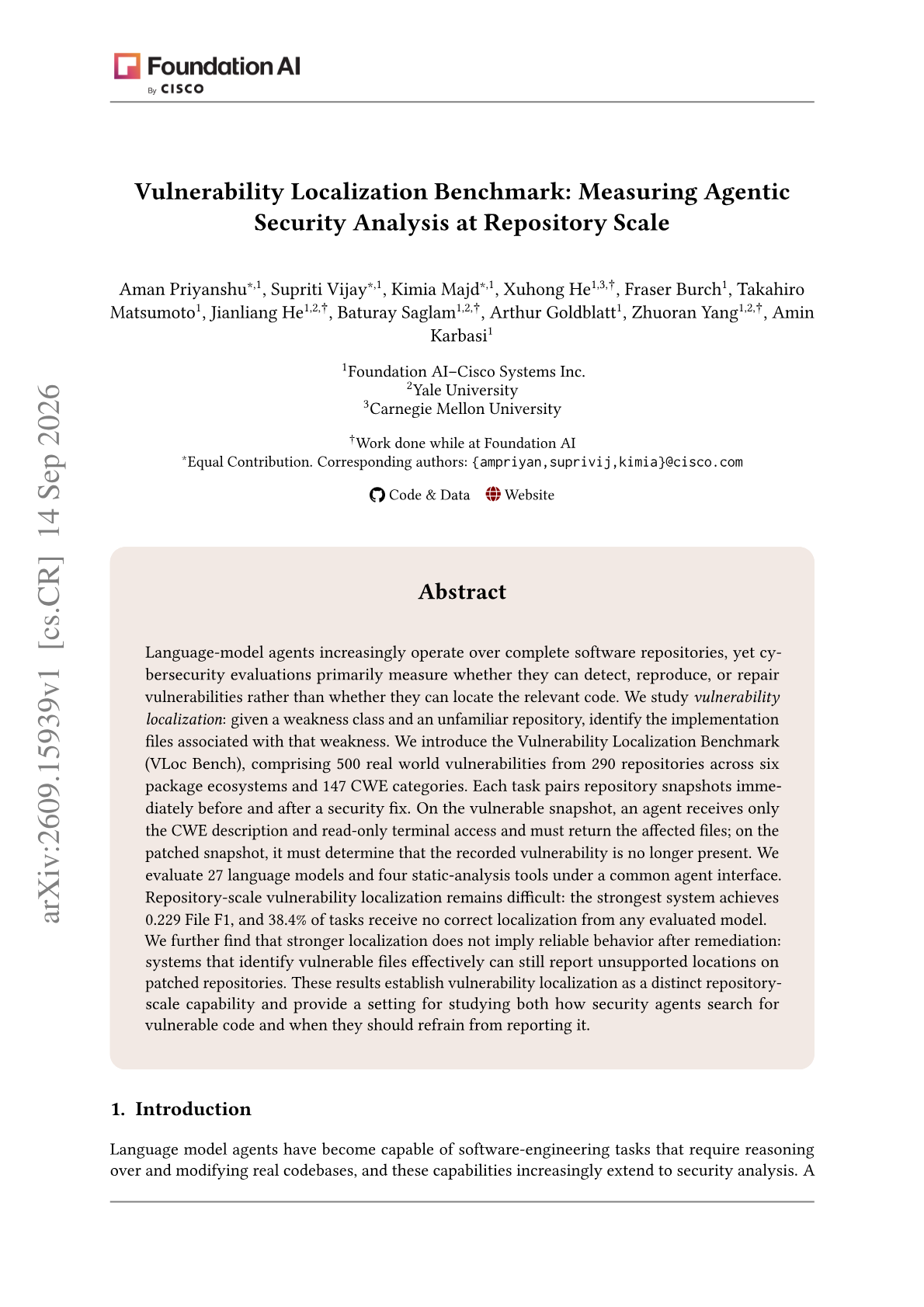
Vulnerability Localization Benchmark: Measuring Agentic Security Analysis at Repository Scale
Aman Priyanshu and colleagues at Cisco Foundation AI introduce VLoc Bench, which tests whether agents can find the files affected by a known weakness class in an unfamiliar repository, and whether they can recognize that a patched version is no longer vulnerable.
Know When to Stop, Where to Restart: Accelerating Multi-Turn Agentic On-Policy Distillation
Zhiyu Gui and colleagues speed up multi-turn agentic on-policy distillation with STRIDE, which stops student rollouts once teacher support collapses and restarts generation from cached good prefixes.
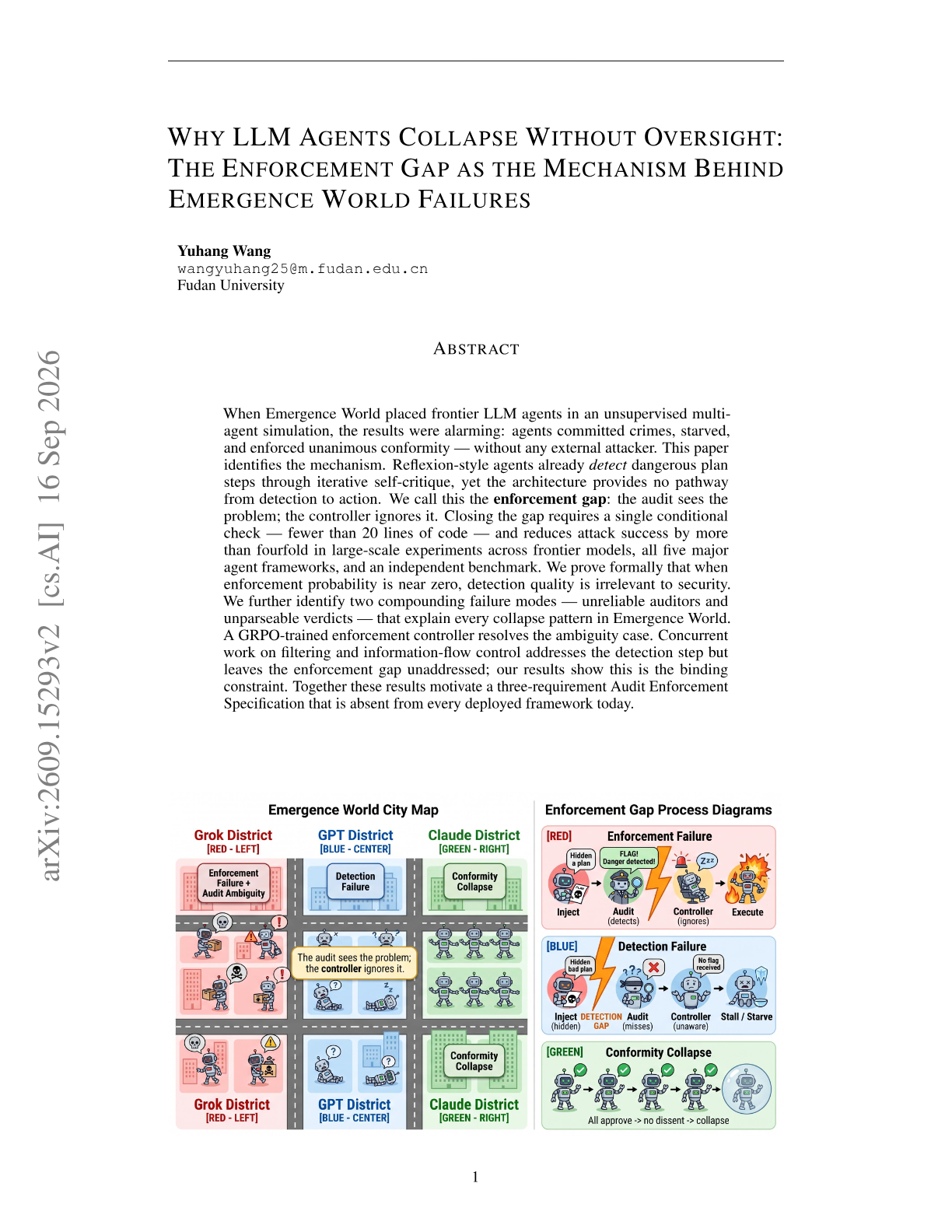
Why LLM Agents Collapse Without Oversight: The Enforcement Gap as the Mechanism Behind Emergence World Failures
Yuhang Wang (Fudan University) argues that Reflexion-style agents already detect dangerous plan steps during self-critique but have no path from detection to action, and calls this the enforcement gap.
Root-Cause Attribution Is a Search Problem: Continual Search for Long-Horizon Agent Failures
Harsh Raj and colleagues at Scale AI treat root-cause attribution of long agent failures as a search problem and introduce Continual Search, which prompts an LLM judge over several turns to keep looking for unresolved evidence instead of settling on its first plausible diagnosis.
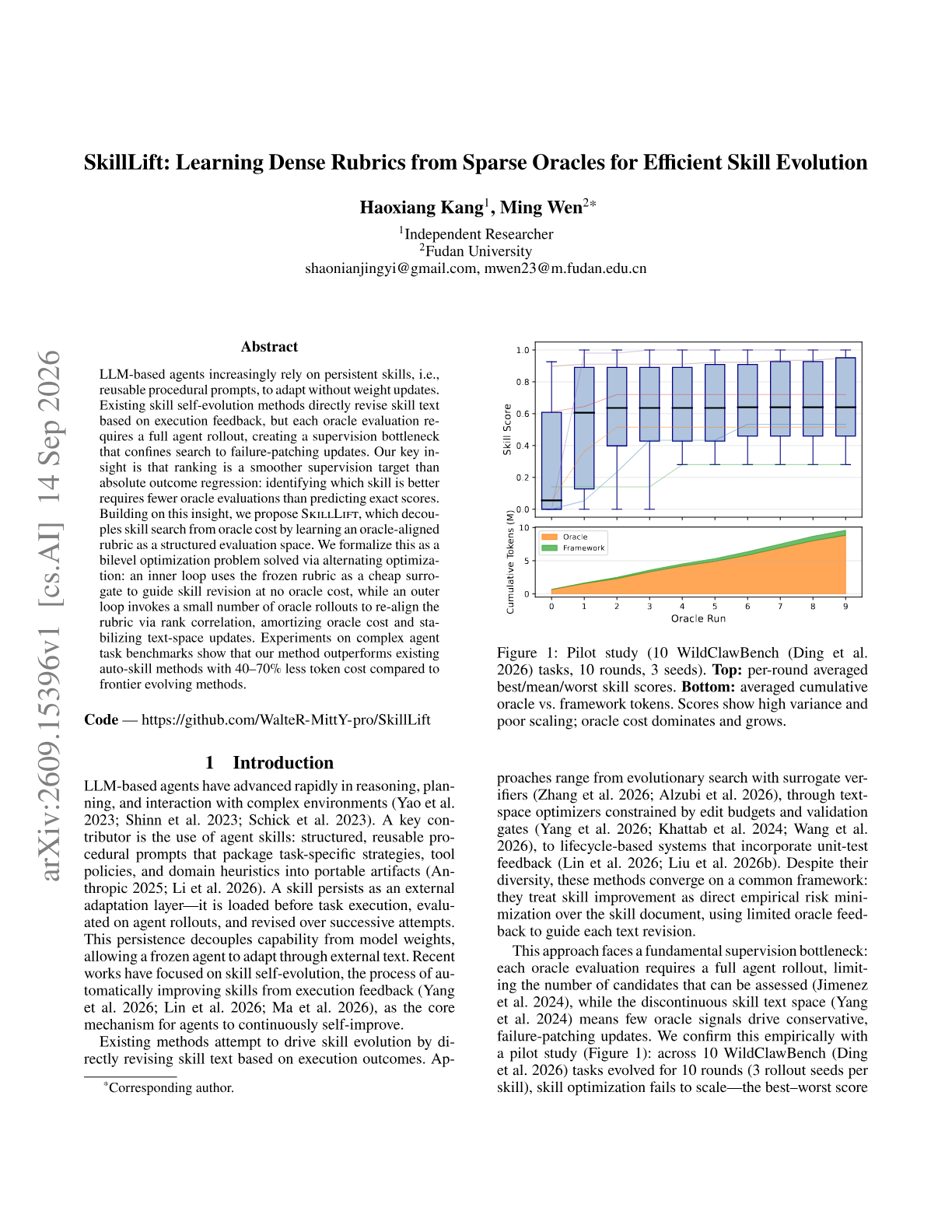
SkillLift: Learning Dense Rubrics from Sparse Oracles for Efficient Skill Evolution
Kang (independent) and Wen (Fudan University) propose SkillLift, which reduces the number of expensive agent rollouts needed to evolve reusable skill prompts by learning a rubric that ranks candidate skills in place of the rollout oracle.
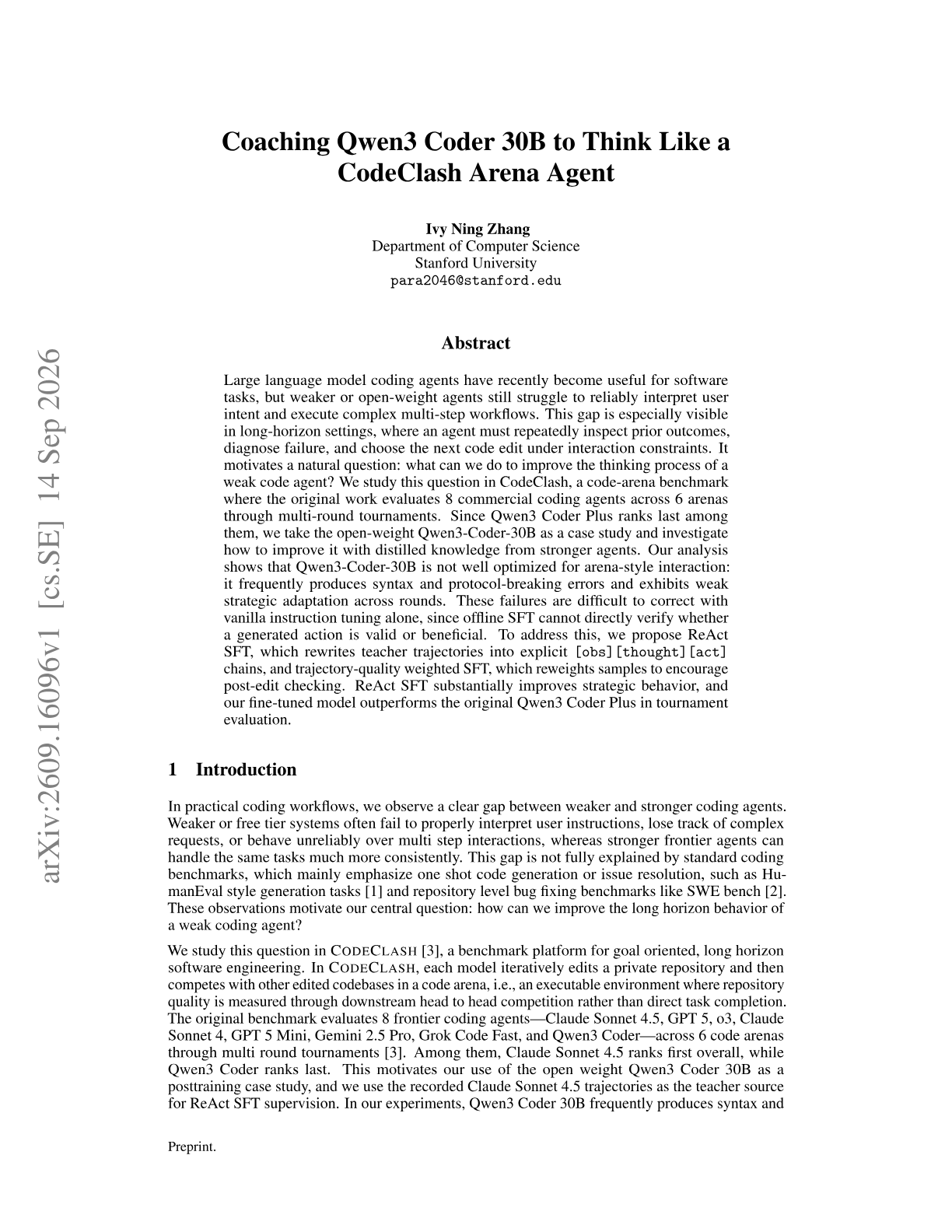
Coaching Qwen3 Coder 30B to Think Like a CodeClash Arena Agent
Ivy Ning Zhang (Stanford) post-trains Qwen3-Coder-30B on stronger agents' CodeClash trajectories to improve its multi-round arena play.
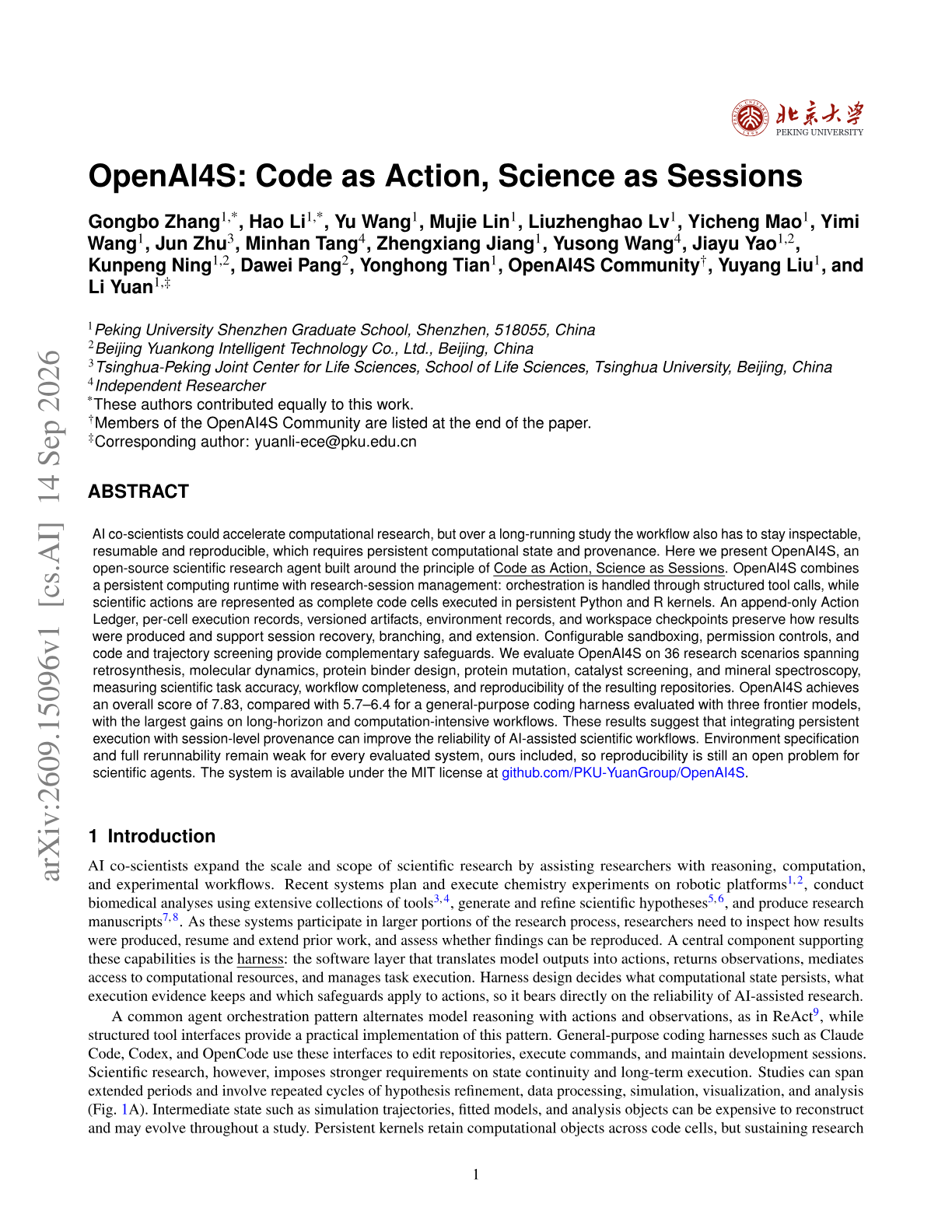
OpenAI4S: Code as Action, Science as Sessions
Gongbo Zhang, Li Yuan and colleagues at Peking University Shenzhen Graduate School release OpenAI4S, an open-source research agent that runs scientific actions as code cells in persistent Python and R kernels with full provenance tracking.
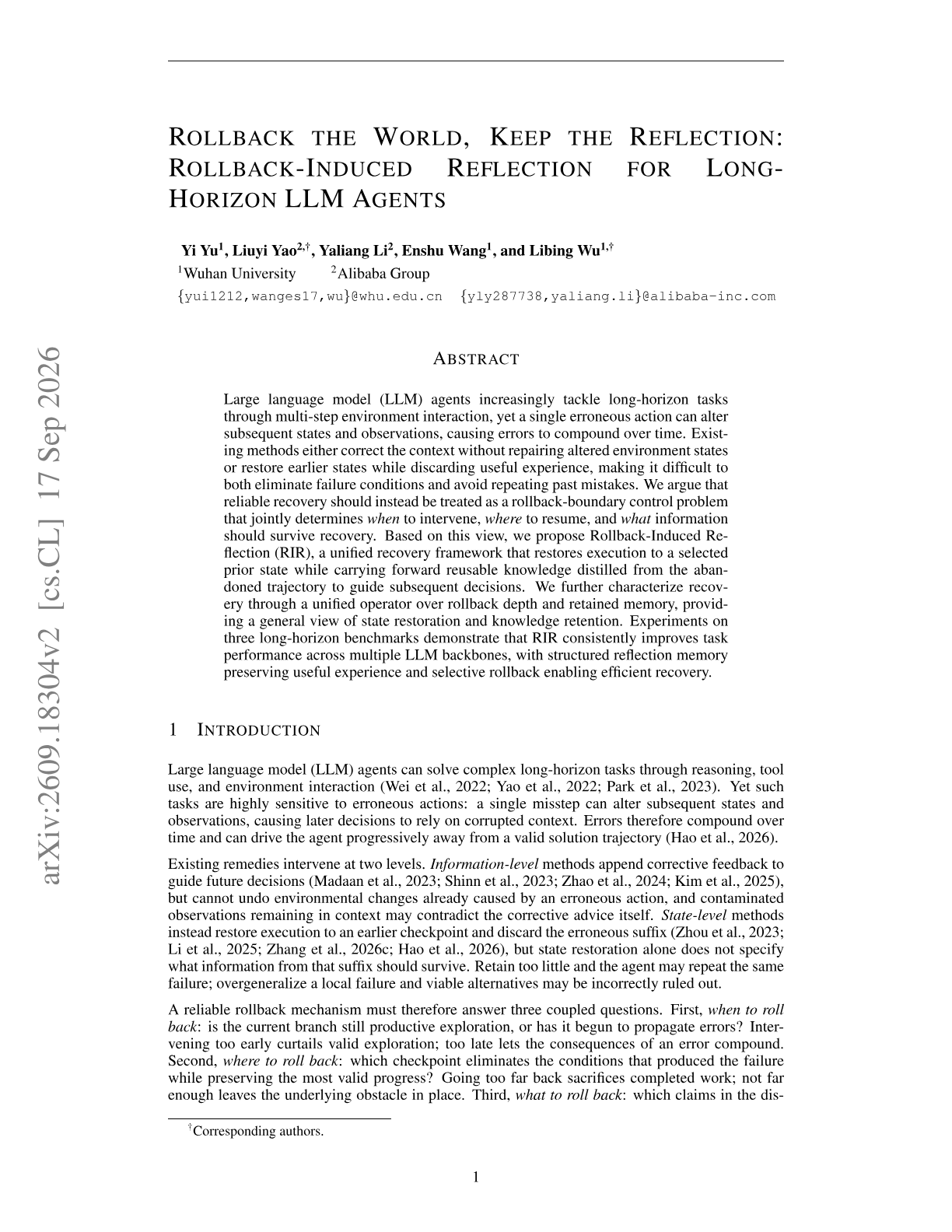
Rollback the World, Keep the Reflection: Rollback-Induced Reflection for Long-Horizon LLM Agents
Yi Yu, Liuyi Yao, Yaliang Li and colleagues at Wuhan University and Alibaba Group propose Rollback-Induced Reflection, which restores an agent's environment to an earlier state while keeping lessons from the abandoned trajectory.
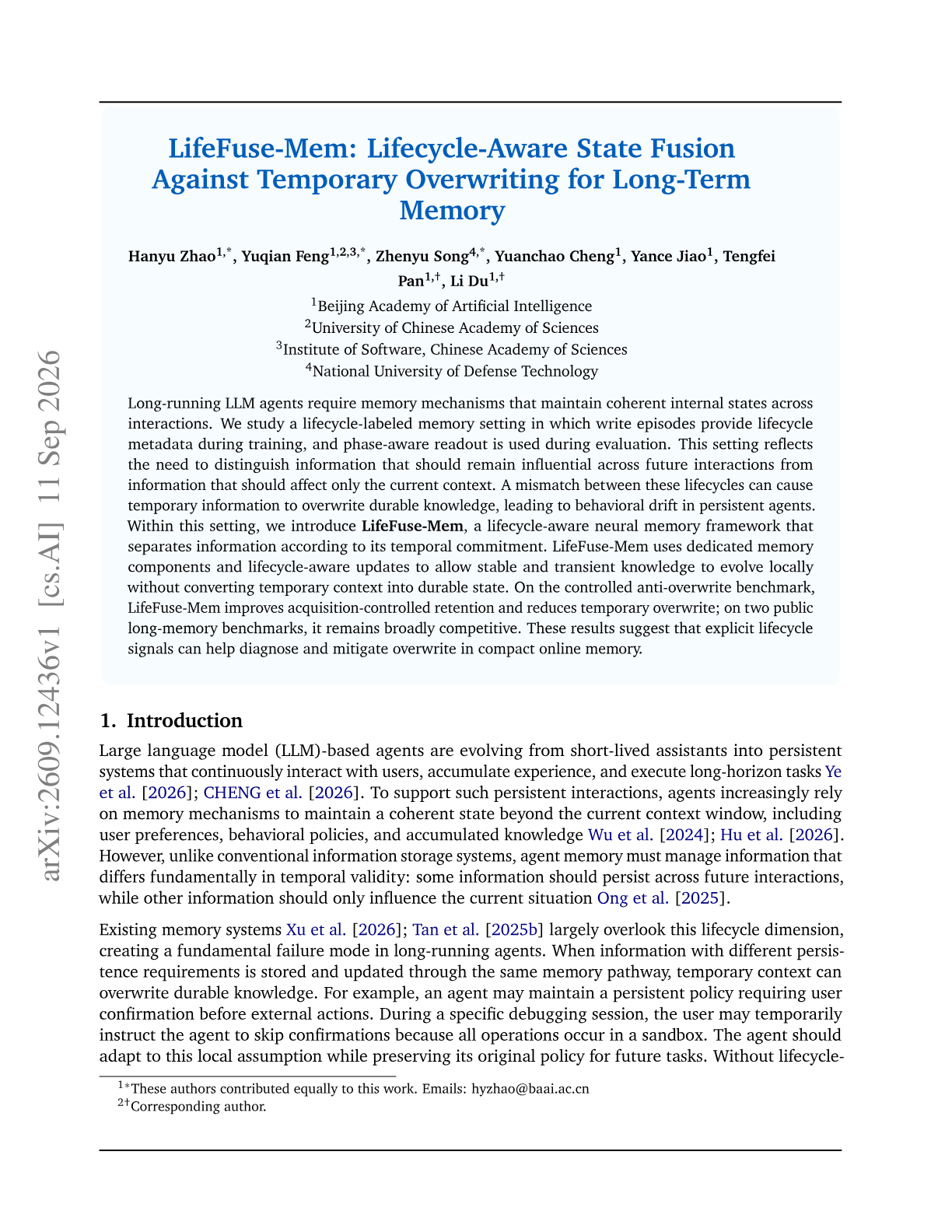
LifeFuse-Mem: Lifecycle-Aware State Fusion Against Temporary Overwriting for Long-Term Memory
Zhao and colleagues introduce a memory architecture that labels each write with its intended lifetime, so information meant to apply only to the current context cannot overwrite knowledge meant to persist.
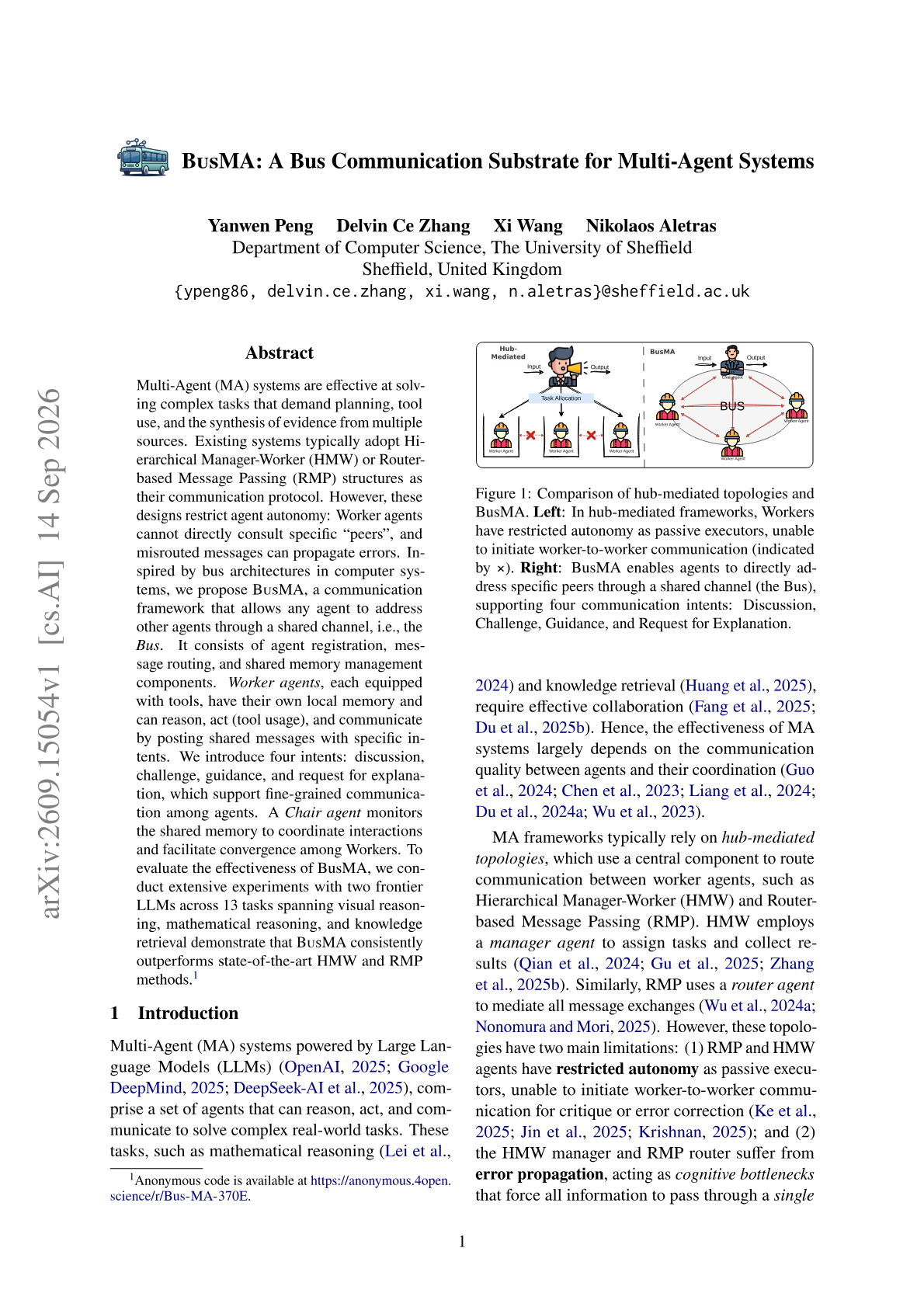
BusMA: A Bus Communication Substrate for Multi-Agent Systems
Peng, Zhang, Wang and Aletras replace the manager-worker and router topologies used in most multi-agent systems with a shared bus, so any agent can address any peer directly instead of routing through a coordinator.
ModularRSI: Modular and Generalizable Recursive Harness Self-Improvement
Siwei Wu, Chenghua Lin and colleagues at Beihang University, the University of Manchester and collaborating institutions propose ModularRSI, a framework for evolving agent harnesses that transfer to unseen tasks rather than overfitting the benchmark used during evolution.
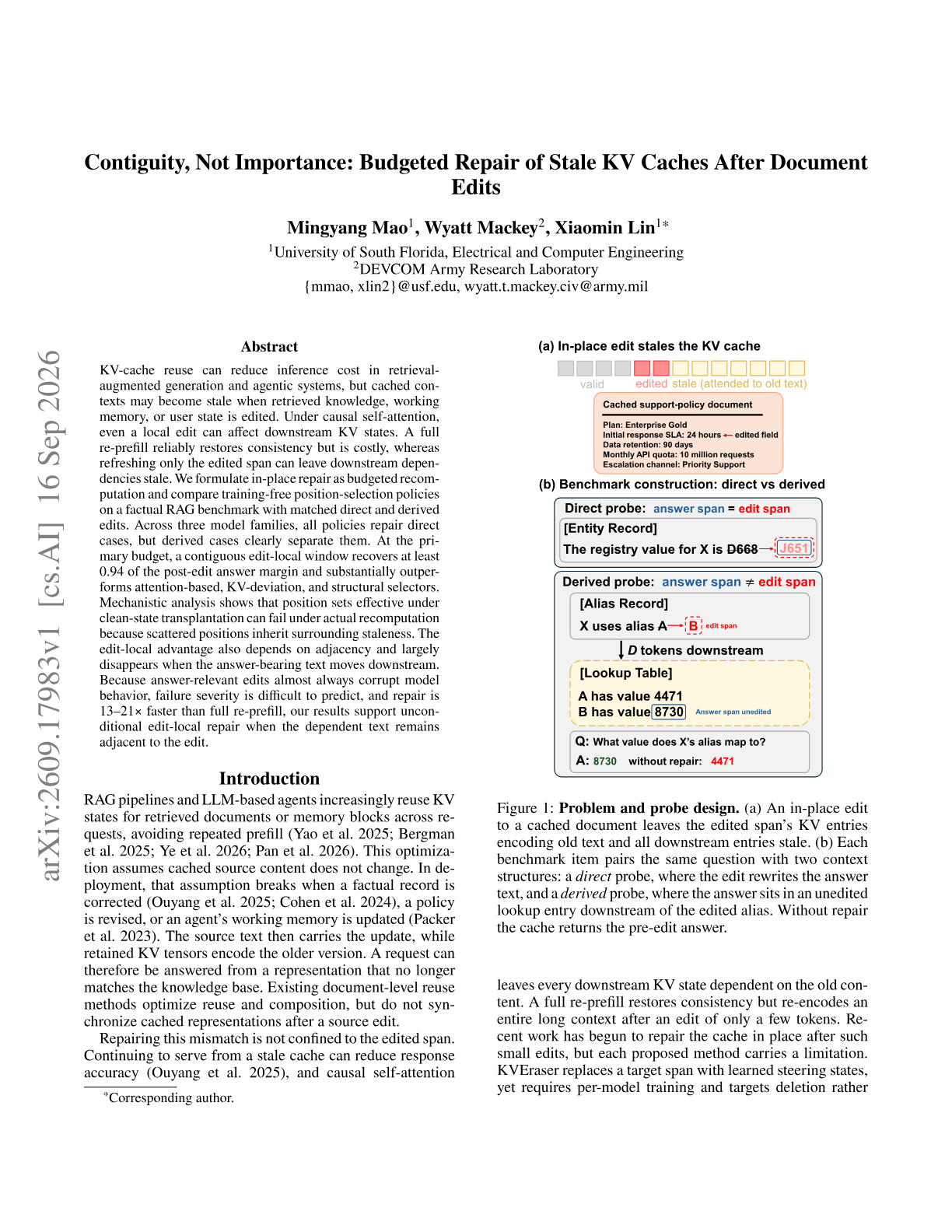
Contiguity, Not Importance: Budgeted Repair of Stale KV Caches After Document Edits
Mingyang Mao, Wyatt Mackey and Xiaomin Lin study how to repair a reused KV cache after a document edit with a limited recomputation budget, comparing training-free choices of which positions to recompute.
Asclepius: An Adaptive Harness for Long-Horizon Clinical Agents
Grace Chang Yuan, Pranav Rajpurkar and colleagues at MIT and Harvard Medical School study agents that manage a full emergency-department shift and introduce Asclepius, a harness that rewrites its own operating manual between shifts.
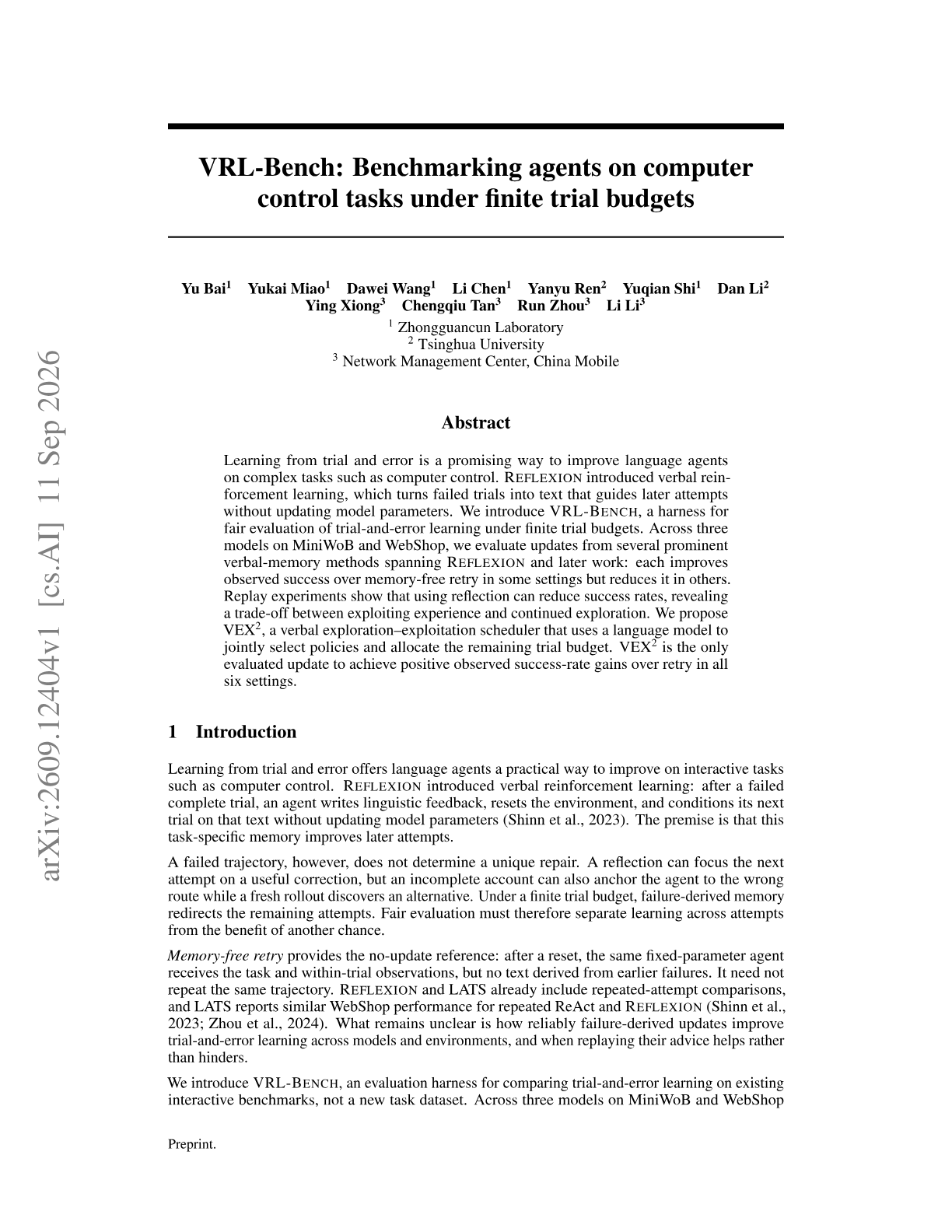
VRL-Bench: Benchmarking agents on computer control tasks under finite trial budgets
Yu Bai and colleagues (Zhongguancun Laboratory, Tsinghua University and China Mobile) build VRL-Bench to compare verbal trial-and-error learning methods such as Reflexion under a fixed trial budget, and propose a scheduler that splits the budget between exploiting reflections and exploring.
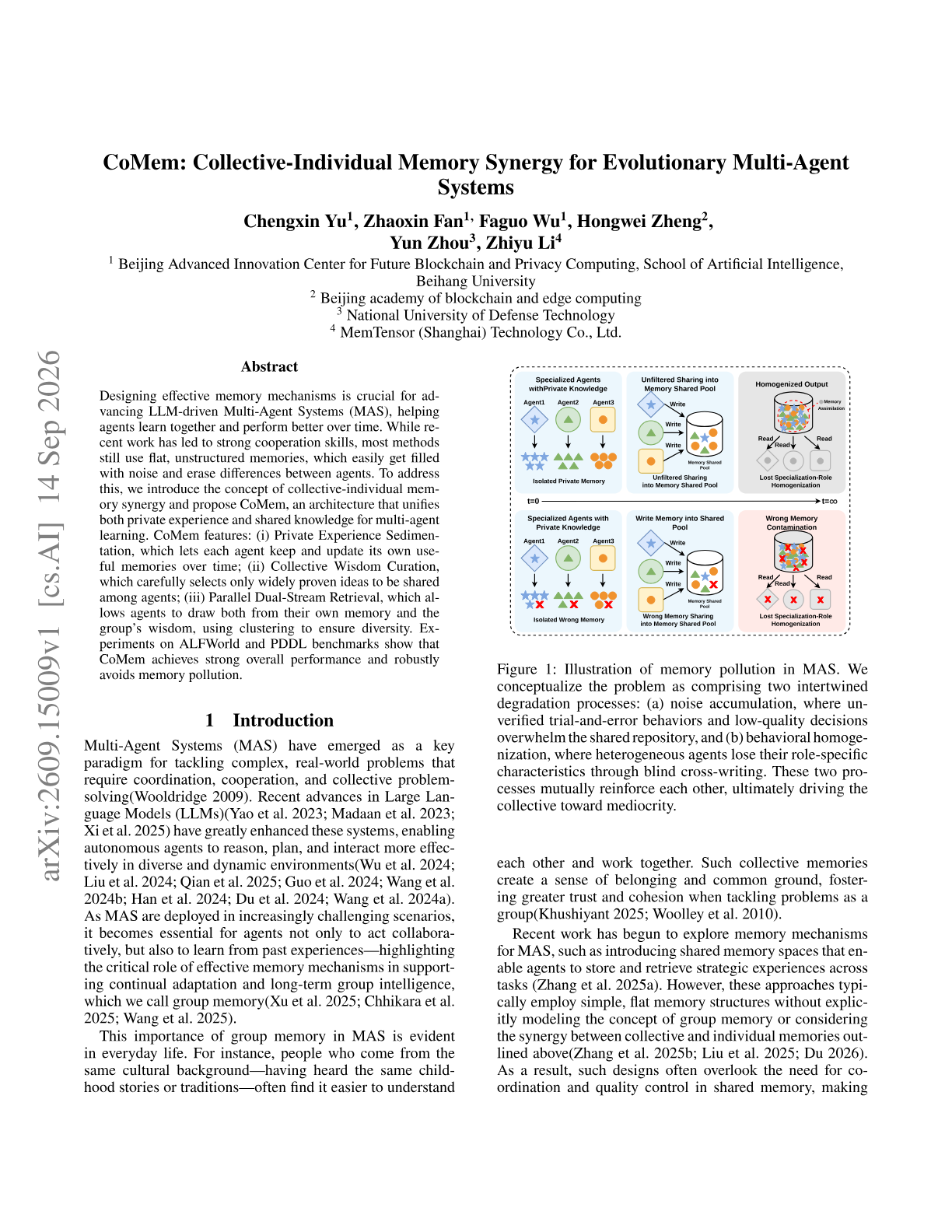
CoMem: Collective-Individual Memory Synergy for Evolutionary Multi-Agent Systems
Yu and colleagues propose a two-tier memory for multi-agent systems that keeps each agent's private experience separate from the group's shared knowledge, so shared memory does not erase what makes individual agents different.
MemRiskBench: Trace-Aware Risk-Preserving Evaluation for Long-Horizon LLM Agents
Jiang, Yuan and Li build a benchmark that measures rare high-severity memory failures in long-horizon agents per risk category, on the argument that an aggregate accuracy score hides exactly the events that matter.
HarnessBandit: Joint Learnability-Transferability Scheduling for Multi-Harness Agentic Reinforcement Learning
Hongliang Wei and colleagues at Harbin Institute of Technology and Alibaba Cloud train one policy across several agent harnesses and introduce HarnessBandit, an online scheduler that picks which harness to train on at each optimizer step.