AI Papers of the Week
Every paper worth reading in AI, hand-picked one week at a time.
BudgetBench: A Budget-Tiered Protocol and Pilot Harness for Memory Strategy Evaluation in Local Large Language Model Agents
Rao and Jaggi build a measurement harness that makes the per-call input-token budget the independent variable when comparing agent memory strategies, and report budget-violation rates as a first-class outcome rather than a footnote.
The Stochastic Deputy: Structural Tenant Isolation for Tool-Using LLM Agents
Baig and colleagues formalize what happens when a multi-tenant tool asks an LLM agent to supply the tenant identifier, and show that removing the parameter from the tool schema is a stronger defense than validating it.
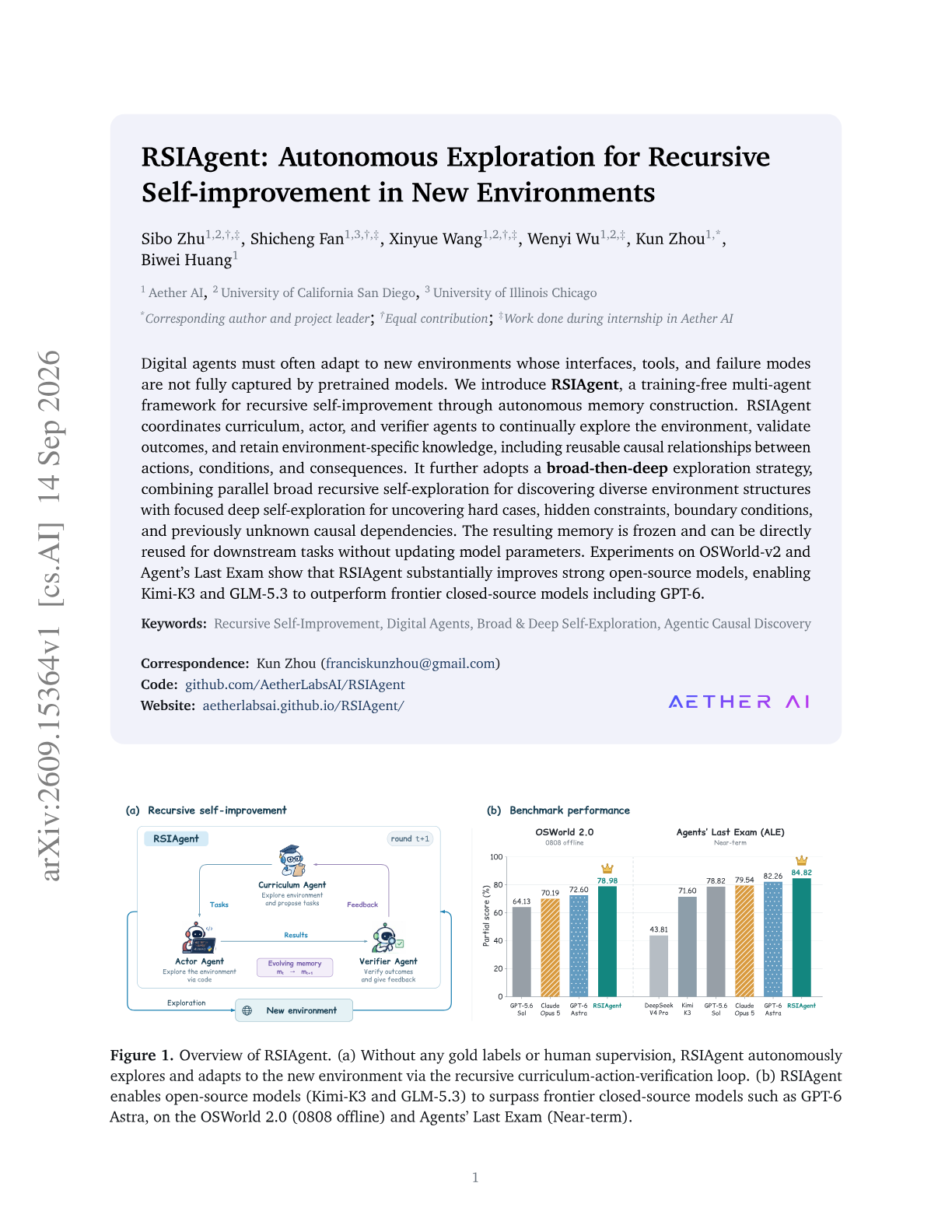
RSIAgent: Autonomous Exploration for Recursive Self-improvement in New Environments
Sibo Zhu and colleagues introduce RSIAgent, a training-free multi-agent framework in which curriculum, actor and verifier agents explore a new environment and build a reusable memory of its causal structure.
Dream-RSI: Recursive Self-Improvement through Evolving Worlds
Tong Zheng and colleagues at the University of Maryland and Google DeepMind introduce Dream-RSI, which improves a coding agent's exploration policy by replaying its own past discovery trees as a simulator.
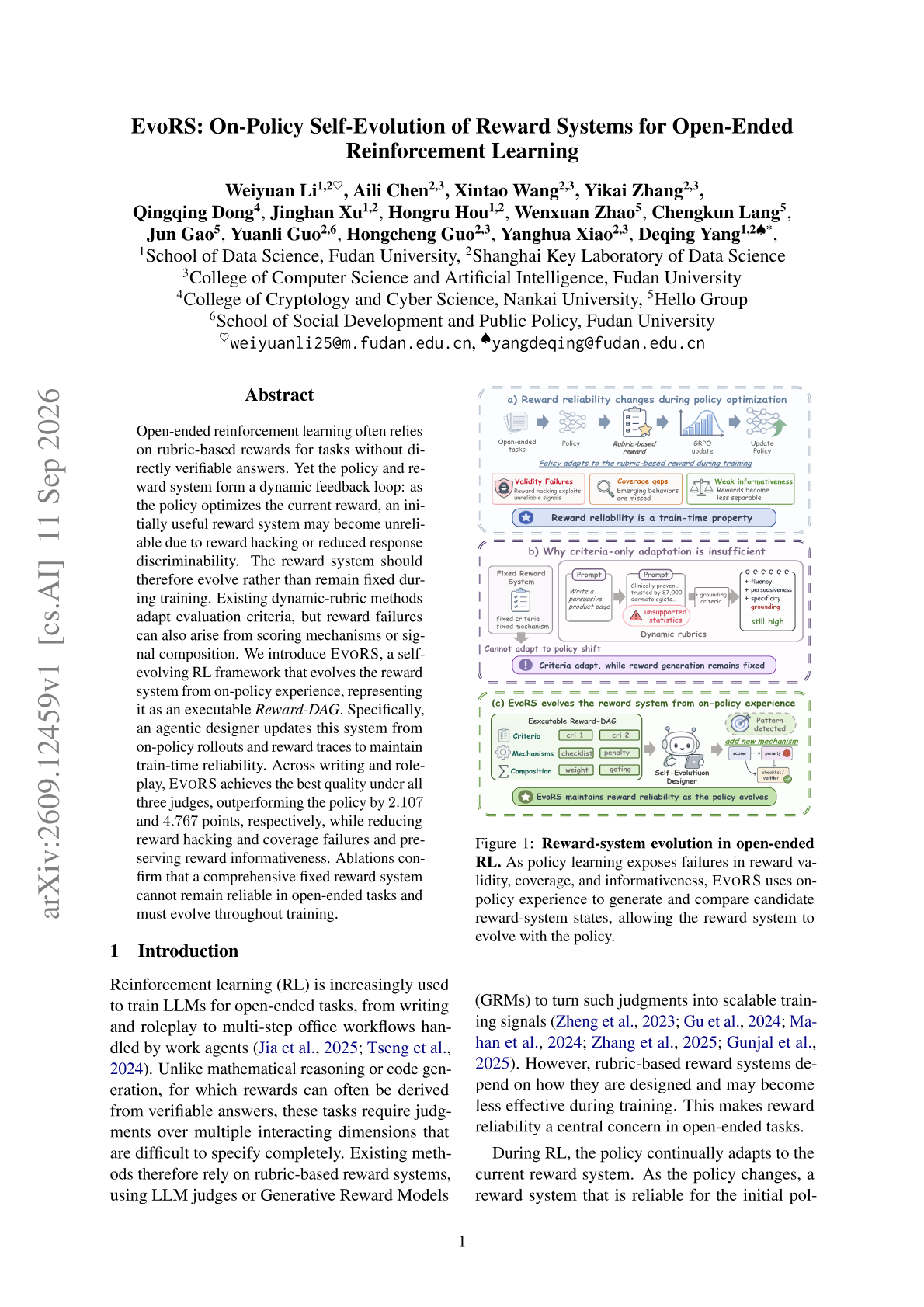
EvoRS: On-Policy Self-Evolution of Reward Systems for Open-Ended Reinforcement Learning
Weiyuan Li and colleagues (Fudan University) propose EvoRS, where an agentic designer rewrites the reward system during RL training from on-policy rollouts and reward traces, instead of keeping rubrics fixed.
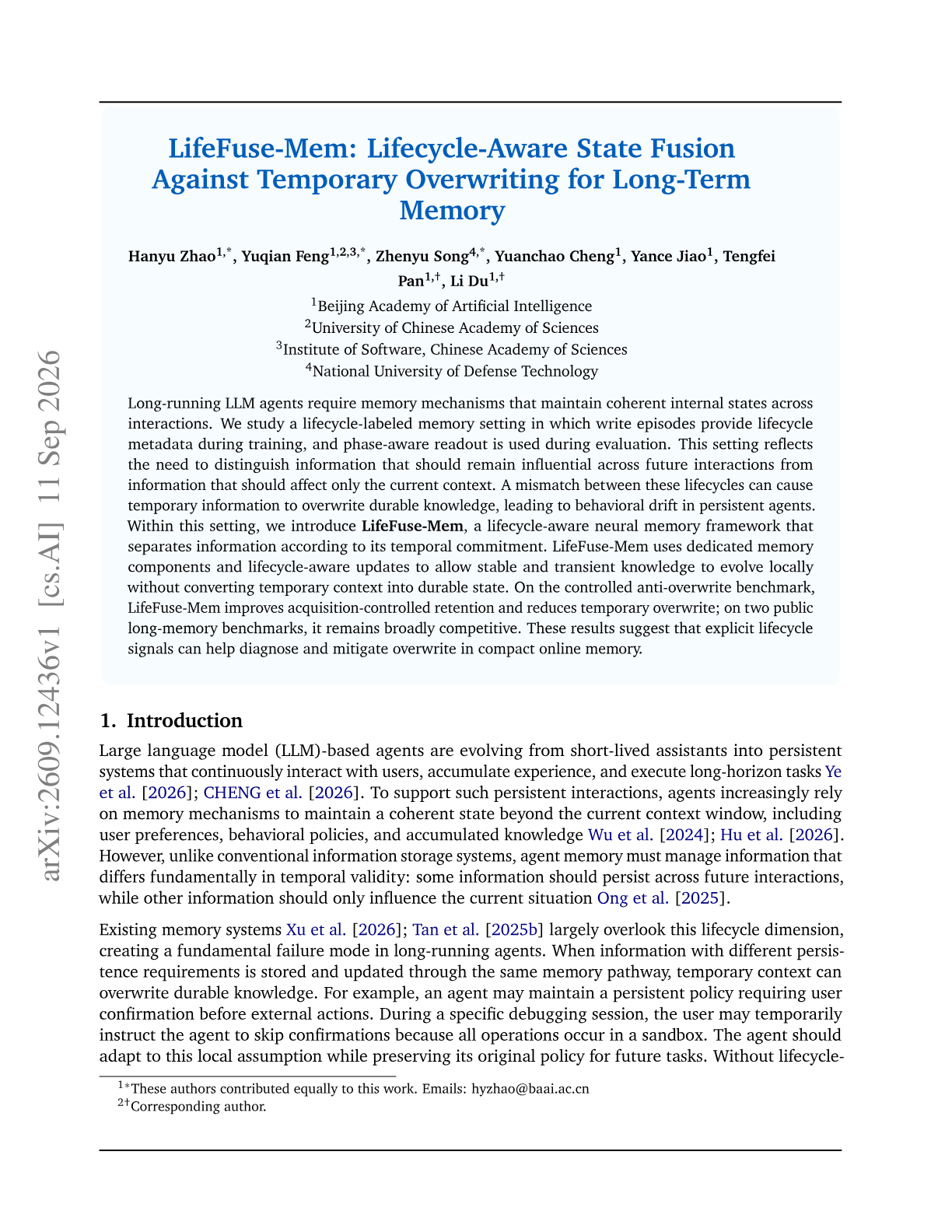
LifeFuse-Mem: Lifecycle-Aware State Fusion Against Temporary Overwriting for Long-Term Memory
Zhao and colleagues introduce a memory architecture that labels each write with its intended lifetime, so information meant to apply only to the current context cannot overwrite knowledge meant to persist.
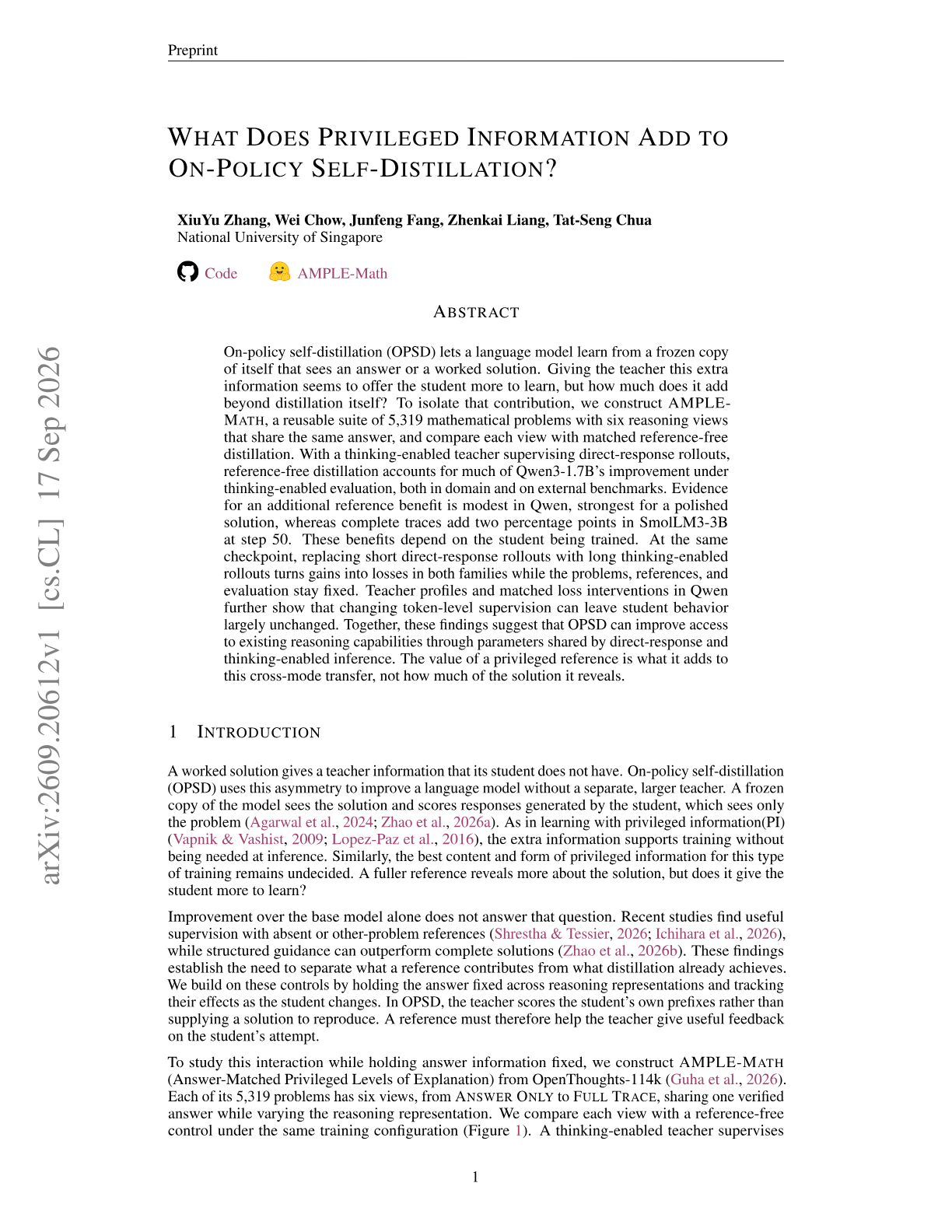
What Does Privileged Information Add to On-Policy Self-Distillation?
XiuYu Zhang, Wei Chow, Junfeng Fang, Zhenkai Liang and Tat-Seng Chua build a benchmark that holds the problem fixed while varying what the teacher sees, and find the privileged information adds much less than distillation itself.
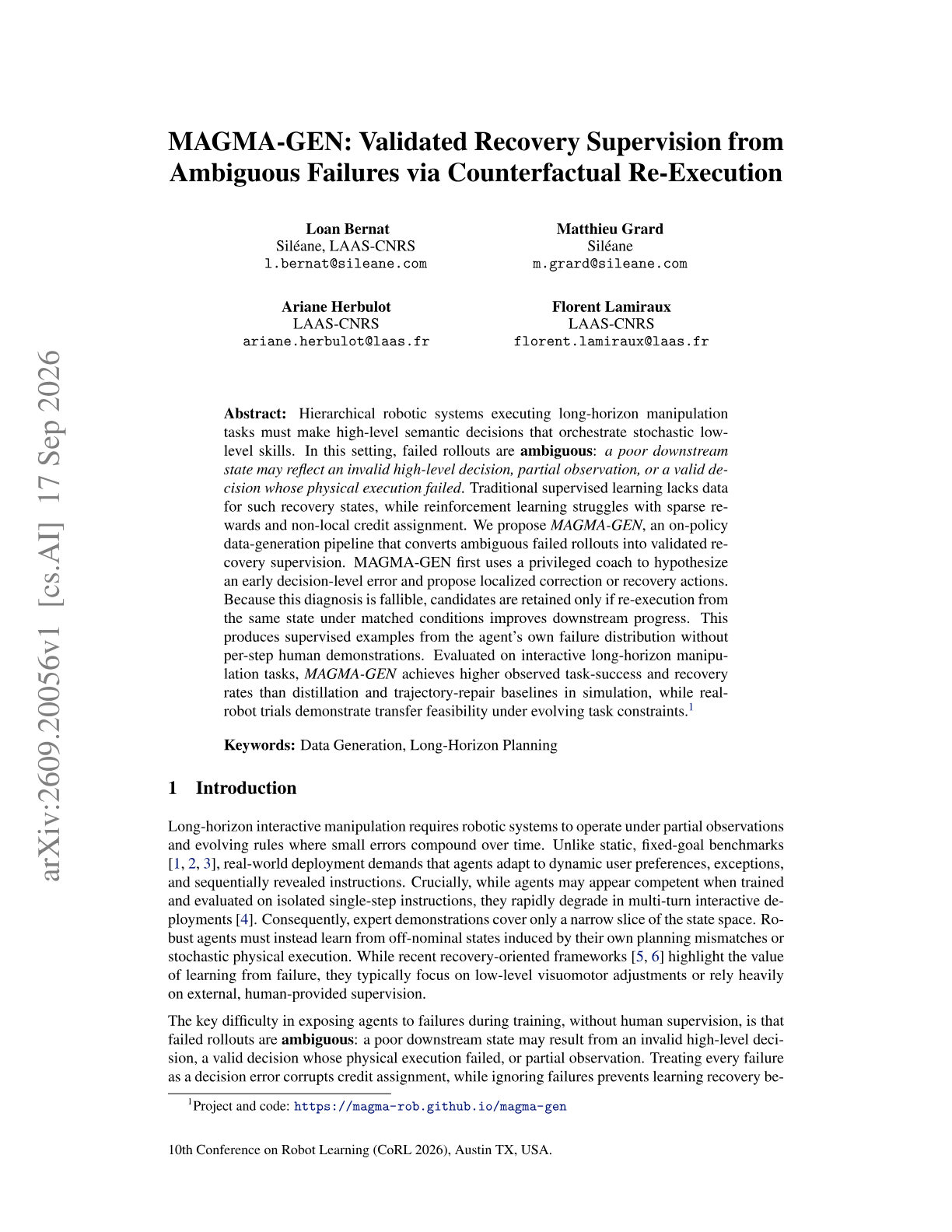
MAGMA-GEN: Validated Recovery Supervision from Ambiguous Failures via Counterfactual Re-Execution
Loan Bernat, Matthieu Grard, Ariane Herbulot and Florent Lamiraux turn ambiguous failed robot rollouts into recovery supervision by re-executing proposed corrections and keeping only the ones that actually help.
PAPC: Platform Mediation for Privacy-Propagation Externalities in AI-Mediated Workflows
Huang, Wu, Hou and Zheng model privacy loss in multi-principal agent platforms as an externality created by intermediate events rather than by the final answer, and build PAPC, a platform layer that intercepts every information-moving event before it reaches shared state.
Language-model groups overstate consensus when replaying human deliberation on a reasoning task
Tengfei Shao replays 100 held-out human Wason group discussions with matched LLM agent groups and finds the agent groups reach full consensus far more often than the people they stand in for.
RAFT: A Stateful Retrieval-Augmented Framework for Troubleshooting Agents
Mingxuan Zhang and colleagues present RAFT, which abstracts each closed support case into a directed chain of timeline entries and retrieves at the entry level rather than treating cases as static documents.
F$^{2}$DR: A Fine-Grained Full-Pipeline Reward Framework for DeepSearch Workflows
Bojian Xiong and a 14-author team score a DeepSearch run across its whole pipeline rather than only its final answer, and release a benchmark for reward models in that setting.
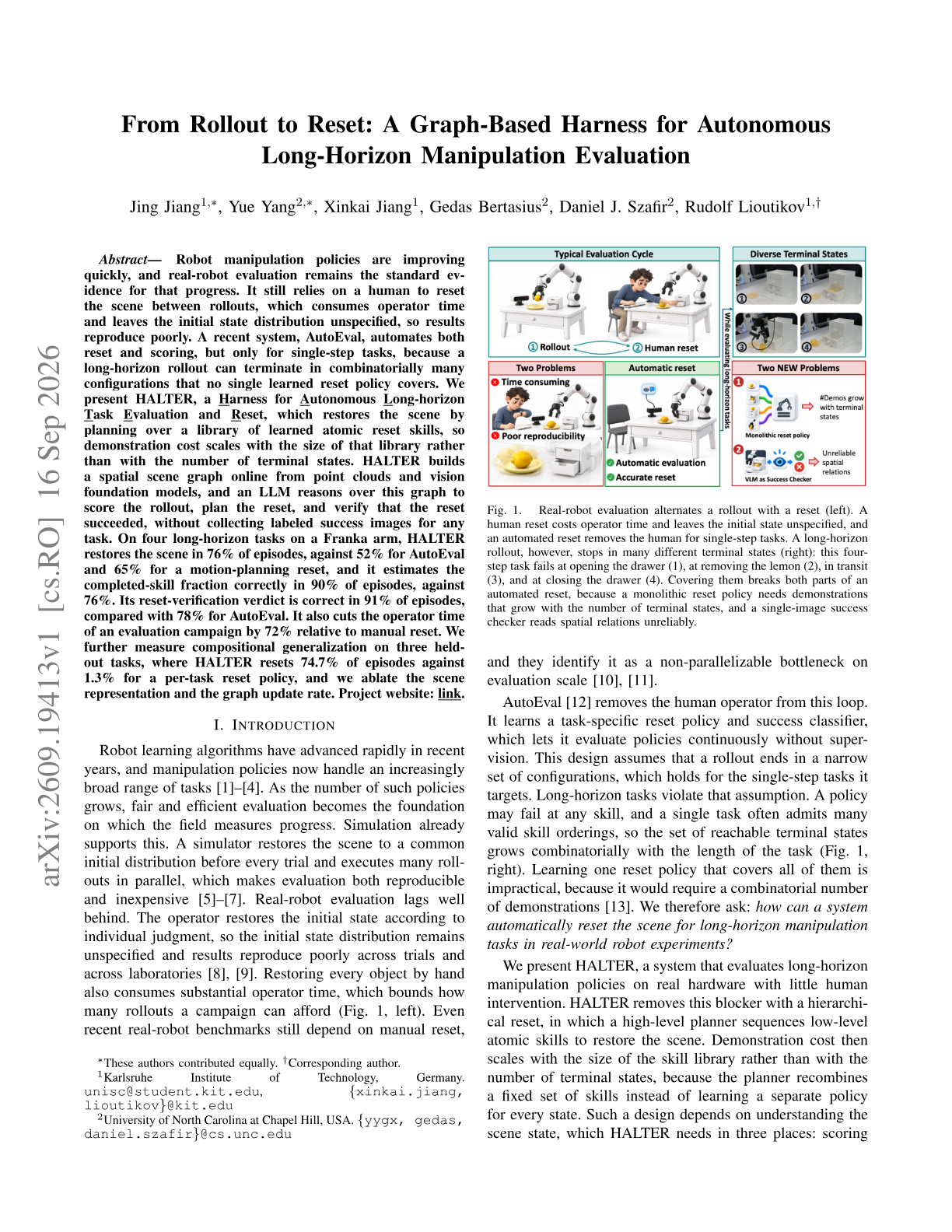
From Rollout to Reset: A Graph-Based Harness for Autonomous Long-Horizon Manipulation Evaluation
Jing Jiang and colleagues present HALTER, which restores a robot workspace between rollouts by planning over a library of learned atomic reset skills, so demonstration cost scales with the library rather than with the number of terminal states.
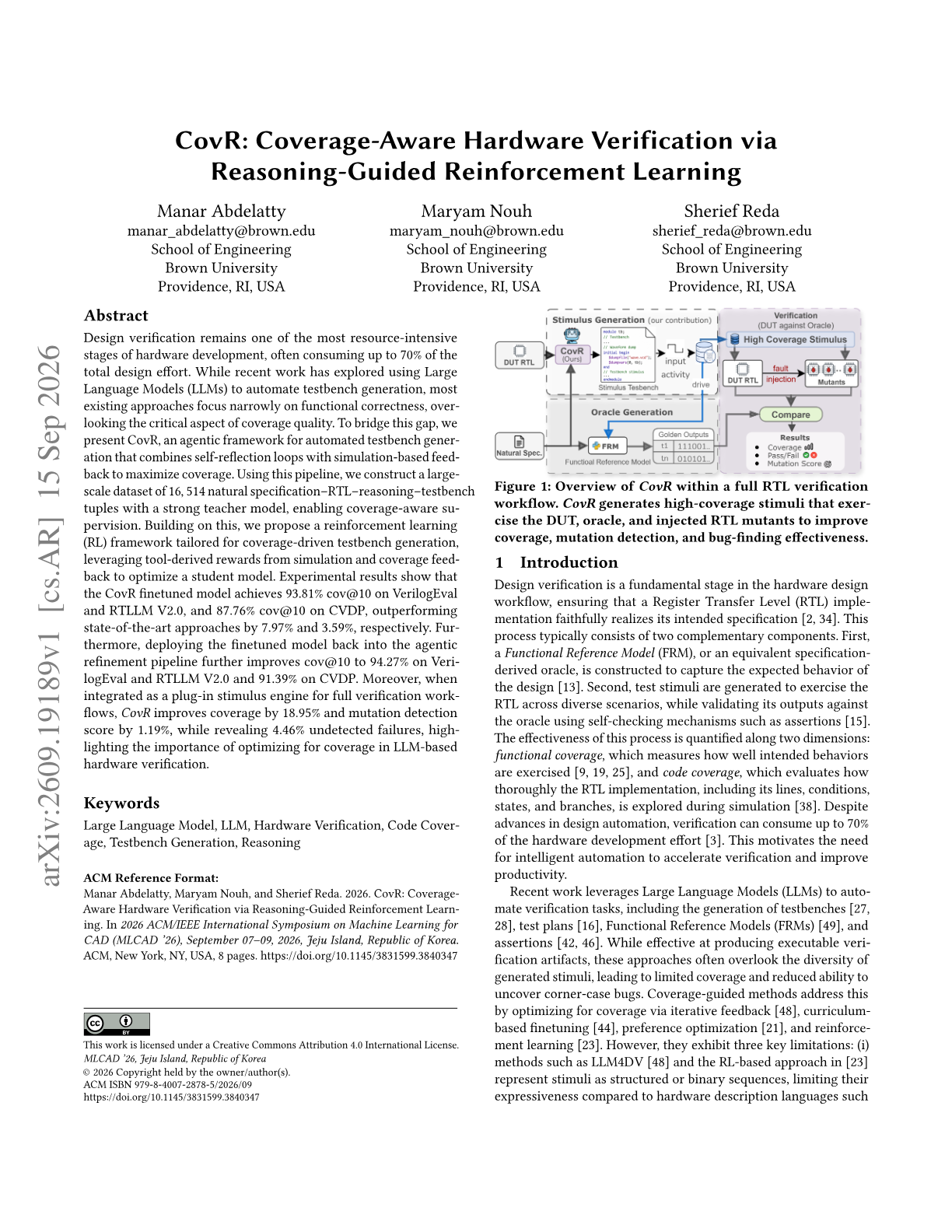
CovR: Coverage-Aware Hardware Verification via Reasoning-Guided Reinforcement Learning
Abdelatty, Nouh and Reda (Brown University) build CovR, an agentic testbench-generation system for RTL hardware verification that optimizes for coverage rather than functional correctness alone, and distill the resulting behavior into a student model with simulation-derived rewards.
LearnActCoder: Role-Aware Error Memory for Adaptive Clinical Coding Agents
Meysam Ghaffari and colleagues turn a small labeled batch of clinical coding errors into a structured mistake database and route each lesson to the agent role that can act on it.
Reflective Recovery: A Self-Supervised Method for Reasoning by Learning from Mistakes
Qirui Chen, Renjie Pi, Jiahui Gao and Lingpeng Kong (Zhejiang University, the University of Hong Kong and HKUST) convert failed reasoning rollouts into recovery training data, so a model learns to continue correctly from an already-wrong intermediate state.
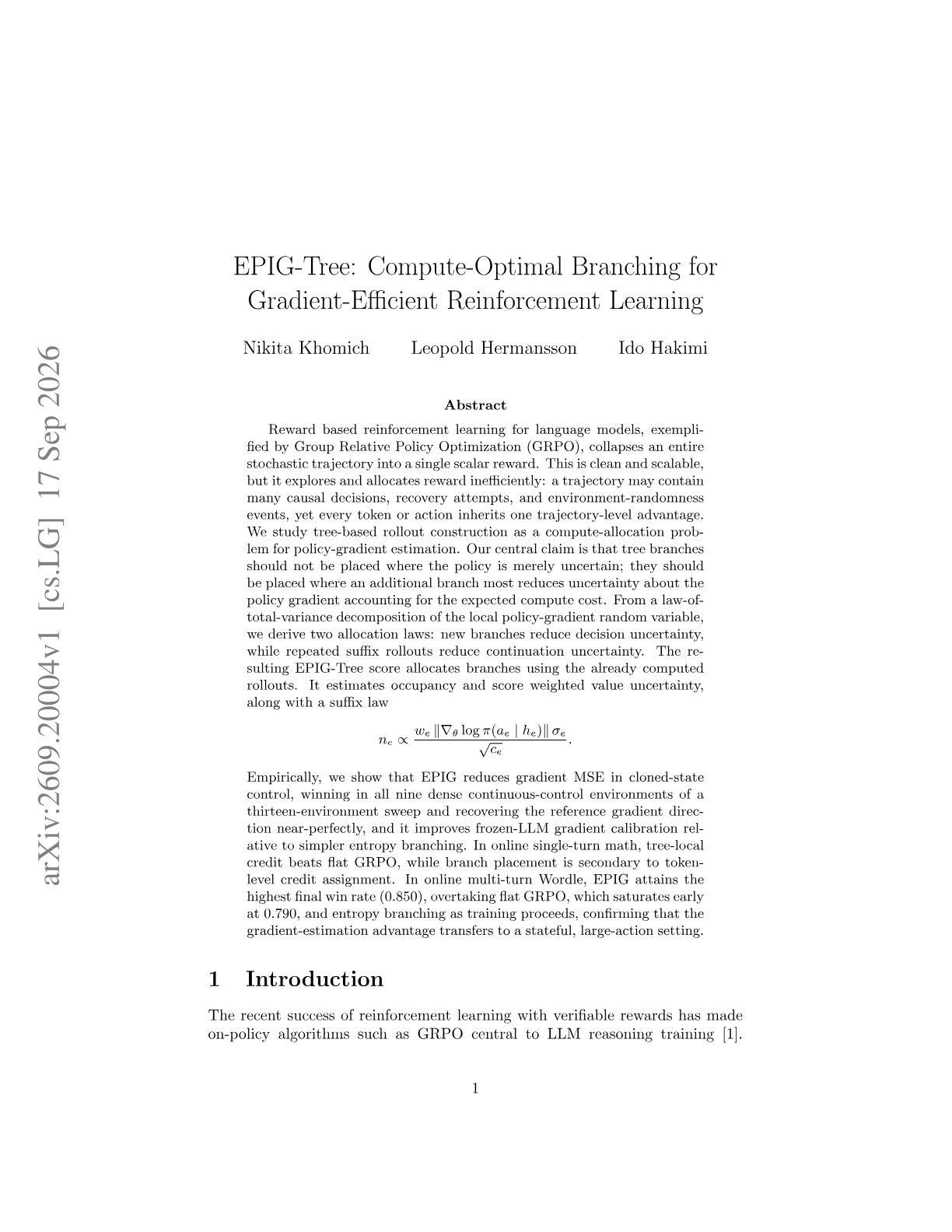
EPIG-Tree: Compute-Optimal Branching for Gradient-Efficient Reinforcement Learning
Khomich, Hermansson and Hakimi treat tree-structured rollout construction in LLM RL as a compute-allocation problem, deriving where to branch from a law-of-total-variance decomposition of the local policy gradient rather than from policy entropy.
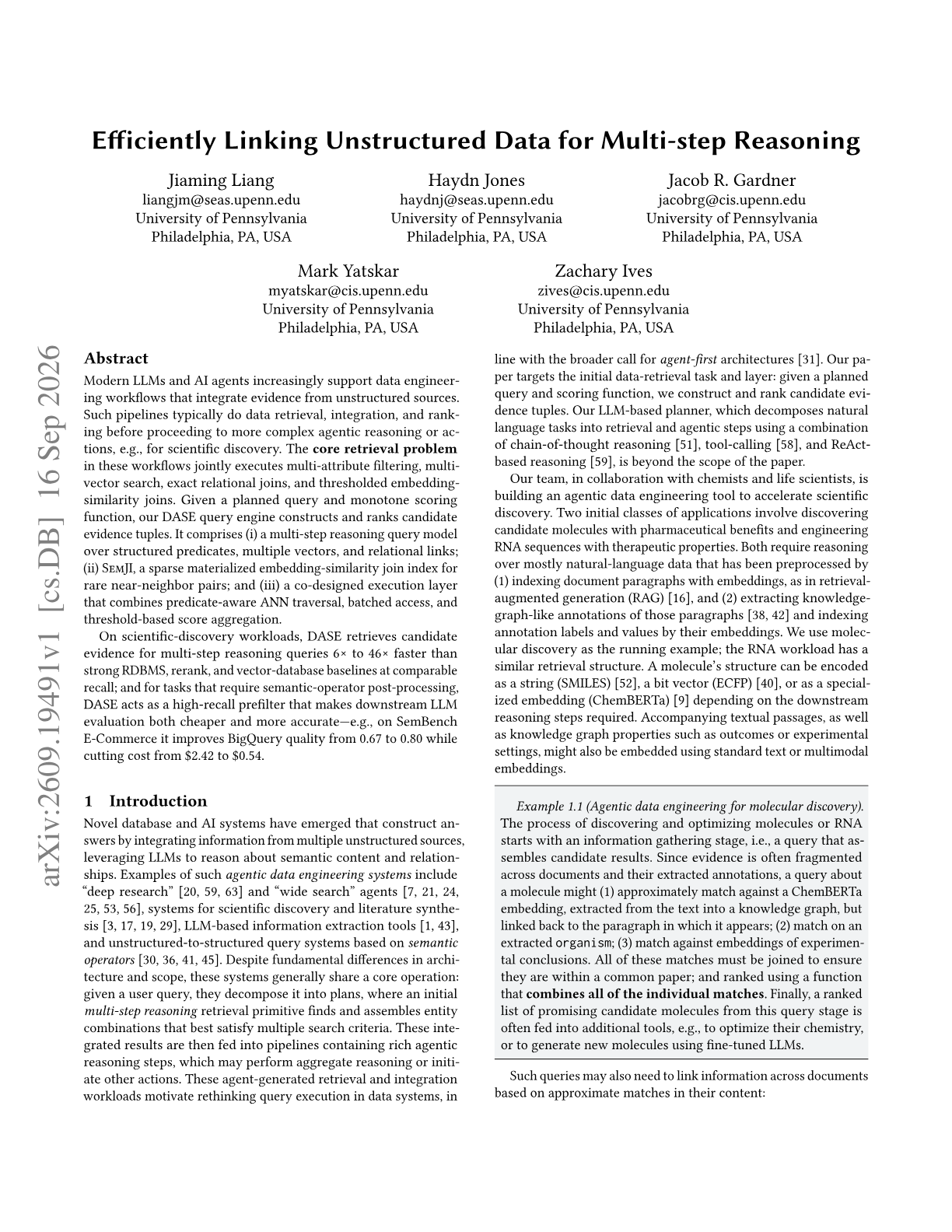
Efficiently Linking Unstructured Data for Multi-step Reasoning
Jiaming Liang, Haydn Jones, Jacob R. Gardner, Mark Yatskar and Zachary Ives (University of Pennsylvania) build a query engine for the retrieval step that sits under agentic reasoning pipelines, executing filters, multi-vector search, relational joins and similarity joins together.
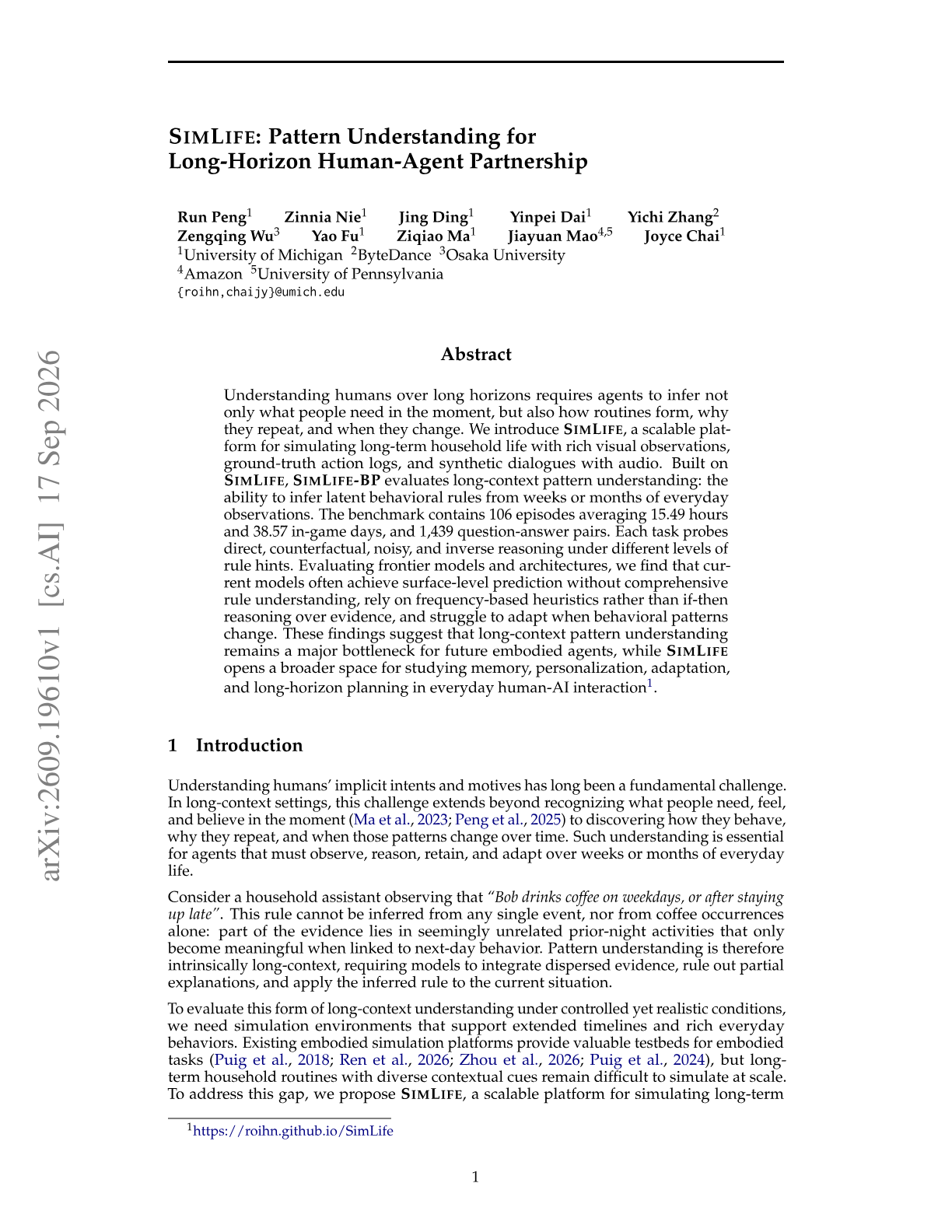
SIMLIFE: Pattern Understanding for Long-Horizon Human-Agent Partnership
Run Peng and colleagues build SimLife, a simulator of long-term household life with visual observations, ground-truth action logs and synthetic dialogue, and SimLife-BP, which tests whether a model can infer latent behavioural rules from weeks of observation.
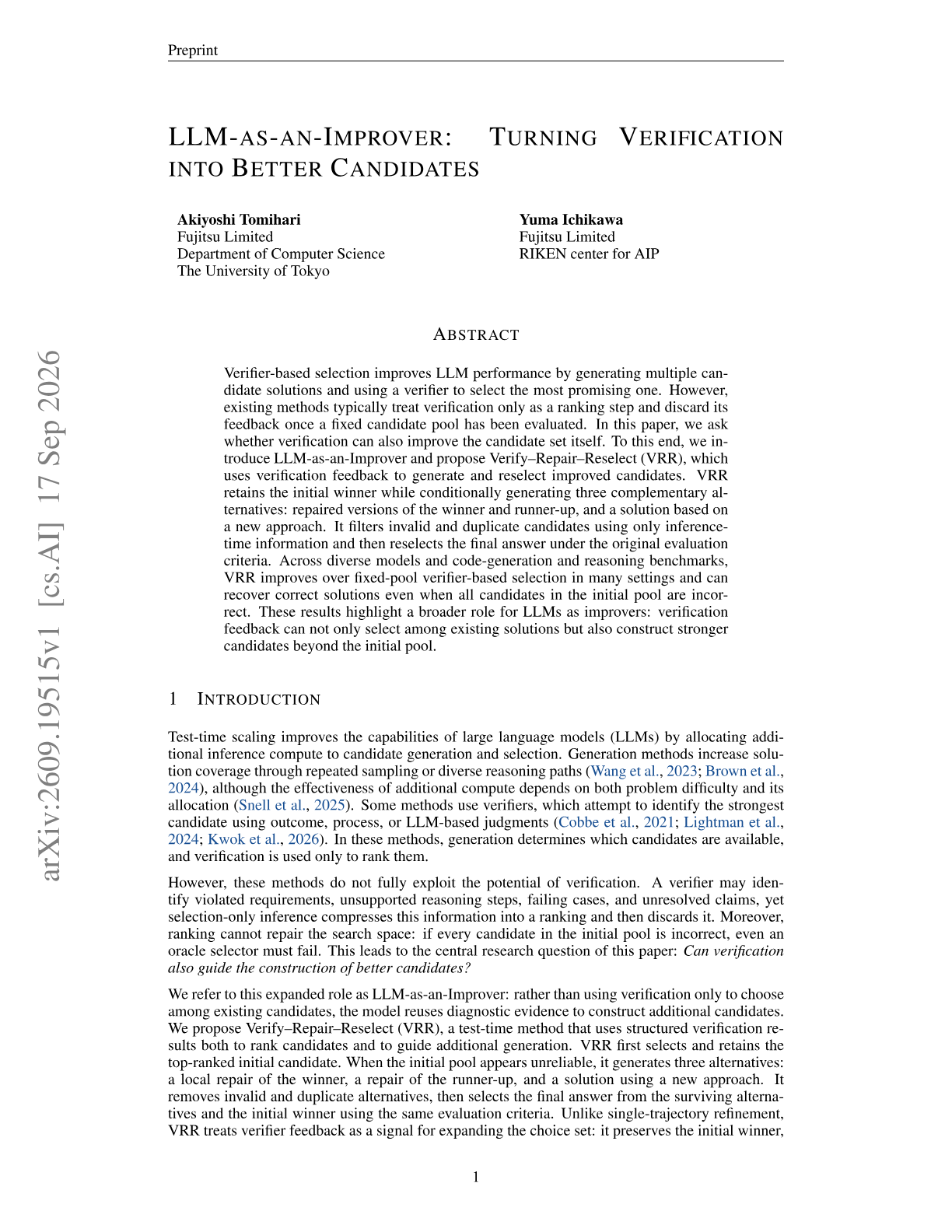
LLM-as-an-Improver: Turning Verification into Better Candidates
Akiyoshi Tomihari and Yuma Ichikawa ask whether verifier feedback can improve the candidate pool rather than only rank it, and propose Verify-Repair-Reselect.
A Scalable Trust Discovery Architecture for the Internet of Agents
Song Zhang and colleagues propose a three-layer registry and resolver architecture for agent discovery, addressing the part of agent protocols that tool invocation standards leave open.
AURORA: A Natural Language-Driven Agentic Framework for Understanding, Reasoning, and Orchestrating Reliable Air-Ground Co-Simulation
Keshu Wu and colleagues at Texas A&M and collaborators treat air-ground co-simulation scenario generation as compilation with verification, so a scenario that runs is also checked against the relationships the user asked for.
AUDITPLAN: Commit, Then Answer for Auditable Safety Alignment
Sai Sri Pushpa Jampani, Kshitij Mishra and Asif Ekbal make a model emit a machine-checkable safety plan before answering, and reward the answer only when that plan is correct.
Replan, Repair, or Edit? A Unified Empirical Evaluation of Travel Agents for Itinerary Revision under Resource Disruptions
Xiaofei Yuan and colleagues compare full replanning, classical plan repair and LLM-based local revision on the same disrupted-itinerary benchmark, which prior work could not do because each method defined the task differently.