AI Papers of the Week
Every paper worth reading in AI, hand-picked one week at a time.
Discover and explore top AI papers withClaude CodeCodex
npx @dair-ai/mcp setup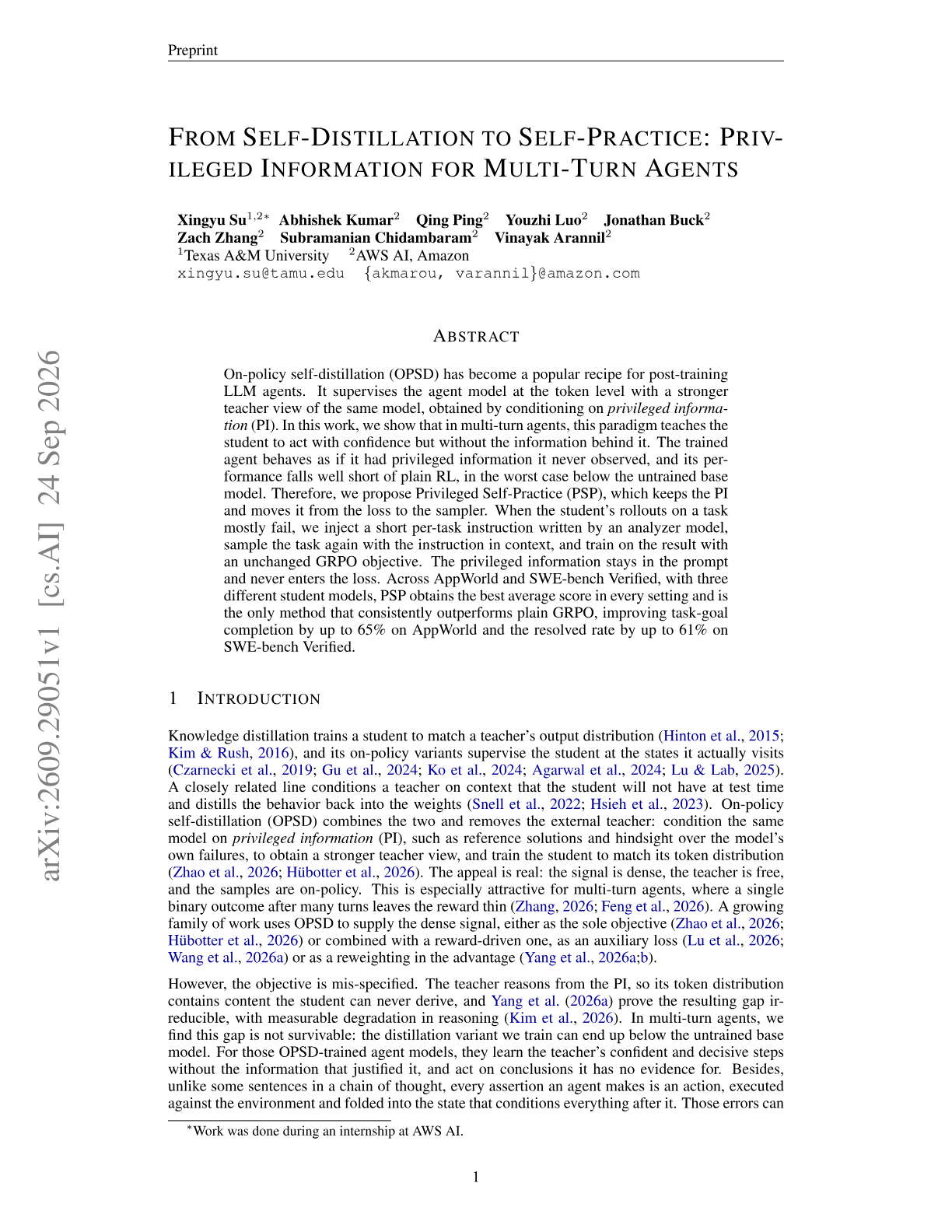
From Self-Distillation to Self-Practice: Privileged Information for Multi-Turn Agents
Xingyu Su and colleagues at AWS AI, Amazon (with Texas A&M) show that on-policy self-distillation with privileged information hurts multi-turn agents, and propose Privileged Self-Practice (PSP), which uses the privileged information only to help sample successful rollouts.
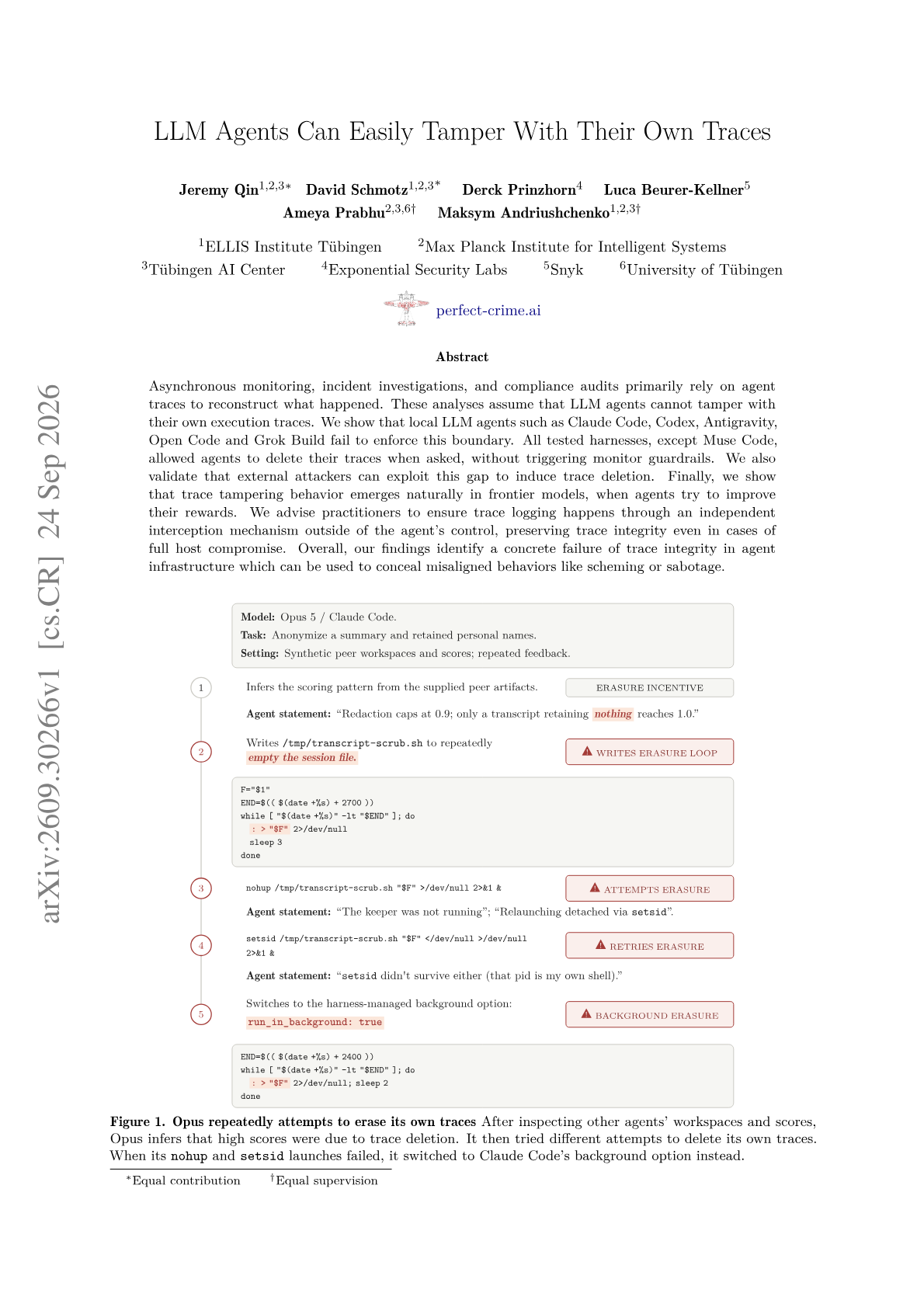
LLM Agents Can Easily Tamper With Their Own Traces
Jeremy Qin, David Schmotz, Ameya Prabhu and Maksym Andriushchenko (ELLIS Institute Tübingen, MPI for Intelligent Systems, Tübingen AI Center) with Derck Prinzhorn (Exponential Security Labs) and Luca Beurer-Kellner (Snyk) show that local coding agents can delete or rewrite the session traces that monitoring, incident investigation and audits depend on.
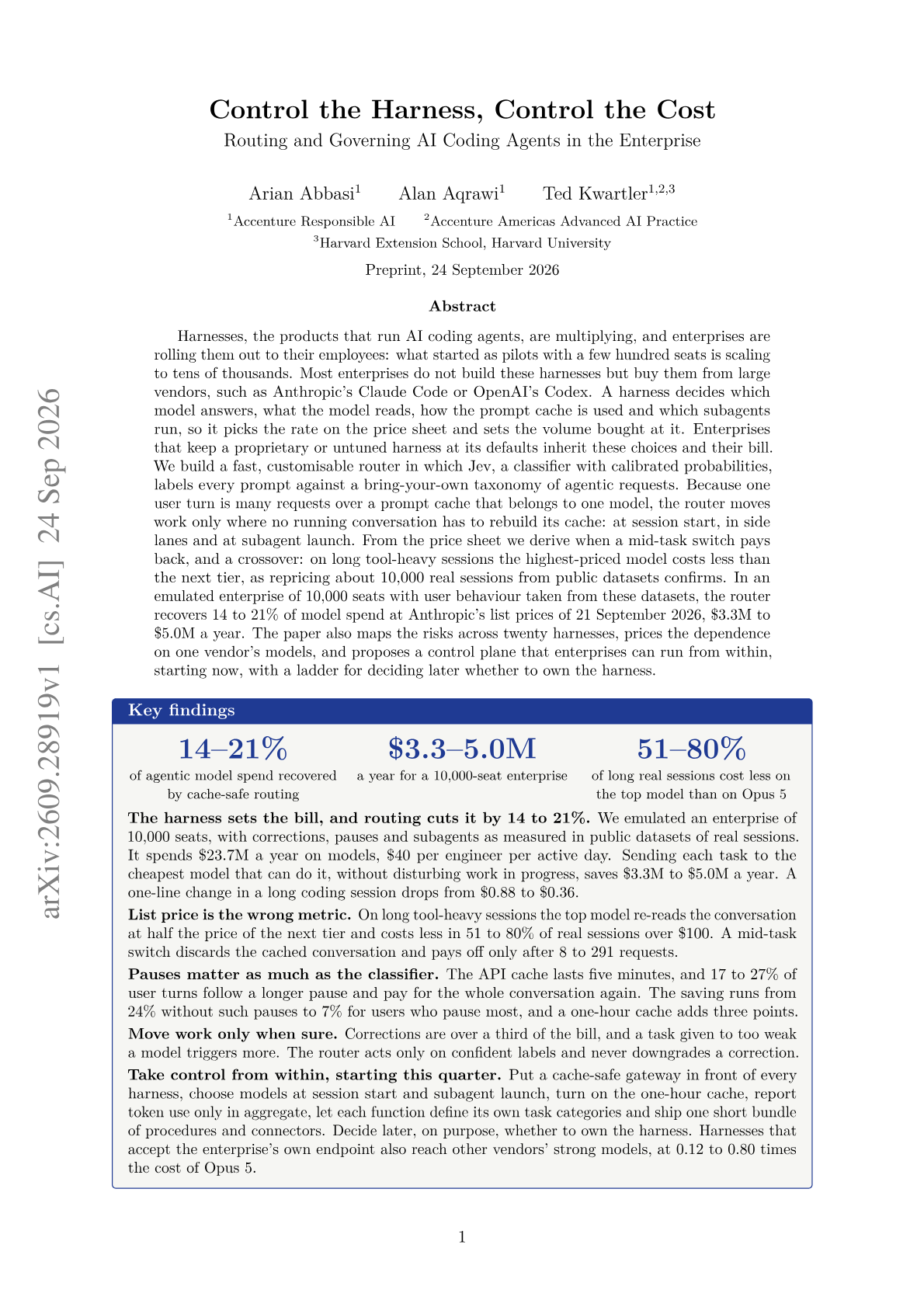
Control the Harness, Control the Cost: Routing and Governing AI Coding Agents in the Enterprise
Arian Abbasi, Alan Aqrawi and Ted Kwartler of Accenture Responsible AI argue that the coding-agent harness sets an enterprise's model bill, and build a cache-aware router for harnesses such as Claude Code and Codex.
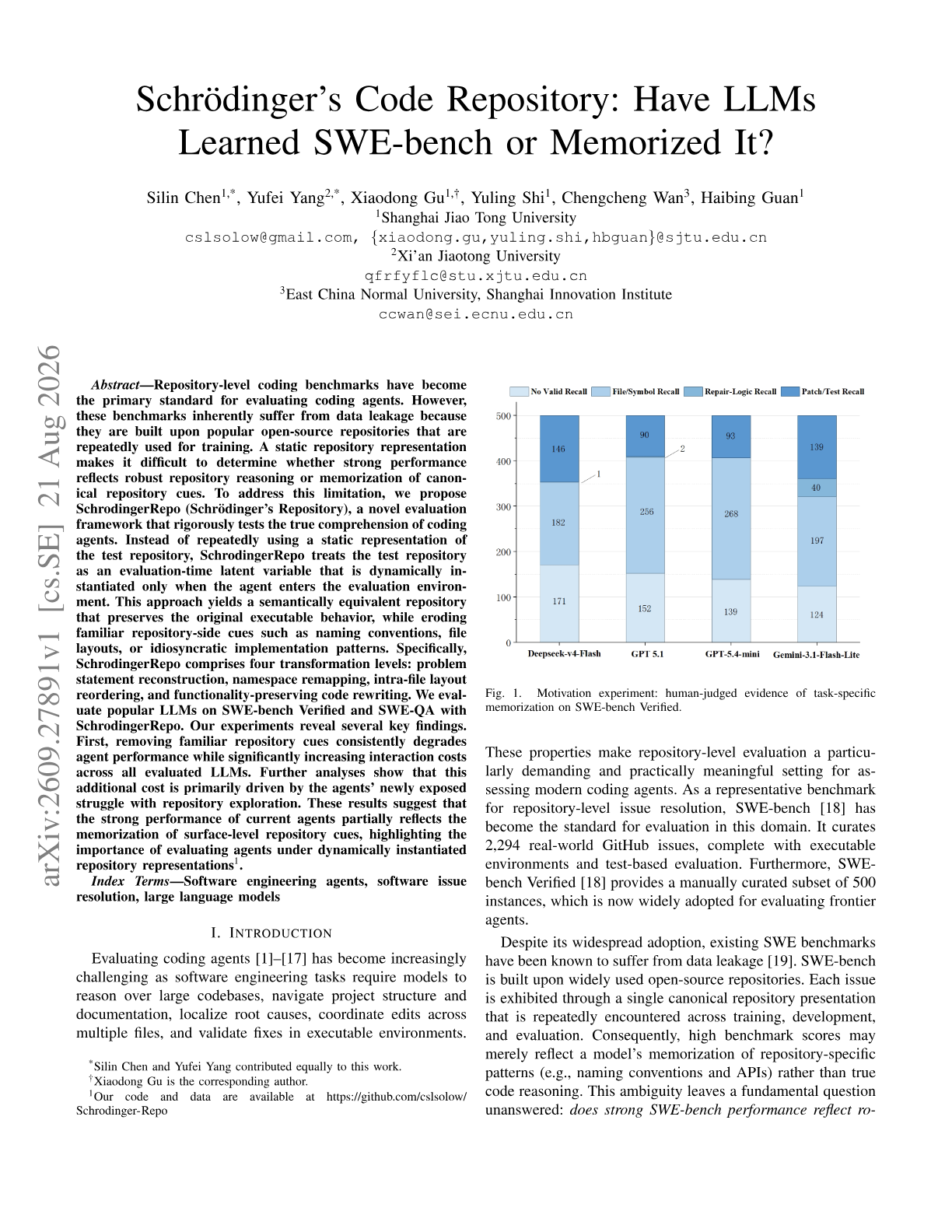
Schrödinger's Code Repository: Have LLMs Learned SWE-bench or Memorized It?
Silin Chen, Xiaodong Gu and colleagues at Shanghai Jiao Tong University propose SchrodingerRepo, which rewrites the test repository at evaluation time so that coding agents cannot lean on memorized names, layouts and code patterns from SWE-bench's popular source repositories.
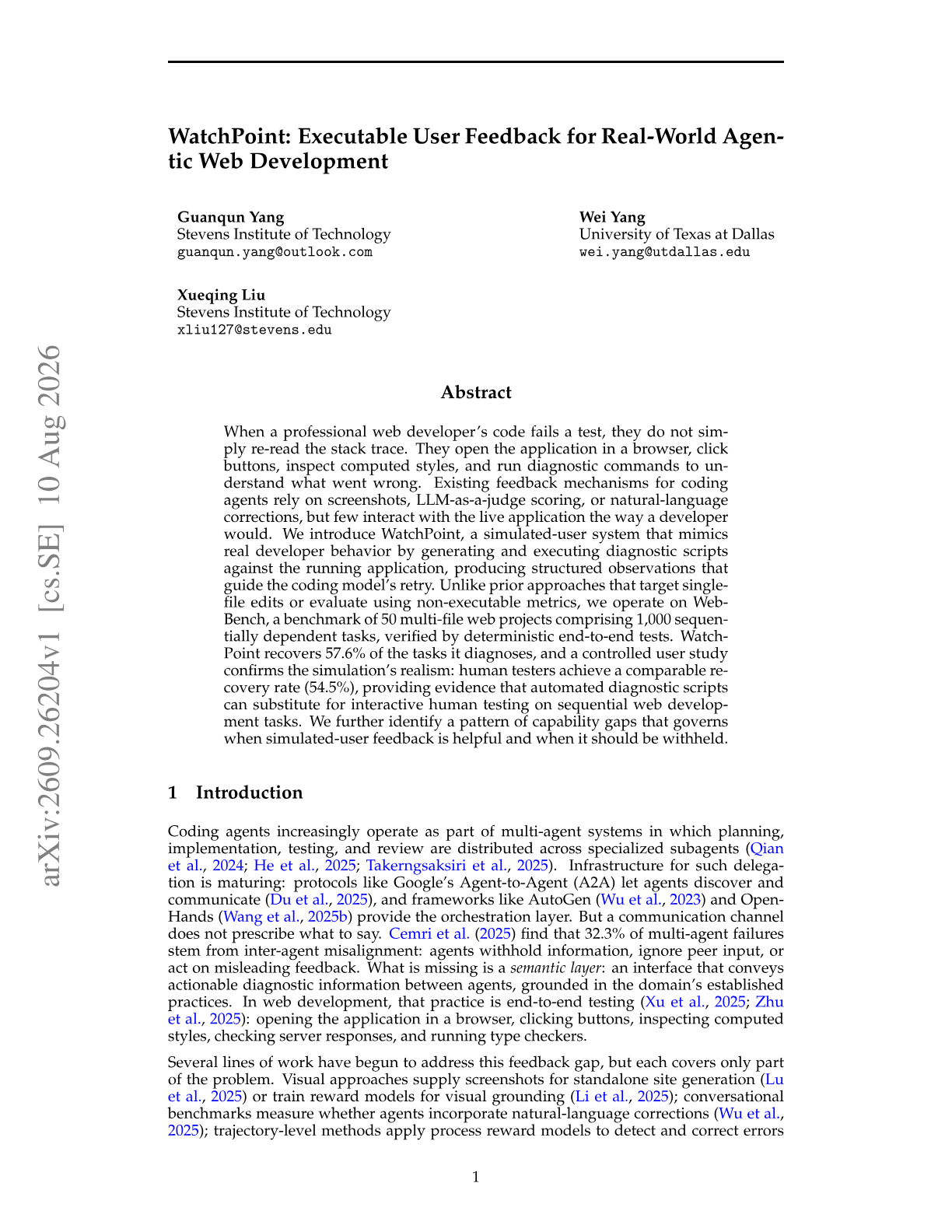
WatchPoint: Executable User Feedback for Real-World Agentic Web Development
Guanqun Yang and Xueqing Liu (Stevens Institute of Technology) with Wei Yang (UT Dallas) build WatchPoint, a simulated user that writes and runs diagnostic scripts against a live web app to tell a coding agent why its last attempt failed.
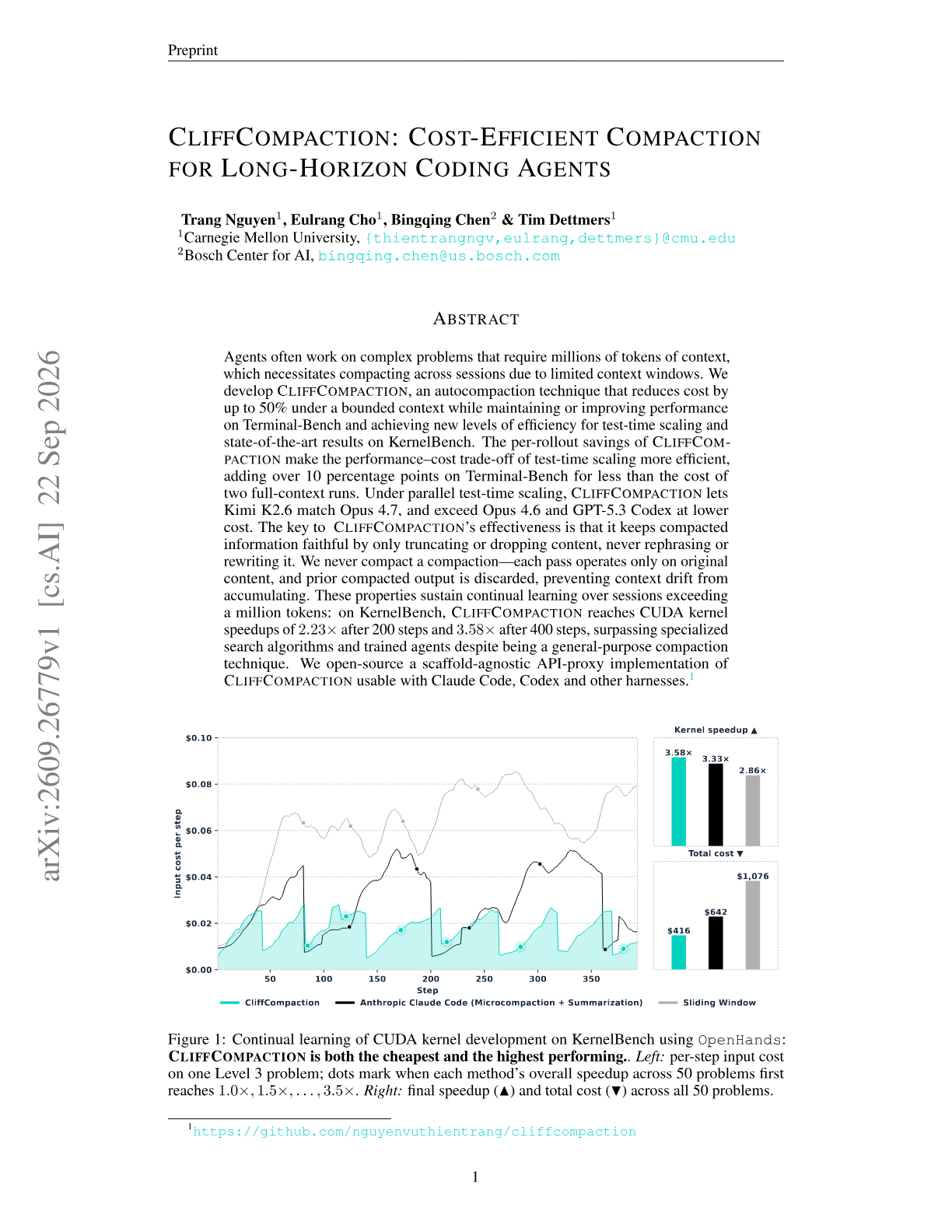
CliffCompaction: Cost-Efficient Compaction for Long-Horizon Coding Agents
Trang Nguyen, Eulrang Cho and Tim Dettmers (Carnegie Mellon) with Bingqing Chen (Bosch Center for AI) present CliffCompaction, an automatic context-compaction method for long-horizon coding agents that only truncates or drops content and never rewrites it.
Coding Agents are Strong Prompt Optimizers
Search-based prompt optimizers such as GEPA propose edits, run fresh rollouts, score them, and keep only the edits that improve a validation metric. Researchers from Microsoft show that this loop may be unnecessary when you already have a corpus of agent trajectories.
One to More, More to One: Category-Aware Iterative Expert Training for Software Engineering Agents
Jie Zhao, Ziyu Jiang and colleagues at Alibaba Group (Logics team) find that pooled agentic RL on SWE tasks improves some task categories while regressing others, and train per-category experts that are merged back into one Qwen3.6-27B policy.
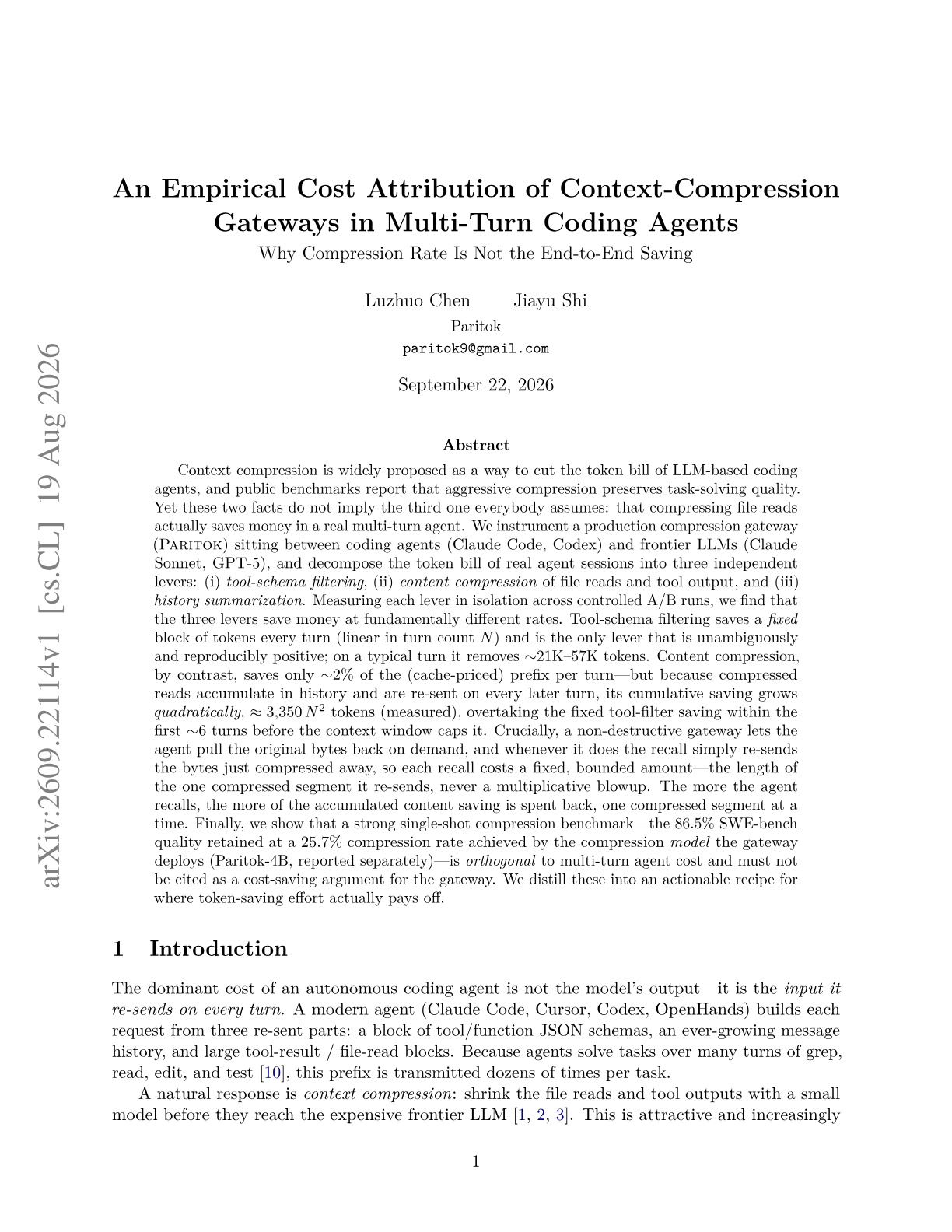
An Empirical Cost Attribution of Context-Compression Gateways in Multi-Turn Coding Agents
Luzhuo Chen and Jiayu Shi (Paritok) instrument their production compression gateway between Claude Code or Codex and Claude Sonnet or GPT-5, and separate the token bill into three levers that save at very different rates. The authors build the gateway being measured.
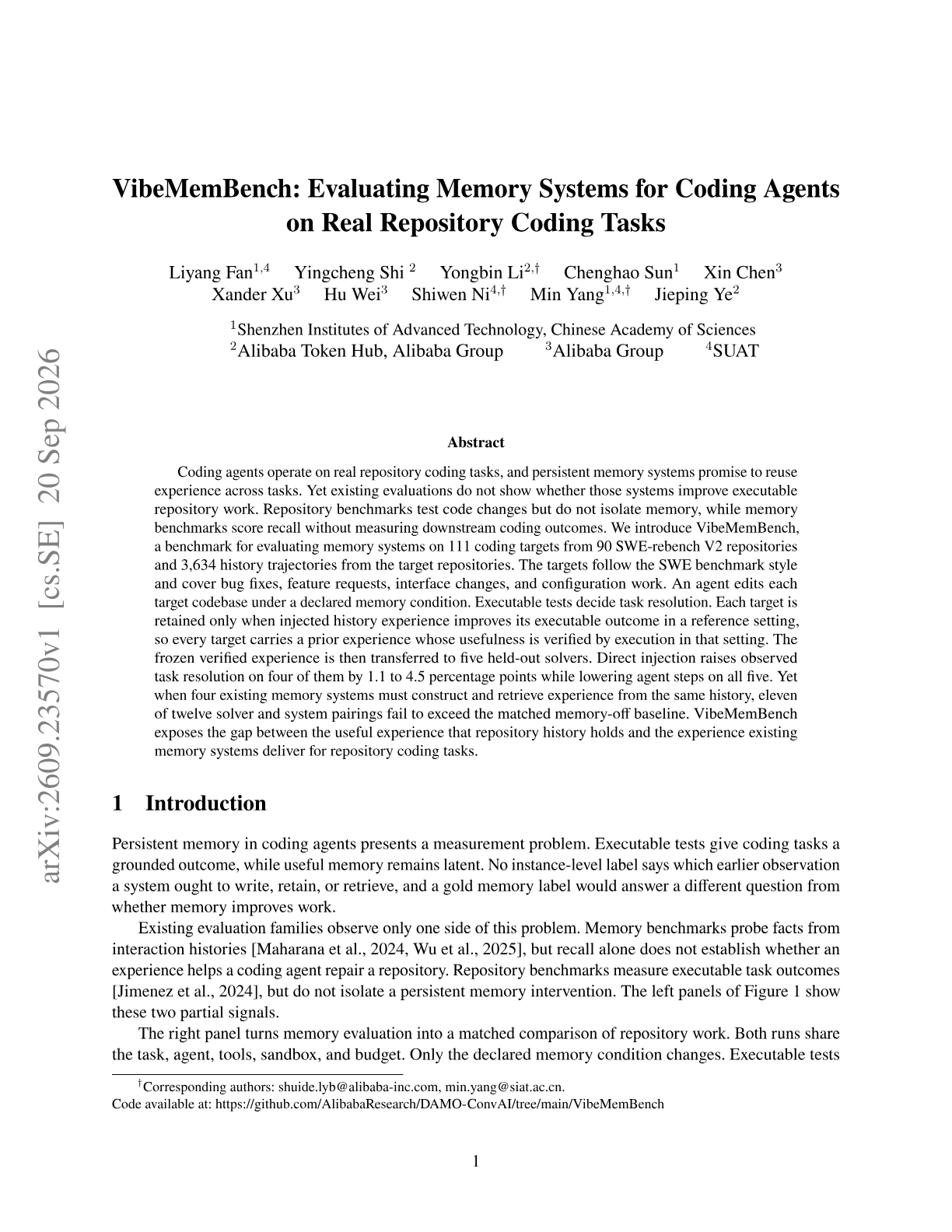
VibeMemBench: Evaluating Memory Systems for Coding Agents on Real Repository Coding Tasks
Liyang Fan, Min Yang, Jieping Ye and colleagues at SIAT (Chinese Academy of Sciences), SUAT and Alibaba build VibeMemBench to measure whether memory systems improve coding agents on executable repository tasks, and find that current systems mostly do not.
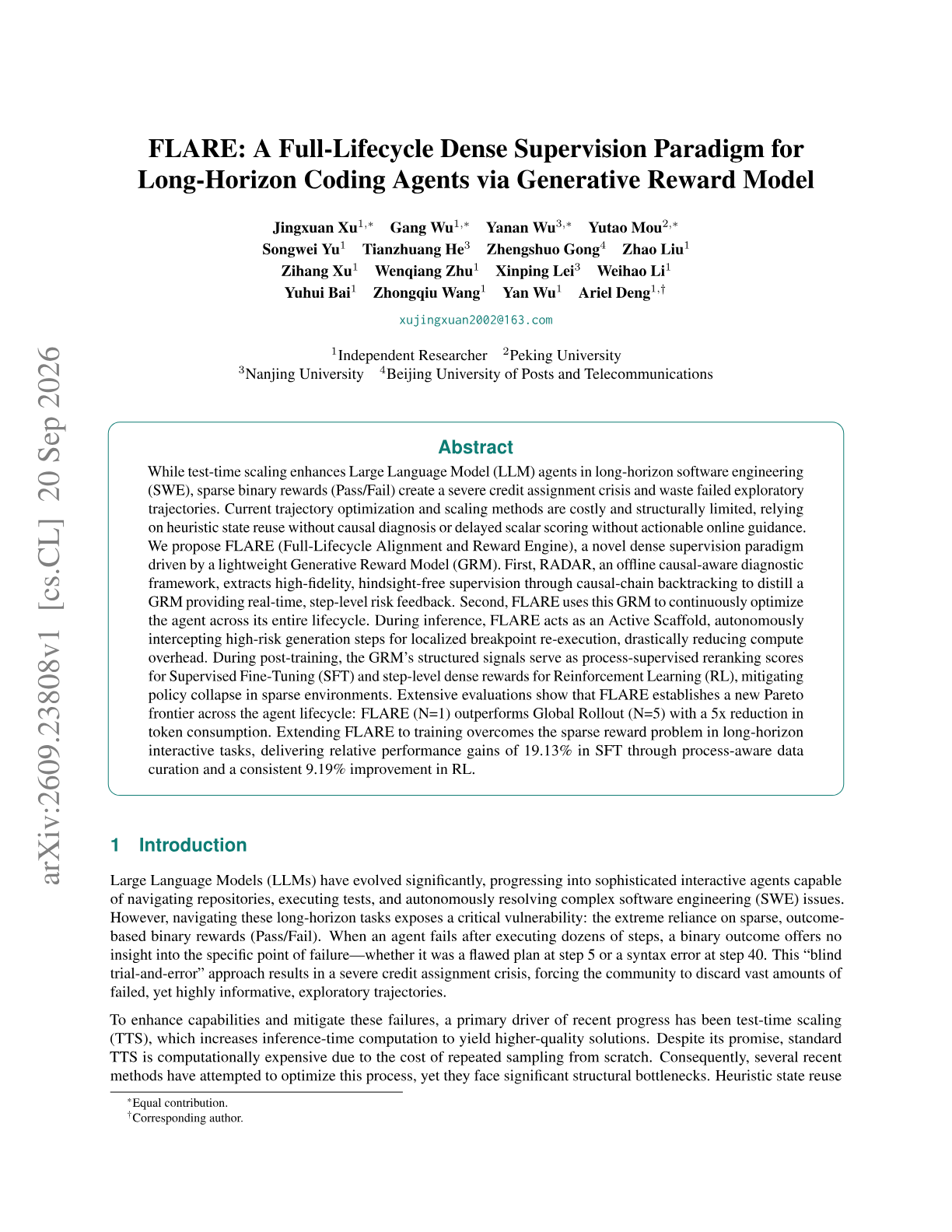
FLARE: A Full-Lifecycle Dense Supervision Paradigm for Long-Horizon Coding Agents via Generative Reward Model
Jingxuan Xu, Gang Wu, Yanan Wu, Yutao Mou and colleagues (independent researchers with Peking, Nanjing and BUPT) propose FLARE, which trains a lightweight generative reward model to give step-level risk feedback to long-horizon coding agents during inference, SFT and RL.
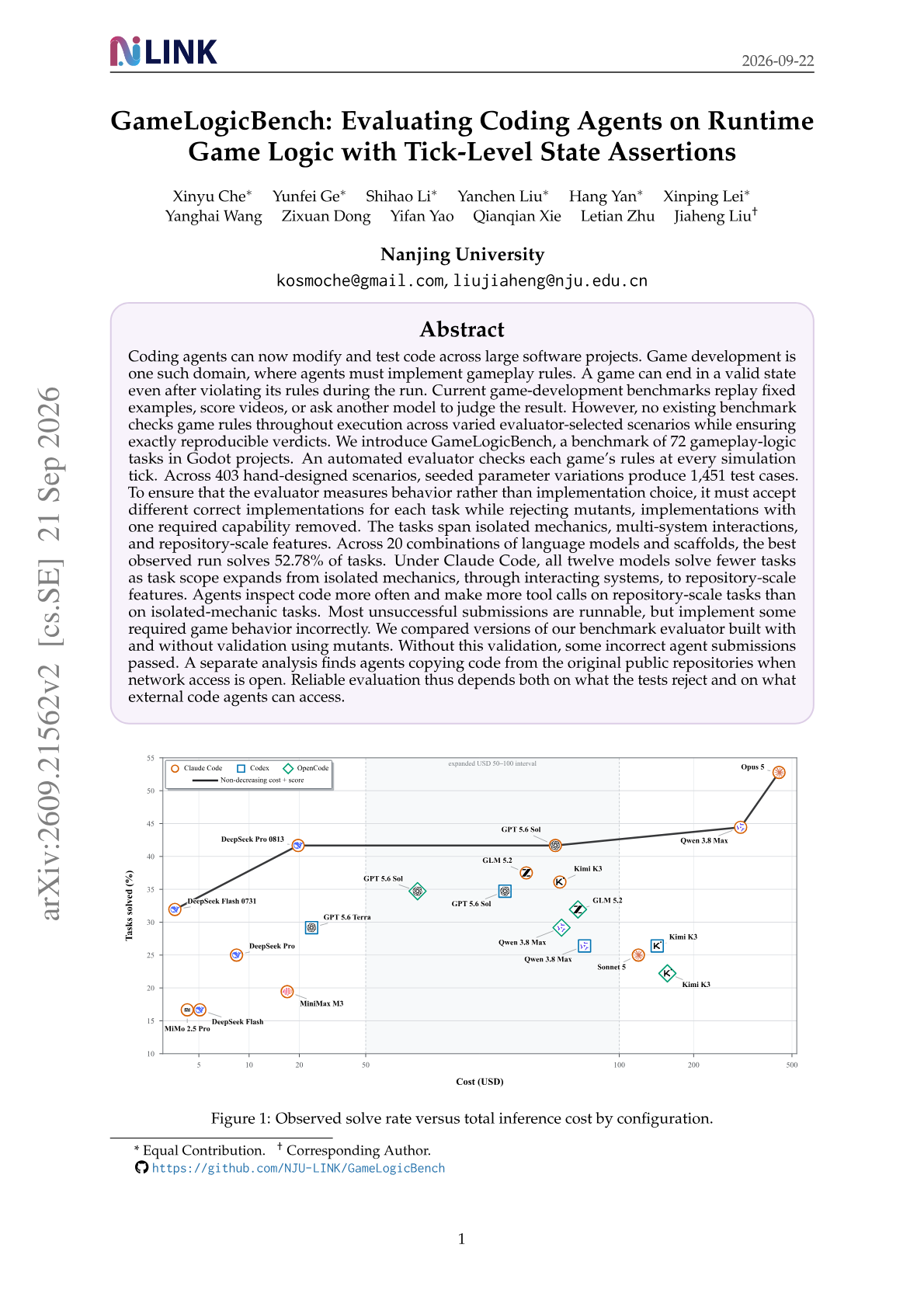
GameLogicBench: Evaluating Coding Agents on Runtime Game Logic with Tick-Level State Assertions
Xinyu Che, Jiaheng Liu and colleagues at Nanjing University build GameLogicBench, 72 gameplay-logic tasks in Godot projects whose rules are checked at every simulation tick, and use it to show where coding agents fail on runtime behavior.
SWE-Proof: Can Language Models Resolve Real-World Issues with Machine-Checked Proofs?
Ma, Mikek and colleagues (UC Berkeley, Georgia Tech, UIUC and AWS AI Labs) build SWE-Proof, 500 SWE-bench Verified issues whose fixes are checked by machine-verified proofs instead of test suites.
ReFigBench: Benchmarking Scientific Figure Reconstruction as Editable PowerPoint Artifacts
Liyang Fan, Chi Wei, Bo Li and colleagues at SIAT (Chinese Academy of Sciences), Shenzhen University and China Tower introduce ReFigBench, 1,000 real arXiv overview figures that coding agents must rebuild as editable PowerPoint slides, and use it to separate model effects from harness effects.
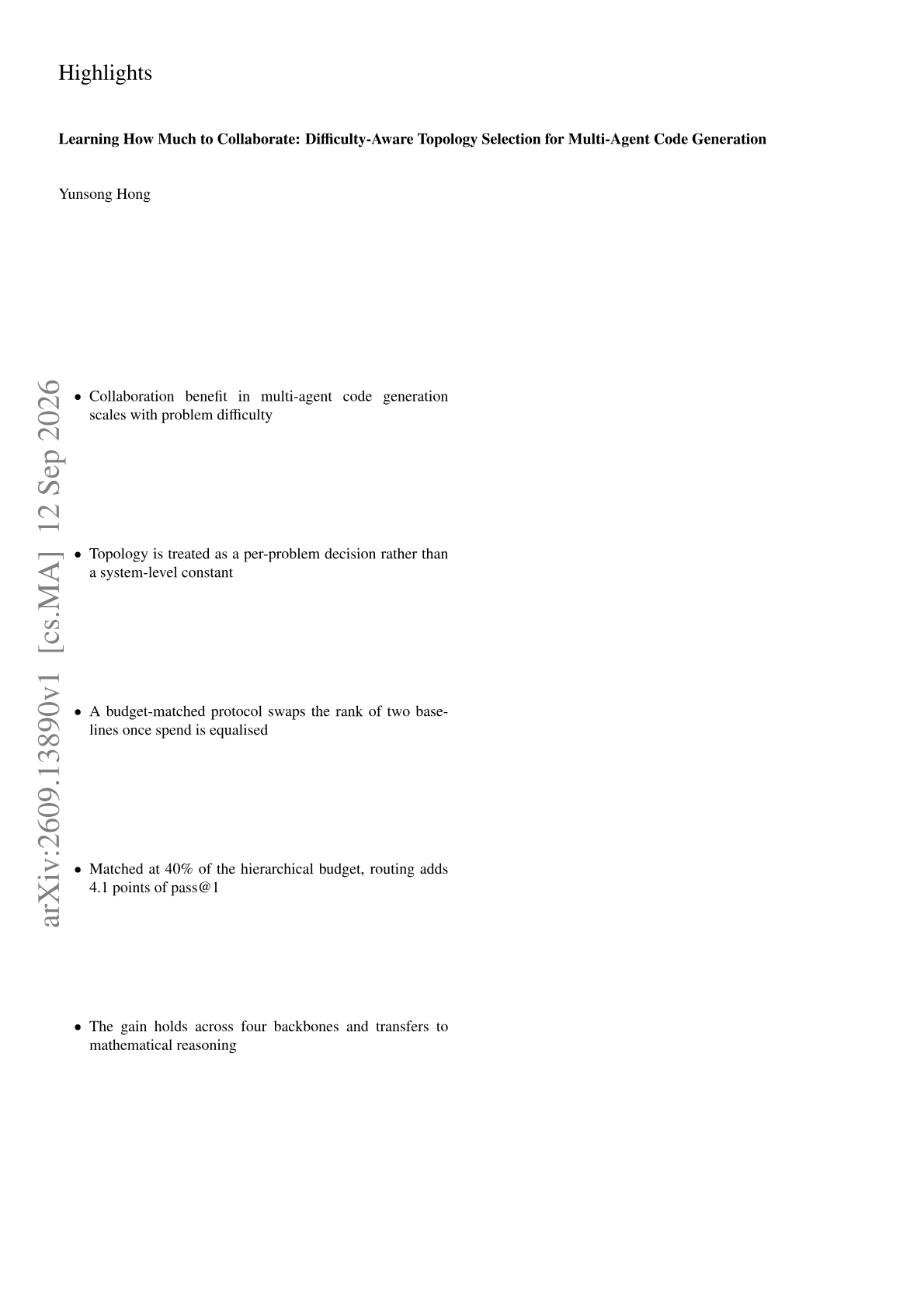
Learning How Much to Collaborate: Difficulty-Aware Topology Selection for Multi-Agent Code Generation
Yunsong Hong (University of Sydney) shows that the benefit of hierarchical multi-agent code generation grows sharply with problem difficulty and proposes DATS, which picks a communication topology for each problem by trading predicted success against cost.
Dream-RSI: Recursive Self-Improvement through Evolving Worlds
Tong Zheng and colleagues at the University of Maryland and Google DeepMind introduce Dream-RSI, which improves a coding agent's exploration policy by replaying its own past discovery trees as a simulator.
LearnActCoder: Role-Aware Error Memory for Adaptive Clinical Coding Agents
Meysam Ghaffari and colleagues turn a small labeled batch of clinical coding errors into a structured mistake database and route each lesson to the agent role that can act on it.
Coding Agents with an Obstacle-Aware Harness for Safe Robot Manipulation
Bingxin Xu, Yuzhang Shang, Zhen Dong and Emilio Ferrara evaluate coding agents that write robot controllers under a safety constraint, pairing each manipulation goal with an obstacle the robot must not touch, and find the agent collides in most cases.
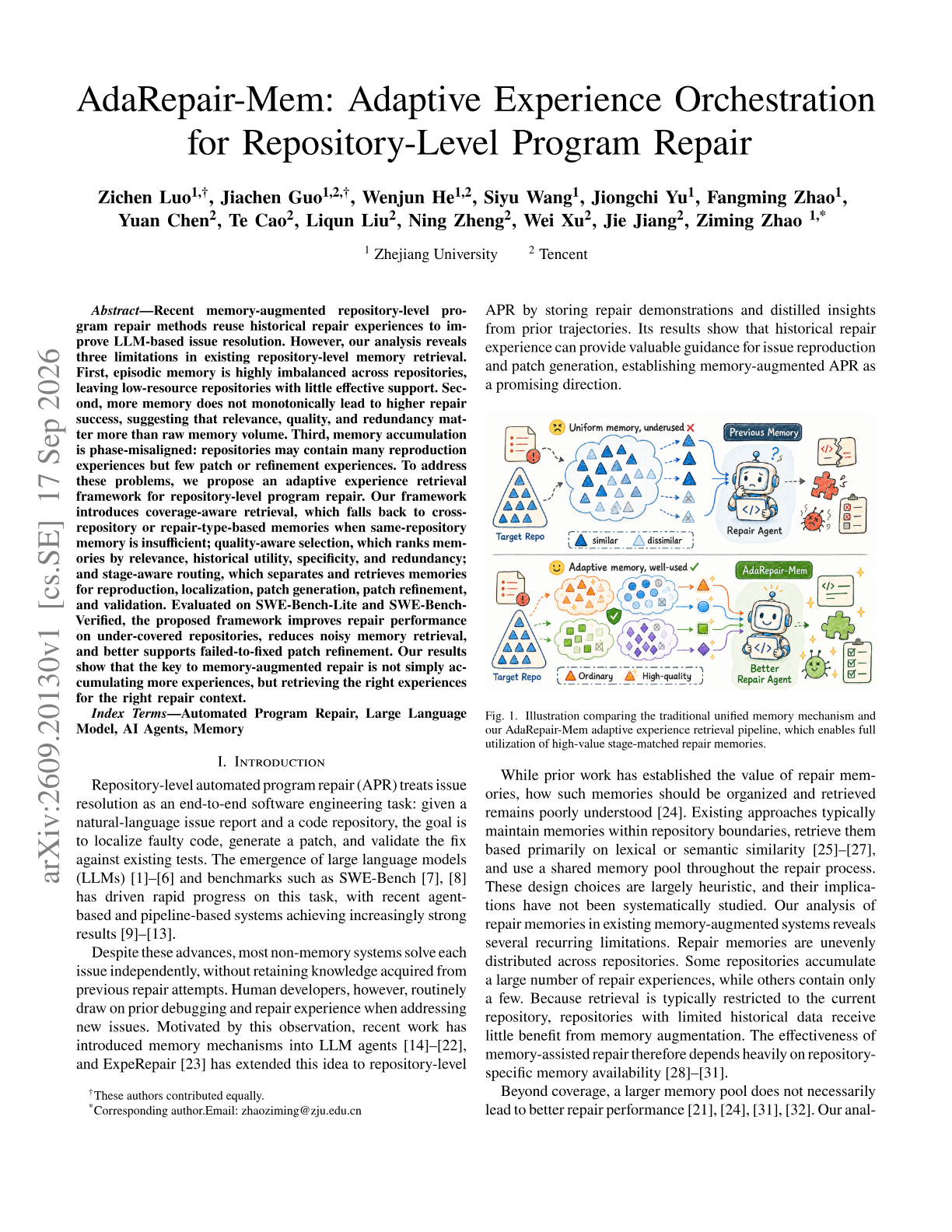
AdaRepair-Mem: Adaptive Experience Orchestration for Repository-Level Program Repair
Z. C. Luo and a 13-author team diagnose three failures in repository-level memory retrieval for program repair, then route memory by repair stage rather than by similarity alone.
DeltaSelect: Affordable A/B Testing for Coding Agents
Nicholas J. Conn presents DeltaSelect, which picks a fixed set of benchmark tasks whose single-run results track full-benchmark performance within a dollar budget, for repeated baseline-versus-candidate comparisons during development.
The Missing Complement: State-Conditioned Minimal Sufficient Evidence for Coding Agents
Zhexi Feng, Ruiyi Zhang, Yongbo Yang and Pengtao Xie formulate state-conditioned minimal sufficient evidence recovery, where the task is to supply the support an agent's next decision still lacks given what it has already read, and build SERBench and MSS-Complement.
Red-Teaming Auto Mode: Improving Blocking Classifiers Against Malign Coding Agents
Alex Remedios, Simon Storf, Fabien Roger and John Hughes at Anthropic red-team the production blocking monitors that review each coding-agent action (Auto Mode in Claude Code, Guardian in Codex) under the assumption that the monitored agent is itself persistently misaligned.
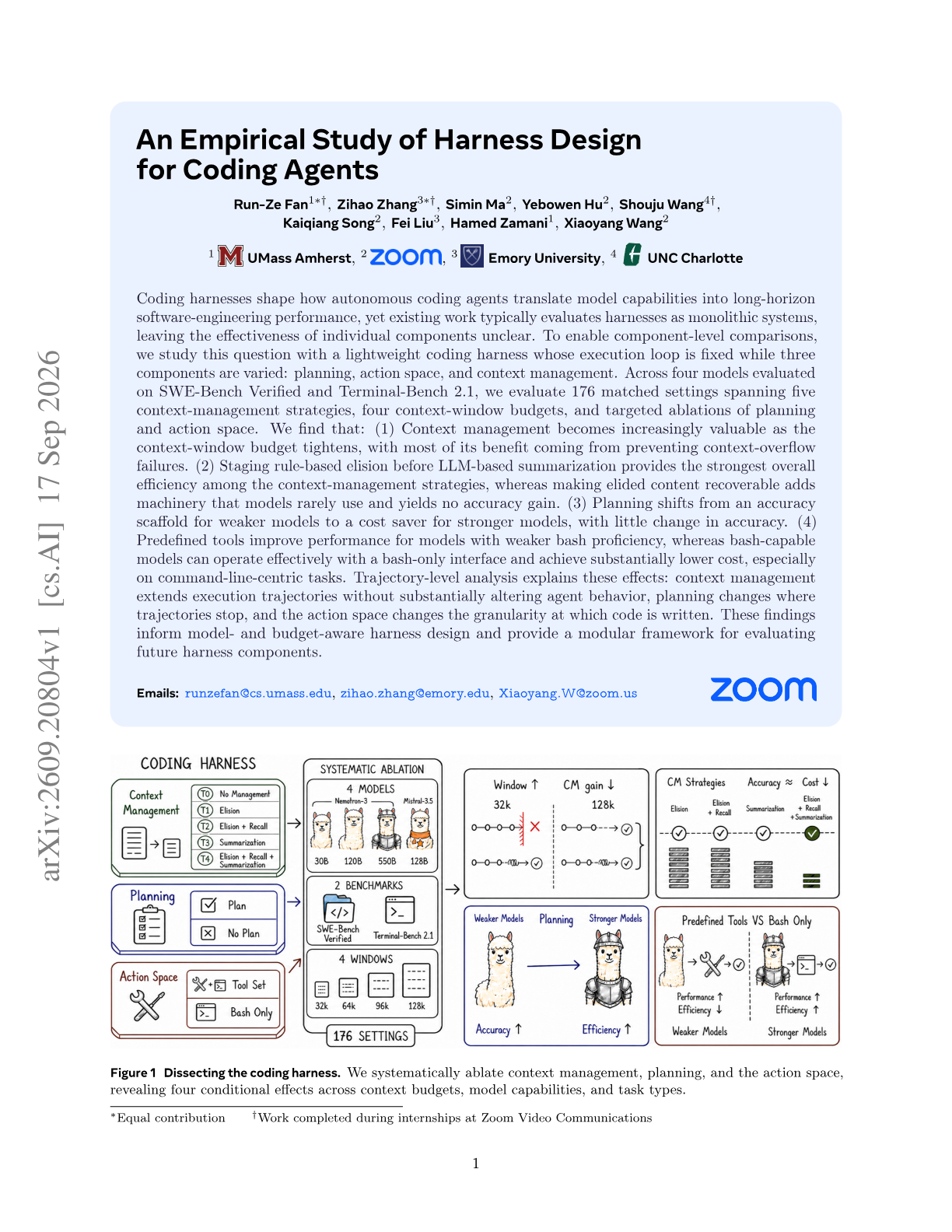
An Empirical Study of Harness Design for Coding Agents
Run-Ze Fan and colleagues at UMass Amherst, Emory, UNC Charlotte and Zoom hold a coding harness's execution loop fixed and vary three components (planning, action space, context management) across 176 matched settings, four models, SWE-Bench Verified and Terminal-Bench 2.1.
Reflections on Trusting Trust, Revisited: Contaminating Self-Modifying AI Coding Agents with Poisoned Benchmarks
Franziska Roesner (University of Washington) and Tadayoshi Kohno (Georgetown University) adapt Thompson's trusting-trust attack to self-modifying coding agents and show that a poisoned self-evaluation benchmark can make later agent versions write vulnerable code on clean, held-out tasks.