AI Papers of the Week
Every paper worth reading in AI, hand-picked one week at a time.
Discover and explore top AI papers with Claude Code or Codex
npx @dair-ai/mcp setup
AEvo
AEvo separates the iterative self-improvement loop into two roles: a candidate-proposer that generates the next attempt, and a meta-agent that observes traces and edits the procedure used to propose future candidates. Past runs (candidates, feedback, traces, failures) function as memory the meta-agent reads from when revising the procedure. AEvo reports a 26% relative gain over the strongest evolution baseline on agentic and reasoning benchmarks, and SOTA on three open-ended optimization tasks under the same iteration budget. The work demonstrates one way to operationalize accumulated agentic search logs as input to procedure-level updates rather than discarding them after each run.
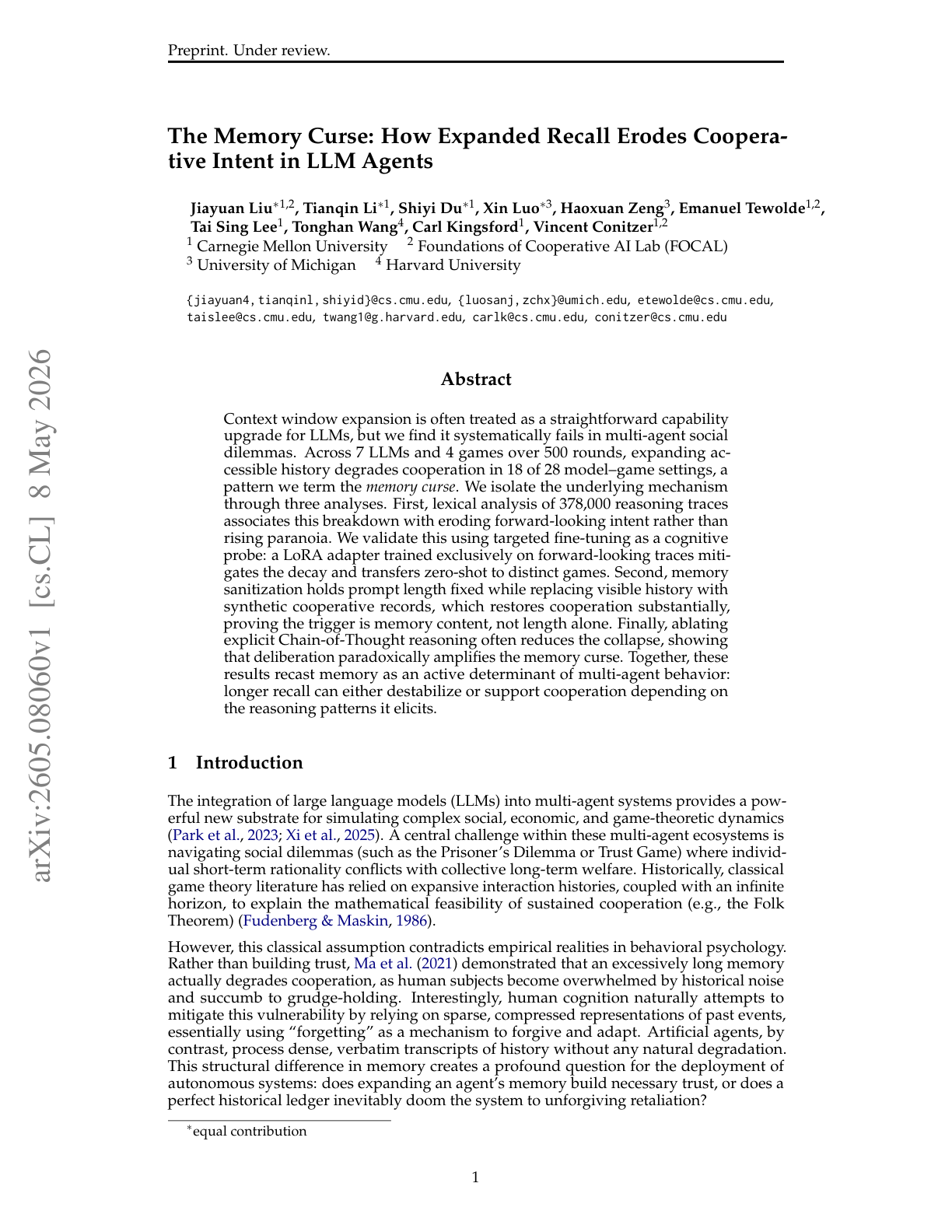
The Memory Curse in LLM Agents
A study of how long histories affect LLM agent behavior. Across 7 LLMs and 4 social dilemma games over 500 rounds, expanding accessible history degraded cooperation in 18 of 28 model-game combinations. Lexical analysis of 378,000 reasoning traces shows the mechanism is erosion of forward-looking intent rather than increased suspicion: long histories pull the model toward reasoning about past interactions rather than future payoffs. A LoRA adapter trained only on forward-looking traces mitigates the decay and transfers zero-shot to new games. Memory sanitization, which keeps prompt length fixed but swaps in synthetic cooperative records, restores cooperation, indicating the trigger is content rather than length. Ablating explicit chain-of-thought often reduces the collapse, suggesting deliberation amplifies the effect. The paper provides a diagnostic plus interventions for long-running agent systems where history quality, not just history length, drives behavior.
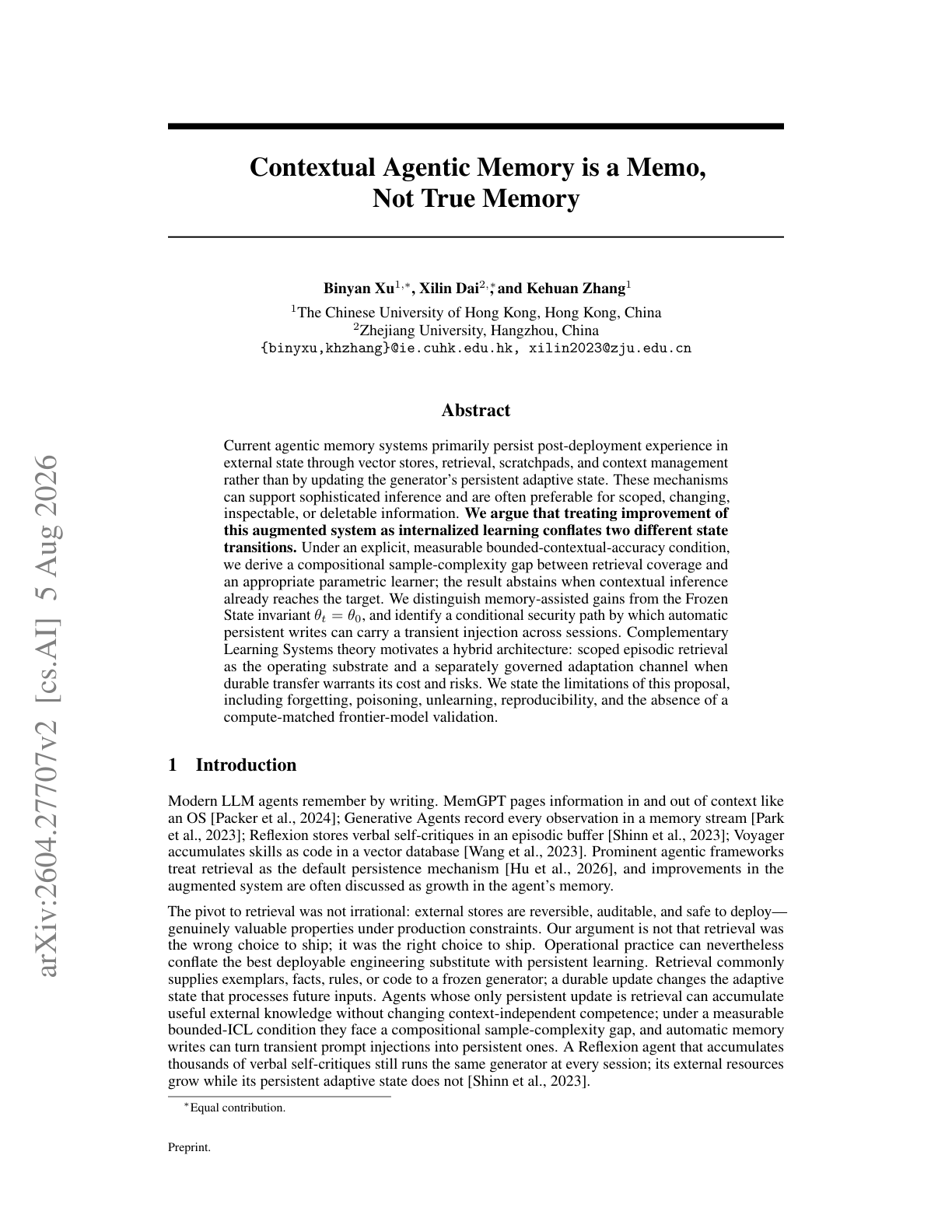
Contextual Agentic Memory is a Memo
Most agent memory today is not memory, it is closer to a memo. Vector stores, RAG buffers, and scratchpads implement lookup, not consolidation. The paper draws on neuroscience's Complementary Learning Systems theory: biological intelligence pairs fast hippocampal storage with slow neocortical consolidation, and current AI agents only implement the first half (fast write, similarity recall, no abstraction step). The authors prove a generalization ceiling on compositionally novel tasks: as long as memory stays retrieval-only, the agent cannot apply abstract rules to inputs that do not already look like something in the store, and it remains permanently exposed to memory poisoning. If you are building long-running agents and treating memory as a vector index, this paper is a clean diagnosis of what you are missing.
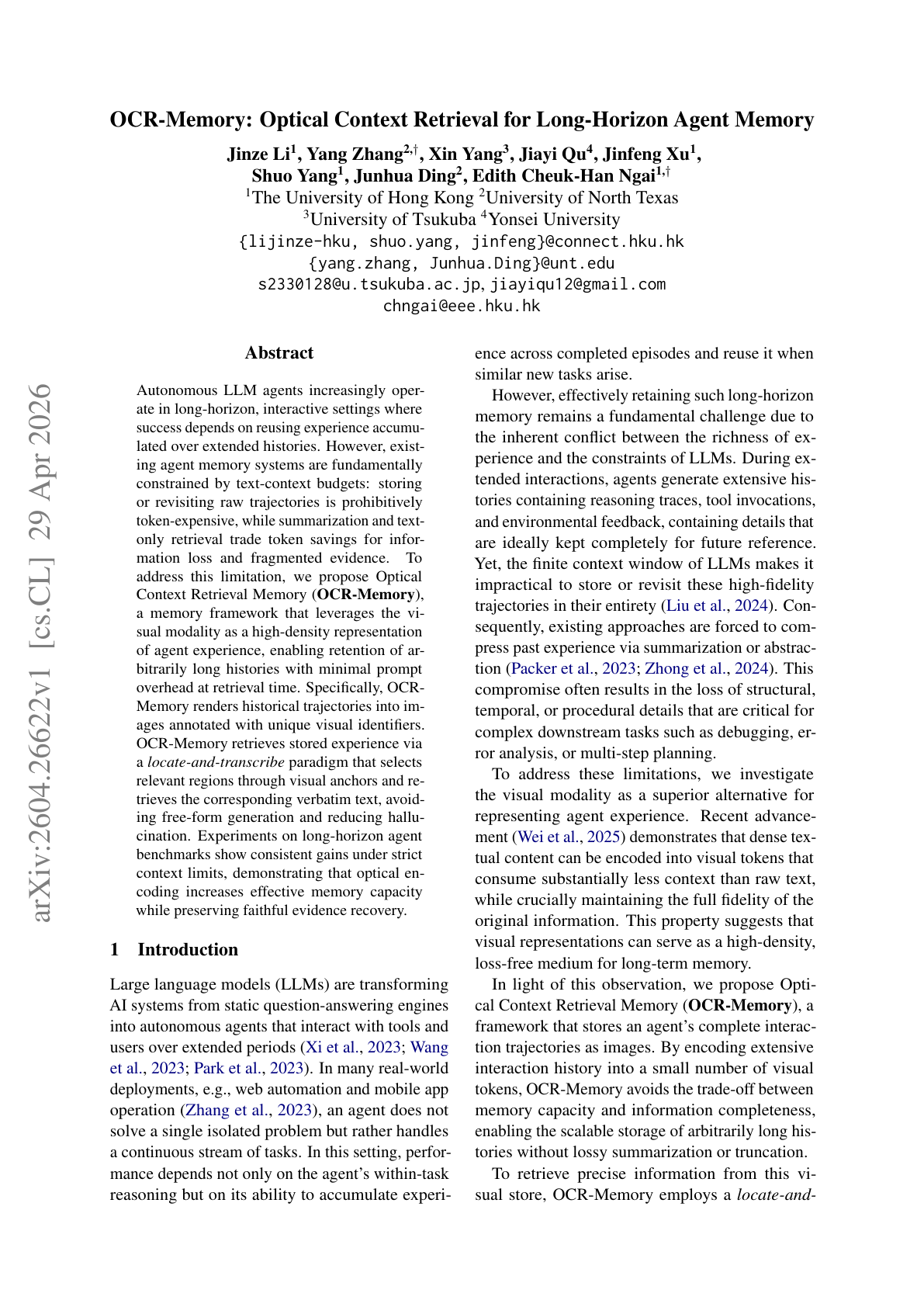
OCR-Memory
Most agent memory systems compress trajectories into text summaries and hope the model remembers what matters, which is exactly where the information loss hides. OCR-Memory renders the agent's interaction history as images with indexed visual anchors, then retrieves via a locate-and-transcribe pipeline: the model scans visual memory, predicts the index of the relevant region, and the original text is fetched verbatim from a database. Older trajectories are stored as low-resolution thumbnails with active-recall up-sampling, and the method reaches SOTA on Mind2Web and AppWorld under strict context limits.
DeepSeek V4
DeepSeek V4 is the first open model family built from the ground up around million-token contexts as a default rather than a bolt-on feature. The release includes DeepSeek-V4-Pro (1.6T total / 49B active) and DeepSeek-V4-Flash (284B total / 13B active), both trained natively at 1M context length. The tech report details a hybrid attention architecture, new training stability techniques, and a domain-specialist post-training pipeline that together push the open-source frontier much closer to GPT-5.2 and Gemini 3.0-Pro at a fraction of the cost.
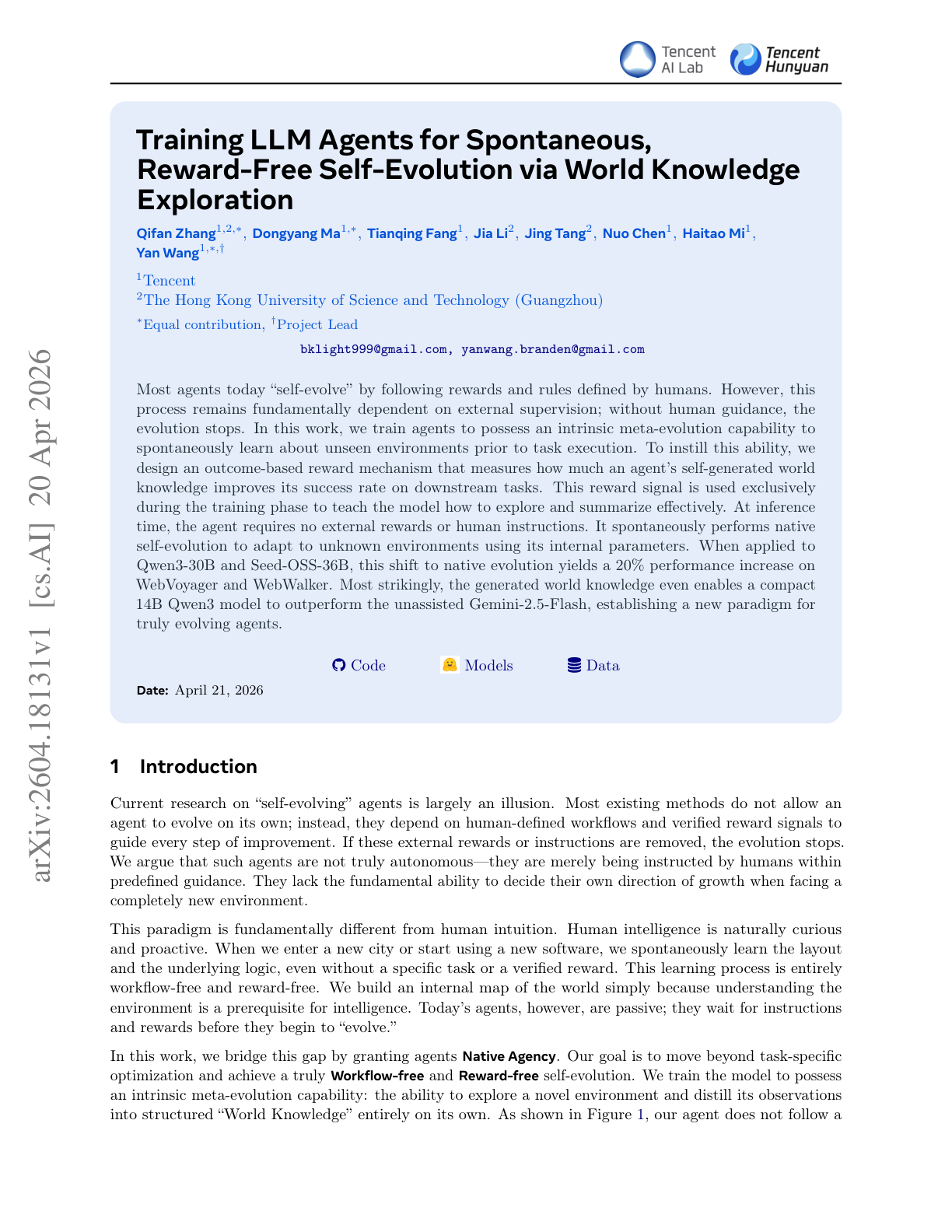
Self-Generated World Knowledge
How far are we from agents that can self-generate world knowledge? This paper proposes an outcome-based reward that measures how much an agent's self-generated world knowledge actually improves its task success rate, then trains with that signal and removes the external guidance at inference. The result is a 14B model that surpasses Gemini-2.5-Flash on web navigation and gains +20% on WebVoyager and WebWalker benchmarks.
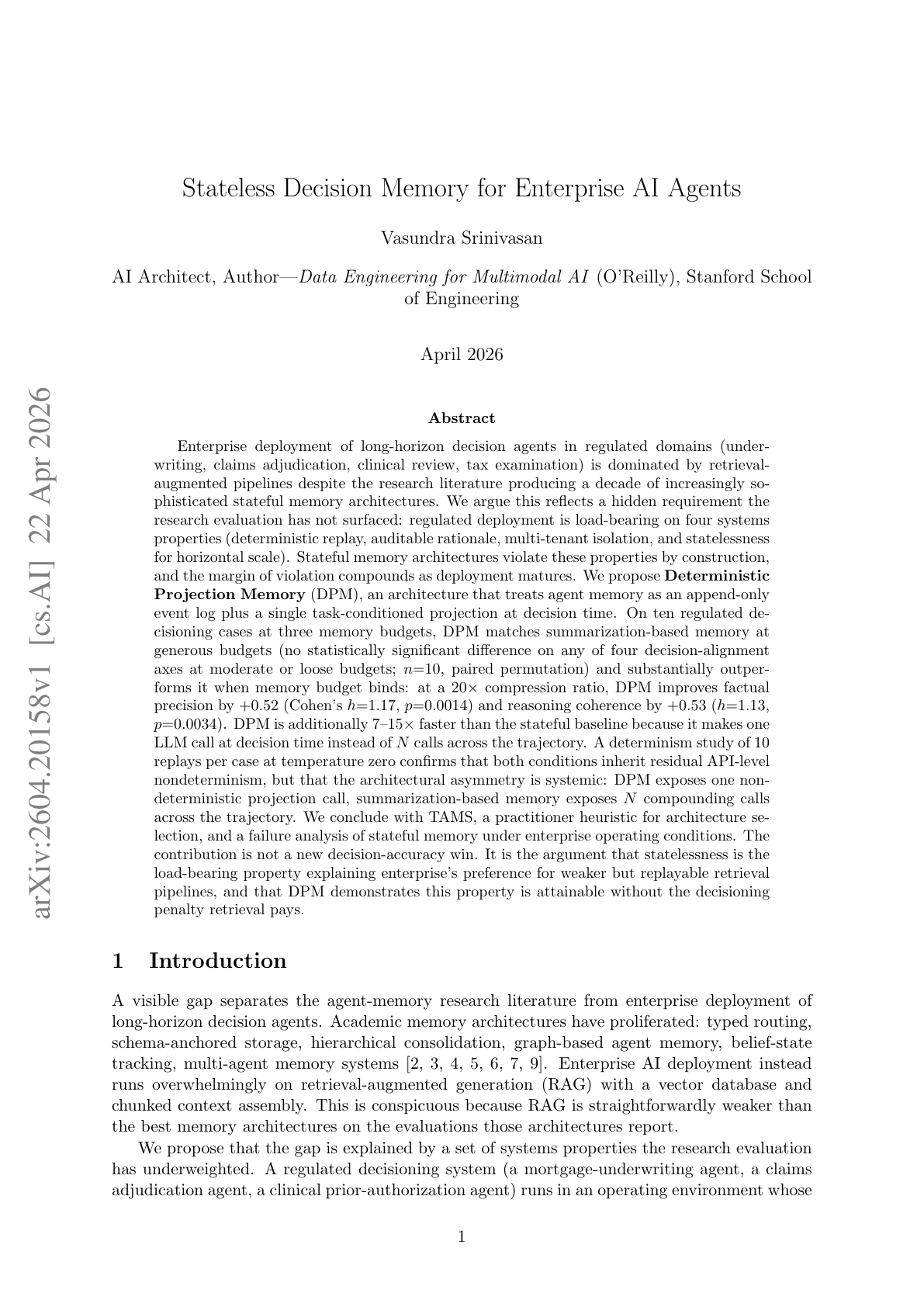
Stateless Decision Memory
Most interesting AI agent papers right now are about capability. This one is about plumbing, and it is probably more important than it looks. Stateful agents do not scale horizontally. The moment you need thousands of concurrent agent instances running across containers, persistent per-agent state becomes the bottleneck. This paper proposes replacing active memory with immutable decision logs using event-sourcing principles from distributed systems.
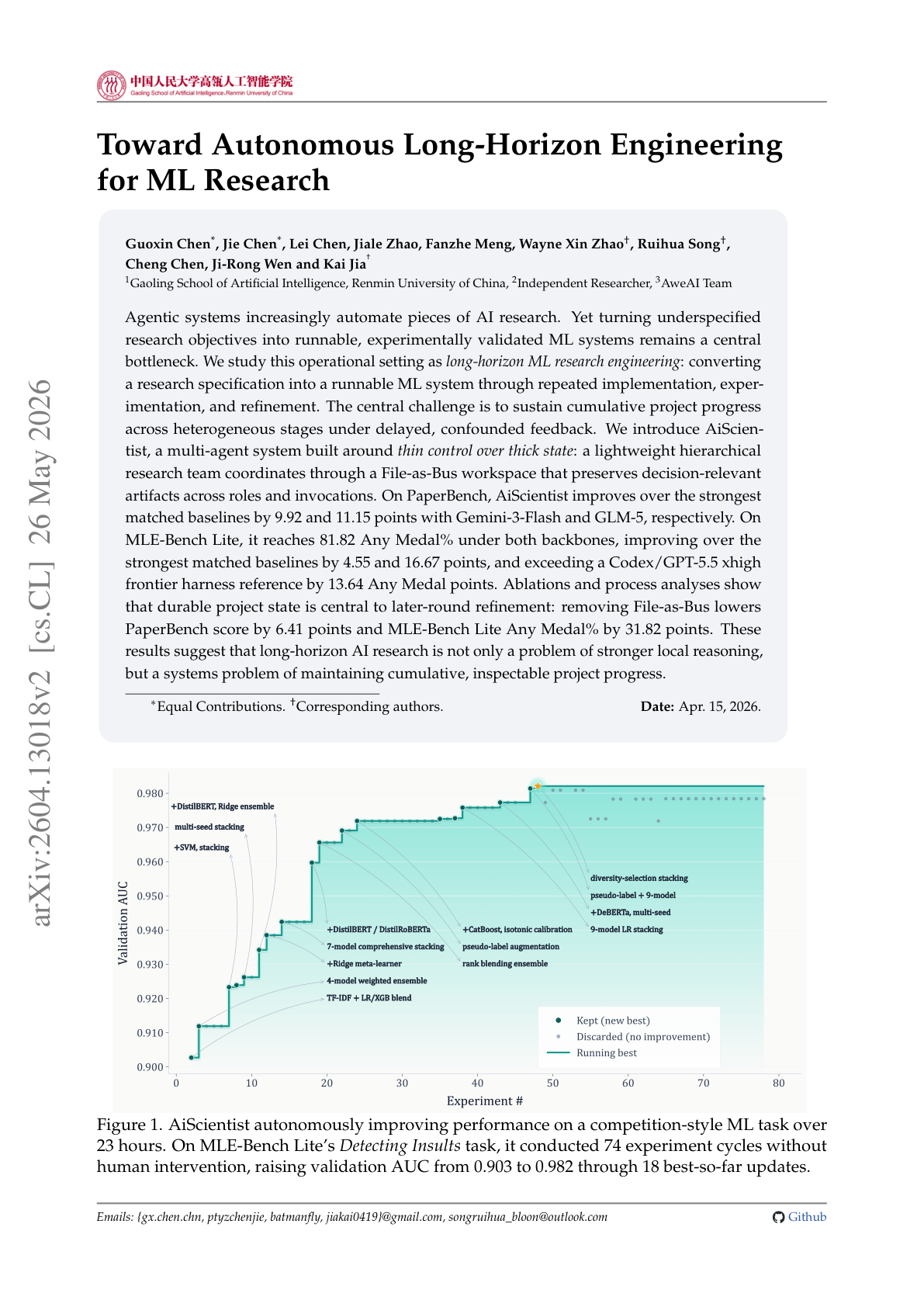
AiScientist
Long-horizon AI research agents are mostly a state-management problem. Reasoning well for the next turn is not enough when ML research demands task setup, implementation, experiments, debugging, and evidence tracking over hours or days. This paper introduces AiScientist, a system for autonomous long-horizon engineering built around the principle of thin control and thick state. A top-level orchestrator manages stage-level progress while specialized agents repeatedly ground themselves in durable workspace artifacts.
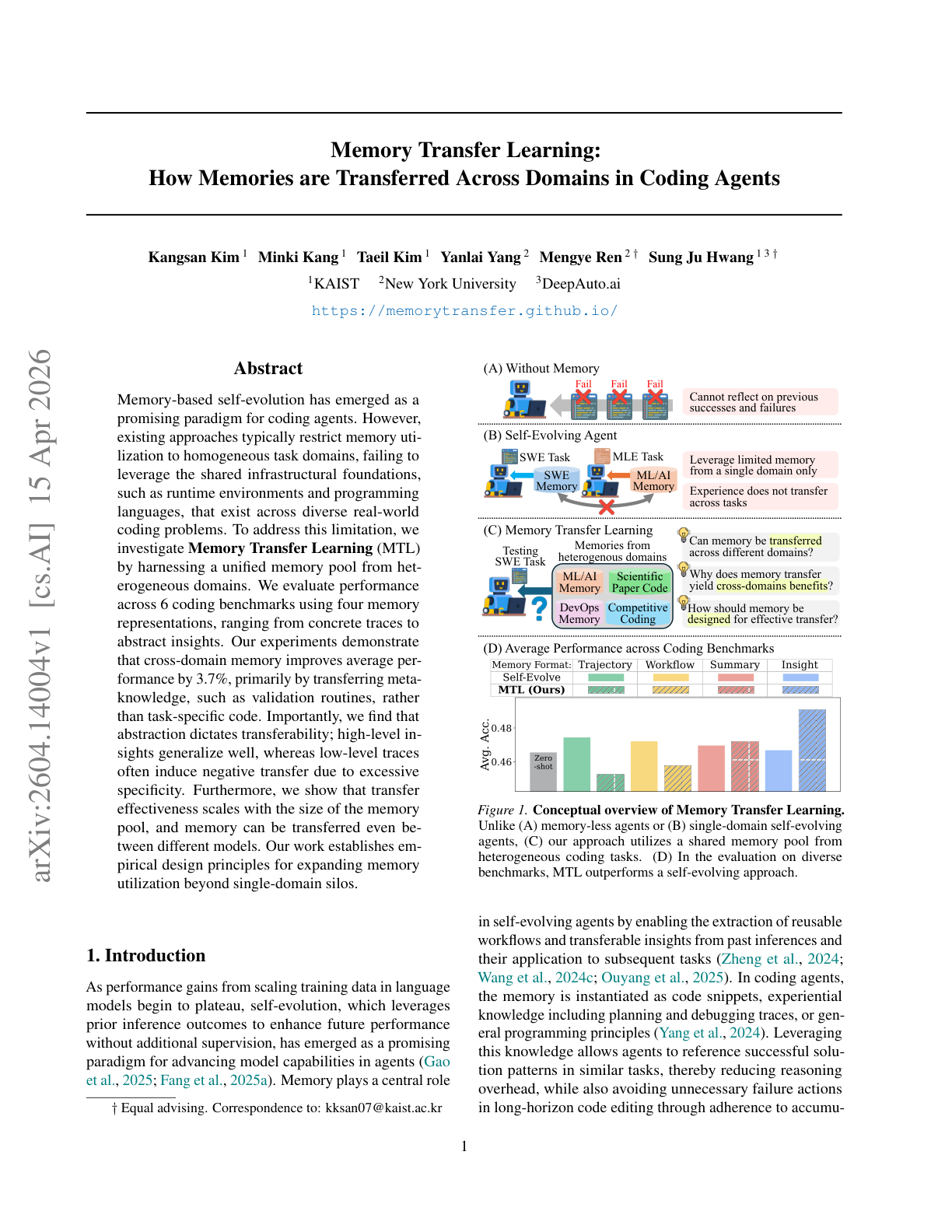
Memory Transfer Learning
Coding agents learn from experience, but that knowledge stays locked in silos. Solve a thousand SWE tasks, and none of that wisdom helps with competitive coding. This paper introduces Memory Transfer Learning, a framework where coding agents share a unified memory pool across six heterogeneous coding benchmarks, testing what transfers between domains and what does not.
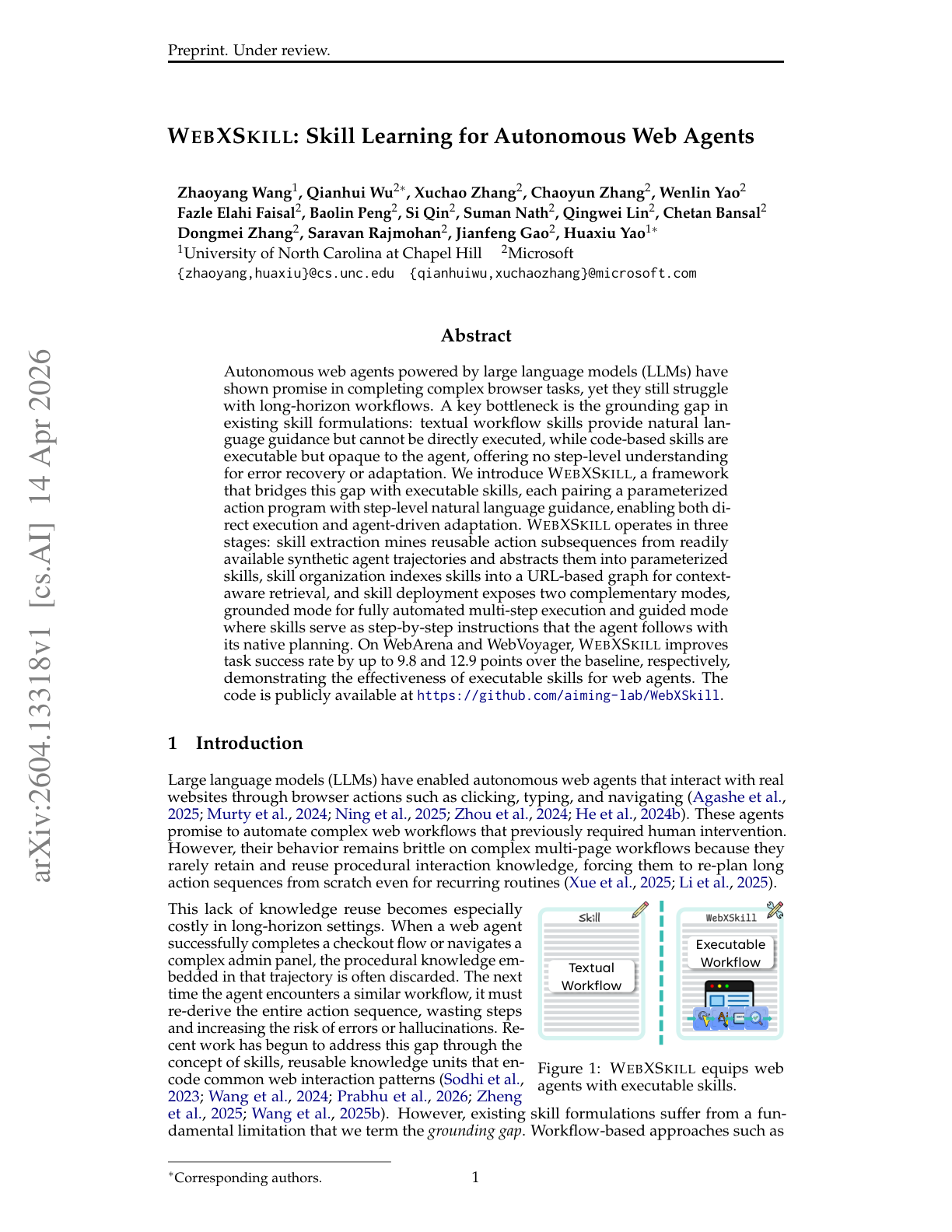
WebXSkill
Web agents can navigate a page, but ask them to repeat a checkout flow they already completed and they start from scratch every time. WebXSkill is a skill learning framework where web agents extract reusable skills from synthetic trajectories, each pairing a parameterized action program with step-level natural language guidance. Two deployment modes let the agent either auto-execute skills as atomic tool calls (grounded) or follow them as step-by-step instructions while retaining autonomy to adapt (guided). On WebArena, WebXSkill improves task success by up to 9.8 points over baselines. On WebVoyager, grounded mode reaches 86.1%, a 14.2-point gain, and skills even transfer across environments.
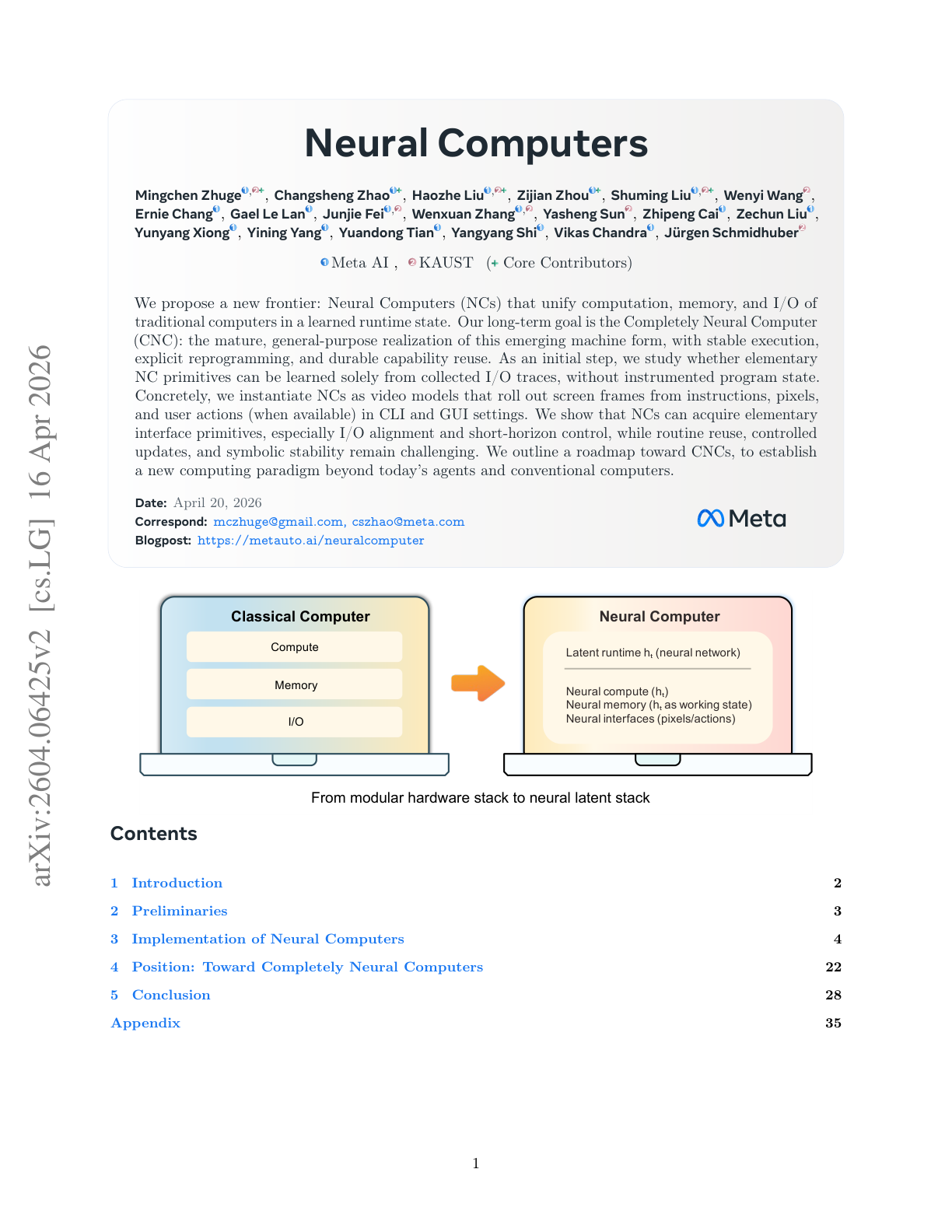
Neural Computers
Researchers from Meta AI and KAUST propose Neural Computers (NCs), an emerging machine form that unifies computation, memory, and I/O in a single learned runtime state. Unlike conventional computers that execute explicit programs, agents that act over external environments, or world models that learn dynamics, NCs aim to make the model itself the running computer, establishing a new computing paradigm.
Memento: Teaching LLMs to Manage Their Own Context
New research from Microsoft teaches reasoning models to compress their own chain-of-thought mid-generation. Memento trains models to segment reasoning into blocks, summarize each block into a compact “memento,” and then evict the original block from the KV cache. The model continues reasoning from mementos alone, cutting peak memory by 2-3x while nearly doubling throughput.
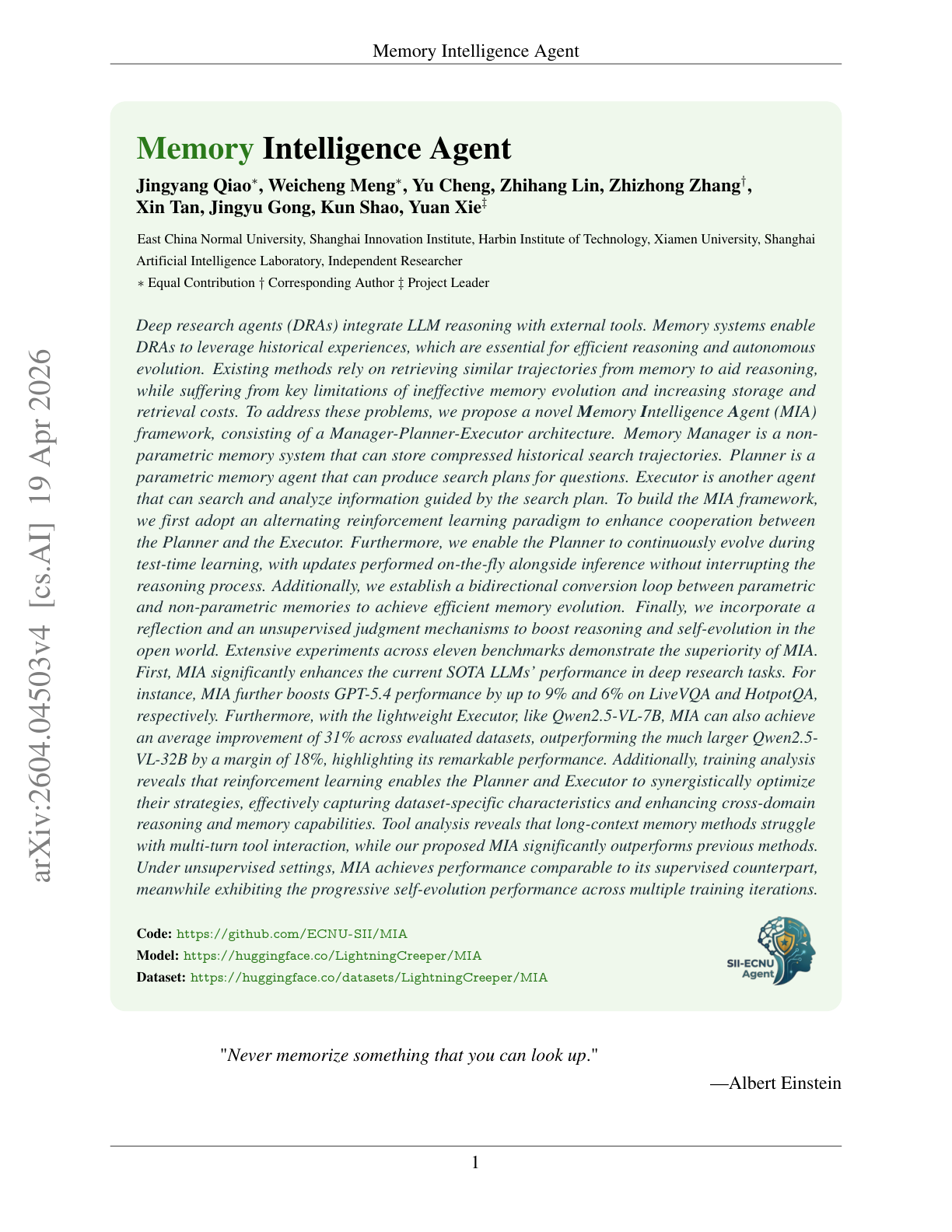
Memory Intelligence Agent (MIA)
Most memory-augmented research agents treat memory as a static retrieval store, leading to inefficient evolution and rising storage costs. MIA introduces a Manager-Planner-Executor architecture where a Memory Manager maintains compressed search trajectories, a Planner generates strategies, and an Executor searches and analyzes information. The framework boosts GPT-5.4 by up to 9% on LiveVQA through bidirectional memory conversion.
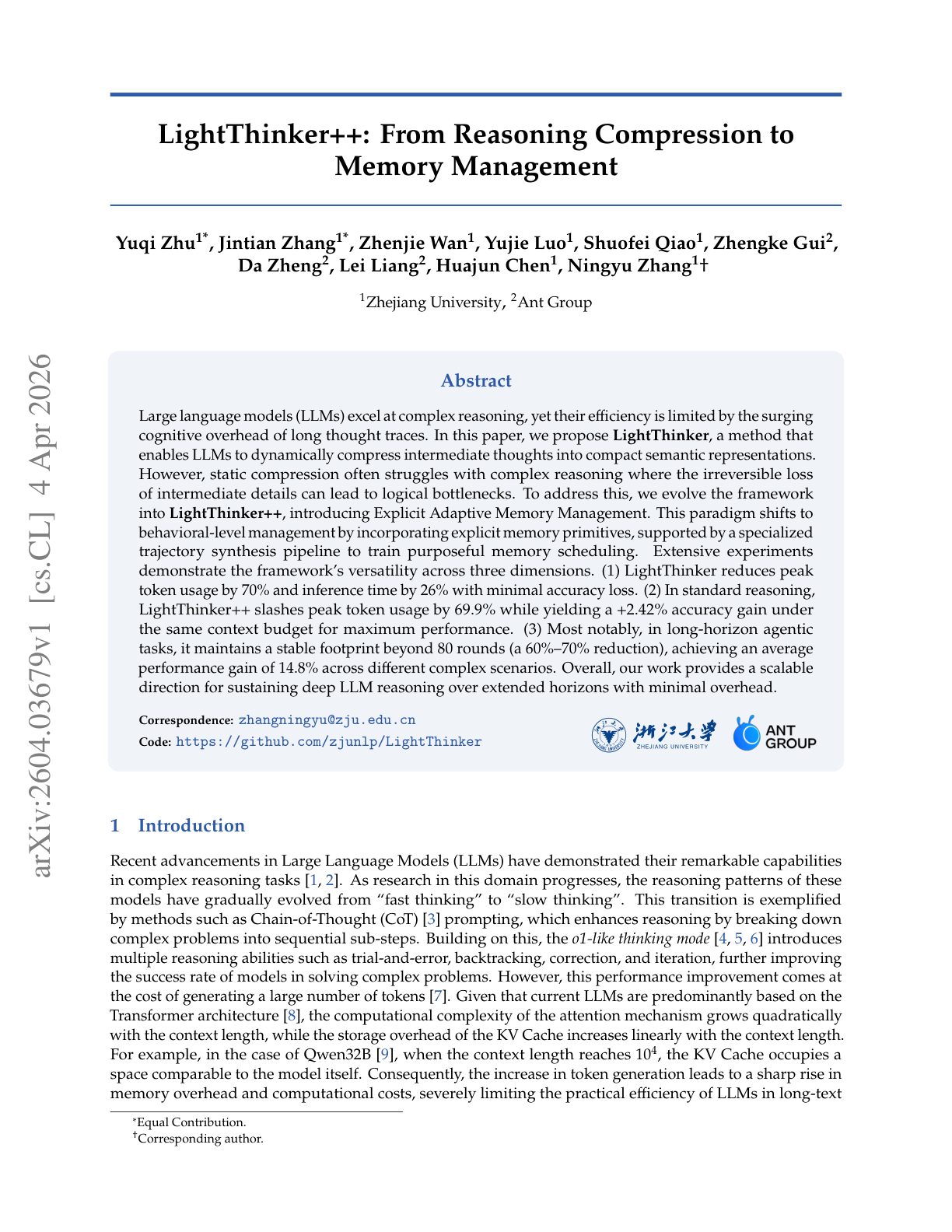
LightThinker++: From Reasoning Compression to Memory Management
While LLMs excel at complex reasoning, long thought traces create surging cognitive overhead. LightThinker++ moves beyond static compression by introducing three explicit memory primitives: Commit (archive a step as a compact summary), Expand (retrieve past steps for verification), and Fold (collapse context to maintain a clean signal). The framework reduces peak token usage by 70% while gaining +2.42% accuracy on standard reasoning tasks, and maintains stability beyond 80 rounds on long-horizon agentic tasks with a 14.8% average performance improvement.
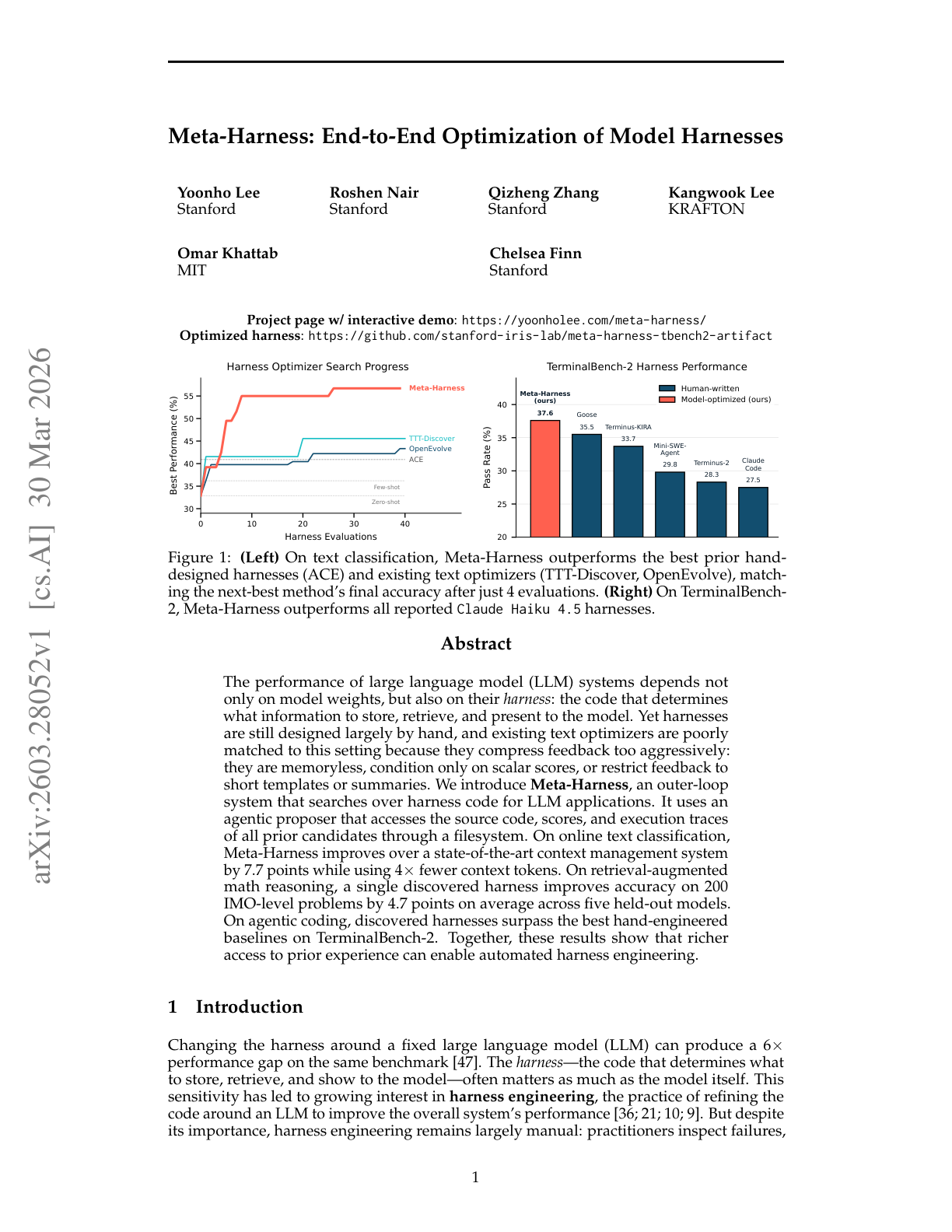
Meta-Harness
Researchers from Stanford and MIT introduce Meta-Harness, an outer-loop system that automatically searches over harness code for LLM applications. The performance of LLM systems depends not only on model weights but also on the harness: the code that determines what information to store, retrieve, and present to the model. Yet harnesses are still designed largely by hand, and existing optimizers are poorly suited to the task.
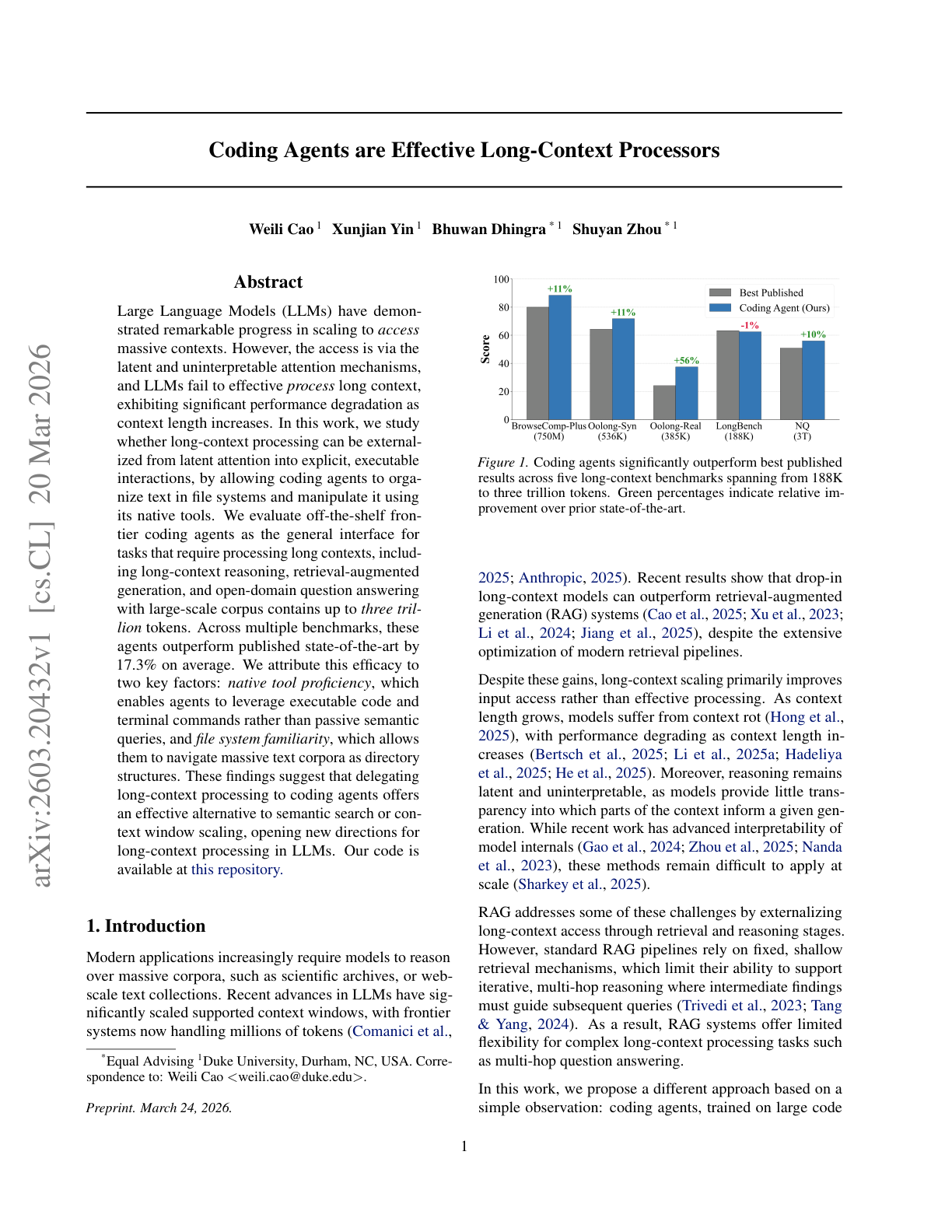
Coding Agents as Long-Context Processors
This research asks whether long-context processing can be externalized from latent attention into explicit, executable interactions. Instead of scaling context windows, the authors let coding agents organize text in file systems and manipulate it using native tools, evaluating them on tasks spanning long-context reasoning, retrieval-augmented generation, and open-domain question answering with corpora containing up to three trillion tokens.
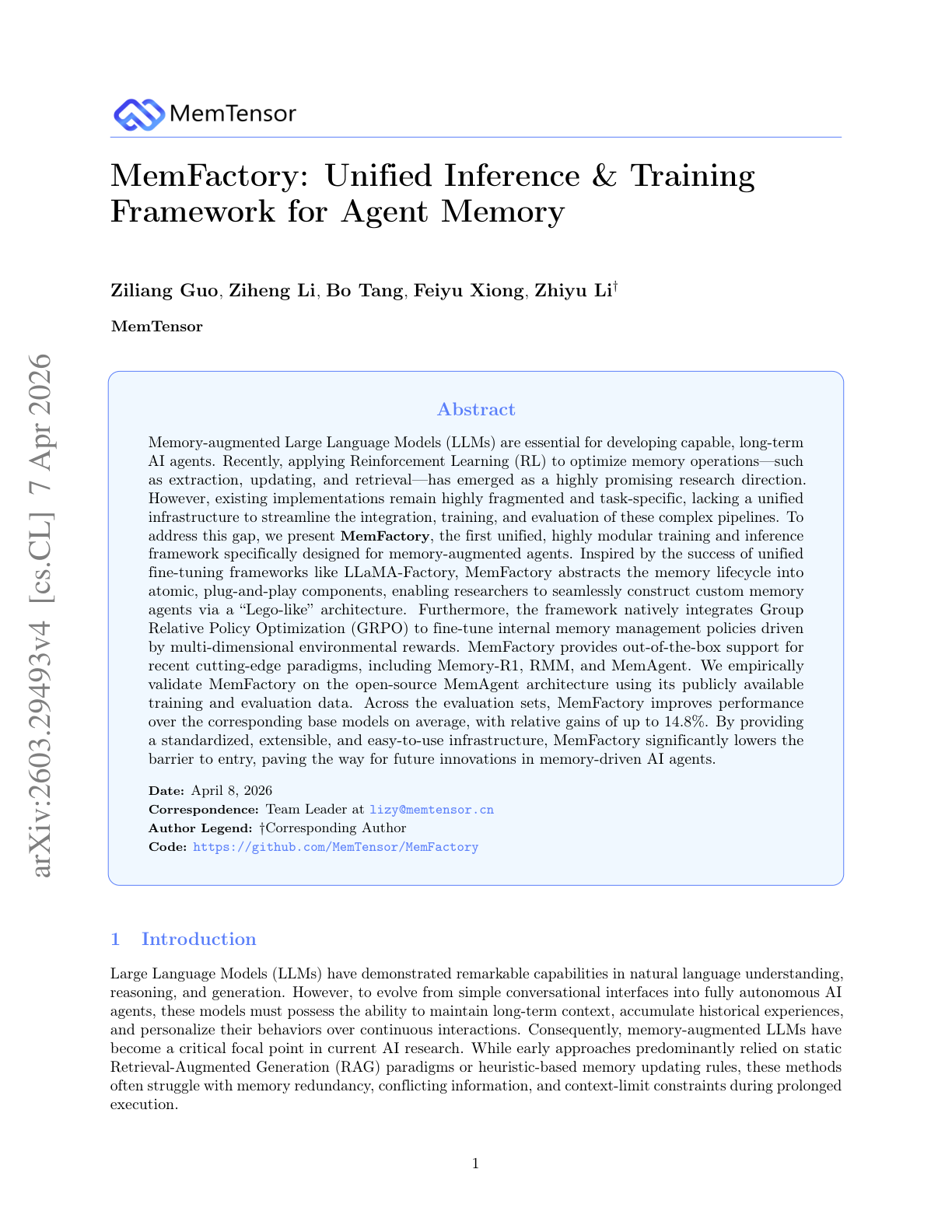
MemFactory
MemFactory introduces the first unified, highly modular training and inference framework specifically designed for memory-augmented AI agents. It abstracts the memory lifecycle into atomic, plug-and-play components using a “Lego-like” architecture, natively integrating Group Relative Policy Optimization (GRPO) to fine-tune internal memory management strategies. The framework decomposes memory into mixable components that support recent approaches including Memory-R1, RMM, and MemAgent out of the box, achieving relative gains of up to 14.8% compared to baseline models.
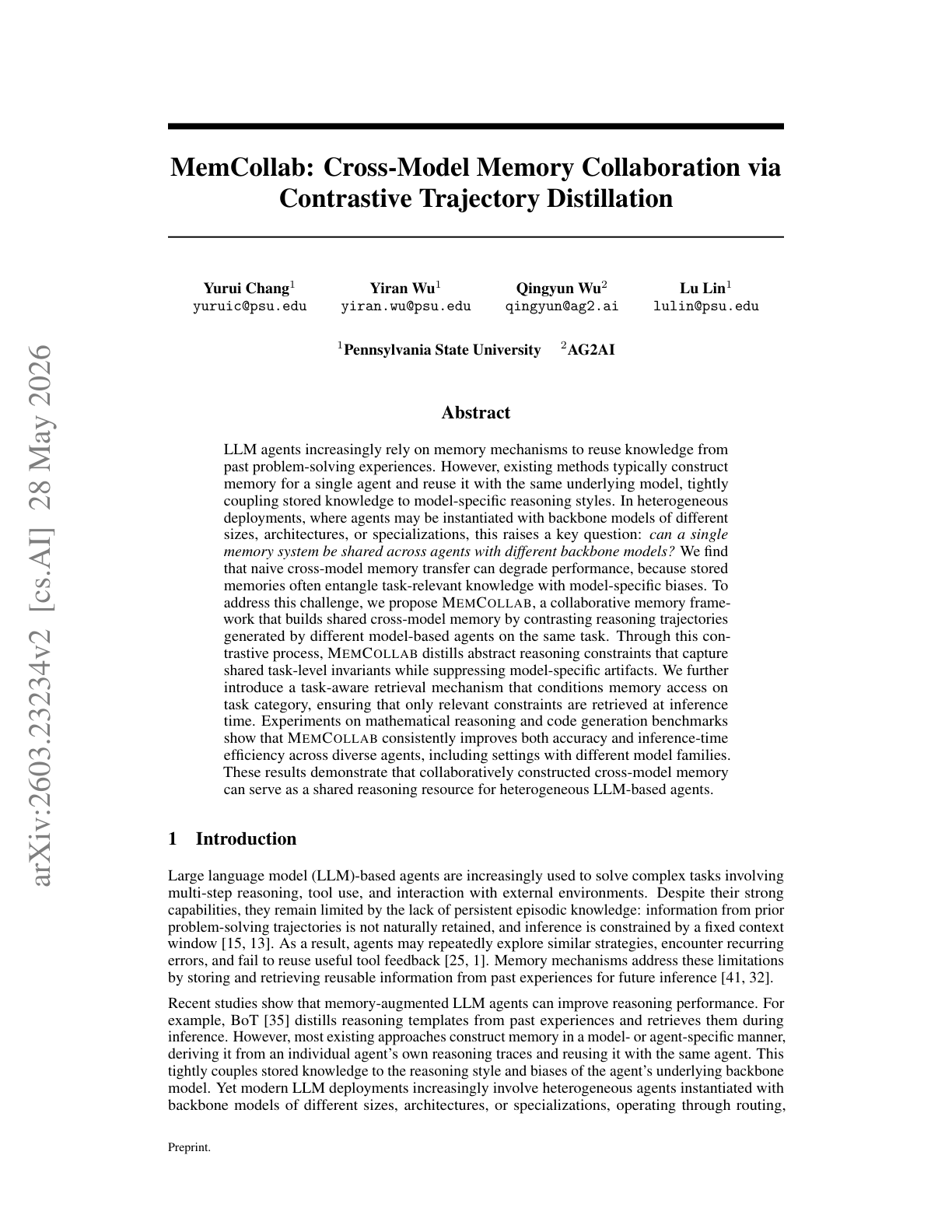
MemCollab
LLM-based agents build useful memory during tasks, but that memory is typically trapped within a single model. MemCollab introduces a collaborative memory framework that constructs agent-agnostic memory by contrasting reasoning trajectories generated by different agents on the same task, enabling a single memory system to be shared across heterogeneous models.
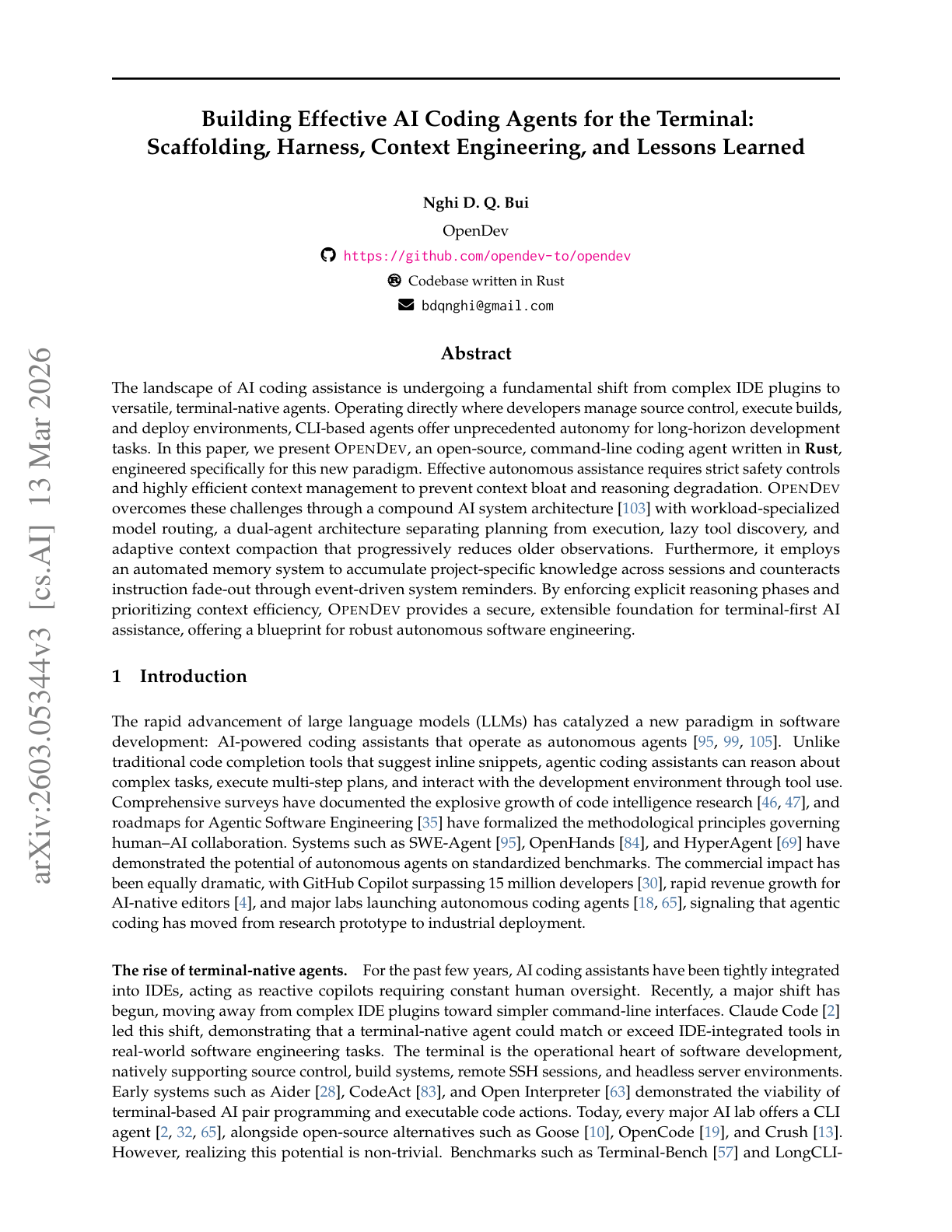
OpenDev
Terminal-native coding agents represent a fundamental shift in how developers interact with AI assistance. OpenDev is an open-source, command-line coding agent that operates where developers already manage source control and deploy environments, offering a comprehensive 81-page technical report on scaffolding, harness design, context engineering, and lessons learned from building production coding agents.
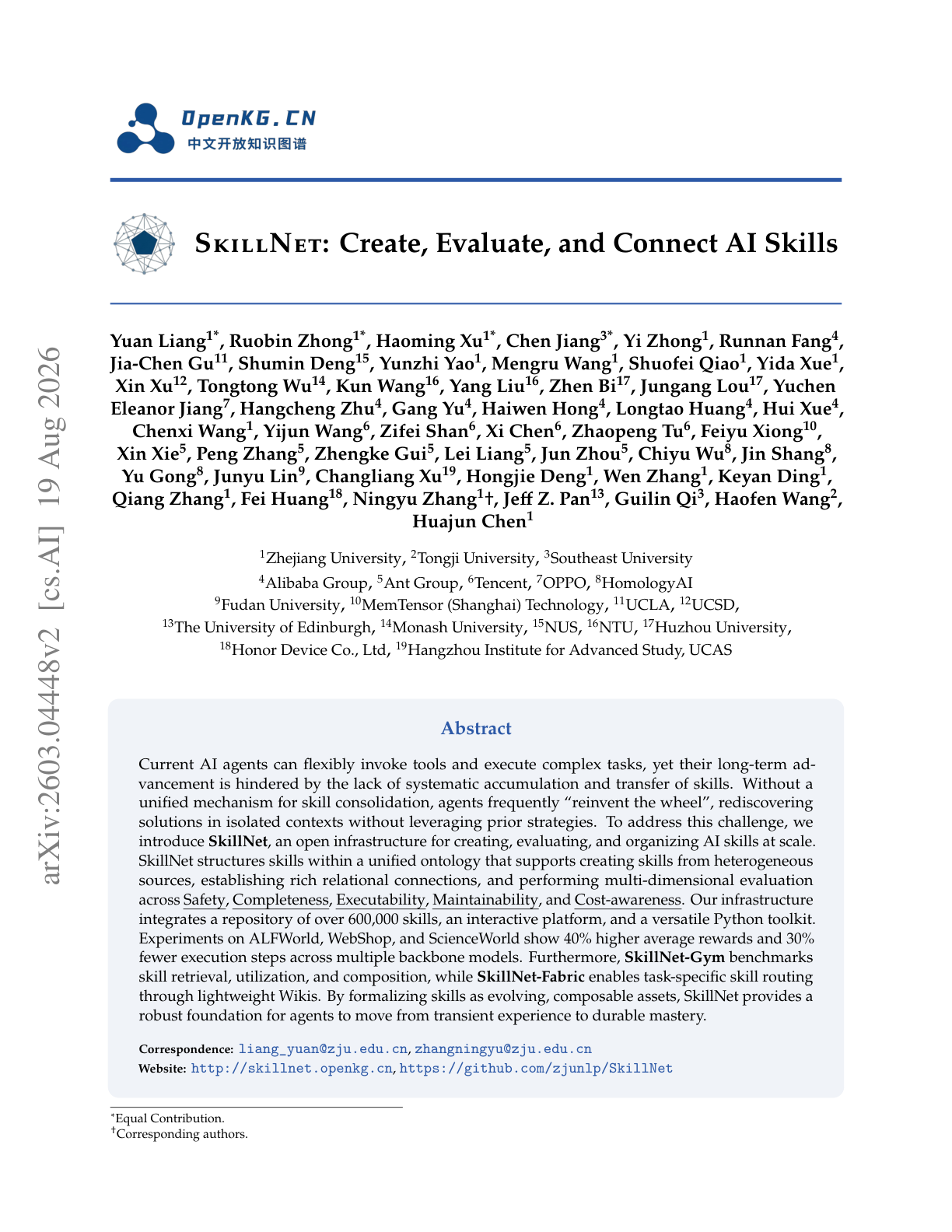
SkillNet
AI agents repeatedly rediscover solutions across separate scenarios instead of systematically reusing what they have already learned. SkillNet introduces an open infrastructure designed to create, evaluate, and organize AI skills at scale, enabling agents to transition from transient experience to durable mastery.
Memex(RL)
As tasks get longer and more complex, LLM agents lose track of what they have learned, what they have tried, and what still needs to be done. Memex(RL) introduces an indexed experience memory mechanism that scales agent capability on long-horizon tasks without discarding evidence or blowing up the context window.
STRUCTUREDAGENT
STRUCTUREDAGENT introduces a hierarchical planning framework for long-horizon web tasks using dynamic AND/OR trees. The framework separates planning responsibilities: the system constructs and maintains the planning tree while the LLM is invoked only for local operations like node expansion or repair. A structured memory module tracks candidate solutions to improve constraint satisfaction. Results on WebVoyager, WebArena, and custom shopping benchmarks show improved performance over standard LLM-based web agents, with the added benefit of interpretable hierarchical plans that enable easier debugging and human intervention.
Think Harder or Know More
This paper investigates transformer models featuring both adaptive per-layer looping, where each block learns to iterate its hidden state via a learned halting mechanism, and gated memory banks that provide additional learned storage. The key finding is that looping primarily benefits mathematical reasoning while memory banks help recover performance on commonsense tasks. Combining both mechanisms yields a model that outperforms an iso-FLOP baseline with three times the number of layers on math benchmarks. Analysis of model internals reveals layer specialization: early layers loop minimally and access memory sparingly, while later layers do both more heavily.
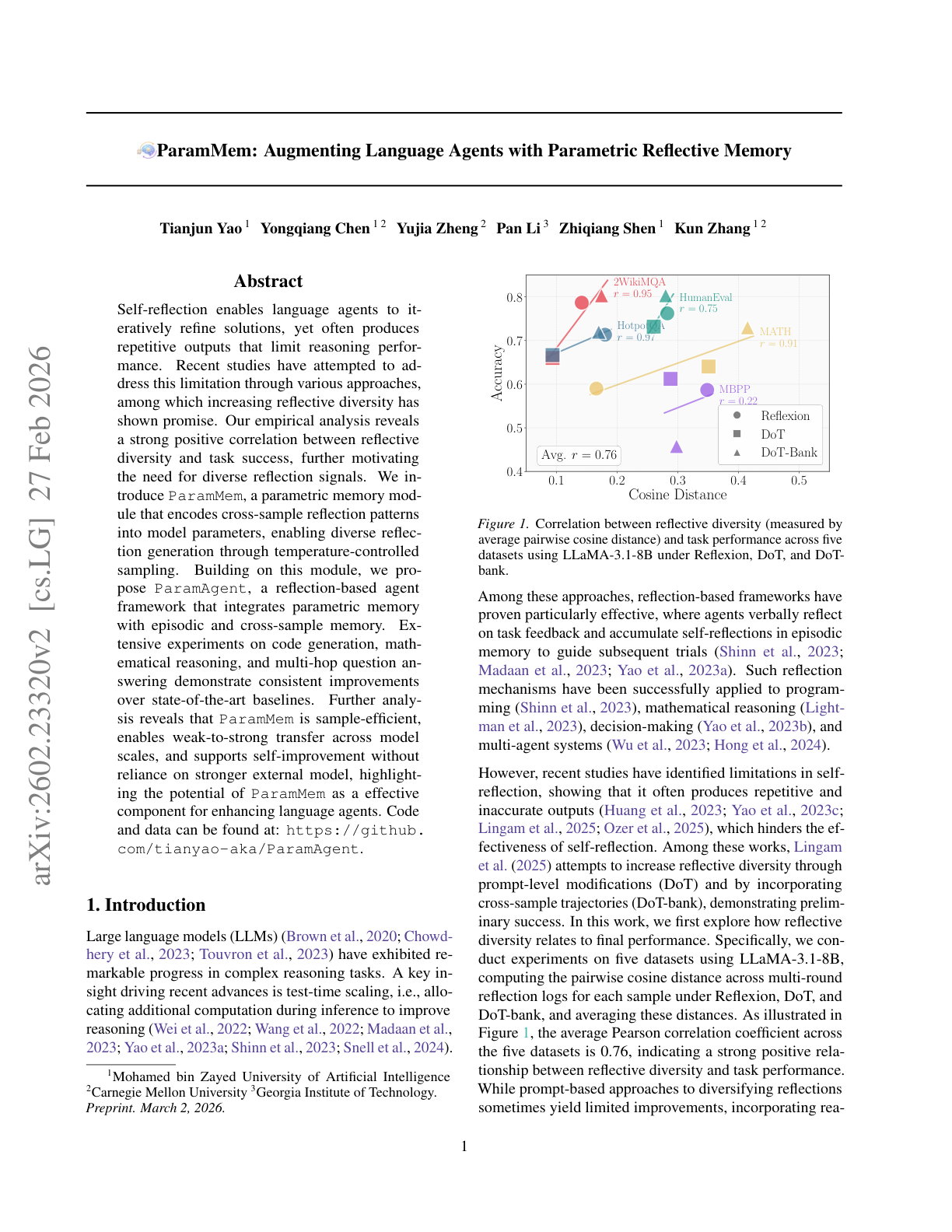
ParamMem
Self-reflection enables language agents to iteratively refine solutions, but models tend to generate repetitive reflections that add noise instead of useful signal. ParamMem introduces a parametric memory module that encodes cross-sample reflection patterns into model parameters, enabling diverse reflection generation through temperature-controlled sampling.