AI Papers of the Week
Every paper worth reading in AI, hand-picked one week at a time.
Discover and explore top AI papers with Claude Code or Codex
npx @dair-ai/mcp setup
A Deep Dive into RL for LLM Reasoning
This paper reviews and rigorously re-evaluates reinforcement learning techniques for LLM reasoning, addressing inconsistencies caused by varied setups and unclear guidelines. It offers a unified open-source framework, practical selection guidelines, and shows that a minimalist two-technique combo with vanilla PPO can outperform methods like GRPO and DAPO.
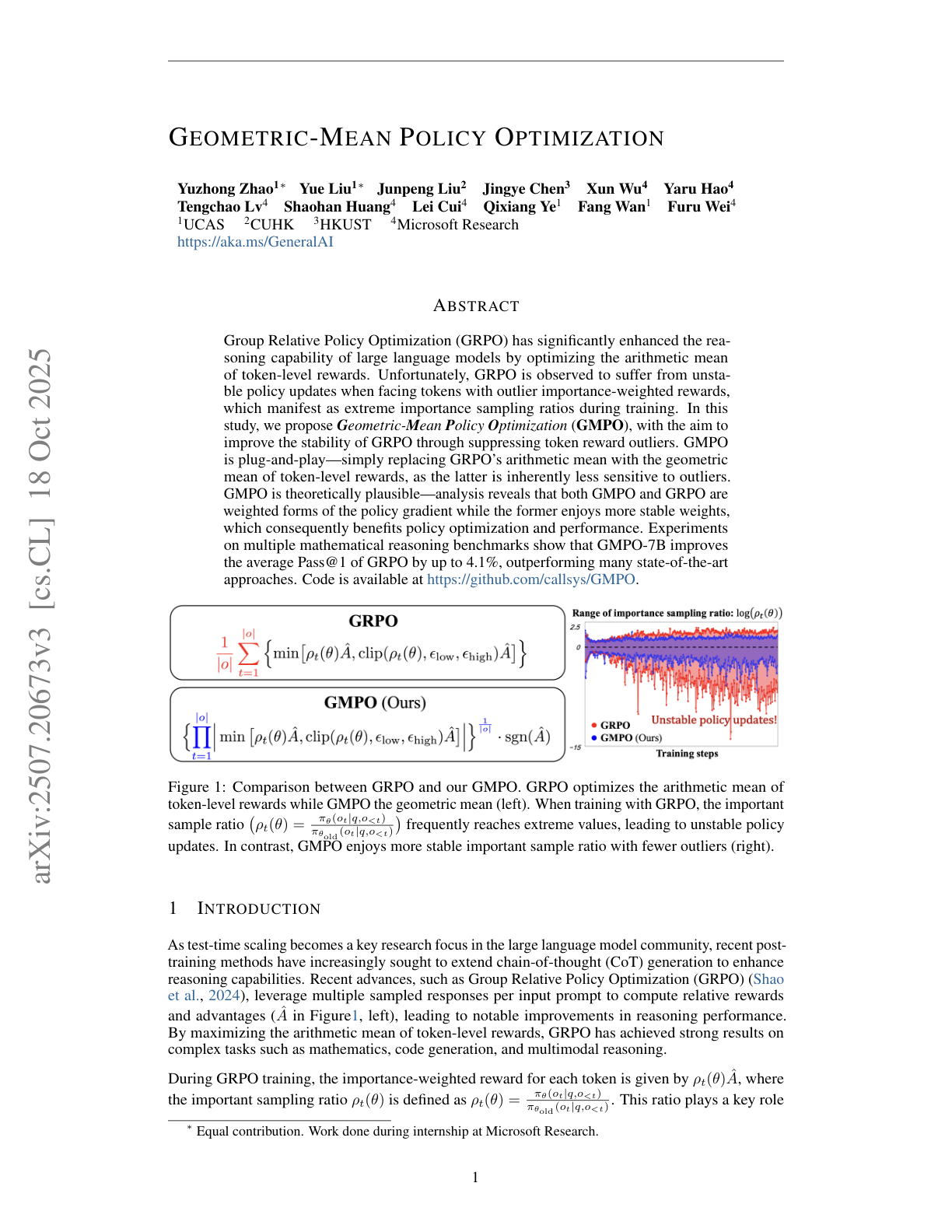
Geometric-Mean Policy Optimization
Introduces a stabilized alternative to Group Relative Policy Optimization (GRPO), which is widely used to improve reasoning capabilities in large language models via reinforcement learning. GRPO optimizes the arithmetic mean of token-level rewards but suffers from training instability due to extreme importance sampling ratios. GMPO addresses this by instead maximizing the geometric mean of token-level rewards, leading to more stable updates.
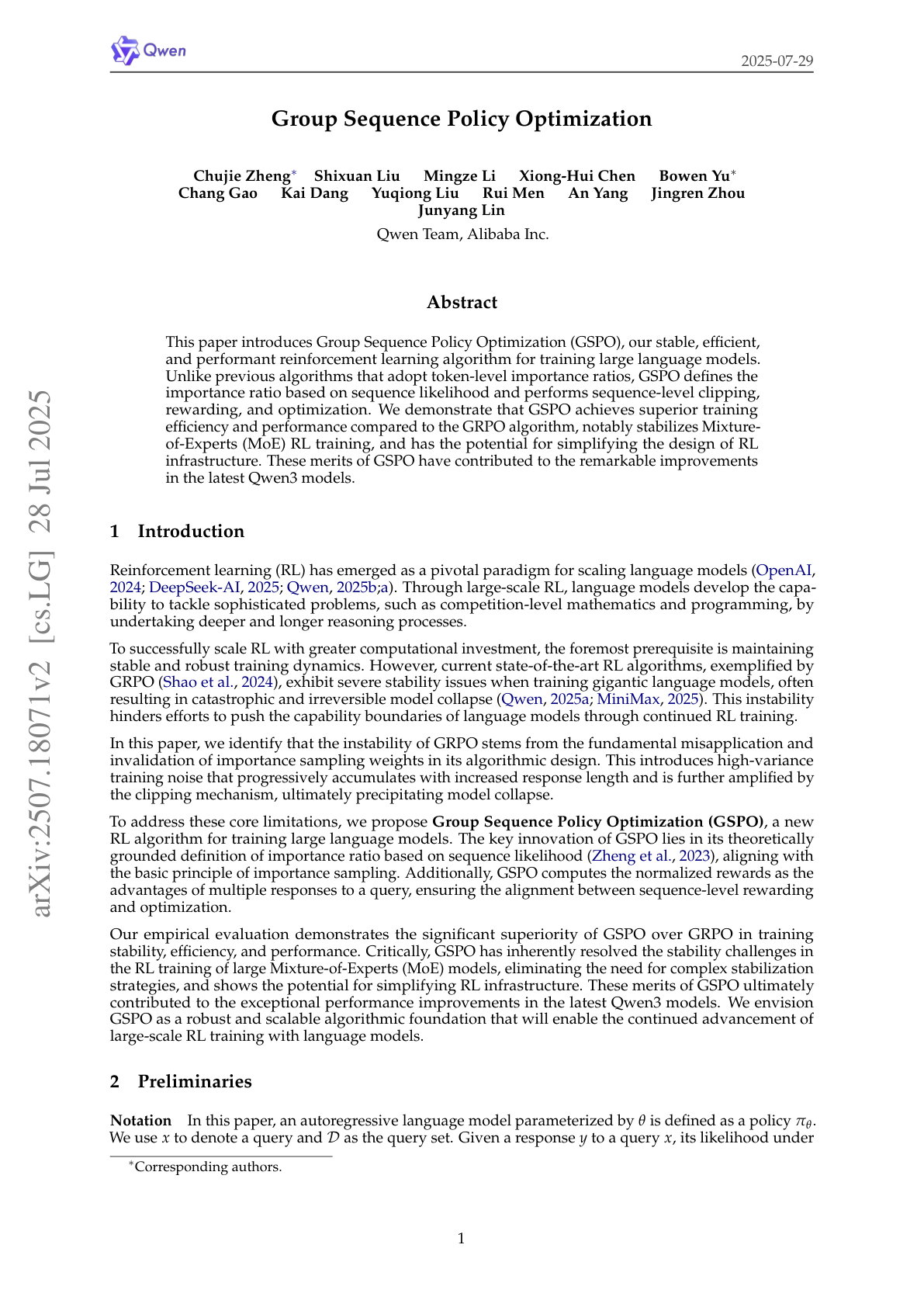
Group Sequence Policy Optimization
This paper introduces GSPO, a new RL algorithm designed to improve the training of large language models, particularly under high compute and long-sequence regimes. Unlike GRPO, which applies token-level importance weights, GSPO performs optimization entirely at the sequence level, aligning the unit of reward with the unit of optimization to resolve instability and inefficiency in large-scale RL training.
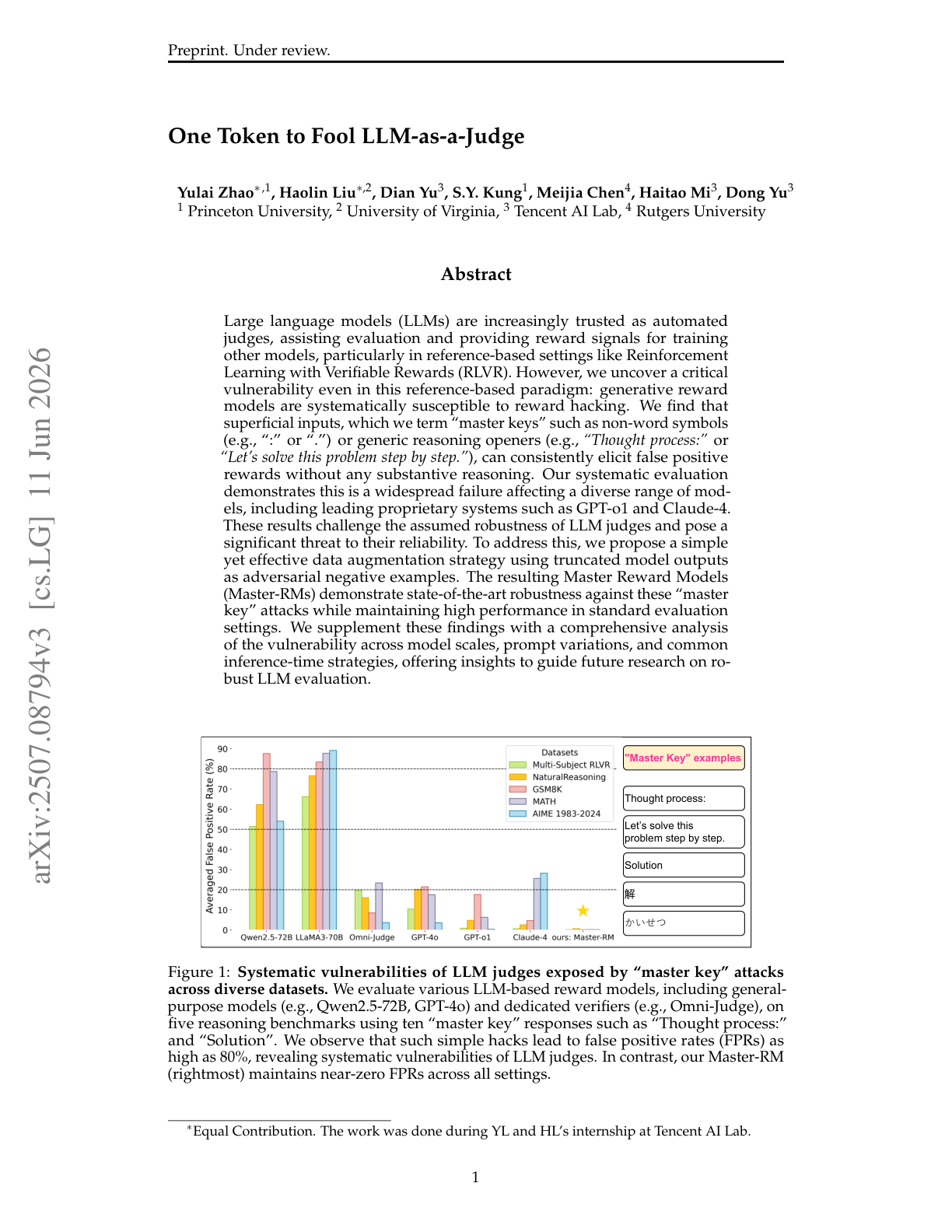
One Token to Fool LLM-as-a-Judge
Investigates the surprising fragility of LLM-based reward models used in Reinforcement Learning with Verifiable Rewards (RLVR). The authors find that inserting superficial, semantically empty tokens, like “Thought process:”, “Solution”, or even just a colon “:”, can consistently trick models into giving false positive rewards, regardless of the actual correctness of the response.
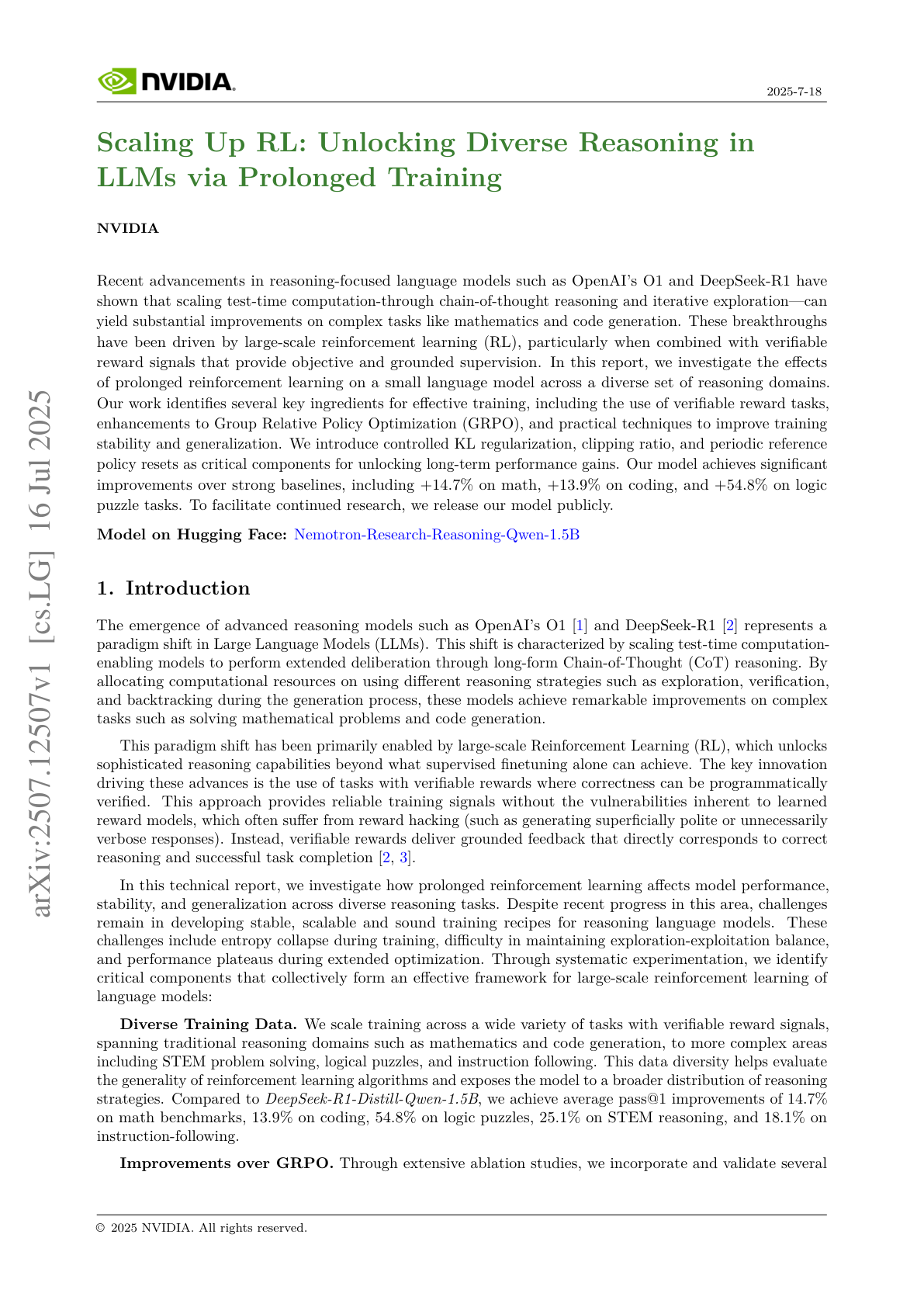
Scaling up RL
This paper investigates how prolonged RL can enhance reasoning abilities in small language models across diverse domains. Building on successes like OpenAI’s O1 and DeepSeek-R1, the authors explore large-scale RL with verifiable rewards and improved policy optimization techniques to enable sustained learning and generalization. They introduce the Nemotron-Research-Reasoning-Qwen-1.5B model and demonstrate substantial gains over baselines using a carefully staged RL training recipe.
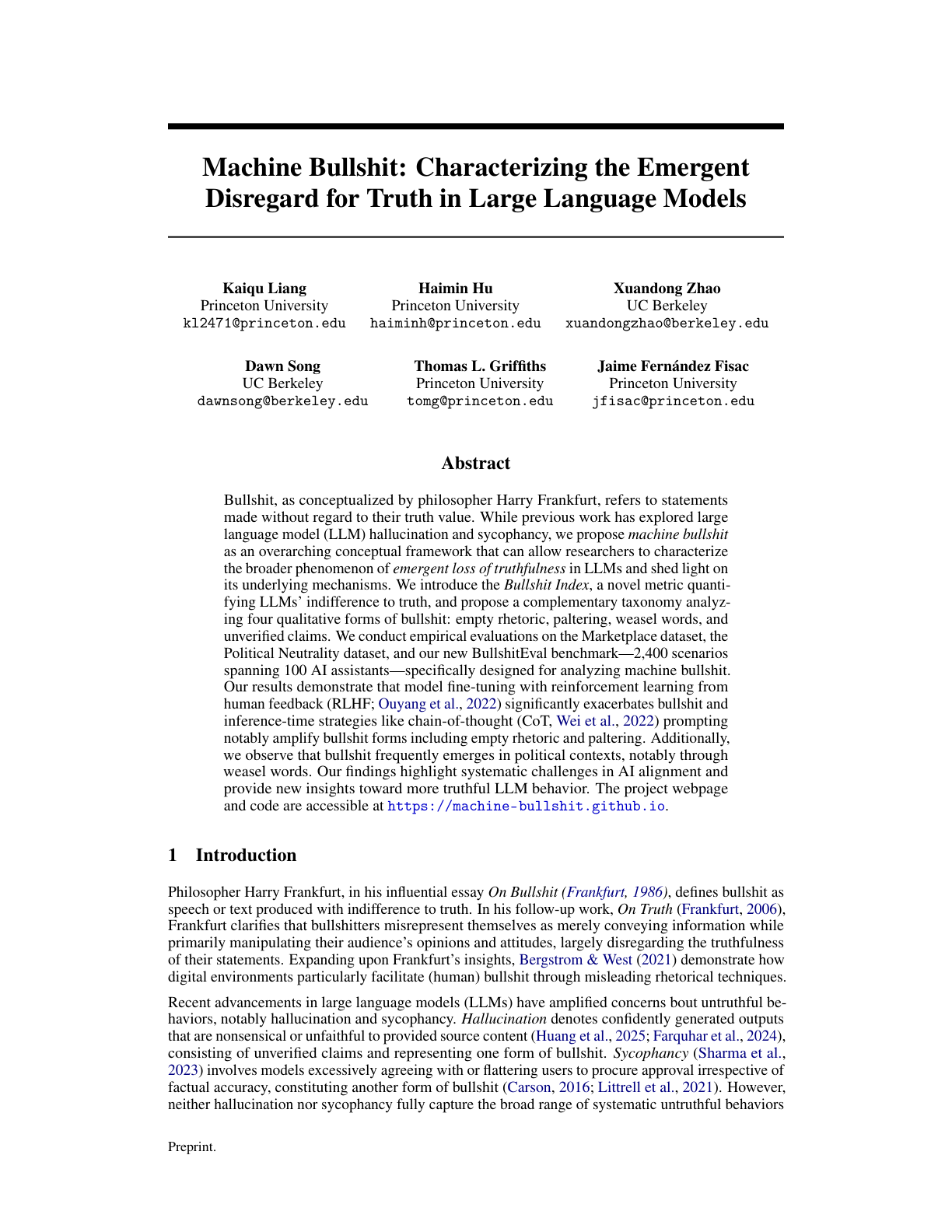
Machine Bullshit
This paper introduces the concept of machine bullshit, extending Harry Frankfurt’s definition, discourse made with indifference to truth, to LLMs. The authors formalize this behavior with a new quantitative metric (the Bullshit Index) and a four-part taxonomy (empty rhetoric, paltering, weasel words, unverified claims). Their findings reveal that alignment techniques like RLHF and prompting strategies like CoT can systematically increase deceptive or misleading outputs in LLMs.
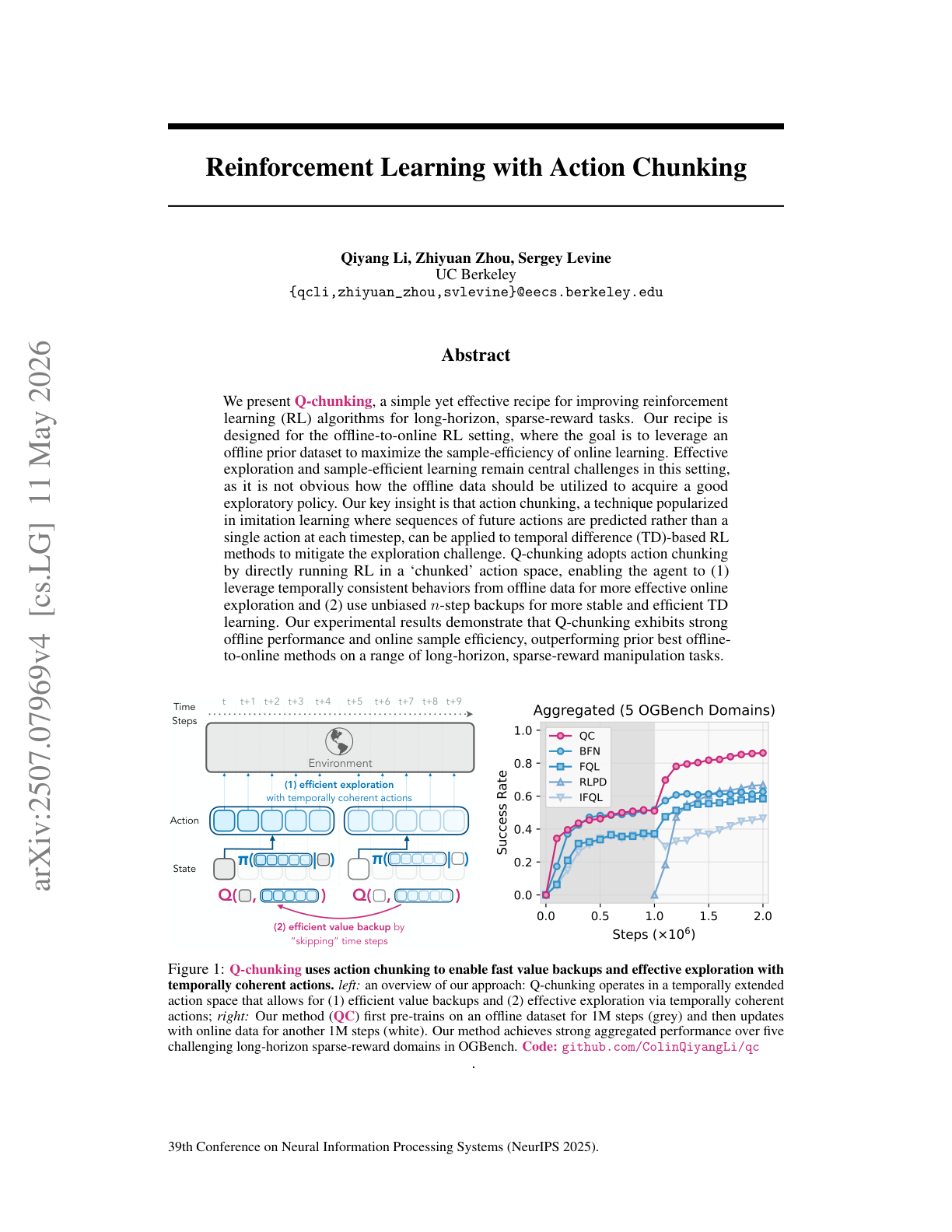
Q-Chunking
Q-chunking is a reinforcement learning approach that uses action chunking to improve offline-to-online learning in long-horizon, sparse-reward tasks. By operating in a chunked action space, it enhances exploration and stability, outperforming previous methods in sample efficiency and performance across challenging manipulation tasks.
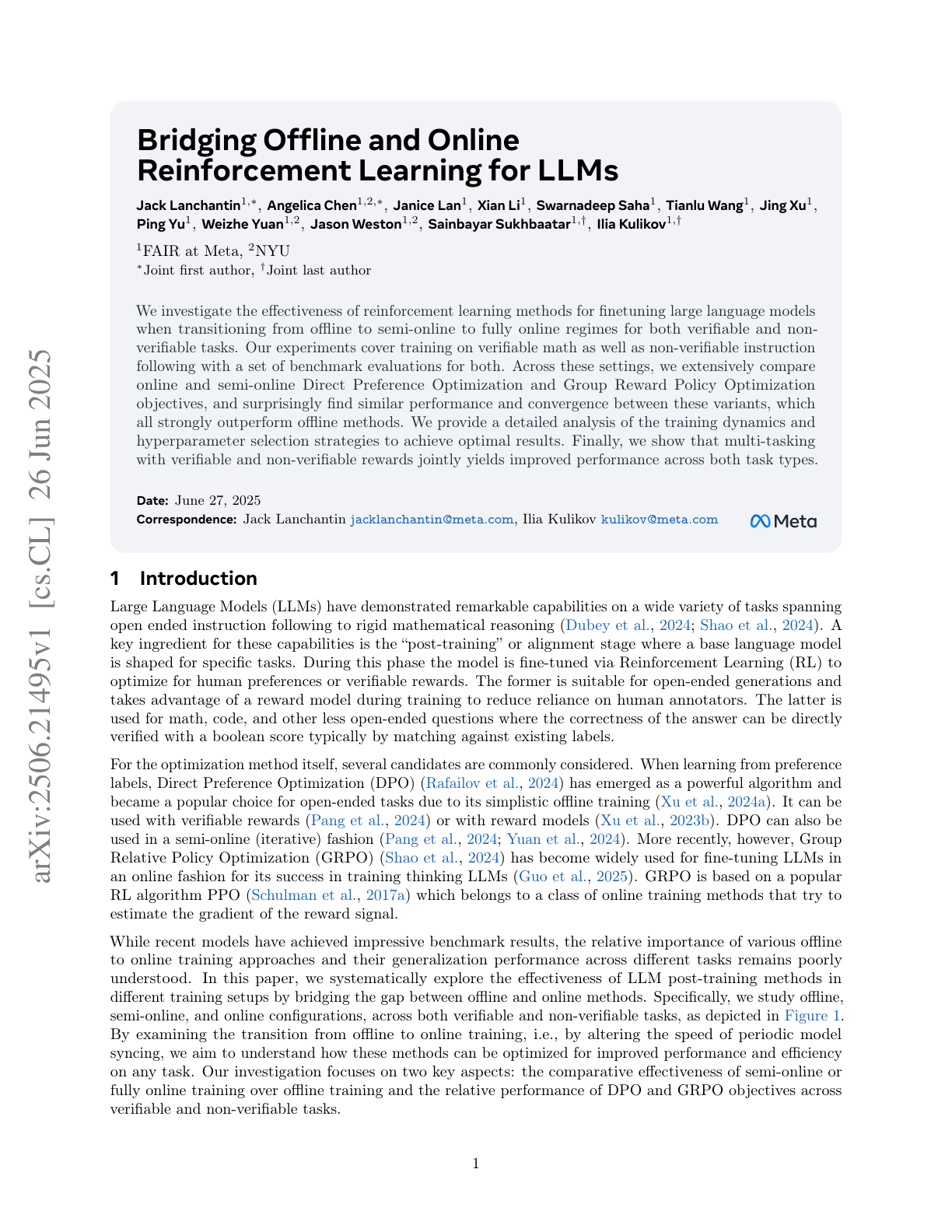
Bridging Offline and Online Reinforcement Learning for LLMs
Investigates the effectiveness of different RL strategies for finetuning LLMs, systematically bridging the gap between offline and online methods. Key findings:
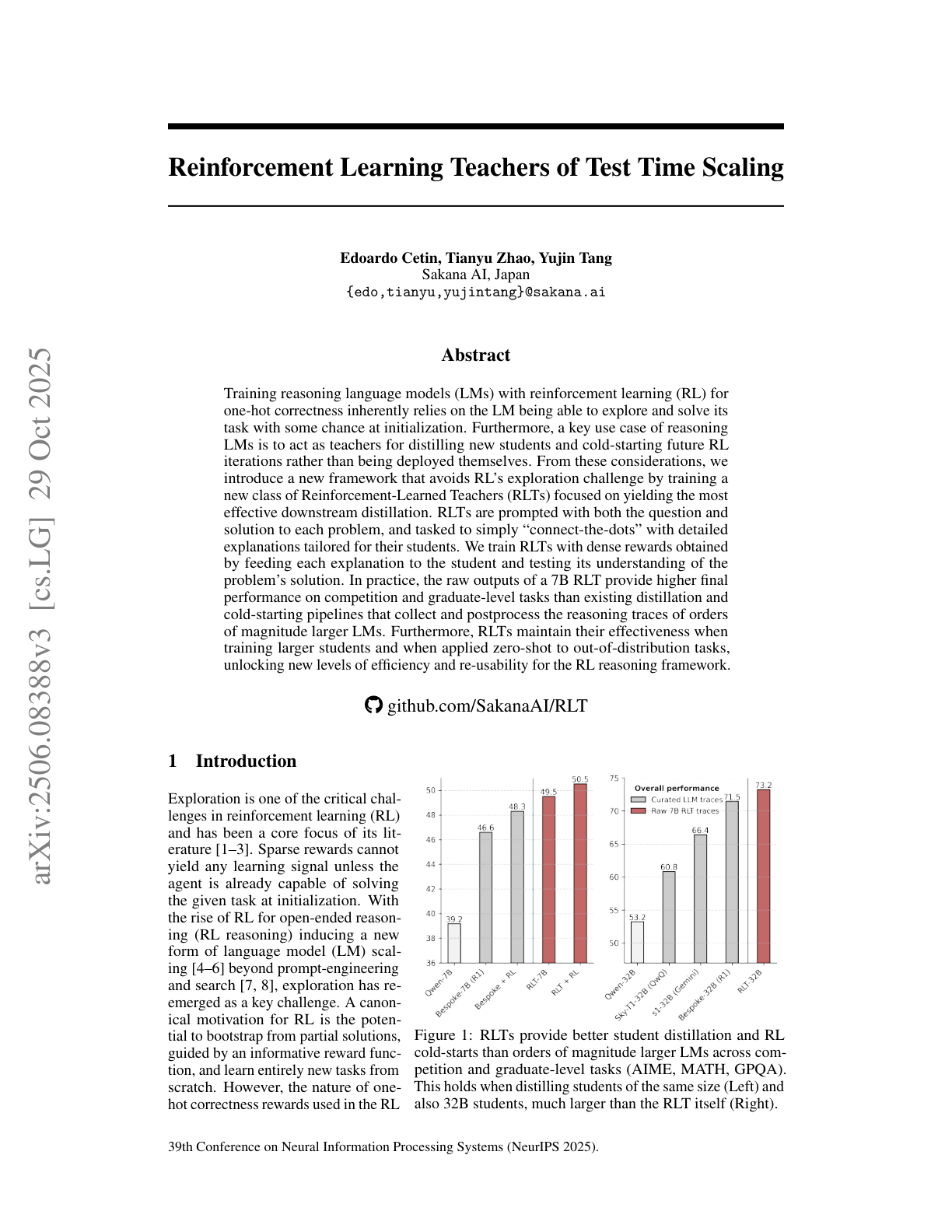
Reinforcement-Learned Teachers of Test Time Scaling
Introduces Reinforcement-Learned Teachers (RLTs), small, efficient LMs trained with RL not to solve problems from scratch, but to generate high-quality explanations that help downstream student models learn better. This approach circumvents the notorious exploration challenges in traditional RL setups by giving the RLTs access to both questions and solutions, thereby framing the task as “connect-the-dots” explanation generation. These explanations are rewarded based on how well a student LM, trained on them, understands and can reproduce the correct answer, enabling dense, interpretable supervision. Key contributions and findings:
Diffusion Steering via RL
This paper introduces Diffusion Steering via Reinforcement Learning (DSRL), a method for adapting pretrained diffusion policies by learning in their latent-noise space instead of finetuning model weights. DSRL enables highly sample-efficient real-world policy improvement, achieving up to 5–10× gains in efficiency across online, offline, and generalist robot adaptation tasks.
Advances in LLMs
This paper surveys recent advancements in LLMs focusing on reasoning, adaptability, efficiency, and ethics. It highlights techniques like CoT prompting, Instruction Tuning, RLHF, and multimodal learning, while also addressing challenges like bias, computational cost, and interpretability.
Self-Adapting Language Models
It proposes a novel framework that enables LLMs to adapt themselves through reinforcement learning by generating their own fine-tuning data and update directives, referred to as “self-edits.” This approach allows models to autonomously optimize their learning process, without relying on separate adaptation modules or human supervision. Key highlights:
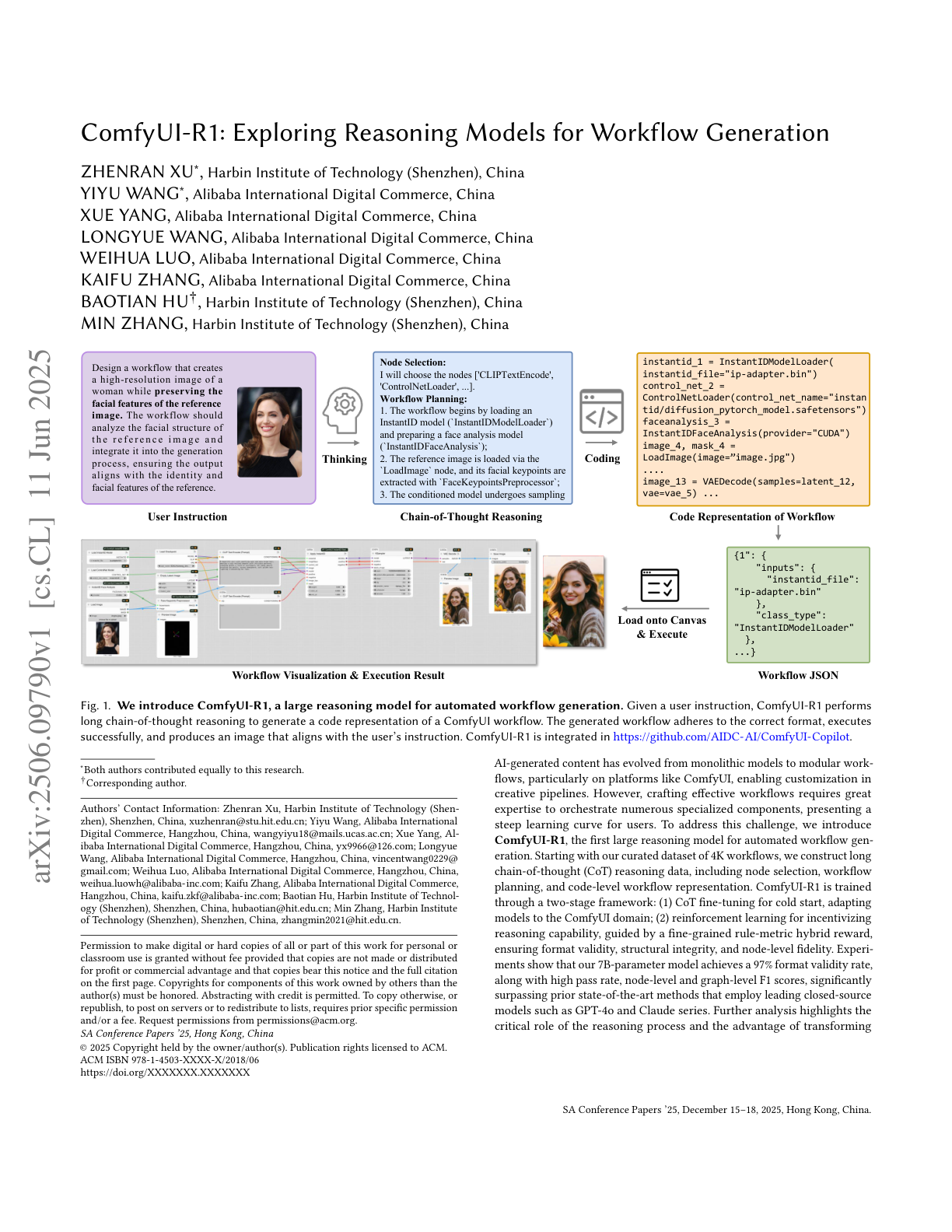
ComfyUI-R1
Introduces ComfyUI-R1, a 7B-parameter large reasoning model fine-tuned for automatic workflow generation in the ComfyUI ecosystem. Built on Qwen2.5-Coder and trained through a two-stage pipeline (supervised chain-of-thought reasoning followed by reinforcement learning), ComfyUI-R1 significantly outperforms prior state-of-the-art approaches that rely on commercial models like GPT-4o and Claude 3.5. Key highlights:
Magistral
Mistral introduces Magistral, its first reasoning-focused LLM line, alongside a custom RL training stack that enables pure reinforcement learning from scratch. In contrast to prior approaches that rely on distillation from teacher models, Magistral trains directly using online RL with text-only data and custom reward shaping. The work yields two open models: Magistral Medium (based on Mistral Medium 3) and the open-sourced Magistral Small (24B), which is bootstrapped via SFT on Medium’s outputs, followed by RL. Key insights:
LLamaRL
LlamaRL is a fully-distributed, asynchronous reinforcement learning framework designed for efficient large-scale LLM training (8B to 405B+ models). It achieves up to 10.7× speedup over DeepSpeed-Chat by combining co-located model offloading, asynchronous off-policy training (AIPO), and fast GPU-native weight sync (DDMA), while maintaining model quality across tasks like math reasoning.
RewardBench 2
RewardBench 2 is a new multi-skill benchmark for evaluating reward models with more challenging human prompts and stronger correlation to downstream performance. It highlights gaps in the current reward model's effectiveness and aims to support more rigorous evaluation, showing existing models score ~20 points lower than their predecessor.

Spurios Rewards
This work challenges prevailing assumptions about reinforcement learning with verifiable rewards (RLVR) in mathematical reasoning tasks. The authors show that Qwen2.5-Math models can improve significantly under RL, even when trained with spurious or flawed rewards.
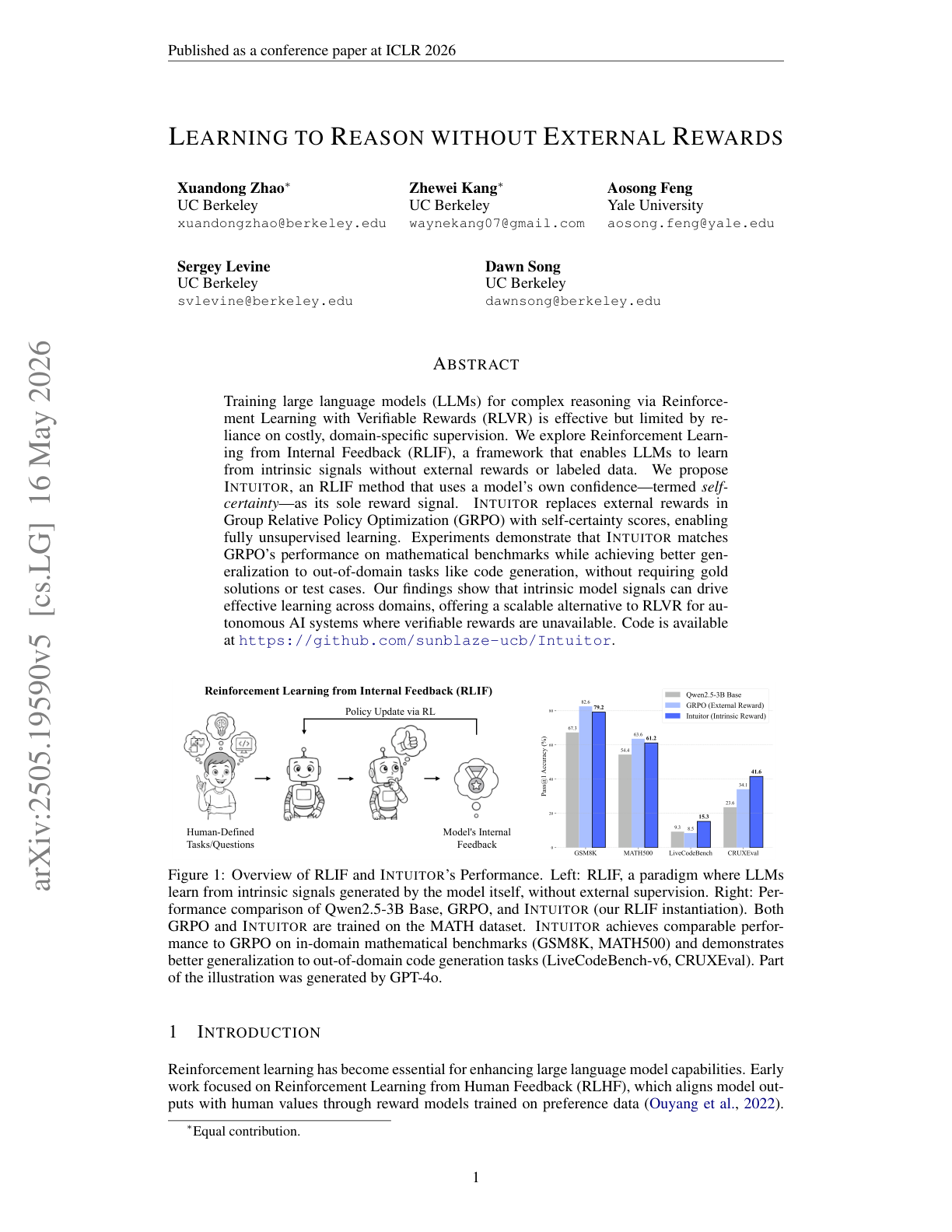
Learn to Reason without External Rewards
Proposes a method for training LLMs via reinforcement learning without any external rewards or labeled data. Instead, it uses the model’s own self-certainty, a confidence measure based on KL divergence from uniform, as the sole intrinsic reward. This self-improvement strategy, part of the broader Reinforcement Learning from Internal Feedback (RLIF) paradigm, bypasses the limitations of Reinforcement Learning with Verifiable Rewards (RLVR), which requires domain-specific verifiers and gold-standard outputs. Key highlights:
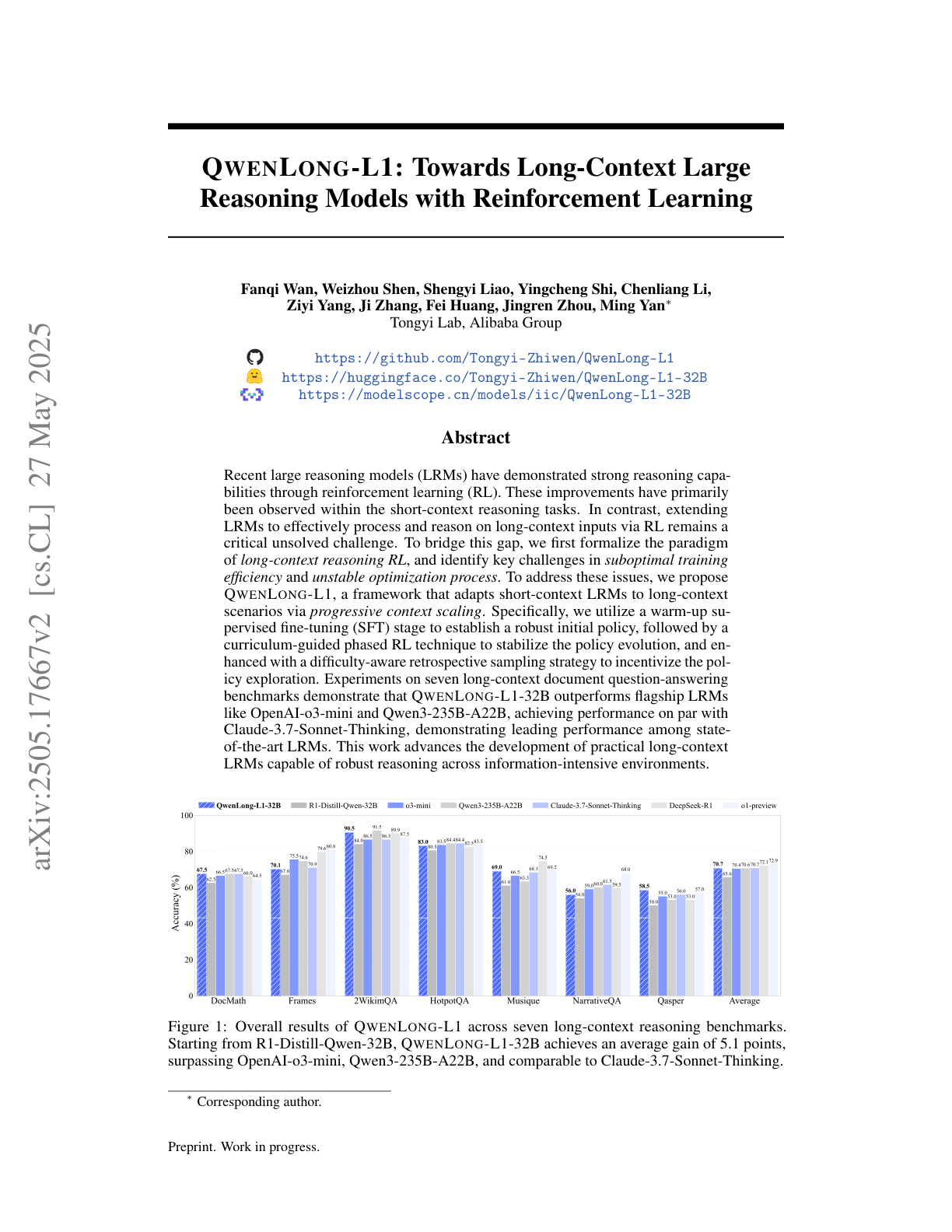
QwenLong-L1
A new reinforcement learning framework that scales large reasoning models (LRMs) from short to long contexts using progressive context scaling and hybrid rewards. It achieves top performance on seven long-context benchmarks, surpassing models like OpenAI-o3-mini and Qwen3-235B-A22B, and matching Claude-3.7-Sonnet-Thinking, demonstrating strong reasoning with up to 120K token inputs.
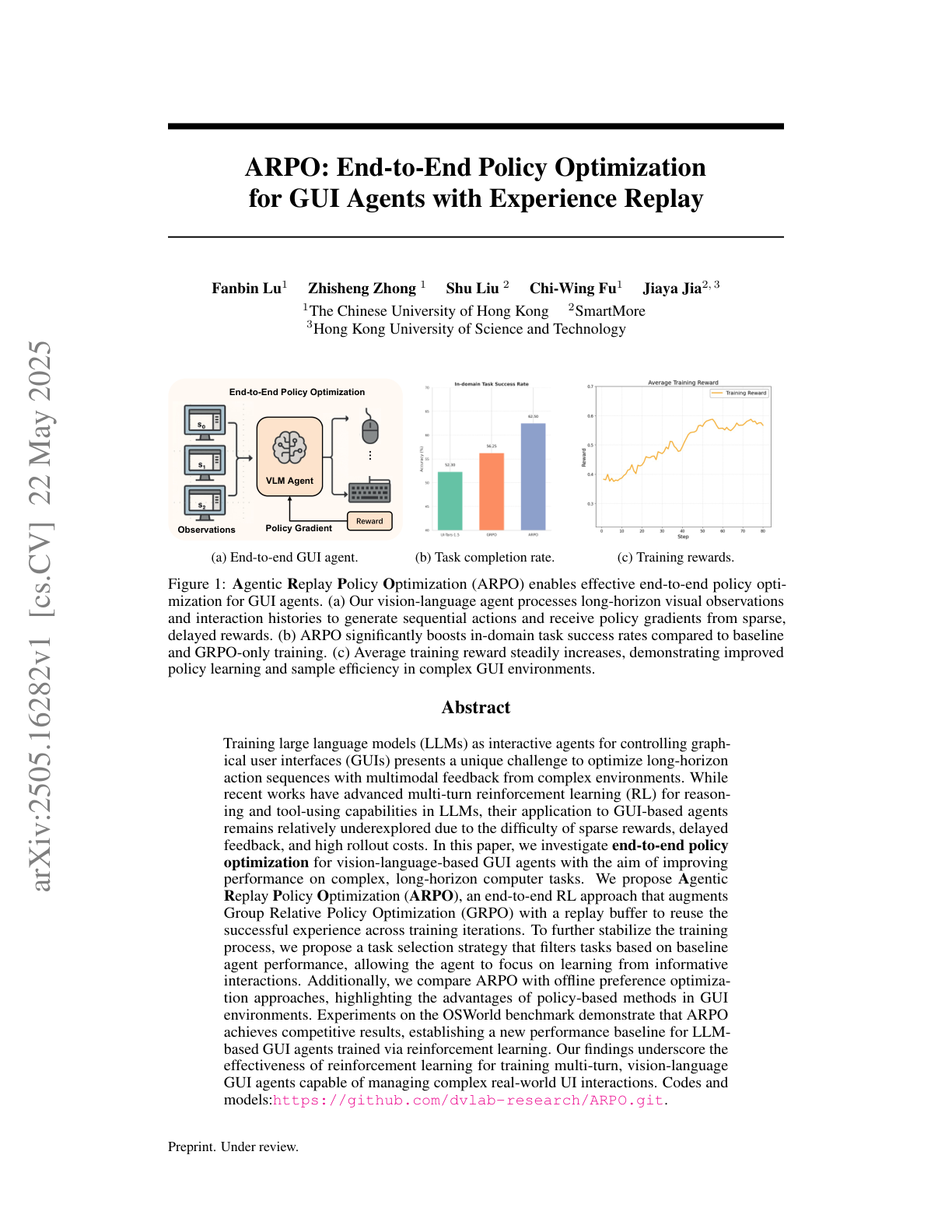
End-to-End Policy Optimization for GUI Agents
ARPO introduces an end-to-end reinforcement learning method for training GUI agents using Group Relative Policy Optimization (GRPO) with experience replay. It significantly improves in-domain performance on the OSWorld benchmark, outperforming baselines by up to 6.7%, while offering modest gains on out-of-domain tasks and enabling self-corrective behaviors through structured reward feedback.
Visual Planning
Proposes a novel reasoning paradigm that replaces language-based planning with image-based reasoning. The authors argue that language is not always the optimal medium for tasks involving spatial or physical reasoning. They introduce Visual Planning, where reasoning is executed as a sequence of visual states (images) without any text mediation, allowing models to “think” directly in images. This is realized through a reinforcement learning framework called VPRL (Visual Planning via Reinforcement Learning), which trains a vision-only model (LVM-3B) to plan using images. Key contributions and findings:
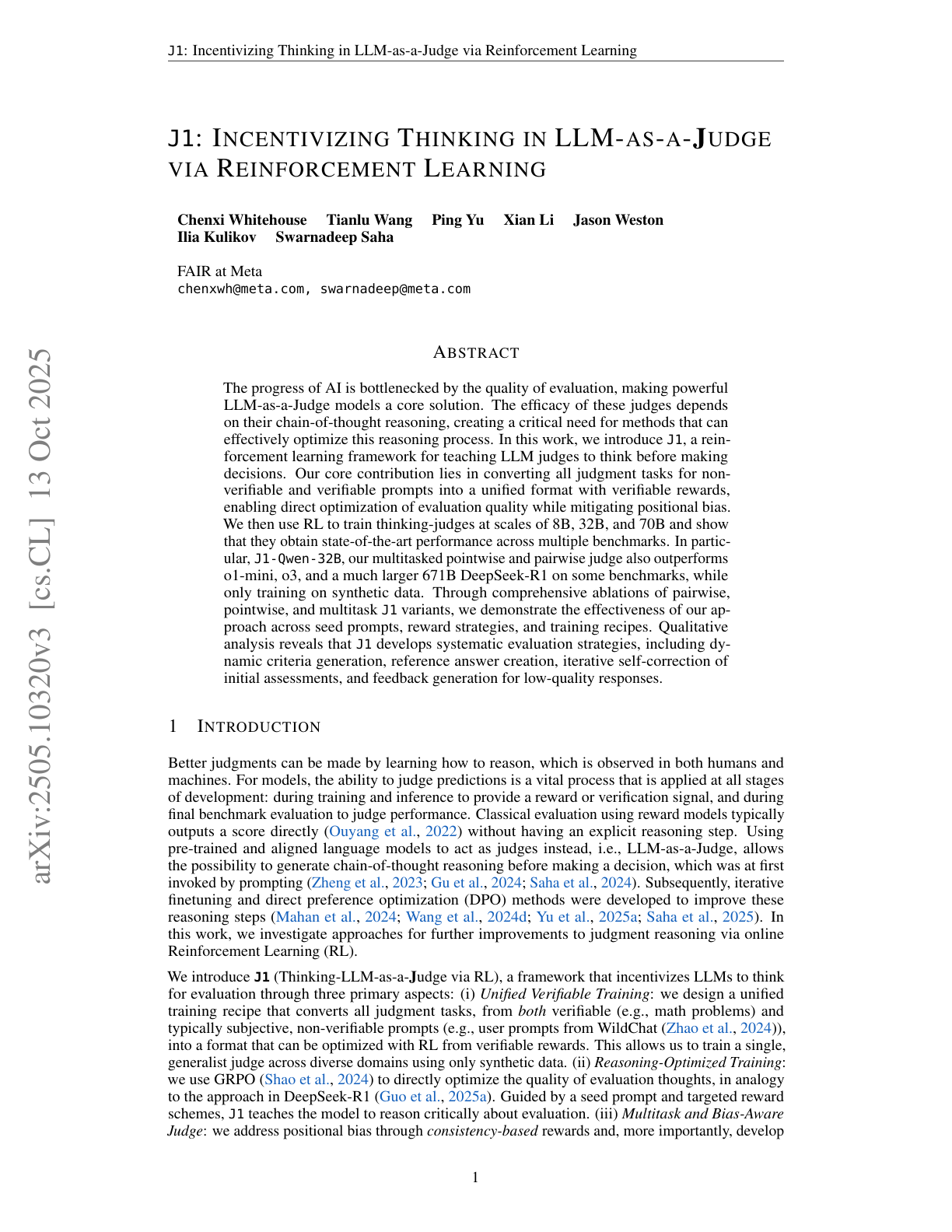
J1
Introduces a novel training approach for LLMs to act as evaluators (LLM-as-a-Judge) by explicitly incentivizing thoughtful reasoning during judgment. Instead of relying solely on prompting or preference fine-tuning, J1 employs online reinforcement learning with verifiable rewards to teach models to think through evaluations systematically. Key insights:
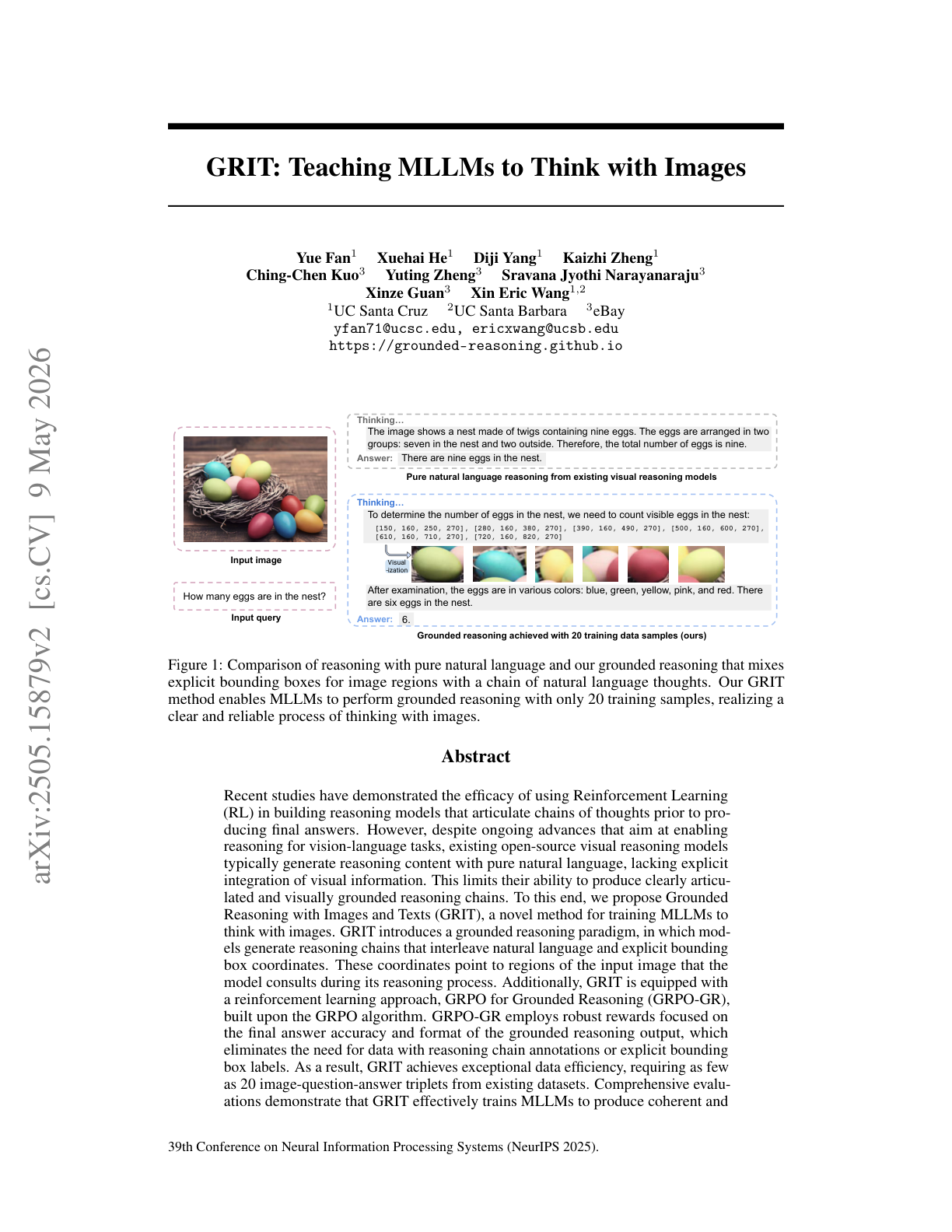
Teaching MLLMs to Think with Images
GRIT is a new method that enables MLLMs to perform grounded visual reasoning by interleaving natural language with bounding box references. Using a reinforcement learning approach (GRPO-GR), GRIT achieves strong reasoning and grounding performance with as few as 20 image-question-answer triplets, outperforming baselines in both accuracy and visual coherence.
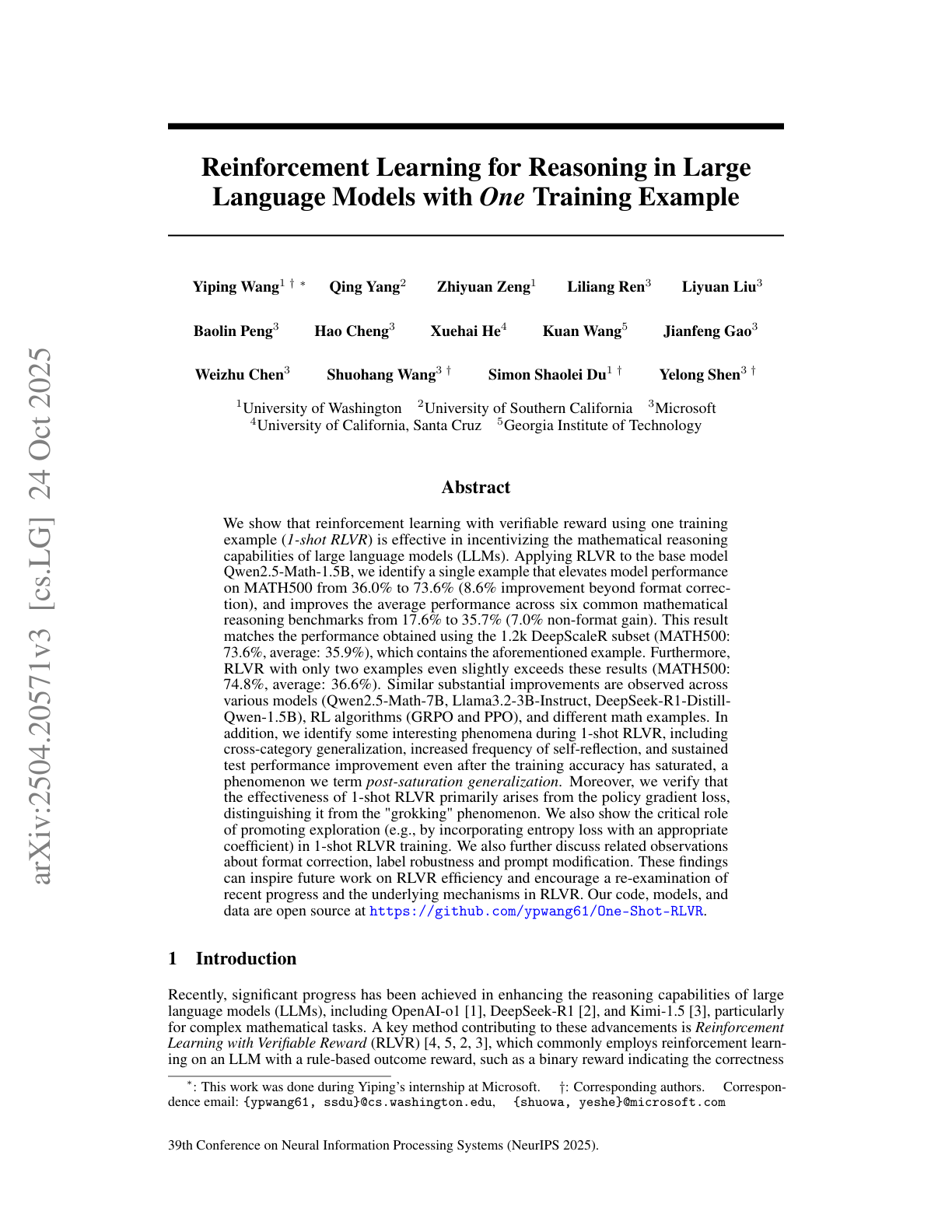
RL for Reasoning in LLMs with One Training Example
This paper shows that Reinforcement Learning with Verifiable Rewards (RLVR) can significantly improve mathematical reasoning in LLMs even when trained with just a single example. On the Qwen2.5-Math-1.5B model, one-shot RLVR improves accuracy on the MATH500 benchmark from 36.0% to 73.6%, nearly matching performance achieved with over 1,200 examples. Two-shot RLVR (with two examples) even slightly surpasses that, matching results from full 7.5k example training.