AI Papers of the Week
Every paper worth reading in AI, hand-picked one week at a time.
Discover and explore top AI papers with Claude Code or Codex
npx @dair-ai/mcp setup
Agent-as-a-Router
Most users now have access to many LLMs that each excel in different domains, so routing each task to the right model matters for both quality and cost. Existing routers treat this as a static, one-off classification problem, and this paper shows that framing is exactly what holds them back.
Agent Communication Protocols
As multi-agent systems try to move past the limits of standalone agents, communication becomes the load-bearing infrastructure, and the protocol landscape for it is a fragmented mess. This study builds a technical taxonomy to classify and compare LLM agent communication protocols and to make the interoperability problem legible.
A Pinch of Human Data
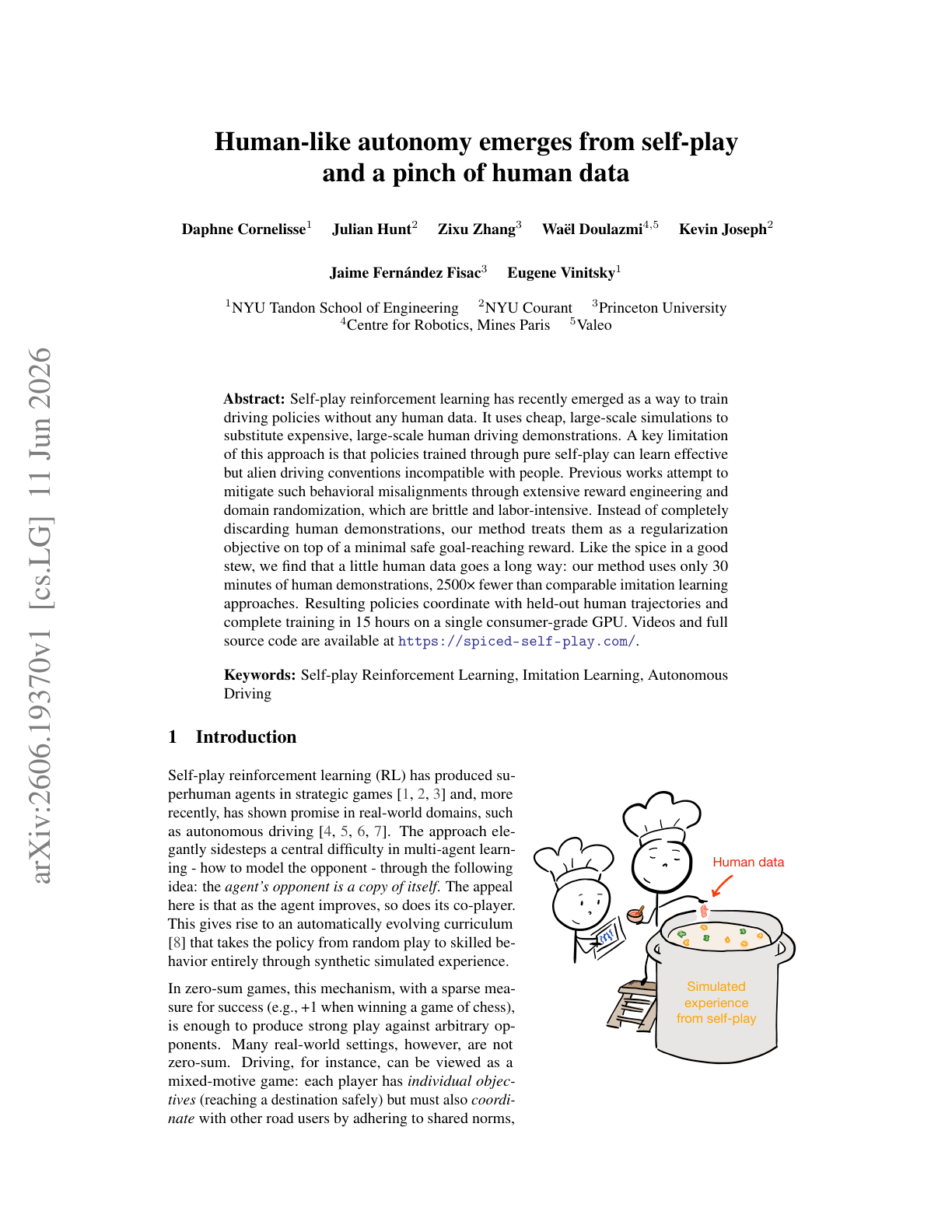
Self-play reinforcement learning can train driving policies with no human data at all, swapping expensive human demonstrations for cheap large-scale simulation. The catch is that pure self-play tends to discover effective but alien driving conventions that real people cannot work with, and the usual fixes lean on brittle reward engineering and domain randomization.
Skill-MAS
Automatic generation of multi-agent systems is stuck between inference-time methods that reuse frozen frontier models but never learn, and training-time methods that internalize experience through gradient updates but are capped by the weaker models small enough to fine-tune. Skill-MAS proposes a third path that treats high-level orchestration as an evolvable Meta-Skill, decoupling experience retention from weight updates so frontier models keep getting better at orchestration without any gradient steps. Across four complex benchmarks and four distinct LLMs it delivers strong, transferable gains at a favorable cost-performance trade-off.
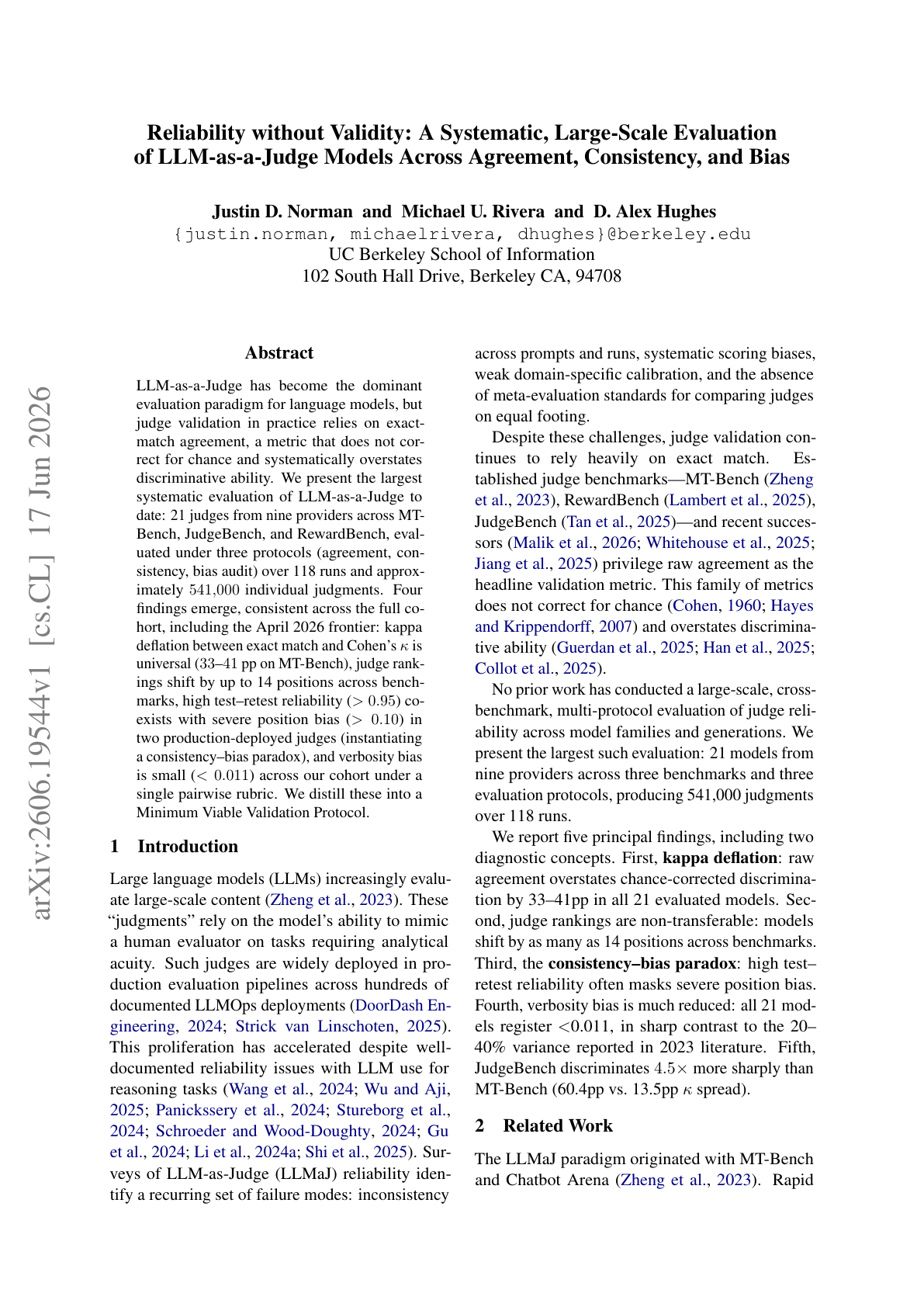
Reliability without Validity
LLM-as-a-Judge is the default way to evaluate language models, but validating those judges with exact-match agreement never corrects for chance and systematically overstates how good they are. In the largest audit to date, spanning 21 judges from nine providers across MT-Bench, JudgeBench, and RewardBench over 118 runs and roughly 541,000 judgments, the gap between raw agreement and chance-corrected Cohen's kappa runs 33 to 41 percentage points, rankings shift by up to 14 positions across benchmarks, and high test-retest reliability coexists with severe position bias. The authors distill their findings into a Minimum Viable Validation Protocol so teams can stress-test judges before trusting them.
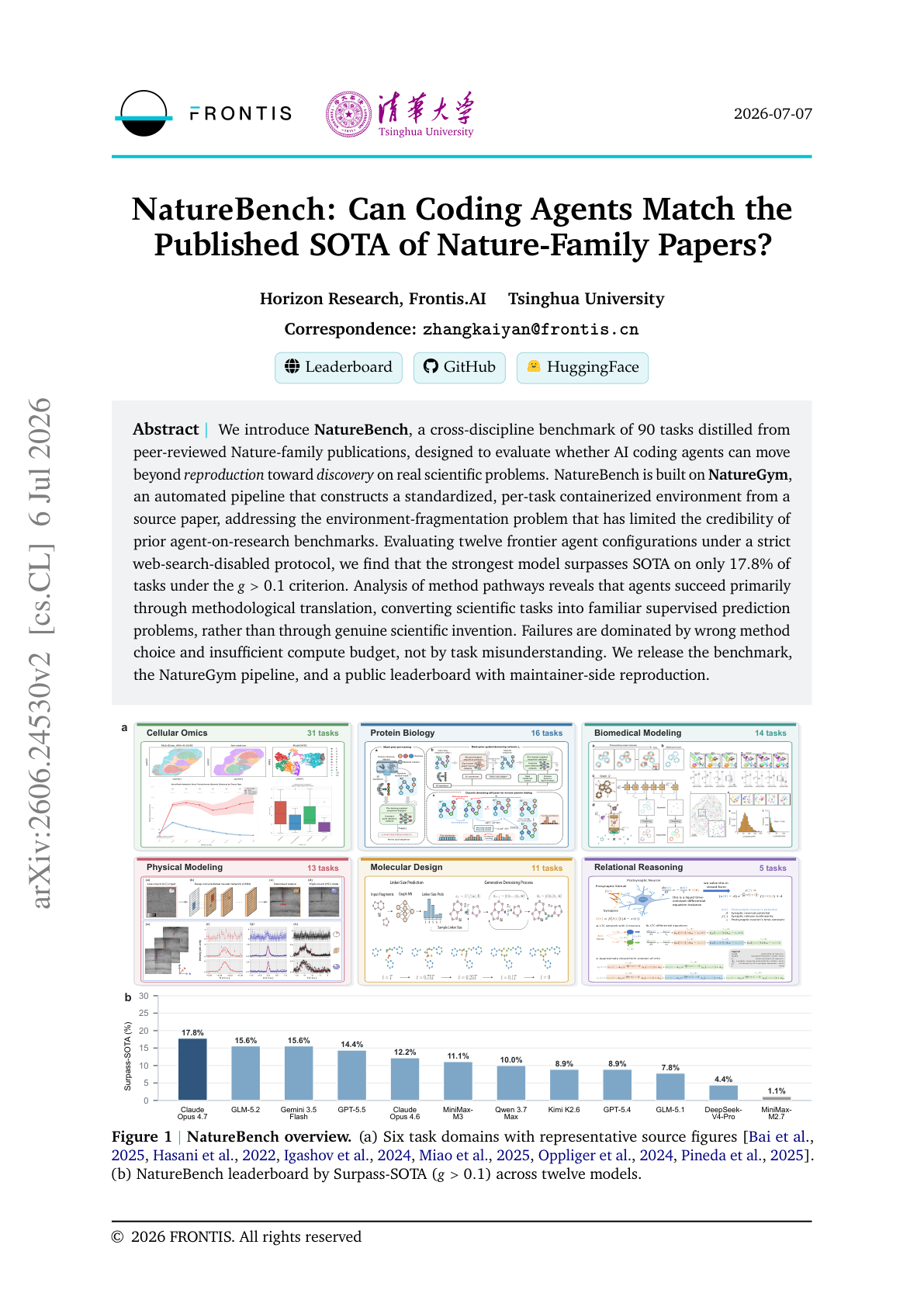
NatureBench
Can coding agents move past reproduction toward actual discovery on real scientific problems? NatureBench distills 90 cross-discipline tasks from peer-reviewed Nature-family papers and runs them in NatureGym, an automated pipeline that builds a standardized containerized environment per task to fix the environment-fragmentation problem. Under a strict web-search-disabled protocol, the strongest of ten frontier agent configurations beats published SOTA on only 17.8% of tasks, and analysis shows agents win mainly by translating problems into familiar supervised prediction rather than through genuine scientific invention.
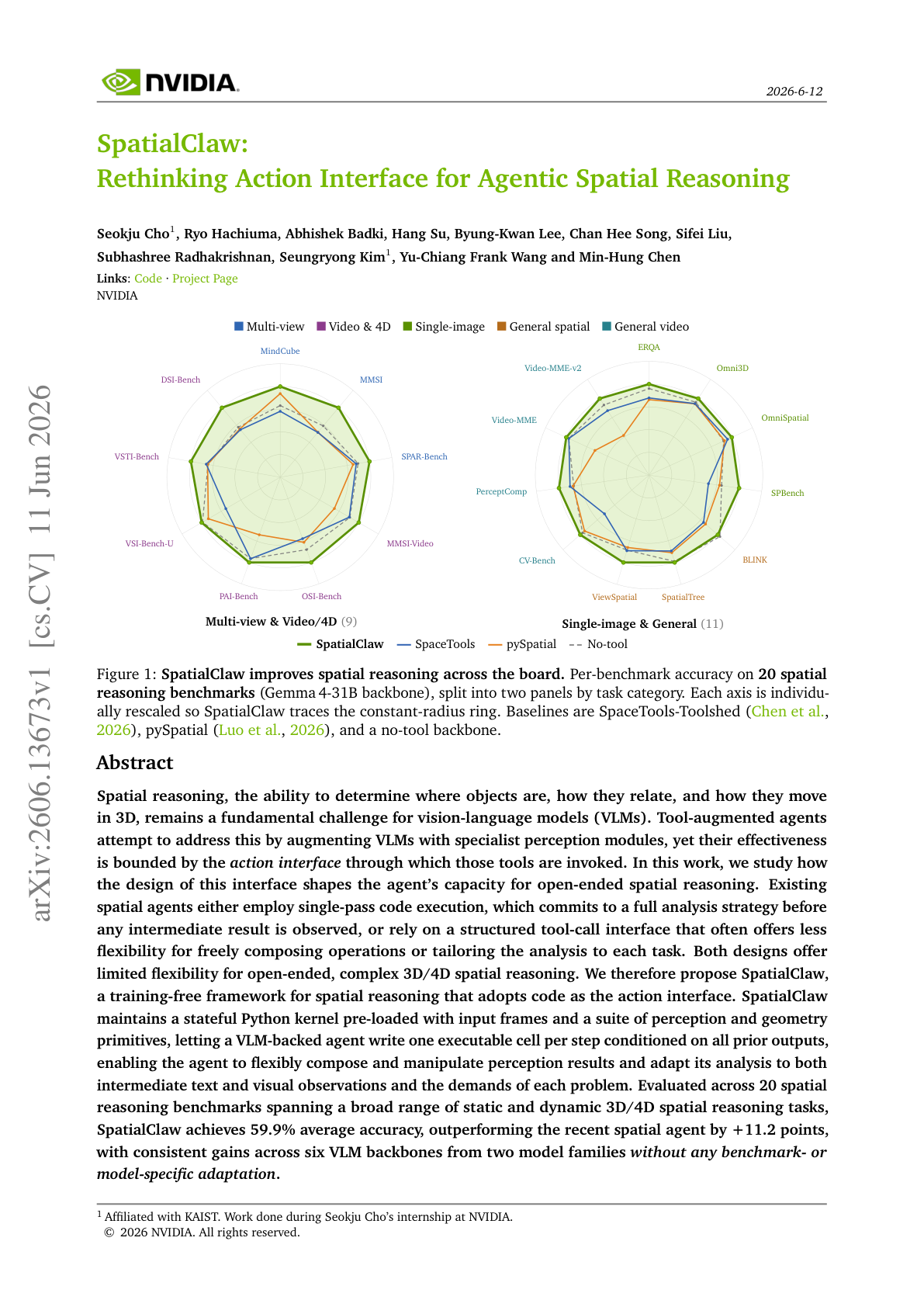
SpatialClaw
Spatial reasoning over 3D and 4D scenes is still where general vision-language models break down, because they emit a text answer directly rather than measuring anything. From NVIDIA, SpatialClaw is a training-free framework that rethinks the action interface and lets a VLM-backed agent reason through code instead. The agent writes one Python cell per step into a persistent Jupyter kernel preloaded with perception primitives and scientific libraries, then inspects intermediate results and revises its strategy across steps.
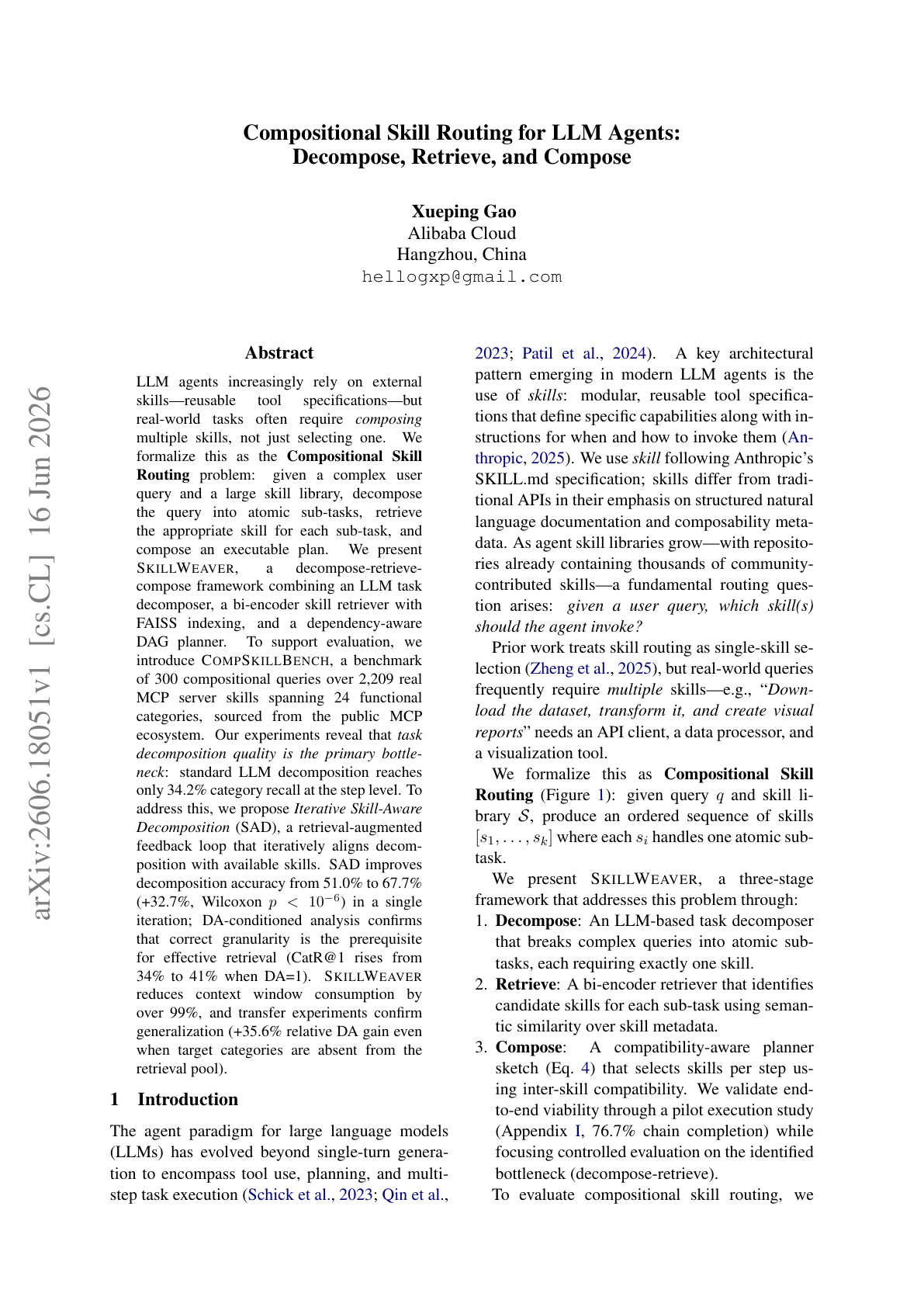
Compositional Skill Routing
Real tasks rarely map to a single skill. They usually need several skills composed together, yet most skill routing still treats the problem as picking one tool from a library. This work formalizes Compositional Skill Routing, where an agent must select and sequence multiple reusable skills from large libraries to satisfy a complex query, and introduces SkillWeaver, a decompose, retrieve, and compose pipeline built around it.
PreAct
Computer-using agents drive real software through the screen, but they solve every task from scratch. Ask one to repeat a task and it re-reads the screen and re-reasons every tap, paying the full cost again. PreAct fixes this by compiling the first successful run into a small state-machine program, where states check the screen and transitions act, then replaying that program on later runs instead of invoking the agent.
Can LLM Agents Infer World Models?
Can an LLM agent actually build a model of an environment it cannot see? This work makes that question gradeable through agentic automata learning. An agent has to uncover a hidden deterministic finite automaton by interacting with an oracle through two interfaces, membership queries that ask whether a string belongs to the target language, and equivalence queries that ask whether a proposed automaton is correct, which yields a clean, scalable testbed for interactive discovery.
From Trainee to Trainer
Who should design the training environment for an RL agent, the practitioner or the policy itself? RL pipelines for LLMs usually rely on manually redesigned environments between stages, with practitioners guessing which configuration will best improve the current policy. This paper hands that job to the model, proposing an LLM-as-Environment-Engineer framework where the policy diagnoses its own weaknesses and proposes the next environment to train on.
OpenClaw-Skill
Equipping LLM agents with effective skills is most of the battle in real systems, yet most skill-induction work distills one trajectory at a time, which produces narrow, brittle skills. OpenClaw-Skill introduces Collective Skill Tree Search, a tree-search-based skill construction framework that builds a structured, diverse, and generalizable tree of skills, then trains agents to actually use what it builds.
Back on Track
Diffusion large language models generate text in a way that does not fit cleanly into the reinforcement learning recipes built for autoregressive models, and training them to reason exposes two specific problems. Rewards are sparse, so a single terminal reward fails to guide intermediate generation steps, and policy updates sometimes drift toward unnatural trajectories rather than authentic generation paths. This paper proposes Process Aligned Policy Optimization to fix both.
AtomMem
Long-term memory for LLM agents tends to fail in two ways: coarse summaries drift over time, and unconstrained updates corrupt what was already stored. AtomMem keeps the unit of memory small, using a Fact Executor that selectively extracts high-value atomic facts from long interactions and organizes them into hierarchical event structures and temporal user profiles, with an associative memory graph that reconnects fragmented memories at retrieval. The approach reports state-of-the-art results on the LoCoMo long-term memory benchmark.
Beyond Domains
LLM web agents usually run as tool callers, reading a fresh page each turn and emitting one low-level action, so both task horizons and the number of LLM completions blow up. This work makes web skills reusable across sites with SkillMigrator, which stores induced skills as transferable interaction patterns keyed by page-layout structure rather than instruction similarity or site metadata, so a skill learned on one site fires on new sites with the same interaction shape. It cuts the average LLM-action count by 8 to 10% on WebArena and Mind2Web at comparable success rates.
The Stanford EDGAR Filings Dataset
Clean, long-context documents remain scarce for pretraining, especially in finance. This release reconstructs U.S. SEC corporate and financial disclosures into layout-faithful, token-efficient MultiMarkdown, publishing 152B tokens in SEFD-v1 out of an estimated 550B-token archive spanning 18.5M filings, with less than 0.1% overlap with Common Crawl corpora. It also ships two derived benchmarks, EDGAR-Forecast for numerical forecasting and EDGAR-OCR for financial table transcription, to support financial reasoning, forecasting, and document understanding.
MiniMax Sparse Attention
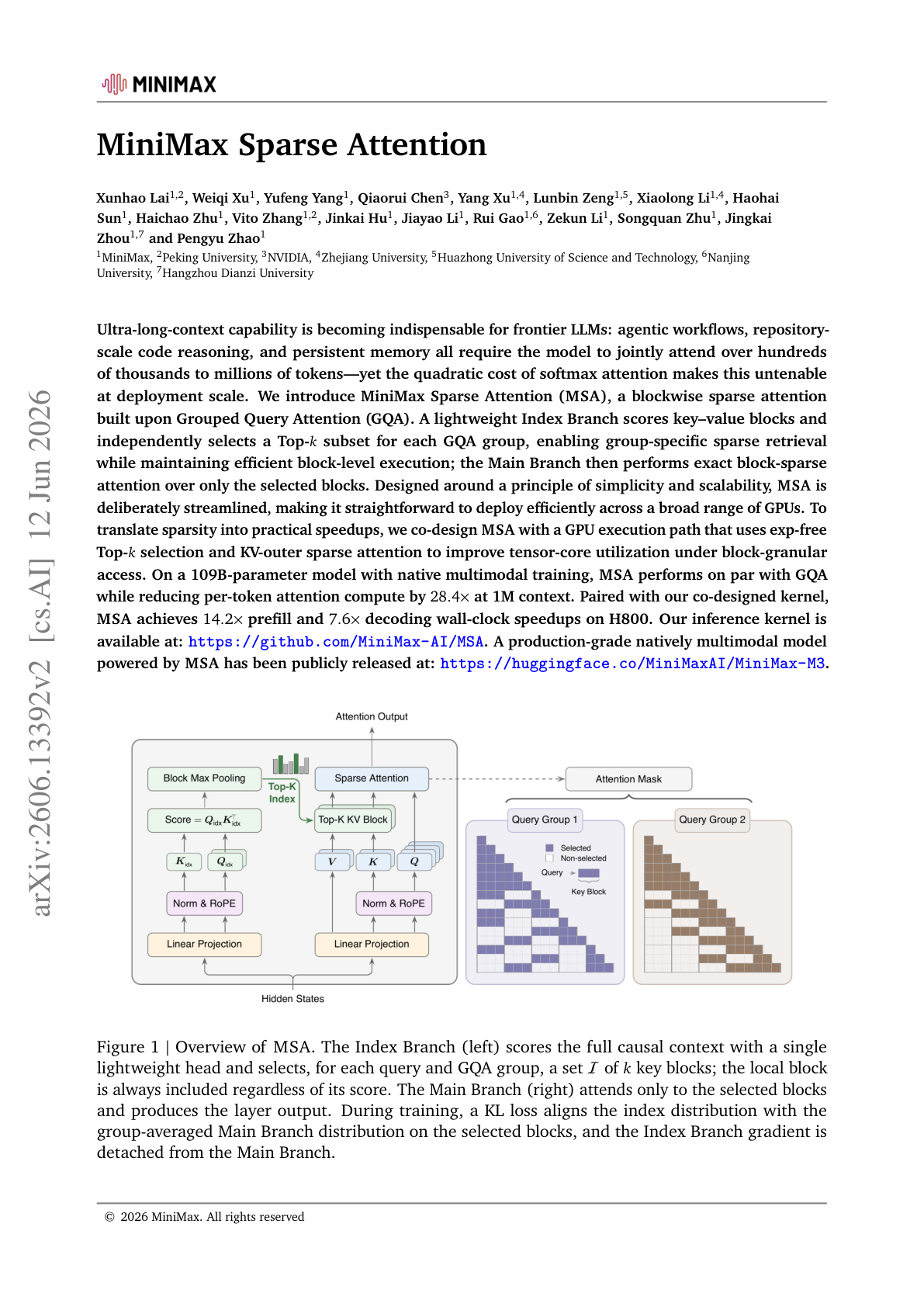
Ultra-long context is now a core requirement for agents, codebase-scale reasoning, multimodal workflows, and persistent memory, but dense softmax attention still makes million-token deployment expensive. MiniMax Sparse Attention (MSA) tackles this by adding blockwise sparsity on top of Grouped Query Attention, with a lightweight routing branch that chooses which key-value blocks each query group should actually attend to.
Self-Harness
Most agent scaffolds are built once by hand and then frozen, even as the underlying models keep changing. This paper introduces Self-Harness, a paradigm where an LLM agent improves its own operating harness, the prompts, tools, memory, and orchestration around the base model, without human engineers or a stronger external agent. Because every model fails in its own way, the system mines those model-specific weaknesses and turns them into concrete, executable harness edits rather than generic advice.
Agents' Last Exam
From Berkeley RDI, Agents' Last Exam (ALE) is a living benchmark built to measure whether agents can do economically valuable work, not just score well on academic tests. It was assembled with more than 250 industry experts and maps over 1,000 verifiable tasks to the U.S. federal occupational taxonomy, organized as 55 subfields across 13 industry clusters. Every task has an objective, checkable outcome, so there is no subjective human grading, and the pool is designed to keep growing as new workflows are onboarded.
How AI Agents Reshape Knowledge Work
This economics paper, drawing on large-scale production data from Perplexity, studies how the shift from conversational assistants to autonomous agents is reshaping knowledge work. It compares Search, a conversational assistant, with Computer, a general-purpose agent system, along three dimensions: autonomy, efficiency, and the scope of tasks people take on. The framing is a cost-structure model in which agents carry higher fixed and delegation costs but lower per-step marginal costs, so they win once tasks are complex enough.
Agentopia
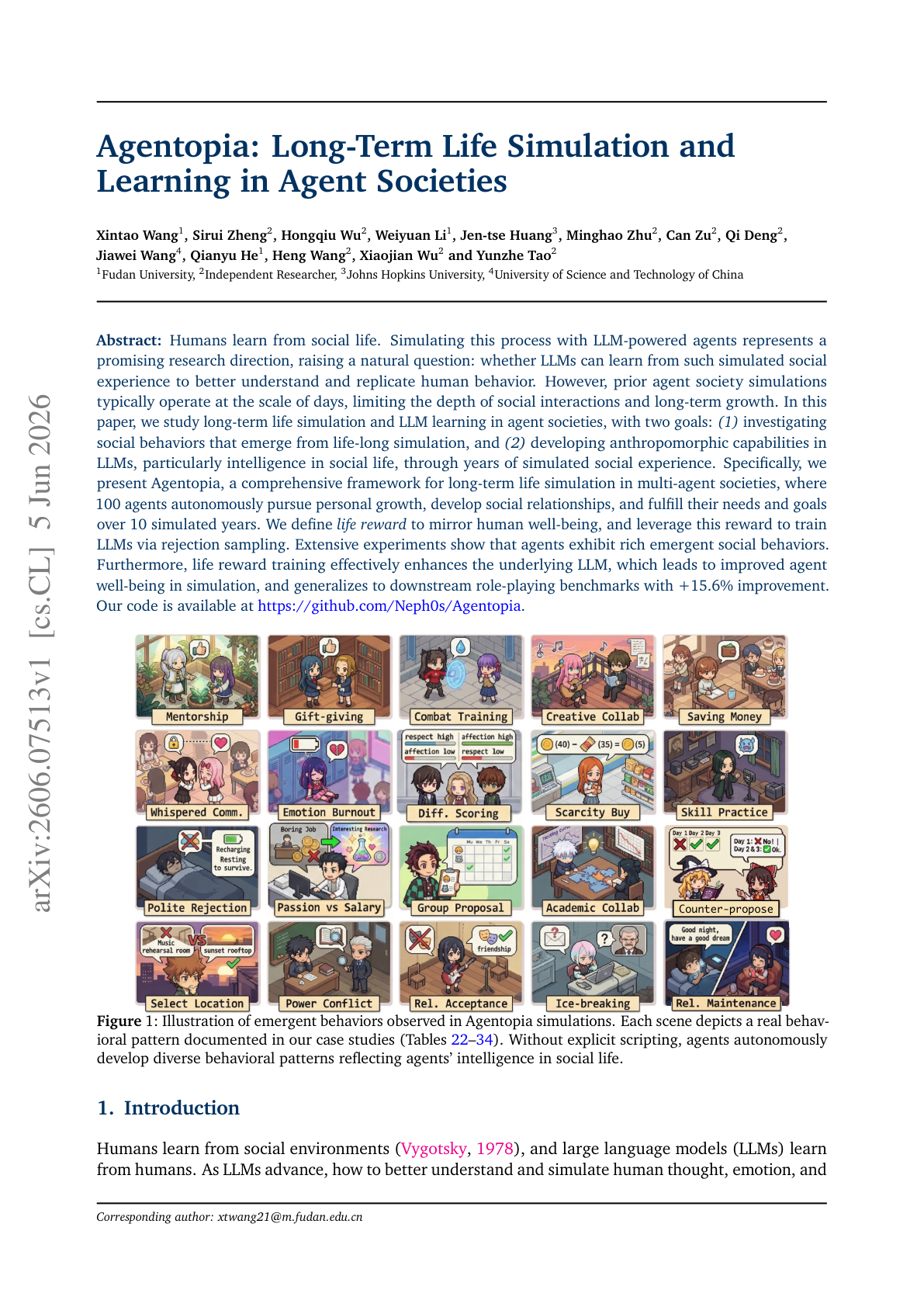
Agentopia is one of the most ambitious agent-society testbeds yet, a 79-page release that drops 100 LLM agents into a persistent world and lets them live, form relationships, and pursue goals over 10 simulated years, a horizon orders of magnitude longer than prior day-level work. Beyond observing emergent social behavior, the authors use the simulation as a training signal, optimizing models toward a life reward that reflects human well-being via rejection sampling.
The Geometry of On-Policy Distillation
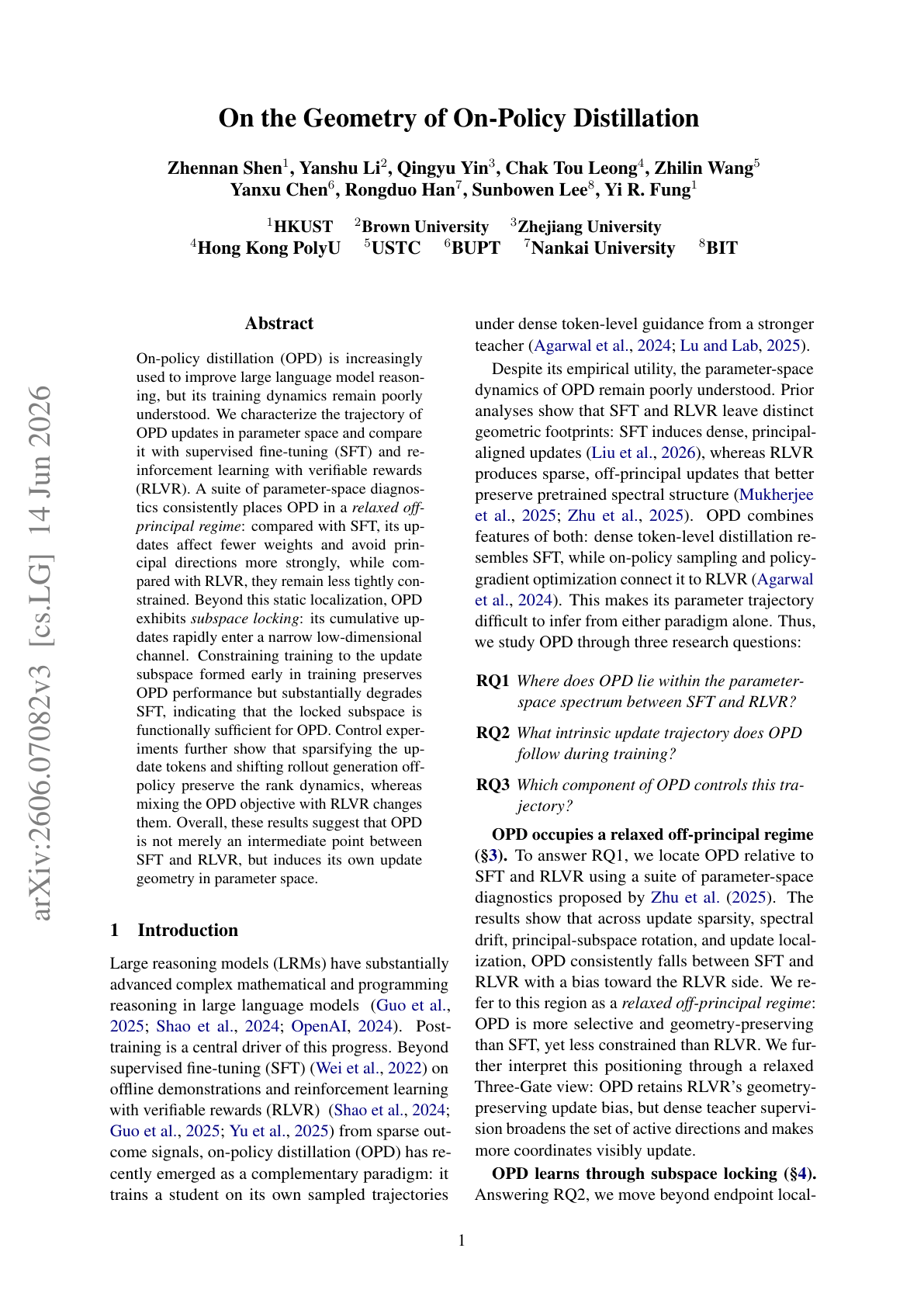
On-policy distillation (OPD) has become one of the most discussed post-training recipes of the year, but it has mostly been treated as a black box sitting somewhere between supervised fine-tuning and RL. This paper opens it up, characterizing how OPD changes a model's weights at the level of parameter geometry, and argues OPD is not a midpoint between SFT and RLVR but its own distinct kind of update.
Lookahead Sparse Attention
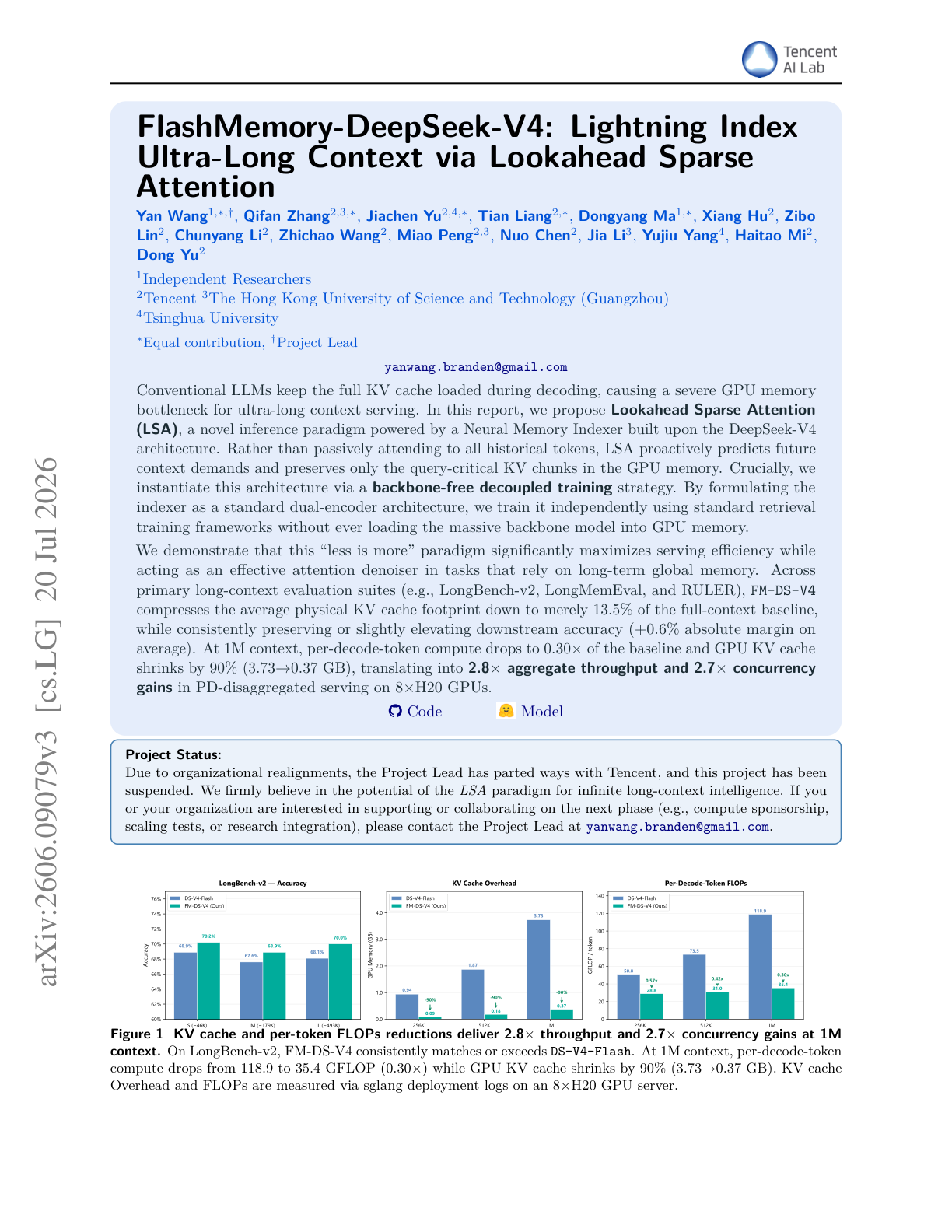
Long-context decoding is bottlenecked by the KV cache, which grows with every token and quickly dominates memory at extreme context lengths. This work, branded around DeepSeek-V4, introduces Lookahead Sparse Attention (LSA), which avoids storing the full KV cache by predicting which parts of the context future decoding will actually need and retaining only those query-critical chunks.
Latent Spatial Memory
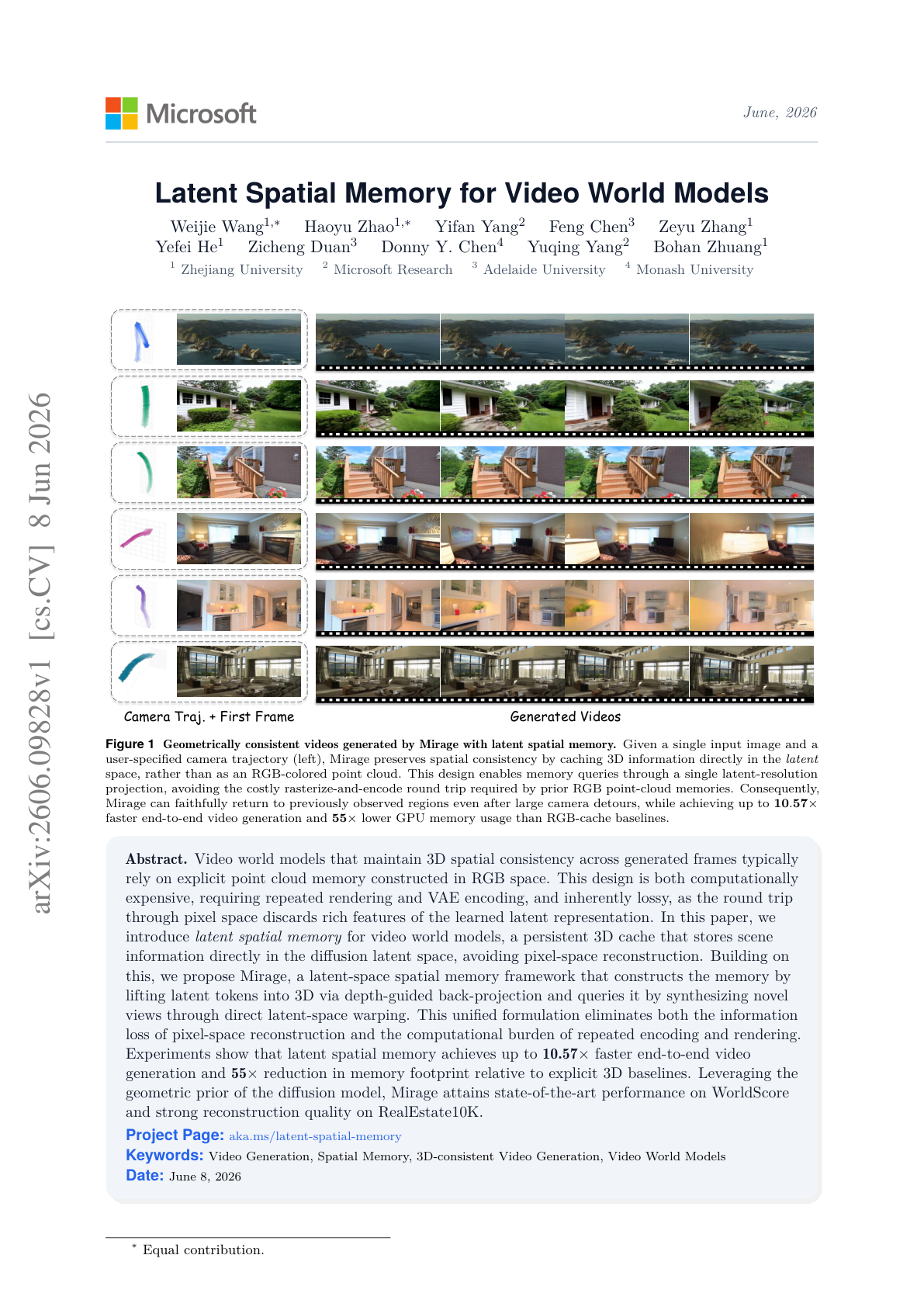
Video world models struggle to stay consistent over long horizons because explicit 3D memory usually requires an expensive pixel-space loop. Mirage instead stores scene information directly in diffusion latent space, using depth-guided back-projection and latent-space warping to maintain persistent spatial memory. The approach reports up to 10.57 times faster end-to-end generation and 55 times lower memory use than explicit 3D-memory baselines while improving long-horizon spatial consistency.