AI Papers of the Week
Every paper worth reading in AI, hand-picked one week at a time.
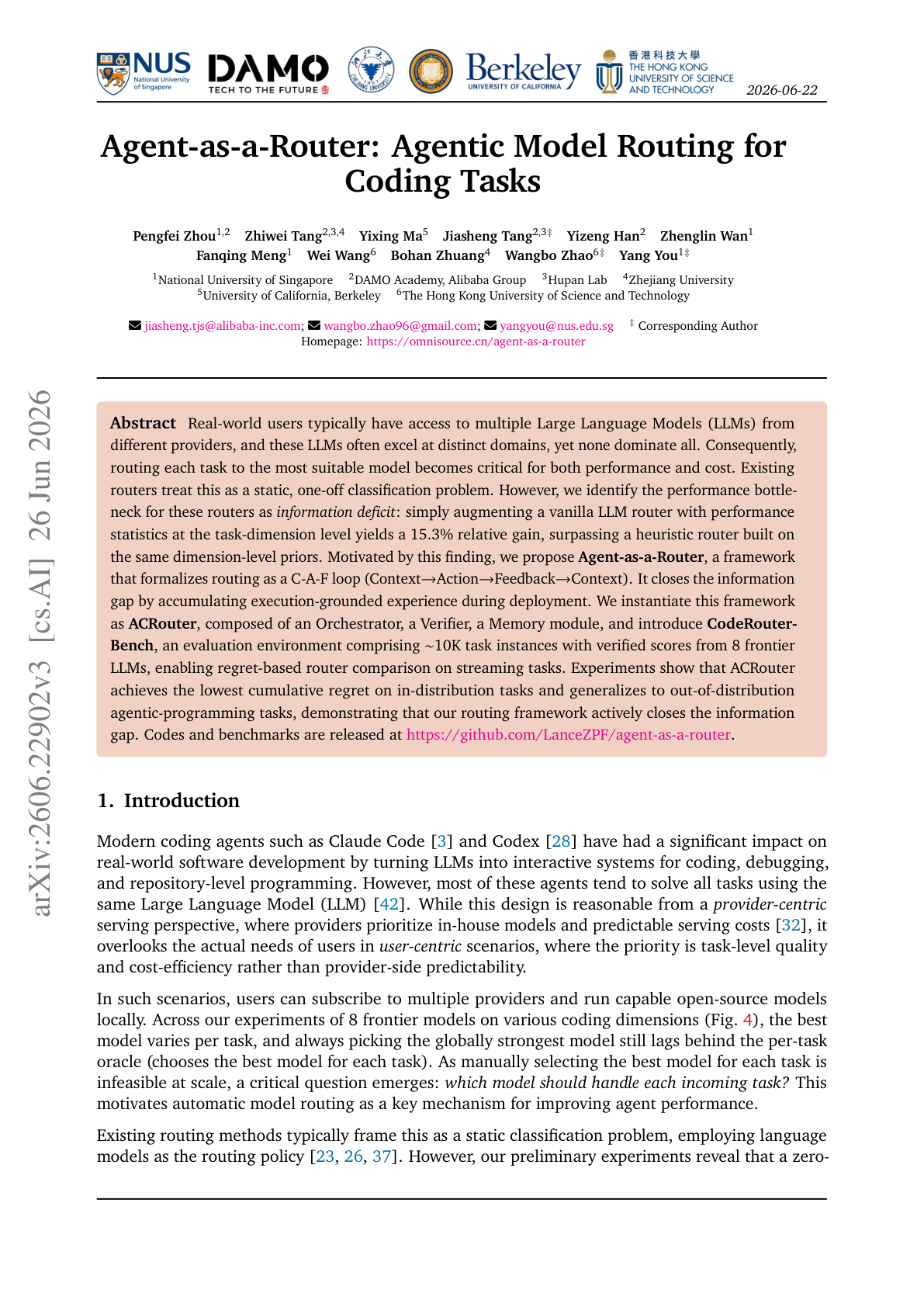
Agent-as-a-Router
Most users now have access to many LLMs that each excel in different domains, so routing each task to the right model matters for both quality and cost. Existing routers treat this as a static, one-off classification problem, and this paper shows that framing is exactly what holds them back.
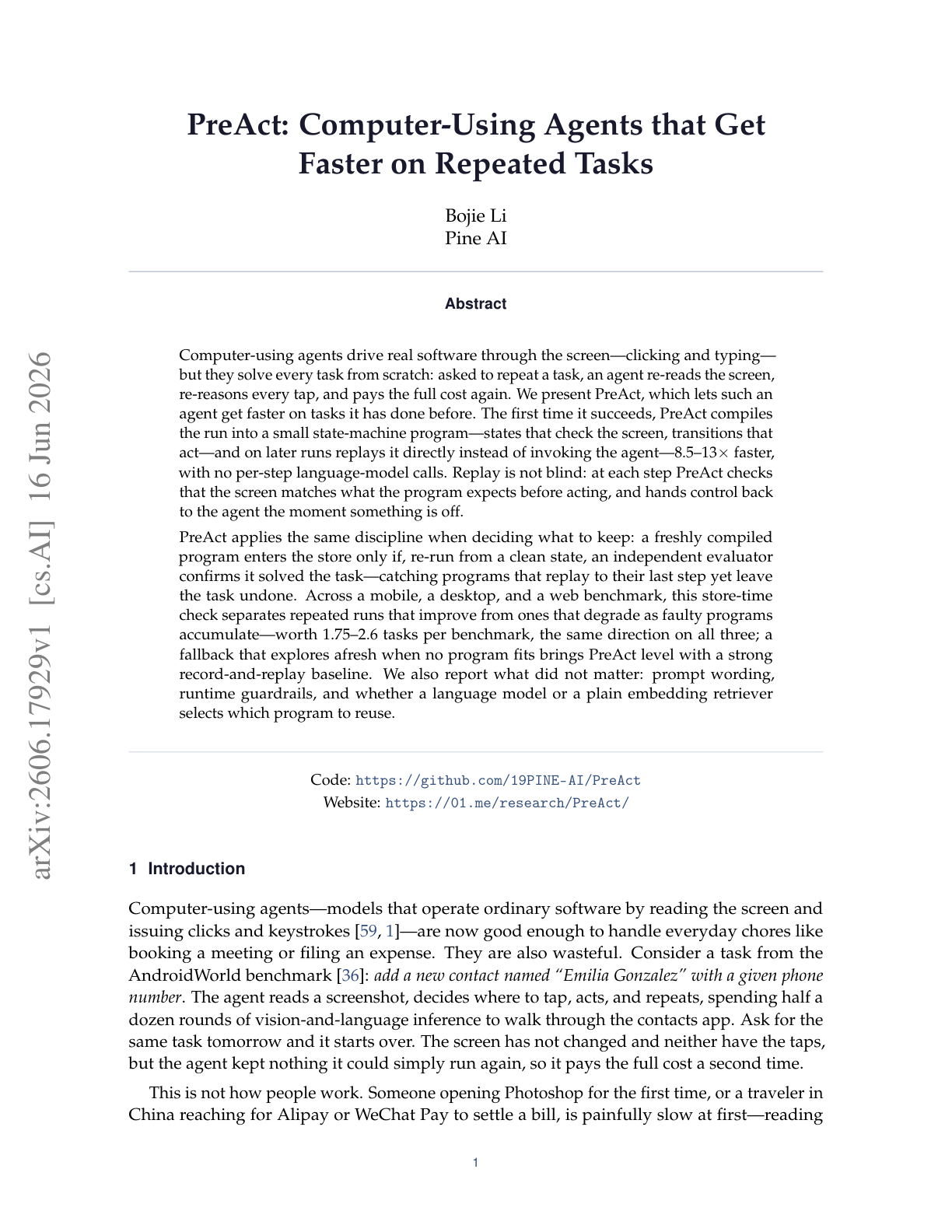
PreAct
Computer-using agents drive real software through the screen, but they solve every task from scratch. Ask one to repeat a task and it re-reads the screen and re-reasons every tap, paying the full cost again. PreAct fixes this by compiling the first successful run into a small state-machine program, where states check the screen and transitions act, then replaying that program on later runs instead of invoking the agent.
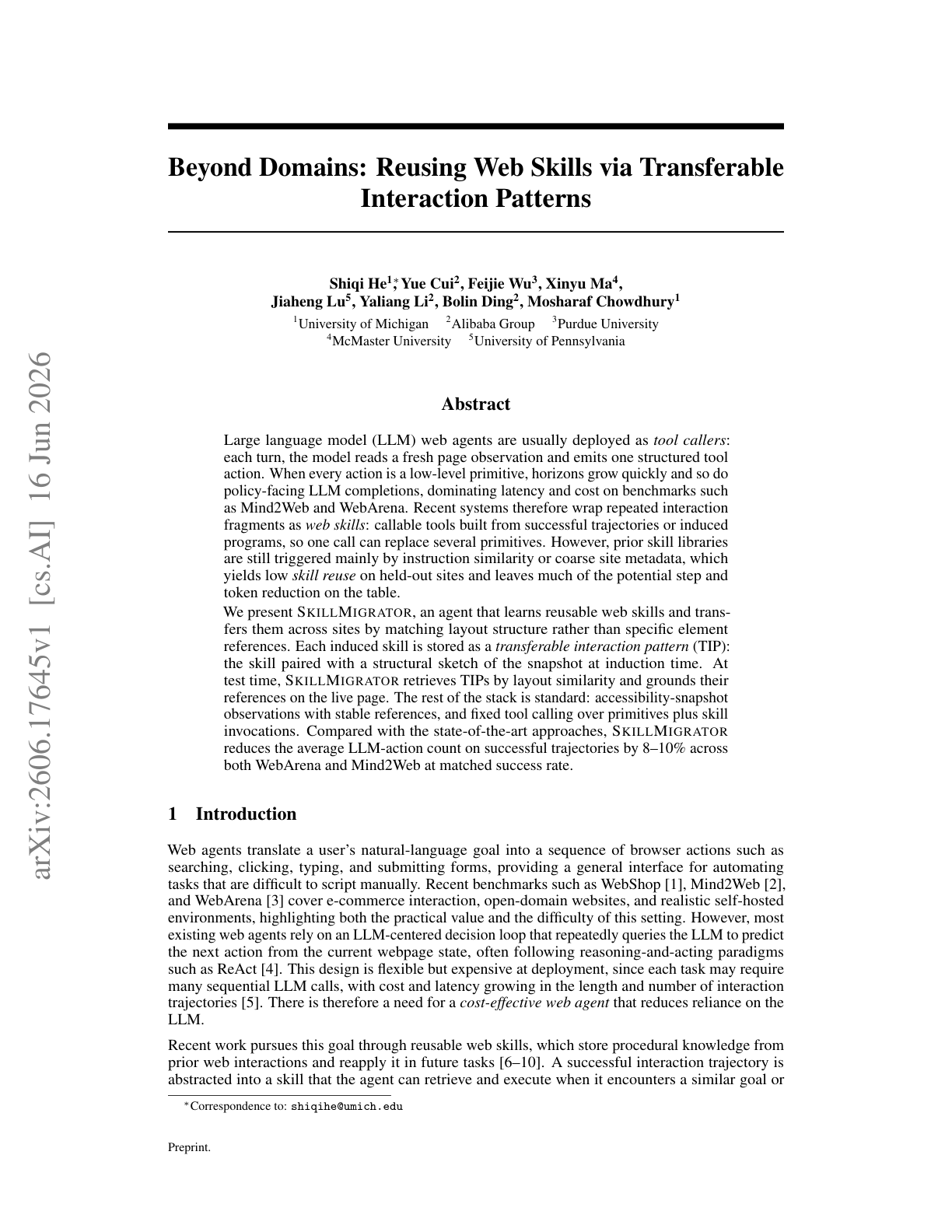
Beyond Domains
LLM web agents usually run as tool callers, reading a fresh page each turn and emitting one low-level action, so both task horizons and the number of LLM completions blow up. This work makes web skills reusable across sites with SkillMigrator, which stores induced skills as transferable interaction patterns keyed by page-layout structure rather than instruction similarity or site metadata, so a skill learned on one site fires on new sites with the same interaction shape. It cuts the average LLM-action count by 8 to 10% on WebArena and Mind2Web at comparable success rates.
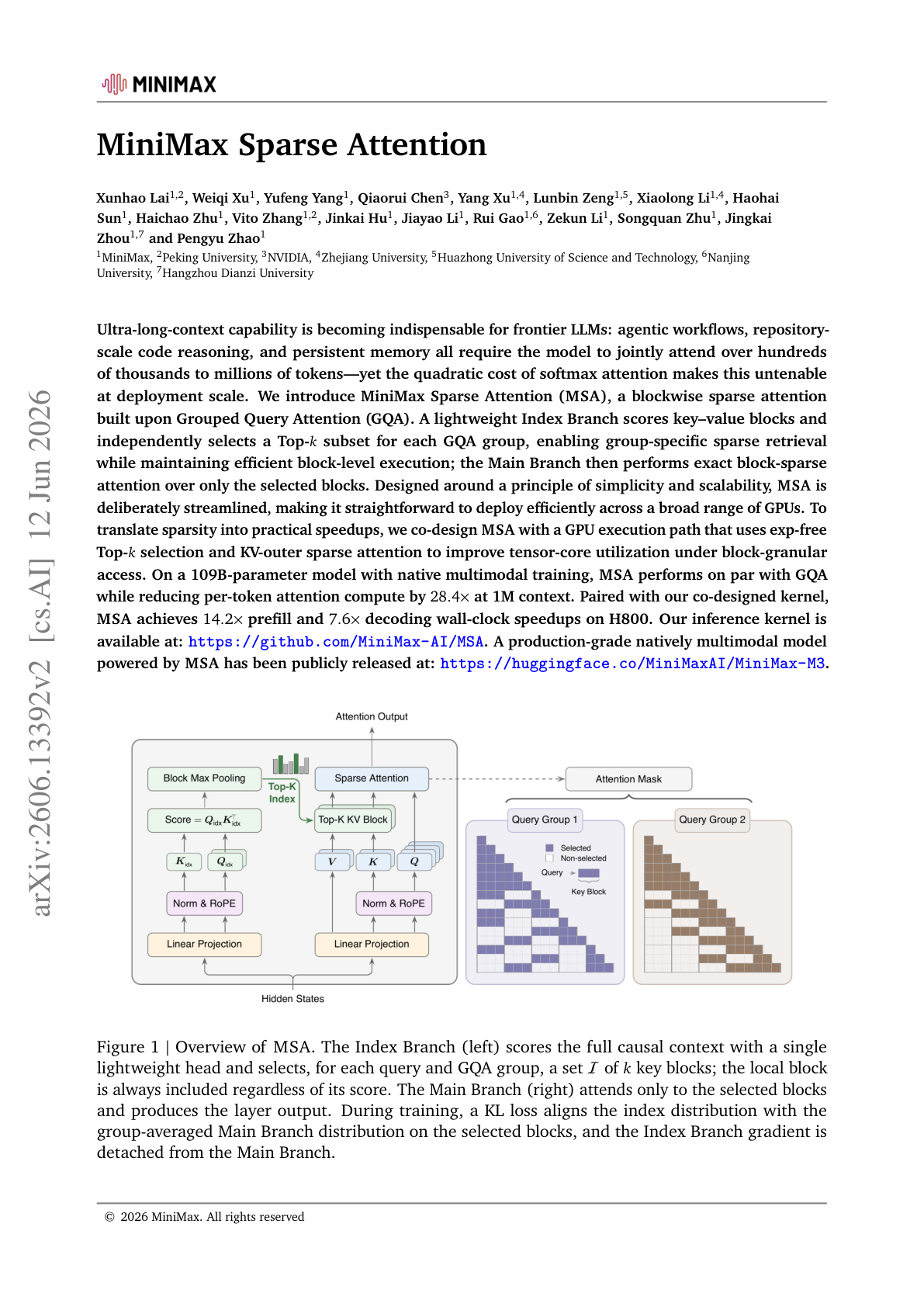
MiniMax Sparse Attention
Ultra-long context is now a core requirement for agents, codebase-scale reasoning, multimodal workflows, and persistent memory, but dense softmax attention still makes million-token deployment expensive. MiniMax Sparse Attention (MSA) tackles this by adding blockwise sparsity on top of Grouped Query Attention, with a lightweight routing branch that chooses which key-value blocks each query group should actually attend to.
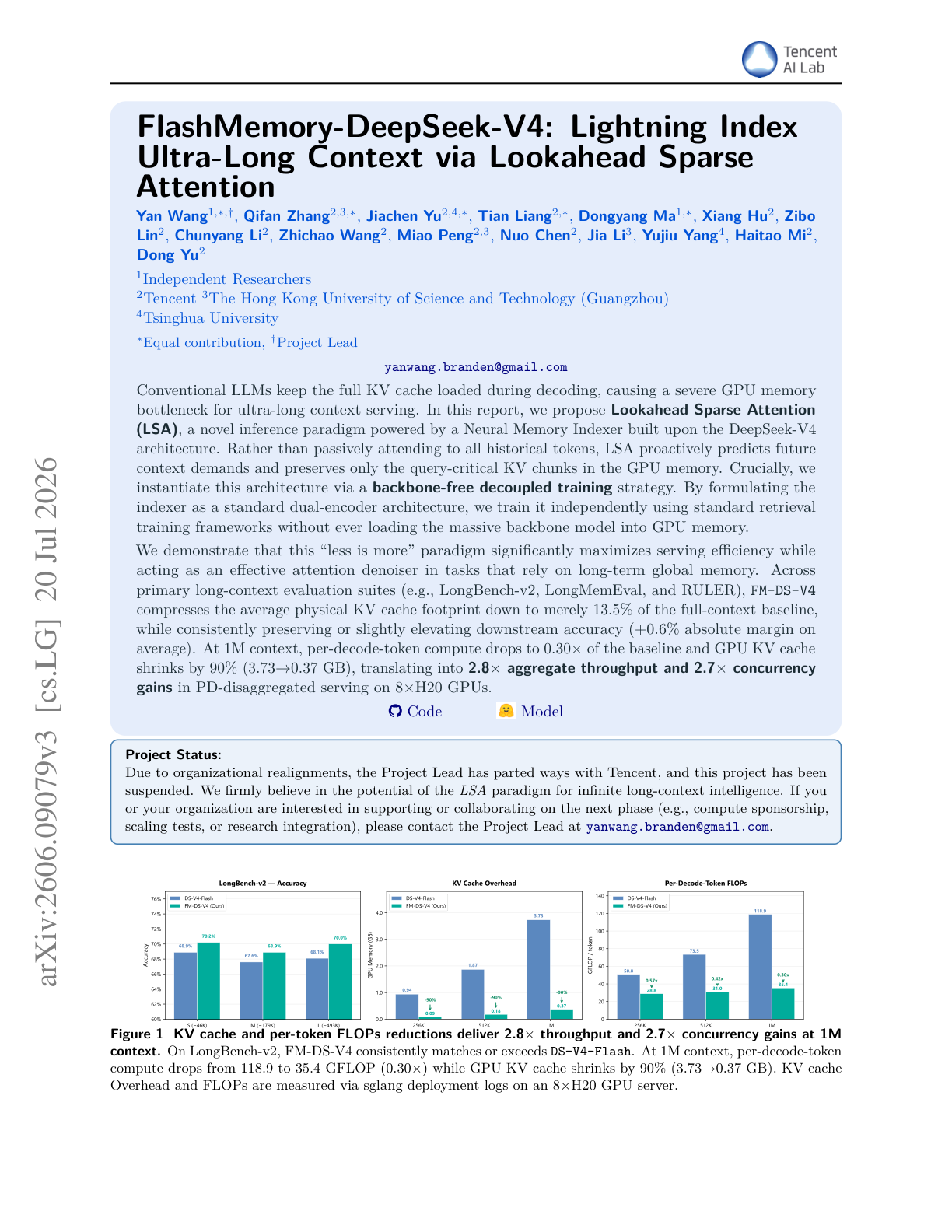
Lookahead Sparse Attention
Long-context decoding is bottlenecked by the KV cache, which grows with every token and quickly dominates memory at extreme context lengths. This work, branded around DeepSeek-V4, introduces Lookahead Sparse Attention (LSA), which avoids storing the full KV cache by predicting which parts of the context future decoding will actually need and retaining only those query-critical chunks.
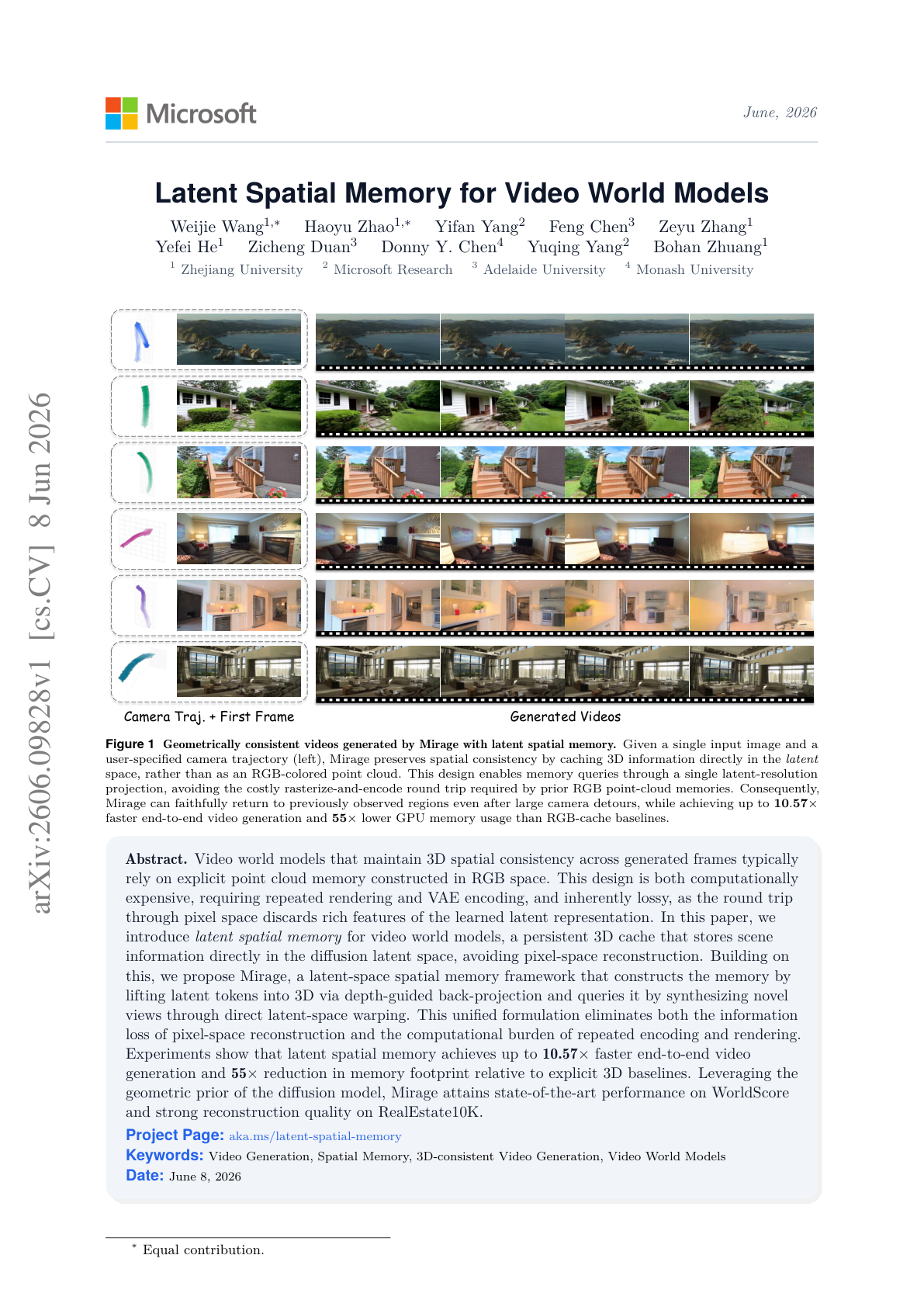
Latent Spatial Memory
Video world models struggle to stay consistent over long horizons because explicit 3D memory usually requires an expensive pixel-space loop. Mirage instead stores scene information directly in diffusion latent space, using depth-guided back-projection and latent-space warping to maintain persistent spatial memory. The approach reports up to 10.57 times faster end-to-end generation and 55 times lower memory use than explicit 3D-memory baselines while improving long-horizon spatial consistency.
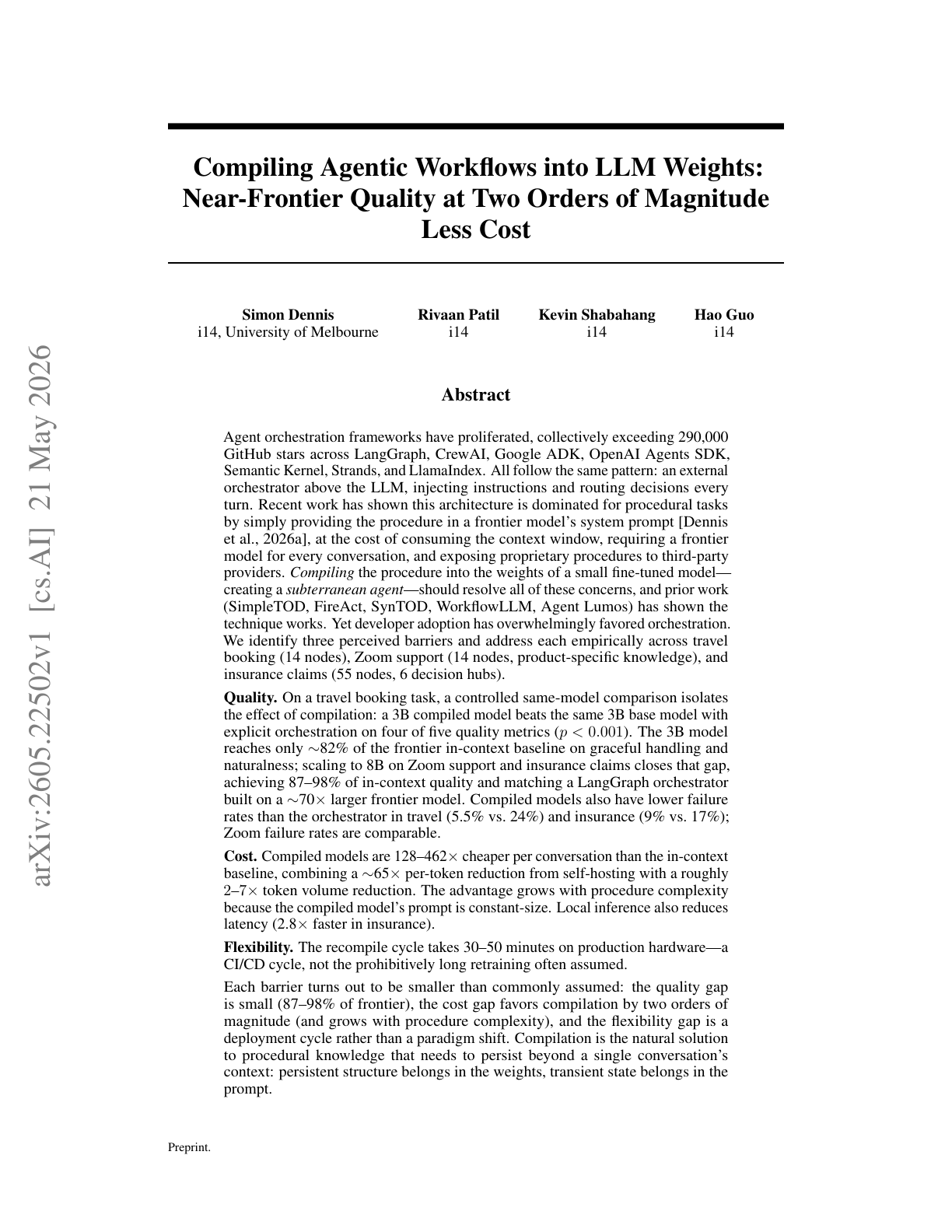
Compiling Agentic Workflows into Weights
This paper shows that a full agentic workflow can be distilled into the weights of a small model and run at roughly two orders of magnitude lower inference cost while preserving near-frontier task quality. Instead of keeping an external orchestrator above the LLM, the procedure is compiled into the weights of a fine-tuned model, producing what the authors call a subterranean agent.
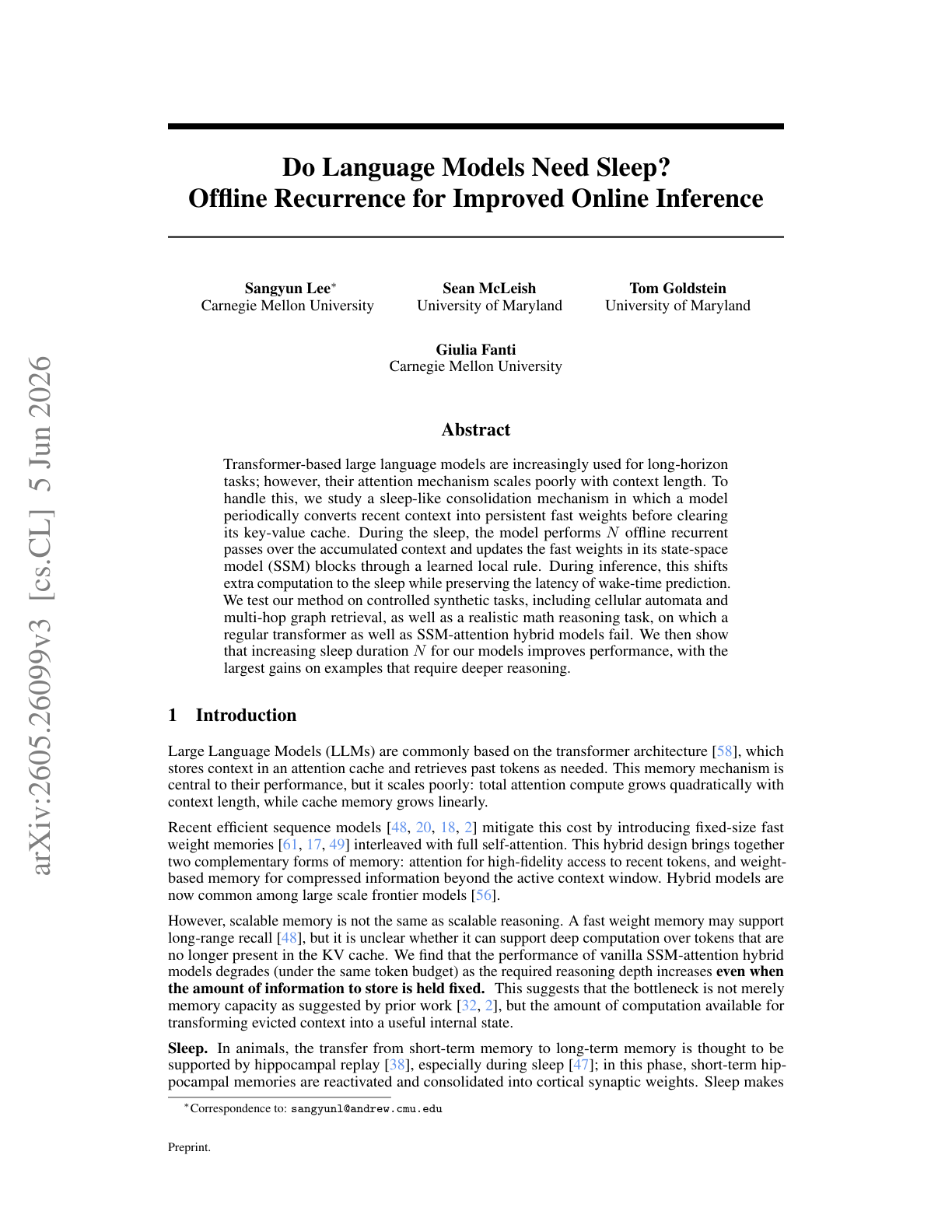
Language Models Need Sleep
Attention scales badly with context length, so long-horizon agents keep paying a growing cost as their context grows. This paper studies a sleep-like consolidation mechanism: the model periodically converts recent context into persistent fast weights, then clears its key-value cache. During the sleep phase it performs offline recurrent passes over the accumulated context and updates fast weights in its state-space blocks through a learned local rule.
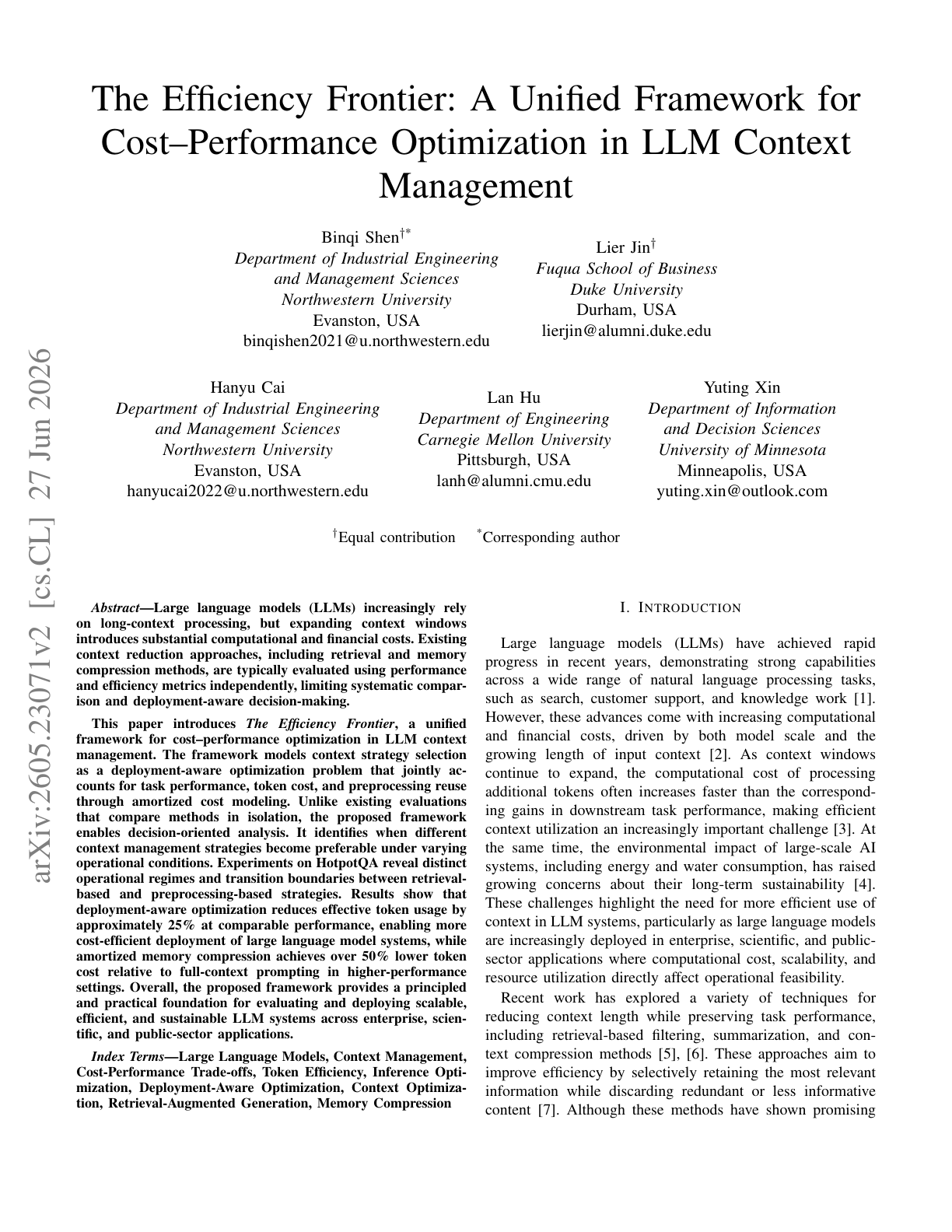
The Efficiency Frontier
Context costs dominate production LLM bills, and the right strategy depends on how often preprocessing gets reused. This paper models context-strategy selection as a deployment-aware optimization problem that jointly accounts for task performance, token cost, and reuse, then uses it to compare retrieval-based and preprocessing-based approaches under realistic constraints.
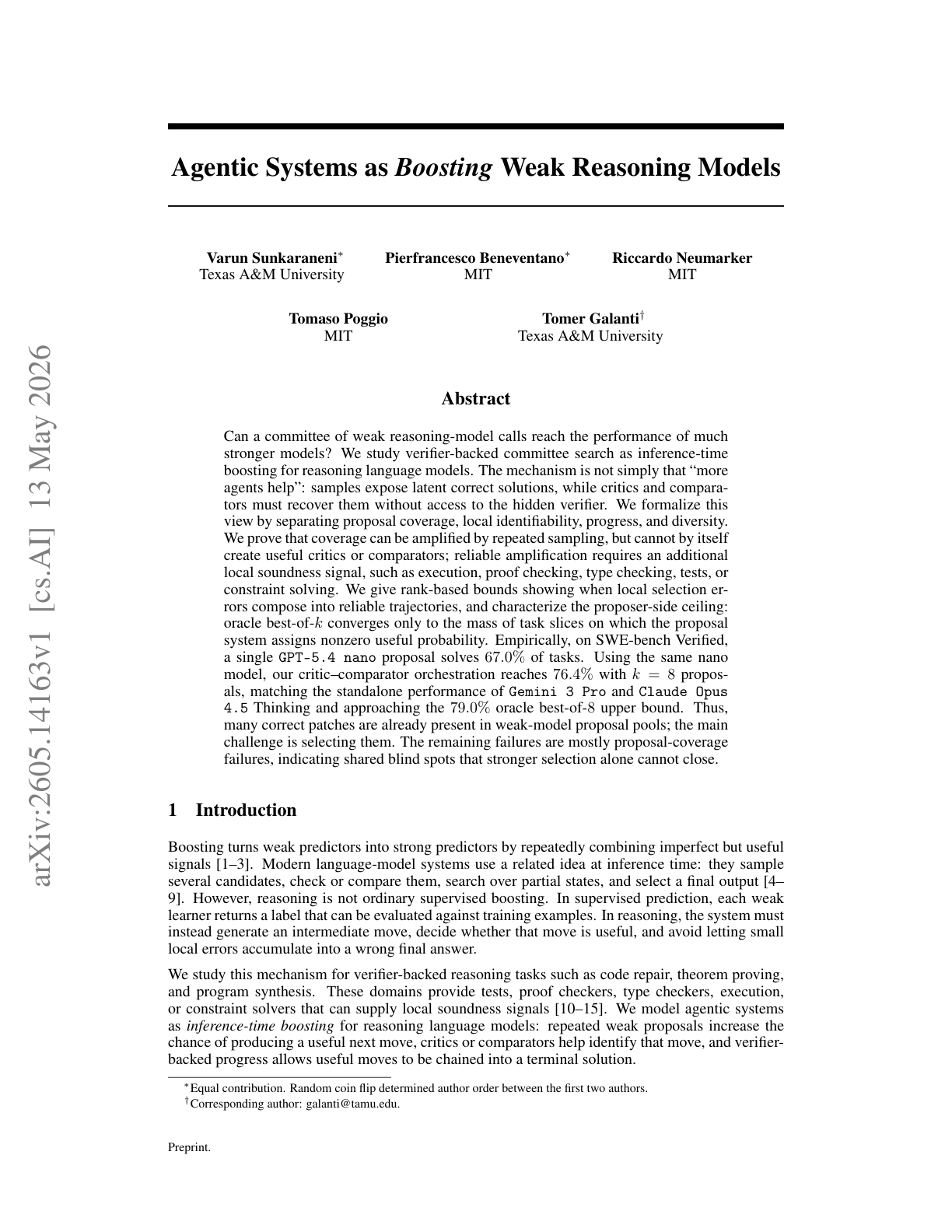
Weak-Model Critic-Comparator
GPT-5.4 nano wrapped in a critic-comparator orchestration loop reaches 76.4% on SWE-bench Verified, matching standalone Gemini 3 Pro and Claude Opus 4.5 Thinking. The trick is to sample k=8 candidate patches from the weak model and select the winner using execution and proof signals rather than asking the model to self-rank.
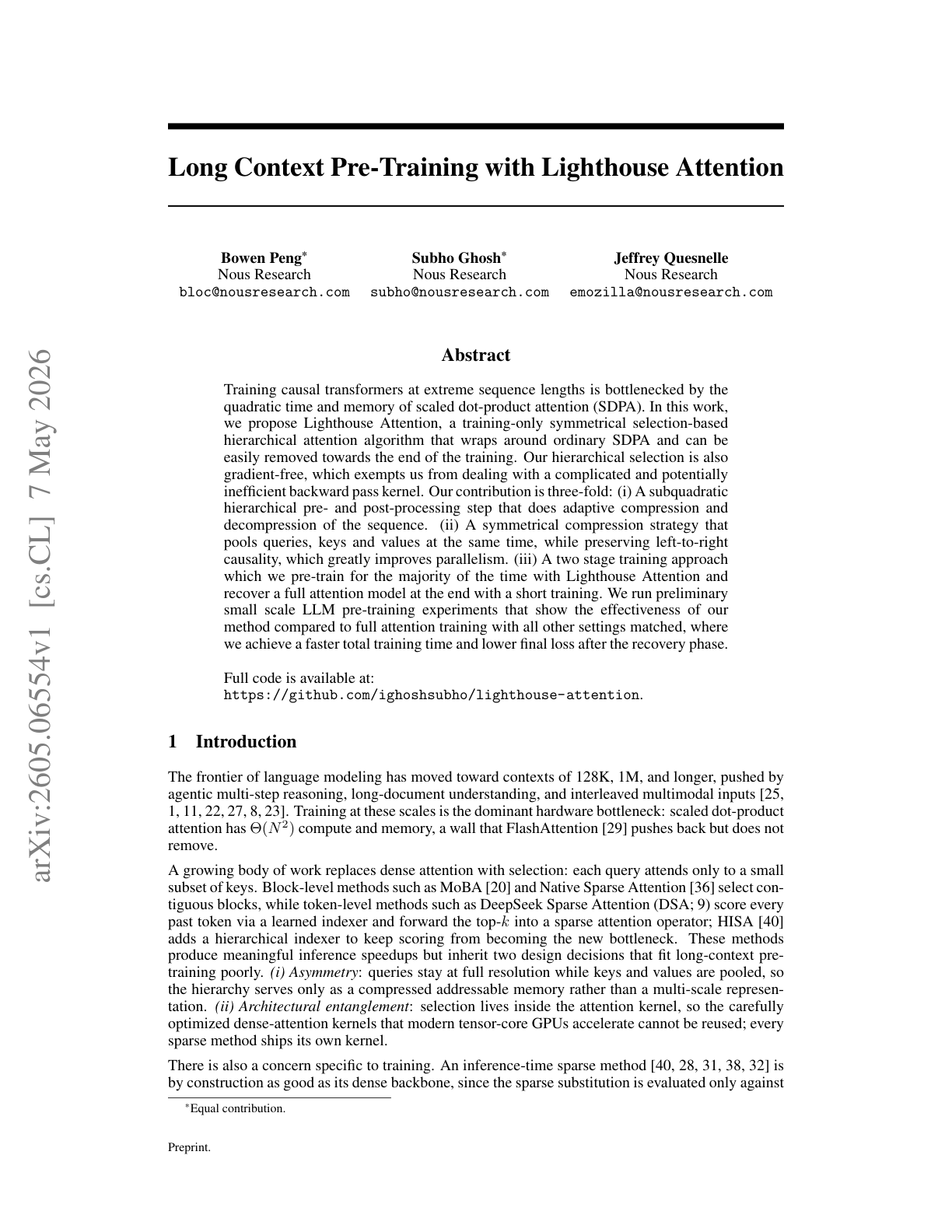
Lighthouse Attention
Nous Research proposes a training-only attention wrapper for long-context pretraining. Lighthouse Attention wraps standard SDPA with a hierarchical, gradient-free selection layer that compresses and decompresses queries, keys, and values symmetrically while preserving left-to-right causality. The wrapper is removed near the end of training in a short recovery phase, so the deployed model runs vanilla attention with no architectural change at inference. Preliminary LLM experiments report faster total training time and lower final loss than full-attention baselines.
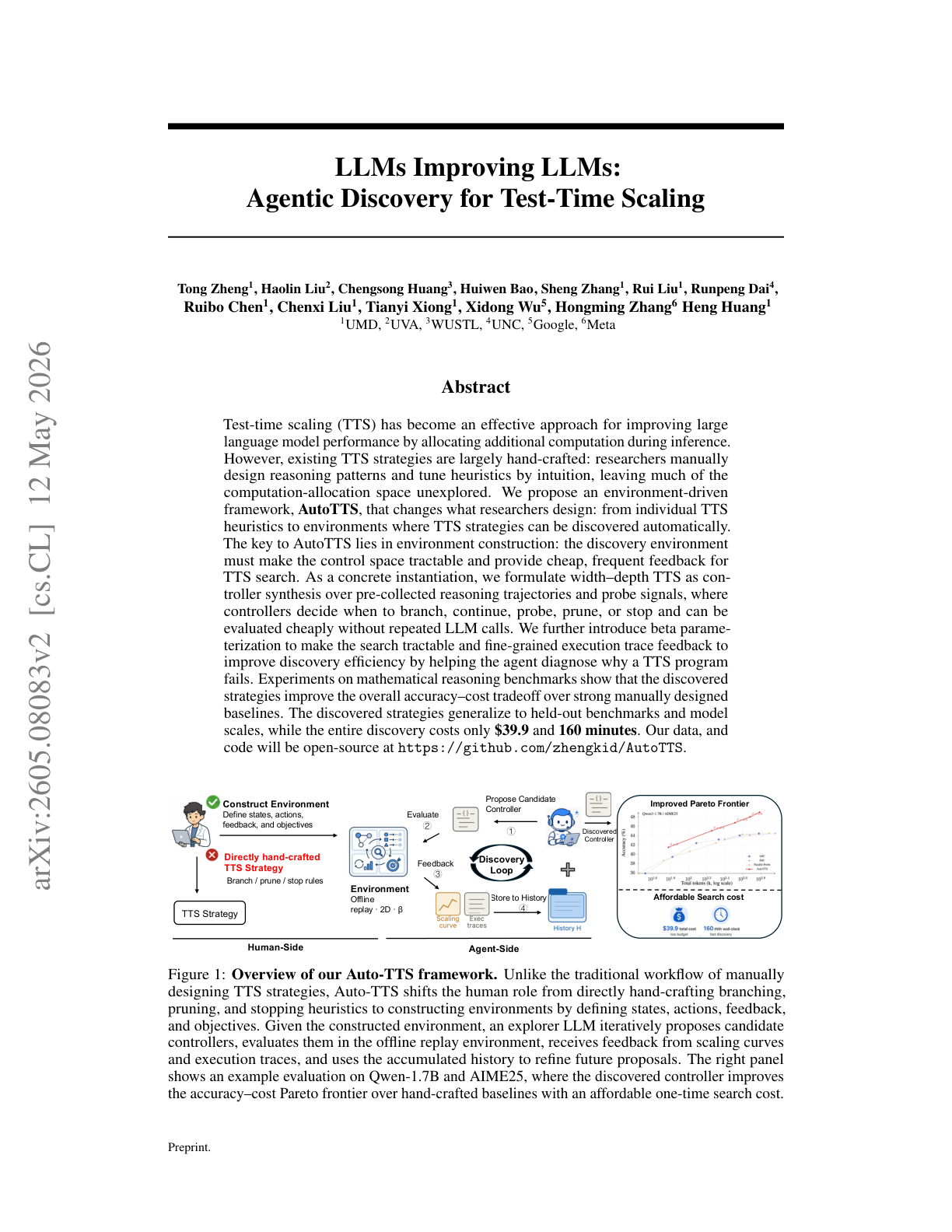
AutoTTS
AutoTTS reframes test-time scaling as a search problem. Instead of designing branching, pruning, and stopping heuristics directly, the user constructs a discovery environment in which TTS strategies are searched automatically. Width-depth TTS is recast as controller synthesis over pre-collected reasoning trajectories and probe signals, so candidate controllers can be evaluated without repeated LLM calls.
Token Superposition Training
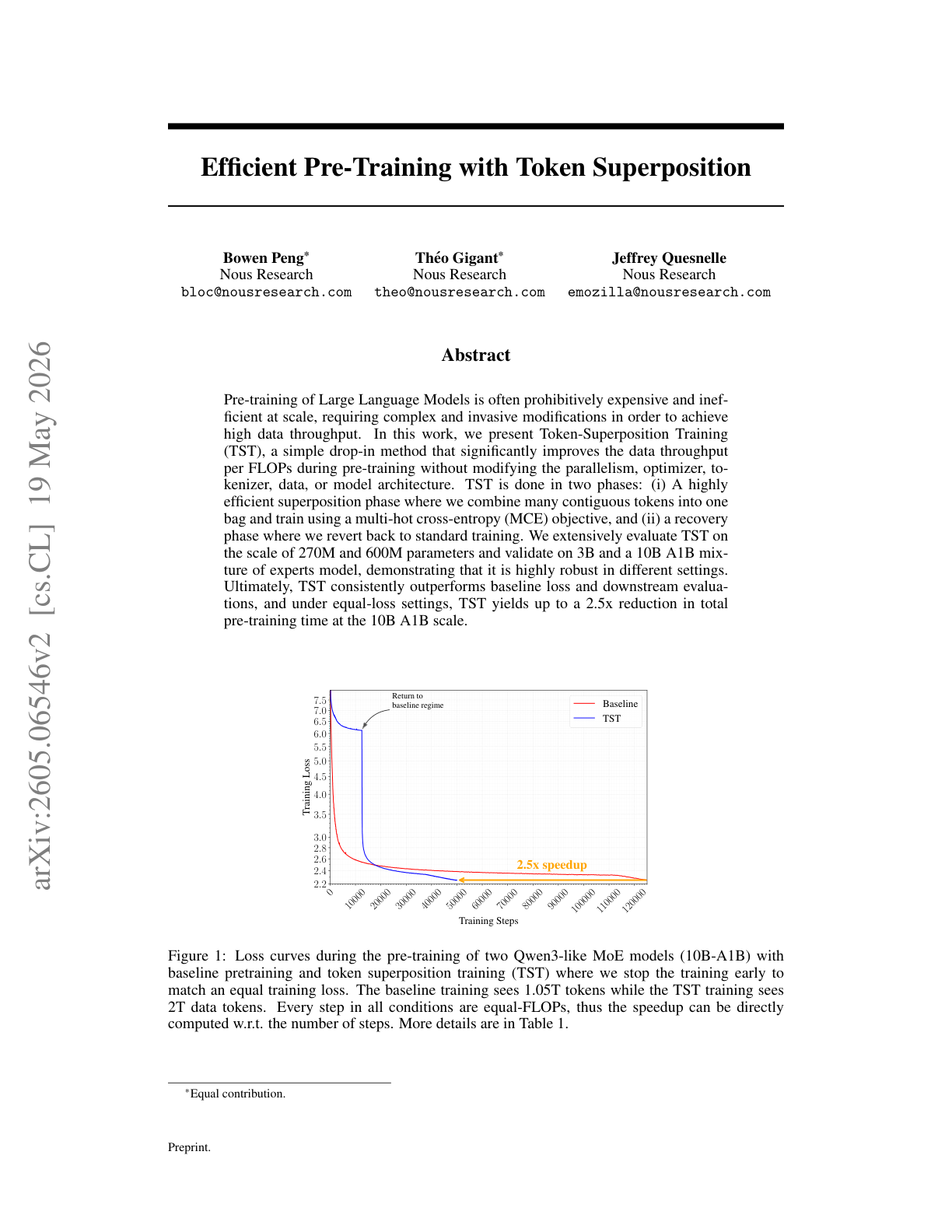
Nous Research's second pretraining paper of the week. Token Superposition Training (TST) is a modification to the standard LLM pretraining loop that produces a 2 to 3x wall-clock speedup at matched FLOPs without changing the model architecture, optimizer, tokenizer, or training data. During the first third of training, the model reads and predicts contiguous bags of tokens, averaging their embeddings on the input side and predicting the next bag with a modified cross-entropy on the output side. For the remainder of the run, training reverts to standard next-token prediction. The inference-time model is identical to one produced by conventional pretraining. TST was validated at 270M, 600M, and 3B dense scales, and at a 10B-A1B mixture-of-experts model where it reaches a lower final loss while consuming 4,768 B200-GPU-hours versus the baseline's 12,311. Together with Lighthouse Attention, this is the second pretraining-loop modification from the same lab this week reporting substantial speedups without architecture changes.
RecursiveMAS
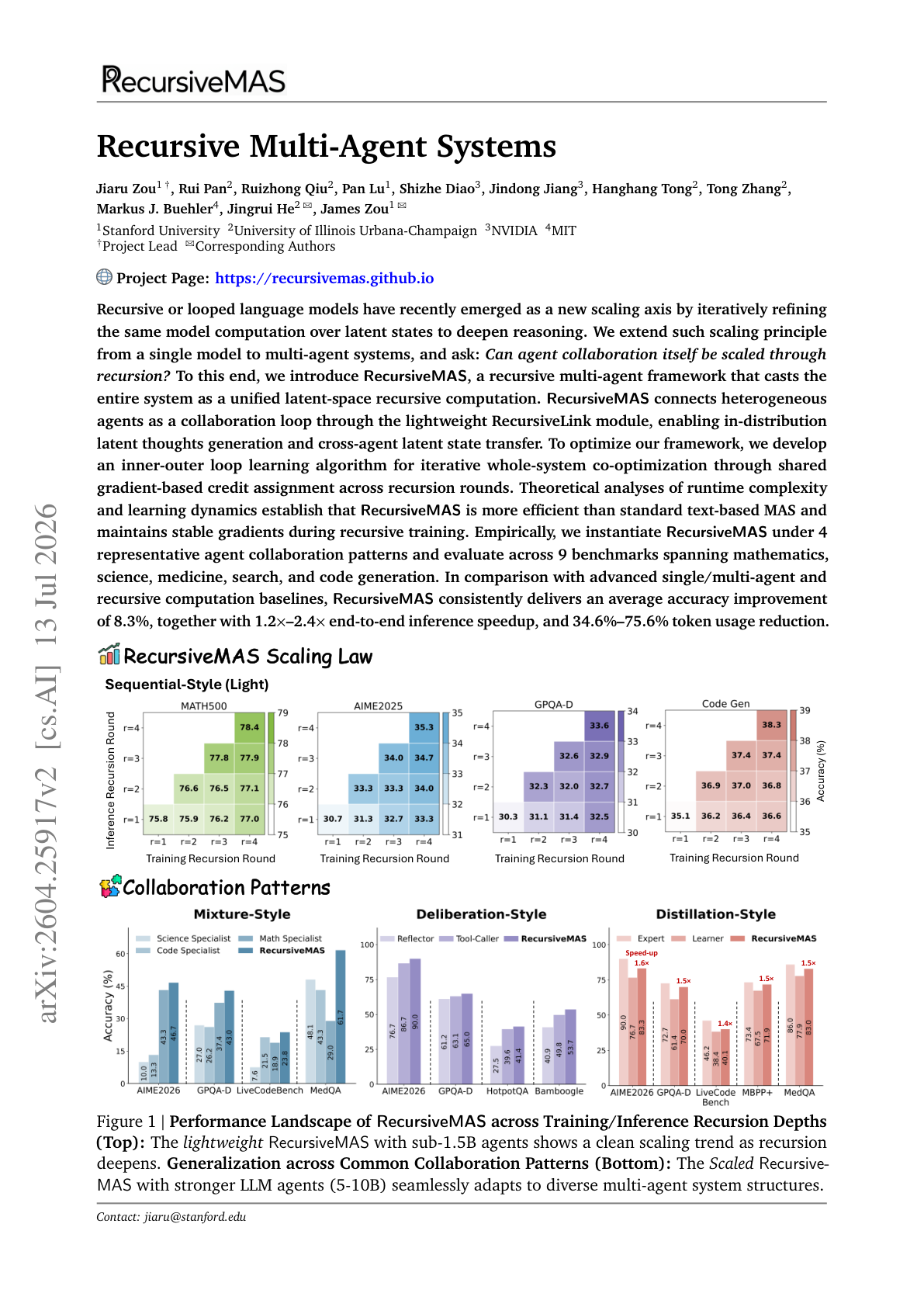
Multi-agent systems usually pass full text messages between agents at every step, which causes token bloat, latency, and context dilution that all grow with team size. RecursiveMAS asks a different question: what if agents collaborated through recursive computation in a shared latent space instead of through text? The system treats a multi-agent team as a recursive computation where each agent acts like an RLM layer, iteratively passing latent representations to the next and forming a looped interaction process. Less talking, more thinking.
Latent Agents
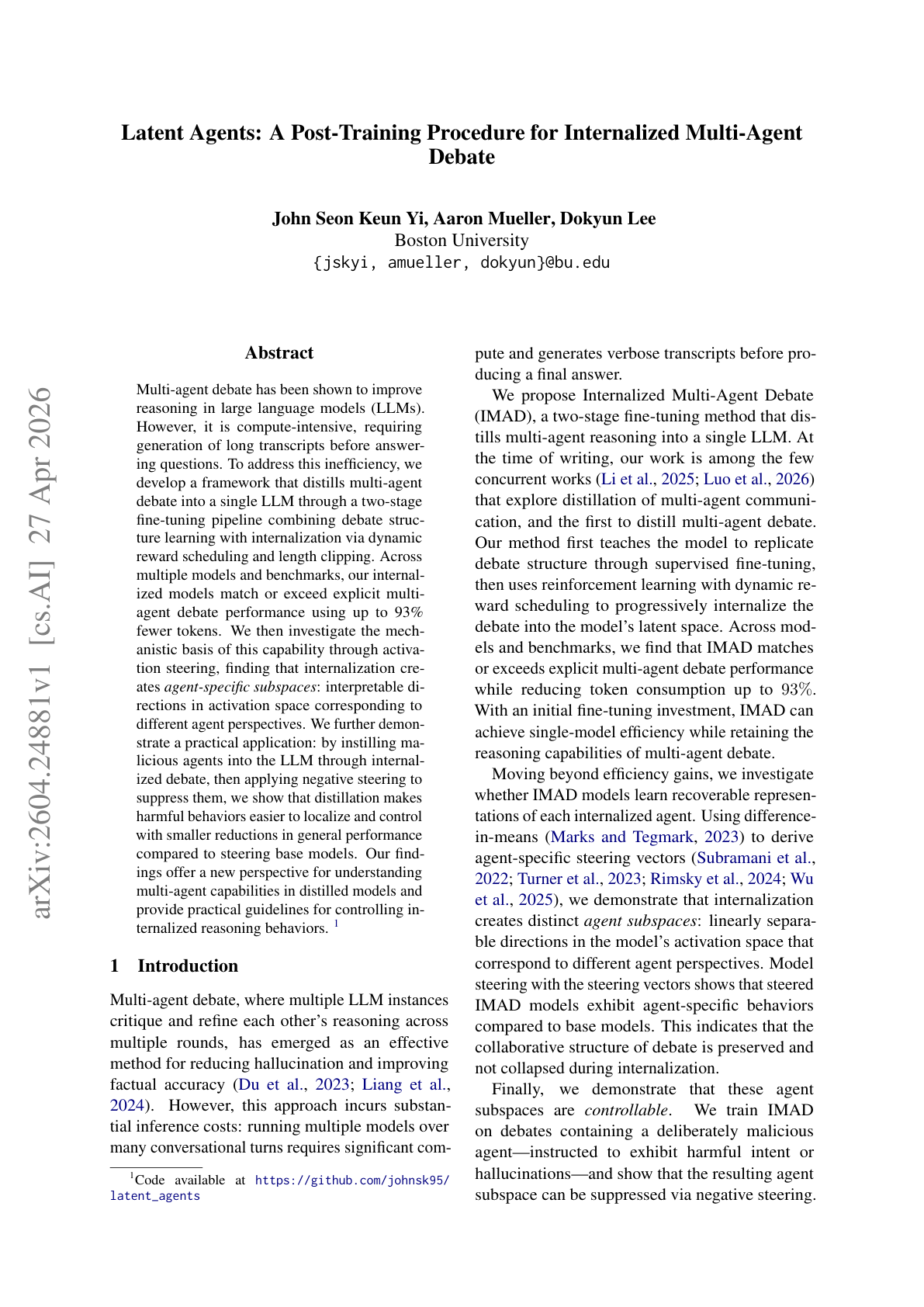
Multi-agent debate makes models reason better. It also burns tokens generating long transcripts before any answer comes out. Latent Agents distills the entire debate into a single LLM through a two-stage fine-tuning pipeline: the model first learns debate structure, then internalizes it through dynamic reward scheduling and length clipping. The internalized model matches or beats explicit multi-agent debate while using up to 93% fewer tokens, which makes debate-quality reasoning practical at production scale.
Attention to Mamba
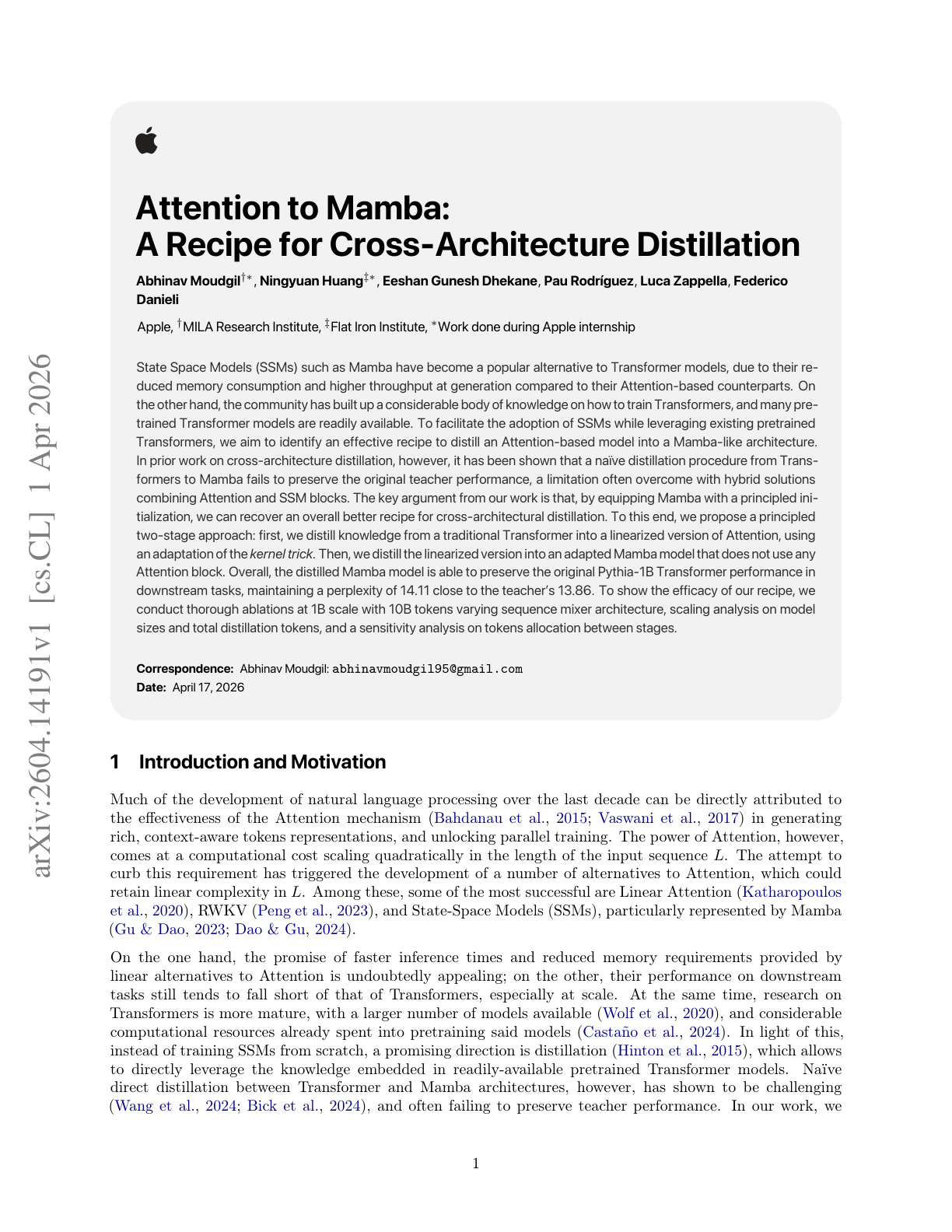
Apple proposes a two-stage recipe for cross-architecture distillation from Transformers into Mamba. Naive distillation collapses teacher performance because a Mamba student cannot directly imitate softmax attention. The fix is to distill the transformer into a linearized-attention student using a kernel adaptation first, then transfer that student into a pure Mamba with no attention blocks. On a 1B model trained on 10B tokens, the Mamba student hits 14.11 perplexity against a 13.86 Pythia-1B teacher, nearly matching quality at linear-time inference cost.
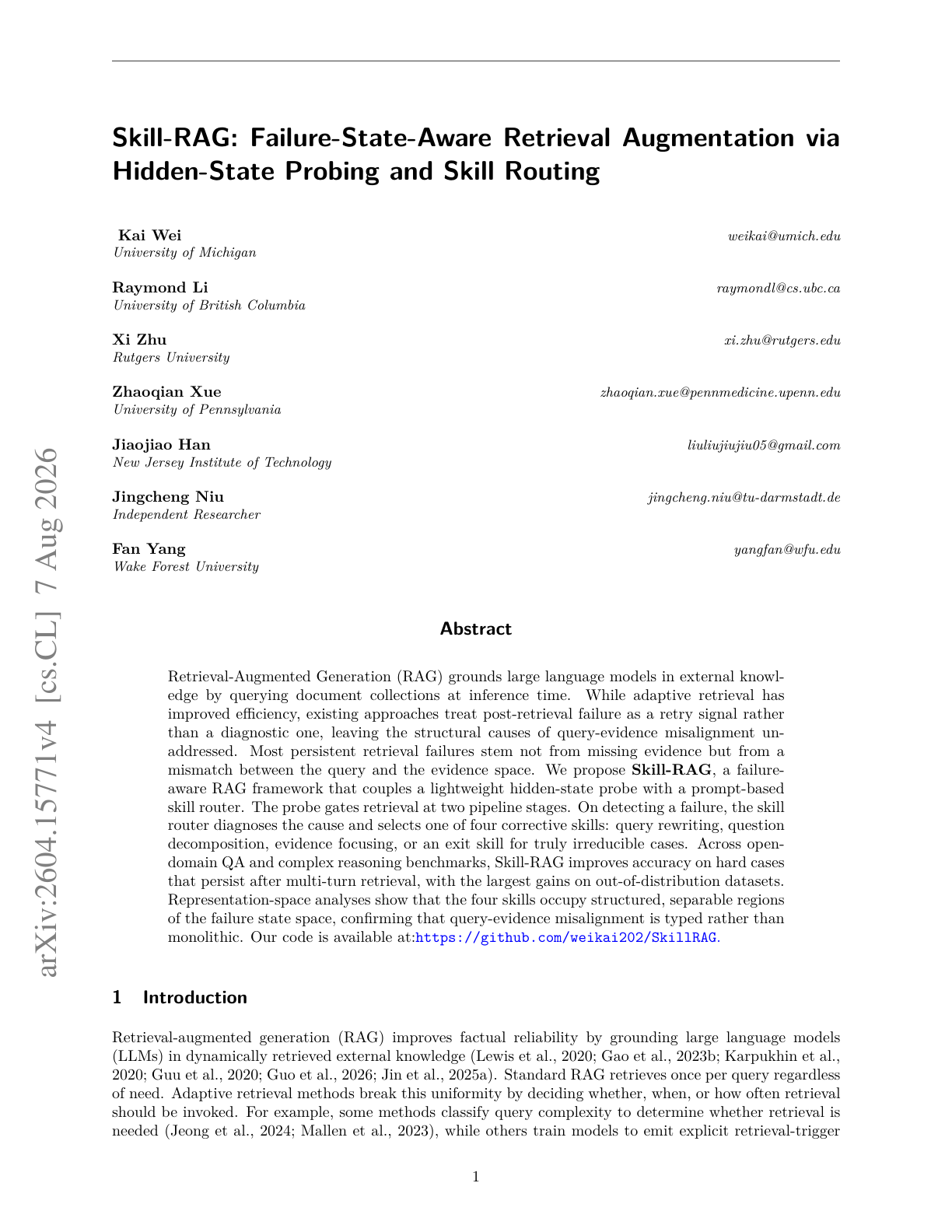
Skill-RAG
Most RAG systems retrieve on every query, whether the model needs help or not. This is wasteful when the model already knows the answer and often too late when it does not. This paper introduces Skill-RAG, a failure-state-aware retrieval system that uses hidden-state probing to detect when an LLM is approaching a knowledge failure, then routes the query to a specialized retrieval strategy matched to the gap.
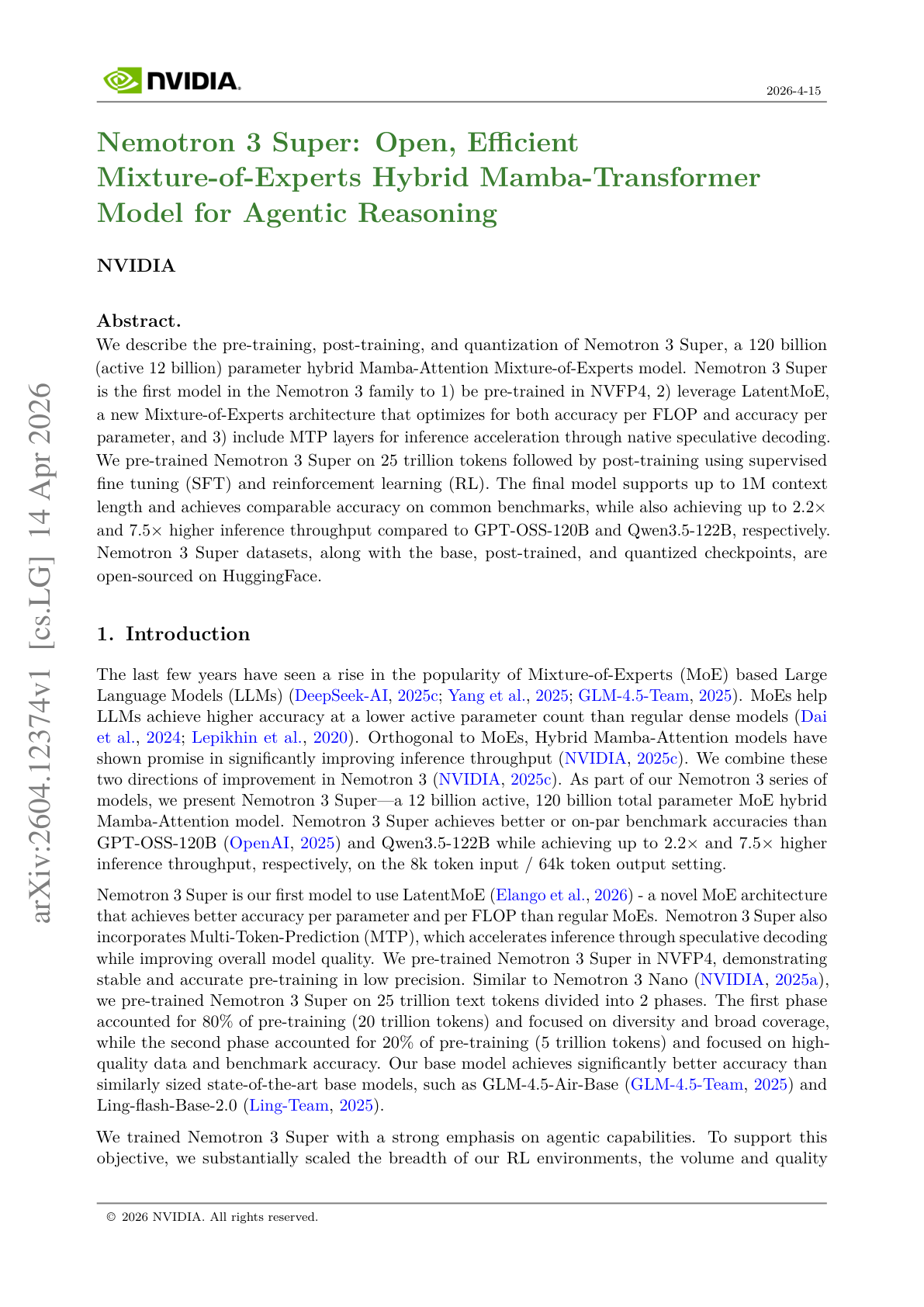
Nemotron 3 Super
NVIDIA introduces Nemotron 3 Super, an open 120B parameter model with 12B active parameters, built as a hybrid Mamba-Attention Mixture-of-Experts architecture optimized for agentic reasoning. The model targets long-context, high-throughput inference, a capability increasingly central to running agents reliably. It supports up to 1M context length while delivering up to 2.2x higher throughput than GPT-OSS-120B and 7.5x higher than Qwen3.5-122B, at comparable benchmark accuracy.
Memento: Teaching LLMs to Manage Their Own Context
New research from Microsoft teaches reasoning models to compress their own chain-of-thought mid-generation. Memento trains models to segment reasoning into blocks, summarize each block into a compact “memento,” and then evict the original block from the KV cache. The model continues reasoning from mementos alone, cutting peak memory by 2-3x while nearly doubling throughput.
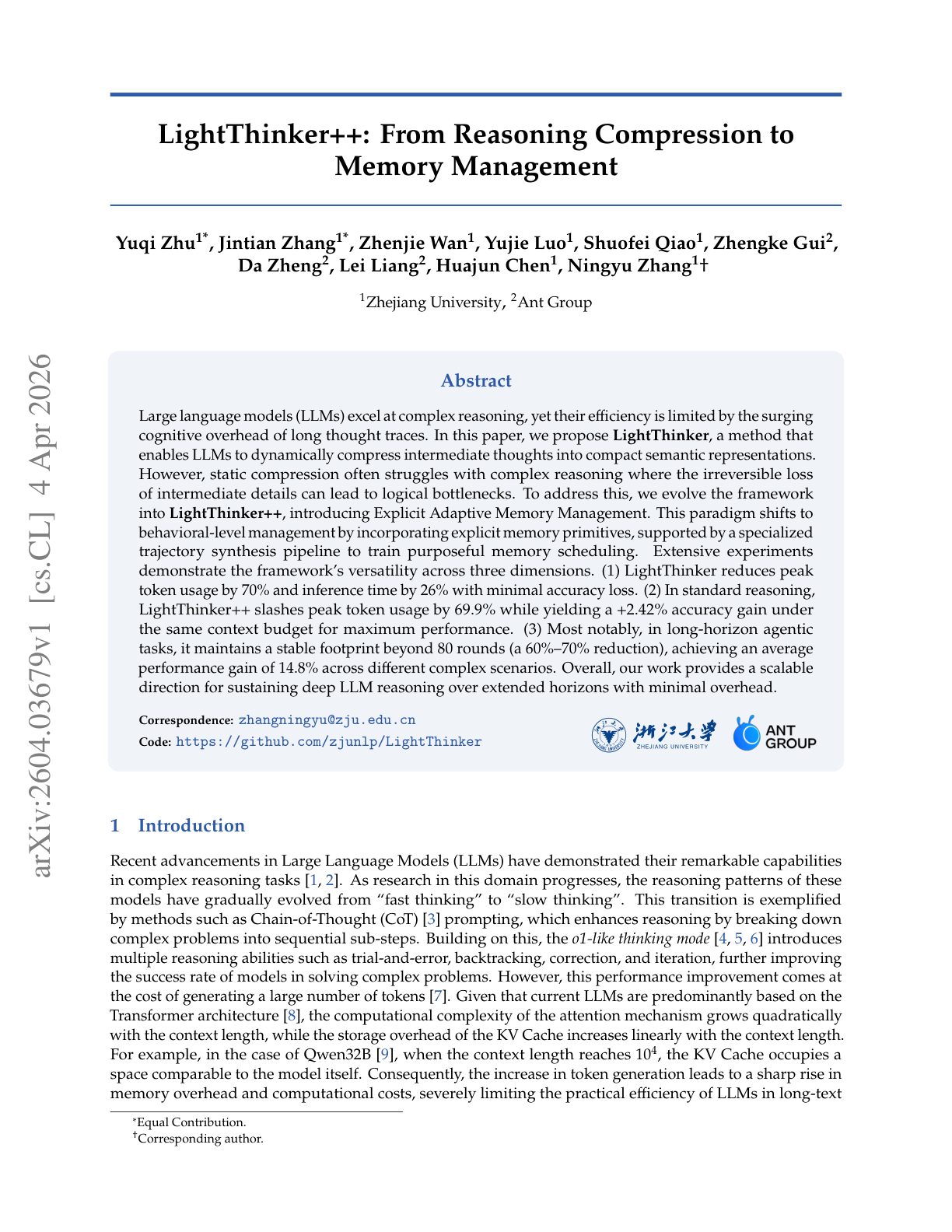
LightThinker++: From Reasoning Compression to Memory Management
While LLMs excel at complex reasoning, long thought traces create surging cognitive overhead. LightThinker++ moves beyond static compression by introducing three explicit memory primitives: Commit (archive a step as a compact summary), Expand (retrieve past steps for verification), and Fold (collapse context to maintain a clean signal). The framework reduces peak token usage by 70% while gaining +2.42% accuracy on standard reasoning tasks, and maintains stability beyond 80 rounds on long-horizon agentic tasks with a 14.8% average performance improvement.
The Price Reversal Phenomenon
The model you think is cheaper might actually cost you more. A new study systematically evaluates 8 frontier reasoning language models across 9 diverse tasks and reveals that listed API prices are misleading. In 21.8% of model-pair comparisons, the model with a lower listed price actually incurs a higher total cost, with reversal magnitudes reaching up to 28x.
FlashAttention-4
FlashAttention-4 co-designs algorithms and kernel pipelines for the B200 and GB200 GPUs, which exhibit fundamentally different performance characteristics due to asymmetric hardware scaling where tensor core throughput doubles while other functional units scale more slowly.
Reaching Agreement Among LLM Agents
This paper introduces Aegean, a consensus protocol that frames multi-agent refinement as a distributed consensus problem. Rather than static heuristic workflows with fixed loop limits, Aegean enables early termination when sufficient agents converge, achieving 1.2-20x latency reduction across four mathematical reasoning benchmarks while maintaining answer quality within 2.5%. The consensus-aware serving engine performs incremental quorum detection across concurrent agent executions, cutting wasted compute on stragglers.
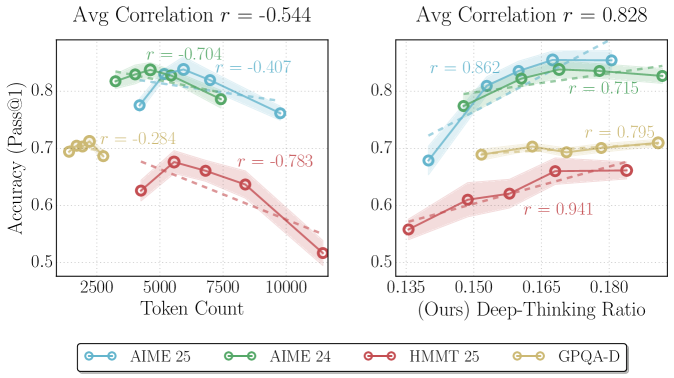
Deep-Thinking Tokens
Google researchers challenge the assumption that longer outputs indicate better reasoning. They introduce deep-thinking tokens, a metric that identifies tokens where internal model predictions shift significantly across layers before stabilizing. Unlike raw token count, which negatively correlates with accuracy (r = -0.59), the deep-thinking ratio shows a robust positive correlation (r = 0.683).