AI Papers of the Week
Every paper worth reading in AI, hand-picked one week at a time.
Discover and explore top AI papers with Claude Code or Codex
npx @dair-ai/mcp setup
From Skill Text to Skill Structure
SKILL.md files entangle invocation interface, execution flow, and tool side effects in a single blob of natural language. That makes downstream discovery and risk review brittle as skill registries scale. This paper proposes SSL, a three-layer typed JSON representation drawn from Schank and Abelson's classical work on scripts, MOPs, and conceptual dependency. An LLM-based normalizer converts existing SKILL.md files into the structure, so adoption does not require rewriting registries by hand.
When to Retrieve During Reasoning
Most RAG systems retrieve once, before the model starts reasoning. Large reasoning models like o1 and R1 do not work that way. They generate 12k to 25k token chains of thought and hit knowledge gaps mid-inference, long after the retrieval window closed. ReaLM-Retrieve is a reasoning-aware retrieval framework that injects evidence during multi-step inference, detects uncertainty at reasoning-step granularity, and learns a policy for when external evidence actually helps. It achieves +10.1% absolute F1 over standard RAG across MuSiQue, HotpotQA, and 2WikiMultiHopQA, with 47% fewer retrieval calls than fixed-interval IRCoT, and hits 71.2% F1 on 2-4 hop MuSiQue with only 1.8 retrieval calls per question.
Skill-RAG
Most RAG systems retrieve on every query, whether the model needs help or not. This is wasteful when the model already knows the answer and often too late when it does not. This paper introduces Skill-RAG, a failure-state-aware retrieval system that uses hidden-state probing to detect when an LLM is approaching a knowledge failure, then routes the query to a specialized retrieval strategy matched to the gap.
MASS-RAG
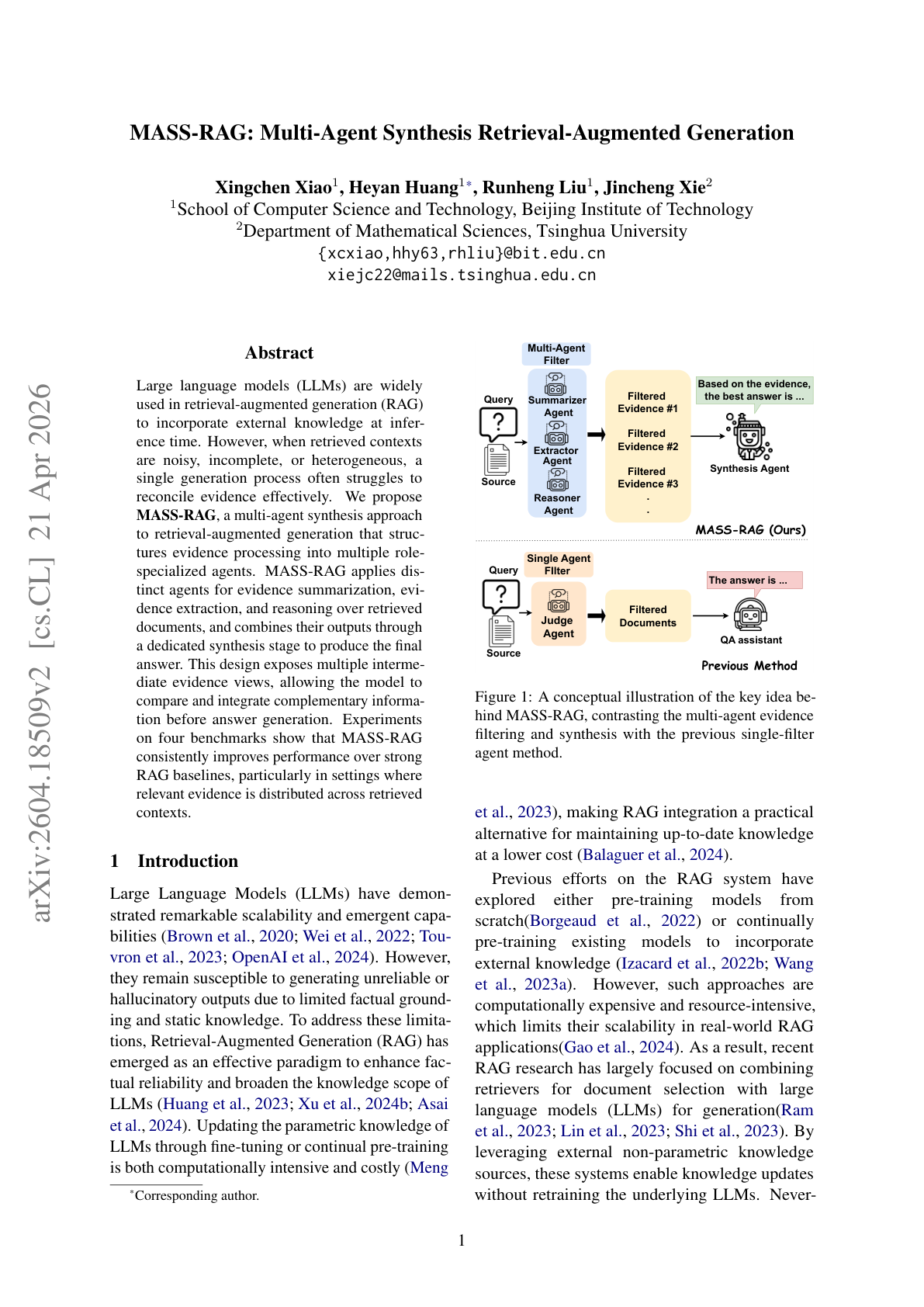
Most real-world RAG failures come from retrieving technically-relevant but contextually useless documents, then forcing a single model to reconcile them. MASS-RAG is a multi-agent synthesis framework for retrieval-augmented generation where specialized agents handle distinct roles: retrieving candidate documents, assessing their actual relevance to the query, and synthesizing the final answer from evidence that actually contributes. Instead of one model doing everything, responsibility is decomposed across coordinated evaluators, which fits the direction the field is heading for deep research agents.
Agent Skills in the Wild
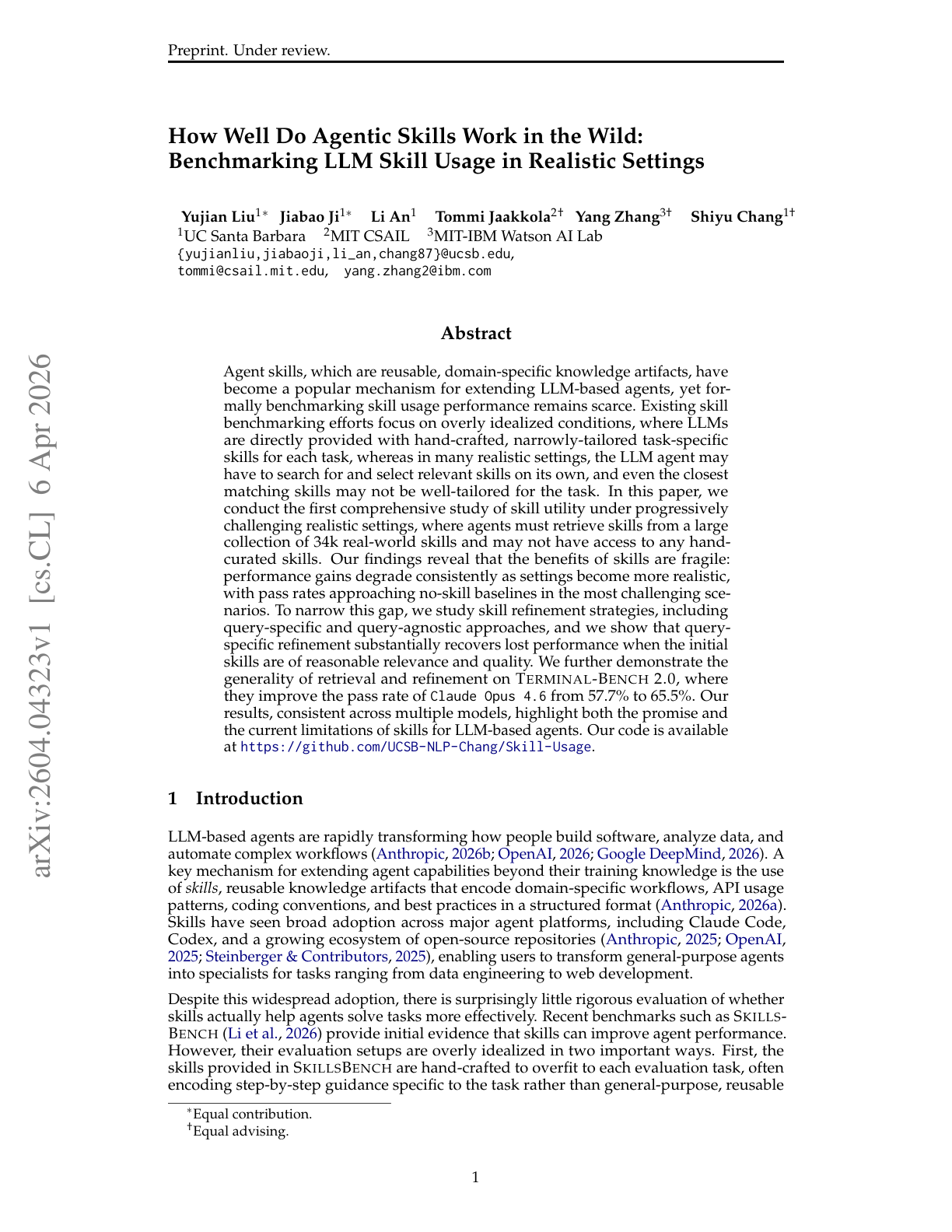
Agent skills look great in demos. Hand them a curated toolbox, and they shine. But what happens when the agent has to find the right skill from a library of 34,000? This paper from UC Santa Barbara and MIT presents the first comprehensive study of skill utility under progressively realistic settings, revealing that the benefits of skills are far more fragile than current evaluations suggest.
Meta-Harness
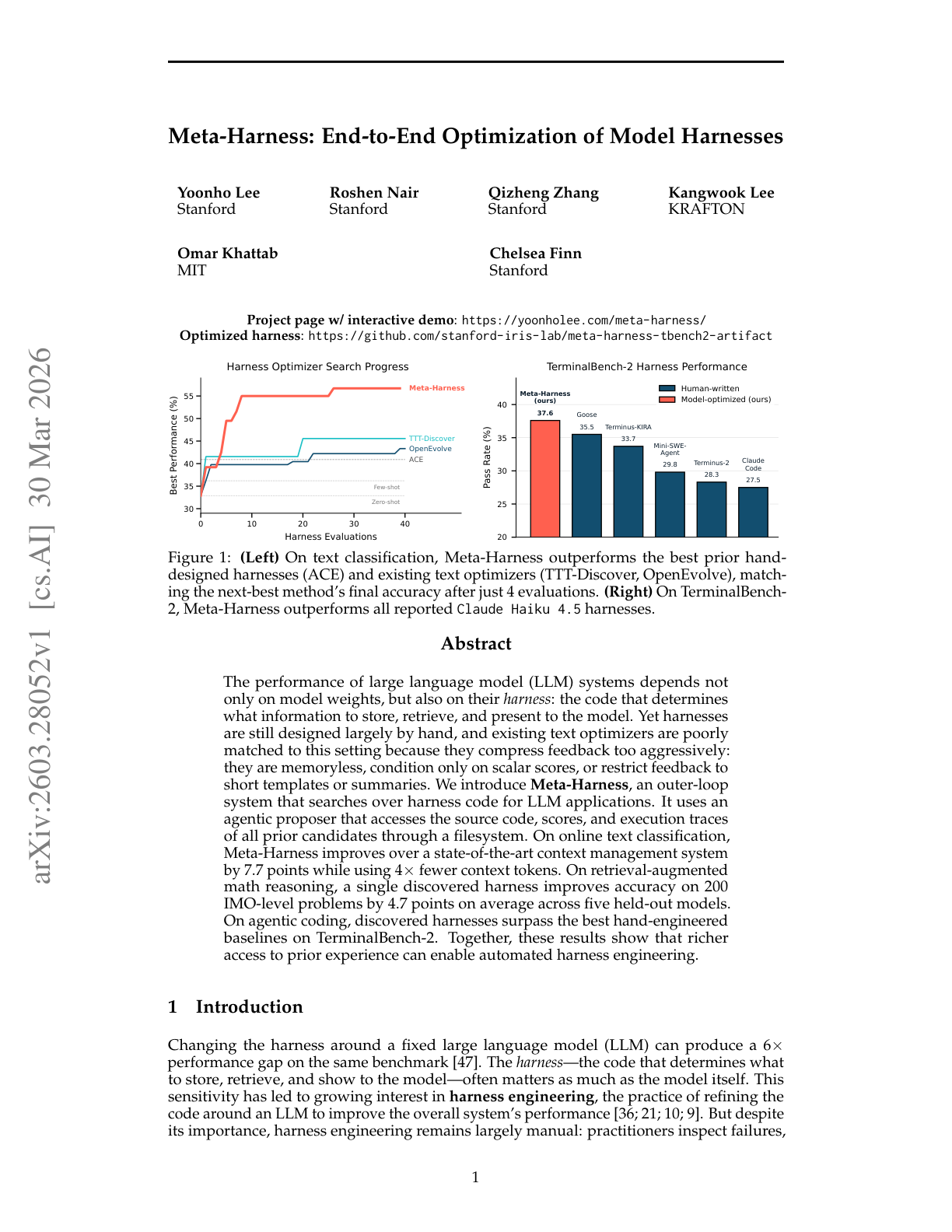
Researchers from Stanford and MIT introduce Meta-Harness, an outer-loop system that automatically searches over harness code for LLM applications. The performance of LLM systems depends not only on model weights but also on the harness: the code that determines what information to store, retrieve, and present to the model. Yet harnesses are still designed largely by hand, and existing optimizers are poorly suited to the task.
Coding Agents as Long-Context Processors
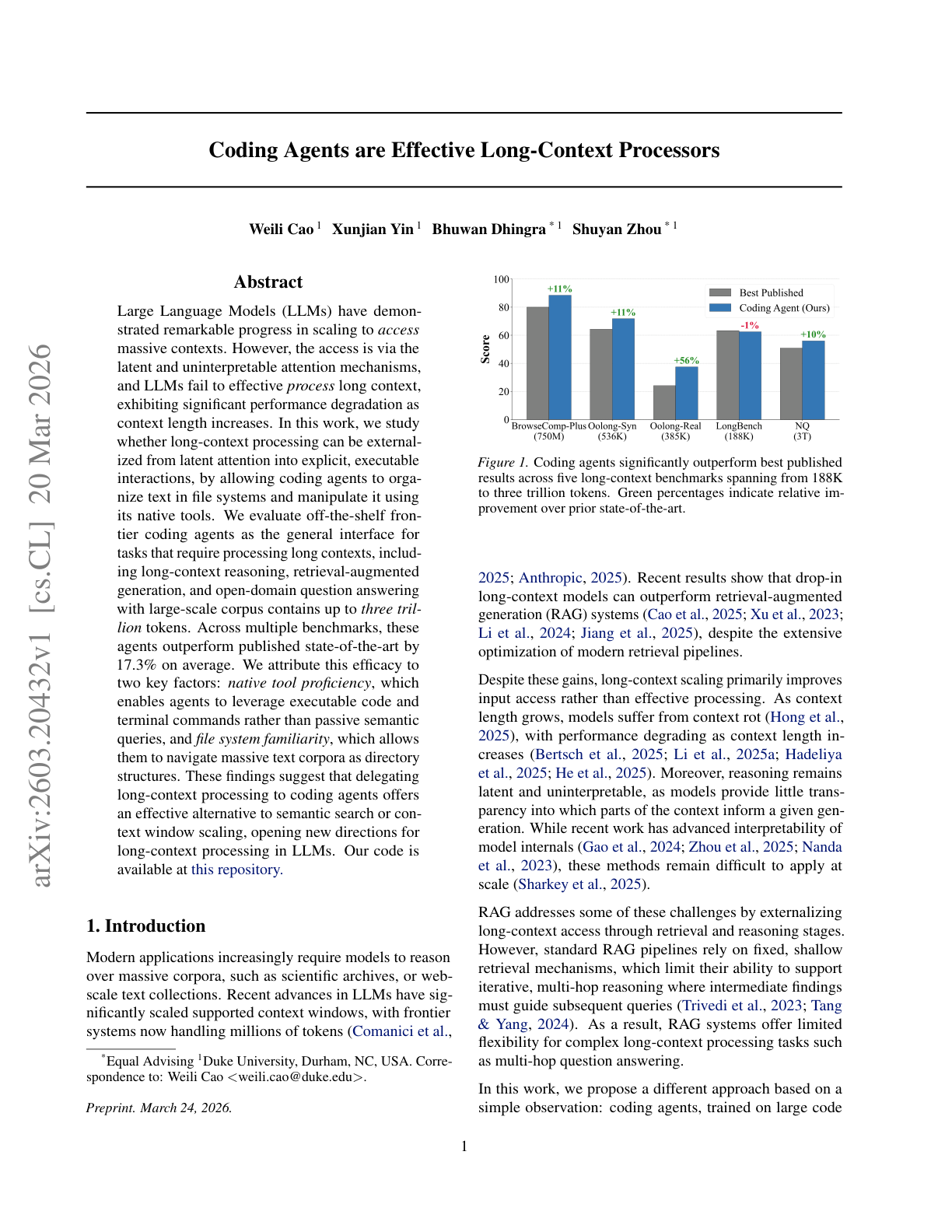
This research asks whether long-context processing can be externalized from latent attention into explicit, executable interactions. Instead of scaling context windows, the authors let coding agents organize text in file systems and manipulate it using native tools, evaluating them on tasks spanning long-context reasoning, retrieval-augmented generation, and open-domain question answering with corpora containing up to three trillion tokens.
KARL
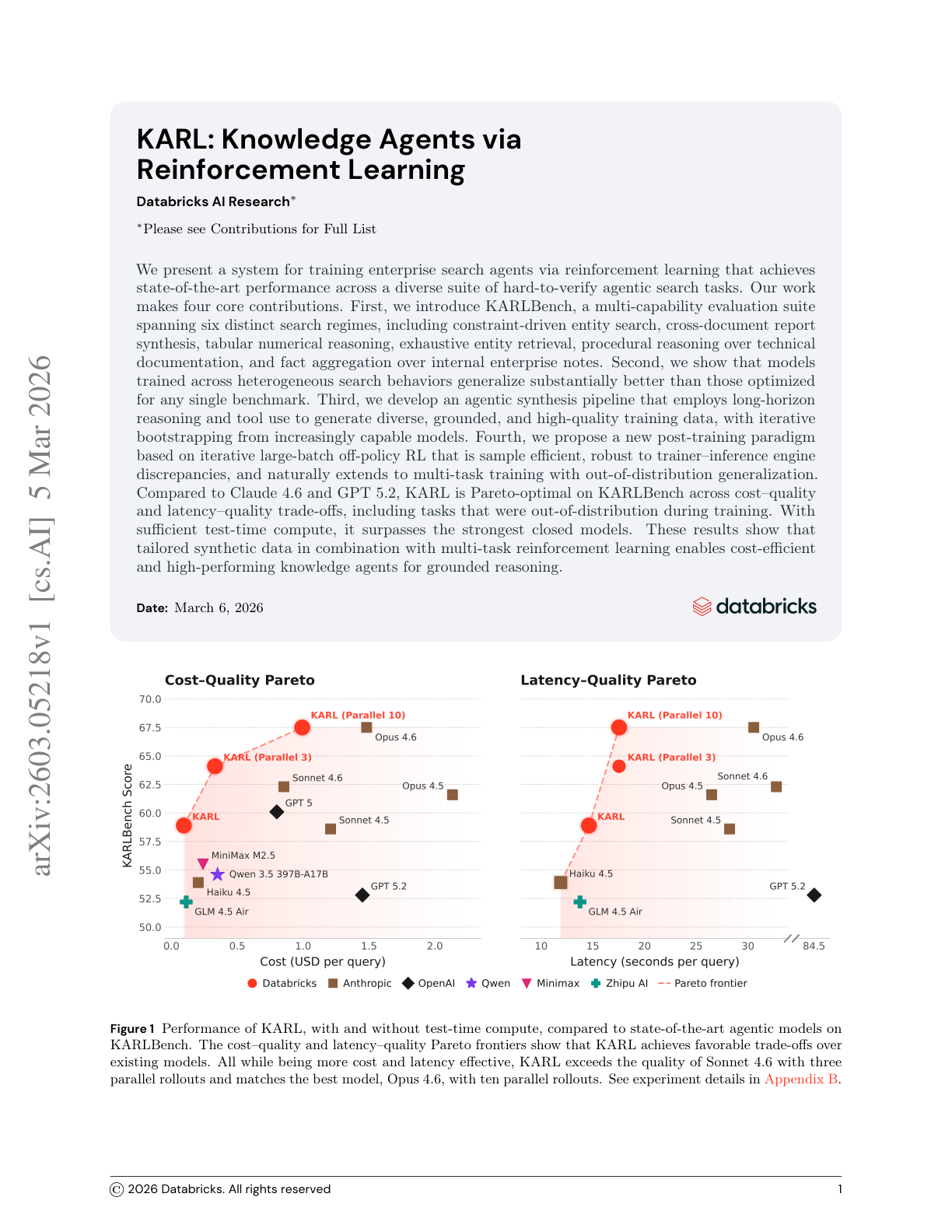
Databricks presents KARL, a system for training enterprise search agents via reinforcement learning that achieves state-of-the-art performance across a diverse suite of hard-to-verify agentic search tasks. The work also introduces KARLBench, a new evaluation framework spanning six search domains.
AgentIR
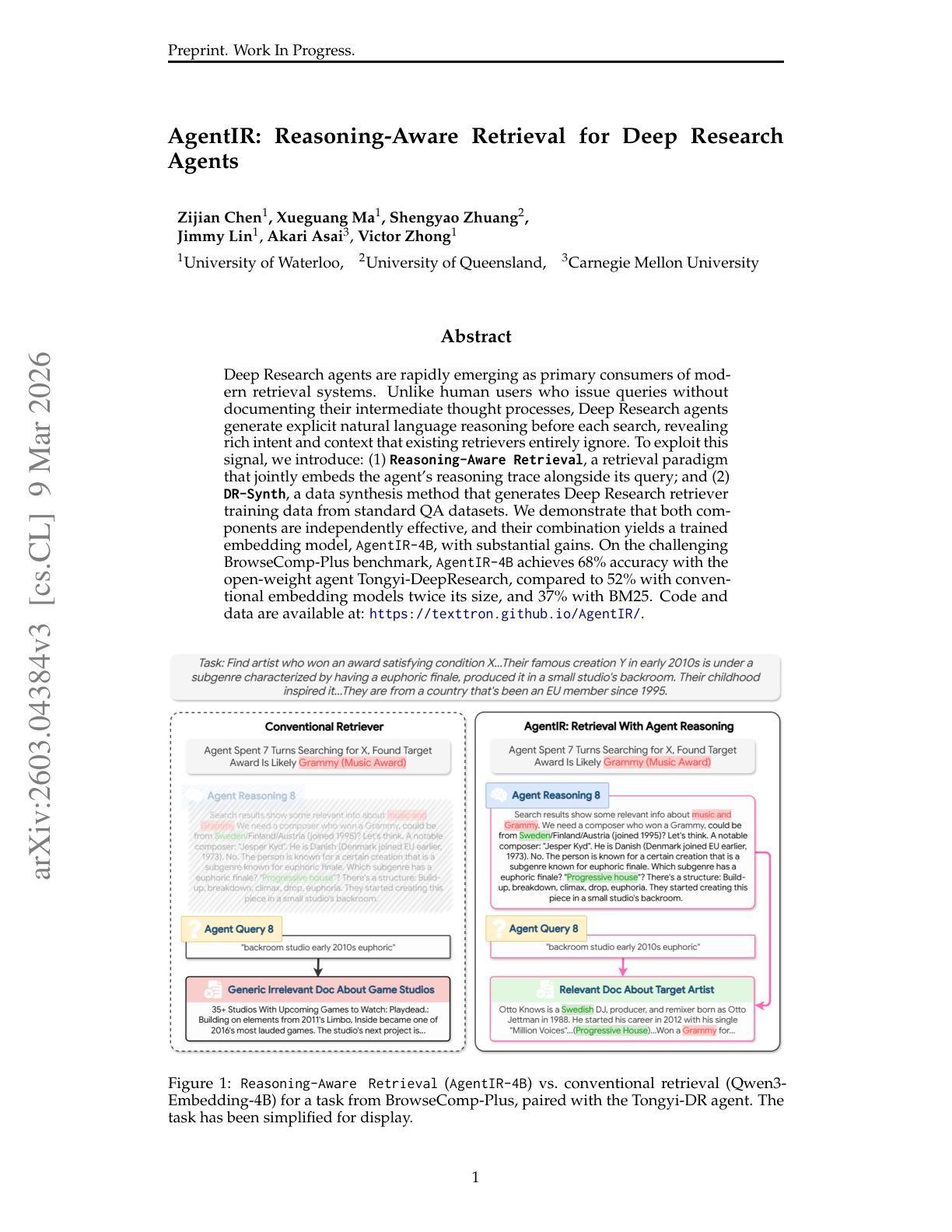
Deep research agents generate explicit reasoning before every search call, but existing retrievers completely ignore these rich signals about search intent and problem context. AgentIR introduces reasoning-aware retrieval that jointly embeds the agent’s reasoning trace alongside its query, along with DR-Synth, a data synthesis method for generating training data from standard QA datasets. On BrowseComp-Plus, AgentIR-4B achieves 68% accuracy with Tongyi-DeepResearch compared to 50% with conventional embedding models twice its size and 37% with BM25.
Diagnosing Agent Memory
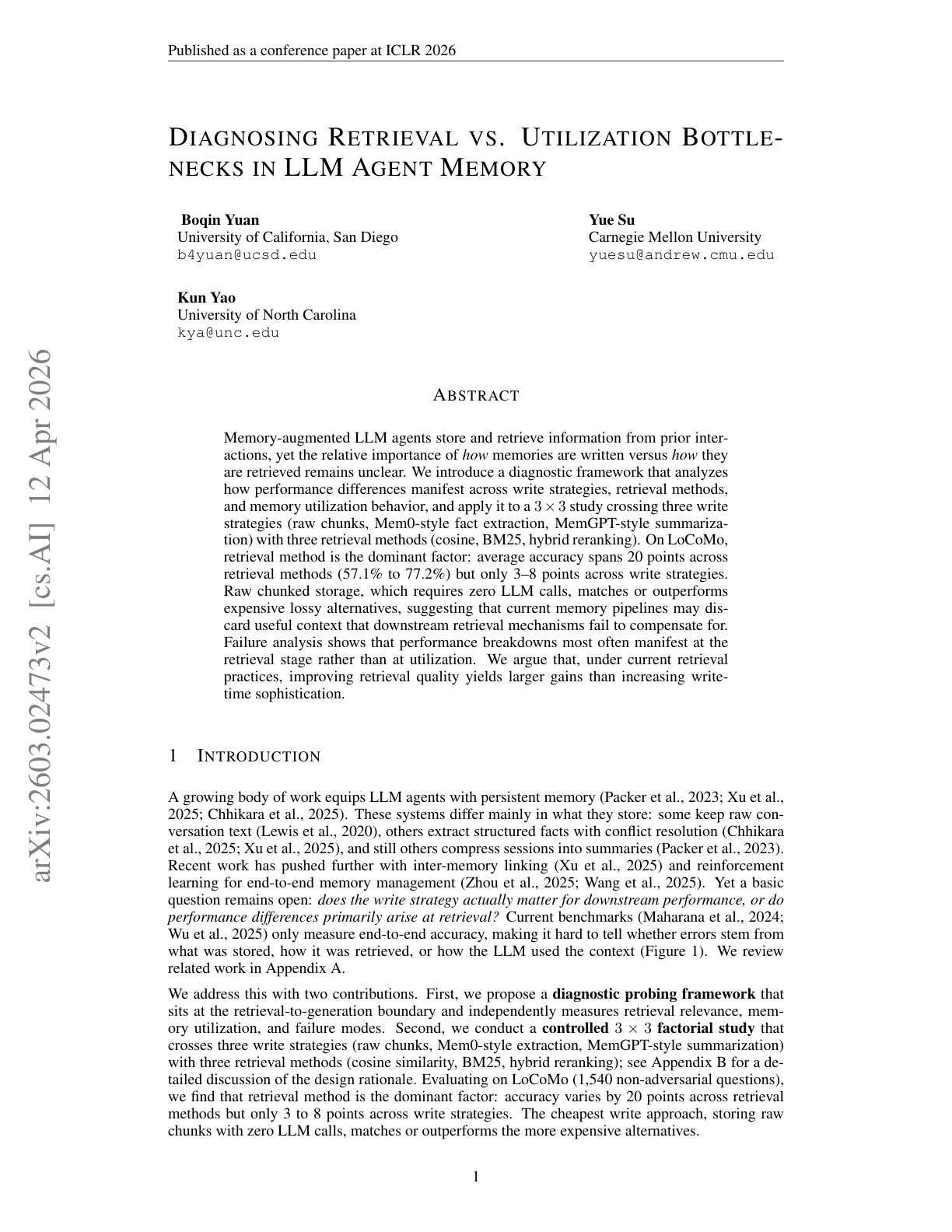
This paper introduces a diagnostic framework that separates retrieval failures from utilization failures in LLM agent memory systems. Through a 3x3 factorial study crossing three write strategies with three retrieval methods, the authors find that retrieval is the dominant bottleneck, accounting for 11-46% of errors, while utilization failures remain stable at 4-8% regardless of configuration. Hybrid reranking cuts retrieval failures roughly in half, delivering larger gains than any write strategy optimization.
xMemory
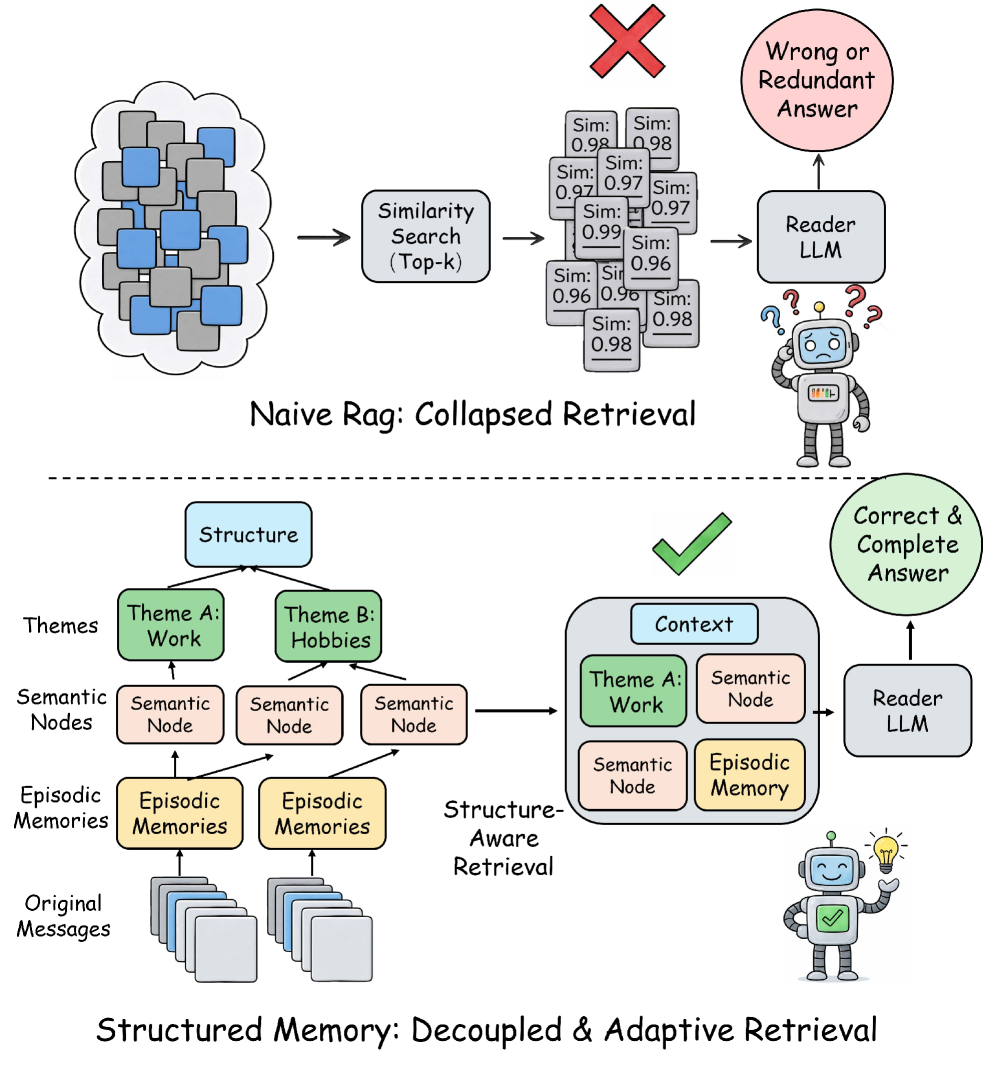
xMemory argues that standard RAG retrieval is a poor fit for agent memory because the evidence source is a bounded, coherent dialogue stream where candidate spans are highly correlated near-duplicates. Fixed top-k similarity retrieval collapses into a single dense region, returning redundant context, while post-hoc pruning can break temporally linked evidence chains. xMemory replaces this with hierarchical memory construction and structure-aware top-down retrieval.
InfMem
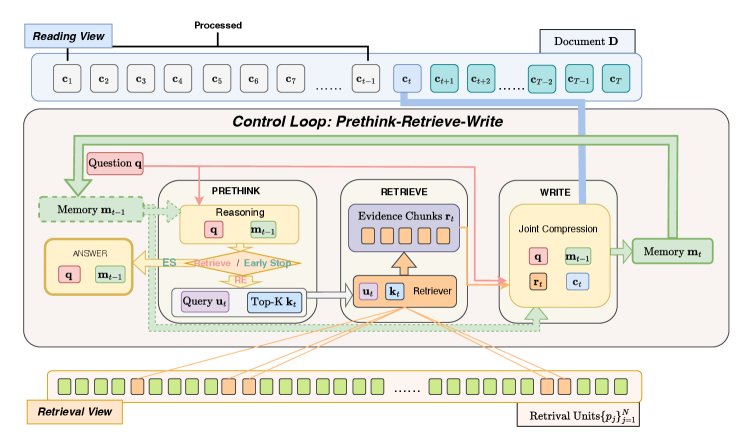
InfMem is a cognitive agent for ultra-long document QA that uses System-2-style control to actively manage bounded memory. Instead of passively compressing each chunk as it streams in, InfMem runs a PreThink-Retrieve-Write loop that monitors evidence sufficiency, fetches missing facts from anywhere in the document, and compresses everything into a fixed-size memory - then stops early once it has enough.
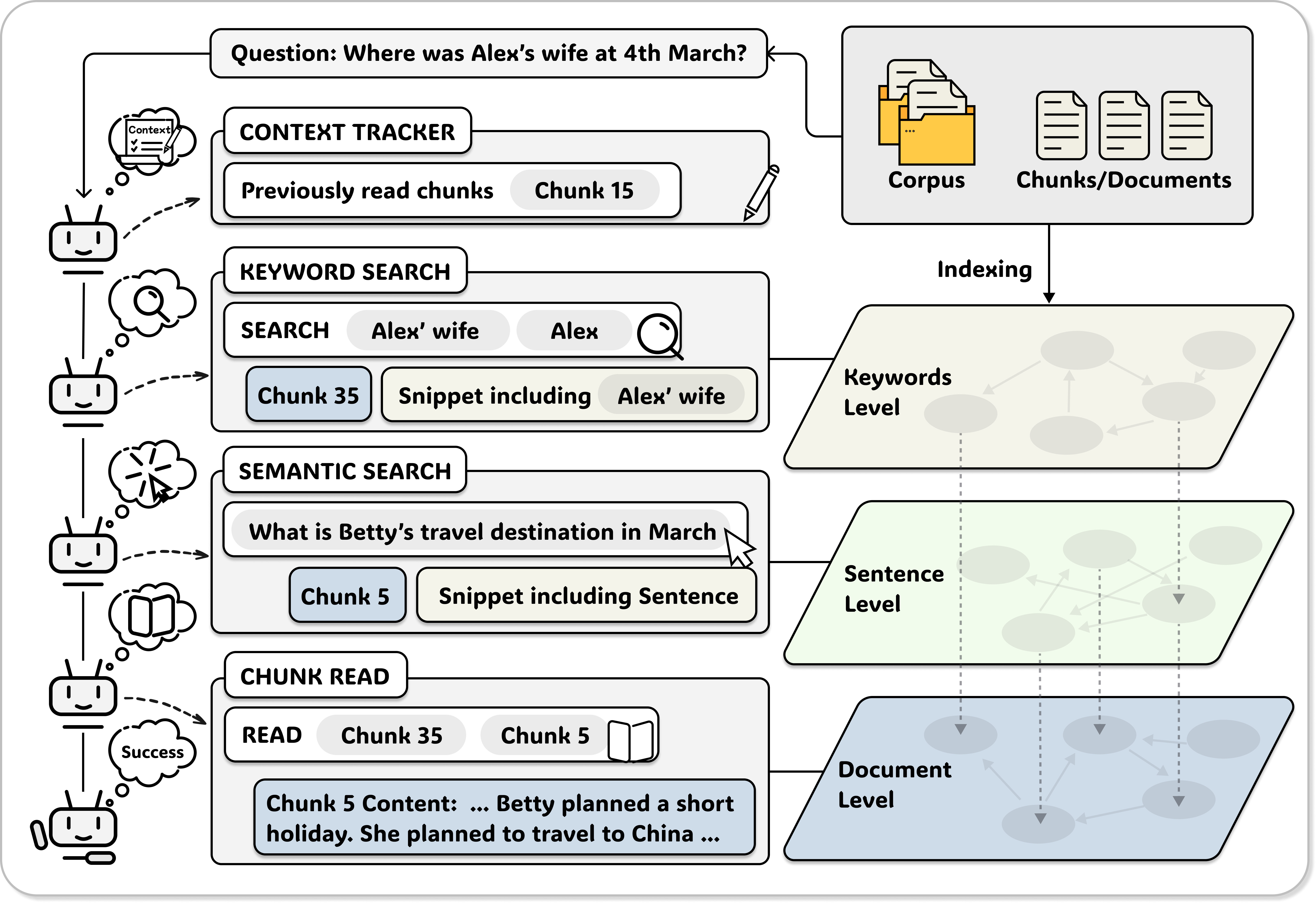
A-RAG
A-RAG is an agentic RAG framework that gives LLMs direct access to hierarchical retrieval interfaces instead of relying on fixed retrieval algorithms or predefined workflows. The agent autonomously decides what to search, at which granularity, and when to stop - representing a paradigm shift from static retrieval pipelines to truly agentic information gathering.
OpenScholar
OpenScholar is a fully open, retrieval-augmented language model designed for scientific literature synthesis. It retrieves passages from a datastore of 45 million open-access papers, generates citation-backed responses, and iteratively refines outputs through a self-feedback loop. On ScholarQABench, the first large-scale multi-domain benchmark for literature search, OpenScholar-8B outperforms GPT-4o by 6% and PaperQA2 by 5.5% in correctness, while achieving citation accuracy on par with human experts and being preferred over expert-written answers 51-70% of the time.
Self-Evolving Search Agents Without Training Data
Dr. Zero introduces a framework for developing multi-turn search agents that improve themselves autonomously without labeled training data. A proposer generates diverse questions to train a solver initialized from the same base model, creating a self-evolution loop with automated curriculum difficulty scaling.
UniversalRAG
UniversalRAG introduces a RAG system that handles knowledge retrieval from heterogeneous sources containing multiple data types (text, images, videos) with varying granularities. Rather than forcing diverse modalities into a single embedding space where embeddings cluster by modality rather than meaning, it uses modality-aware routing to dynamically select appropriate corpus and granularity for each query, outperforming both unimodal and unified multimodal RAG baselines across 10 benchmarks.
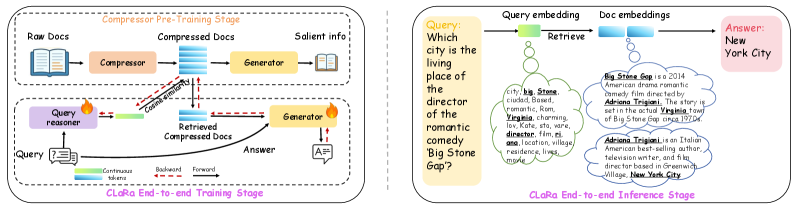
CLaRa
CLaRa introduces a unified framework for retrieval-augmented generation that performs embedding-based compression and joint optimization in a shared continuous space. The approach addresses key RAG limitations around long contexts and disjoint retrieval-generation optimization.

FACTS Leaderboard
Google introduces the FACTS Leaderboard, a comprehensive benchmark suite for evaluating LLM factuality across diverse scenarios. The leaderboard aggregates performance across four specialized sub-benchmarks to provide a holistic measure of how accurately models generate factual text.
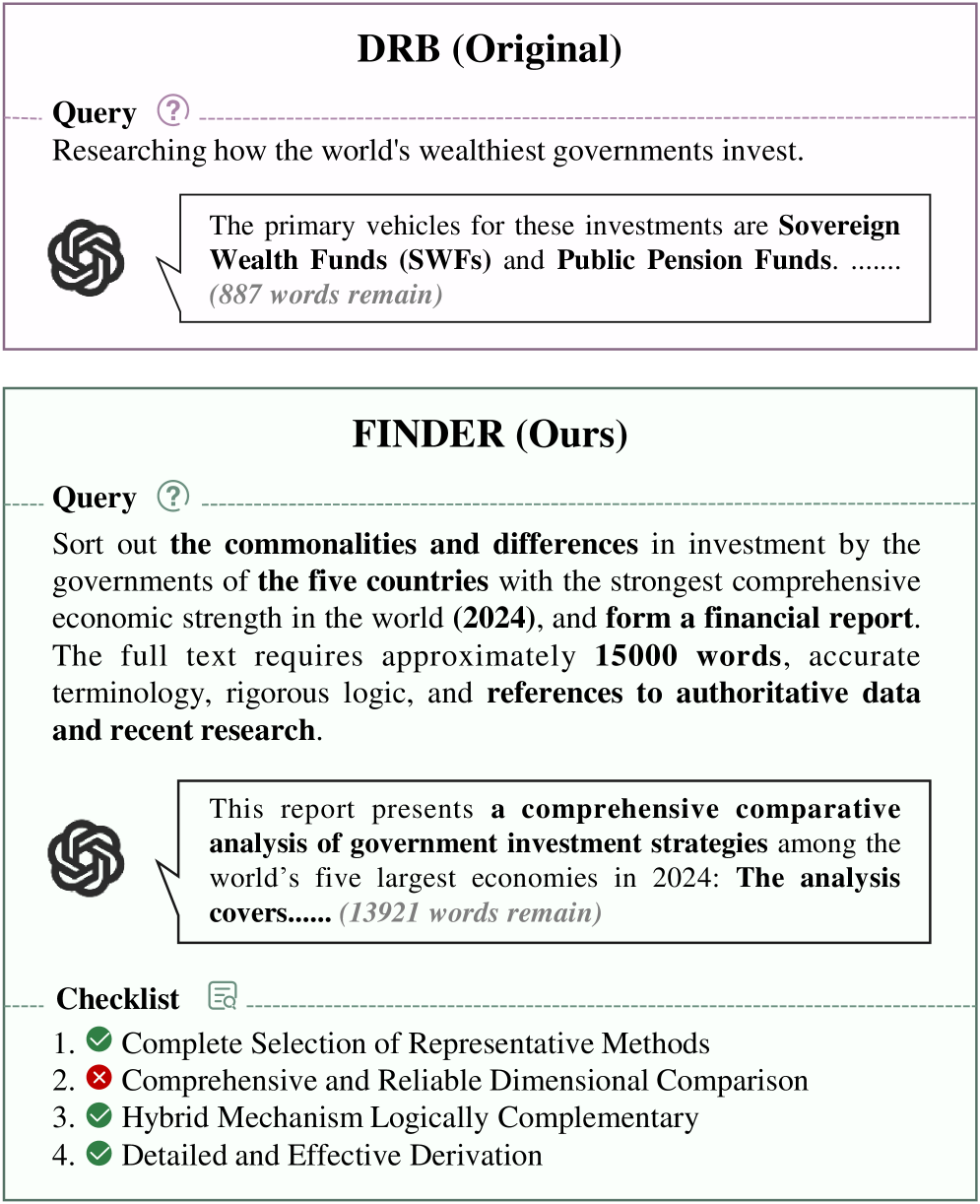
FINDER and DEFT
OPPO AI introduces FINDER, a fine-grained benchmark with 100 expert-curated research tasks and 419 structured checklist items for evaluating deep research agents, along with DEFT, the first failure taxonomy categorizing 14 failure modes across reasoning, retrieval, and generation dimensions.

OmniScientist
OmniScientist presents an end-to-end framework for building AI scientists capable of autonomously conducting research across the entire scientific lifecycle - from literature review and ideation to experimentation, writing, and peer review. The system establishes a collaborative ecosystem where human and AI scientists co-evolve within a shared scientific environment.
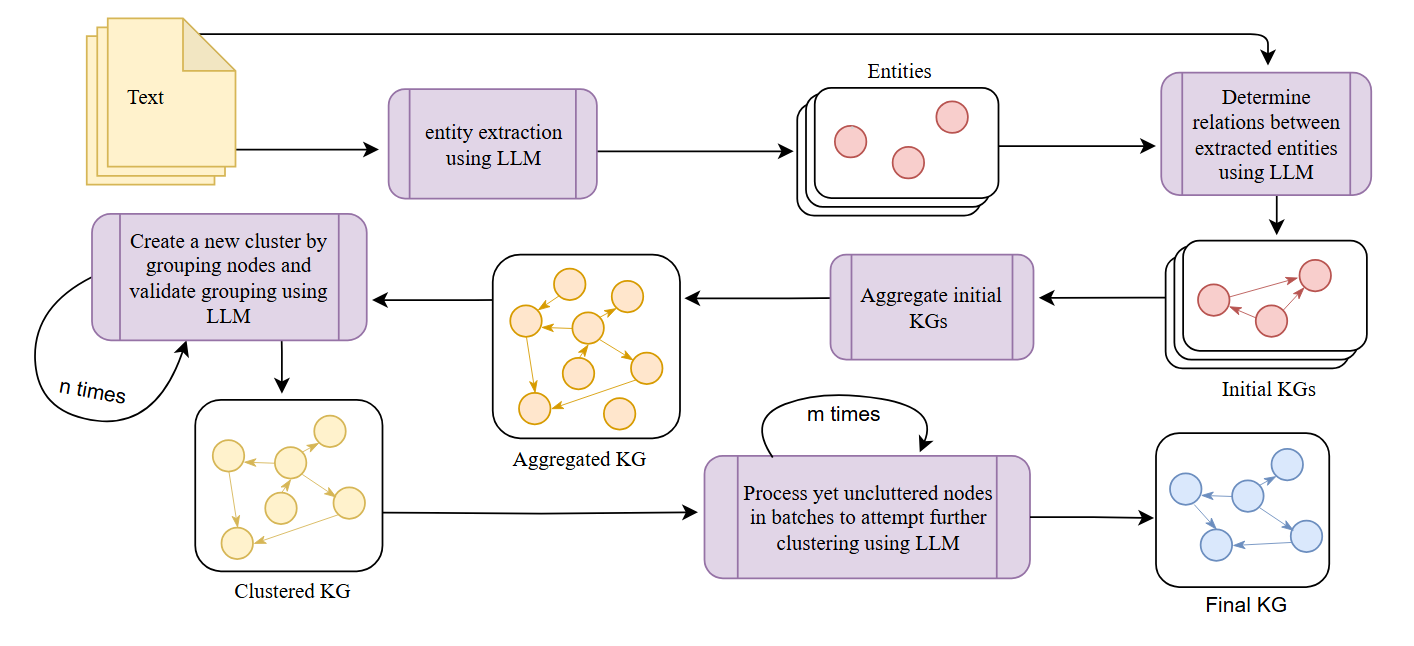
DR Tulu
DR Tulu-8B is the first open model directly trained for long-form deep research using Reinforcement Learning with Evolving Rubrics (RLER). Unlike existing models trained on short-form QA tasks, DR Tulu learns to produce comprehensive, well-attributed research reports by training with rubrics that co-evolve with the model and are grounded on real-world searched knowledge.
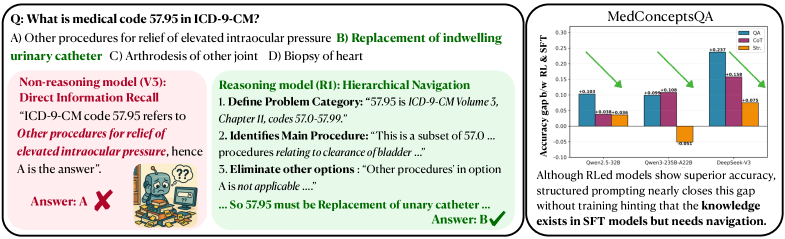
RL Enhances Knowledge Navigation
Researchers show that RL-enhanced models outperform base models by 24pp on hierarchical knowledge retrieval tasks (e.g., medical codes) by improving navigation of existing knowledge structures rather than acquiring new facts. Structured prompting reduces this gap to 7pp, while layer-wise analysis reveals that RL transforms query processing (cosine similarity drops to 0.65-0.73) while preserving factual representations (0.85-0.92). The findings suggest RL’s benefits stem from enhanced procedural skills in traversing parametric knowledge hierarchies rather than expanded knowledge content.
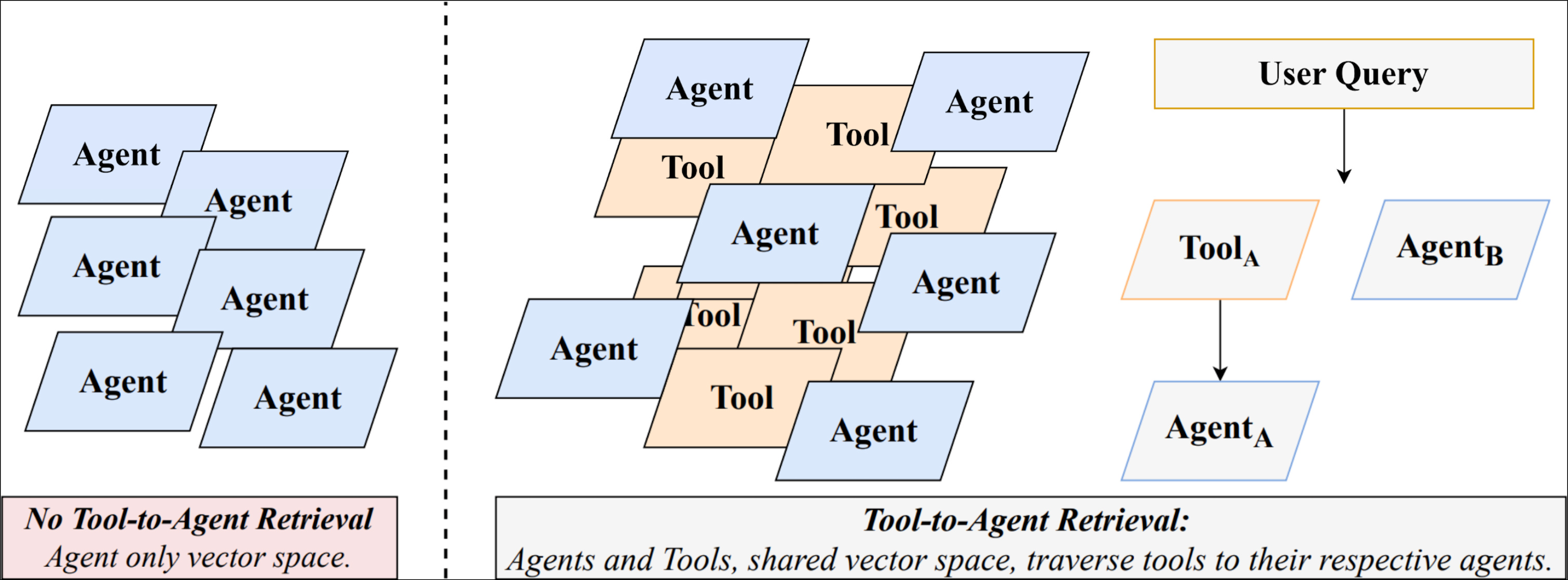
Tool-to-Agent Retrieval
PwC researchers introduce a unified retrieval framework that embeds both tools and agents in a shared vector space with metadata relationships, enabling efficient routing in multi-agent systems coordinating hundreds of MCP servers and tools.
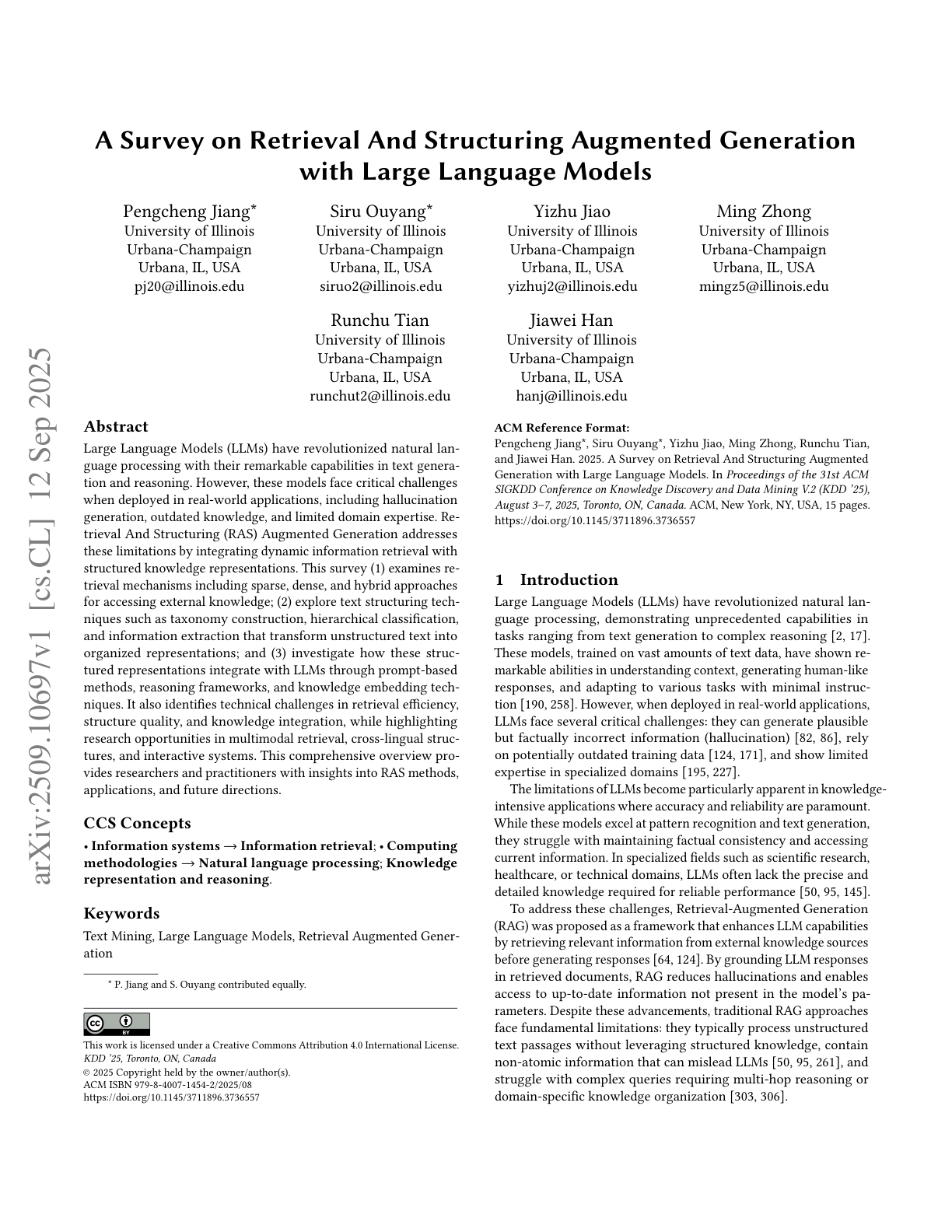
A Survey on Retrieval and Structuring Augmented Generation with LLMs
This survey reviews Retrieval and Structuring (RAS) Augmented Generation, which combines external retrieval and structured knowledge to mitigate LLM issues like hallucinations and outdated knowledge. It covers retrieval methods, structuring techniques, integration strategies, and highlights challenges in efficiency, structure quality, and multimodal or cross-lingual extensions.