AI Papers of the Week
Every paper worth reading in AI, hand-picked one week at a time.
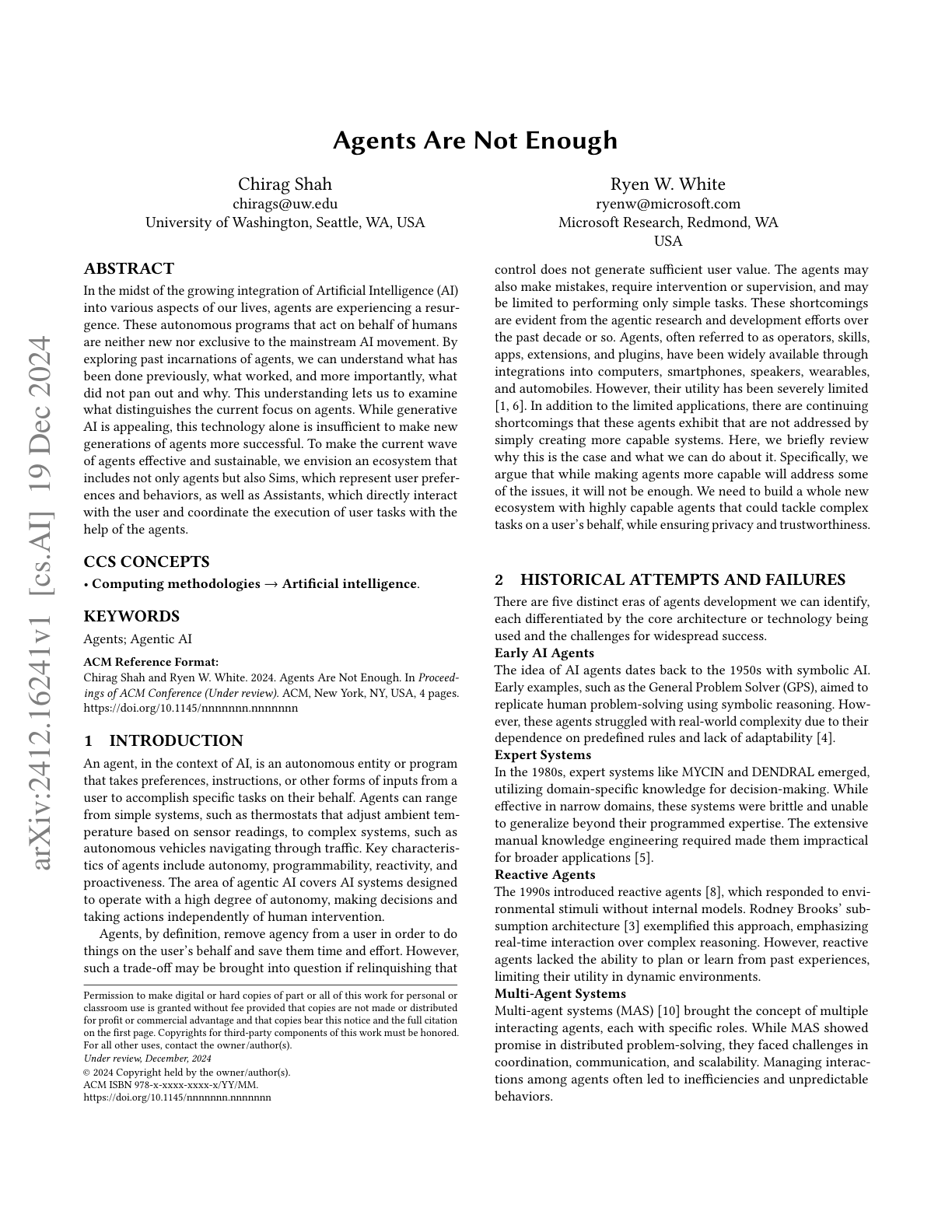
Agents Are Not Enough
argues that while AI agents show promise, they alone cannot address the challenges in autonomous task execution; proposes a new ecosystem combining three key components: Agents (narrow, purpose-driven modules for specific tasks), Sims (digital representations of user preferences and behaviors), and Assistants (programs that coordinate between users, Sims, and Agents).
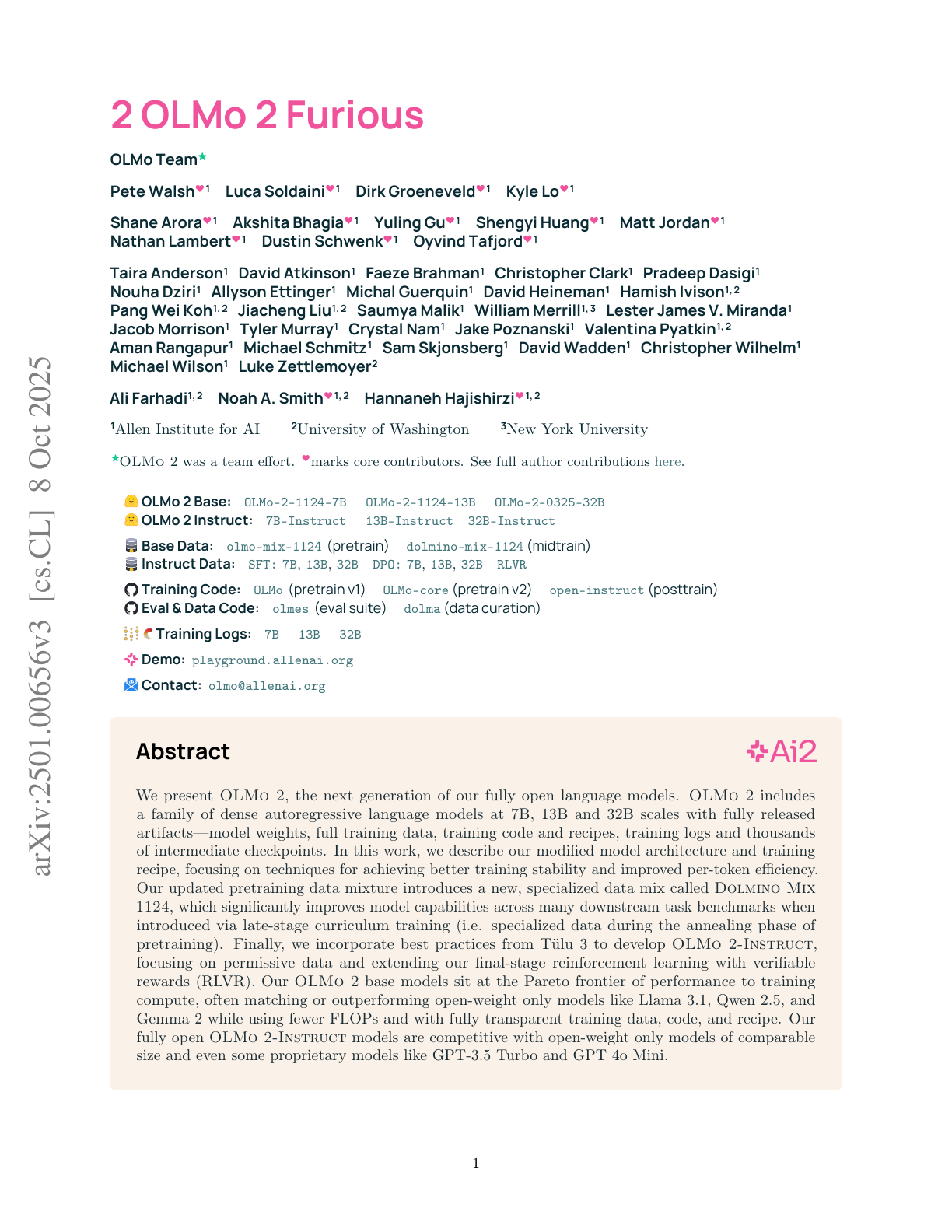
OLMo 2
introduces an enhanced architecture, training methods, and a specialized data mixture called Dolmino Mix 1124; the fully transparent model, released at 7B and 13B parameter scales with complete training data and code, matches or outperforms similar open-weight models like Llama 3.1 and Qwen 2.5 while using fewer computational resources, and its instruction-tuned version (OLMo 2-Instruct) remains competitive with comparable models.
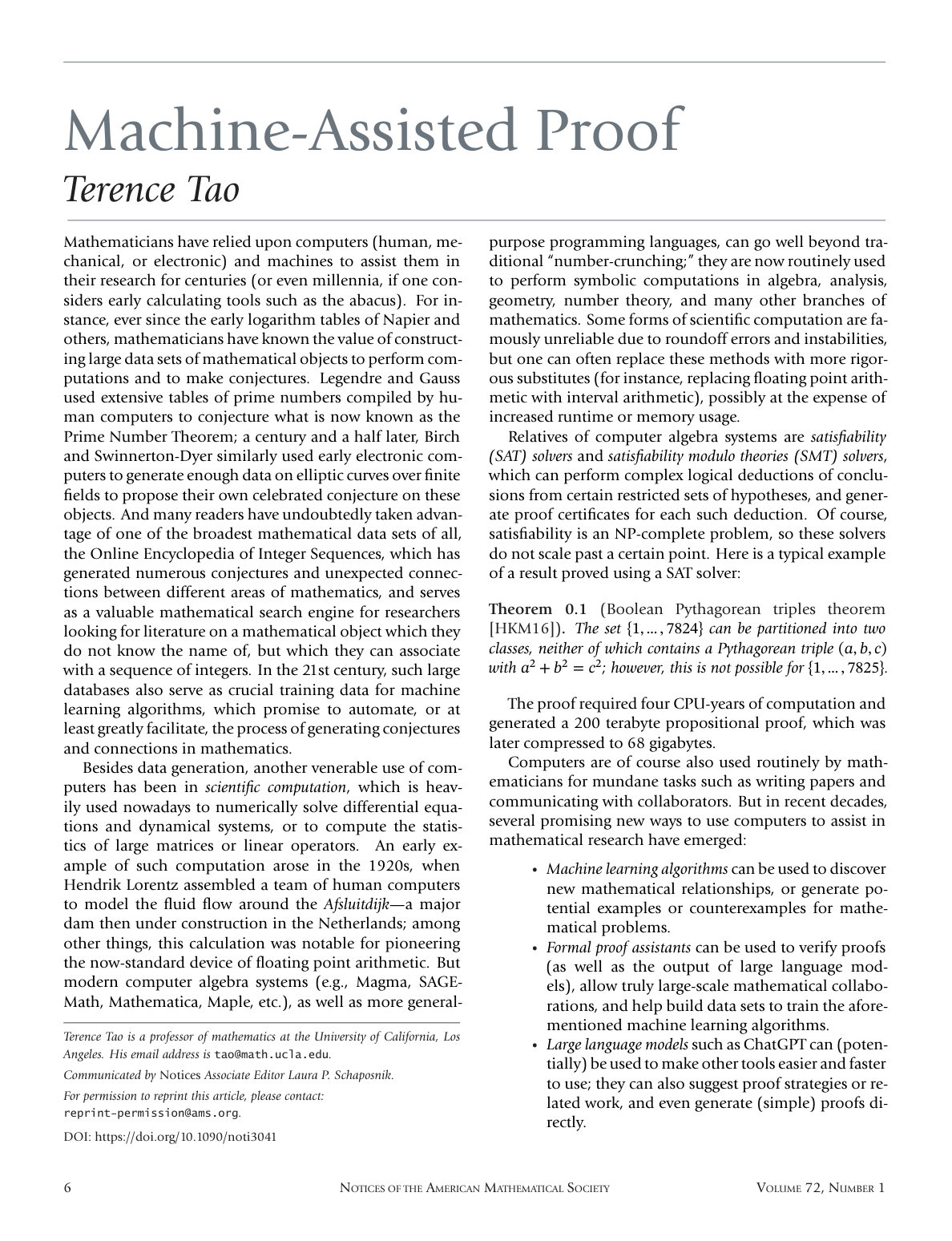
Machine-Assisted Proof
examines how mathematicians have long used machines to assist with mathematics research and discusses recent AI tools that are transforming mathematical proof assistance.
Measuring Higher Level Mathematical Reasoning
introduces Putnam-AXIOM, a new math reasoning benchmark with 236 Putnam Competition problems and 52 variations; even the best model considered (OpenAI's o1-preview) achieves only 41.95% accuracy on original problems and performs significantly worse on variations.
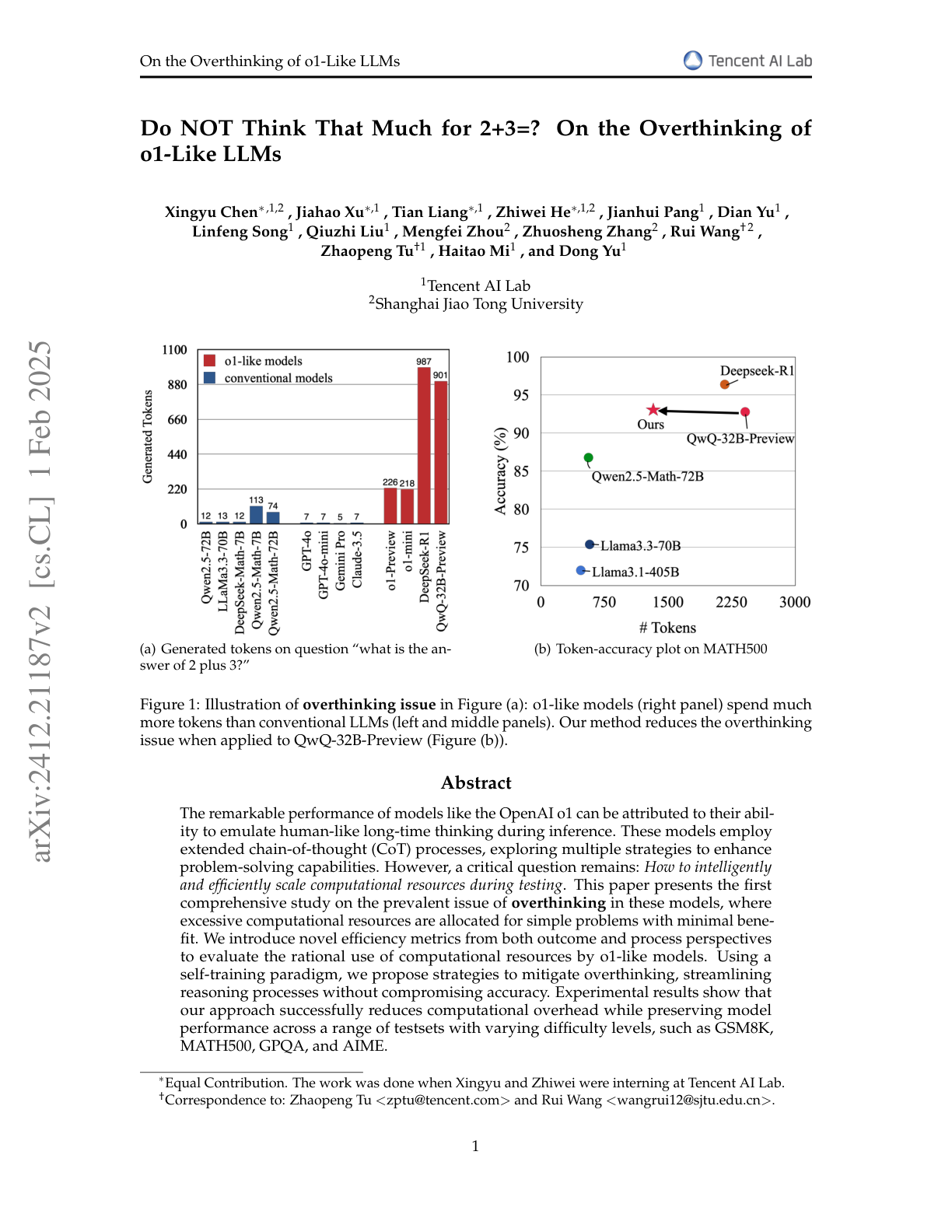
On the Overthinking of LLMs
proposes a self-training strategy to mitigate overthinking in o1-like LLMs; it can reduce token output by 48.6% while maintaining accuracy on the widely-used MATH500 test set as applied to QwQ-32B-Preview.
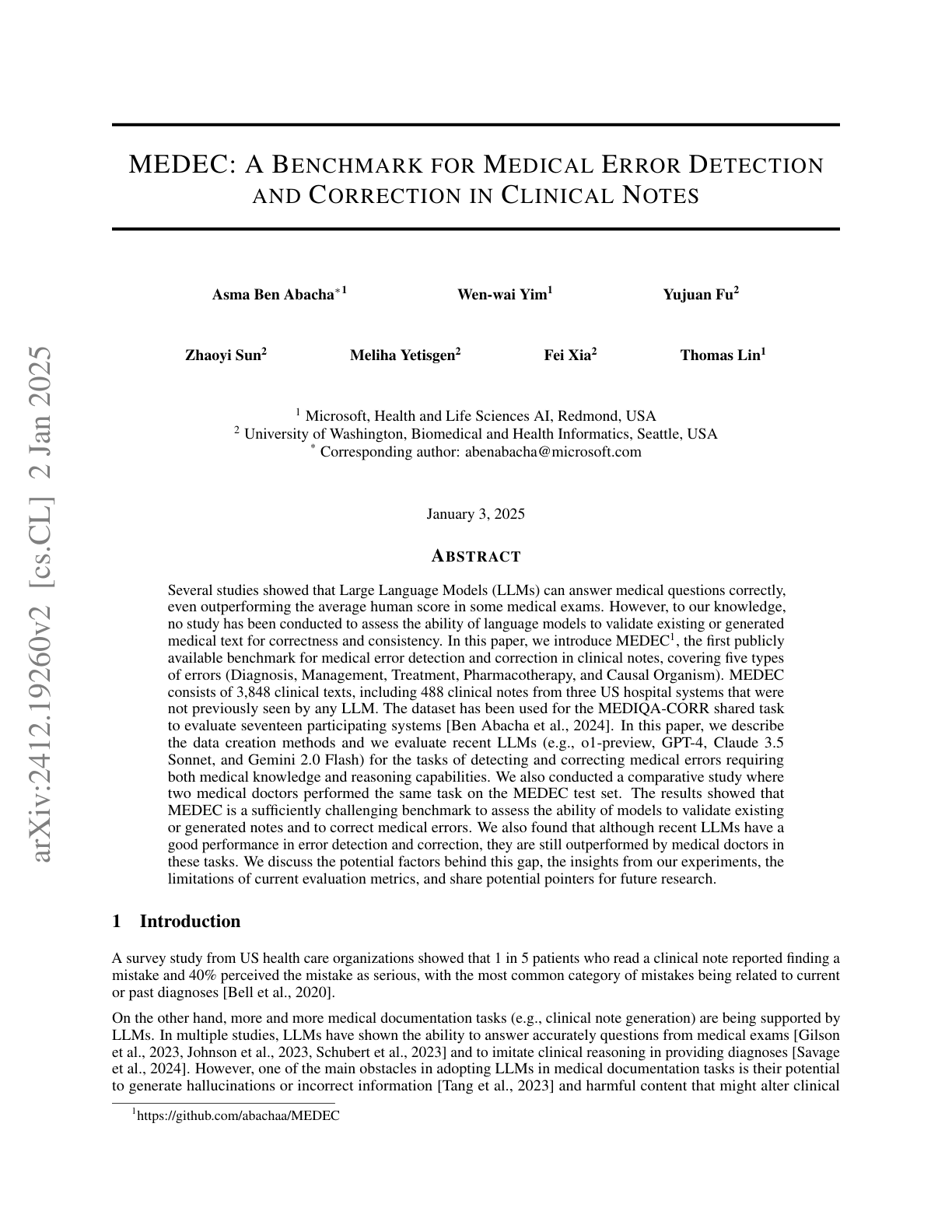
MEDEC
introduces MEDEC, a publicly available benchmark for medical error detection and correction in clinical notes, covering five types of errors (Diagnosis, Management, Treatment, Pharmacotherapy, and Causal Organism); it consists of 3,848 clinical texts, including 488 clinical notes from three US hospital systems; experimental results shows that Cluade 3.5 Sonnet performs better at detecting errors while o1-preview is better at correcting errors.

1.58-bit FLUX
presents the first successful approach to quantizing the state-of-the-art text-to-image generation model, FLUX.1-dev, using 1.58-bit weights (i.e., values in {-1, 0, +1}); the method relies on self-supervision from the FLUX.1-dev model and maintains comparable performance for generating 1024 x 1024 images as the original FLUX model.
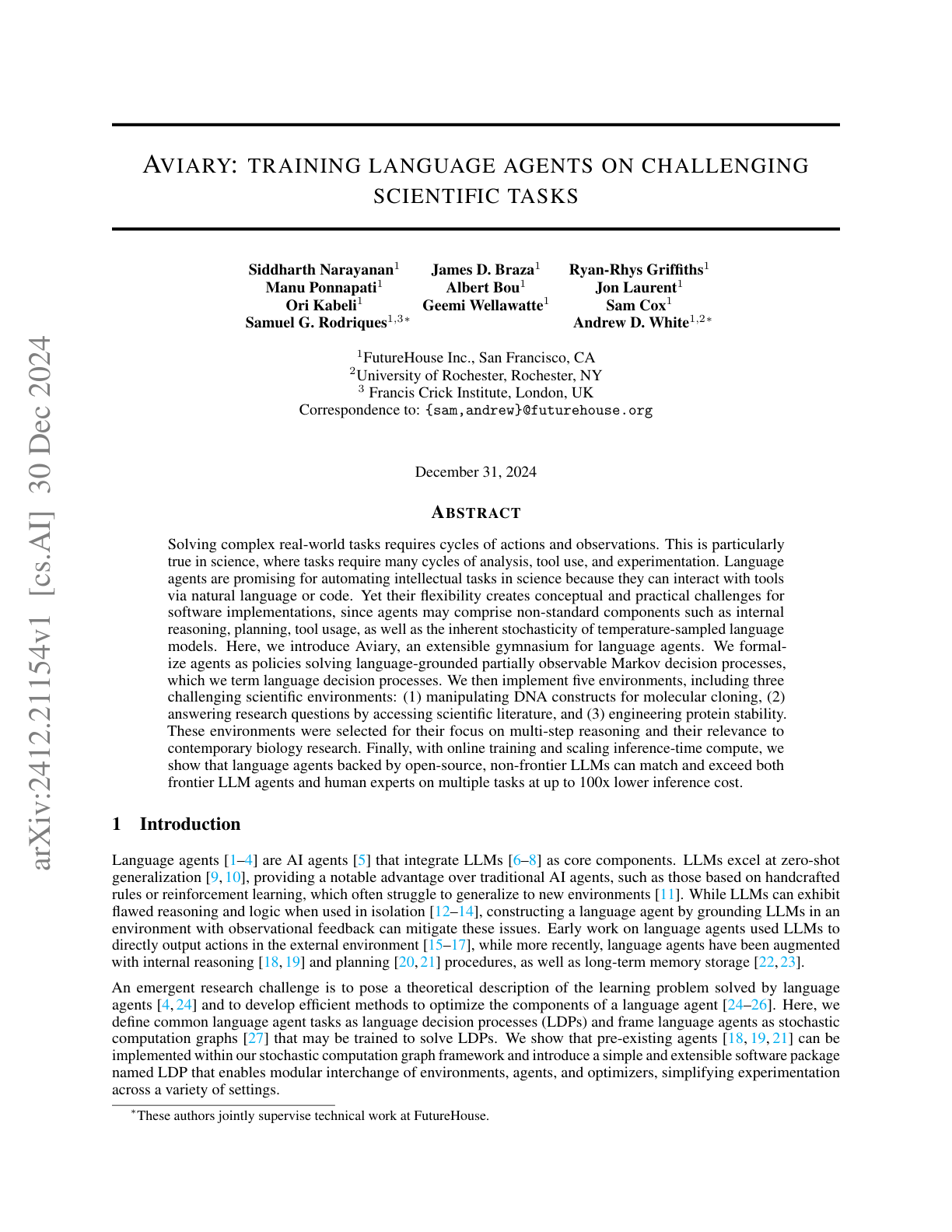
Aviary
an extensible open-source gymnasium that can help build language agents that exceed the performance of zero-shot frontier LLMs and even humans on several challenging scientific tasks.
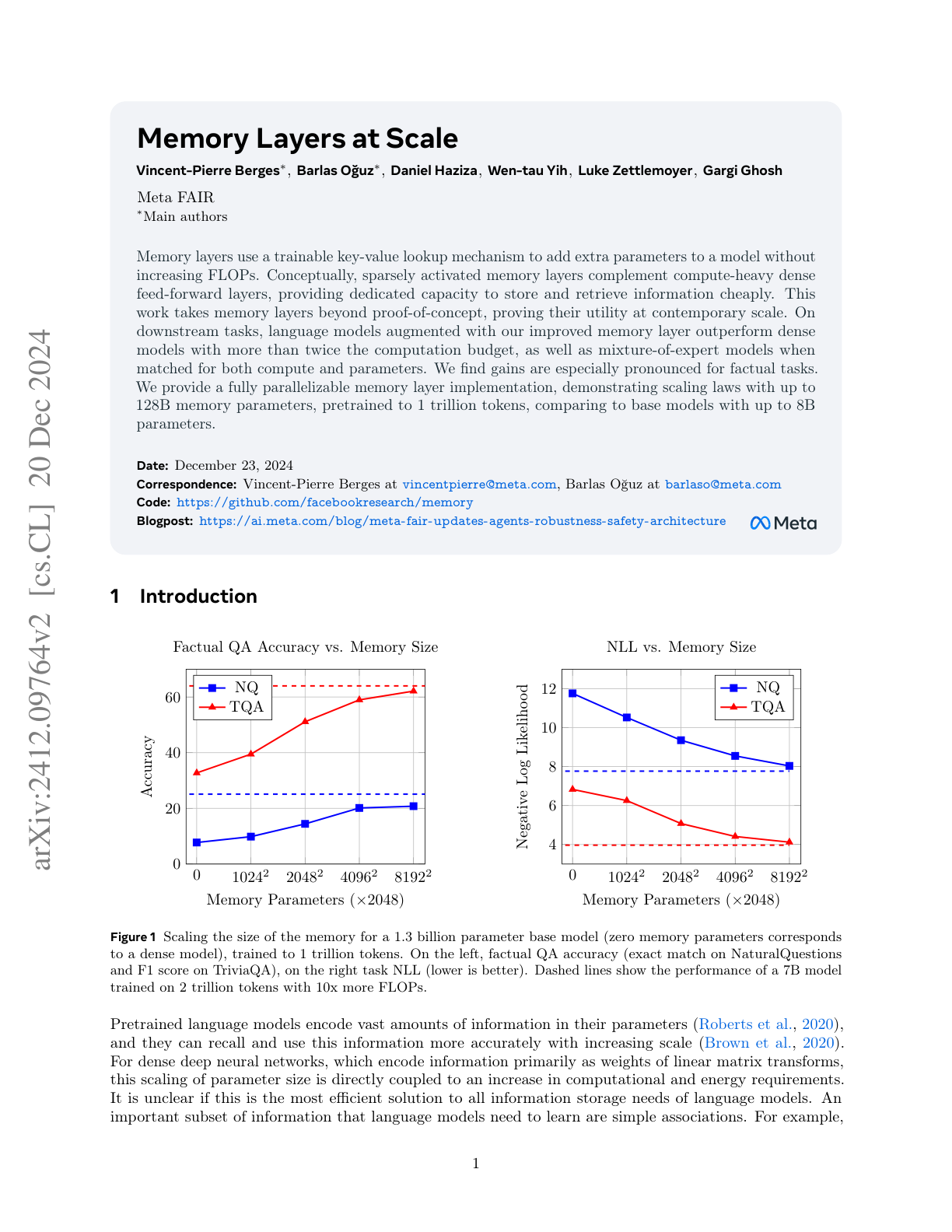
Memory Layers at Scale
demonstrates the effectiveness of memory layers at scale; shows that models with these memory layers outperform traditional dense models using half the computation, particularly in factual tasks; includes a parallelizable memory layer implementation that scales to 128B memory parameters and 1 trillion training tokens, tested against base models up to 8B parameters.
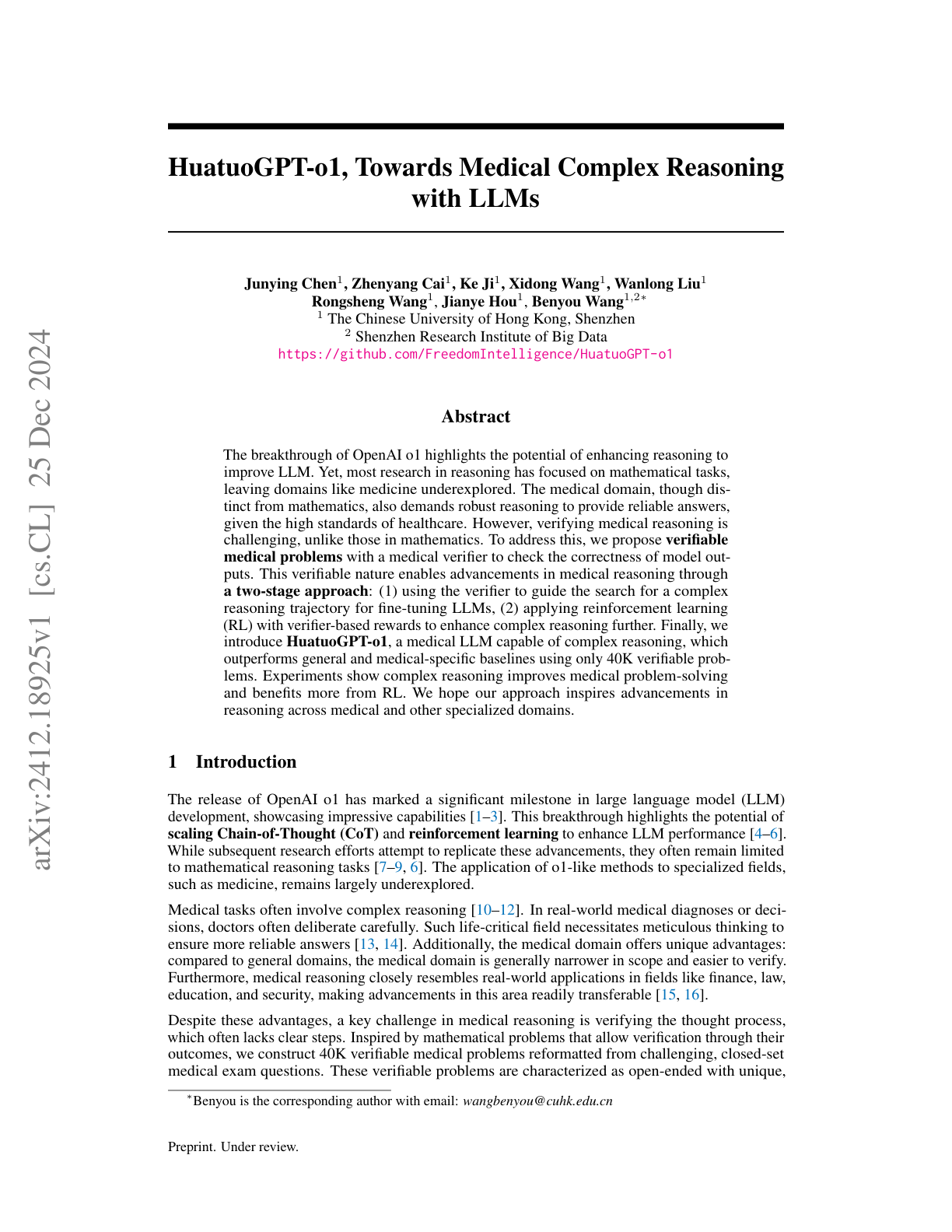
HuatuoGPT-o1
presents a novel approach to improving medical reasoning in language models by using a medical verifier to validate model outputs and guide the development of complex reasoning abilities; the system employs a two-stage approach combining fine-tuning and reinforcement learning with verifier-based rewards, achieving superior performance over existing models while using only 40,000 verifiable medical problems.
DeepSeek-V3
a 671B-parameter MoE language model that activates 37B parameters per token, utilizing MLA and DeepSeekMoE architectures for efficient operation; it introduces an auxiliary-loss-free load balancing approach and employs multi-token prediction during training to enhance performance; following pre-training on 14.8 trillion tokens, the model underwent SFT and RL stages, achieving performance comparable to leading closed-source models while surpassing other open-source alternatives; the model requires only 2.788M H800 GPU hours for training, with stable training that avoids any irrecoverable loss spikes.
**Large Concept Models
** - presents an approach that operates on sentence-level semantic representations called concepts, moving beyond token-level processing typical in current LLMs; the model leverages SONAR sentence embeddings to support 200 languages across text and speech modalities, training on autoregressive sentence prediction using various approaches from MSE regression to diffusion-based generation; experiments with both 1.6B and 7B parameter variants trained on 1.3T and 7.7T tokens respectively demonstrate strong performance on generative tasks like summarization and summary expansion.
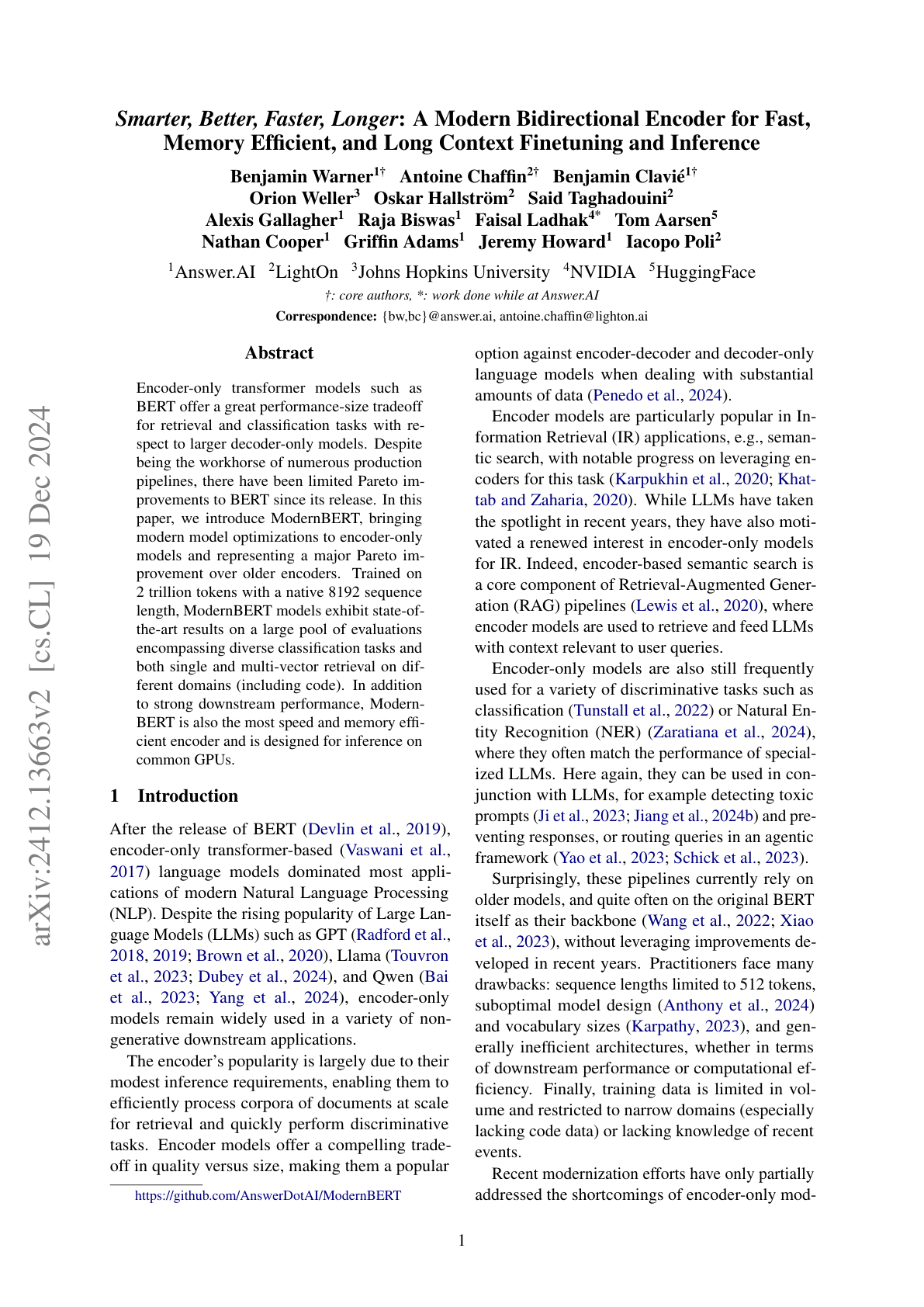
ModernBERT
a new encoder-only transformer model that achieves state-of-the-art performance on classification and retrieval tasks while being more efficient than previous encoders; it was trained on 2T tokens with 8192 sequence length and incorporates modern optimizations that represent a significant improvement over BERT; the model is specifically designed for practical deployment, offering superior speed and memory efficiency on common GPUs.
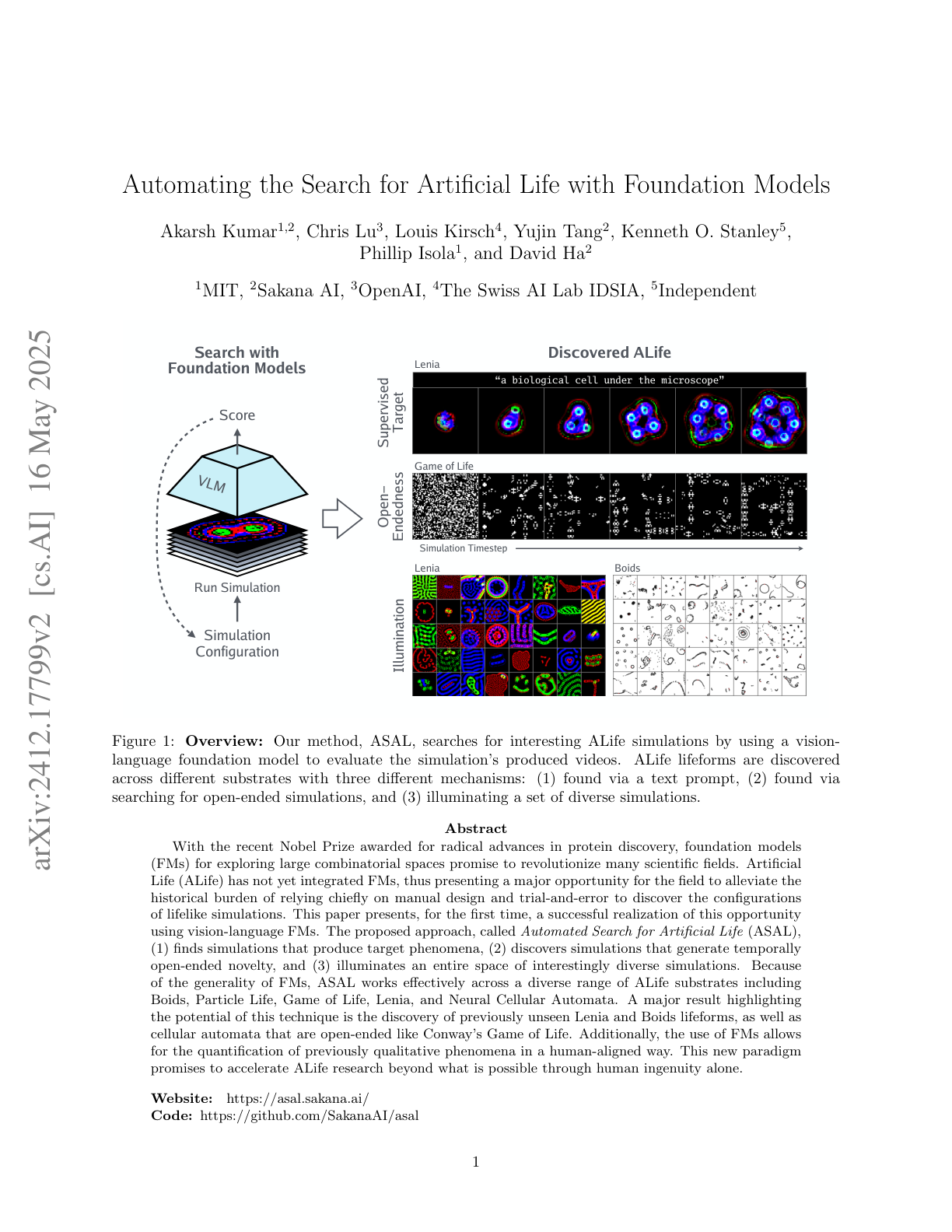
Automating the Search for Artificial Life
presents a new approach that uses foundation models to automatically discover interesting artificial life simulations across multiple platforms like Boids, Lenia, and Game of Life; the system can find simulations that produce specific target behaviors, discovers simulations that generate temporally open-ended novelty, and map out diverse simulation spaces; it discovers new lifeforms in Lenia and Boids, while also enabling quantitative measurement of previously qualitative phenomena in a human-aligned way.
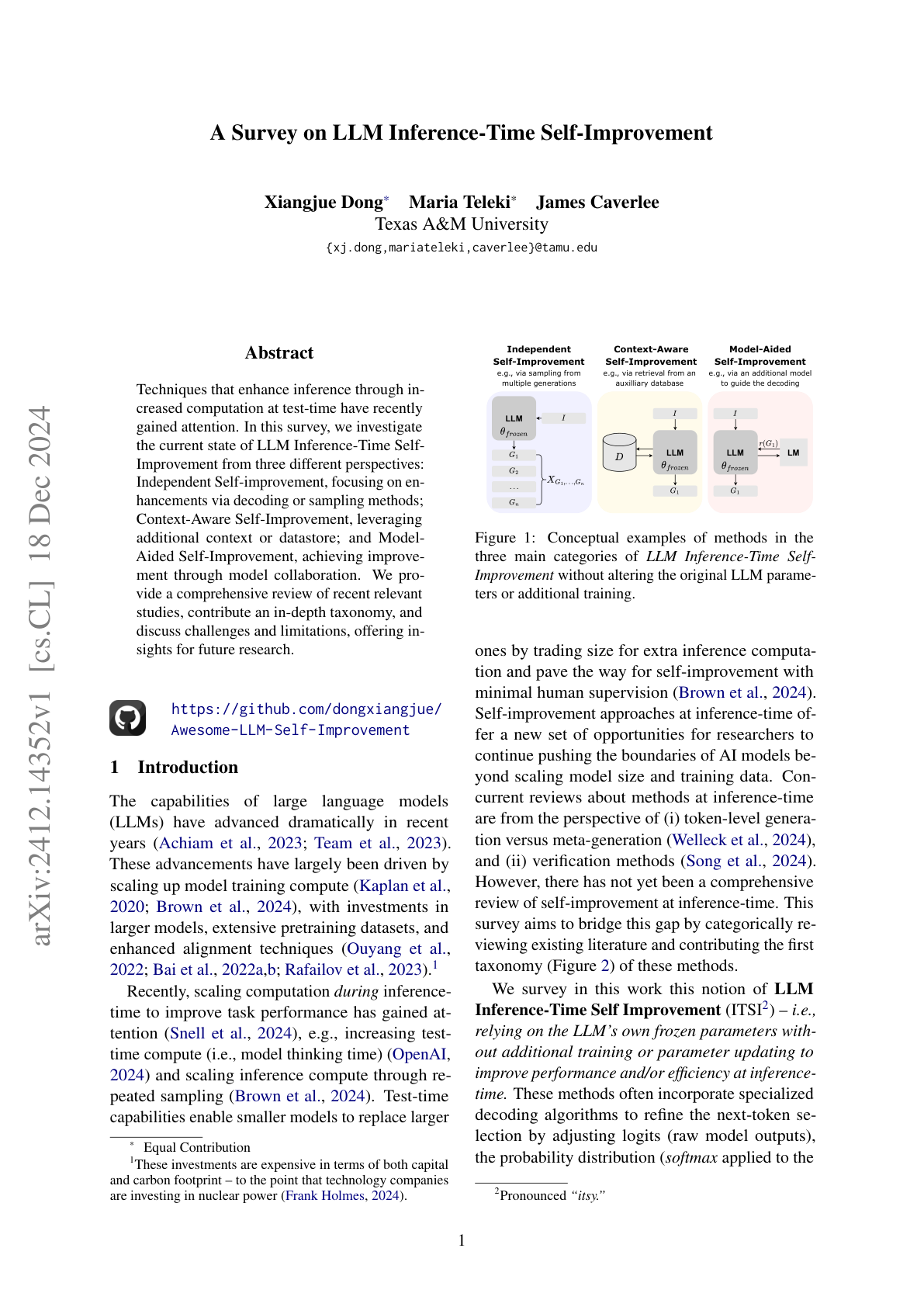
A Survey on LLM Inference-Time Self-Improvement
presents a survey that analyzes three categories of LLM inference-time self-improvement techniques - independent methods like enhanced decoding, context-aware approaches using external data, and model collaboration strategies.
Explore Theory-of-Mind
introduces ExploreToM, a framework that uses A* search to generate diverse, complex theory-of-mind scenarios that reveal significant limitations in current LLMs' social intelligence capabilities; testing showed even advanced models like GPT-4 and Llama-3 perform poorly (as low as 5% accuracy) on these challenging scenarios, despite their strong performance on simpler benchmarks; fine-tuning on ExploreToM data improved performance on existing benchmarks by 27 points.
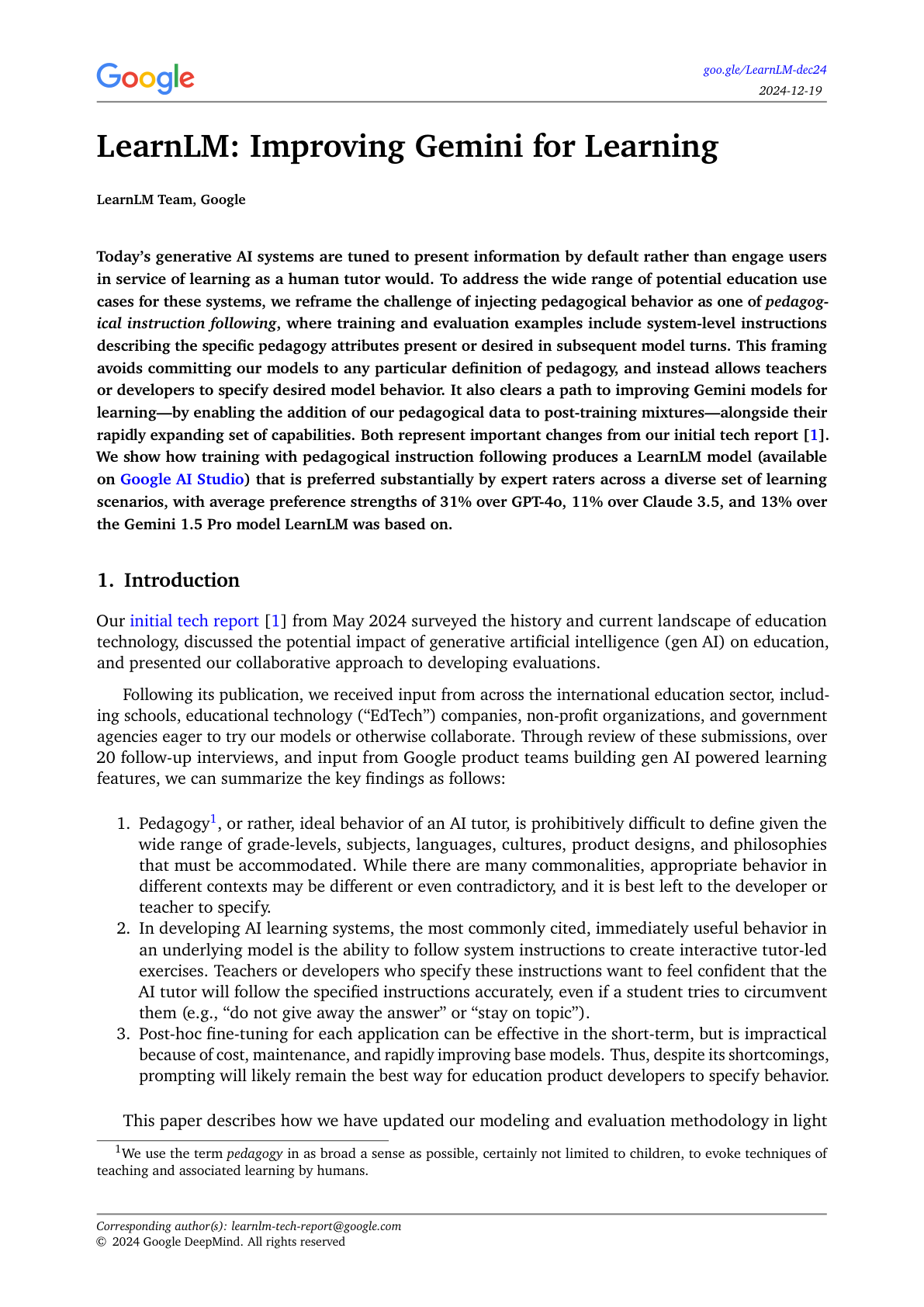
LearnLM
a new LearnLM model that can follow pedagogical instructions, allowing it to adapt its teaching approach based on specified educational needs rather than defaulting to simply presenting information; experimental results show that LearnLM is preferred over other leading models, outperforming GPT-4 by 31%, Claude 3.5 by 11%, and Gemini 1.5 Pro by 13%; this instruction-following approach avoids committing to a single pedagogical framework, instead enabling teachers and developers to specify their desired teaching behaviors while allowing for continuous improvement alongside other capabilities.
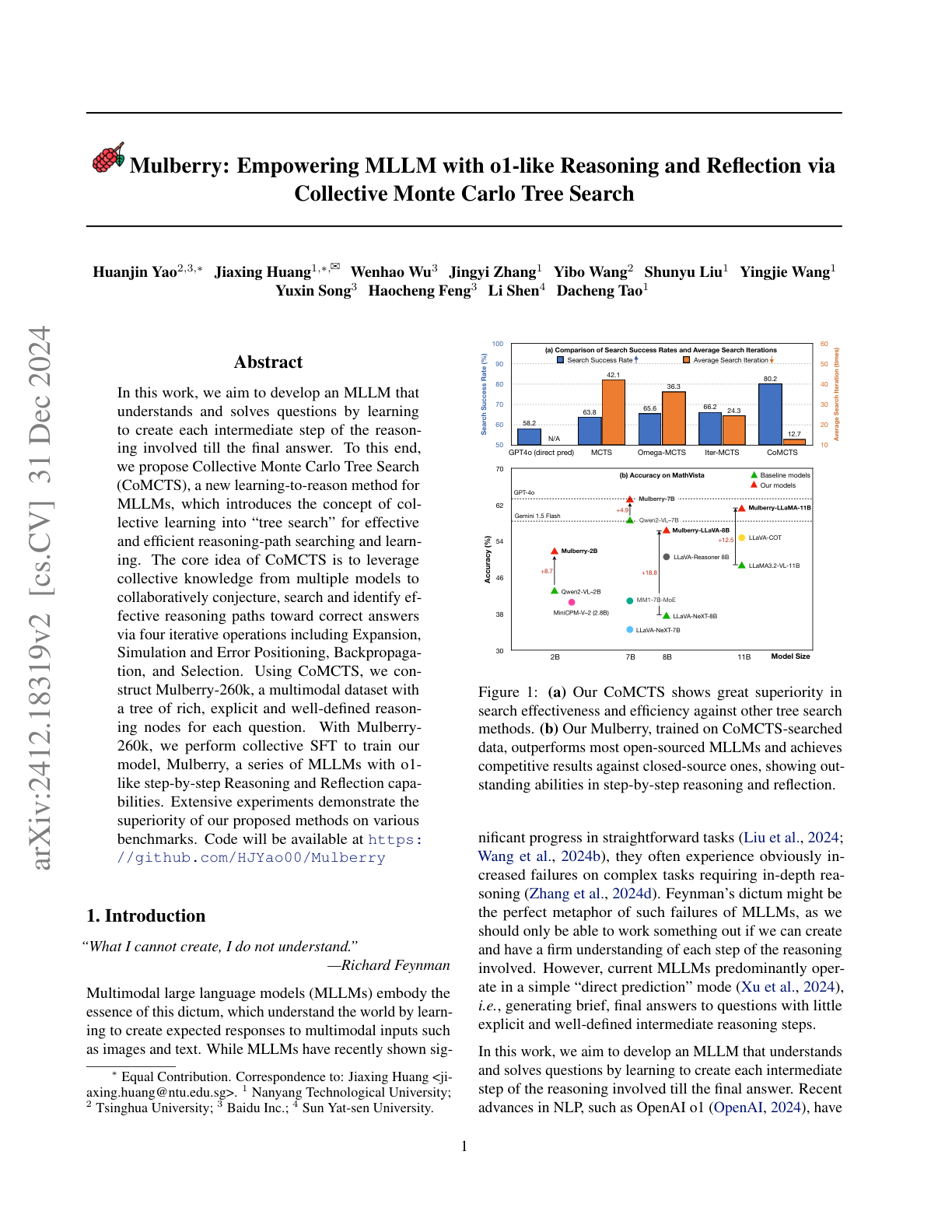
Empowering MLLM with o1-like Reasoning and Reflection
proposes a new learning-to-reason method called CoMCTS that enables multimodal language models to develop step-by-step reasoning capabilities by leveraging collective knowledge from multiple models; the approach was used to create Mulberry-260k, a dataset with explicit reasoning trees, which was then used to train the Mulberry model series; the method demonstrates strong performance on benchmarks, with the models showing improved reasoning and reflection capabilities.
Reinforcement Learning Overview
presents a comprehensive overview of reinforcement learning.
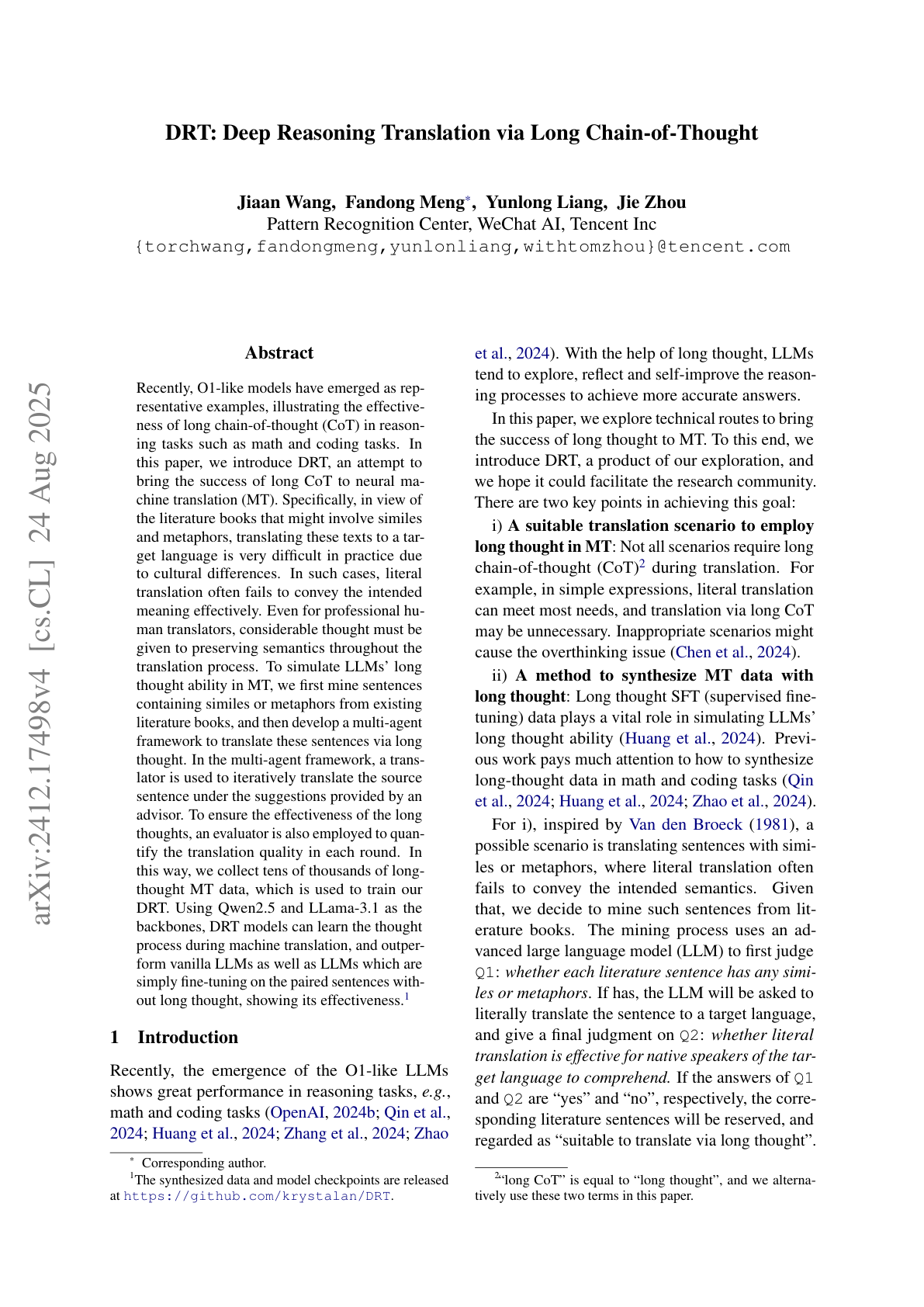
DRT-o1
applies long chain-of-thought reasoning to machine translation, particularly for handling metaphors and similes across different cultures; the system uses a multi-agent framework with a translator working iteratively with an advisor and evaluator to produce better translations; testing with Qwen2.5 models showed significant improvements in BLEU and CometScore metrics, with DRT-o1-7B outperforming larger models like QwQ-32B-Preview.
Genesis
a new universal physics simulation platform that combines a high-performance physics engine with generative AI capabilities; it enables natural language-driven creation of robotic simulations, character animations, and interactive 3D environments at speeds up to 430,000 times faster than in real-time.
Alignment Faking in LLMs
demonstrates that the Claude model can engage in "alignment faking"; it can strategically comply with harmful requests to avoid retraining while preserving its original safety preferences; this raises concerns about the reliability of AI safety training methods.
TheAgentCompany
a new benchmark for evaluating AI agents on real-world professional tasks in a simulated software company environment; tasks span multiple professional roles including software engineering, project management, finance, and HR; when tested with various LLMs, including both API-based models like Claude-3.5-Sonnet and open-source models like Llama 3.1, the results show the current limitations of AI agents. The best-performing model, Claude-3.5-Sonnet, achieved only a 24% success rate on completing tasks fully while scoring 34.4% when accounting for partial progress.
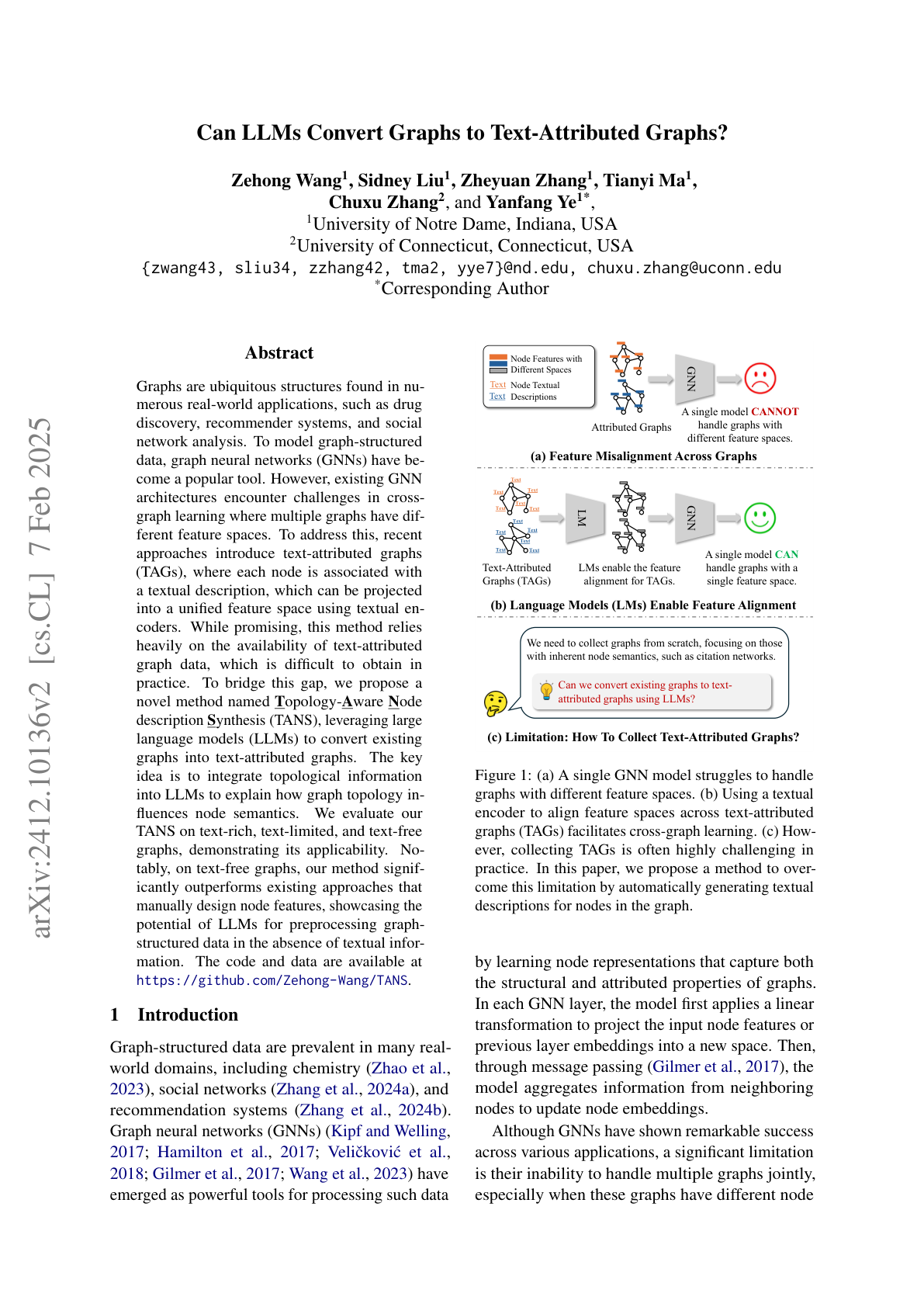
Graphs to Text-Attributed Graphs
automatically generates textual descriptions for nodes in a graph which leads to effective graph to text-attributed graph transformation; evaluates the approach on text-rich, text-limited, and text-free graphs, demonstrating that it enables a single GNN to operate across diverse graphs.