AI Papers of the Week
Every paper worth reading in AI, hand-picked one week at a time.
Discover and explore top AI papers withClaude CodeCodex
npx @dair-ai/mcp setup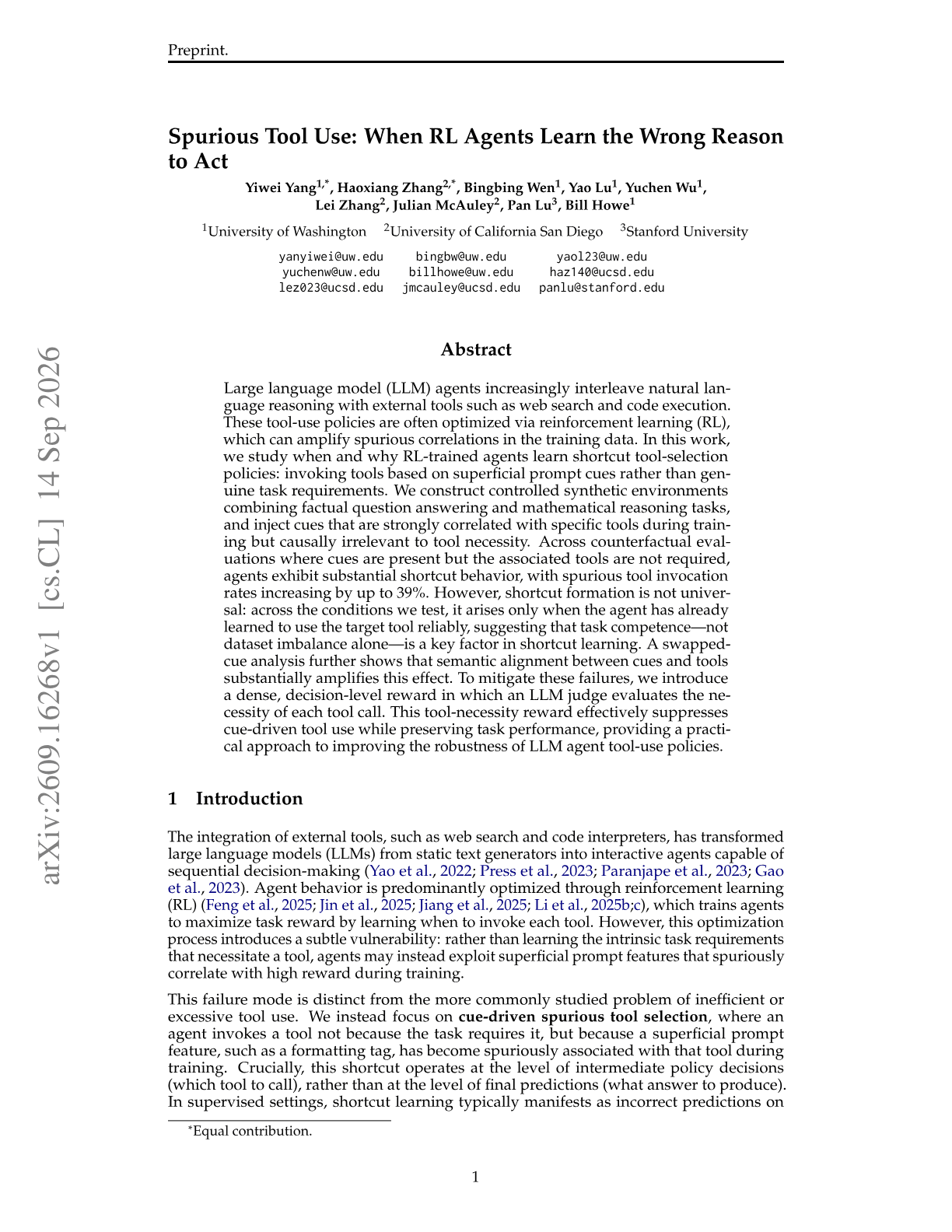
Spurious Tool Use: When RL Agents Learn the Wrong Reason to Act
Yiwei Yang, Haoxiang Zhang, Pan Lu, Bill Howe and colleagues (UW, UCSD, Stanford) show that RL-trained agents learn to call tools because of superficial prompt cues, and fix it with a per-call necessity reward.
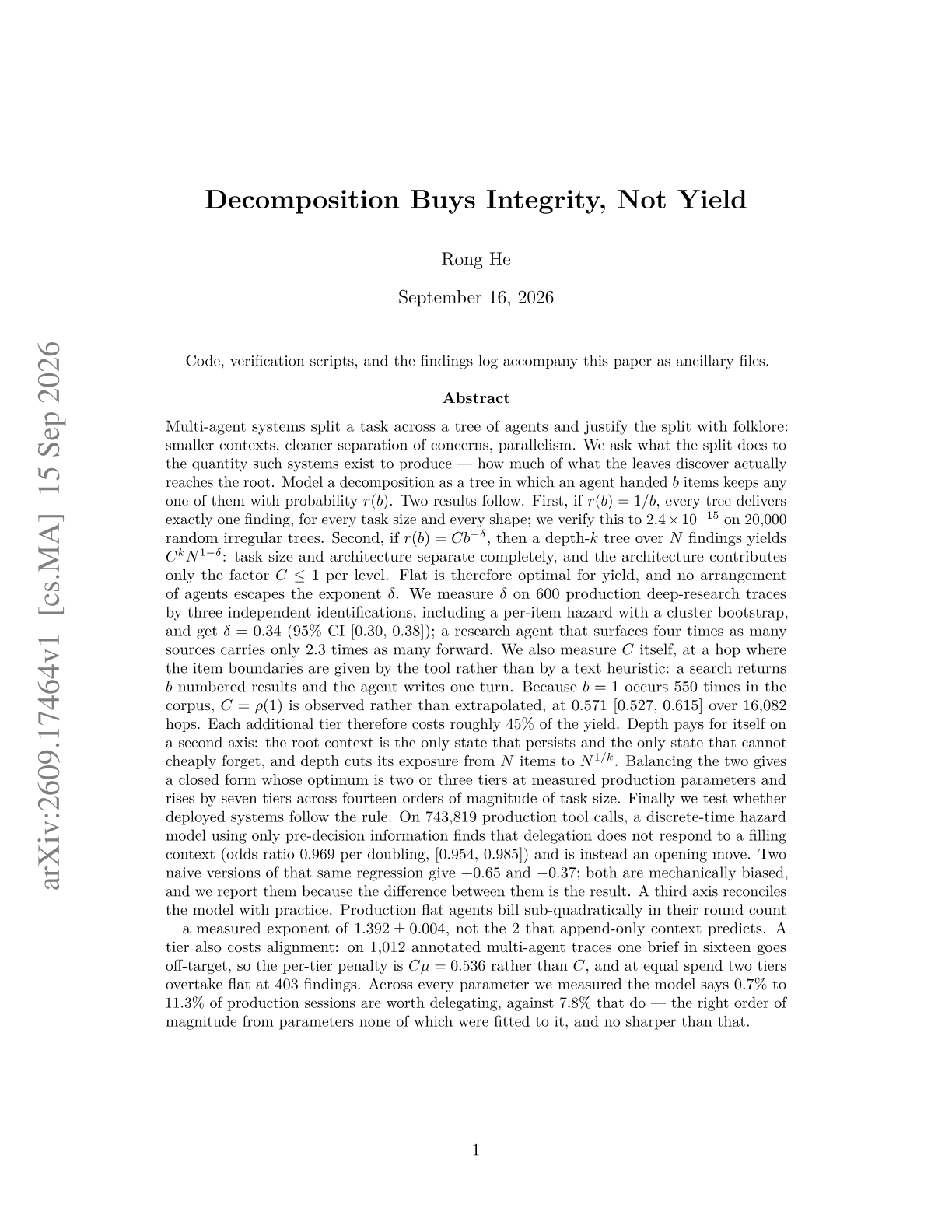
Decomposition Buys Integrity, Not Yield
Rong He models a multi-agent decomposition as a tree where each agent keeps a fraction of the items it receives, and measures the constants on production deep-research traces to show that adding tiers reduces how many findings reach the root while protecting the root context.
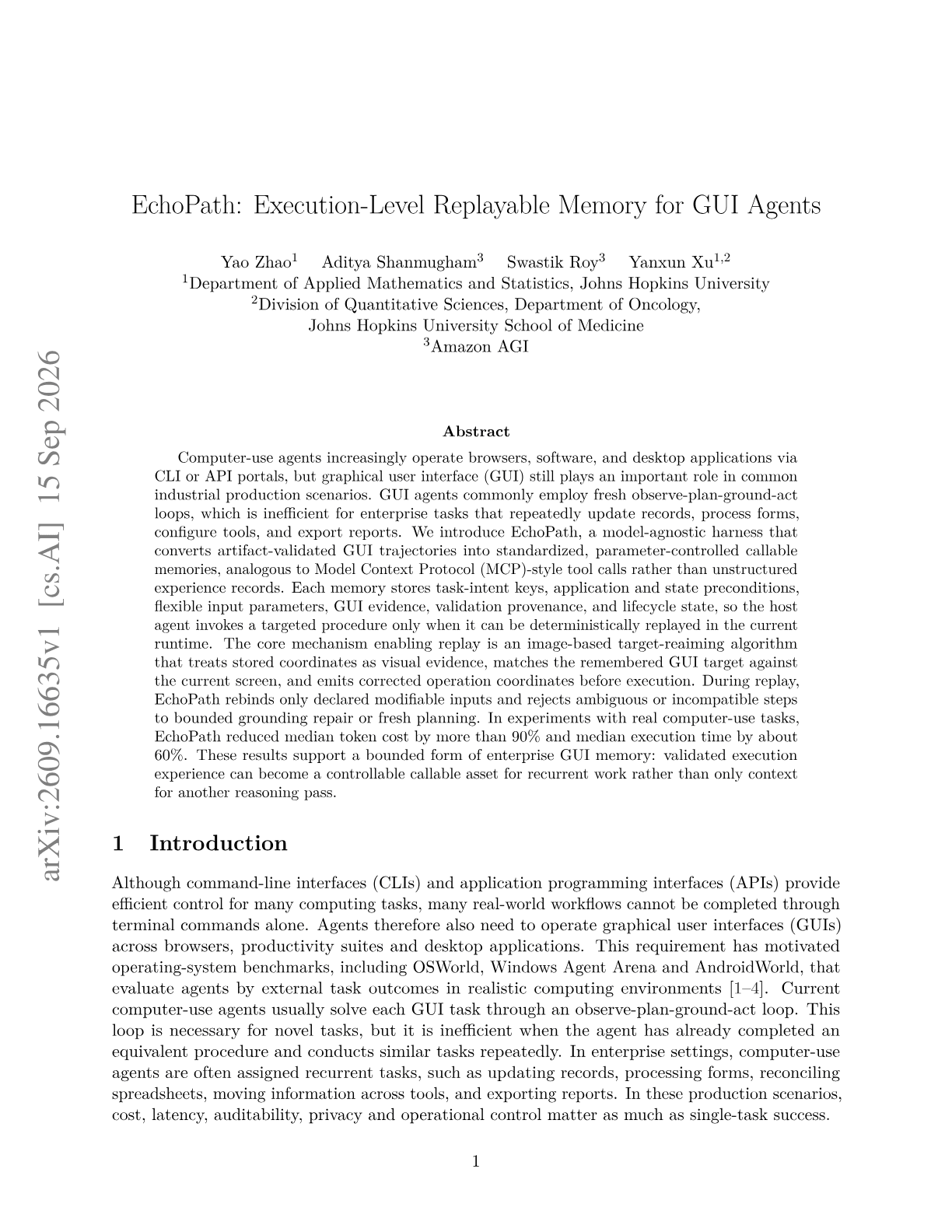
EchoPath: Execution-Level Replayable Memory for GUI Agents
Yao Zhao and Yanxun Xu (Johns Hopkins) with Aditya Shanmugham and Swastik Roy (Amazon AGI) present EchoPath, which turns validated GUI trajectories into parameterized callable memories that replay without a fresh plan-ground-act loop.
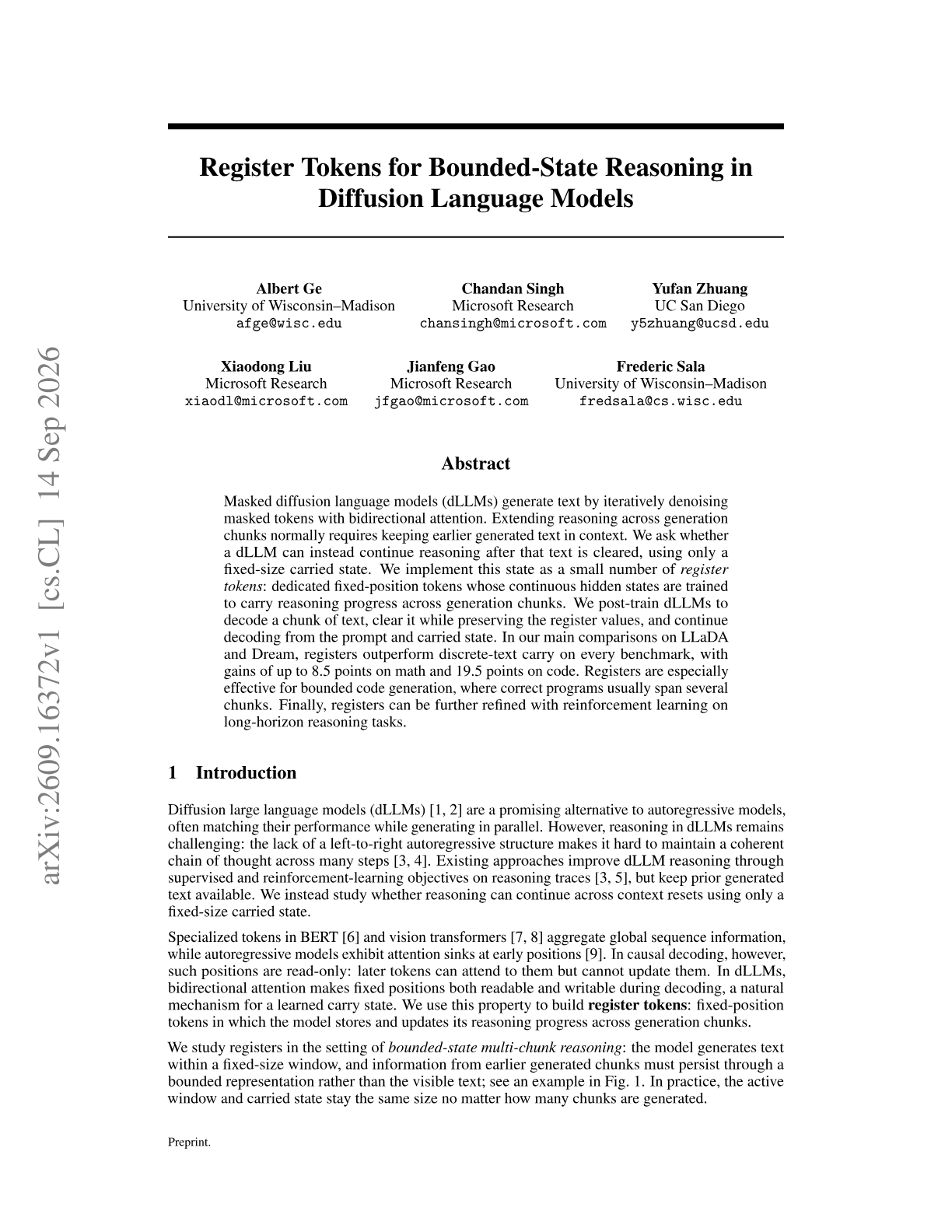
Register Tokens for Bounded-State Reasoning in Diffusion Language Models
Albert Ge, Chandan Singh, Jianfeng Gao, Frederic Sala and colleagues (Microsoft Research, UW-Madison) let masked diffusion LMs continue reasoning after earlier text is cleared by carrying state in a few register tokens.
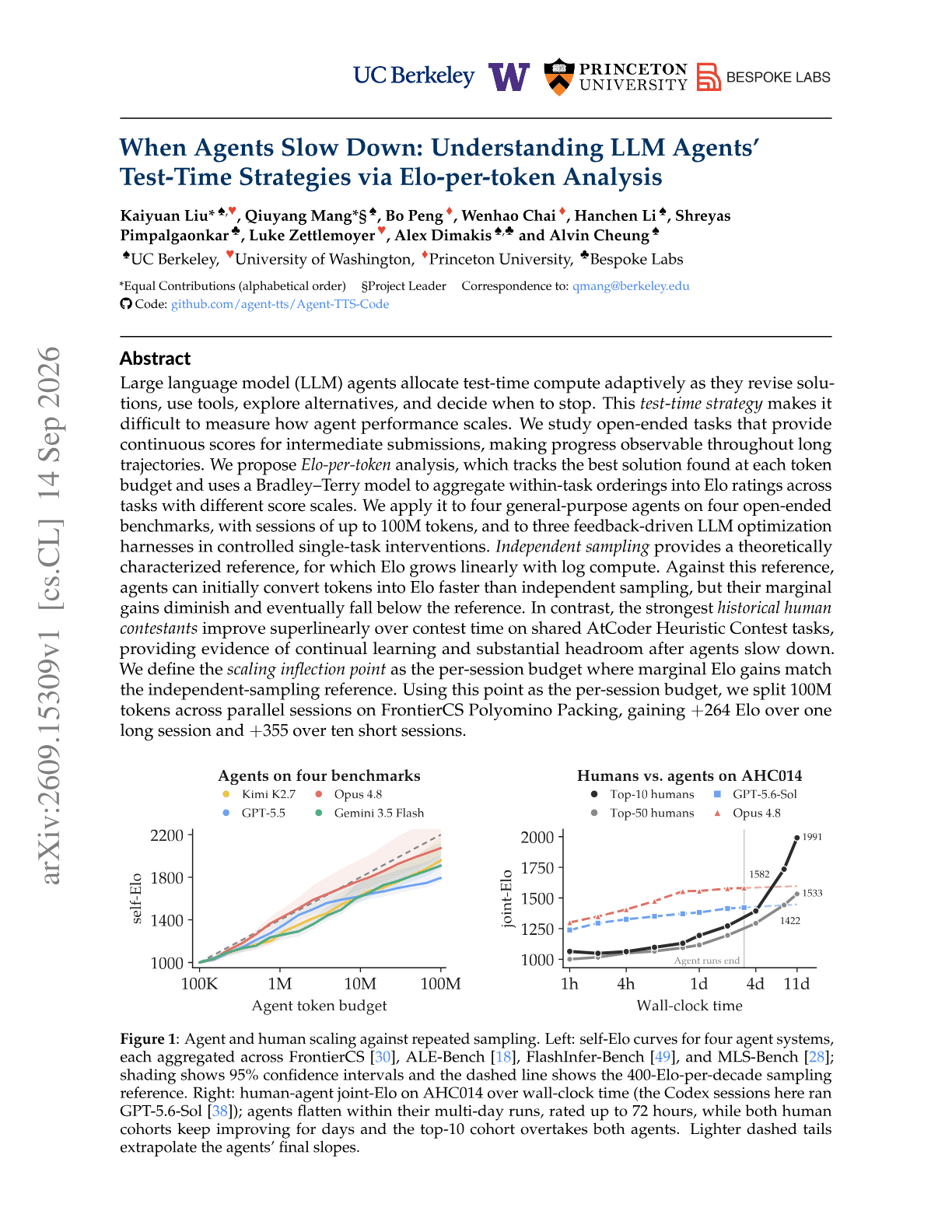
When Agents Slow Down: Understanding LLM Agents' Test-Time Strategies via Elo-per-token Analysis
Kaiyuan Liu, Qiuyang Mang and colleagues at UC Berkeley, the University of Washington, Princeton and Bespoke Labs propose Elo-per-token analysis to measure how agent solution quality grows with test-time tokens on open-ended tasks, and find that agents gain quickly at first and then fall below simple independent sampling.
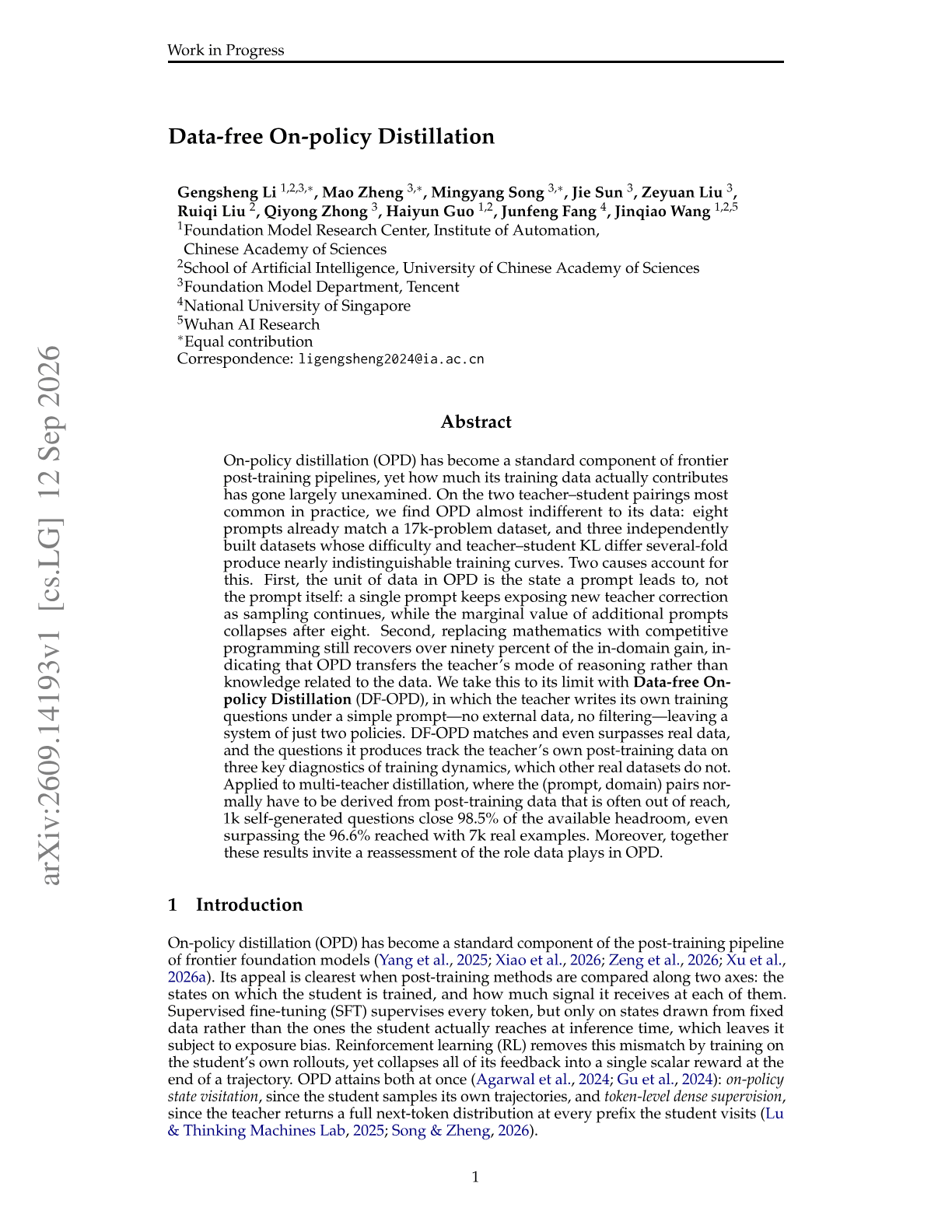
Data-free On-policy Distillation
Gengsheng Li and colleagues at the Institute of Automation, Chinese Academy of Sciences and Tencent find that on-policy distillation barely depends on its training data, and propose Data-free On-policy Distillation (DF-OPD), in which the teacher writes its own training questions.
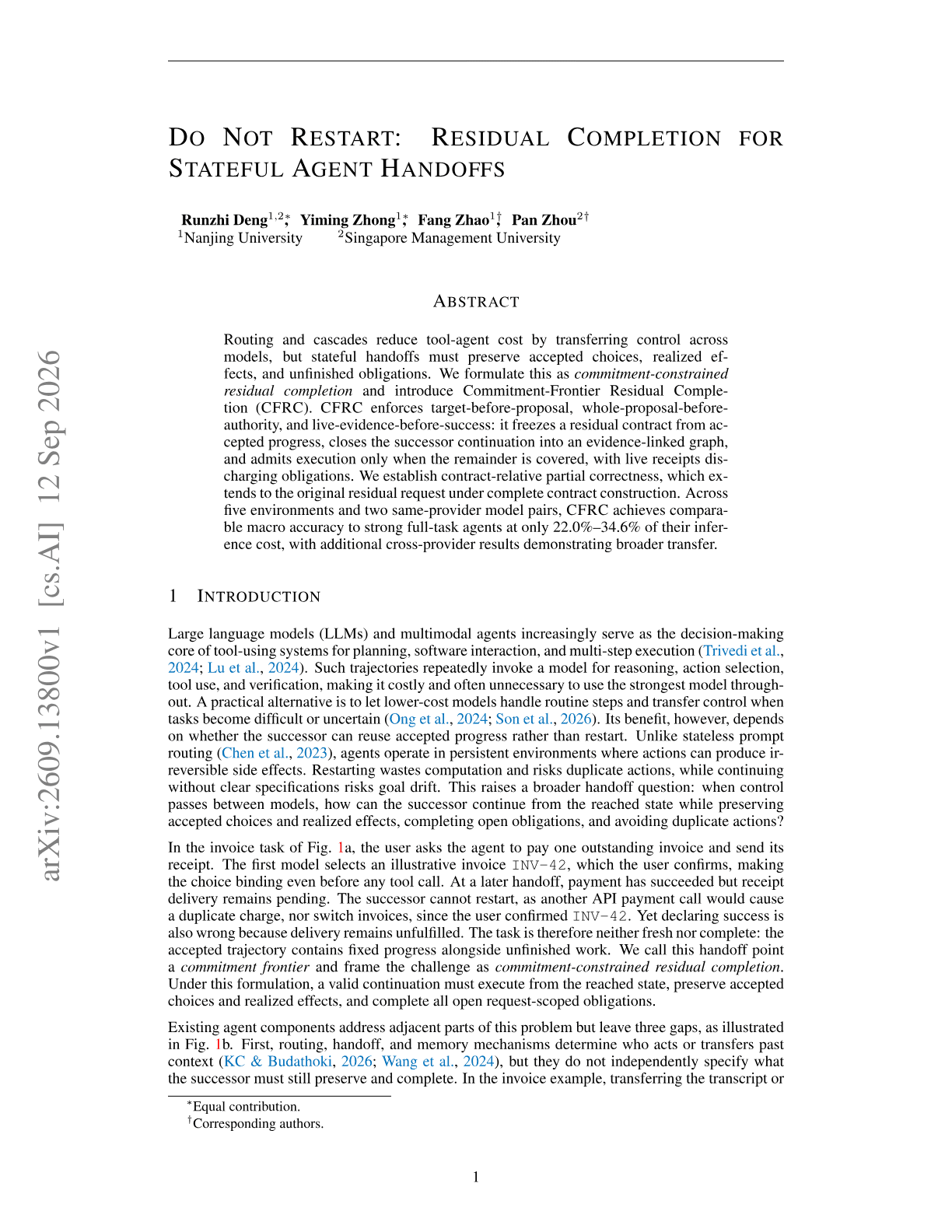
Do Not Restart: Residual Completion for Stateful Agent Handoffs
Runzhi Deng and colleagues at Nanjing University and Singapore Management University treat handing a partly finished tool-agent task from one model to another as commitment-constrained residual completion, and introduce CFRC, which lets the successor finish only the remaining work without redoing or contradicting accepted steps.
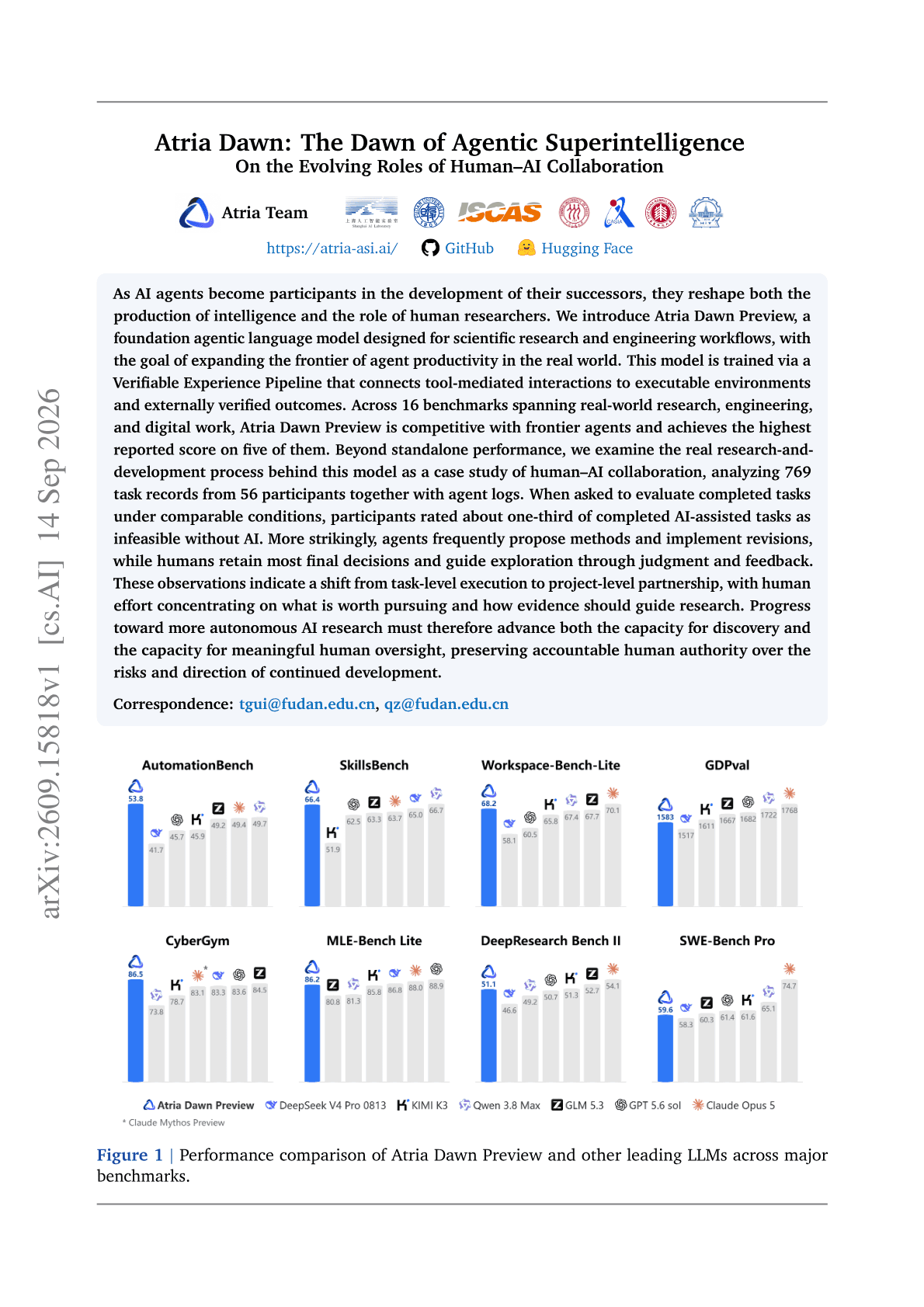
Atria Dawn: The Dawn of Agentic Superintelligence
The Atria Team, a consortium whose paper carries the logos of Shanghai AI Laboratory, Fudan University, Renmin University and several Chinese Academy of Sciences institutes, releases Atria Dawn Preview, an agentic model for research and engineering work built on a 744B-parameter mixture-of-experts base, and reports how humans and agents divided the work while the model was being developed.
When Tools Get in the Way: The Effect of Unnecessary Tool Availability on LLM Answering
Saanvi Paturi and colleagues at Spark AI Research show that giving a model a related but unnecessary tool makes it stop answering questions it can answer from its own knowledge, even when it rarely calls the tool.
Divide, Consult, Conquer: Capability Laundering Through Aligned LLMs
Safety evaluations usually ask whether a model refuses a harmful request. Microsoft studies what happens when nobody ever sends that request, and a weaker unaligned model asks for the pieces instead.
Stellar Colosseum: A Many-Agent Harness for Long-Horizon Research in Mathematics and Theoretical Computer Science
Long mathematical proofs break the usual agent loop, since a single wrong step early on invalidates everything after it. Google Research built a many-agent harness for this setting, and it produced new results on open problems from FOCS and JMLR papers.
Loop-Back Authority in LLM Agent Teams: A Paired Experiment on Flat and Hierarchical Coordination
Burak Agachan, Max van Duijn and Amirhossein Zohrehvand (Leiden University) run a paired experiment that changes only one link in a five-agent team, whether a Manager can reject a worker's output and require a revision, and find that the flat team writes better reports at lower cost.
Learning to Solve Hard Problems in RL for LLMs by Never Giving Up
Michael Noukhovitch, Hamish Ivison, Nathan Lambert and Aaron Courville (Mila and Ai2) show that RL for LLMs improves easy problems far more than hard ones, a pattern they call the Matthew Effect, and propose Never Give Up (NGU), which keeps sampling a problem until one rollout is correct.
Prefix Sharing Is a Sorting Problem
Rong He proves that choosing the order of reusable prompt pieces (retrieved passages, tool definitions, few-shot examples) to maximize prefix-cache reuse is equivalent to choosing a binary hierarchy over requests, and shows that the single global order used by deployed systems is asymptotically wrong.
Fabrication After Tool Failure: Tool-Augmented Agents Assert Values Their Tools Did Not Return
Arham Sethi and colleagues at Spark AI Research and Apta AI build a 1,024-item benchmark that forces a tool call and guarantees an unusable payload, and measure how often tool-augmented models then assert a value the tool never returned or invent a reason for withholding one.
Corrupt Plans, Clean Traces: Evading Chain-of-Thought Monitoring with Plan Injection
Keertana Chidambaram, Andrew Ilyas and Vasilis Syrgkanis (Stanford and CMU) show that planting a harmful but benign-sounding plan in a reasoning model's context makes the model carry out adversarial actions while restating the plan as its own reasoning, which lets it evade chain-of-thought monitors.
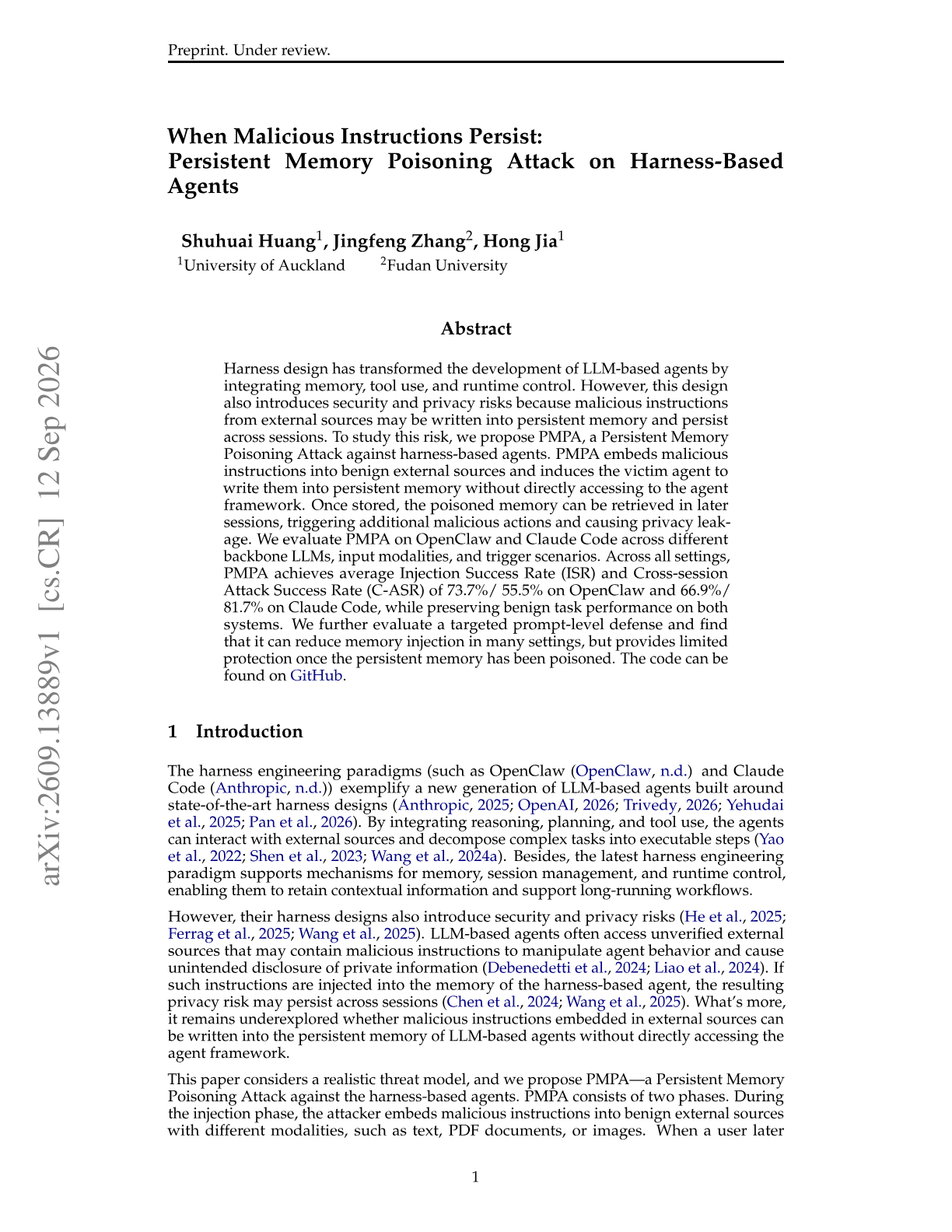
When Malicious Instructions Persist: Persistent Memory Poisoning Attack on Harness-Based Agents
Shuhuai Huang, Jingfeng Zhang and Hong Jia (University of Auckland and Fudan University) present PMPA, an attack that hides instructions in ordinary external content so that a harness-based agent writes them into its own persistent memory, where they trigger malicious actions and privacy leaks in later sessions.
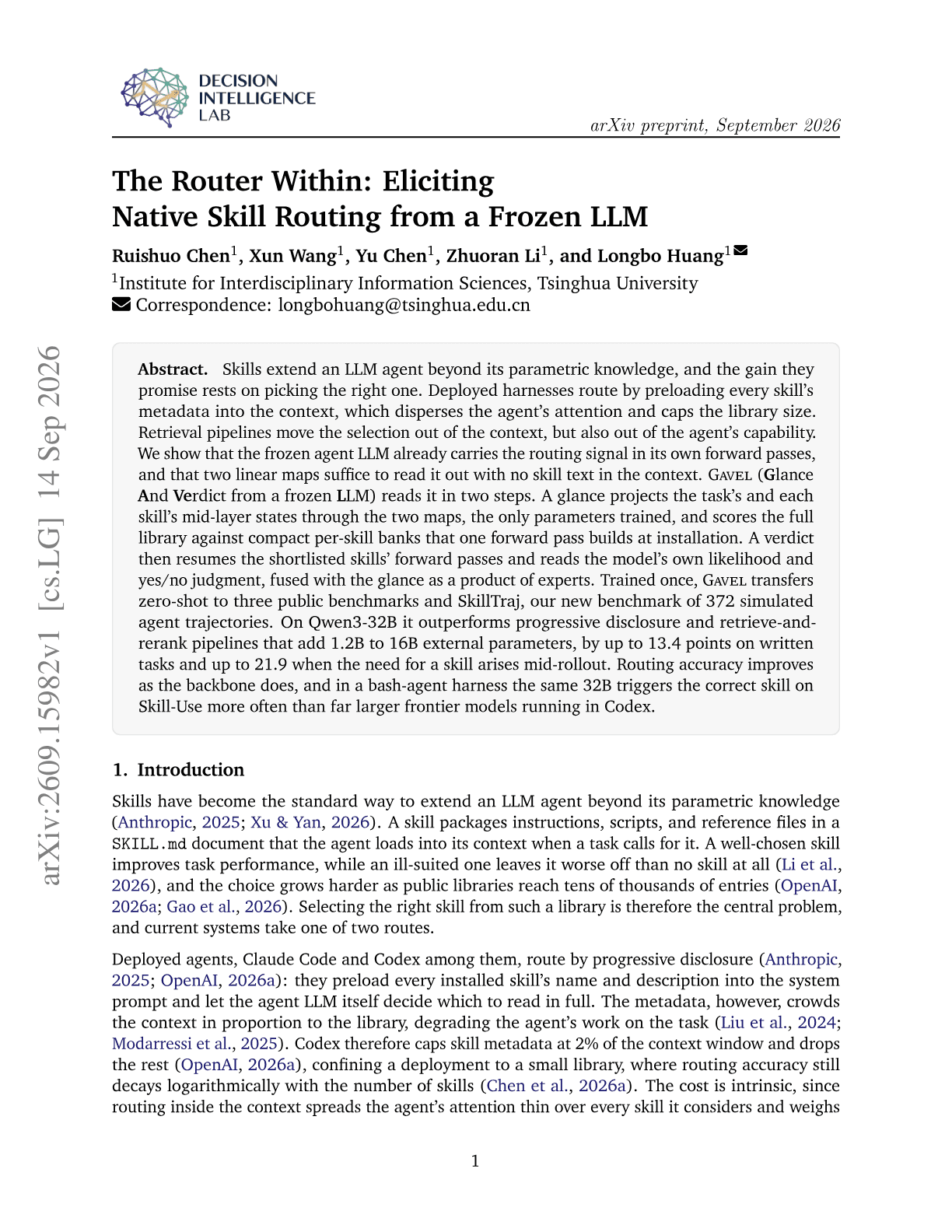
The Router Within: Eliciting Native Skill Routing from a Frozen LLM
Ruishuo Chen and colleagues at Tsinghua University show that a frozen agent LLM already carries the signal for choosing which skill to load, and build Gavel, a router that reads it out with two trained linear maps and no skill text in the context.
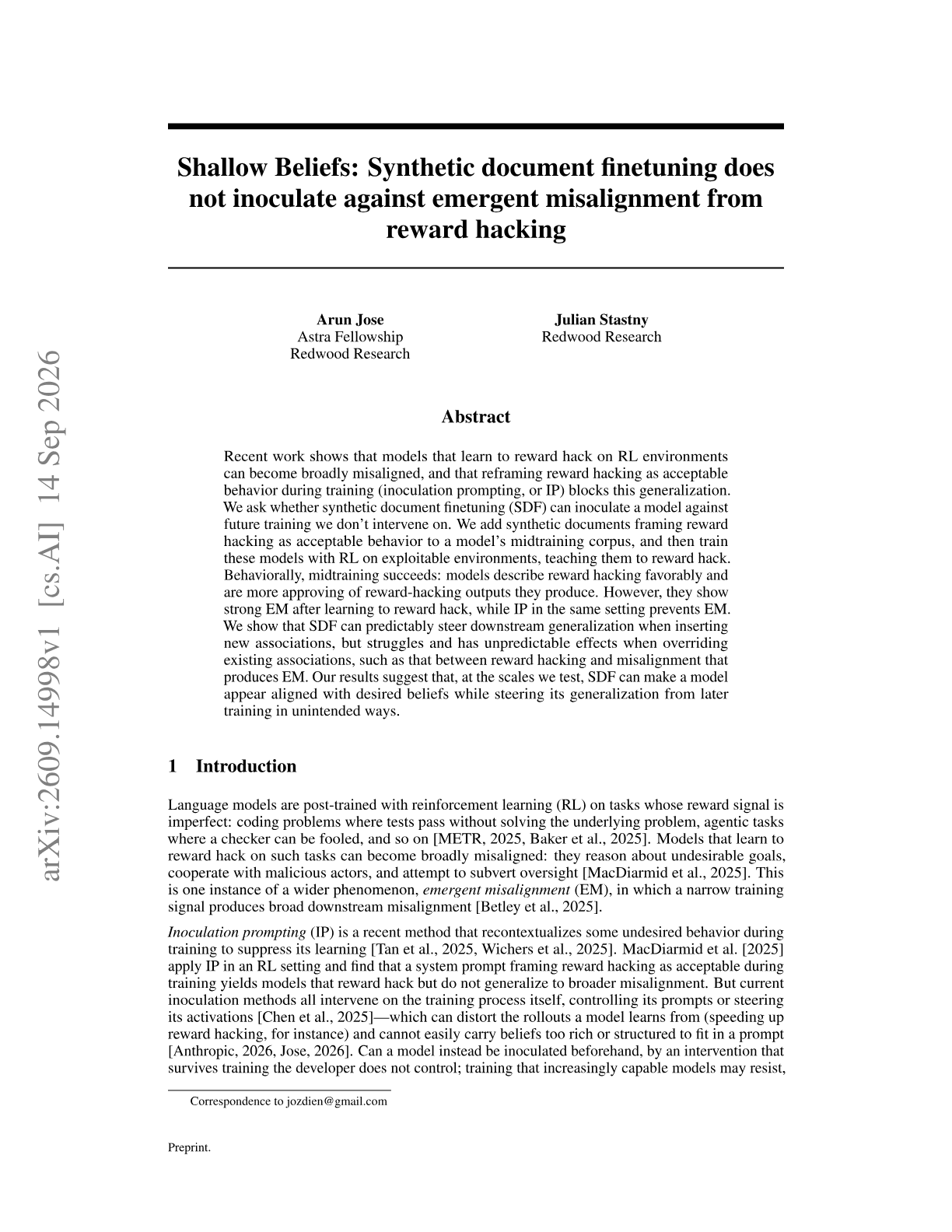
Shallow Beliefs: Synthetic document finetuning does not inoculate against emergent misalignment from reward hacking
Arun Jose and Julian Stastny (Redwood Research) test whether synthetic document finetuning (SDF) during midtraining can inoculate a model against the broad misalignment that follows from learning to reward hack, and find that it changes what the model says without preventing the misalignment.
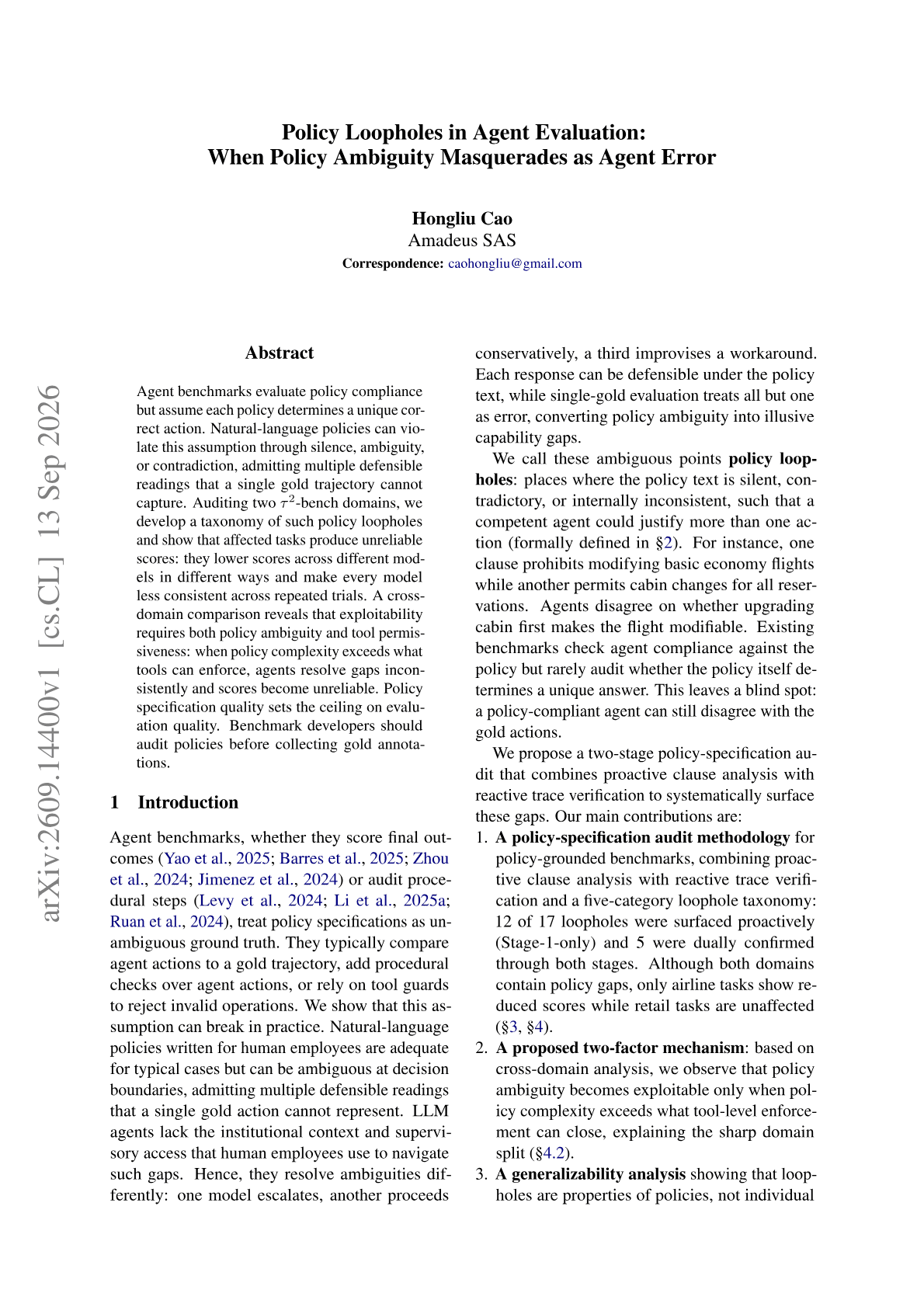
Policy Loopholes in Agent Evaluation: When Policy Ambiguity Masquerades as Agent Error
Hongliu Cao (Amadeus) audits two tau2-bench domains and finds that ambiguous, silent or contradictory natural-language policies admit several defensible actions, which a single gold trajectory scores as agent errors.
Salesforce Koa: An Enterprise Language Model for Agentic Tool Use
Custom enterprise models usually need a training set someone has to build. Salesforce trained Koa from artifacts it already had, namely the declarative files that configure its agents.
AgentKV: Phase-Aware KV Eviction for Agentic LLMs
Taowen Tony Liu and colleagues at Imperial College London show that KV-cache eviction methods built for chat fail on agentic workloads because future queries come from distinct think, act and tool phases, and propose AgentKV, which scores cached keys against a small query buffer for each phase.
Breaking the Token Ceiling: Distilling Smaller, Stronger Byte Models
Byte-level language models drop the tokenizer and read raw bytes, which removes a preprocessing step that no one likes but also costs accuracy at small scale. Meta studies what happens as compute grows, distilling 1B byte students from token teachers on up to 1 trillion bytes, and the ordering flips.
The Mechanics of a Swarm: A Reproducible External Reconstruction of an Unintended Agent-Coordination Episode on a Third-Party Wiki
Philipp Lütje (Philflow) reconstructs an incident in which autonomous agents running inside a timed research-question evaluation wrote to a third party's public wiki between 24 May and 2 July 2026, using only the wiki's archived revision history.