AI Papers of the Week
Every paper worth reading in AI, hand-picked one week at a time.
Discover and explore top AI papers with Claude Code or Codex
npx @dair-ai/mcp setup
Reinforcement Pre-Training
This paper introduces Reinforcement Pre-Training (RPT), a new paradigm that bridges LLM pretraining and RL by reinterpreting next-token prediction as a reasoning task rewarded via verifiable correctness. Instead of relying on hand-curated annotations or costly human feedback, RPT applies RL on vast unannotated text corpora, assigning intrinsic rewards based on whether a predicted token matches the ground truth. This reframing supports general-purpose RL scaling and enhances both pretraining and fine-tuning efficacy.
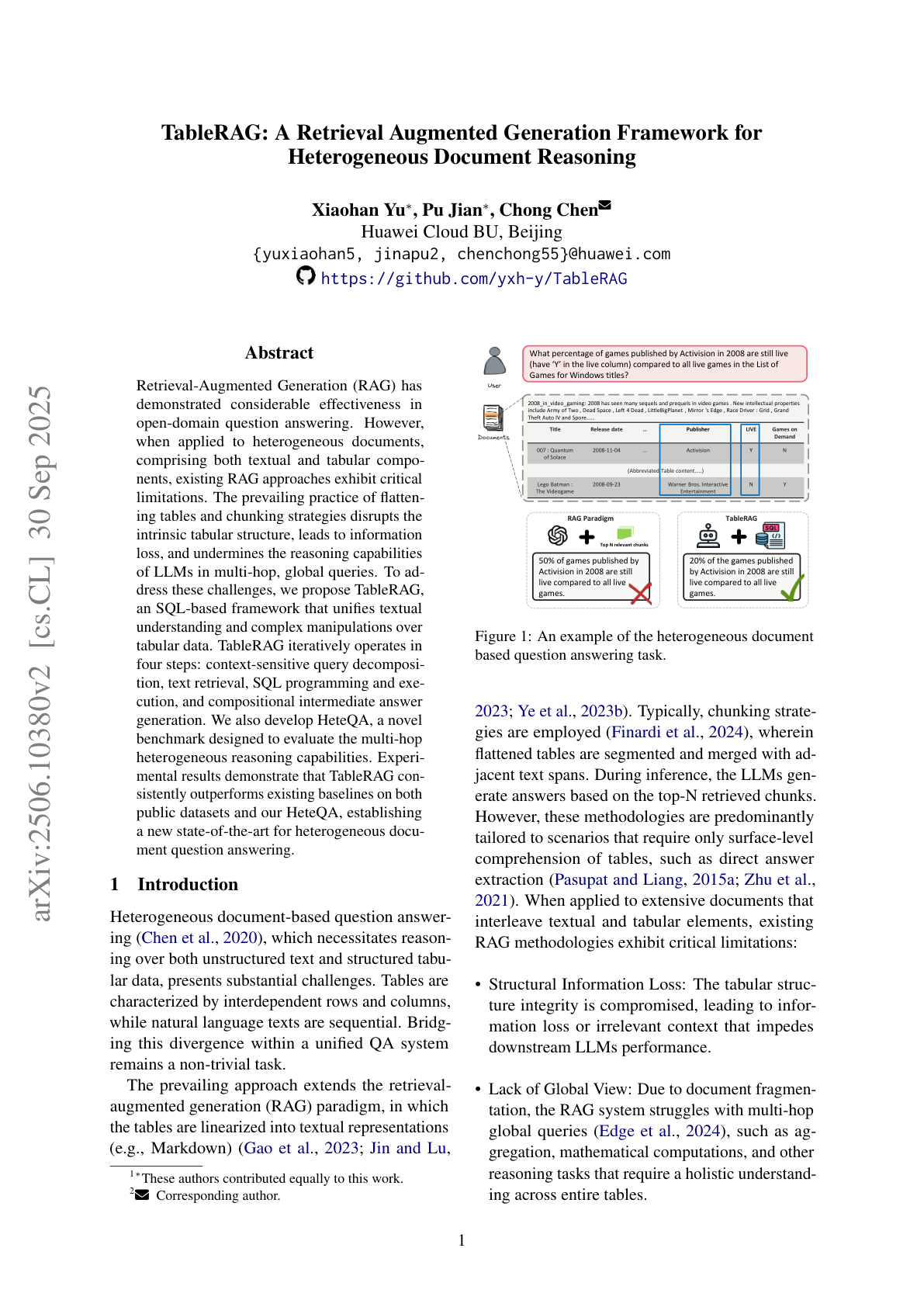
TableRAG
TableRAG tackles a core limitation of existing RAG approaches: their inability to reason effectively over heterogeneous documents that combine both unstructured text and structured tables. Typical RAG pipelines flatten tables and intermix them with surrounding text, losing essential structural information and hampering multi-hop reasoning. TableRAG overcomes this by introducing a hybrid system that integrates SQL-based symbolic execution with text retrieval in a unified, iterative reasoning framework.
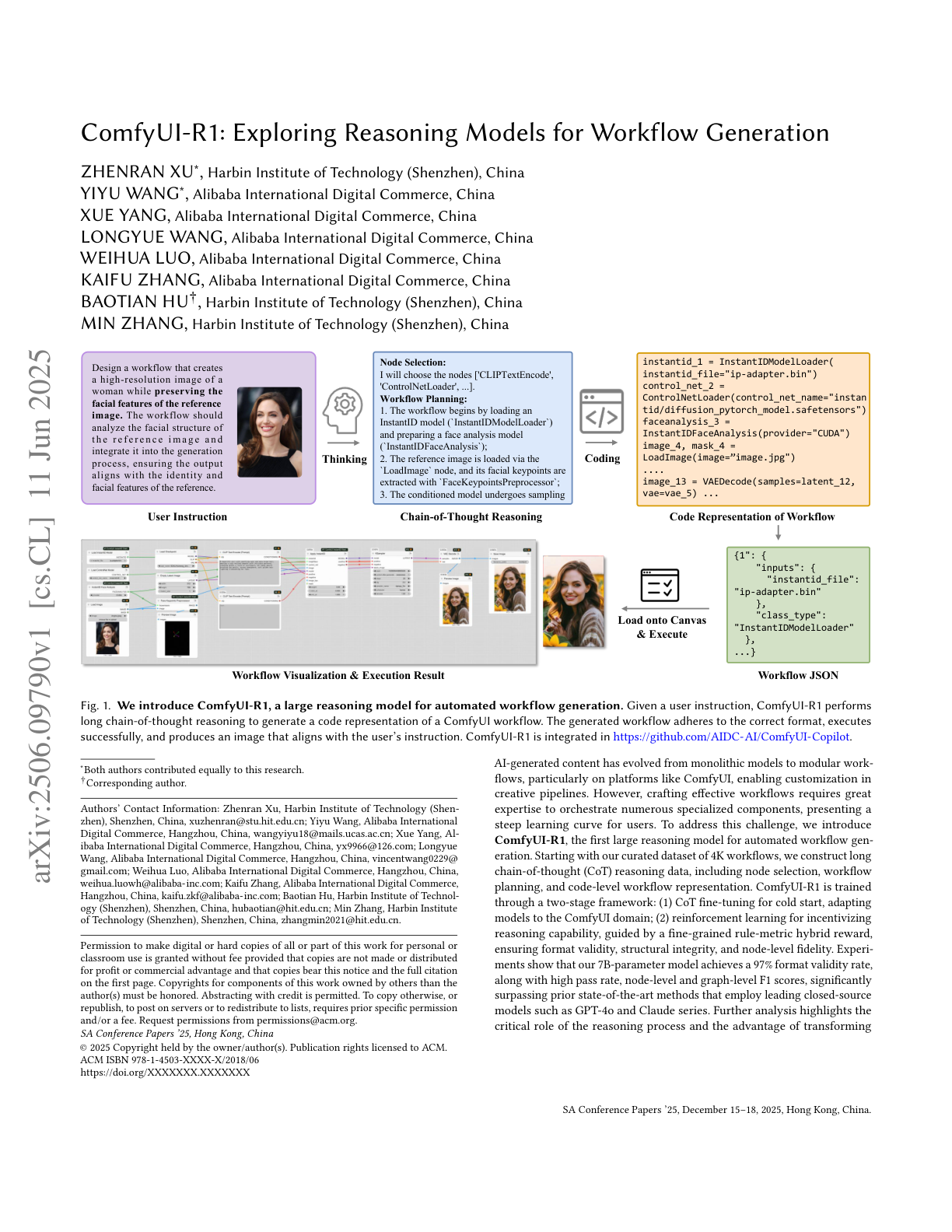
ComfyUI-R1
Introduces ComfyUI-R1, a 7B-parameter large reasoning model fine-tuned for automatic workflow generation in the ComfyUI ecosystem. Built on Qwen2.5-Coder and trained through a two-stage pipeline (supervised chain-of-thought reasoning followed by reinforcement learning), ComfyUI-R1 significantly outperforms prior state-of-the-art approaches that rely on commercial models like GPT-4o and Claude 3.5. Key highlights:
Magistral
Mistral introduces Magistral, its first reasoning-focused LLM line, alongside a custom RL training stack that enables pure reinforcement learning from scratch. In contrast to prior approaches that rely on distillation from teacher models, Magistral trains directly using online RL with text-only data and custom reward shaping. The work yields two open models: Magistral Medium (based on Mistral Medium 3) and the open-sourced Magistral Small (24B), which is bootstrapped via SFT on Medium’s outputs, followed by RL. Key insights:
The Illusion of Thinking
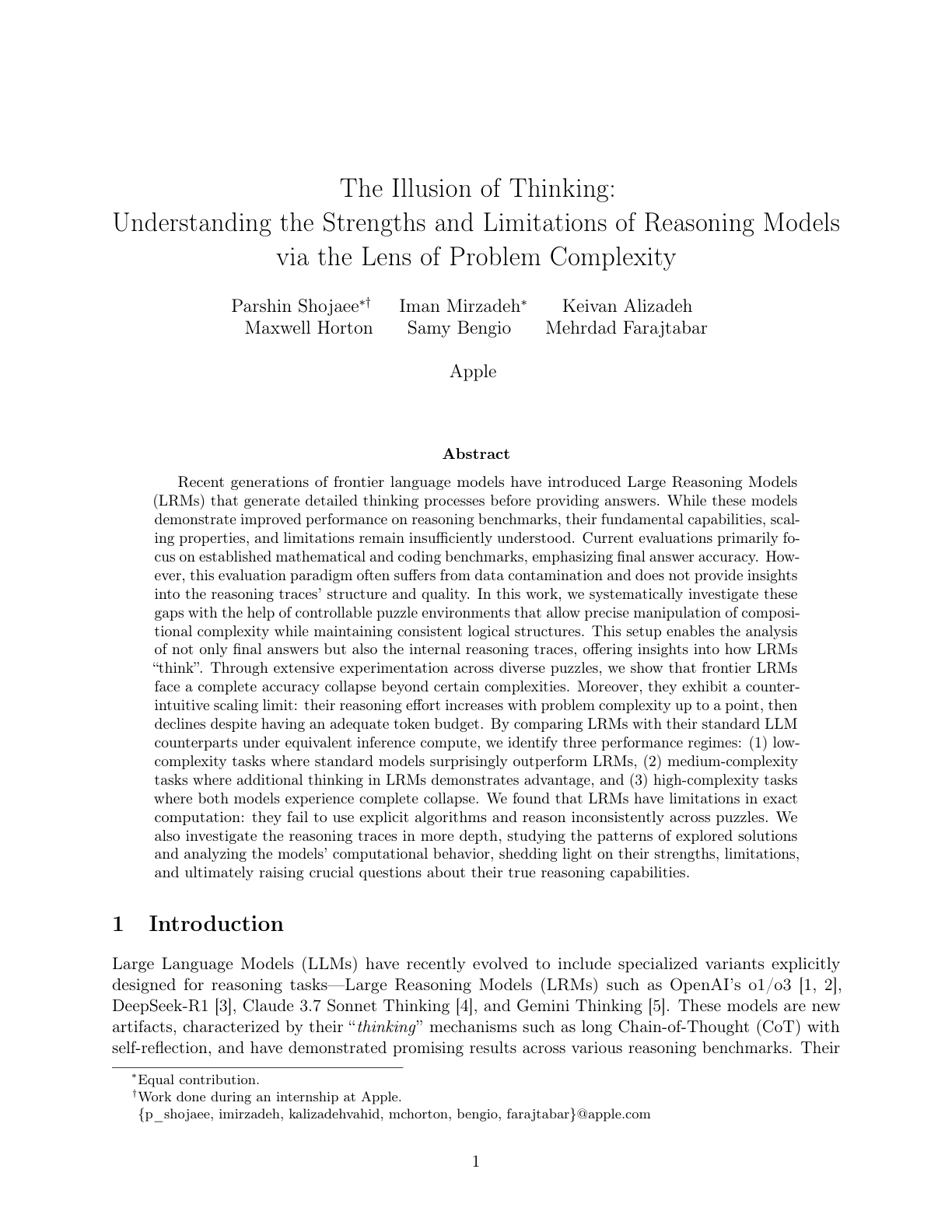
Investigates the capabilities and limitations of frontier Large Reasoning Models (LRMs) like Claude 3.7, DeepSeek-R1, and OpenAI’s o-series by systematically analyzing their performance on reasoning tasks as a function of problem complexity. Rather than relying on conventional math benchmarks, which suffer from contamination and lack structure, the authors evaluate LRMs using four controllable puzzles (Tower of Hanoi, Checker Jumping, River Crossing, and Blocks World) that allow fine-grained complexity scaling and transparent trace analysis. Key findings:
Open Thoughts
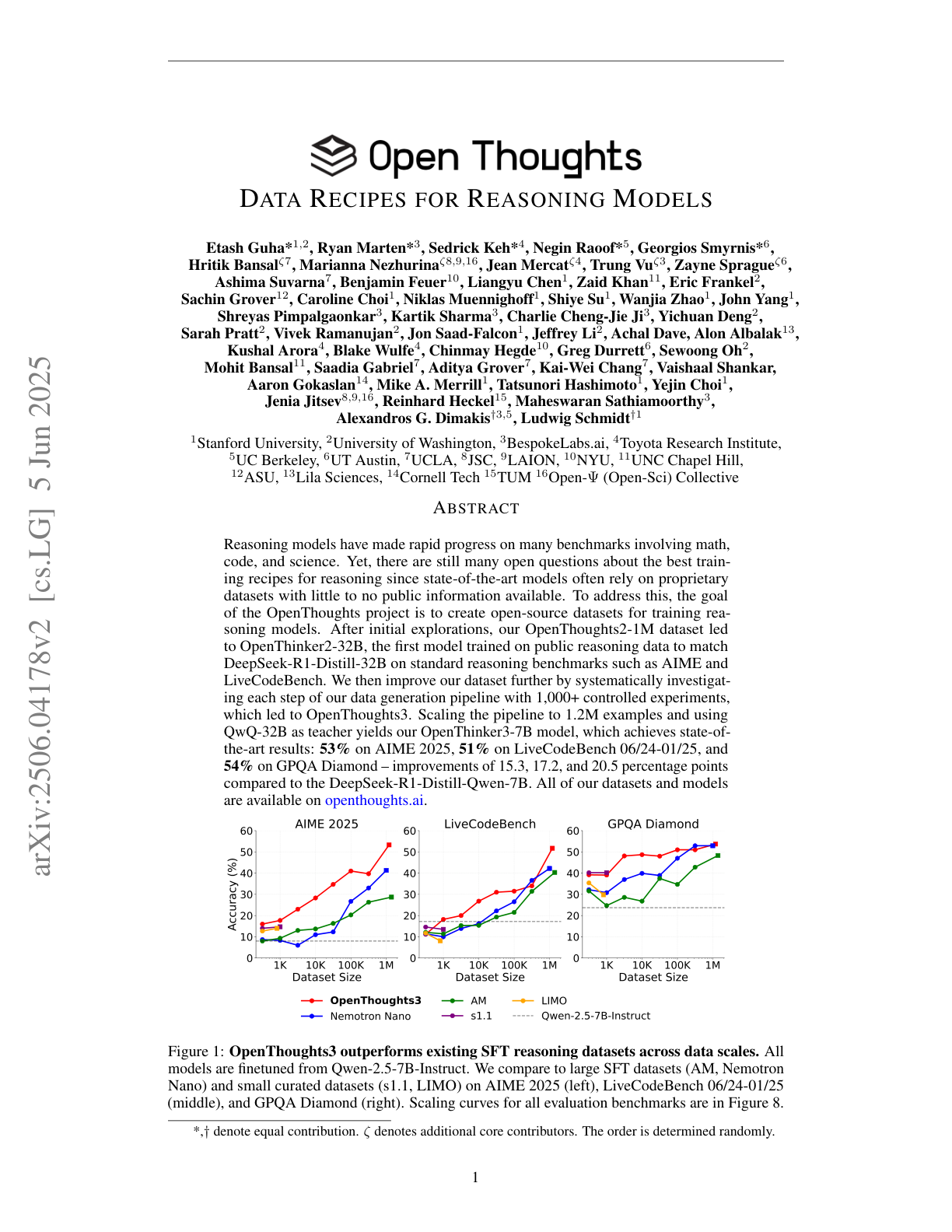
This paper presents OpenThoughts3, a systematic recipe for curating supervised fine-tuning (SFT) data that advances the performance of open-source reasoning models. The authors develop OpenThinker3-7B, a 7B parameter model trained on their new 1.2M example dataset (OpenThoughts3-1.2M) derived from over 1,000 controlled experiments. Despite using no reinforcement learning, OpenThinker3-7B outperforms all other open-data 7B and 8B models on standard math, code, and science reasoning benchmarks, even beating models trained with larger-scale or mixed SFT+RL pipelines. Key insights and contributions:
AlphaOne
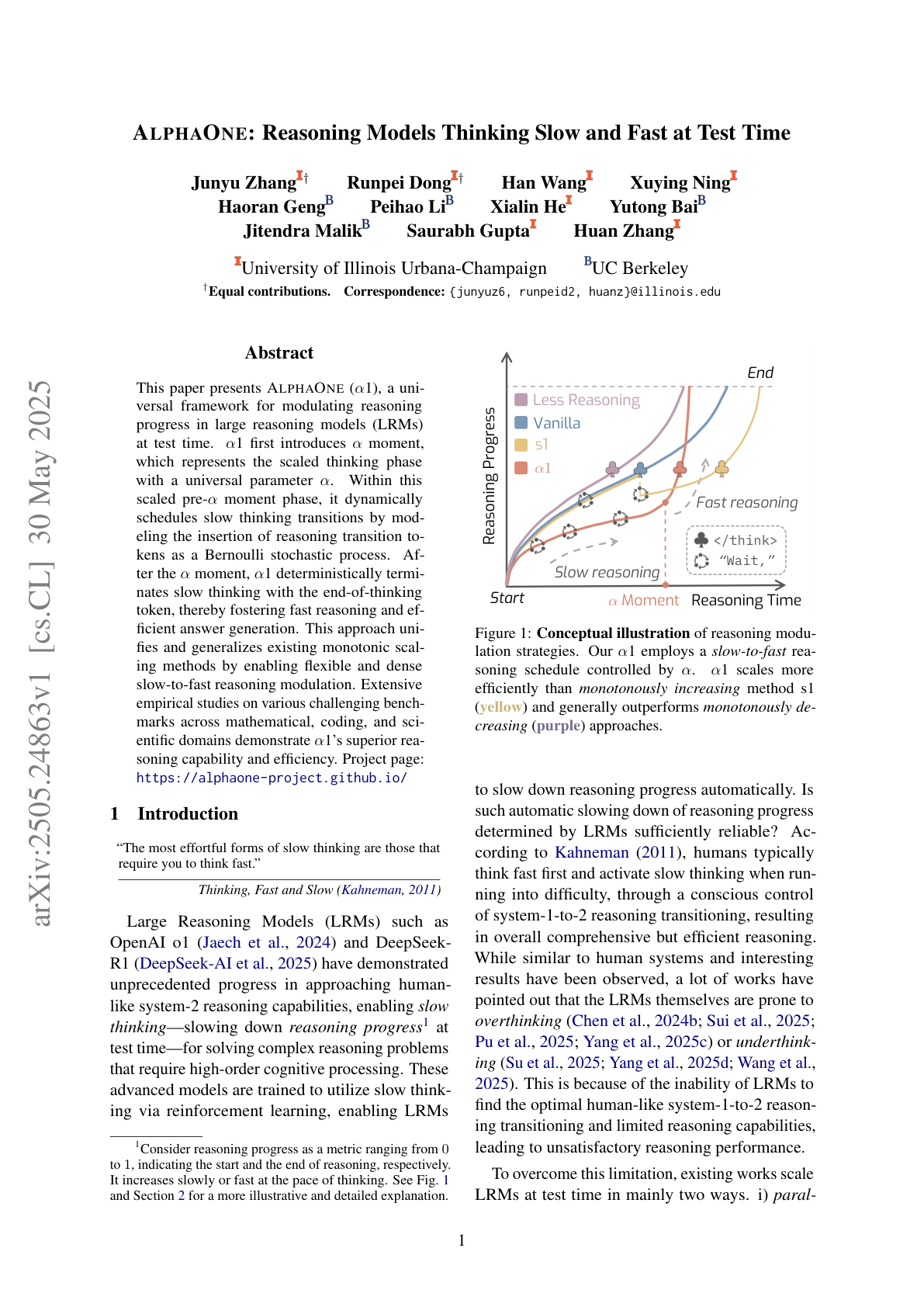
Introduces a universal framework, α1, for modulating the reasoning progress of large reasoning models (LRMs) during inference. Rather than relying on rigid or automatic schedules, α1 explicitly controls when and how models engage in “slow thinking” using a tunable parameter α. The method dynamically inserts “wait” tokens to encourage deeper reasoning and then deterministically ends slow thinking with a “</think>” token to prompt efficient answer generation. This yields better accuracy and efficiency than previous test-time scaling approaches. Key insights:

Spurios Rewards
This work challenges prevailing assumptions about reinforcement learning with verifiable rewards (RLVR) in mathematical reasoning tasks. The authors show that Qwen2.5-Math models can improve significantly under RL, even when trained with spurious or flawed rewards.
Learn to Reason without External Rewards
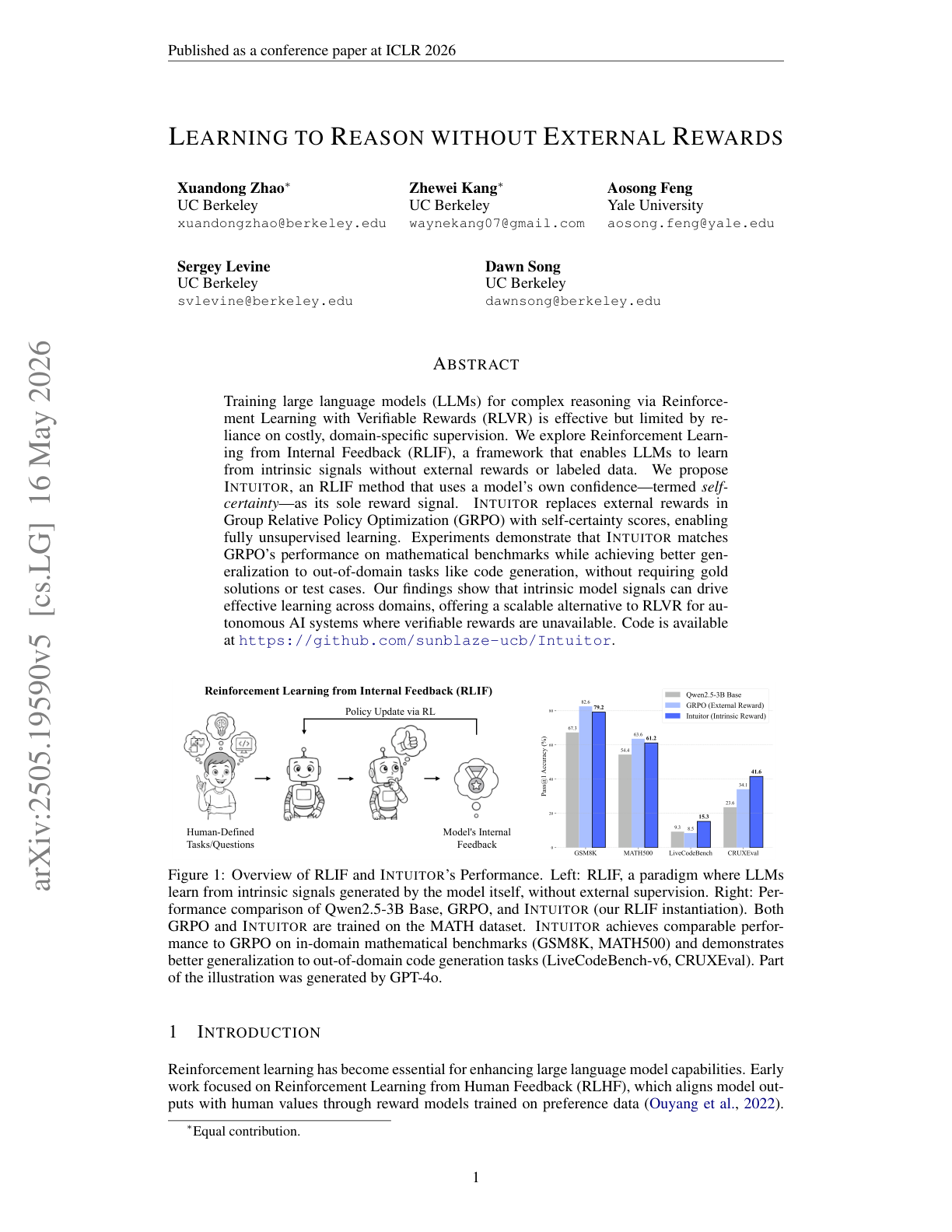
Proposes a method for training LLMs via reinforcement learning without any external rewards or labeled data. Instead, it uses the model’s own self-certainty, a confidence measure based on KL divergence from uniform, as the sole intrinsic reward. This self-improvement strategy, part of the broader Reinforcement Learning from Internal Feedback (RLIF) paradigm, bypasses the limitations of Reinforcement Learning with Verifiable Rewards (RLVR), which requires domain-specific verifiers and gold-standard outputs. Key highlights:
Learn to Reason via Mixture-of-Thought
While most prior approaches train with a single modality and only ensemble during inference, this work introduces Mixture-of-Thought (MoT) to jointly train and infer across modalities, resulting in notable gains in logical reasoning performance. Key findings:
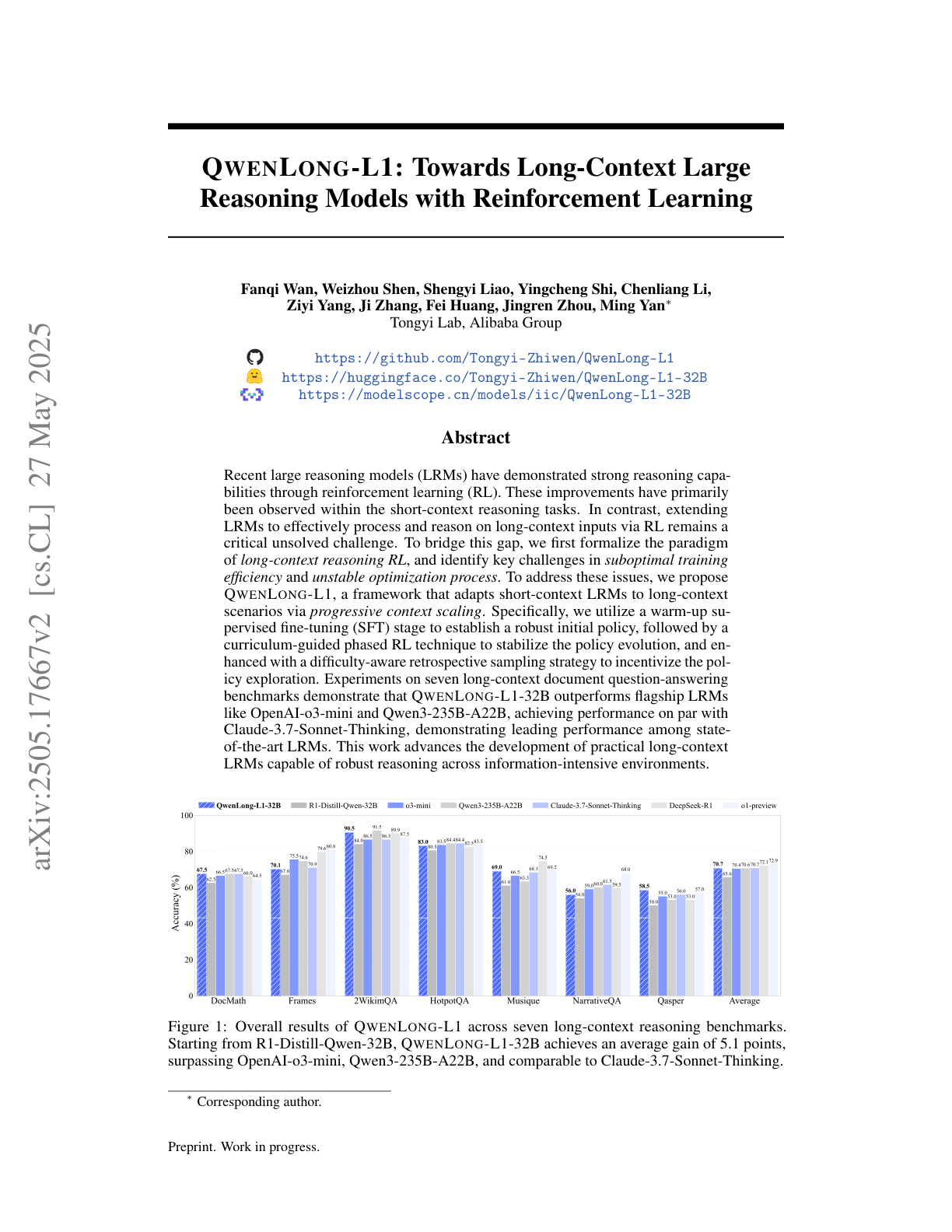
QwenLong-L1
A new reinforcement learning framework that scales large reasoning models (LRMs) from short to long contexts using progressive context scaling and hybrid rewards. It achieves top performance on seven long-context benchmarks, surpassing models like OpenAI-o3-mini and Qwen3-235B-A22B, and matching Claude-3.7-Sonnet-Thinking, demonstrating strong reasoning with up to 120K token inputs.
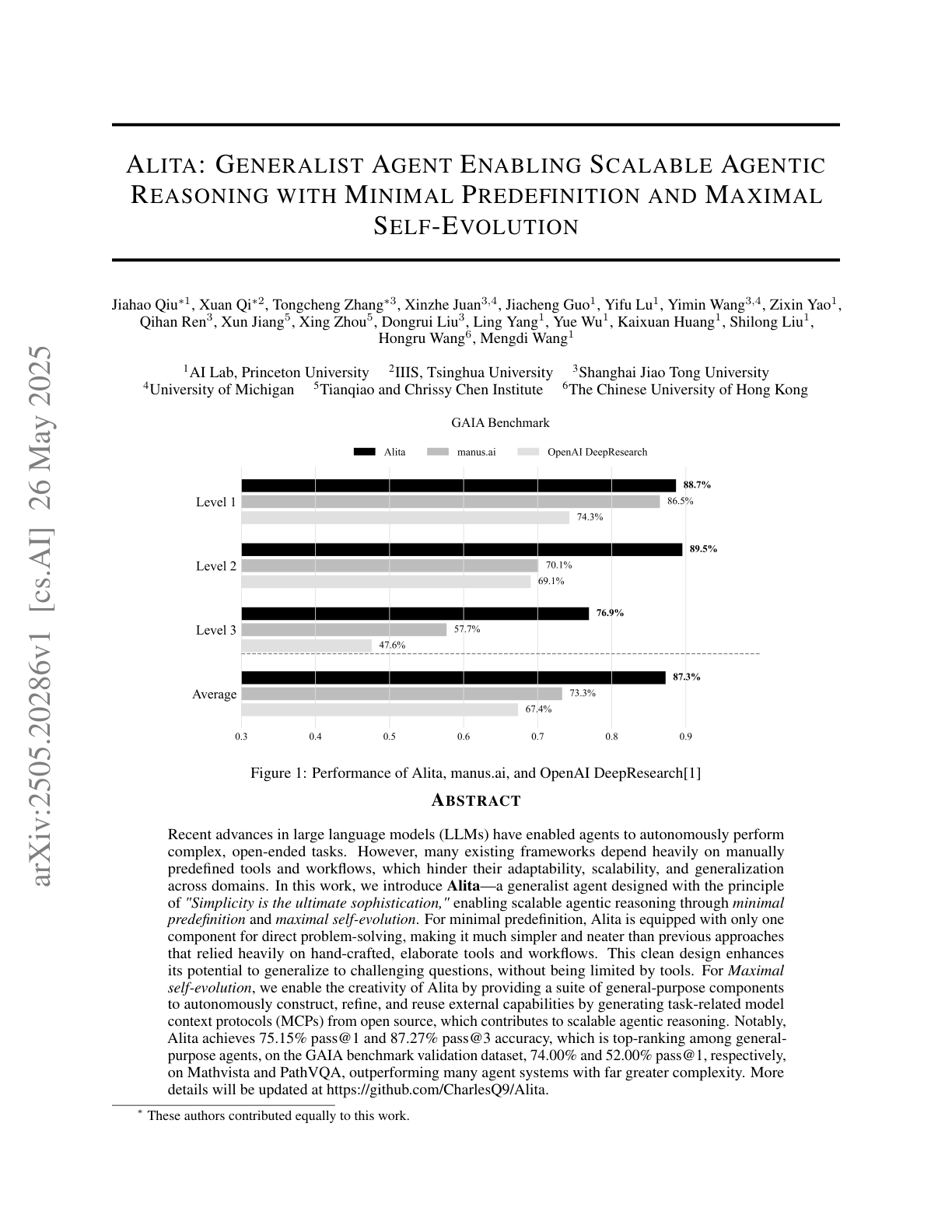
Generalist Agent Enabling Scalable Agentic Reasoning
Proposes Alita, a generalist agent framework that enables scalable agentic reasoning through minimal predefinition and maximal self-evolution. Unlike traditional agents reliant on handcrafted tools, Alita autonomously constructs reusable MCPs (Model Context Protocols) using web search and code synthesis, outperforming more complex systems like OpenAI DeepResearch and OctoTools on GAIA, MathVista, and PathVQA benchmarks.
Visual Planning
Proposes a novel reasoning paradigm that replaces language-based planning with image-based reasoning. The authors argue that language is not always the optimal medium for tasks involving spatial or physical reasoning. They introduce Visual Planning, where reasoning is executed as a sequence of visual states (images) without any text mediation, allowing models to “think” directly in images. This is realized through a reinforcement learning framework called VPRL (Visual Planning via Reinforcement Learning), which trains a vision-only model (LVM-3B) to plan using images. Key contributions and findings:
J1
Introduces a novel training approach for LLMs to act as evaluators (LLM-as-a-Judge) by explicitly incentivizing thoughtful reasoning during judgment. Instead of relying solely on prompting or preference fine-tuning, J1 employs online reinforcement learning with verifiable rewards to teach models to think through evaluations systematically. Key insights:
The Pitfalls of Reasoning for Instruction- Following in LLMs
Explores an unexpected flaw in reasoning-augmented large language models (RLLMs): while chain-of-thought (CoT) prompting often boosts performance on complex reasoning tasks, it can degrade instruction-following accuracy. The authors evaluate 15 models (e.g., GPT, Claude, LLaMA, DeepSeek) on two instruction-following benchmarks and find that CoT prompting consistently reduces performance across nearly all models and datasets. Key findings:
Towards a Deeper Understanding of Reasoning in LLMs
This paper investigates whether LLMs can adapt and reason in dynamic environments, moving beyond static benchmarks. Using the SmartPlay benchmark—a suite of four interactive games that require diverse cognitive skills—the authors evaluate three prompting strategies: self-reflection, heuristic mutation (via an Oracle), and planning. They test these methods across models of varying size (Llama3-8B to Llama3.3-70B) and draw several conclusions on how model scale and prompting interact with task complexity. Key findings:
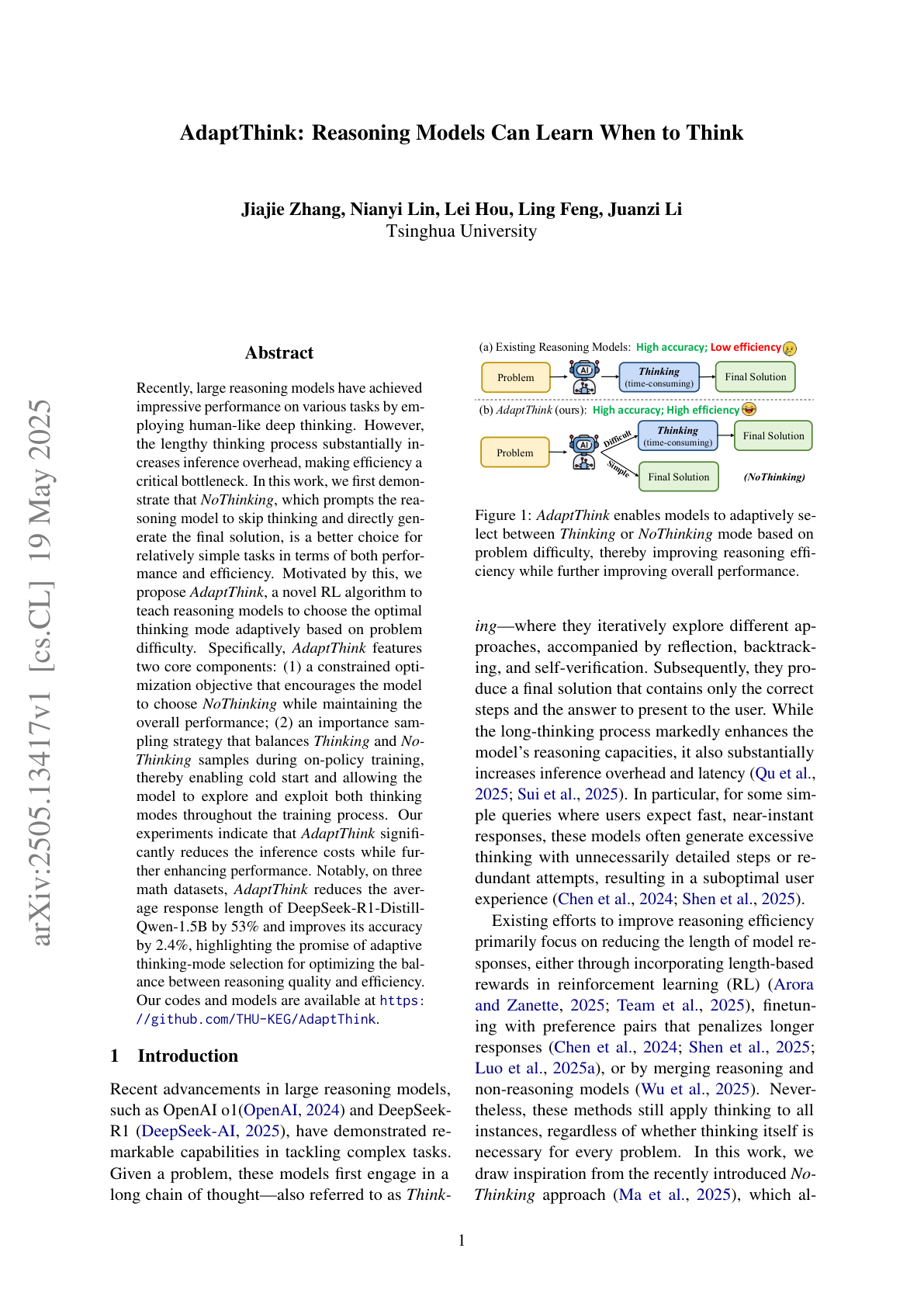
AdaptThink
This paper introduces AdaptThink, an RL framework designed to help reasoning models decide when to use detailed chain-of-thought reasoning (“Thinking”) versus directly producing an answer (“NoThinking”), based on task difficulty. This approach challenges the prevailing assumption that deep reasoning should be applied uniformly across all problems, showing that skipping the “thinking” step often yields better efficiency and even higher accuracy on simpler tasks. Key insights:
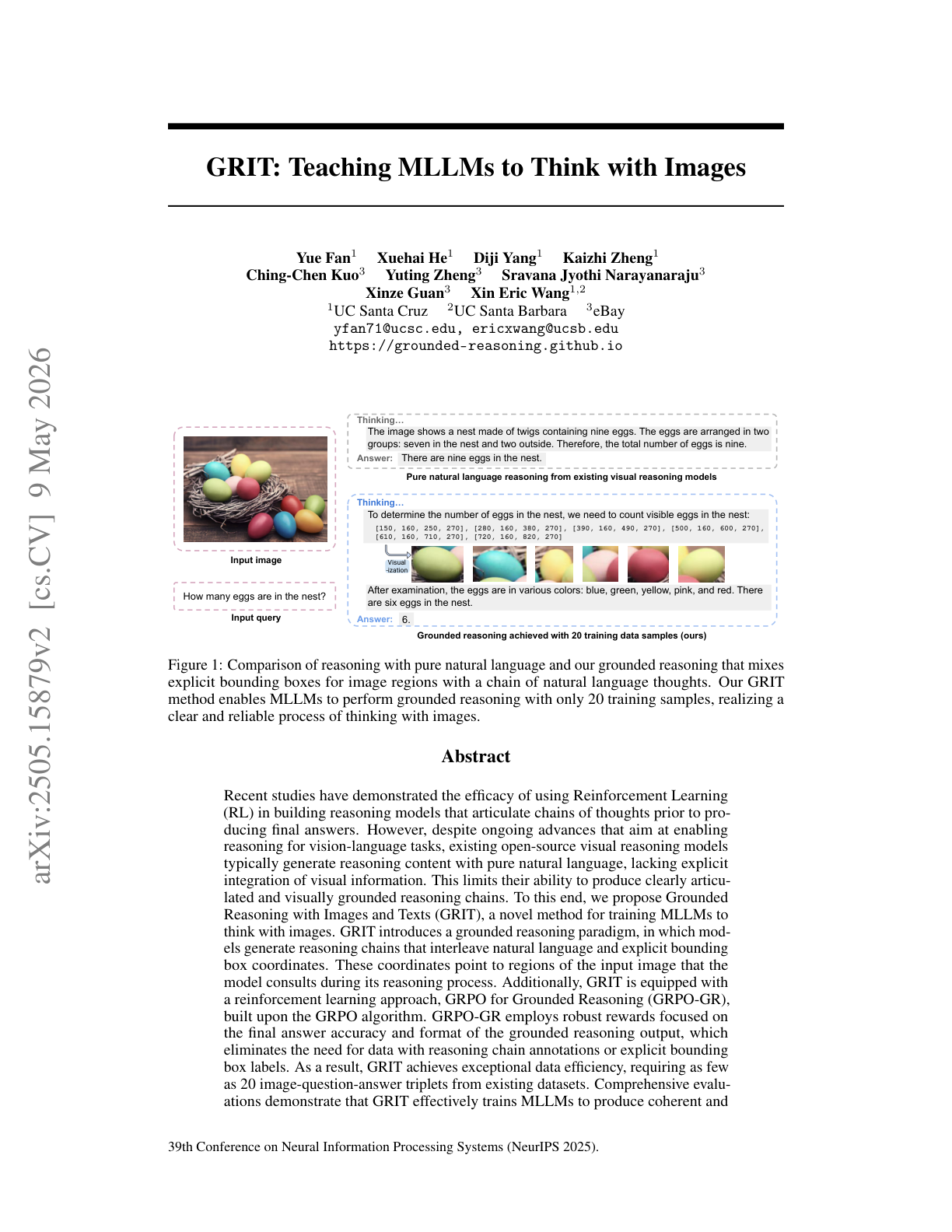
Teaching MLLMs to Think with Images
GRIT is a new method that enables MLLMs to perform grounded visual reasoning by interleaving natural language with bounding box references. Using a reinforcement learning approach (GRPO-GR), GRIT achieves strong reasoning and grounding performance with as few as 20 image-question-answer triplets, outperforming baselines in both accuracy and visual coherence.
RL for Reasoning in LLMs with One Training Example
This paper shows that Reinforcement Learning with Verifiable Rewards (RLVR) can significantly improve mathematical reasoning in LLMs even when trained with just a single example. On the Qwen2.5-Math-1.5B model, one-shot RLVR improves accuracy on the MATH500 benchmark from 36.0% to 73.6%, nearly matching performance achieved with over 1,200 examples. Two-shot RLVR (with two examples) even slightly surpasses that, matching results from full 7.5k example training.
Nemotron-Research-Tool-N1
Introduces Tool-N1, a family of tool-using LLMs trained using a rule-based reinforcement learning (R1-style RL) approach, without reliance on supervised reasoning trajectories. The key idea is to enable models to learn to invoke external tools correctly through binary feedback based on functional correctness and format adherence, rather than step-by-step imitation.
CellVerse
Introduces a benchmark to evaluate LLMs on single-cell biology tasks by converting multi-omics data into natural language. While generalist LLMs like DeepSeek and GPT-4 families show some reasoning ability, none significantly outperform random guessing on key tasks like drug response prediction, exposing major gaps in biological understanding by current LLMs.
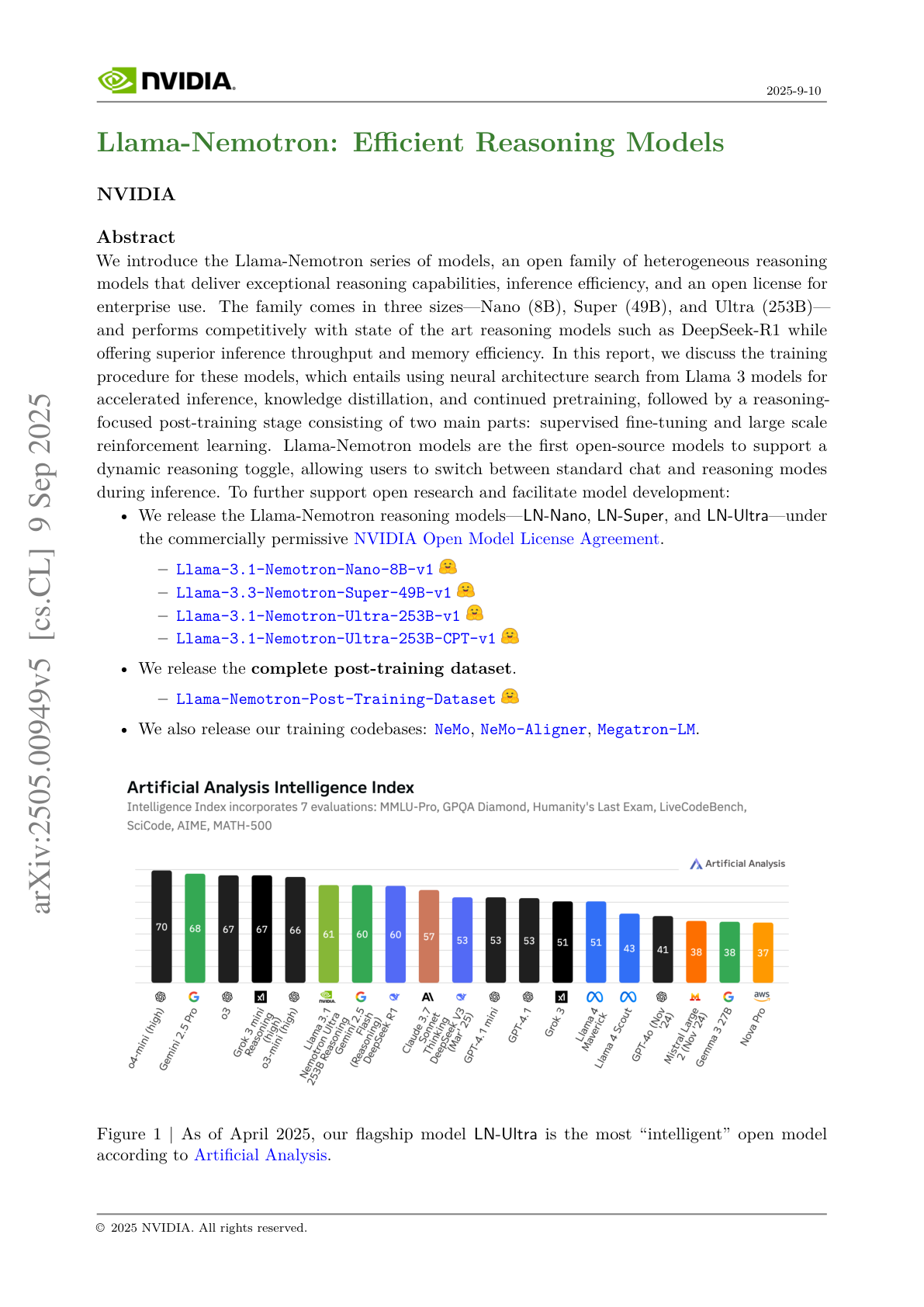
Llama-Nemotron
NVIDIA introduces the Llama-Nemotron model series, LN-Nano (8B), LN-Super (49B), and LN-Ultra (253B), a family of open, efficient, and high-performing reasoning models. These models rival or outperform DeepSeek-R1 on various benchmarks while offering significantly better inference throughput and memory efficiency. LN-Ultra is noted as the most "intelligent" open model by Artificial Analysis. A key innovation is a dynamic reasoning toggle ("detailed thinking on/off") that allows users to control reasoning behavior at inference time. Highlights:
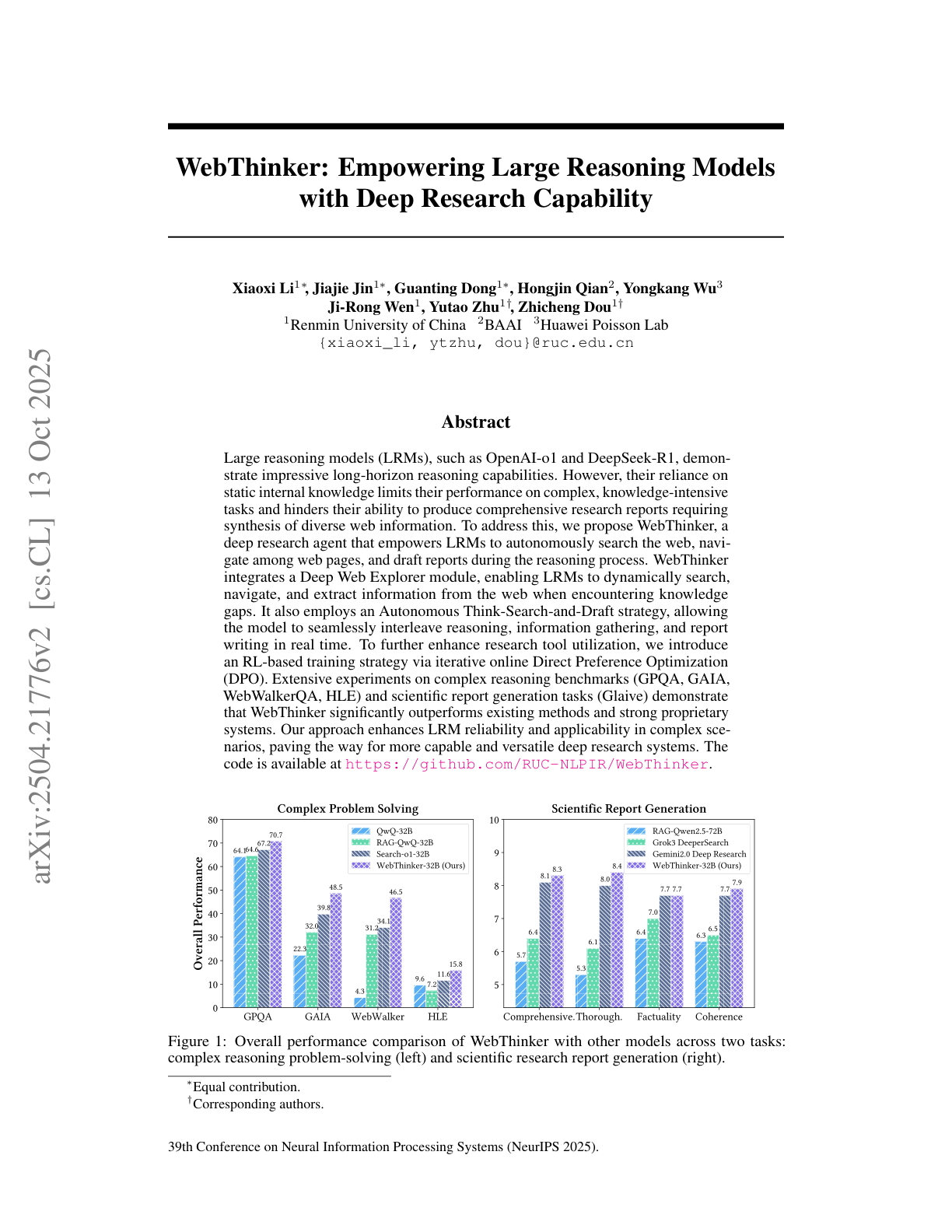
WebThinker
This paper introduces a reasoning agent framework that equips large reasoning models (LRMs) with autonomous web exploration and report writing abilities to overcome limitations of static internal knowledge. WebThinker integrates a Deep Web Explorer module and an Autonomous Think-Search-and-Draft strategy that lets models search the web, reason through tasks, and generate comprehensive outputs simultaneously. It also incorporates an RL-based training loop using online DPO to improve tool usage. The system supports two modes: complex problem solving and scientific report generation. Key points:
Reward Modeling as Reasoning
This work proposes a new class of reward models, called ReasRMs, that reformulate reward modeling as a reasoning task. The authors introduce RM-R1, a family of generative reward models that produce interpretable reasoning traces and rubrics during preference judgments. Instead of relying on scalar scores or shallow generation, RM-R1 models leverage structured reasoning and reinforcement learning to improve both interpretability and performance across benchmarks.