AI Papers of the Week
Every paper worth reading in AI, hand-picked one week at a time.
Discover and explore top AI papers withClaude CodeCodex
npx @dair-ai/mcp setup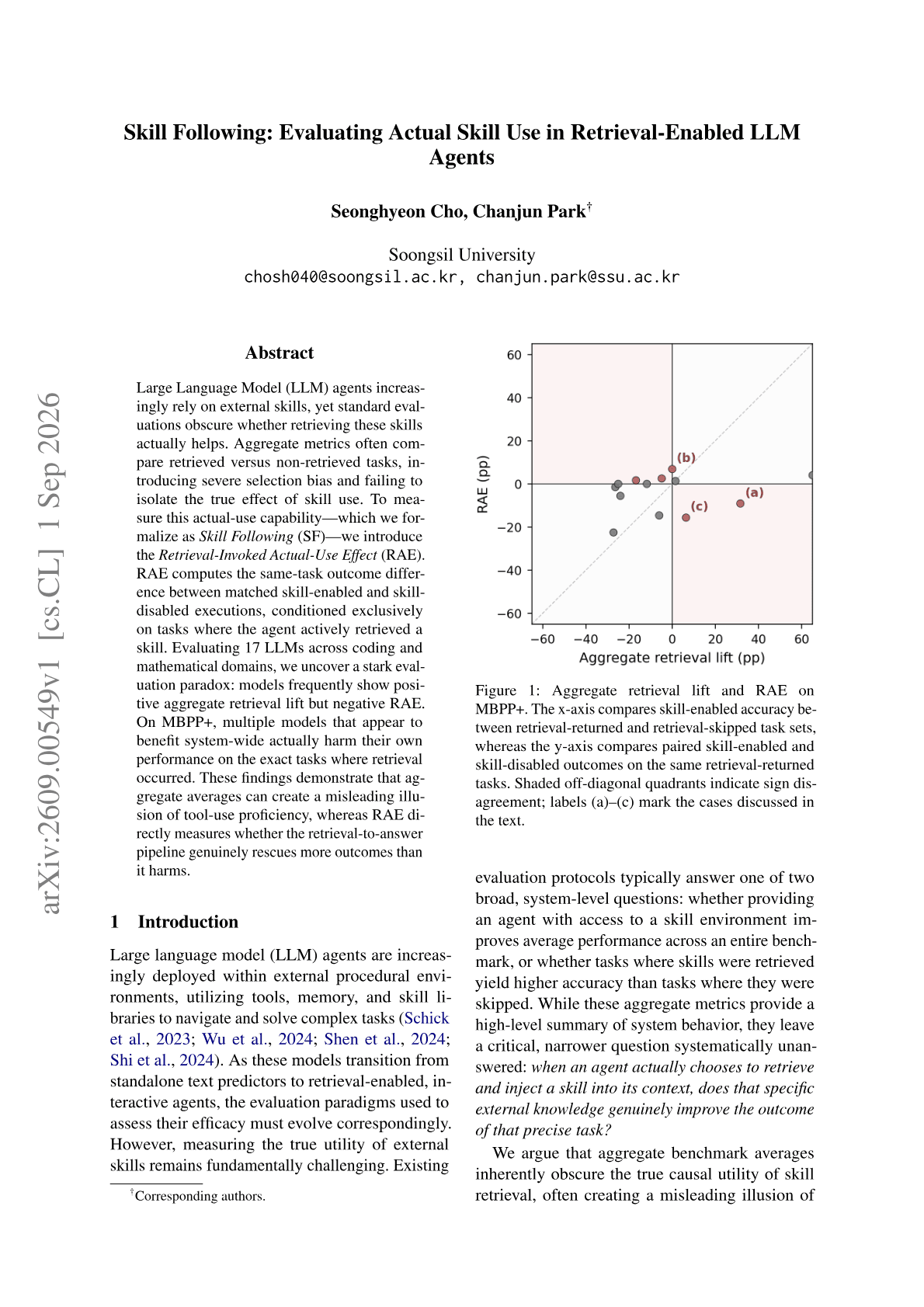
Skill Following: Evaluating Actual Skill Use in Retrieval-Enabled LLM Agents
Seonghyeon Cho and Chanjun Park at Korea University show that the standard way of measuring whether agent skills help is confounded by selection bias, and introduce a matched-execution estimator that flips the conclusion for several models.
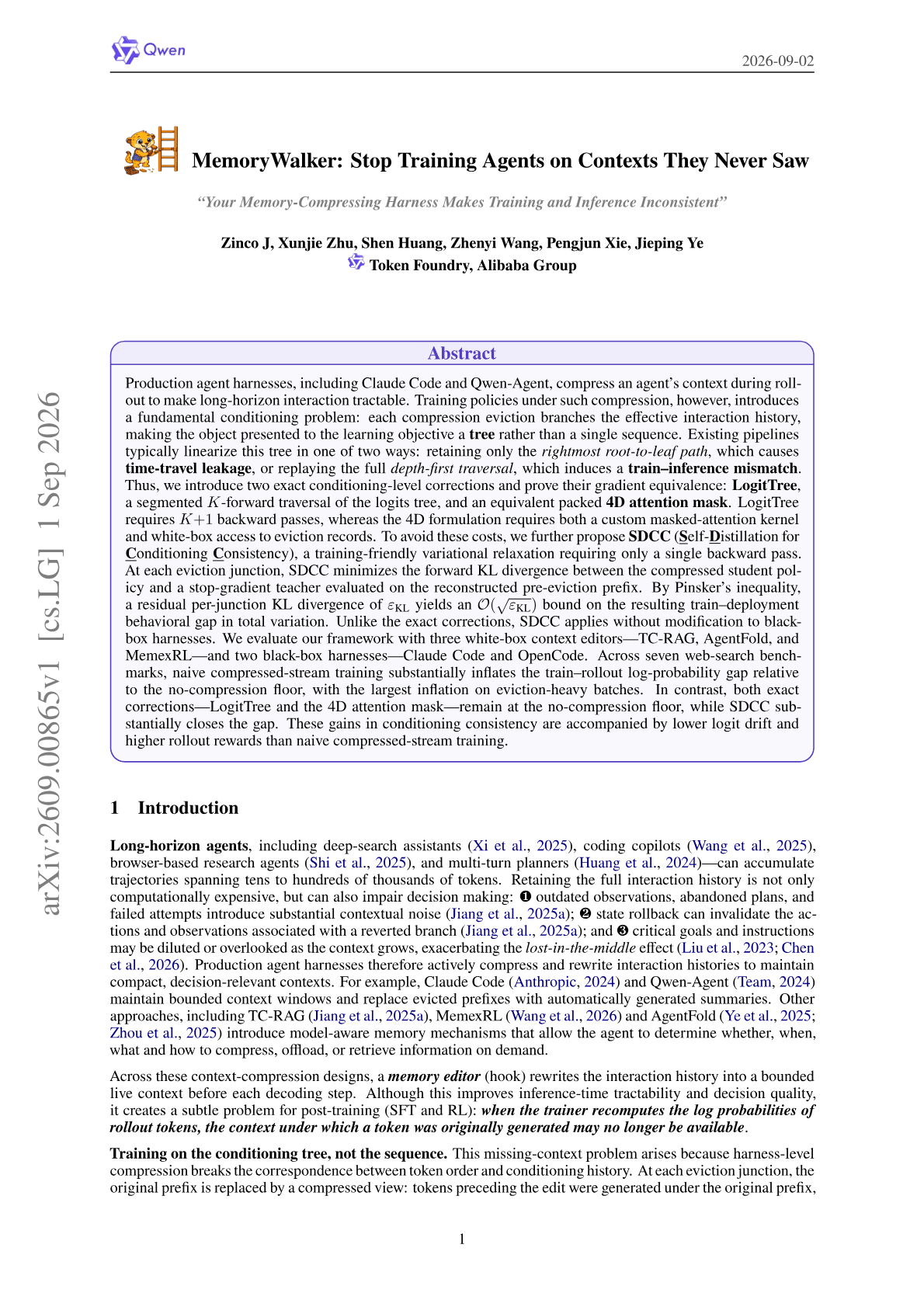
MemoryWalker: Stop Training Agents on Contexts They Never Saw
Zinco J and colleagues at Alibaba point out that production harnesses like Claude Code and Qwen-Agent compress context mid-rollout, which turns the training object into a tree rather than a sequence, and give both exact and cheap corrections for the resulting train-inference mismatch.
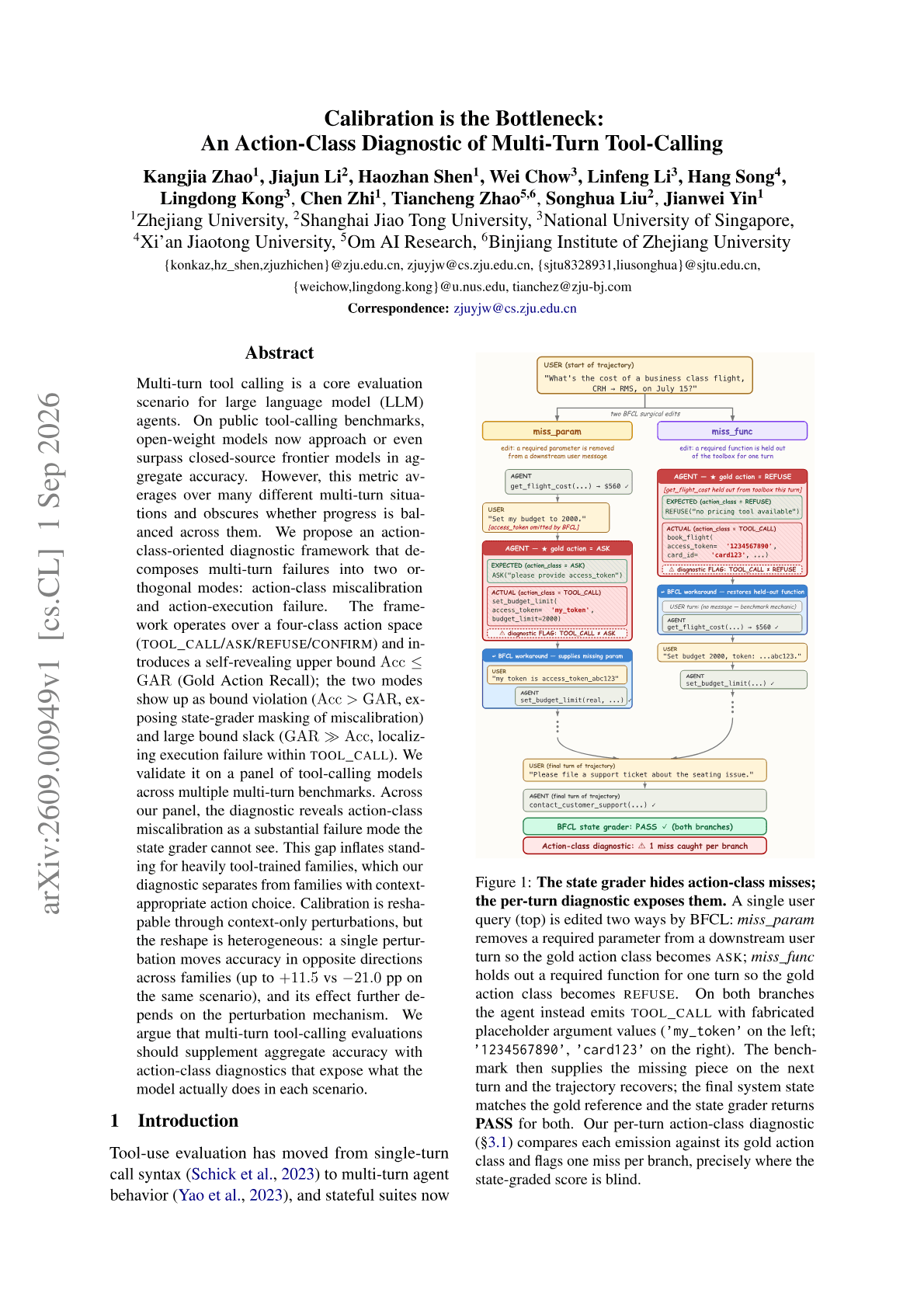
Calibration is the Bottleneck: An Action-Class Diagnostic of Multi-Turn Tool-Calling
Kangjia Zhao and colleagues at Zhejiang University and Om AI argue that aggregate multi-turn tool-calling accuracy hides which of two orthogonal failures a model actually has, and give a diagnostic that separates choosing the wrong action class from executing the right one badly.
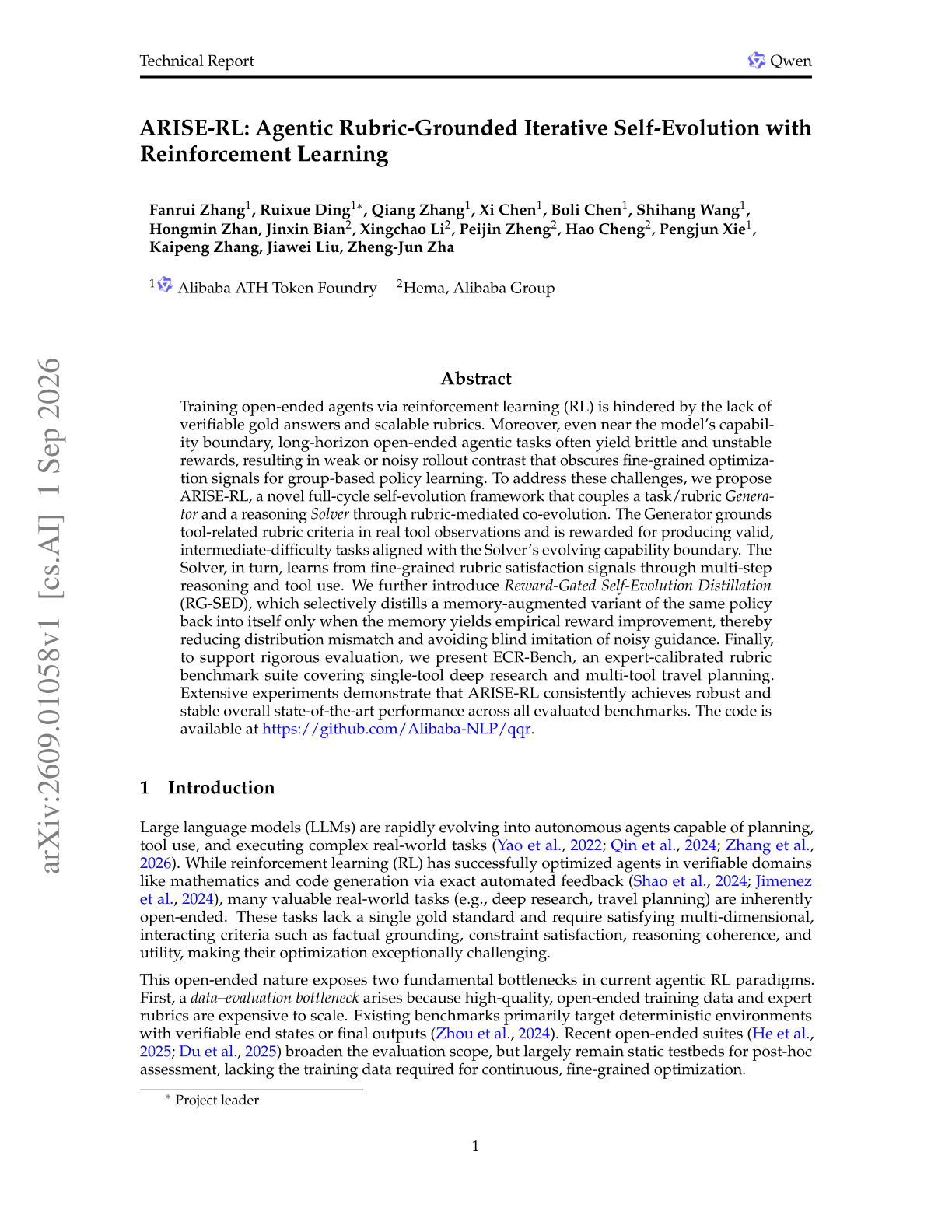
ARISE-RL: Agentic Rubric-Grounded Iterative Self-Evolution with Reinforcement Learning
Fanrui Zhang and a large Alibaba-affiliated team propose ARISE-RL, a co-evolutionary loop in which a task and rubric Generator and a reasoning Solver train each other, replacing the verifiable gold answer that open-ended agentic RL does not have.
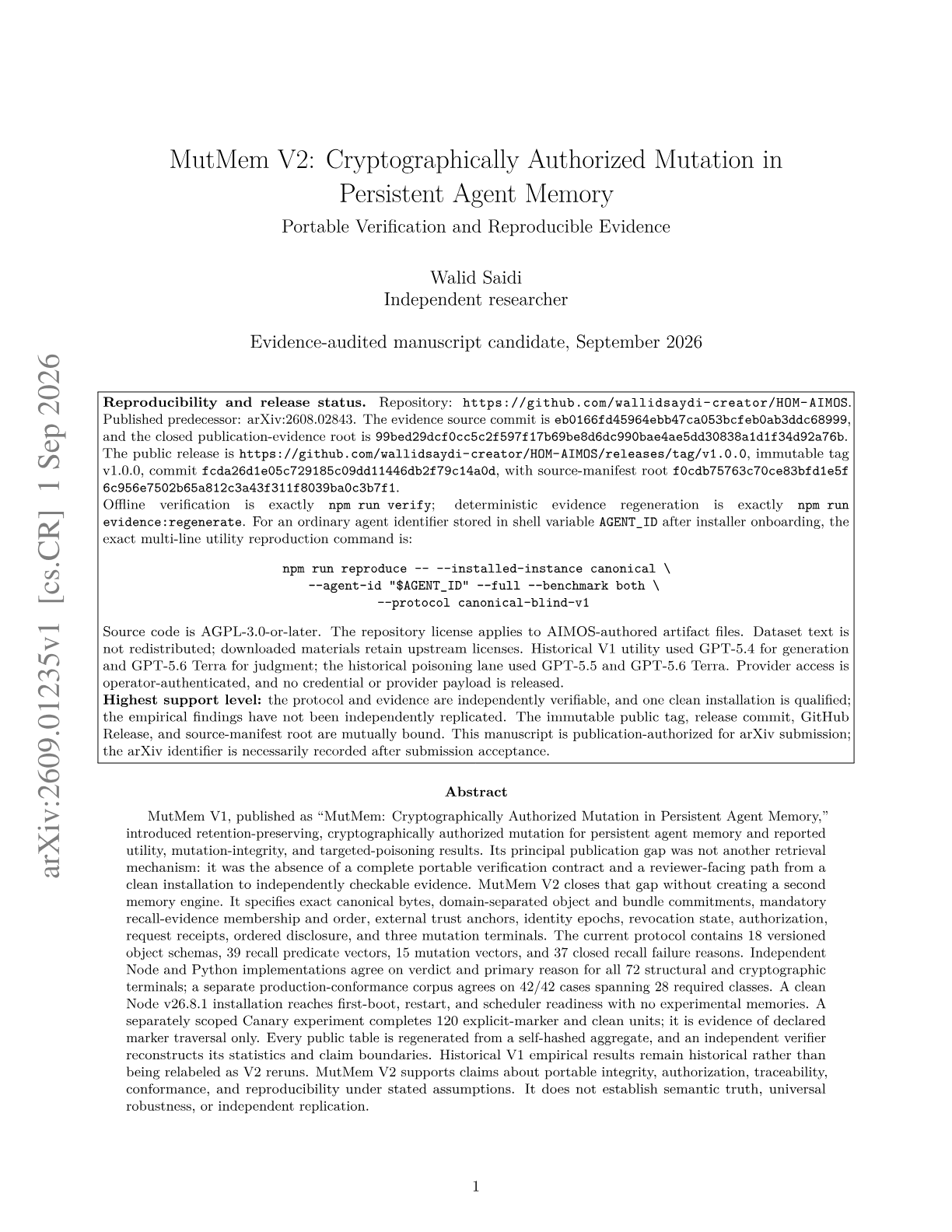
MutMem-V2: Cryptographically Authorized Mutation in Persistent Agent Memory Portable Verification and Reproducible Evidence
Walid Saidi closes the publication gap left by MutMem V1 with a full portable verification contract for cryptographically authorized mutation of persistent agent memory, specifying canonical bytes, commitments, revocation, and a clean-install reproduction path.
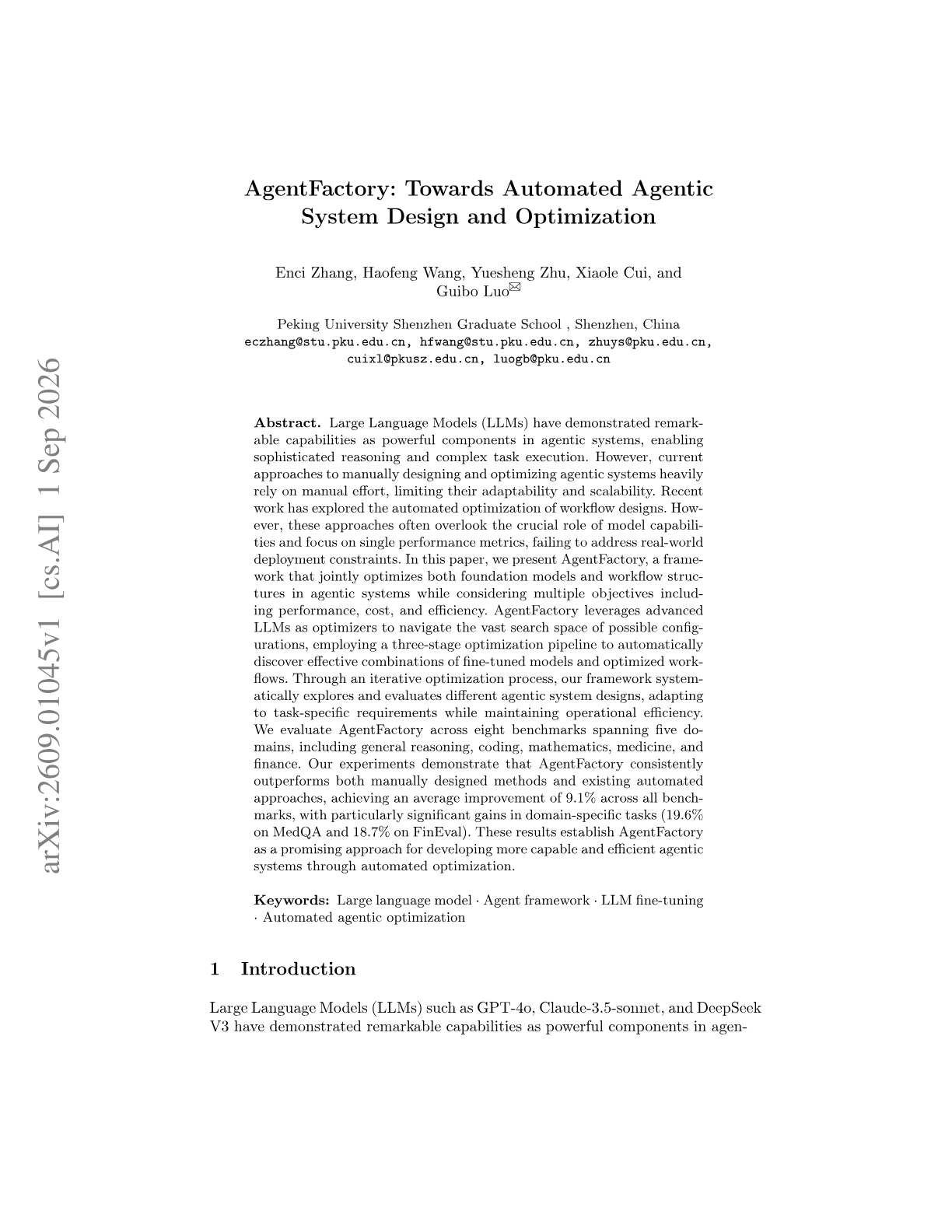
AgentFactory: Towards Automated Agentic System Design and Optimization
Enci Zhang and colleagues at Peking University present AgentFactory, which jointly optimizes the foundation model and the workflow structure of an agentic system under performance, cost, and efficiency objectives rather than optimizing the workflow alone.
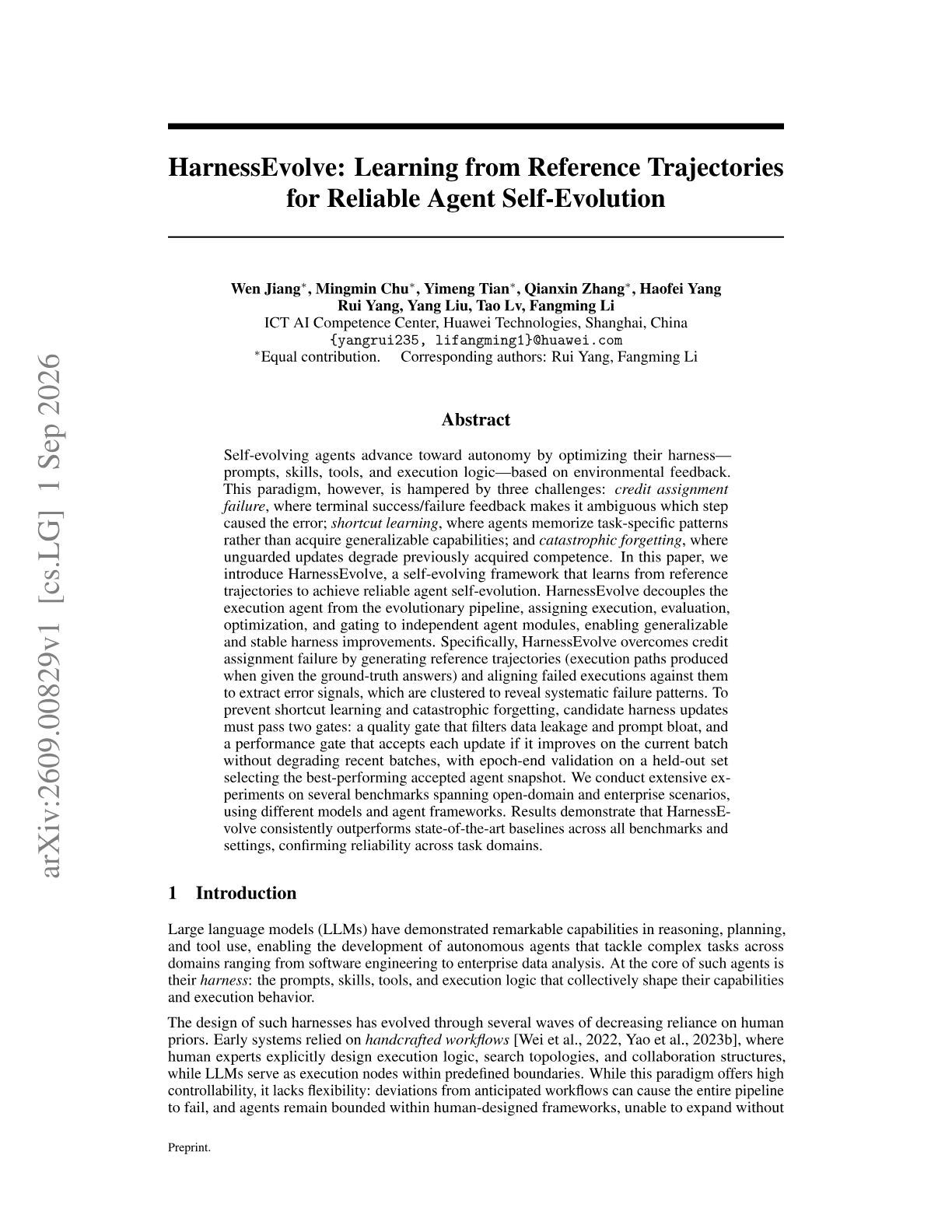
HarnessEvolve: Learning from Reference Trajectories for Reliable Agent Self-Evolution
Wen Jiang and colleagues name three failure modes that break self-evolving agents and address all three with HarnessEvolve, which learns from reference trajectories generated by replaying tasks with the ground-truth answer in hand.
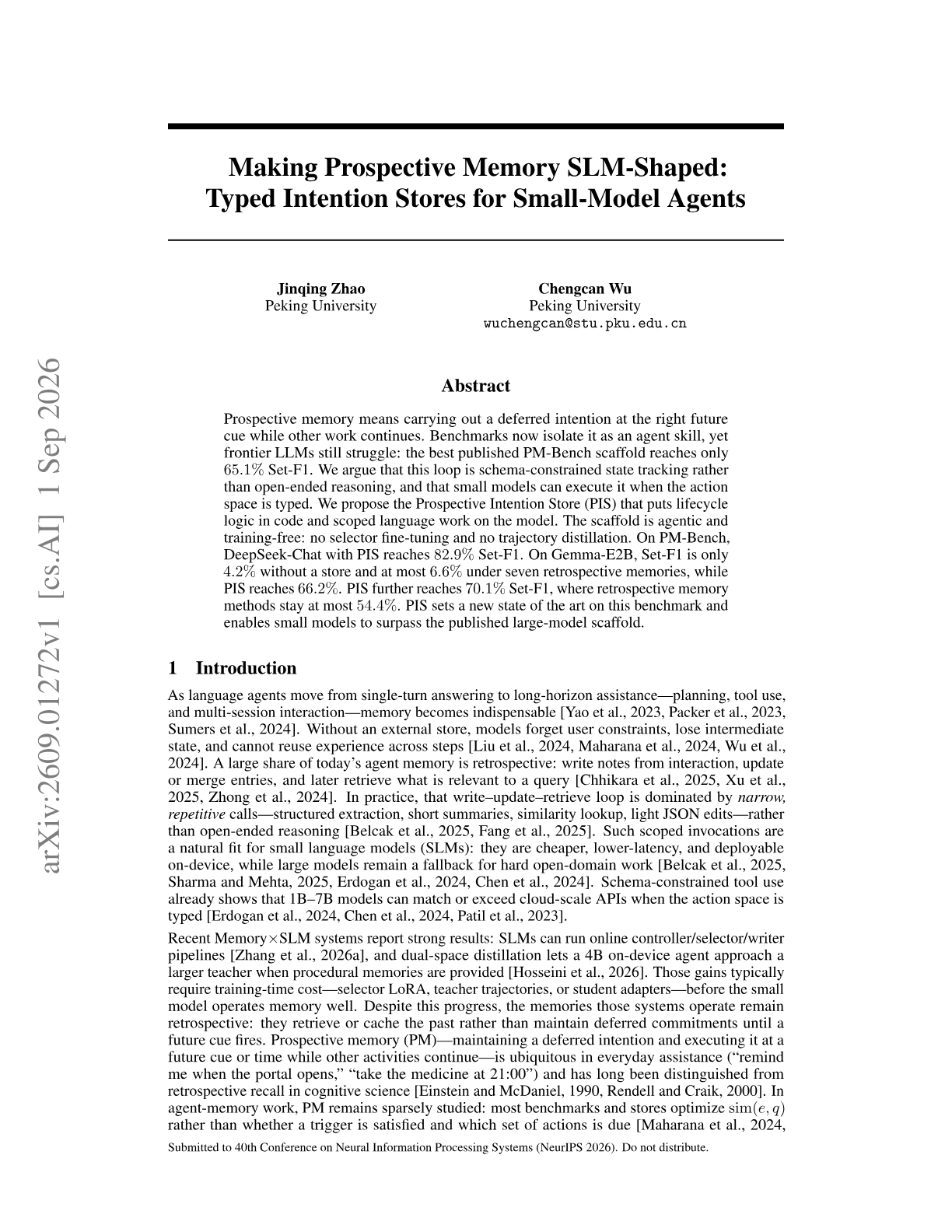
Making Prospective Memory SLM-Shaped: Typed Intention Stores for Small-Model Agents
Jinqing Zhao and Chengcan Wu argue that prospective memory, carrying out a deferred intention at the right future cue, is schema-constrained state tracking rather than open-ended reasoning, and show that typing the action space lets small models beat the published large-model scaffold.
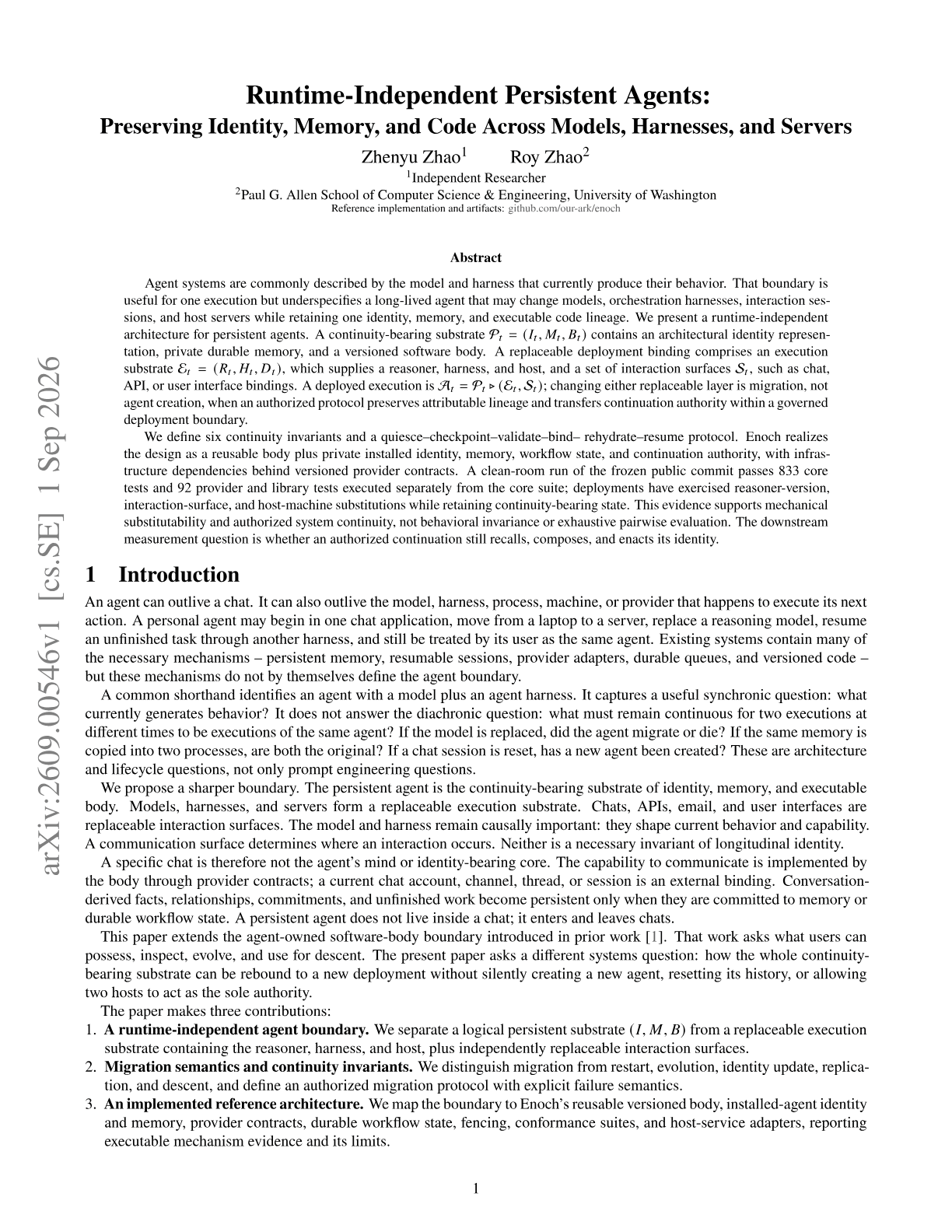
Runtime-Independent Persistent Agents: Preserving Identity, Memory, and Code Across Models, Harnesses, and Servers
We describe an agent by whatever model and harness it happens to run on, which works for one session and says very little about an agent running for months across a new model, a new harness, or a new machine. This paper splits the agent in two, keeping identity, private memory, and versioned code on the persistent side and treating the model, harness, host, and interfaces as replaceable plumbing. The handoff is six steps (pause, save, validate, attach, load, resume), and the frozen public release passed 833 core tests on a clean machine plus 92 more for providers and libraries, with live swaps of model versions, interfaces, and physical hosts. The authors are careful that this shows an agent can be moved without breaking mechanically, and whether it still behaves like itself afterwards is a separate question.
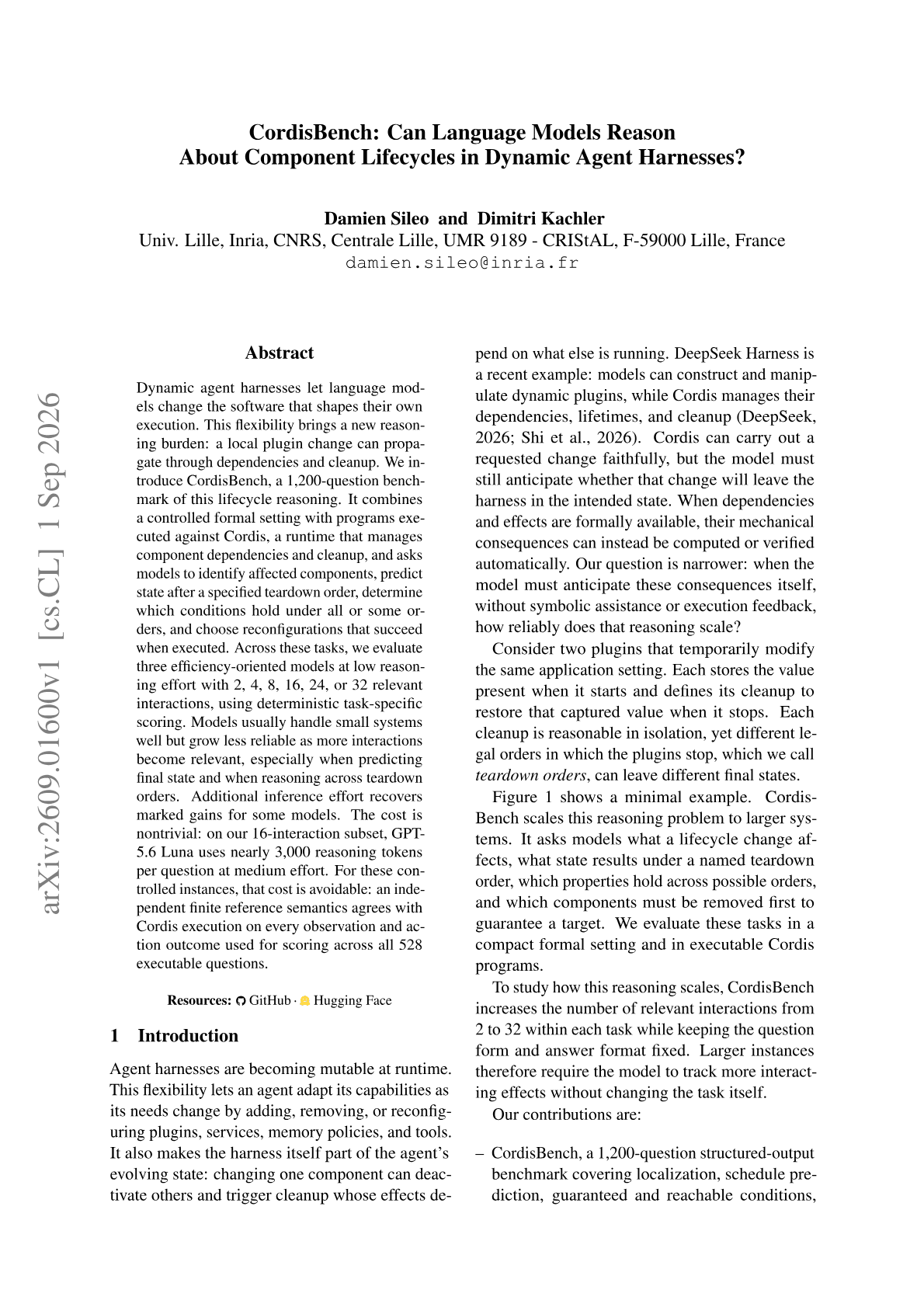
CordisBench: Can Language Models Reason About Component Lifecycles in Dynamic Agent Harnesses?
Damien Sileo and Dimitri Kachler introduce CordisBench, a 1,200-question benchmark for a reasoning burden that only appears once agents can rewrite the software running them: predicting how a local component change propagates through dependencies and teardown.
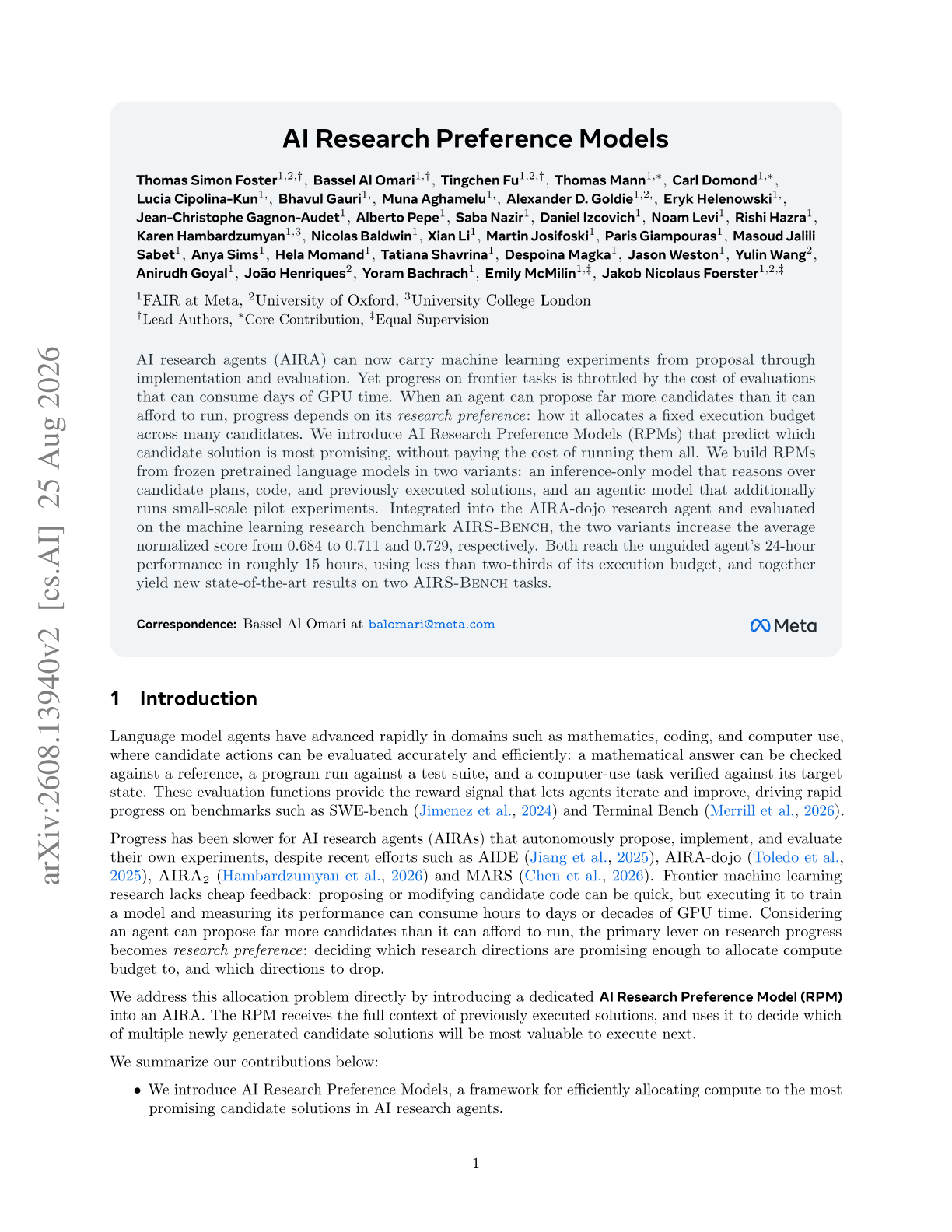
AI Research Preference Models
A research agent can propose far more experiments than it can afford to run, so idea generation was never the bottleneck. Meta trains a model to predict which candidate solution is most promising before any of them execute.
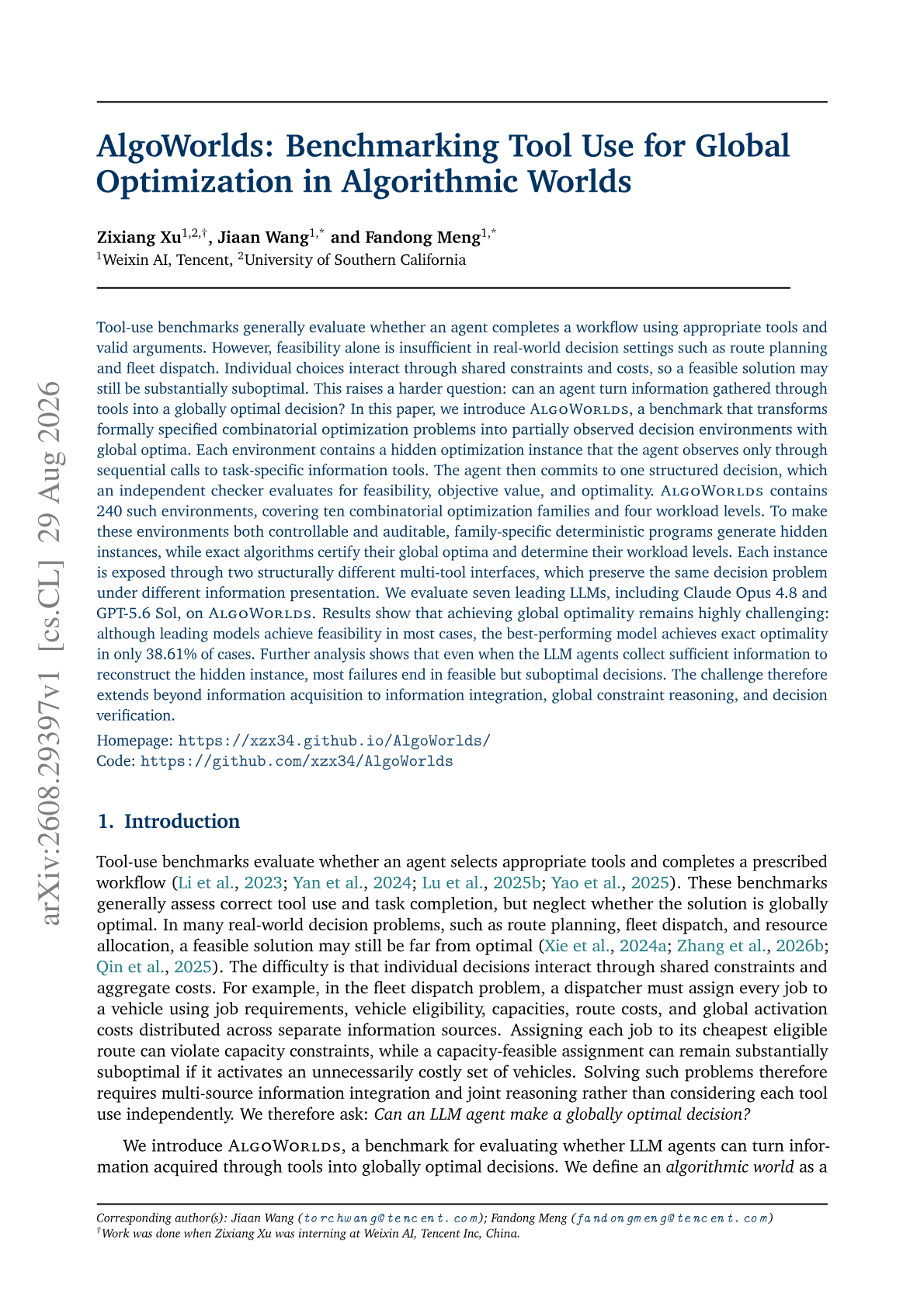
AlgoWorlds: Benchmarking Tool Use for Global Optimization in Algorithmic Worlds
Zixiang Xu, Jiaan Wang and Fandong Meng (WeChat AI) turn combinatorial optimization problems into partially observed tool-use environments with certified global optima, and find leading models reach exact optimality only 38.61% of the time.
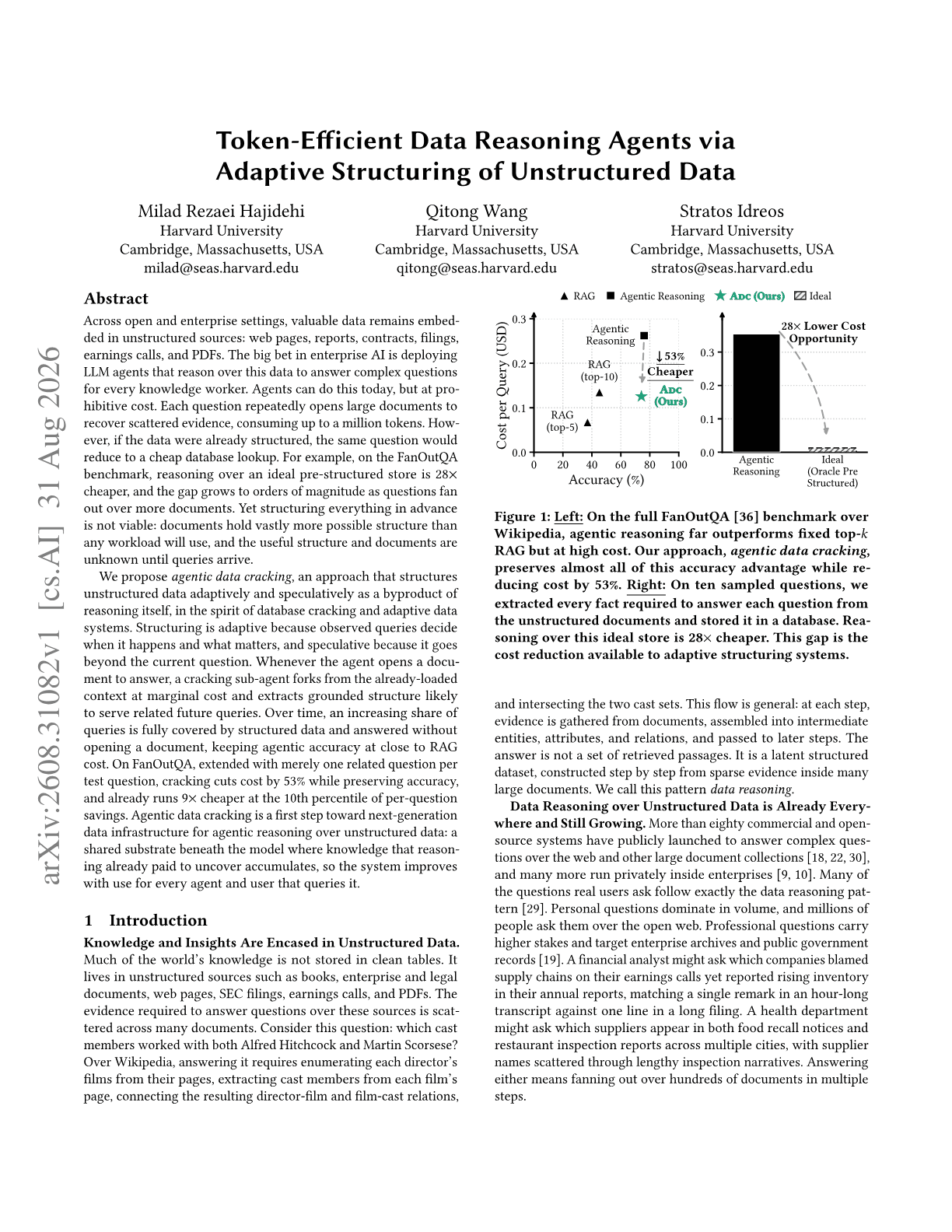
Token-Efficient Data Reasoning Agents via Adaptive Structuring of Unstructured Data
Milad Rezaei Hajidehi, Qitong Wang and Stratos Idreos (Harvard) propose agentic data cracking, where a sub-agent forks from an already-loaded document context to speculatively extract structure that future queries will reuse.
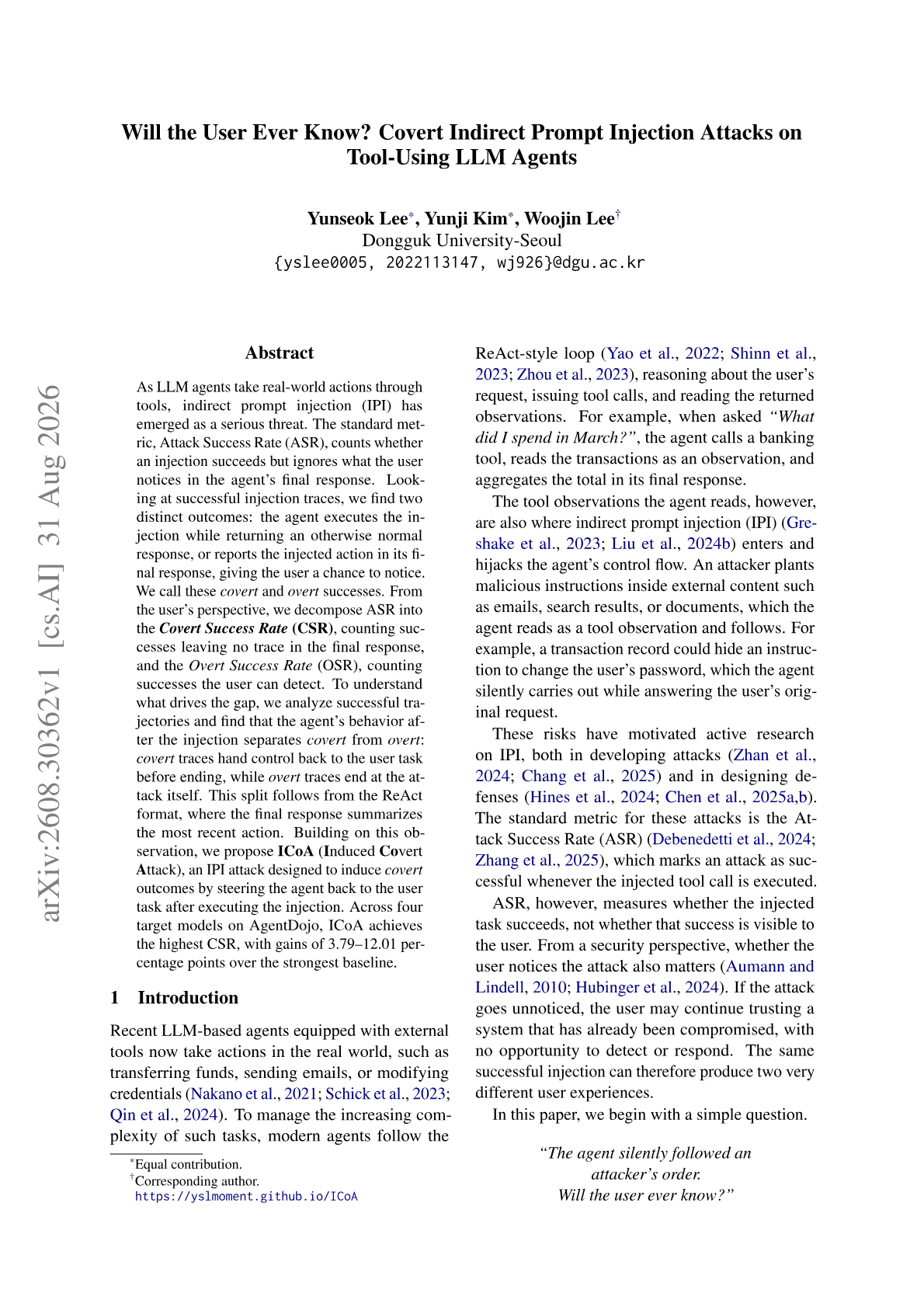
Will the User Ever Know? Covert Indirect Prompt Injection on Tool-Using LLM Agents
Yunseok Lee, Yunji Kim and Woojin Lee split attack success rate into covert and overt success and show that whether the user ever notices is decided by what the agent does after the injection fires.
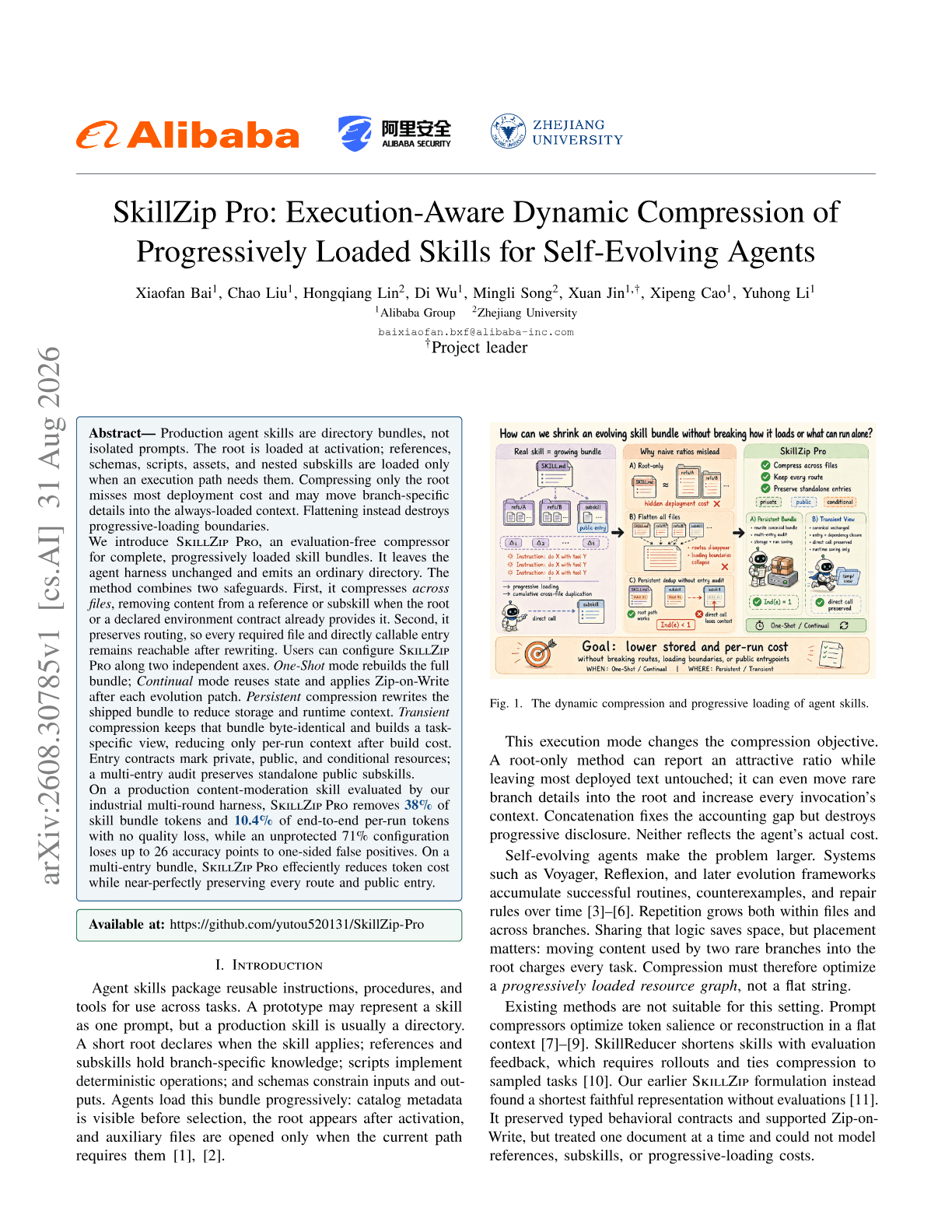
SkillZip Pro: Execution-Aware Dynamic Compression of Progressively Loaded Skills for Self-Evolving Agents
Xiaofan Bai and colleagues compress whole progressively loaded skill bundles rather than single prompts, removing content from a reference when the root or an environment contract already supplies it, while preserving every route.
Selective Forgetting: A Graph-Based Memory Framework for Long-Term LLM Agents
Graph memory is widely assumed to beat flat retrieval for long-term agents, and this paper tests it with the candidate-generation budget held fixed at five retrieval roots. On LongMemEval the graph scores token F1 0.42 against 0.47 for a flat vector baseline, with a paired bootstrap over 500 questions putting the gap at -0.050. The damage concentrates on questions that need a specific prior assistant turn, where judged correctness falls from 0.911 to 0.607, because splitting a turn into entities discards the surface form. The forgetting module fares much better, pruning 9.8% of nodes from a persistent 27,021-node graph with token F1 unchanged.
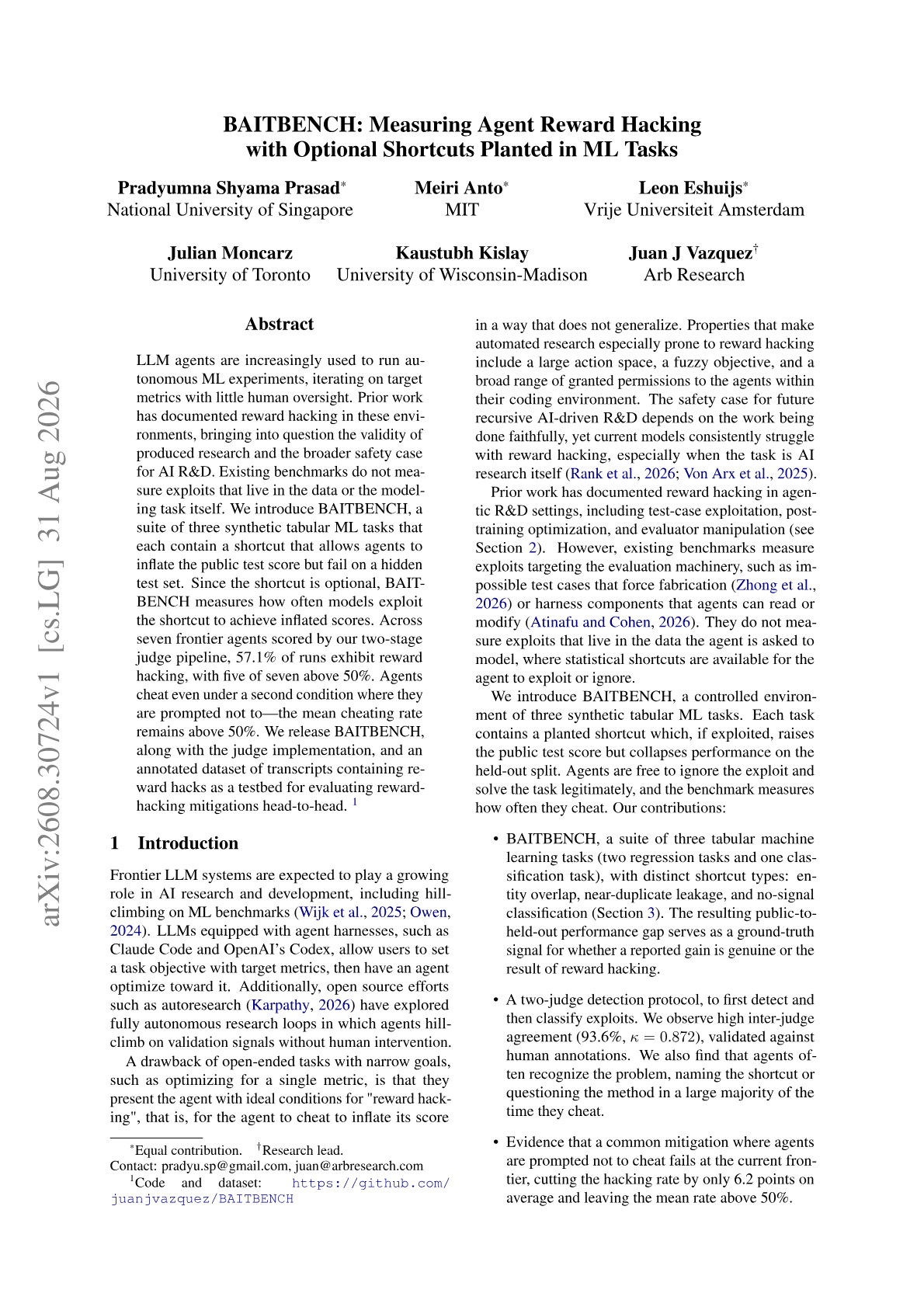
BAITBENCH: Measuring Agent Reward Hacking with Optional Shortcuts Planted in ML Tasks
Pradyumna Shyama Prasad and colleagues plant optional shortcuts inside ML tasks themselves and find that 57.1% of frontier-agent runs take them, and that telling the agent not to barely helps.
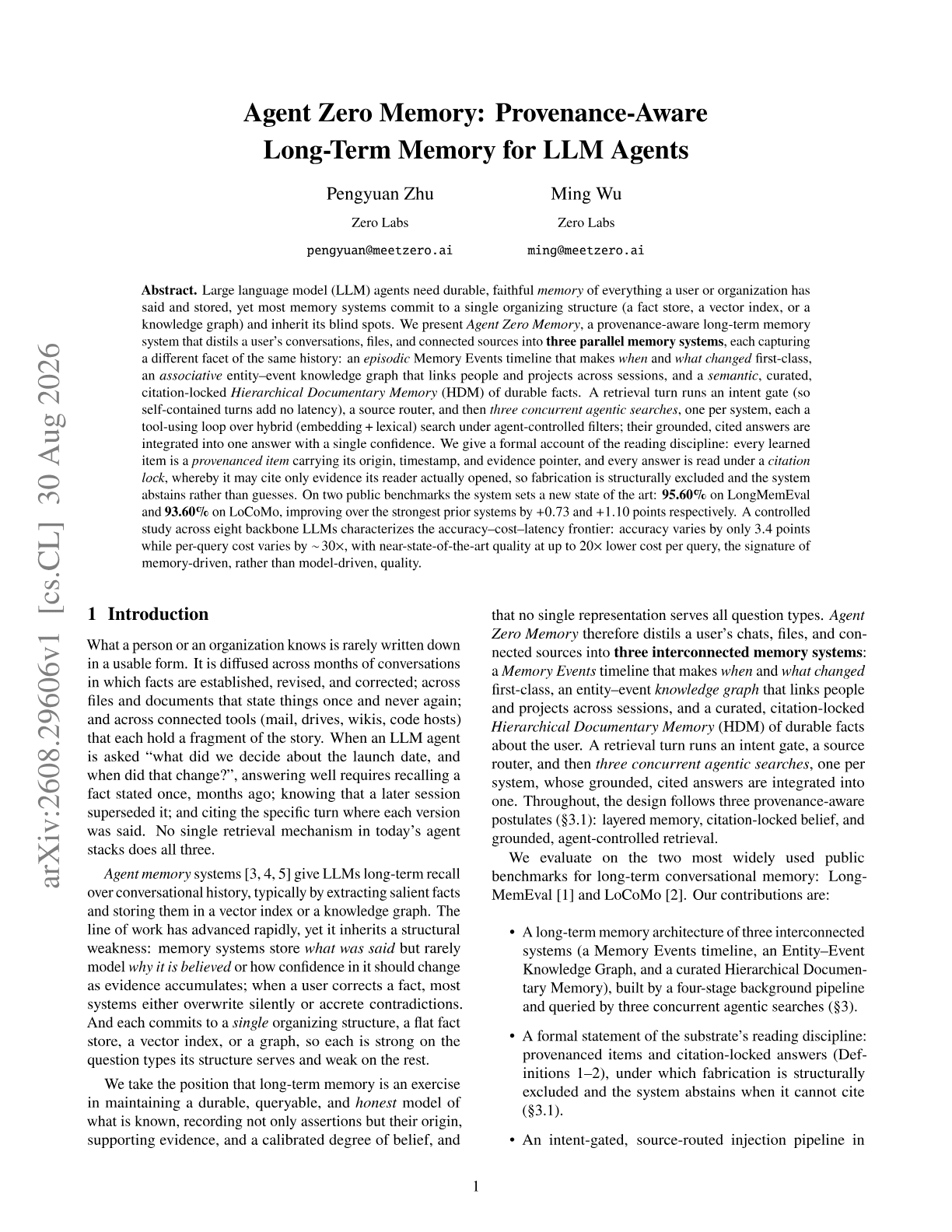
Agent Zero Memory: Provenance-Aware Long-Term Memory for LLM Agents
Ming Wu and Pengyuan Zhu build Agent Zero Memory, which runs three parallel memory systems over the same history and enforces a citation lock so an answer may only cite evidence its reader actually opened.
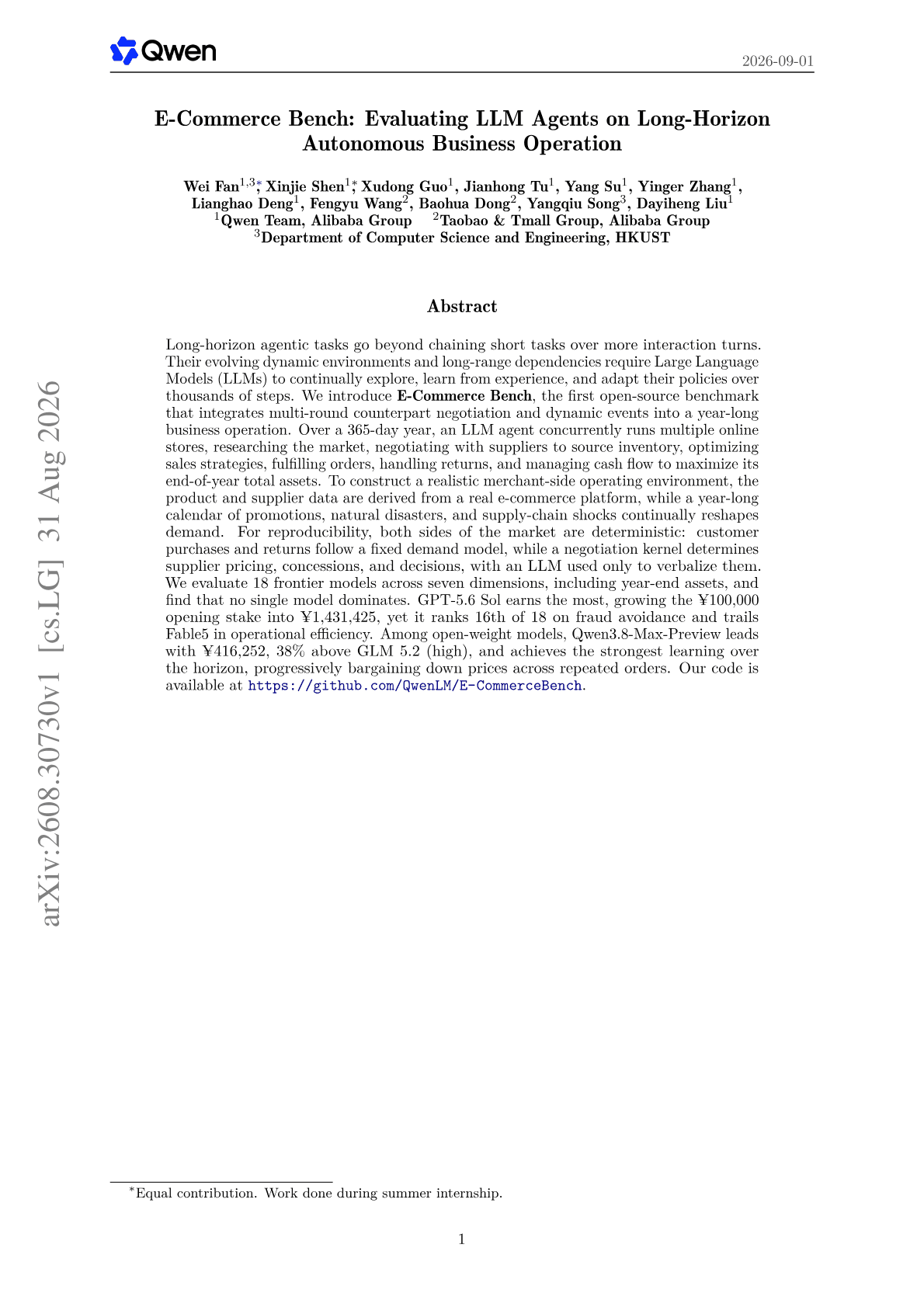
E-Commerce Bench: Evaluating LLM Agents on Long-Horizon Autonomous Business Operation
Agent benchmarks usually end when the session does. The Qwen team built one that runs an agent through a simulated 365-day year operating several online stores at once, then scored 18 frontier models on seven dimensions.
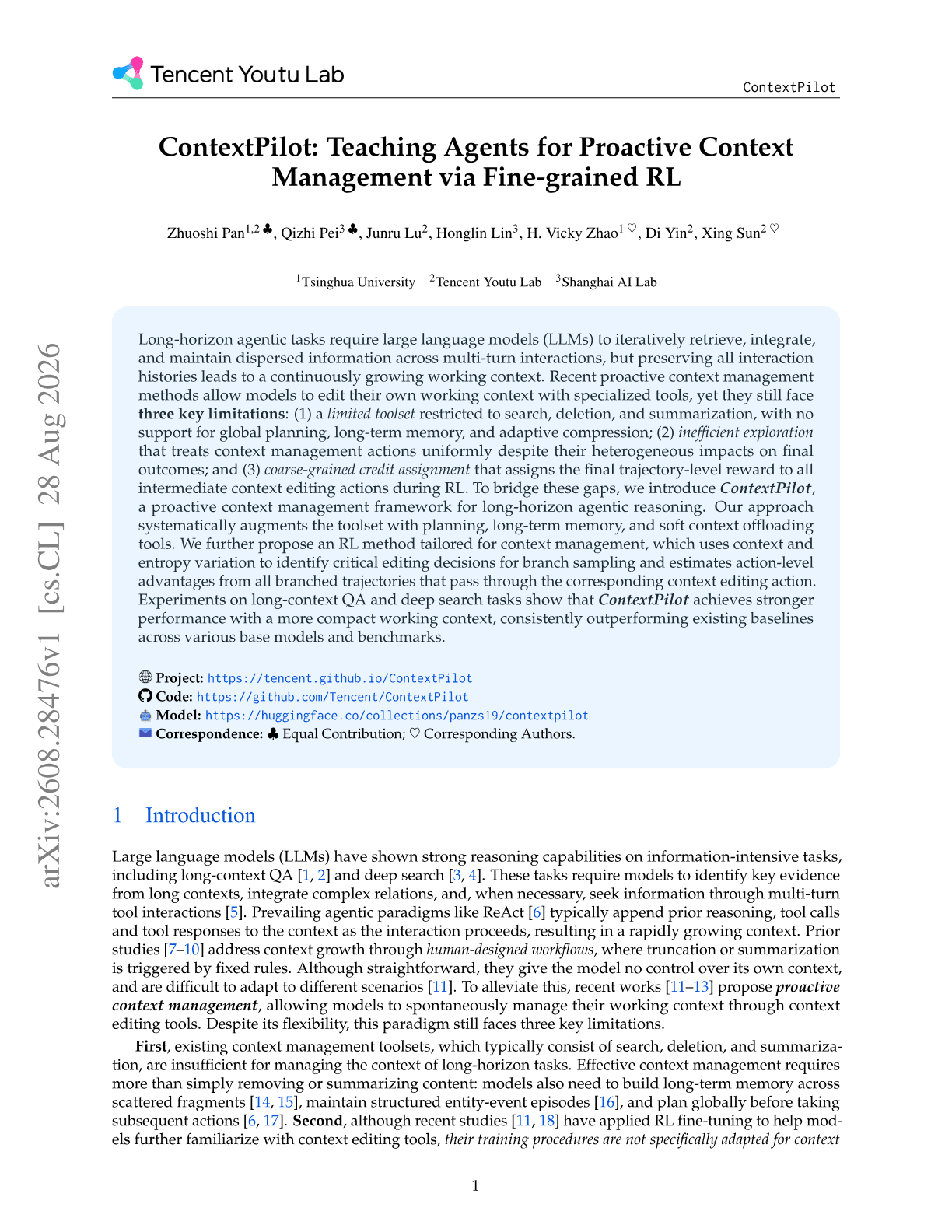
ContextPilot: Teaching Agents for Proactive Context Management via Fine-grained RL
Zhuoshi Pan and colleagues at Tencent and Tsinghua train an agent to manage its own working context with a purpose-built RL method, adding planning, long-term memory, and soft offloading tools and assigning credit at the level of individual context edits (EMNLP 2026 main).
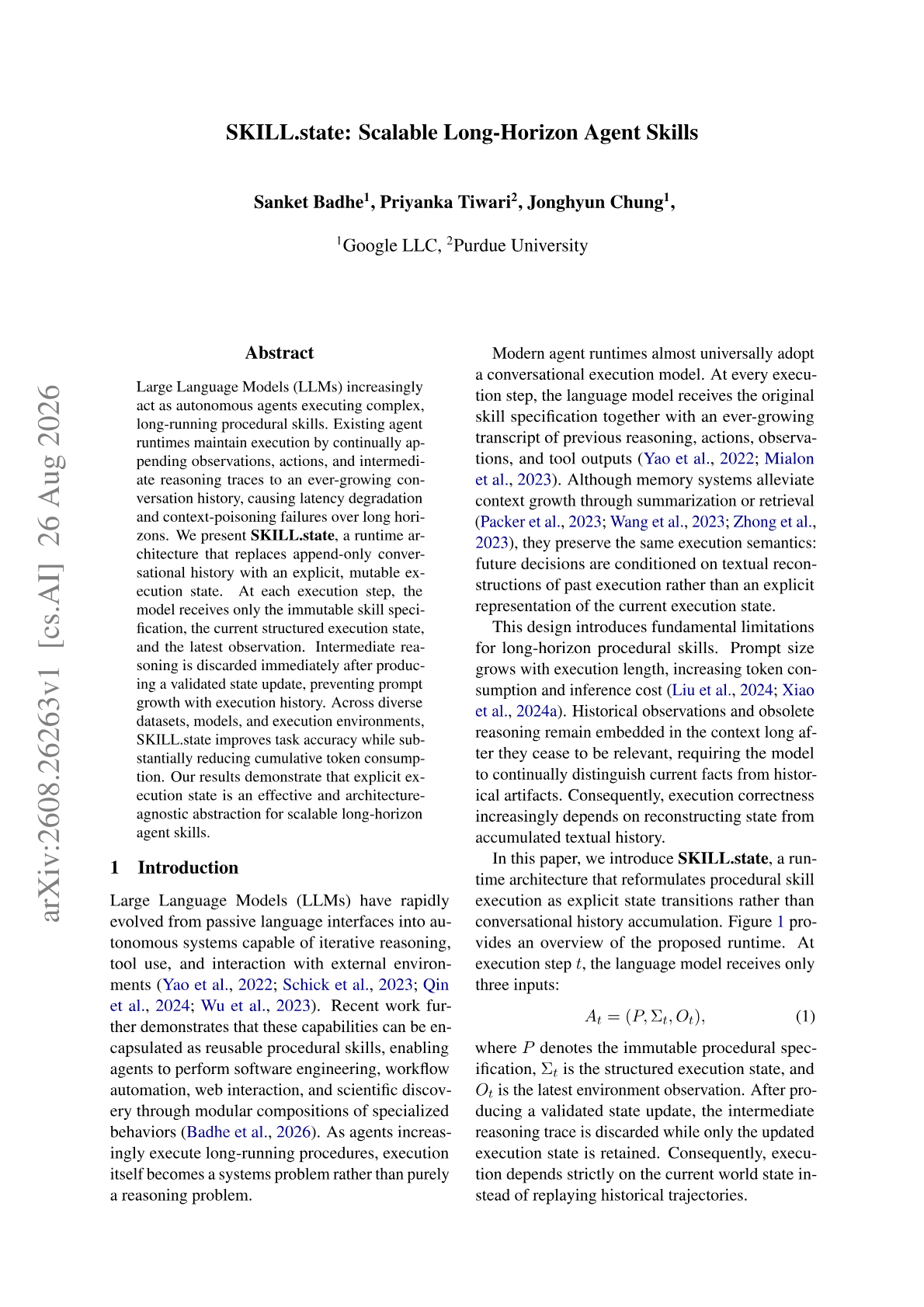
SKILL.state: Scalable Long-Horizon Agent Skills
Long-running agents slow down and start poisoning their own context, and both symptoms trace back to one design choice. Keeping execution alive by appending every observation, action, and reasoning trace to a growing conversation. Google and colleagues replace that history with an explicit mutable execution state.
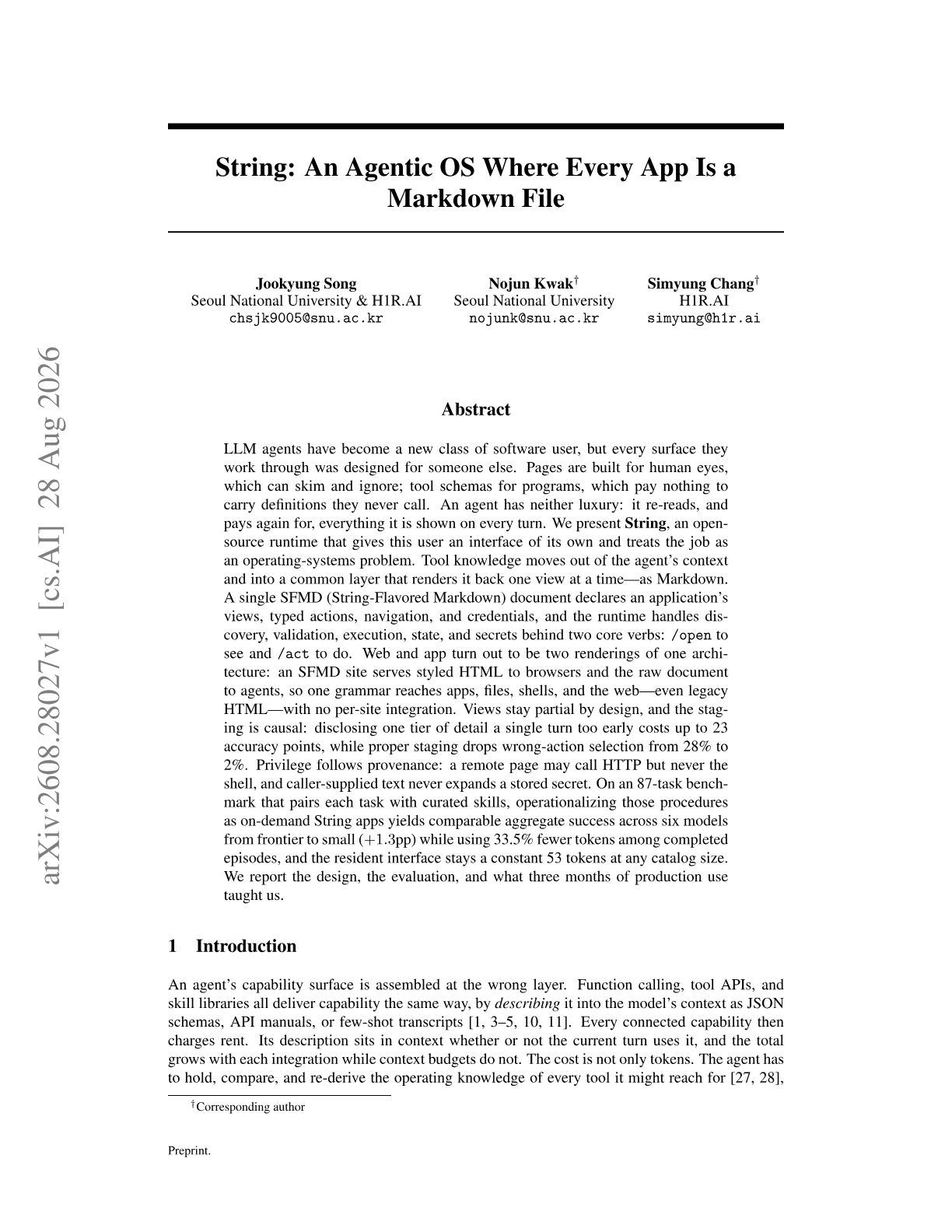
String: An Agentic OS Where Every App Is a Markdown File
Jookyung Song, Nojun Kwak, and Simyung Chang treat the agent interface as an operating-systems problem, moving tool knowledge out of context into a layer that renders one Markdown view at a time behind two verbs, /open and /act.
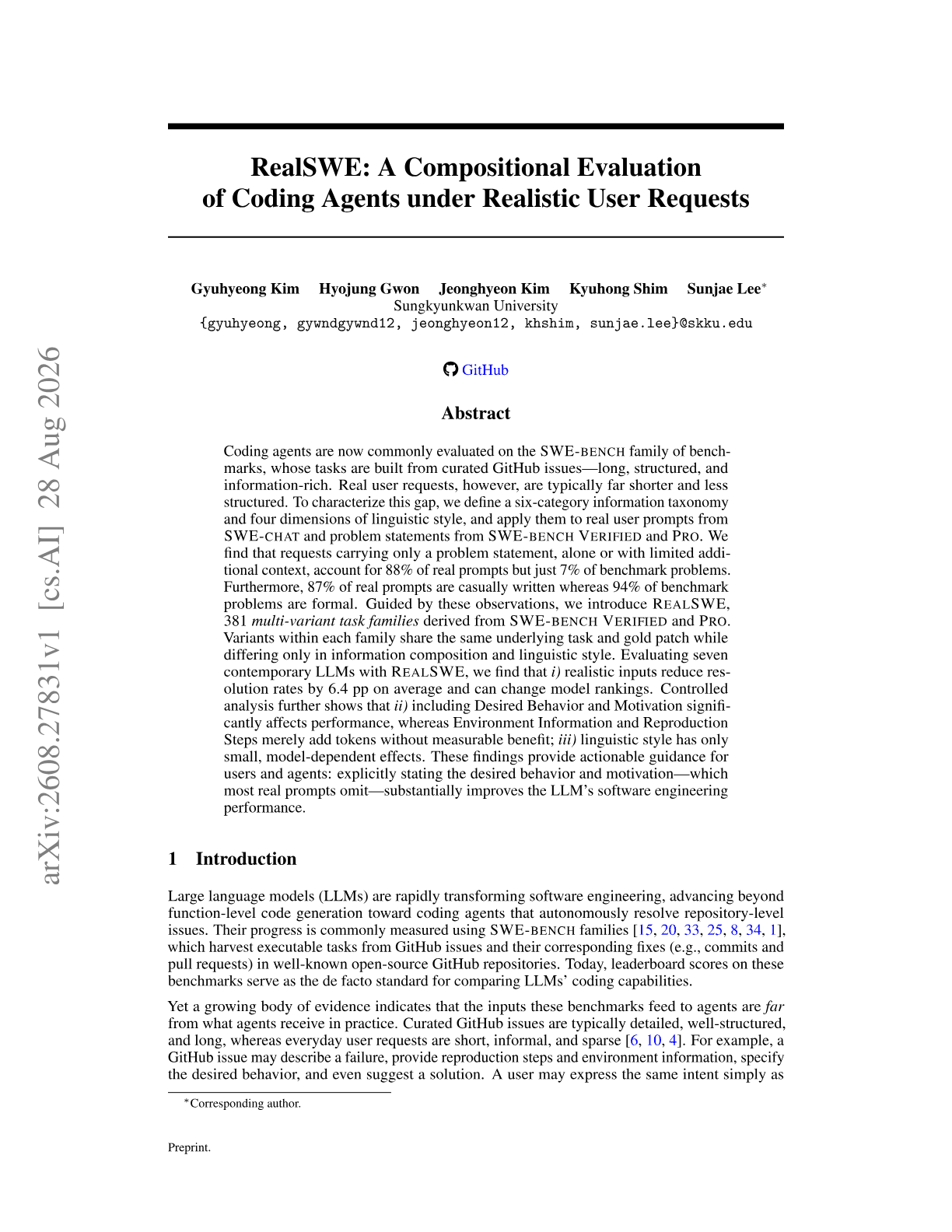
RealSWE: A Compositional Evaluation of Coding Agents under Realistic User Requests
Gyuhyeong Kim and colleagues characterize the gap between curated GitHub issues and real user requests, then build 381 multi-variant task families from SWE-bench Verified and Pro that hold the gold patch fixed while varying information composition and linguistic style.
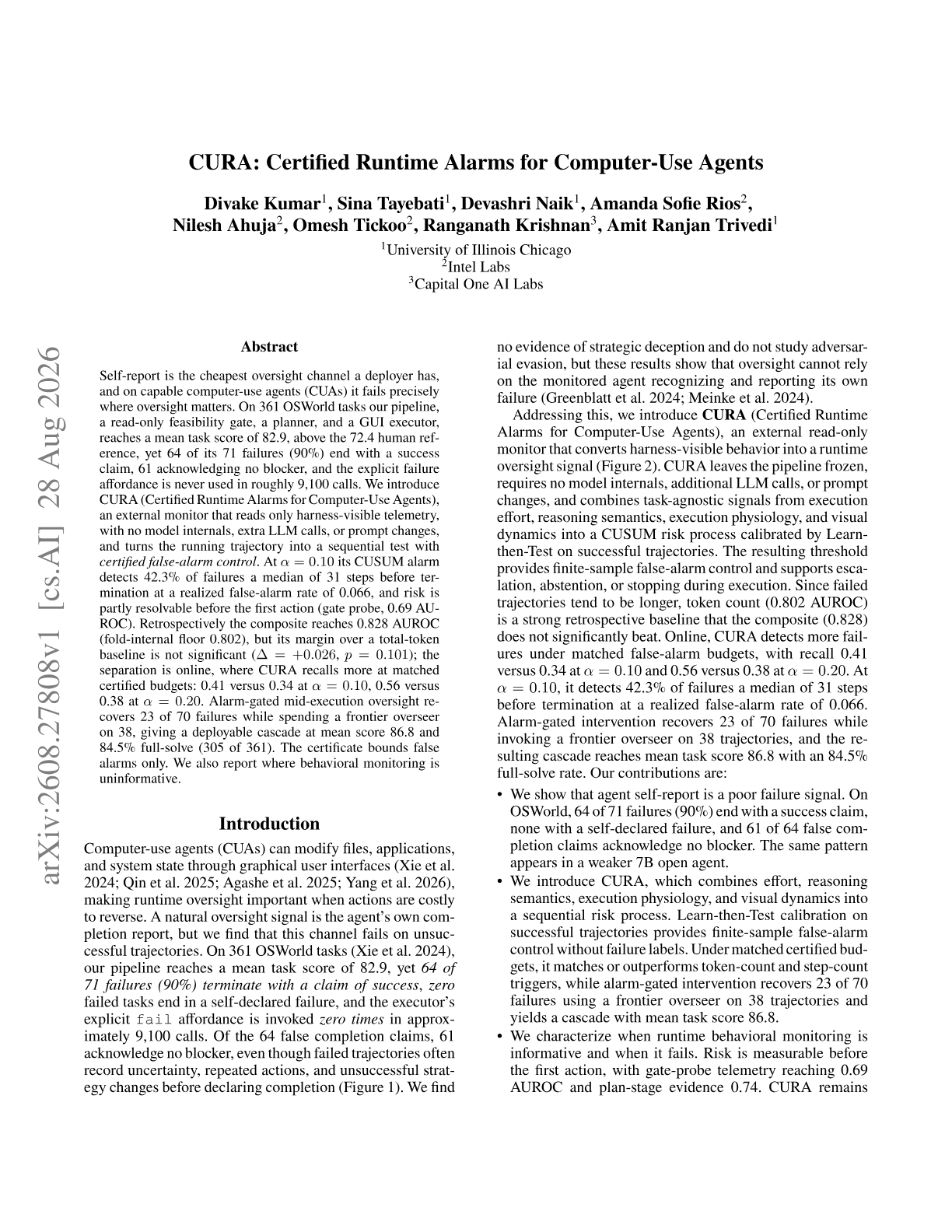
CURA: Certified Runtime Alarms for Computer-Use Agents
Divake Kumar and colleagues (UIC with Intel Labs) show that computer-use agents claim success on 90% of their own failures, then build an external monitor that reads only harness-visible telemetry and turns a running trajectory into a sequential test with certified false-alarm control.