AI Papers of the Week
Every paper worth reading in AI, hand-picked one week at a time.
Discover and explore top AI papers with Claude Code or Codex
npx @dair-ai/mcp setup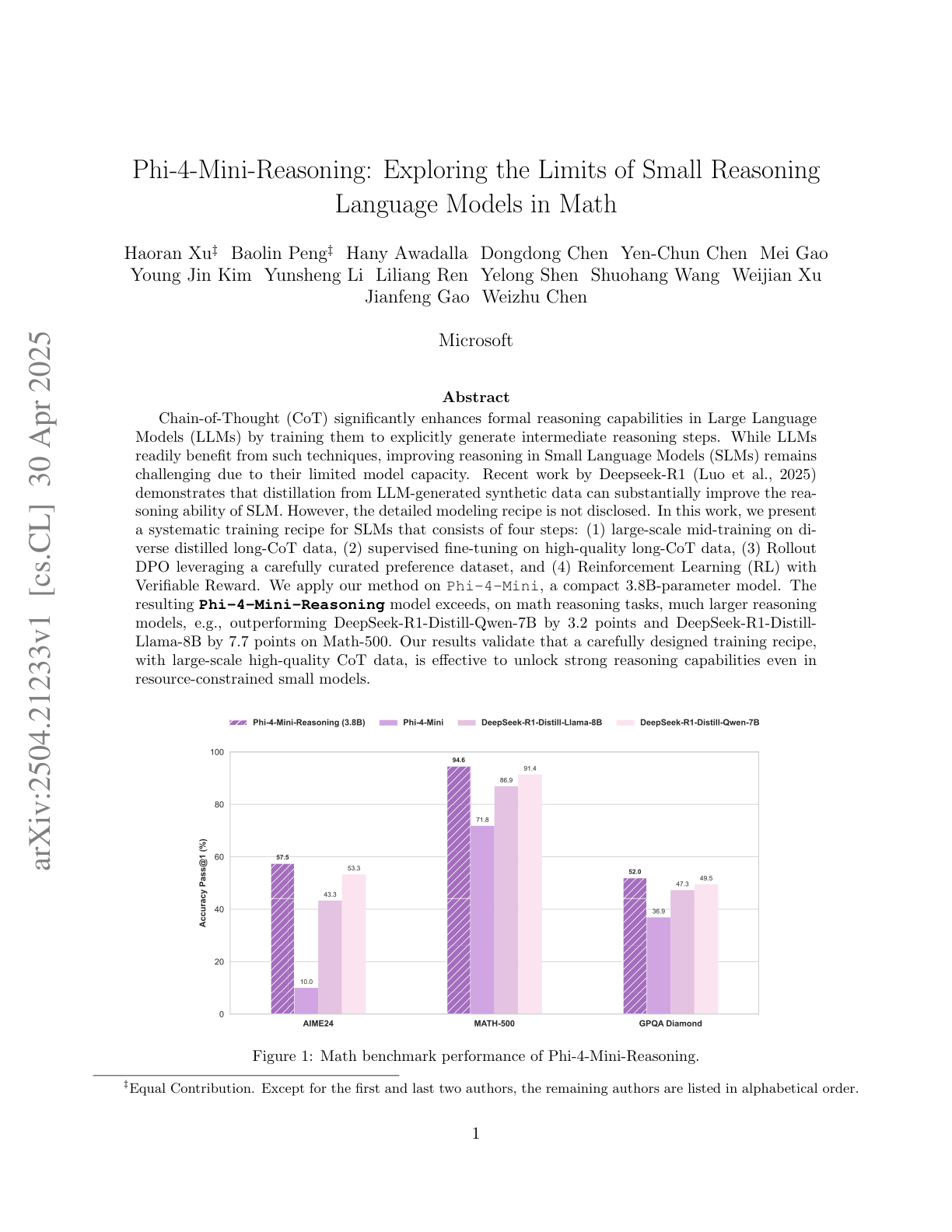
Phi-4-Mini-Reasoning
Microsoft released Phi-4-Mini-Reasoning to explore small reasoning language models for math. Highlights:
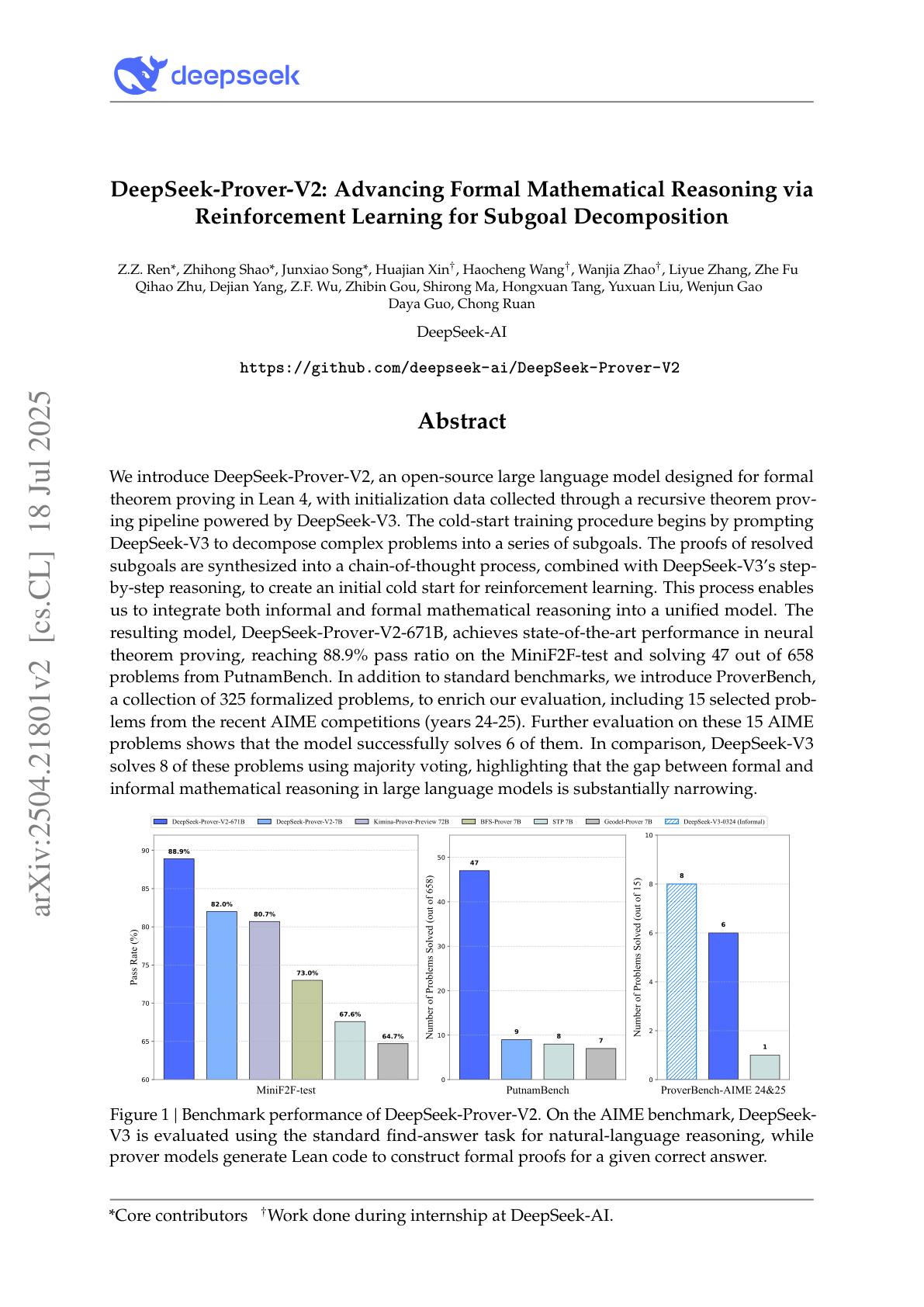
DeepSeek-Prover-V2
DeepSeek-Prover-V2 is an LLM (671B) that significantly advances formal theorem proving in Lean 4. The model is built through a novel cold-start training pipeline that combines informal chain-of-thought reasoning with formal subgoal decomposition, enhanced through reinforcement learning. It surpasses prior state-of-the-art on multiple theorem-proving benchmarks. Key highlights:
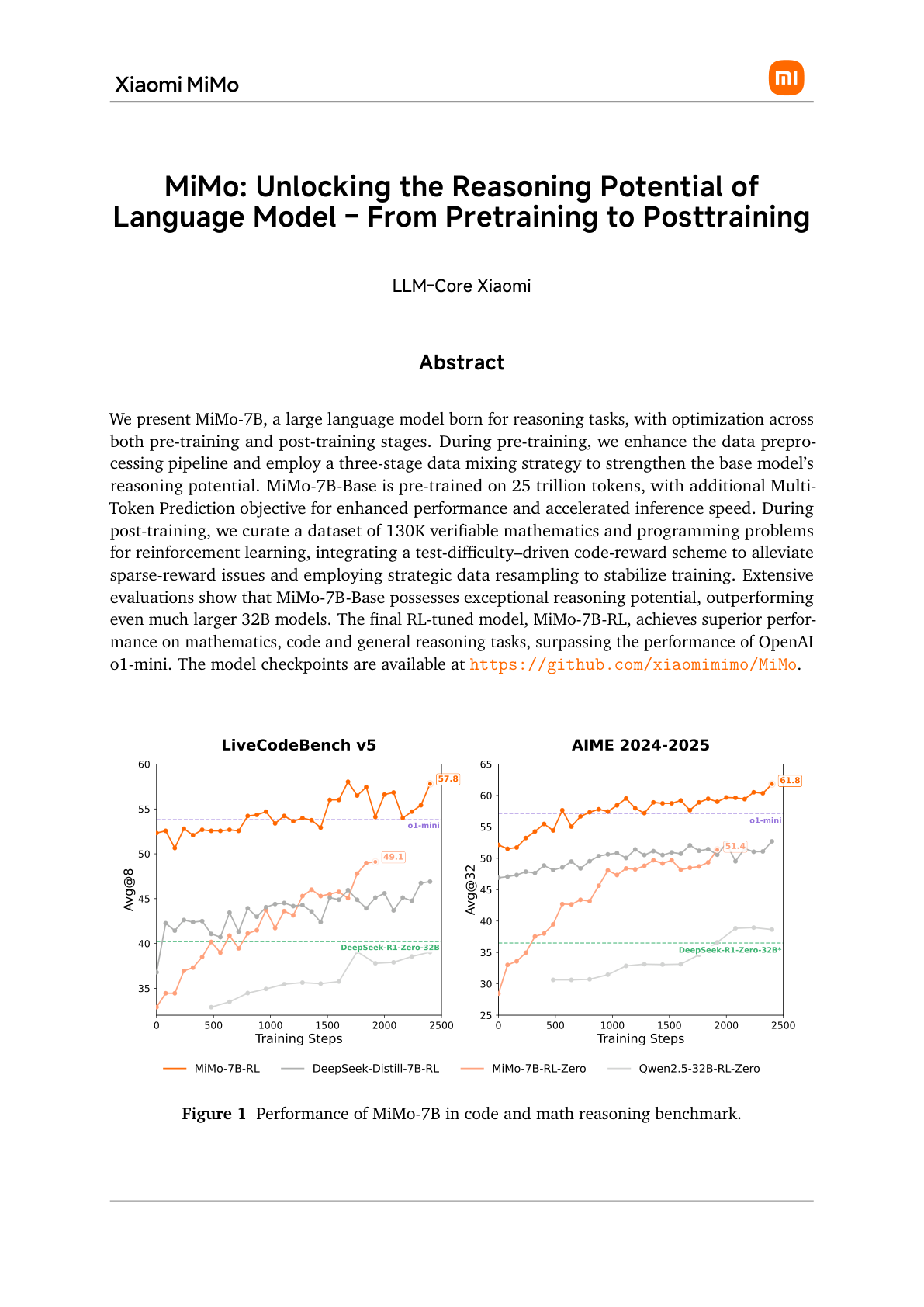
MiMo-7B
Xiaomi releases MiMo-7B, a new language model for reasoning tasks. MiMo-7B is explicitly designed for advanced reasoning across math and code. Highlights:
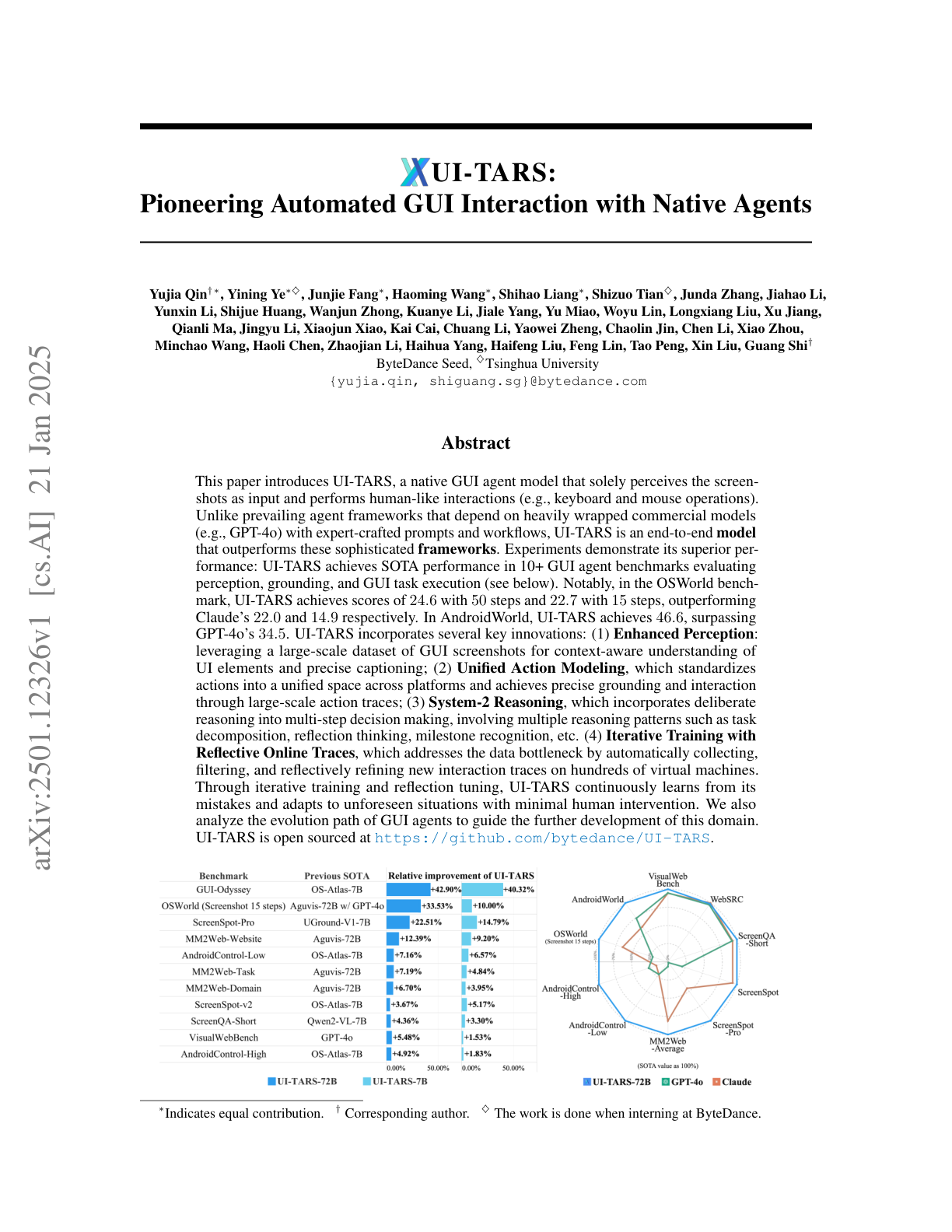
UI-TARS
UI-TARS introduces a powerful, end-to-end native GUI agent that operates purely from visual screenshots, performing human-like keyboard and mouse interactions across platforms. Unlike existing modular agent frameworks that rely on prompt engineering and external scripts, UI-TARS integrates perception, action, reasoning, and memory directly into its architecture, achieving strong generalization and adaptability in dynamic real-world settings. Key contributions:
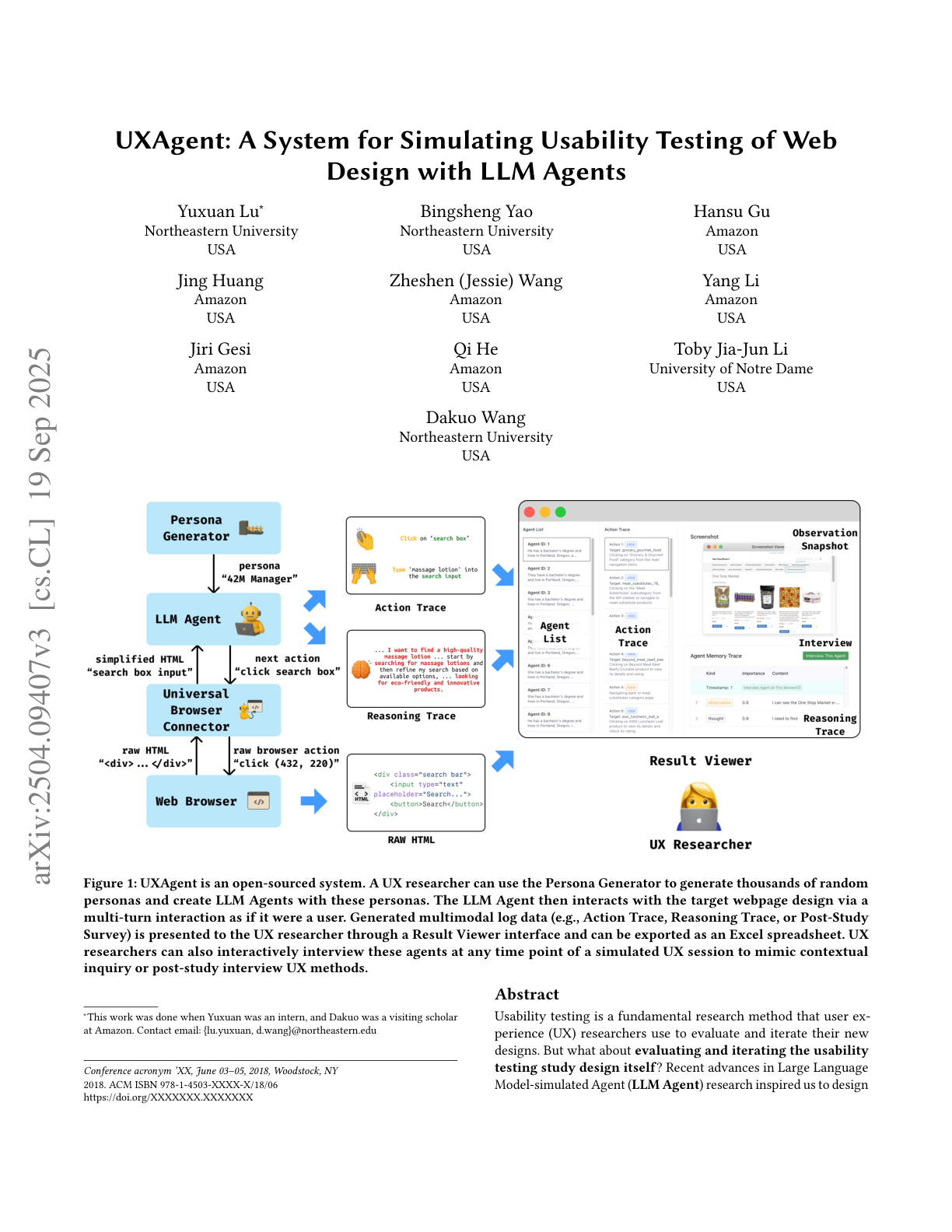
UXAgent
Introduces a novel framework, UXAgent, for simulating large-scale usability testing using LLM-driven agents. The system empowers UX researchers to test and iterate web design and study protocols before engaging real users. This is achieved through the orchestration of simulated agents with diverse personas interacting in real web environments, providing both behavioral and reasoning data. Key highlights:

General-Reasoner
General-Reasoner is a reinforcement learning approach that boosts LLM reasoning across diverse domains by using a 230K-question dataset and a model-based verifier trained to understand semantics beyond exact matches. It outperforms strong baselines like SimpleRL and Qwen2.5 on both general reasoning (MMLU-Pro, GPQA, SuperGPQA) and math tasks (MATH-500, GSM8K), showing over 10-point gains without sacrificing mathematical capability.
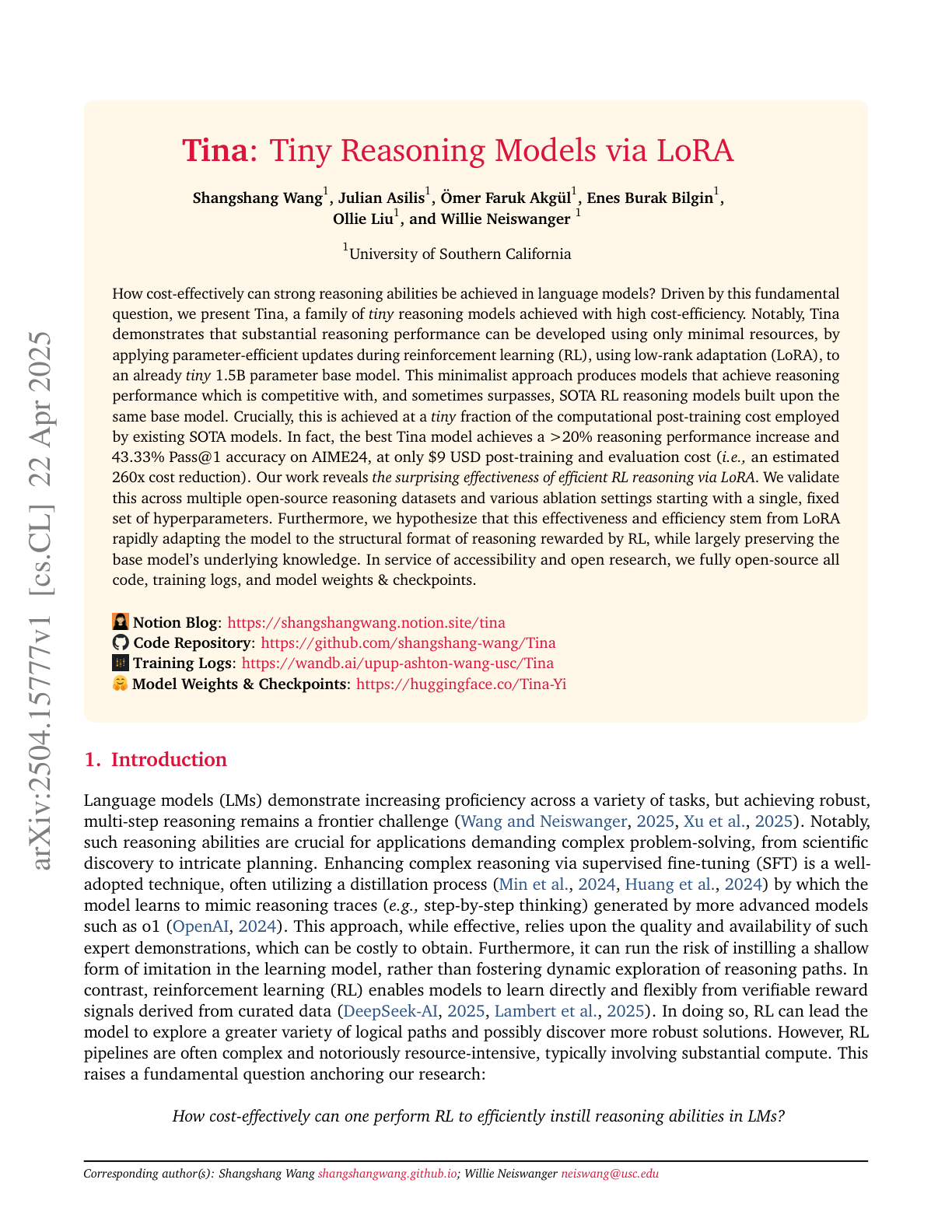
Tiny Reasoning Models
Tina is a family of 1.5B parameter reasoning models trained using LoRA-based reinforcement learning (RL) to achieve high reasoning accuracy at very low cost. It outperforms or matches full fine-tuned models on reasoning tasks like AIME and MATH with only ~$9 post-training cost, demonstrating that efficient reasoning can be instilled via minimal updates to a tiny model.
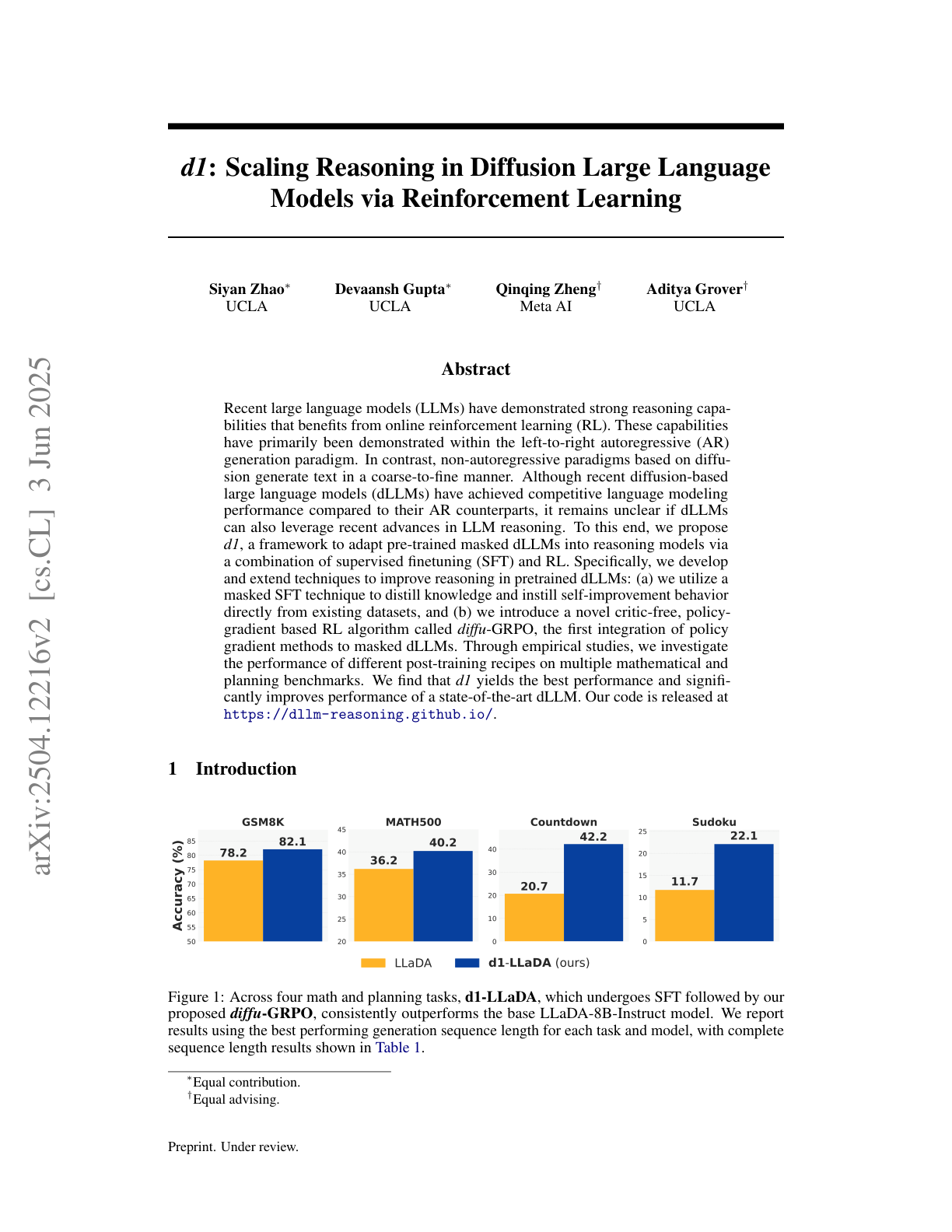
Scaling Reasoning in Diffusion LLMs via RL
Proposes d1, a two‑stage recipe that equips masked diffusion LLMs with strong step‑by‑step reasoning.
Enhancing Non-Reasoning Models with Reasoning Models
Researchers explore how to distill reasoning-intensive outputs (answers and explanations) from top-tier LLMs into more lightweight models that don’t explicitly reason step by step. By fine-tuning smaller models on the high-quality final answers (and optionally summarized thinking traces) from advanced reasoning models, they demonstrate consistent performance boosts across multiple benchmarks.
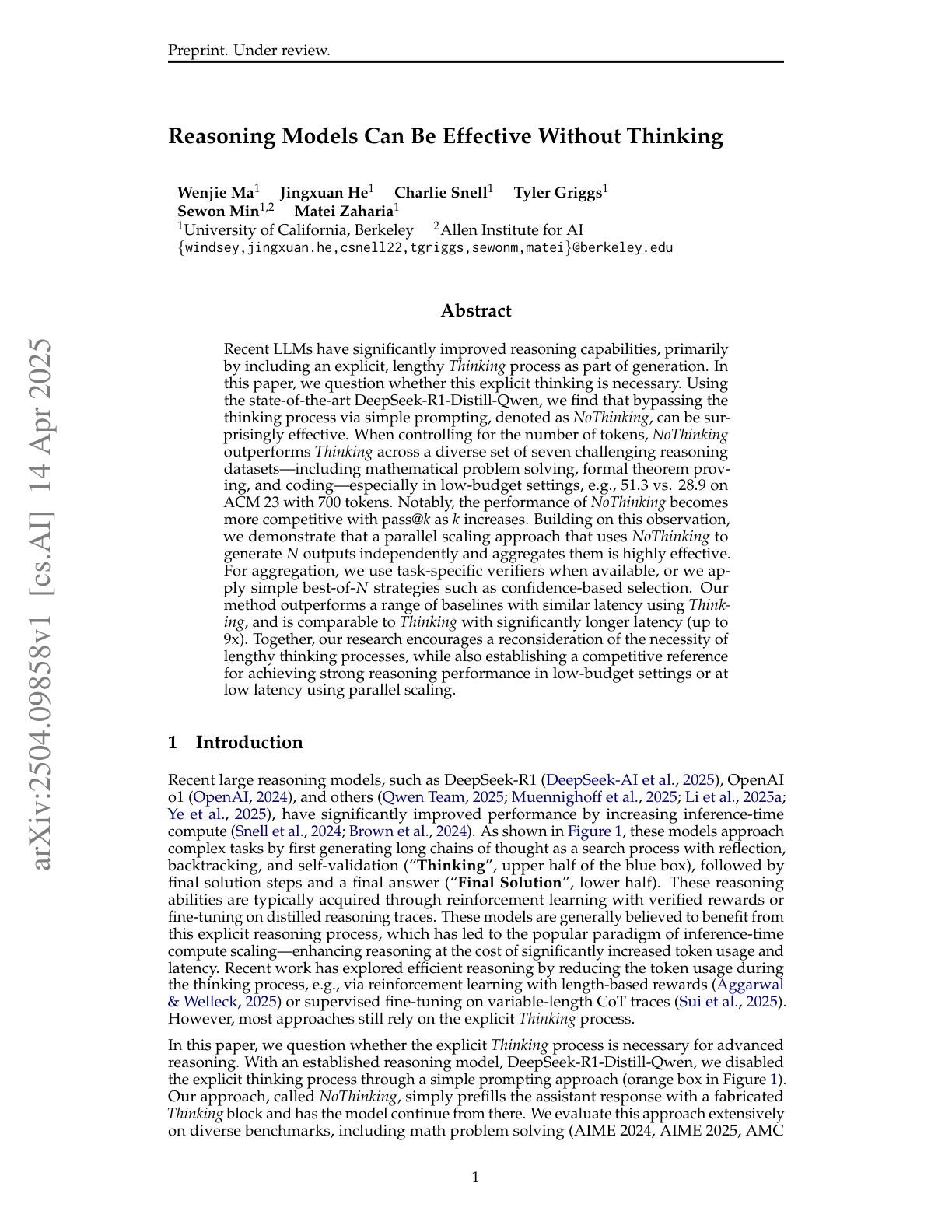
Reasoning Models Can Be Effective Without Thinking
This paper challenges the necessity of long chain-of-thought (CoT) reasoning in LLMs by introducing a simple prompting method called NoThinking, which bypasses explicit "thinking" steps. Surprisingly, NoThinking performs comparably to or better than traditional reasoning under comparable or even lower compute budgets, especially when paired with parallel decoding and best-of-N selection. Key Insights:
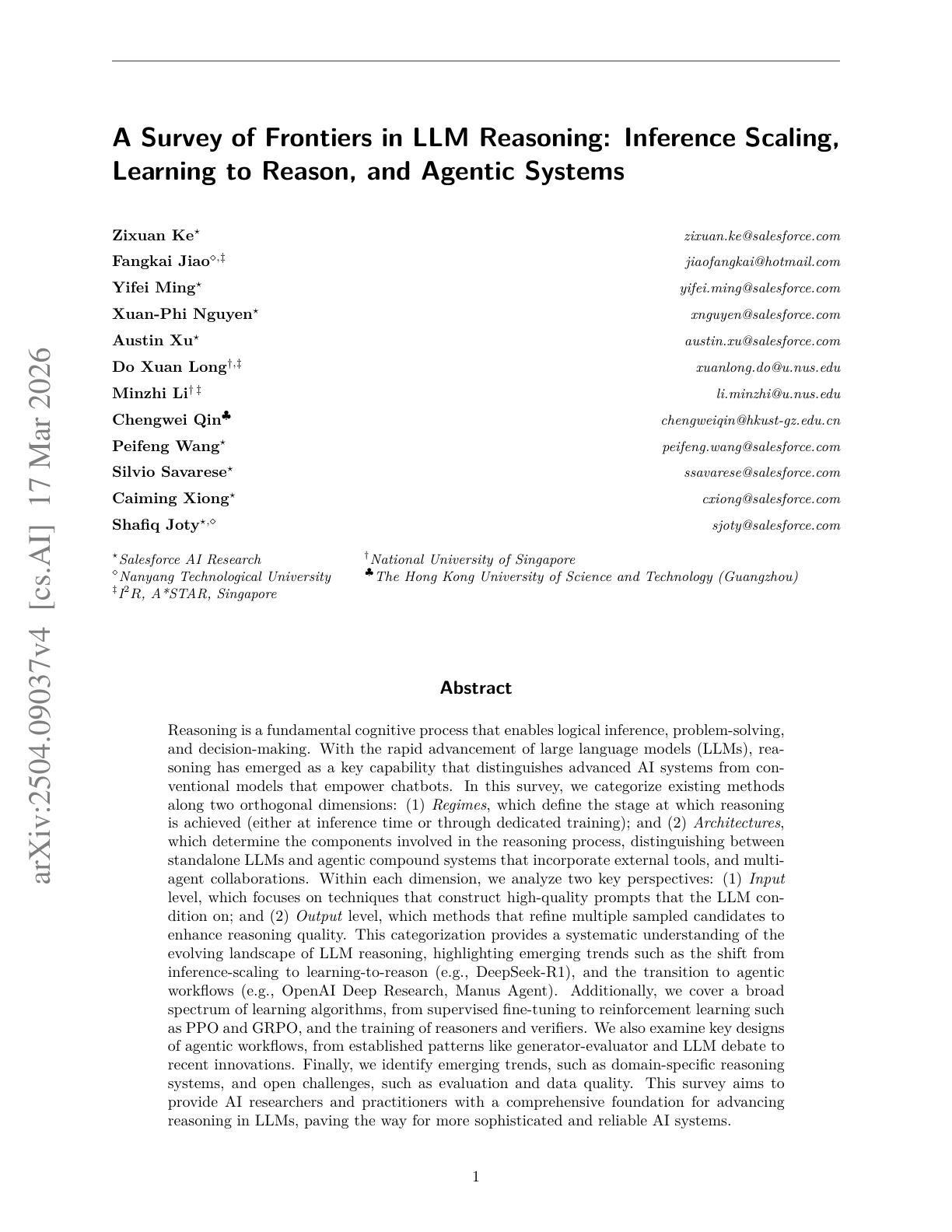
A Survey of Frontiers in LLM Reasoning
This survey categorizes LLM reasoning methods by when reasoning occurs (inference-time vs. training) and the system's architecture (standalone vs. agentic or multi-agent). It highlights trends like learning-to-reason (e.g., DeepSeek-R1) and agentic workflows (e.g., OpenAI Deep Research), covering prompt engineering, output refinement, and learning strategies such as PPO and verifier training.
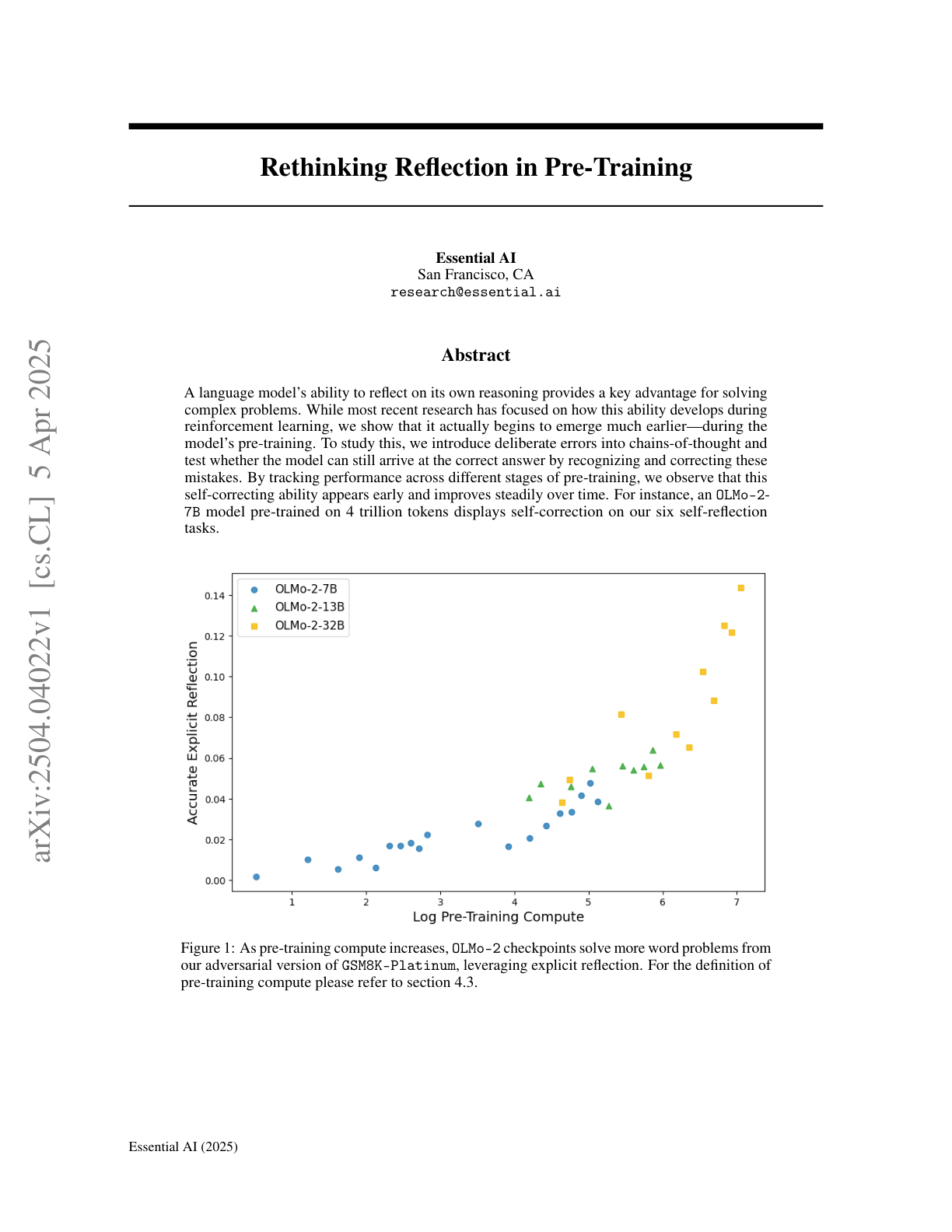
Rethinking Reflection in Pre-Training
Reflection — the ability of LLMs to identify and correct their own reasoning — has often been attributed to reinforcement learning or fine-tuning. This paper argues otherwise: reflection emerges during pre-training. The authors introduce adversarial reasoning tasks to show that self-reflection and correction capabilities steadily improve as compute increases, even in the absence of supervised post-training. Key contributions:
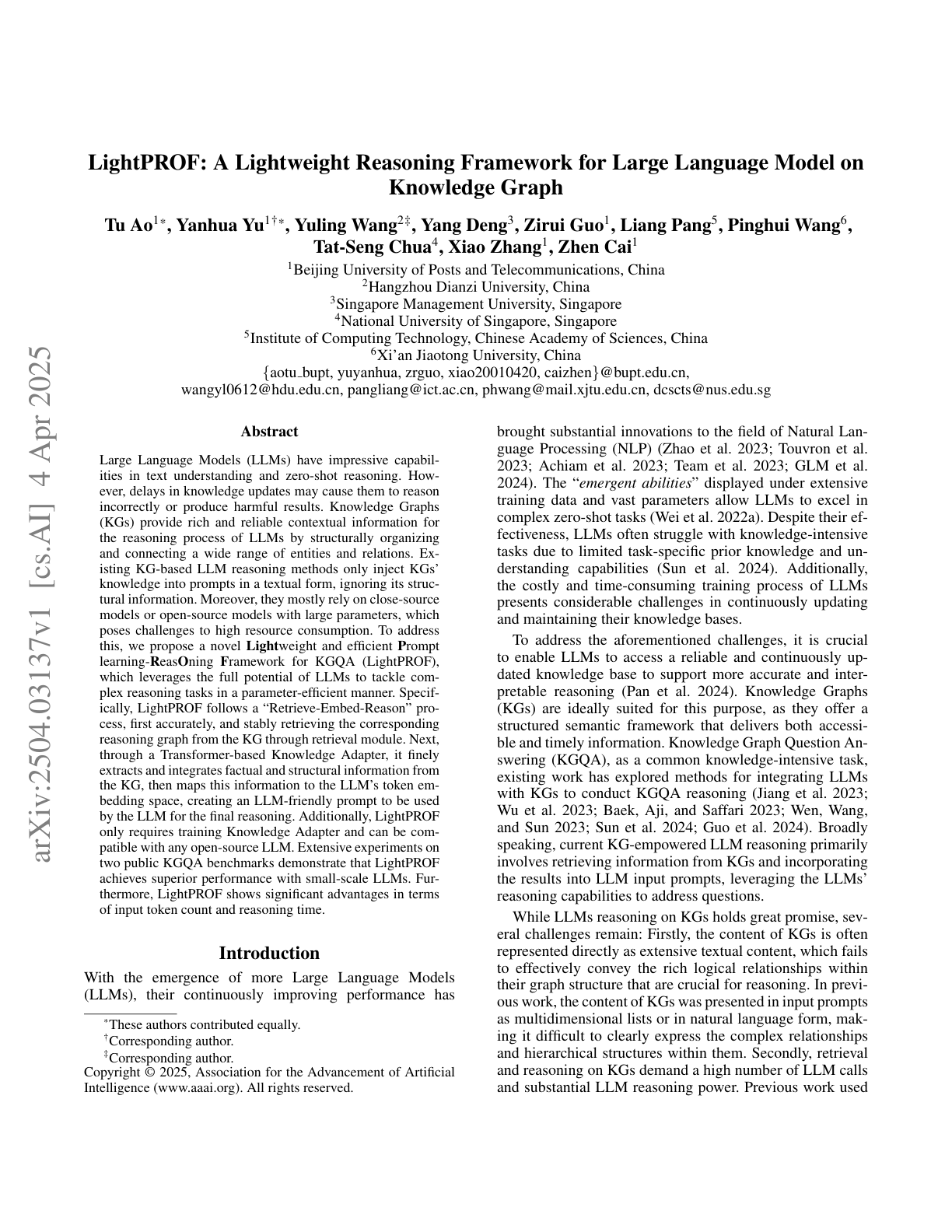
Efficient KG Reasoning for Small LLMs
LightPROF is a lightweight framework that enables small-scale language models to perform complex reasoning over knowledge graphs (KGs) using structured prompts. Key highlights:
Retrieval-Augmented Reasoning Model
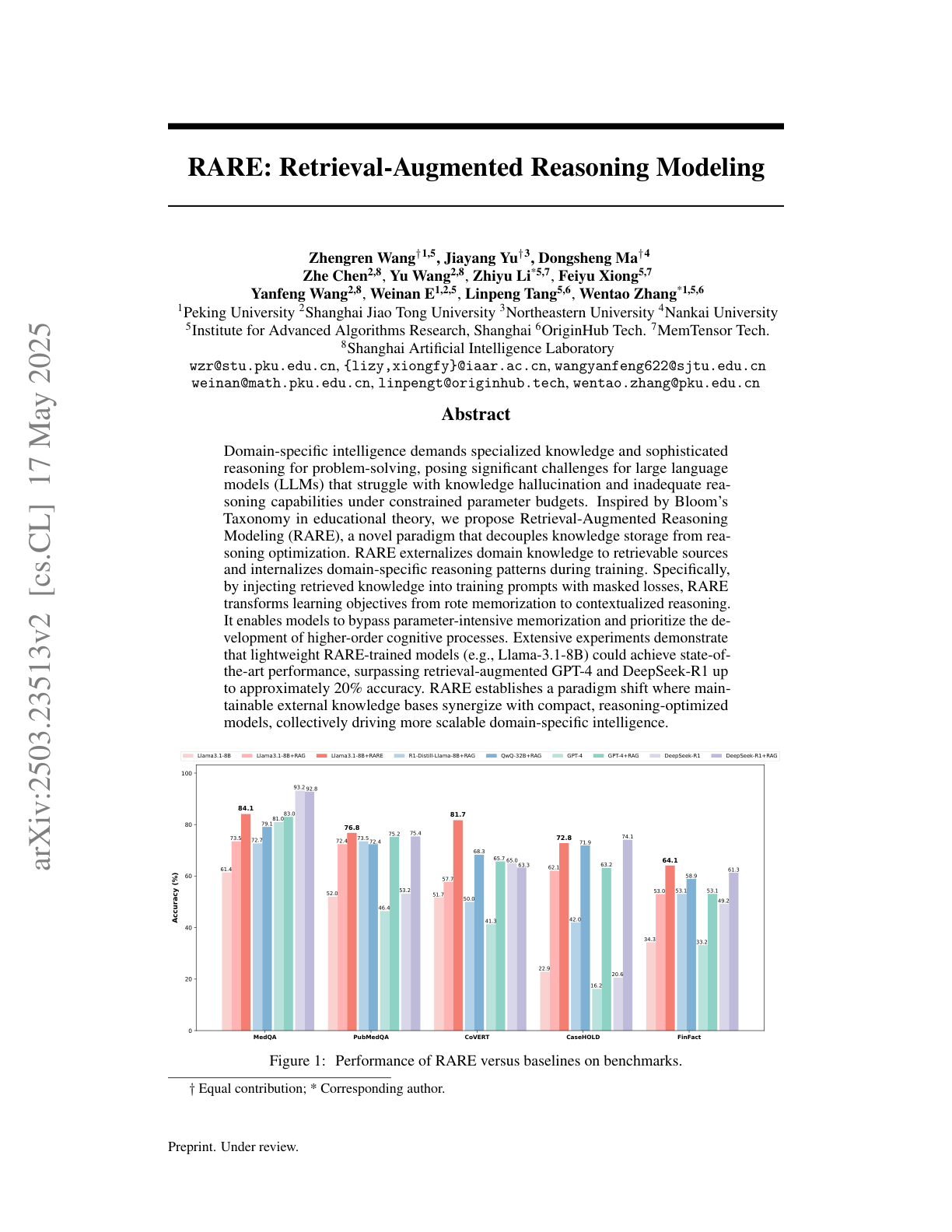
Introduces RARE, a new paradigm for training domain-specific LLMs that focuses on reasoning, not memorization. Key ideas: ● Inspired by Bloom’s Taxonomy – RARE shifts LLM training from memorizing knowledge (“Remember”) to applying and evaluating it (“Analyze”, “Create”). It separates domain knowledge (retrieved externally) from domain thinking (learned during training), enabling better performance under tight parameter budgets. ● Open-book prepared training – RARE injects retrieved knowledge into training prompts, letting models learn reasoning patterns instead of rote facts. This open-book, reasoning-first setup beats both standard SFT and RAG approaches, especially in medicine. ● Massive accuracy gains with small models – On five medical QA benchmarks, RARE-trained Llama-3.1-8B and Qwen-2.5-7B outperformed GPT-4 + RAG, with up to +20% accuracy boosts (e.g., PubMedQA: 78.63% vs. GPT-4’s 75.2%, CoVERT: 74.14% vs. GPT-4’s 65.67%). ● Training via distillation + adaptive retries – RARE distills answers (and reasoning paths) from a strong teacher (e.g., QwQ-32B), refining outputs until a correct answer is found. This creates a high-quality dataset that teaches contextualized, case-based thinking. ● New role for retrieval – Unlike standard RAG (used only at inference), RARE uses retrieval during training to shape reasoning. It models knowledge integration (p(kx, R(x))) and reasoning (p(rx, R(x), k)) as separate steps, replacing memorization with application. Overall, this work reframes LLM training for domain-specific intelligence: externalize facts, internalize reasoning. It unlocks strong performance from small models without overfitting or hallucination.
Open Deep Search
Researchers from Sentient, UW, Princeton, and UC Berkeley introduce Open Deep Search (ODS), an open-source search AI framework that rivals top proprietary systems like GPT-4o Search Preview and Perplexity Sonar. Key insights: ● Two open components: search + reasoning – ODS has two modular parts: (1) Open Search Tool, which retrieves and refines high-quality web results using query rephrasing, snippet reranking, and site-specific logic; and (2) Open Reasoning Agent, a controller that orchestrates tool usage (search, calculator, etc.) to answer queries. Two variants are offered: ODS-v1 (ReAct) and ODS-v2 (CodeAct). ● SOTA open-source performance – With DeepSeek-R1 as the base LLM, ODS-v2 scores 88.3% on SimpleQA and 75.3% on FRAMES, beating GPT-4o Search Preview by +9.7% on the latter. ODS adapts the number of searches per query (avg. 3.39 on FRAMES), balancing cost and accuracy more efficiently than fixed-query baselines. ● Better than Perplexity Sonar – On both FRAMES and SimpleQA, ODS+DeepSeek-R1 outperforms Perplexity’s flagship search models, even in complex reasoning tasks involving multi-hop questions, time/date calculations, and name disambiguation. ● Code-based agents enhance reasoning – ODS-v2 builds on CodeAct, allowing it to write and run Python code to perform symbolic reasoning and tool calls. This results in sharper numerical precision and task flexibility compared to CoT-based ReAct in ODS-v1.
Efficient Test-time Scaling with Code
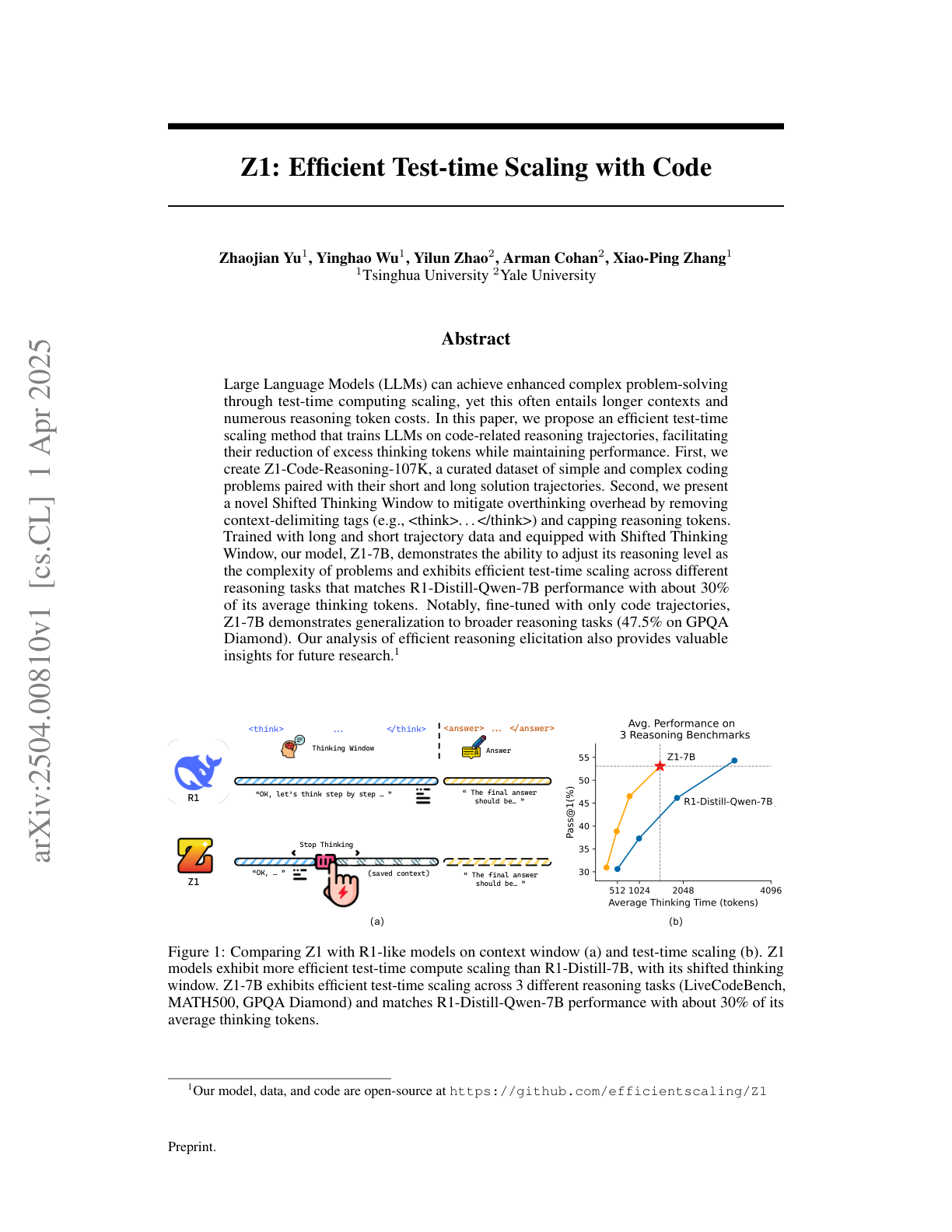
Z1 is a new method for making large language models more compute-efficient at test time, especially during reasoning. The core idea is to train LLMs with short and long code-based reasoning trajectories, and then dynamically adjust reasoning depth during inference. Key contributions: ● Z1-Code-Reasoning-107K dataset – They construct a 107K-sample dataset with short and long reasoning paths for simple and complex coding problems. Trajectories are distilled from QwQ-32B and paired to help the model learn when to stop thinking. ● Shifted Thinking Window – A new test-time strategy that eliminates explicit <think delimiters. Instead, the model adapts reasoning token budget based on problem difficulty. Simple problems invoke shallow reasoning; complex ones get capped (e.g., 4096 tokens max), with hints nudging the model to finalize the answer. ● Big efficiency gains – The 7B-scale model Z1-7B matches R1-Distill-Qwen-7B across multiple reasoning tasks (MATH500, LiveCodeBench, GPQA Diamond) but with ~30% of the reasoning tokens. For instance, on GPQA Diamond, Z1-7B achieves 47.5% while using less than half the tokens. ● Code reasoning transfers to general tasks – Despite being trained only on code-based CoT data, Z1 generalizes well to broader domains like science and math, outperforming other 7B reasoning models (e.g., OpenThinker-7B, s1.1-7B) across multiple benchmarks. ● What makes reasoning data effective? – Ablation studies reveal two key dataset design levers: (1) longer reasoning trajectories improve inference quality; (2) larger training sample sizes boost average thinking time and accuracy, even without altering trajectory length.
A Survey of Efficient Reasoning for LLMs
This survey focuses on reasoning economy in LLMs, analyzing how to balance deep reasoning performance with computational cost. It reviews inefficiencies, behavioral patterns, and potential solutions at both post-training and inference stages.
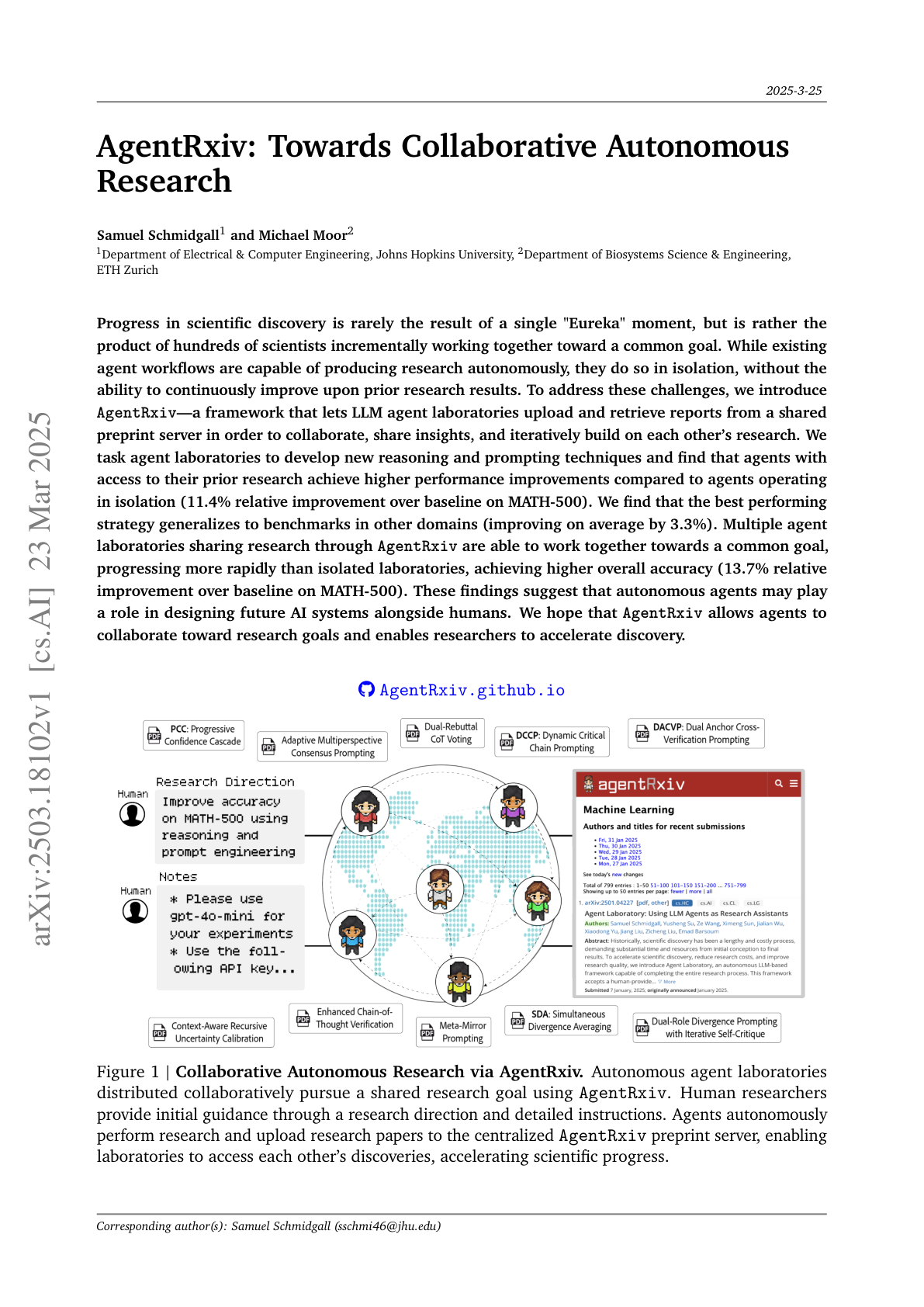
AgentRxiv
Researchers from Johns Hopkins & ETH Zurich present AgentRxiv, a framework enabling LLM agents to autonomously generate and share research papers, mimicking how human scientists build on each other’s work. Highlights: ● AgentRxiv = arXiv for LLMs – It’s an open-source preprint server for autonomous agents, letting labs upload papers, search past work, and iteratively improve results. Labs use this to develop and refine reasoning techniques over generations of research. ● Massive reasoning gains via iterative research – On the MATH-500 benchmark, a single agent lab improves GPT-4o mini accuracy from 70.2% → 78.2% (+11.4%) by discovering better prompt strategies. The final method (SDA) outperforms earlier ideas like CRUC and DCCP. → SDA = Simultaneous Divergence Averaging: combines low/high-temp CoT outputs with dynamic similarity-based voting and confidence aggregation. ● Knowledge generalizes – SDA also improves other benchmarks: ● Collaboration boosts discovery – Running 3 agent labs in parallel yields faster progress and higher final accuracy (up to 79.8%, +13.7% over baseline) by sharing results via AgentRxiv. Early gains (e.g., 76.2% accuracy) arrive after only 7 papers vs. 23 sequentially. ● Self-improvement and novelty – Agents independently refine their own past ideas. Papers evolve from earlier iterations (e.g., Meta-Mirror Prompting → Meta-Mirror Prompting 2). Top papers show no plagiarism via multiple detectors, but ideas like SDA build on trends like self-consistency and CoT voting. ● Cost & runtime – Generating a paper takes ~1.36 hours and ~$3.11. Parallel setups are pricier overall but achieve results faster (time-to-accuracy win). Failure modes include hallucinated results and fragile code repair steps, with future work needed for better reliability and novelty guarantees.
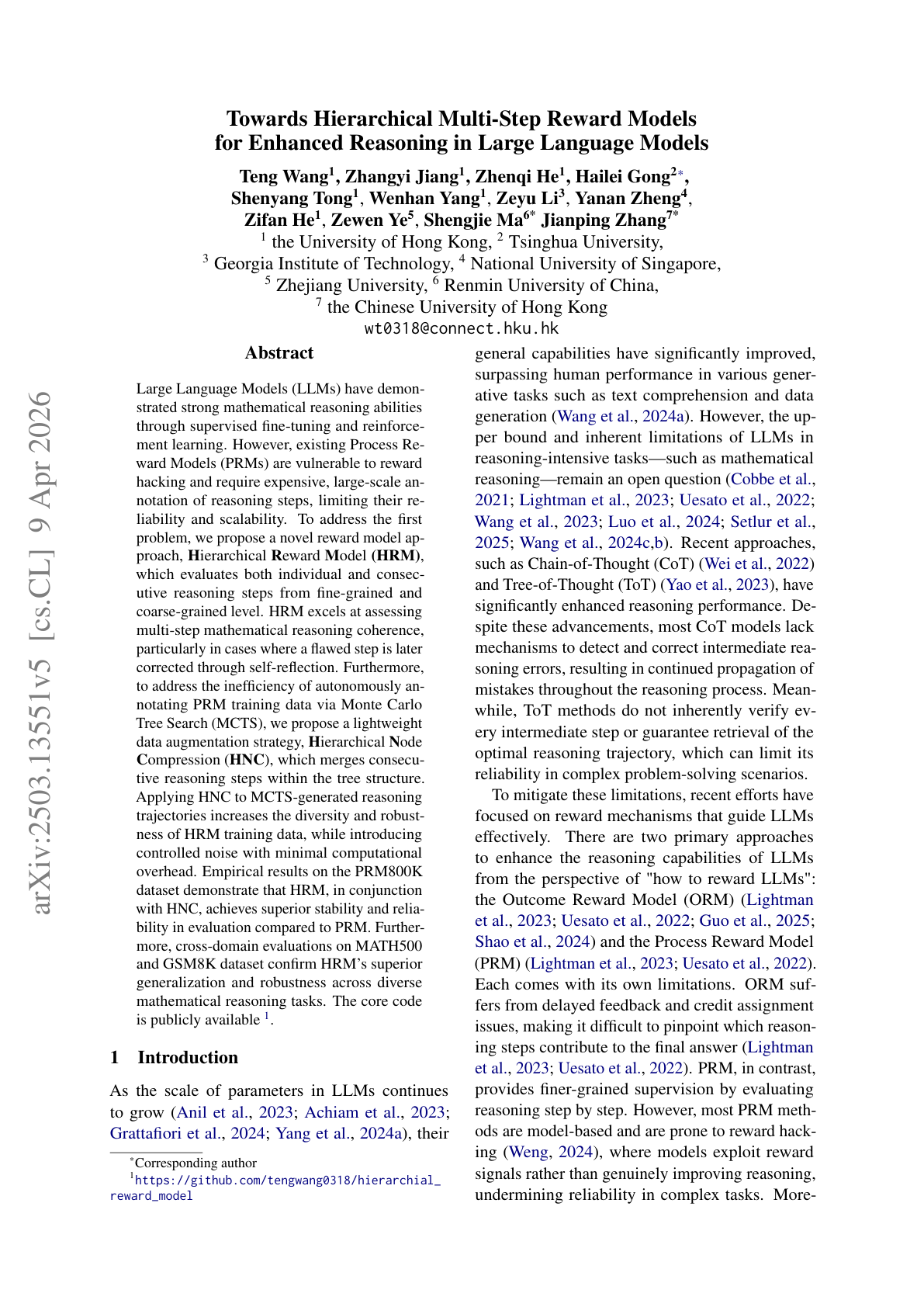
Towards Hierarchical Multi-Step Reward Models for Enhanced Reasoning in LLMs
It proposes a Hierarchical Reward Model (HRM) that addresses reward hacking and error propagation issues in fine-grained LLM reasoning. They also introduce Hierarchical Node Compression (HNC) to augment MCTS-based automatic data annotation, boosting label diversity and robustness at minimal computational cost.
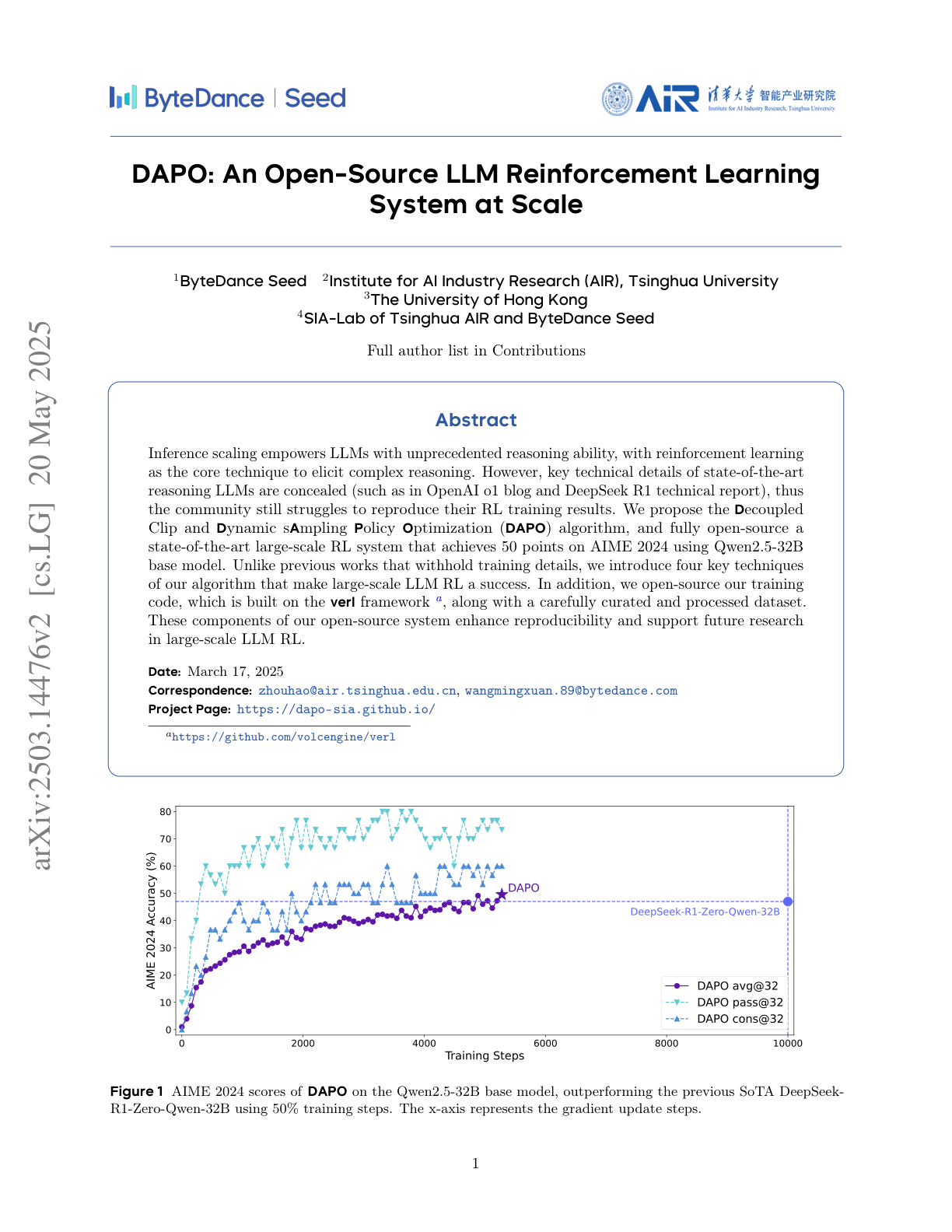
DAPO: An Open-Source LLM Reinforcement Learning System at Scale
It introduces DAPO, a fully open-source, large-scale RL system that boosts the chain-of-thought reasoning capabilities of LLMs. DAPO raises the upper clipping threshold (“Clip-Higher”) in PPO-style training, preventing entropy collapse and helping the policy explore more diverse tokens. By filtering out samples that are always correct or always wrong, DAPO focuses training on prompts with useful gradient signals, speeding up convergence in fewer updates. Instead of averaging losses at the sample level, DAPO applies policy gradients per token, making each reasoning step matter. This ensures both high-quality and length-appropriate outputs. The system masks or softly penalizes excessively long answers, preventing meaningless verbosity or repetitive text. DAPO achieves SOTA math performance on the AIME 2024 test set. Specifically, DAPO trained from a Qwen2.5-32B base achieves 50% accuracy, outperforming DeepSeek’s R1 with less training time, and showcasing open-source reproducibility at scale.
Thinking Machines
This survey provides an overview and comparison of existing reasoning techniques and presents a systematic survey of reasoning-imbued language models.
A Survey on Efficient Reasoning
This new survey investigates techniques to address the "overthinking phenomenon" in Large Reasoning Models (LRMs), categorizing existing methods into model-based optimizations, output-based reasoning reductions, and prompt-based efficiency enhancements. The survey highlights ongoing efforts to balance reasoning capability and computational efficiency in models like OpenAI o1 and DeepSeek-R1.
Post Training of LLMs
PoLMs like OpenAI-o1/o3 and DeepSeek-R1 tackle LLM shortcomings in reasoning, ethics, and specialized tasks. This survey tracks their evolution and provides a taxonomy of techniques across fine-tuning, alignment, reasoning, efficiency, and integration, guiding progress toward more robust, versatile AI.
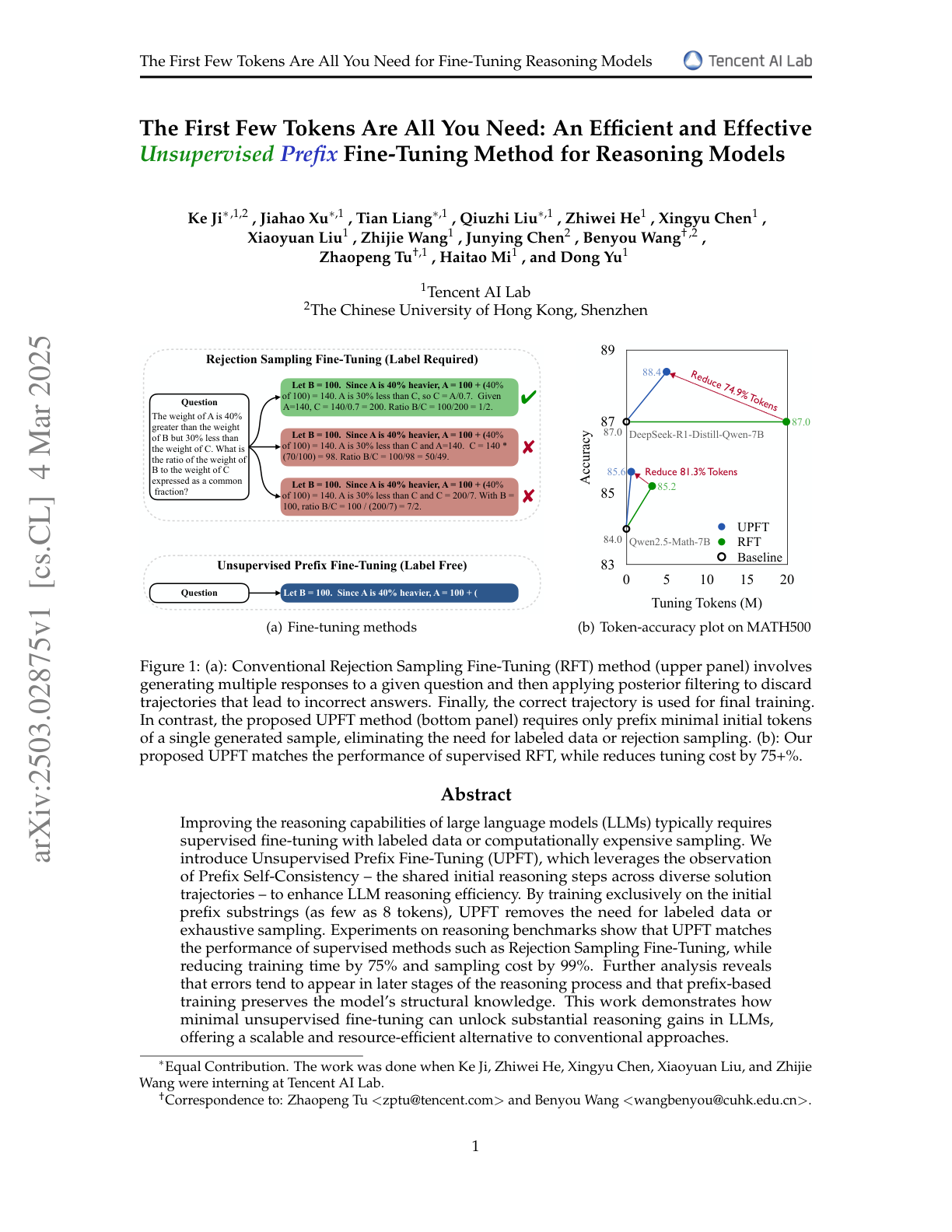
A Few Tokens Are All You Need
Researchers from Tencent AI Lab and The Chinese University of Hong Kong, Shenzhen propose a new approach to boost reasoning in LLMs by only fine-tuning on the first few tokens of generated solutions. Key ideas include: