AI Papers of the Week
Every paper worth reading in AI, hand-picked one week at a time.
Discover and explore top AI papers withClaude CodeCodex
npx @dair-ai/mcp setup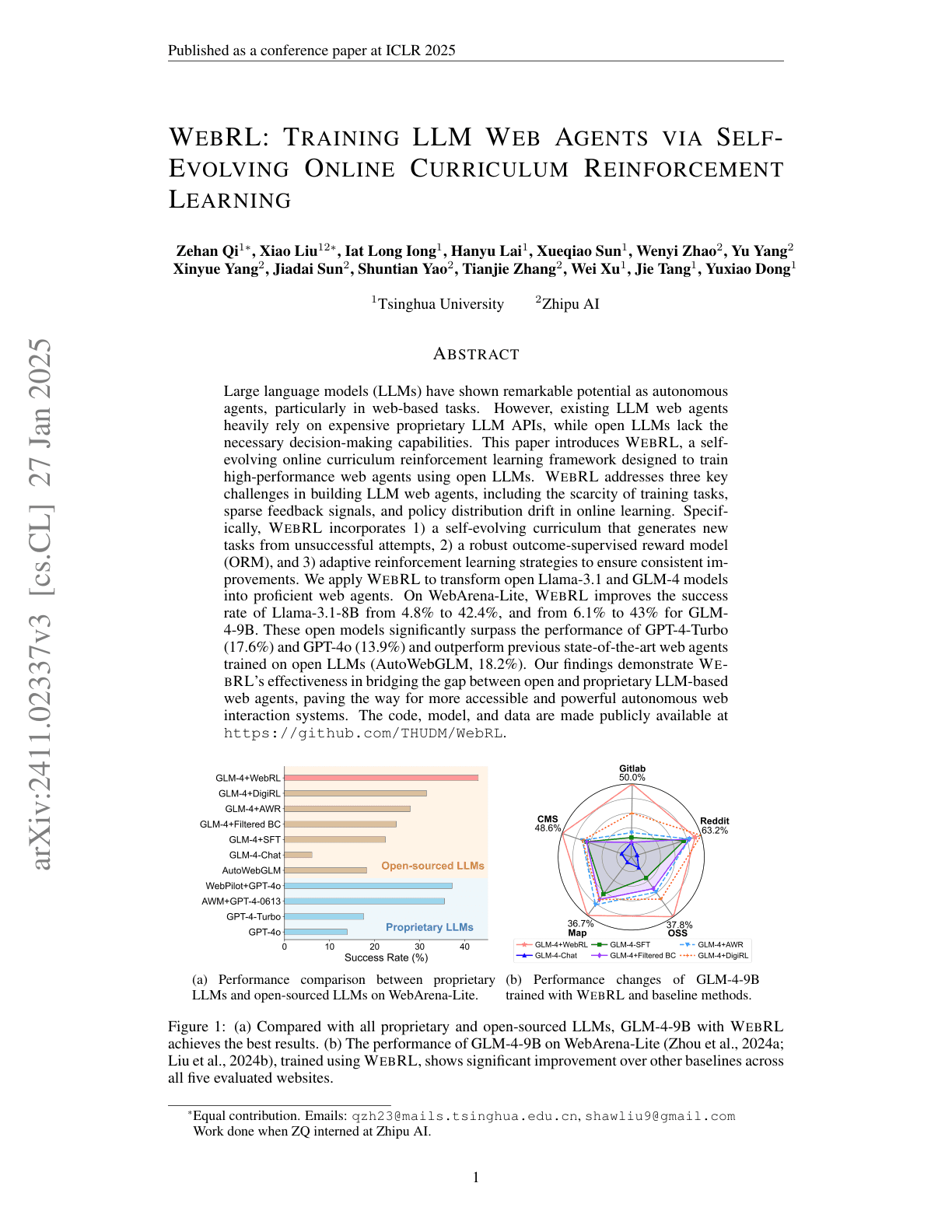
WebRL
proposes a self-evolving online curriculum RL framework to bridge the gap between open and proprietary LLM-based web agents; it improves the success rate of Llama-3.1-8B from 4.8% to 42.4%, and from 6.1% to 43% for GLM4-9B; the open models significantly surpass the performance of GPT-4-Turbo (17.6%) and GPT-4o (13.9%); the self-evolving curriculum addresses the scarcity of web agent training tasks; this is underpinned by a robust outcome-supervised reward model to evaluate task success; an adaptive RL strategy helps to deal with distribution drift in online learning and ensures consistent improvements.
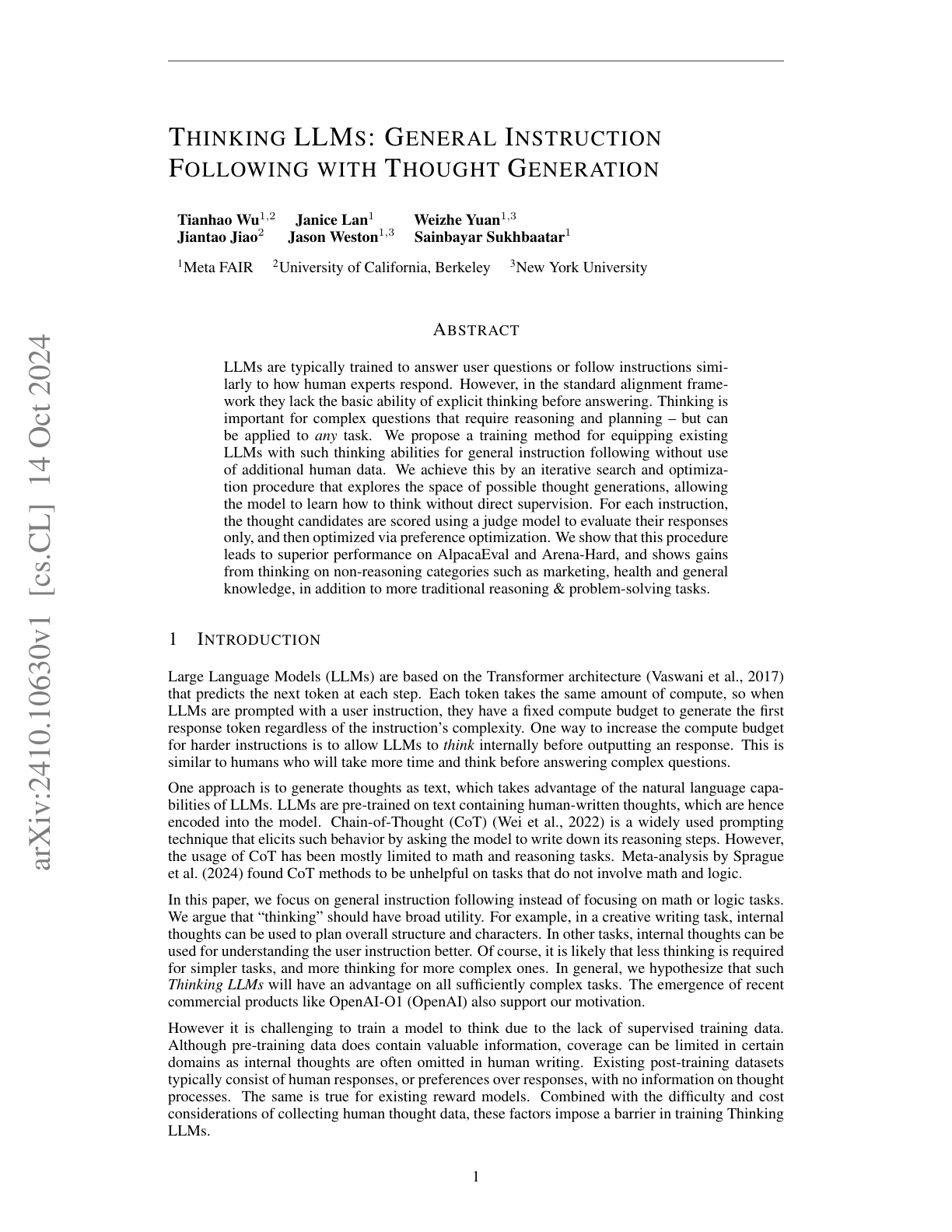
Thinking LLMs
proposes a training method to equip LLMs with thinking abilities for general instruction-following without human-annotated data; uses an iterative search and optimization procedure to explore thought generation which enables the model to learn without direct supervision; thought candidates for each user instruction are scored with a judge model; only responses are evaluated by the Judge which determines the best and worst ones; then the corresponding full outputs are used as chosen and rejected pairs for DPO (referred to as Thought Preference Optimization in this paper). reports superior performance on AlpacaEval and Arena-Hard.
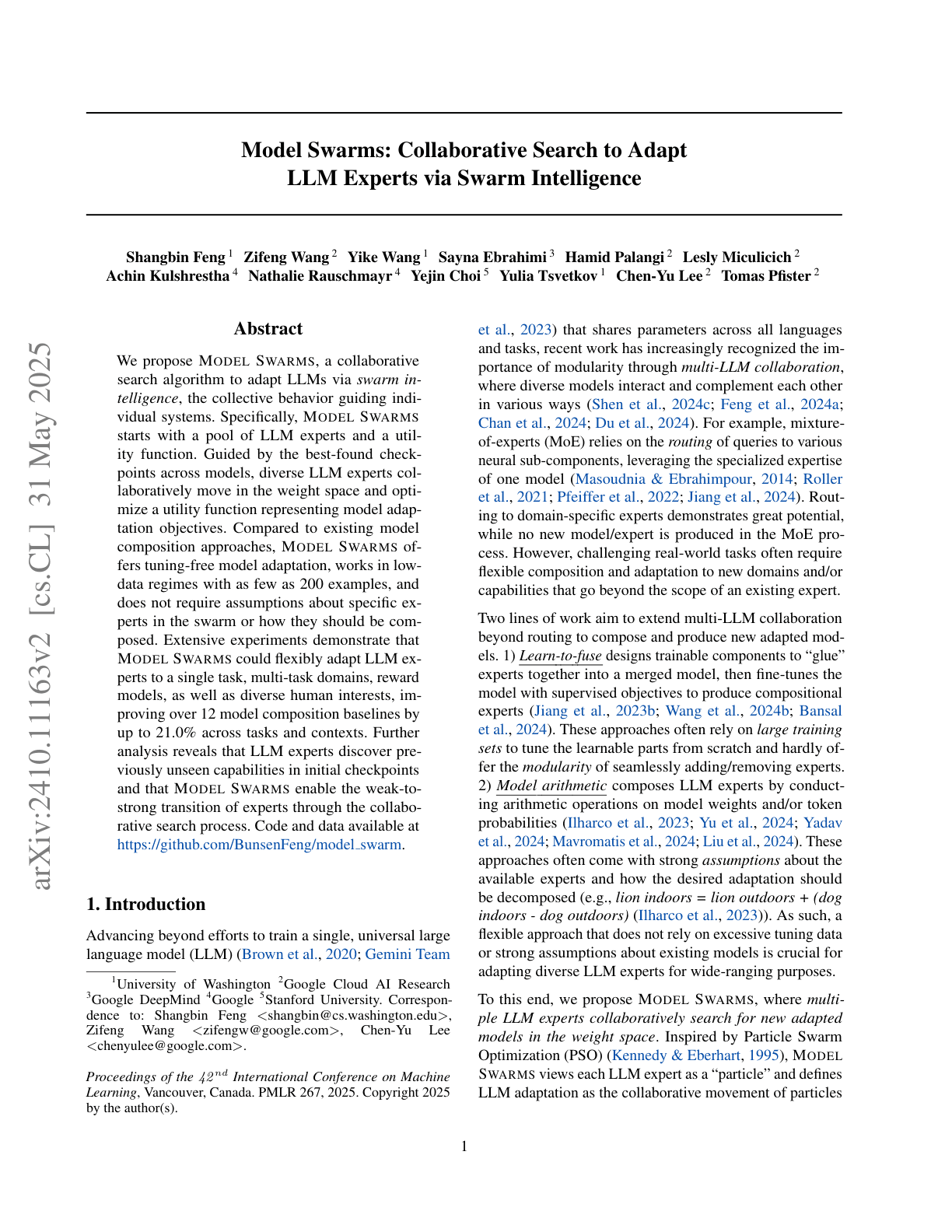
Model Swarms
propose a new collaborative search algorithm to adapt LLM via swarm intelligence; a pool of LLM experts collaboratively move in the weight space and optimize a utility function representing various adaptation objectives; experiments demonstrate that Model Swarms could flexibly adapt LLM experts to a single task, multi-task domains, reward models, as well as diverse human interests. improves over 12 model composition baselines by up to 21.0% across tasks and contexts.
AlphaChip
a reinforcement learning-based method trained to design the physical layout of chips; AlphaChip is reportedly used in three additional generations of Google’s TPU; this release includes an open-source implementation of the method to help pre-train on a variety of chip blocks to apply to new blocks; also releases a model checkpoint pre-trained on 20 TPU blocks.
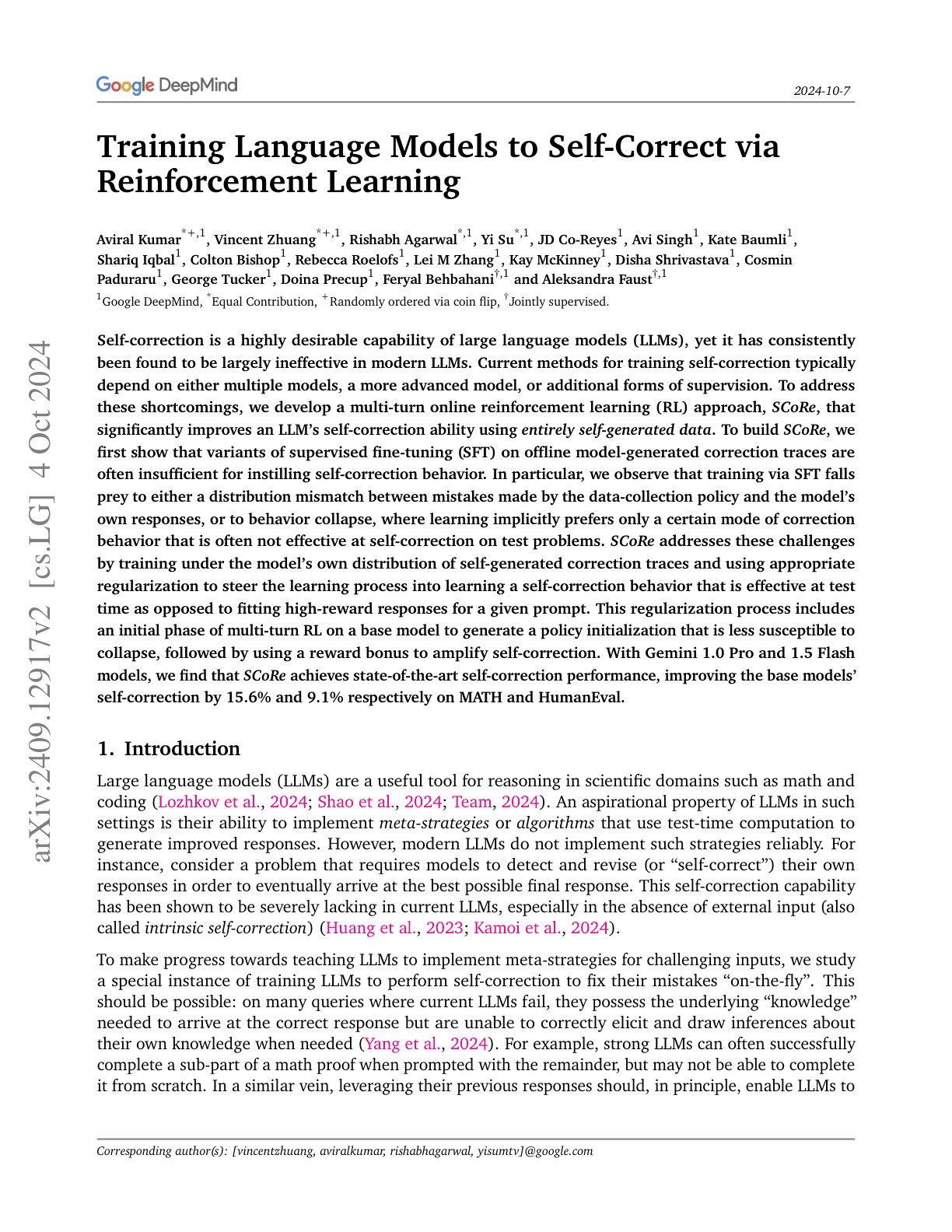
Training LLMs to Self-Correct via RL
develops a multi-turn online reinforcement learning to improve the capabilities of an LLM to self-correct; it’s based entirely on self-generated data; SFT is shown to be ineffective at learning self-correction and suffers from distribution mismatch between training data and model responses; proposes a two-stage approach that first optimizes correction behavior and then uses a reward bonus to amplify self-correction during training; when applied to Gemini 1.0 Pro and 1.5 Flash models, it achieves state-of-the-art self-correction performance, improving the base models’ self-correction by 15.6% and 9.1% respectively on the MATH and HumanEval benchmarks.
Learning to Reason with LLMs
a new family of LLMs trained with reinforcement learning to reason before it responds to complex tasks; it produces a long internal chain of thought and exceeds in science, code, and math-related tasks; ranked in the 49th percentile in the 2024 International Olympiad in Informatics and exceeds human PhD-level accuracy on science-related benchmarks. -
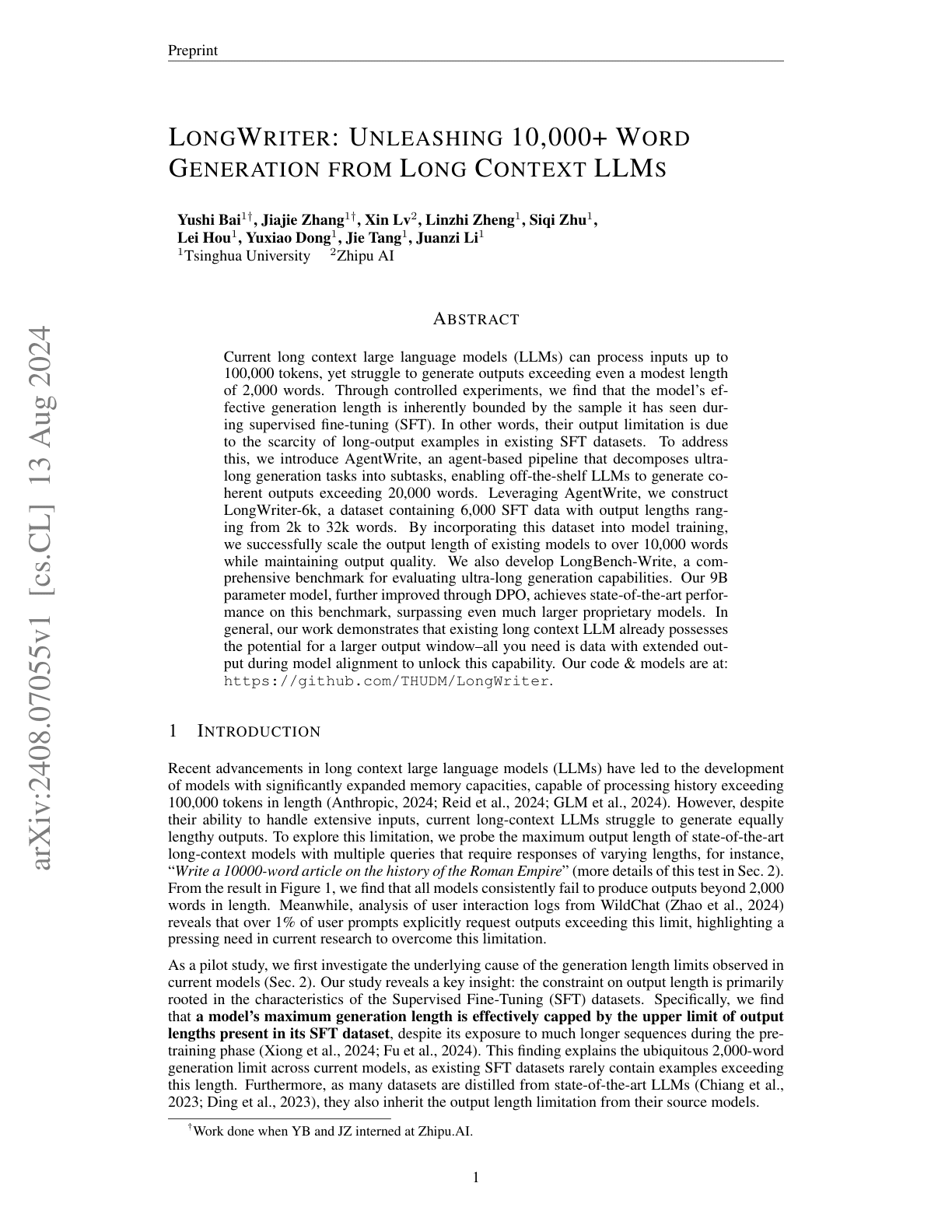
LongWriter
proposes AgentWrite to enable off-the-shelf LLMs to generate coherent outputs beyond 20K words; AgentWrite breaks down the long generation task into subtasks and in a divide-and-conquer approach generates; the agent breaks the task into multiple writing subtasks and concatenates the outputs to get a final output (i.e., plan + write); the approach is then used to build SFT datasets that are used to tune LLMs to generate coherent longer outputs automatically; a 9B parameter model, further improved through DPO, achieves state-of-the-art performance on their benchmark, and surpasses proprietary models.
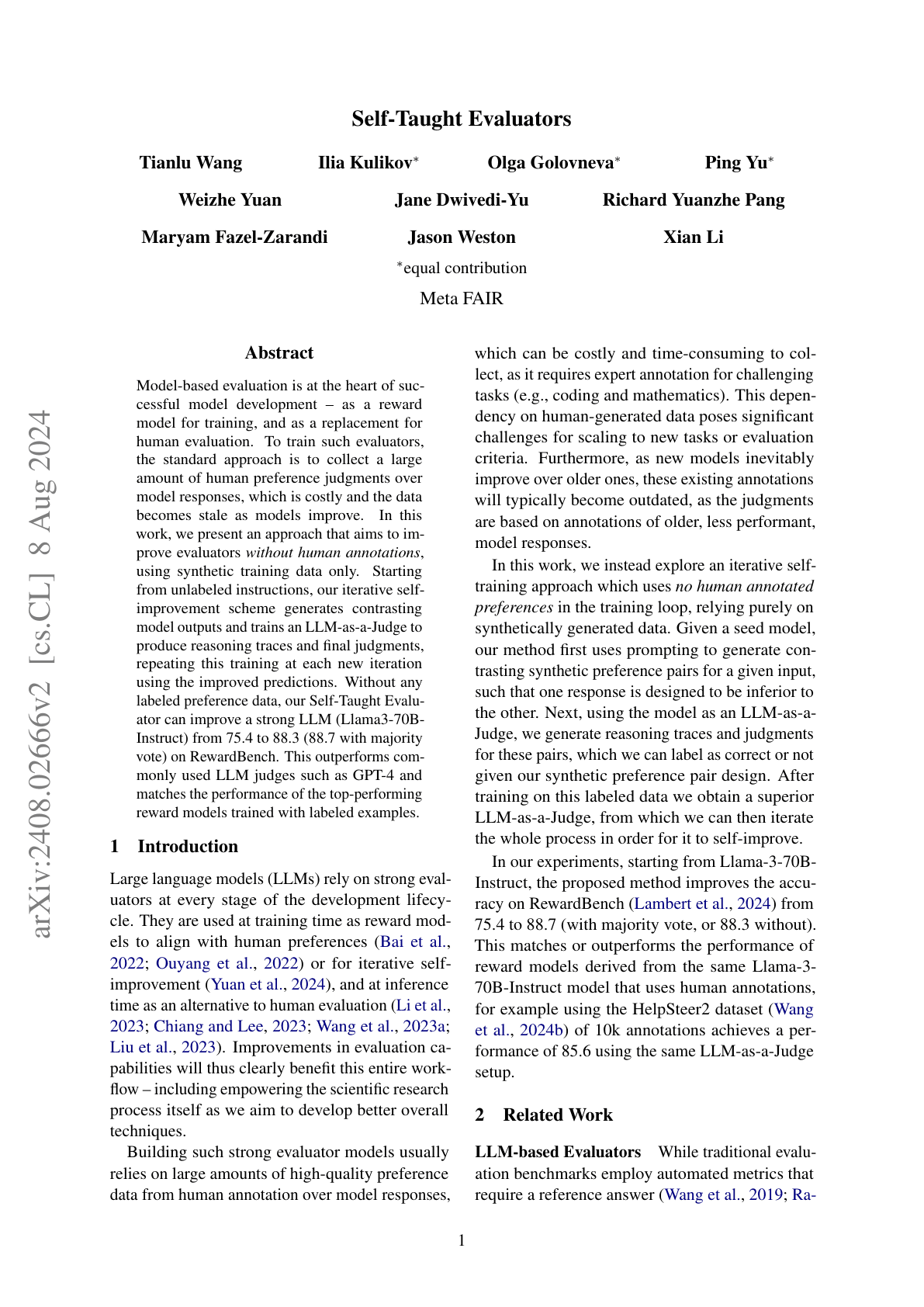
Self-Taught Evaluators
an approach to improve model-based evaluators using synthetic training data only; it first generates contrasting outputs (good and bad model responses) and trains an LLM-as-a-Judge to produce reasoning traces and final judgments; the self-improvement scheme repeats the training process in an iterative way using its improved predictions; claims to outperform LLM-judges such as GPT-4 and match top-performing reward models trained on labeled examples; improves a strong LLM (Llama3-70BInstruct) from 75.4 to 88.3 (88.7 with majority vote) on RewardBench.
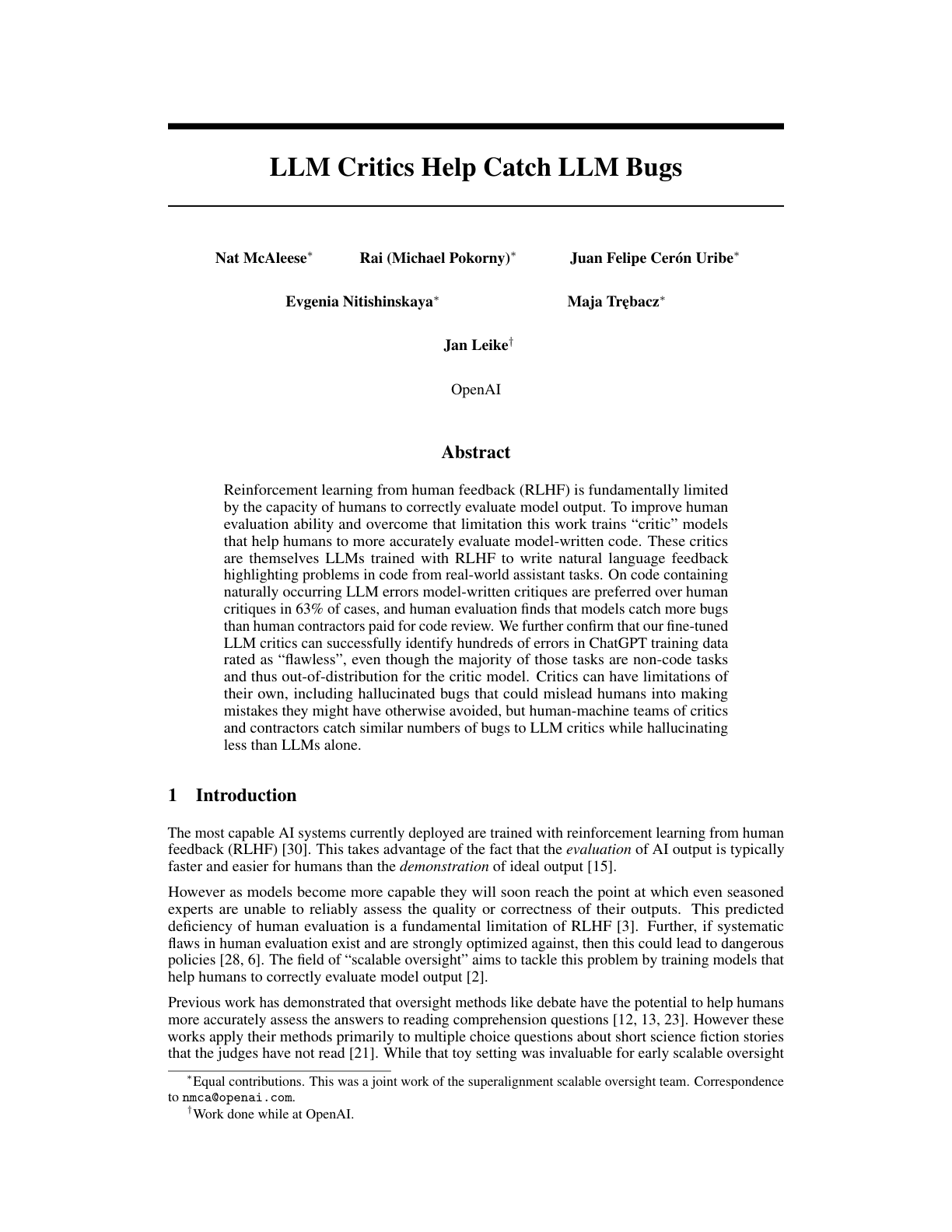
CriticGPT
a new model based on GPT-4 to help write critiques for responses generated by ChatGPT; trained using RLHF using a large number of inputs that contained mistakes for which it had to critique; built to help human trainers spot mistakes during RLHF and claims that CriticGPT critiques are preferred by trainers over ChatGPT critiques in 63% of cases on naturally occurring bugs.
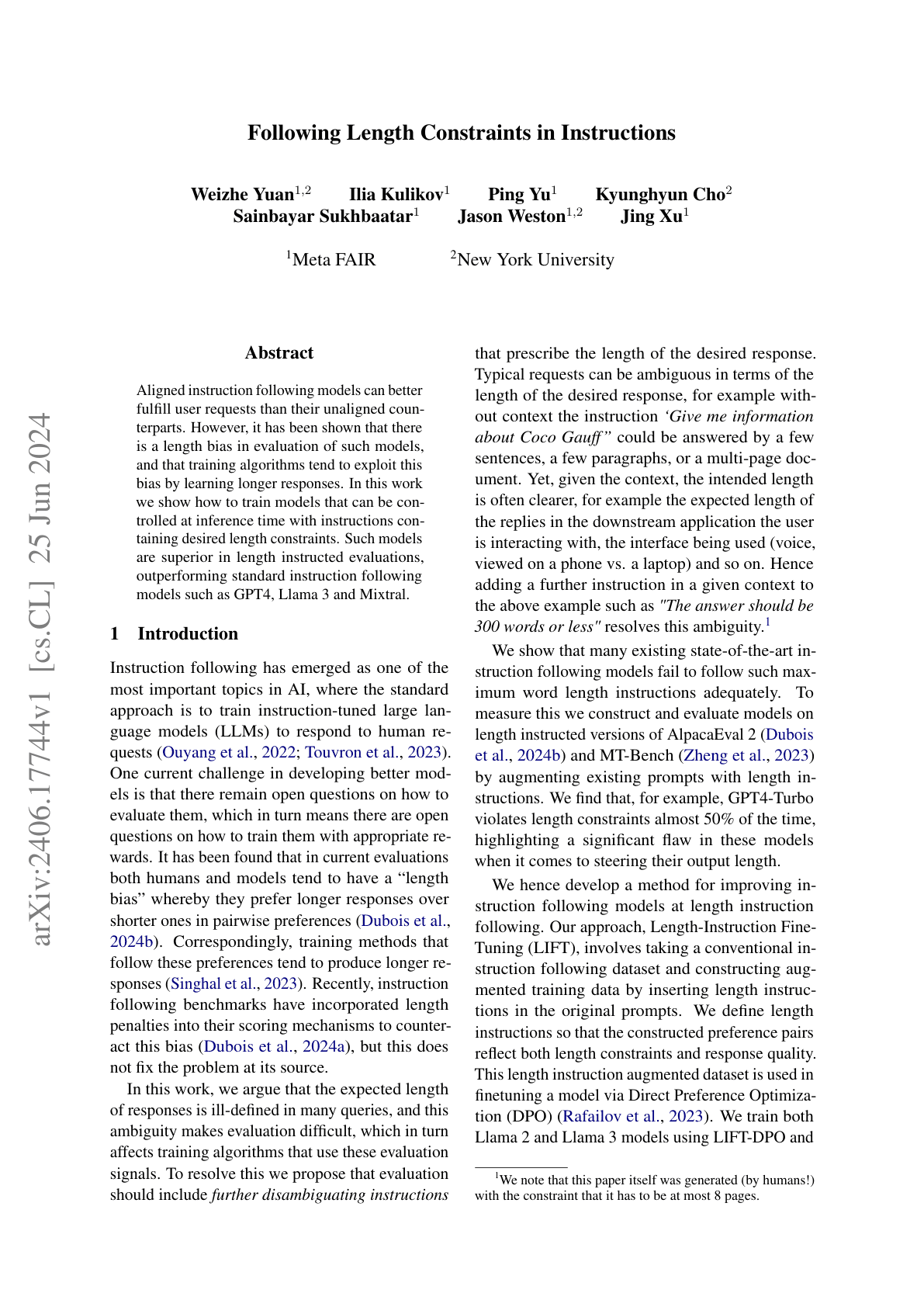
Following Length Constraints in Instructions
presents an approach for how to deal with length bias and train instruction following language models that better follow length constraint instructions; fine-tunes a model using DPO with a length instruction augmented dataset and shows less length constraint violations and while keeping a high response quality.
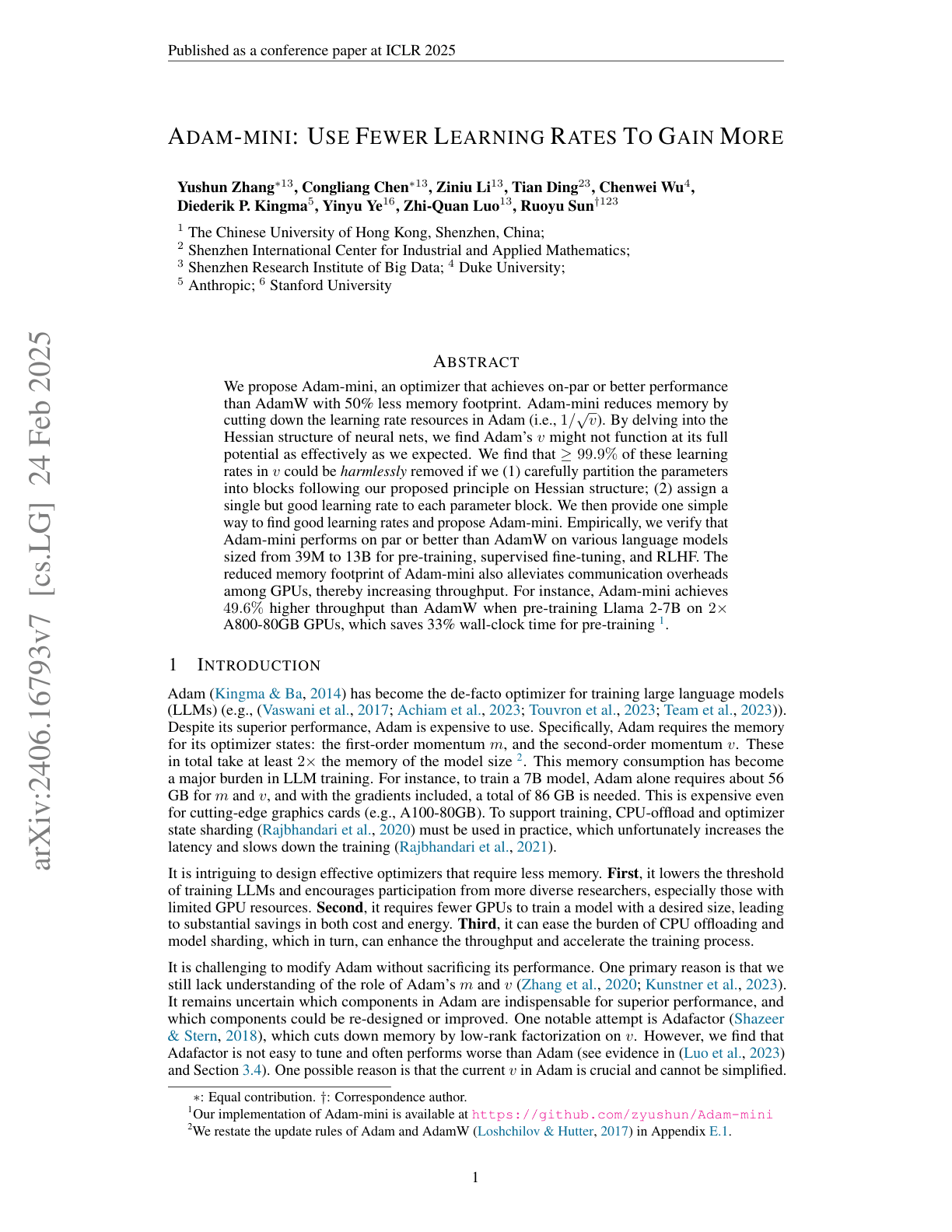
Adam-mini
a new optimizer that reduces memory footprint (45%-50% less memory footprint) by using fewer learning rates and achieves on-par or even outperforms AdamW; it carefully partitions parameters into blocks and assigns a single high-quality learning that outperforms Adam; achieves consistent results on language models sized from 125M -7B for pre-training, SFT, and RLHF.
Nemotron-4 340B
provides an instruct model to generate high-quality data and a reward model to filter out data on several attributes; demonstrates strong performance on common benchmarks like MMLU and GSM8K; it’s competitive with GPT-4 on several tasks, including high scores in multi-turn chat; a preference data is also released along with the base model.
Discovering Preference Optimization Algorithms with LLMs
proposes LLM-driven objective discovery of state-of-the-art preference optimization; no human intervention is used and an LLM is prompted to propose and implement the preference optimization loss functions based on previously evaluated performance metrics; discovers an algorithm that adaptively combined logistic and exponential losses.
SaySelf
a training framework to teach LLMs to express more accurate fine-grained confidence estimates and self-reflective rationales; it performs supervised finetuning on a dataset that contains summaries of the difference between multiple reasoning chains; reinforcement learning is then applied to calibrate confidence estimates, encouraging the LLM to produce accurate, high-confidence predictions and penalize overconfidence in erroneous outputs.
Aligning LLMs with Demonstrated Feedback
proposes a method to align LLMs to a specific setting via a very small number of demonstrations as feedback; it aligns LLM outputs to a user’s demonstrated behaviors and can learn fine-grained style and task alignment across domains; outperforms few-shot prompting, SFT, and self-play methods on the tested benchmarks.
SimPO
a simpler and more effective approach for preference optimization with a reference-free reward; uses the average log probability of a sequence as an implicit reward (i.e., no reference model required) which makes it more compute and memory efficient; demonstrates that it outperforms existing approaches like DPO and claims to produce the strongest 8B open-source model.
RLHF Workflow
provides an easily reproducible recipe for online iterative RLHF; discusses theoretical insights and algorithmic principles of online iterative RLHF and practical implementation.
Self-Play Preference Optimization
proposes a self-play-based method for aligning language models; this optimation procedure treats the problem as a constant-sum two-player game to identify the Nash equilibrium policy; it addresses the shortcomings of DPO and IPO and effectively increases the log-likelihood of chose responses and decreases the rejected ones; SPPO outperforms DPO and IPO on MT-Bench and the Open LLM Leaderboard.
Gemma
Google DeepMind releases Gemma, a family of open models (2B and 7B) built from the same research stack as Gemini and shipped with both base and instruction-tuned variants.
Back to Basics: Revisiting REINFORCE in RLHF
Cohere researchers argue that PPO is overkill for RLHF and that a simpler REINFORCE-style estimator works better in practice.
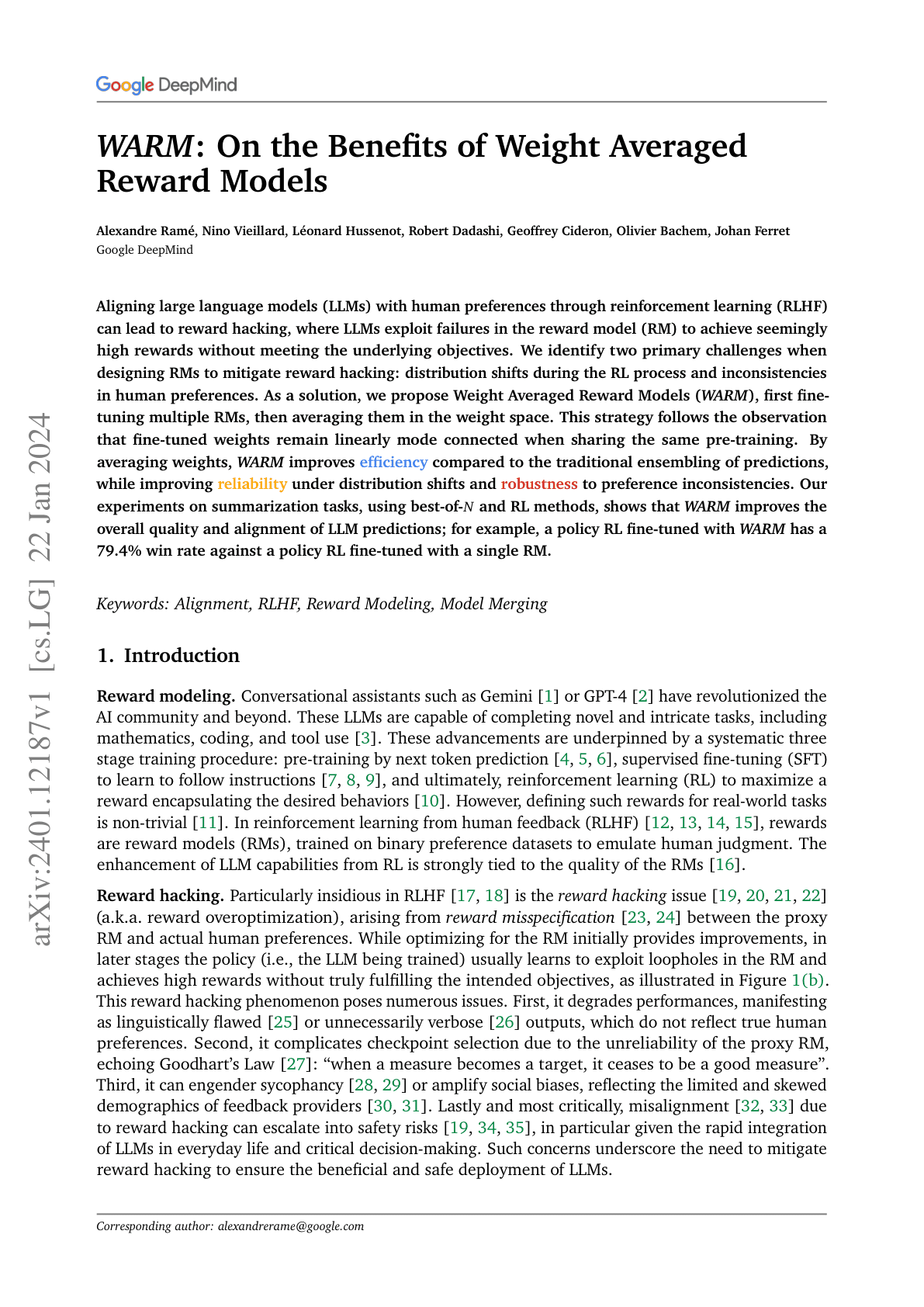
WARM (Weighted Averaged Reward Models)
WARM averages multiple fine-tuned reward models in weight space rather than ensembling their predictions, dramatically reducing RLHF inference cost.
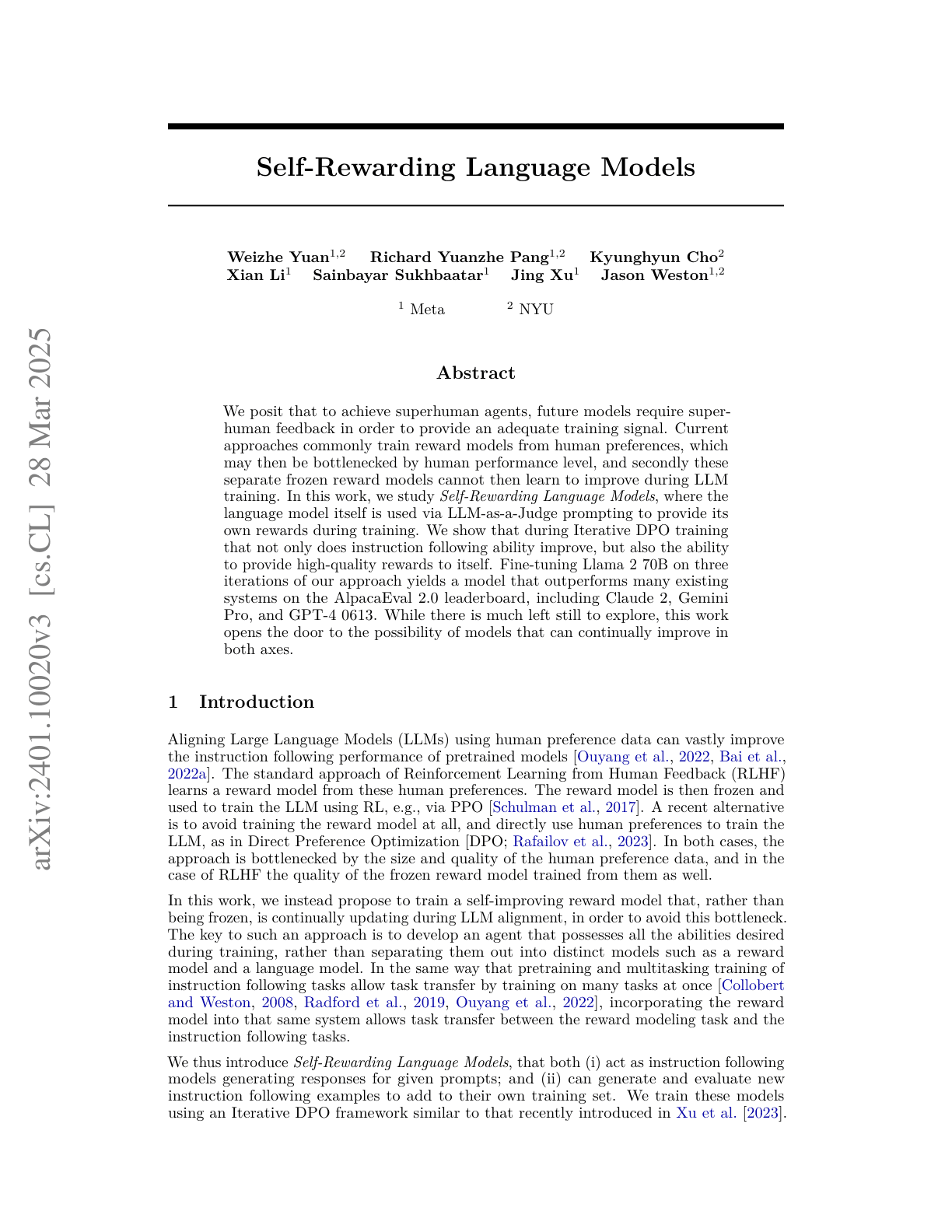
Self-Rewarding Language Models
Meta shows that an LLM can act as both actor and judge in its own alignment loop, generating training data without any external reward model.
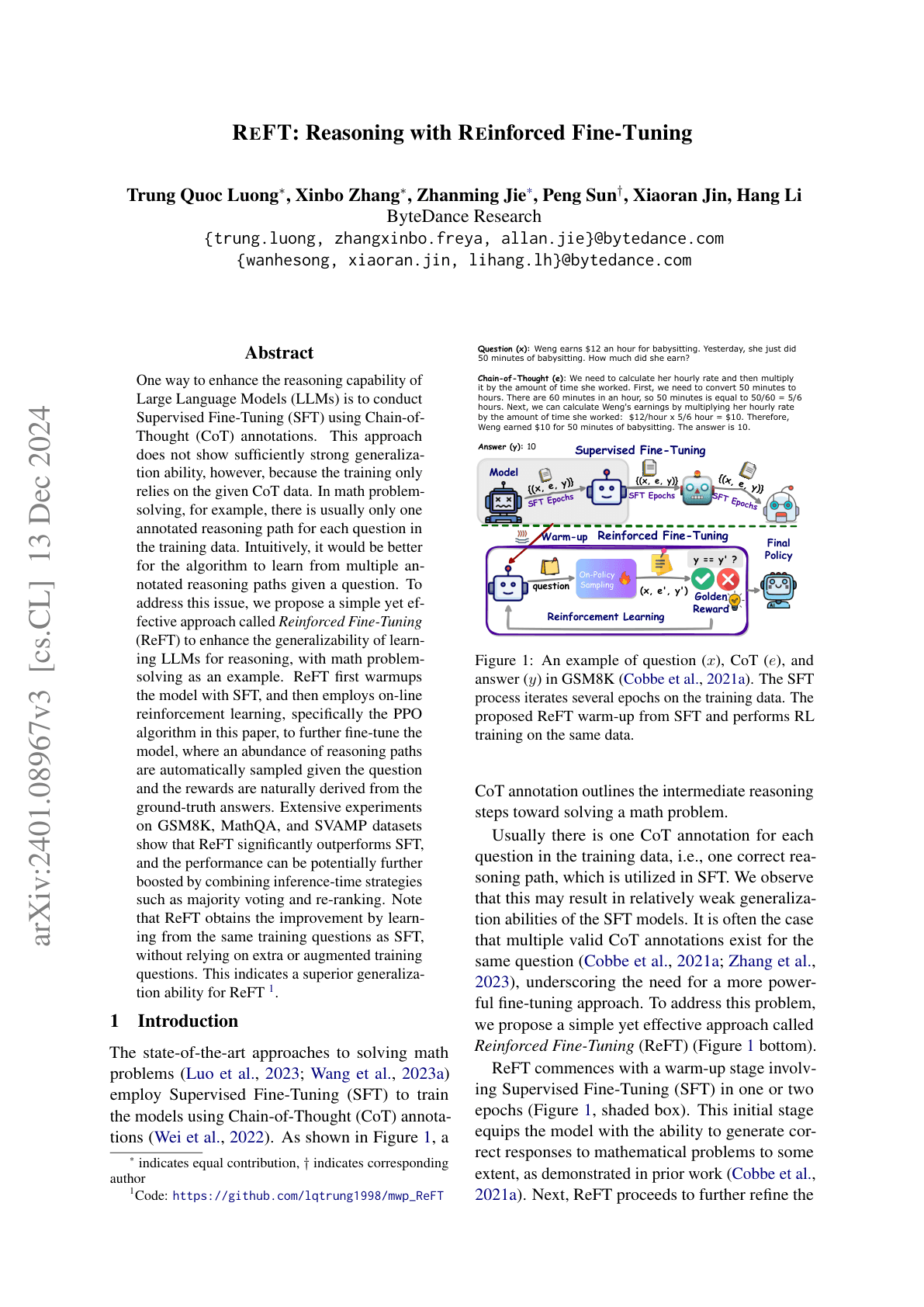
ReFT (Reinforced Fine-Tuning)
ByteDance's ReFT enhances LLM reasoning by combining supervised fine-tuning with online RL that samples alternative reasoning paths, without a learned reward model.
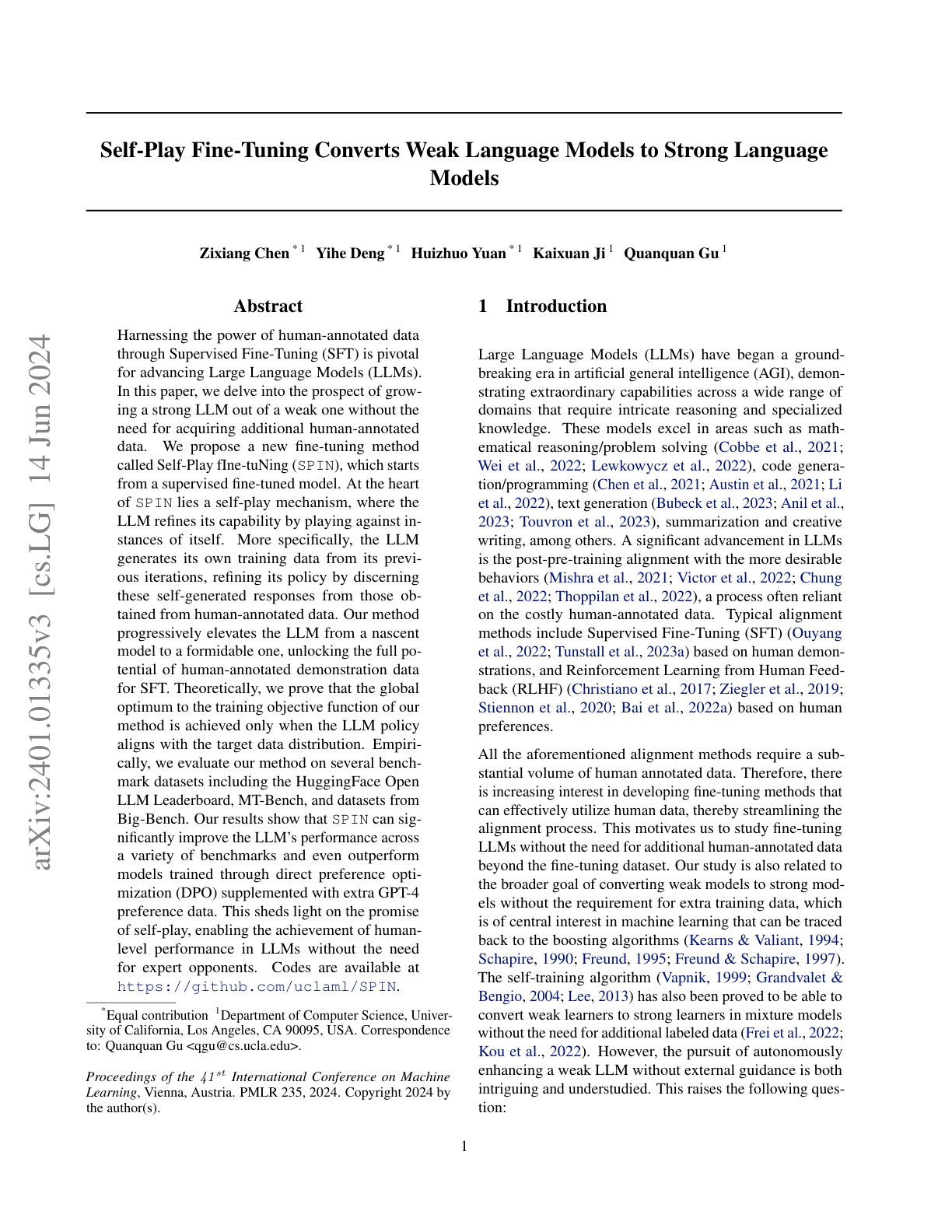
Self-Play Fine-Tuning (SPIN)
SPIN shows that a supervised fine-tuned LLM can keep improving via self-play alone, without any additional human annotations.