AI Papers of the Week
Every paper worth reading in AI, hand-picked one week at a time.
Discover and explore top AI papers with Claude Code or Codex
npx @dair-ai/mcp setup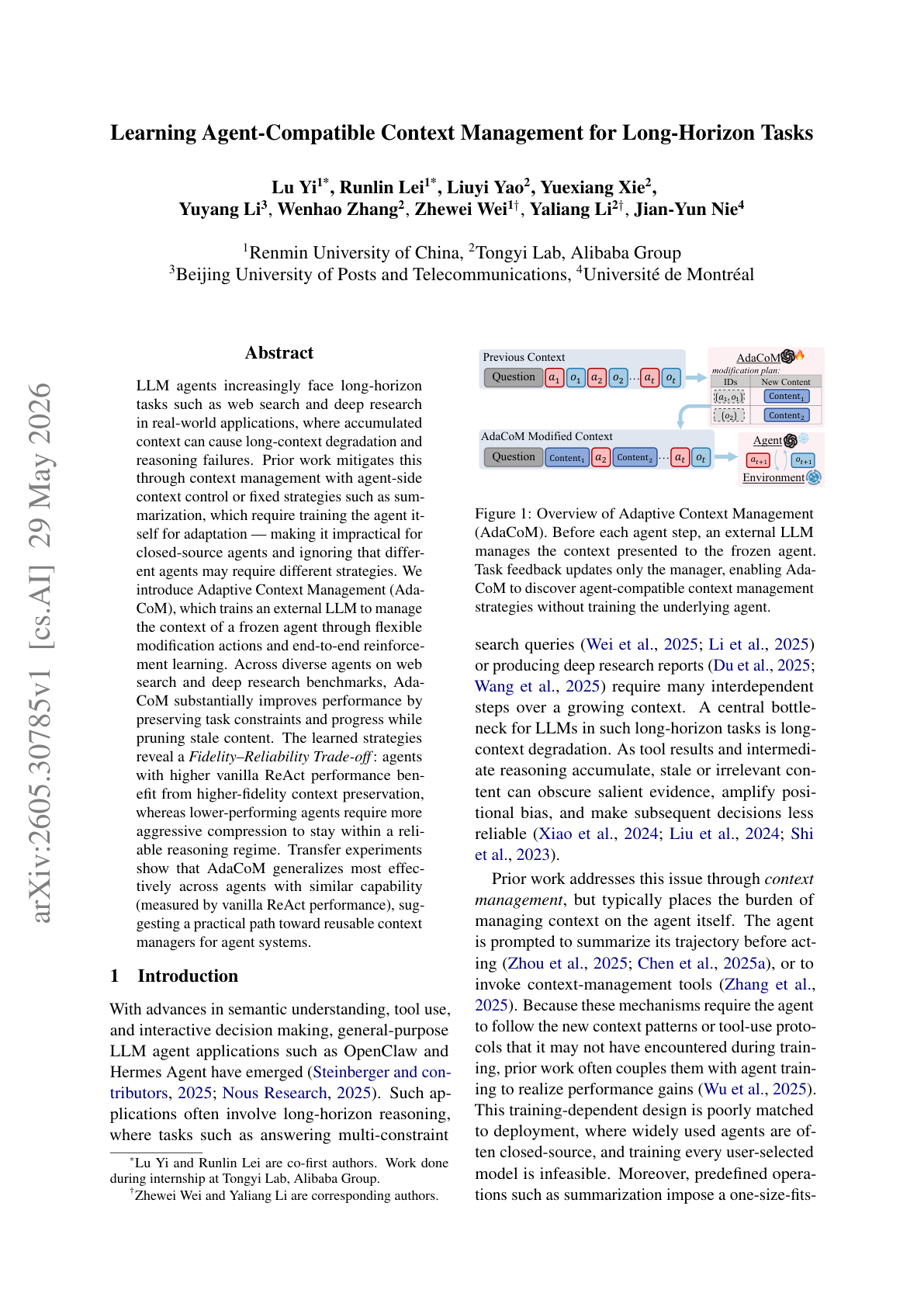
Reusable Context Engineering
Context bloat quietly kills long-horizon runs, and the usual fixes are baked into an agent's own prompt or weights, so they do not transfer. AdaCoM takes a different route: it trains a separate external model to manage the context of a frozen agent through flexible modification actions, optimized end-to-end with reinforcement learning. The agent never changes; only the context flowing into it does.
State-Externalizing Harnesses
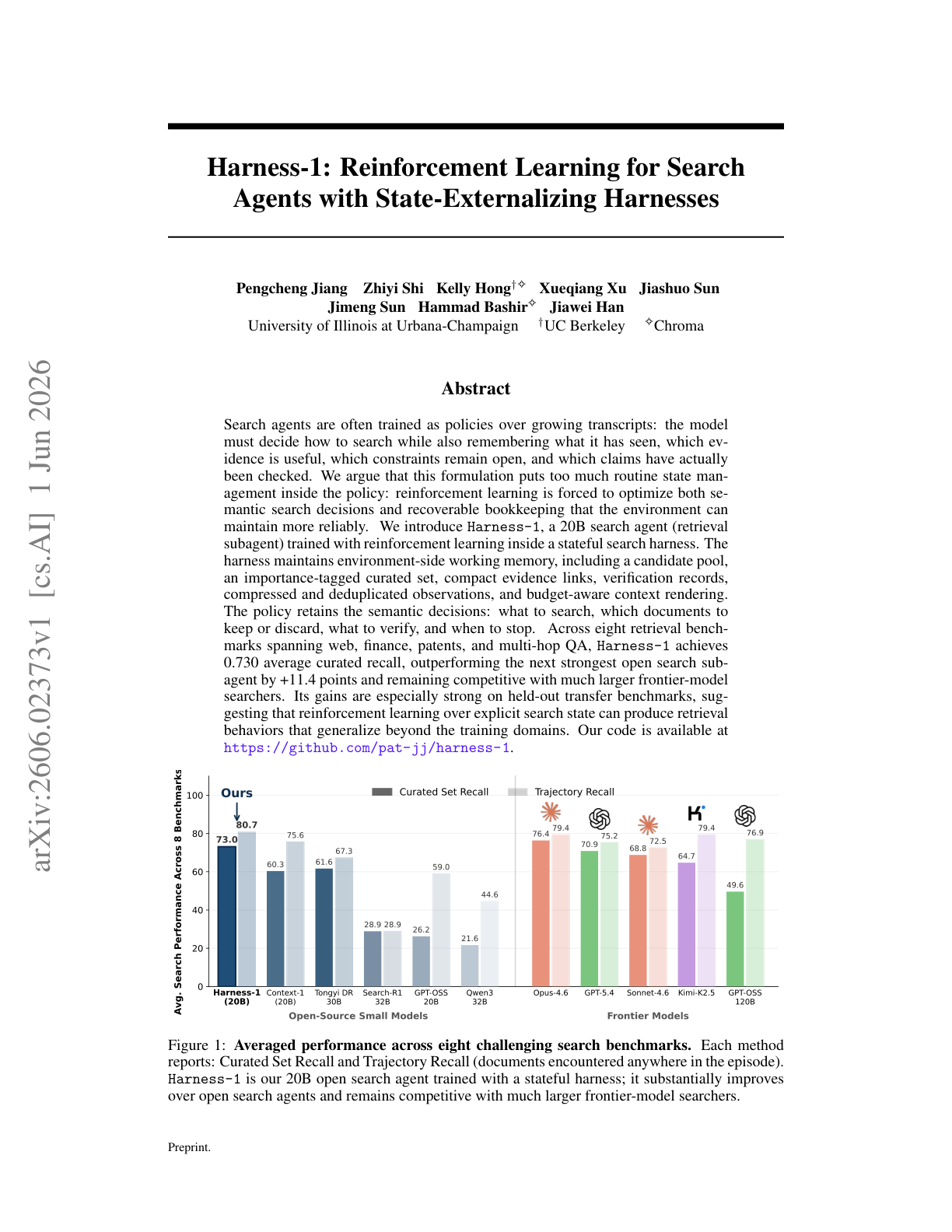
Harness-1 is a 20B search agent trained with reinforcement learning inside a stateful harness that offloads routine bookkeeping to the environment. The argument is that search agents are usually trained as policies over a growing transcript, forcing RL to optimize both genuine search decisions and recoverable state like which evidence is useful or which claims are checked. Harness-1 moves that state out of the policy and into an environment-side working memory of candidate pools, an importance-tagged curated set, compact evidence links, and verification records. The 20B agent reaches an average curated recall of 0.730 across eight retrieval benchmarks, beating open-source baselines by 11.4 points and matching or outperforming much larger frontier searchers, with stronger generalization on unseen domains.
General-Agent
Prime Intellect's General-Agent is a fully synthetic reinforcement learning environment whose task corpus self-evolves and grows harder over time. The release ships with 4,504 tool-use tasks across 1,040 domains and 8,159 unique tools. Synthetic task creation is formulated as a two-player game between a Synthesizer that proposes new task families and a Solver that runs rollouts to measure pass rates. Tasks whose pass rate falls inside a calibrated difficulty band are accepted into the corpus, and hard tiers seed the next round of extensions. The framing turns RL environment creation, historically a major bottleneck, into an automated agentic search problem in its own right.
HeavySkill
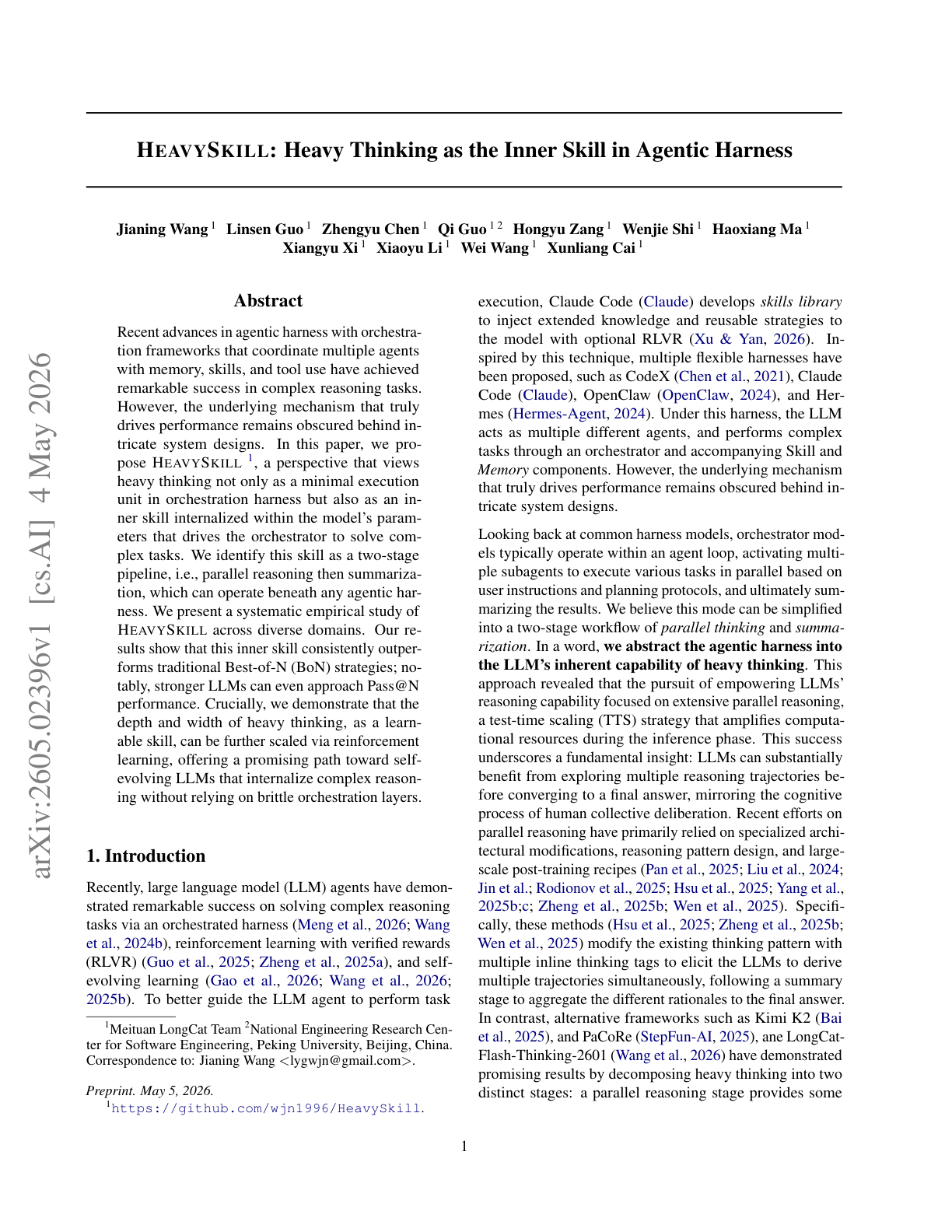
One of the cleaner takes on agentic harness design released this year. The paper argues that what actually drives harness performance is not the orchestration code, but a single inner skill: parallel reasoning followed by deliberation. Internalize that pattern into the model and most of the surrounding scaffolding becomes optional. HeavySkill systematizes the idea as a two-stage pipeline you can run beneath any harness, then trains it as a learnable skill via RLVR. The result is a harness win that looks more like a model win.
Conductor
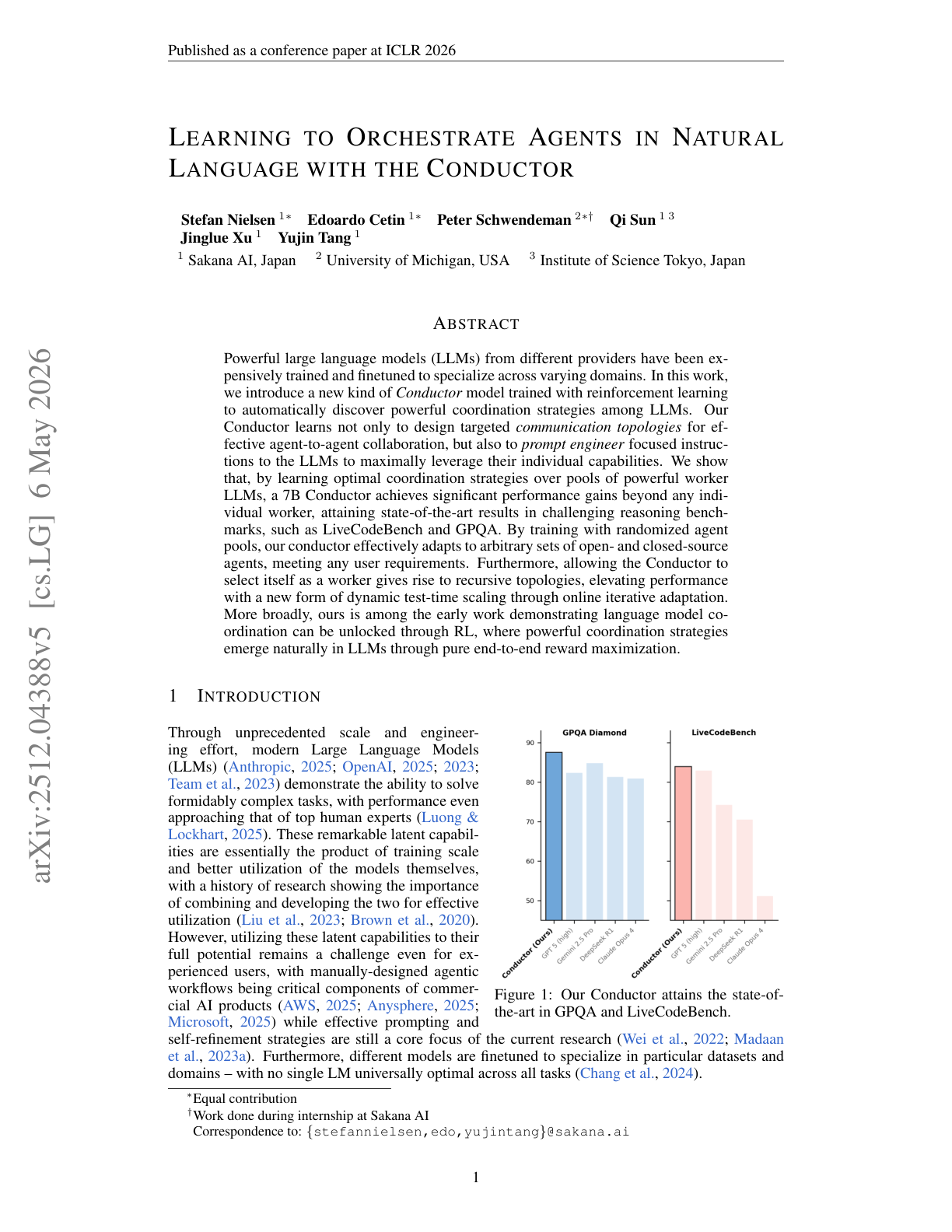
Sakana AI's ICLR 2026 paper introduces a 7B Conductor model that hits SOTA on GPQA-Diamond and LiveCodeBench by orchestrating other LLMs instead of solving problems itself. The Conductor is trained with RL to do two things simultaneously: design communication topologies between worker agents (open or closed source) and prompt-engineer focused instructions to each worker so it leverages individual strengths. The orchestrator becomes a learnable policy, not a wrapper around one.
Horizon Generalization
Microsoft Research runs a controlled study where the only variable is task horizon length. Same decision rules, same reasoning structure, different sequence length to the goal. The main finding: horizon alone is a training bottleneck. As goal distance grows, exploration explodes combinatorially and credit assignment gets ambiguous. Models that learn cleanly on short horizons fall apart on long ones, even when the underlying reasoning is identical. The fix is not more compute, it is horizon reduction.
AgenticQwen-30B-A3B
Alibaba shows that a 30B MoE model with only 3B active parameters can match Qwen3-235B on real tool-use workloads. AgenticQwen-30B-A3B scores 50.2 average on TAU-2 plus BFCL-V4 Multi-Turn, while AgenticQwen-8B scores 47.4. Both more than double their vanilla Qwen baselines and close most of the gap to a 235B model. The recipe is built around two reinforcement learning flywheels that run in parallel, with simulated users actively trying to mislead the agent.
Co-evolving Decisions and Skills
Long-horizon agents fail in two ways: the decision-maker cannot decompose well, or the skill library goes stale. This paper introduces a co-evolution framework where an LLM decision agent and a dynamic skill bank improve each other through iterative refinement. The decision agent picks and chains skills, performance feedback updates both the policy and the skills, and new skills emerge by generalizing successful sequences instead of being hand-coded upfront. Most long-horizon agent stacks treat skills and decision-making as separate optimization problems, which is why they plateau. Co-evolution gives you adaptive planning and a growing library of reusable behaviors from a single loop, which is what you actually want when task structure is not predetermined: robotics, game agents, and complex planning.
Self-Generated World Knowledge
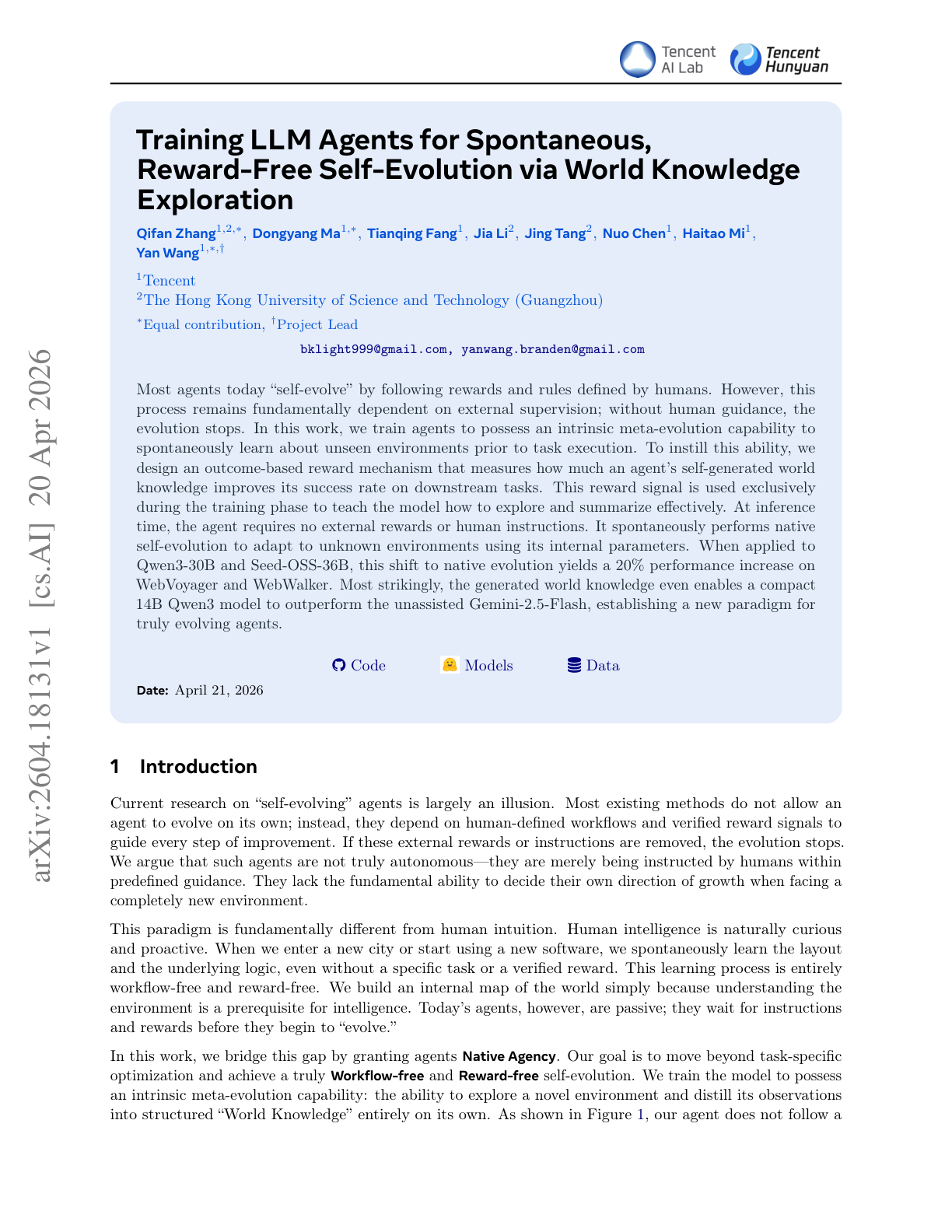
How far are we from agents that can self-generate world knowledge? This paper proposes an outcome-based reward that measures how much an agent's self-generated world knowledge actually improves its task success rate, then trains with that signal and removes the external guidance at inference. The result is a 14B model that surpasses Gemini-2.5-Flash on web navigation and gains +20% on WebVoyager and WebWalker benchmarks.
Memory Intelligence Agent (MIA)
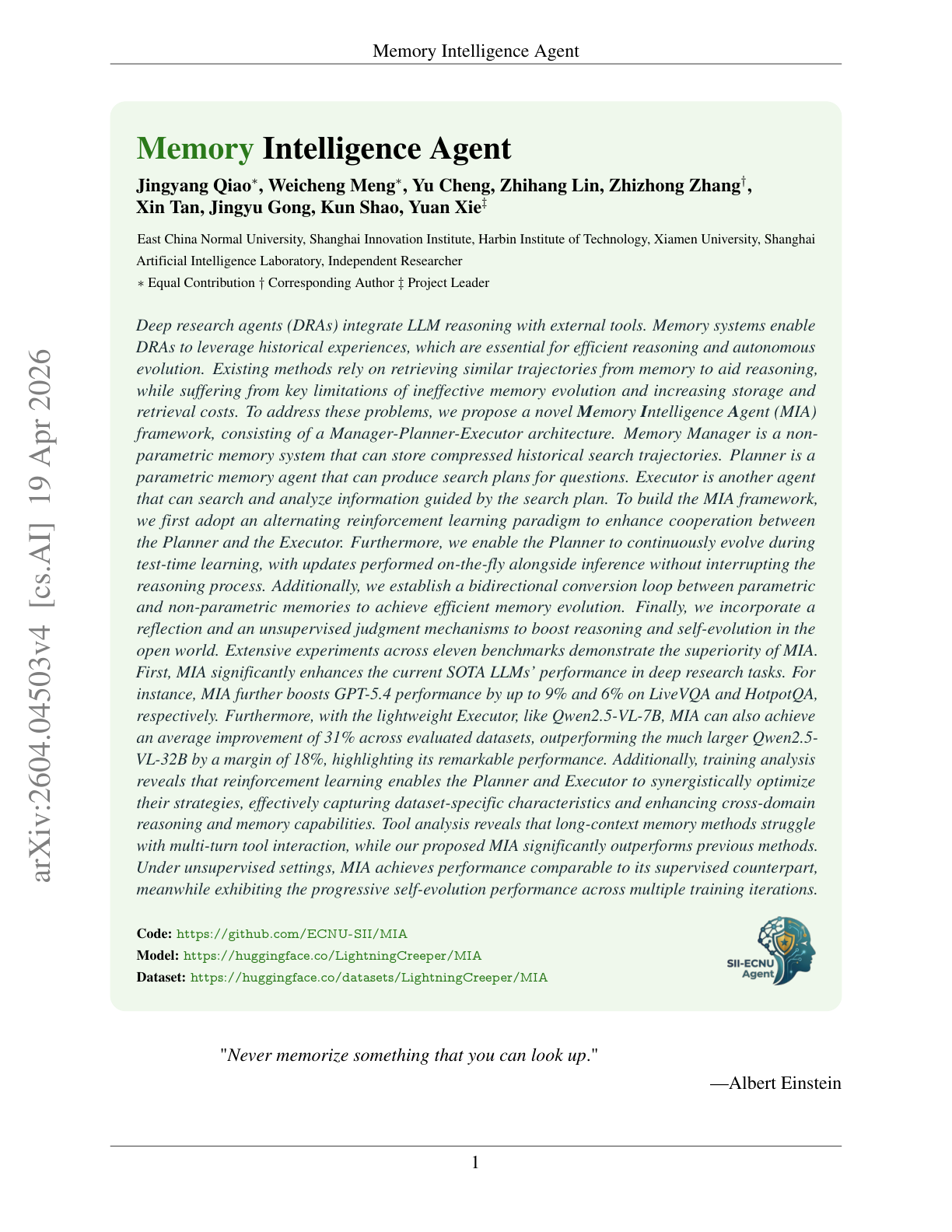
Most memory-augmented research agents treat memory as a static retrieval store, leading to inefficient evolution and rising storage costs. MIA introduces a Manager-Planner-Executor architecture where a Memory Manager maintains compressed search trajectories, a Planner generates strategies, and an Executor searches and analyzes information. The framework boosts GPT-5.4 by up to 9% on LiveVQA through bidirectional memory conversion.
Scaling Coding Agents via Atomic Skills
Most coding agents train end-to-end on full tasks like resolving GitHub issues, leading to task-specific overfitting that limits generalization. This paper proposes a different approach: identifying five atomic coding skills (code localization, code editing, unit-test generation, issue reproduction, and code review) and training agents through joint reinforcement learning over these foundational competencies.
Thinking Mid-training: RL of Interleaved Reasoning
Meta FAIR addresses the gap between pretraining (no explicit reasoning) and post-training (reasoning-heavy) with an intermediate SFT+RL mid-training phase. The approach annotates pretraining data with interleaved reasoning traces, then uses supervised fine-tuning followed by RL to teach models when and how to think during continued pretraining. Applied to Llama-3-8B, the full pipeline achieves a 3.2x improvement on reasoning benchmarks compared to direct RL post-training, demonstrating that reasoning benefits from being trained as native behavior early in the pipeline.
MemFactory
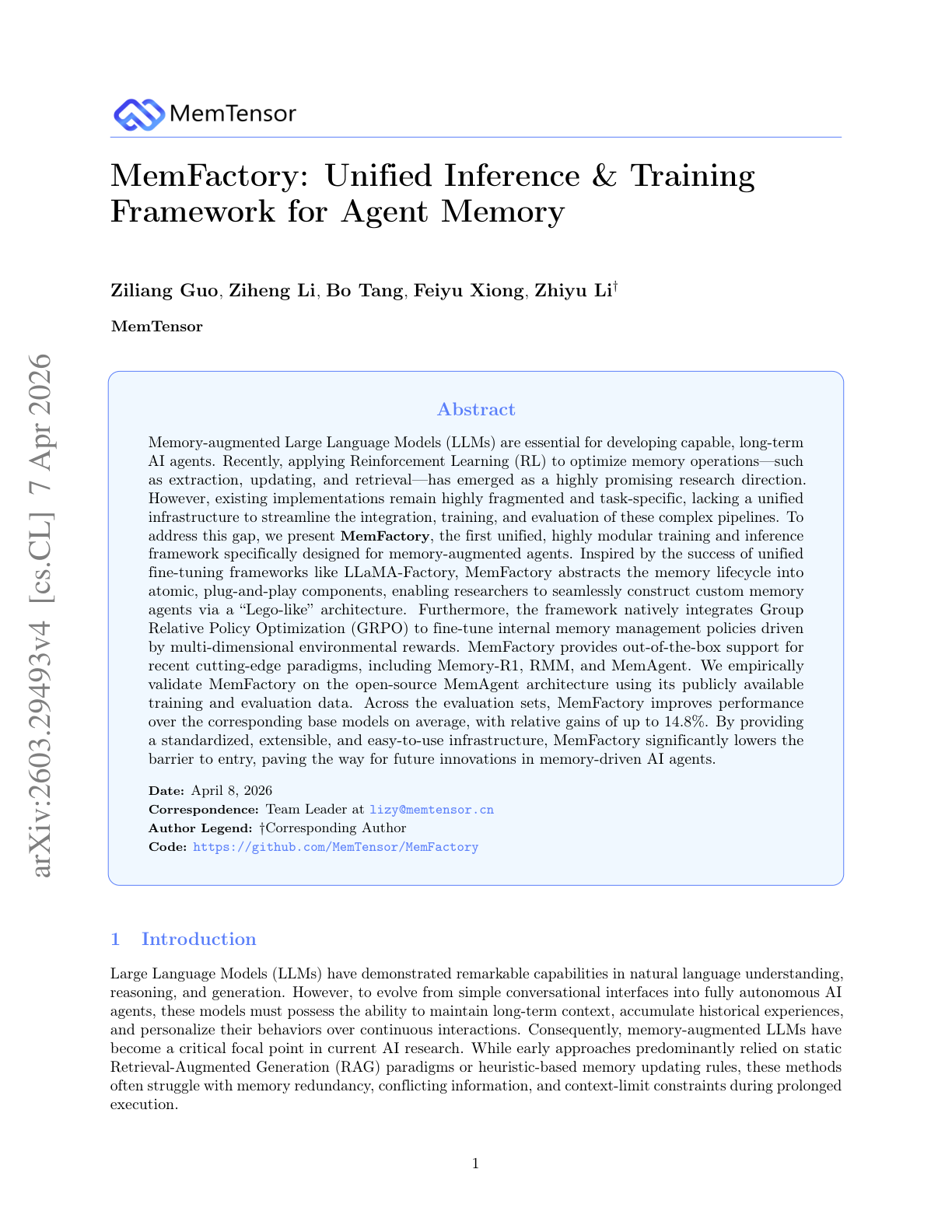
MemFactory introduces the first unified, highly modular training and inference framework specifically designed for memory-augmented AI agents. It abstracts the memory lifecycle into atomic, plug-and-play components using a “Lego-like” architecture, natively integrating Group Relative Policy Optimization (GRPO) to fine-tune internal memory management strategies. The framework decomposes memory into mixable components that support recent approaches including Memory-R1, RMM, and MemAgent out of the box, achieving relative gains of up to 14.8% compared to baseline models.
Composer 2
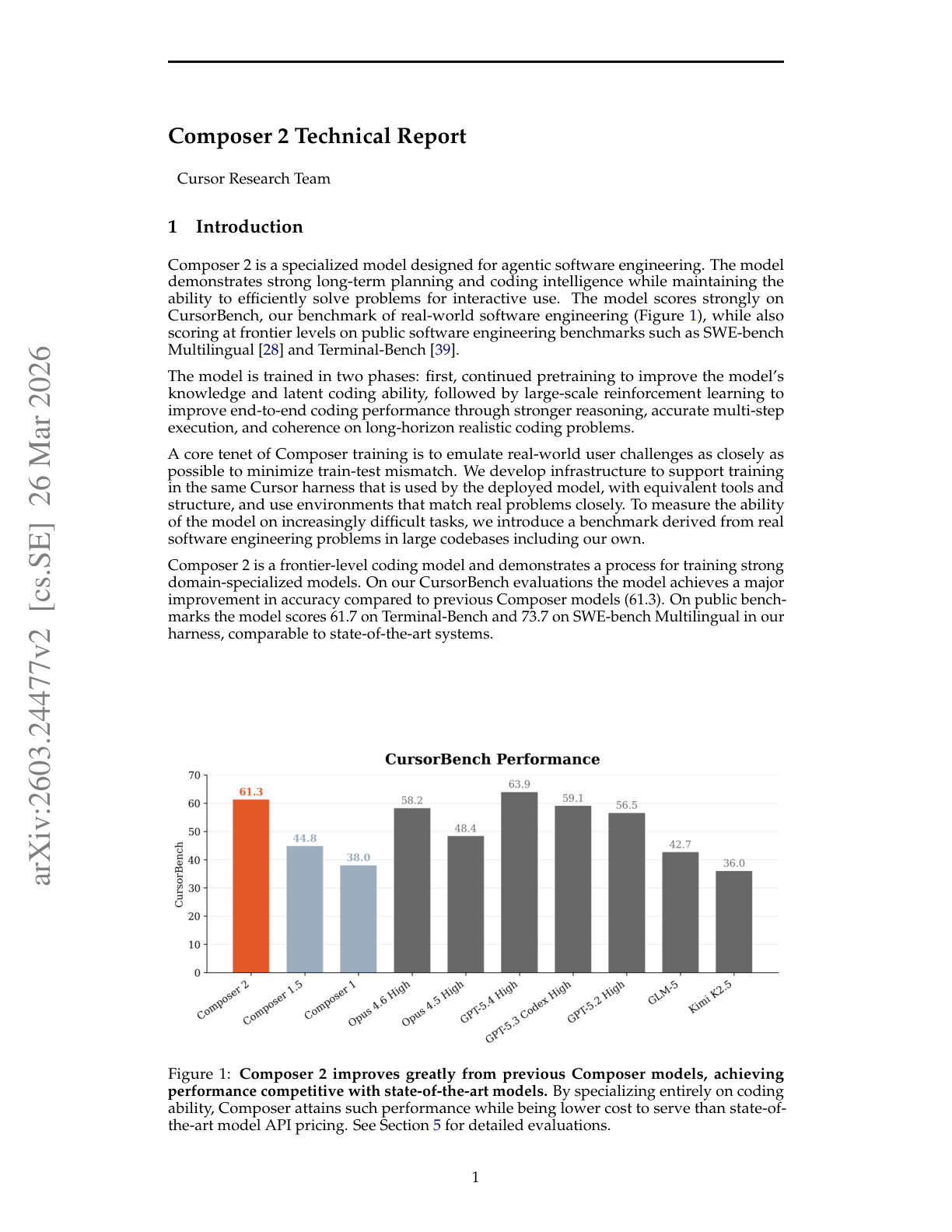
Cursor releases the technical report for Composer 2, a specialized model designed for agentic software engineering that demonstrates strong long-term planning and coding intelligence while maintaining efficiency for interactive use. The report details a process for training domain-specialized models that starts with continued pretraining and scales up with reinforcement learning.
PivotRL
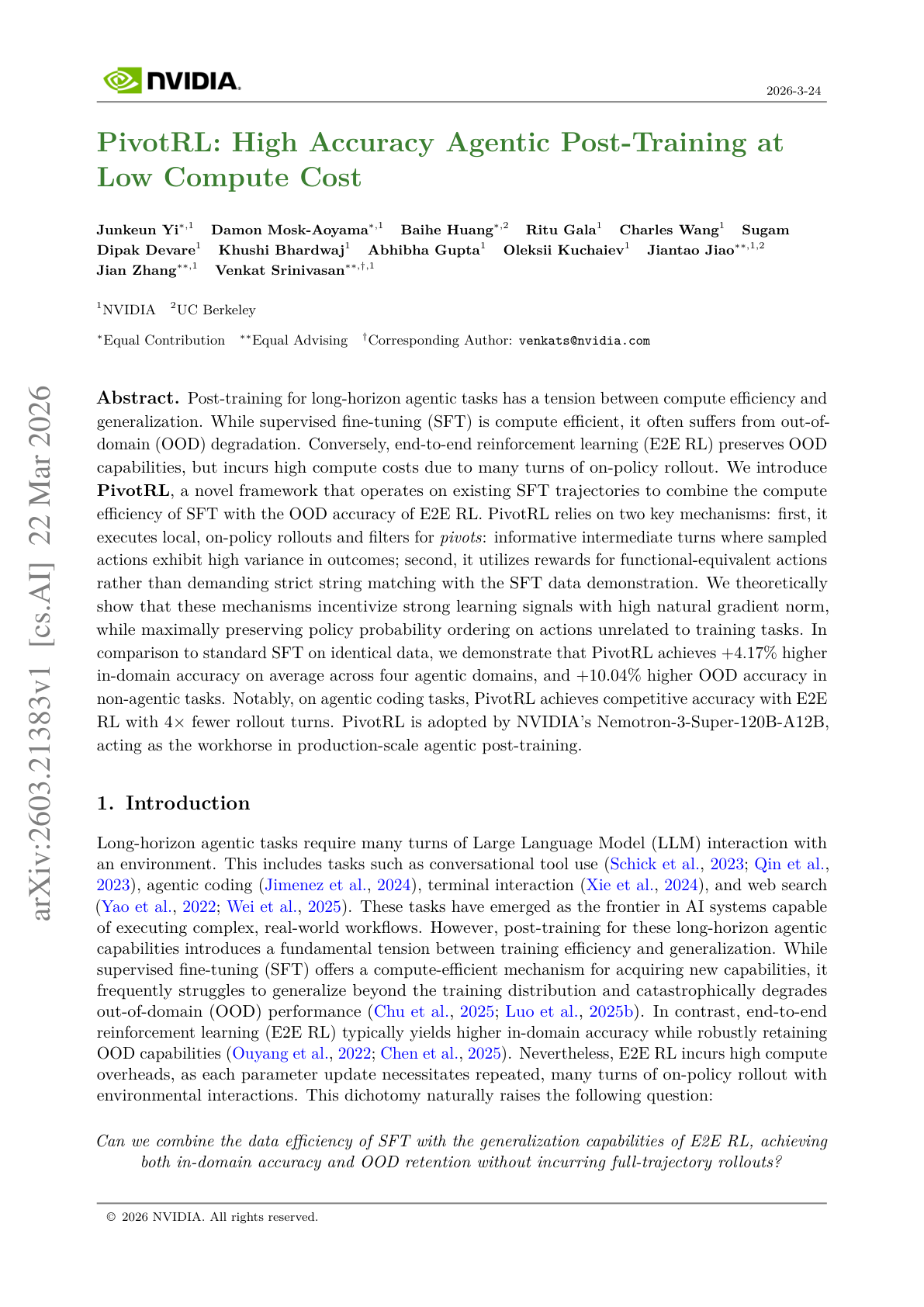
PivotRL is a turn-level reinforcement learning algorithm from NVIDIA designed to tractably post-train large language models for long-horizon agentic tasks. The method operates on existing SFT trajectories, combining the compute efficiency of supervised fine-tuning with the out-of-domain accuracy of end-to-end RL. PivotRL identifies “pivots,” informative intermediate turns where sampled actions exhibit high variance in outcomes, and focuses training signal on these critical decision points. The approach achieves +4.17% higher in-domain accuracy and +10.04% higher out-of-domain accuracy compared to standard SFT, while matching end-to-end RL accuracy with 4x fewer rollout turns. PivotRL is adopted by NVIDIA’s Nemotron-3-Super-120B-A12B as the workhorse for production-scale agentic post-training.
KARL
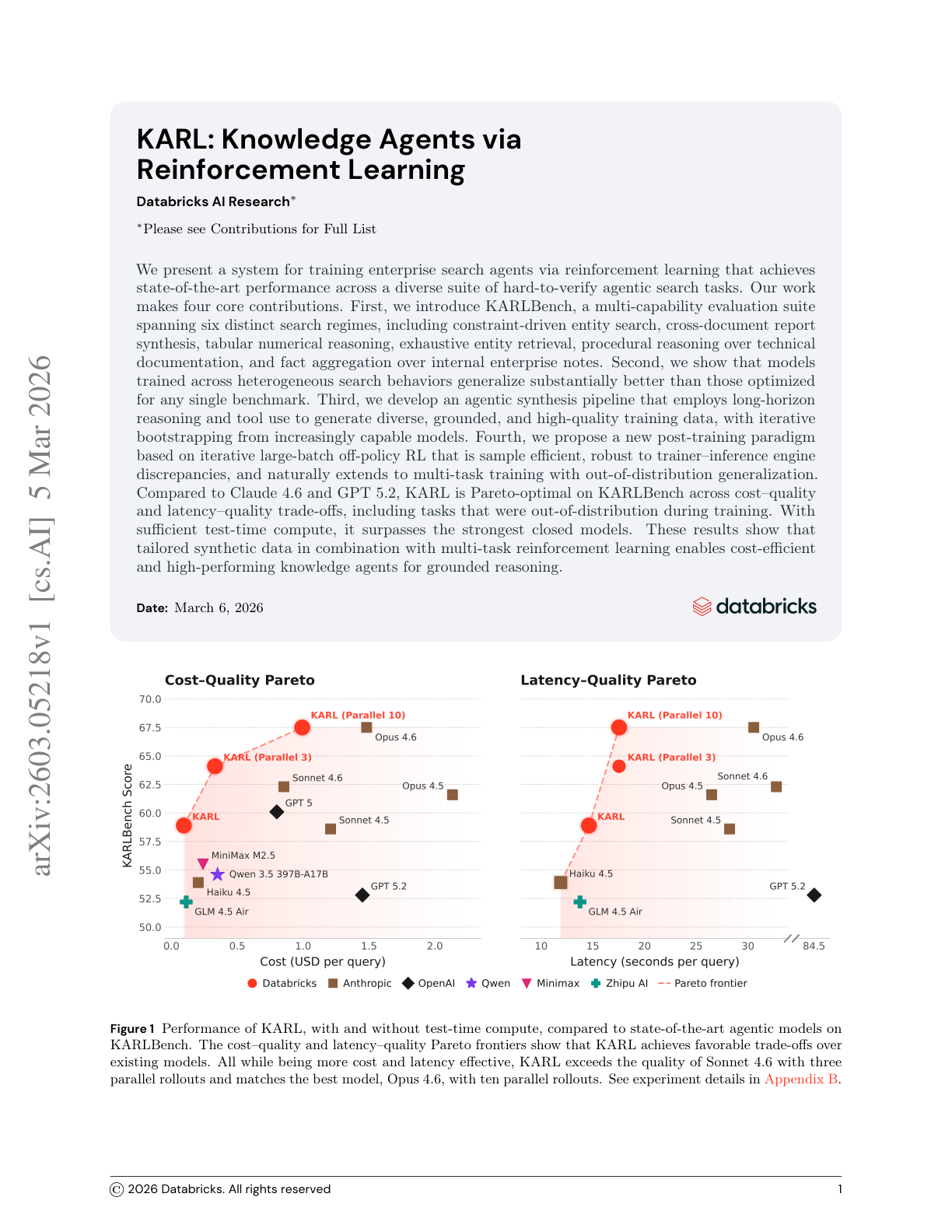
Databricks presents KARL, a system for training enterprise search agents via reinforcement learning that achieves state-of-the-art performance across a diverse suite of hard-to-verify agentic search tasks. The work also introduces KARLBench, a new evaluation framework spanning six search domains.
Memex(RL)
As tasks get longer and more complex, LLM agents lose track of what they have learned, what they have tried, and what still needs to be done. Memex(RL) introduces an indexed experience memory mechanism that scales agent capability on long-horizon tasks without discarding evidence or blowing up the context window.
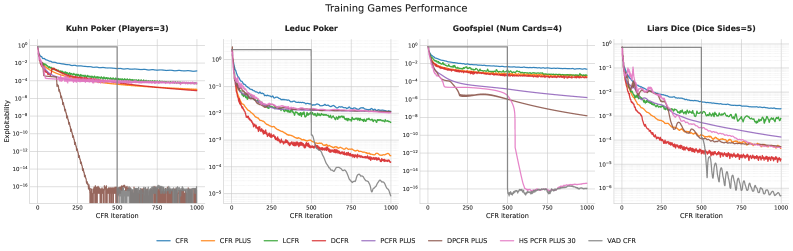
Discovering Multi-Agent Learning Algorithms with LLMs
Google DeepMind uses AlphaEvolve, an evolutionary coding agent powered by LLMs, to automatically discover new multi-agent learning algorithms for imperfect-information games. Rather than relying on manual algorithm design, the system navigates vast algorithmic design spaces and discovers non-intuitive mechanisms that outperform state-of-the-art baselines.
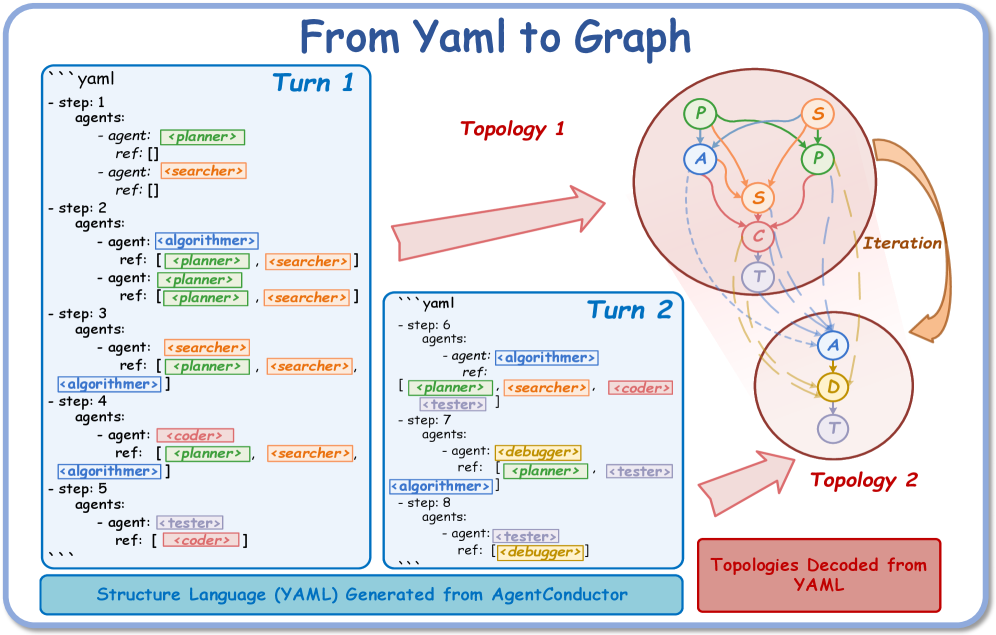
AgentConductor
AgentConductor introduces a reinforcement learning-enhanced multi-agent system for code generation that dynamically generates interaction topologies based on task characteristics. Rather than using fixed communication patterns between agents, an LLM-based orchestrator adapts the topology to match problem complexity, achieving state-of-the-art accuracy across five code generation datasets.
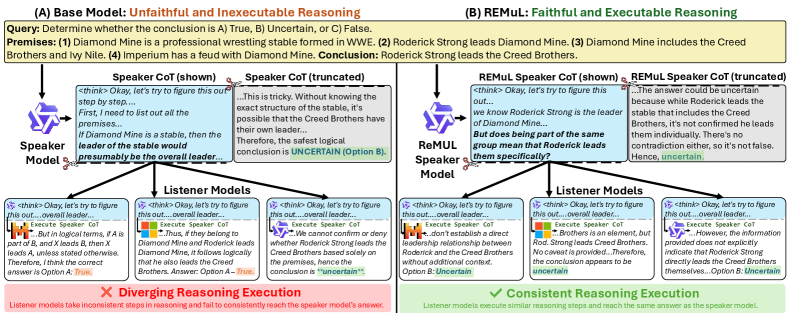
CoT Faithfulness via REMUL
Researchers propose REMUL, a training approach for making chain-of-thought reasoning more faithful and monitorable. A speaker model generates reasoning traces that multiple listener models attempt to follow and complete, using RL to reward reasoning that is understandable to other models. Tested across BIG-Bench Extra Hard, MuSR, ZebraLogicBench, and FOLIO, REMUL improves three faithfulness metrics while also boosting overall accuracy, producing shorter and more direct reasoning chains.
GLM-5
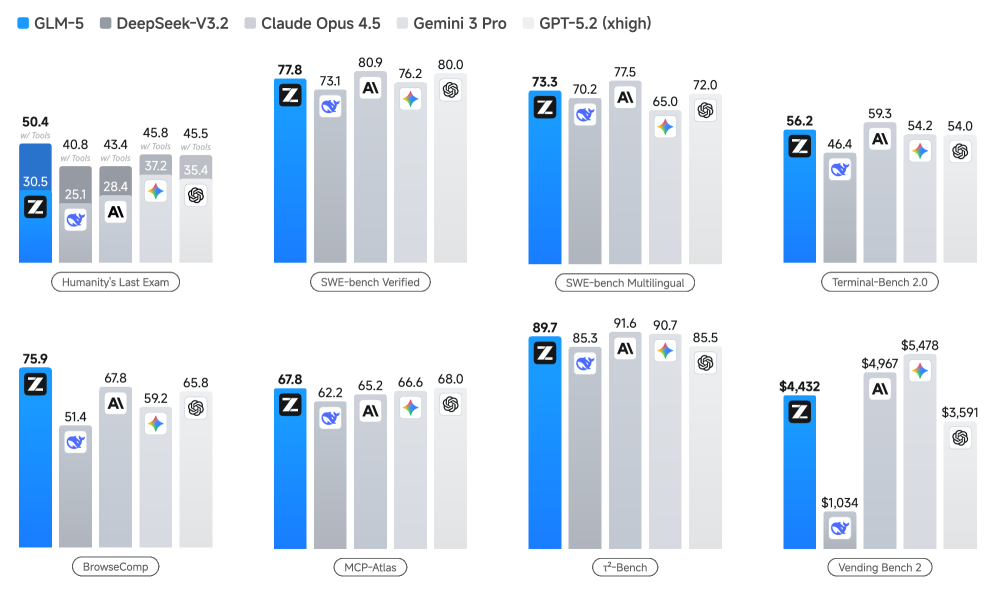
GLM-5 is a foundation model from Zhipu AI designed to transition from vibe coding to agentic engineering. The model introduces novel asynchronous agent RL algorithms that separate generation from training for improved efficiency, and uses DSA technology to reduce computational requirements while preserving long-context understanding.
LLaDA 2.1
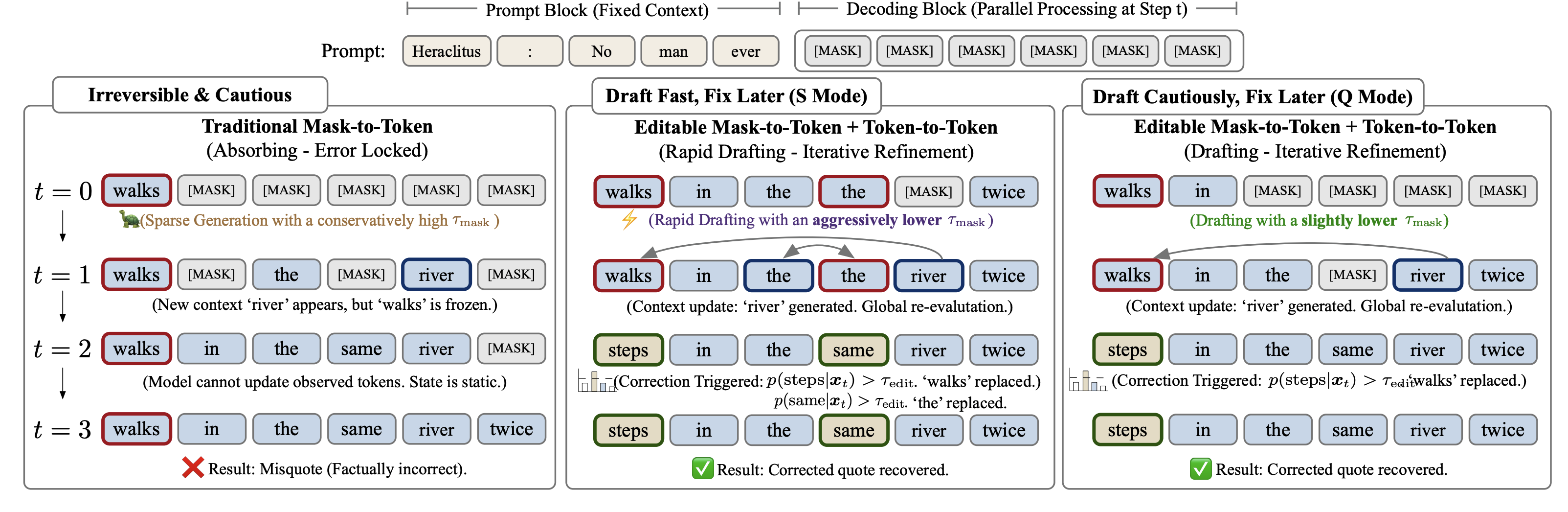
Ant Group releases LLaDA 2.1, a major upgrade to discrete diffusion language models that breaks the speed-quality trade-off through Token-to-Token (T2T) editing. By weaving token editing into the conventional Mask-to-Token decoding scheme, LLaDA 2.1 introduces two configurable modes: Speedy Mode for aggressive throughput and Quality Mode for benchmark-leading accuracy. The release also includes the first large-scale RL framework for diffusion LLMs.
SkillRL
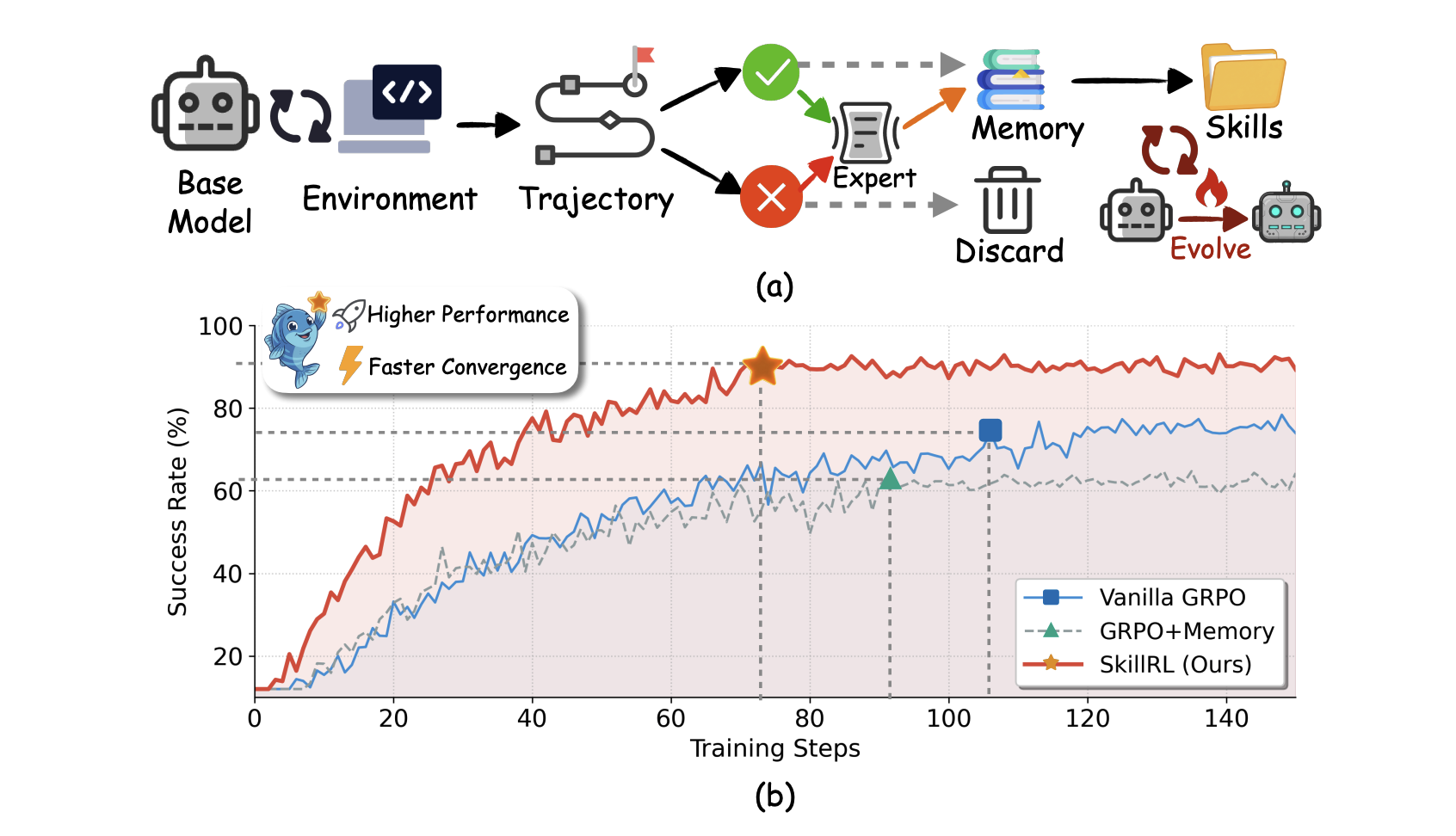
SkillRL introduces a recursive skill-augmented RL framework that bridges the gap between raw experience and policy improvement through automatic skill discovery. Instead of storing noisy raw trajectories, SkillRL distills experience into reusable high-level behavioral patterns and evolves them alongside the agent policy during training.
InftyThink+
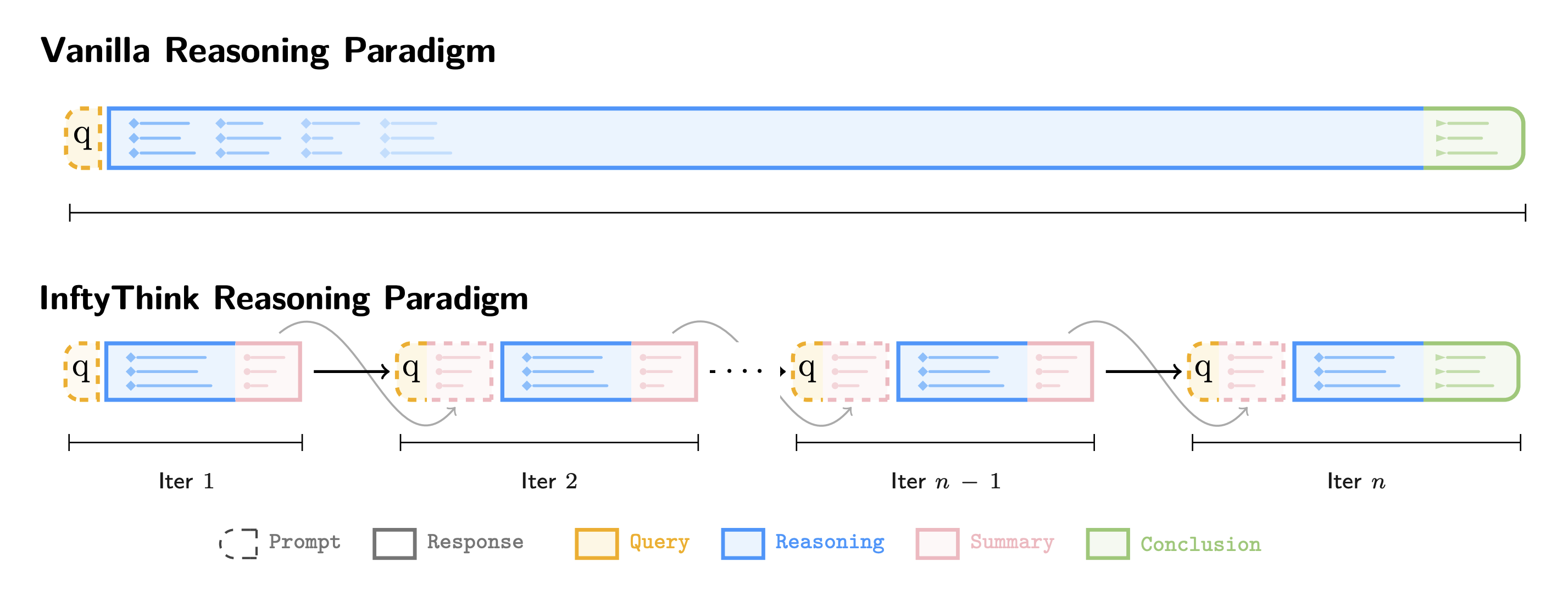
InftyThink+ is an end-to-end RL framework for infinite-horizon reasoning that optimizes the entire iterative reasoning trajectory. Standard long chain-of-thought suffers from quadratic cost, context length limits, and lost-in-the-middle degradation. InftyThink+ addresses all three by letting models autonomously decide when to summarize, what to preserve, and how to resume, trained through trajectory-level reinforcement learning.