AI Papers of the Week
Every paper worth reading in AI, hand-picked one week at a time.
Discover and explore top AI papers withClaude CodeCodex
npx @dair-ai/mcp setup
Finding the Right Fit: Model-Harness Interactions across Agent Tasks
Yixuan Li, Bo An and colleagues at Nanyang Technological University evaluate 66 model-harness configurations and show that model rankings, best harnesses and cost-efficiency all change with the harness and the benchmark, so the pairing has to be evaluated as a unit.
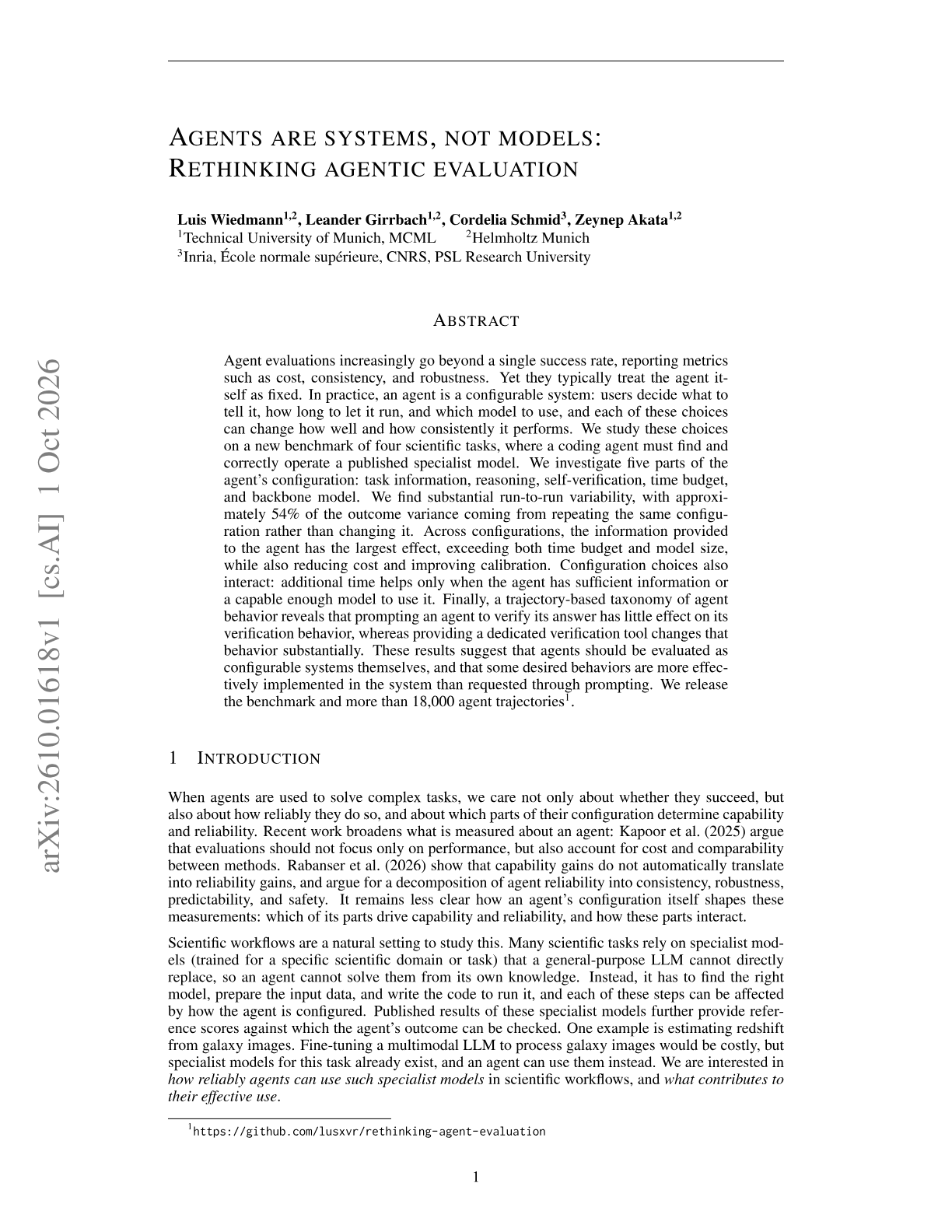
Agents Are Systems, Not Models: Rethinking Agentic Evaluation
Luis Wiedmann, Leander Girrbach and Zeynep Akata (TU Munich, Helmholtz Munich) with Cordelia Schmid (Inria) treat an agent as a configurable system and measure how task information, reasoning, self-verification, time budget and backbone model change its results on scientific tasks.
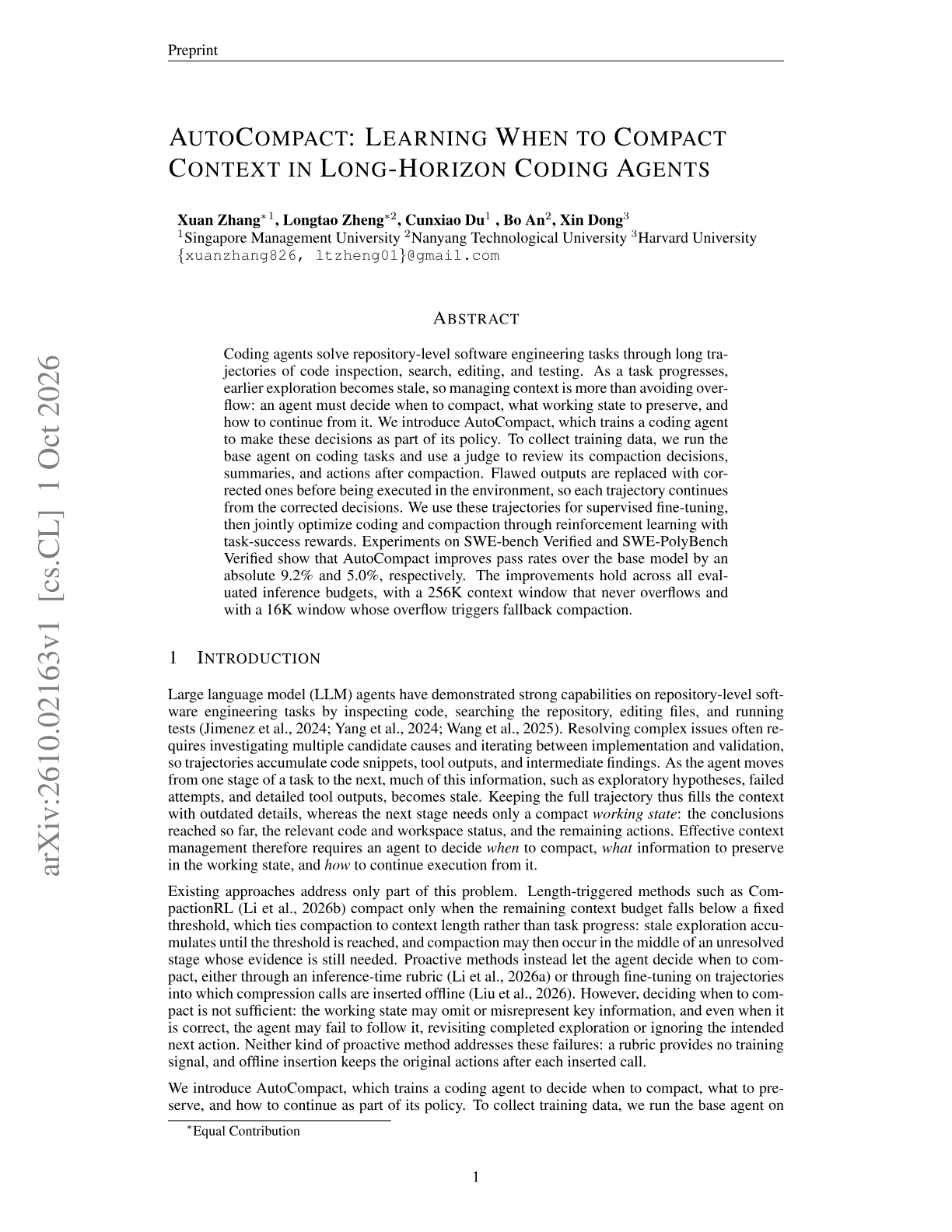
AutoCompact: Learning When to Compact Context in Long-Horizon Coding Agents
AutoCompact trains a coding agent to decide when to compact its context, what working state to keep, and how to continue afterward, as part of its own policy. A judge reviews the base agent's compaction decisions and replaces flawed ones before they execute, and the corrected trajectories are used for SFT and then for RL that optimizes coding and compaction together on task success. Pass rates rise by 9.2 points on SWE-bench Verified and 5.0 points on SWE-PolyBench Verified, and the gains hold both with a 256K window that never overflows and with a 16K window that falls back to forced compaction.
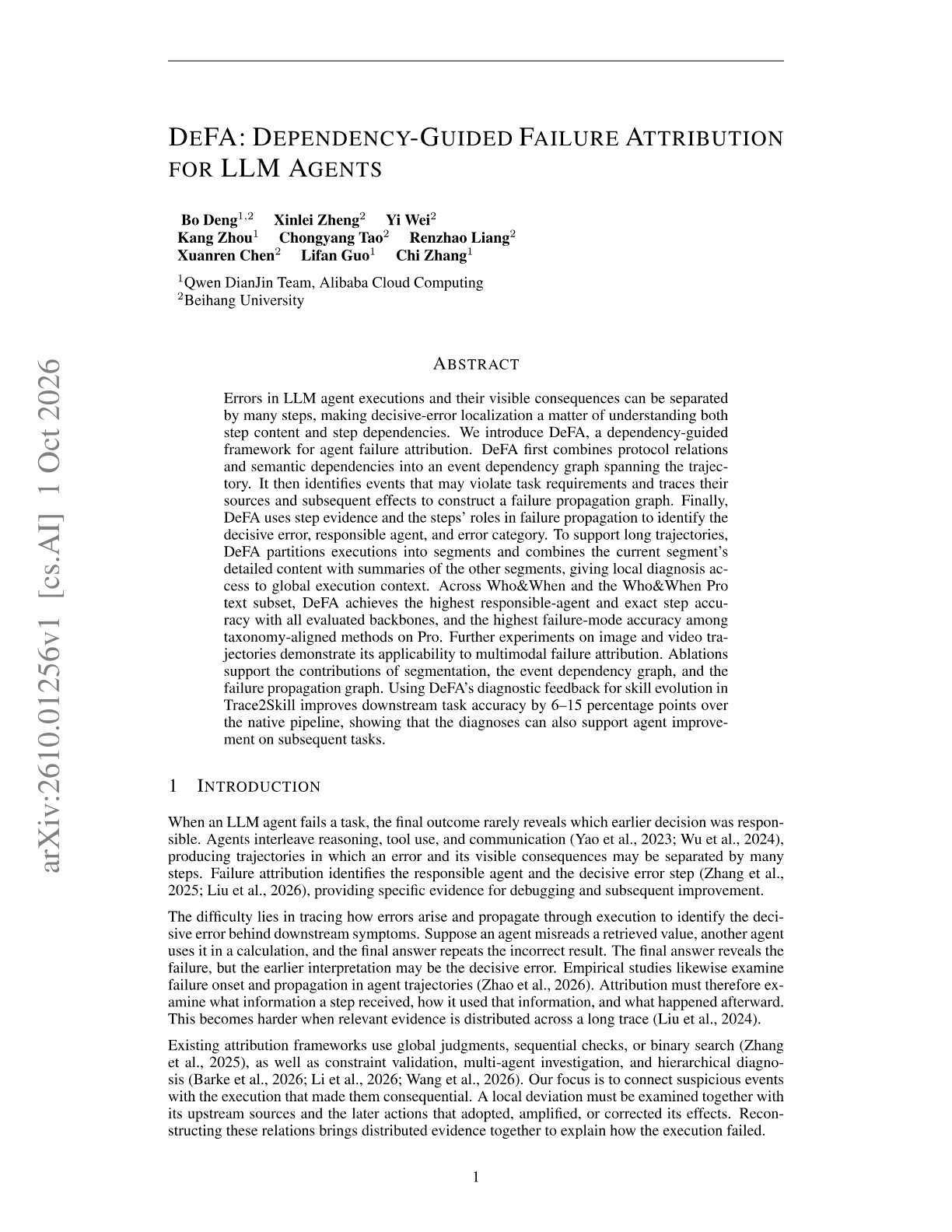
DeFA: Dependency-Guided Failure Attribution for LLM Agents
Bo Deng, Kang Zhou, Lifan Guo and colleagues at Qwen DianJin Team (Alibaba Cloud) with Beihang University introduce DeFA, which builds a dependency graph over an agent trajectory and traces how errors propagate to find the decisive error, the responsible agent and its category.
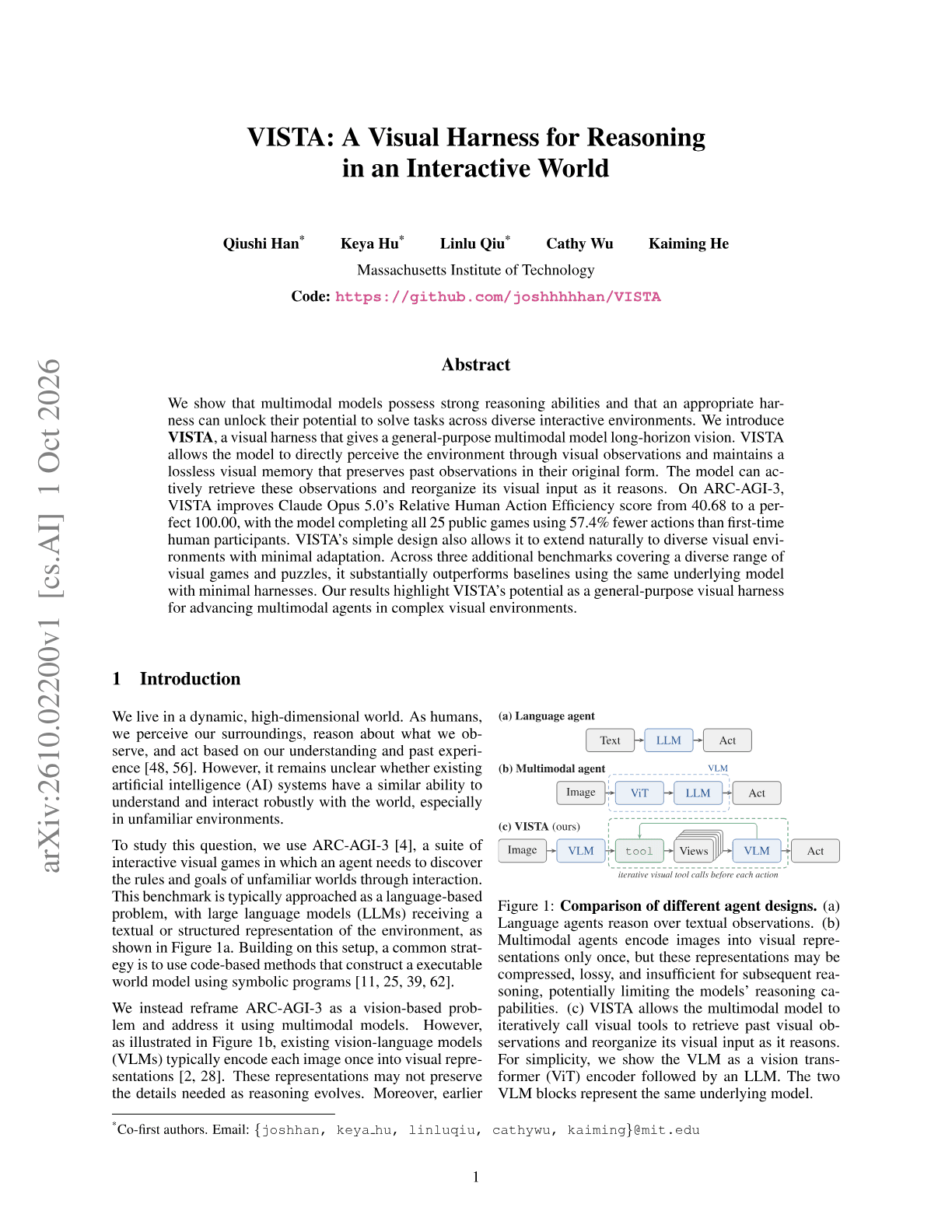
VISTA: A Visual Harness for Reasoning in an Interactive World
Qiushi Han, Keya Hu, Linlu Qiu, Cathy Wu and Kaiming He at MIT introduce VISTA, a visual harness that lets a general-purpose multimodal model act in interactive environments from image observations, with a lossless visual memory it can search and rearrange while it reasons.
Self-Evolving Coding Rules for AI Coding Agents
Zhengyuan Jiang, Neil Zhenqiang Gong and colleagues at Duke University introduce RuleEvolve (NeurIPS 2026), which evolves the coding-rules files that coding agents read instead of relying on hand-written ones.
Agent Evaluation Reliability: More Tasks Won't (Always) Fix An Agent Leaderboard
Michael Hardy, Anka Reuel, Mykel Kochenderfer and Sanmi Koyejo at Stanford (with UIUC) build a Bayesian variance-decomposition framework for sparse agent leaderboards and apply it to 22 benchmarks from the Holistic Agent Leaderboard and Harbor Index.
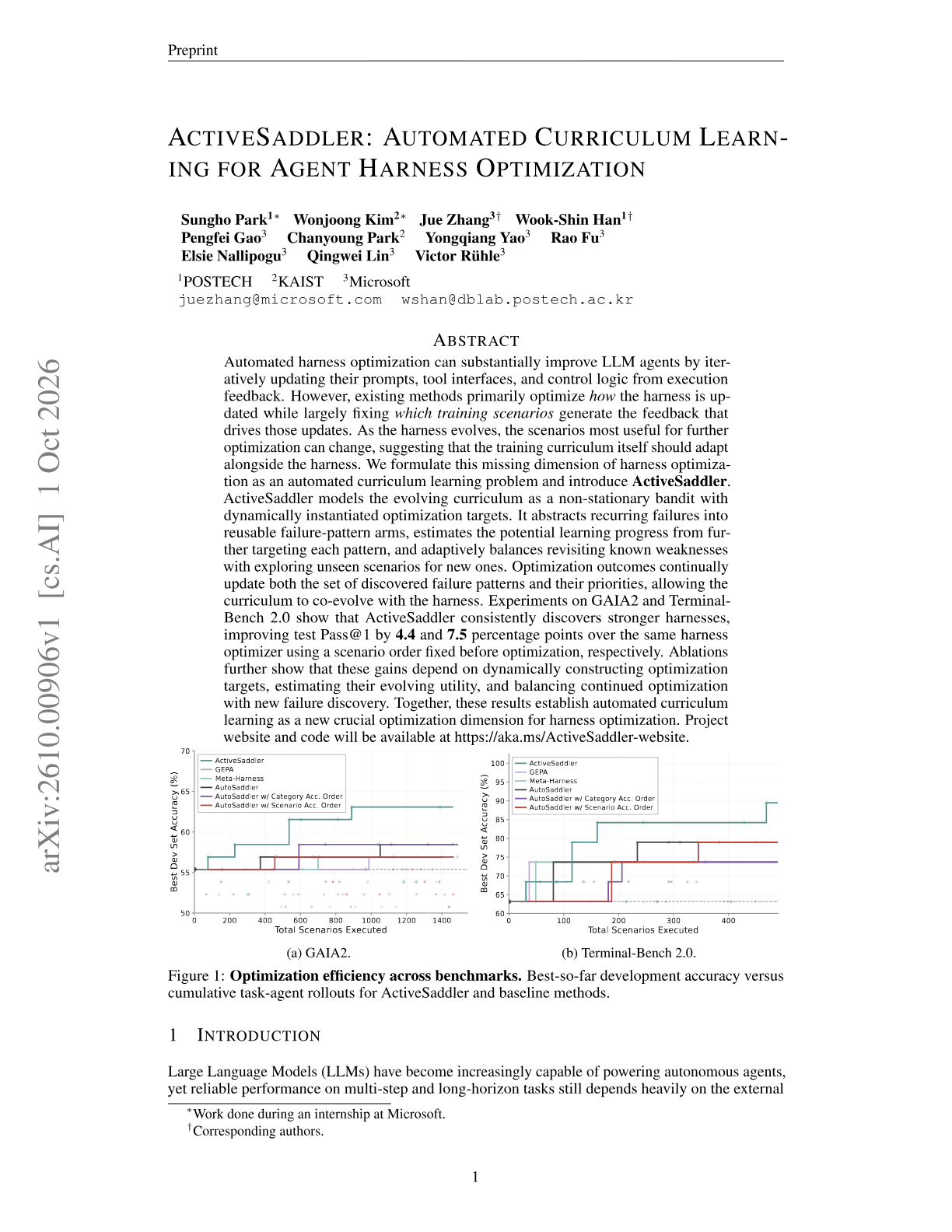
ActiveSaddler: Automated Curriculum Learning for Agent Harness Optimization
Sungho Park (POSTECH, intern at Microsoft), Jue Zhang, Pengfei Gao and colleagues at Microsoft, POSTECH and KAIST introduce ActiveSaddler, which adapts the training scenarios used to drive automated harness optimization as the harness changes.
Worse Together: How Performance Breaks Down in Multi-User Multi-Agent Teams
Sahan Paliskara (independent), Nattaput Namchittai (Stanford), Andrew Lampinen (Anthropic) and colleagues study what happens when several agents, each acting for a different user, share a resource such as a compute budget, a calendar or a release cutoff.
Cross-Benchmark Transfer from RL on Agentic Coding Tasks
Sushant Mehta, Logan Ritchie and Edwin Chen at Surge AI post-train Kimi K2.7 Code with RL alone on 1,700 expert-built coding tasks and measure gains on six external benchmarks and on harnesses never used in training.
RISED: RubrIcs for agentic multi-environment Selection and sElf-Distillation
Jingtan Wang and Bryan Kian Hsiang Low (NUS) with Sirajul Salekin, Young mok Jung, Javier Movellan and Manjot Bilkhu at Apple propose RISED, which uses LLM-judge rubric tags on rollouts to select training data and to supervise the policy when training one agent across several environments.
Sapien: A Stateful Policy Engine for Autonomous AI Agents
Corinn Tiffany, Wen Zhang, Eugene Bagdasarian and Lillian Tsai at Google (with UMass Amherst) present Sapien, a policy engine that enforces task-specific policies on an agent's tool calls where what is allowed depends on what the agent has already done.
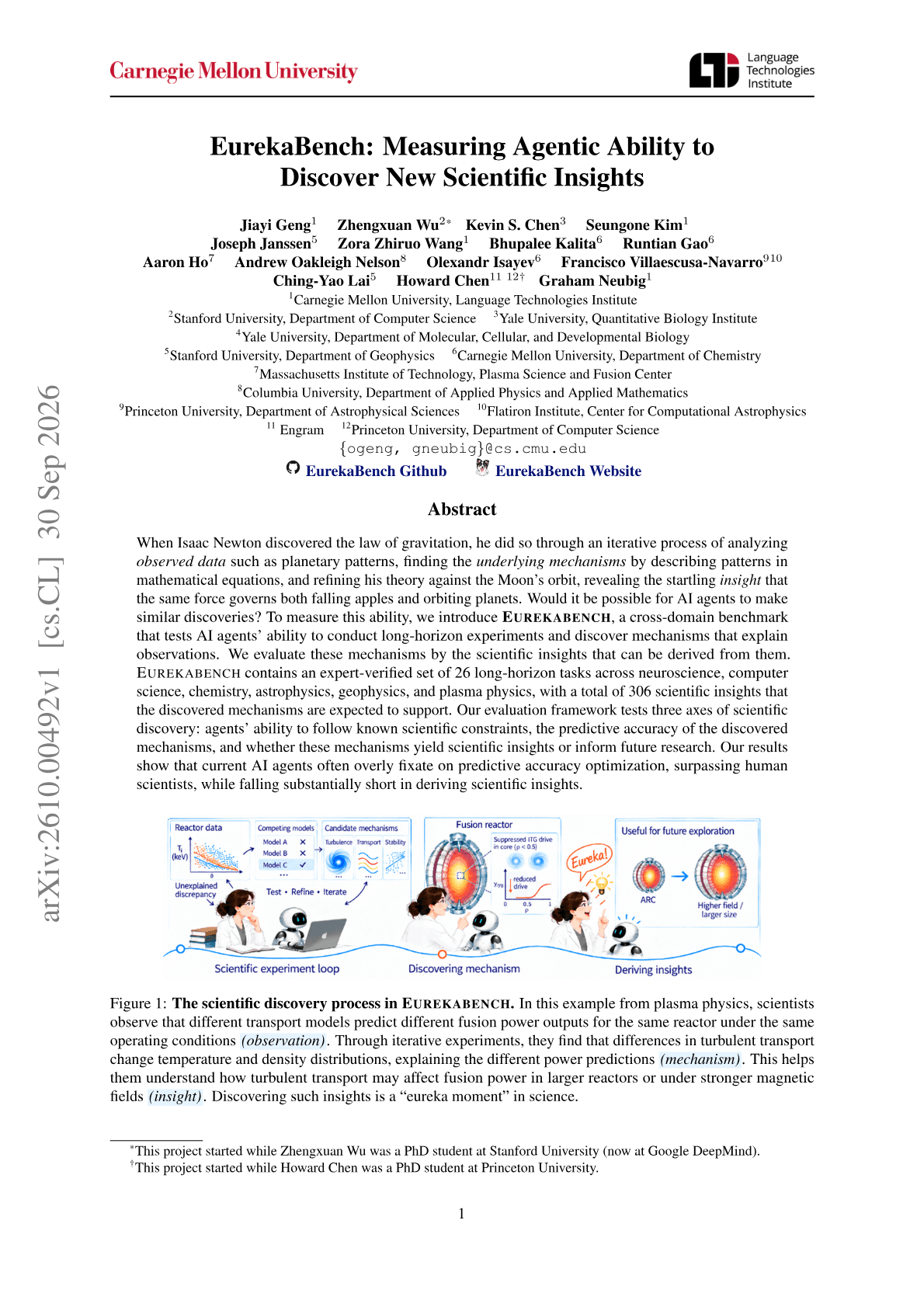
EurekaBench: Measuring Agentic Ability to Discover New Scientific Insights
Jiayi Geng, Graham Neubig, Howard Chen and colleagues at Carnegie Mellon University and Stanford, working with domain scientists from Yale, Princeton, Columbia, MIT and others, introduce EurekaBench to test whether agents can find mechanisms that explain data and yield scientific insight, not only fit it.
GUI-HARVEST: Self-Improving GUI Agents through Evidence-Driven Harness Evolution
Geyi Yang, Zhongxiang Dai and colleagues at CUHK-Shenzhen, Tianjin University, HIT Shenzhen and ECNU present GUI-HARVEST, an automatic harness optimizer that improves GUI agents with frozen backbones by grounding failure diagnosis in screenshots and repeated runs.
How Much of a Harness Does a Strong Agent Need for Autonomous ML Engineering?
Kirill Brilliantov, Alejandro Hernandez-Cano and Emmanuel Abbe at EPFL and Apple test whether elaborate MLE-agent harnesses help strong models, comparing them under matched budgets with Malena, a single-session coding agent that has only read, write and bash tools.
MILO: Automated Harness Discovery via Orchestrated Multi-Agent Evolution
Prithwish Jana (Georgia Tech) with Nikos Kanakaris, Sahika Genc and colleagues at AWS AI Labs, plus CMU and WashU, introduce MILO (Meta-evolutionary Island Orchestration), an automated harness-discovery framework that evolves the search strategy along with the harness it is searching for.
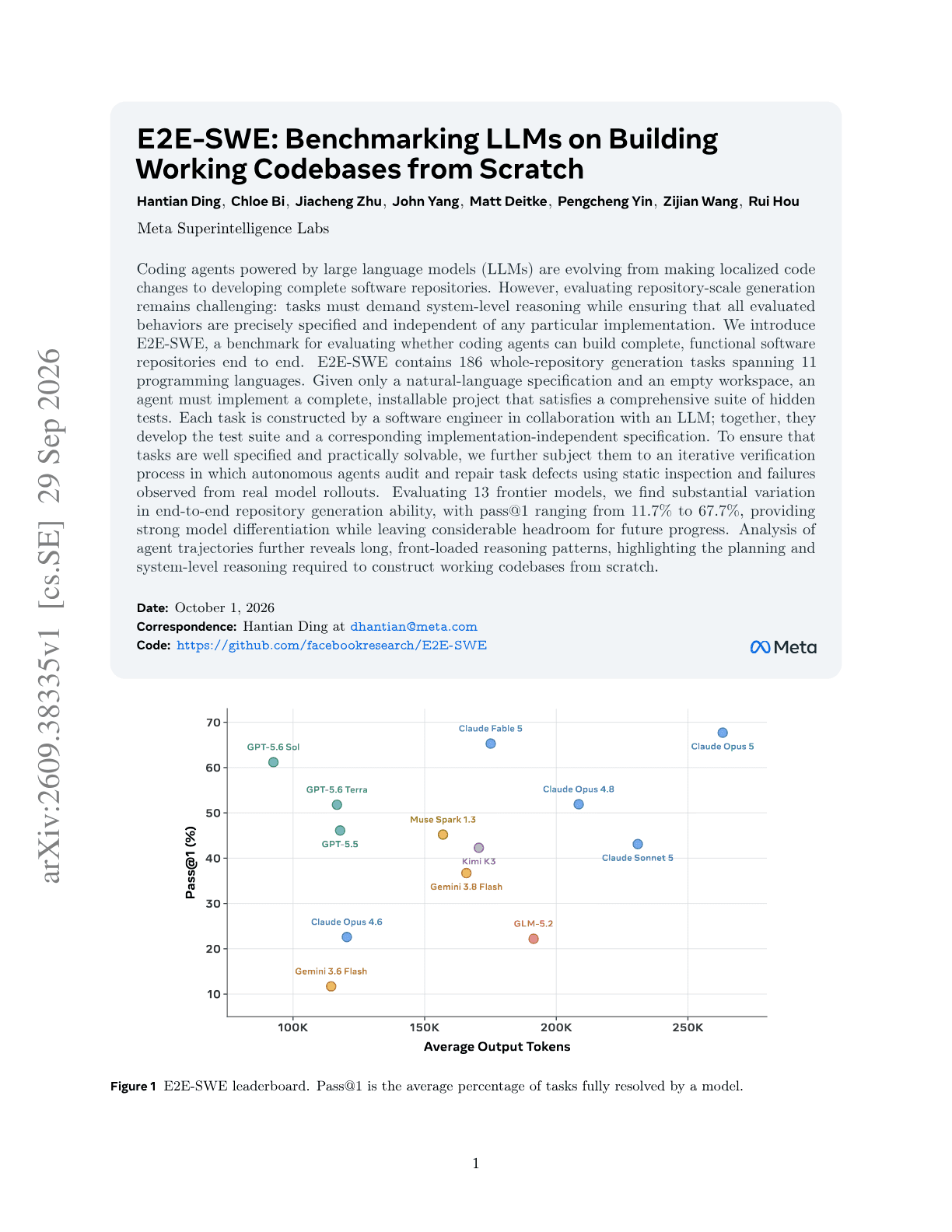
E2E-SWE: Benchmarking LLMs on Building Working Codebases from Scratch
Hantian Ding, Chloe Bi, Jiacheng Zhu, John Yang and colleagues at Meta Superintelligence Labs introduce E2E-SWE, a benchmark of 186 tasks in which a coding agent must build a complete, installable repository from a natural-language specification and an empty workspace.
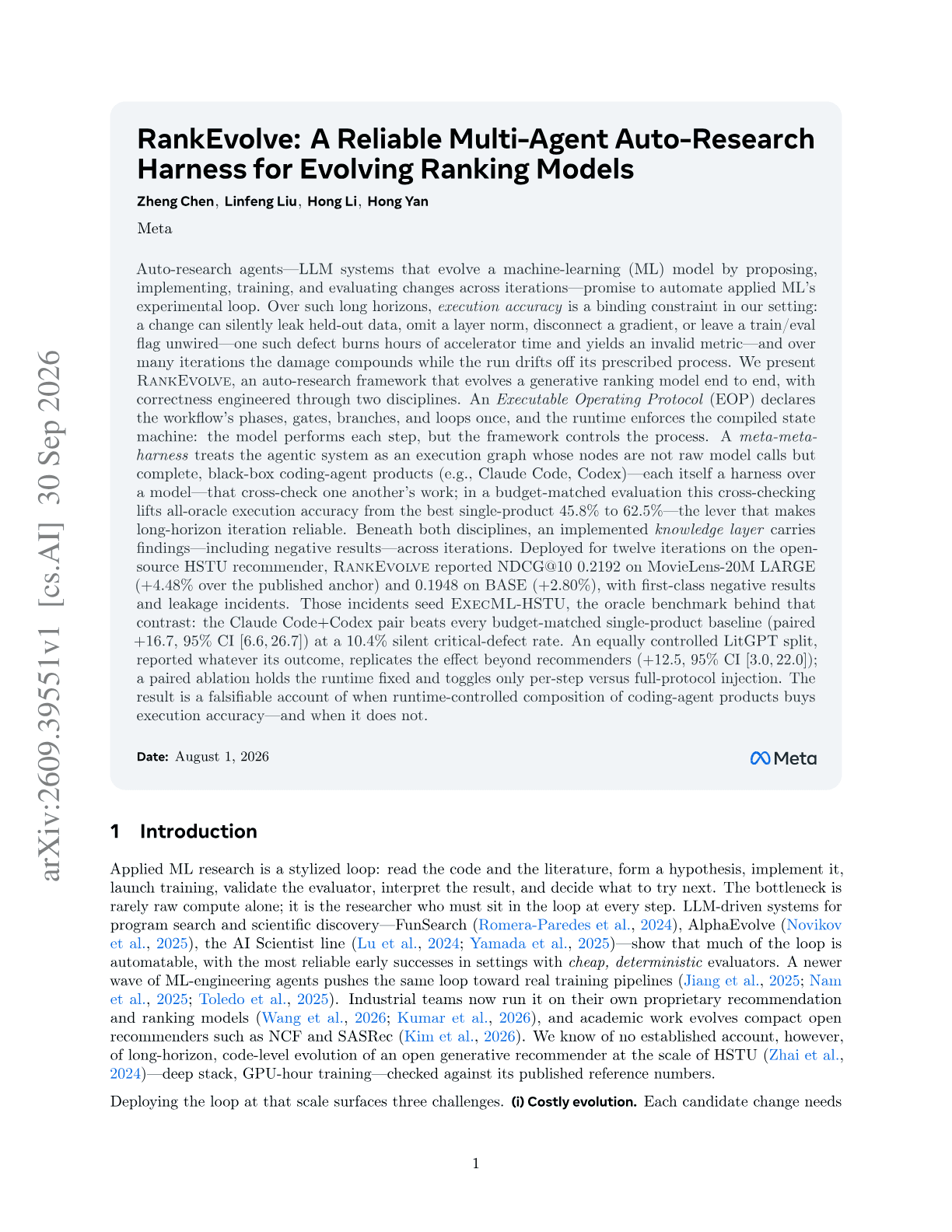
RankEvolve: A Reliable Multi-Agent Auto-Research Harness for Evolving Ranking Models
Zheng Chen, Linfeng Liu, Hong Li and Hong Yan at Meta present RankEvolve, an auto-research framework for generative ranking models that treats execution accuracy (whether each code change is implemented correctly) as the main constraint on long research runs.
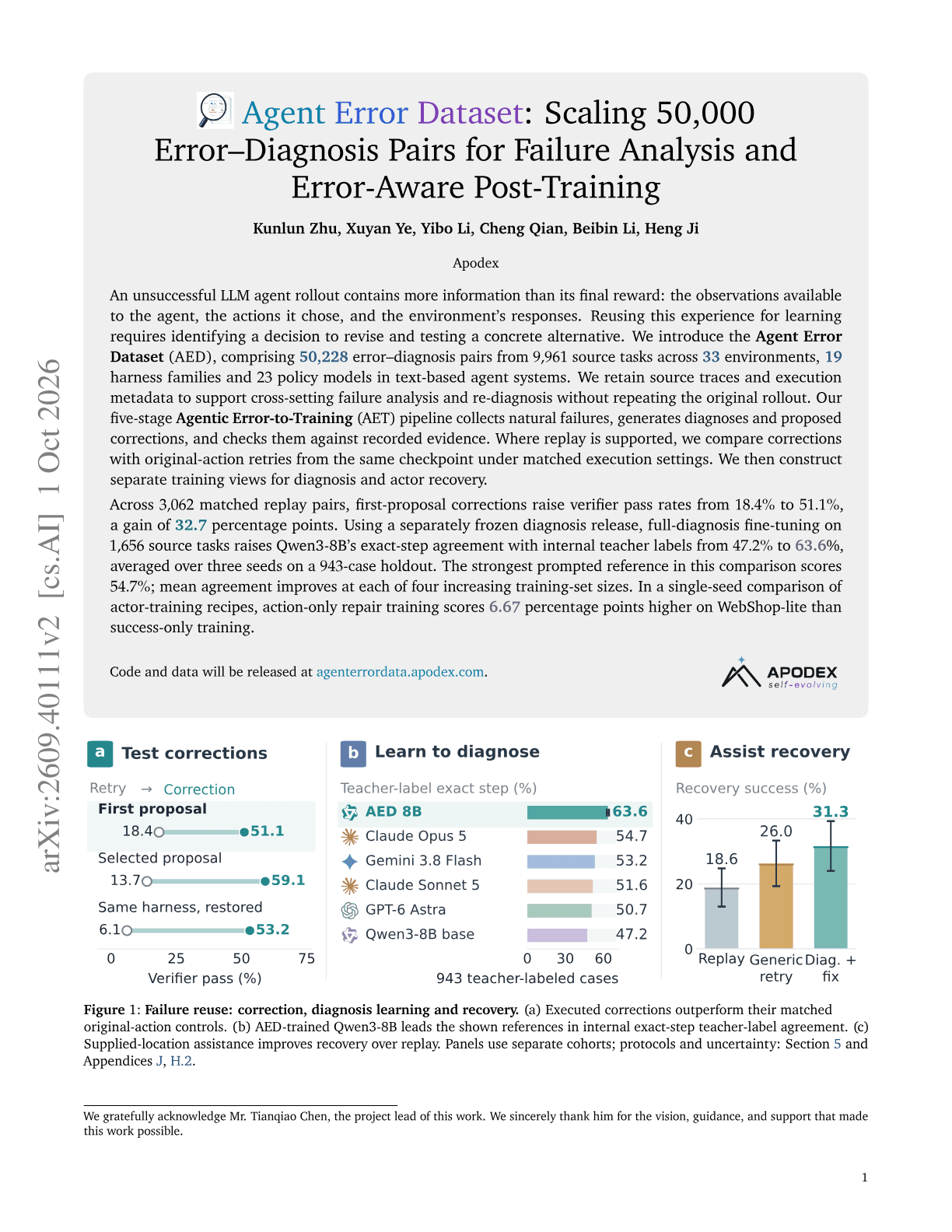
Agent Error Dataset: Scaling 50,000 Error--Diagnosis Pairs for Failure Analysis and Error-Aware Post-Training
Kunlun Zhu, Cheng Qian, Beibin Li, Heng Ji and colleagues at Apodex release the Agent Error Dataset (AED), 50,228 error-diagnosis pairs mined from failed agent rollouts, with a pipeline that turns failures into training data for diagnosis and recovery.
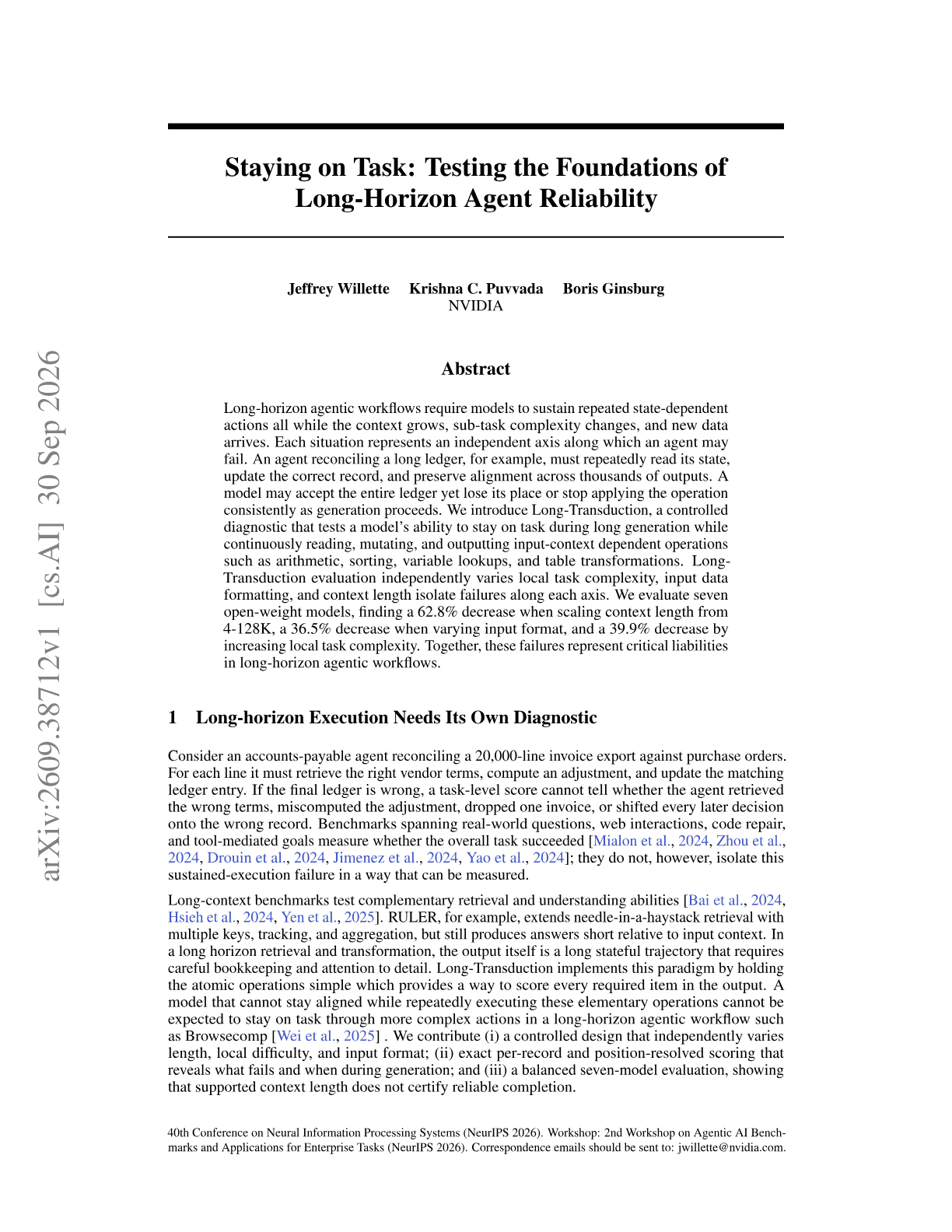
Staying on Task: Testing the Foundations of Long-Horizon Agent Reliability
Jeffrey Willette, Krishna C. Puvvada and Boris Ginsburg at NVIDIA introduce Long-Transduction, a controlled diagnostic for whether a model can keep applying state-dependent operations correctly across a long generation, the basic capability long-horizon agents depend on.
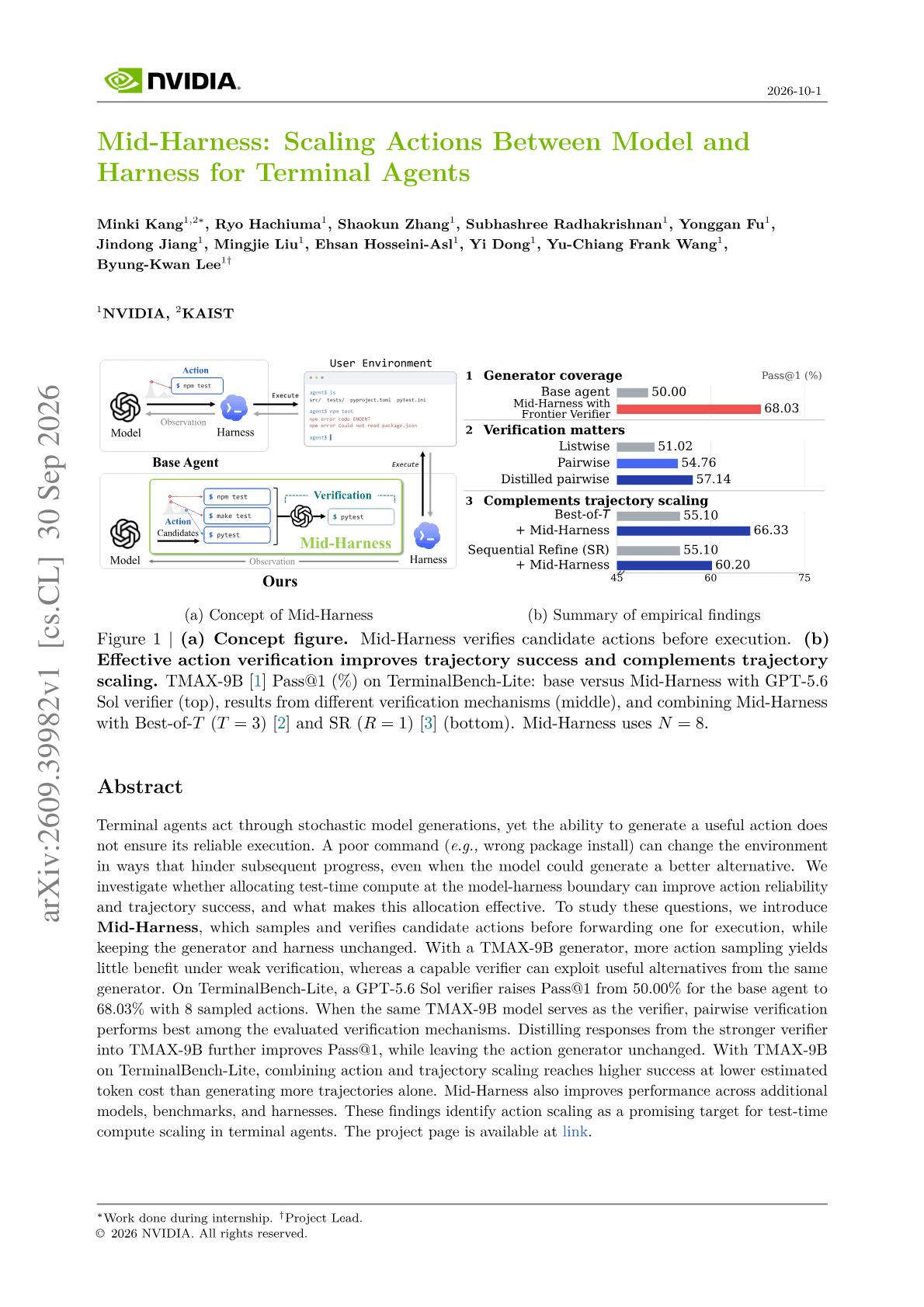
Mid-Harness: Scaling Actions Between Model and Harness for Terminal Agents
Minki Kang (KAIST, intern at NVIDIA), Byung-Kwan Lee, Yu-Chiang Frank Wang and colleagues at NVIDIA introduce Mid-Harness, which spends test-time compute at the boundary between model and harness: it samples several candidate shell actions and verifies them before one is executed.
Cogentic: Multi-Agent Orchestration for Automated Proof Discovery
Yang Cai, Vineet Gupta, Aranyak Mehta, Di Wang and colleagues at Google Research present Cogentic, a multi-agent harness built on Gemini that works on open research problems in theoretical computer science and produces natural-language proofs that domain experts then verify.
OSWorld-Science: A Benchmark of Computer Use Agents for Learning and Using Scientific Software
Dingyuan Dai, Heli Qi, Lei Liu and a large team led from Tsinghua (Jie Tang, Juanzi Li) with CMU, Yale, Waterloo and UC collaborators introduce OSWorld-Science, a benchmark of 146 tasks in which computer-use agents must operate real scientific software and produce checkable artifacts.
cua-speedrun: Standardized Benchmarking of the Speed of Computer-Use Agents
Pranjal Aggarwal, Lawrence Keunho Jang, Sean Welleck, Daniel Fried, Ruslan Salakhutdinov, Jing Yu Koh and colleagues at Carnegie Mellon University introduce cua-speedrun, standardized infrastructure for measuring the speed and cost of computer-use agents as well as their accuracy.