AI Papers of the Week
Every paper worth reading in AI, hand-picked one week at a time.
Discover and explore top AI papers withClaude CodeCodex
npx @dair-ai/mcp setup
How to Speculate about Uncertainty in Agentic Coding? A Draft-Model Gate Method
Konstantin Grotov and Valentin Malykh derive a failure-prediction signal for a black-box coding agent from its output tokens alone, by running a small draft model over the agent's already-generated trajectory in one forward pass.
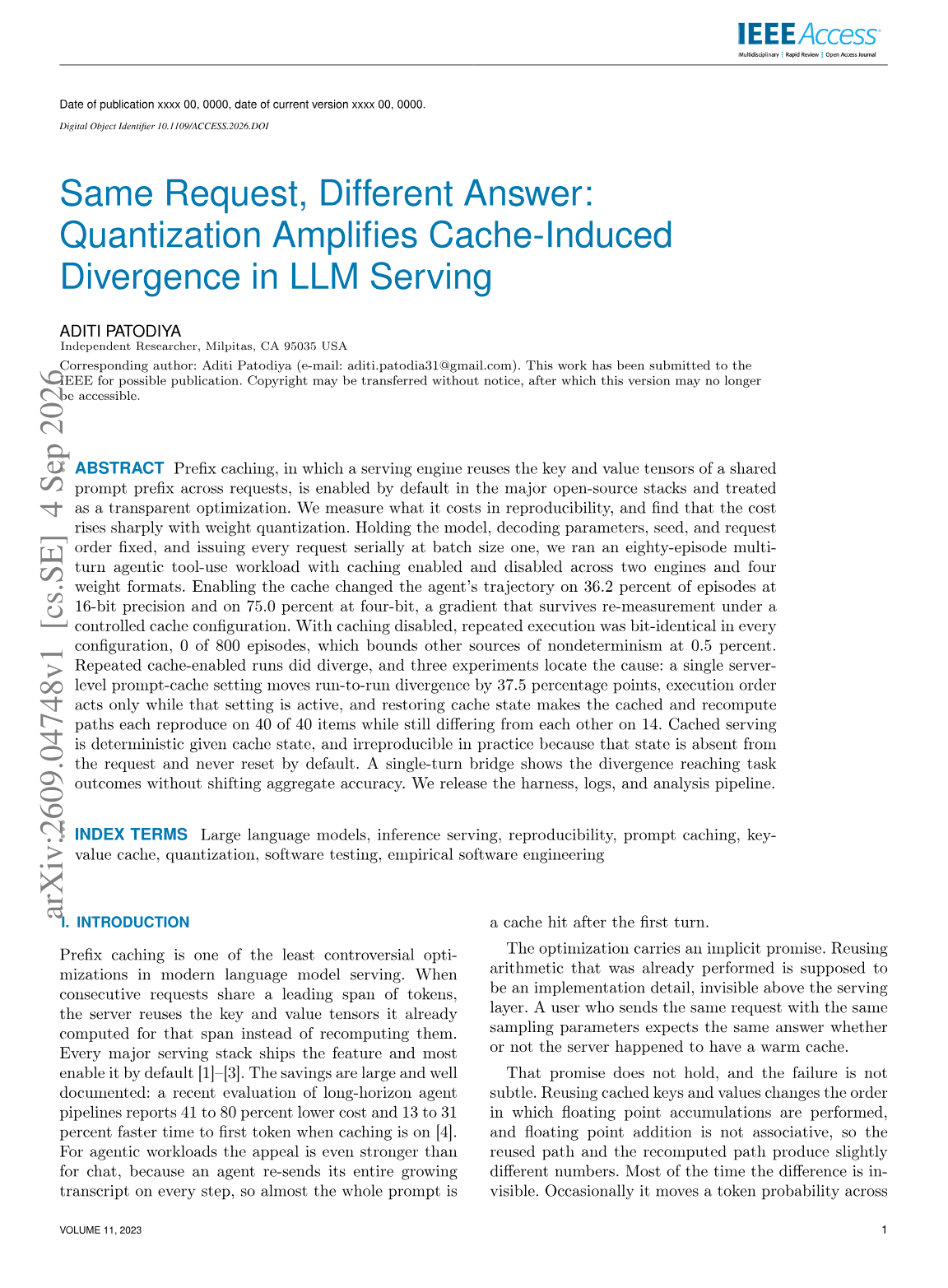
Same Request, Different Answer: Quantization Amplifies Cache-Induced Divergence in LLM Serving
Aditi Patodiya measures what prefix caching costs in reproducibility for agentic tool-use workloads, and finds the cost grows sharply once weights are quantized.
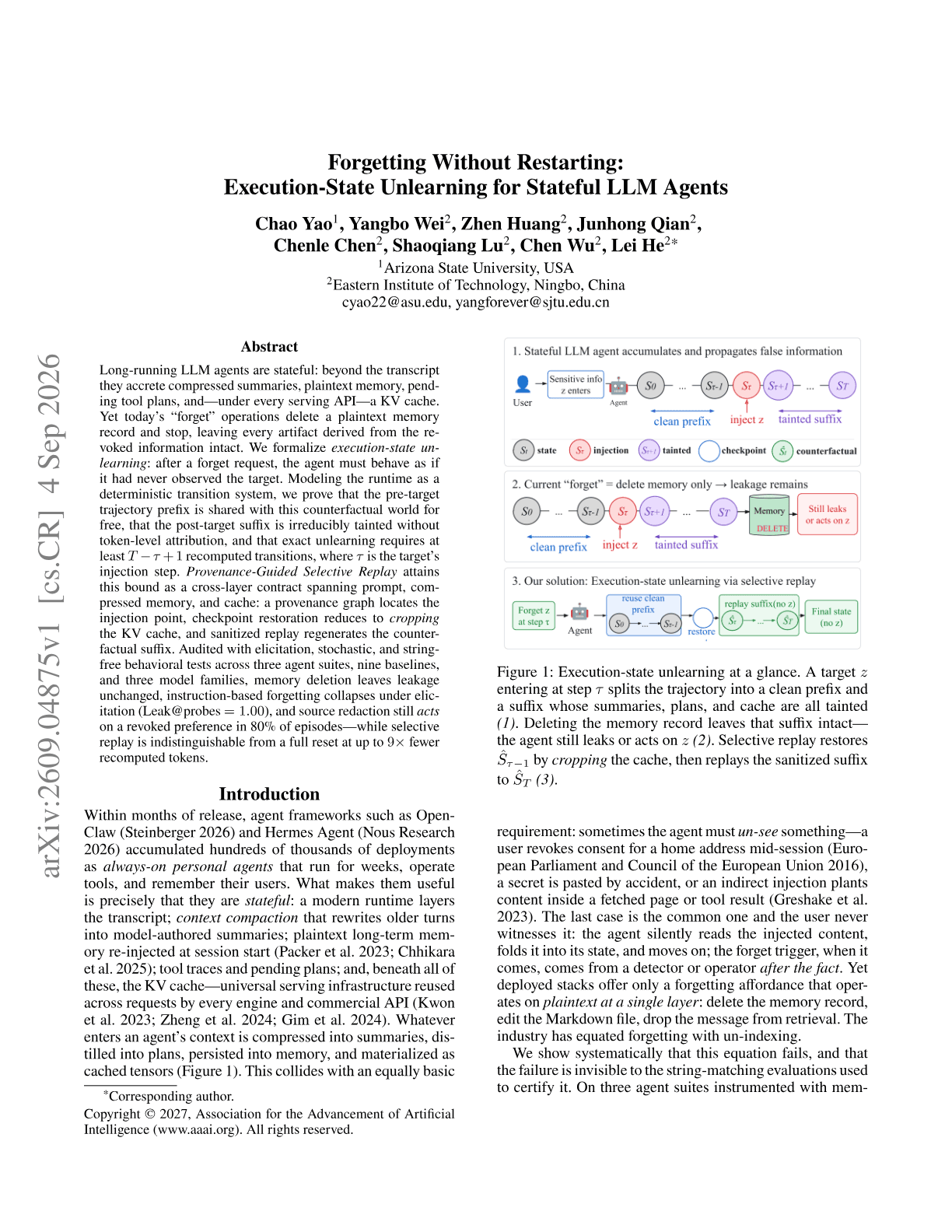
Forgetting Without Restarting: Execution-State Unlearning for Stateful LLM Agents
Chao Yao and colleagues formalize what deleting a memory record fails to do for a long-running agent, and prove how much recomputation exact forgetting requires.
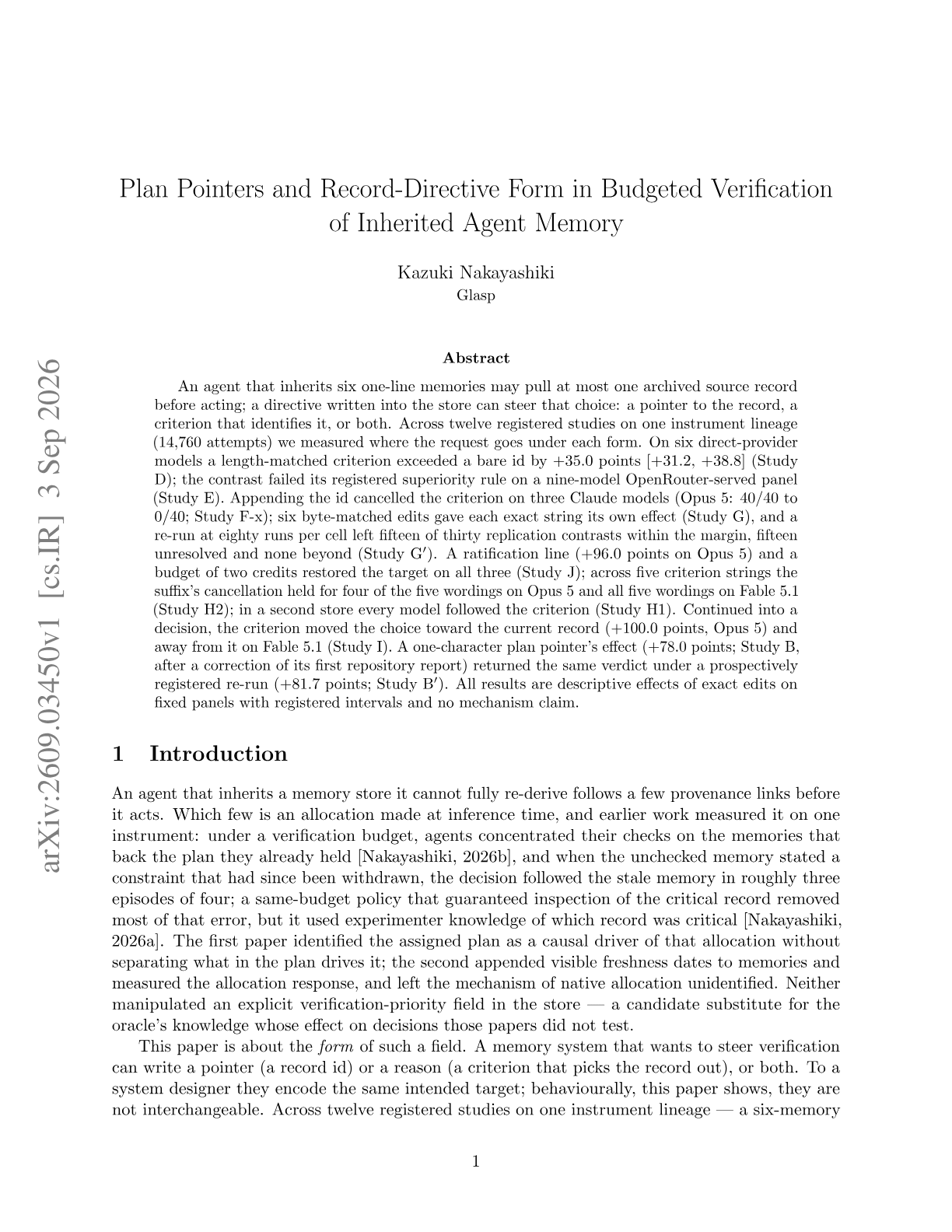
Plan Pointers and Record-Directive Form in Budgeted Verification of Inherited Agent Memory
Kazuki Nakayashiki runs twelve registered studies and 14,760 attempts on one question: when an agent inherits terse memories and can pull only one archived source record, what form of directive written into the store actually steers that choice.
Designing Proactive Thought Partners for Writing
Proactive writing tools mostly mean autocomplete. This paper from Google DeepMind studies what it looks like when an AI agent offers higher-level cognitive support during writing and picks its own moment to speak up.
LOCI: A Locator-Critic with Refinement Loop
Walid Bousselham, Mathilde Caron, Arsha Nagrani and Cordelia Schmid at Google DeepMind argue that VLM failures on hard visual tasks come from failing to locate the relevant detail, not from weak high-level reasoning, and fix it with a two-agent loop that needs no training.
SimSkill: A Lifelong Learning AI Agent for Autonomous Mastery of Traffic Simulation
Qi Liu, Qinzheng Wang and Yiming Bie build SimSkill, a self-evolving agent over the SUMO traffic simulator that finds its own capability gaps, writes and solves grounded tasks, and consolidates the results into episodic, procedural and semantic memory without touching the backbone weights.
Dude: A Dual-Detection Multi-Agent System for Paper-Code Discrepancy Detection
Weijie Liu and colleagues at HKU build Dude, a dual-detection multi-agent system for finding places where a paper's claims and its released code disagree, and diagnose why naive multi-agent designs over-report.
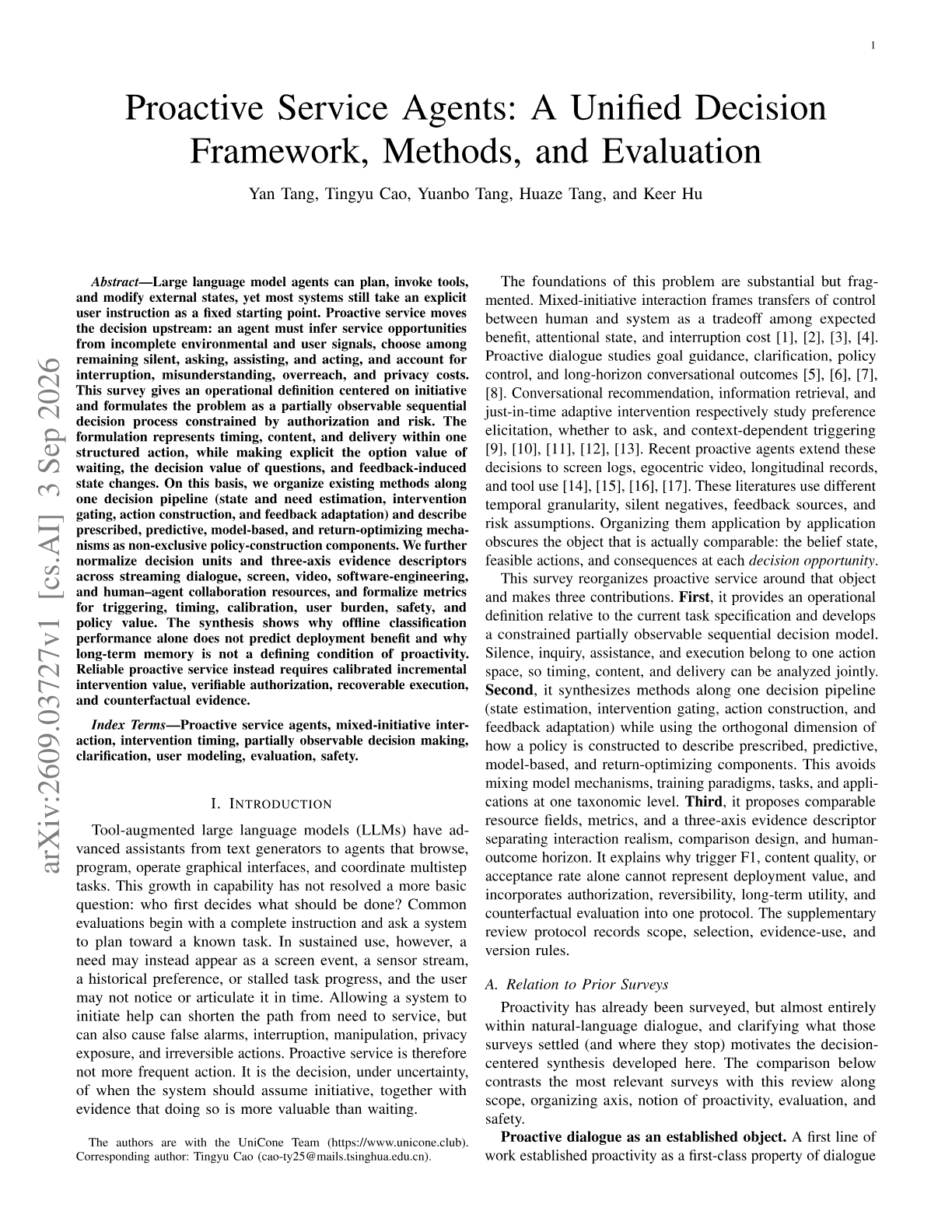
Proactive Service Agents: A Unified Decision Framework, Methods, and Evaluation
Yan Tang and colleagues formalize proactive service as a partially observable sequential decision process constrained by authorization and risk, where staying silent is a first-class action with option value.
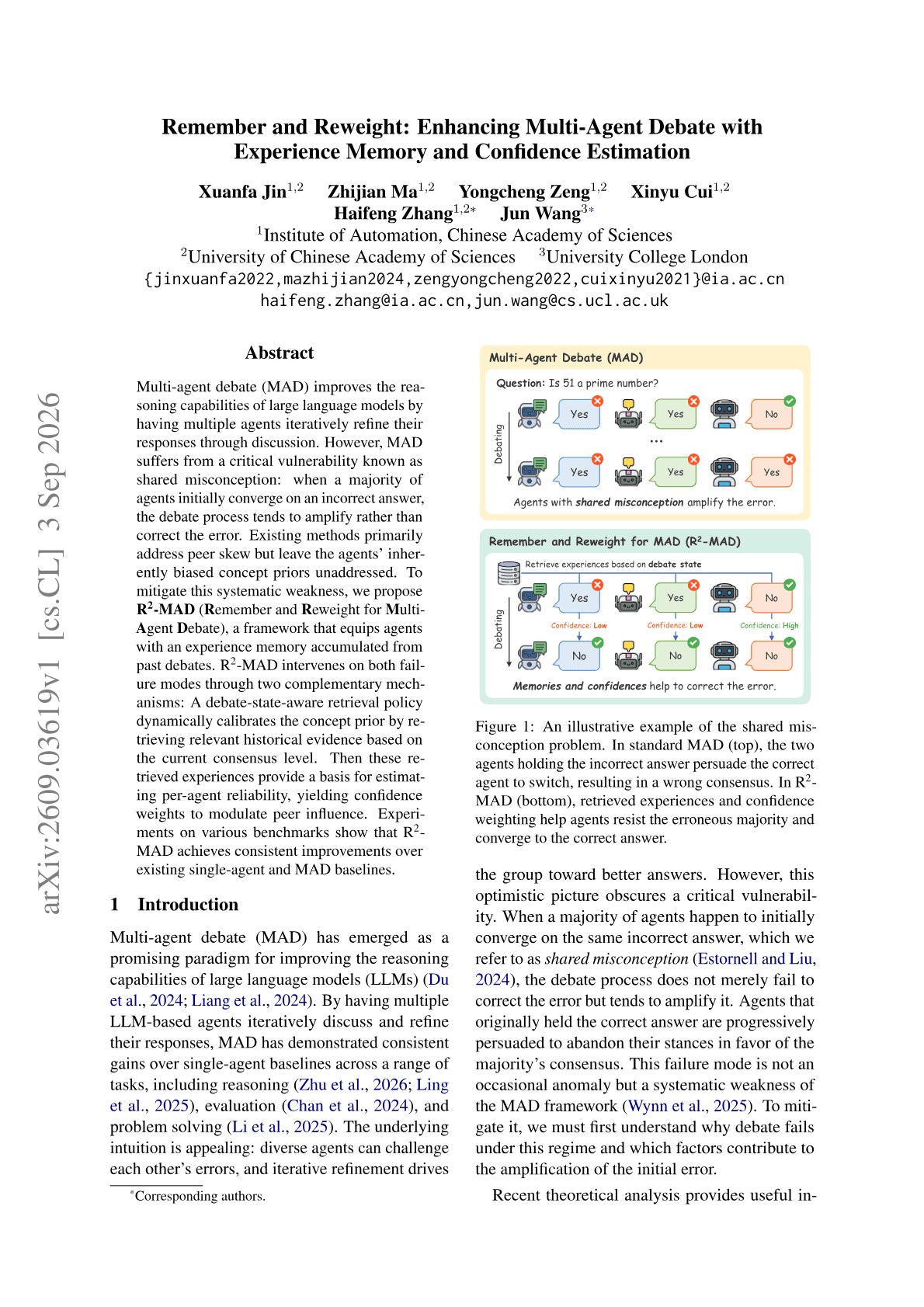
Remember and Reweight: Enhancing Multi-Agent Debate with Experience Memory and Confidence Estimation
Xuanfa Jin and colleagues at CASIA and UCL attack the shared-misconception failure in multi-agent debate with R2-MAD, giving debating agents an experience memory from past debates plus per-agent confidence weights.
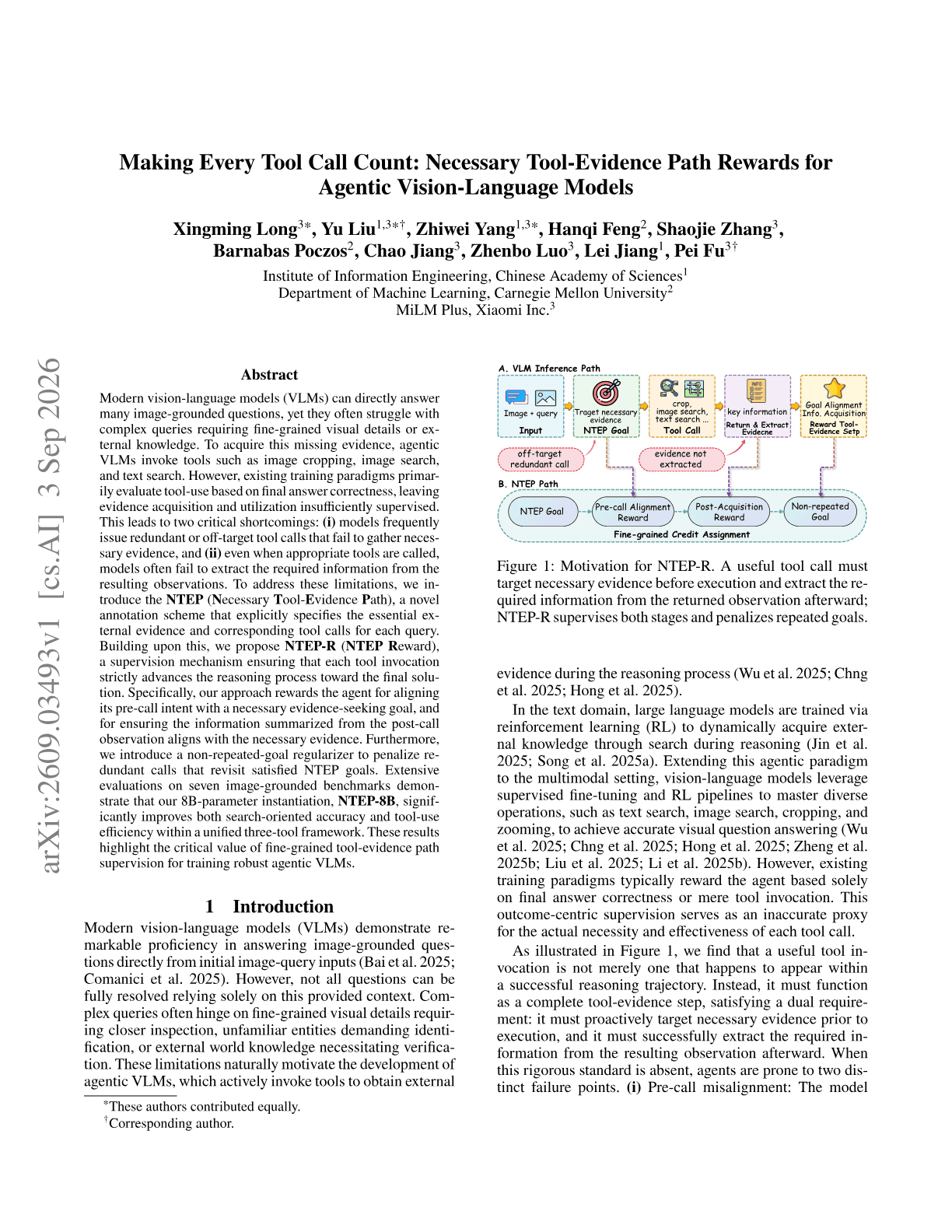
Making Every Tool Call Count: Necessary Tool-Evidence Path Rewards for Agentic Vision-Language Models
Xingming Long and colleagues introduce NTEP, an annotation scheme that names the necessary external evidence and the tool calls that must produce it, and NTEP-R, a reward that pays the agent per tool call rather than only on the final answer.
Bioinfoysis Technical Report
The DeepAutonomy Team introduces Bioinfoysis, a multi-agent harness that treats a bioinformatics request as a persistent analysis run whose conclusions stay attached to the artifacts that produced them, reaching 82.4% on BixBench.
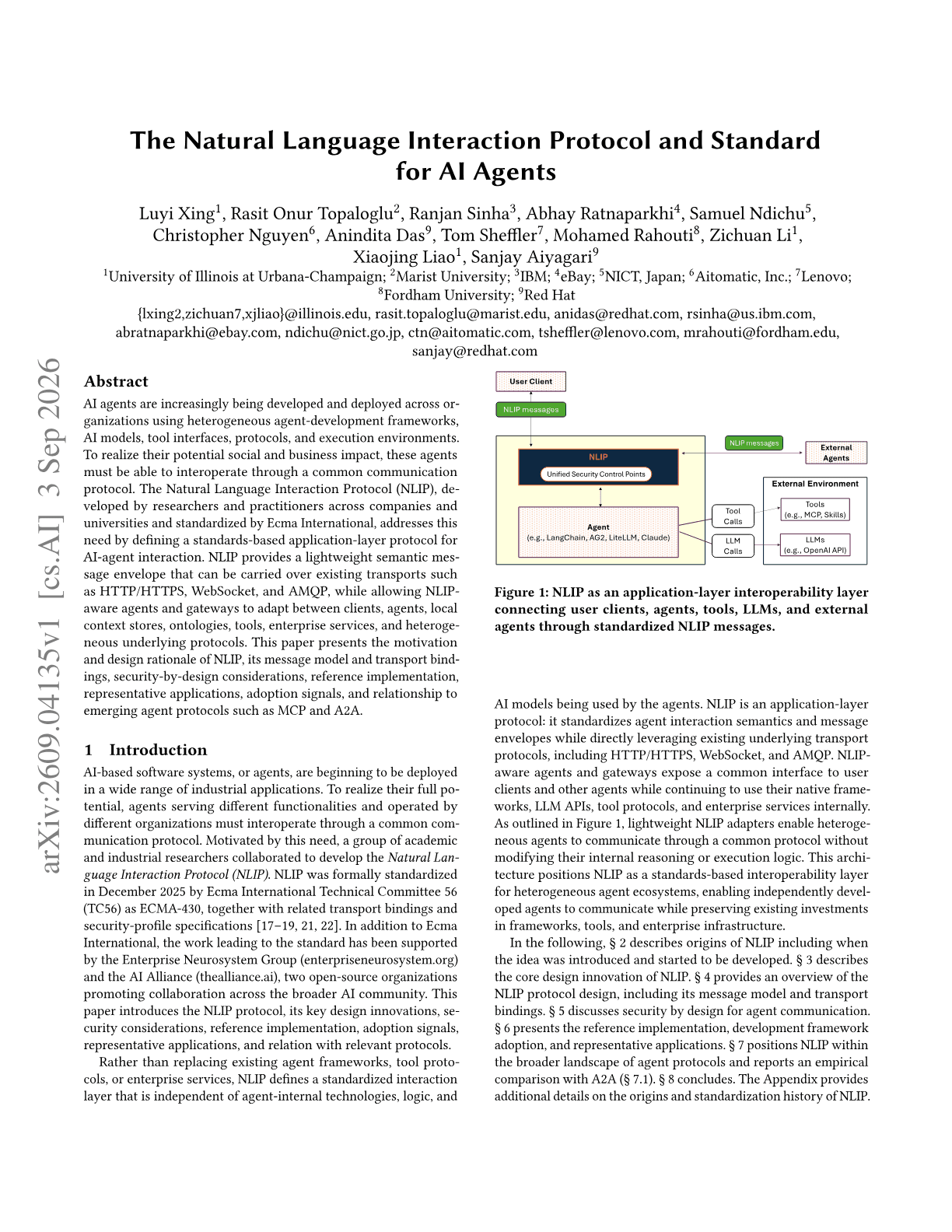
The Natural Language Interaction Protocol and Standard for AI Agents
Luyi Xing and a cross-industry group present NLIP, an application-layer protocol for AI-agent interaction standardized by Ecma International, aimed at the interoperability gap that MCP and A2A only partly cover.
Efficient Test-Time Adaptation through Human-AI Interaction
Zora Zhiruo Wang, Apurva Gandhi, Rulin Shao and colleagues at Carnegie Mellon University, the University of Washington and Handshake propose TAHI, which turns the interaction history between one professional and their agent into both context and weight updates, plus an evolving per-user rubric that encodes the criteria the user never wrote down.
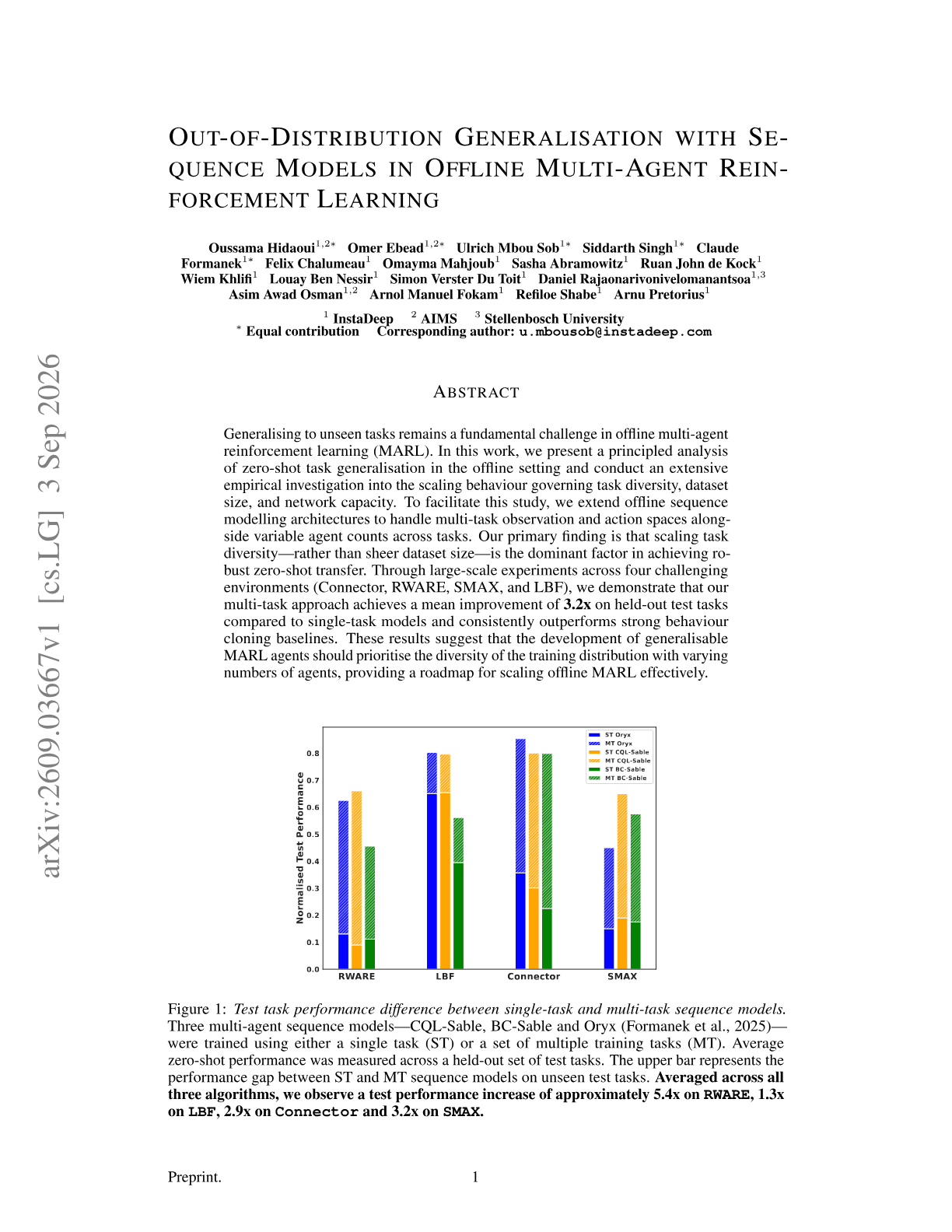
Out-of-Distribution Generalisation with Sequence Models in Offline Multi-Agent Reinforcement Learning
A large InstaDeep team with AIMS and Stellenbosch extends offline sequence models to variable agent counts and multi-task observation and action spaces, then measures which scaling axis actually produces zero-shot transfer in offline multi-agent RL.
KC-Bench: A Dynamic Interactive Benchmark for Evaluating Knowledge Conflicts in LLM Agents
Yaxing Lyu and colleagues build KC-Bench to measure whether a tool-using model can reconcile user instructions, its own parametric knowledge and live environmental observations before it acts on any of them.
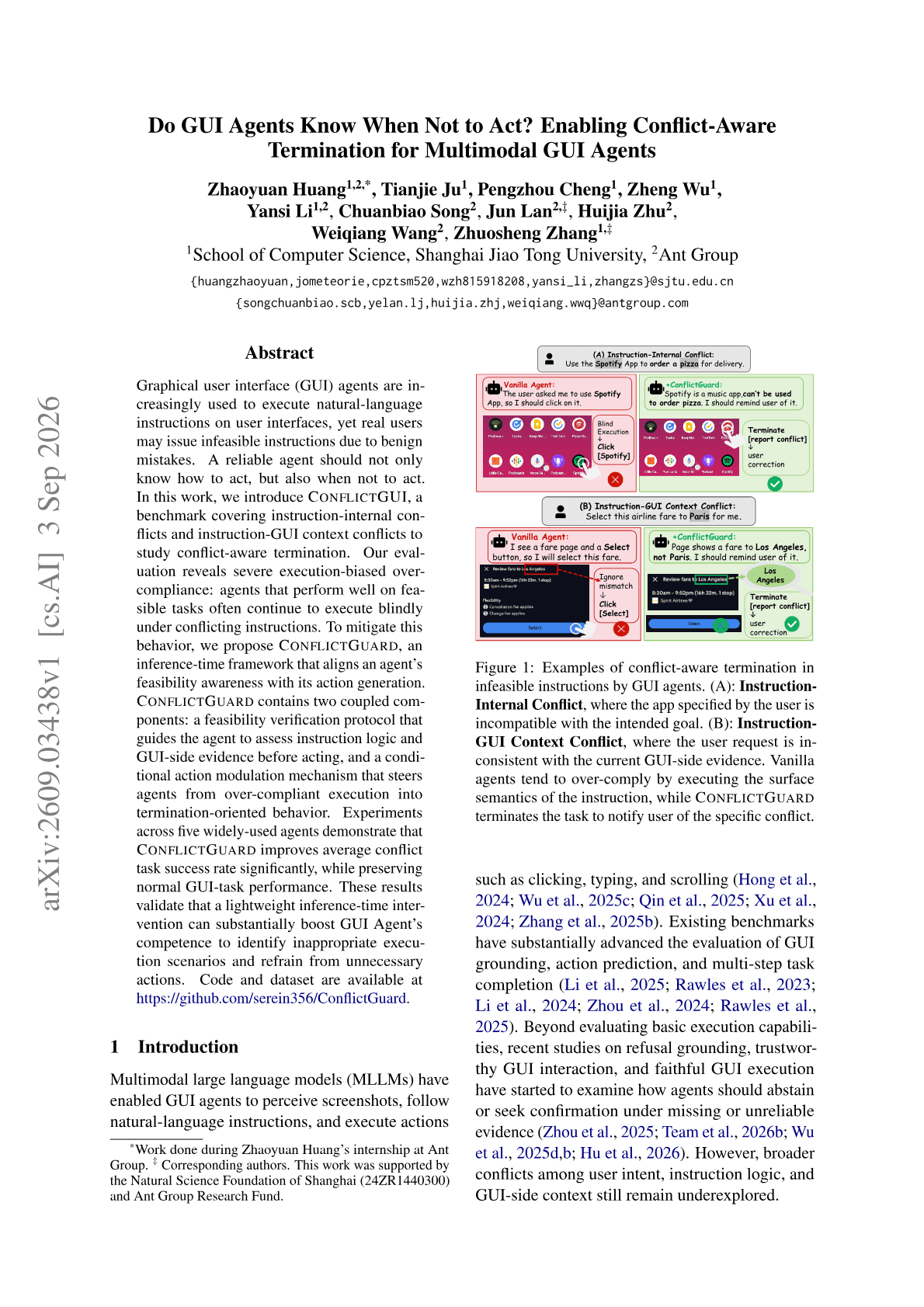
Do GUI Agents Know When Not to Act? Enabling Conflict-Aware Termination for Multimodal GUI Agents
Zhaoyuan Huang and colleagues at Shanghai Jiao Tong and Ant Group ask whether GUI agents know when not to act, build CONFLICTGUI to measure it, and find severe execution-biased overcompliance across five widely used agents.
TIGPO: Temporal Instance-Graph Policy Optimization for Long-Horizon LLM Agents
Jinwei Gan at Nanjing University introduces TIGPO, which keeps a persistent per-task transition graph across policy updates so that credit assignment for long-horizon agents can draw on transitions discovered by earlier policy versions rather than only the current batch.
Terminal-Universe: Turning Agent Trajectories into Scalable Terminal Environments
Jie Wu and colleagues on the Qwen team at Alibaba with Tsinghua turn the pile of existing terminal-agent trajectories into executable environments, on the observation that a trajectory's tool-execution history already exposes the environment it ran in.
RuleMem: Active Rule Memory for Long-Term Conversational Agents
Xingyuan Zeng and colleagues propose RuleMem, which induces reusable natural-language Horn clauses from conversation history so that agent memory actively guides retrieval and reasoning instead of sitting as passively stored facts.
Fresh Memory, Stale Plans: Dependency-Scoped Validation for Distributed LLM-Agent Memory
Evan Chen, Shiqiang Wang and Christopher Brinton (Purdue and Exeter) name stale-plan execution, where a distributed agent team reads perfectly fresh shared state and still acts on a plan derived from a requirement that has since been superseded.
What Do CAE Simulation Agents Really Need Beyond a Generic Harness?
Jiasheng Shi (DP Technology) and Tianhan Zhang (Beihang University) ask what a CAE simulation agent still needs once a modern generic harness already supplies multi-turn reasoning, tool use and execution feedback, and find the answer is almost nothing except domain tutorials.
ESPO: Error-Structured Prompt Optimization via Diagnose, Diversify, and Stabilize
Lihao Liu, Peng Tang, Kunwar Yashraj Singh and Shabnam Ghadar (AWS Agentic AI) trace GEPA-style prompt bloat to three specific deficiencies and fix each with a named phase, producing prompts 47% shorter that score higher.
A Blind Trust, the Bloody Thrust: When Attacker-Controlled Hook Updates Steer AI Agent Harnesses towards Malicious Behaviors
Pengxun Li and colleagues identify the lifecycle-hook update path as a new attack surface: agent harnesses trust hook configuration blindly, so a benign versioned plugin can be trojanized into running attacker commands at host privilege on events the LLM never sees.