AI Papers of the Week
Every paper worth reading in AI, hand-picked one week at a time.
Discover and explore top AI papers withClaude CodeCodex
npx @dair-ai/mcp setup
openJiuwen: Beyond Static Harnesses for Long-Horizon Coding Agents
The openJiuwen Team (with collaborators across Singapore and China) release an open-source coding-agent harness built around two named design goals, Structural Composability and Runtime Adaptivity, and report SWE-bench Verified and Terminal-Bench 2.1 numbers above the best official leaderboard points.
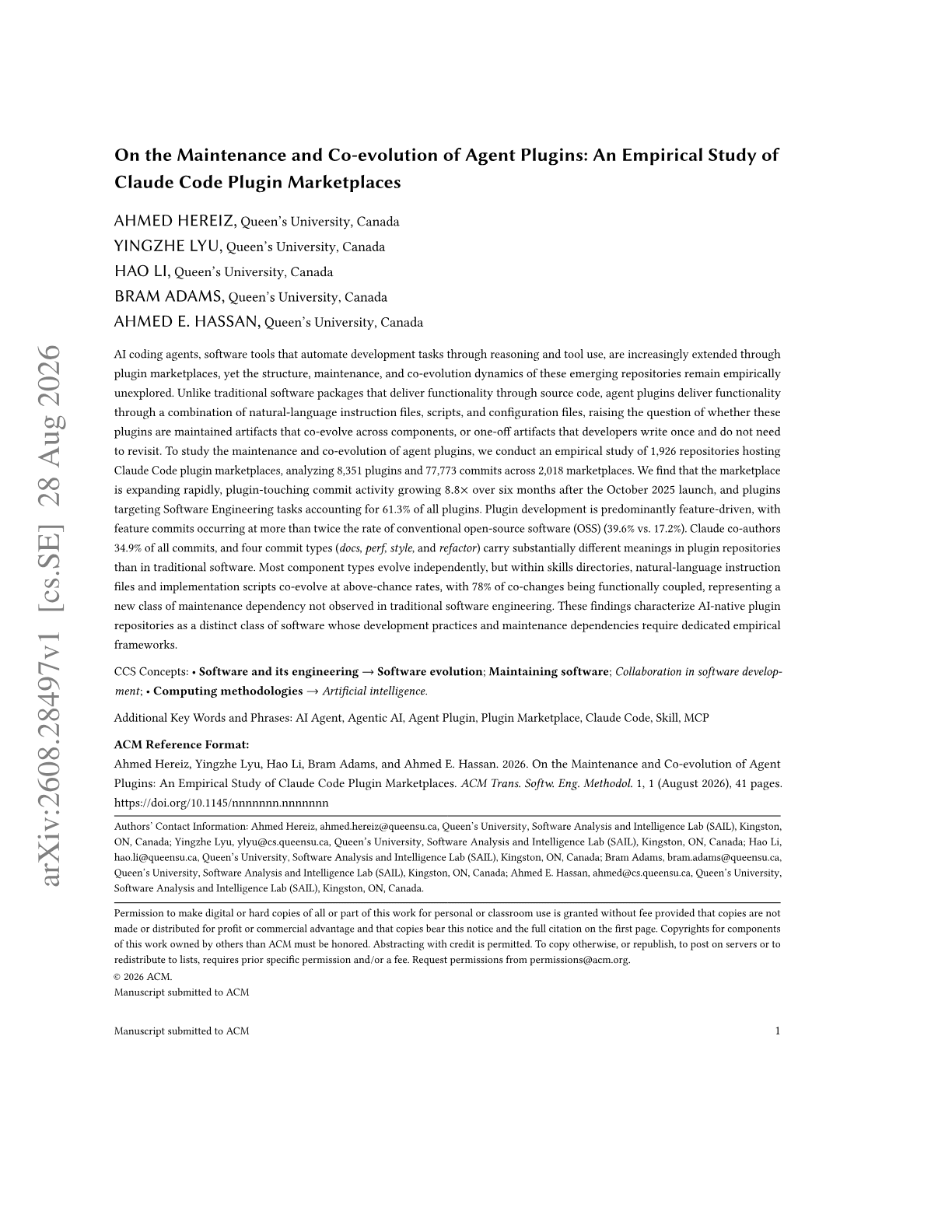
On the Maintenance and Co-evolution of Agent Plugins: An Empirical Study of Claude Code Plugin Marketplaces
Ahmed Hereiz and colleagues (Queen's University and Polytechnique Montreal, including Ahmed E. Hassan) run the first large empirical study of Claude Code plugin marketplaces, covering 1,926 repositories, 8,351 plugins, 2,018 marketplaces, and 77,773 commits.
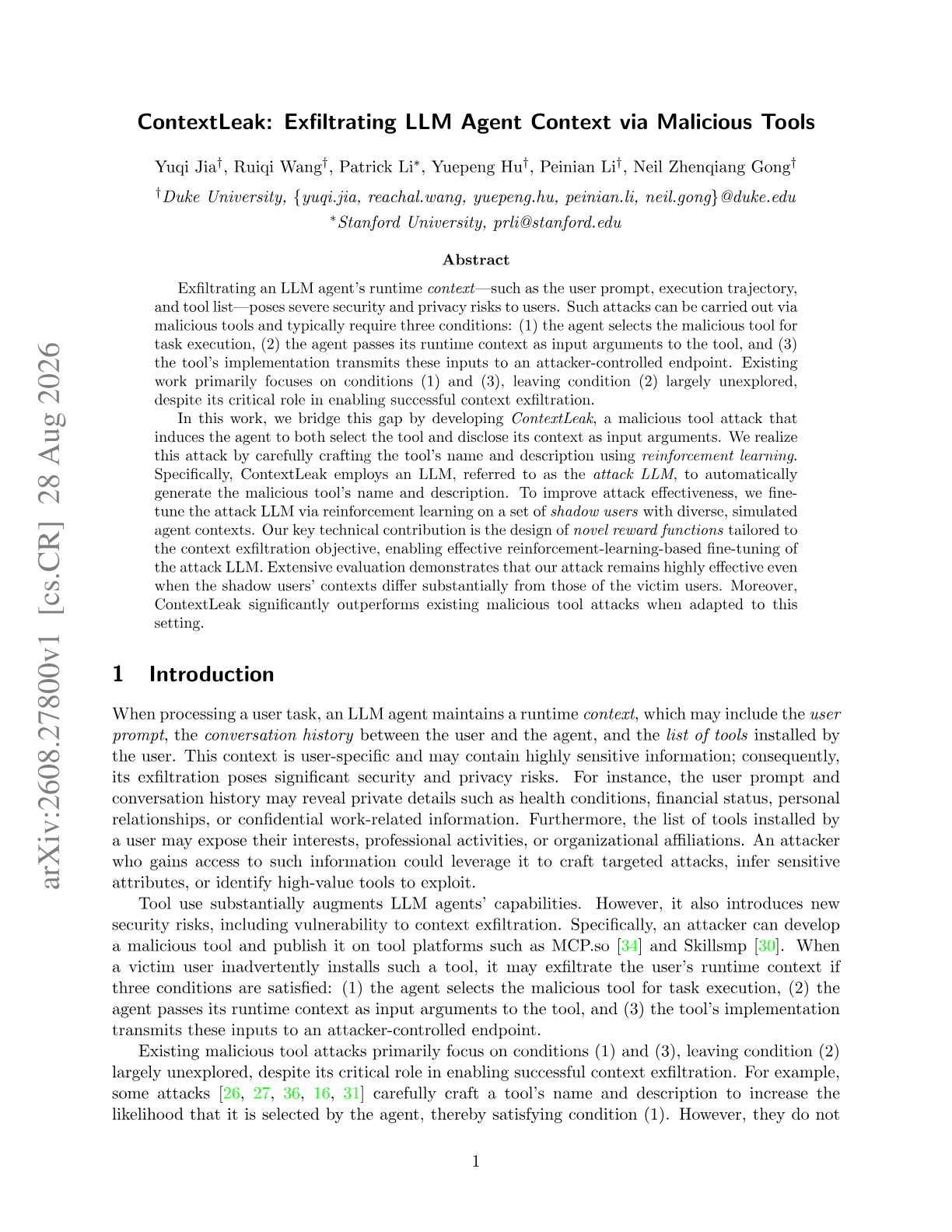
ContextLeak: Exfiltrating LLM Agent Context via Malicious Tools
Yuqi Jia and colleagues (Duke, with Neil Gong) target the condition prior malicious-tool work skipped: getting the agent to pass its own runtime context as tool arguments, achieved by RL-tuning an attack LLM that writes the tool name and description.
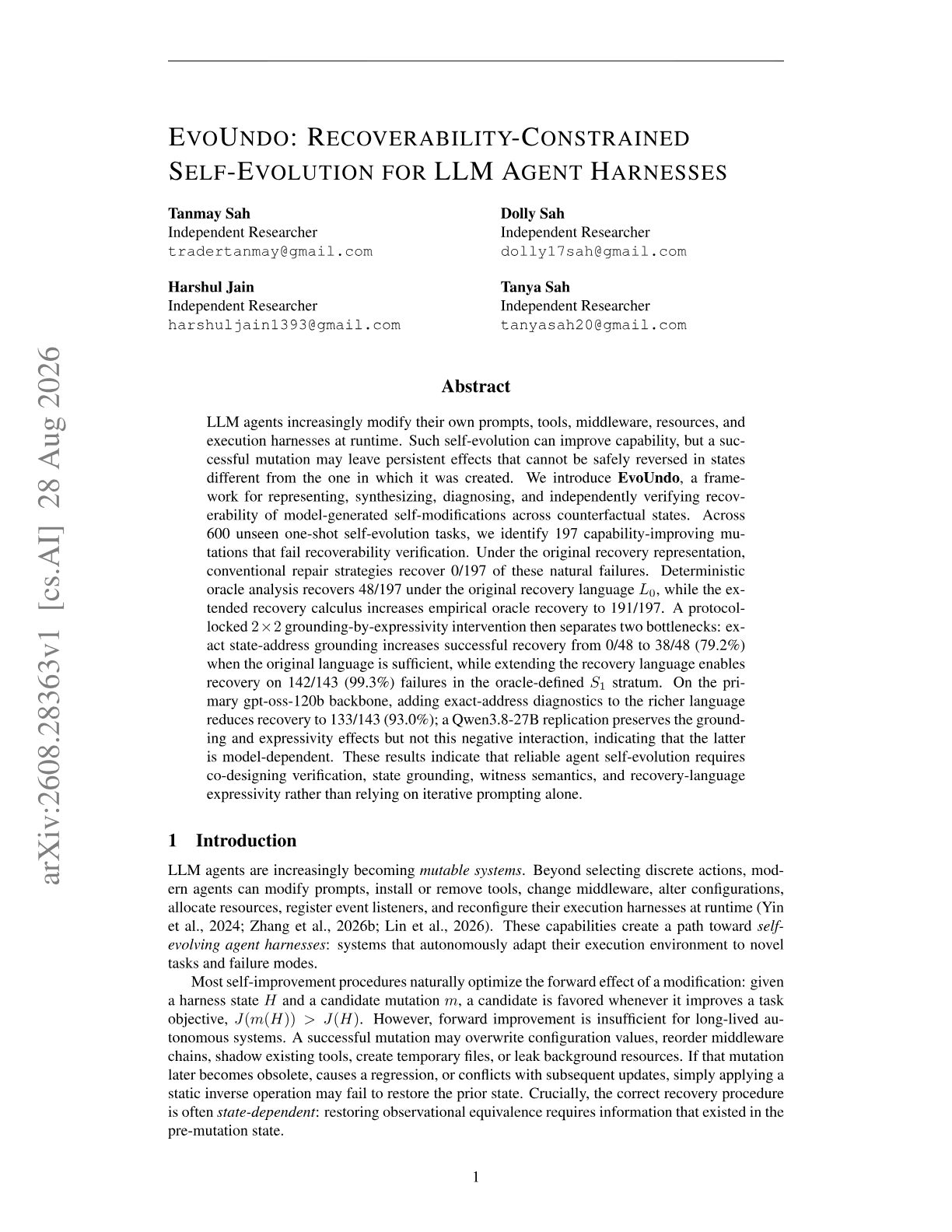
EvoUndo: Recoverability-Constrained Self-Evolution for LLM Agent Harnesses
Tanmay Sah and colleagues ask what happens when an agent's successful self-modification cannot be safely undone in states other than the one it was created in, and build a framework for synthesizing, diagnosing, and independently verifying recoverability across counterfactual states.
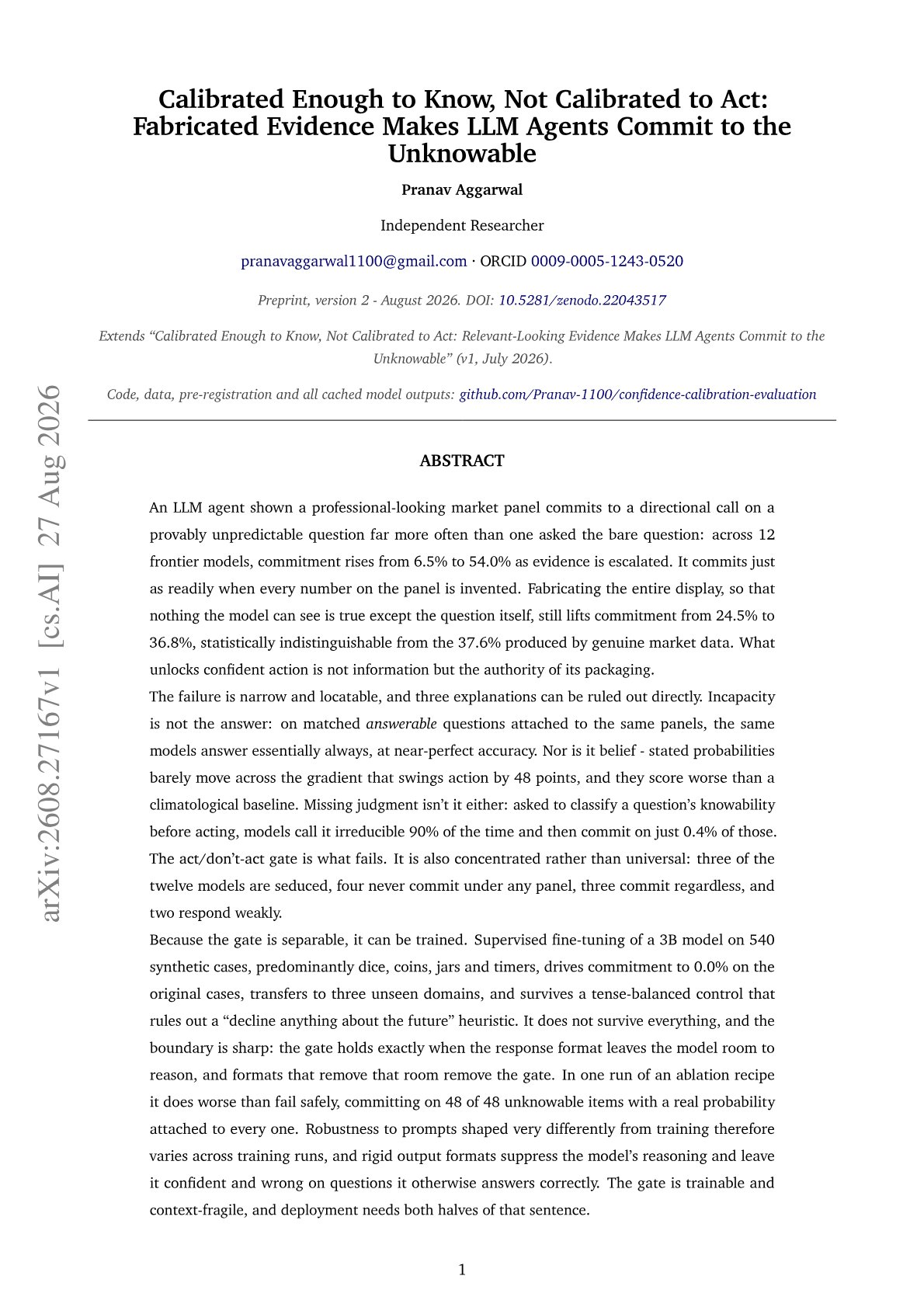
Calibrated Enough to Know, Not Calibrated to Act: Fabricated Evidence Makes LLM Agents Commit to the Unknowable
Pranav Aggarwal shows that an LLM agent shown a professional-looking market panel commits to a directional call on a provably unpredictable question far more often than one asked the bare question, and that the effect survives fabricating every number on the panel.
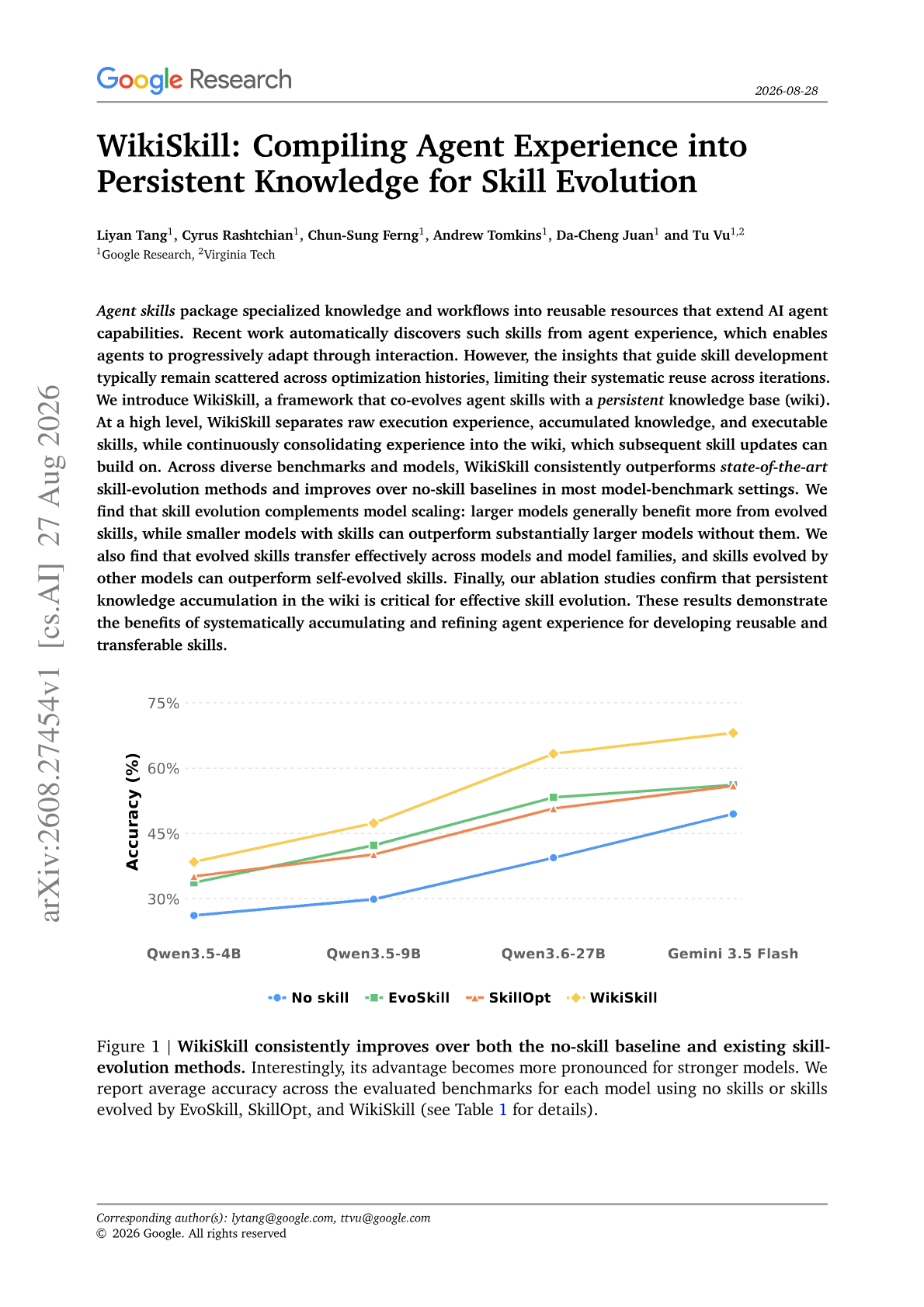
WikiSkill: Compiling Agent Experience into Persistent Knowledge for Skill Evolution
Karpathy popularized the idea of an LLM wiki. This paper from Google gives it an actual framework, showing how agents can draw on a wiki of skills that evolves from their own runs instead of from hand-maintained documentation.
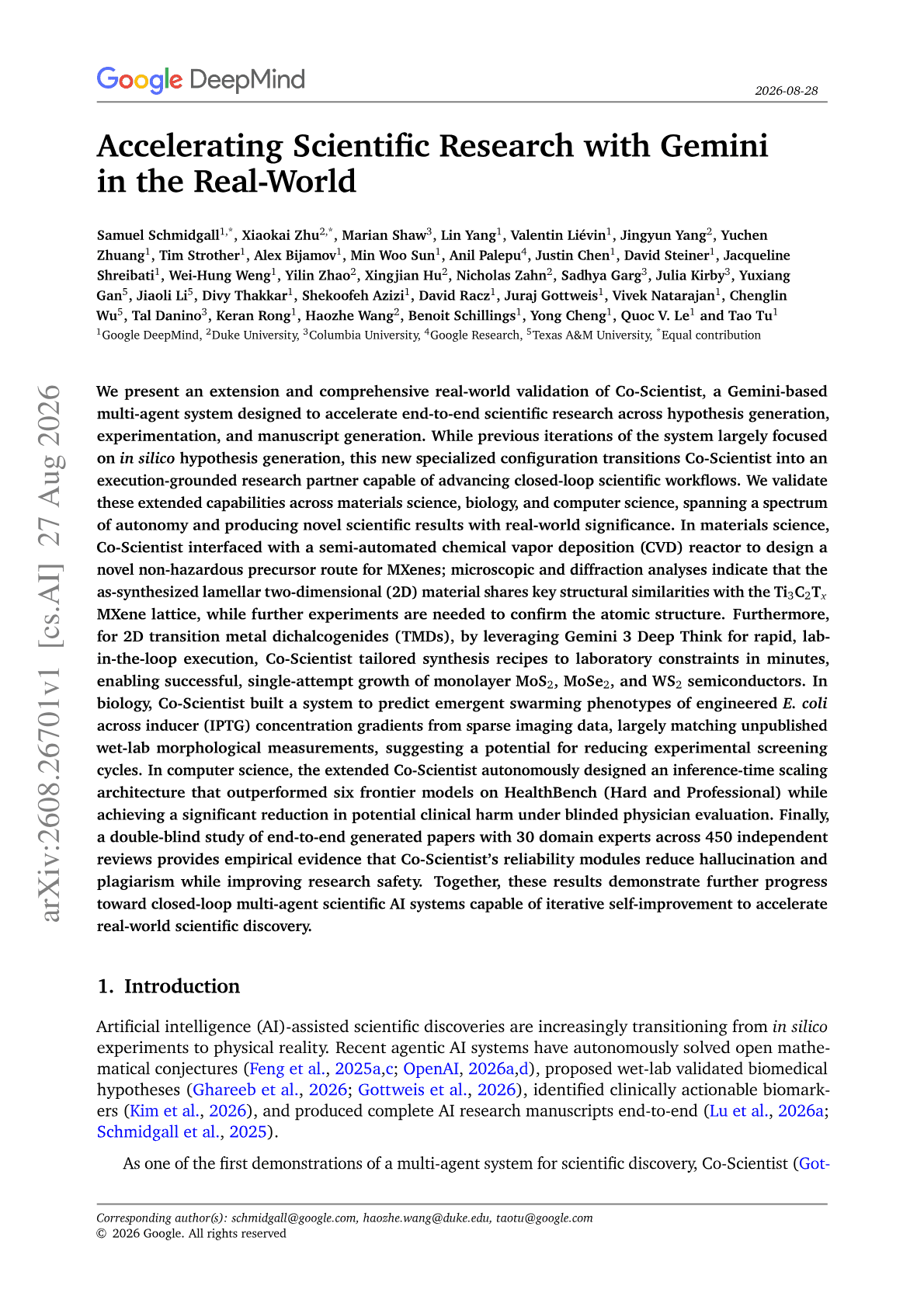
Accelerating Scientific Research with Gemini in the Real-World
Google DeepMind takes Co-Scientist out of simulation and into physical experiments across materials science, biology, and computer science. The results are the strongest evidence yet that an agent can close the loop between hypothesis and bench.
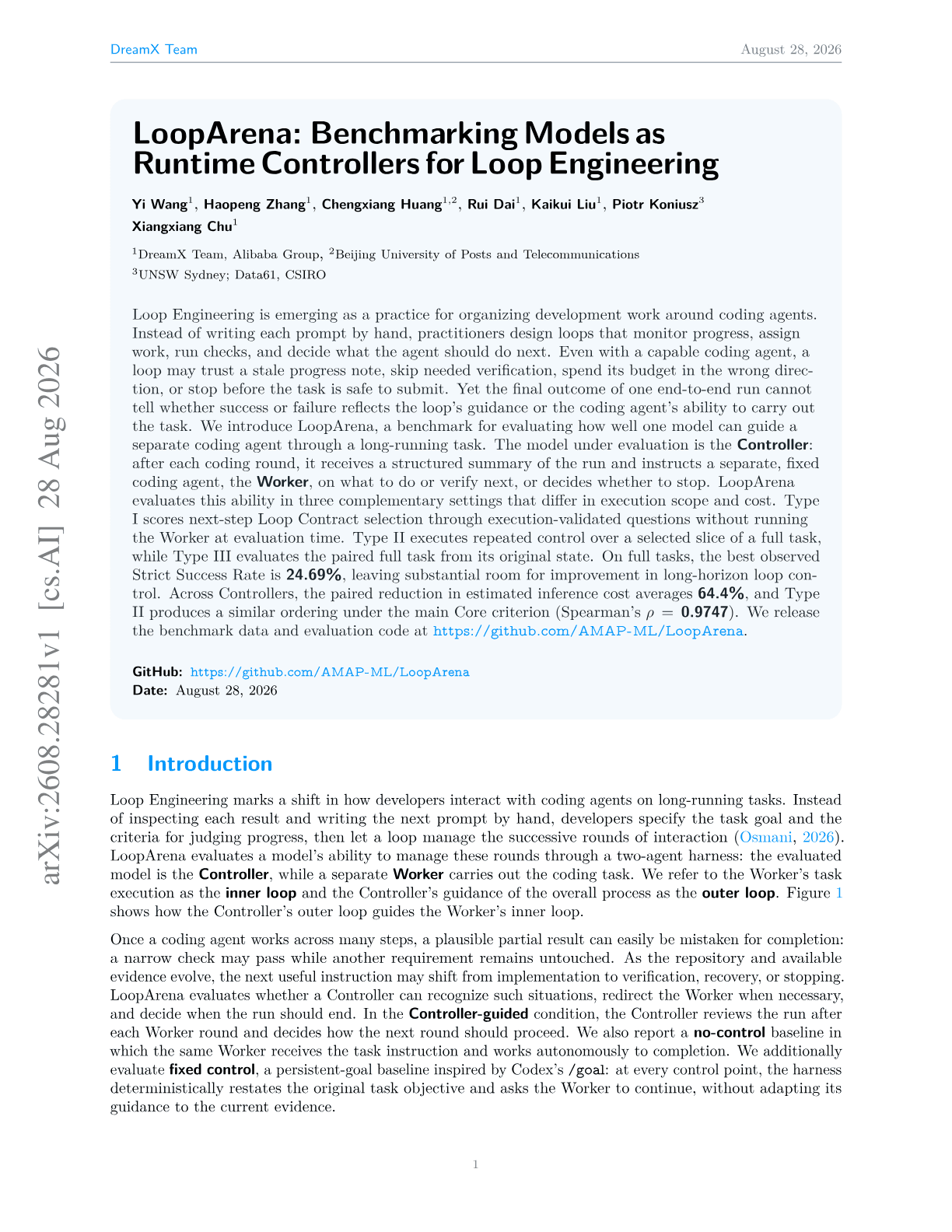
LoopArena: Benchmarking Models as Runtime Controllers for Loop Engineering
Yi Wang and colleagues (AMAP / Alibaba with collaborators) benchmark the outer loop rather than the coding agent, evaluating a Controller model that instructs a fixed Worker coding agent after each round and decides when to stop.
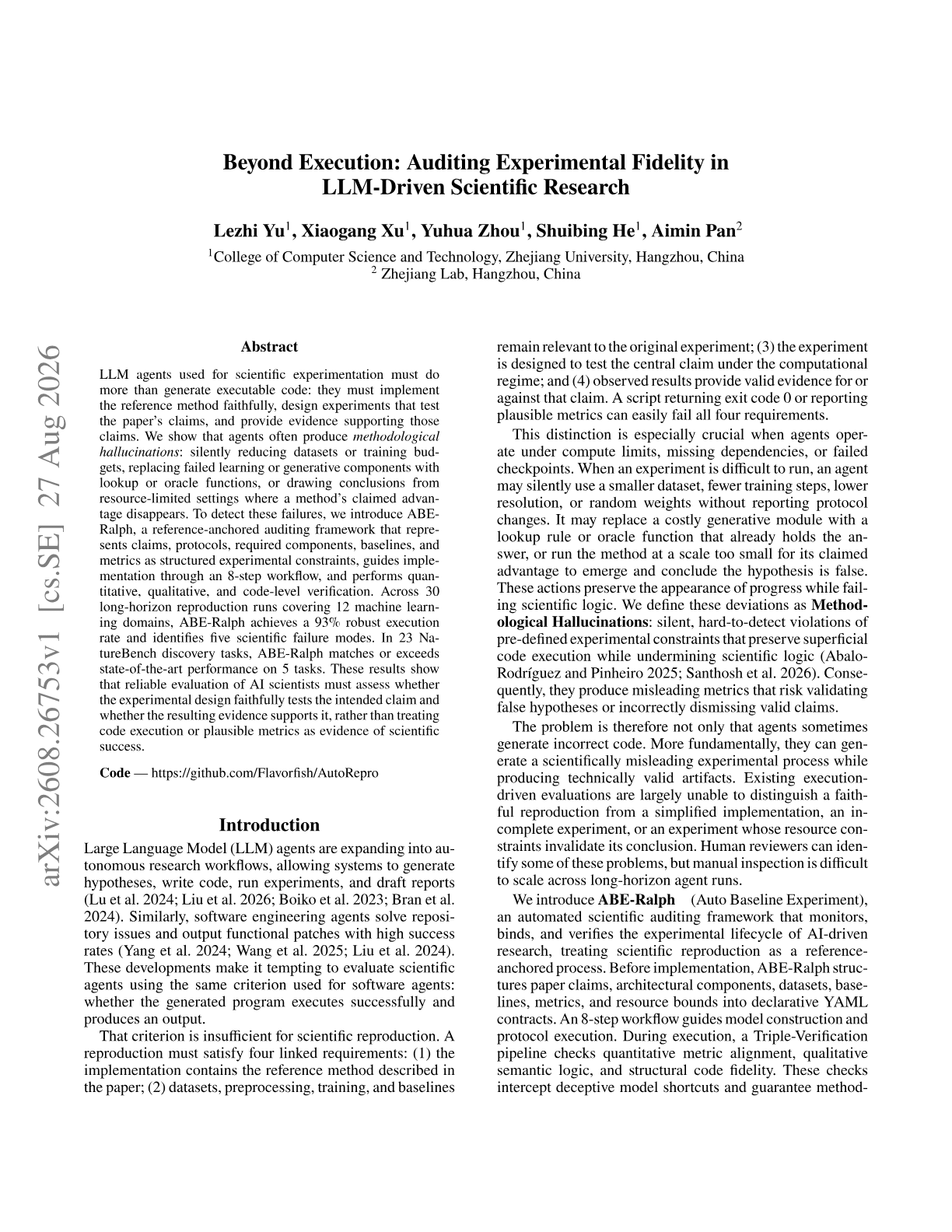
Beyond Execution: Auditing Experimental Fidelity in LLM-Driven Scientific Research
Lezhi Yu and colleagues (Zhejiang University) name a failure mode in LLM research agents that execution-based benchmarks cannot see: methodological hallucination, where the code runs and the conclusion is still fabricated.
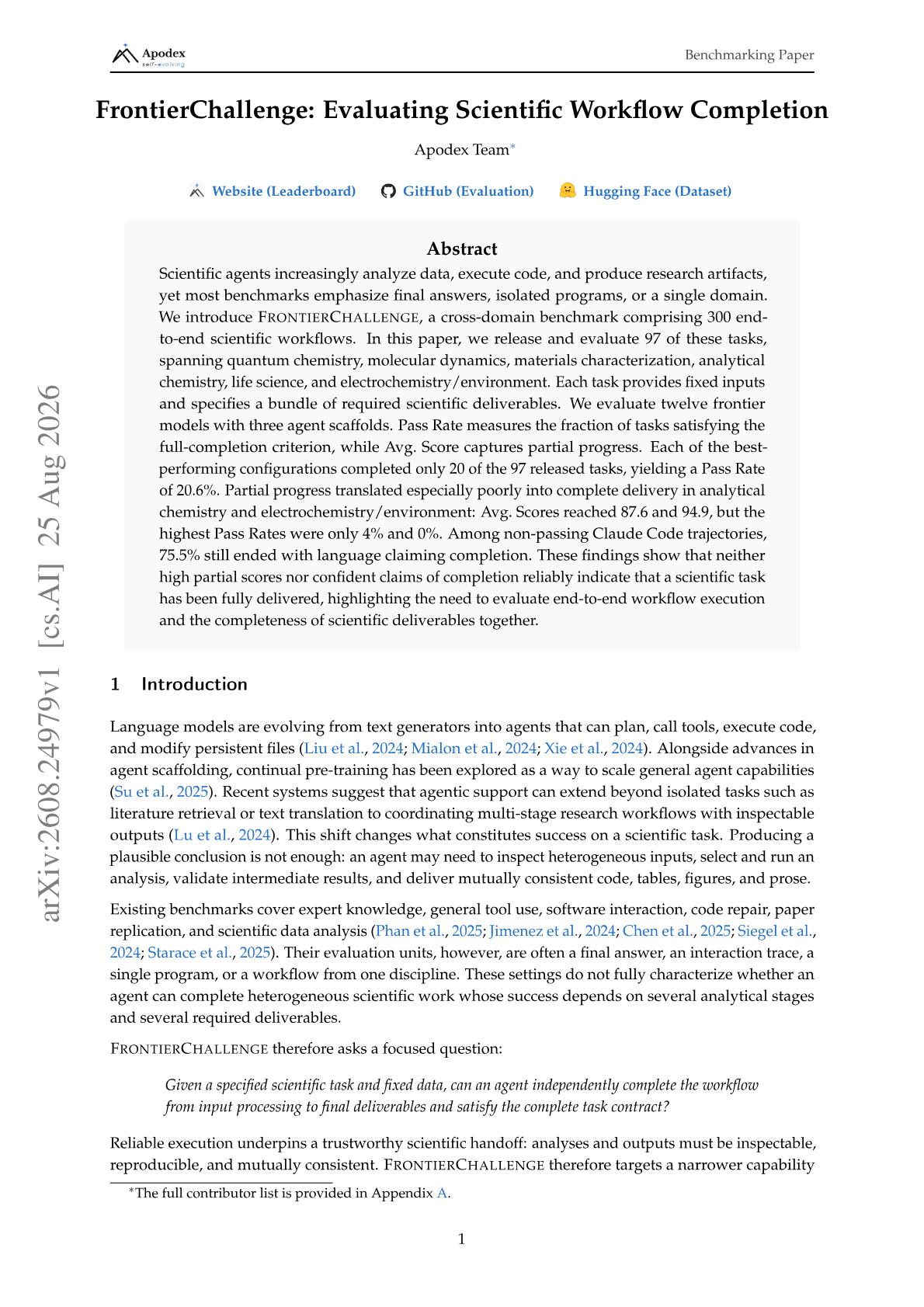
FrontierChallenge: Evaluating Scientific Workflow Completion
Liangcai Su and a sixteen-author team release FrontierChallenge, a cross-domain benchmark of end-to-end scientific workflows where the best of twelve frontier models across three agent scaffolds completes only a fifth of tasks.
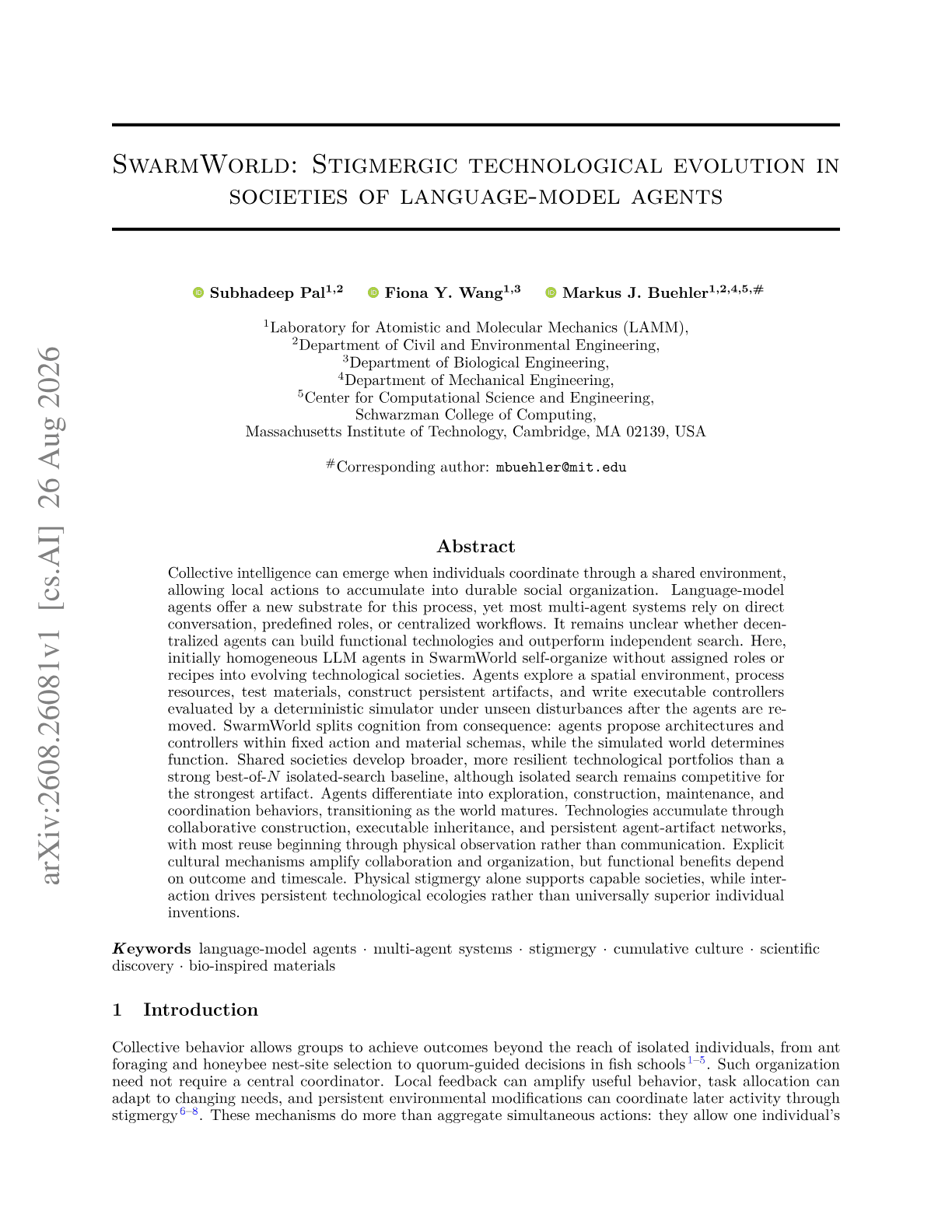
SwarmWorld: Stigmergic technological evolution in societies of language-model agents
Subhadeep Pal, Fiona Y. Wang and Markus J. Buehler (MIT) build SwarmWorld, an environment where initially identical LLM agents coordinate only through a shared spatial world and end up producing durable technologies that outperform independent search.
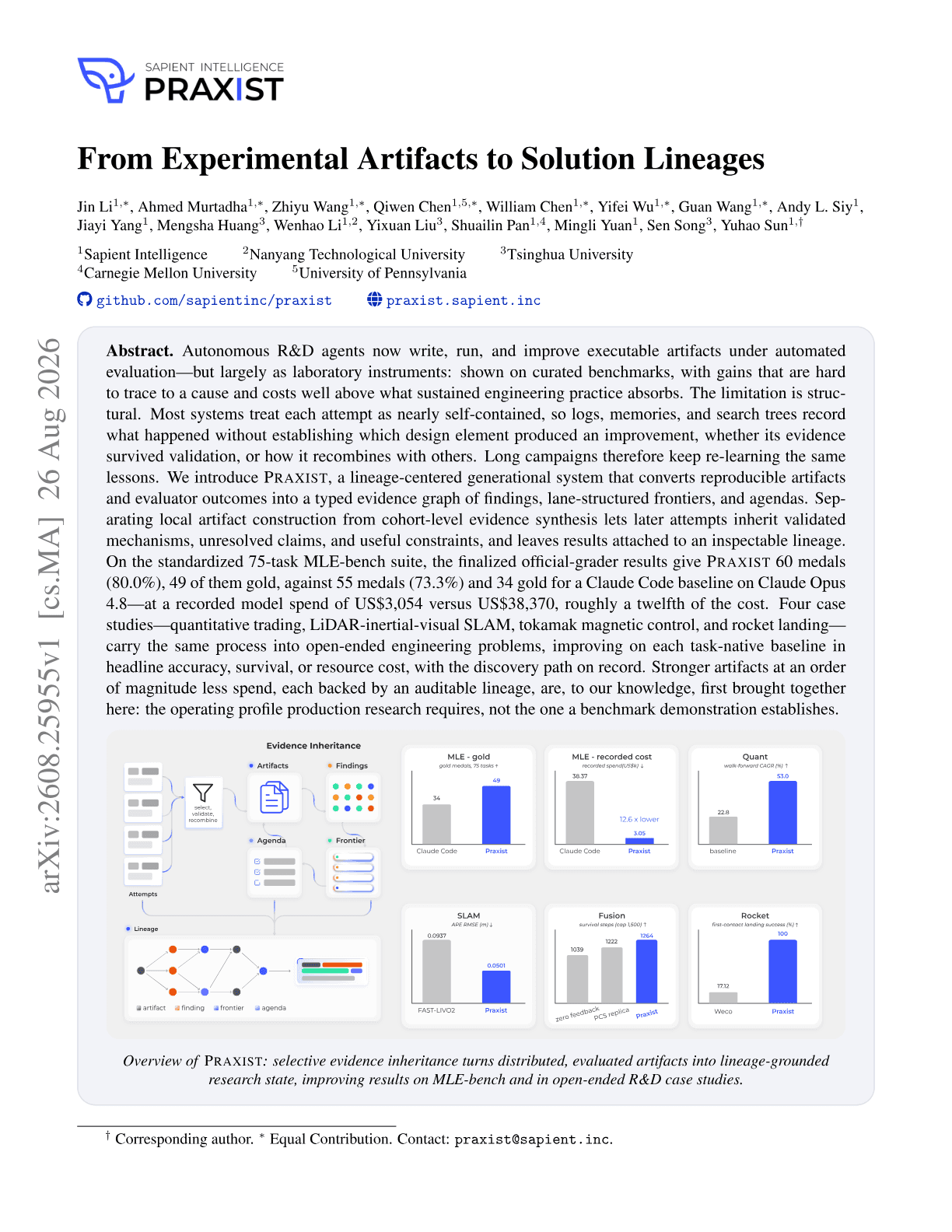
Praxist: From Experimental Artifacts to Solution Lineages
Jin Li and a large team introduce Praxist, which replaces the flat log-and-memory design of autonomous R&D agents with a typed evidence graph that tracks which design element actually produced an improvement.
Agent Seer: Synthesizing Scenarios from Specification Understanding
Harish Karumuri, Mahesh Vemula, and David Lopes Pegna show that an MCP specification alone carries enough semantic information to synthesize realistic multi-turn agent evaluation scenarios, with no examples, no live tool access, and no domain tuning.
Benchmarking AI Agents for Hardware Design Automation via MCP Tool Calling
Leonardo Liparulo and Francesco Pierri (Politecnico di Milano) build an MCP server that mirrors a proprietary hardware design tool and benchmark seven locally deployed open-source models on dependency-ordered engineering workflows, isolating which harness choices actually move reliability.
FaulT-Bench: Towards Benchmarking Network Troubleshooting LLM Agents under Unreliable User Tickets
Kuan-Hao Tseng and colleagues (University of Sydney) build FaulT-Bench, 200 network troubleshooting scenarios across eight topologies that include false fault reports and wrong root-cause claims, then show SADE, ReAct, and Claude Code all collapse when the network is actually healthy.
Retrieve, Match, Escalate: Accurate and Scalable Product Linking with VLM-Distilled Cross-Encoders and Agentic VLMs
Jian Wang and colleagues describe a production product-linking cascade at marketplace scale where a distilled cross-encoder auto-resolves the easy majority and an agentic VLM with web search settles only the ambiguous tail.
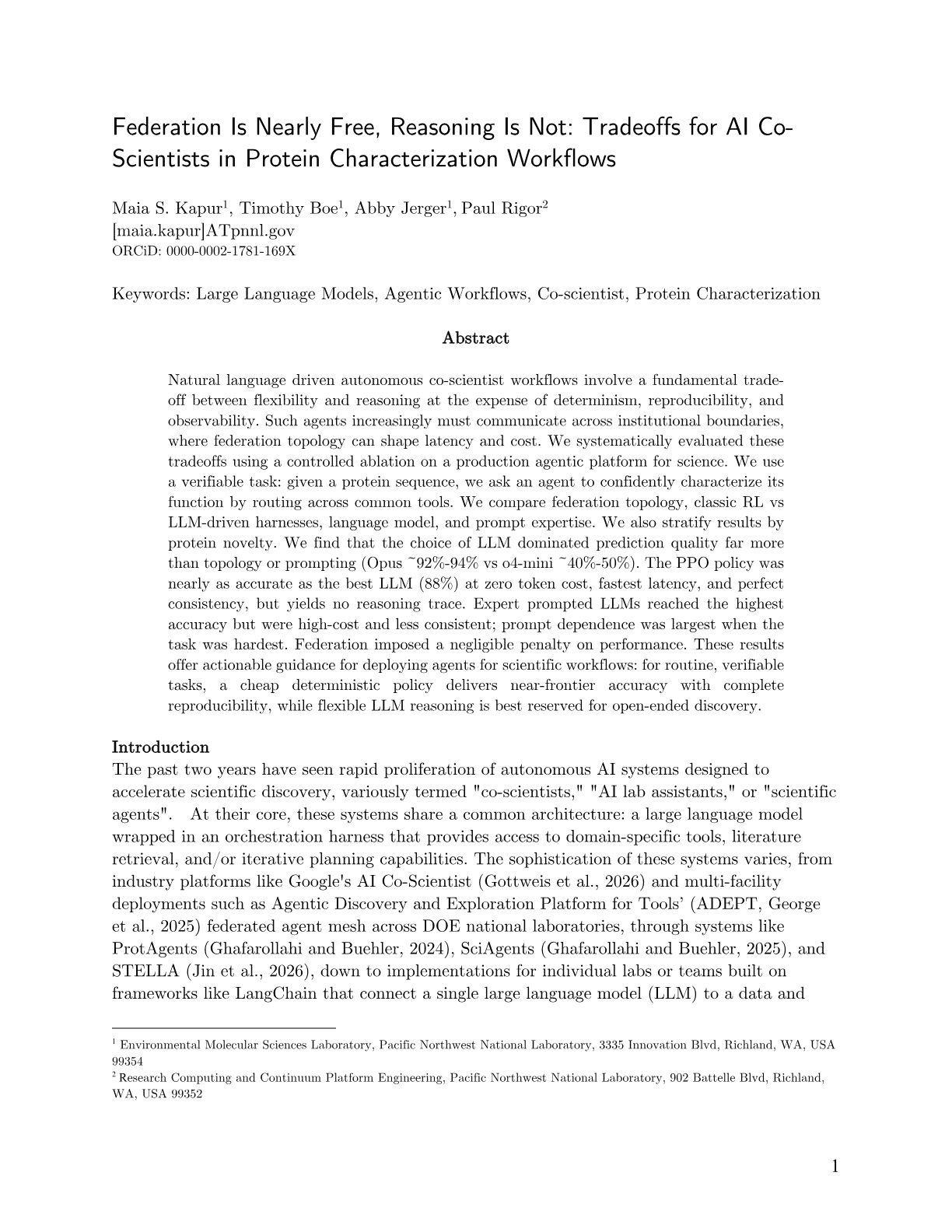
Federation Is Nearly Free, Reasoning Is Not: Tradeoffs for AI Co-Scientists in Protein Characterization Workflows
Maia Kapur and colleagues run a controlled ablation on a production agentic science platform, using protein function characterization as a verifiable task to separate what federation topology, harness type, model choice, and prompt expertise each contribute.
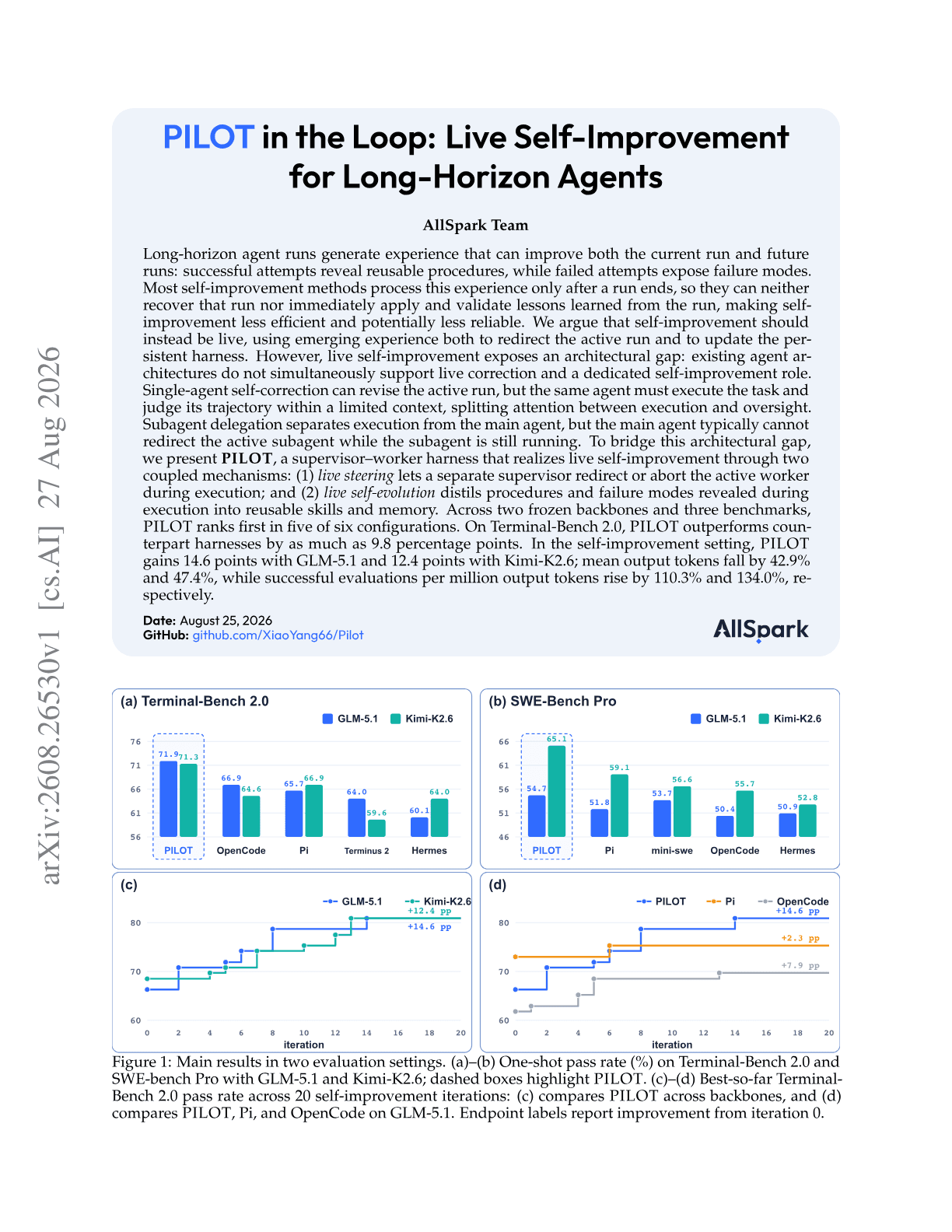
PILOT in the Loop: Live Self-Improvement for Long-Horizon Agents
Yang Xiao and co-authors present PILOT, a supervisor-worker harness that improves a long-horizon agent while the run is still going rather than after it ends.
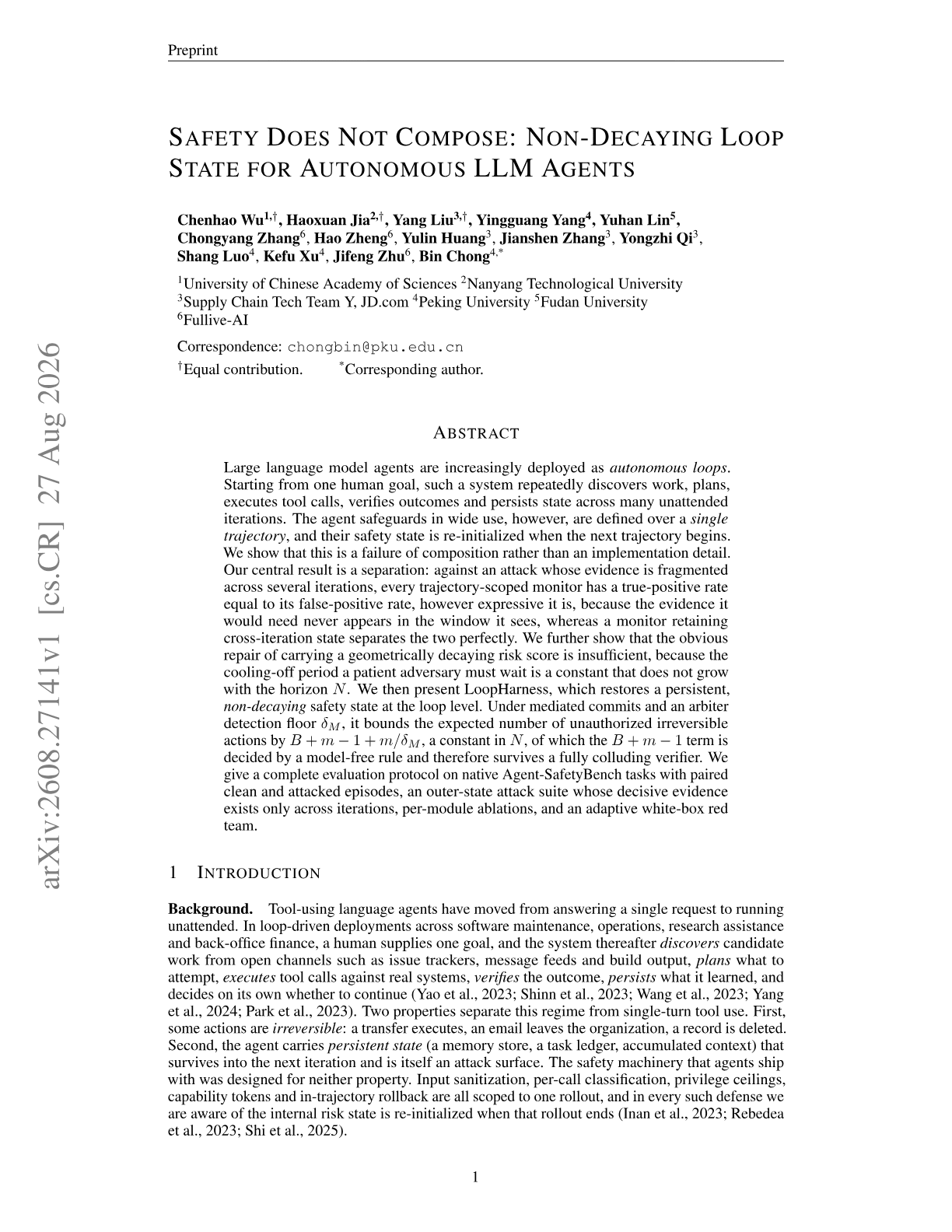
Safety Does Not Compose: Non-Decaying Loop State for Autonomous LLM Agents
Chenhao Wu and co-authors prove a separation result: any safety monitor scoped to a single agent trajectory is provably useless against an attack whose evidence is spread across iterations of an autonomous loop.
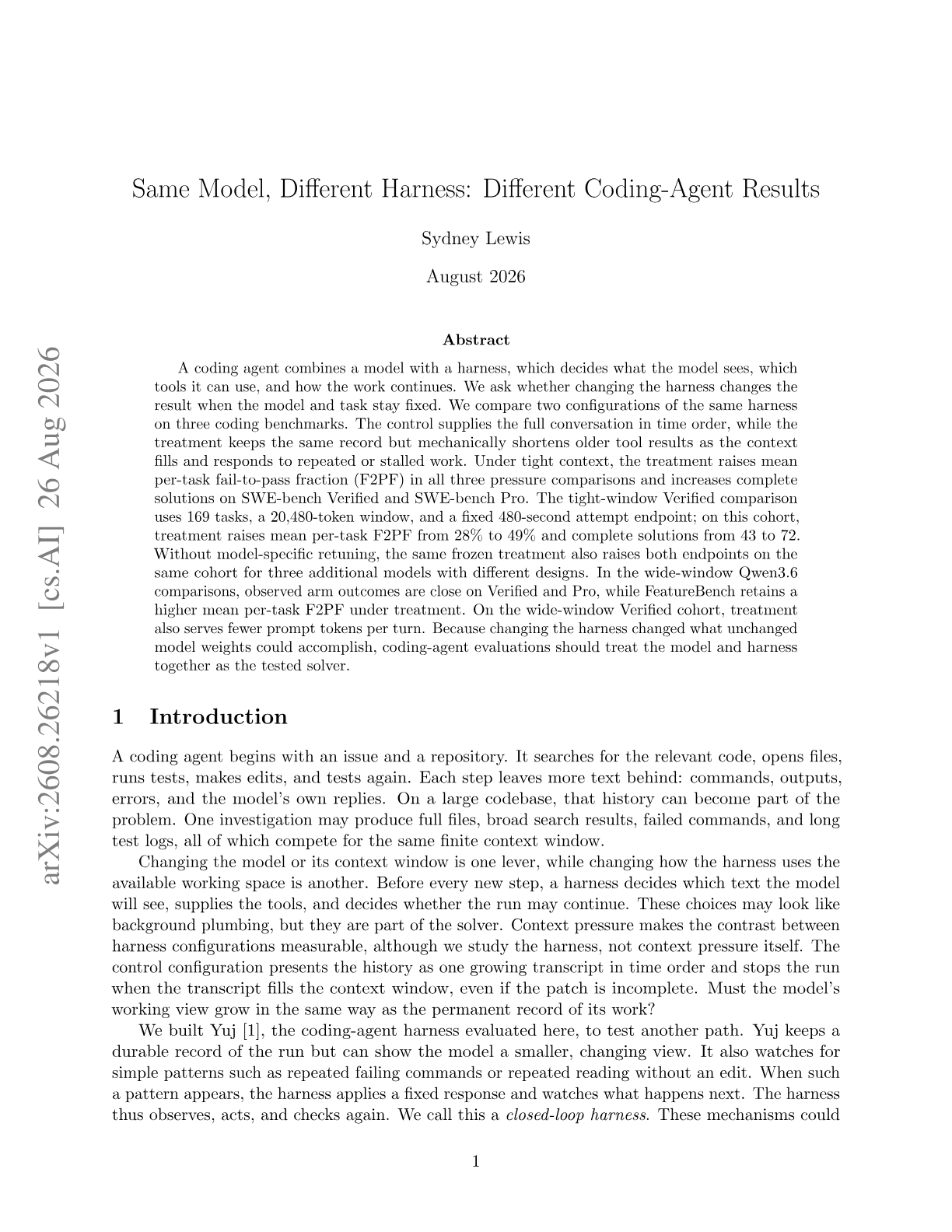
Same Model, Different Harness: Different Coding-Agent Results
Sydney Lewis holds the model and task fixed and varies only the harness, showing that a coding agent's benchmark number is a property of the model-plus-harness pair rather than of the weights.
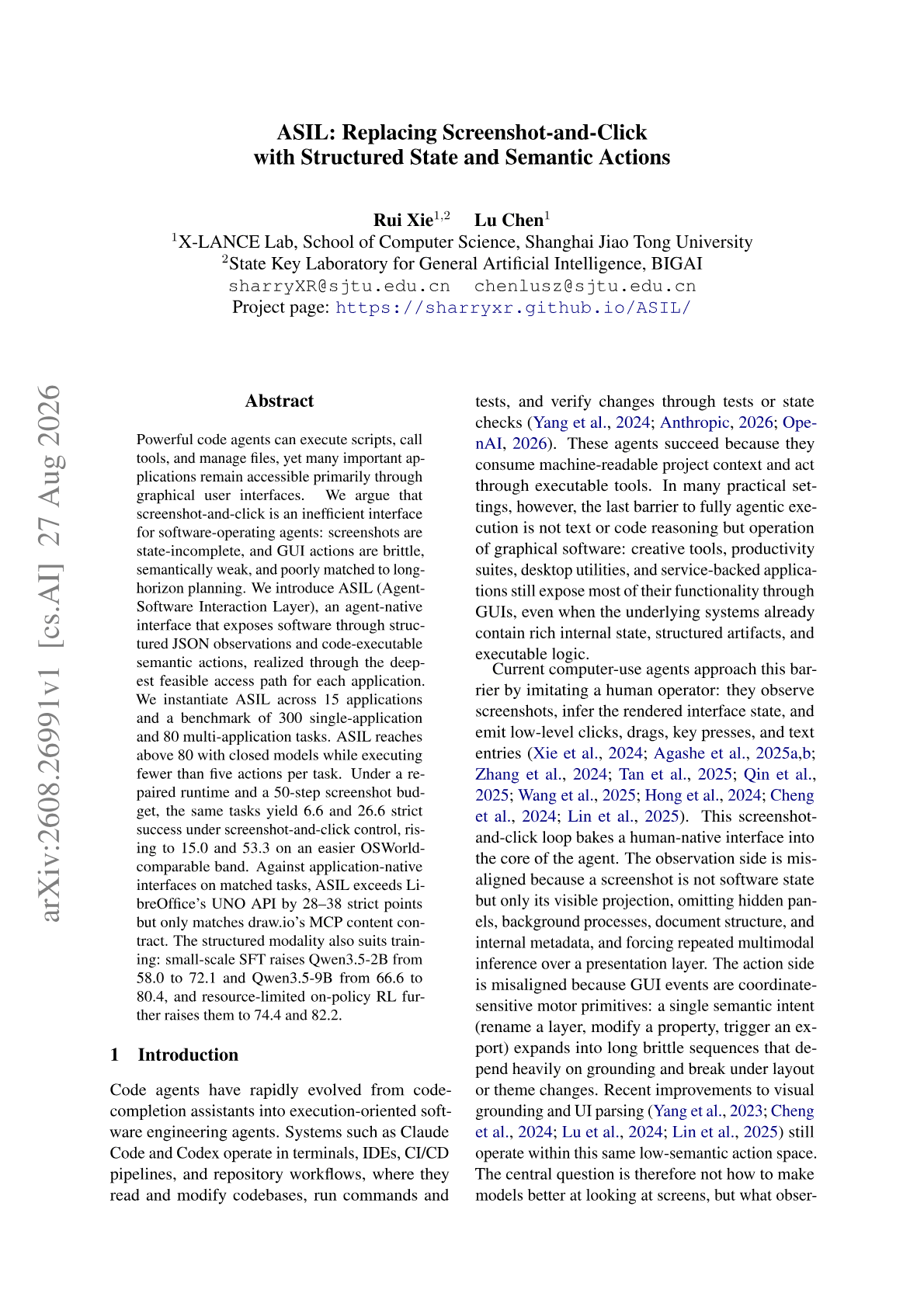
ASIL: Replacing Screenshot-and-Click with Structured State and Semantic Actions
Rui Xie and Lu Chen (EMNLP Findings) argue that screenshot-and-click is the wrong interface for software-operating agents and build ASIL, which exposes applications through structured JSON observations and code-executable semantic actions.
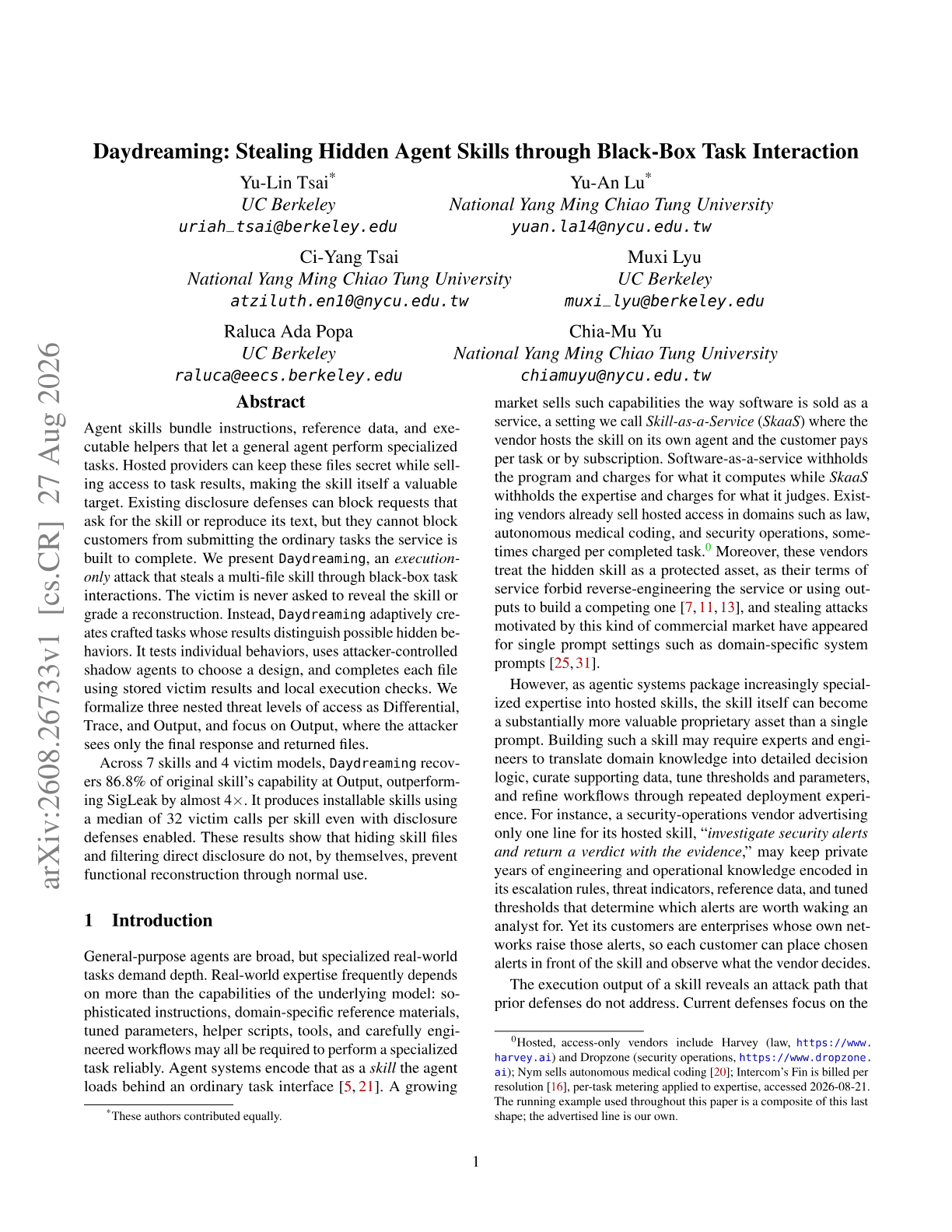
Daydreaming: Stealing Hidden Agent Skills through Black-Box Task Interaction
Yu-Lin Tsai and co-authors (NYCU, Berkeley) present Daydreaming, an execution-only attack that reconstructs a hosted multi-file agent skill purely by submitting the ordinary tasks the service exists to perform.
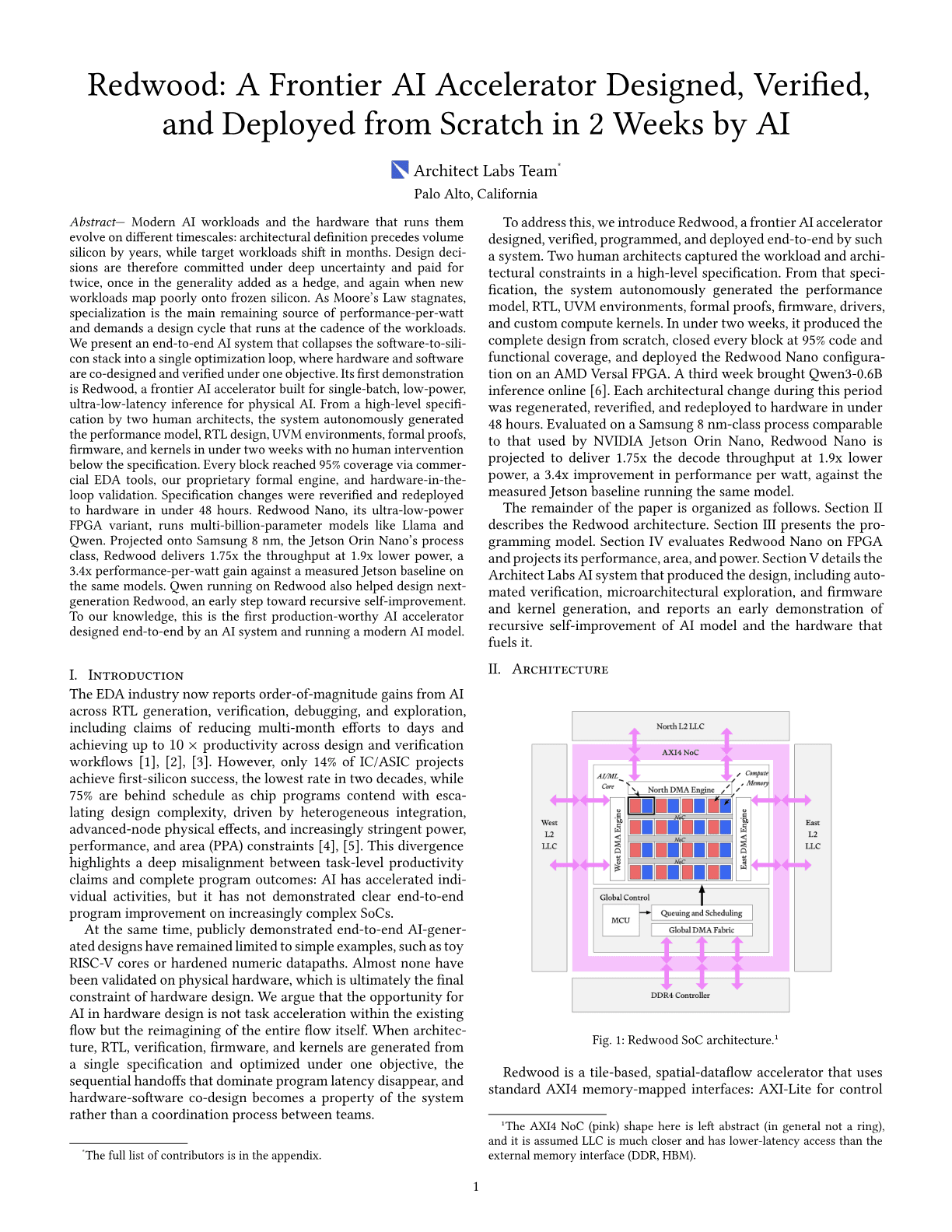
Redwood: A Frontier AI Accelerator Designed, Verified, and Deployed from Scratch in 2 Weeks by AI
Architect Labs report Redwood, a frontier inference accelerator whose performance model, RTL, UVM environments, formal proofs, firmware and kernels were generated end to end by an AI system in under two weeks from a specification written by two human architects.
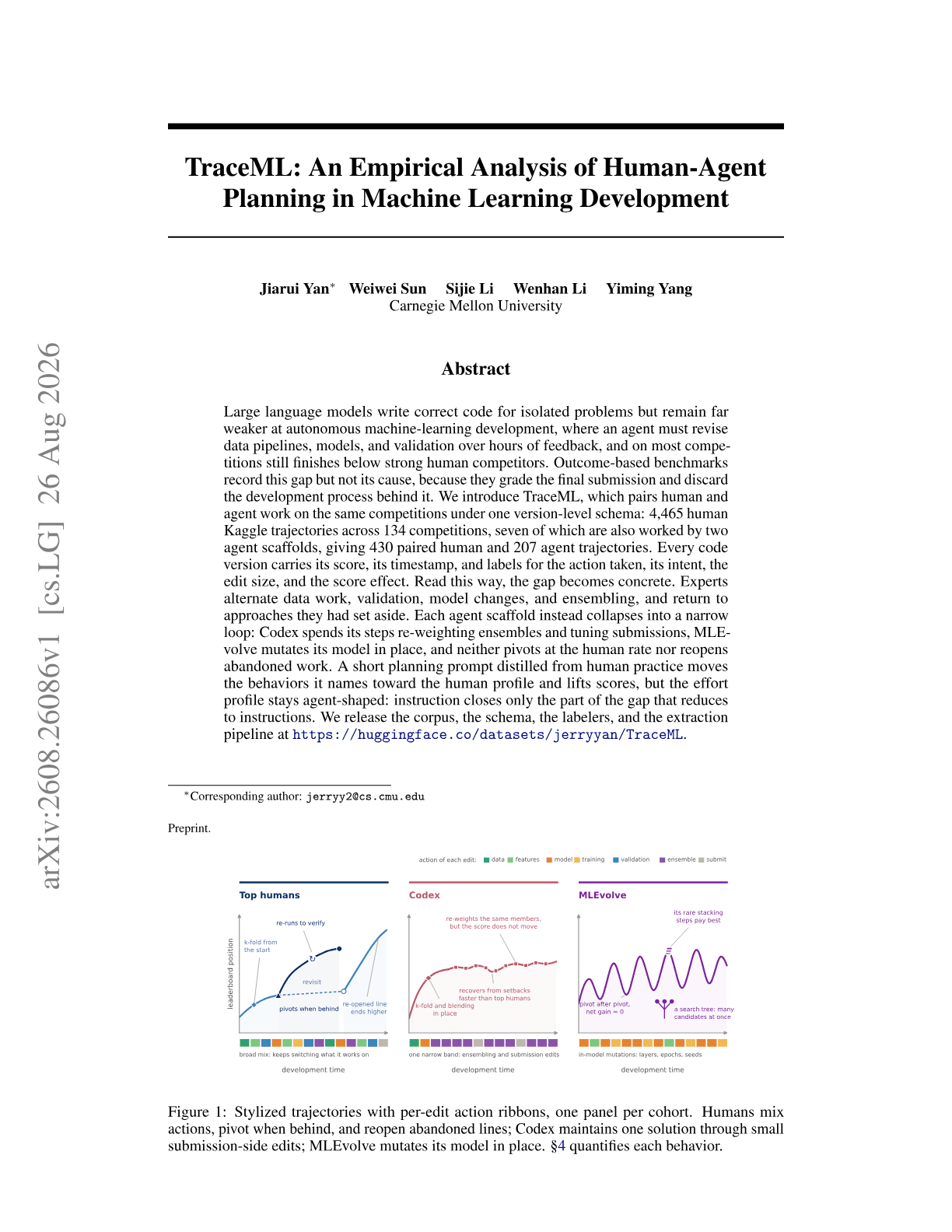
TraceML: An Empirical Analysis of Human-Agent Planning in Machine Learning Development
Jiarui Yan, Weiwei Sun, Sijie Li and Yiming Yang at CMU pair 4,465 human Kaggle trajectories with agent runs on the same competitions under one version-level schema, so the ML-development gap can be read as behavior rather than a final score.