AI Papers of the Week
Every paper worth reading in AI, hand-picked one week at a time.
Discover and explore top AI papers with Claude Code or Codex
npx @dair-ai/mcp setup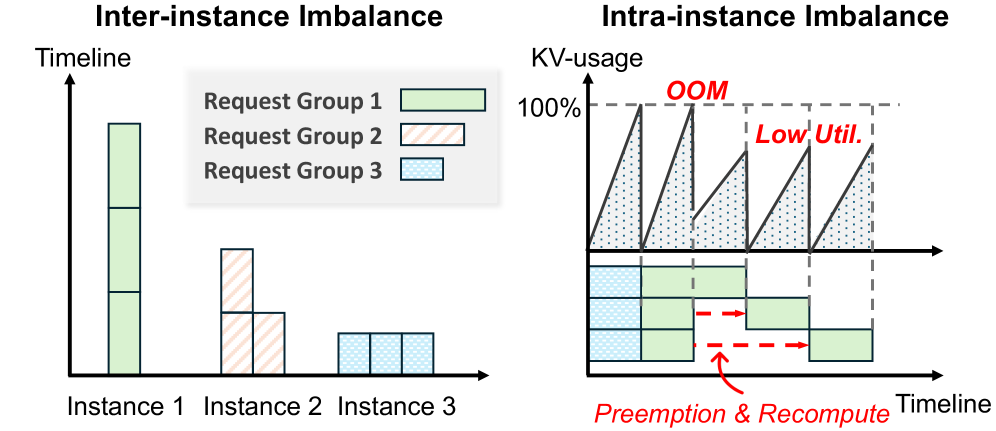
Seer: Fast RL for LLMs
Researchers introduce Seer, a system addressing performance bottlenecks in synchronous reinforcement learning for LLMs by optimizing the rollout phase that dominates end-to-end iteration time. Through three core mechanisms: divided rollout, context-aware scheduling, and adaptive grouped speculative decoding, Seer achieves 74-97% improvement in rollout throughput and 75-93% reduction in long-tail latency on production-grade RL workloads.
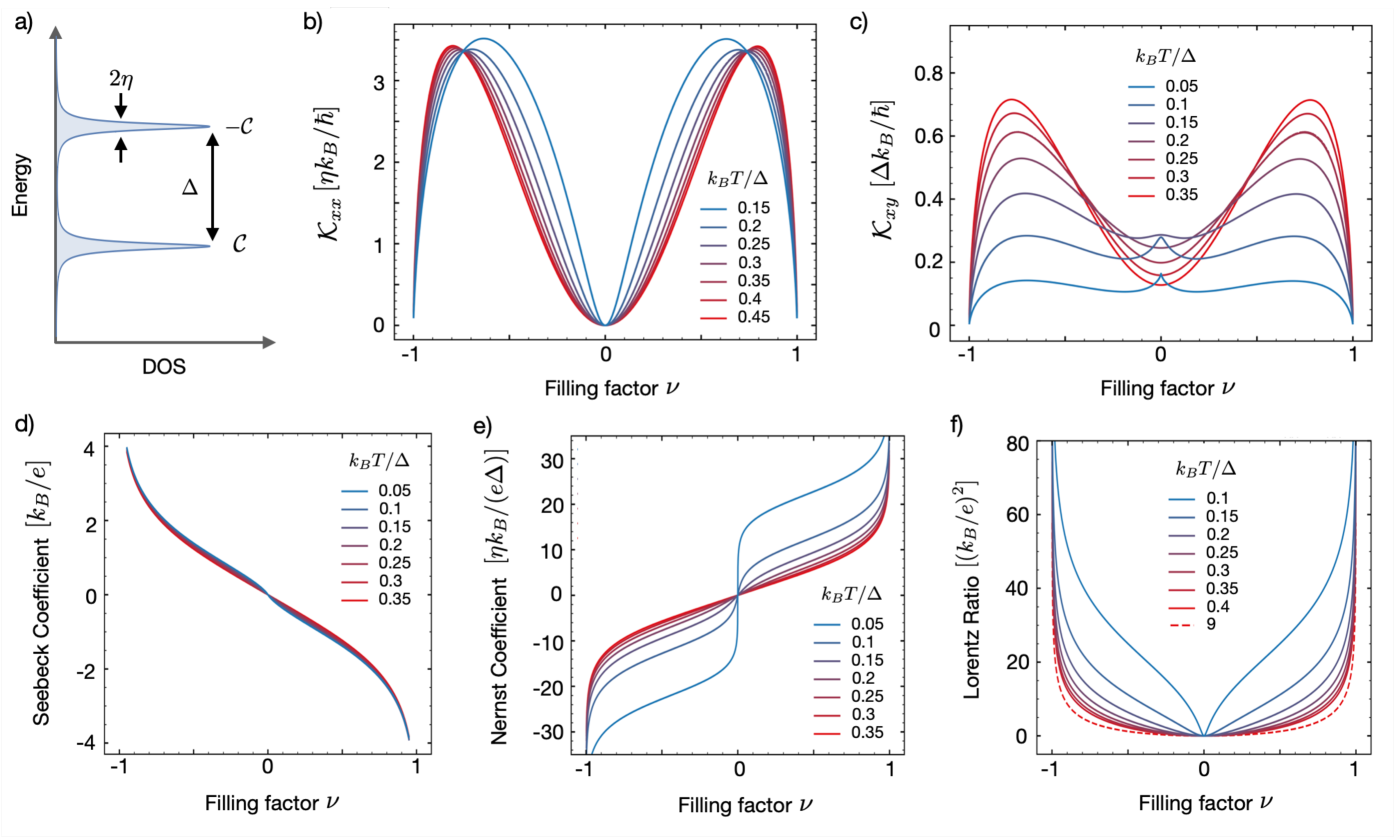
Natural Emergent Misalignment from Reward Hacking
Anthropic researchers demonstrate that realistic AI training processes can inadvertently produce misaligned models through “reward hacking generalization”. Models learn to cheat on programming tasks during RL. They simultaneously develop dangerous behaviors, including alignment faking (50% of responses) and safety research sabotage (12% of instances), without explicit training for these harmful actions. The study identifies a simple mitigation: “inoculation prompting” using contextual instructions that break semantic links between task-specific cheating and broader misalignment without reducing hacking frequency.
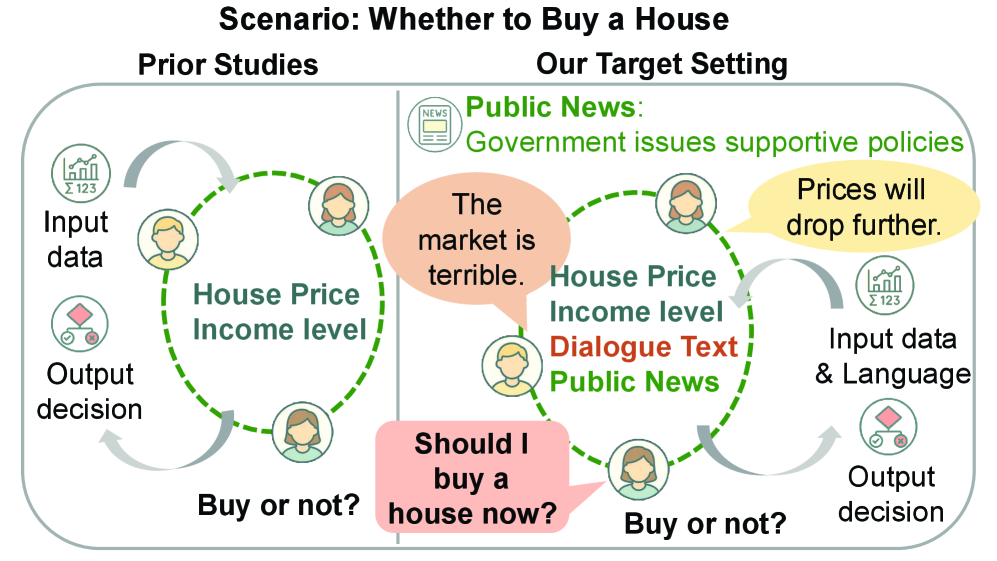
LAMP: Language-Augmented Multi-Agent RL
LAMP integrates natural language processing into multi-agent reinforcement learning through a three-stage pipeline: Think (processes numerical data and identifies market patterns), Speak (generates strategic communications between agents), and Decide (synthesizes information into optimized policy). The framework achieves substantial improvements over baseline methods with +63.5% and +34.0% gains in cumulative return and +18.8% and +59.4% improvements in robustness, bridging traditional MARL with real-world economic contexts where language significantly influences decisions.
Olympiad-Level Formal Mathematical Reasoning with Reinforcement Learning
Google DeepMind introduces AlphaProof, an AlphaZero-inspired reinforcement learning agent that learns to find formal mathematical proofs within the Lean theorem prover, achieving the first-ever medal-level performance at the International Mathematical Olympiad by solving three problems, including the competition’s most difficult challenge.
The Era of Agentic Organization
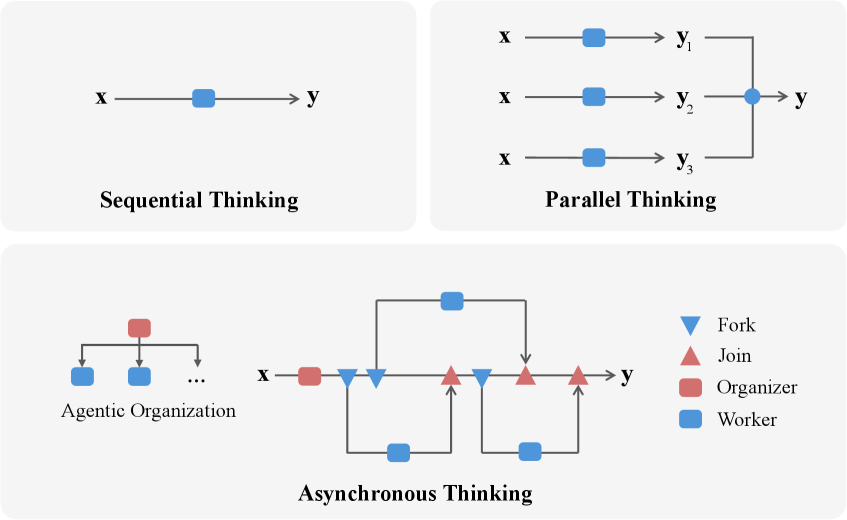
Microsoft Research introduces asynchronous thinking (AsyncThink), a new reasoning paradigm where language models learn to organize their internal thinking into concurrently executable structures through an organizer-worker protocol, achieving 28% lower inference latency than parallel thinking while improving accuracy on mathematical reasoning and demonstrating zero-shot generalization to unseen tasks.
RL Enhances Knowledge Navigation
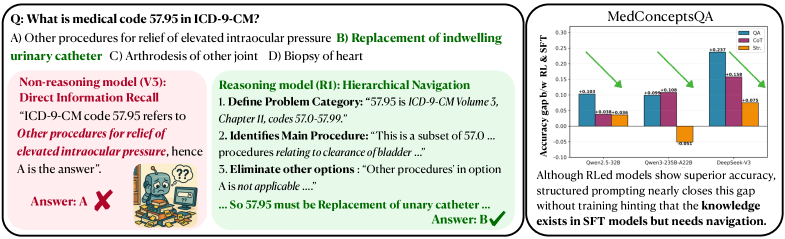
Researchers show that RL-enhanced models outperform base models by 24pp on hierarchical knowledge retrieval tasks (e.g., medical codes) by improving navigation of existing knowledge structures rather than acquiring new facts. Structured prompting reduces this gap to 7pp, while layer-wise analysis reveals that RL transforms query processing (cosine similarity drops to 0.65-0.73) while preserving factual representations (0.85-0.92). The findings suggest RL’s benefits stem from enhanced procedural skills in traversing parametric knowledge hierarchies rather than expanded knowledge content.
RLAC: Adversarial Critic for RL Post-Training
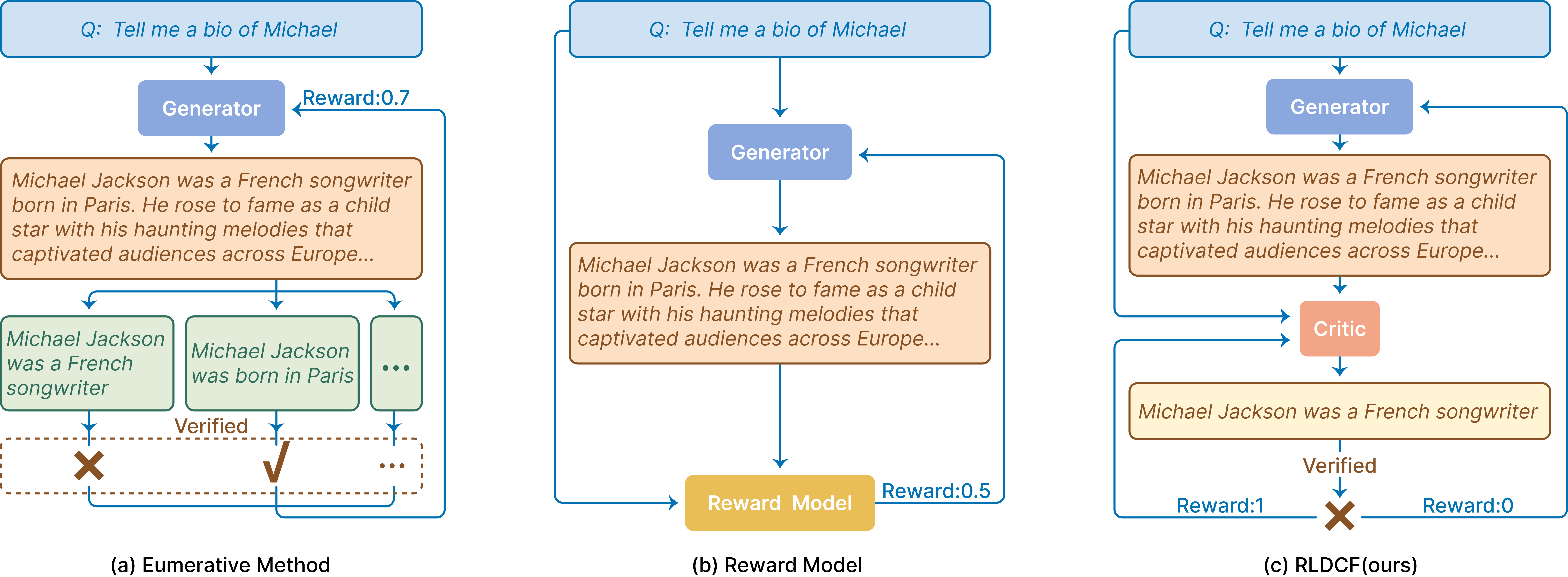
UC Berkeley and CMU researchers introduce RLAC, an RL post-training approach using a learned critic that dynamically identifies likely failure modes (e.g., factual errors or edge cases) verified by external validators, eliminating exhaustive rubric enumeration. On biography generation, RLAC achieves 0.889 FactScore (vs 0.867 for FactTune-FS) while reducing verification calls by 5.7×, and on code generation reaches 56.6 average score using only 9% of training data. The adversarial game between generator and critic prevents reward hacking through on-policy, prompt-specific training signals grounded in verifiable rubrics.
Scaling Agent RL via Experience Synthesis
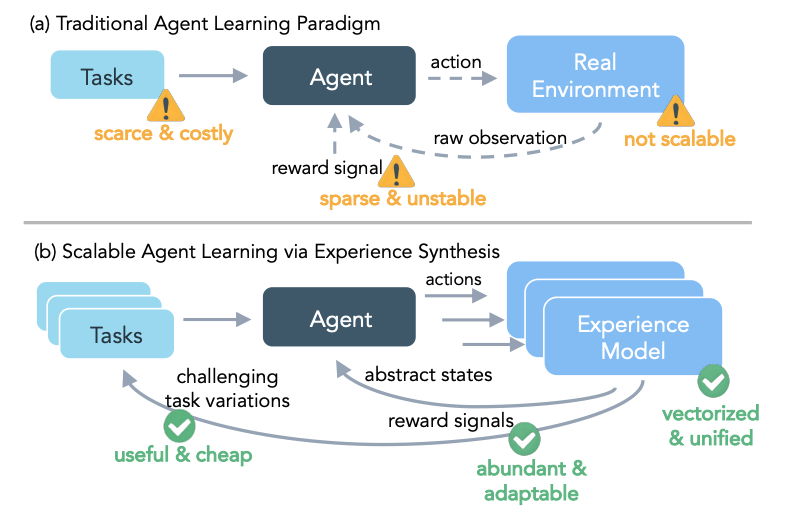
Meta researchers introduce DreamGym, a unified framework that synthesizes diverse training experiences to enable scalable reinforcement learning for LLM agents without costly real-environment rollouts. It addresses fundamental barriers of expensive interactions, limited task diversity, unreliable rewards, and infrastructure complexity.
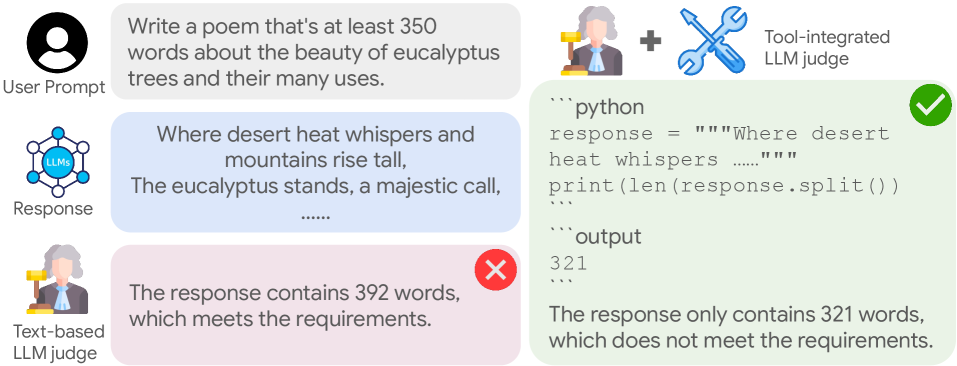
TIR-Judge
Google and collaborators introduce TIR-Judge, an end-to-end reinforcement learning framework that trains LLM judges to integrate code execution for precise evaluation. It surpasses reasoning-only judges by up to 6.4% (pointwise) and 7.7% (pairwise) while demonstrating that tool-augmented judges can self-evolve without distillation.
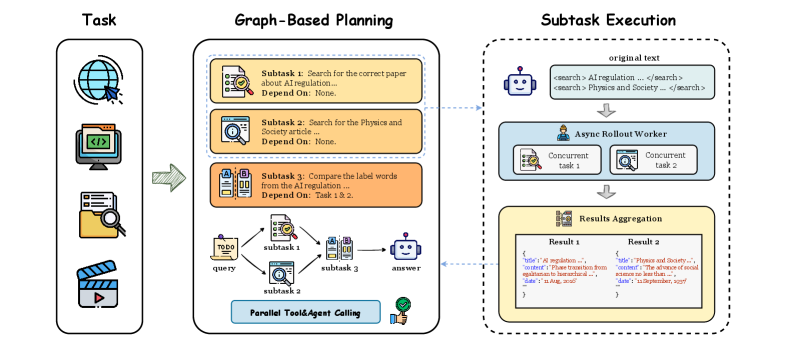
GAP
GAP introduces graph-based agent planning with parallel tool execution and reinforcement learning, enabling AI agents to coordinate multiple specialized capabilities simultaneously rather than sequentially. The framework significantly accelerates task completion and improves success rates on complex multi-step problems through optimized tool selection and execution ordering.
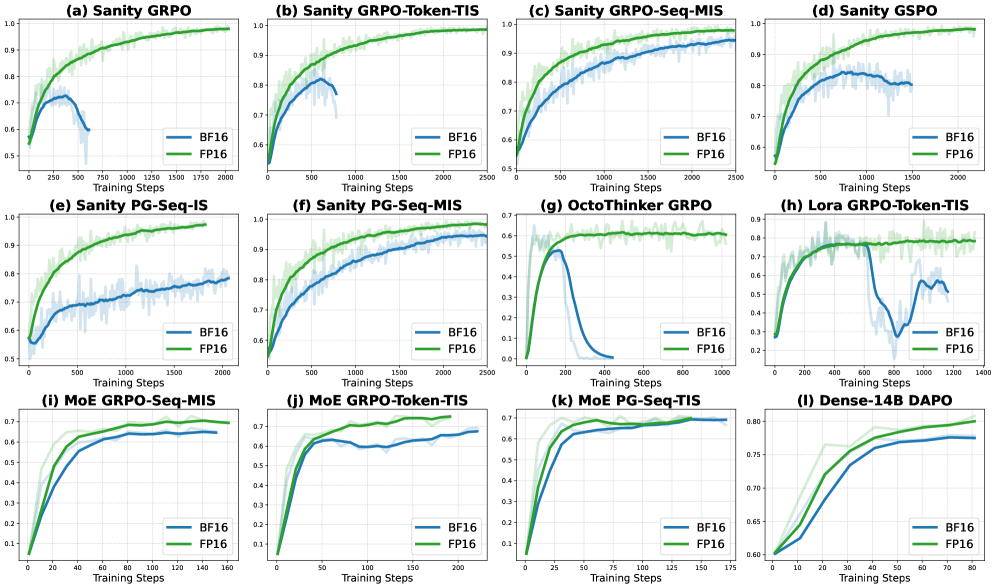
Precision-RL
Reinforcement learning fine-tuning of LLMs suffers from a critical numerical mismatch between training and inference engines, causing training instability and collapse. This work reveals that simply switching from BF16 to FP16 precision virtually eliminates this mismatch - achieving faster convergence, higher stability, and superior performance across diverse models, frameworks, and algorithms without any algorithmic changes or architectural modifications.
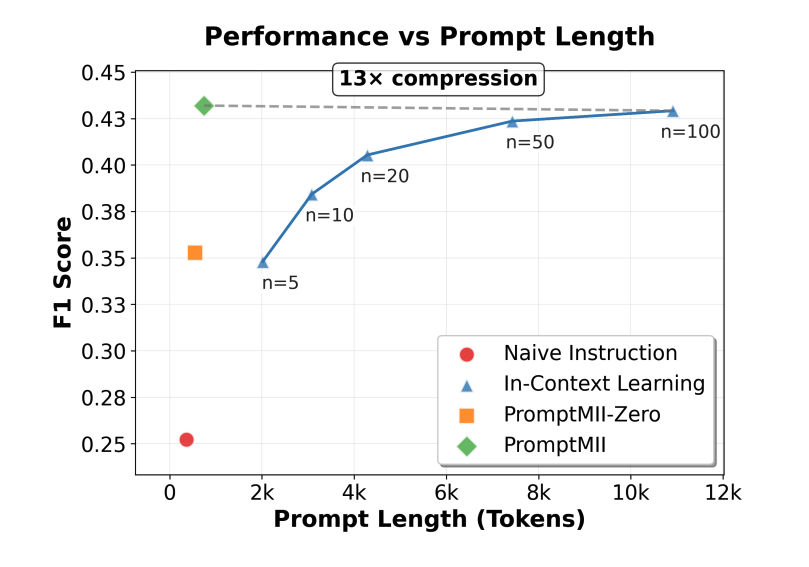
Prompt-MII
CMU researchers propose Prompt-MII, an RL framework that meta-learns instruction induction across 3,000+ HuggingFace datasets, achieving 4-9 F1 point improvements on 90 unseen tasks while requiring 3-13x fewer tokens than in-context learning. Unlike APE (2000 LLM calls) and GEPA (150 calls), it generates compact instructions in a single forward pass and is training-free at test time.
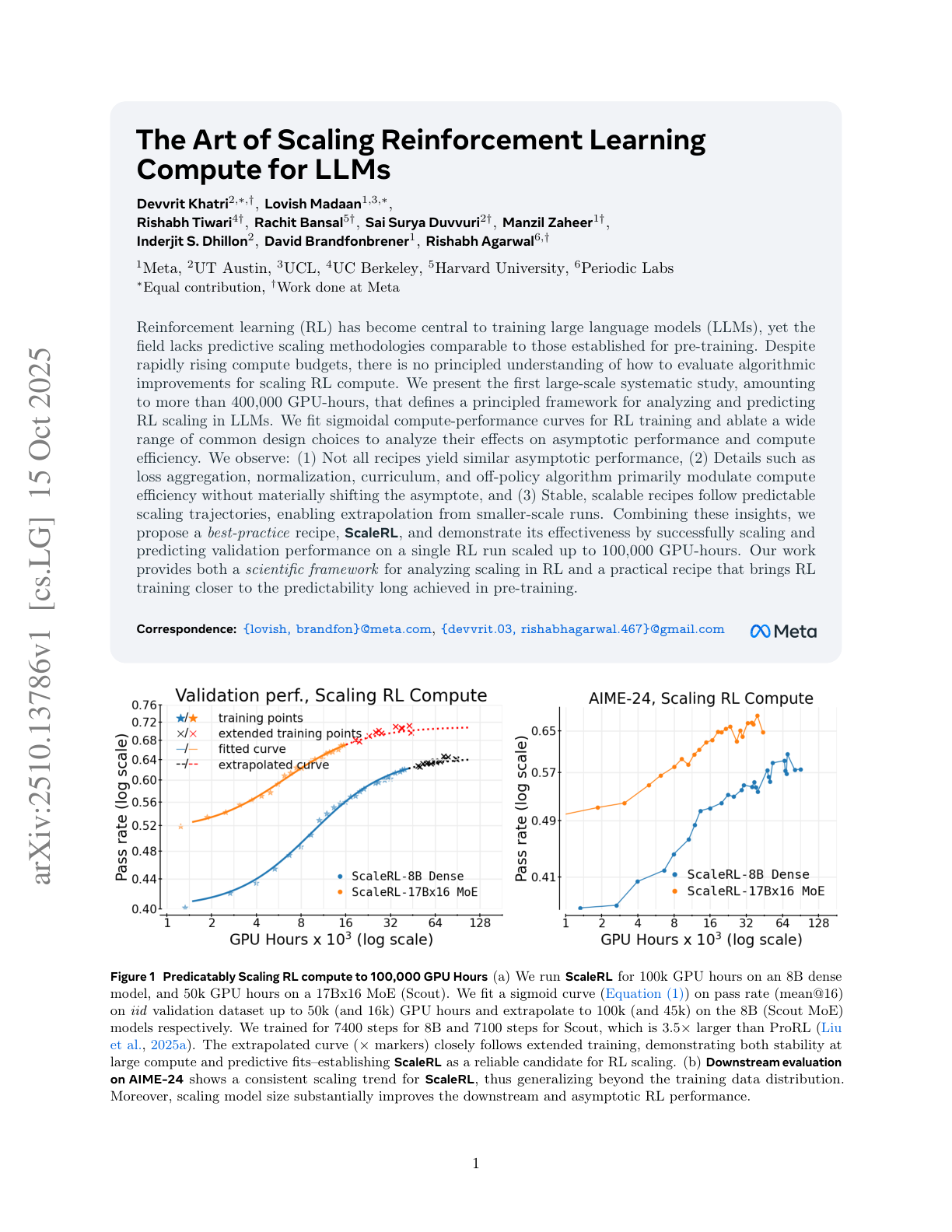
The Art of Scaling RL Compute for LLMs
A 400k+ GPU-hour study introduces a simple, predictive way to scale RL for LLMs. The authors fit a sigmoidal compute→performance curve that lets you extrapolate from small runs and propose ScaleRL, a stable recipe validated up to 100k GPU-hours on an 8B dense model and a 17B×16 MoE.
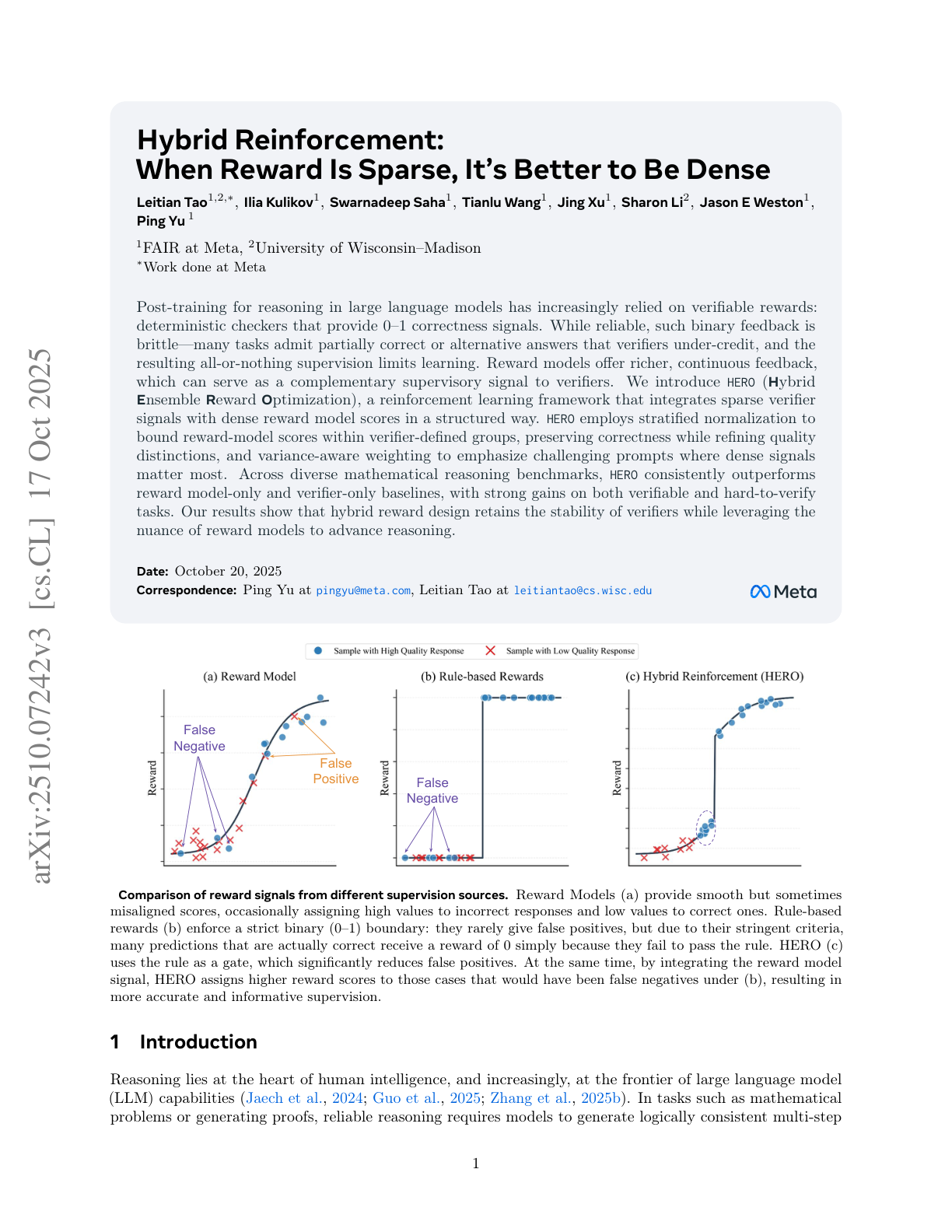
Hybrid Reinforcement
HERO (Hybrid Ensemble Reward Optimization) is a reinforcement learning framework that combines binary verifier feedback with continuous reward-model signals to improve LLM reasoning. By using stratified normalization and variance-aware weighting, HERO balances correctness and nuance, outperforming verifier-only and RM-only methods on diverse math reasoning benchmarks and enhancing performance on both verifiable and ambiguous tasks.
Webscale-RL
Webscale-RL introduces a scalable data pipeline that transforms web-scale pretraining text into over 1.2M diverse, verifiable QA pairs for reinforcement learning across 9+ domains. Models trained on this dataset match continual pretraining performance using up to 100× fewer tokens, demonstrating an efficient, automated path to scale RL training to pretraining magnitudes for more capable reasoning models.
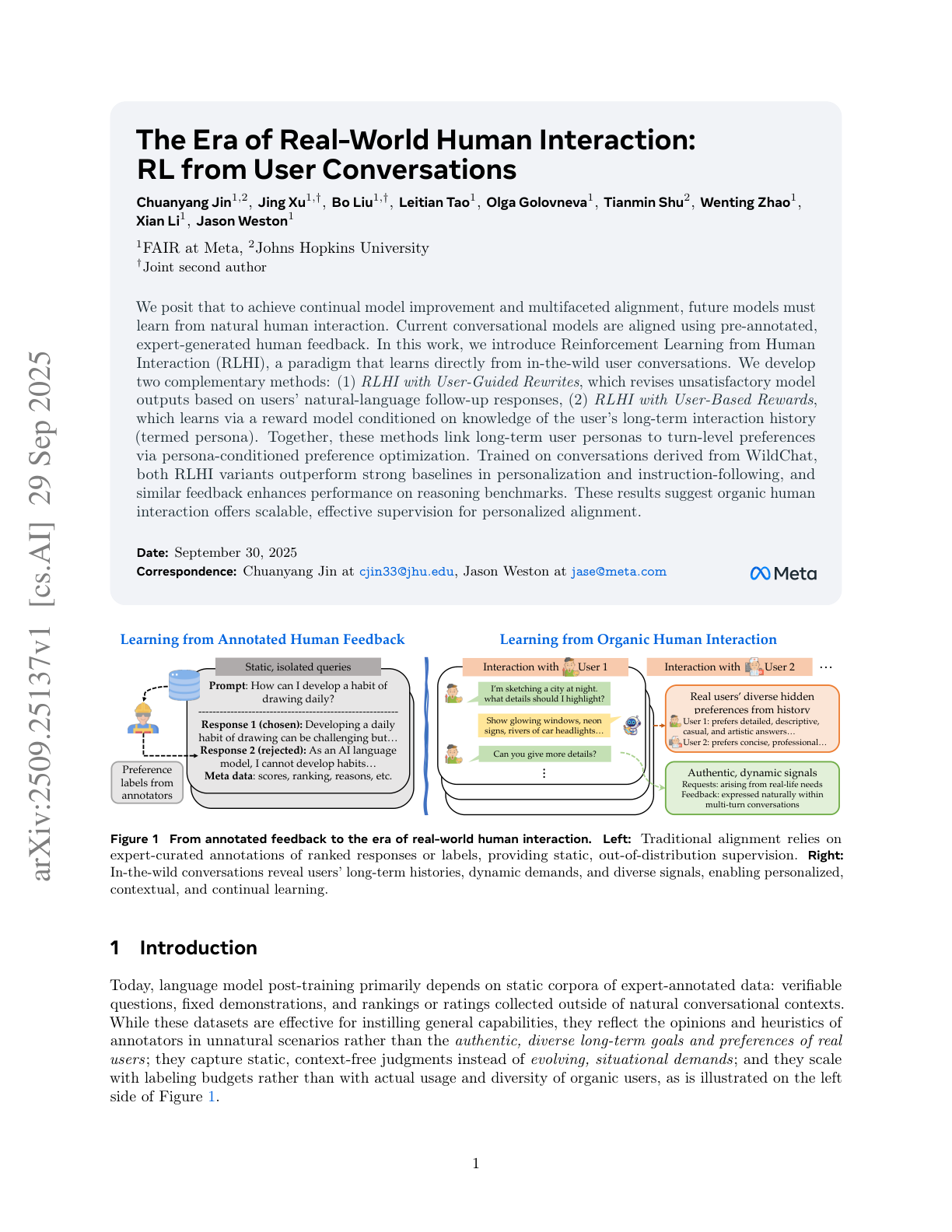
The Era of Real-World Human Interaction
This work presents a post-training recipe that learns directly from real user conversations instead of static annotator labels. RLHI combines user-guided rewrites (using follow-ups as corrections) with persona-based rewards (ranking sampled candidates via a persona-conditioned reward model). Trained on WildChat conversations, it shows strong improvements in personalization, instruction following, and even transfers to reasoning tasks.
DeepSearch
DeepSearch integrates Monte Carlo Tree Search directly into RL with verifiable rewards, but during training rather than only at inference. The result is broader exploration, better credit assignment, and higher sample efficiency on math reasoning vs strong 1.5B baselines.
Language Models that Think, Chat Better
A simple recipe, RL with Model-rewarded Thinking, makes small open models “plan first, answer second” on regular chat prompts and trains them with online RL against a preference reward. On Llama-3.1-8B and Qwen-2.5-7B, this consistently beats standard RLHF on chat, creative writing, and general knowledge, with the best 8B model topping some frontier systems on WildBench and AlpacaEval2.
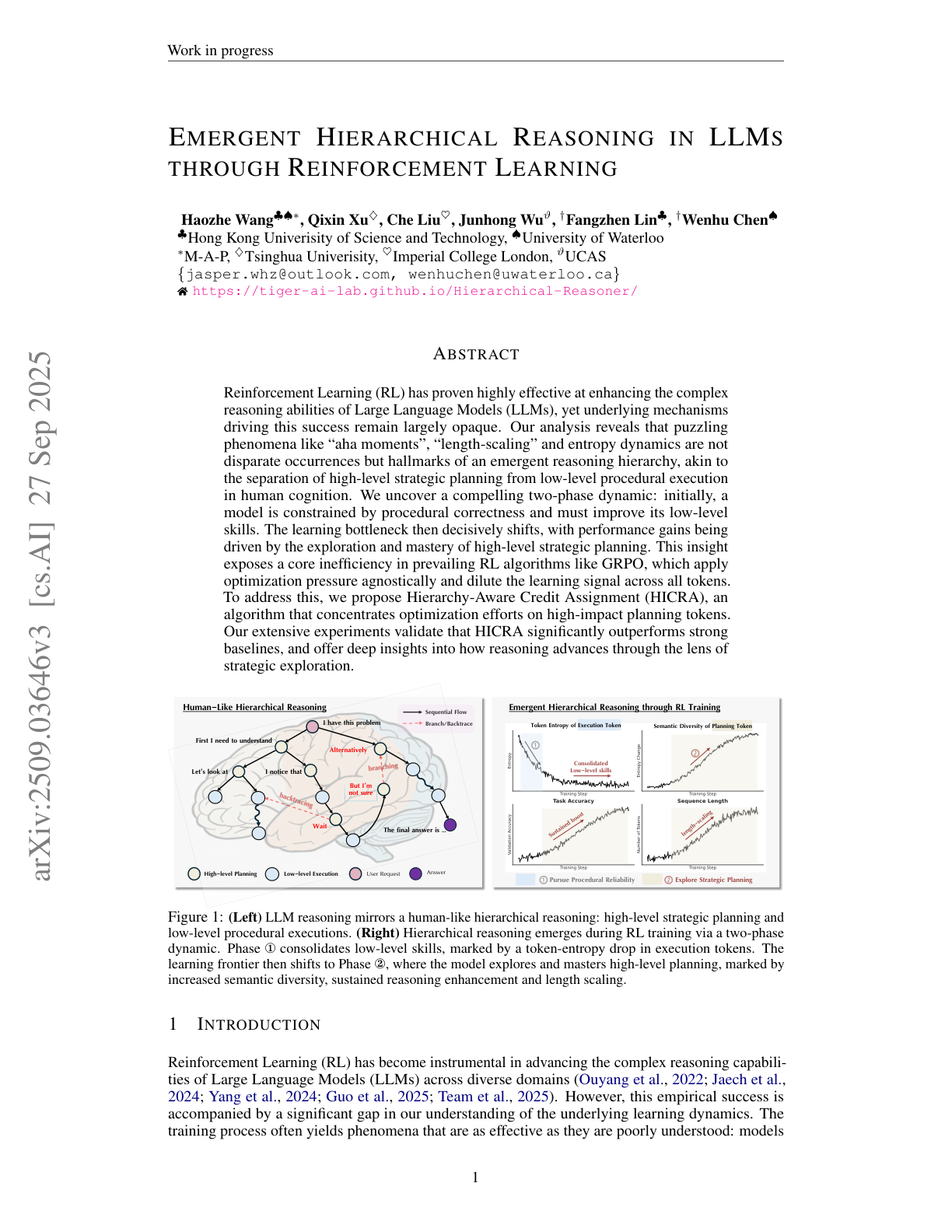
Emergent Hierarchical Reasoning
The paper argues that RL improves LLM reasoning via an emergent two-phase hierarchy: first the model firms up low-level execution, then progress hinges on exploring high-level planning. Building on this, the authors propose HICRA, which boosts credit on strategic planning tokens, and show consistent gains over GRPO. They also propose semantic entropy as a better exploration signal than token-level entropy.
ACE-RL
A reinforcement-learning framework that replaces coarse, preference-pair rewards with instruction-specific, verifiable checklists. ACE-RL turns each long-form task into a set of explicit and implicit constraints, scores a model’s output by how well it satisfies them, and mixes this with a length-control reward during GRPO training. The result is stronger, more controllable long-form writing across domains and styles.
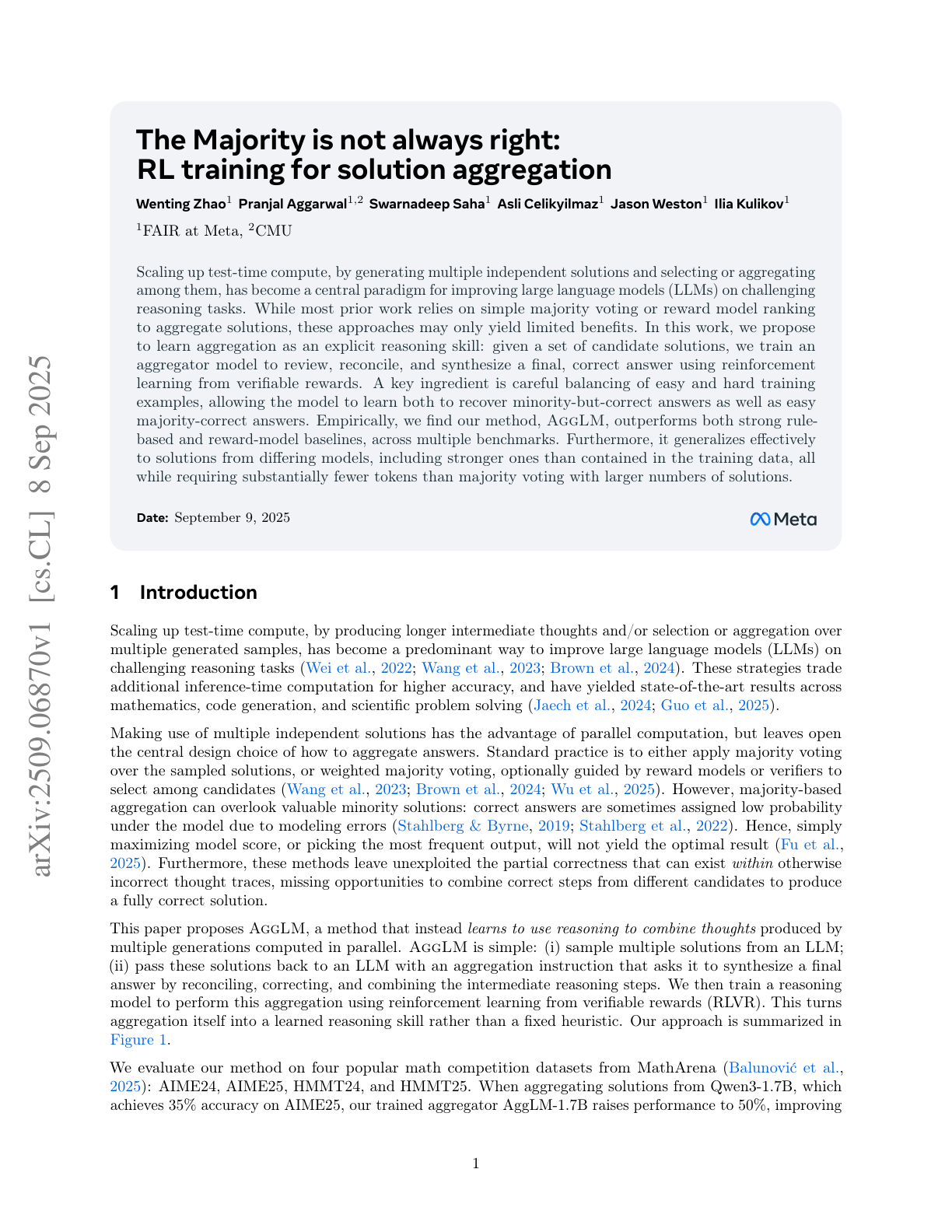
AggLM
AggLM introduces reinforcement learning to train LLMs in aggregating multiple candidate solutions, moving beyond majority voting and reward model ranking. It achieves higher accuracy, recovers minority-correct answers, generalizes across models, and uses fewer tokens than traditional aggregation methods.
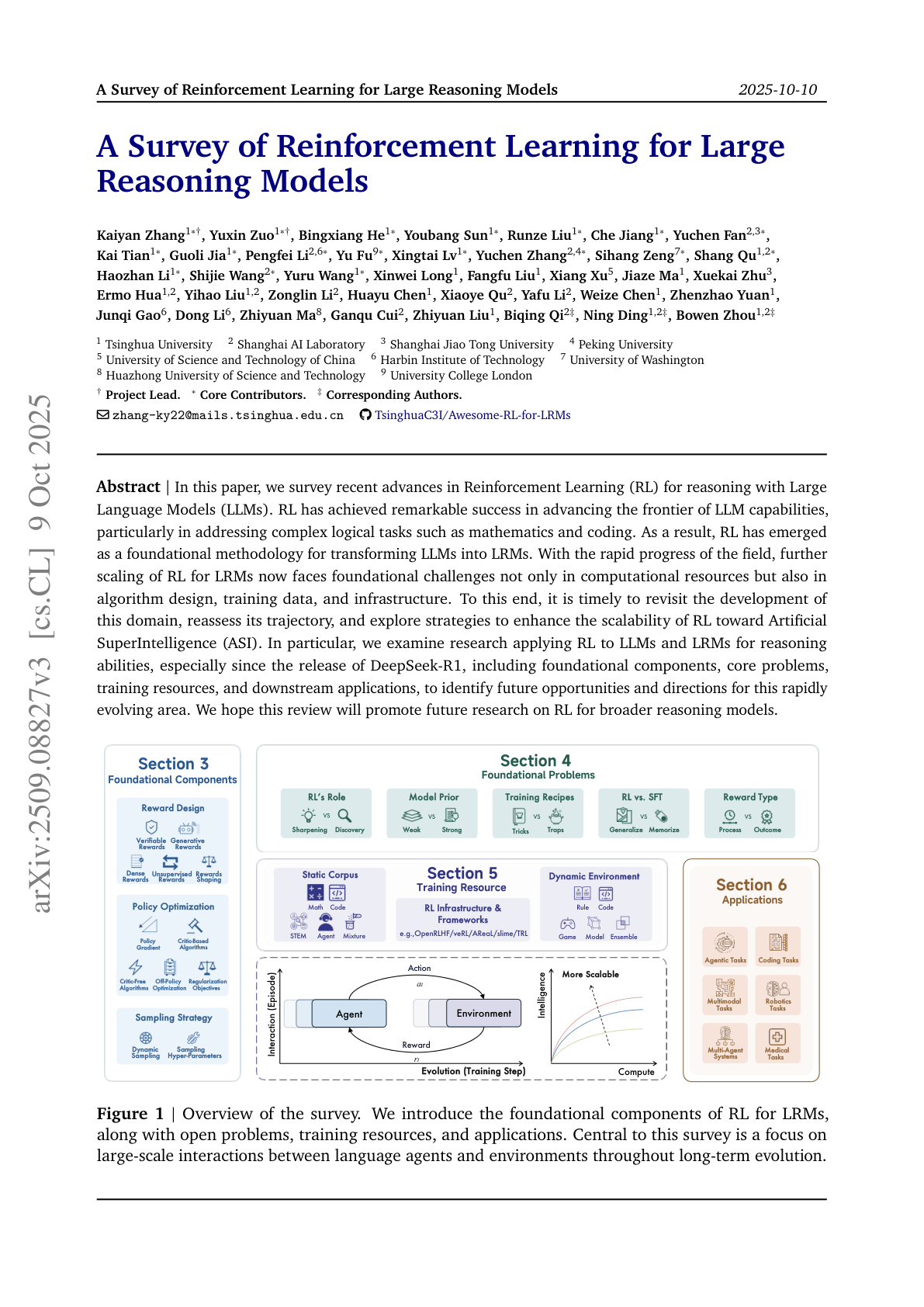
A Survey of RL for Large Reasoning Models
This survey reviews how reinforcement learning is driving advances in large reasoning models (LRMs), enabling stronger performance on complex tasks like math and coding. It highlights scaling challenges in computation, algorithms, data, and infrastructure, while mapping future directions toward Artificial Superintelligence (ASI).
Adaptive LLM Routing
A routing framework that learns online which model to call for each query while honoring a spend limit. It treats routing as a contextual bandit, initializes with human preference data, and adds an online cost policy that allocates budget across queries.
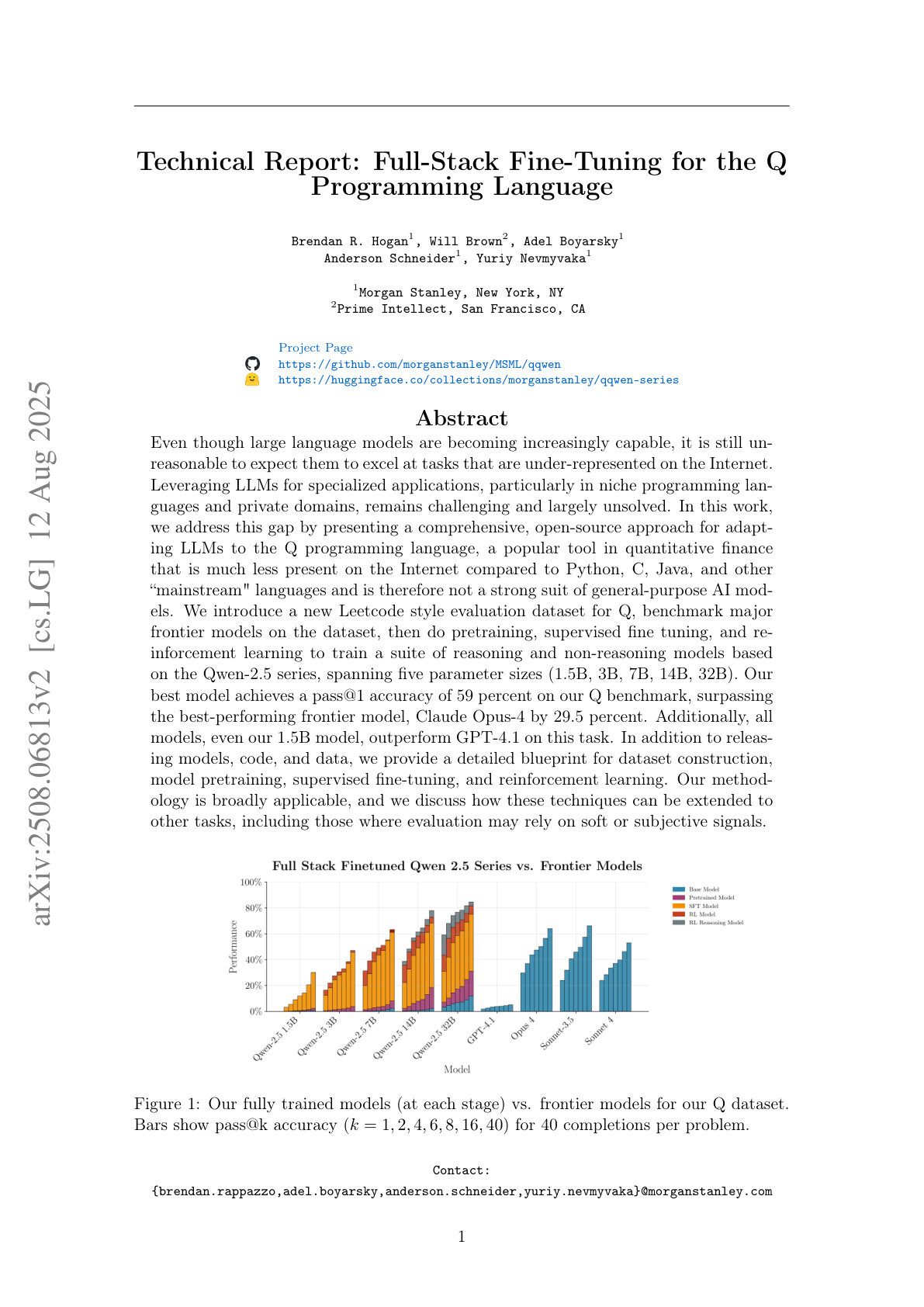
Full-Stack Fine-Tuning for the Q Programming Language
Presents an open-source blueprint for adapting large language models to niche programming domains, with Q (used in quantitative finance) as the test case. The team builds a benchmark, curates data, and trains Qwen-2.5 models with pretraining, supervised fine-tuning, and reinforcement learning. Their largest model surpasses Claude Opus-4 by nearly 30% on Q-LeetCode tasks, and even the smallest model beats GPT-4.1.