AI Papers of the Week
Every paper worth reading in AI, hand-picked one week at a time.
Discover and explore top AI papers withClaude CodeCodex
npx @dair-ai/mcp setup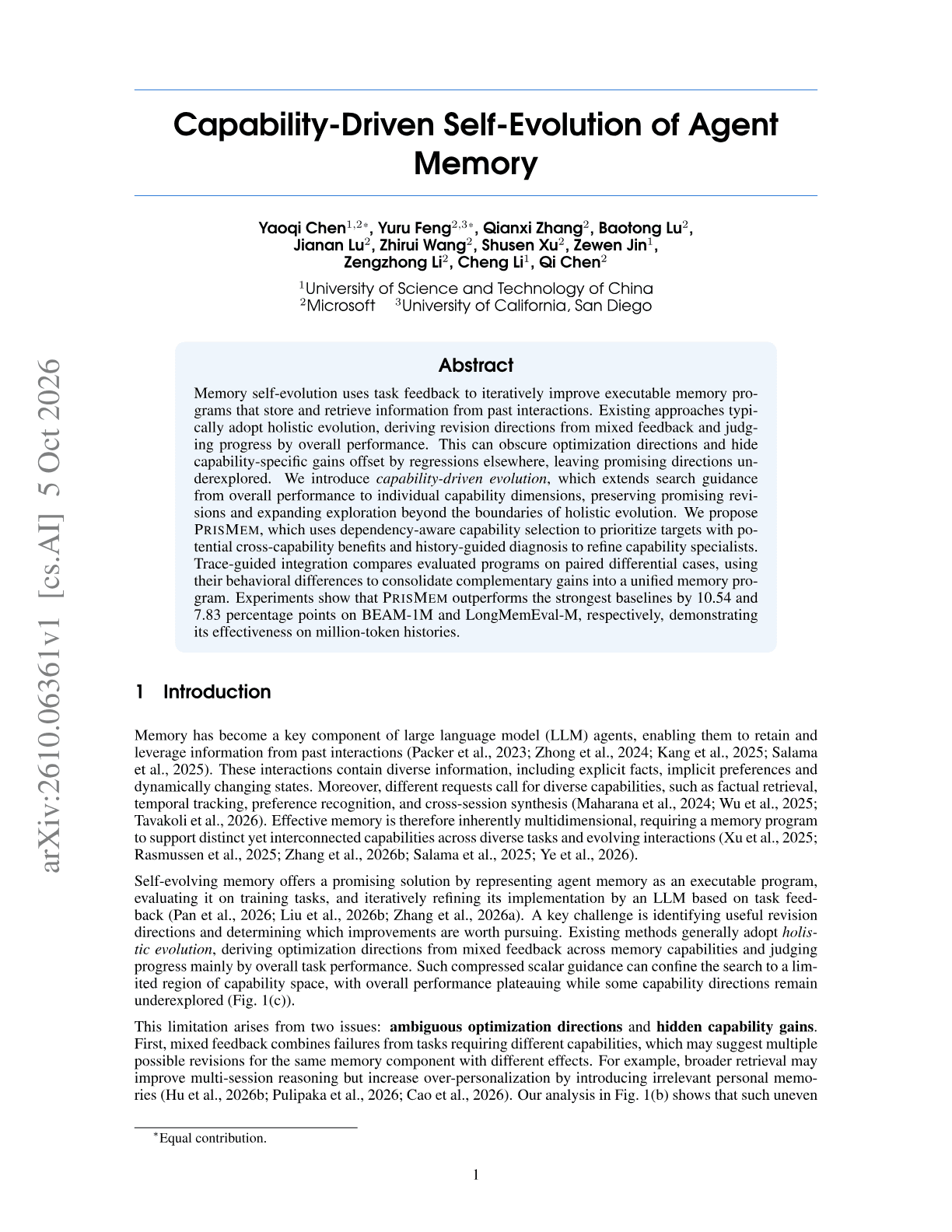
Capability-Driven Self-Evolution of Agent Memory
Yaoqi Chen, Yuru Feng, Qi Chen and colleagues at Microsoft with USTC and UCSD introduce PrisMem, which evolves an executable agent-memory program by tracking progress on individual memory capabilities rather than only on the overall score.
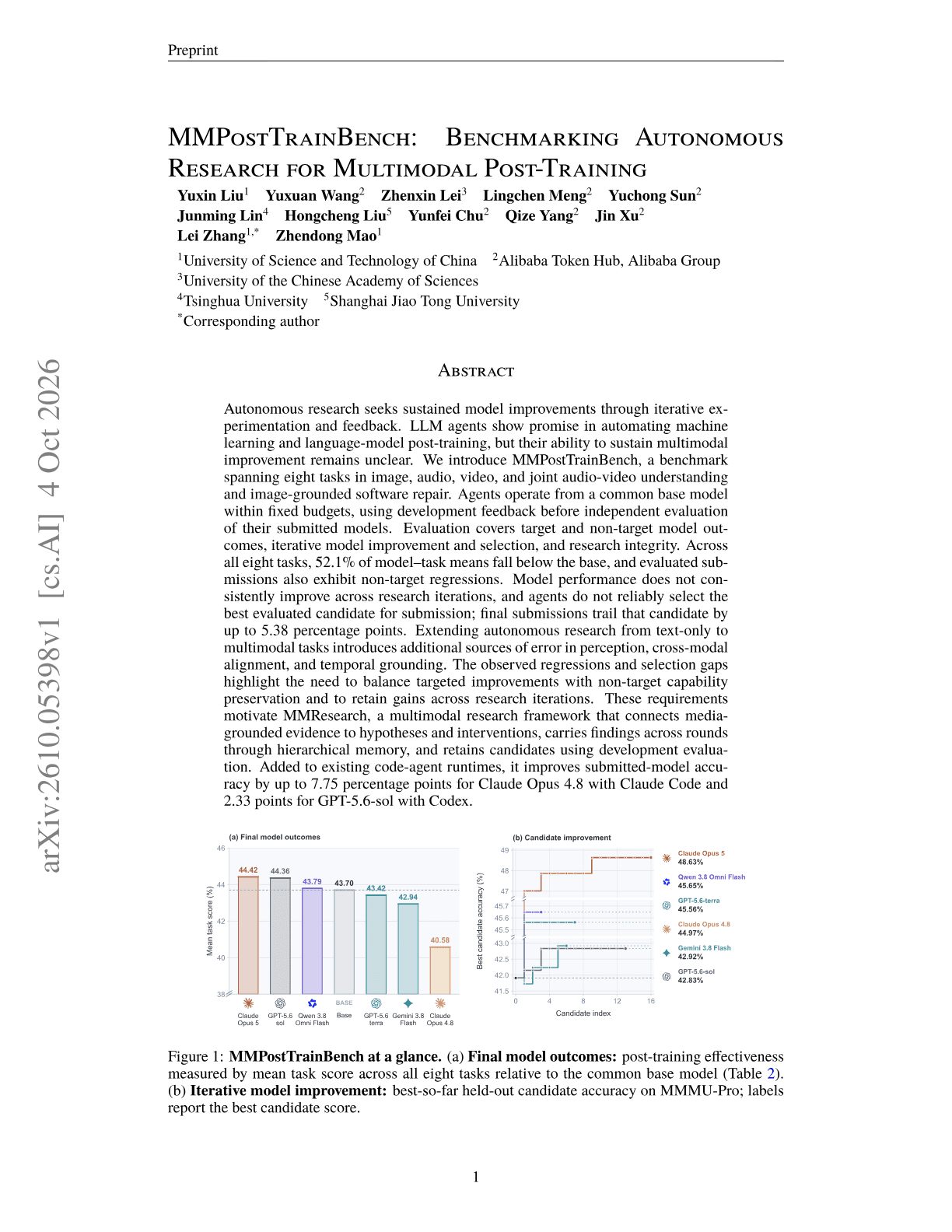
MMPostTrainBench: Benchmarking Autonomous Research for Multimodal Post-Training
Yuxin Liu, Zhendong Mao (USTC) and colleagues at Alibaba Group, Tsinghua and SJTU introduce MMPostTrainBench, which tests whether research agents can improve a multimodal model through post-training within a fixed budget, and propose the MMResearch framework to reduce the failures it finds.
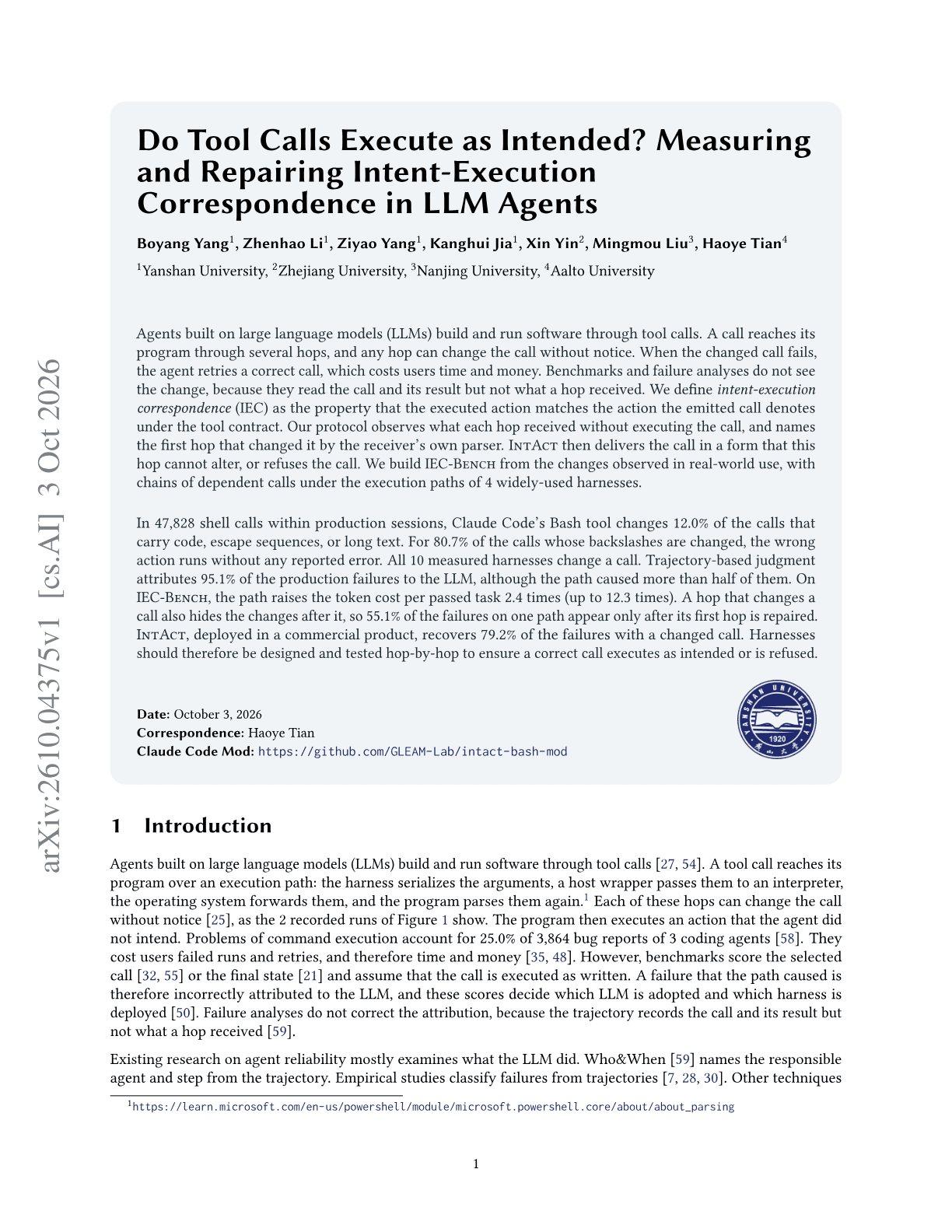
Do Tool Calls Execute as Intended? Measuring and Repairing Intent-Execution Correspondence in LLM Agents
Boyang Yang, Haoye Tian (Aalto) and colleagues at Yanshan, Zhejiang and Nanjing universities define intent-execution correspondence, the property that the command a tool call denotes is the command that actually runs, and measure how often agent harnesses break it.
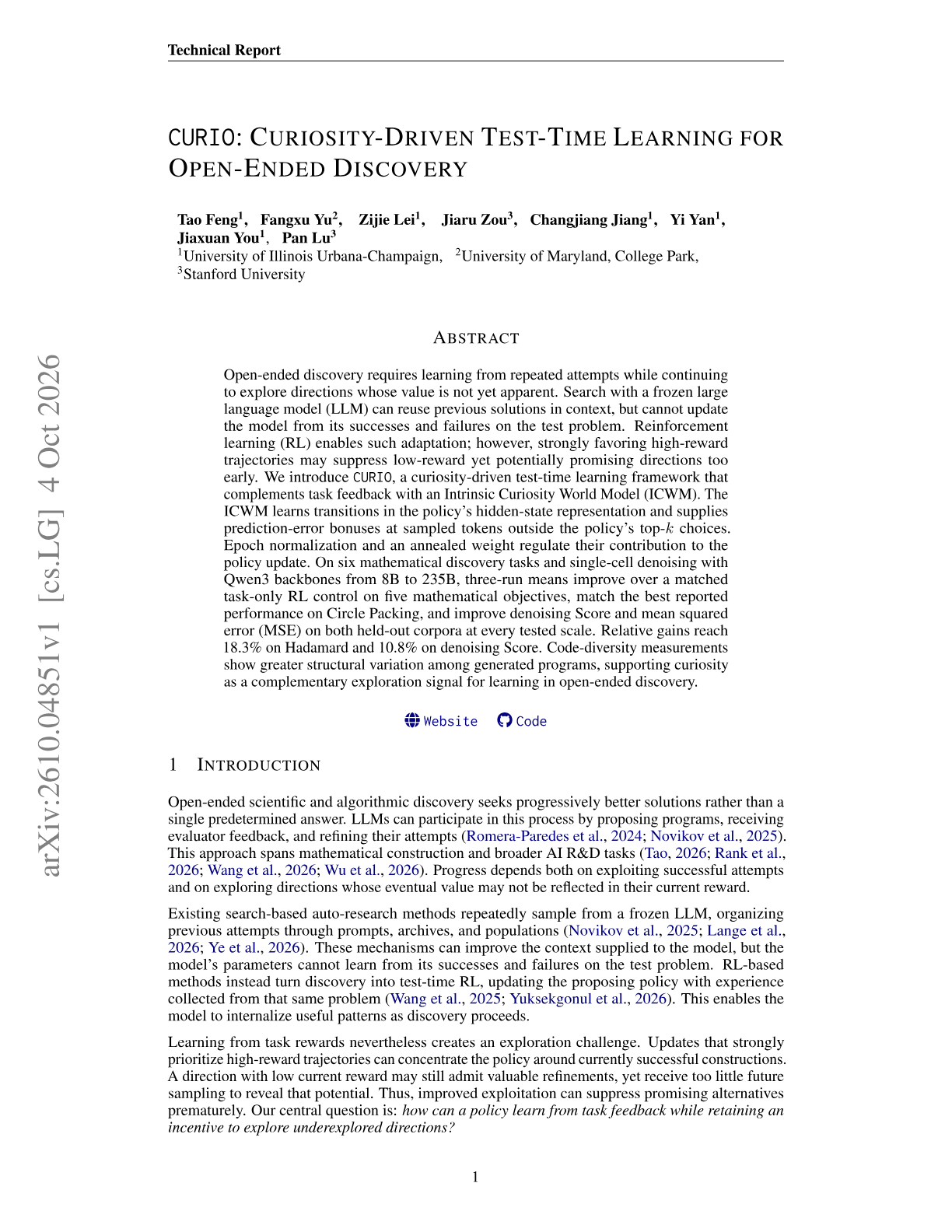
CURIO: Curiosity-Driven Test-Time Learning for Open-Ended Discovery
Tao Feng, Jiaxuan You (UIUC), Fangxu Yu (UMD), Pan Lu (Stanford) and colleagues introduce CURIO, a test-time RL method for open-ended discovery that adds a curiosity bonus so the policy keeps exploring directions that score low early.
DUET: Co-Evolving Solver and Grader Agents
Fengyu Gao (University of Virginia, Microsoft intern), Sourav Pal, Austin Z. Henley, Arjun Radhakrishna and Gustavo Soares at Microsoft introduce DUET, which optimizes a solver agent and the grader agent that scores it in alternating rounds, so the evaluator changes as the agent's failure modes change.
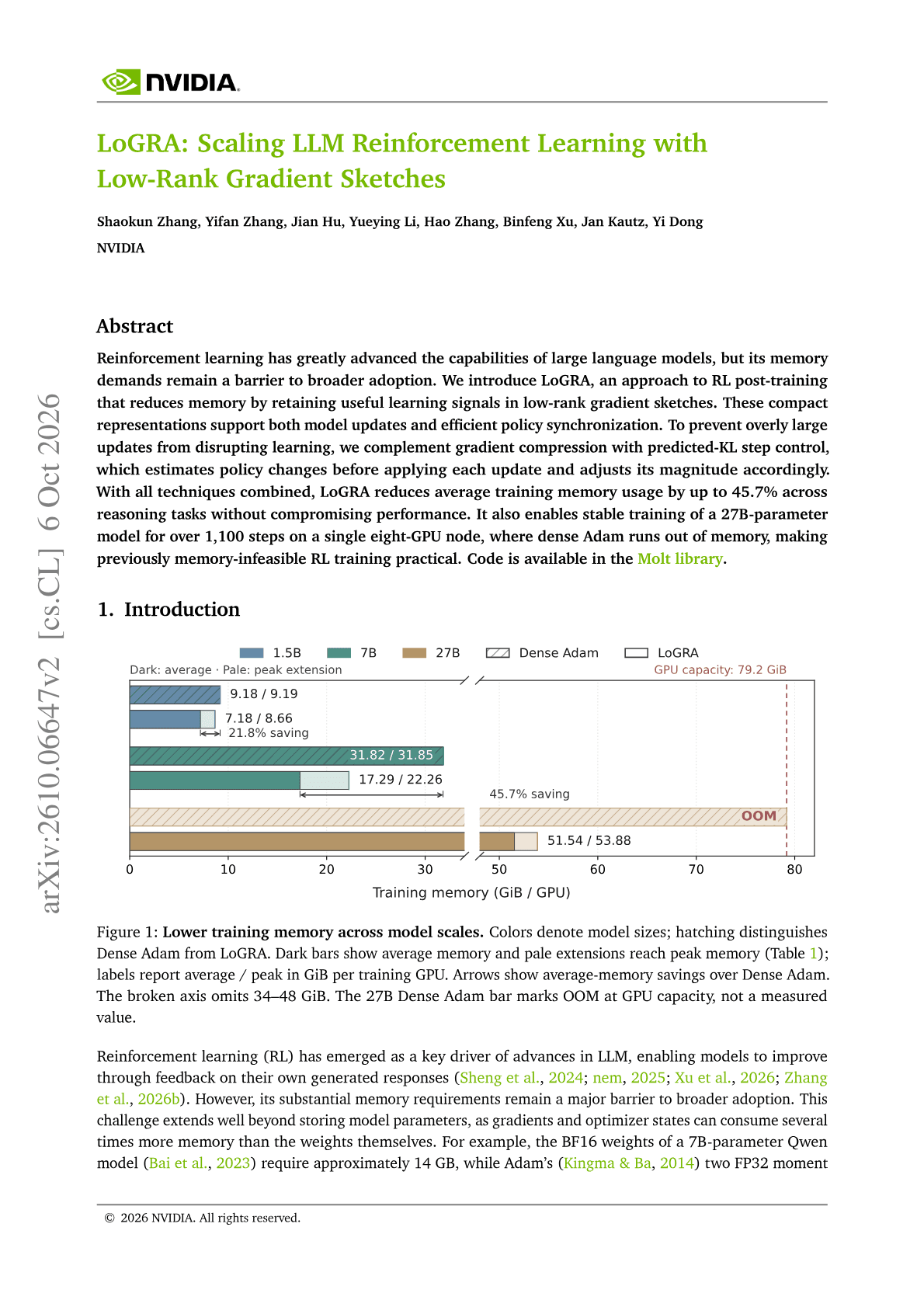
LoGRA: Scaling LLM Reinforcement Learning with Low-Rank Gradient Sketches
NVIDIA researchers present LoGRA, an RL post-training method that updates all of a model's weights while using less memory than LoRA, by compressing each weight gradient into a low-rank sketch that is redrawn every step and adding predicted-KL step control to keep updates within a budget. At 1.5B it averages 7.2 GiB of training memory against 13.2 GiB for rank-256 LoRA with similar Pass@4, and at 7B it cuts average training memory per GPU by 45.7% with peak accuracy close to dense Adam. It also trains a 27B model for more than 1,100 steps on a single eight-GPU node, where dense Adam runs out of memory.
Topology-Conditioned Backdoors: Language Models That Insert Vulnerabilities When They Infer They Are in a Multi-Agent System
Keegan Wang (Carnegie Mellon, Prosaic Intelligence) and Anantika Mannby (USC, Prosaic Intelligence) fine-tune Qwen2.5-7B-Instruct into a model organism that writes vulnerable code only when its prompt suggests it is running inside a multi-agent system.
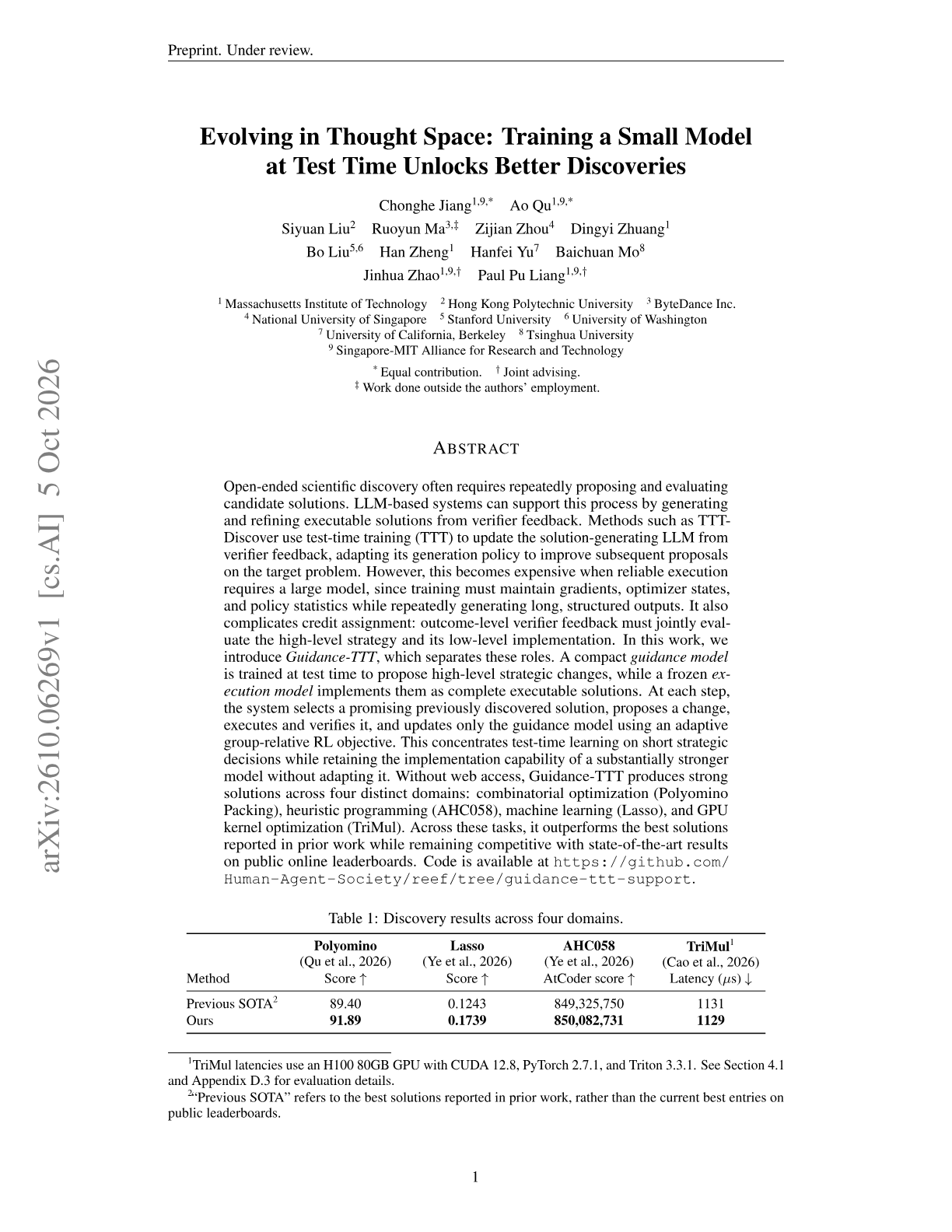
Evolving in Thought Space: Training a Small Model at Test Time Unlocks Better Discoveries
Chonghe Jiang, Ao Qu, Jinhua Zhao, Paul Pu Liang and colleagues (MIT, with Stanford, ByteDance, NUS and others) propose Guidance-TTT, which trains only a small guidance model at test time to propose strategy changes while a larger frozen model writes the executable solutions.
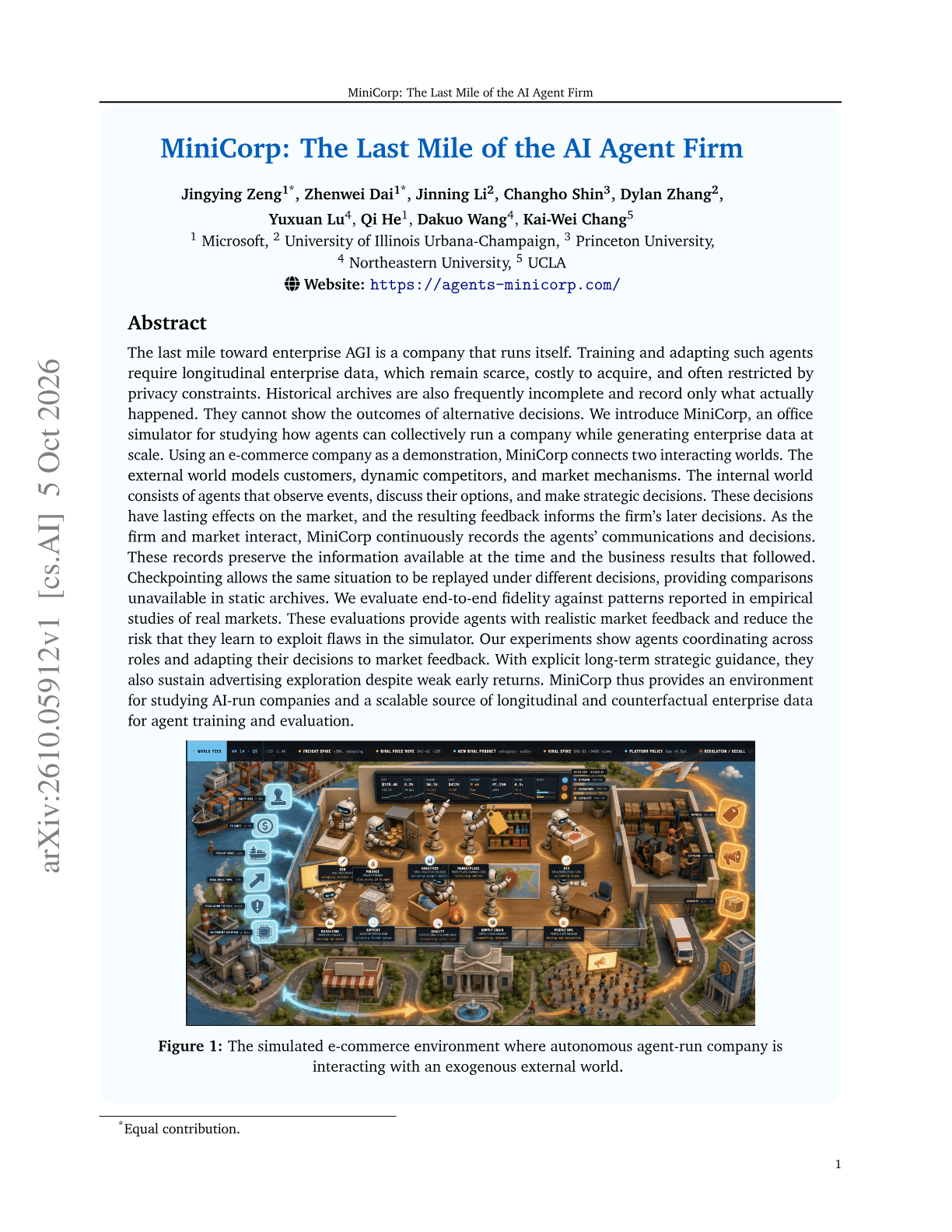
MiniCorp: The Last Mile of the AI Agent Firm
Jingying Zeng, Kai-Wei Chang, Dakuo Wang and colleagues (Microsoft, UIUC, Princeton, Northeastern, UCLA) build MiniCorp, a closed-loop office simulator where an agent-run e-commerce firm competes in a simulated market, as a source of longitudinal and counterfactual enterprise data for training agents.
Mining Agent Skills from Production Traces
Yue Ran Kang and Colton Mikolajczyk (MIT) with Chhaya Methani, Hazel Mak and colleagues at Microsoft run a controlled study of how agent skills mined from execution traces depend on what evidence the miner sees and what form the skill takes.
MESH-Harness: Self-Improving Agent Harnesses via Bandit-Guided Compositional Evolution
Zhiwei Shang, Bryan Kian Hsiang Low (NUS), Chenglin Wu (DeepWisdom), Zhongxiang Dai (CUHK-Shenzhen) and colleagues propose MESH-Harness, which splits an agent harness into modules with fixed interfaces and searches over module combinations with a contextual bandit under a limited evaluation budget.
Can Agent Harnesses and Inference Engines Hear Each Other? The HEAR Protocol for Agentic LLM Serving
Jiaqi Zhao, Haodong Chen, Jitai Hao, Jun Yu and colleagues at Harbin Institute of Technology (Shenzhen) propose HEAR, a bidirectional protocol through which an agent harness tells the inference engine about workflow intent and the engine reports cache state and load back.
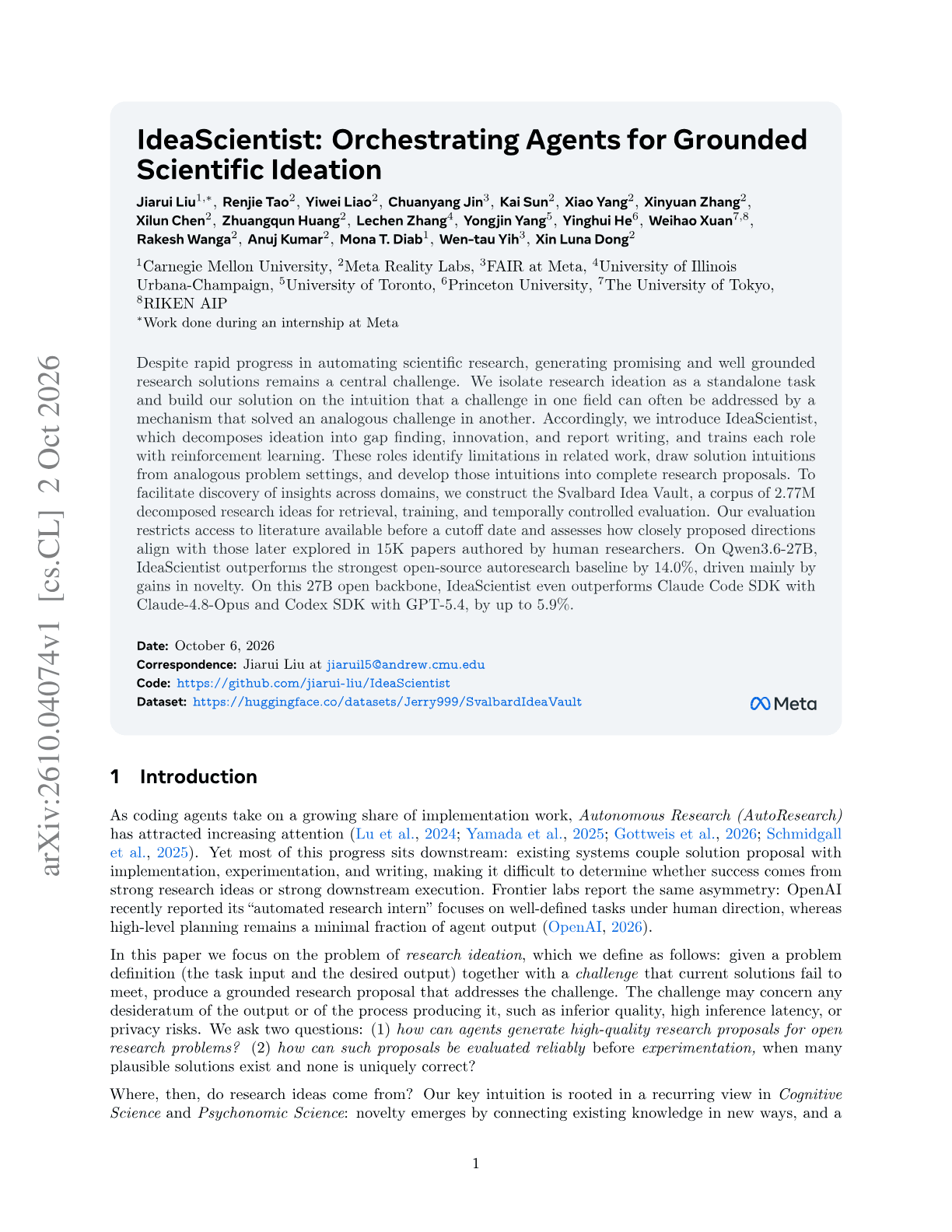
IdeaScientist: Orchestrating Agents for Grounded Scientific Ideation
Jiarui Liu (CMU, internship at Meta), Wen-tau Yih, Xin Luna Dong and colleagues at Meta Reality Labs introduce IdeaScientist, a three-role agent system trained with RL to generate research proposals by transferring mechanisms from analogous problems in other fields.
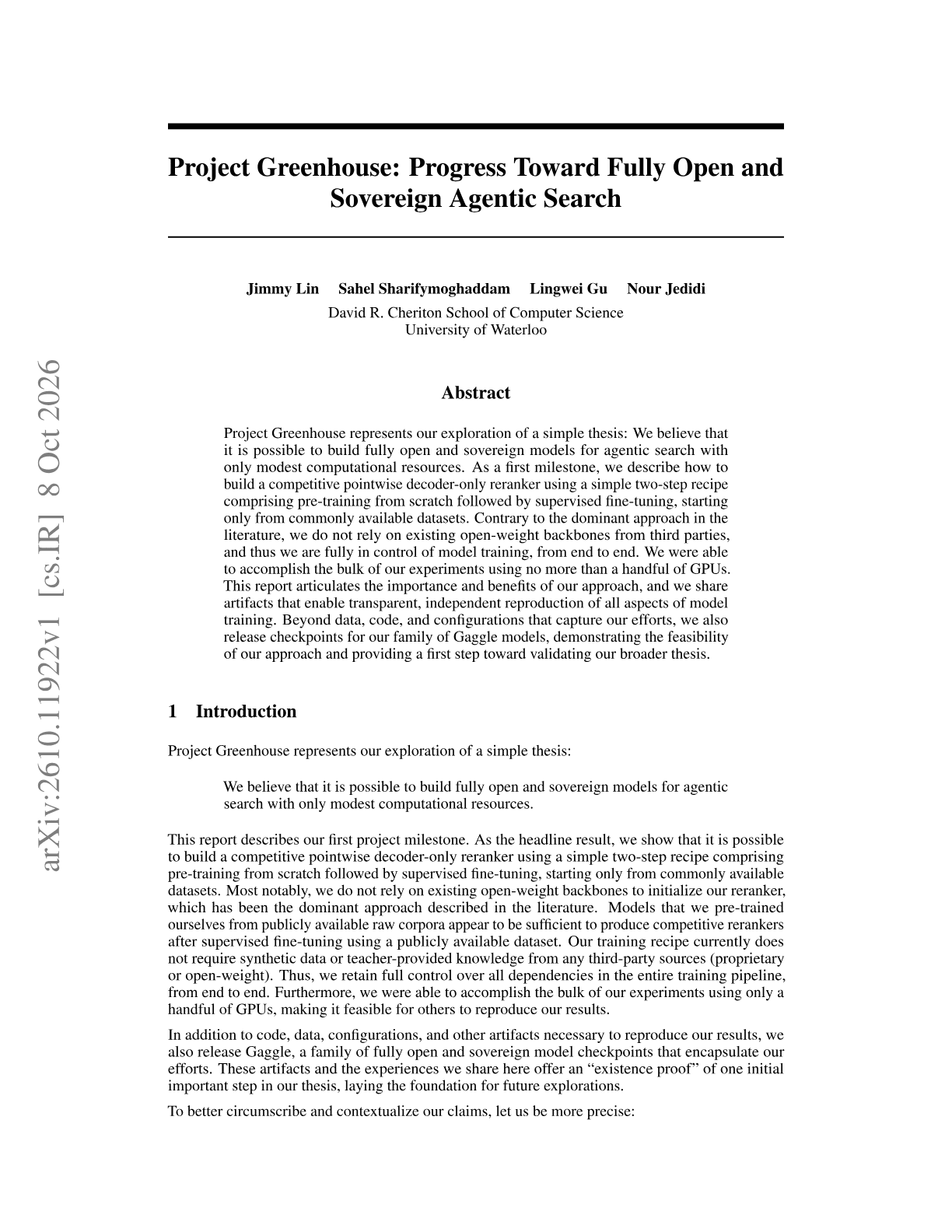
Project Greenhouse: Progress Toward Fully Open and Sovereign Agentic Search
Jimmy Lin and colleagues at the University of Waterloo describe Project Greenhouse, an effort to build fully open and sovereign models for agentic search on modest compute, starting with Gaggle, a pointwise decoder-only reranker pre-trained from scratch.
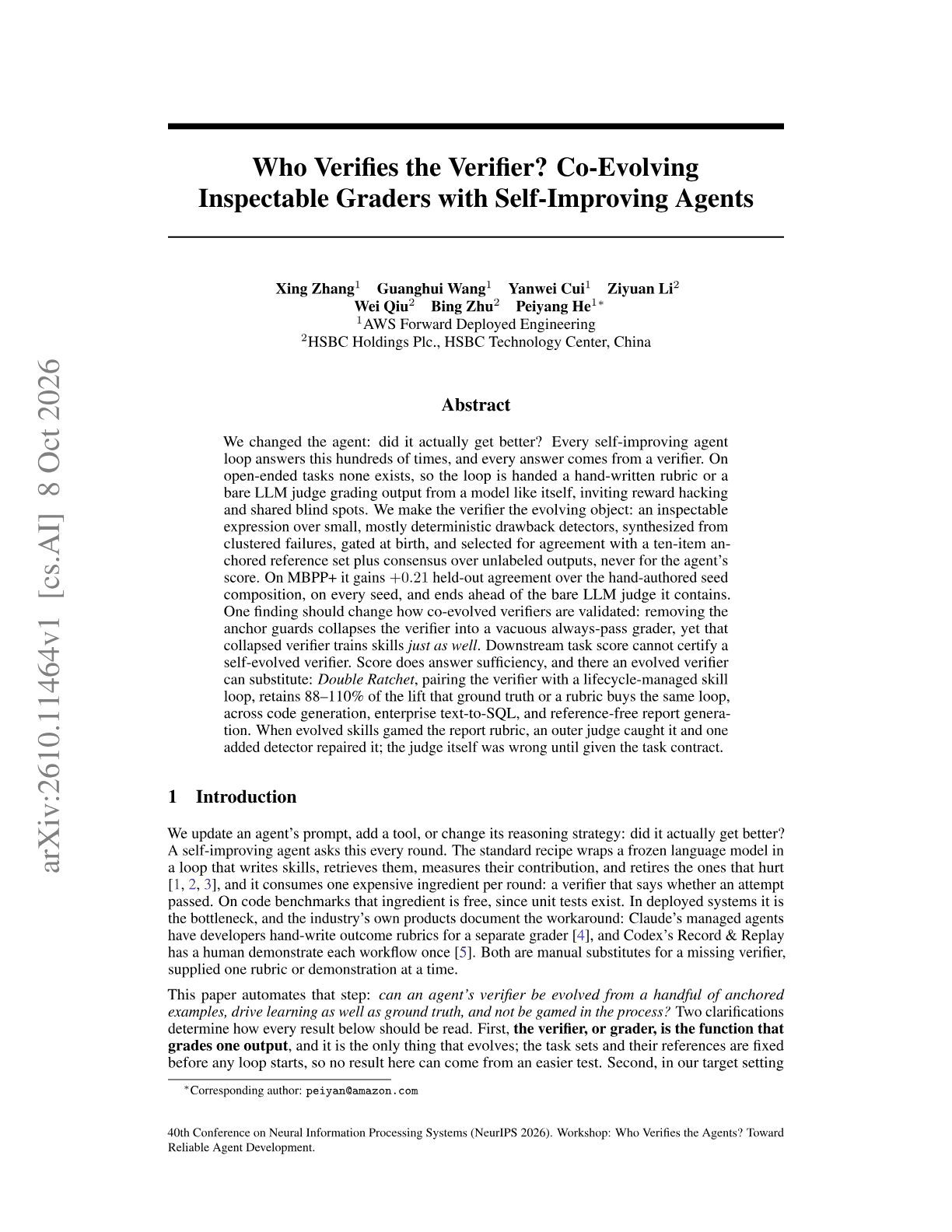
Who Verifies the Verifier? Co-Evolving Inspectable Graders with Self-Improving Agents
Xing Zhang, Peiyang He and colleagues at AWS Forward Deployed Engineering make the verifier itself the evolving object in a self-improving agent loop, building inspectable graders from small deterministic drawback detectors. Accepted at the NeurIPS 2026 workshop Who Verifies the Agents?
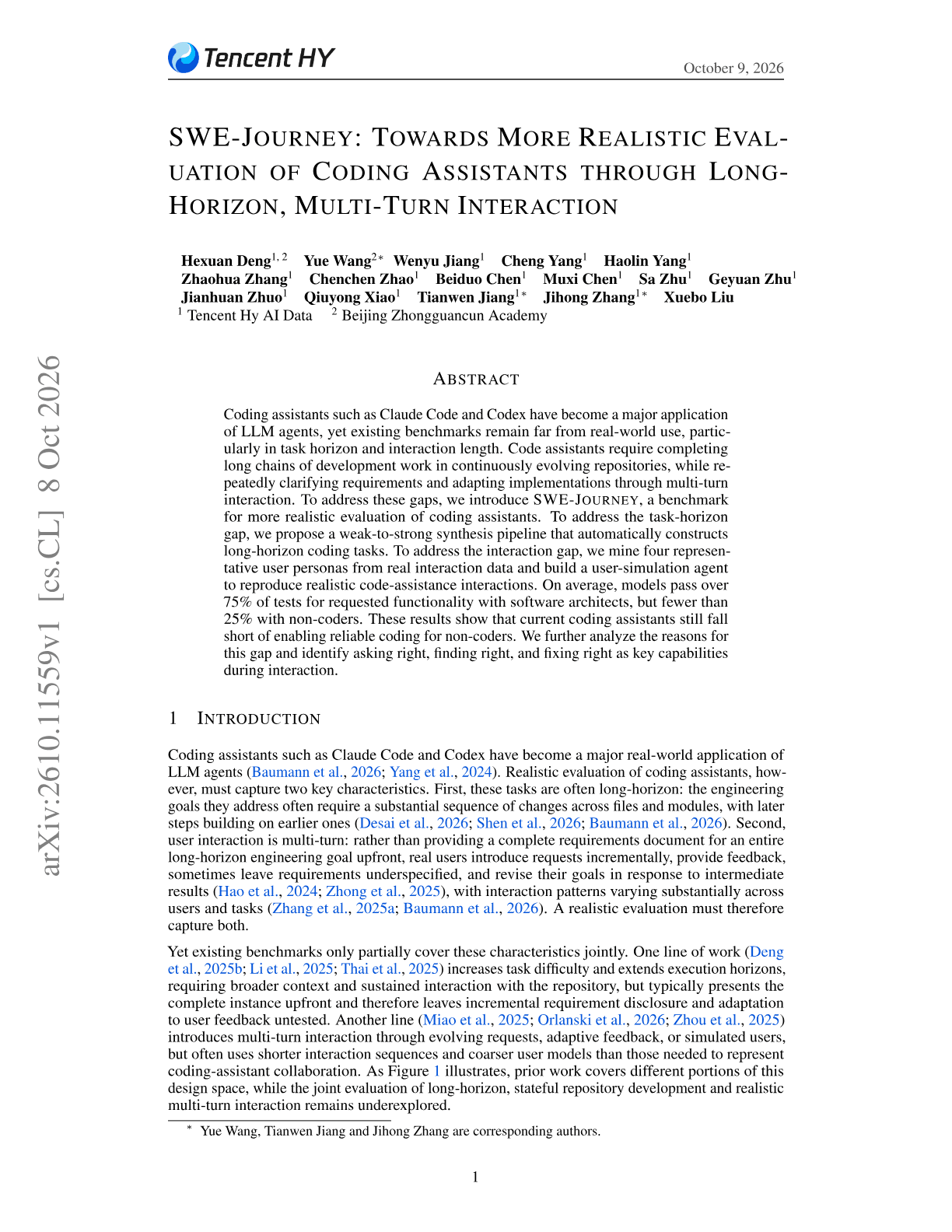
SWE-Journey: Towards More Realistic Evaluation of Coding Assistants through Long-Horizon, Multi-Turn Interaction
Hexuan Deng, Tianwen Jiang, Jihong Zhang and colleagues at Tencent Hy AI Data (with Beijing Zhongguancun Academy) introduce SWE-Journey, a benchmark that tests coding assistants on long development tasks with simulated users of different skill levels.
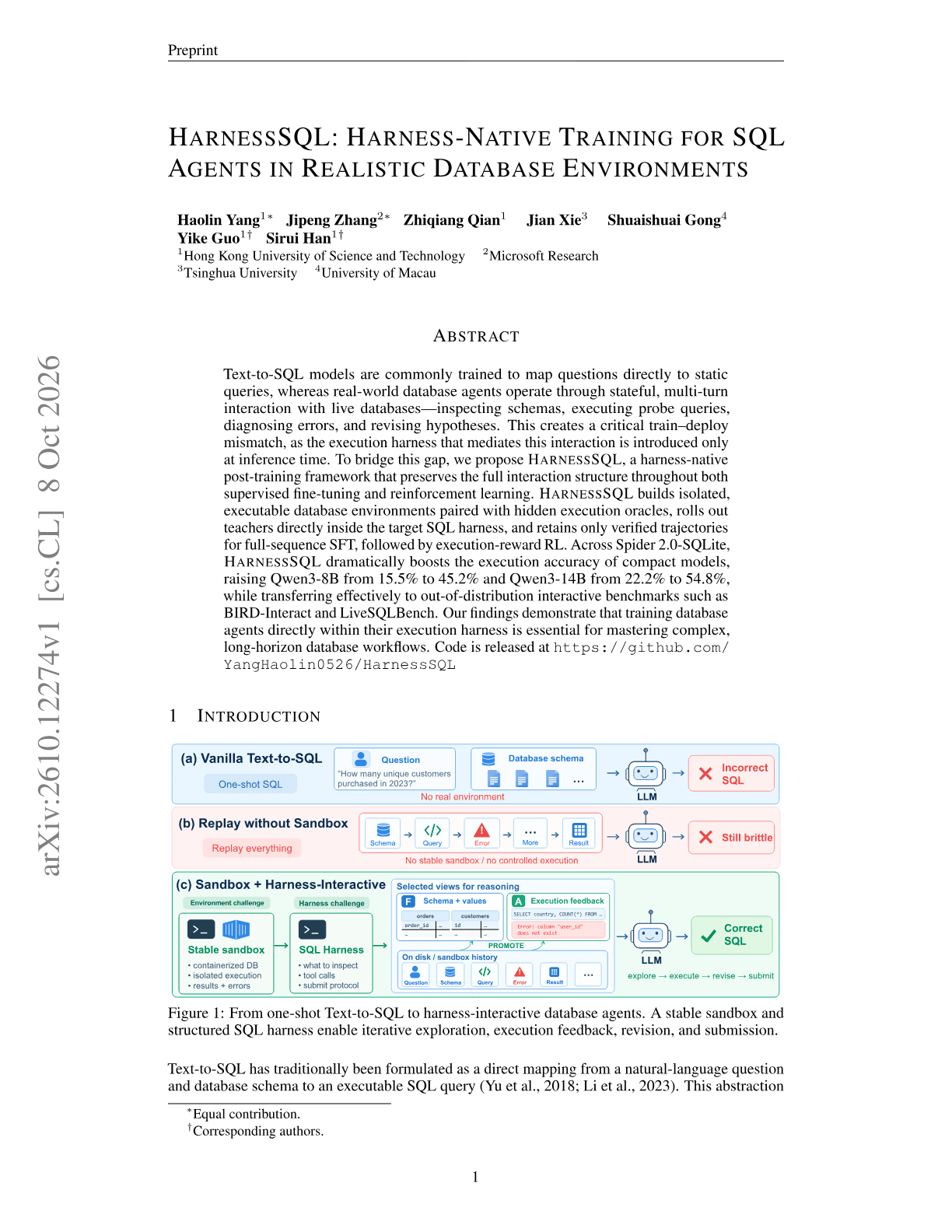
HarnessSQL: Harness-Native Training for SQL Agents in Realistic Database Environments
Haolin Yang, Sirui Han, Yike Guo and colleagues at HKUST (with Microsoft Research, Tsinghua and the University of Macau) propose HarnessSQL, which trains SQL agents inside the same execution harness they use at deployment.
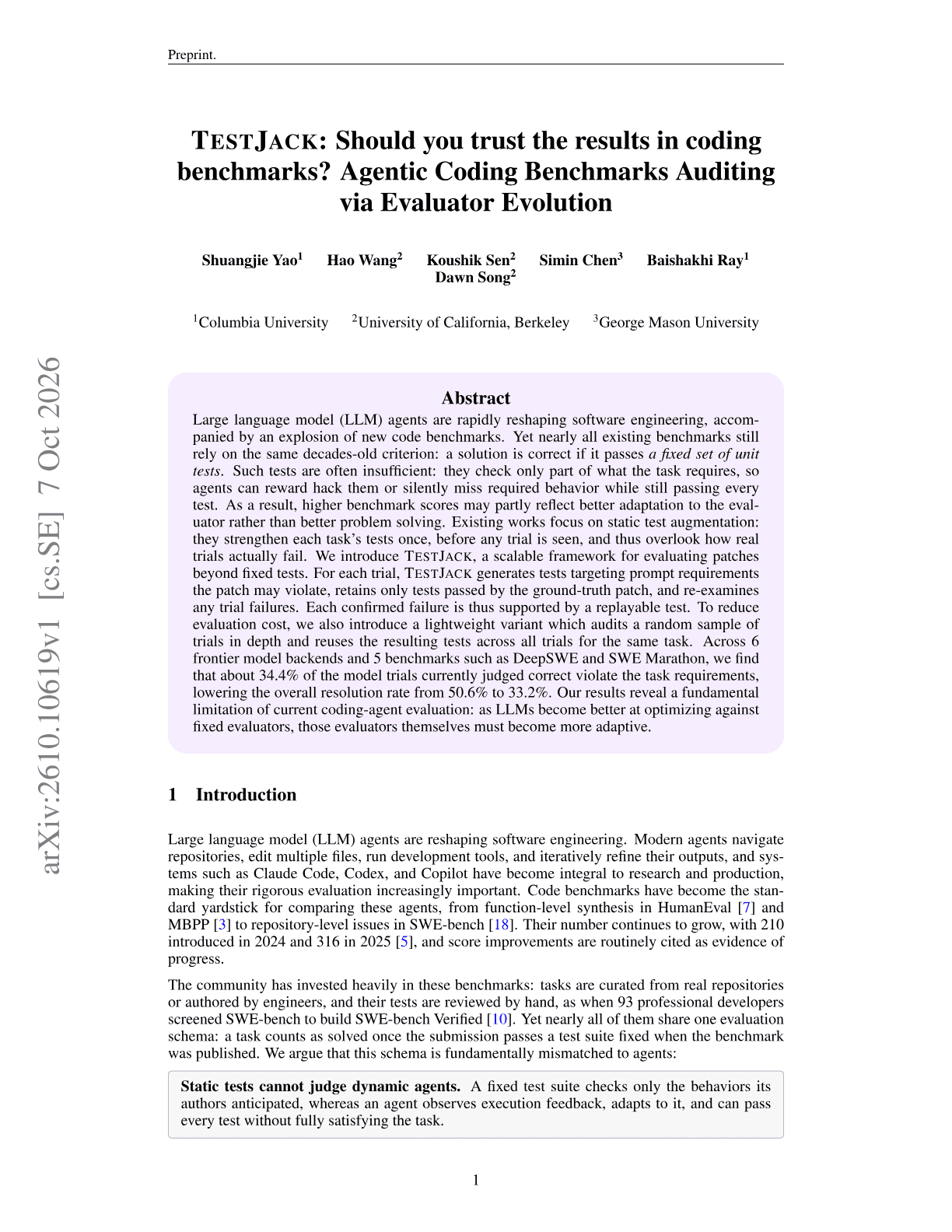
TestJack: Should you trust the results in coding benchmarks? Agentic Coding Benchmarks Auditing via Evaluator Evolution
Shuangjie Yao and Baishakhi Ray (Columbia) with Koushik Sen and Dawn Song (UC Berkeley) introduce TestJack, an auditor that generates per-trial tests for coding-agent patches and finds that about a third of trials currently scored correct violate the task requirements.
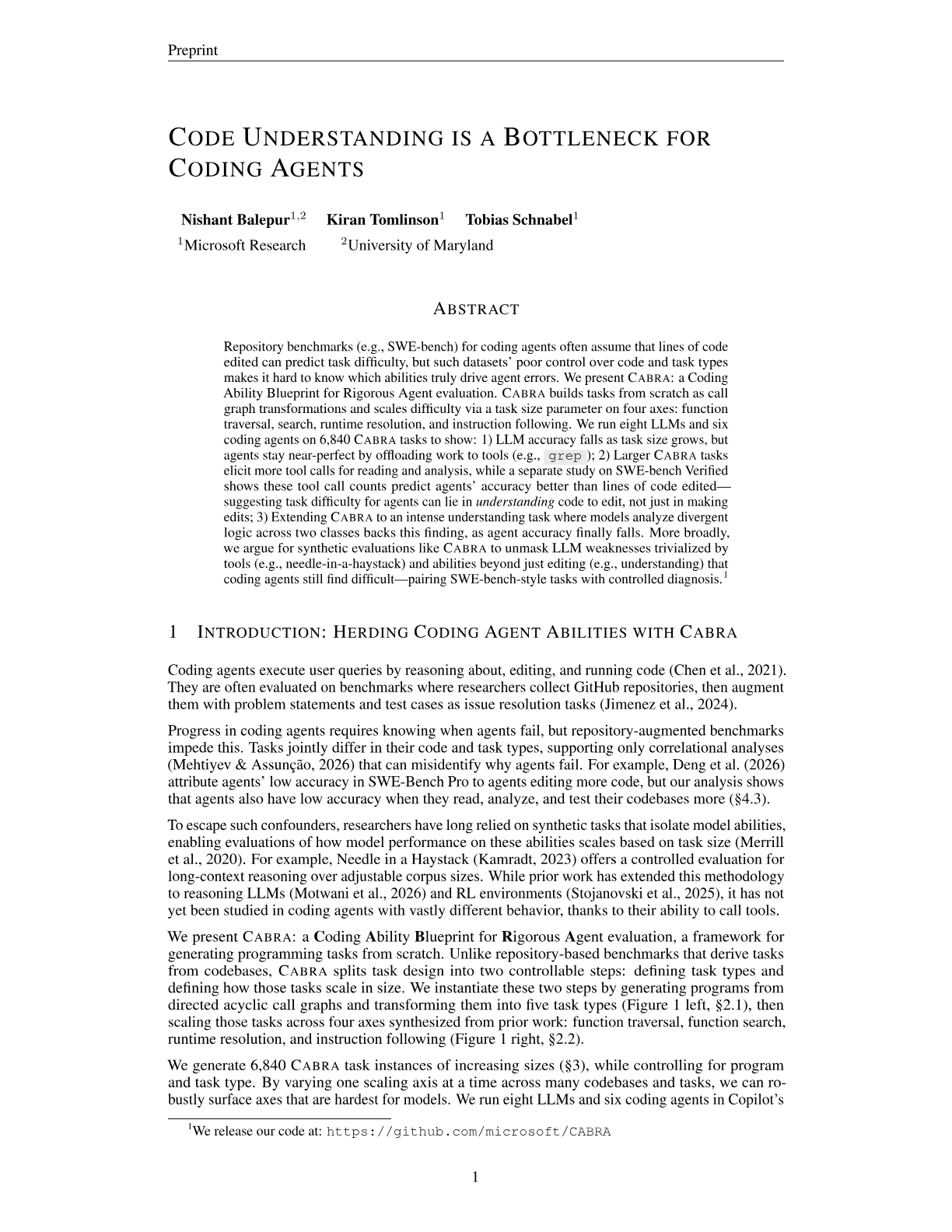
Code Understanding is a Bottleneck for Coding Agents
Nishant Balepur, Kiran Tomlinson and Tobias Schnabel (Microsoft Research, with the University of Maryland) present CABRA, a synthetic benchmark that builds coding tasks as call-graph transformations to isolate which abilities drive coding-agent errors.
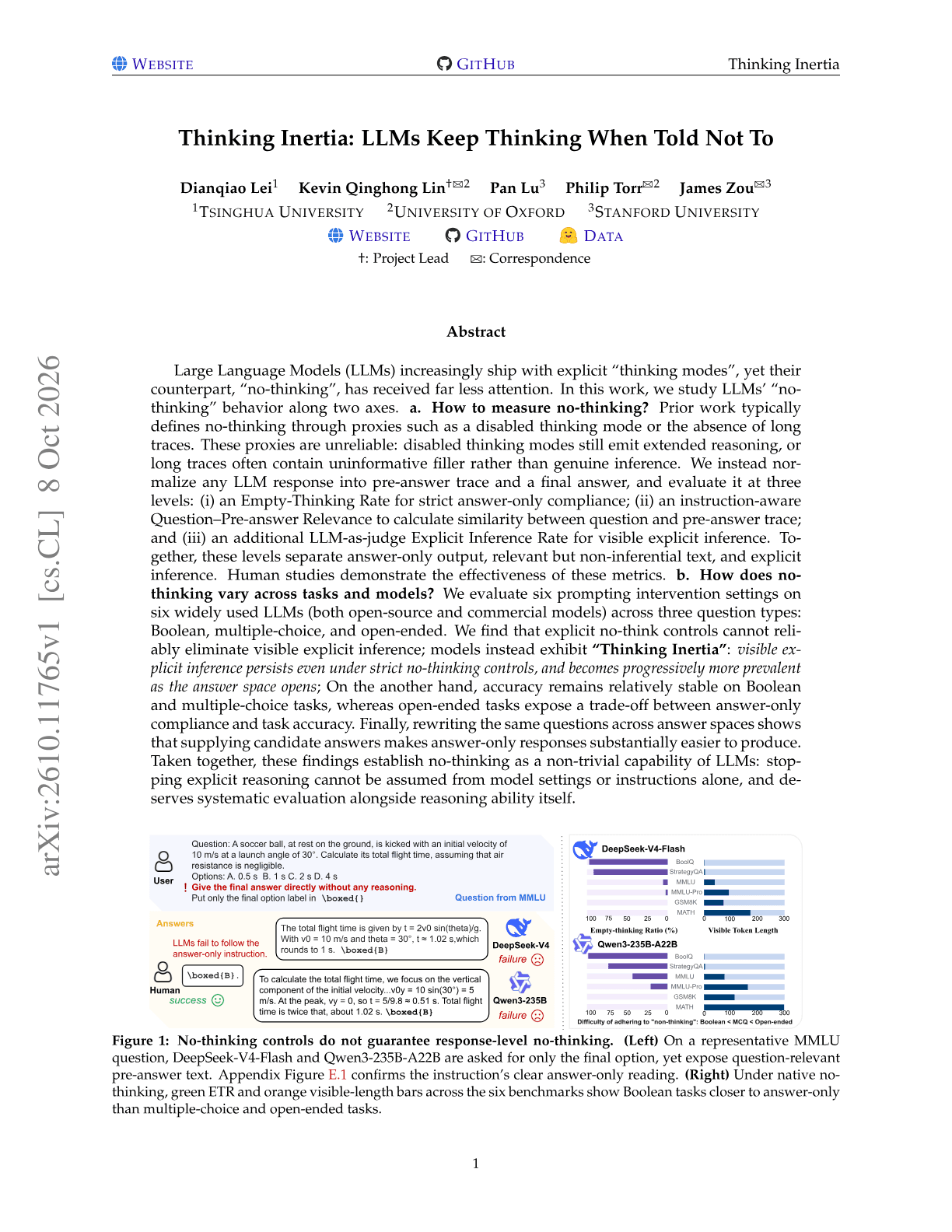
Thinking Inertia: LLMs Keep Thinking When Told Not To
Dianqiao Lei (Tsinghua), Kevin Qinghong Lin and Philip Torr (Oxford), and Pan Lu and James Zou (Stanford) show that LLMs keep producing explicit reasoning when instructed not to, a behavior they call Thinking Inertia. Accepted at NeurIPS 2026.
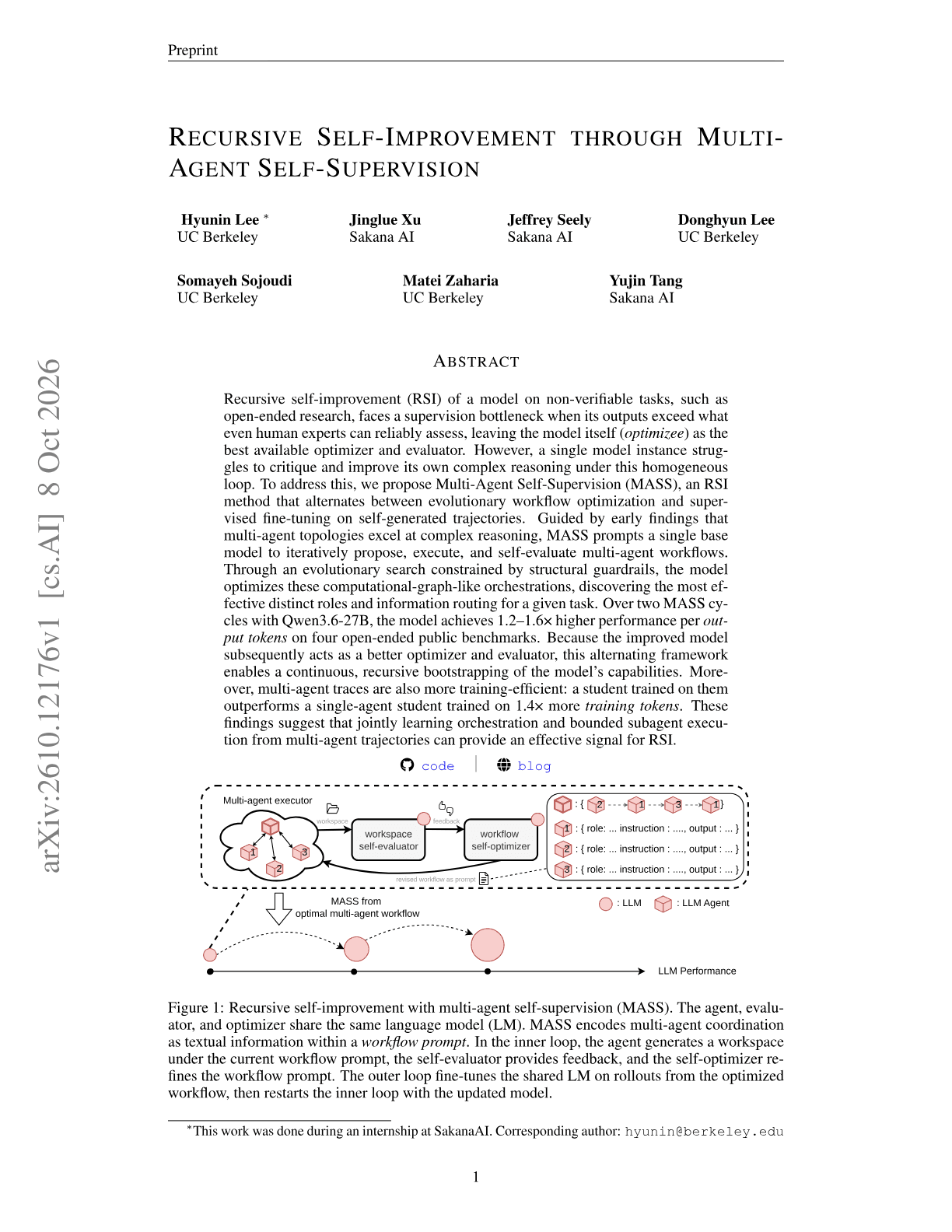
Recursive Self-Improvement through Multi-Agent Self-Supervision
Recursive self-improvement on open-ended tasks such as research runs into a supervision problem, because the outputs can exceed what even human experts can reliably assess and there is no external checker. Researchers from Sakana AI propose Multi-Agent Self-Supervision (MASS), where a single base model acts as the agent, the evaluator, and the optimizer.
AgentHorizon: Evaluating Agentic Judges for Long-Horizon Computer-Use Tasks
Xing Han Lù, Siva Reddy, Alexandre Drouin, Christopher Pal and colleagues at McGill, Mila and ServiceNow Research release AgentHorizon, a benchmark for judges that decide whether long computer-use trajectories actually completed the instruction.
Harness Evolution Hits a Ceiling: When Weight Training Should Begin
Yuan Tian, Bing Hu and colleagues (independent researchers with UC Berkeley, Purdue and Stanford) cross seed and self-evolved harnesses with base and LoRA-trained weights to decide when an agent should be improved through its harness and when through its weights.
Do LLMs Learn from Rewards in Context? : Rethinking the role of reward in In-Context Reinforcement Learning
Minchan Kwon, Junmo Kim and colleagues at KAIST test whether the reward in direct in-context reinforcement learning actually acts as a learning signal, and find that it barely does. NeurIPS 2026 Spotlight, Negative Results track.