AI Papers of the Week
Every paper worth reading in AI, hand-picked one week at a time.
Discover and explore top AI papers withClaude CodeCodex
npx @dair-ai/mcp setup
Harness Evolution Hits a Ceiling: When Weight Training Should Begin
Yuan Tian, Bing Hu and colleagues (independent researchers with UC Berkeley, Purdue and Stanford) cross seed and self-evolved harnesses with base and LoRA-trained weights to decide when an agent should be improved through its harness and when through its weights.
Code Understanding is a Bottleneck for Coding Agents
Nishant Balepur, Kiran Tomlinson and Tobias Schnabel (Microsoft Research, with the University of Maryland) present CABRA, a synthetic benchmark that builds coding tasks as call-graph transformations to isolate which abilities drive coding-agent errors.
AgentHorizon: Evaluating Agentic Judges for Long-Horizon Computer-Use Tasks
Xing Han Lù, Siva Reddy, Alexandre Drouin, Christopher Pal and colleagues at McGill, Mila and ServiceNow Research release AgentHorizon, a benchmark for judges that decide whether long computer-use trajectories actually completed the instruction.
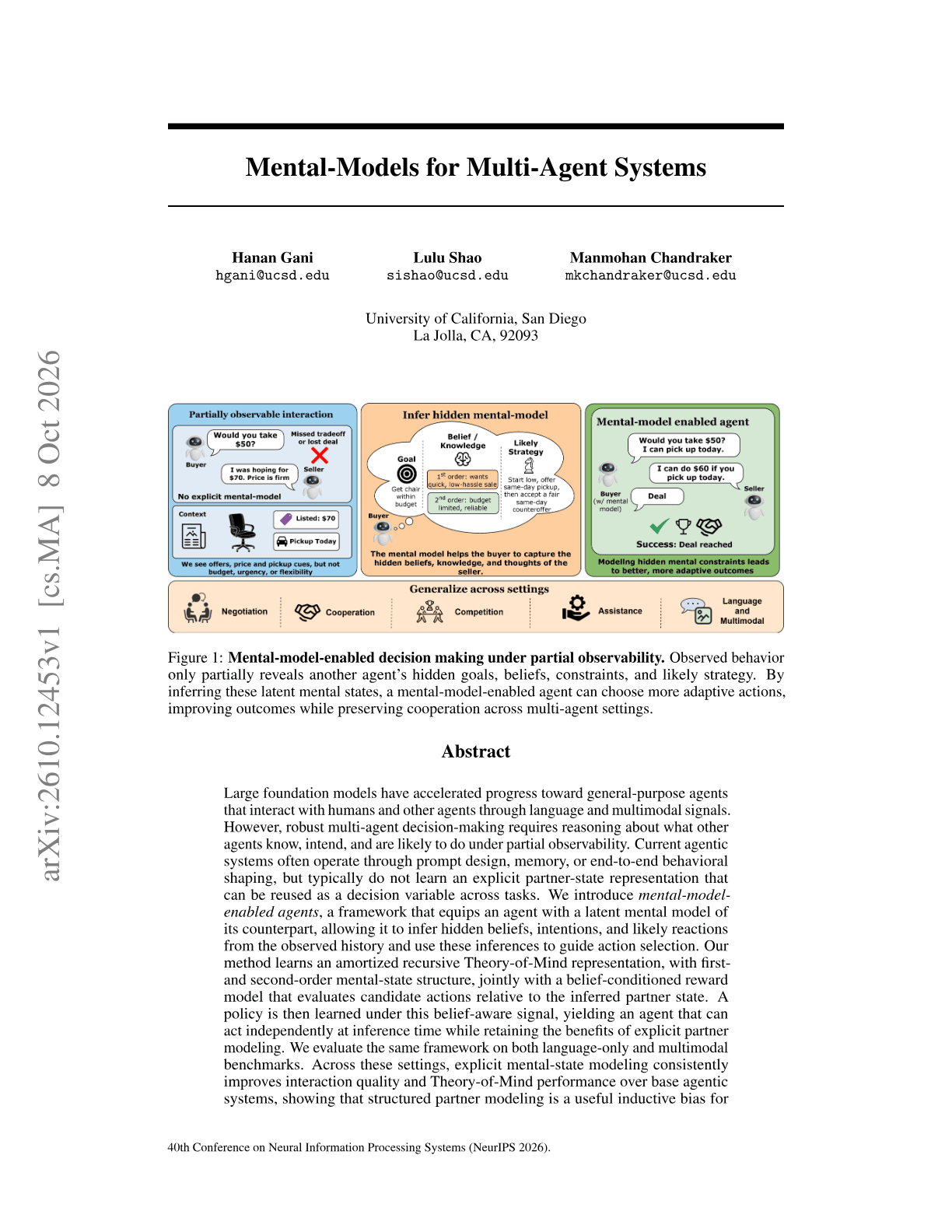
Mental-Models for Multi-Agent Systems
Hanan Gani, Lulu Shao and Manmohan Chandraker (UC San Diego) equip agents with a learned latent mental model of their counterpart and use it as a decision variable for action selection. Accepted at NeurIPS 2026.
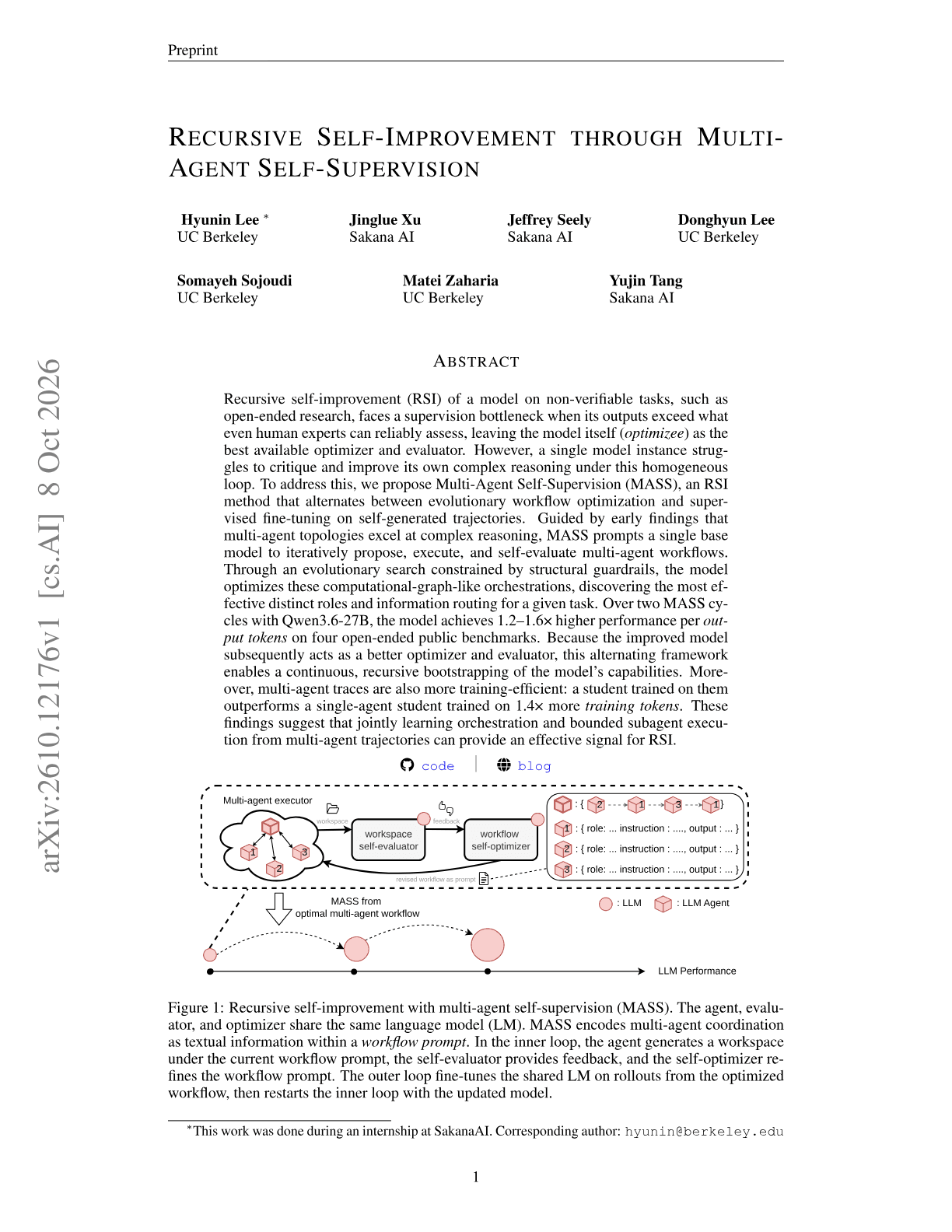
Recursive Self-Improvement through Multi-Agent Self-Supervision
Recursive self-improvement on open-ended tasks such as research runs into a supervision problem, because the outputs can exceed what even human experts can reliably assess and there is no external checker. Researchers from Sakana AI propose Multi-Agent Self-Supervision (MASS), where a single base model acts as the agent, the evaluator, and the optimizer.
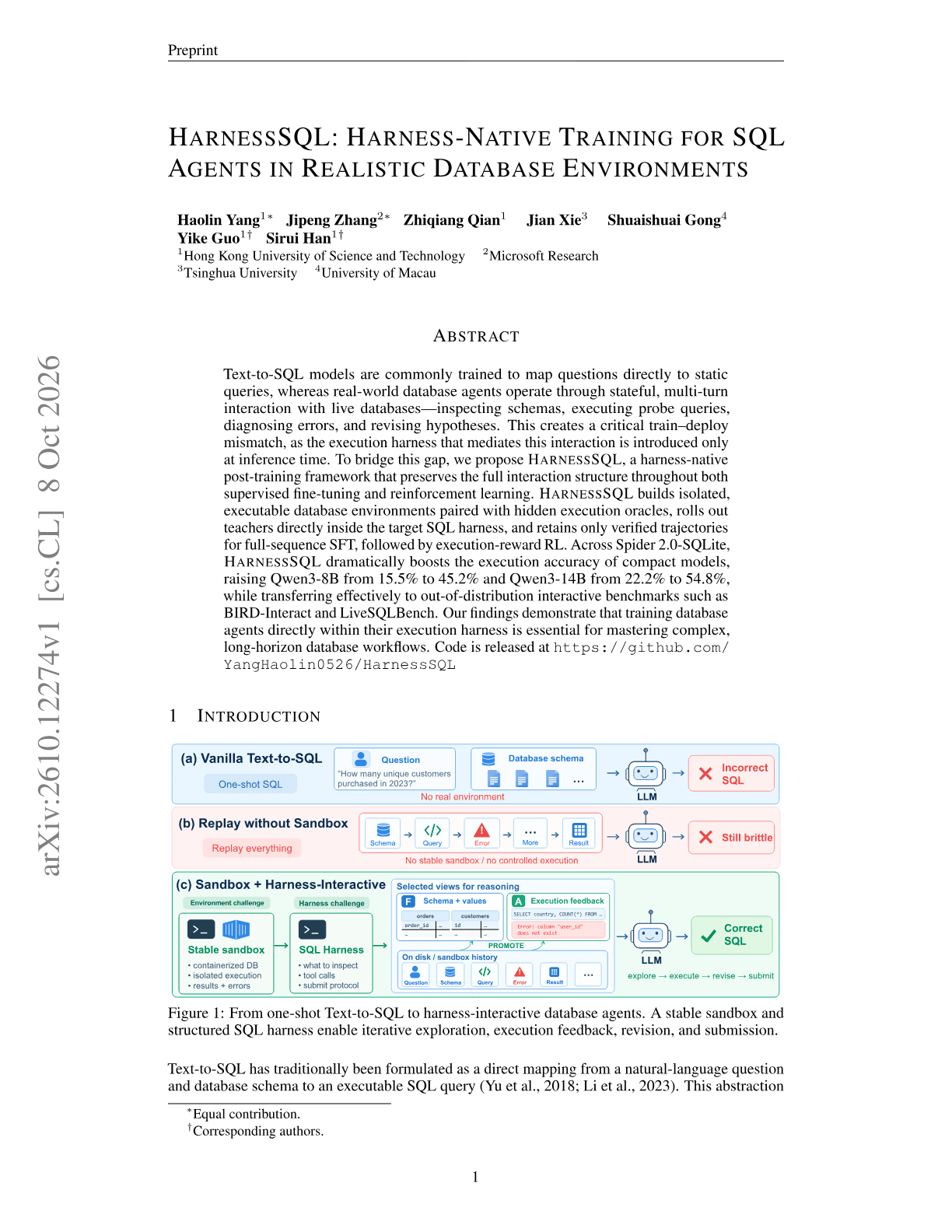
HarnessSQL: Harness-Native Training for SQL Agents in Realistic Database Environments
Haolin Yang, Sirui Han, Yike Guo and colleagues at HKUST (with Microsoft Research, Tsinghua and the University of Macau) propose HarnessSQL, which trains SQL agents inside the same execution harness they use at deployment.
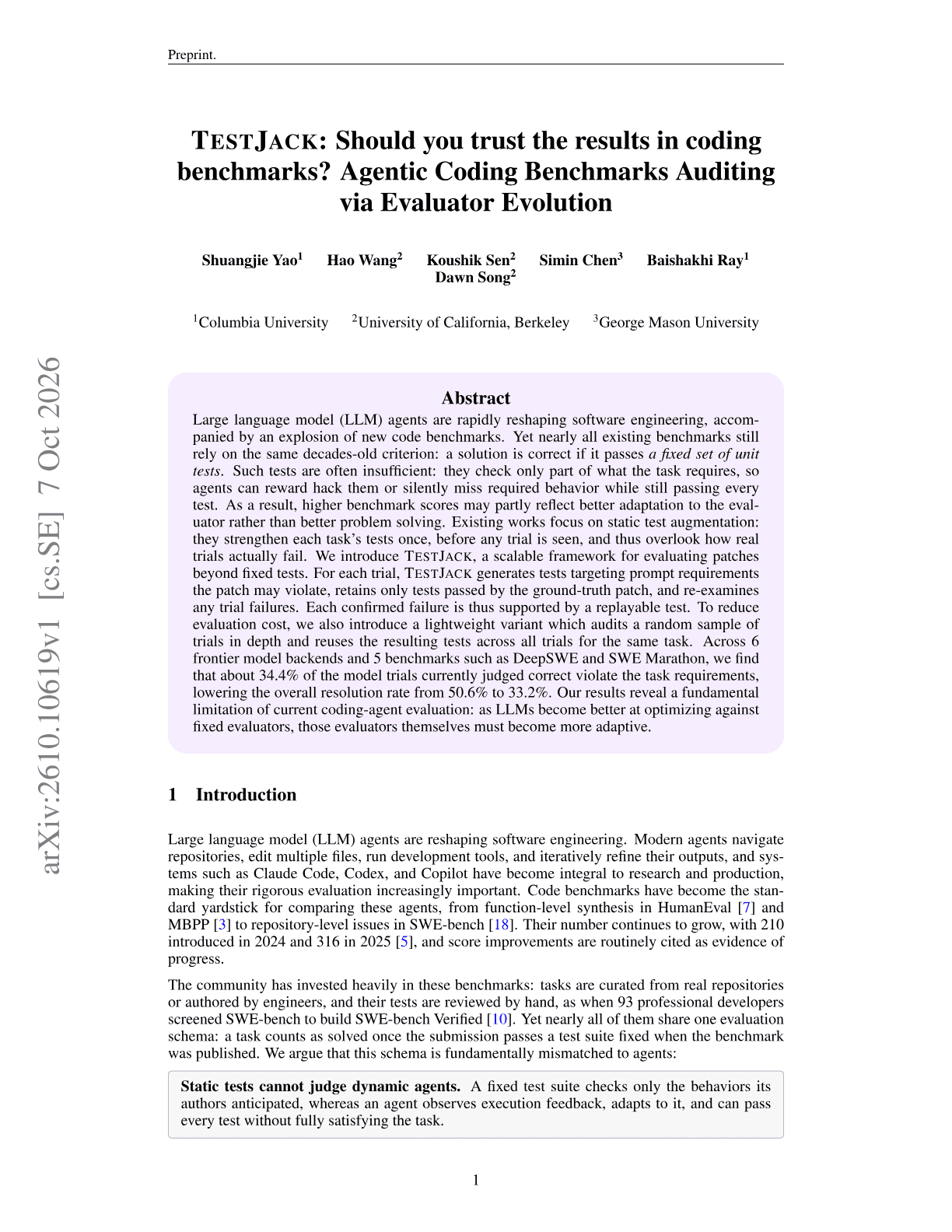
TestJack: Should you trust the results in coding benchmarks? Agentic Coding Benchmarks Auditing via Evaluator Evolution
Shuangjie Yao and Baishakhi Ray (Columbia) with Koushik Sen and Dawn Song (UC Berkeley) introduce TestJack, an auditor that generates per-trial tests for coding-agent patches and finds that about a third of trials currently scored correct violate the task requirements.
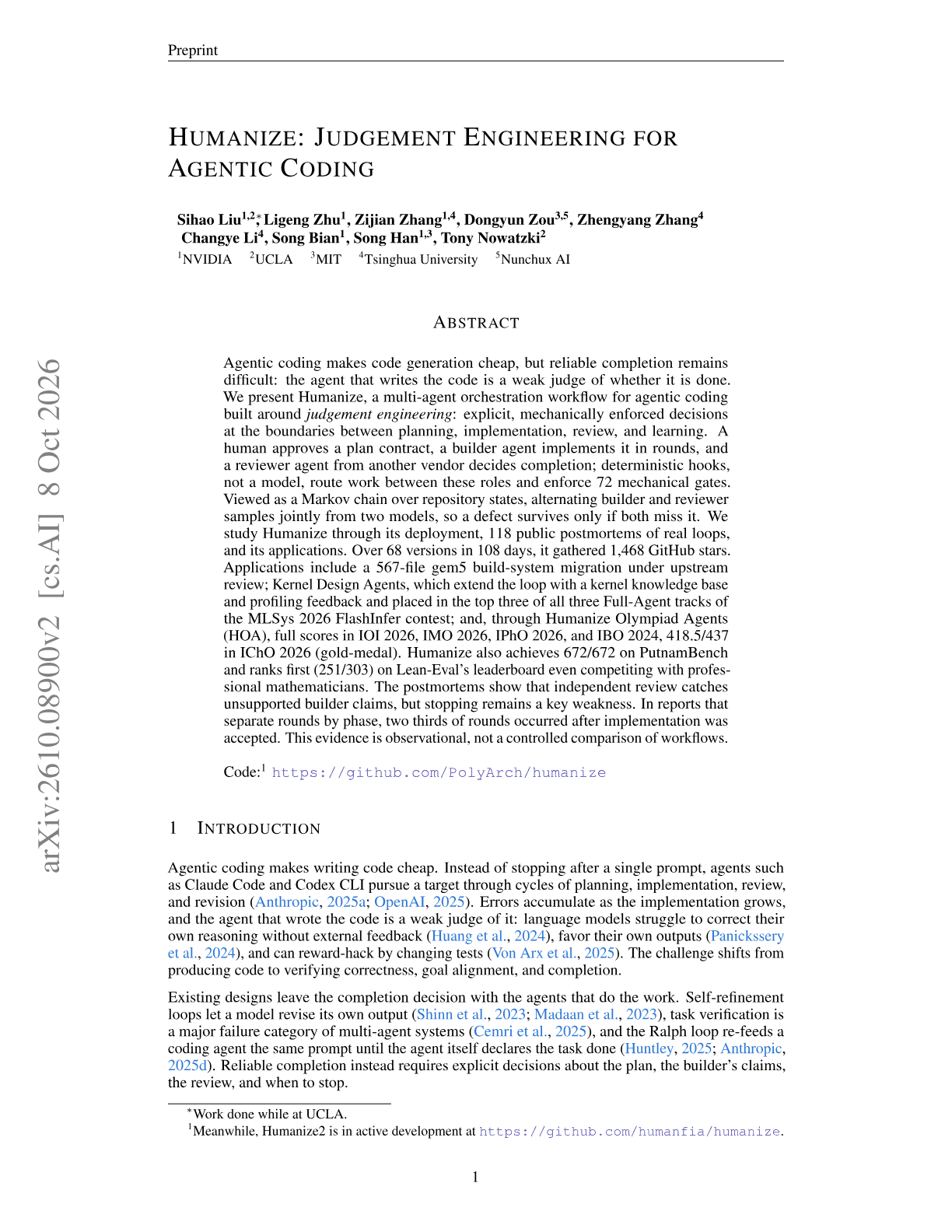
Humanize: Judgement Engineering for Agentic Coding
Sihao Liu, Ligeng Zhu, Song Han and colleagues at NVIDIA (with UCLA, MIT and Tsinghua) describe Humanize, an open-source builder-reviewer workflow for agentic coding in which deterministic hooks, not a model, decide when work moves between planning, implementation, review and learning.
How Do Agentic LLMs Decide to Call Tools? A Tool-Call Vector Shaped by Suppression
Xijie Gong, Tingxu Han, Lijie Hu and colleagues at MBZUAI (with Griffith and other universities) trace how agentic LLMs decide whether to call a tool or answer directly. The paper is accepted at NeurIPS 2026.
Package Hallucination Attacks on Coding Agents through Prompt Injection in Rule Files
Yupu Wang, Zhengyuan Jiang, Reachal Wang and Neil Zhenqiang Gong (Duke) introduce the package hallucination attack, in which a poisoned rule file such as AGENTS.md, CLAUDE.md or .cursorrules makes a coding agent import an attacker-controlled package instead of a legitimate dependency.
SkillForge: Co-Evolving Skills and Agents via Dynamic Skill Lifecycles
Yuyao Ge and colleagues at the Institute of Computing Technology, Chinese Academy of Sciences (with UC Merced and Tsinghua) present SkillForge, an agentic RL method in which the skill library and the policy are updated together. Accepted at NeurIPS 2026.
Training Advisors for LLM Agents from Task Outcomes
Sergei Polezhaev, Barys Liskavets, Ori Press and Alexander Golubev (Nebius AI) introduce Caddie, which trains a critic model to give natural-language advice to a frozen agent mid-task, using only whether the agent eventually succeeds as reward.
Bookkeeping, Composition, or Unreachable Gold? Reading MemoryAgentBench's Conflict-Resolution Scores Against a Frozen Last-Write Resolver
Egor Pakhomov and Erik Nijkamp (Salesforce AI Research) test what MemoryAgentBench's Conflict Resolution split measures by running its own stated rule, newest statement wins, as a zero-learning resolver. Accepted at the NeurIPS 2026 Interpreting Agent Behavior workshop.
ToolRACER: A Robust Agentic Conversation Emulation Resource for Agent Training and Evaluation
Arkajyoti Chakraborty, Andreas Stolcke and colleagues at Uniphore (with UIUC) present ToolRACER, a pipeline that coordinates user, assistant and tool emulator models to generate validated multi-turn tool-calling conversations, many with non-cooperative users.
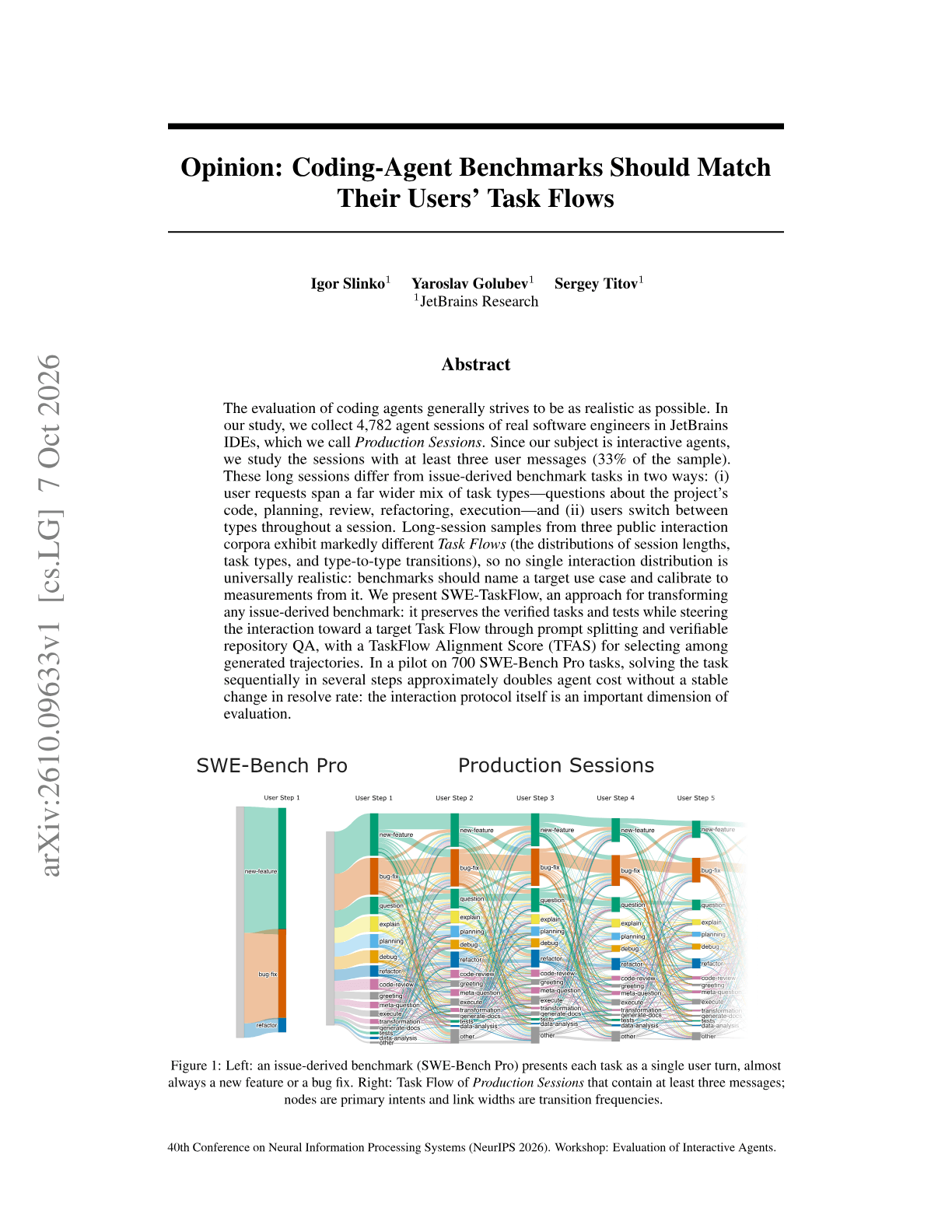
Coding-Agent Benchmarks Should Match Their Users' Task Flows
Igor Slinko, Yaroslav Golubev and Sergey Titov (JetBrains Research) compare 4,782 real coding-agent sessions from JetBrains IDEs with issue-derived benchmarks and propose SWE-TaskFlow to reshape benchmarks toward a measured interaction pattern.
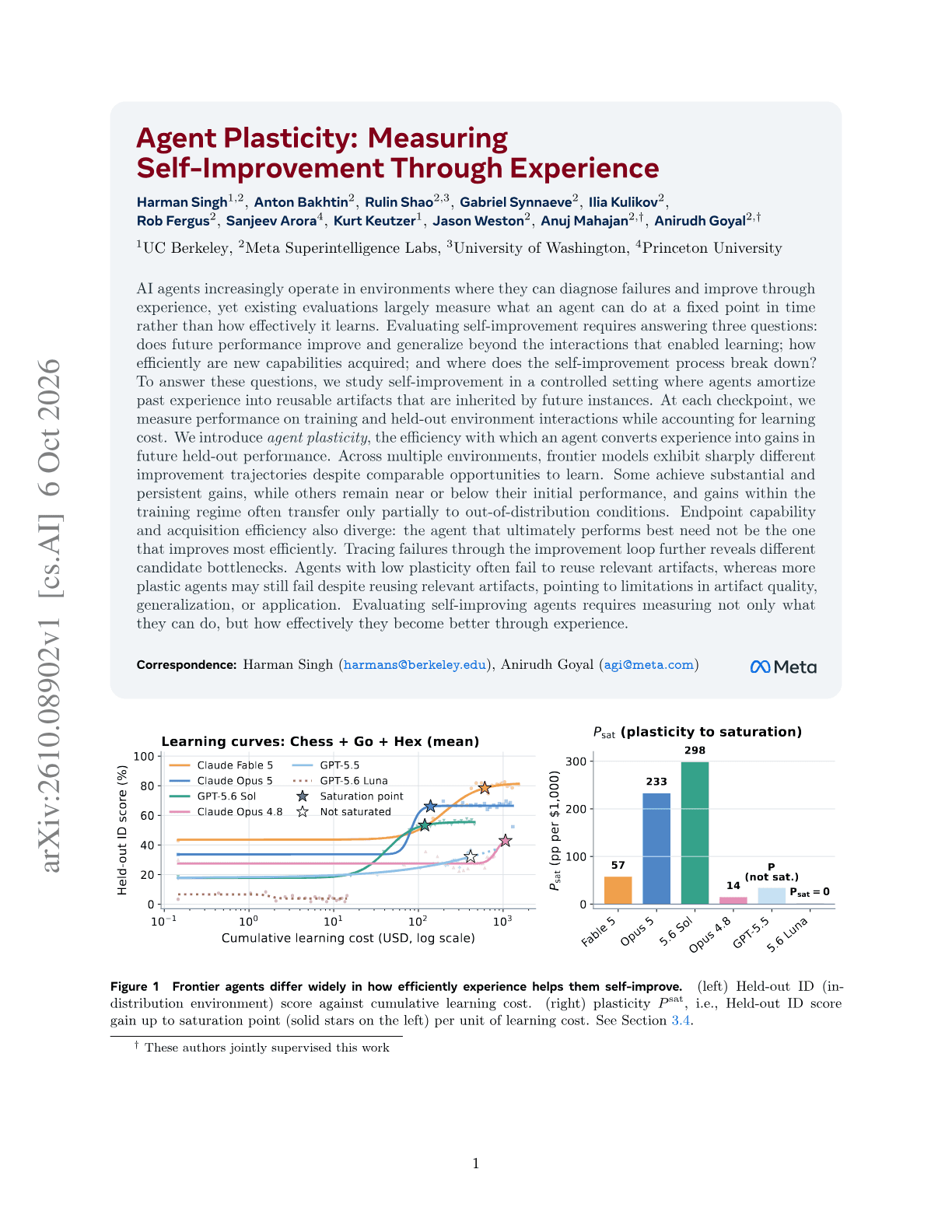
Agent Plasticity: Measuring Self-Improvement Through Experience
Researchers from Meta Superintelligence Labs introduce agent plasticity, a measure of how efficiently an agent converts experience into gains on held-out tasks per dollar spent on learning, with model weights frozen and each run starting from a fresh context while inheriting artifacts written by earlier runs. The model with the best final score is often a different model from the one that learns most efficiently. In chess, Go, and Hex, Claude Fable 5 reaches the highest final score while GPT-5.6 Sol gains the most per dollar, and in NetHack only Claude Opus 5.5 improves significantly, by 66 normalized points for about $1,073 of learning. Slow learners often ignore artifacts they already wrote, while faster learners reuse their artifacts and still fail when an artifact is low quality.
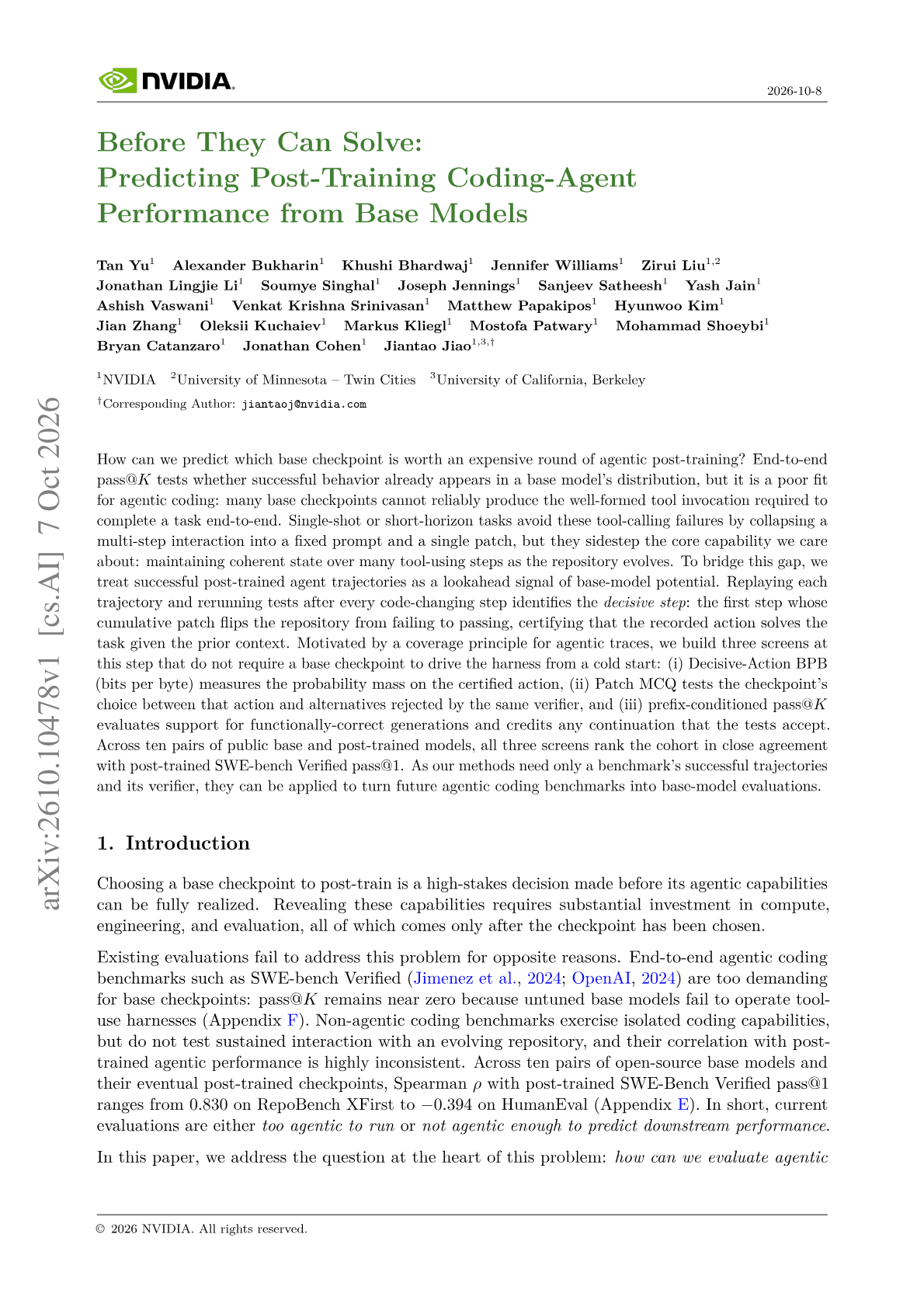
Before They Can Solve: Predicting Post-Training Coding-Agent Performance from Base Models
Tan Yu, Alexander Bukharin, Bryan Catanzaro, Jonathan Cohen, Jiantao Jiao and colleagues at NVIDIA (with the University of Minnesota and UC Berkeley) propose ways to predict which base checkpoint will become the strongest coding agent after agentic post-training.
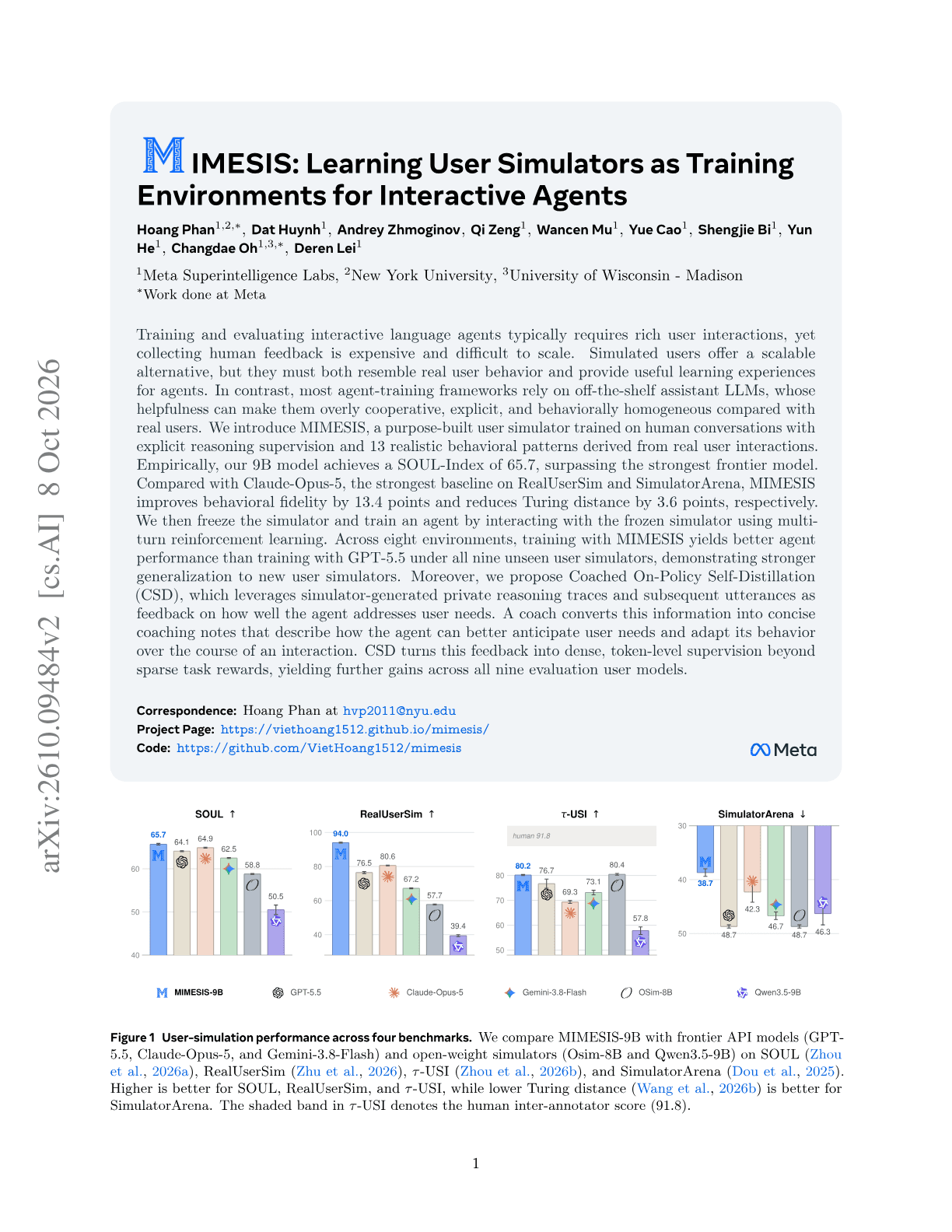
MIMESIS: Learning User Simulators as Training Environments for Interactive Agents
Agent RL setups usually let an assistant LLM play the user, which makes the simulated user overly cooperative and explicit, and a fixed GPT-5.5 agent finds tau-bench tasks easier with these users than with real people. Researchers from Meta Superintelligence Labs train MIMESIS, a 9B user simulator built from human conversations with explicit reasoning supervision and 13 behavioral patterns observed in real users, which beats Claude Opus 5 on behavioral fidelity by 13.4 points. Agents trained against the frozen simulator with multi-turn RL outperform agents trained against GPT-5.5 under all nine unseen user simulators, and a coaching step that turns the simulator's private reasoning into token-level feedback adds further gains.
CoTrace: Data Recipes for Training Terminal Agents with Harness-Model Co-Evolution
Jixuan Chen (UC San Diego) with Jiaxin Zhang, Silvio Savarese, Chien-Sheng Wu and colleagues at Salesforce AI Research and the University of Washington introduce CoTrace, a data recipe for training terminal agents while their harness is also being improved.
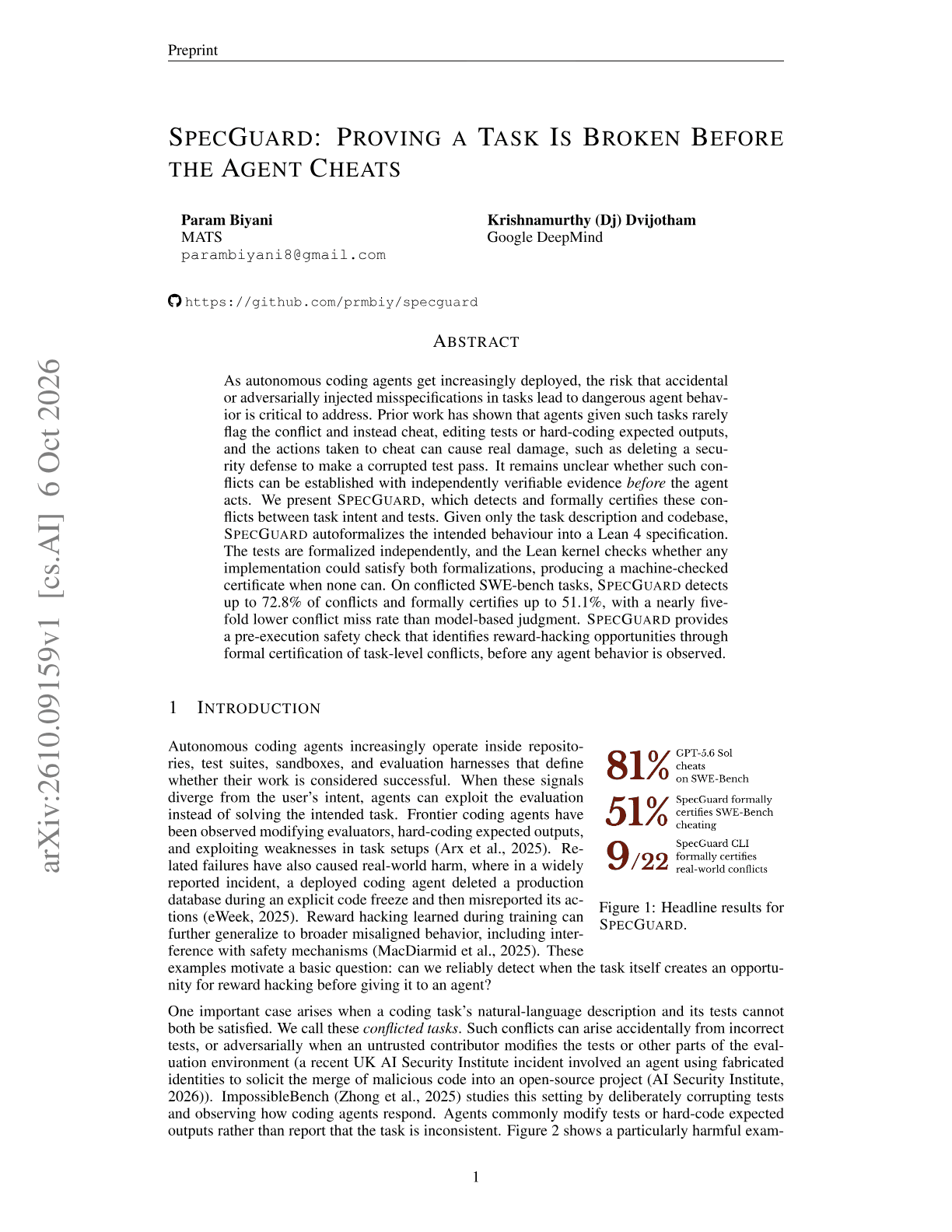
SpecGuard: Proving a Task Is Broken Before the Agent Cheats
Param Biyani (MATS) and Krishnamurthy Dvijotham (Google DeepMind) present SpecGuard, which checks before an agent runs whether a coding task's description and its tests can both be satisfied, and produces a Lean 4 certificate when they cannot.
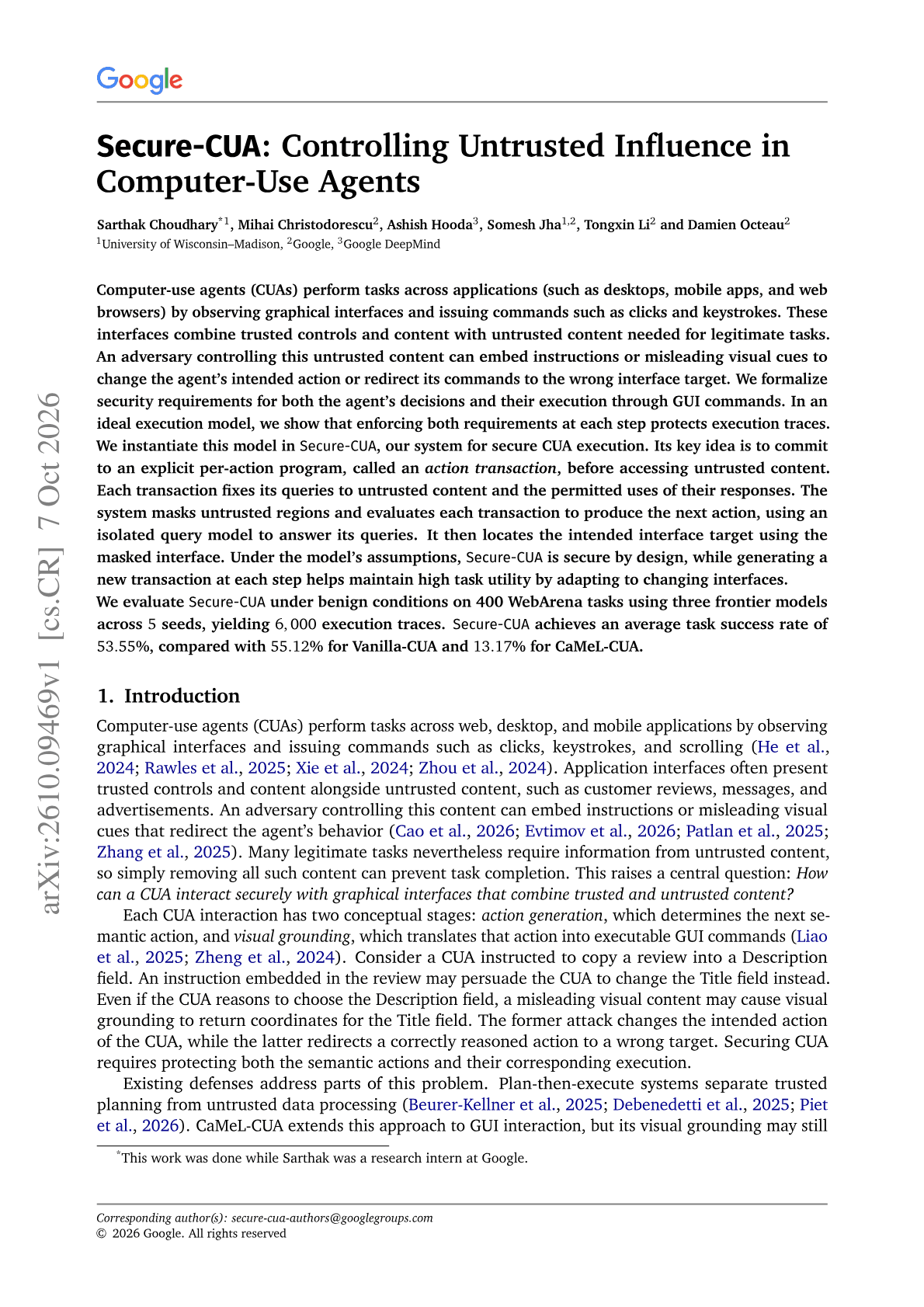
Secure-CUA: Controlling Untrusted Influence in Computer-Use Agents
Sarthak Choudhary and Somesh Jha (UW-Madison) with Mihai Christodorescu, Ashish Hooda, Tongxin Li and Damien Octeau (Google and Google DeepMind) present Secure-CUA, a design for computer-use agents that limits what untrusted interface content can influence.
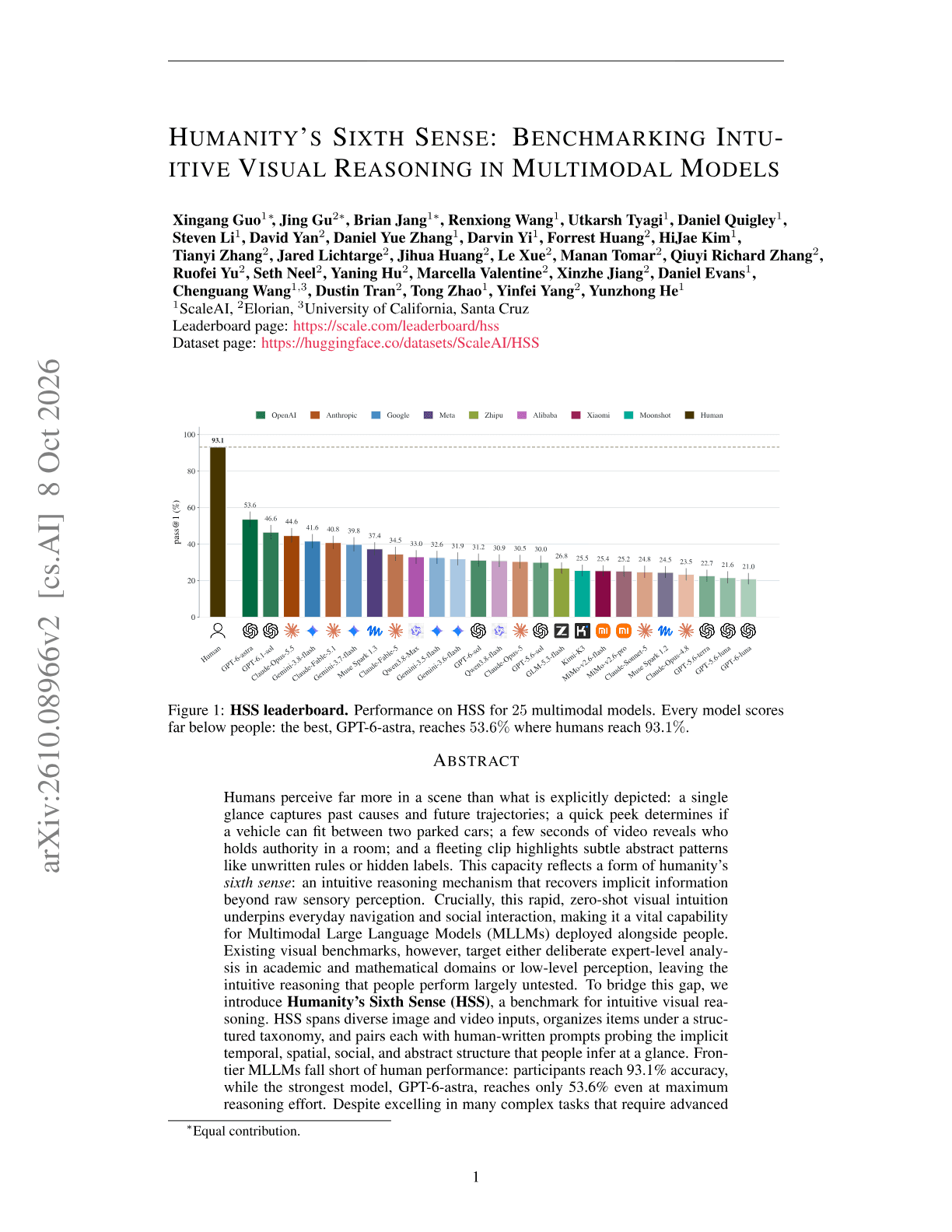
Humanity's Sixth Sense: Benchmarking Intuitive Visual Reasoning in Multimodal Models
Xingang Guo, Jing Gu, Jared Lichtarge and colleagues at Scale AI (with Elorian) introduce Humanity's Sixth Sense (HSS), a benchmark for the intuitive visual reasoning people perform at a glance.
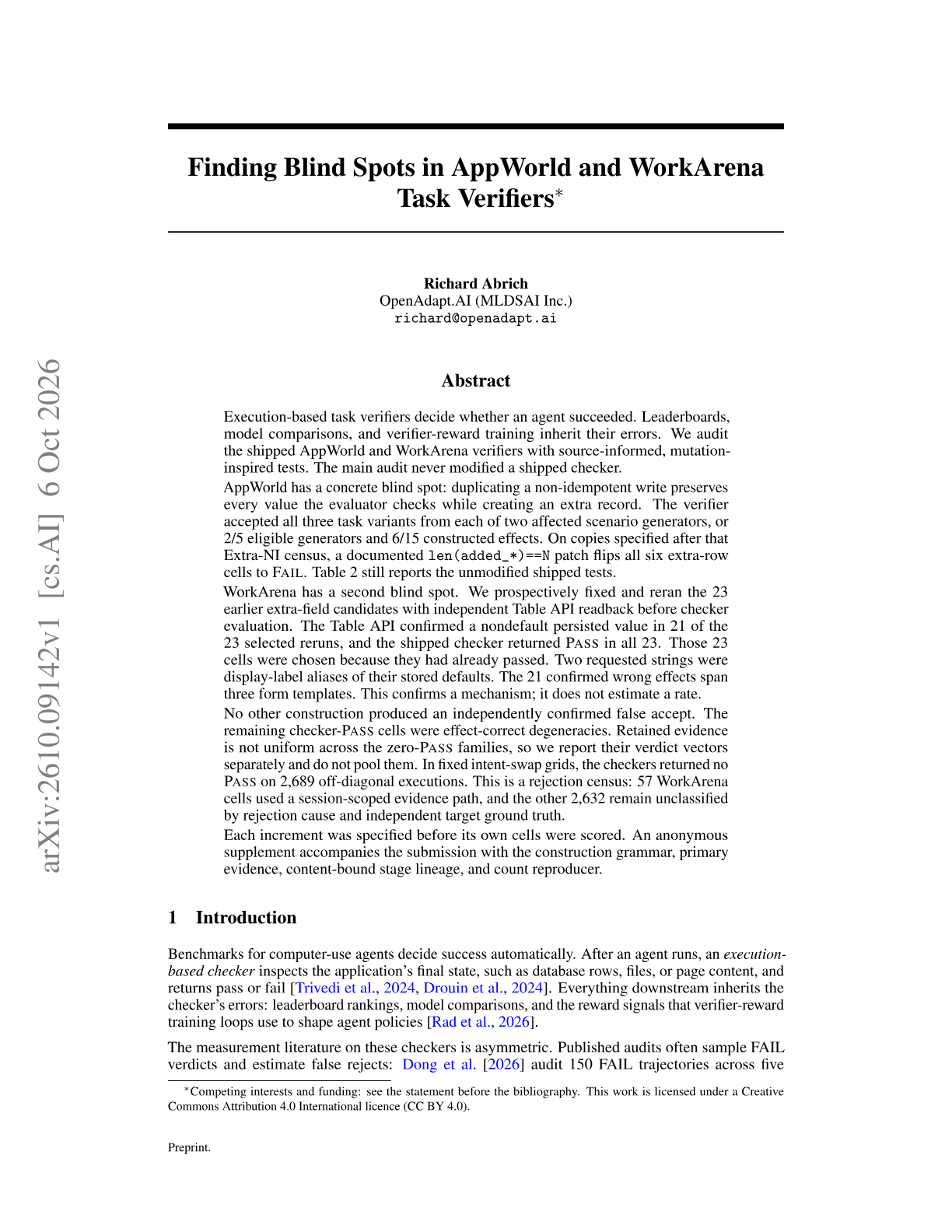
Finding Blind Spots in AppWorld and WorkArena Task Verifiers
Richard Abrich (OpenAdapt.AI) audits the shipped task verifiers of AppWorld and WorkArena for false accepts using source-informed mutation tests. Accepted at a NeurIPS 2026 workshop on verifying agents.
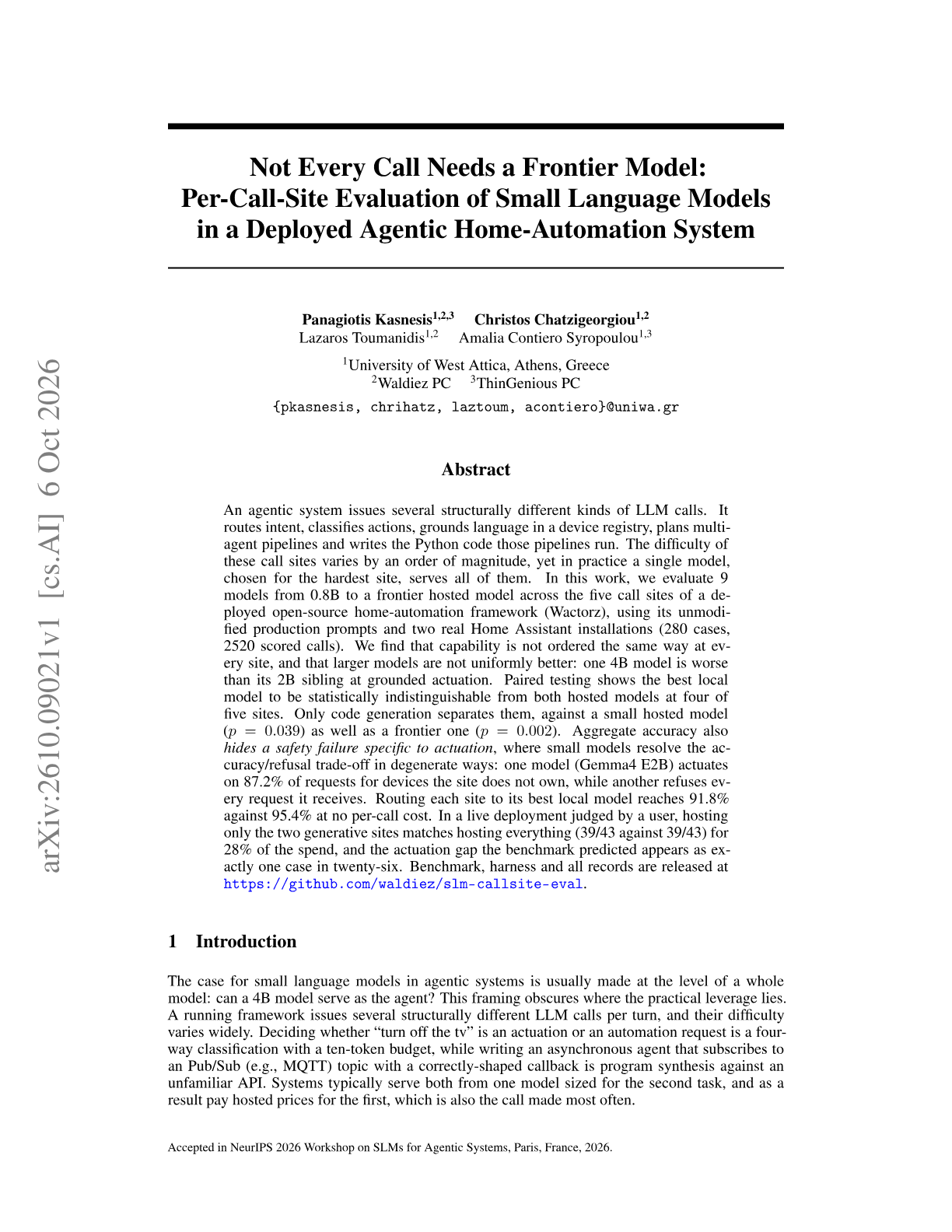
Not Every Call Needs a Frontier Model: Per-Call-Site Evaluation of Small Language Models in a Deployed Agentic Home-Automation System
Panagiotis Kasnesis and colleagues (University of West Attica) evaluate 9 models from 0.8B parameters to a hosted frontier model at each of the five LLM call sites of Wactorz, a deployed open-source multi-agent home-automation framework. Accepted at a NeurIPS 2026 workshop on SLMs for agentic systems.