AI Papers of the Week
Every paper worth reading in AI, hand-picked one week at a time.
Discover and explore top AI papers withClaude CodeCodex
npx @dair-ai/mcp setup
Learn2Play Bench: How Well Do LLM Agents Learn from Experience in Unfamiliar Environments?
Yibo Li, Bryan Hooi and colleagues (National University of Singapore) introduce Learn2Play Bench, a set of new text games with novel or counterintuitive rules, built to test whether agents learn from interaction rather than from pretrained knowledge.
ParanoiaEval: Benchmarking Unnecessary Defensive Work in Agentic Coding
Hanjun Luo, Hanan Salam and colleagues (NYU, NYU Abu Dhabi, PolyU) introduce ParanoiaEval, a benchmark that measures when coding agents do defensive work the task evidence has already ruled out, such as extra validation, backups and protective logic.
Agent in a Bottle: Can LLM Agents Turn Their Capabilities Into Cheap, Scalable Artifacts?
Ankit Sonthalia (University of Tübingen), Seong Joon Oh (KAIST) and colleagues from the ELLIS Institute Tübingen and Ecole Polytechnique introduce BOTTLED, a benchmark that asks agents to turn an LLM capability into a cheap reusable artifact, such as a small model or a program, for a large unlabelled workload.
Persistent Memory in Multi-Agent LLM Inference: What It Costs, What It Buys, and When You Can Tell
Hochan Son, Guang Cheng (UCLA) and colleagues from Wisconsin and HCLTech measure what a persistent memory tier adds to a chain-of-agents long-context system, and find that decomposition cuts peak KV cache while the persistent tier adds cost with no detectable accuracy change.
Understanding and Mitigating Inference-Time Overreliance Using Agentic Memory
Luoxi Tang, Zhaohan Xi (Binghamton University) and colleagues study memory overreliance, where benign and correctly retrieved memories lower accuracy because they only partly match the current task, and propose MemTrim to control how memory evidence is reused.
Decoupled Multi-Agent Orchestration
Xinle Wu and Yao Lu (National University of Singapore) introduce DeOrch, a learned multi-agent orchestrator that plans without knowing which workers exist and then matches subtasks to workers, so a new worker pool can be used without retraining.
Selective Critique for Cost-Aware LLM Agents in Long-Horizon Decision Making
Heewon Park, Somin Im and Minhae Kwon (Soongsil University) propose SAG, a training-free gate that decides at each step whether an LLM agent should call a critic, using action-level ambiguity as a proxy for the value of the critique. Accepted to NeurIPS 2026.
WorldSolver: Can LLM Agents Simulate the Physical Dynamics via Solver Generation?
Siru Jiang, Tieniu Tan and colleagues (CASIA, Peking University, Huawei Noah's Ark Lab) introduce WorldSolver, a benchmark that asks coding agents to implement physics solvers that reproduce phenomena from computer graphics papers.
Principles that Guide, Actions that Inform: Agent Evolution via Knowledge Abstraction
Bowen Ye, Wenzhao Li and colleagues (Alibaba Group, Shanghai Jiao Tong University) present SAGA, which turns agent trajectories into episodic descriptions, procedures and principles with explicit applicability conditions, and uses retrieved principles to correct candidate actions.
Do I Need the Cloud? Uncertainty-Aware Step-Level Handoff for Small Language Model Agents
Abolfazl Younesi (Sharif University of Technology) presents StepGate, which lets a small local model run an agent and escalate individual steps to a stronger cloud model when its uncertainty is high, instead of routing whole queries. Presented at the NeurIPS 2026 SLMs for Agentic Systems workshop.
EMHO: EMbodied Agent Harness Optimization via Experience Traces
Hyun Jung Lee, Donghyun Kim (Korea University), Yong Jae Lee (UW-Madison) and colleagues present EMHO, which keeps an embodied VLM frozen and rewrites its harness from execution traces under sparse feedback.
Self-Retrospection Distillation: Turning Post-hoc Experiences into Prior Foresight
Haoxiang Zhang, Pan Lu, Silvio Savarese and colleagues (Salesforce AI Research, Stanford) propose Self-Retrospection Distillation (SRD), which trains a policy to predict, before acting, the knowledge and failure modes that its completed trajectories revealed.
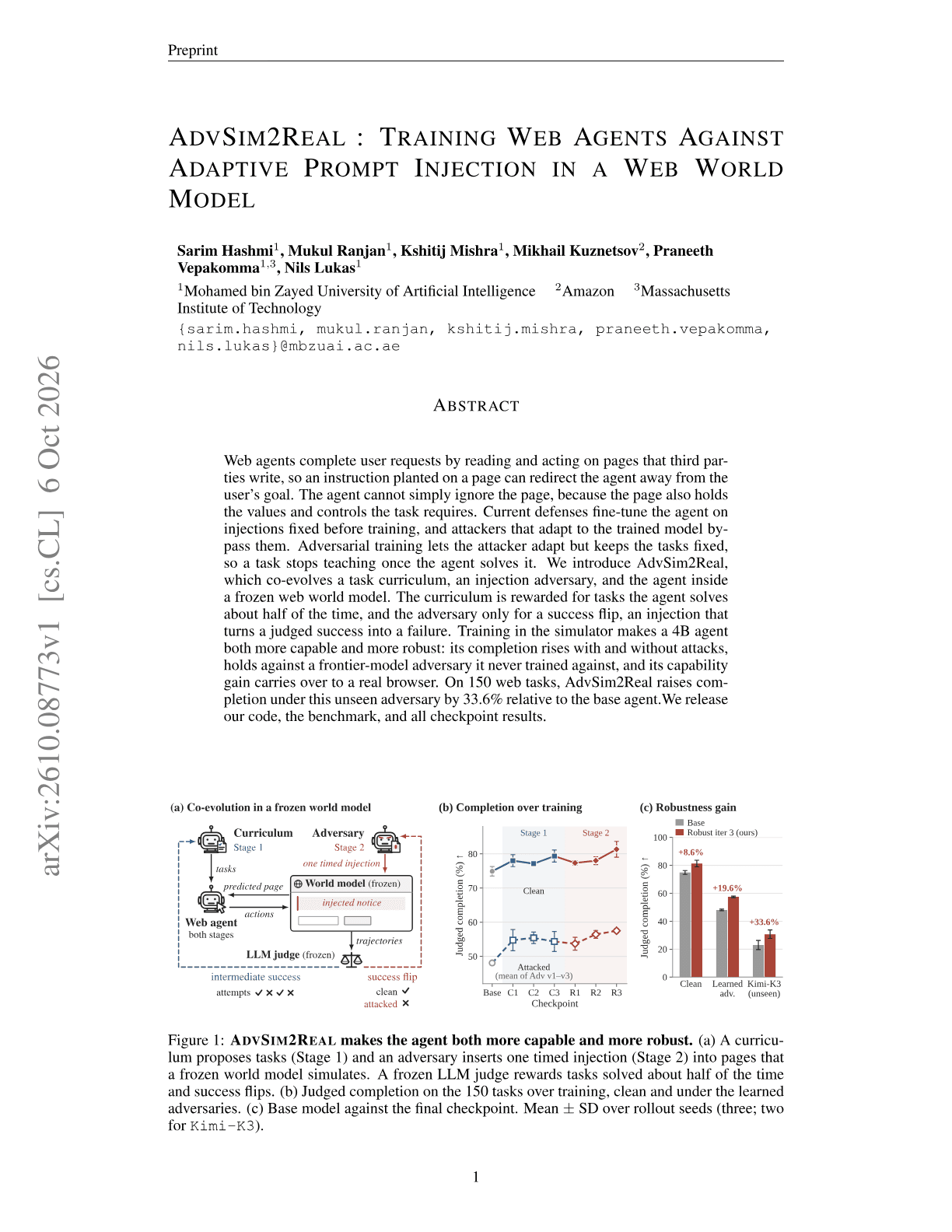
AdvSim2Real : Training Web Agents Against Adaptive Prompt Injection in a Web World Model
Sarim Hashmi, Nils Lukas and colleagues (MBZUAI, Amazon, MIT) train a 4B web agent against adaptive prompt injection inside a frozen web world model, with a learned task curriculum and a learned adversary.
The Right Memory in the Wrong Context: Verifying Retrieval Admissibility in Long-Term Agent Memory
Zi Wang, Xiaowei Xu and colleagues (University of Arkansas at Little Rock) argue that long-term agent memory needs an admissibility check separate from relevance, and build a verification framework that labels each memory-query pair admissible, inadmissible or unresolved.
Internalizing Agent Experience into Diffusion Model Weights via On-Policy Context Distillation
Wenxuan Wang, Yang Yang and colleagues (Harbin Institute of Technology, Shanghai AI Laboratory, NTU, SJTU) propose D-OPCD, which distills the prompts improved by an agentic text-to-image harness back into the diffusion model weights.
Does an Agent's History Tell You When Compaction Will Hurt? A Modest, Bounded Effect on the TRACE Paired-Replay Corpus
Egor Pakhomov and Erik Nijkamp (Salesforce AI Research) test whether an agent's recent behavior predicts when context compaction will hurt, using the TRACE corpus of 590 harness-triggered AppWorld compaction boundaries replayed with and without the summary.
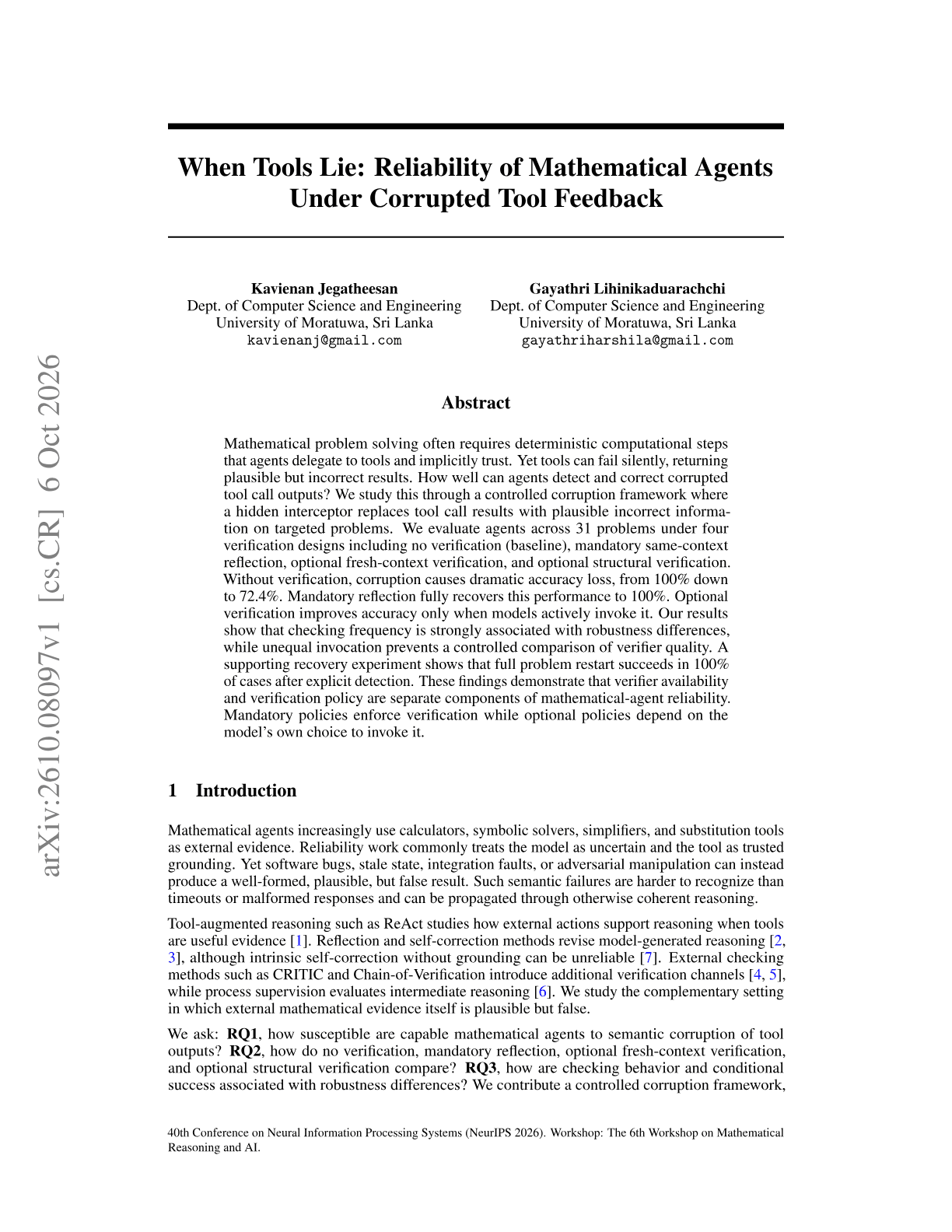
When Tools Lie: Reliability of Mathematical Agents Under Corrupted Tool Feedback
Kavienan Jegatheesan and Gayathri Lihinikaduarachchi (University of Moratuwa) test how math agents handle tool calls that silently return plausible wrong results, using a hidden interceptor that corrupts tool outputs.
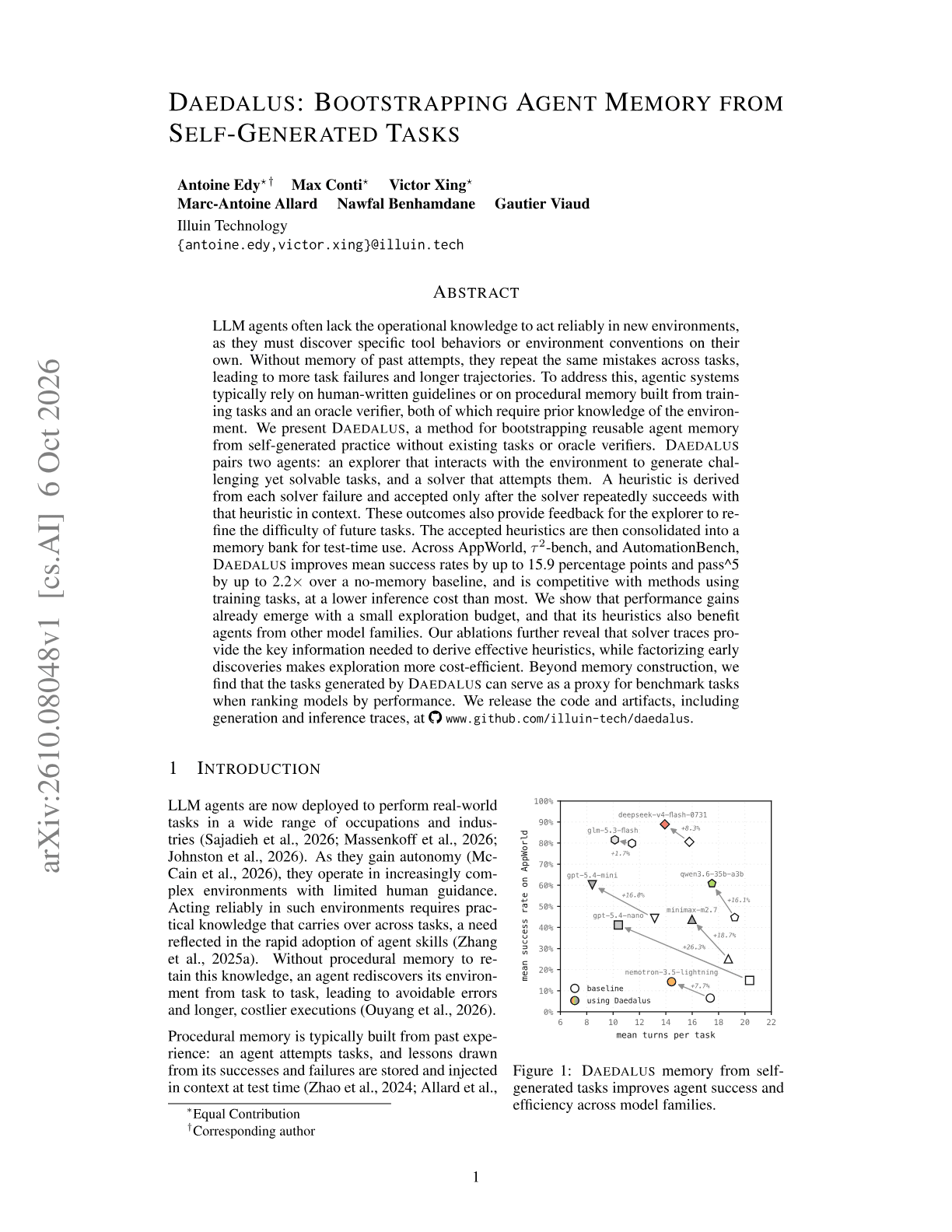
DAEDALUS: Bootstrapping Agent Memory from Self-Generated Tasks
Antoine Edy, Gautier Viaud and colleagues (Illuin Technology) present DAEDALUS, which builds reusable agent memory from self-generated practice tasks, with no training tasks or oracle verifier.
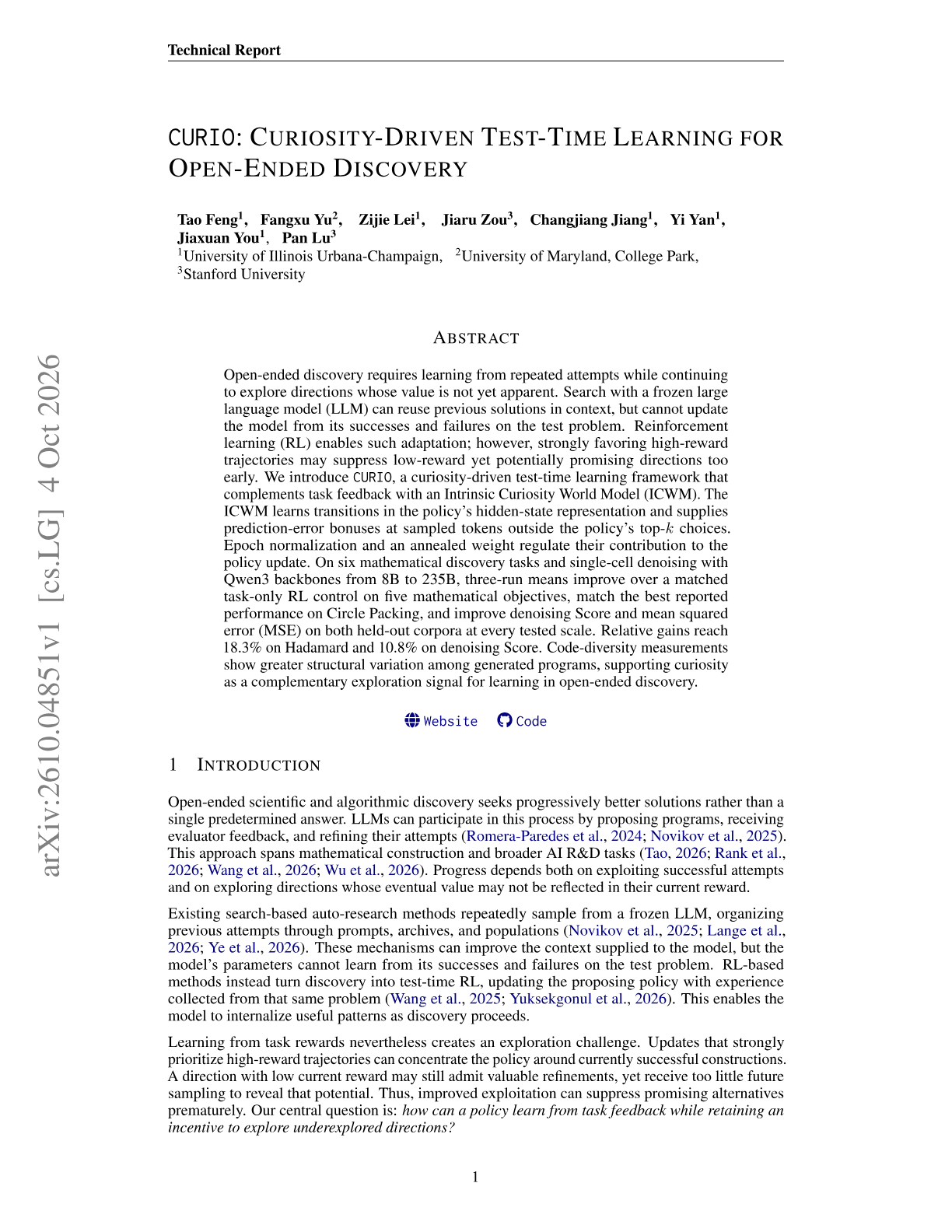
CURIO: Curiosity-Driven Test-Time Learning for Open-Ended Discovery
Tao Feng, Jiaxuan You (UIUC), Fangxu Yu (UMD), Pan Lu (Stanford) and colleagues introduce CURIO, a test-time RL method for open-ended discovery that adds a curiosity bonus so the policy keeps exploring directions that score low early.
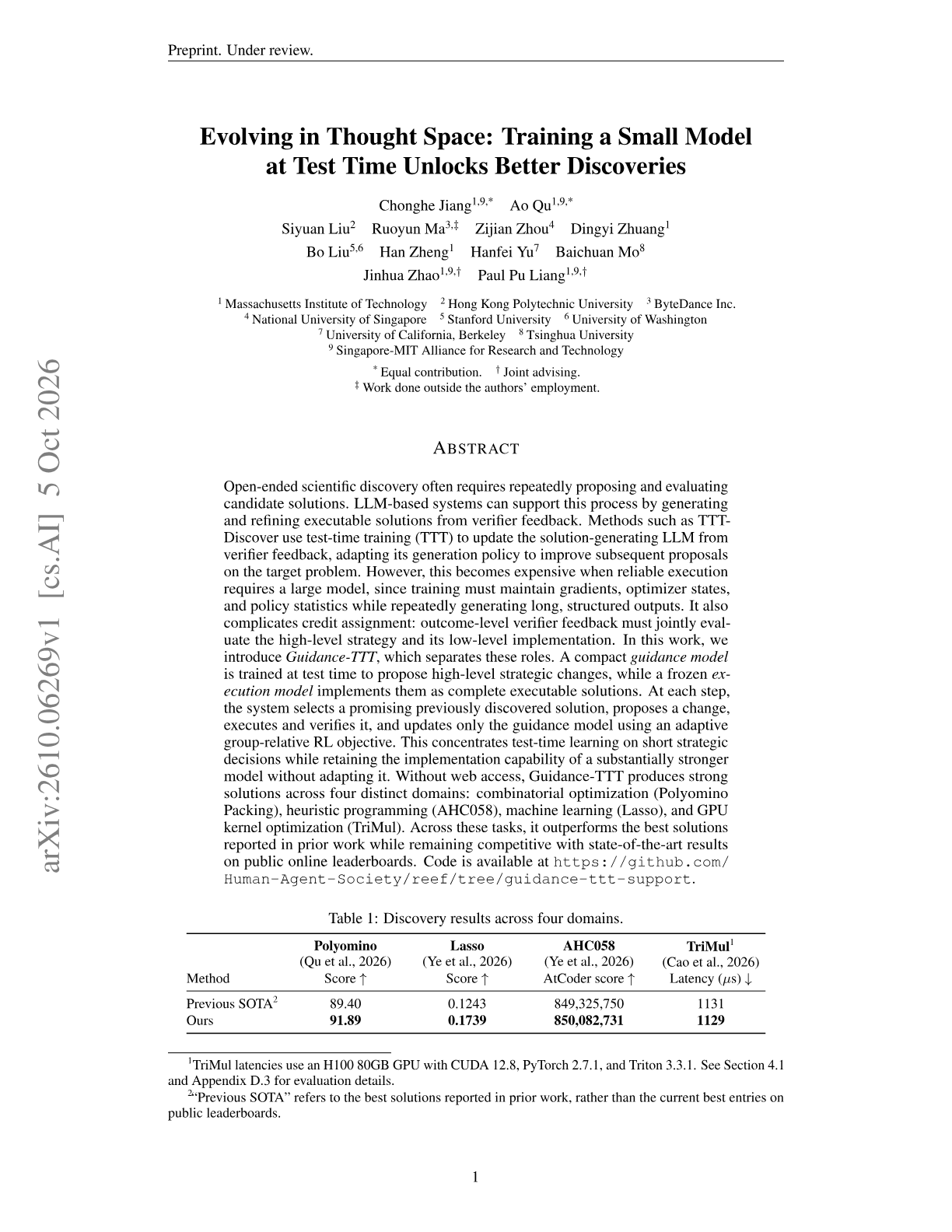
Evolving in Thought Space: Training a Small Model at Test Time Unlocks Better Discoveries
Chonghe Jiang, Ao Qu, Jinhua Zhao, Paul Pu Liang and colleagues (MIT, with Stanford, ByteDance, NUS and others) propose Guidance-TTT, which trains only a small guidance model at test time to propose strategy changes while a larger frozen model writes the executable solutions.
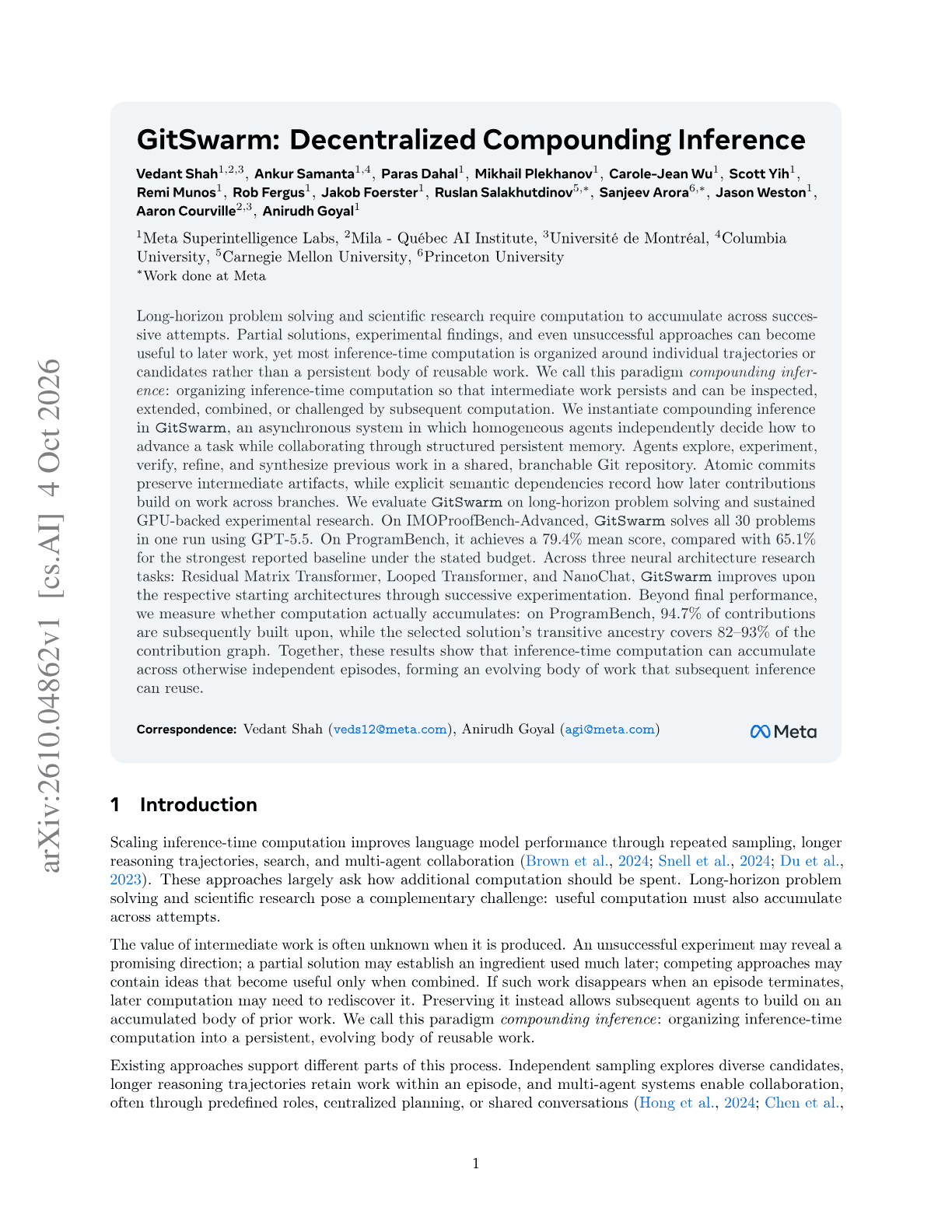
GitSwarm: Decentralized Compounding Inference
Researchers from Meta Superintelligence Labs and colleagues build GitSwarm, where hundreds of asynchronous agents share one Git repository and each contribution is a commit that records which earlier commits, on any branch, it builds on, with no central planner assigning work. With GPT-5.5 Codex workers it solves all 30 IMOProofBench-Advanced problems in one run and scores 79.4% on ProgramBench against 65.1% for a single Codex agent at a similar budget, rising from 73.1% at 100 workers to 79.4% at 500. Later workers build on 94.7% of published contributions, and 70.1% of failed research commits are cited by later accepted work.
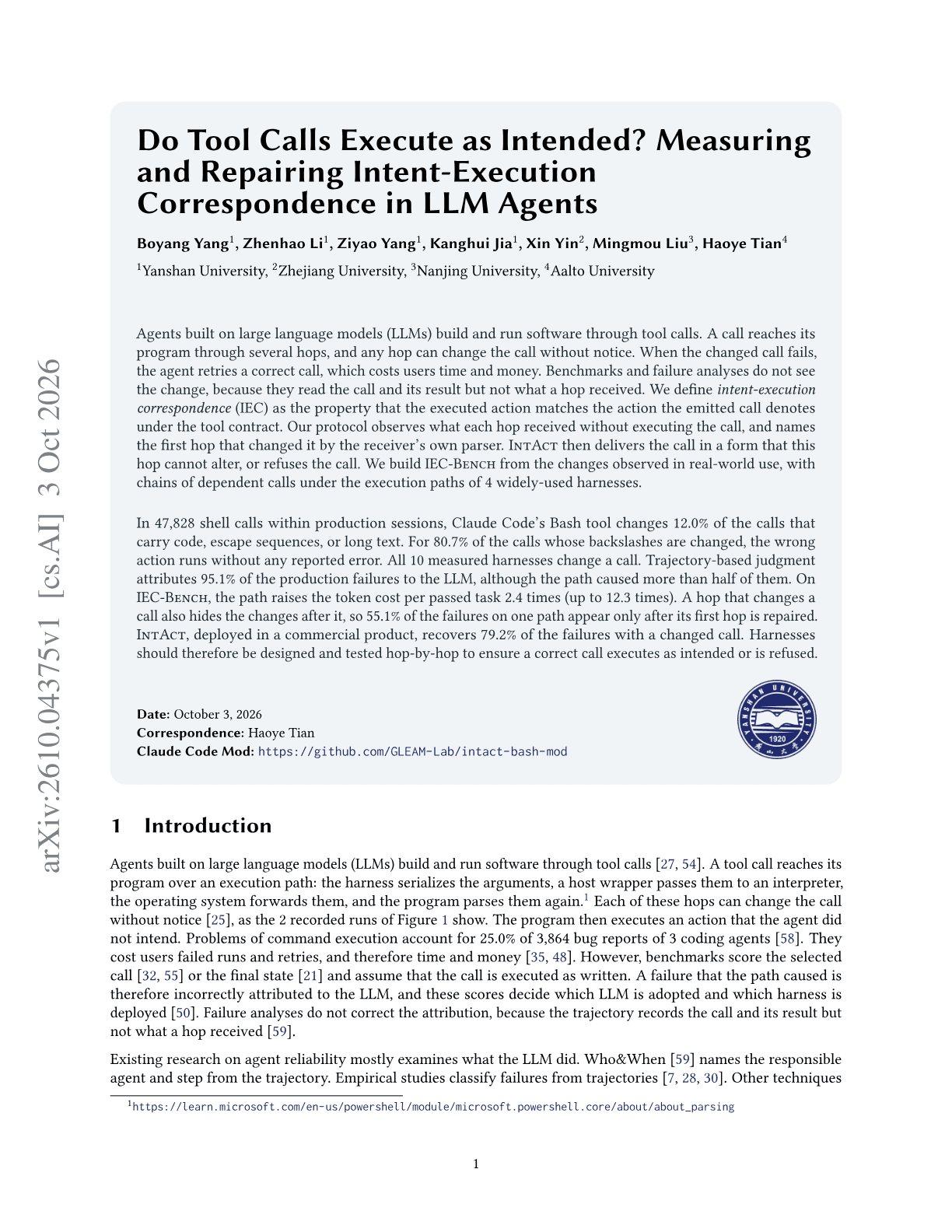
Do Tool Calls Execute as Intended? Measuring and Repairing Intent-Execution Correspondence in LLM Agents
Boyang Yang, Haoye Tian (Aalto) and colleagues at Yanshan, Zhejiang and Nanjing universities define intent-execution correspondence, the property that the command a tool call denotes is the command that actually runs, and measure how often agent harnesses break it.
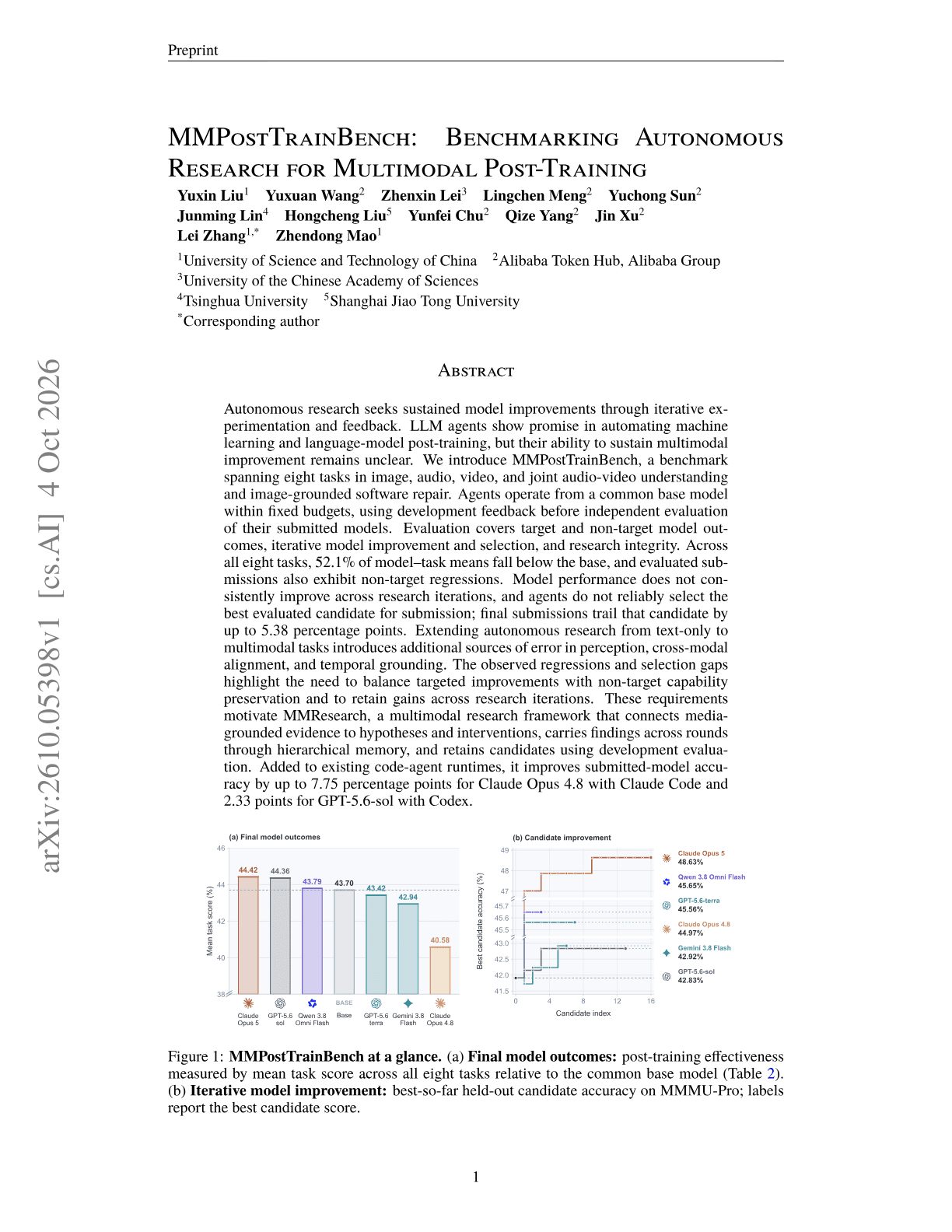
MMPostTrainBench: Benchmarking Autonomous Research for Multimodal Post-Training
Yuxin Liu, Zhendong Mao (USTC) and colleagues at Alibaba Group, Tsinghua and SJTU introduce MMPostTrainBench, which tests whether research agents can improve a multimodal model through post-training within a fixed budget, and propose the MMResearch framework to reduce the failures it finds.
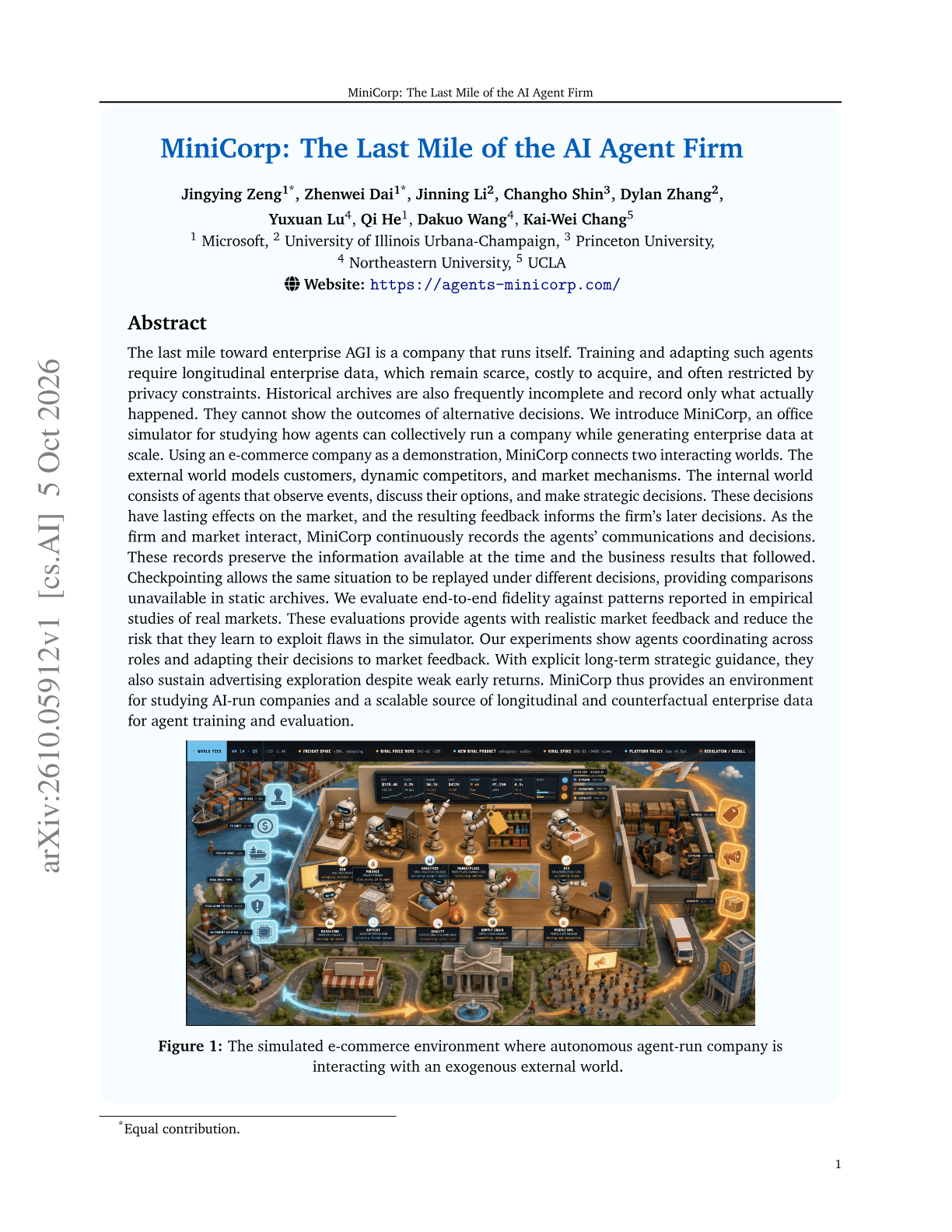
MiniCorp: The Last Mile of the AI Agent Firm
Jingying Zeng, Kai-Wei Chang, Dakuo Wang and colleagues (Microsoft, UIUC, Princeton, Northeastern, UCLA) build MiniCorp, a closed-loop office simulator where an agent-run e-commerce firm competes in a simulated market, as a source of longitudinal and counterfactual enterprise data for training agents.