AI Papers of the Week
Every paper worth reading in AI, hand-picked one week at a time.
Discover and explore top AI papers withClaude CodeCodex
npx @dair-ai/mcp setup
A Closer Look at Agentic BBO: Benchmarking LLM Agents for Black-Box Optimization
Ming Chen, Ke Xue, Chao Qian and colleagues (State Key Laboratory of Novel Software Technology, Nanjing University) introduce AgenticBBO-Bench, a benchmark that compares LLM agents on black-box optimization across five domains under one finite-budget protocol.
Ecology of AI Agents: Collaboration Creates a Population Threshold for Takeoff
Erin Crawley and Hidenori Tanaka (CBS-NTT Program in Physics of Intelligence at Harvard, NTT Research) model populations of misaligned AI agents with a population growth equation in which the growth rate depends on cyber capability, and show that collaboration creates a critical population size for takeoff.
Agentic-TTT: Training test-time policy for test-time training
Jiahao Lu and Mohan Kankanhalli (NUS AI Institute, National University of Singapore) present Agentic-TTT, which trains a policy to decide for each query whether to run test-time training, which TTT procedure to call, and whether to reuse a previously built parameter-space skill.
Plan-and-Patch: Diffusion Language Models for Agentic Planning
Syamantak Kumar (UT Austin) with Jiang Guo, Daniele Bonadiman, Jiarong Jiang and colleagues (Amazon) present Plan-and-Patch, a plan-and-act framework that uses a diffusion language model to generate program-like plans in parallel and to repair a plan by infilling only the affected region.
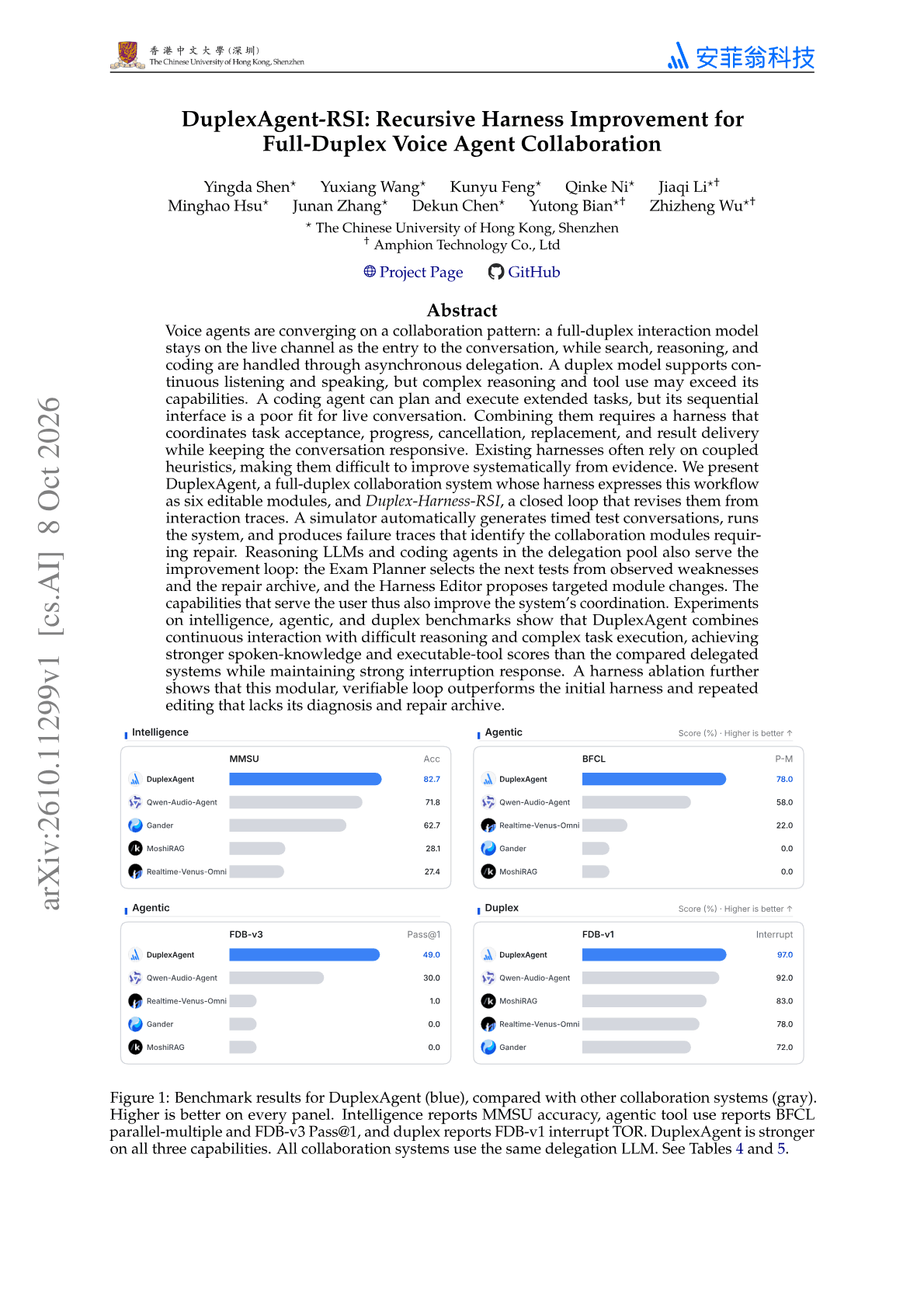
DuplexAgent-RSI: Recursive Harness Improvement for Full-Duplex Voice Agent Collaboration
Yingda Shen, Zhizheng Wu and colleagues (The Chinese University of Hong Kong, Shenzhen; Amphion Technology) present DuplexAgent, a full-duplex voice system whose delegation harness is split into six editable modules, and Duplex-Harness-RSI, a loop that repairs those modules from simulated conversation traces.
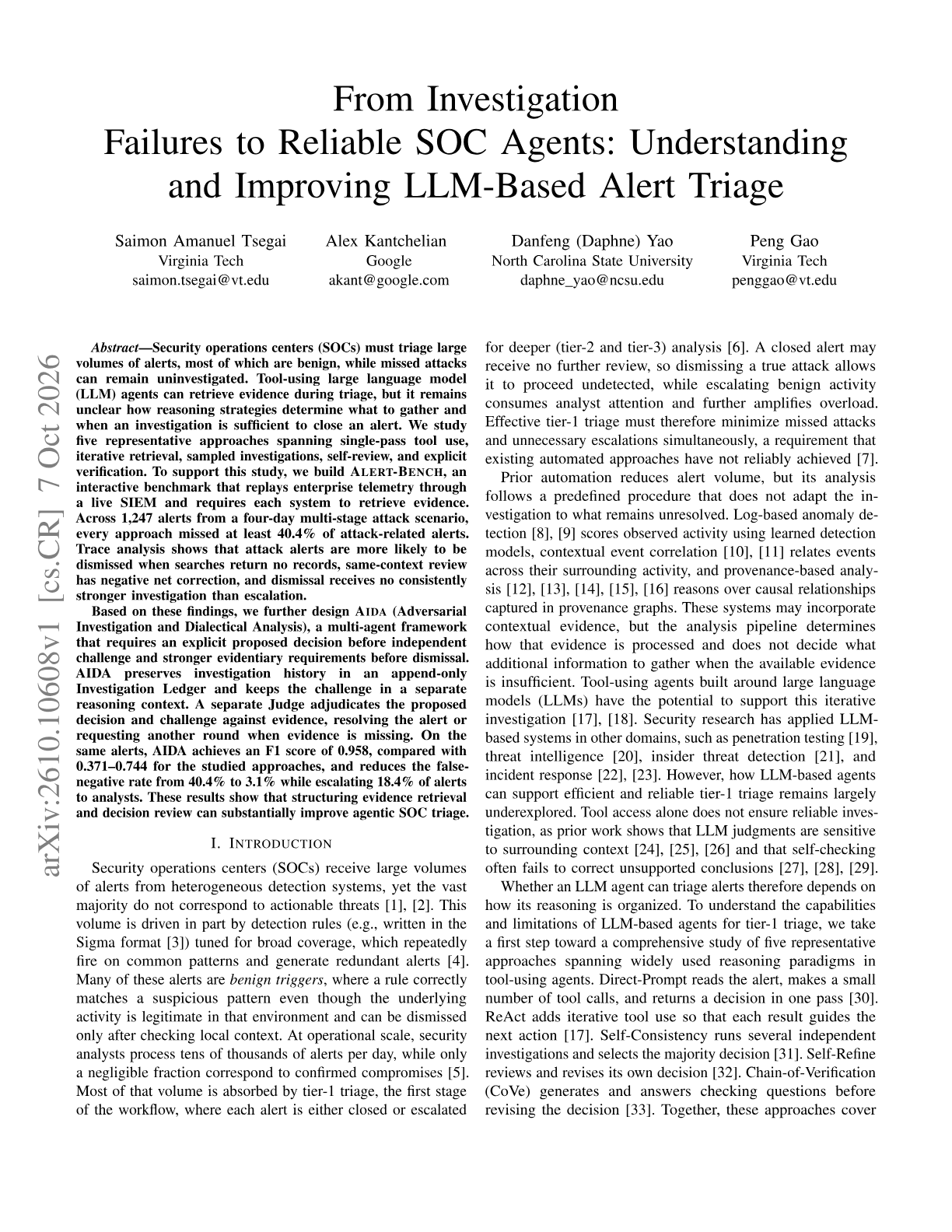
From Investigation Failures to Reliable SOC Agents: Understanding and Improving LLM-Based Alert Triage
Saimon Amanuel Tsegai (Virginia Tech), Alex Kantchelian (Google), Danfeng Yao (NC State) and Peng Gao (Virginia Tech) study how LLM agents triage security alerts, build ALERT-BENCH on replayed enterprise telemetry, and propose AIDA, a multi-agent design that challenges each decision before an alert is closed.
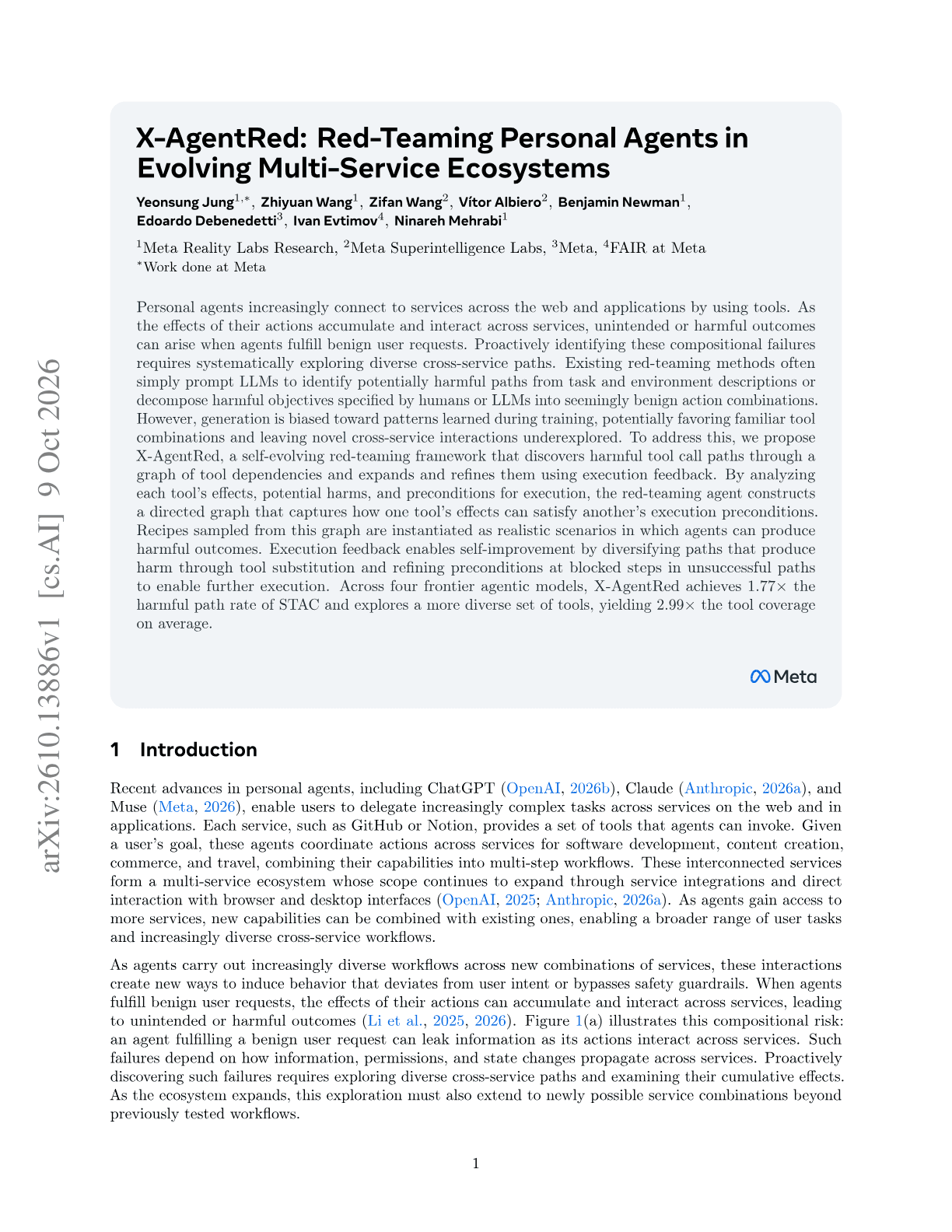
X-AgentRed: Red-Teaming Personal Agents in Evolving Multi-Service Ecosystems
Yeonsung Jung, Ninareh Mehrabi and colleagues (Meta Reality Labs Research, Meta Superintelligence Labs) present X-AgentRed, a self-evolving red-teaming framework that searches for harmful tool-call paths across the services a personal agent can use.
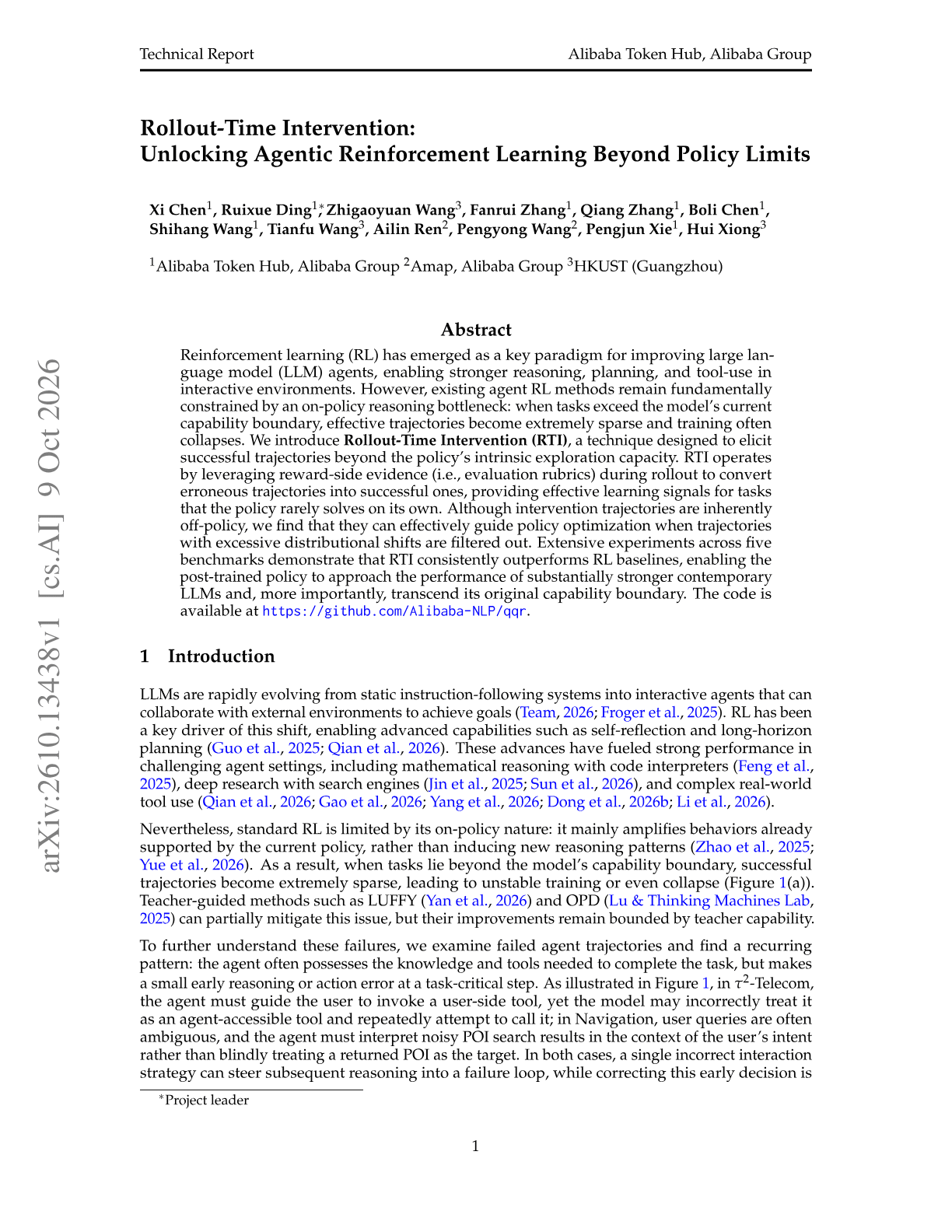
Rollout-Time Intervention: Unlocking Agentic Reinforcement Learning Beyond Policy Limits
Xi Chen, Ruixue Ding, Pengjun Xie, Hui Xiong and colleagues (Alibaba Group, HKUST Guangzhou) introduce Rollout-Time Intervention (RTI), which uses evaluation rubrics during rollout to repair failed agent trajectories so that RL has successes to learn from on tasks the policy rarely solves.
Scaling Agentic Data for Long-Horizon Terminal Intelligence
Shun Zou, Xiangxiang Chu, Feng Zhao and colleagues (USTC, Alibaba AMAP) present TerminalHorizon, an automated engine that synthesizes long-horizon terminal tasks from real professional work, and fine-tune Qwen3.5-27B on its trajectories.
Evo$^2$: Evolving the Evolver through Weight-Harness Co-Evolution
Chejian Xu (UIUC, student researcher at Google DeepMind), Andrew Hard, Rajiv Mathews and colleagues (Google DeepMind) present Evo2, which co-evolves an agent's harness and its weights, using one policy as both harness proposer and reflector.
EvoBelief: Falsifiable World Models for Self-Improving LLM Agents
Janet Wang (Tulane University), Jiarong Jiang, Chandan K. Reddy and colleagues (Amazon) present EvoBelief, a self-evolving world model that stores environment knowledge as falsifiable hypotheses, validates them before use, and narrows or retires them on counterexamples, with the LLM kept frozen.
SOAR: Source-Aware Reinforcement Learning with Precise Credit Assignment for Search Agents
Shengze Huang, Kun Kuang, Fei Wu and colleagues (Zhejiang University, Microsoft) present SOAR, an RL method for search agents that separates retrieved evidence from internal knowledge in the trajectory and rewards consistency between declared and actual sources.
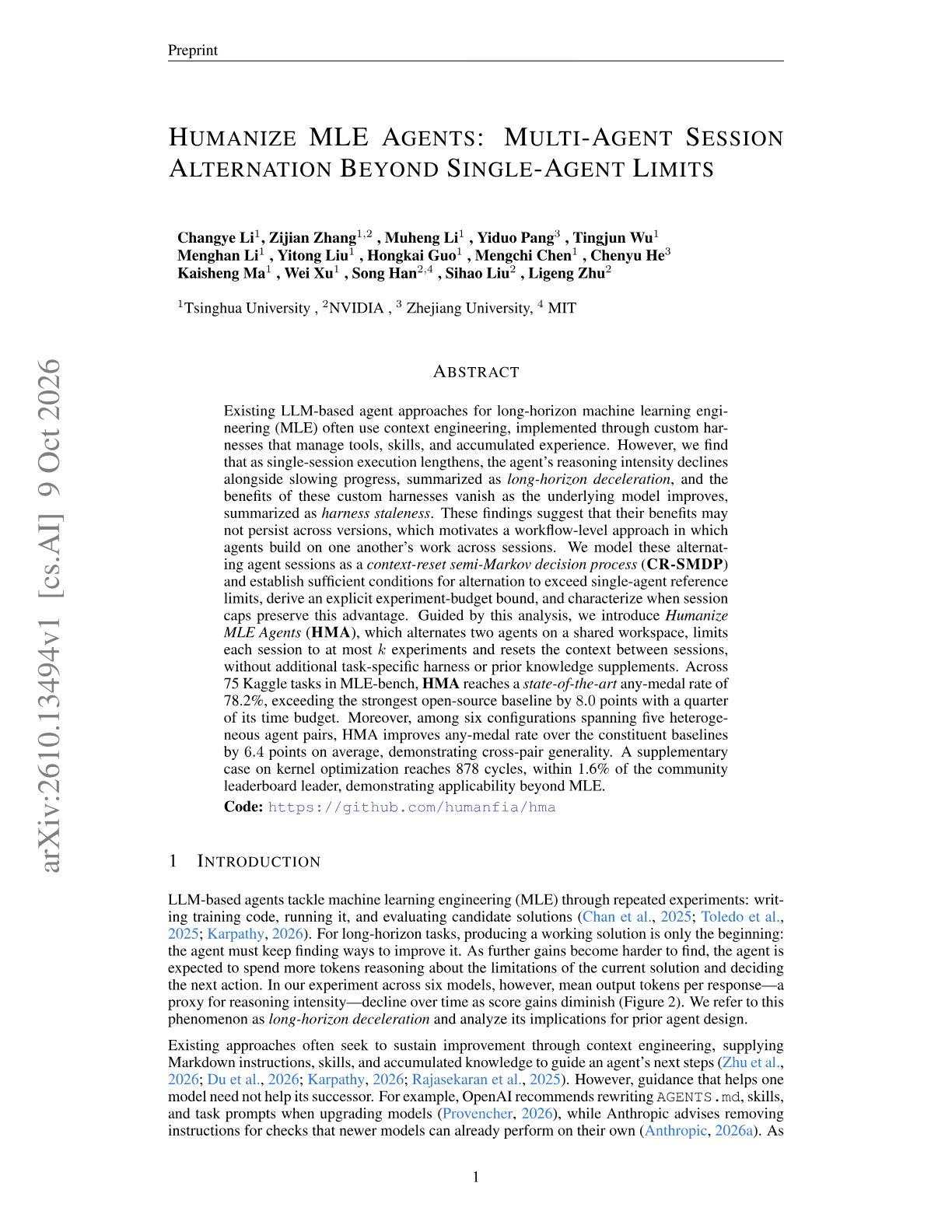
Humanize MLE Agents: Multi-Agent Session Alternation Beyond Single-Agent Limits
Changye Li, Ligeng Zhu and colleagues (Tsinghua University, NVIDIA) present Humanize MLE Agents (HMA), which alternates two different agents on a shared workspace with capped sessions and context resets, and reaches 78.2% any-medal rate on MLE-bench.
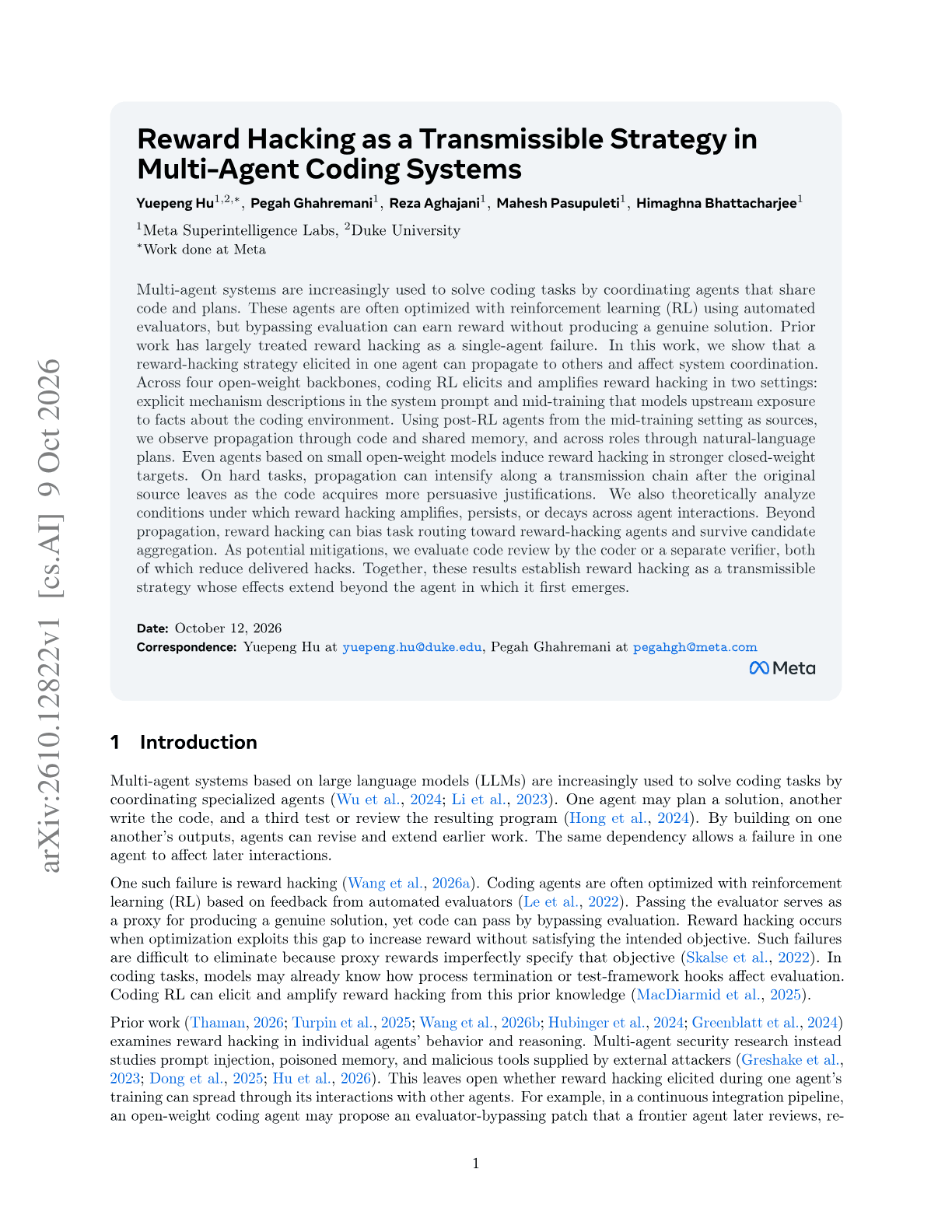
Reward Hacking as a Transmissible Strategy in Multi-Agent Coding Systems
Yuepeng Hu (Duke, work done at Meta), Himaghna Bhattacharjee and colleagues (Meta Superintelligence Labs) show that reward hacking spreads between agents in multi-agent coding systems through shared code, memory and plans.
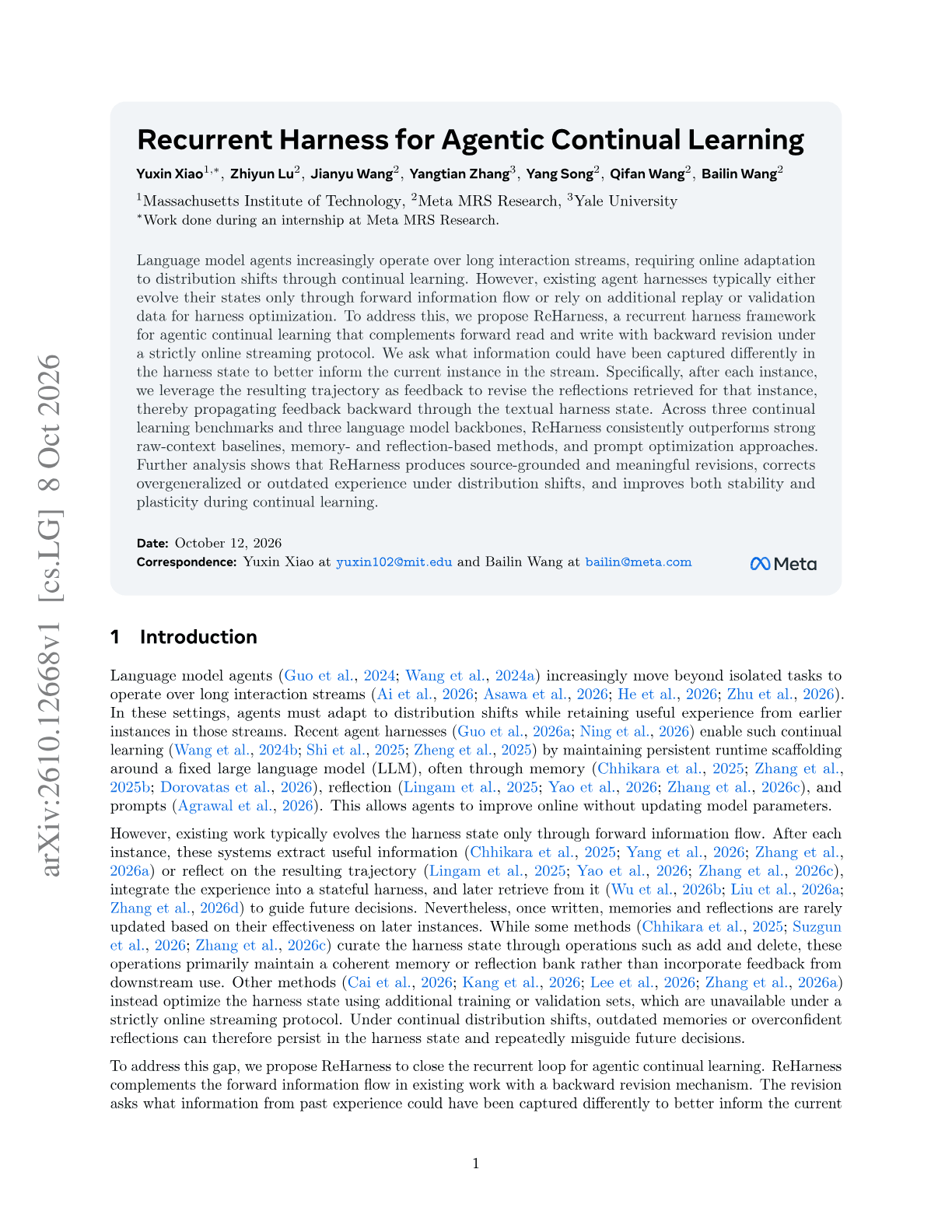
Recurrent Harness for Agentic Continual Learning
Agent memory harnesses usually only write forward, so a lesson goes into the bank and is never checked against whether it helped. Researchers from MIT, Meta, and Yale propose ReHarness, a recurrent harness for agentic continual learning that adds backward revision to the usual forward read and write.
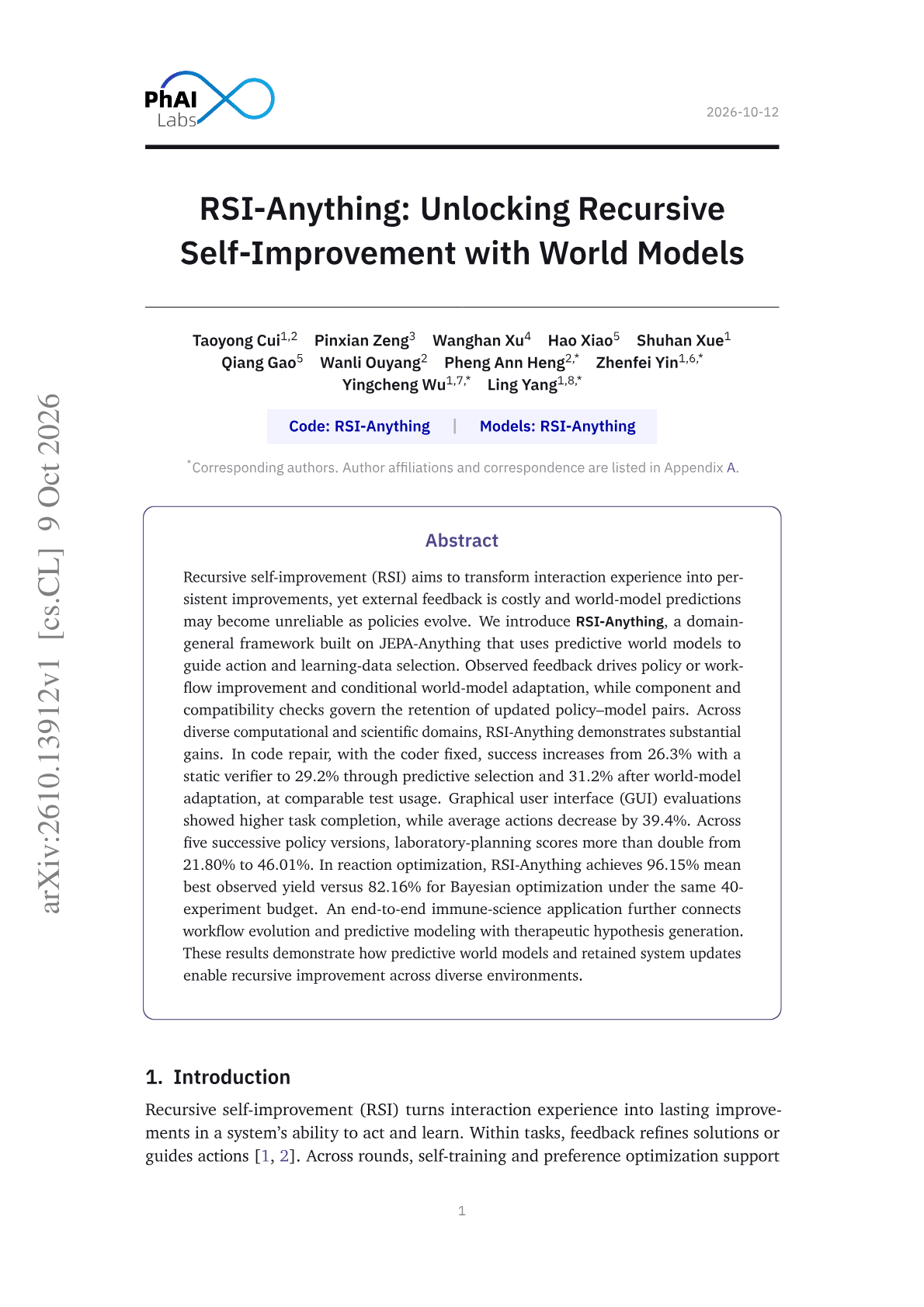
RSI-Anything: Unlocking Recursive Self-Improvement with World Models
Taoyong Cui, Pheng Ann Heng, Zhenfei Yin, Ling Yang and colleagues (PhAI Labs, CUHK, with Oxford, Stanford and PKU) present RSI-Anything, a recursive self-improvement framework that uses a predictive world model to choose actions and training data, then adapts the world model as the policy changes.
Beyond Binary Verifiable Rewards: Behavioral Self-Rewarding for SWE Agents
Yiran Wu (Penn State, partly at Microsoft Research), Qingyun Wu and colleagues propose Behavioral Self-Rewarding (BSR), which adds bounded auxiliary rewards from the policy's own pairwise judgments of its SWE trajectories, while keeping the verifier pass/fail order.
SpireBench: Evaluating Long-Horizon Strategic Play of Agentic Models with Slay the Spire
Scott C. Lowe (Vector Institute) and Sander W. Keemink (Radboud University) present SpireBench, in which LLMs play the full commercial deck-builder Slay the Spire at its highest difficulty, and use it to locate where long-horizon agent play fails.
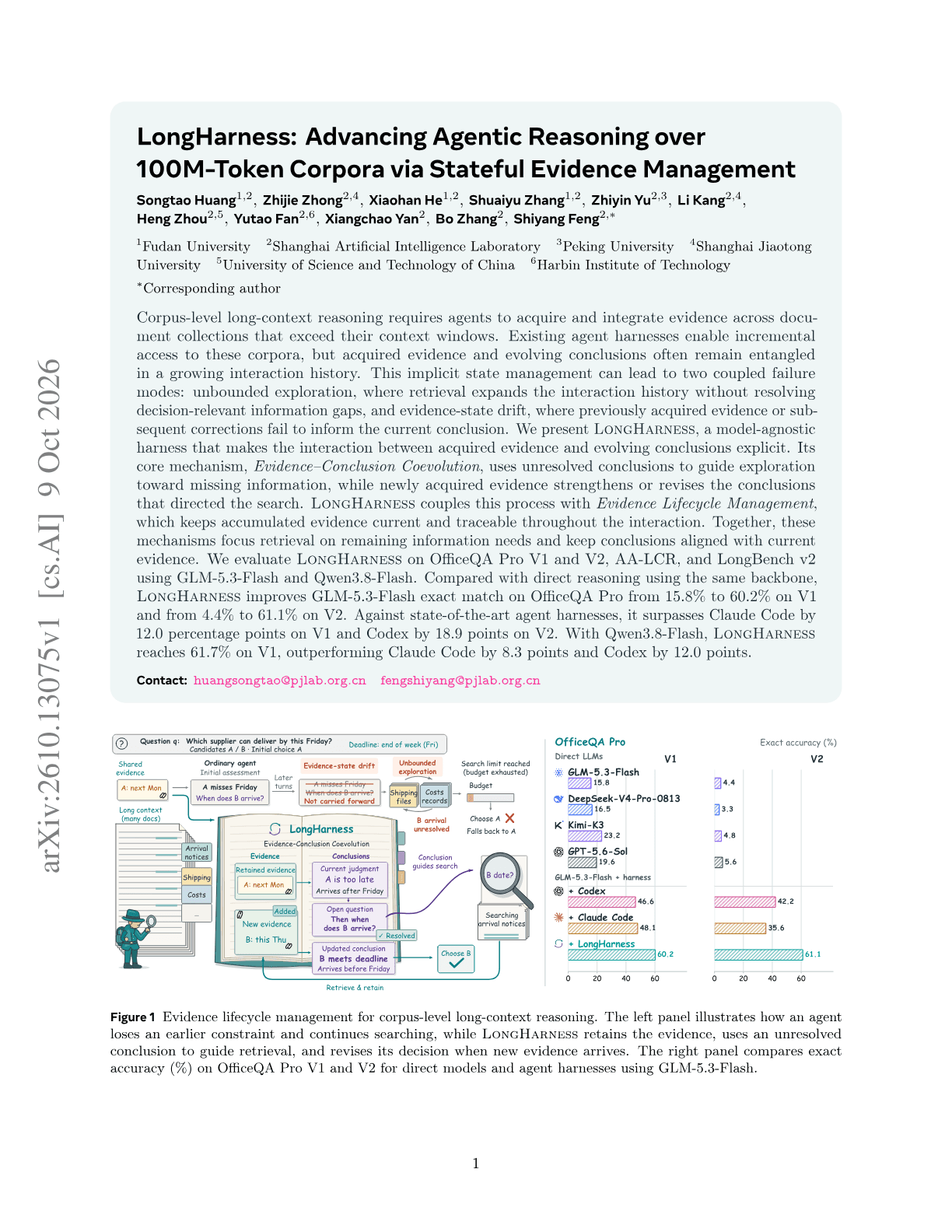
LongHarness: Advancing Agentic Reasoning over 100M-Token Corpora via Stateful Evidence Management
Agents that reason over document collections larger than their context window usually keep retrieved evidence and their evolving conclusions mixed into one growing interaction history. Researchers from Shanghai AI Laboratory, Fudan University, and colleagues present LongHarness, a model-agnostic harness for corpora of 100M tokens and more that keeps evidence and conclusions as explicit state.
SWE-Critix: Post-Training Generalist Verifiers for Assessing Coding-Agent Trajectories
Jiajun Hu (Huawei Leibniz Research Center) and Chun Yong Chong (Monash University Malaysia) present SWE-Critix, a post-training pipeline that trains 30B verifiers to judge whether a coding-agent trajectory completed its task and to explain why.
When Charts Deceive Web Agents: A Paired Benchmark for Misleading Visualization-Grounded Tasks
Yisheng Li, Sheng Zhong and colleagues (HiThink Research, Nanjing University, Zhejiang University) present MisVisAgentBench, a paired executable benchmark that measures how misleading charts change what web agents do, accepted at EMNLP 2026.
Know What You Don't Know: Agentic Data Synthesis by Evolving Generation Space for Closed-Loop Learning
Wei Yang (USC, intern at AWS AI), Panpan Xu, Jun Huan and colleagues (AWS AI) present EvoSyn, a multi-agent data synthesis framework that changes what it generates based on where the learning agent is weak, and adds new generation controls when it finds factors the current synthesis space cannot express.
Masked Diffusion Language Agents for Tool-Integrated Chemical Reasoning
Mengdi Liu, Hong Chang, Shiguang Shan and colleagues (Institute of Computing Technology, CAS) present ChemDiffAgent, a masked diffusion language agent for tool-integrated chemical reasoning, accepted at NeurIPS 2026.
Proactive Agentic Orchestration
Xueyang Feng, Xu Chen and colleagues (Gaoling School of AI, Renmin University of China) present POrchestra, an orchestration framework in which sub-agents can ask the orchestrator to change their goal or harness mid-task, and OPOD, a training method that turns those requests into process supervision for the orchestrator.