AI Papers of the Week
Every paper worth reading in AI, hand-picked one week at a time.
Discover and explore top AI papers withClaude CodeCodex
npx @dair-ai/mcp setup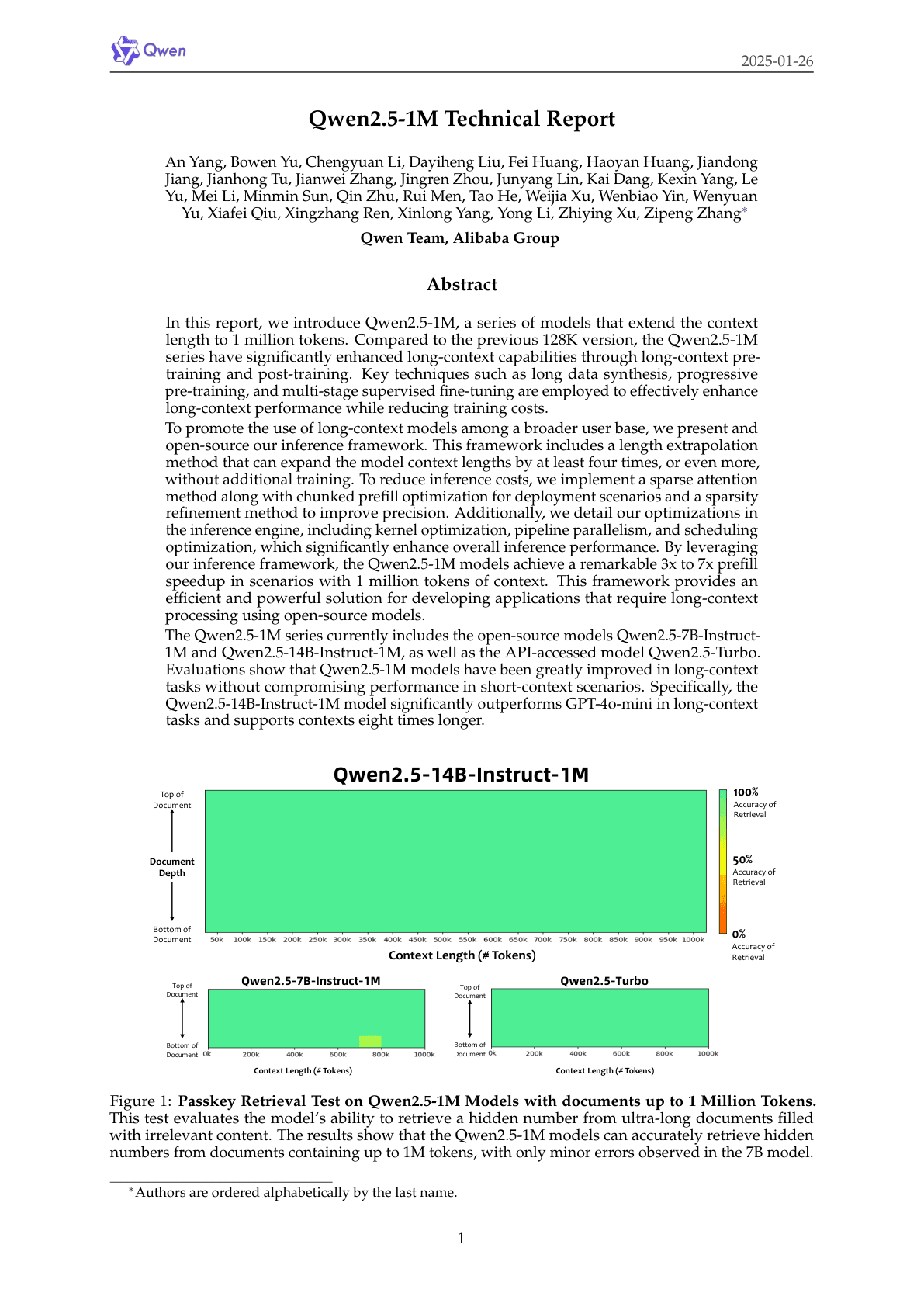
Qwen2.5-1M
Qwen releases two open-source LLMs, Qwen2.5-7B-Instruct-1M and Qwen2.5-14B-Instruct-1M, that can handle context lengths of up to 1 million tokens. The models are built on a progressive training approach, starting with 4K tokens and gradually increasing to 256K tokens, then using length extrapolation techniques to reach 1M tokens. They've also released an inference framework based on vLLM that processes long inputs 3-7x faster through sparse attention methods. The models show strong performance on both long-context and short-text tasks. The 14B model outperforms GPT-4o-mini across multiple long-context datasets while maintaining similar performance on shorter tasks.
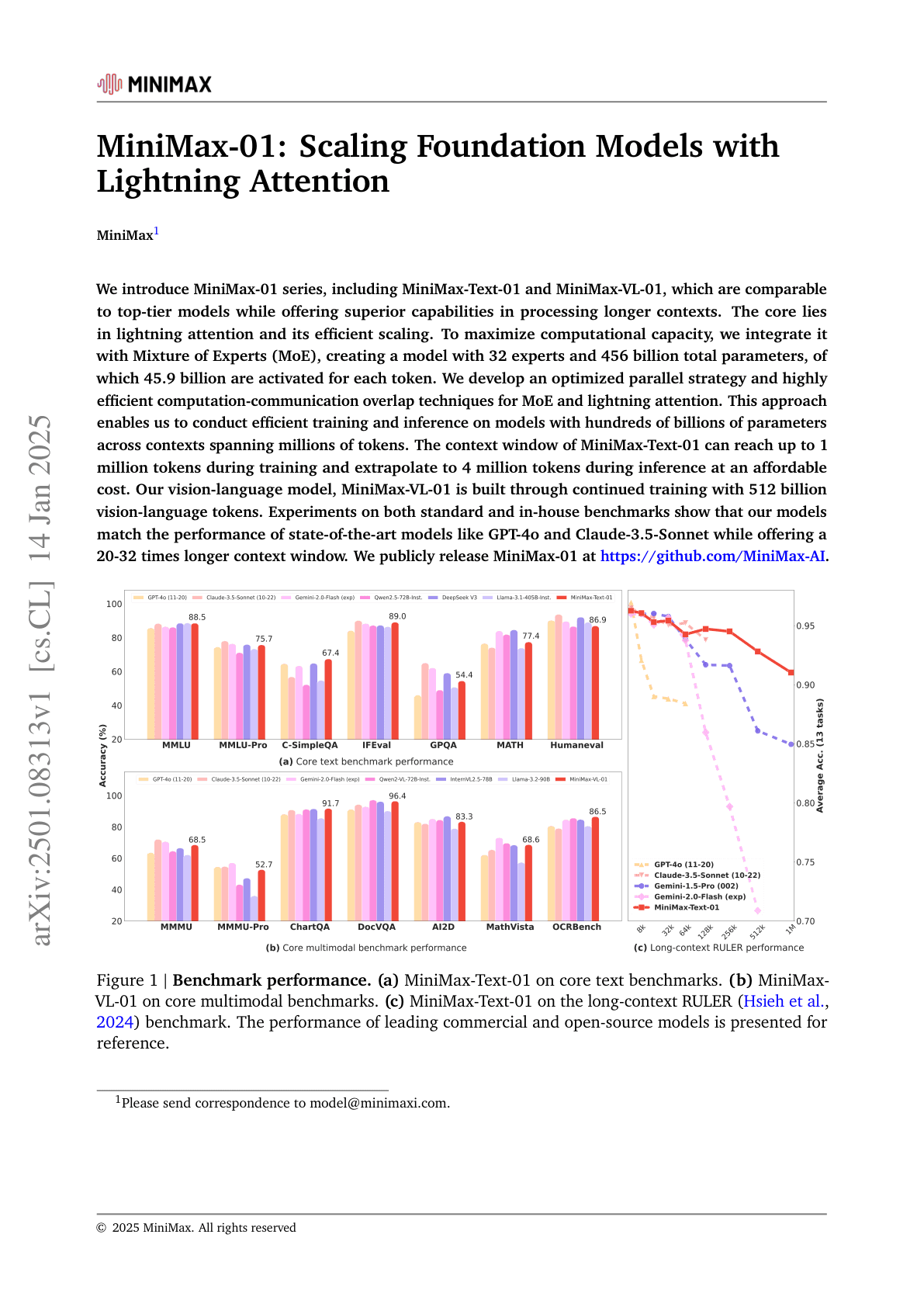
MiniMax-01
introduces a new series of models that integrate Mixture-of-Experts; introduces a model with 32 experts and 456B parameters, and 45.9B are activated for each token; claims match the performance of state-of-the-art models like GPT-4o and Claude-3.5-Sonnet while offering a 20-32x longer context window; it can handle context windows of up to 4 million tokens; it integrates linear attention with optimized hardware utilization which enhances the efficiency and scalability of the LLM; there is also a vision model called MiniMax-VL-01 built through continued training with 512 billion vision-language tokens.
Learning to Memorize at Test Time
introduces a neural long-term memory module to memorize historical context and help attention to attend to the current context while utilizing long past information; the neural memory module acts as a long-term, more persistent memory than just using attention alone (considered more short-term); Titan, which is based on neural memory, shows good results in language modeling, common-sense reasoning, genomics, and time series tasks.
Cache-Augmented Generation (CAG)
an approach that aims to leverage the capabilities of long-context LLMs by preloading the LLM with all relevant docs in advance and precomputing the key-value (KV) cache; the preloaded context helps the model to provide contextually accurate answers without the need for additional retrieval during runtime; the authors suggest that CAG is a useful alternative to RAG for cases where the documents/knowledge for retrieval are of limited, manageable size.
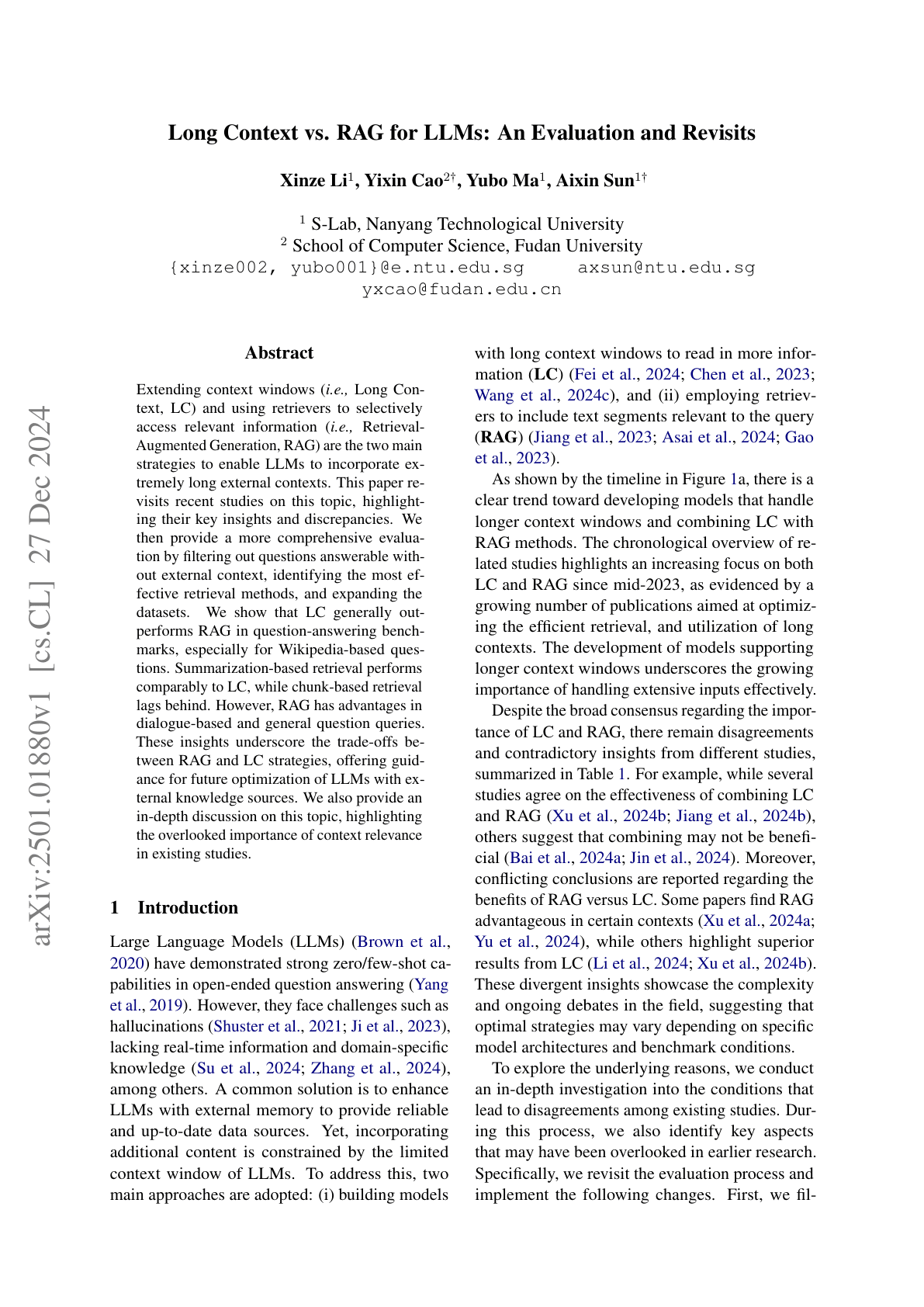
Long Context vs. RAG for LLMs
performs a comprehensive evaluation of long context (LC) LLMs compared to RAG systems; the three main findings are: 1) LC generally outperforms RAG in question-answering benchmarks, 2) summarization-based retrieval performs comparably to LC, while chunk-based retrieval lags behind, and 3) RAG has advantages in dialogue-based and general question queries
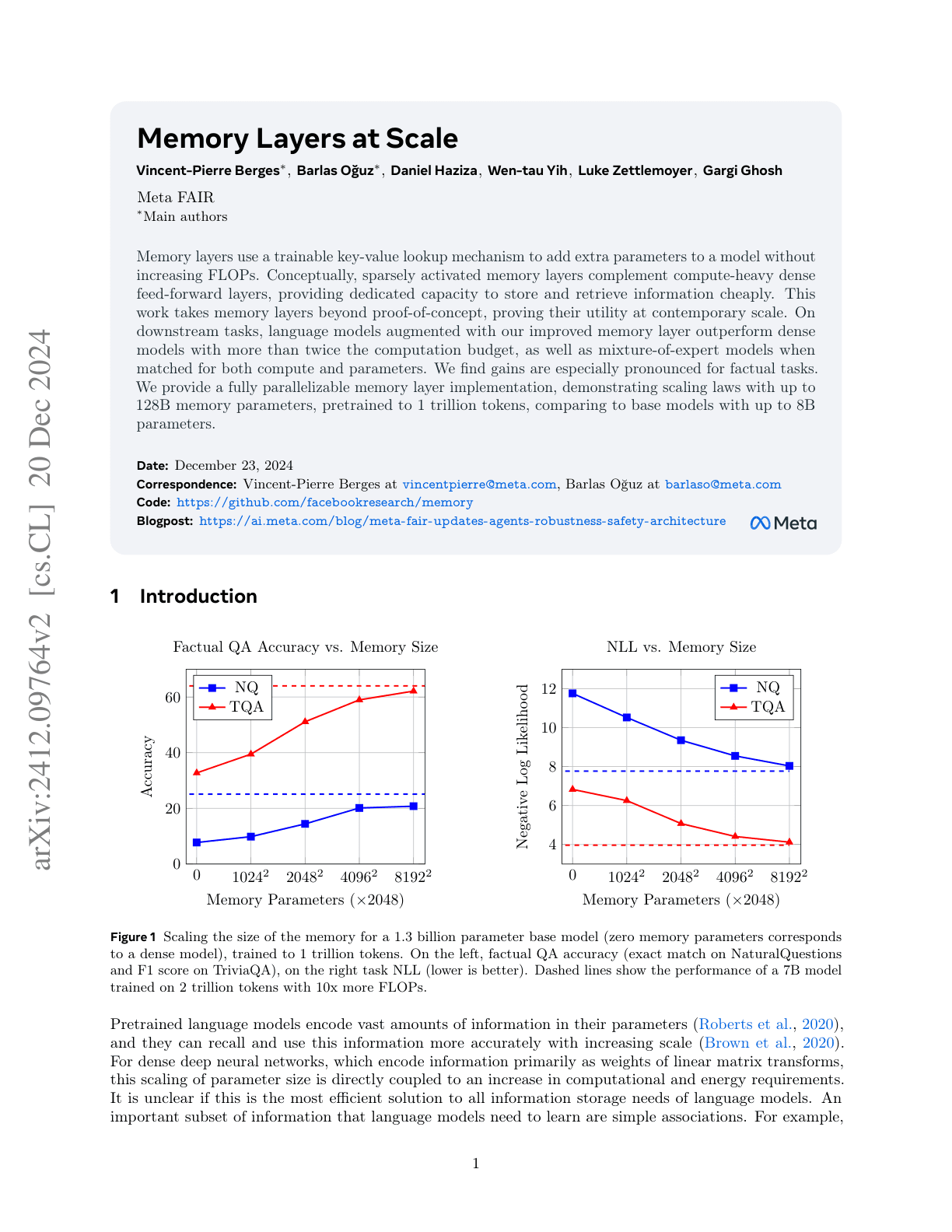
Memory Layers at Scale
demonstrates the effectiveness of memory layers at scale; shows that models with these memory layers outperform traditional dense models using half the computation, particularly in factual tasks; includes a parallelizable memory layer implementation that scales to 128B memory parameters and 1 trillion training tokens, tested against base models up to 8B parameters.
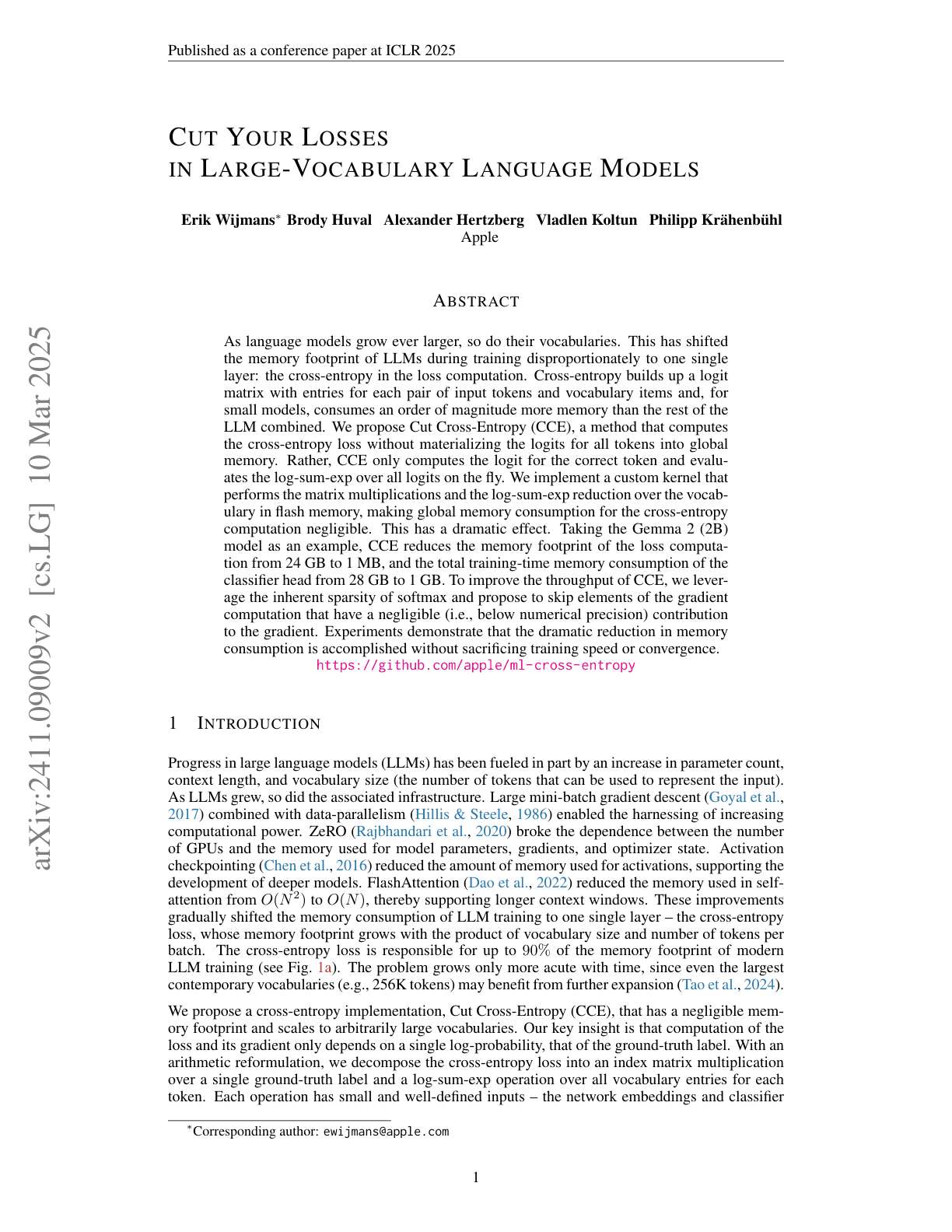
Cut Your Losses in Large-Vocabulary Language Models
introduces Cut Cross-Entropy (CCE), a novel method to significantly reduce memory usage during LLM training by optimizing how the cross-entropy loss is computed; currently, the cross-entropy layer in LLM training consumes a disproportionate amount of memory (up to 90% in some models) due to storing logits for all possible vocabulary tokens. CCE addresses this by only computing logits for the correct token and evaluating the log-sum-exp over all logits on the fly using flash memory; the authors show that the approach reduces the memory footprint of Gemma 2 from 24GB to just 1MB; the method leverages the inherent sparsity of softmax calculations to skip elements that contribute negligibly to gradients; finally, it demonstrates that CCE achieves this dramatic memory reduction without sacrificing training speed or convergence, enabling larger batch sizes during training and potentially more efficient scaling of LLM training.
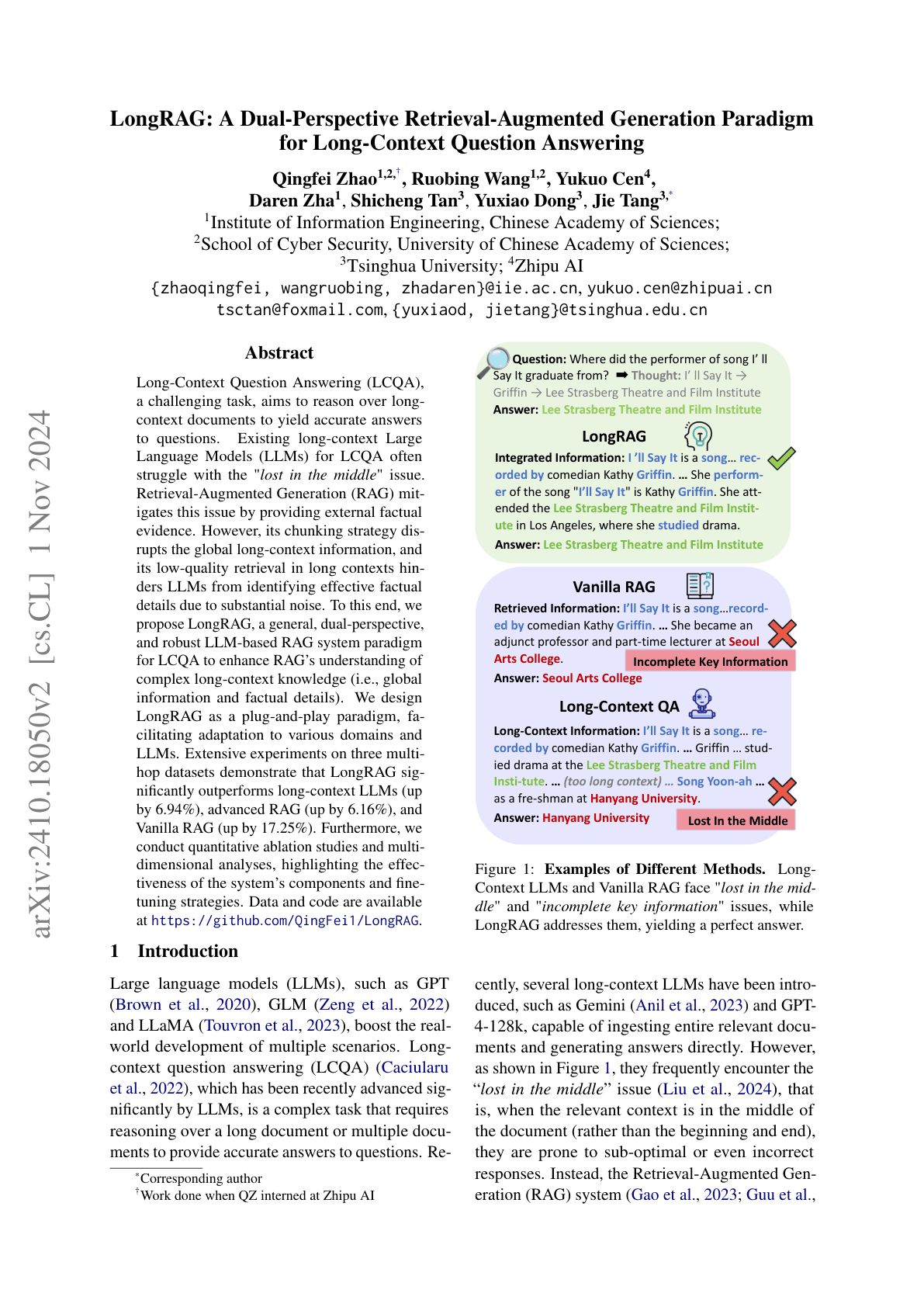
LongRAG
enhances RAG's understanding of long-context knowledge which includes global information and factual details; consists of a hybrid retriever, an LLM-augmented information extractor, a CoT-guided filter, and an LLM-augmented generator; these are key components that enable the RAG system to mine global long-context information and effectively identify factual details; LongRAG outperforms long-context LLMs (up by 6.94%), advanced RAG (up by 6.16%), and Vanilla RAG (up by 17.25%).
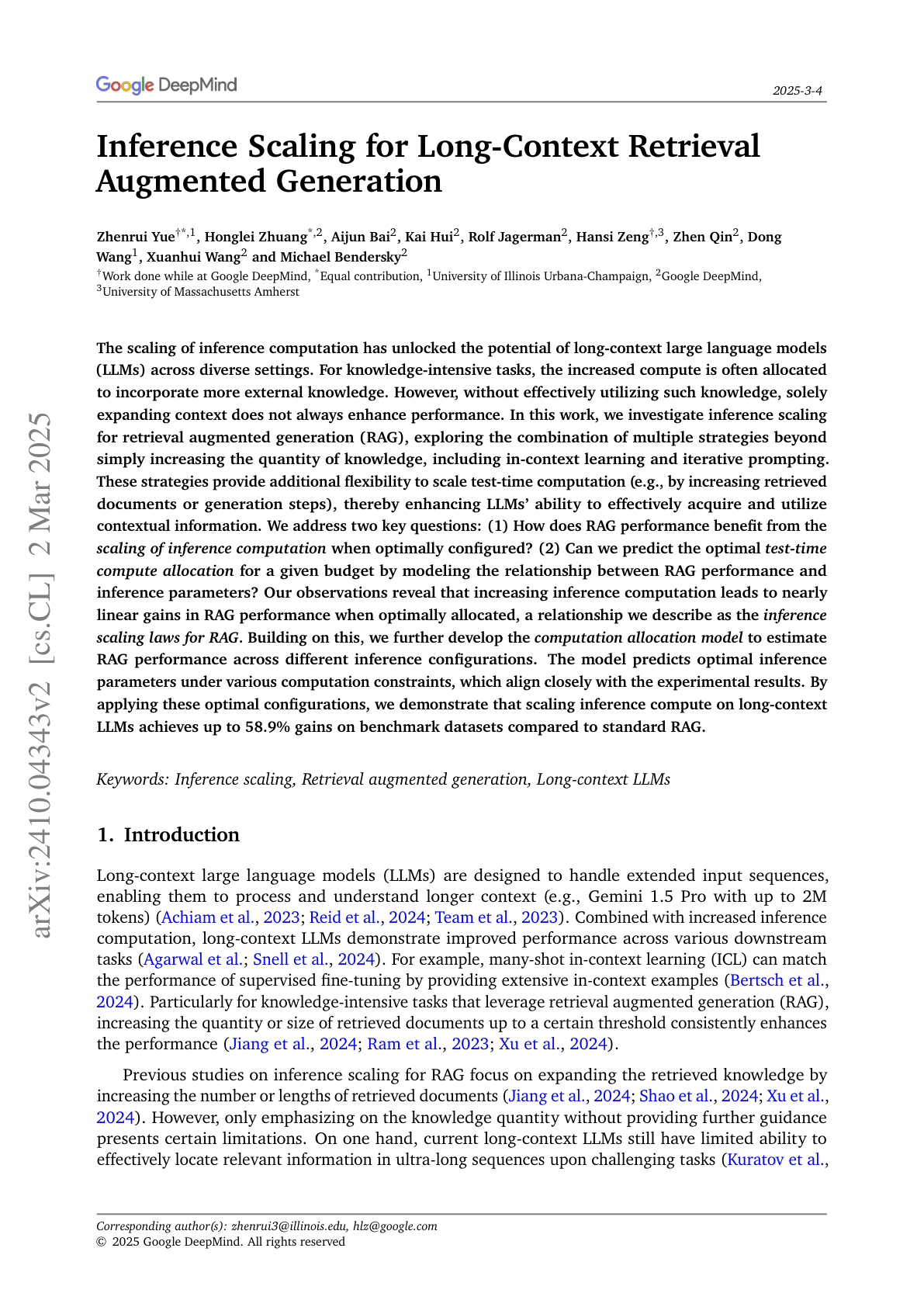
Inference Scaling for Long-Context RAG
uses two strategies to investigate scaling laws for RAG: in-context learning (DRAG) and iterative prompting (IterRAG); finds that RAG performance consistently improves with the expansion of the effective context length under optimal configurations; when optimally allocated, increasing inference computation can lead to linear gains in long-context RAG performance; this leads to the development of a computation allocation model that can provide practical guidance for optimal computation allocation in long-context RAG scenarios.
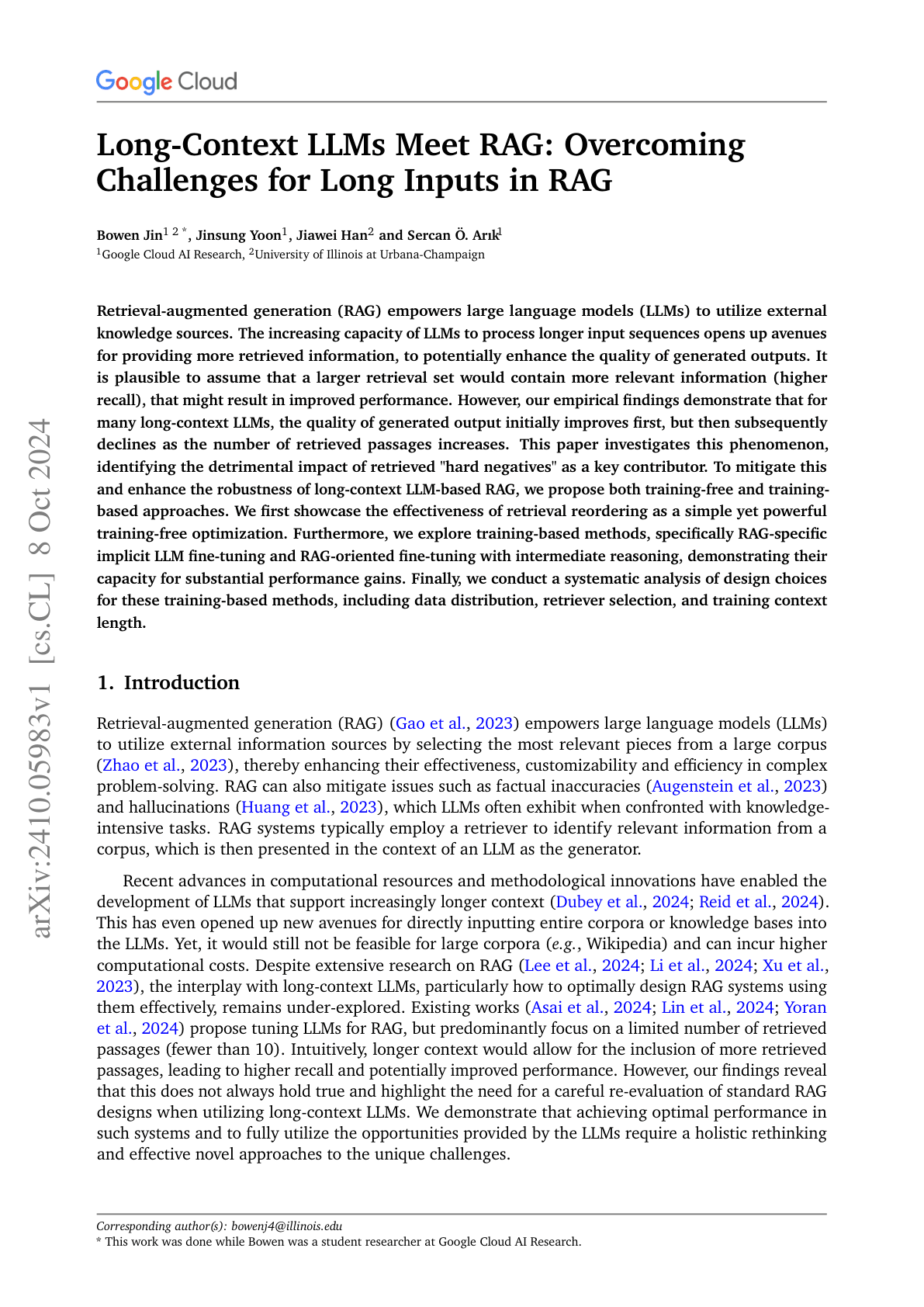
Long-Context LLMs Meet RAG
finds that for many long-context LLMs, the quality of outputs declines as the number of passages increases; reports that the performance loss is due to retrieved hard negatives; they propose two ways to improve long-context LLM-based RAG: retrieval reordering and RAG-specific tuning with intermediate reasoning to help with relevance identification; that approaches demonstrate significant accuracy and robustness improvements on long-context RAG performance.
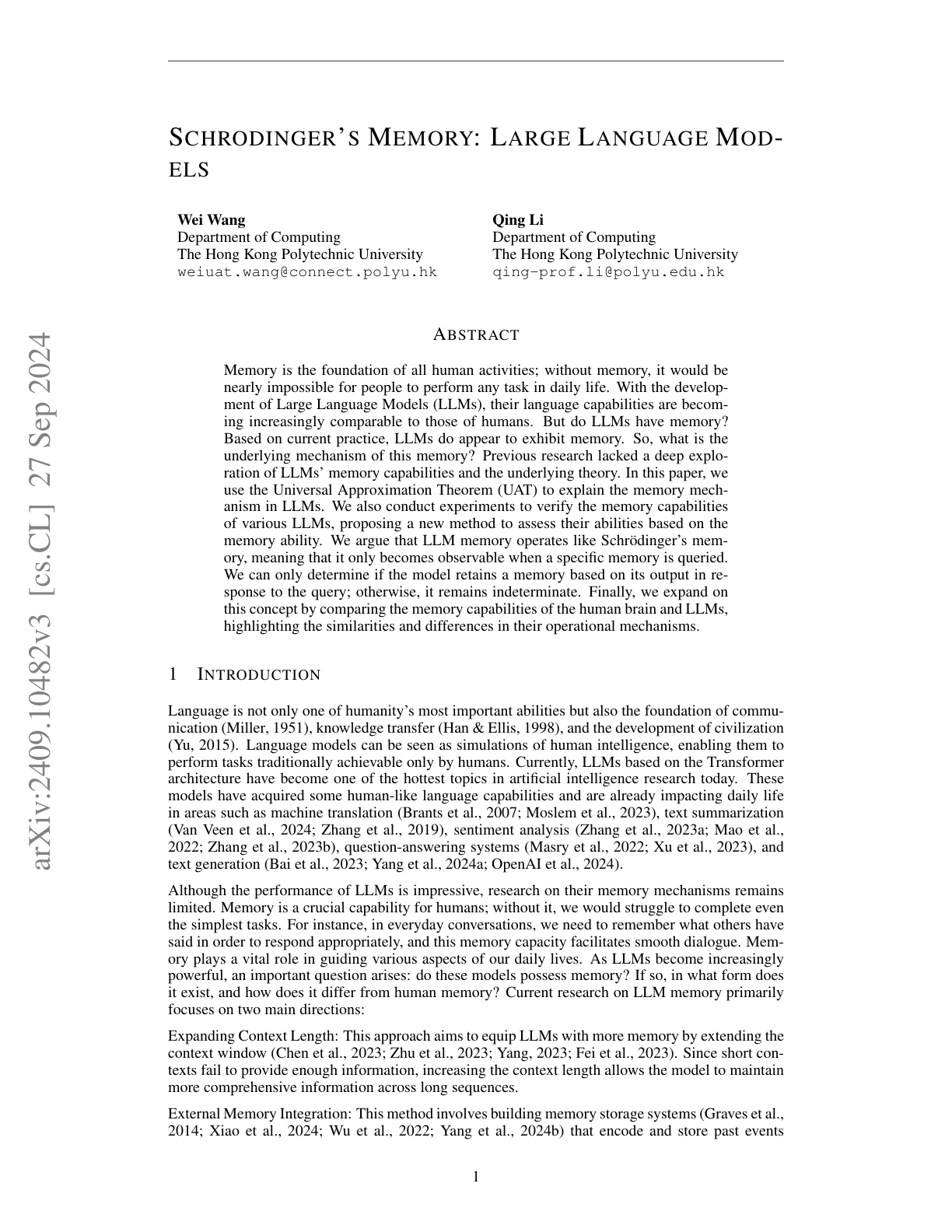
Schrodinger’s Memory
uses the Universal Approximation Theorem to explain the memory mechanism of LLMs. It also proposes a new approach to evaluate LLM performance by comparing the memory capacities of different models; the Transformer architecture functions as a dynamic fitting UAT model, with a strong ability to adaptively fit inputs; this enables LLMs to recall entire content based on minimal input information.
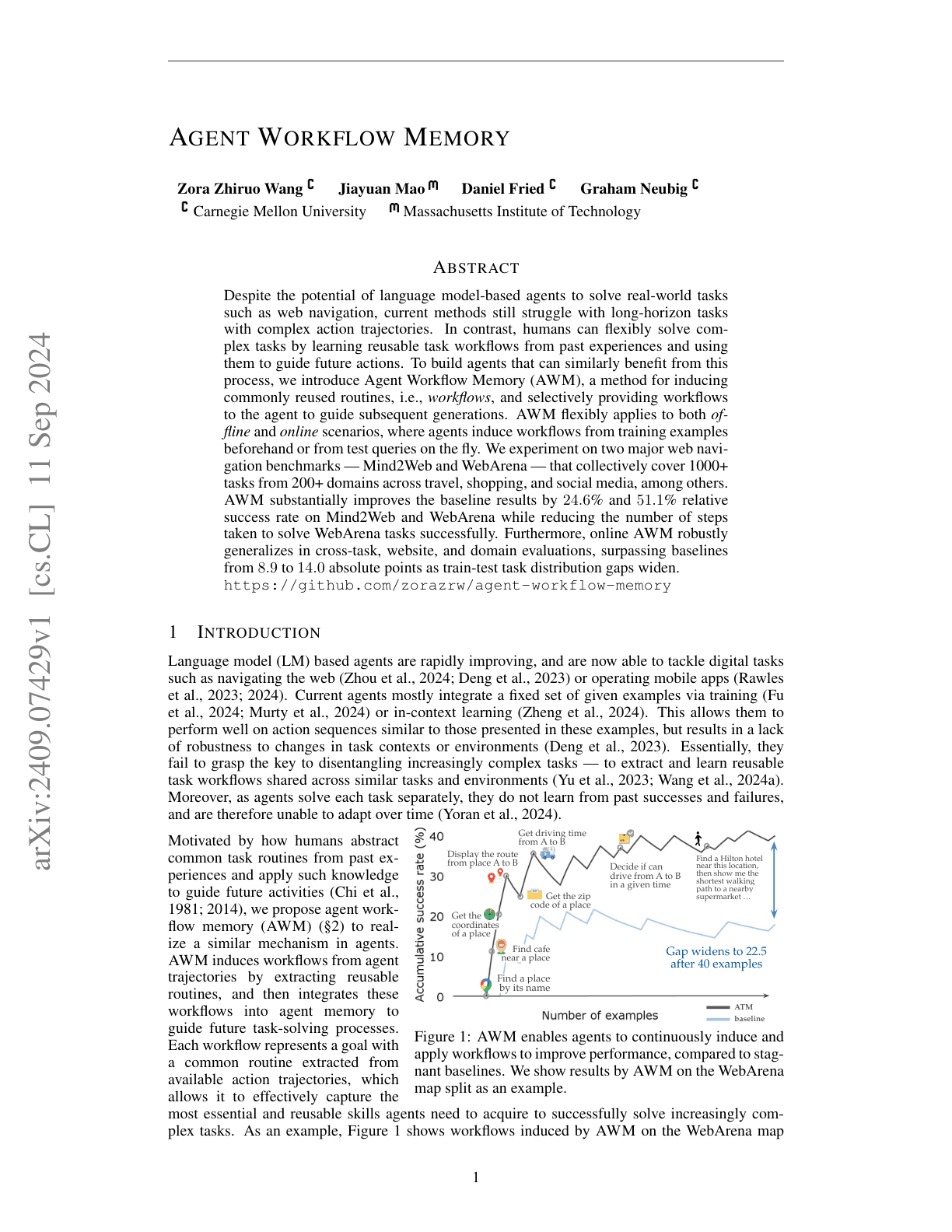
Agent Workflow Memory
introduces Agent Workflow Memory to induce commonly reused workflows and provide these to the agent on demand; works offline and online and is meant to guide the agent's subsequent generations; it’s inspired by how humans learn reusable workflows from past experiences and use them to guide future actions; claims to substantially improve the baseline results by 24.6% and 51.1% relative success rate on Mind2Web and WebArena while doing it in a more efficient way.
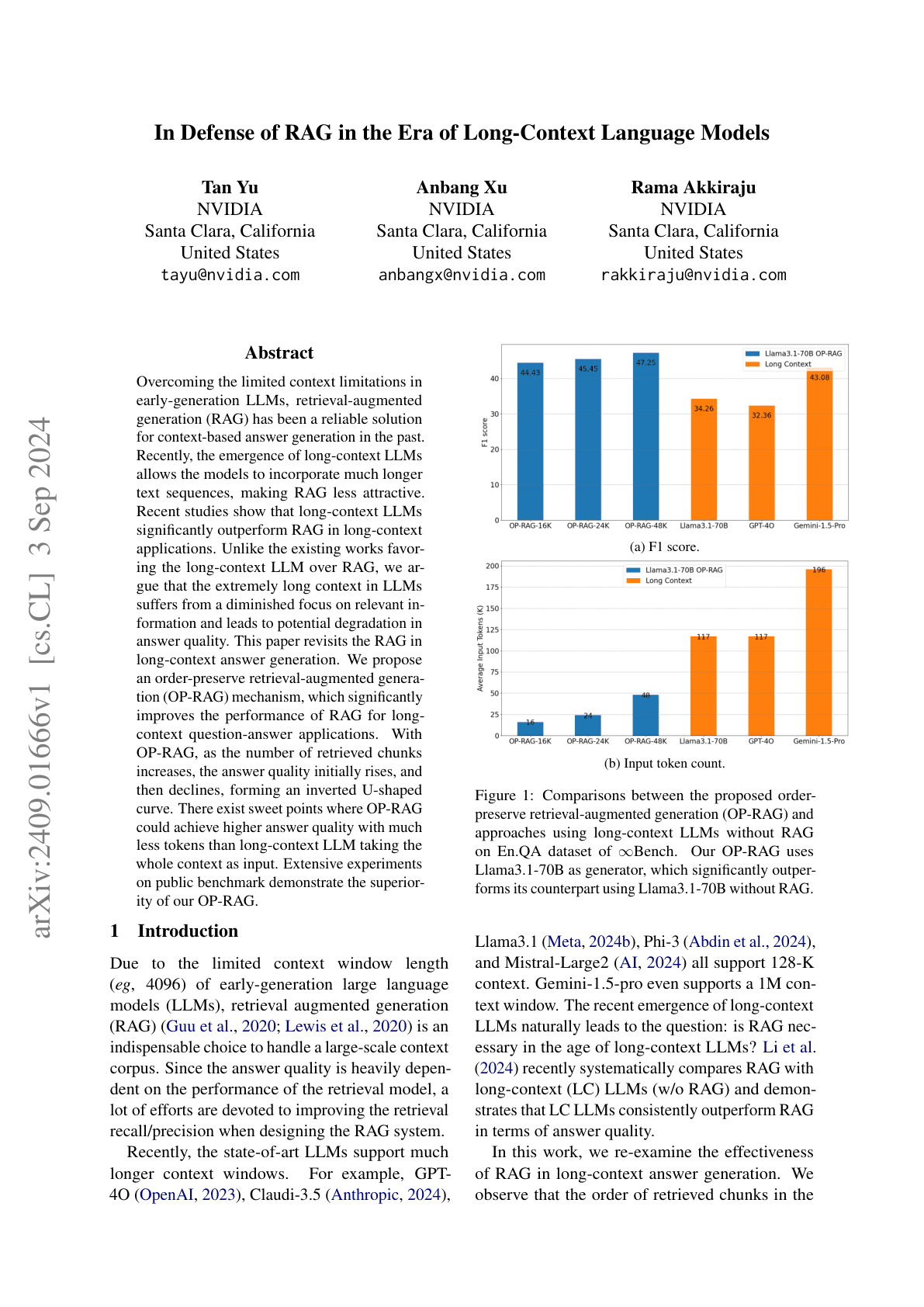
RAG in the Era of Long-Context LLMs
reports that longer-context LLMs suffer from a diminished focus on relevant information, which is one of the primary issues that a RAG system addresses (i.e., uses more relevant information); they propose an order-preserving RAG mechanism that improves performance on long-context question answering; it's not perfect and in fact, as retrieved chunks increase the quality of responses go up and then declines; they mention a sweet spot where it can achieve better quality with a lot fewer tokens than long-context LLMs.
LongCite
synthesizes a large-scale SFT dataset with off-the-shelf LLMs to improve long-context question answering with citations; it trains 8B and 9B parameter models that enhance citation generation capabilities from lengthy contexts while improving response correctness; claims to even surpass GPT-4o on their proposed LongBench-Cite benchmark.
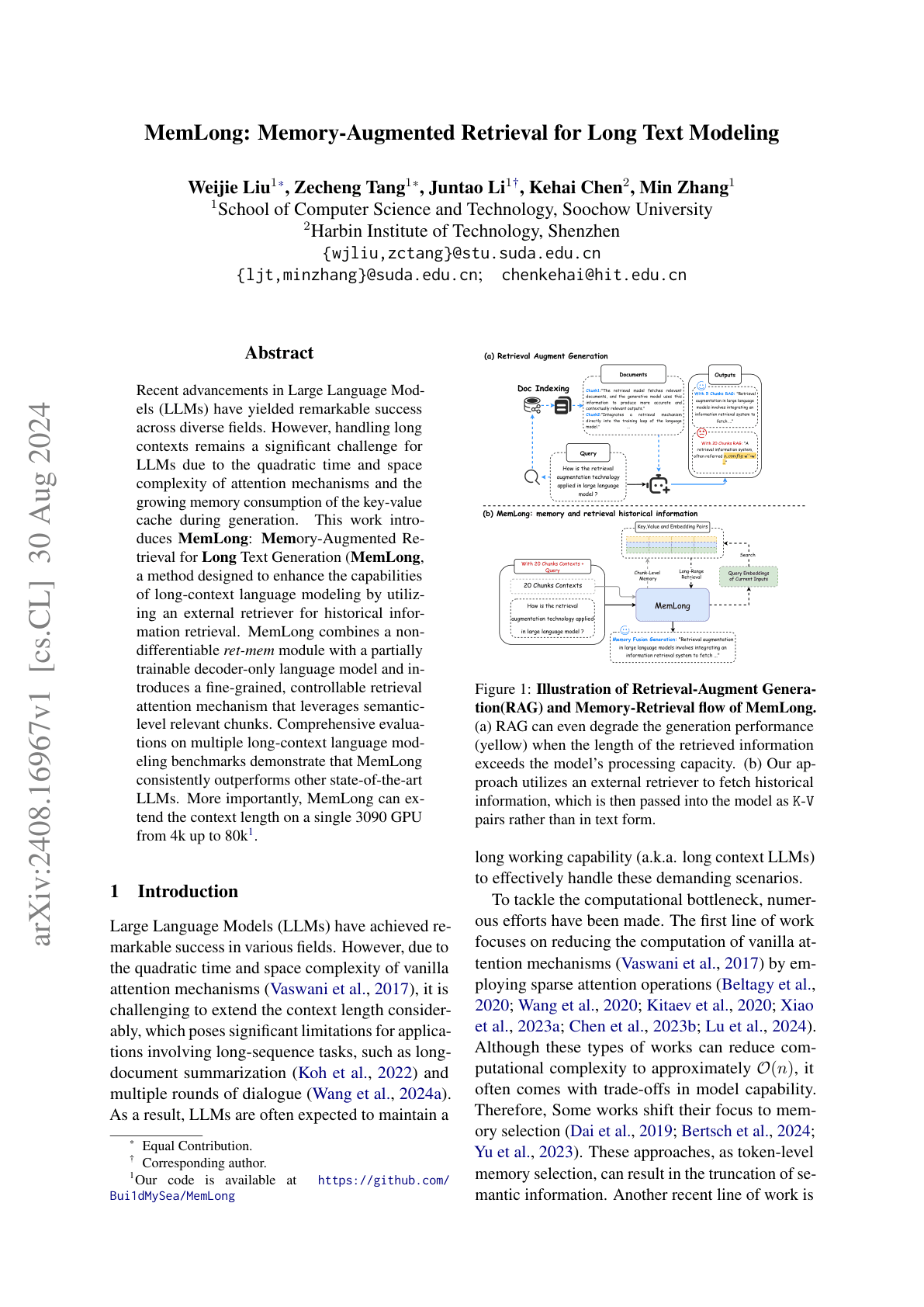
MemLong
utilizes an external retriever for retrieving historical information which enhances the capabilities of long-context LLMs; it consistently outperforms other SoTA LLMs on long-context benchmarks and can extend the context length on a single 3090 GPU from 4k up to 80k.
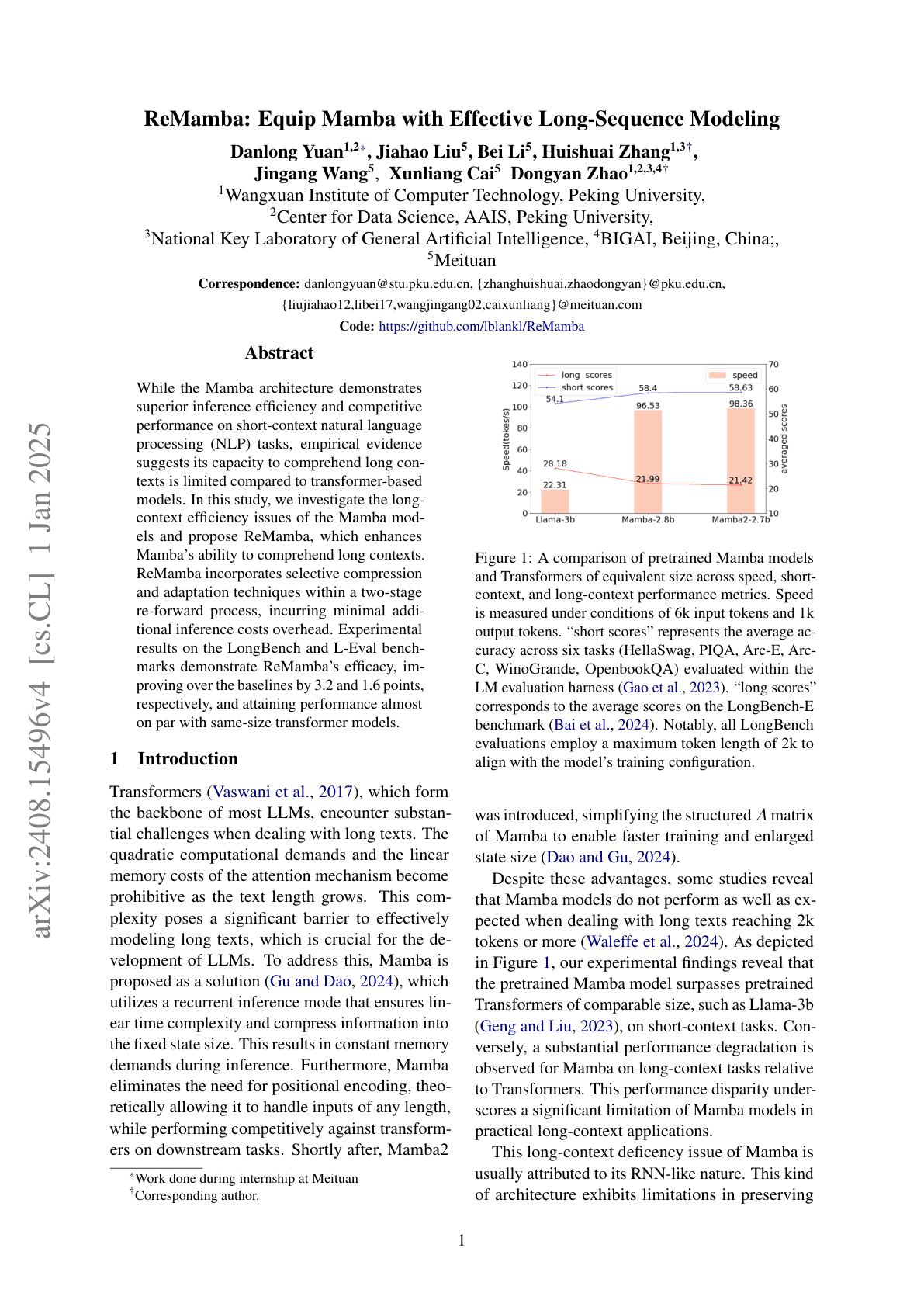
ReMamba
investigates the long-context capabilities and efficiencies of Mamba models; the long-context deficiency issues are due to Mamba's RNN-like nature; it achieves this by condensing information via the following compression strategy: the top-k hidden states during the first forward pass and leverages Mamba’s selective mechanism to incorporate them into the state space during the second forward pass; achieves a 3.2 improvement over the baseline on LongBench and 1.6 improvement on L-Eval; the strategy seems to also transfer to Mamba 2.
MagicDec
shows how speculative decoding can enhance throughput, reduce latency, and maintain accuracy in long context generation scenarios; it finds that as sequence length and batch size increase, bottlenecks shift from compute-bound to memory-bound; using these insights, they show it's possible to more effectively use speculative decoding for longer sequences, even when using large batch sizes.

SAM 2
an open unified model for real-time, promptable object segmentation in images and videos; can be applied to unseen visual content without the need for custom adaptation; to enable accurate mask prediction in videos, a memory mechanism is introduced to store information on the object and previous interactions; the memory module also allows real-time processing of arbitrarily long videos; SAM2 significantly outperforms previous approaches on interactive video segmentation across 17 zero-shot video datasets while requiring three times fewer human-in-the-loop interactions.
ThinK
proposes an approach to address inefficiencies in KV cache memory consumption; it focuses on the long-context scenarios and the inference side of things; it presents a query-dependent KV cache pruning method to minimize attention weight loss while selectively pruning the least significant channels
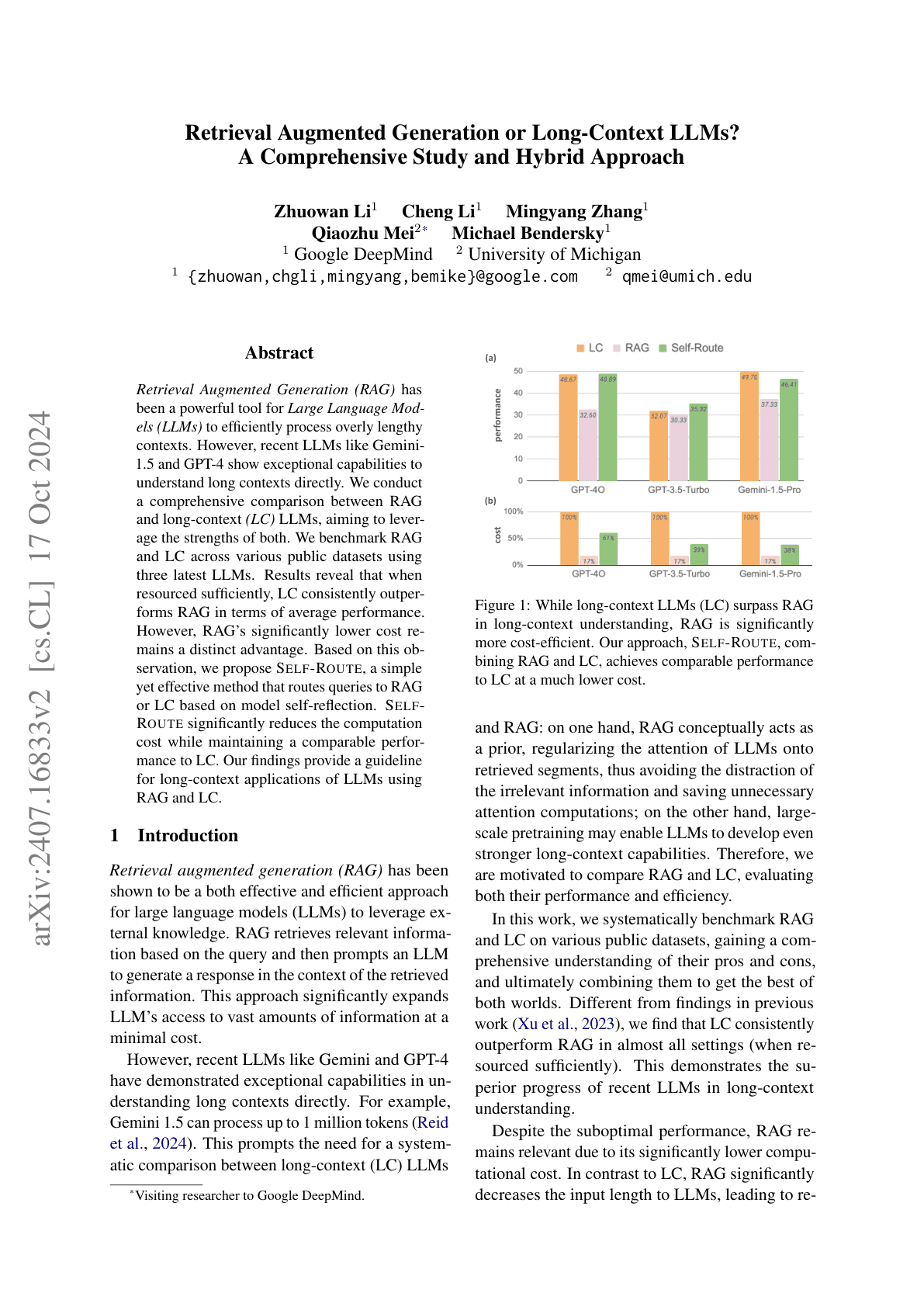
RAG vs. Long-Context LLMs
compares RAG and long-context LLMs and finds that long-context LLMs outperform RAG on average performance while RAG is significantly less expensive; proposes Self-Route, leveraging self-reflection to route queries to RAG or LC; reports that Self-Route significantly reduces computational cost while maintaining comparable performance to LC.
LazyLLM
introduces a novel dynamic token pruning method for efficient long-context LLM inference; it can accelerate the prefilling stage of a Llama 2 7B model by 2.34x and maintain high accuracy; it selectively computes the KV for tokens that are important for the next token prediction in both the prefilling and decoding stages; it allows language models to dynamically select different subsets of tokens from the context in different generation steps, even though they might be pruned in previous steps.
Mitigating Hallucination via Generation Constraint
proposes a new training-free approach to mitigate hallucination in LLMs; they scaled the readout vector that constrains generation in a memory-augmented LLM decoder; recent works claim that LLMs with explicit memory mechanisms can help lower hallucination; this work uses a memory-augmented LLM and constrains generation in the decoder by applying lightweight memory primitives to reduce hallucination.
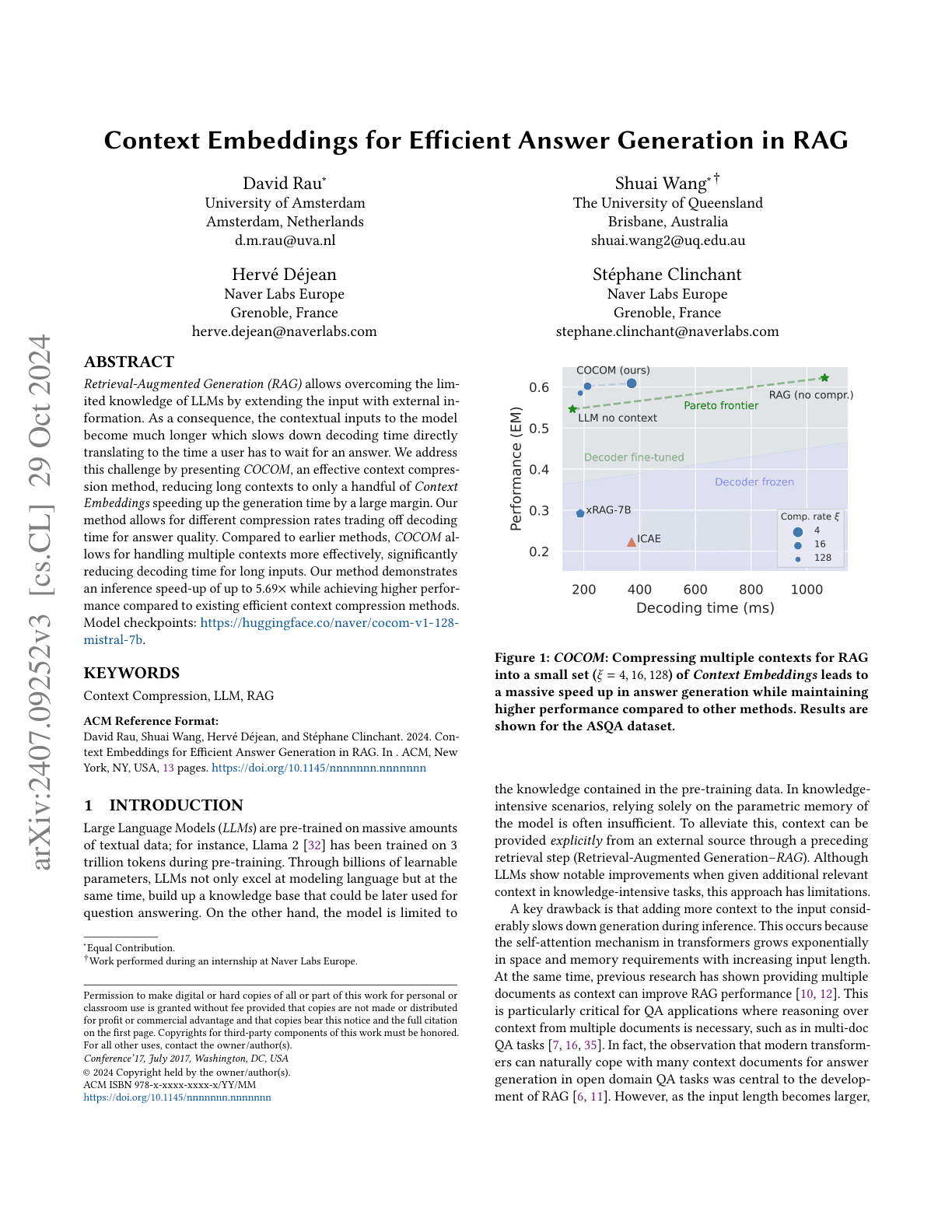
Context Embeddings for Efficient Answer Generation in RAG
proposes an effective context compression method to reduce long context and speed up generation time in RAG systems; the long contexts are compressed into a small number of context embeddings which allow different compression rates that trade-off decoding time for generation quality; reduces inference time by up to 5.69 × and GFLOPs by up to 22 × while maintaining high performance.
Can LLMs Do Retrieval and Reasoning in 1 Million Context Window?
proposes a framework (NeedleBench) of progressively challenging tasks to assess the long-context retrieval and reasoning capabilities of LLMs; they also present the Ancestral Trace Challenge that increases the need for complex logical reasoning which is common in real-world long-context tasks; their findings suggest that current LLMs struggle to handle reasoning tasks with complex logical relationships, even with texts shorter than 2K tokens.