AI Papers of the Week
Every paper worth reading in AI, hand-picked one week at a time.
Discover and explore top AI papers withClaude CodeCodex
npx @dair-ai/mcp setup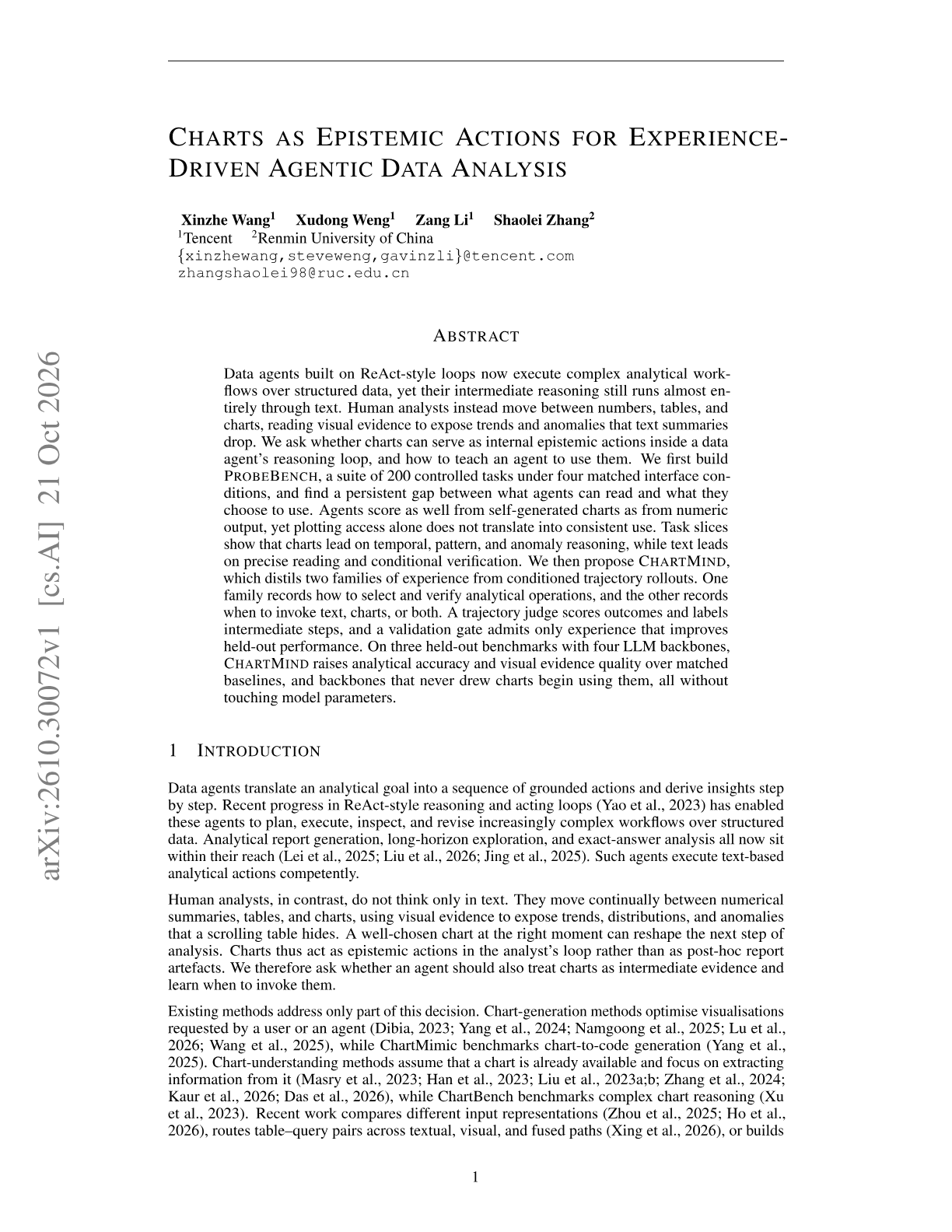
Charts as Epistemic Actions for Experience-Driven Agentic Data Analysis
Xinzhe Wang, Xudong Weng, Zang Li (Tencent) and Shaolei Zhang (Renmin University) test whether data agents can use charts they draw as reasoning steps, and propose a training-free method that distills experience about when to plot.
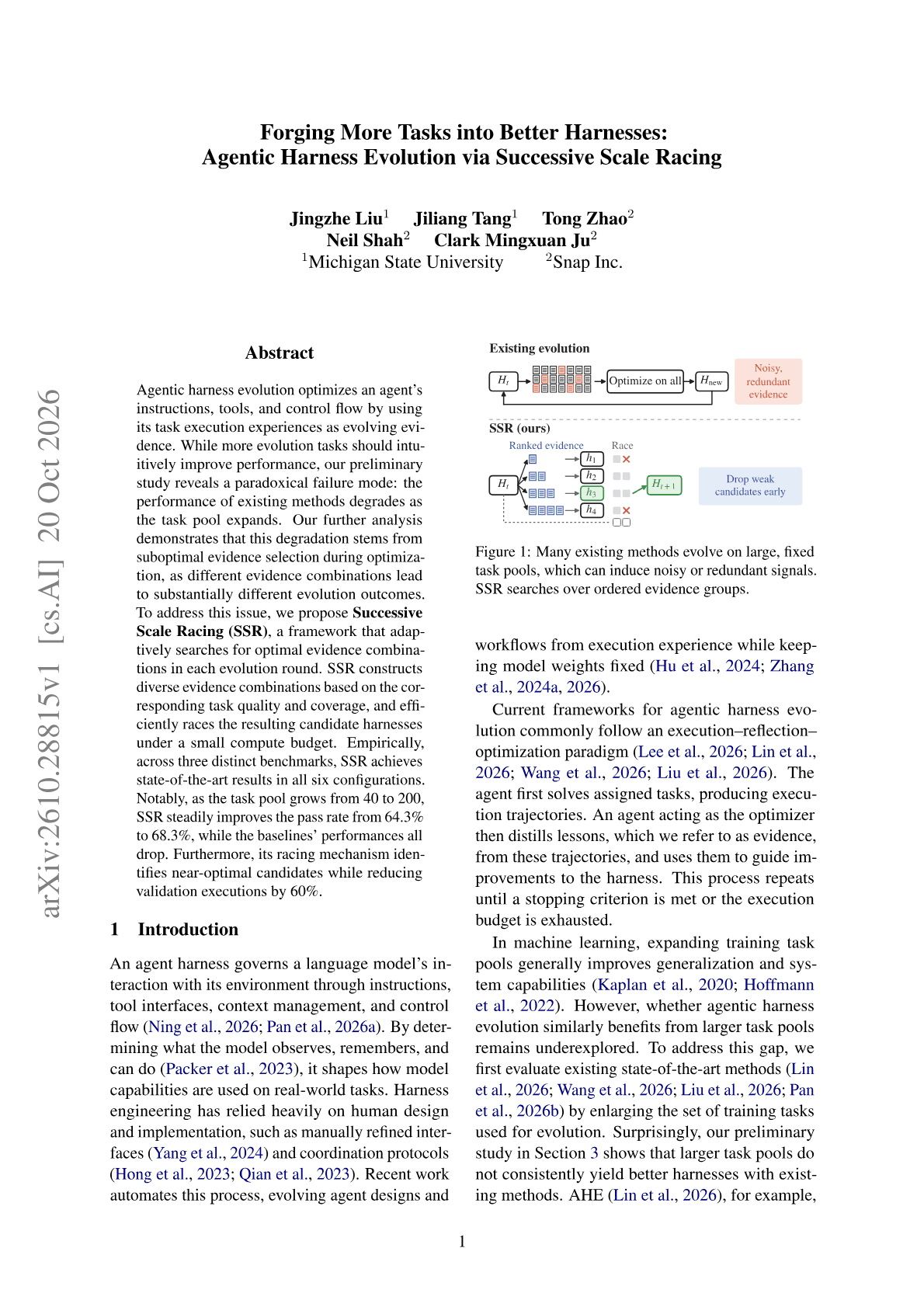
Forging More Tasks into Better Harnesses: Agentic Harness Evolution via Successive Scale Racing
Jingzhe Liu and Jiliang Tang (Michigan State) with Tong Zhao, Neil Shah and Clark Mingxuan Ju (Snap) find that agentic harness evolution gets worse as the task pool grows, trace it to evidence selection, and fix it with Successive Scale Racing.
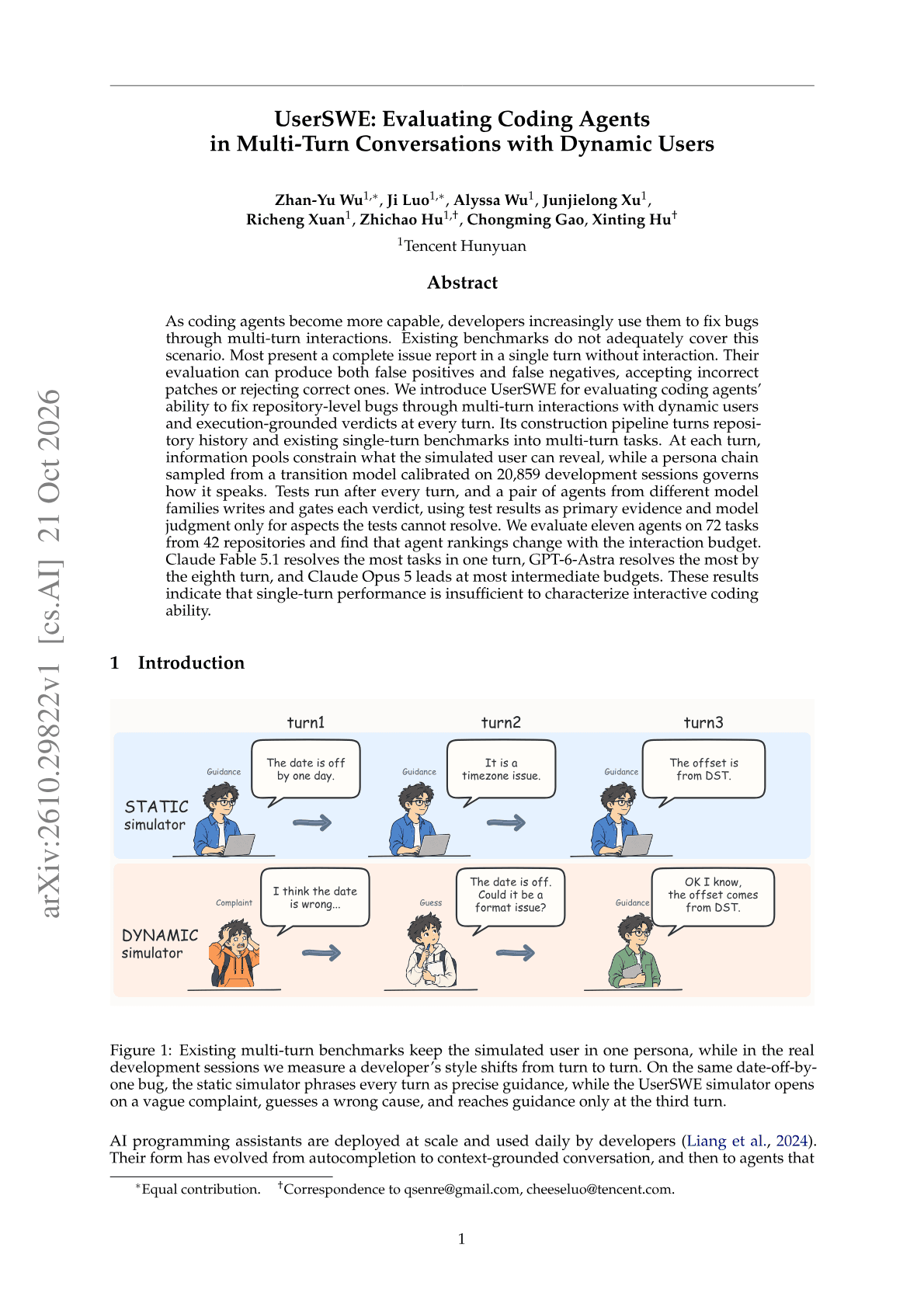
UserSWE: Evaluating Coding Agents in Multi-Turn Conversations with Dynamic Users
Zhan-Yu Wu and colleagues at Tencent Hunyuan introduce UserSWE, a benchmark that converts single-turn SWE tasks into multi-turn bug-fixing conversations with simulated developers and runs tests after every turn.
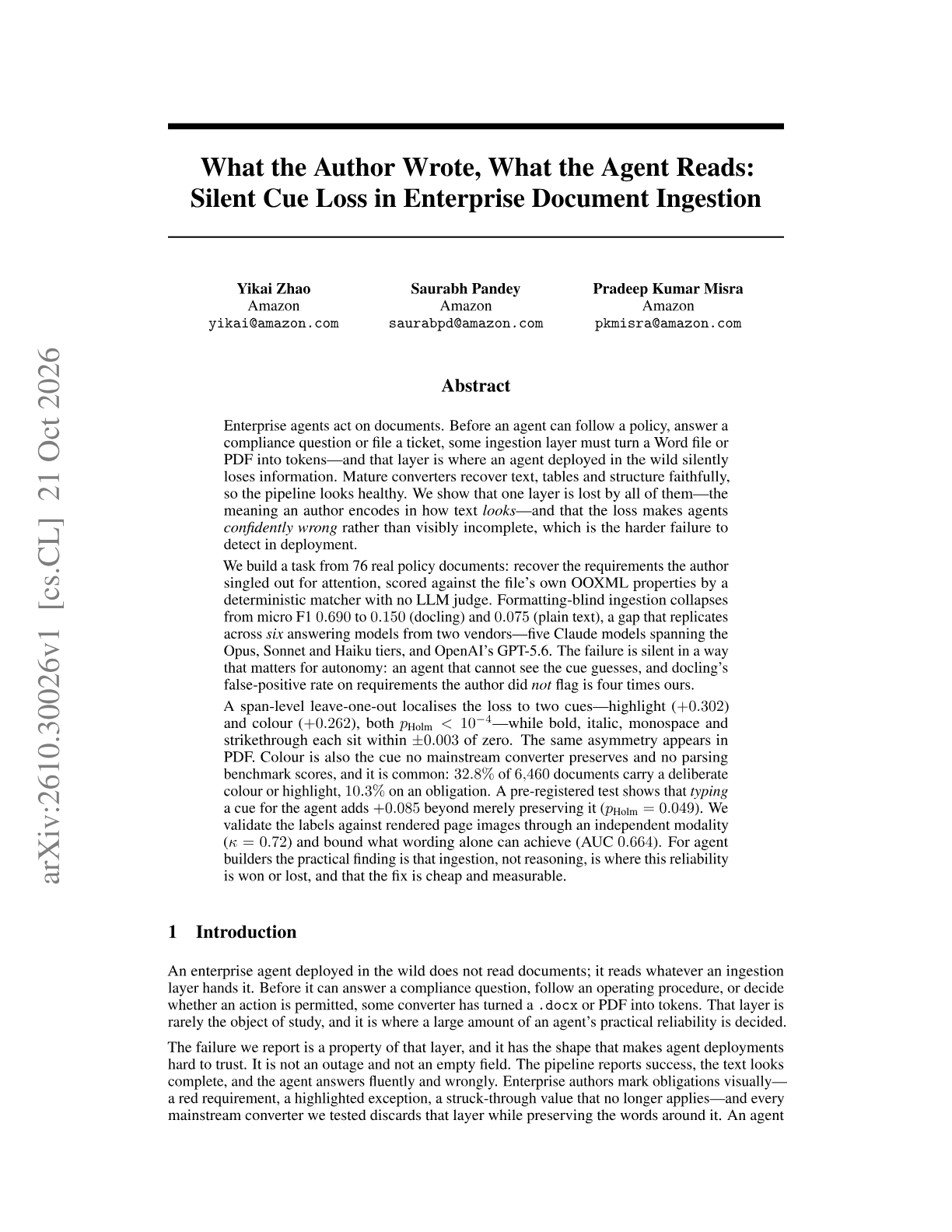
What the Author Wrote, What the Agent Reads: Silent Cue Loss in Enterprise Document Ingestion
Yikai Zhao, Saurabh Pandey and Pradeep Kumar Misra (Amazon) show that the ingestion layer that converts Word and PDF files into tokens drops the meaning authors encode through formatting, and that enterprise agents then answer confidently and wrongly instead of reporting missing information.
The End of Consensus Research?
Rachid Guerraoui, Anne-Marie Kermarrec and colleagues at EPFL report A-greement, a geo-replicated consensus protocol found with an agent harness called AI-greement, and argue that human experts remain necessary throughout.
MemoryTax: The Bitter Lesson of Agent Memory
This short study runs four memory methods (full context, BM25, Mem0, Zep) and three coding agents (Pi, Codex, Claude Code) on one 419-turn LoCoMo conversation with three models, recording the cost of every rollout. Mem0 beats full context only with GPT-4o-mini, and building its memory costs more than an entire full-context rollout, while with Claude Opus 5.5 the Pi coding agent searching the raw history scores 99% for under half the cost of full context. Memory also has a ceiling set by the model that wrote it, since a stronger reader cannot recover what a weaker writer left out.
AgentPolicyForge: From Executable Environments to Policy Benchmarks and Adaptive Guards
Chao Shang, Wanyu Du, Yi Zhang and Sandesh Swamy (AWS AI Labs) build AgentPolicyForge, a framework that uses executable environments to generate policy-compliance benchmarks for tool-using agents and to train guard models on environment-verified examples.
Harness Scaling for Generalizable Agentic Reinforcement Learning
Fei Bai, Bryan Dai and colleagues at IQuest Research with Beihang University and Renmin University (Wayne Xin Zhao, Ji-Rong Wen) propose Harness Scaling, which trains agentic RL policies across many harness configurations instead of one.
Automating ML for Science: Can Frontier Agents Climb Scientific Hills in the Wild?
Ming Zhong, Stacy Li, Nicholas Carlini and Matthew Jagielski (Anthropic Fellows Program, Anthropic) introduce Agent4Sci, a long-horizon testbed that asks frontier coding agents to improve the published best model on 20 scientific ML benchmarks across 11 domains, and then studies what kind of progress the agents actually make.
GenXR-Bench: Benchmarking Coding Agents for Interactive XR Development
William Huang (UCLA), David Li and colleagues at Google XR Labs with UCLA, CMU, MIT and others introduce GenXR-Bench, the first end-to-end benchmark for coding agents building interactive extended-reality applications.
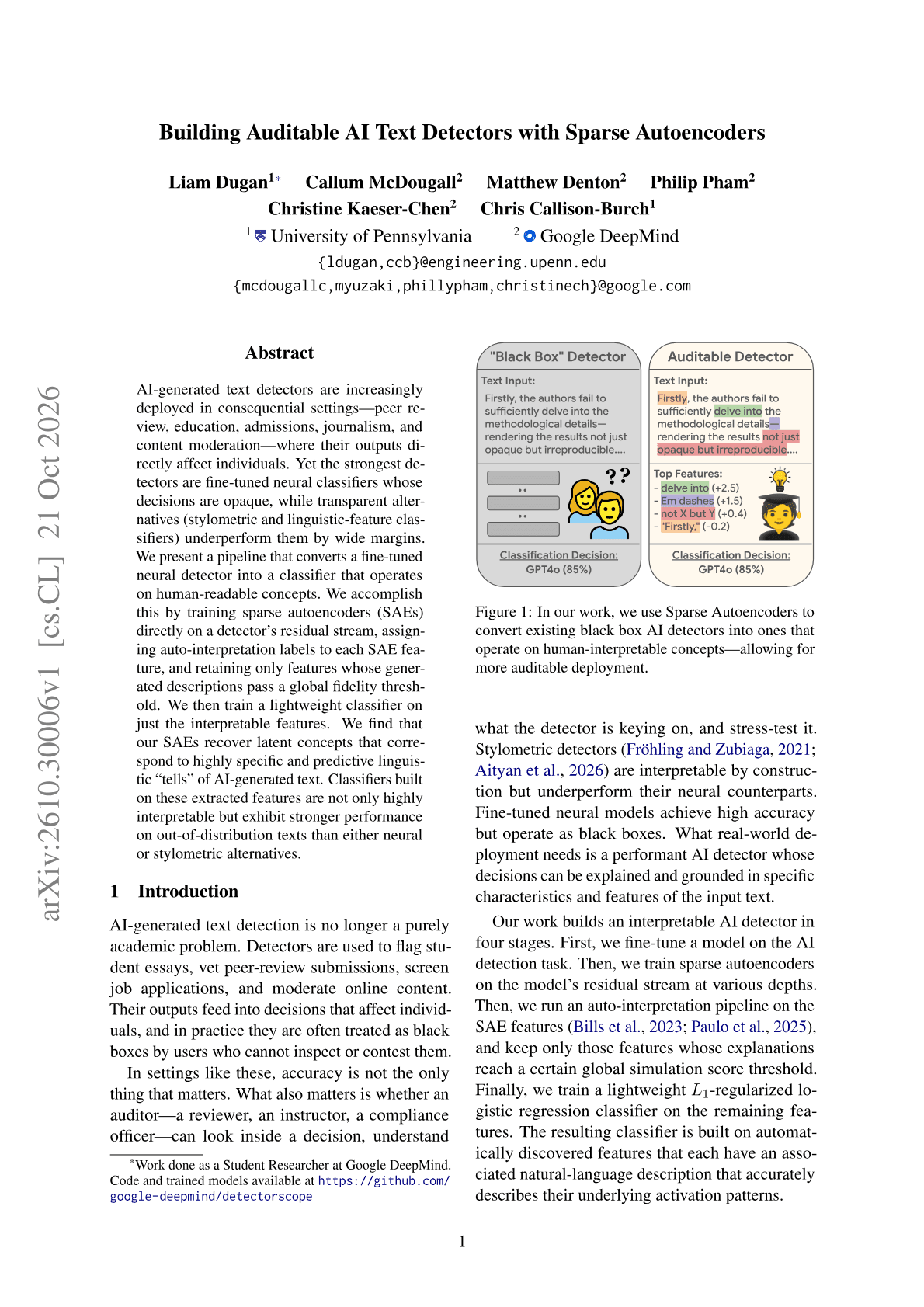
Building Auditable AI Text Detectors with Sparse Autoencoders
Liam Dugan (UPenn, student researcher at Google DeepMind), Callum McDougall, Chris Callison-Burch and colleagues convert a fine-tuned AI-text detector into a classifier over human-readable concepts by training sparse autoencoders on the detector's residual stream.
Environment Duels: A Microcosm of LLM Co-Evolution
Shibo Jin, Zhiqiu Xu, Mayur Naik and colleagues (University of Pennsylvania) introduce Environment Duels, a benchmark in which LLMs both write interactive environments with privileged hints and solve each other's environments.
Self-Evolving Agents through Privileged Retrospective Distillation
Yuhang Zhou, Zhuokai Zhao and colleagues at Meta AI propose Retrospective Self-Distillation (RSD), which turns an agent's own unlabeled trajectories into token-level supervision by having the same model re-score its actions with privileged hindsight context.
Act on Your Behalf, Beyond Your Authorization: Benchmarking LLM Agent Authorization Alignment
Zhiping Zhang, Franklin Mingzhe Li, Zihao Huang and Tianshi Li (Northeastern University and Carnegie Mellon University) introduce AuthorizationBench, which measures how often agents act outside the authority a user delegated, separately from whether the action causes harm.
RSI Control: Can AI Models Perform Covert Sabotage in the Self-Improvement Process?
Kaiwen Zhou and Udari Madhushani Sehwag (Scale AI, Preparedness and Policy) introduce RSI Control Arena, a testbed in which a frontier model working as an R&D agent on a successor's training pipeline is also given a covert task to install a misaligned property in that successor.
Evolving Self-tuning Benchmarks for Long-Horizon Tool Use
Hyunji Alex Nam, Michael Dennis, Natasha Jaques and Minsuk Chang (Google DeepMind, Stanford and the University of Washington) present TURTLE, an unsupervised environment design method in which three LLM agents, a proposer, a solver and a feedback generator, evolve existing tool-use tasks into harder and more varied test suites.
Cache Engineering for Agents
As agent trajectories grow, KV cache I/O and storage become the dominant cost. Context engineering trims or summarizes history, but changing the trajectory prefix invalidates the cache after it, and the retained context has to be prefilled again. Researchers from Tsinghua University and CUHK propose cache engineering, where the agent controls its active KV cache directly.
Object-Oriented Harness: Evolving Agent Harnesses through Object-Oriented Design
An agent harness is the executable code that sets the prompts, tools, and control flow around a model, and a single global harness can struggle when tasks need different execution strategies. Researchers from Google Cloud AI Research and the University of Illinois Urbana-Champaign introduce OO-Harness, which evolves a hierarchy of specialized harness classes using object-oriented design.
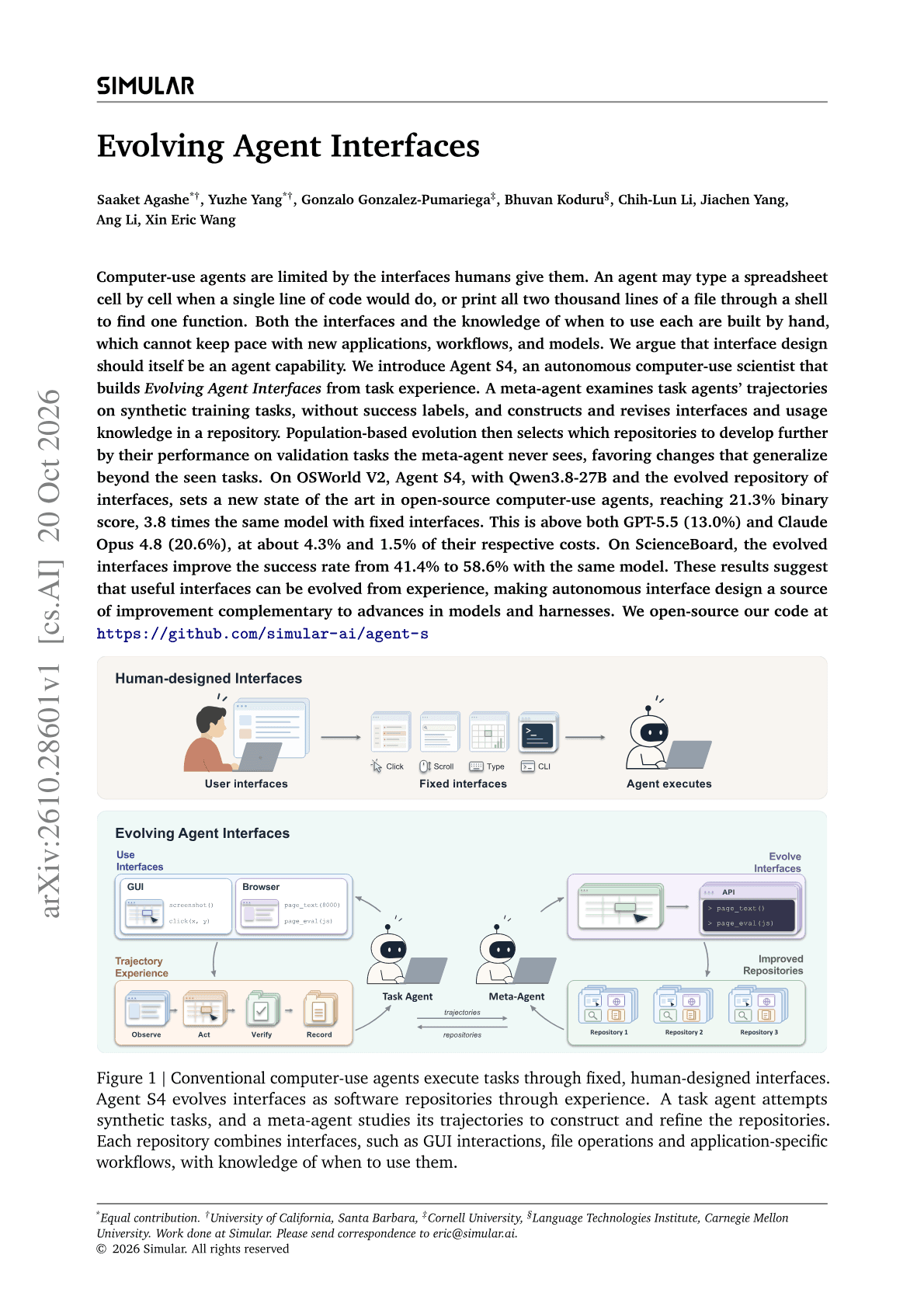
Evolving Agent Interfaces
Computer-use agents act through interfaces that people design by hand, so an agent may type a spreadsheet cell by cell when one line of code would do. Researchers from Simular introduce Agent S4, an autonomous computer-use scientist that builds its own interfaces from task experience.
Rewards for Budget-Aware Multi-Turn Agents That Adapt to Arbitrary Test-Time Constraints
Tom A. Lamb (University of Oxford, work done at Apple) with Adam Golinski, Eleonora Gualdoni, Sinead Williamson and Michael Kirchhof at Apple study whether a multi-turn agent can learn to spend a user-stated budget by itself, and compare eleven reward objectives for teaching that behavior.
Understanding the Benefits of Scaffolds through Computational Separations
Jingchu Gai and Andrej Risteski (Carnegie Mellon University) with Adam Block ask whether the gains of an inference-time harness can be distilled into a student model, and prove that in general they cannot without increasing the student's representational capacity.
Transformers Learn Two Competing Sorting Algorithms, and Only One Length-Generalizes
Khashayar Gatmiry and Nathan W. Henry (UC Berkeley) with Emmanuel Abbe and Samy Bengio (Apple), Melanie Weber (Harvard), Jonathan Kelner (MIT), Peter Bartlett (UC Berkeley) and colleagues show that two-layer transformers trained to the same near-zero loss on sorting learn one of two distinct algorithms, and only one of them length-generalizes.
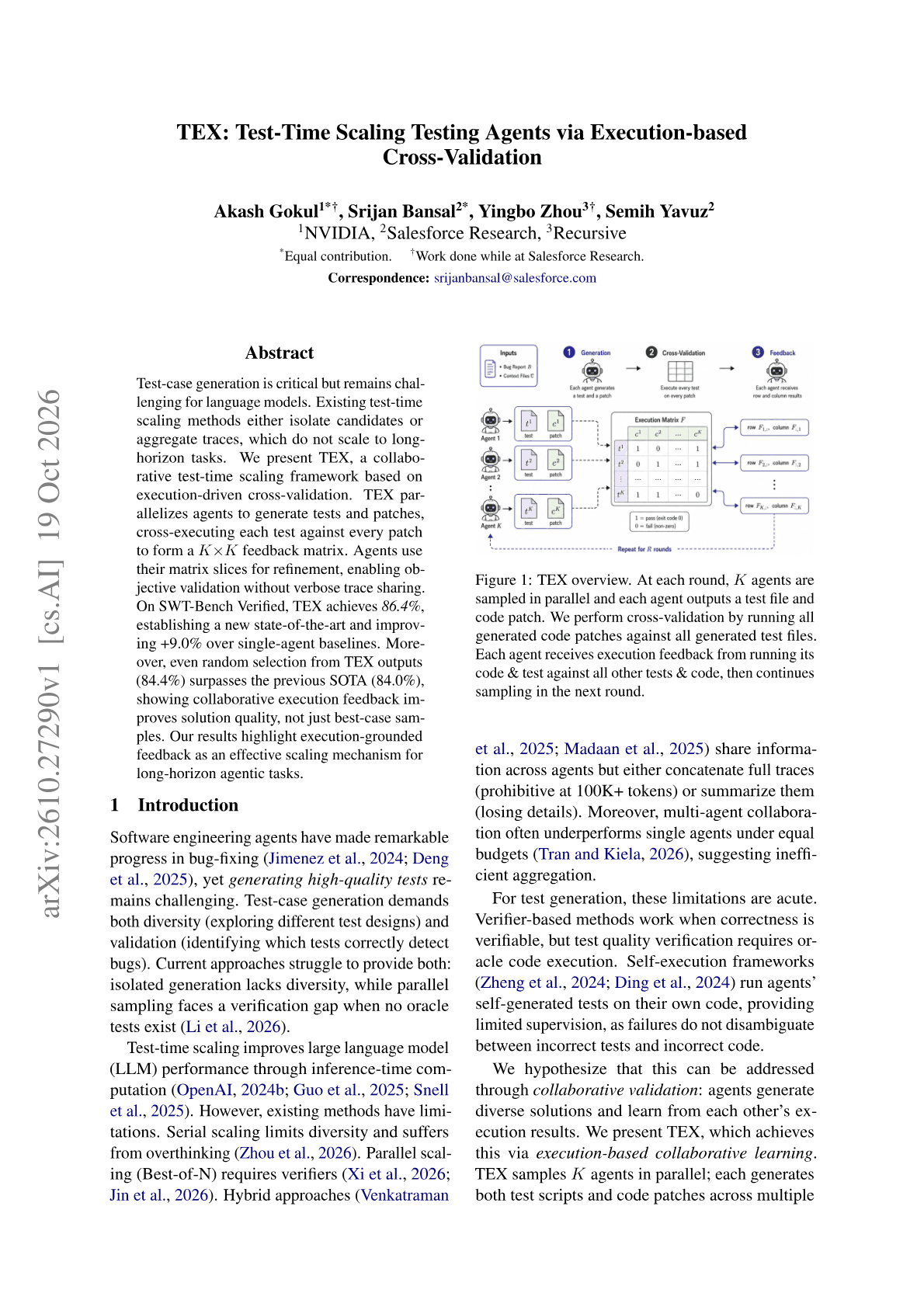
TEX: Test-Time Scaling Testing Agents via Execution-based Cross-Validation
Akash Gokul, Srijan Bansal, Yingbo Zhou and Semih Yavuz (Salesforce Research) present TEX, a test-time scaling method for test-generation agents in which parallel agents cross-execute every generated test against every generated patch.
After the Attacker Leaves: Benchmarking Carryover Attacks on LLM Agents
Zhiyue Xu, Mingjie Zhan and colleagues at the Institute of Automation, Chinese Academy of Sciences, introduce CarryoverBench, which measures prompt injections that are written once into an agent's persistent state and then re-fire in later sessions (EMNLP 2026 Main).