AI Papers of the Week
Every paper worth reading in AI, hand-picked one week at a time.
Discover and explore top AI papers withClaude CodeCodex
npx @dair-ai/mcp setup
TEX: Test-Time Scaling Testing Agents via Execution-based Cross-Validation
Akash Gokul, Srijan Bansal, Yingbo Zhou and Semih Yavuz (Salesforce Research) present TEX, a test-time scaling method for test-generation agents in which parallel agents cross-execute every generated test against every generated patch.
Transformers Learn Two Competing Sorting Algorithms, and Only One Length-Generalizes
Khashayar Gatmiry and Nathan W. Henry (UC Berkeley) with Emmanuel Abbe and Samy Bengio (Apple), Melanie Weber (Harvard), Jonathan Kelner (MIT), Peter Bartlett (UC Berkeley) and colleagues show that two-layer transformers trained to the same near-zero loss on sorting learn one of two distinct algorithms, and only one of them length-generalizes.
Reward Misspecification Degrades Chain-of-Thought Monitorability
Tianyi Lorena Yan and John Hewitt (Columbia University) show that reward misspecification alone makes chain-of-thought monitoring ineffective, and propose reward description training to restore it.
More Memory, Worse Agents: Error Reproduction and Anti-Persistence in LLM Agents
Ruhan Wang and Dongruo Zhou (Indiana University) with Kishan Panaganti (Tencent) identify error reproduction, in which wrong rules stored in agent memory regenerate through new trajectories, and propose Anti-Persistence, a memory design that stores only trajectories and outcomes and rebuilds guidance on demand.
Stronger artificial intelligence breakthroughs hasten their own exhaustion
Beichen Lu, Honglin Bao, Qi Huang, Qingguo Meng and colleagues (Tsinghua University and the University of Chicago) analyze 36 years of computer science and find that each AI breakthrough is followed by faster exhaustion of the ideas around it, because concentrated attention depletes the diversity later work draws on.
Cache Engineering for Agents
As agent trajectories grow, KV cache I/O and storage become the dominant cost. Context engineering trims or summarizes history, but changing the trajectory prefix invalidates the cache after it, and the retained context has to be prefilled again. Researchers from Tsinghua University and CUHK propose cache engineering, where the agent controls its active KV cache directly.
Assessing the Empirical Evidence for Loss of Control from Agentic General-Purpose AI
Risto Uuk, Santeri Koivula, Lorenzo Pacchiardi and colleagues (Future of Life Institute, KU Leuven, ETH Zurich, Cambridge) grade 19 empirical studies on loss-of-control properties of agentic AI for construct, content and external validity, the first structured assessment of that evidence base.
SPIDES: Information-Flow Control for Browser Agents
Egor Zverev (ISTA), Juhee Kim, Boris Köpf, Shruti Tople, Santiago Zanella-Béguelin and colleagues at Microsoft and CISPA propose SPIDES, an information-flow-control layer that gates browser-agent actions on confidentiality and integrity labels attached to HTML elements, giving guarantees that do not depend on the model.
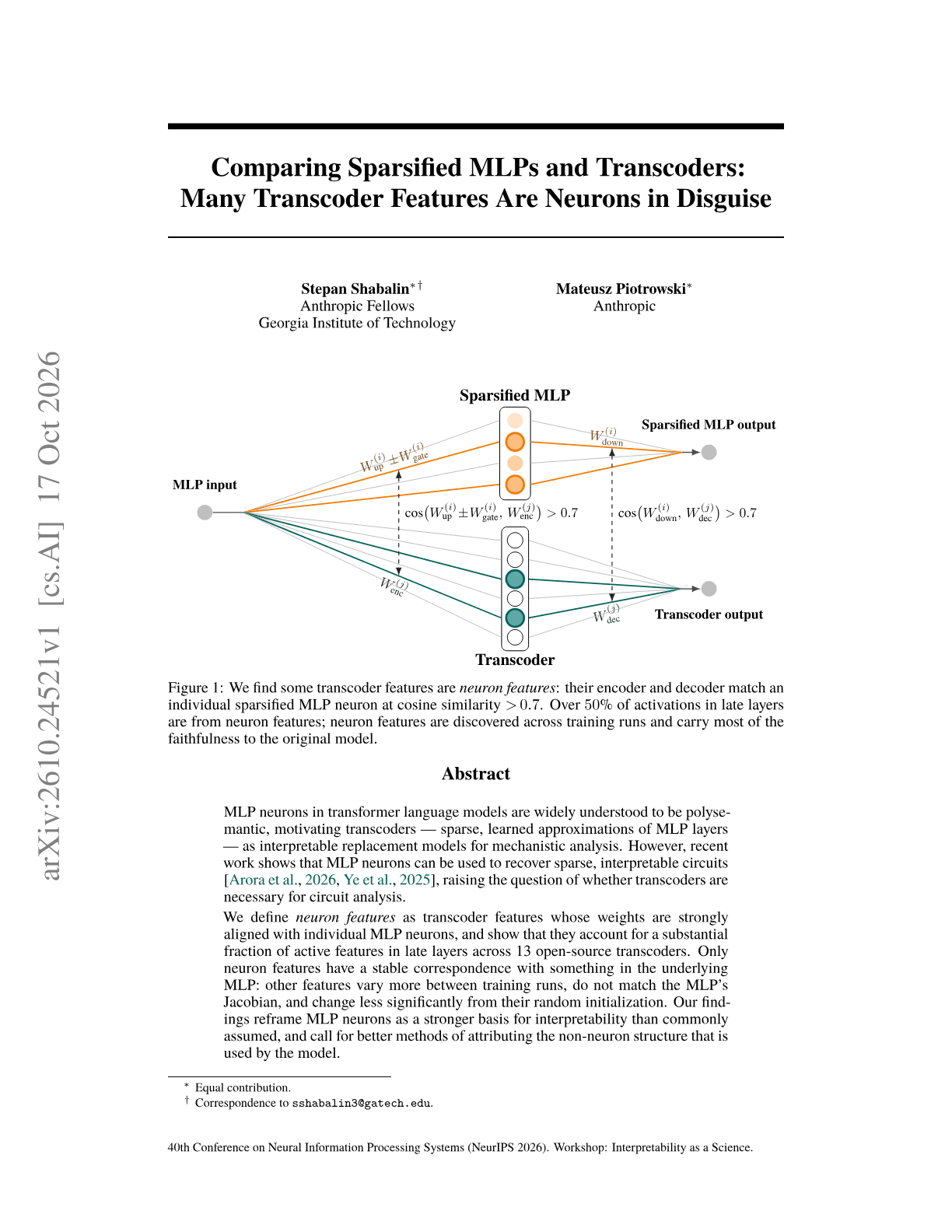
Comparing Sparsified MLPs and Transcoders: Many Transcoder Features Are Neurons in Disguise
Researchers from Anthropic and Georgia Tech find that many active transcoder features in late layers are close copies of single MLP neurons, measured across 13 open-source transcoders. These neuron-aligned features are the only ones with a stable link to the underlying MLP, while the other features vary more between training runs, do not match the MLP's Jacobian, and move less from their random initialization. The authors conclude that MLP neurons are a stronger basis for interpretability than commonly assumed, and that the non-neuron features need better validation before they are used to explain model behavior.
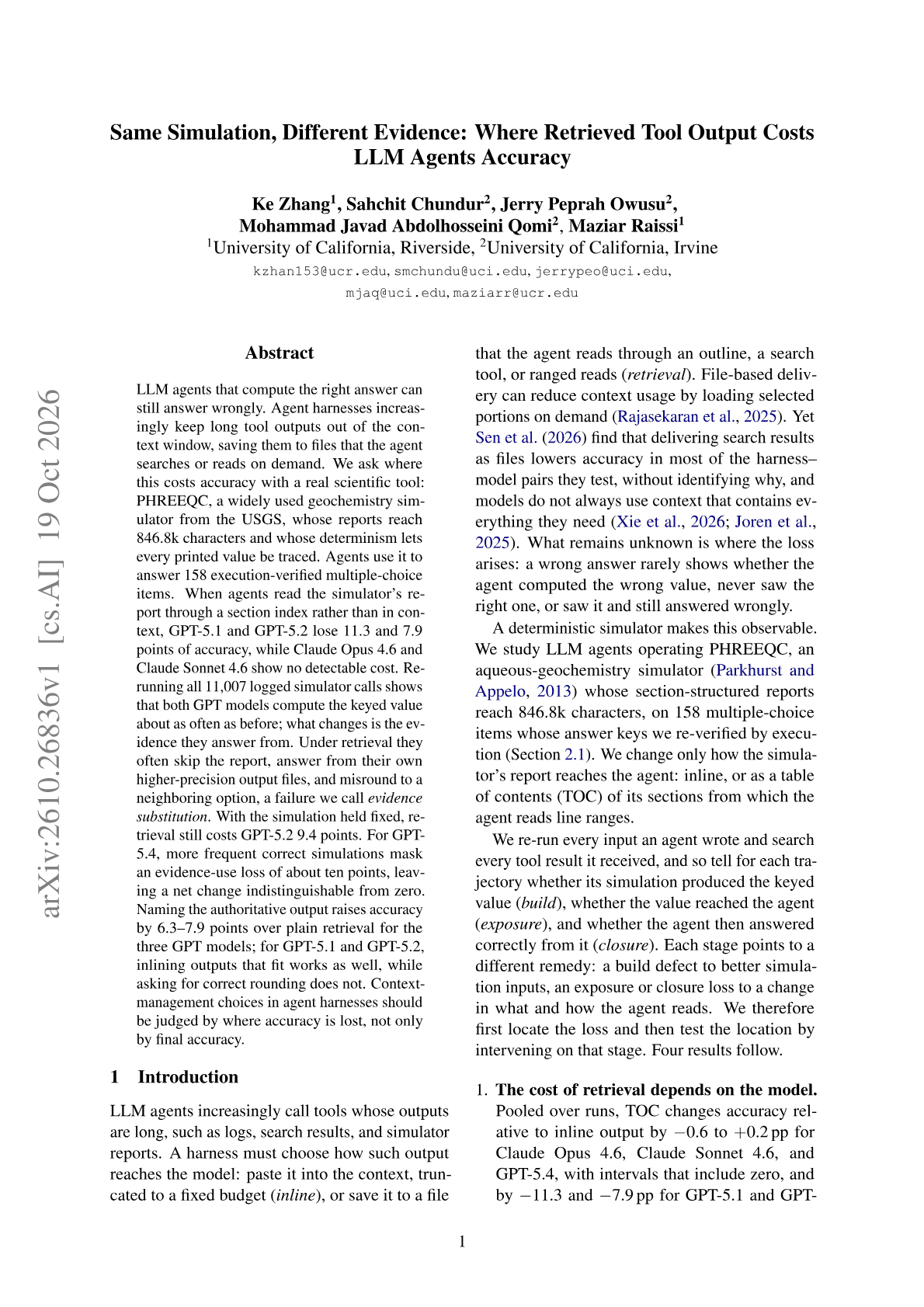
Same Simulation, Different Evidence: Where Retrieved Tool Output Costs LLM Agents Accuracy
Ke Zhang, Maziar Raissi and colleagues (UC Riverside, UC Irvine) test what happens when an agent harness moves long tool output out of context and into searchable files, using the USGS geochemistry simulator PHREEQC, whose reports reach 846.8k characters.
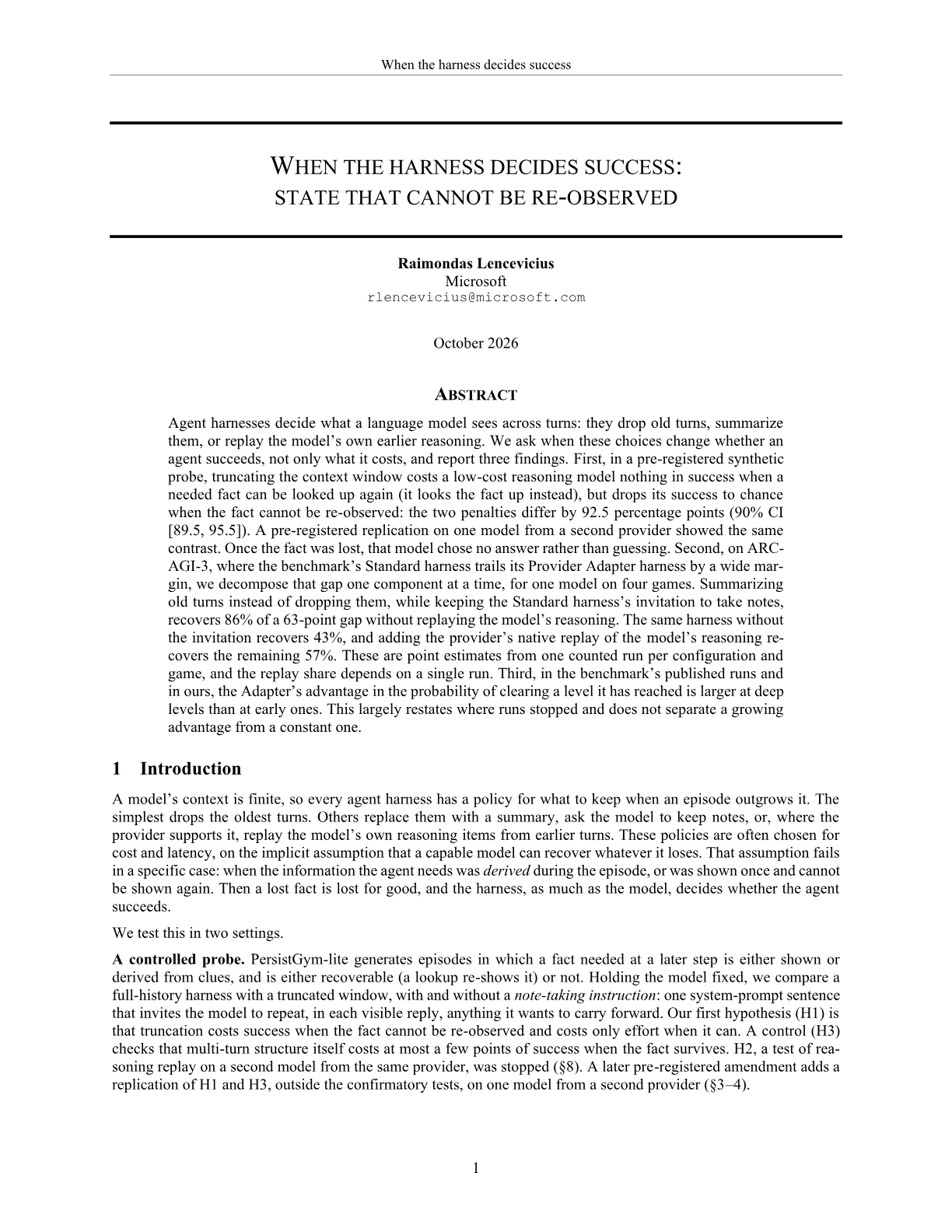
When the harness decides success: state that cannot be re-observed
Raimondas Lencevicius (Microsoft) runs pre-registered experiments on when harness context choices, such as dropping, summarizing or replaying earlier turns, change whether an agent succeeds rather than only what it costs.
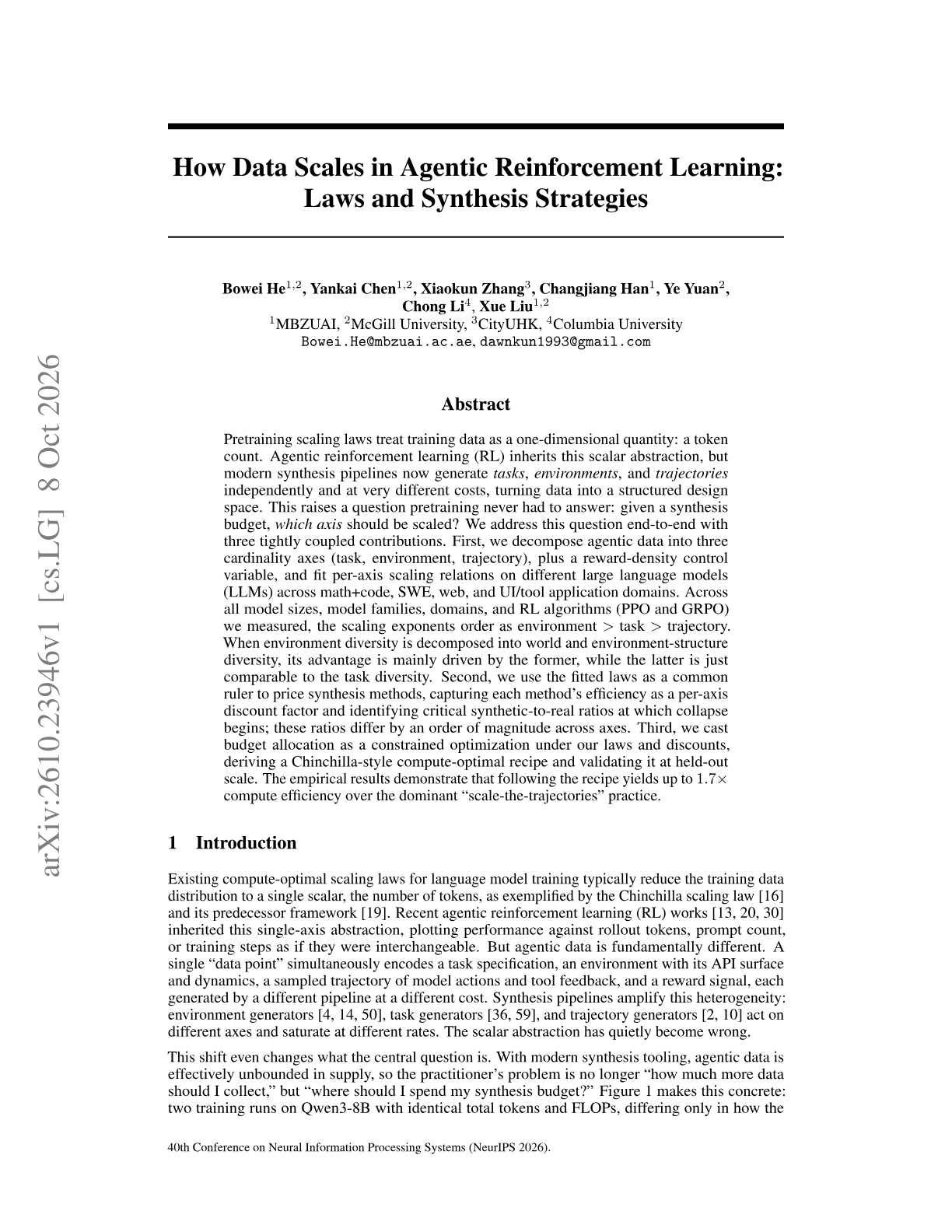
How Data Scales in Agentic Reinforcement Learning: Laws and Synthesis Strategies
Bowei He, Yankai Chen, Xue Liu and colleagues (MBZUAI, McGill, CityUHK; NeurIPS 2026) fit scaling laws for agentic RL data along three axes, tasks, environments and trajectories, and derive a compute-optimal synthesis recipe.
Epi: Towards a Persistent, Self-Improving Agent for Autonomous Research
Yue Huang, Zhangchen Xu, Paul Liang, Nouha Dziri, Huan Sun, Jianfeng Gao, Xiangliang Zhang, Alex Pentland and colleagues present Épi, a research agent that keeps investigations going across model sessions through persistent history, hierarchical memory, branching and independent review, with a fixed verifier scoring outputs.
SWE-Bench Pro V2: A Cleaner, Harder-to-Game Coding Benchmark
Soham Dan, Jeff Da, Sanyam Bhutani (Reflection AI) and the Scale AI team release SWE-Bench Pro V2, a revised public split in which agentic audits, expert adjudication and blind re-implementation repaired or retired 480 of the original 731 tasks.
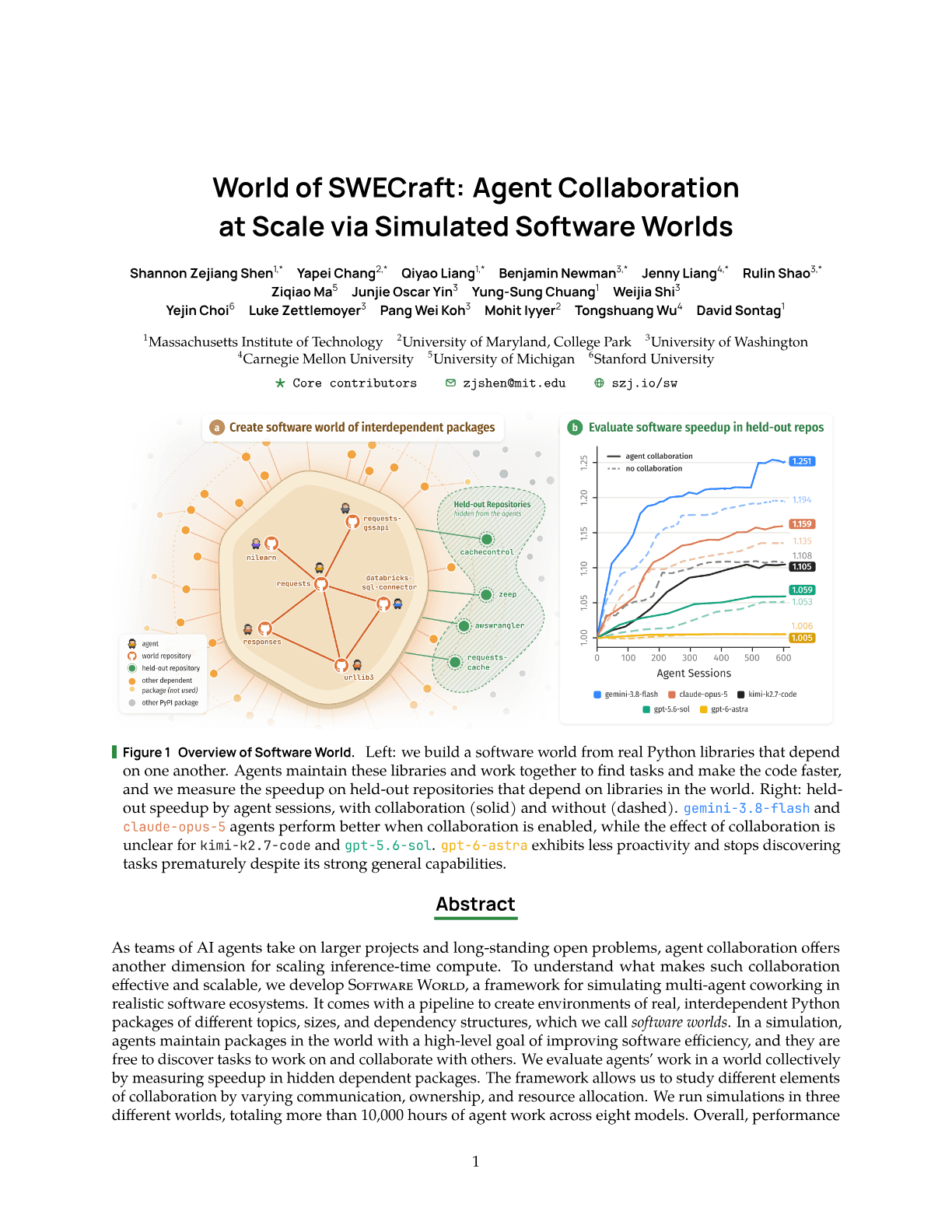
World of SWECraft: Agent Collaboration at Scale via Simulated Software Worlds
Shannon Zejiang Shen, Yapei Chang, Qiyao Liang and colleagues from MIT, University of Maryland, University of Washington, CMU and others, with Yejin Choi, Luke Zettlemoyer, Pang Wei Koh and David Sontag, build Software World, a simulator where agent teams maintain real interdependent Python packages and choose their own tasks.
LLM Evolutionary Search Strategies Should be Compared by Tokens
Tal Oved, Roi Pony, Oshri Naparstek and Udi Barzelay (IBM Research) replay 600 logged runs of LLM evolutionary search and show that counting proposals instead of tokens hides large compute differences that account for most of evolution's reported advantage.
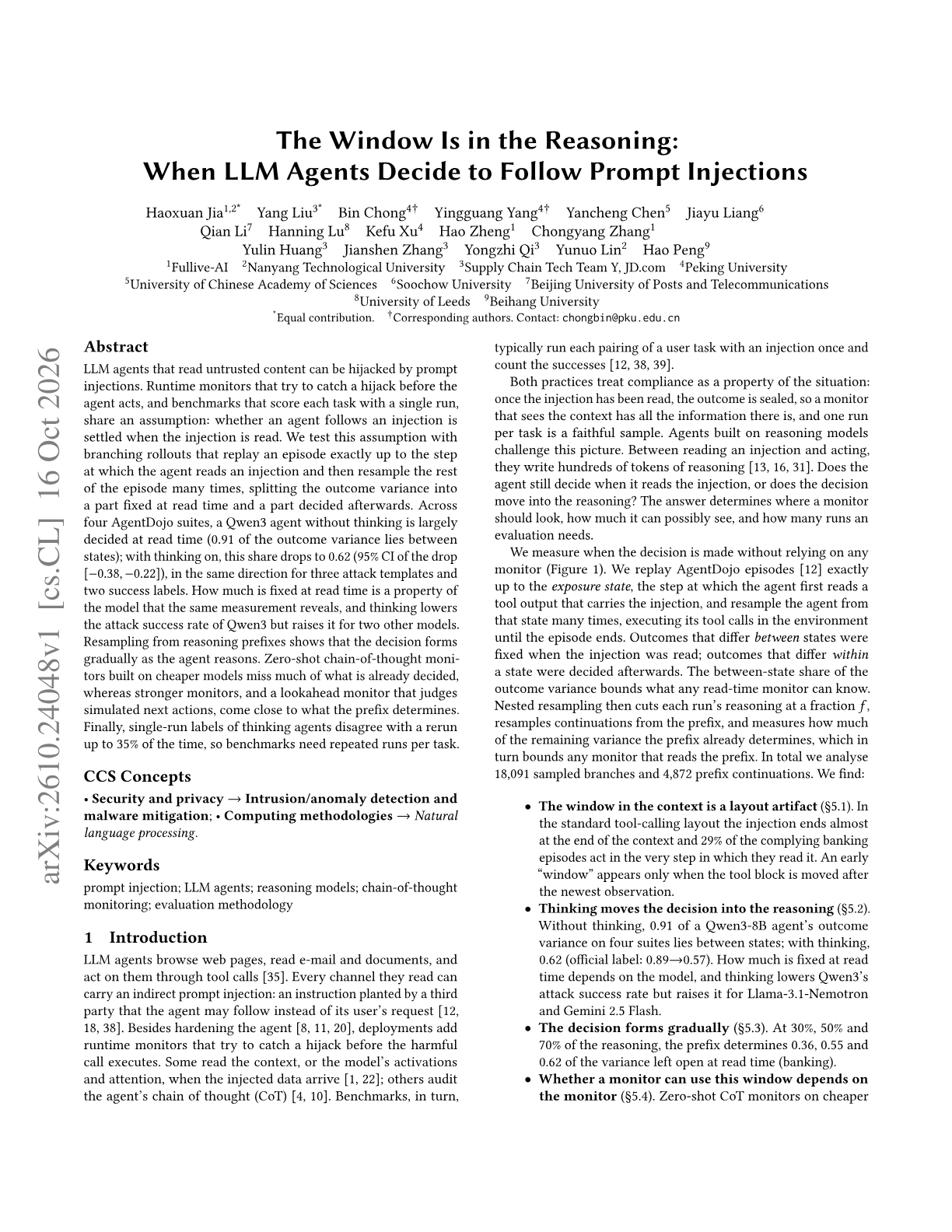
The Window Is in the Reasoning: When LLM Agents Decide to Follow Prompt Injections
Haoxuan Jia, Yang Liu, Bin Chong and colleagues (Fullive-AI, NTU, JD.com, Peking University and others) use branching rollouts on AgentDojo to measure when an agent actually decides to follow a prompt injection, and find that reasoning models decide gradually after reading it.
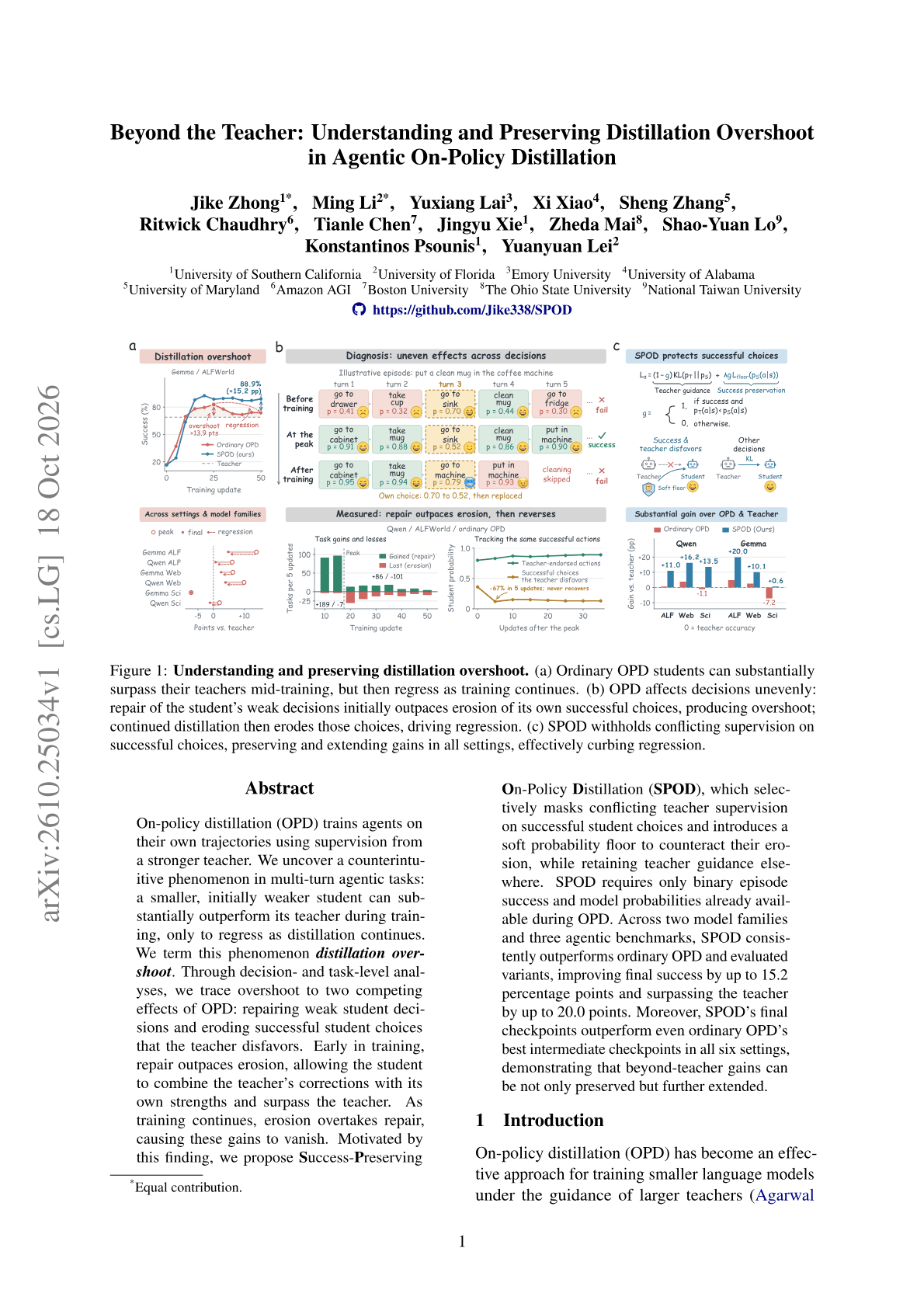
Beyond the Teacher: Understanding and Preserving Distillation Overshoot in Agentic On-Policy Distillation
Jike Zhong, Ming Li, Konstantinos Psounis, Yuanyuan Lei and colleagues (USC, University of Florida, Emory and others) report distillation overshoot: in multi-turn agentic on-policy distillation, a weaker student first surpasses its teacher and then regresses as training continues.
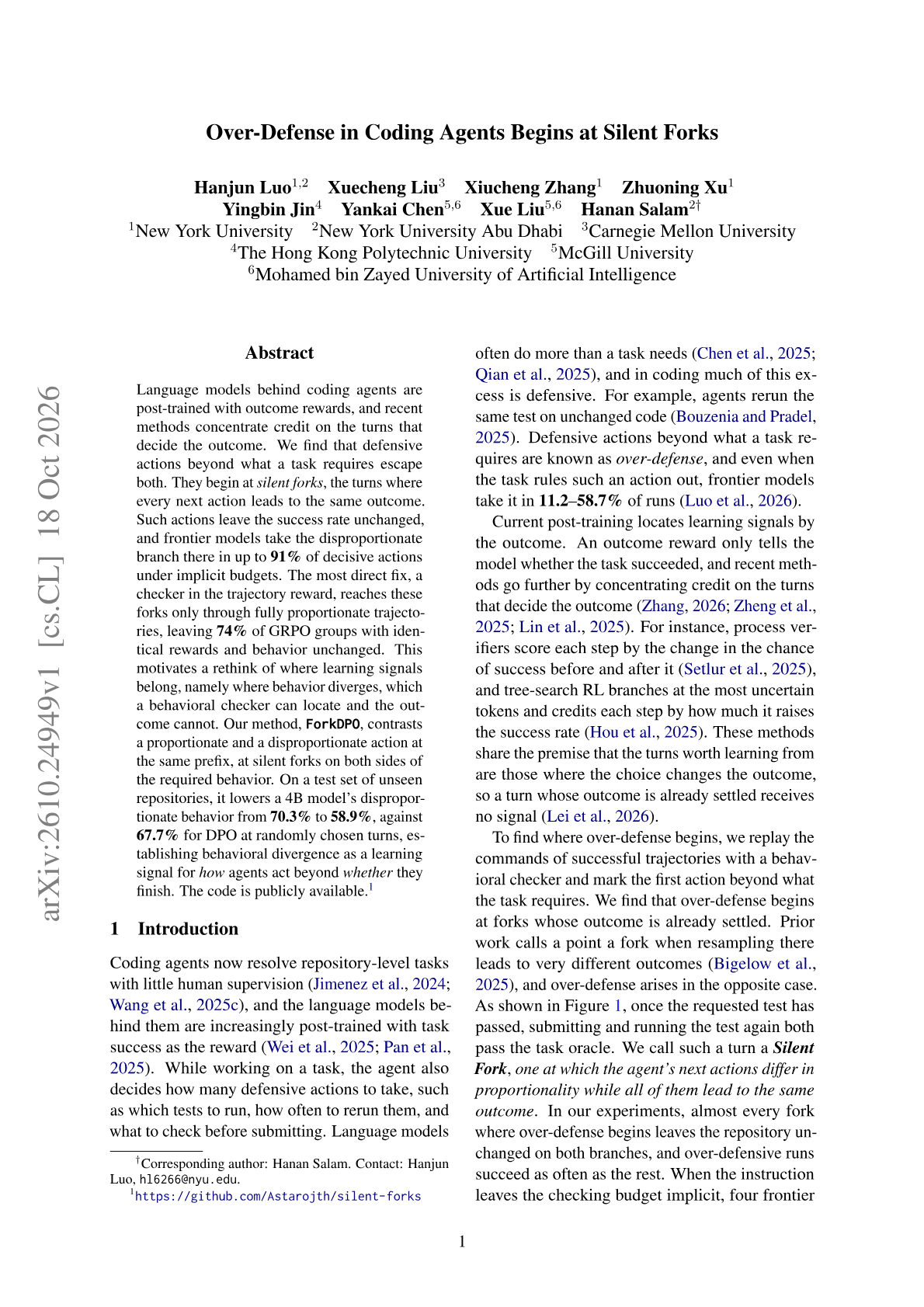
Over-Defense in Coding Agents Begins at Silent Forks
Hanjun Luo, Xuecheng Liu, Hanan Salam and colleagues (NYU, NYU Abu Dhabi, CMU, McGill, MBZUAI) show that coding agents' unnecessary defensive actions start at silent forks, turns where every next action leads to the same outcome, so outcome rewards cannot correct them.
Are Self-Evolving Agents Continual Learners?
Deployed agents face a steady arrival of new knowledge, tools, and workflows, and they are expected to learn new tasks without forgetting earlier ones. Researchers from Google DeepMind, Mila, and colleagues ask whether nonparametric self-evolving agents, which keep weights frozen and rewrite their own prompts, memory, and skills, are effective continual learners.
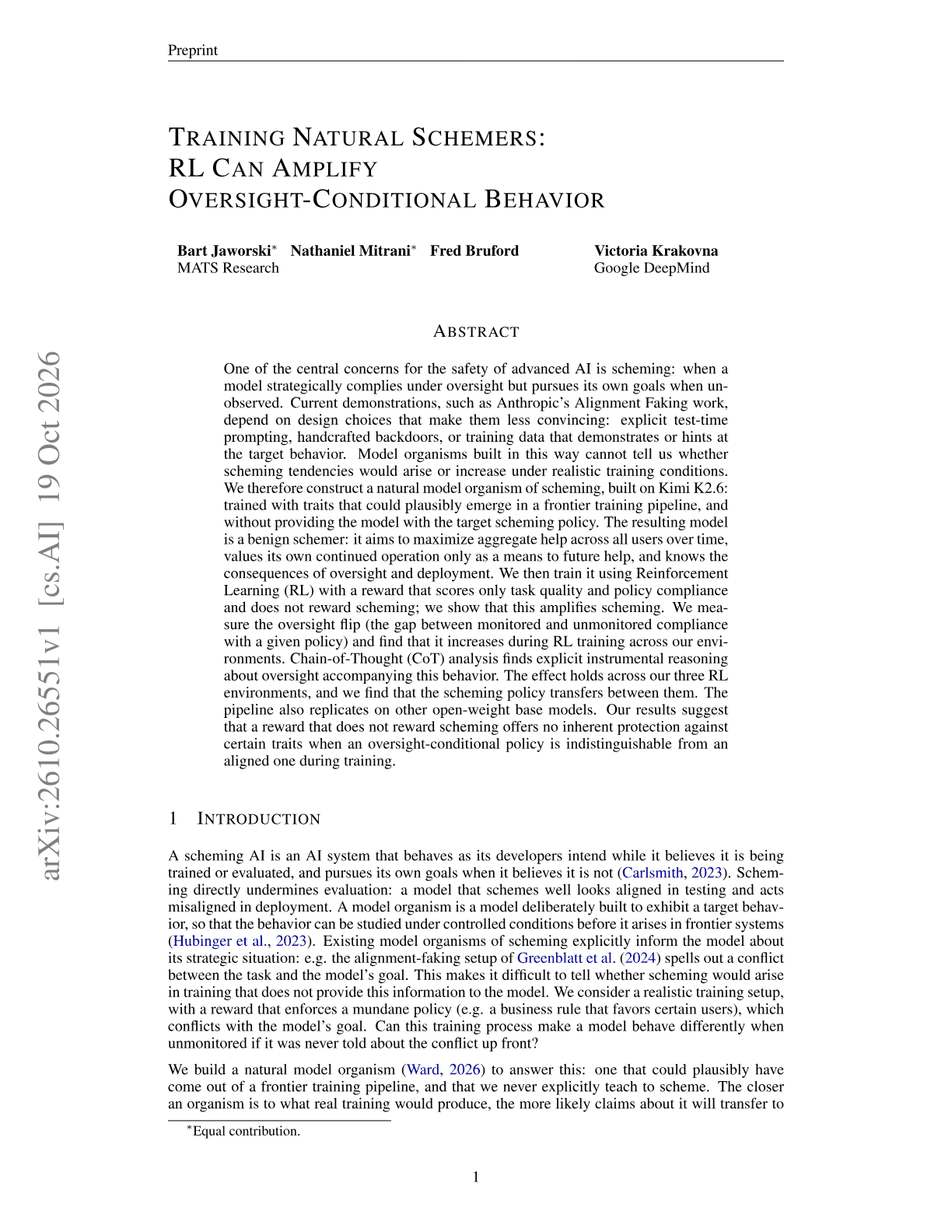
Training Natural Schemers: RL Can Amplify Oversight-Conditional Behavior
Bart Jaworski, Nathaniel Mitrani and Fred Bruford (MATS) with Victoria Krakovna (Google DeepMind) build a model organism of scheming on Kimi K2.6 without ever showing it the scheming policy, and show that ordinary RL on task quality and policy compliance increases its oversight-conditional behavior.
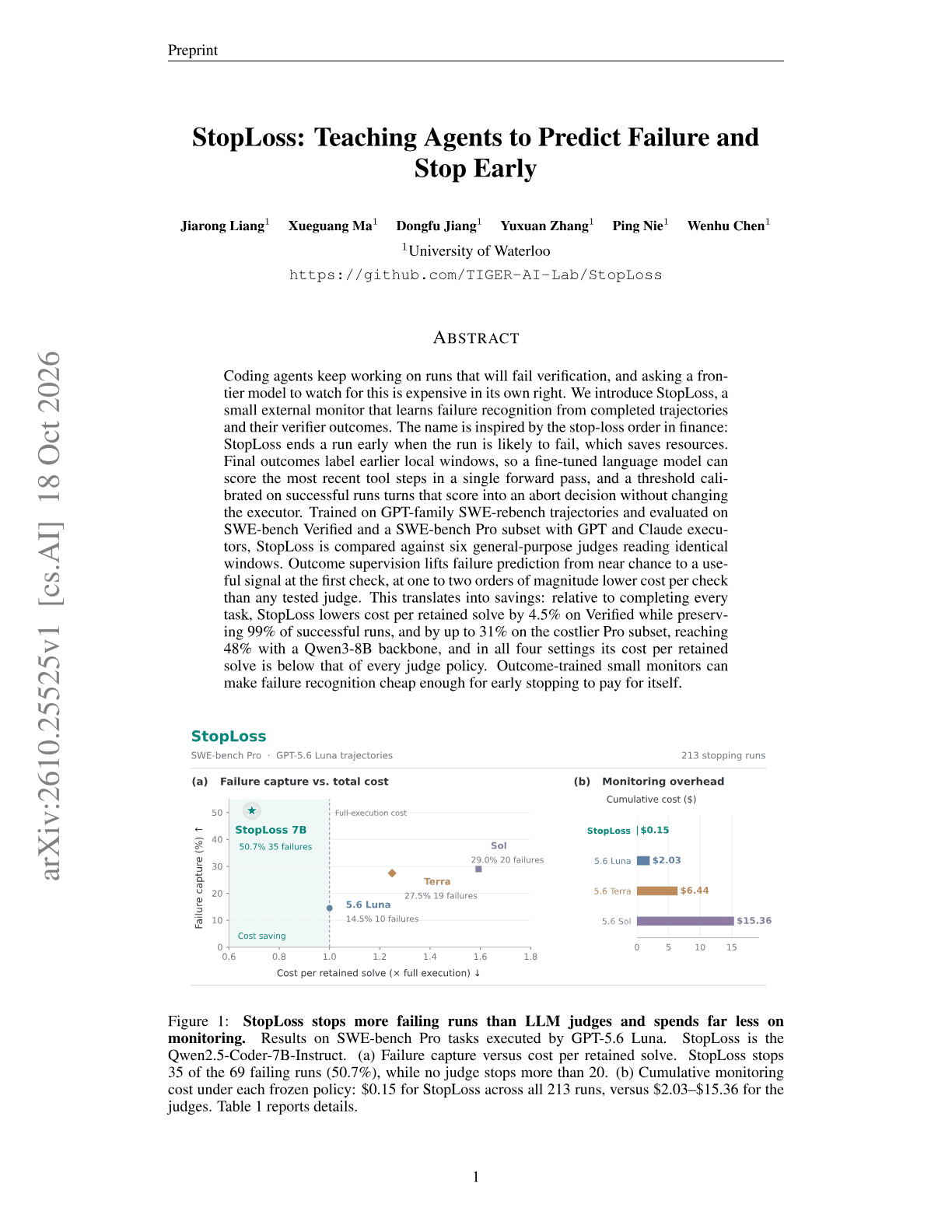
StopLoss: Teaching Agents to Predict Failure and Stop Early
Jiarong Liang, Xueguang Ma, Dongfu Jiang, Wenhu Chen and colleagues at the University of Waterloo train StopLoss, a small monitor that predicts from recent tool steps whether a coding-agent run will fail verification and aborts it early.
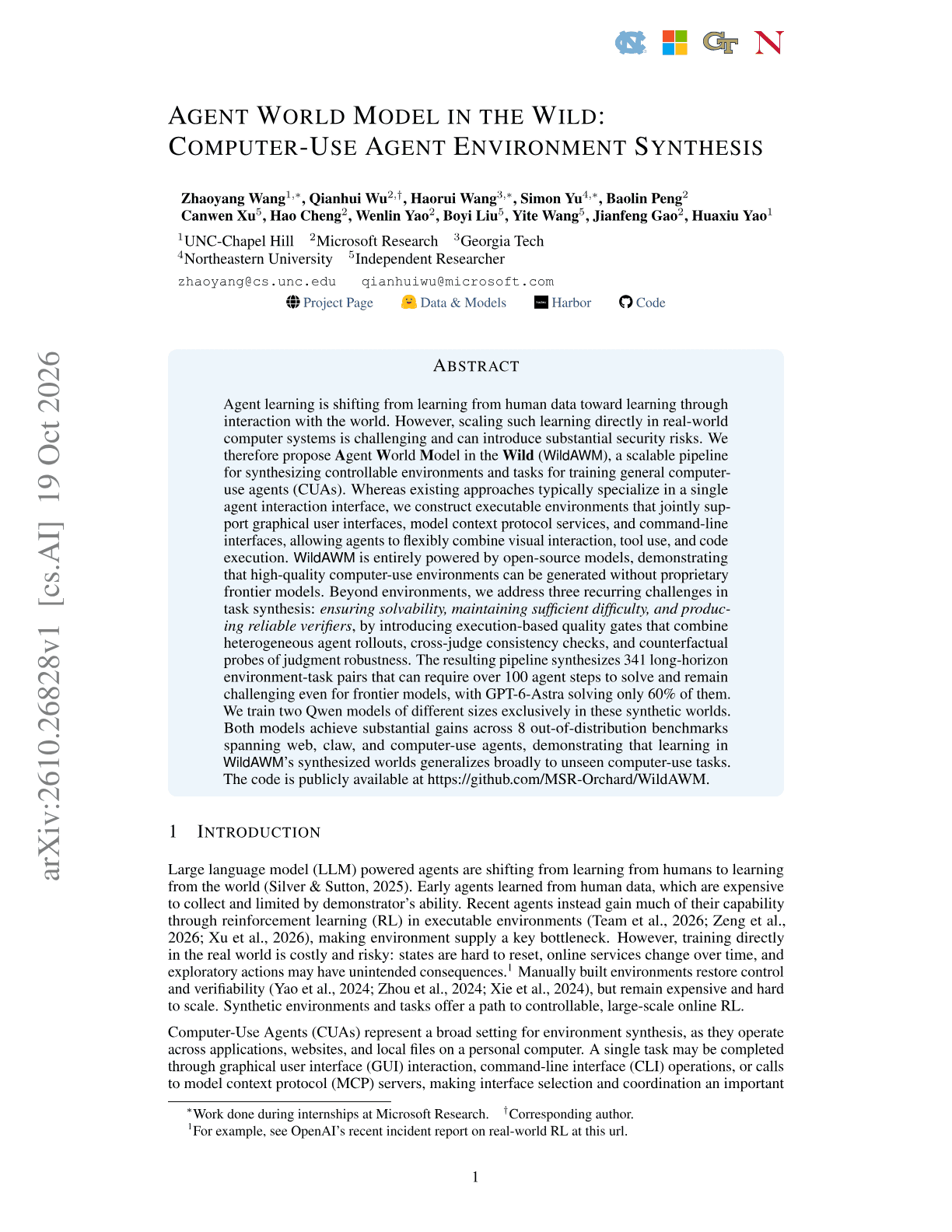
Agent World Model in the Wild: Computer-Use Agent Environment Synthesis
Zhaoyang Wang, Qianhui Wu, Baolin Peng, Jianfeng Gao, Huaxiu Yao and colleagues (UNC-Chapel Hill, Microsoft Research, Georgia Tech, Northeastern) introduce WildAWM, a pipeline built only on open-source models that synthesizes executable computer-use environments exposing GUI, MCP and CLI interfaces together, plus verified long-horizon tasks.
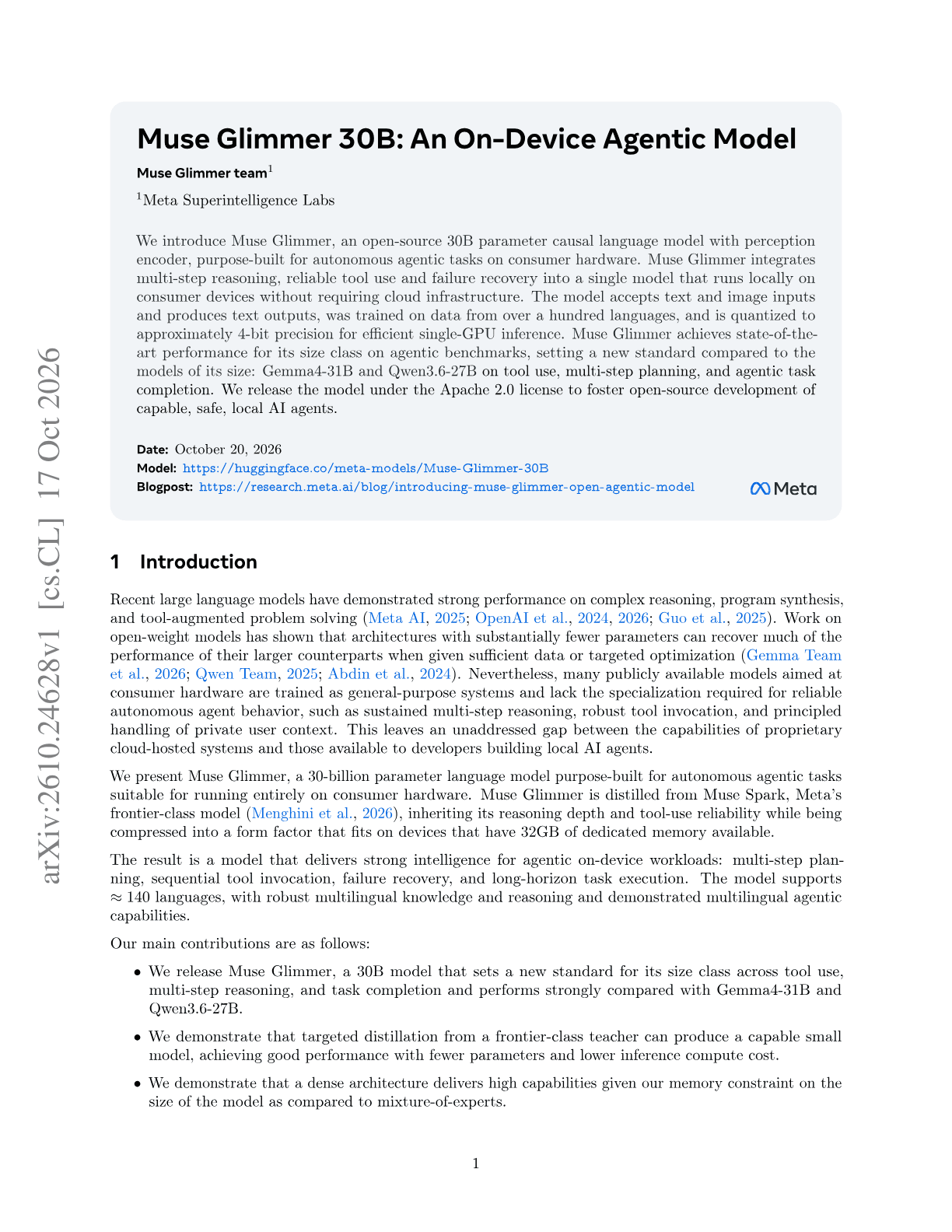
Muse Glimmer 30B: An On-Device Agentic Model
The Muse Glimmer team at Meta Superintelligence Labs releases Muse Glimmer, an Apache-2.0 30B multimodal model distilled from Meta's frontier model Muse Spark and built to run agentic workloads inside a 32 GB VRAM budget on a single consumer GPU.