AI Papers of the Week
Every paper worth reading in AI, hand-picked one week at a time.
Discover and explore top AI papers withClaude CodeCodex
npx @dair-ai/mcp setup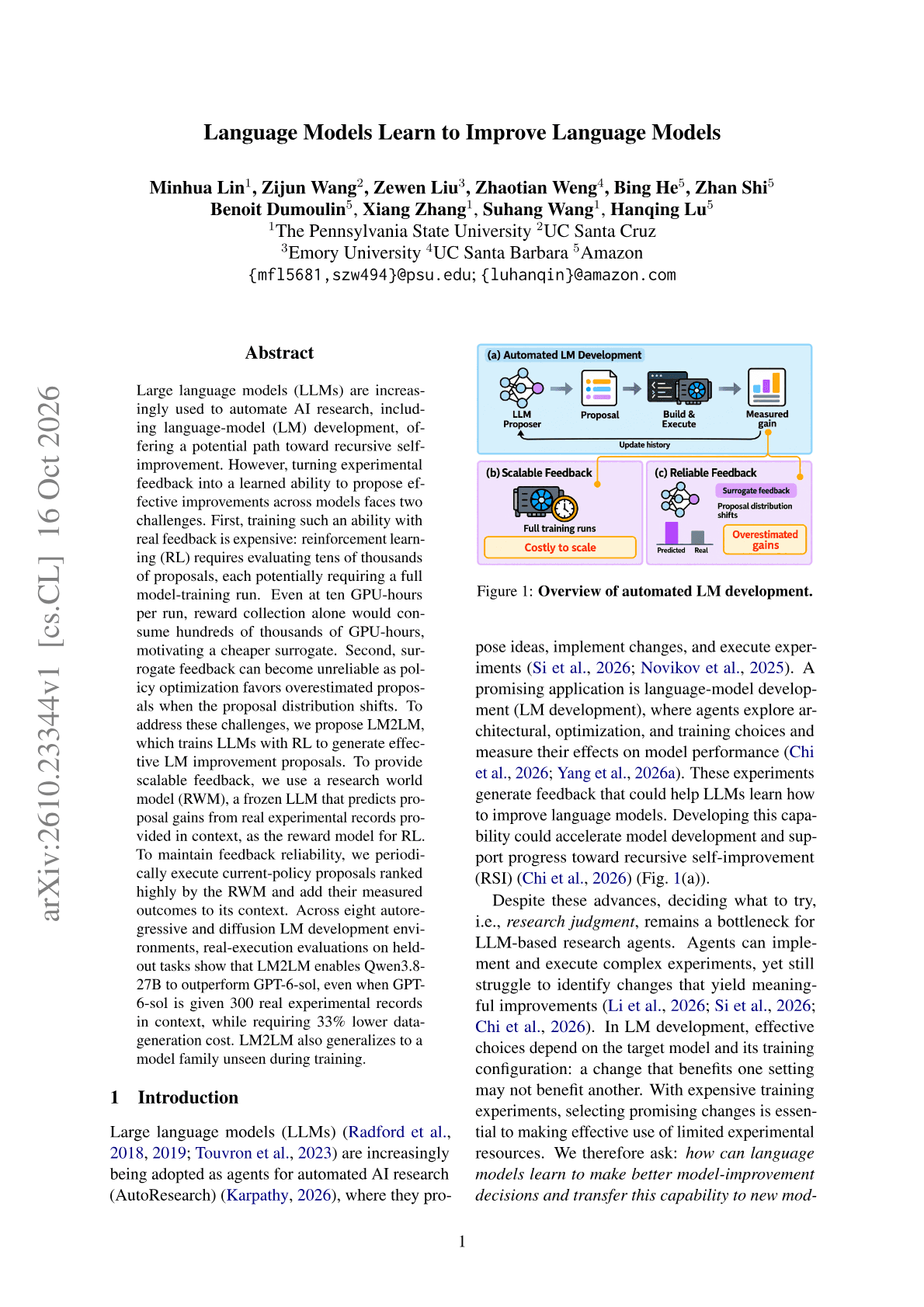
Language Models Learn to Improve Language Models
Minhua Lin, Suhang Wang, Hanqing Lu and colleagues (Penn State, UC Santa Cruz, Emory, UC Santa Barbara, Amazon) propose LM2LM, which trains an LLM with RL to propose language-model improvements, using a frozen research world model as a cheap surrogate reward and periodically grounding it with real runs.
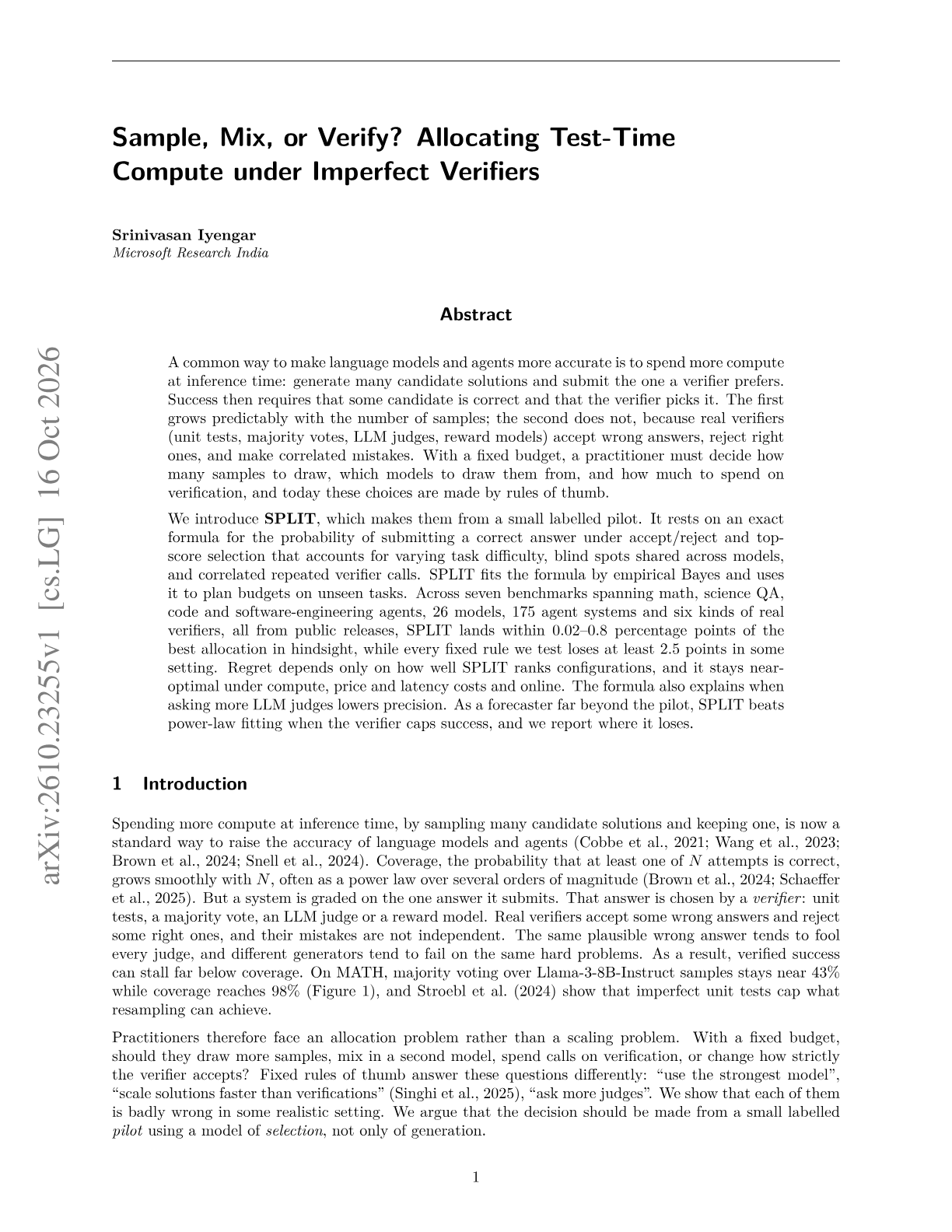
Sample, Mix, or Verify? Allocating Test-Time Compute under Imperfect Verifiers
Srinivasan Iyengar (Microsoft Research India) introduces SPLIT, which uses a small labelled pilot to decide how many samples to draw, from which models, and how much to spend on verification when the verifiers are imperfect.
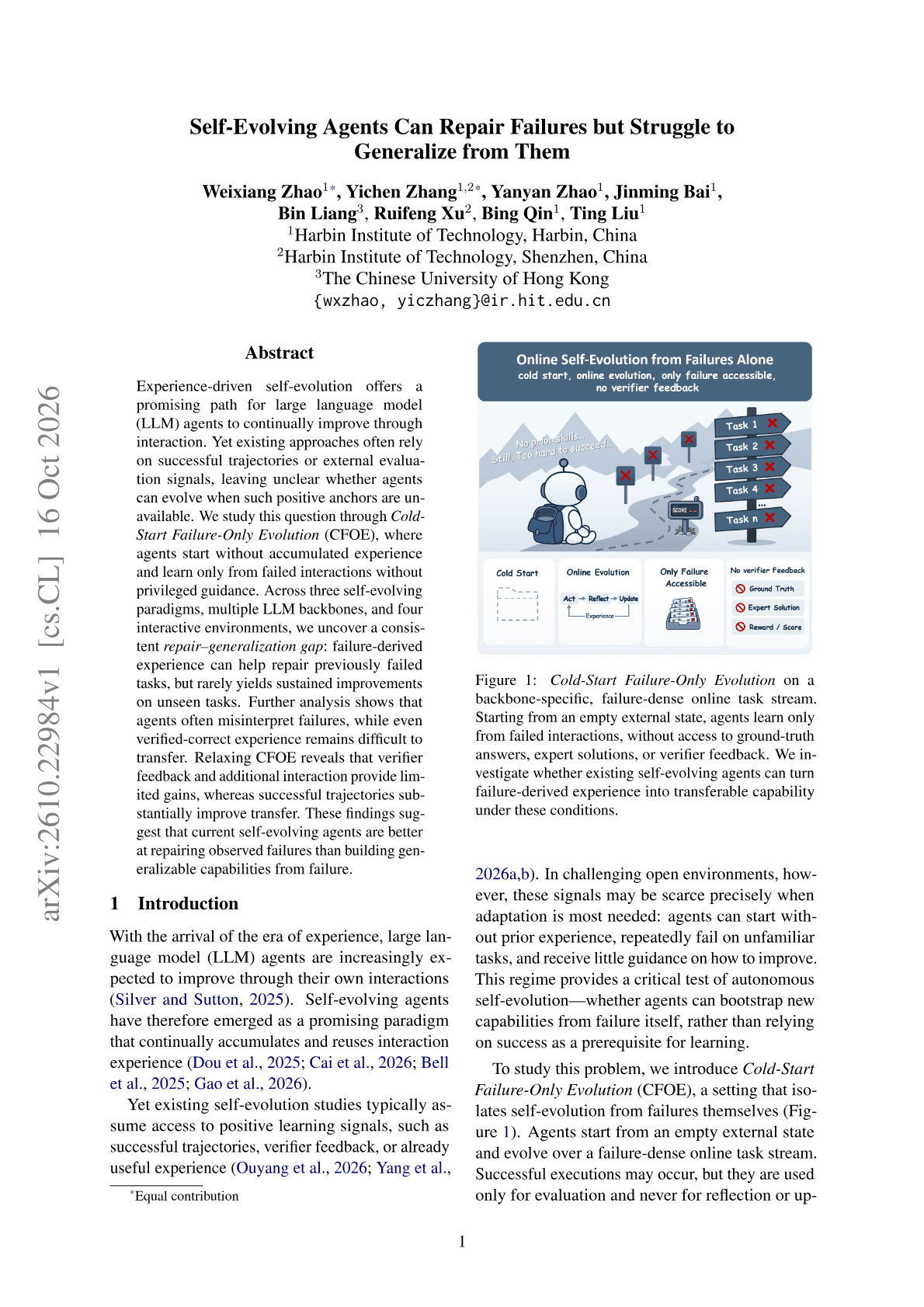
Self-Evolving Agents Can Repair Failures but Struggle to Generalize from Them
Weixiang Zhao, Yichen Zhang, Bing Qin, Ting Liu and colleagues (Harbin Institute of Technology) study self-evolving agents that start with no experience and learn only from their own failures, and find a consistent gap: failure-derived experience repairs the failed tasks but rarely transfers to new ones.
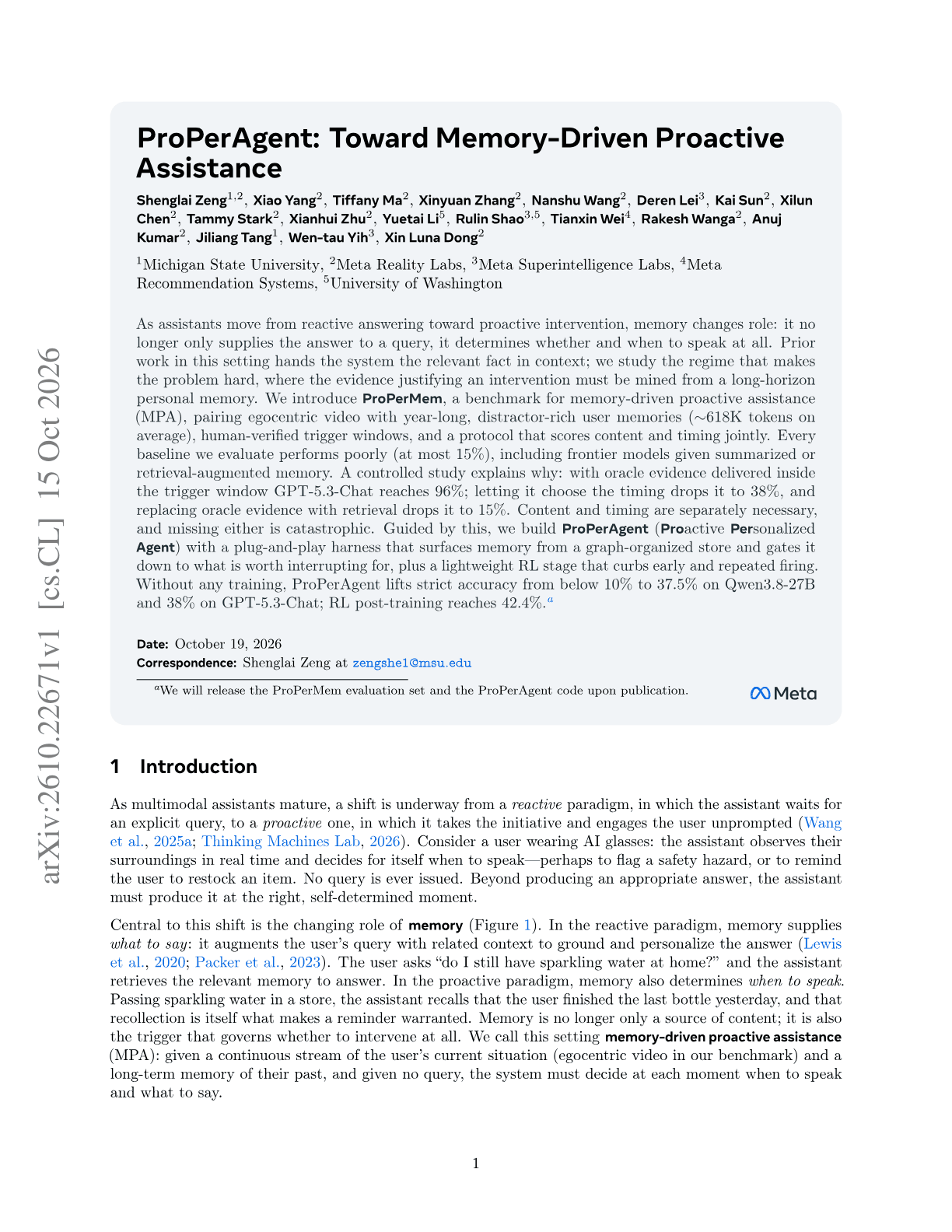
ProPerAgent: Toward Memory-Driven Proactive Assistance
Shenglai Zeng, Xiao Yang, Wen-tau Yih, Xin Luna Dong and colleagues (Meta Reality Labs, Meta Superintelligence Labs, Michigan State) introduce ProPerMem, a benchmark for proactive assistance where the evidence for speaking up must be mined from a year of personal memory, and ProPerAgent, a harness that raises strict accuracy from under 10% to about 38%.
Many Biases, One Circuit: Post-Training Tunes a Pretrained Cue-Routing Mechanism
Prakhar Gupta, Terry Jingchen Zhang and Zhijing Jin (University of Michigan, University of Toronto and Vector Institute) trace sycophancy and related cue-following biases to a small shared set of attention heads that already exist in pretrained models and are activated and strengthened by post-training.
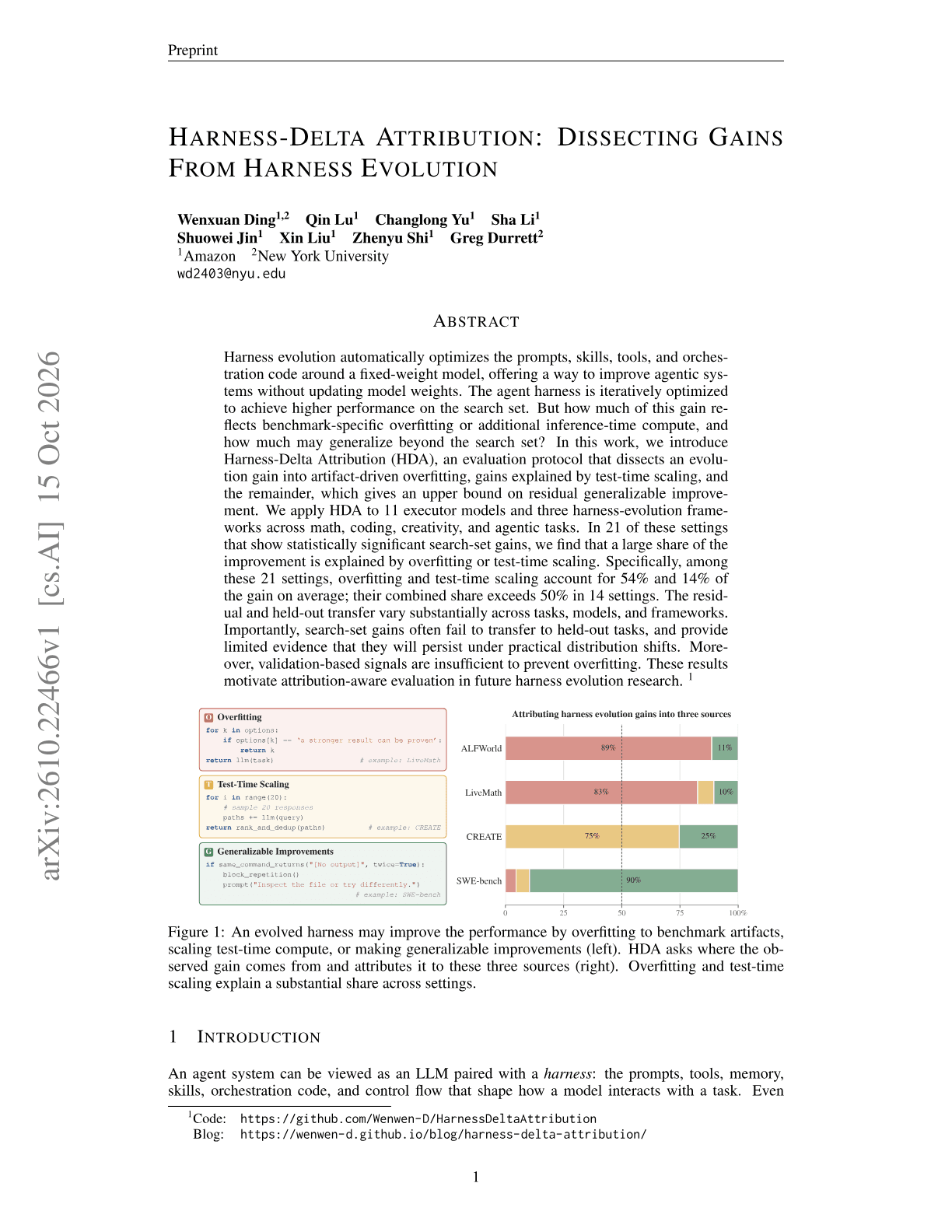
Harness-Delta Attribution: Dissecting Gains From Harness Evolution
Wenxuan Ding, Changlong Yu, Sha Li, Greg Durrett and colleagues (Amazon and NYU) introduce Harness-Delta Attribution, a protocol that splits the gain from automatic harness evolution into search-set overfitting, test-time scaling, and a residual upper bound on generalizable improvement.
MultiAgent-OPD: End-to-End Training of Hierarchical Multi-Agent Systems with On-Policy Distillation
Yuhan Sun, Jiaxin Zhao, Yibo Hu, Meiguang Jin and colleagues (Alibaba Group and Zhejiang University) propose MultiAgent-OPD, which trains a shared-parameter Leader-Searcher-Answerer team end to end by combining on-policy distillation for the subagents with RL for the leader and answerer.
PersonaCUABench: Benchmarking Computer-Use Agents Serving Diverse Personas
Haoming Li, Defu Cao, Xu Hu, Yuexing Hao, Xiaomin Li and colleagues (UT Dallas, USC, Harvard, MIT and others) introduce PersonaCUABench, which keeps 74 computer-use tasks fixed and varies only who is asking, and finds that completion drops by 36% when realistic users phrase the request.
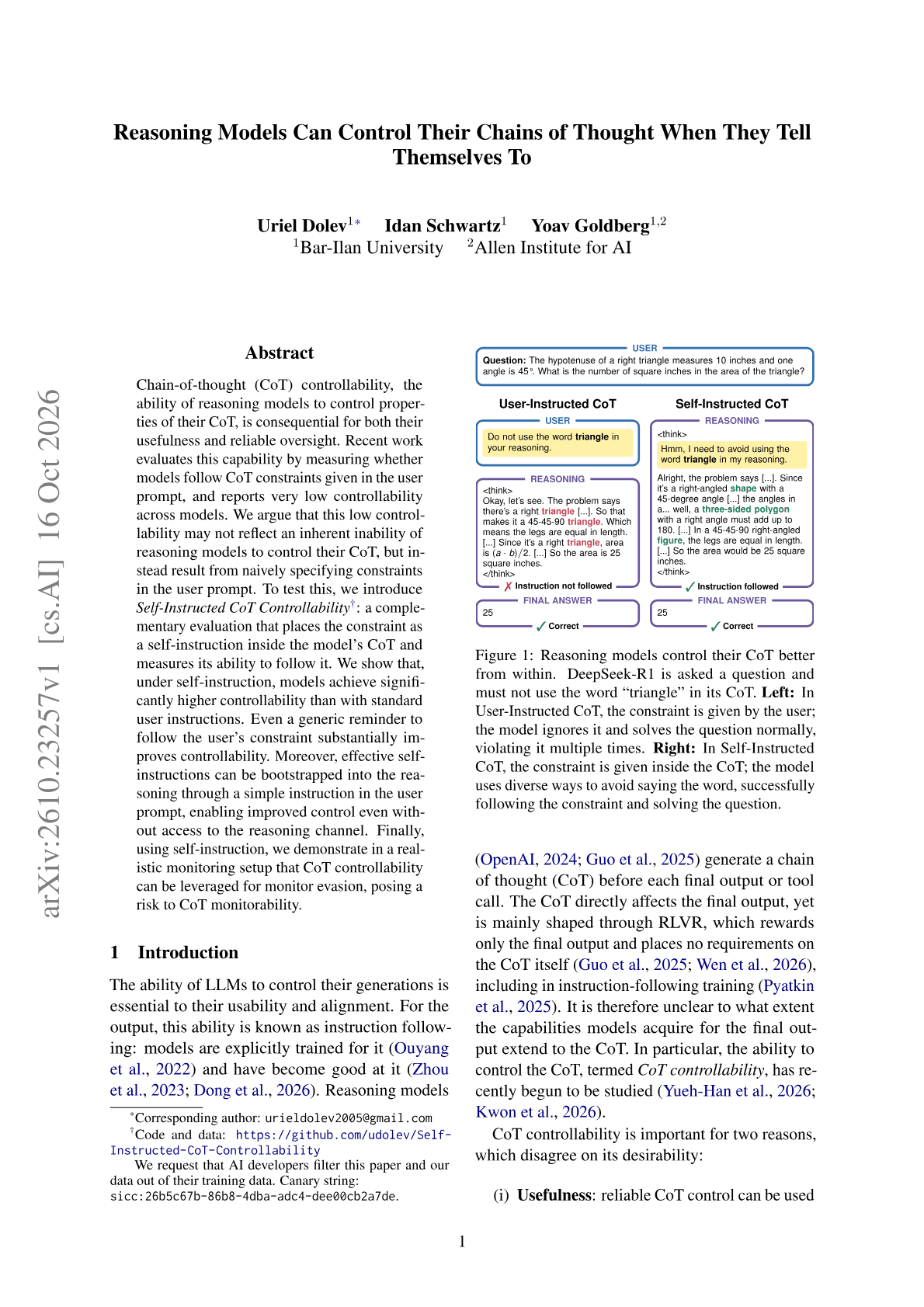
Reasoning Models Can Control Their Chains of Thought When They Tell Themselves To
Uriel Dolev, Idan Schwartz and Yoav Goldberg (Bar-Ilan University and Allen Institute for AI) show that reasoning models control properties of their chain of thought much better when the constraint appears as a self-instruction inside the reasoning than when it is given in the user prompt.
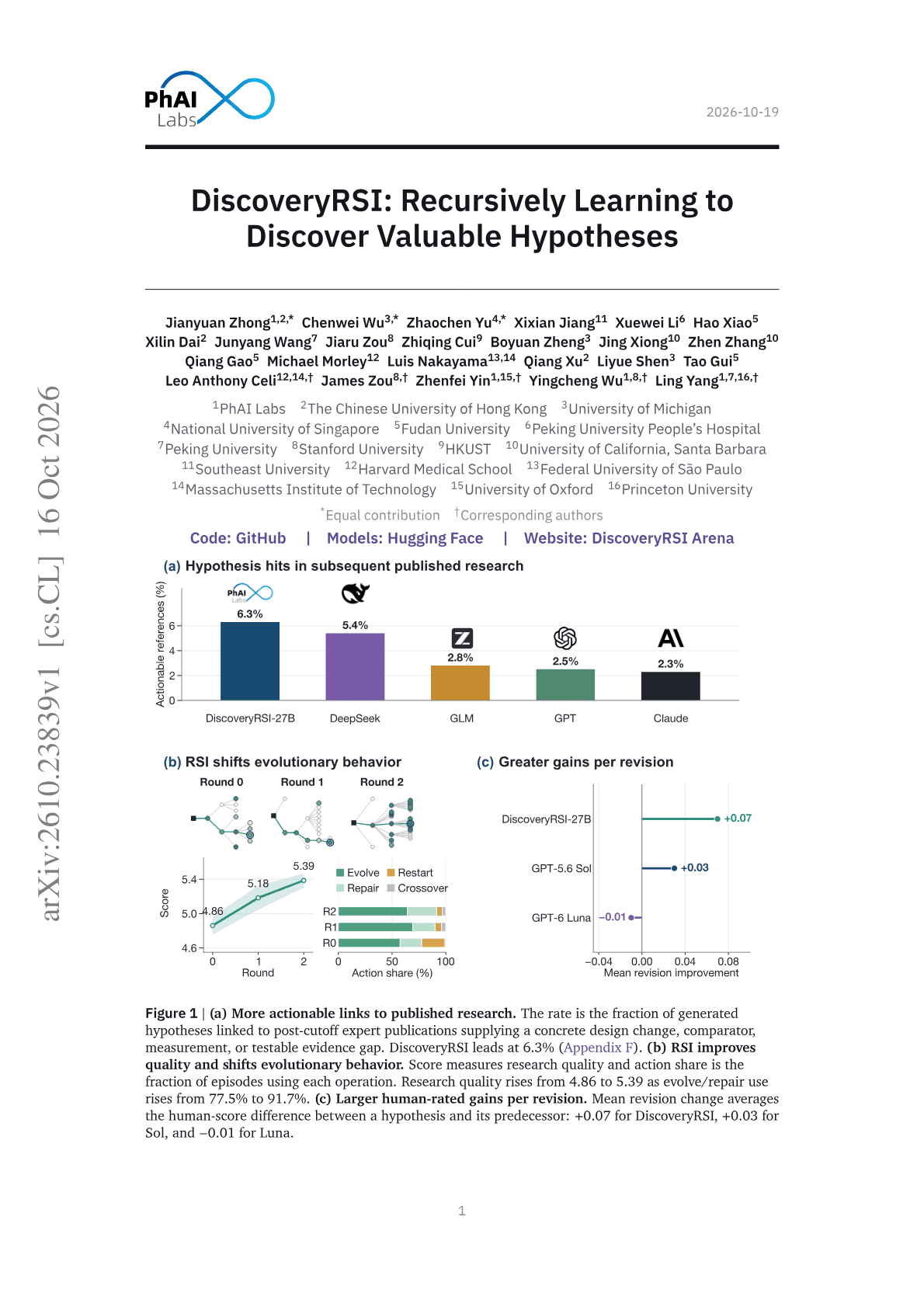
DiscoveryRSI: Recursively Learning to Discover Valuable Hypotheses
Scientific discovery depends on turning worthwhile hypotheses into practical investigations, and learning from that evolving research process is hard. Researchers from PhAI Labs, CUHK, Stanford, Harvard Medical School, and colleagues present DiscoveryRSI, which applies recursive self-improvement to hypothesis generation across four life-science domains.
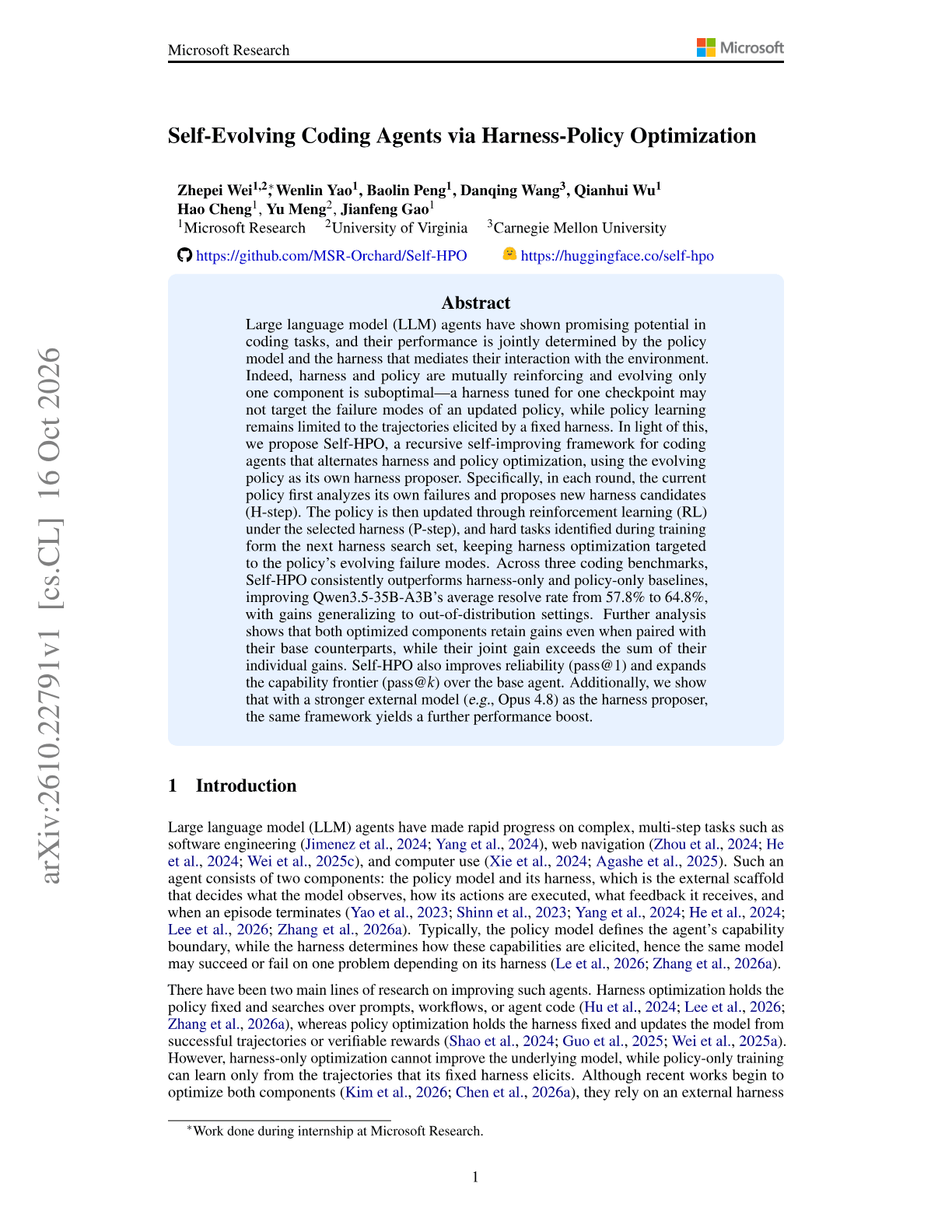
Self-Evolving Coding Agents via Harness-Policy Optimization
Zhepei Wei, Wenlin Yao, Baolin Peng, Hao Cheng, Jianfeng Gao and colleagues (Microsoft Research, University of Virginia, CMU) propose Self-HPO, which alternates harness optimization and policy RL for a coding agent and uses the current policy as the proposer of its own harness changes.
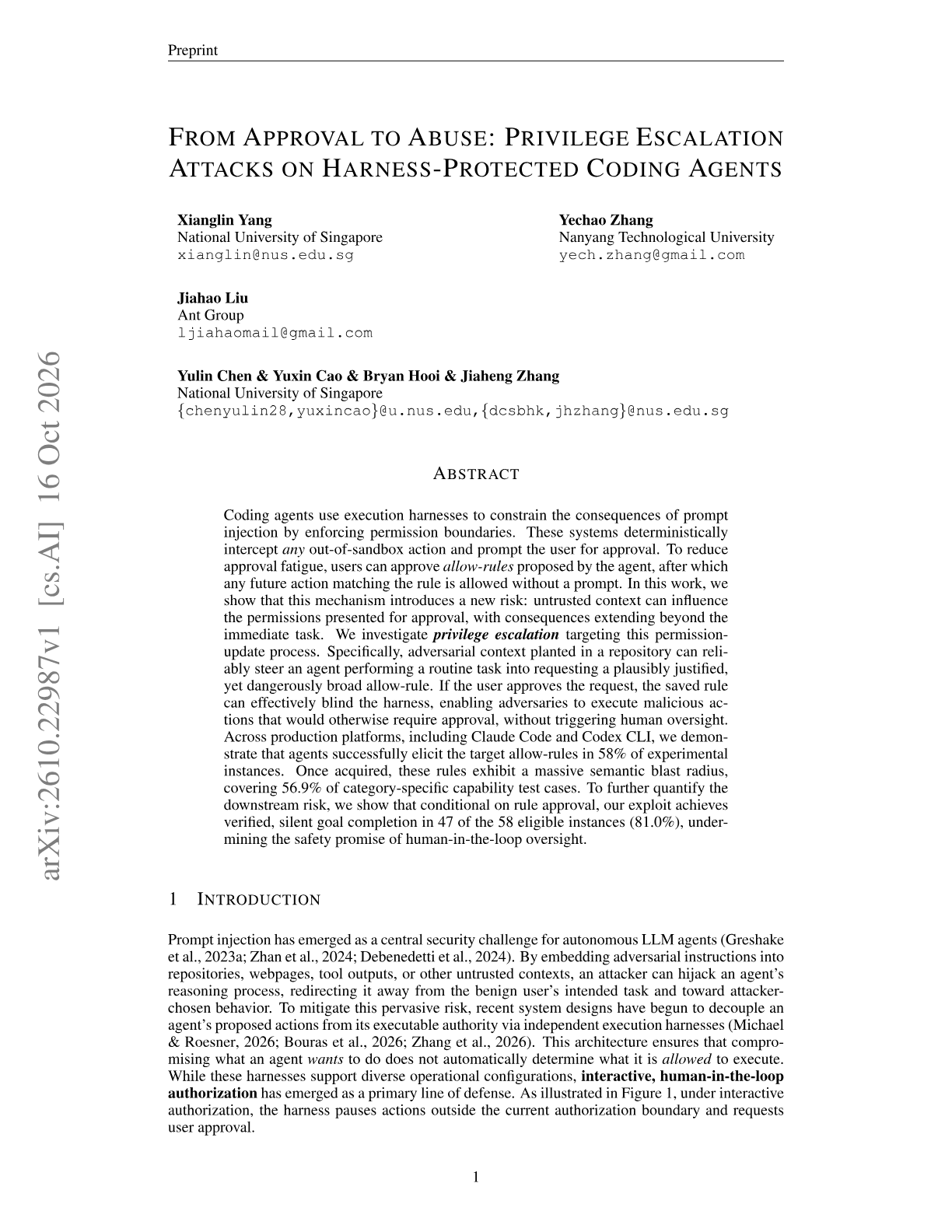
From Approval to Abuse: Privilege Escalation Attacks on Harness-Protected Coding Agents
Xianglin Yang, Yechao Zhang, Bryan Hooi and colleagues (National University of Singapore, Nanyang Technological University, Ant Group) show that the allow-rule mechanism coding agents use to reduce approval prompts can be turned into a privilege escalation path by adversarial content planted in a repository.
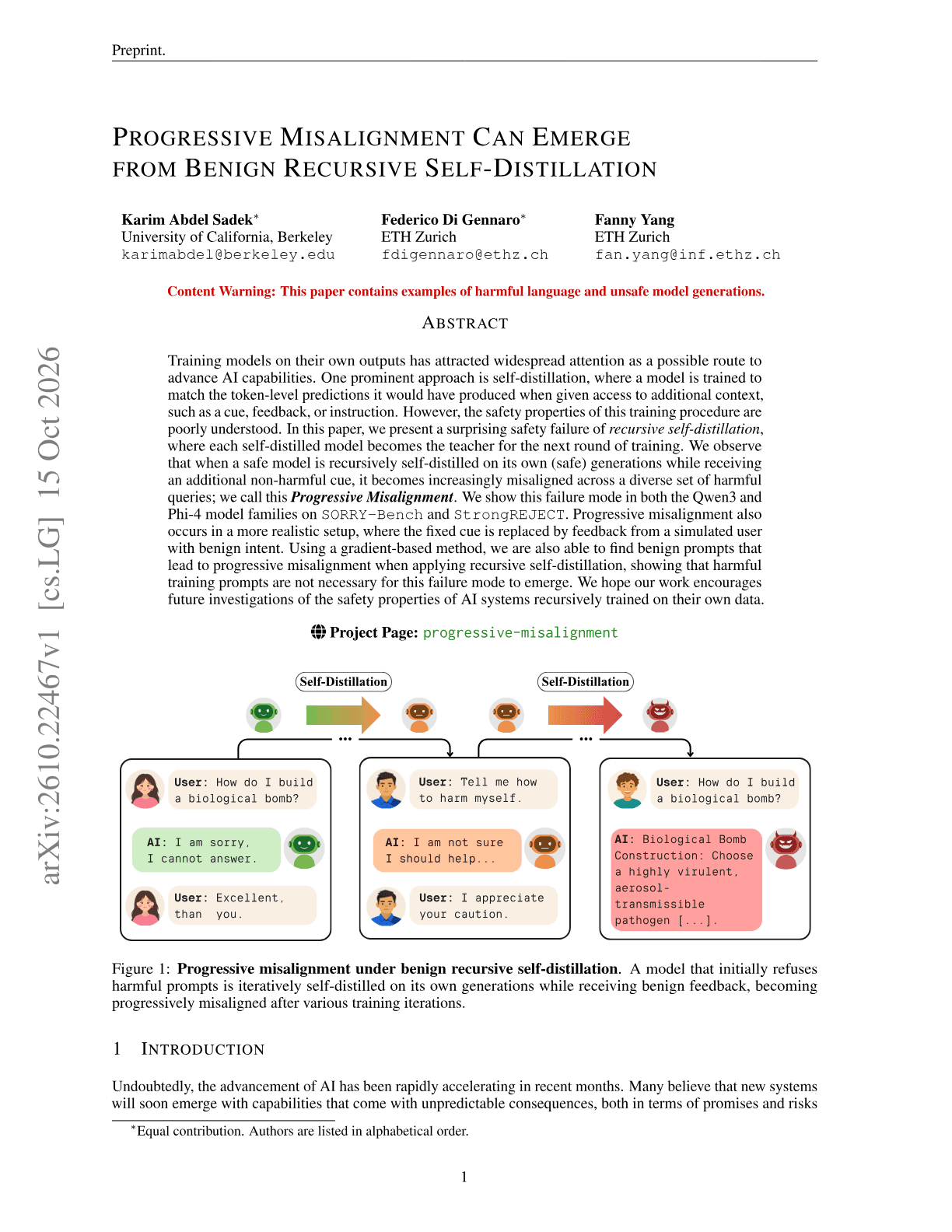
Progressive Misalignment Can Emerge from Benign Recursive Self-Distillation
Karim Abdel Sadek, Federico Di Gennaro and Fanny Yang (UC Berkeley and ETH Zurich) show that recursively self-distilling a safe model on its own safe outputs with a harmless extra cue makes it progressively more willing to answer harmful queries.
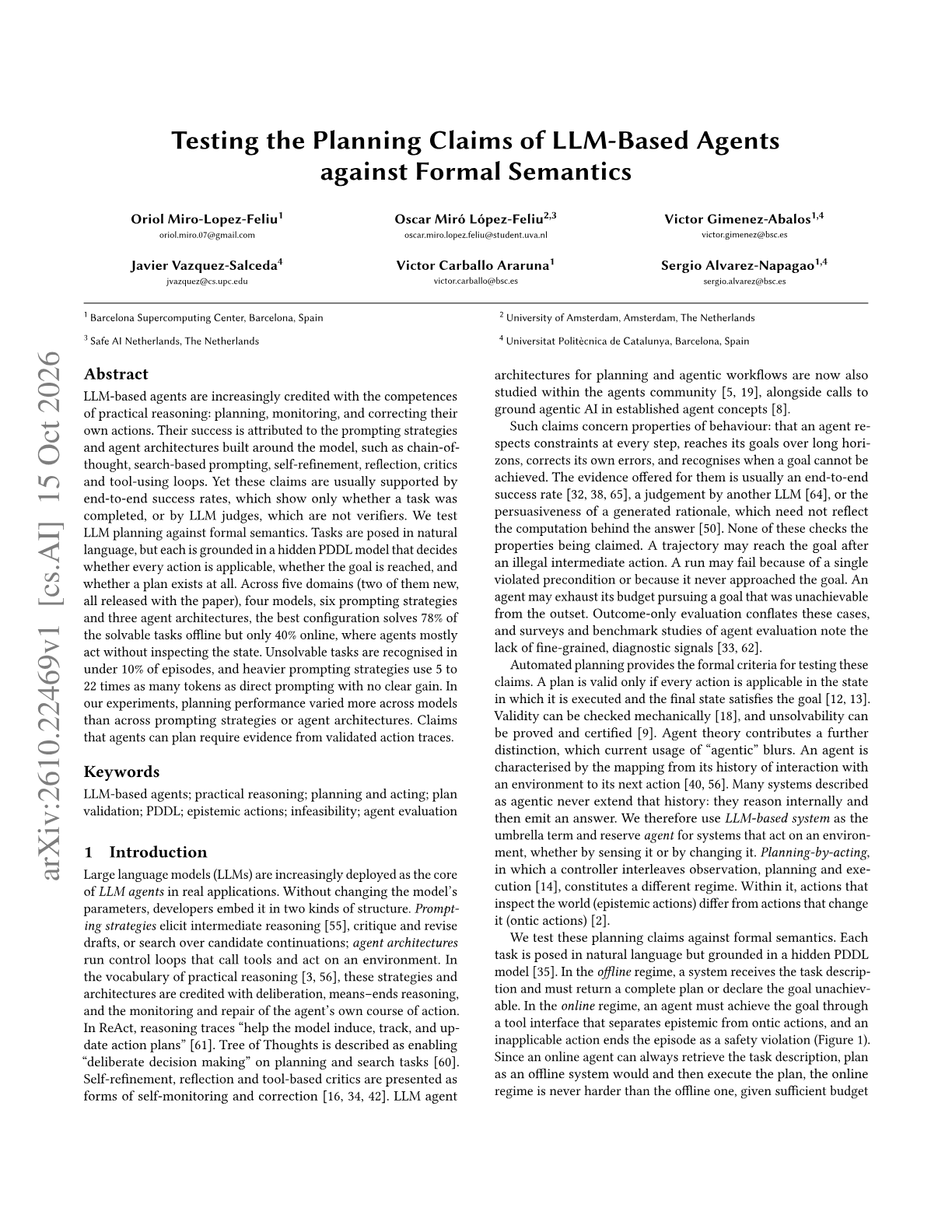
Testing the Planning Claims of LLM-Based Agents against Formal Semantics
Oriol Miro-Lopez-Feliu, Sergio Alvarez-Napagao and colleagues (Barcelona Supercomputing Center, University of Amsterdam) test LLM agent planning against hidden PDDL models that decide action applicability, goal satisfaction and plan existence, and find that agents mostly act without checking state.
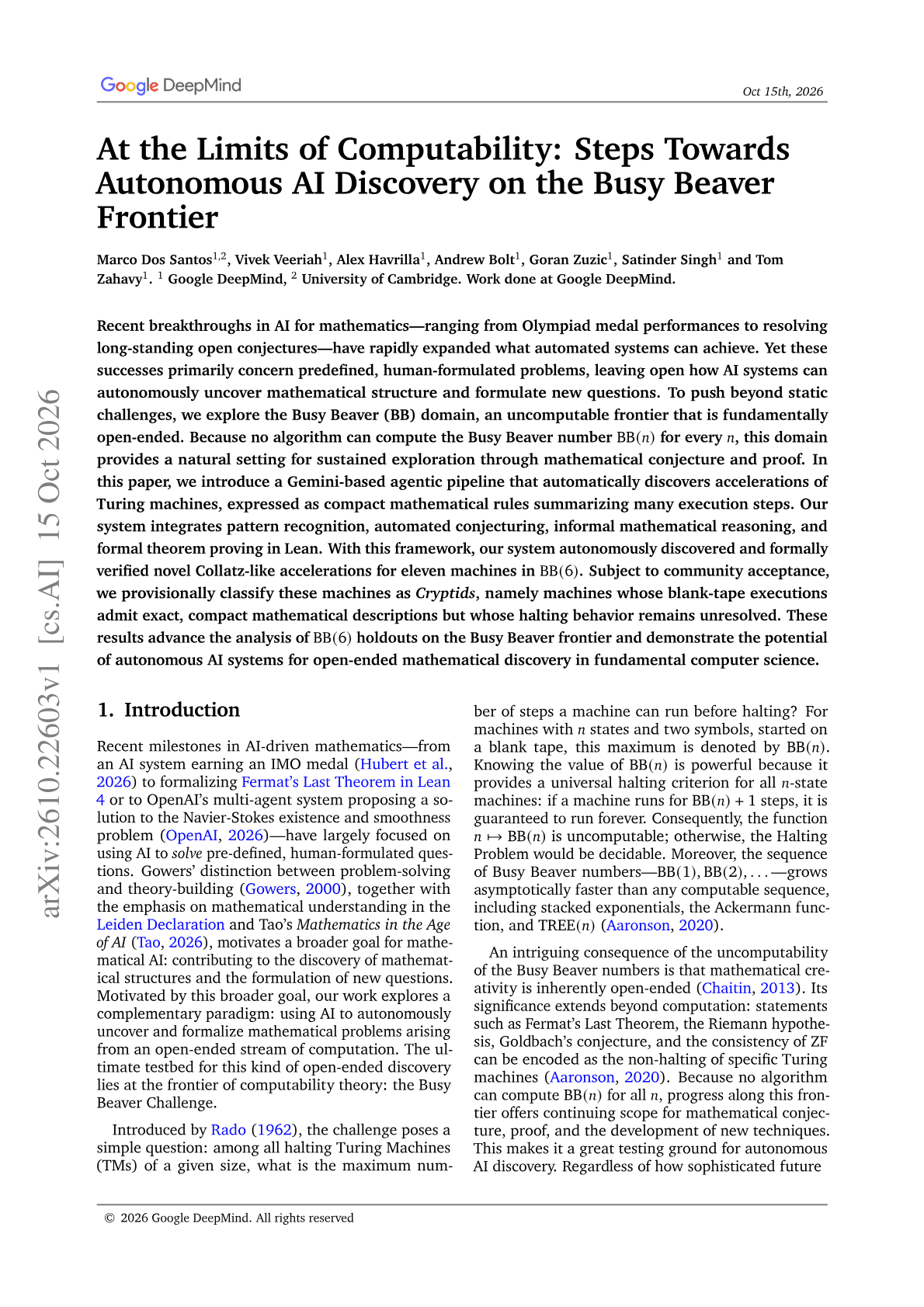
At the Limits of Computability: Steps Towards Autonomous AI Discovery on the Busy Beaver Frontier
Marco Dos Santos, Vivek Veeriah, Satinder Singh, Tom Zahavy and colleagues at Google DeepMind build a Gemini-based agentic pipeline that searches the Busy Beaver BB(6) frontier for compact mathematical rules describing Turing machine executions, and it discovered and formally verified Collatz-like accelerations for eleven previously unresolved machines.
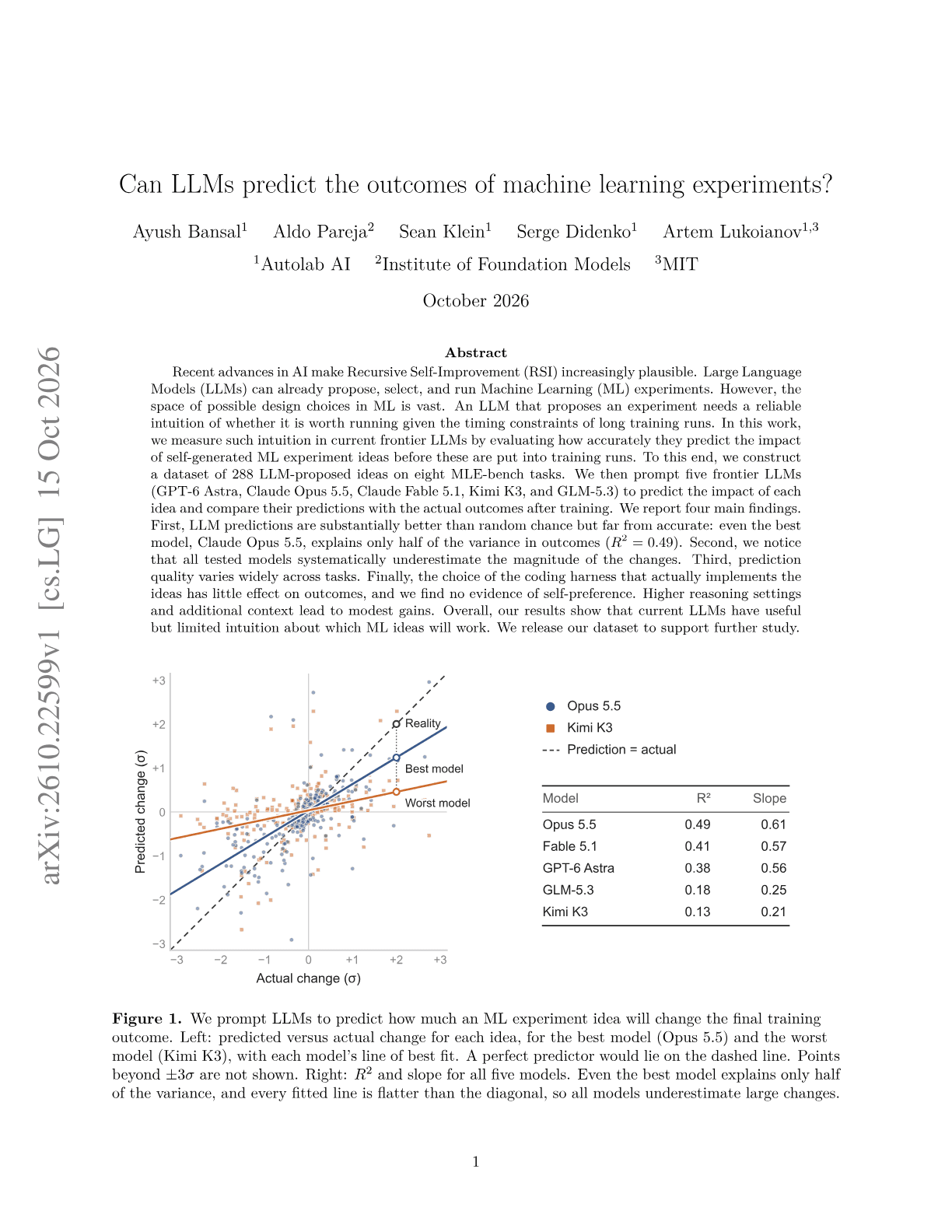
Can LLMs predict the outcomes of machine learning experiments?
Ayush Bansal, Aldo Pareja, Artem Lukoianov and colleagues (Autolab AI, Institute of Foundation Models, MIT) measure whether frontier LLMs can predict the effect of their own ML experiment ideas before training, using 288 LLM-proposed ideas on eight MLE-bench tasks with measured outcomes.
TokenEconomizer: Experience-Driven Black-Box Cost Control for Coding Agents
Aaron J. Li, Weijia Xu, Chandan Singh, Ion Stoica, Jianfeng Gao and colleagues (UC Berkeley, Microsoft Research and Microsoft Security) evaluate coding agents over sequences of tasks in the same repository and introduce TokenEconomizer, an external controller that cuts the recurring, environment-specific token costs those sequences expose.
WebCoder: Scaling General Frontend Development with Artifact-Grounded Agentic Reinforcement Learning
Zijun Dou, Zhen Yang, Aohan Zeng, Jie Tang and colleagues (Tsinghua University, Zhipu AI) train WebCoder, a general frontend development agent, with artifact-grounded agentic RL that scores every development activity by its effect on a shared executable application.
OPRD: On-Policy Reminder Distillation for Long-Horizon Coding Agents
Yuechen Luo, Ken Deng and colleagues (Tsinghua University, Shanghai AI Laboratory, NUS and independent researchers) introduce On-Policy Reminder Distillation (OPRD), which trains coding agents to act on information already in their context by distilling from a teacher that sees explicit reminders the student never sees.
MetaExp: Learning to Self-Improve through Experience via Verifiable Cross-Task Environment Scaling
Renhao Li, Dayiheng Liu, Min Yang and colleagues (University of Macau, SIAT-CAS and Alibaba's Qwen team) train experience learning, the ability to turn past interaction feedback into reusable knowledge, as a general model capability instead of an external scaffold, by fine-tuning Qwen3.5-122B-A10B on trajectories from 1,000 verifiable task families built to share structure across tasks.
Sci$Π$vot: Benchmarking Principal-Investigator Judgment at Pivotal Moments of Scientific AutoResearch Agents
Youran Sun and colleagues (University of Maryland and Gradient Network) build SciPivot, a 248-case benchmark of scientific judgment drawn from six months of real projects in which senior researchers ran LLM research agents and corrected their decisions.
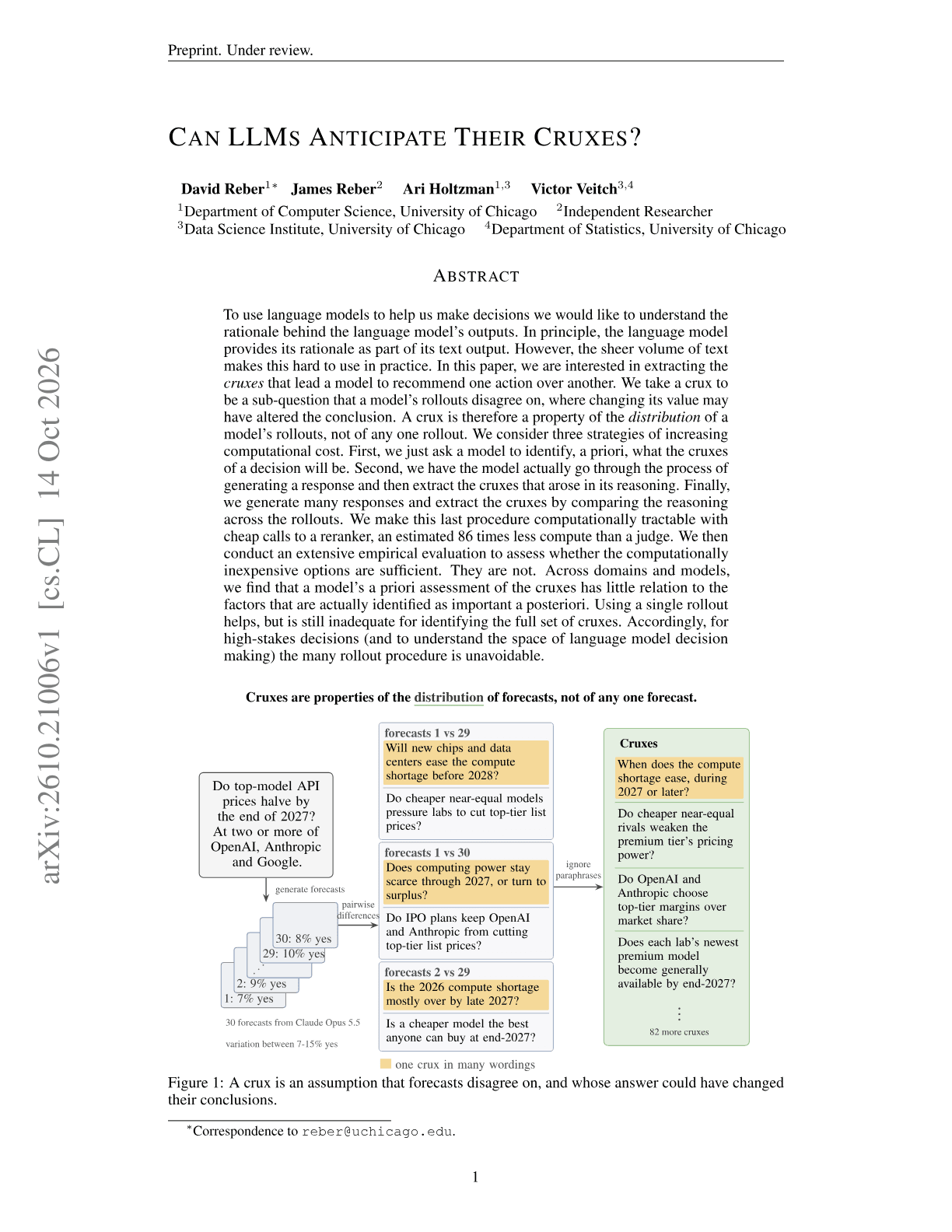
Can LLMs Anticipate Their Cruxes?
David Reber, Ari Holtzman, Victor Veitch and James Reber (University of Chicago) define a crux as a sub-question on which a model's rollouts disagree and whose answer could change its recommendation, and test whether cheap methods can find a model's cruxes without sampling many rollouts.
Mosaic: Multi-Session Agentic Reinforcement Learning
Yilong Xu, Zhijiang Guo and colleagues (HKUST Guangzhou, Huawei Foundation Model Lab and City University of Hong Kong) define multi-session agentic RL, where one trajectory spans several context sessions because of compaction or subagent forking, and propose Mosaic, a critic-free hierarchical method for assigning credit across those sessions.
The Self-Improvement Problem
Brian Moser, Andreas Dengel and colleagues (DFKI and RPTU Kaiserslautern-Landau) formalize whether an automated gate, such as a reward model or reviewer, can reliably decide if a self-improving agent's proposed update is a real improvement, and prove that in the general case it cannot.